For most of the last 250 years, the Turki-speaking, sedentary, Muslim inhabitants of Altishahr (an indigenous term for Eastern Turkestan, Chinese Turkestan, or southern Xinjiang) have been ruled by China-based states, beginning with the Qing empire's conquest of the region in 1759–60 and continuing through the Republican and Communist periods into the present, with a few brief irruptions of Altishahri independence. Throughout much of this period, Altishahris' connections to the wider Turkic and Islamic worlds were dictated to varying degrees by their Manchu and Chinese rulers. Whether for this reason or others, neither Islamic movements of revival and reform nor nationalist movements overtook Altishahr in any significant way until the 1930s.Footnote 1 The late and blustery entry of nationalist thought into Altishahr in the 1930s, which gave to Altishahris the newly shaped and named “Uyghur” identity, provides a stark contrast with the primordialist notions of identity now promoted by the People's Republic of China's official “multinational state” (多民族国家) ideology. In this context, questions of identity have been foregrounded in the study of Xinjiang, Altishahr, and the Uyghurs. While much of this scholarly interest has focused on the formation of the nationalist Uyghur identity and the consequences of that notion of identity in the present (Bovingdon Reference Bovingdon2010; Brophy Reference Brophy2011; Dautcher Reference Dautcher2009; Gladney Reference Gladney1990; Rudelson Reference Rudelson1997), this essay will examine the nature of an identity system that preceded the arrival of nationalist worldviews in Altishahr.
The Turki-speaking inhabitants of Altishahr in the nineteenth and early twentieth centuries maintained many different kinds of identities. Most famously, there was the town- or oasis-based identity that made Kashgarliks out of the natives of Kashgar (Fletcher Reference Fletcher and Fairbank1978, 69; Rudelson Reference Rudelson1997, 40). Religious orders, such as the White and Black mountain Naqshbandi tariqats, provided another mode of identity. Tradesmen identified with each other by profession, a system bolstered by guilds, trade manuals (risālah), and the master-apprentice relationship. At the broadest level, people identified with the wider Islamic world as members of the Islamic ummah. However, one form of identity has received more attention from scholars than any other, and that is the regional identity shared among the settled Turki speakers of Altishahr's many oases (Bellér-Hann Reference Bellér-Hann2008; Gladney Reference Gladney1990; Newby Reference Newby, Bellér-Hann, Cesaro, Harris and Finley2007). This scholarly interest in a broadly maintained and relatively homogeneous identity system that was coterminous with a linguistic, geographical, and cultural unit is surely due in part to the overwhelming importance of nations and nationalisms in the modern world. Such interest is also encouraged by the strength that the settled Altishahri Turki identity gained from the 1930s onward as it was reshaped, with some difficulty, into an “Uyghur” nation. As such, the search for an earlier identity system in the Tarim Basin, preceding and roughly continuous with the modern Uyghur nation, risks taking on a teleological cast. Yet the postmodern interest in the modern nation does not preclude a fruitful investigation of such a broad, regional, nonmodern identity system on its own terms. Indeed, the study of large nonmodern identity systems has provided important insights into the possibilities of human social organization, even when such studies have been undertaken in order to explain the emergence of nationalism (Anderson Reference Anderson1991; Gellner Reference Gellner1983). The case of the region-wide Altishahri identity, which thrived until the popularization of printing and the increasing penetration of nationalist imaginings from Soviet Central Asia in the 1930s, also promises its own alternative to the ways we understand the organization and imagination of societies. This essay hypothesizes the existence of a writing-facilitated system of identity maintenance that operated in a nonindustrial, nonmodern setting: nineteenth- and early twentieth-century Altishahr.Footnote 2 It examines the question of what sort of identity system can arise under the influence of manuscript technology, limited literacy, and pilgrimage in an agrarian economy.
The Altishahri Identity and Its Name
Two important recent works on Altishahri history before the Communist era have treated the prenationalist, Turki-speaking Muslims of Altishahr as an ethnic group, while still emphasizing that ethnicity was only one of several dimensions of identity (Bellér-Hann Reference Bellér-Hann2008, 69, 87; Newby Reference Newby, Bellér-Hann, Cesaro, Harris and Finley2007). Newby (Reference Newby, Bellér-Hann, Cesaro, Harris and Finley2007), for instance, notes that this identity was marked by a common historical experience, “shared myths and legends,” extensive inter-oasis mobility, and, most convincingly, consistent and explicit perceptions of alterity vis-à-vis other groups. She notes that Altishahris clearly differentiated themselves from Han Chinese by calling them “Khitay,” from Turkic and Mongolic nomadic groups whom they called “Kirghiz” and “Qalmaq,” and even from the settled Turkic-speakers of western Turkestan,Footnote 3 with whom they shared language, religion, and way of life. This last group they labeled “Andijani,” whether they came from Andijan, Khoqand, Samarqand, or Bukhara. As Newby (Reference Newby, Bellér-Hann, Cesaro, Harris and Finley2007) argues, the idea of an Altishahri “us” is clearly indicated in such designations of those from outside of settled Altishahr as “them.” In the present study, I will delve deeper into this shared identity to investigate in greater detail what kind of identity system this was and especially how it was maintained. First, however, it is necessary to settle on a name for this identity group.
Altishahri authors not only mentioned other ethnicities, but also occasionally wrote about their own identity, a fact that has been overlooked in part because there was no single, stable ethnonym for the group. Rather, Altishahris employed a variety of terms, most of which were broad terms repurposed to distinguish between Altishahris and outsiders. Such terms included “Musulmān” (“Muslim”) (Brophy Reference Brophy2011, 31; Kim Reference Kim2004, 3), “Turki” (Bellér-Hann Reference Bellér-Hann2008, 51), “yerlik” (“local”) (Fletcher Reference Fletcher and Fairbank1978, 69), and, rarely, “Altishahrlik” (“person of Altishahr”) (Hadji [Reference Hadji and Jarring1935] 1951, 162). The adaptation of general terms is well illustrated by the eighteenth-century text, Ta  kīrah-i ‘Azīzān, which denotes Altishahris by the term Musulmān, the most common name for the Altishahri identity before the 1930s. In a revealing passage, the author writes, “the Kirghiz are making many attacks . . . they will pillage the homeland [yürt]. Might we Musulmāns become prisoners of the Kirghiz” (Kāshgharī c. Reference KĀshgharĪ1770a, 50a)?Footnote 4 The Kirghiz whom the author excludes from the Musulmān identity were, at this time, not only adherents of Islam but even devotees of the same lines of Sufi spiritual leaders (the Naqshbandiyya) whose stories are the subject of his history. It is clear that in this context Musulmān does not indicate the wider community of believers in the Islamic faith, but instead denotes in particular the settled Turkic-speaking Muslims of Altishahr. Musulmān could be used to describe culture or ethnicity rather than faith,Footnote 5 and Kāshgharī used such lexical flexibility to facilitate his description of conflict between Altishahris and another Muslim identity group. The lack of a term devoted exclusively to naming the Altishahri identity did not stop authors from expressing that identity. Whether people called themselves Turki, yerlik, Musulmān, or Altishahrlik, or avoided naming their regional identity altogether, the notion that the settled Turki Muslims of Altishahr shared something that Kirghiz, Andijanis, Chinese, and other outsiders lacked demonstrates a sense of identity before the spread of nationalist movements.
However, if we are to write and speak about this identity, we are still left with the question of how to refer to it in our own discussions. The terms mentioned above each present significant problems. “Turki” and “yerlik” are troublesome for their overlap with terms used in western Turkestan, while “Musulmān” is obviously confusing because of its more familiar role as the designation for a religious status. “Altishahrlik” would seem to be ideal because it is an indigenous term and its semantic range matches the topic of this study exclusively. However, this term appears only very rarely. In the absence of an unproblematic indigenous term, I have instead employed “Altishahri,” putting the indigenous geographical term “Altishahr” in the nisba adjectival form (a grammatical form that has its roots in Arabic but was used throughout Central Asia). By using this partly artificial exonym I hope to emphasize the fact that, while there was a reasonably stable phenomenon of Altishahri identity, none of indigenous names used to designate that identity were used with long-term consistency, at least not in the written record.
Historical Practice as Means of Identity Maintenance
We now return to the main question of this study, the question of how Altishahri identity was maintained. In particular, this paper explores how the Altishahri approach to history acted as an expression and mechanism of group identity maintenance. Of course, there were many other means by which identities were formed and maintained, involving the maintenance of both alterity at ethnic boundaries and identity within the group through shared symbols, stories, and practices (Barth Reference Barth, Vermeulen and Govers1994, 11–32). To take one obvious example of identity maintenance through alterity, the Turkic Muslim population distinguished themselves from the Han Chinese minorities in the towns through the taboo on pork. The popular historical tradition, on the other hand, brought the maintenance of identity beyond the realm of immediate personal interactions at ethnic boundaries. Through tales of interactions with a “them” and the formation of an “us,” the popular historical tradition advertised Altishahri identity to insiders, including those who never came into contact with the “other,” and taught people that they were part of a larger community, shared with people they would never meet.
I will flesh out this system of historical tradition and identity maintenance in three sections. The first section gives an example of the content of Altishahri identity as presented in a popular historical narrative, using the details of that narrative to explore ideas about the origins of Altishahri identity that were produced and consumed by Altishahris themselves. In the second section, concerning manuscripts and the popular historical tradition, I argue that flexibility in manuscript technology permitted the average reader or listener the ability to participate in the shaping and reshaping of the historical tradition, and that, through the creation of a new genre from old texts, the community forged a common origin tale that left necessary room for local identities. Lastly I will discuss place and mobility, arguing that the practice of regional pilgrimage tied the dissemination of historical knowledge to points on the landscape, putting the protagonists of history, the founders of Altishahri identity, into a web of geographical relationships. These geographic ties, both textual and physical, contributed to the maintenance of a regional identity that had no consistent name but provided a sense of shared origins.
The First Altishahri
The creation of a shared perspective on the past was no doubt an important factor in the development of an Altishahri identity, but the presence of a functioning local historical tradition has not always been obvious to outsiders. Some of the European scholars and explorers who visited Altishahr around the turn of the twentieth century lamented that there was little or no historical writing to be found, only religious and legendary texts (e.g., Grenard Reference Grenard and Dutreuil de Rhins1898, 1). At the same time, those explorers collected an enormous amount of local writing about the past. Such works do indeed contain a great deal of supernatural and magical content, like flying saints, a disappearing city, and men who transform themselves into dogs. However, they can also be surprisingly accurate, especially when it comes to chronology. More importantly, while few works produced in Altishahr fit European notions of what history should be, Altishahri readers considered many of these “religious or legendary” texts as authoritative representations of the past. Those works that gained acceptance in Altishahr as accurate treatments of the past are considered here as history.Footnote 6
To judge from the manuscripts that are most widely represented in archives, antiquarian shops, and private collections today, the most popular form of writing about Altishahr's own past was a type of book called “ta kirah” (Dmitrieva Reference Dmitrieva2002; Hartmann Reference Hartmann1904; Mukhlisov Reference Mukhlisov1957; Raquette Reference Raquette and Mannerheim1940; Thum Reference Thum2010; Vali Reference Vali1989).Footnote 7 The roots of these texts can be traced to the Persian genre of the same name, which collected the sayings or writings of saints or poets alongside their biographies (Thum Reference Thum2010, 51–53). However, eighteenth- to twentieth-century Altishahri ta kirahs often strayed far from the biographical ta kirah as it was known in the Persian, Arabic, or Urdu traditions. In form and content, they are extraordinarily diverse, though they are united by their tendency to touch upon the origins of saints and shrines in Altishahr.
The Ta kirah of the Four Sacrificed Imams provides an excellent example of how ta kirahs could provide Altishahri readers with explanations for the origins of their own identity group. It is important because it was widely consumed, and because in the nineteenth and early twentieth centuries, when this narrative reached its greatest popularity, the supposed tomb of the Four Imams had become an important gathering place where Muslims from Altishahr's widely spread oases converged and mingled. The Ta kirah of the Four Sacrificed Imams was, furthermore, a text that circulated exclusively within Altishahr, its contents apparently irrelevant to Turkic-speaking Muslims outside of Altishahr, who do not seem to have preserved or copied the text. The popularity of this text within Altishahr is shown by at least thirty copies in public archives (Dmitrieva Reference Dmitrieva2002; Hartmann Reference Hartmann1904; Jarring Reference Jarring1997; Raquette Reference Raquette and Mannerheim1940; Vali Reference Vali1989; XU 1991, 371;) and many more in private collections and antiquarian shops in Xinjiang. In fact, it may have been the single most widely copied text explaining the historical origins of the “Muslims” in Altishahr.
The Ta kirah of the Four Sacrificed Imams was likely set down in writing in the Eastern Turki language sometime between 1700 and 1849, and was probably based on oral sources of the epic tradition (Thum, forthcoming). The ta kirah tells of four imams who leave the city of Mada‘in (in Iraq?) to assist the Qarakhanid ruler, Yūsuf Qādir Khān, in the conquest of Kashgar, Yarkand, and Khotan for Islam. The bulk of the work describes the battles that ensue against the native Buddhist inhabitants of Altishahr. After many years of grueling battles, in which “blood flows like the Oxus” and “heads litter the battlefield like stones,” the imams and Yūsuf Qādir Khān push the infidels back to Khotan. However, just before victory is sealed, the Buddhists manage to murder the imams through trickery. As the surviving Muslims lament the imams’ passing, a voice comes from the unseen, saying,
“Oh friends, we will become invisible to your eyes. Circle around us, and whoever among you mourn and humble yourselves will be companions and assistants of Islam.” Then their bodies disappeared from the sight of all but one person. His name was Khi r Bābā. His mother had been pregnant when she came from Mawarannahr [i.e. western Turkestan] and gave birth to him in Khotan. Now he was forty-one years old. One day the Imams said to him “Oh Khir Bābā, stay at our grave.” (LuTI, n.d.)
Despite Khir Bābā's protests that the task is too difficult for a lone man in a strange land, the imams command him to establish a shrine at their graves, consisting of lamps and cooking pots, flags and banners, and endowments to fund the upkeep of the shrine. Yūsuf Qādir Khān confirms Khir Bābā as shaykh (caretaker) of the imams' shrine, and appoints the shrine with the items the imams had requested.
The short tale of Khir Bābā stands out among the repetitive battle scenes that constitute the bulk of the Four Imams' ta kirah. The personal details about Khir Bābā are particularly remarkable. Usually it is the protagonists' actions, the sizes of their armies, the number of enemies they slay, or the threats and vows they make that earn the attention of the author. Personal description is almost entirely absent. Age and place of birth are given for no other character in the tale, including the Four Imams themselves and the hero-king Yūsuf Qādir Khān. Thus, the details of the identity of Khir Bābā, a character who appears for only a few pages, seem to be of great importance.
Coming immediately after the revelation of Khir Bābā's unique power to see the deceased Four Imams, these details appear almost as an explanation of his visionary abilities, a list of qualities that led the imams to choose this particular man as the keeper of their shrine. Khir Bābā's age reveals that, within the logic of the narrative, his mother gave birth to him during the earliest incursions of Islamic Qarakhanid forces into Khotan.Footnote 8 The revelation of his first name hints at his visionary powers; “Khir” was the name of a prophet who frequently appeared to guide seekers, be they Sufi mystics in search of God or Alexander the Great in search of the water of life (Iskandarnamah 1978). The second name, “Bābā,” actually more of a nickname or title than a name, is certainly appropriate for an ancestor of the Muslims of Khotan. However, it is the circumstances of Khir Bābā's conception and birth that are of the greatest interest to the discussion of Altishahri identity. Khir Bābā's dual origin in western Turkestan (conception) and Khotan (birth) provides both continuity with the greater Islamic world and a local specificity of origin that qualify him to hold a special connection with the imams and to act as steward of their tomb in Altishahr. He highlights at once the separation and the connection between Altishahris and the greater Islamic community. His genealogy is traceable to core Islamic lands, but he is of local birth, and it is this first local Muslim who is chosen to guard the tomb of the foreigners who made Altishahr holy through their deaths.
Within the Ta kirah of the Four Sacrificed Imams, the Khir Bābā episode stands at a pivotal moment for the story of Altishahri origins, the moment when the imams are transformed from foreign Muslims, born in some unspecified place abroad but fighting in Altishahr, to local saints, by virtue of their death and burial in the region. In the ta kirahs of Altishahr, the place of death is often known simply as a person's manzil, a place of destination or a stopping point. As the final abode of a saint on earth, the place of death trumps all other connections between individual and place. Death and burial are a means of naturalization, one that can be consummated by the establishment of a rau  ah (tomb) or mazār (shrine). In the Ta kirah of the Four Sacrificed Imams, the establishment of cooking pots, flags, and an endowment, overseen by Khir Bābā, transforms the imams' place of death from manzil into rau ah. The ta kirah ends with a statement that blessings will accrue to those who make pilgrimage to the rau ah and to those who “read this ta kirah or have it read to them.” Thus, the foreign Four Imams, having acquired a rau ah and a ta kirah, became the objects of veneration among the Altishahri people. The close connection to Altishahr that the Four Imams earned through their local death is not only attested in the literary treatment of their lives. Nineteenth-century Altishahri consumers of the text seem to have internalized the imams' naturalization. Thus, in one copy of their ta kirah, the copyist labeled the work as “The Ta
 kirah of the Imams of [the Altishahri oasis of] Khotan” (Ta kirah-'i Imāmān-i Khotan),Footnote 9 despite the imams' foreign origin.
The establishment of a manzil and then a mazar or rau ah in Altishahr, is, after being a Muslim, the major uniting factor in the identities of Altishahr's canon of local hero-saints. Some saints of the popular ta kirah tradition are kings, others scholars, others mendicant Sufis, but all were Muslims and all of the most popular ones died in Altishahr (with the exception of Imam A‘ẓam, whose ta kirah does not seem to have been an Altishahri product). There are no ta kirahs describing heroes of Altishahri origin who found their end in foreign lands. The wide circulation of the ta kirahs established a canon of heroes who explain the history of a region through their shared local death. From their places of death sprang the new Altishahri identity.
According to this tradition, the Four Imams were not the only outsiders to make a big mark on the landscape of Altishahr. There were also the Seven Muhammads from the Hejaz, who, in the time of the prophet, traveled the world in search of their own graves and found them in Yarkand, founding what today remains the largest and busiest shrine in the oasis (LuHM, n.d.). A Sufi master named Muḥammad Sharīf came from Ferghana in the sixteenth century and uncovered the lost tombs of other saints, both local and foreign, buried in various parts of Altishahr (LuMS, n.d.). A Samanid noble from northeastern Iran converted a tenth-century prince of Kashgar to Islam, spurring him to begin wars of conversion that raged across several oases, and was buried in the royal town of Artush (al-Uzghanī, 16th–17th c.a). All of these strangers became heroes. Their graves grew into holy sites that attracted the prayers and donations of countless pilgrims, and their histories were recorded in the vernacular, recited at shrine festivals, and widely propagated in manuscript form. We now turn to the mechanisms by which these individual histories were consumed and linked together, weaving a regional origin tale on a geographical weft of tombs and travel, a story that supported a shared identity across wide desert wastes, long before the arrival of nationalism.
Manuscript Technology and the Creation of a Local Historical Genre
The development of a shared historical tradition was not just a matter of composing texts that described the local past, but also of collectively forging a genre to convey such knowledge. Altishahr's genre of popular local history, the ta kirah, coalesced in the eighteenth century, as written tales about Altishahri shrines appeared and gained popularity (Thum, forthcoming). Once the genre was well established, it further encouraged the production of new historical texts about Altishahr's past.Footnote 10 The creation of the ta kirah genre cleared a space for local history in a literary landscape that had long been dominated by the Persian tradition. Saints of Kashgar and Khotan began to populate a written past crowded with the Iranian heroes of the Shahname and the Semitic prophets of the Qisas al-Anbiya (Jarring Reference Jarring1980, 15). Throughout this process, the dynamics of manuscript technology allowed a wide community of readers and copyists, not just a handful of authors, to participate in the creation of a genre of particularly Altishahri history, which reflected the community's self-imagination and drew together local histories into a larger regional history.
The ta kirah category is especially interesting because its boundaries are not obvious from the form and content of the texts. This is in part due to the fact that the formation of the category involved the recontextualizing of old works from other genres, often against the apparent intentions of the original authors. A look at the contents of the ta kirahs reveals few commonalities, aside from the focus on personages who died in Altishahr. While, at the most general level, all may be considered hagiographies, insofar as they describe holy figures, the variety of form and content apparent in the ta kirahs exceeds the usual expectation for a genre. Some ta kirahs are prose epics, others romances, others long poems in mas̱navī or qasīdah form, others genealogies, and still others are excerpts from a biographical encyclopedia.Footnote 11 Yet we know that indigenous producers and consumers of these texts were in remarkably consistent agreement over what was and was not a ta kirah. We know this because the copyists consistently labeled certain works with the word “ta kirah” at the beginning of the texts.
Though the formal and thematic boundaries of the ta kirah are remarkably loose, the social context in which the ta kirahs were used preserved the integrity of the genre and reinforced its salience for consumers of ta kirah texts. The significance of social practice in genre construction was connected to the manner in which manuscript technology was deployed in Altishahr. The production and consumption of literature and history in nineteenth-century Altishahr were not just pursuits for educated elites. They were practices widely accessible even to the illiterate. This broad access was provided through public readings of manuscripts, and public readings necessarily positioned the text in varying social contexts. Quite unlike the broad, undifferentiated, and silent textual circulation encouraged by the print industry, in Altishahr's manuscript tradition a specialized association between genre, place, and event mediated the meaning and authenticity of texts. The organization of genres was not solely dependent on the form or content of the books. Textual categories were shaped by social context.
Some associations of genre and social context are unsurprising. Catechisms were used in the maktabs, community primary schools that were common throughout Altishahr. Works of Quranic exegesis and fiqh were read out by traveling scholars at special public sessions in mosques (Qadir Reference Qadir1985, 51). Other associations are less obvious. Semi-historical works inherited from the wider Islamic world, including romances, folktales, and epics, were read out in public places, such as barbershops, cobbler's shops, or marketplaces (Grenard Reference Grenard and Dutreuil de Rhins1898, 86; Qadir Reference Qadir1985, 67–90). These works included, for example, the 1001 Nights, the Shāhnāmah, and Kalila and Dimna. For all but the few highly educated elites in Altishahr, this constituted world history, the pasts of other peoples and places, delivered in entertaining forms in public, nonsacred settings. On the other hand, the Altishahri local history genre par excellence, the ta kirah, was performed or read aloud among large crowds at saints’ tombs during pilgrimages (Jarring Reference Jarring1935, 348). It was the connection to Altishahri tombs, as much as the content of the texts, that marked the boundary of the ta kirah genre. While ta kirahs circulated beyond the realm of pilgrimage and could be read in more intimate contexts, it was the shrine reading that would have reached the largest audience. Thus, in addition to conveying the Altishahri community's vision of its own past, the ta kirah was the genre of texts that both explained the origins of shrines and acted as their liturgy.
Based on indigenous and foreign textual evidence, it is clear that public performances of ta kirahs occurred at least as early as 1830 and were still common in the 1930s. Although worship at many shrines stretches back into pre-Islamic times (Grenard Reference Grenard and Dutreuil de Rhins1898, 143–44; Stein Reference Stein1904, 226), the earliest written tales of local saints only appeared in the sixteenth or seventeenth century, in a Persian-language biographical dictionary (al-Uzghanī, 16th–17th c.b; Baldick Reference Baldick1993; DeWeese Reference Deweese1996). The first clear record of ta kirah recitations at shrines is even later, dating to 1830, when a certain Abū al-Qāsīm wrote that:
kīrahs are manykīrah is wealthy,kīrah together.
However, it is likely that similar practices were common at least a century before then. Certainly tales of the saints were performed by storytellers (called rāwiān) at the shrines as early as the early 1700s, when the Yarkandi poet Zalīlī documented the practice (Zalīlī [c. Reference ZalĪlĪ1718] 1985, 605). Ta kirah readings were still going strong when Gunnar Jarring visited Kashgar in 1929–30 and reported that pilgrims recited the ta kirah at the Ordam Padshah shrine (Jarring Reference Jarring1935, 348). At another shrine, Jarring wrote that “the sheik lectured about [the saint] … according to his biography, tazkira” (Jarring Reference Jarring and Claeson1986, 136). Today, ta kīrah performances continue at some shrines despite what appears to be widespread government confiscation of manuscripts and local officials' proscription of practices that do not align with Chinese official Islam. The persistence of the tradition in an atmosphere of coercion and fear speaks eloquently of its significance to those who participate in shrine veneration.
The popularization of the ta kirahs from the mid-eighteenth century onward can be traced not only in their public performances, but also in their increasing utilization of the vernacular language, Turki, rather than Persian, which had monopolized the literary landscape until that point. In the century and a half that followed the rise of the vernacular (i.e., 1700–1850), much of the available literature that touched on the lives of Altishahri saints was excerpted and collected as ta kirahs. Oral epics about the holy wars of the first Islamic kings were written down to become the ta kirah of Ordam Padishah, the most famous shrine in the Kashgar oasis (Hājī, c. Reference HᑠĀjĪ1700–1849). Another author reworked notices on the Companions of the Cave from Tabari's History and Rabghuzi's Stories of the Prophets to make the ta kirah of the Companions of the Cave shrine near Turpan (Gursoy-Naskali Reference Gursoy-Naskali1985; Kāshgharī [?] late 18th century). Other texts, like the ta kirah of Yarkand's Seven Muhammads (LuHM, n.d.), seem to have been new formulations, though probably at least loosely connected to older oral materials.
By the middle of the 1800s, the process of finding or creating ta kirahs for the most important shrines was largely completed, and important connections between shrines and ta kirahs had begun to take shape. While ta kirahs continued to be written after the mid-nineteenth century (e.g., Sayrami's Ta kirat al-Avliyā' (Sayrami [1911] 1986, 11)), the most popular works were already completed by this point. A comparison of the surviving ta kirahs to the shrines of the region reveals that the largest shrines have ta kirahs, and every popular ta kirah (with the exception of Imam A'zam's) links to a shrine in Altishahr.Footnote 12 The linkage became so strong that one ta kirah was popularly known by the name of its shrine rather than the names of the saints described in the book (Jarring Reference Jarring1980, 85). Shrines were seen to need ta kirahs in order to achieve authenticity and importance. One Altishahri author accused people of inventing ta kirahs specifically for the shrines, claiming that, “as the people were satisfied with it, the shrines became famous under these made-up names” (Hamada Reference Hamada1978, 79–80; Sayrāmī Reference SayrĀmĪ1911). It came to be assumed that the shaykhs preserved copies of the ta kirah at the shrine (Abū al-Qāsīm Reference Abū al-QĀsĪm1830, 50b). Indeed, several European visitors purchased ta kirahs at shrines or recorded their presence there (Bellew Reference Bellew1875, 278, 374–75; Hartmann Reference Hartmann1904, 19; Raquette Reference Raquette and Mannerheim1940, 3–15; Skrine Reference Skrine1926, 176). Today, many Uyghur pilgrims still expect the shrines they visit to have ta kirahs, even though local authorities have confiscated most of these books.
Not only did ordinary consumers of the ta kirahs shape the genre through extratextual social practices, but they also manipulated the physical texts themselves. Shrine performances promoted a broad readership, and that readership in turn made its own marks upon the texts, marks that further reshaped the meaning of those texts to reflect the Altishahri community and its expectations of history. The manuscript tradition's mechanisms of textual reproduction and the customs of book-use in nineteenth-century Altishahr extended the powers of authorship to a wide circle. The creative power of the monastic scribe in Europe, especially as a perpetually modernizing force, is well known (Febvre and Martin Reference Febvre, Martin and Gerard1976, 320). In Altishahr, the modernizing force of the scribe shaped texts to meet the rising interest in shrines and local origins. Unlike their counterparts in medieval Europe, though, the scribes of Altishahr were not concentrated in monasteries, and the practice of copying was not limited to a handful of specialists. Some people did make a profession of copying, and these sat in long rows in the Kashgar bazaar, waiting for customers (Jarring Reference Jarring and Claeson1986, 78). However, manuscripts could be copied by any literate consumer. A manuscript in the Jarring collection, for example, was copied by a certain Sulayman Akhund, who identified himself as a professional storyteller twice in the manuscript.(Jarring Reference Jarring1997, 464).
Some authors were aware that the flexibility of the manuscript tradition left the fate of their work in the hands of a wide community; they expected readers and copyists to participate in the continued creation of the text as it was reproduced and transmitted across generations. Such an attitude is recognizable in a handful of works that include a call to the reader to amend the shortcomings of the book (Kāshgharī c. Reference KĀshgharĪ1770b, 86; Sayrāmī [Reference SayrĀmĪ1911] 1986, 37). One of these is the ta kirah of the Companions of the Cave, whose author writes, “I request men of learning that, if there should be any mistakes and faults in this ta kīr they should amend them with a kind postscript and bring them into shape by means of a pen-knife of forgiveness” (Gursoy-Naskali Reference Gursoy-Naskali1985, 35). Such a request is of course unthinkable in the world of print, where a single corrected text is dwarfed by centralized mass production, but in manuscript publication one amended copy can give birth to further copies bearing the same corrections, and those to even more. In the medieval Arab world, this phenomenon was tempered by the ijāzat system of licenses (Pedersen Reference Pedersen and French1984), but in Altishahr it seems there was no such method of enforcing the author's will. Copying was done freely. The author could not avoid ceding control of the text, and the readers gained a voice in a larger textual conversation.
Although minor changes were common,Footnote 13 in practice, significant textual emendations usually took the rather unromantic form of abbreviation, an act which itself carries meaning. Over time, copyists gradually eliminated information that was no longer essential, as the old works took on their new roles as ta kirahs. Gradually, the ta kirahs were shaped into simple records of the saints' greatest deeds and praise of their greatest qualities. By the 1900s, all of the ta kirah manuscripts were copyists' abbreviations to a greater or lesser extent.
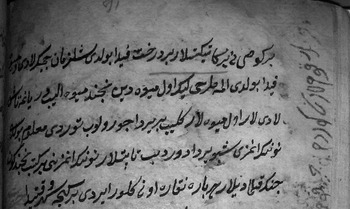
Readers and copyists also added information in the forms of marginalia, colophons, and postscripts. In the margins, readers sometimes recorded personal experiences related to the shrine or the book. For example, one reader wrote in the margin of a Four Imams ta kirah, “I saw the dunes of [Imām Mahdī-'i] Ākhir-i Zamān” alongside the episode in which the protagonists encounter the Imām Mahdī-'i Ākhir-i Zamān in the desert (MzTI, n.d., 91) (see figure 1). Colophons often recorded the copyist's name, but could include other personal information, like hometown. Postscripts usually described the benefits of pilgrimage and reading the ta kirah, i.e., that the readers will have their troubles solved and their lives made easy. Such blessings, which also sometimes appeared in marginalia (e.g., MzTI, n.d., 50), were taken seriously. Reading was a meritorious act in and of itself, and people documented their readings in the margins and endpapers of all kinds of manuscripts, with messages like, “Qāsim Akhūnd read it three times starting 1316 [AH]. . .” (LuJN, n.d., 99a). In the ta kirahs, such records of merit reflect the increasing role of ta kirahs as effective tools for gaining God's favor and improving one's lot in this world and the next. Customs of marginalia also allowed readers to write themselves into the history of the saints' worship, creating community history by documenting their own roles in the practice of history.
Marginal notation in manuscript (MzTI, n.d.): “I saw the dunes of [Imām Mahdī-'i] Ākhir-i Zamān.”

Another important manipulation of the texts that helped create the ta kirah was the act of collecting and binding. Most of the popular works that circulated in Altishahr were relatively short, and manuscripts were often composed of several texts copied or bound together. With surprising consistency, works of the same type tended to be collected together. This process reaffirmed the functional affinity of the works in a given compilation, buttressing genres. In the case of the ta kirah, collecting and binding were also means by which Altishahr's textual consumers expressed the geographical and historical connectedness (and limits) of their imagined community. Usually ta kirah compilations contained three to ten ta kirahs. The precise arrangements of these anthologies varied widely in Altishahr, but most demonstrate a measure of geographical consistency, based on the locations of the tombs of saints described in the texts. For example, a manuscript of the Four Imams' ta kirah cited above (LuT2, n.d.) contains eight other ta kirahs.Footnote 14 It is a Kashgar-centered compilation, in which several ta kirahs of saints buried in the Kashgar area are joined by a ta kirah of a Yarkand saint, a Keriya saint, and a Khotan saint. In the late nineteenth century, there was no widely available, single-author history of the whole region.Footnote 15 That role was filled by this type of volume—by bringing together diverse ta kirahs, which, once bound together, functioned as a history of all Altishahr, a comprehensive view of those parts of the past that mattered to people. In the example cited above (LuT2, n.d.), the ta kirahs explain the first royal convert to Islam in Kashgar, his descendents’ martyrdom at the hands of the Buddhist armies of Yarkand and Khotan, the final conquest of Khotan with the help of the Four Imams, the supposed participation of the scholar Ghazālī in the spread of the faith to Khotan, and, hundreds of years later, the rediscovery of martyrs' graves throughout Altishahr by the Sufi master Muḥammad Sharīf, who was buried in Yarkand. Other composite manuscripts present a slightly different history. Since each anthology was made of a different combination of ta kirahs, there could be no single definitive history of the region, even though such region-wide composite histories were common. One could mix and match the building blocks of history, but the blocks were always chosen from the same set. It was a modular history from which a pseudo-national narrative could be built with a local focus, but without the local emphases threatening the integrity of the larger story. Narrower oasis identities were preserved in the building of a large regional identity.
The manuscript technologies and traditions outlined here, in their interface, undermined the author's monopoly on creativity and put the meaning of the book in the hands of a large community. At no one moment did any one of these practices permit an individual to dramatically alter the work's significance, but, over time, the interaction of such practices brought important changes to the form, content, and context of texts, at times carrying them far from the apparent intentions of their first authors.Footnote 16 The manuscript tradition's potential for communal authorship manifested itself especially dramatically in the ta kirah genre, a genre that the community molded to simultaneously serve ritual purposes and create a pseudo-national origin story. The popular ta kirahs became a genre by many mechanisms, but not by simple authorial composition. It was only in spite of a wild variation in form and content that the consumers of histories shaped a genre and a canon under the term “ta kirah.” The shaping of the ta kirah genre through the flexibility of manuscript technology was largely left in the hands of the literate, though, as we have seen, this group extended beyond the bounds of a specialized scribal class. Copyists were diverse, and readers added their own text. These were the numerous builders of Altishahr's view of its own past. It was through their efforts that stories of that past were concentrated into a form suited for wide distribution and seamless integration into the sacred context of the shrine. In the shrine context, the ta kirahs' vision of the past reached an even broader community than that of the literate, and, as we will see, further linked together the geographically isolated oases of Altishahr.
Shrine Readings
The readings that took place at shrines brought the ta kirahs to vast audiences, especially during a shrine's annual pilgrimage festival. Major shrines had specific times of the year when they hosted large groups of “pilgrims from all over the province” (Skrine Reference Skrine1926, 122). The timing of these events could coincide with rest periods in the agricultural cycle, weather preferences, or Islamic holidays, such as the first ten days of Muharram. The numbers of pilgrims involved in such shrine festivals are astonishing for such a sparsely populated region. The British officer H. W. Bellew visited Kashgar in 1874–75 and reported that the Ordam Padshah shrine in the desert near Kashgar was said to attract fifteen to twenty thousand pilgrims during its largest annual festival—this at a time when the entire Kashgar oasis had a population of only about 112,000 (Forsyth Reference Forsyth1875, 38). Gunnar Jarring reported similarly large numbers of pilgrims based on his visit to Kashgar four decades later (Jarring Reference Jarring and Claeson1986, 112).
Shrine gatherings attracted people from all walks of life for both sacred and mundane purposes (Bellér-Hahn 2008, 376). Located in graveyards or at desolate locations in the desert, the shrines were liminal sites where people of all statuses mixed. One contemporary Altishahri author, Abdul Vali Akhund, complained about the variety of people who attended shrine festivals, writing:
Some people come as though [the shrine] were a big bazaar, especially gamblers, hoodlums, thieves, cripples, prostitutes, fruit-sellers, bakers, and cooks. These do not bow in the direction the shrine at all. They are busy, not with making pilgrimage or circling the shrine, but with their own professions and business. Thus, for them it is the same whether they get into a Chinaman's coat or a shrine. (Abdul Vali Akhund Reference Abdul Vali Akhund1905–10, 1)Footnote 17
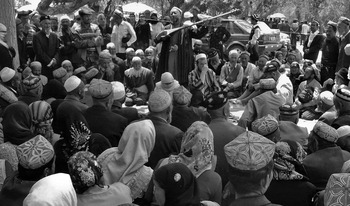
Abdul Vali Akhund also noted class differences in the ritual activities of pilgrims, whom he divided into the noble (khaṣ) and common (‘am). The noble pilgrims followed more orthodox modes of devotion, such as the recitation of “one or two suras” from the Qur'an, while the commoners engaged in activities like “rubbing their face and eyes on the shrine's walls” (Abdul Vali Akhund Reference Abdul Vali Akhund1905–10, 1). Today's largest shrine festival, which takes place in early summer at the shrine of Imam Asim, closely resembles the situation described by Abdul Vali Akhon. We may add that at Imam Asim, the thousands of pilgrims are divided between two centers of activity, a main shrine and an associated temporary bazaar, separated by a ritual processional path. In the current arrangement at Imam Asim, historical and hagiographical recitations occur both in the immediate vicinity of the shrine and in an associated bazaar-like area where “fruit-sellers, bakers, and cooks” ply their trades (see figure 2).Footnote 18
A singer of tales at the Shrine of Imam Asim.

The presence of such diverse audiences at local history readings chipped away at one major barrier to large-scale, homogeneous identity formation common in the nonmodern world: the specialized localization of education along lines of class and profession (Gellner Reference Gellner1983, 29–43). While tradesmen like bakers were educated through apprenticeships, elites through the madrassa, and thieves presumably in less formal situations, members of all these groups were present at the shrine festivals when readings of local history took place. The same context that helped to create and bound the genre of popular local history was also instrumental in spreading a shared view of the Altishahri past among diverse segments of the population.
Our sources provide little detail about the recitations that the pilgrims heard at shrines, and it is unclear whether most readings were undertaken by the pilgrims themselves, as recorded by Jarring (Reference Jarring1935, 348), or by the shaykhs, as recorded in a ta kirah composed in 1829–30 (Abū al-Qāsīm Reference Abū al-QĀsĪm1830). Probably both types of readings took place. In addition, professional storytellers like the one mentioned by Zalīlī ([c. Reference ZalĪlĪ and Tursun1718] 1985, 605) performed tales from ta kirahs among the crowds, as they continue to do today at the shrine of Imam Asim. The most formal readings of the ta kirah likely coincided with the greatest concentration of pilgrims, the pilgrimage festivals, but other kinds of ta kirah performances were available at the shrines year-round. In addition to their numerous roles in the day-to-day devotional lives of their immediate communities, shrines received visitors from more distant parts of Altishahr throughout the year.Footnote 19 Today, these are people whom the shaykhs recognize immediately as outsiders. While local visitors are treated like family, coming and going unnoticed, strangers from further away are treated as guests and given a tour of the shrine and an introduction to the history of the shrine and the saints buried therein. This can range from an informal, conversational introduction to a long monologue. Today this is necessarily done from memory, as the ta kirahs have nearly all been confiscated. However, the summary or memorized recitation is not a new phenomenon, as Gunnar Jarring refers to a paraphrased ta kirah recitation in his recollection of a 1930 visit (Jarring Reference Jarring and Claeson1986, 136), and the Uyghur writer Saypiddin Ăzizi recalled hearing informal tales of the same saint from the shaykhs and elders around the shrine in the 1920s (Ăzizi Reference Ăzizi1987, 2). Taken as a whole, the numerous references to hagiographical performances suggest that ta kirah content was delivered in a rather wide variety of ways at the shrines, including memorized recitations, readings directly from books, summarized lectures, and professional storytelling.
Of course, the connection between the shrine and the ta kirah was not an exclusive one. While the ta kirah held a special connection to the shrine, short suras from the Qur'an were also recited as prayer at the shrine, as they were in almost every other Altishahri sacred context. Furthermore, the reading of ta kirahs outside the shrine context was always possible for literate book-owners. Sven Hedin described how one of his guides entertained his servants by reading from two books of ta kirahs that he took along on the journey (Hedin Reference Hedin1903, 136). However, it is hard to imagine that such smaller performances, along with private reading, were any match for the shrine gatherings in terms of the power to disseminate the ta kirahs. For large parts of the population, the shrine readings would have been the most likely point of contact with the ta kirahs, and therefore with local history.
Shrine Writings
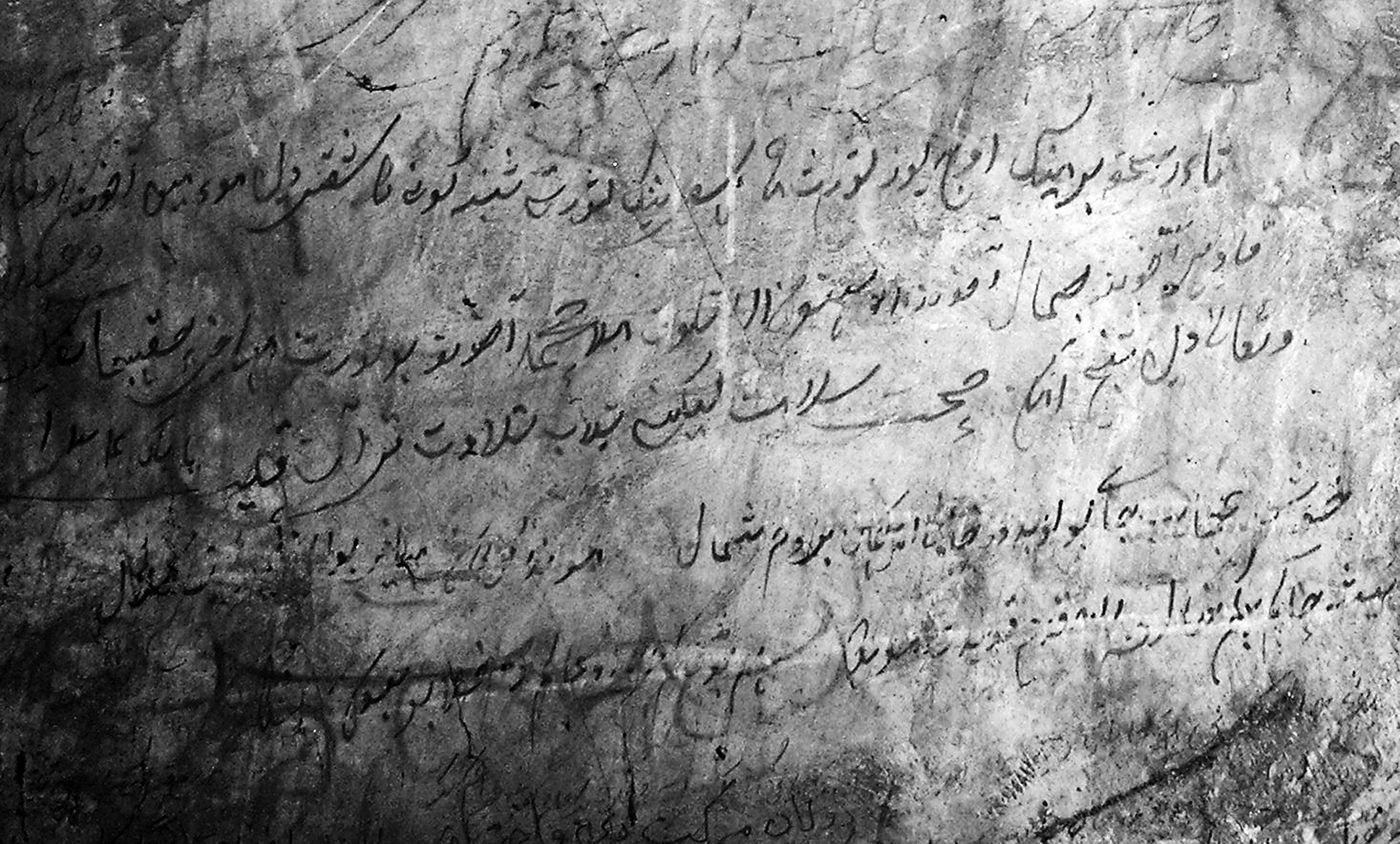
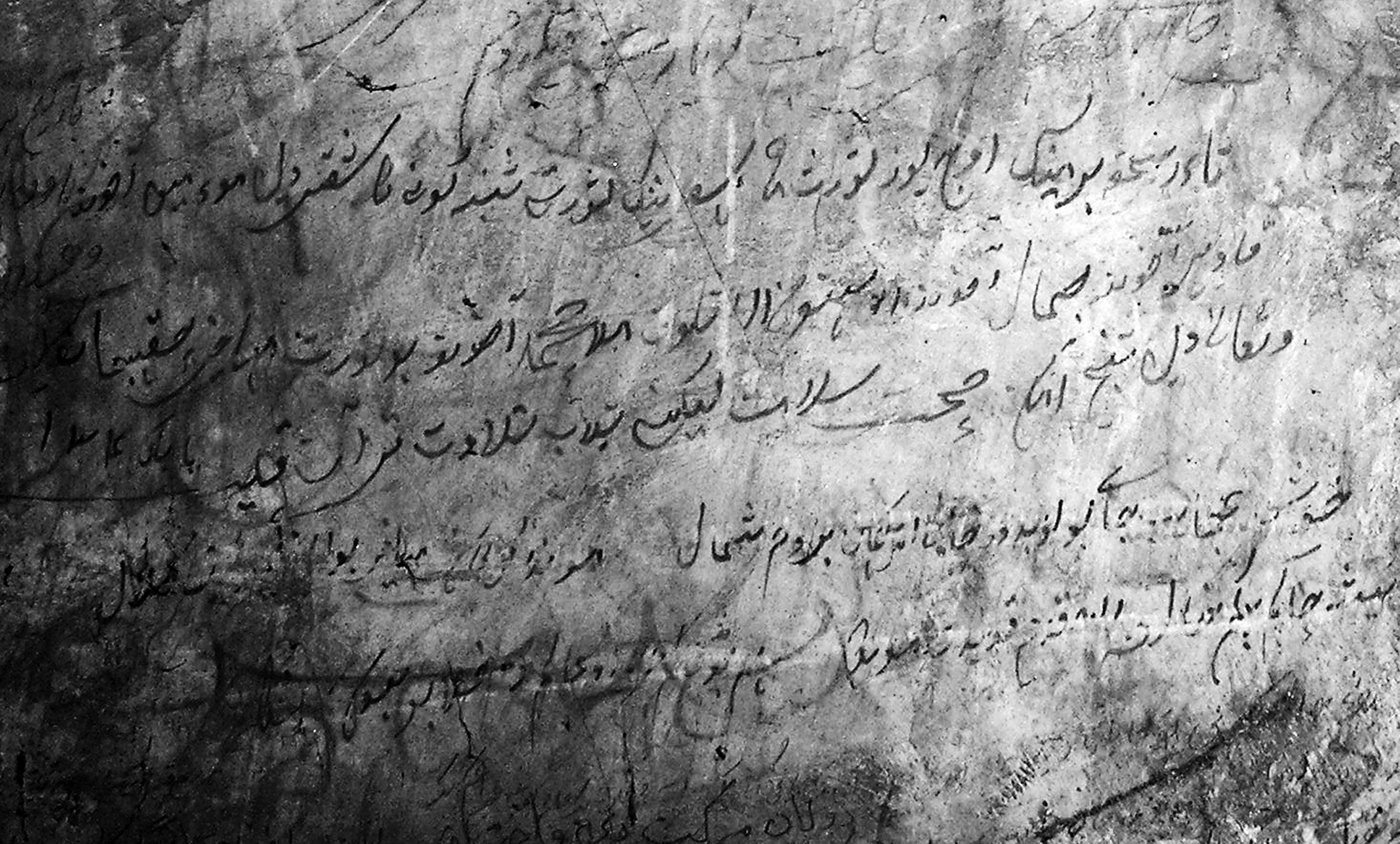
When the festivals ended and the crowds went home or to the next shrine, traces of their worship remained. Just as the manuscript tradition allowed people to write their own pasts into the margins of Altishahr's popular histories, pilgrimage permitted individuals to locate their own narratives alongside those of the saints, who were, in turn, the primary characters of history. Some pilgrims made this relationship a very literal reality by writing records of their visits on the walls, interior and exterior, of the shrines. Such graffiti provide a host of clues about the nature of pilgrimage and the maintenance of Altishahri identity. Typical graffiti record the date, the names of the pilgrims, their hometowns, and a very short account of their worship at the shrine, usually describing practices that match very closely with the practices of those pilgrims Abdul Wali Akhund praised as “noble.” The style and content of such graffiti are well represented by an example on the interior wall of the Baysī Hakim Beg shrine in Yarkand's Altunluq cemetery (see figure 3), which reads,
In the year 1304 [1886 AD] on Saturday, the fourth of the month of Safar, Mu'mīn Akhūnd, Qādīr Akhūnd, and Jamāl Akhūnd from Kashgar, along with Mullā Muḥammad Akhūnd of Upper Artush, these four travelers, requesting from God Almighty peace and security along with health and wellness, recited from the Qur'an, and returned.
This kind of graffiti writing seems to have been widespread. A handful of shrines that have preserved their original interior surfaces from the Qing period (usually due to neglect) bear graffiti in the same format, with the oldest surviving graffito dating to 1878, preserved on the wall of a tomb in the Muḥammad Sharīf Shrine compound in Yarkand. During his expedition of 1906–8, C. G. Mannerheim noticed the same practice at the shrine of Kohmarim, near Khotan (Mannerheim [Reference Mannerheim1940] 1969, 101). The practice continued through the twentieth century, and remains a common feature of shrine worship, except where shrines have been dressed up under Chinese government pressure for the benefit of tourists, such as at the Afāq Khvāja shrine near Kashgar.
Graffiti in Baysī Hakim Beg Shrine, including the 1886 graffito of Mu'mīn Akhūnd et al.
The graffiti tell a story of pilgrims from the farthest oases of Altishahr visiting even relatively minor shrines. For the period from the 1880s through the 1930s, the best collection of early graffiti, the Baysī Hakim Beg shrine in Yarkand, documents visitors from both nearby villages like Poskam and the distant Altishahri towns of Merkit, Yengihisar, Kashgar, Artush, Khotan, Kucha, and Uch Turpan, along with pilgrims from Turpan who had established residences in Yengihisar. Shrines with greater reputations may have attracted pilgrims from an even greater diversity of towns. Since every major town had at least one important shrine, the clusters of routes encouraged by each shrine overlapped to create a dense network of moving people and information, which ensured that the histories associated with a particular oasis were disseminated to pilgrims from all corners of Altishahr. It is also important that this network of movement seems to have been largely limited to Altishahr. Of some fifty-seven pilgrims whom I have traced whose place of origin is preserved and legible in 1930s or earlier graffiti, only one, a pilgrim from Bukhara, did not come from Altishahr (and among the much better preserved and more numerous graffiti from after the 1930s, no pilgrims from outside of Altishahr recorded a visit). Systems of cultural interaction are almost never fully isolated, but the degree of geographic consistency that the surviving graffiti suggest for Altishahr's pilgrimage network was a powerful encouragement for the development of an identity that followed the same geography.
In the most basic sense, the sheer physical circulation of Altishahri people achieved by the pilgrimage tradition encouraged a region-wide identity through immediate encounters between people from diverse places. The interaction of pilgrims of various origins is eloquently attested to in places where several pilgrims decided to chronicle their pilgrimage together in a shared graffito. The most striking of these is a graffito dated 1887–88 from the Baysī Hakim Beg shrine, the legible parts of which read,
In the year 1302, year of the fish, on the sixth of the month of [unclear], Islām Akhūnd, the scribe, came from Poskam, recited the opening sura of the Qur'an, and, God willing, returned in health and wellness. The Kuchaliq from Kashgar, Maht Akhund ['s son?] Sābit, the Yengihissarliq …… son of Ṣādiq Beg,… Islām Akhūnd, the friend of the friends who came with us [?], [name?] Niyāz Akhūnd, …………………… Akhūnd ………….
Here we have an artifact of the interaction of pilgrims from far-flung and unconnected towns (Poskam, Kucha via Kashgar, and Yengihissar) who, for at least a moment, saw themselves as a group, drawn together by the same saint. And even though most people could not manage to travel between, say Kashgar and Yarkand, like Meht Akhund, they would encounter such travelers during pilgrimage festivals at their own local shrines, a phenomenon already noted by Aurel Stein in 1904 (331). The travelers would, in turn, bring back the stories from the distant shrine's ta kirahs to their home communities. The networks of pilgrimage kept the population of Altishahr in contact with each other, while still maintaining an emphasis on the local community, for the majority of pilgrims would come from within a few days’ journey.
The connection between mobility and history also added geographical implications to the acquisition and organization of historical knowledge. Over their lifetimes, pilgrims would have acquired knowledge of different histories from the different shrines they had visited. Today, in parts of Altishahr where shrine culture has best survived the onslaught of Chinese religious restrictions, members of older generations will often speak of history in geographic terms, listing places by their saints, and saints by their places. Of course, the saints in an individual's home oasis receive the most detailed treatment, with knowledge diminishing as the conversation moves to more distant oases. At the same time, most of the older participants in shrine culture are familiar with the biggest shrine in each major oasis (and of course its saint). Such geographical arrangements of overlapping historical knowledge, concentrated for each participant in their home oasis, but including material from more distant oases with diminishing depth, mirrored the arrangement of ta kirahs within composite manuscripts.
As much as the physical circulation of people helped to maintain a shared identity, perhaps the greatest significance of the shrine graffiti lay in the record and display of that circulation. By recording their acts of devotion, pilgrims who wrote graffiti documented those small parts of their own histories that they shared with the saints. Just as the Four Imams' visit to the death-site of Imām Ja'farī Tayarān (LuTI, n.d.) and Muḥammad Sharīf's pilgrimage to the tomb of Sulṭān Satūq Bughrā-khān (LuMS, n.d.) appeared in their ta kirahs, the pilgrims' visits to Muḥammad Sharīf's tomb were displayed on the shrine walls. Thus, the historical experience was thick with the (brief) stories of ordinary people, fellow Altishahris. The walls of many shrines were covered in small personal histories, and the margins of manuscripts often bore the record of other people's readings, all of which was rich material for building an imagined community.Footnote 20 Literate pilgrims could see for themselves on the shrine walls that Mu'min Akhund and his friends from Kashgar venerated the same Yarkand saint that they did, much like ta kirah readers could see the names of others who had performed ritualized readings of a book before them.
It is also significant that the majority of shrine graffiti recorded the writer's home village. This constant reminder of other pilgrims put the content of the ta kirahs in a new light. The point is not just that the content of the ta kirahs told at the shrines created a shared sense of origins, but that the imagination of an audience for those books, of fellow readers in far-flung oases who shared those same origins, would have also contributed to a feeling of shared identity, and a sense that this identity was shared with people whom one would never meet. It is also important to remember that this was a time and a place without maps. As we know, maps are powerful tools in the creation of an imagined community. They are images that give shape to the borders of “our” land. While these images were not available to Altishahris, the shrine graffiti performed a similar function. Pilgrims who entered the Baysī Hakim Beg shrine in the 1920s were surrounded by the names of Altishahr's oases, a constellation of place names that demonstrated the breadth and limits of “us”ness.
Conclusion
Thus, manuscript technology and pilgrimage practice interacted to create a shared sense of origins, along with a record and display of that sharing, across the entire region of Altishahr. The historical tradition that arose bore several traces of the context in which it developed. The association of historical knowledge and place created a spatial, rather than chronological or genealogical, organization of this culture's knowledge of the past. The Altishahri tradition also made history far more personal than it is for us today. Pilgrimage was a participation in history, and the addition of one's own story to the pages or walls of history was sanctioned by custom and faith. History also gained a special glow of authenticity because of its connection to sacred places, many of which had drawn worshipers for over a thousand years. Finally, history for each person was slightly weighted toward their local oasis, while still promoting the imagination of fellow Altishahris in other oases sharing the same past. Everyone in the system shared an identity with the same group, but each person would have had a slightly different view of what that identity was, at least in terms of historical origins. This entire tradition was possible in part because it united Altishahr's greatest mechanism for moving and mixing ordinary people, the pilgrimage circuit, with its most powerful means of creating and disseminating historical knowledge, the manuscript recitation.
Perhaps it is no coincidence that Altishahr's oasis-based modular system of history and identity formed in the context of indirect rule under the Qing, in which the highest indigenous Altishahri official was the oasis governor, or beg. These local governors patronized shrines, and upon their deaths, their tombs often became shrines themselves, as in the case of the Baysī Hakim Beg shrine at Yarkand. In Altishahri culture, only a Muslim ruler could claim the right to rule, and the infidel Qing rulers of Altishahr are conspicuously absent from Altishahr's popular historical tradition. Political legitimacy ended beyond the oasis level, and so did the content of individual historical texts. It is a commonplace that the formation of large-scale identity groups often articulates with the boundaries of political units. The case of Altishahr is no exception, as the oasis was a basic unit of the local popular historical tradition. However, just as the political system, with its oases-level begs, was tied together through a Qing superstructure of indirect rule, so too were conceptions of history and identity drawn together through the interaction of pilgrimage and manuscript technology. The boundaries of this network were no doubt influenced in part by the boundaries of the Qing political unit of Xinjiang. Travel to western Turkestan and interior China was always more restricted than travel within Xinjiang. In many periods, travel outside the province was impossible. This is not to say that the political unit in which Altishahris found themselves was the sole or even main cause of the identity group's extent. Geography did its part as well. Political barriers aside, inter-oasis communication was, if not always shorter, at least safer and cheaper than expeditions over the Pamir, Karakorum, or Tianshan mountain ranges. Language and culture also limited the extent of the Altishahri identity. The northern parts of Xinjiang, dominated as they were by nomadic Kazakh and Mongolic speakers on the one hand and Han Chinese colonists on the other, were hardly fertile ground for Turki texts and the rituals of settled Muslim agriculturalists. However, the context of Qing rule surely influenced the course of Altishahri identity development. Indeed, group identities around the world have been shaped in part by colonial encounters not unlike the Qing conquest of Xinjiang. The possibility that the Altishahri imagined community's modular nature might be connected to the system of indirect rule is a tantalizing one.
The Altishahri system of identity maintenance outlined here fell short of the level of homogeneity that characterizes nationalism as a mode of community self-imagination. While Altishahris did share a regional identity, the view of that identity was slightly different depending on the home oasis from which it was regarded. And it was not only a shortage of homogeneity that differentiated this system from nationalism. The Altishahri system of identity maintenance eschewed claims of a natural alignment between sovereignty and identity. It also depended on types of communication and imagination wholly foreign to the nationalism that would later conquer the region, including sacred texts embedded in ritual contexts, travel by foot or under animal power, manuscript rather than print technology, and concepts of indigeneity based on deathplace as much as birthplace. As we have seen, these features lent Altishahri identity a character quite alien to the nationalism that dominates the world today. It may well be that the Altishahri identity went unnoticed for so long because our scholarly notions of identity were born in a world of nationalism, a world that expects secular histories and consistent ethnonyms, among other incidental features of our particular brand of identity. Yet if the Altishahri system lacked the overwhelming homogeneity of nationalism, Altishahr's circulation of people, record and display of the names and places of fellow Altishahris, and networked (though not quite uniform) teaching of common origins across all segments of society also represent an identity system more complex than the classic Barthian view of an ethnicity negotiated at group boundaries. The Altishahri case presents an alternative form of imagined community, one that did not develop out of the full assemblage of technological, historical, cultural, and intellectual phenomena we call modernity, but that still maintained a large, reasonably homogeneous identity across the region of Altishahr, formed in part through the mechanisms of community authorship, genre manipulation, and pilgrimage.
Acknowledgements
I would like to thank the many Uyghur pilgrims, shaykhs, and bibliophiles who generously welcomed me into their communities, as well as helpful staff at various archives, especially the extremely hospitable staff of the rare-book room at the Lund University Library. This research was generously supported by Harvard University's Sheldon Fellowship. Comments from Mark Elliott, Engseng Ho, and the anonymous reviewers were particularly helpful, as were comments from the participants at the Kashgar Revisited workshop at the University of Copenhagen, May 2012.