INTRODUCTION
The remediation of misarticulations in children's speech has been a core part of speech-language pathology practice since the earliest days of the profession (Van Riper, Reference Van Riper1978 [1939]), and the treatment of unintelligible speech remains a prominent function of the speech-language pathologist (Schooling, Reference Schooling2003). However, treatment approaches are more efficient now that we understand that the underlying nature of the problem is considerably more complex than “persistence of faulty habits of articulation” (Morley, Reference Morley1957, p. 232). Modern conceptualizations of speech sound disorders, such as the Speech Disorders Classification System (Shriberg, Reference Shriberg1994; Shriberg, Austin, Lewis, McSweeny & Wilson, Reference Shriberg, Austin, Lewis, McSweeny and Wilson1997; Shriberg et al., Reference Shriberg, Fourakis, Hall, Karlsson, Lohmeier, McSweeny and Wilson2010; Shriberg, Lewis, Tomblin, McSweeny, Karlsson & Scheer, Reference Shriberg, Lewis, Tomblin, McSweeny, Karlsson and Scheer2005; Shriberg, Lohmeier, Strand & Jakielski, Reference Shriberg, Lohmeier, Strand and Jakielski2012) recognize multiple distal and proximal causes that explain the observed heterogeneity in clinical typology. Specifically, speech characteristics vary greatly between children with speech sound disorders as well as within children across developmental time.
In terms of distal causes, environmental risk and protective factors interact with the genotype, to produce varying trajectories of speech development. The heritability of speech disorders is now well established (Lewis et al., Reference Lewis, Shriberg, Freebairn, Hansen, Stein, Taylor and Iyengar2006), and some specific genetic causes have been identified. For example, polymorphisms in the FOXP2 gene are associated with apraxia of speech, a motor speech disorder characterized by poor voluntary control of speech movements. However, these polymorphisms and apraxia of speech as a subtype of speech disorder are both rare. More commonly, speech difficulties in children are phonological in nature and the underlying distal cause conforms to the common disease / common variant model described by Bishop (Reference Bishop2009). Accordingly, the etiology is multifactorial, involving interactions among many genetic and environmental factors that combine to explain the full range of variance in speech intelligibility. The large number of genes involved, each having small effects, accounts for the heterogeneity observed within the general population and within diagnostic subgroups. Therefore, advances in our understanding of the genetic underpinnings of speech sound disorders have limited direct clinical application despite hope for the future (Morgan, Reference Morgan2013).
More promising as a guide to individualizing treatment approaches is an understanding of the more proximal causes of the child's speech problem. These proximal causes map roughly on to the concept of the endophenotype – the network of structural mechanisms and neurolinguistic processes responsible for speech development. As a core feature of the disorder, the processes that are associated with the child's speech deficit should be measurable even as the child matures or when there are changes in the environment. In other words, stability in the endophenotype is expected even as the phenotype is changing with development and environmental inputs such as speech therapy. Oral motor functioning and phonological processing will be considered here as possible proximal causes of a primary developmental speech sound disorder.
Several approaches to speech therapy are based on the view that unintelligible or misarticulated speech is caused by difficulties with speech motor control (Lof & Watson, Reference Lof and Watson2008) especially when the child's speech contains inconsistent speech errors or distortion errors (Betz & Stoel-Gammon, Reference Betz and Stoel-Gammon2005; Broomfield & Dodd, Reference Broomfield and Dodd2004; Forrest, Reference Forrest2003). However, motor speech disorders are actually very rare, perhaps 1–5% of the population of children with primary developmental speech impairments (e.g. Bradford & Dodd, Reference Bradford and Dodd1996; Shriberg, Reference Shriberg1994). Some children with speech errors demonstrate significant difficulties with strength, rate, or patterns of articulator movement when assessed with appropriate technologies (Gibbon, Reference Gibbon1999; Goozée, Murdoch, Ozanne, Cheng, Hill & Gibbon, Reference Goozée, Murdoch, Ozanne, Cheng, Hill and Gibbon2007). However, these difficulties cannot be discerned from the characteristics of the children's speech errors, as is sometimes assumed as in the case of so-called phonetic disorder, i.e. distortion errors are thought to be motoric in nature but in fact are often associated with cognitive-linguistic endophenotypes and may not be associated with underlying phonetic instability (Preston & Edwards, Reference Preston and Edwards2007; Preston & Koenig, Reference Preston and Koenig2011). Therefore, more direct measures of speech motor control, such as maximum performance tasks, are more diagnostically informative (Thoonen, Maassen, Gabreels & Schreuder, Reference Thoonen, Maassen, Gabreels and Schreuder1999; Murray, McCabe, Heard & Ballard, Reference Murray, McCabe, Heard and Ballard2015).
Children with speech sound disorders have been observed to struggle with a range of tasks that involve encoding, storing, and manipulating phonological representations as measured by tests of speech perception (Edwards, Fox & Rogers, Reference Edwards, Fox and Rogers2002; Rvachew & Grawburg, Reference Rvachew and Grawburg2006), phonological memory (Munson, Edwards & Beckman, Reference Munson, Edwards and Beckman2005; Sahlén, Reuterskiöld-Wagner, Nettelbladt & Radeborg, Reference Sahlén, Reuterskiöld-Wagner, Nettelbladt and Radeborg1999; Shriberg et al., Reference Shriberg, Lohmeier, Strand and Jakielski2012), and phonological awareness (Anthony, Greenblatt Aghara, Dunkelberger, Anthony, Williams & Zhang, Reference Anthony, Greenblatt Aghara, Dunkelberger, Anthony, Williams and Zhang2011; Bird, Bishop & Freeman, Reference Bird, Bishop and Freeman1995; Larrivee & Catts, Reference Larrivee and Catts1999). Phonological processing impairments are particularly well established as an endophenotype for speech sound disorder, especially since children with a history of unintelligible speech who no longer present with surface speech errors nonetheless continue to present with long-standing phonological processing deficits (Raitano, Pennington, Tunick, Boada & Shriberg, Reference Raitano, Pennington, Tunick, Boada and Shriberg2004). Furthermore, these deficits in phonological processing are associated with concomitant reading disability, and this conjoint risk for speech and reading disability is associated with common genetic risk factors (Smith, Pennington, Boada & Shriberg, Reference Smith, Pennington, Boada and Shriberg2005).
Although research at the endophenotype level leads to a sense of consensus (the majority of children with a speech sound disorder have difficulties with phonological processing), the links from the endophenotype to the phenotype level of description are not straightforward. As previously mentioned, the clinical presentation of children with speech sound disorders is heterogeneous, and various schemas have been proposed to group the population into subtypes based on profiles of speech errors. In particular, Dodd (Reference Dodd and Dodd1995) has proposed that distortion errors, inconsistent errors, typical phonological process errors, and atypical error patterns differentiate subtypes that also map onto discrete proximal causes. In particular, children with atypical patterns of phonological error were expected to have a family history of speech errors and underlying difficulties with phonological processing, but in fact these characteristics were found to be commonly occurring among samples of English-speaking children with a speech sound disorder, regardless of their patterns of speech errors. Rather, the error type profiles identified by Dodd may reflect developmental and severity gradients rather than qualitative differences between subgroups of children (Rvachew & Brosseau-Lapré, Reference Rvachew and Brosseau-Lapré2012).
Heterogeneity in the pattern of speech errors produced by children with speech sound disorders might also reflect environmental factors rather than differences in the underlying phenotype. This can be seen by comparing the speech errors produced by children learning different languages. Recently, we compared the types of speech sound errors produced by twenty-four Quebec French-speaking children to those produced by twenty-four Canadian English-speaking children, with both groups recruited from speech therapy caseloads (Brosseau-Lapré & Rvachew, Reference Brosseau-Lapré and Rvachew2014). The groups were carefully matched for age and receptive vocabulary skills; furthermore, they were matched for percent consonants correct in their spontaneous speech to ensure equivalent severity of the speech impairment across the two groups. One might expect similarity in the kinds of error patterns observed because the consonant inventory is largely overlapping in French and English /p, b, t, d, k, ɡ, m, n, f, v, s, z, ʃ, ʒ, l, w, j/; for a description of the French phonological system we refer the reader to Walker (Reference Walker2001). Despite the fact that a few segments are unique to French (/ɲ, ʁ, ɥ/), and several English segments are absent from the French inventory (/ɹ, tʃ, dʒ, θ, ð, h/; /ŋ/ being absent except in a few instances such as /kãpiŋkaʁ/), it is possible to describe error patterns in both languages according to phonological processes (Bishop & Minor-Corriveau, Reference Bishop and Minor-Corriveau2015) or delinking features (Bérubé, Bernhardt & Stemberger, Reference Bérubé, Bernhardt and Stemberger2013) that are common to both languages.
Notwithstanding these similarities in consonant inventory, striking differences in the frequencies of occurrence for consonants (Crystal, Reference Crystal1995) and syllables shapes (Adda-Decker, Boula de Mareüil, Adda & Lamel, Reference Adda-Decker, Boula de Mareüil, Adda and Lamel2005) must be considered. In particular, the core syllable shape in French is a simple CV, in comparison to English which uses proportionally more closed syllables (Stokes, Kern & Dos Santos, Reference Stokes, Kern and Dos Santos2012). Another important difference between these two languages is the absence of lexical stress in French, which organizes prosody around the phrase as the accentual unit. In conversational French, stress placement falls on the last full syllable of a group, such as the utterance or a syntactic or semantic phrase, with a counter-accent on the first syllable of the group (Di Cristo, Reference Di Cristo1999). Therefore, the last syllable of an isolated word would be stressed, as in jambon ‘ham’ [ˌʒãˈbɔ̃]; when the word is placed in a phrase such as le jambon chaud ‘the hot ham’ [ˌlə ʒãbɔ̃ ˈʃo], no syllables in the word are stressed as the accent and counter-accent shift to the edges of the phrase. Brosseau-Lapré and Rvachew (Reference Brosseau-Lapré and Rvachew2014) concluded that these differences in prosody combined with the longer word lengths in French compared to English accounted for a significant difference in the patterns of speech error that we observed between groups of children with speech sound disorder speaking these two languages. Specifically, French-speaking children produced significantly more syllable structure errors than English-speaking children. In contrast, English-speaking children produced more errors involving segments, while leaving the syllable structure of the word intact. Other findings are consistent with this conclusion, such as the very early age of consonant mastery observed for Quebec French-speaking children by MacLeod, Sutton, Trudeau, and Thordardottir (Reference MacLeod, Sutton, Trudeau and Thordardottir2011). Differing patterns of cluster errors by Quebec French-speaking children, relative to Canadian English-speaking children, also appear to reflect these trade-offs between word shape and prosody between the two languages (Rvachew & Brosseau-Lapré, Reference Rvachew and Brosseau-Lapré2015; Rvachew, Leroux & Brosseau-Lapré, Reference Rvachew, Leroux and Brosseau-Lapré2014).
Purpose of the study
To our knowledge, no study has described the psycholinguistic profiles of French-speaking children with a speech disorder. Endophenotypes, being core determinants of a disorder, are expected to remain stable despite environmental variation, such as the characteristics of the child's ambient language. We believe it is important to determine whether the same endophenotypes that have been identified in English-speaking children (measures of phonological processing and oral motor skills) are also involved in French-speaking children. Here we describe the endophenotypic characteristics of seventy-two French-speaking children recruited from speech therapy caseloads in Quebec. The children were diagnosed with a trouble phonologique, that will be referred to as developmental phonological disorder (DPD), for the remainder of this paper. This diagnostic term describes a primary and developmental speech sound disorder that is characterized by the production of many more speech sound errors than would be expected given the child's age, with a concomitant impact on the intelligibility of the child's speech.
The primary hypothesis is that these Quebec French-speaking children with DPD will present with an endophenotypic profile consistent with that observed in English-speaking children with a primary developmental speech sound disorder: specifically, most of the children are expected to have difficulties with phonological processing, and only a very small proportion of children are expected to present with a motor speech disorder. A secondary hypothesis is that articulation accuracy will be predicted by vocabulary and phonological processing skills, with oral-motor function not explaining speech deficits in Quebec French-speaking children. Confirmation of a similar endophenotype for speech sound disorder cross-linguistically, despite differences in the phenotypic profile, will have theoretical and clinical implications for our understanding of this commonly occurring developmental disorder.
METHODS
Participants
The children with DPD were recruited in six cohorts and were referred to the study by speech-language pathologists (SLPs) at the Montreal Children's Hospital. Each child was assessed by the first author, a certified SLP, or by graduate students in speech-language pathology under the supervision of the first author. The assessments were conducted in a testing room at the Montreal Children's Hospital or in a research laboratory at McGill University. A total of seventy-two eligible children completed the intake assessment over one visit of 60–90 minutes. During this time, most parents completed questionnaires about their child's development, and medical and family history; a few families asked to complete the questionnaires at home with their spouse. The percentage of exposure to French was established by questionnaire: parents were asked about language use from each household member to the child; from each caregiver to the child in daycare or preschool; the child's language exposure through media and organized activities; and the child's language exposure through playmates. The total number of hours of exposure to each language during a child's typical week was calculated. One to six weeks later, the children were seen for a second assessment visit lasting 40–50 minutes, during which time a language sample was collected and measures of speech perception and syllable repetition skills were administered. The selection criteria were: native and dominant speaker of French (at least 75% exposure to French as reported by the parents); age 4;0 to 5;11 on the first planned day of intervention; primary diagnosis of DPD; hearing within normal limits as documented before referral to the study; and standard score of at least 80 on measures of receptive vocabulary and non-verbal intelligence. Children were excluded from the study if their DPD was secondary to other conditions, such as sensory-neural hearing loss, cerebral palsy, cleft palate, global developmental delay, or autism spectrum disorder. Concomitant receptive and/or expressive language impairment and suspected childhood apraxia of speech were not exclusionary criteria. Two identical twins and two siblings participated in the study; one child from each pair was removed from certain analyses, as described below.
Ten typically developing (TD) children also participated in the study and were assessed at their house by the first author. Parents of the TD children completed the same questionnaires about their child's development, medical and family history, and language exposure. In addition, four measures which will be described below were administered to these children: receptive vocabulary, phonological awareness, articulation accuracy in single words, and syllable repetition.
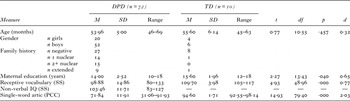
Table 1 presents descriptive information for the two groups of participants. With regards to the children with DPD, there were fifty-two males and twenty females, a 2·6 male:female ratio which is very similar to the 2·75:1 ratio reported for English-speaking children with speech sound disorders by Shriberg (Reference Shriberg1994). In terms of past or current family history of speech, language, or reading difficulties, the data are presented for sixty-five of the seventy-two children with DPD, since two children had been adopted, the parents of three additional children did not complete the questionnaires, and one member of each sibling pair was randomly removed from the family history analyses. The parents of 41·5% of the children with DPD reported no family history of speech, language, or reading difficulties, compared to 80% of the TD children. Twenty-one percent of the children with DPD had one biological and nuclear family member with a history of current or past speech, language, or reading difficulties, while only one of the TD children reportedly had a nuclear family member with attention and language difficulties. Twenty-three percent of the children with DPD and none of the TD children had at least two affected nuclear family members. Thirteen percent of the children with DPD reportedly had a positive family history for at least one extended family member, and 10% of the TD children had one extended family member who presented with language difficulties.
Demographic data and test scores of the children with DPD and the TD children

notes: SS = standard score; PCC = percentage of consonants correct. Receptive vocabulary measured by the Échelle de vocabulaire en images Peabody (Dunn, Theriault-Whalen & Dunn, Reference Dunn, Theriault-Whalen and Dunn1993); non-verbal IQ by the non-verbal matrices subtest of the Kaufmann Brief Intelligence Test-2 (Kaufman & Kaufman, Reference Kaufman and Kaufman2004); and single-word articulation by the Test Francophone de Phonologie (Paul & Rvachew, Reference Paul and Rvachew2008).
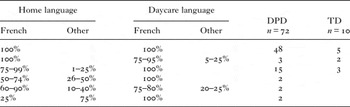
French is the majority language of the approximately 7·9 million residents of the province of Quebec, Canada. While 51·8% of the population of Quebec is monolingual French, only 37% of the residents of the city of Montreal and its region do not speak other languages: 53·7% speak both French and English, and the most common mother tongues in this city, following French and English, are Arabic, Spanish, Italian, Creole, and Greek (Statistics Canada, 2012). Table 2 presents the linguistic environments of the participants.
Language exposure of the children with DPD and TD children at home and at daycare

notes: ‘Other’ language at home usually refers to English, although five children with DPD were exposed to one of these languages at home, in addition to French: Spanish, Arabic, Albanian, Lingala, or Bulgarian. ‘Other’ language at daycare was always English.
Procedures
EVIP. The Échelle de Vocabulaire en Images Peabody (Dunn, Theriault-Whalen & Dunn, Reference Dunn, Theriault-Whalen and Dunn1993) is a Canadian-French adaptation of the Peabody Picture Vocabulary Test-Revised (Dunn & Dunn, Reference Dunn and Dunn1981). The practice and test items were administered as instructed in the test manual.
K-BIT-2. The Matrices subtest of the Kaufman Brief Intelligence Test, 2nd Edition (Kaufman & Kaufman, Reference Kaufman and Kaufman2004) measures non-verbal intelligence. Children were presented with color plates with a target picture at the top, and six pictures at the bottom. They were asked to point to the picture among the six choices that went with the target. The practice and test items were administered according to the instructions in the test manual.
TFP. The Test Francophone de Phonologie (Paul & Rvachew, Reference Paul and Rvachew2008) is a test of articulation accuracy that mirrors the phoneme distribution, syllable shapes, and word length characteristics of Quebec French, as described in Paul (Reference Paul2009). In brief, a total of 54 words are elicited using 20 full-color photographs, targeting 161 consonants and 107 vowels. Examiners used carrier phrases to elicit spontaneous productions of the target words; if the child did not answer, delayed imitation techniques such as asking a choice question with the target as the first choice was used. Immediate imitation was used as a last resort to ensure datasets that were as complete as possible for each child. Nonetheless, three children each refused to produce one target word, and one child did not produce two target words. The percentage of consonants correct (PCC) was calculated based on the number of consonants each child attempted to produce on this test. Administration of the TFP was video-recorded using a Sony Handycam HDR-XR520 or a JVC Everio GZ-MG360 video camera. The audio files were extracted and saved as .wav files.
OSMSE-3. The Oral Speech Mechanism Screening Examination, Third Edition (St Louis & Ruscello, Reference St Louis and Ruscello2000) evaluates the structure and function of the lips, tongue, jaw, teeth, palate, pharynx, velopharyngeal mechanism, breathing, and diadochokinesis (DDK) and alternate motion rates (AMRs). The screening tool was administered according to the manual and was video-recorded. Repetition rates were calculated from waveform displays of the children's responses. Many of the children who participated in this study were younger than 5;0, the minimum age to use the OSMSE-3 norms. Younger children had more difficulty completing the required number of repetitions (16 for single syllables, 12 for [pata], and 8 for [pataka]) but age was not correlated with performance with regard to repetition rates in syllable/seconds for any of the isolated syllables or syllable sequences. We therefore calculated the repetitions/second for each child, and prorated the pass criteria for the required number of repetitions. Pass standards were 2·9, 2·3, 2·7, 1·7, and 0·95 repetitions/second for [pa], [ta], [ka], [pata], and [pataka], respectively, for children up to the age of 55 months, and 3·2, 2·5, 2·9, 1·7, and 1·0 for children aged 66 to 71 months.
TCP. The Test de Conscience Phonologique (Brosseau-Lapré & Rvachew, Reference Brosseau-Lapré and Rvachew2008, unpublished), is a French adaptation of the Phonological Awareness Test developed by Bird et al. (Reference Bird, Bishop and Freeman1995). While the number of practice and trial items remained the same for the rime matching, onset matching, and onset segmentation and matching subtests, the target phonemes and syllable structures of the words were modified to better represent the phonology of Quebec French. A laptop was used to present the pictures and audio stimuli, although the examiner pointed to each picture and named them live-voice. The test stimuli, items, and instructions are available under “Clinical tools” at <http://www.medicine.mcgill.ca/srvachew>.
SRT. The Syllable Repetition Task was administered using a PowerPoint audio presentation and scored according to the instructions provided by Shriberg and Lohmeier (Reference Shriberg and Lohmeier2008). A competence score as well as three speech processing scores (encoding, memory, and transcoding) can be derived from the SRT, as described by Shriberg et al. (Reference Shriberg, Lohmeier, Strand and Jakielski2012). The competence score consists of the number of consonants that were accurately produced by the child; cognate substitutions on the voiced stops are scored as correct (i.e. p/b, t/d), and addition errors are not taken into account as long as the target consonant is produced in the correct position. Encoding of auditory-perceptual representations is measured by calculating the percentage of substitution of sounds that belong to the same manner as the target, which presumably indicates partial knowledge of the target. The ratios of accurately repeated consonants in longer words compared to shorter words allow quantifying the contribution of phonological memory in the speaker's performance on the SRT. The ratios are transformed using the formula 100*(1 + natural log of the ratio); values above 100 or below 0 are truncated. Finally, the transcoding score is the percentage of items containing one of more addition errors such as /bɑdɑ/ → [bɑndɑ], subtracted from 100 so that higher scores denote higher competence in transcoding. Addition errors are considered to reflect motor planning and/or programming deficits.
Reliability
The first author completed narrow phonetic transcriptions of the participants’ responses on the TFP based on the audio recordings. Audio files were reviewed at least three times for each child. In the case that a child produced the same target word more than once, the clearer recording was transcribed; if the productions were equally clear, the first one was used. Two research assistants (one graduate student in speech-language pathology and one undergraduate student in linguistics) independently transcribed 10% and 20% of the TFP samples. The mean transcription agreement with the first author for narrow transcription of the target consonants was 94% (range = 88% to 97%). When the consonant transcriptions differed, the two transcribers listened to the audio recording and reached consensus on the final transcription.
RESULTS
Oral motor abilities
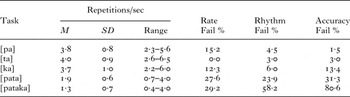
The OSMSE-3 yielded perfect oral structure scores for nearly all children but highly variable oral function scores. Certain tongue movements proved difficult, in particular: elevate the tongue, move tongue along the palate, puff out the cheeks. Table 3 shows that 52·9% of children passed all five syllable repetition tasks, which leaves a substantial proportion who had significant difficulties with rate, rhythm, and/or accuracy for at least one task. The proportion of children failing more than three tasks, indicating difficulties with the repetition of both single- and multi-syllable sequences, was small (5·9%, or 4 children in total). Therefore, these data suggest that the proportion of children with an actual motor speech disorder was small in this group, as has been reported in other studies describing English-speaking children with speech impairments.
Performance of 65 French-speaking preschoolers with DPD on tasks to assess DDK and AMR

notes: Data obtained from the Oral Speech Mechanism Screening Examination, Third Edition (St Louis & Ruscello, Reference St Louis and Ruscello2000). Data is available for 65 of the 72 children since we removed one child from each of the two pairs of siblings; three children refused to complete the repetition rate tasks; and the video recordings were missing for two additional children. The data for [pata] only includes 57 children as this specific task was not administered by mistake to eight of the children.
The relationship between DDK and AMR performance and all other study measures (i.e. receptive vocabulary, non-verbal intelligence, consonant accuracy in single words, and phonological awareness) was examined using two strategies: Pearson correlations between measures and t-tests to examine differences between children who achieved below or above average performance on the DDK and AMR measures. The analyses revealed no relationship between oral-motor performance and any other measure.
Phonological awareness
As shown in Table 4, the phonological awareness performance of the DPD group was significantly poorer than that of the TD group with respect to all four scores derived from the Test de Conscience Phonologique. This test proved so difficult for the children with DPD that eleven children in this group did not respond correctly to any test items, whereas some children in the TD group achieved ceiling-level performance. The rime-matching subtest proved to be easier than onset matching or segmentation for both groups of children.
Test de Conscience Phonologique scores obtained by the children with DPD and the TD children

note: % passed is the percentage of children with DPD who obtained a score less than 1 SD below the mean obtained by the group of TD children.
Syllable repetition task
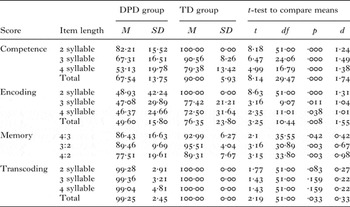
SRT scores are shown in Table 5 by group and type of score (i.e. competence, encoding, memory, and transcoding scores). As expected, the competence scores decreased with word length for children in both groups, but the TD group achieved high scores at all word lengths. All TD children obtained scores of 100% for the 2-syllable target words, scores above 75% for the 3-syllable target words, and scores above 50% for the 4-syllable target words. We adopted a standard of one standard deviation below the mean to compare profiles of our Quebec French-speaking children with DPD to the literature regarding the psycholinguistic profiles of English-speaking children with speech sound disorders. Children with DPD scored more than a standard deviation below the TD mean on average at every word length. With regard to encoding of auditory-perceptual representations, the mean score of the DPD group was also more than a standard deviation below the mean of the TD group, consistent with our hypothesis of phonological processing deficits in this group. As further confirmation, the phonological memory score was one-and-a-half standard deviations lower for the DPD group compared to the TD group. In contrast, the transcoding scores of the two groups were similar and essentially at ceiling, indicating that children were very unlikely to make errors indicative of a motor speech disorder. Those few instances of consonant addition errors did occur within the DPD group, however: one child added a single consonant to one 2-syllable word; two other children each added a consonant to one 2-syllable word and one 4-syllable word; and two other children each added one consonant to one 3-syllable word. Two of these children passed both the DDK and AMR tasks, while one child failed the AMR only, and two children failed both the DDK and AMR tasks.
Competence and processing scores derived from Syllable Repetition Task performance by 52 children with DPD and 10 TD children

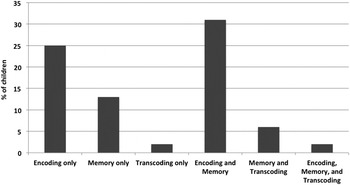
SRT outcomes are further represented in Figure 1, which shows the proportion of the DPD group children who obtained an SRT encoding or memory score that is more than one standard deviation below the mean of the ten TD children. Eleven children (21% of the 52 children for whom we have SRT data) passed all three speech processing tasks on the test.
Percentages of children with DPD who failed at least one speech processing task on the SRT.

Predictors of articulation accuracy
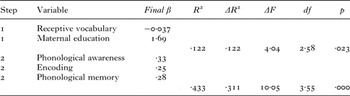
As a further test of our hypotheses, Table 6 shows the results of a hierarchical multiple regression analysis that identifies the contribution of phonological processing skills to articulation accuracy after controlling for receptive vocabulary and maternal education. In this analysis, phonological processing was defined as the aggregate of phonological awareness (TCP) and SRT performance (specifically, the encoding and phonological memory scores). As predicted, all three measures of phonological processing made a contribution to articulation accuracy, whereas DDK and AMR did not contribute to articulation accuracy beyond the contribution of phonological processing.
Hierarchical multiple regression analysis to examine contribution of phonological processing to speech production accuracy

notes: Receptive vocabulary was assessed with the Échelle de vocabulaire en images Peabody (see Table 2 for descriptive statistics); maternal education was assessed in years; phonological awareness was assessed with the Test de Conscience Phonologique (see text for details and Table 4 for descriptive statistics); encoding and phonological memory scores were derived from performance on the Syllable Repetition Task (see text for details and Table 5 for descriptive statistics).
Subgroups of children using cluster analysis
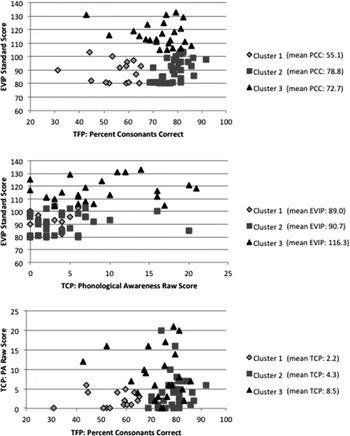
Finally, the K-means cluster function of SPSS for Windows was used to identify clusters within the DPD group on the basis of their articulation accuracy (PCC), receptive vocabulary (EVIP), and phonological awareness (TCP) test scores. As shown in Figure 2, the resulting clusters were as follows: Cluster 1 (9 children; 18%) had the lowest PCC values along with low EVIP and TCP scores. Cluster 2 (26 children, 52%) obtained much higher PCC scores but low EVIP and TCP scores. Cluster 3 (15 children, 30%) obtained relatively high scores on all three measures.
Cluster profiles of the 72 children with DPD.

The relationships between receptive vocabulary, phonological awareness skills, and speech accuracy found in these three clusters of children also point to the important role of phonological processing in achieving articulation accuracy. It makes sense that Cluster 3 would achieve relatively good articulation accuracy given their higher receptive vocabulary and good phonological awareness. However, the similarly good articulation accuracy of Cluster 2 must be explained: Why does this cluster overlap with Cluster 3 rather than Cluster 1 for articulation accuracy, given their relatively poor receptive vocabulary and phonological awareness performance? The explanation cannot be found in non-verbal intelligence or oral motor skills because comparison of the three clusters revealed that they did not differ in terms KBIT-2 scores (F(2,47) = 1·53, p = ·227) or function score of the OSMSE-3 (F(2,47) = 1·503, p = ·233). Differences were found, however, on the competence score of the SRT (F(2,47) = 6·402, p = ·003). Significantly higher competence scores on the SRT were found for Cluster 2 and Cluster 3 relative to Cluster 1, although no differences were seen for encoding, memory, or transcoding scores.
DISCUSSION
Previously we have demonstrated that Quebec French-speaking preschool-age children with DPD differ significantly from their English-speaking peers with respect to their phenotypic profile: in other words, these two groups of children present with noticeably different profiles of speech errors, such that Quebec French-speaking children produce more syllable structure errors and English-speaking children produce more segment level errors. We concluded that these differences in speech characteristics for children who are struggling to acquire the phonological system of their language reflect differences in the language input from the environment. Here we hypothesized that the Quebec French-speaking children with DPD would nonetheless present similarly to English-speaking children at the endophenotypic level. More specifically we expected this sample of seventy-two Quebec French-speaking children to have significant difficulty with tests of phonological processing relative to their age peers with normally developing speech accuracy. We further expected that their difficulties with the acquisition of age-appropriate speech accuracy would not be explained by oral motor deficits. These hypotheses, derived from many studies on English-speaking children with speech impairments (e.g. Rvachew & Grawburg, Reference Rvachew and Grawburg2006), were fully confirmed.
As we expected, very few children showed difficulties with motor planning and/or programming as evidenced by their ability to repeat single syllables and syllable sequences rapidly. Although most children failed at least one syllable repetition task, only 5·9% failed both single- and multi-syllable repetition tasks, providing a clear indication of a motor speech disorder. Furthermore, only five children obtained a low transcoding score on the SRT due to the production of addition errors that are characteristic of childhood apraxia of speech: of these five children, three failed transcoding and phonological memory; one child failed transcoding, phonological memory, and encoding; and one child failed transcoding only. As found in other studies, most children in our study who did present with motor speech difficulties also had deficits in other endophenotypes related to phonological processing skills, language skills, and literacy skills (e.g. Lewis, Freebairn, Hansen, Iyengar & Taylor, Reference Lewis, Freebairn, Hansen, Iyengar and Taylor2004; Shriberg et al., Reference Shriberg, Lohmeier, Strand and Jakielski2012).
In contrast, the majority of children obtained significantly low encoding and memory scores on the SRT, indexing deficits in multiple areas of phonological processing. These phonological processing deficits were further confirmed by marked difficulties on all subtests of the phonological awareness test by virtually all of the children in the DPD group. Furthermore, phonological awareness, encoding, and memorial processes explained significant unique variance in speech production accuracy even after controlling for individual differences in receptive language and maternal education.
Ramus, Marshall, Rosen, and van der Lely (Reference Ramus, Marshall, Rosen and van der Lely2013) recently attempted to explain the partial (incomplete) overlap of specific language impairment with developmental dyslexia in a study in which three factors were found to explain variance in the language abilities of the participants: non-phonological language skills (e.g. vocabulary, grammar), phonological processing skills (e.g. rhyme awareness, rapid digit naming), and phonological representations (e.g. nonword repetition, nonword discrimination, articulation accuracy). The authors concluded that a multiple-component model of language abilities best explains the relationship between language and reading disabilities. Similarly, DPD overlaps with language impairment and dyslexia and this comorbidity may result from common endophenotypes as well as common genetic and environmental risk factors as outlined by Pennington (Reference Pennington2006) in reference to the multiple deficit view of developmental disorders (see also Lewis et al., Reference Lewis, Avrich, Freebairn, Hansen, Sucheston, Kuo and Stein2011; Pennington & Bishop, Reference Pennington and Bishop2009).
Some of our participants with DPD had poor articulation accuracy but relatively good phonological awareness, while some children had milder difficulties with articulation accuracy but poorer phonological awareness, as previously described for English-speaking children with DPD (e.g. Hesketh, Reference Hesketh2004; Rvachew, Chiang & Evans, Reference Rvachew, Chiang and Evans2007). Examination of these variations in profile between children can be helpful in illuminating the interactions that explain individual outcomes. Three clusters of children with DPD were found in our sample, with different strengths and weaknesses with regard to phonological processing skills, receptive vocabulary, and articulation accuracy. The children in Cluster 1 who had difficulties across all domains would likely need relatively intense speech therapy directed at improvement of speech accuracy, combined with specific efforts to intensify environmental inputs to support language and emergent literacy growth, using, for example, a ‘response to intervention approach’ and an enriched preschool environment (e.g. Wilcox, Gray, Guimond & Lafferty, Reference Wilcox, Gray, Guimond and Lafferty2011). The children in Cluster 2 who presented with similarly low receptive vocabulary and PA scores, but on average achieved higher PCC values, might respond well to the comprehensive but somewhat less intense input-oriented approach to intervention described in Rvachew and Brosseau-Lapré (Reference Rvachew and Brosseau-Lapré2015). The third cluster of children presented with relatively good albeit delayed articulation accuracy with above-average receptive vocabulary skills; these children would likely respond well to a stand-alone phonology therapy targeting their specific error patterns. The outlier in this cluster obtained a PCC value below 60 despite exceptional vocabulary knowledge and average phonological awareness skills; closer inspection of the data for this child revealed that his non-verbal intelligence was in the higher average range and that his well-educated parents reported a high frequency of literacy activities such as reading books and going to the library. Language input provided to the child is the most important environmental influence in terms of language development (Hart & Risley, Reference Hart and Risley1992). Strong vocabulary scores, combined with strong non-verbal intelligence and rich language input likely allowed this child to attain good phonological awareness despite the challenges associated with his severe DPD.
Cross-linguistic differences
Despite the finding that Quebec French- and Canadian English-speaking children with DPD are similar at the level of the endophenotype, there was an interesting difference in our sample's performance when repeating the 2-syllable target words of the SRT relative to the published literature for English-speaking children. Few Quebec French-speaking children with DPD (6%) obtained a score of 50% or less for the CVCV words, compared to 24% of the participants in Shriberg, Lohmeier, Campbell, Dollaghan, Green, and Moore (Reference Shriberg, Lohmeier, Campbell, Dollaghan, Green and Moore2009). One possible explanation for this difference is the age of the participants, as the Quebec French-speaking children were four to six years old, whereas the English-speaking children were three to five years old. Additionally, it is possible that French-speaking children with DPD repeat CVCV targets more accurately than English-speaking children, since French words tend to be longer than words in English (MacLeod et al., Reference MacLeod, Sutton, Trudeau and Thordardottir2011). A similar finding was found by Dispaldro, Leonard, and Deevy (Reference Dispaldro, Leonard and Deevy2013) in Italian-speaking children with specific language impairment or typical development, using a nonword list composed of words with phonemes and syllable shapes that are mastered by young children. Italian words are also longer than English words, with most words in Italian being three and four syllables long (Mancini & Voghera, Reference Mancini, Voghera and De Mauro1994). Dispaldro et al. (Reference Dispaldro, Leonard and Deevy2013) proposed that familiarity with longer words “might enable Italian-speaking children to gain greater command of longer linguistic material” (p. 332). Further studies are required to determine whether the performance of children speaking languages with longer words than English on the 3-syllable targets of the SRT might indicate difficulties with encoding of acoustic-perceptual information, similarly to how English-speaking children perform with the 2-syllable words of the SRT.
Limitations
An important limitation of this study was that speech perception was not measured directly in our participants. Initially we had planned to assess speech perception using a two-alternative, forced-choice word identification task modeled on the procedure described in Rvachew and Grawburg (Reference Rvachew and Grawburg2006). Therefore, assessment of the children's ability to identify single-syllable words with the initial consonant produced either correctly or incorrectly was piloted. However, we found that this measure was not a valid test of speech perception abilities for French-speaking children, given that their speech production error patterns are at the prosodic level of the phonological hierarchy. Thus, a stronger test of our hypothesis that the underlying speech process that explains the speech impairment in these children involves encoding of phonological input requires the development of a valid measure of speech perception that is better adapted to the French language, specifically involving multi-syllabic words and the simulation of syllable structure error patterns (e.g. omission of word-internal coda consonants, misarticulation of consonants in unstressed syllables within multi-syllabic words, and spreading of features within complex onsets).
The total sample of this study is also a limitation because, while reasonably large at eighty-two children overall, we were unable to model the complex relationships among all the variables that we assessed. The matching of the samples was also problematic because the large difference in receptive vocabulary skills and the smaller difference in maternal education may explain some of the difference in phonological processing abilities between the DPD and TD groups. However, during the course of the study we developed measures of speech accuracy and phonological awareness that proved to be valid and reliable for French-speaking children, and showed that the Syllable Repetition Task could be used with this population as well. Therefore, following modification of the speech perception test to reflect our improved understanding of phonological development in French, these new tools are in place for continued investigation of the underpinnings of DPD in French and the linkages between the phonological processing endophenotype and later literacy outcomes.
CONCLUSION
This study represented the first description of the speech characteristics of a large group of Quebec French-speaking children with DPD. The children presented with a primary underlying deficit in the domain of phonological processing, as has been reported in many prior studies for English-speaking children with deficits in speech accuracy and intelligibility. All children who are referred for a speech-language pathology assessment due to concerns with speech accuracy must be carefully examined for concomitant deficits in the language, phonological processing, and literacy domains so that interventions can be targeted at the surface characteristics and the psycholinguistic underpinnings of the child's communication deficit. The results of the current study add to a growing literature recommending that interventions for children with DPD focus on perceptual and phonological knowledge (e.g. Munson, Baylis, Krause & Yim, Reference Munson, Baylis, Krause, Yim, Fougerón, Kühnert, Imperio and Vallée2010), in addition to speech accuracy.