Introduction
Behavioural and psychological symptoms in dementia (BPSD; Finkel, Reference Finkel2000) are common in the community and even more in institutional settings (van der Linde et al. Reference van der Linde, Stephan, Savva, Dening and Brayne2012). BPSD include a variety of heterogeneous symptoms such as delusions, aggression, irritability, aberrant motor behaviour and impulsivity, but also depression, anxiety and apathy. The symptoms are thought to arise from interactions between dementia severity, environmental factors and other (somatic) diseases (van der Linde et al. Reference van der Linde, Stephan, Savva, Dening and Brayne2012; Sampson et al. Reference Sampson, White, Leurent, Scott, Lord, Round and Jones2014). In settings such as nursing homes and private households BPSD were found to inflict strain on both formal and informal caregivers (Ballard et al. Reference Ballard, Lowery, Powell, O'Brien and James2000; Matsumoto et al. Reference Matsumoto, Ikeda, Fukuhara, Shinagawa, Ishikawa, Mori, Toyota, Matsumoto, Adachi, Hirono and Tanabe2007; Huang et al. Reference Huang, Lee, Liao, Wang and Lai2012) and often to be more difficult to manage than the cognitive deficits associated with dementia (Black & Almeida, Reference Black and Almeida2004).
Persons with dementia have a high risk of being hospitalised (Bynum et al. Reference Bynum, Rabins, Weller, Niefeld, Anderson and Wu2004; Phelan et al. Reference Phelan, Borson, Grothaus, Balch and Larson2012) and BPSD may complicate the treatment resulting in longer stays and increased costs. BPSD have been investigated in specialised acute treatment settings such as psychogeriatric wards (e.g. Edell & Tunis, Reference Edell and Tunis2001; Tan et al. Reference Tan, Wong and Allen2005). However, little is known about BPSD in somatic wards in the general hospital and no representative studies have been conducted. Despite employing differential methods of assessing BPSD, two studies reported that around three-quarters of the older patients with dementia showed at least one behavioural or psychological symptom during their stay (Wancata et al. Reference Wancata, Benda and Meise2004; Sampson et al. Reference Sampson, White, Leurent, Scott, Lord, Round and Jones2014). In internal patients apathy, aggression, depressive thoughts and delusions were found to be most common (Wancata et al. Reference Wancata, Benda and Meise2004) and in patients admitted via emergency services aggression, sleep disturbances, activity disturbances and anxiety to be the most frequent (Sampson et al. Reference Sampson, White, Leurent, Scott, Lord, Round and Jones2014). In general medicine, trauma orthopaedic and geriatric patients with a Mini Mental State Examination (Folstein et al. Reference Folstein, Folstein and McHugh1975) score ≤24 changes in appetite, apathy, anxiety and depression were the most prevalent, but no overall prevalence was calculated (Goldberg et al. Reference Goldberg, Whittamore, Harwood, Bradshaw, Gladman and Jones2011).
In one study (Sampson et al. Reference Sampson, White, Leurent, Scott, Lord, Round and Jones2014), a general rating of nursing staff distress was obtained, indicating that in 63% of all cases with BPSD the symptoms were at least mildly troubling or dangerous. However, no investigations on the symptom level were conducted.
Knowledge of the frequency of BPSD in the general hospital and associated complications potentially helps to develop programmes aimed at improving care and reducing distress for both patients and hospital staff. The present study was conducted as part of the General Hospital Study (GHoSt) and aimed to investigate: (1) the frequency of BPSD in a representative sample of older general hospital patients; (2) the distress for nursing staff associated with the individual symptoms; and (3) the association of BPSD with complications during care, special treatment needs and other behavioural problems. As hospital patients with dementia are prone to developing delirium and this comorbidity reflects the clinical reality, we decided not to exclude cases with delirium for statistical analyses.
Method
Study population and participants
The study protocol was approved by the institutional review board of the Faculty of Medicine, Technical University of Munich (approval number 66/14, 21 march 2014). GHoSt was a cross-sectional population-based study conducted in general hospitals in the two southernmost German federal states Bavaria and Baden-Wurttemberg. These states are inhabited by more than 23 million people, which represent nearly 30% of total German population. According to the state hospital directories, which list all hospitals of a given state, there were 209 hospitals with at least 150 beds. The hospitals were contacted by a random order and asked for willingness to participate. For cooperating hospitals, five wards were randomly selected. Geriatric, neurologic and psychiatric wards were excluded, as the study aimed to examine comorbid dementia and on these wards patients are often admitted with dementia as a primary diagnosis. Paediatric wards and intensive care units were also excluded.
All patients who were 65 years or older on the day of examination were identified on the wards from current patient lists. Patients who were isolated due to infectious disease, moribund, not sufficiently proficient in German or for whom the nursing staff expressed other clinical concerns were excluded. If legal guardianship existed for a patient, the guardians were contacted before the patient was seen and informed about the study, either in person in the hospital or by phone. Verbal or written consent was then obtained from the guardians. Patients without legal guardianship were visited in their rooms and informed about the study. All patients gave written consent to participate.
Procedure and materials
Data collection for each patient was conducted by trained junior researchers and followed four phases: bedside patient examination, nursing staff interview, inspection of the medical records and evaluation of the cognitive status with regard to dementia, delirium and degree of cognitive impairment. Additional informant interviews were conducted for all patients with legal guardians and for some patients with unclear cognitive status.
Patient examination
Demographic data were obtained from the patients and a cognitive test battery was administered, including the 6-Item Cognitive Impairment Test (6CIT; Katzman et al. Reference Katzman, Brown, Fuld, Peck, Schechter and Schimmel1983; Brooke & Bullock, Reference Brooke and Bullock1999; Hessler et al. Reference Hessler, Schäufele, Hendlmeier, Junge, Leonhardt, Weber and Bickel2016), which includes items tapping memory, attention and executive functioning; the word-list learning test from the DemTect (Kalbe et al. Reference Kalbe, Kessler, Calabrese, Smith, Passmore, Brand and Bullock2004), affording patients to recall as many as possible of ten words that were read to them twice directly after hearing them and after a short delay; the Serial Sevens Test (calculating five subtractions of 7 from 100), and a verbal fluency test (naming as many animals as possible within 1 min).
Nursing staff interview
For each patient the responsible nurse was interviewed with a standardised and fully structured questionnaire about the timeframe from admission to the day of examination for GHoSt. Behavioural and psychological symptoms were assessed with a modified short form of the Neuropsychiatric Inventory (NPI-Q; Kaufer et al. Reference Kaufer, Cummings and Ketchel2000). The nurses were asked whether they had observed the following 11 symptoms during the patient's current stay: delusions, hallucinations, agitation/aggression, dysphoria/depression, anxiety, euphoria/elation, apathy/indifference, disinhibition, irritability/lability, aberrant motor behaviour and nighttime disturbances. When the nurses reported the presence of a symptom, they indicated on a six-point scale how distressing the symptom was for them: 0 = not at all, 1 = minimally, 2 = mildly, 3 = moderately, 4 = severely or 5 = very severely. No rating of severity of the BPSD was obtained. The nurses were also asked to rate the patient's mental status from: (1) ‘Memory and mental capacity are normal’ to (4) ‘The patient appears to be severely mentally impaired’ and whether they observed any fluctuations in the patient's consciousness and cognition. Functional ability was assessed with the Barthel Index (Mahoney & Barthel, Reference Mahoney and Barthel1965), which stages the level of independent functioning in areas such as personal hygiene, mobility and ingestion. Also, data on complications in nursing, the need for special measures above routine treatment and the presence of other behavioural problems (e.g., shouting) were collected.
Medical records
The inspected medical records comprised charts of the current stay and previous medical reports that were available in the hospital. Recorded information included somatic diagnoses at admission according to ICD-10, previously known ICD-10 diagnoses of cognitive impairment, medication acting upon the nervous system as defined by the Anatomical Therapeutic Chemical (ATC) Classification System (all medications whose ATC-code starts with ‘N’), as well as neurological and psychiatric consults during the current stay.
Informant interview
Guardians, relatives or other persons that knew the patient well were interviewed in person on the ward or by phone. Demographic data were cross-checked, a rating of the patient's cognitive status previous to the admission was obtained, and – if cognitive problems were reported – it was inquired whether a physician had been consulted and whether a respective diagnosis had been assigned.
Diagnoses of cognitive impairment
Based on all available information dementia was diagnosed according to DSM-IV. Delirium was diagnosed with the Confusion Assessment Method (CAM; Inouye et al. Reference Inouye, van Dyck, Alessi, Balkin, Siegal and Horwitz1990; Bickel, Reference Bickel2007). The CAM asks for an acute onset of the cognitive deficits, the presence of deficits in attention and/or thinking, altered consciousness and, if present, whether these deficits fluctuated over the period of observation. For the diagnosis of delirium, onset must be acute or deficits fluctuating, attention must be impaired, and either thinking or consciousness altered. The Clinical Dementia Rating Scale (CDR; Hughes et al. Reference Hughes, Berg, Danziger, Coben and Martin1982) was employed to rate the severity of cognitive impairment. The CDR discriminates between five stages of severity: no (0), questionable (0.5), mild (1), moderate (2) and severe (3). After data collection, all cases were reviewed in the respective working groups and two senior researchers (HB and MS) with longstanding experience in the field of dementia then audited the diagnoses of dementia and delirium. Over the course of the study, consensus meetings were held in order to ensure consistent application of diagnostic criteria across study centres. In ambiguous cases the differential diagnosis dementia v. delirium was performed considering third-party information about the patients’ cognitive status before the current hospital stay. When cognitive deficits appeared to have had a sudden onset, there was no indication of previous deficits and the CAM criteria were met, delirium was diagnosed. When the deficits met the criteria of the CAM but informants reported deficits and impaired activities of daily living before the hospital stay, dementia with delirium was diagnosed.
Statistical analysis
For each symptom, the frequency as reported by the nursing staff was calculated. These frequencies pertain to the whole stay of the respective patients up to the day of the examination. The 95% confidence intervals according to the Wilson score method were calculated with the epidemiologic statistics program OpenEpi (Dean et al. Reference Dean, Sullivan and Soe2013). To assess whether a particular symptom was experienced as more or less distressing, a quotient was calculated. For each symptom the number of cases for which the nurses rated the distress between 3 and 5 (moderately to very severely distressing) was divided by the number of cases with a rating between 0 and 2 (not at all to mildly distressing). Symptoms with a distress quotient larger than 1 were predominantly experienced as distressing while quotients lower than 1 indicate a symptom that was mostly perceived as little distressing. Differences in the frequency of the symptoms between patients with and without dementia were compared with χ 2-tests. Frequency and distress quotient were plotted against each other to demonstrate their relationship.
Further analyses were conducted considering only patients with dementia, including those with comorbid delirium. The association between dementia severity according to CDR and the frequency of the individual symptoms was assessed with χ 2 tests. Factor analysis employing a principal components method and varimax rotation was carried out to identify clusters in the BPSD. The patients’ factor scores were saved and entered in binary logistic regression models as predictors for complications in care. Separate models were calculated with dichotomised (reported v. not reported) outcome variables related to three groups of complications in care: (1) nursing: basic nursing (e.g. fends off bedding, bathing and help with excretion), treatment nursing (e.g. fends off medication, wound care or pulls out catheters and needles), ingestion (e.g. food untouched, fends off feeding and throws food) and generally increased expenditure of time compared with patients with the same somatic problems. (2) Medical treatment: medical measures (e.g. disobeys bed rest, fends off examinations and blood withdrawal), physical restraint in bed or chair, attachment of bed rails, transfer to single or special room or hall, need for neurologic or psychiatric consult and medication acting upon the nervous system (antipsychotics, anxiolytics, antidepressants, hypnotics or sedatives, anti-dementia drugs, antiepileptics and analgetics). (3) Behavioural problems: verbal or physical aggression (e.g. shouts, insults others, hits and kicks), ringing the bell very often or without identifiable reason, getting lost on the ward or attempts to leave ward or hospital and falls.
The associations of the factor scores with age, the number of days since admission, and the Barthel-Index total score (higher values indicated better functionality in daily activities) were investigated with Pearson's correlation coefficients. Multivariate analysis of variance (MANOVA) was employed to examine the relationship of sex and medical discipline with the factor scores. Only main effects for sex and medical discipline were calculated.
These analyses were followed by a range of further binary logistic regression analyses, with the BPSD as predictors and more detailed dichotomous care-relevant variables as outcomes. Euphoria was not examined due to the low number of cases. The results are presented as online Supplementary material.
To test whether the associations remained unchanged, we repeated the above analyses with excluding patients with delirium superimposed on dementia. Data analysis was performed with SPSS 23.
Results
Of the 55 randomly selected hospitals 33 (60%) cooperated. On the day of examination 2801 patients were 65 or older. Six-hundred forty-seven fulfilled the exclusion criteria as they were isolated due to infectious disease (133), insufficiently proficient in German (86), too sick for participation (53), discharged on the day of examination (267), repeatedly not met on the ward (75) or for other reasons, for example, deafness (33), resulting in a sample of 2154 eligible patients. Six-hundred eighty-five (31.8%) refused participation or their legal guardians refused or could not be reached, resulting in a study sample of 1469 patients (68.2%).
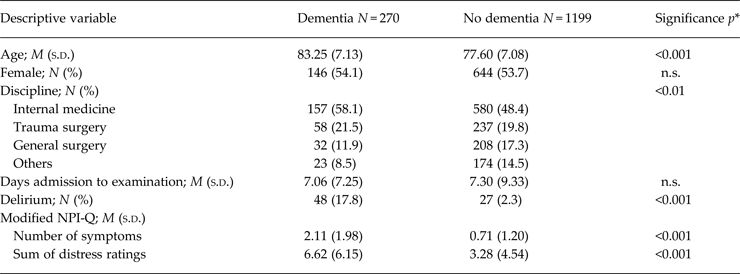
Two-hundred seventy (18.4%) patients were diagnosed with dementia, of which 100 were rated as mild, 97 as moderate and 73 as severely impaired on the CDR. Mean age of the whole sample was 78.64 (s.d. = 7.42). Table 1 shows the descriptive statistics for patients with and without dementia.
Descriptive statistics for patients with and without dementia

M, mean; s.d., standard deviation; NPI-Q, Neuropsychiatric Inventory; n.s. = p > 0.05.
* χ 2 tests for categorical and independent t tests for continuous variables.
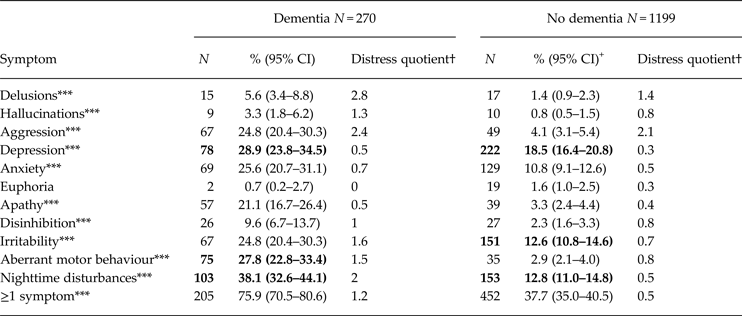
Table 2 displays the frequencies of the individual symptoms and the distress quotients as reported by the nursing staff for patients with and without dementia.
Frequency of behavioural and psychological symptoms in patients with and without dementia and associated distress as reported by nursing staff

Three most frequent symptoms in each group are in boldface.
95% CI = 95% confidence interval according to the Wilson score method.
† Number of patients with moderately, severely, or very severely distressing symptoms divided by number of patients with non-, minimally or mildly distressing symptoms.
Comparisons with χ 2 tests: *** p < 0.001.
Among patients with dementia, nighttime disturbances, depression and aberrant motor behaviour were the most frequent symptoms and delusions, aggression and nighttime disturbances caused the greatest distress. At least 1 symptom was reported for 76% and the overall distress quotient across all symptoms was 1.2, indicating that the symptoms were predominantly distressing. For patients without dementia, depression, irritability and nighttime disturbances were most frequently reported and aggression and delusions were experienced as most distressing. All other symptoms had a distress quotient <1. For about 38% one or more symptoms were reported and the overall distress quotient was 0.5. Comparisons with χ 2 tests suggested that all symptoms were statistically significantly more often reported for patients with dementia except for euphoria. The same symptoms were consistently rated as more distressing in people with dementia.
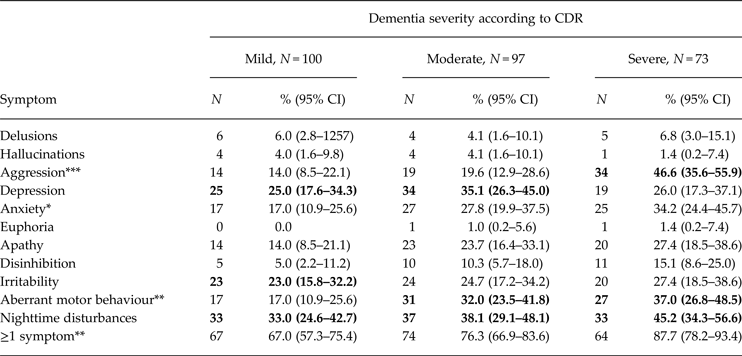
Subsequent results were obtained considering only data from patients with dementia. Aberrant motor behaviour, anxiety, aggression and at least one BPSD were statistically significantly associated with dementia severity (Table 3). For 67.0% of the patients with mild dementia at least one symptom was reported, with nighttime disturbances (33.0%), depression (25.0%) and irritability (23.0%) being the most common. For 76.3% of the moderate dementia group at least one symptom was reported, with nighttime disturbances (38.1%), depression (35.1%) and aberrant motor behaviour (32.0%) being the most frequent. In the severe dementia group, the nursing staff reported at least one symptom for 87.7%, with aggression (46.6%), nighttime disturbances (45.2%) and aberrant motor behaviour (37.0%) being the most common.
Association of behavioural and psychological symptoms with dementia severity according to Clinical Dementia Rating Scale (CDR)

The three most frequent symptoms in each group are in boldface.
95% CI = 95% confidence interval according to the Wilson score method.
Comparisons with χ 2 tests: *** p < 0.001, ** p < 0.01, * p < 0.05.
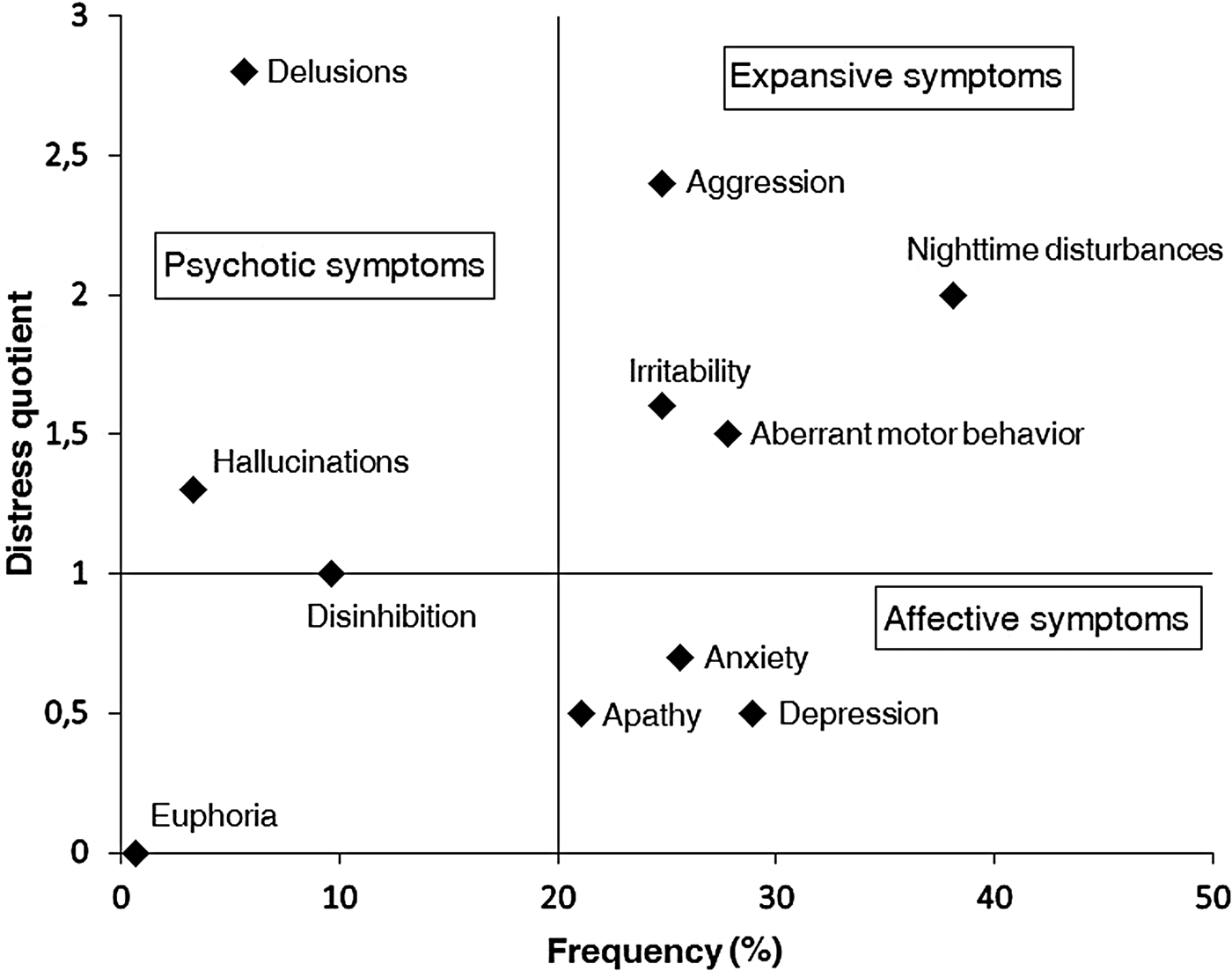
Figure 1 visualises the data from Table 2 by plotting the frequency v. the distress quotient. The Scatterplot was divided into four quadrants by separating the symptoms at 20% frequency and a distress quotient of 1.
Relationship between frequency of the behavioural and psychological symptoms in patients with dementia and the associated distress for nursing staff. Note. Distress quotient = number of patients with moderately, severely or very severely distressing symptoms divided by number of patients with non-, minimally or mildly distressing symptoms.

The first quadrant in Fig. 1 is occupied by the less frequent but more distressing psychotic symptoms. The second quadrant includes the frequent and distressing expansive symptoms (i.e. symptoms that describe outwards oriented behaviour that may directly affect other persons) and the third the frequent but less distressing affective symptoms. The fourth quadrant includes only the very infrequent symptom euphoria.
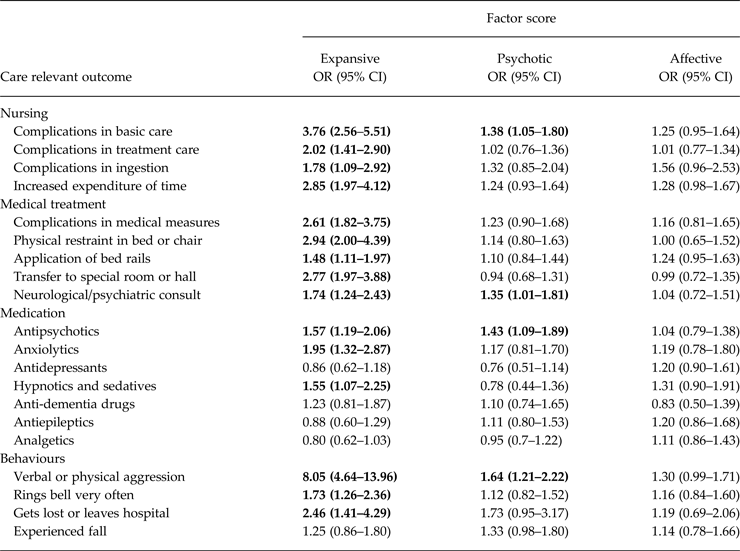
Factor analysis revealed three independent groups of symptoms that accounted for 45.0% of the variance in BPSD and were largely congruent with the pattern from Fig. 1. Aggression, disinhibition, irritability, aberrant motor behaviour and nighttime disturbances comprised group 1 and explained 19.8% of the variance. Delusions and hallucinations comprised group 2 (12.7% variance explained), and depression, anxiety, euphoria and apathy comprised group 3 (12.5% variance explained). These factors suggest a grouping of BPSD into expansive, affective and psychotic symptoms. Table 4 displays the associations of the factor scores with care-relevant variables.
Association of factor scores with complications in nursing, special treatment needs and behavioural problems. Results of the binary logistic regression analyses

OR, odds ratio.
95% CI = 95% confidence interval of the odds ratio.
Statistically significant associations in boldface.
Higher scores on the expansive factor were associated with a range of complications during care, special treatment needs and other behaviours. Psychotic symptoms were associated with complicated basic care, increased utilisation of psychiatric or neurologic consults and antipsychotic medication. Affective symptoms showed no statistically significant association. The results of extended analyses on the symptom level and with more detailed care variables are presented in Supplementary Table 1. The most complications were associated with aggression, nighttime disturbances and aberrant motor behaviour. As for the psychotic symptoms, delusions were related to more complications than hallucinations, and among the affective symptoms, anxiety showed the most associations, while depression was only related to anti-depressive and hypnotic/sedative medication.
The factor scores showed no statistically significant correlations with age and days since admission. The Barthel Index showed very small but statistically significant negative correlations with expansive symptoms (r = −0.20, p = 0.004) and affective symptoms (r = −0.18, p = 0.007).
MANOVA revealed no significant main effect of medical discipline but a significant main effect of sex. Tests of between-subjects effects indicated that male and female patients with dementia did not differ on mean factor scores for affective and psychotic symptoms but that men had higher mean factor scores for expansive symptoms with 1.11 (s.d. = 0.11) compared with women with 0.85 (s.d. = 0.07), F = 12.68, p < 0.001.
The associations between BPSD and care and demographic variables as well as the distress quotients remained unchanged when patients with delirium superimposed on dementia were excluded. Except for depression, whose frequency slightly increased, all frequencies only minimally decreased. The largest difference was observed for aberrant motor behaviour, which dropped from 27.8 to 21.9% in the dementia group. Supplementary Table 2 displays the frequencies of behavioural and psychological symptoms for patients with and without dementia with the delirium cases excluded. The most frequent symptoms in patients with dementia and delirium were nighttime disturbances, which were reported for 25/48 (52.1%) cases and aberrant motor behaviour, which was reported for 24 (50.0%) cases.
Discussion
Behavioural and psychological symptoms were reported for 76% of patients with dementia compared to 38% of patients without dementia. The nursing staff consistently rated the same symptoms as more distressing in patients with dementia compared with patients without dementia, and the overall distress was more than twice as large. While 67% of the patients with mild dementia showed BPSD, the rate increased to 88% in the severely impaired. These results suggest that behavioural and psychological symptoms are not a general phenomenon in older hospital patients, but co-occur with dementia and are especially present in patients in advanced stages of cognitive deterioration. The BPSD were best described by three groups that were congruent with other studies using the NPI-Q (van der Linde et al. Reference van der Linde, Dening, Matthews and Brayne2013) and had differential impact on the treatment in the hospital.
The expansive symptoms included nighttime disturbances, aberrant motor behaviour, irritability, aggression and disinhibition. Except for disinhibition, these symptoms were reported for more than 20% of the patients with dementia and were only exceeded by delusions with regard to the distress for the nurses. Nighttime disturbances were the most common of all BPSD with 38%. The symptoms showed strong associations with complications during routine nursing tasks and medical treatment, including severe problems such as pulling out catheters and throwing food. Higher rates of physical restraint, neurologic or psychiatric consults, and multiple neurotropic drugs might reflect the struggle to control these behaviours.
The psychotic symptoms included delusions and hallucinations, which were infrequent but co-occurred with behavioural problems, such as physical aggression, insulting others, shouting, getting lost on the ward, attempts to leave the hospital and falls. Delusions caused the highest distress of all BPSD.
Affective symptoms comprised depression, anxiety, apathy and euphoria. All symptoms were experienced as little distressing and had frequencies above 20%, except for euphoria, which was only reported for two cases. Anxiety was associated with some complications in care and behavioural problems, while apathy and depression were mostly regarded as unproblematic by hospital staff.
Previous studies reported BPSD in more than three-quarters of older general hospital patients (Wancata et al. Reference Wancata, Benda and Meise2004; Sampson et al. Reference Sampson, White, Leurent, Scott, Lord, Round and Jones2014), which is confirmed by the present study. Despite different methods to assess BPSD in the three studies, the results indicate that nighttime disturbances, aggression, aberrant motor behaviour and depression are the most common BPSD in older general hospital patients.
The rates of BPSD observed in our study partly differ from what was reported for other settings. These differences may result from interplay of setting-specific factors and the methods used to assess BPSD. In a large population-based study of community-dwelling persons with dementia, apathy, sleep problems and irritability were the most common symptoms (Savva et al. Reference Savva, Zaccai, Matthews, Davidson, McKeith and Brayne2009), compared with nighttime disturbances, depression and aberrant motor behaviour in our study. Agitation, delusions and disinhibition were found to be the most distressing for family carers in the community setting (Tan et al. Reference Tan, Wong and Allen2005), compared with delusions, aggression and irritability in our sample. Exceeding the 75% found in general hospitals, the prevalence of BPSD in nursing homes lies between 80 and 85%, with irritability, apathy, and aberrant motor behaviour or agitation being among the most common symptoms (Margallo-Lana et al. Reference Margallo-Lana, Swann, O'Brian, Fairbarin, Reichelt, Potkins, Mynt and Ballard2001; Zuidema et al. Reference Zuidema, Derksen, Verhey and Koopmans2007). Partly corresponding to our study, agitation and aggression as well as disinhibition and aberrant motor behaviour seemed to impose the most distress on carers in this setting (Song & Oh, Reference Song and Oh2015). In patients of an acute psychogeriatric ward, agitation, irritability, delusions and depression were the most frequent symptoms, while agitation, irritability and disinhibition were reported as most distressing (Tan et al. Reference Tan, Wong and Allen2005). In conclusion, while frequencies of the individual symptoms differ, expansive symptoms appear to be common across all settings and were consistently rated as causing the most distress in caregivers.
Clinical implications
Behavioural and psychological symptoms are frequent in older general hospital patients with dementia and associated with distress nursing staff. No strategies for the prevention of BPSD in the hospital have been proposed so far. The psychopharmacological treatment options for BPSD seem to be limited with antipsychotics showing moderate effects in the short-term reduction of expansive symptoms (Ballard et al. Reference Ballard, Gauthier, Cummings, Brodaty, Grossberg, Robert and Lyketsos2009). Due to the general absence of side effects and since they can be more readily individualised, caregiver education programmes and symptom management strategies that address the interaction between patient and caregiver might have longer lasting effects in reducing BPSD (Ballard et al. Reference Ballard, Gauthier, Cummings, Brodaty, Grossberg, Robert and Lyketsos2009; Olazarán et al. Reference Olazarán, Reisberg, Clare, Cruz, Peña-Casanova, del Ser, Woods, Beck, Auer, Lai, Spector, Fazio, Bond, Kivipelto, Brodaty, Rojo, Collins, Teri, Mittelman, Orrell, Feldman and Muñiz2010). Educating hospital staff that their patients with dementia are very likely to exhibit expansive or other BPSD during their stay and that appropriate non-pharmacological interventions can be more effective than drugs and physical restraint might be a first step to reducing BPSD and improving the situation for all persons involved. While non-pharmacological interventions for dementia patients have proved to be effective in other settings (private households, nursing homes), the transferability of these methods to hospital care, however, remains to be investigated. An additional contribution might be to improve the pain management in patients with dementia, as they might be unable to express their pain verbally and consequently be undermedicated and become agitated and aggressive (Sampson et al. Reference Sampson, White, Lord, Leurent, Vickerstaff, Scott and Jones2015).
Strengths and limitations
The present study was the first to examine BPSD in a representative sample of general hospital patients. The results possess high external validity and mirror the current situation in German general hospitals. Dementia diagnoses were based on information from multiple sources and the impact of delirium could be examined. BPSD were not directly observed in the patients, but recorded from nursing staff reports, which might be subject to recall biases. This method, however, allowed us to examine the detailed associations of BPSD with nursing staff distress and a range of complications in care. The observation times for BPSD differed between patients depending on the length of stay previous to the examination for GHoSt. However, BPSD were not associated with the time since admission. Even though 60% represent a fairly high response rate among the hospitals, the possibility of a response bias can never be fully excluded.
Conclusions
Three-quarter of the patients with dementia showed at least one behavioural or psychological symptom. Especially expansive symptoms were associated with nursing staff distress and complications in care, highlighting the need for management strategies to improve the situation for both patients and hospital staff.
Supplementary Material
The supplementary material for this article can be found at https://doi.org/10.1017/S2045796016001098
Acknowledgements
The authors are indebted to the nursing, medical and administrative staff of the cooperating hospitals.
Financial Support
The study was funded by the Robert Bosch Stiftung (grant number 11.5.1365.0092.0). Additional support was provided by the Deutsche Alzheimer Gesellschaft. The Robert Bosch Stiftung and the Deutsche Alzheimer Gesellschaft had no role in the conduct of the study and the preparation of the manuscript. The content is solely the responsibility of the authors.
Conflict of Interest
None.
Ethical Standards
The authors assert that all procedures contributing to this work comply with the ethical standards of the relevant national and institutional committees on human experimentation and with the Helsinki Declaration of 1975, as revised in 2008.
Availability of Data and Materials
Data is held by Dr Horst Bickel (Fon +49 89 4140 4246, horst.bickel@tum.de) and will not be shared as they contain sensitive patient information.