Introduction
Studies that examine strategic anticipation within the US federal judicial hierarchy have suggested, in part, that lower court outcomes are not primarily a function of judges’ fear of review and reversal (e.g., Songer, Segal, and Cameron Reference Songer, Segal and Cameron1994; Cameron, Segal, and Songer Reference Cameron, Segal and Songer2000; Lax Reference Lax2003). While several scholars have identified strong theoretical reasons to believe that judges might strategically change the outcomes of cases in anticipation of higher court judges’ preferences (e.g., Cross Reference Cross2003), the empirical evidence of such a relationship has been inconclusive at best (e.g., Klein and Hume Reference Klein and Hume2003).
With the bulk of the strategic anticipation literature focused on lower court outcomes as the unit of analysis, studies have overlooked smaller—although still significant—ways by which a lower court judge might seek to anticipate the preferences of higher court judges. Westerland et al. (Reference Westerland, Segal, Epstein, Cameron and Comparato2010) stand apart in analyzing strategic anticipation through precedent treatment. They show that, as the sitting Supreme Court median justice increasingly dislikes an existing Supreme Court precedent, a US Courts of Appeals panel is more likely to treat that precedent negatively.
This study continues in this vein—examining the influence of strategic anticipation on precedent treatment. Yet, I add an important additional consideration: how does the circuit court panel behave when it evades the higher court’s preferences, especially with regard to precedent treatment? In other words, how does a circuit panel behave when it treats precedent contrary to Supreme Court preferences? I can safely assume in most cases that derelict use of precedent by a circuit court is not grounds for the Supreme Court to grant certiorari. Still, the trajectory of a precedent is important to the Supreme Court (e.g., Hansford and Spriggs Reference Hansford and Spriggs2006), as it more than represents the long-term influence of judicial policy making. Given the mere threat of review, how, then, are judges to write their opinions?
This article argues that this is the precise dilemma facing circuit court judges who reach a particular disposition that requires a particular treatment of a Supreme Court precedent. The circuit judges, according to this theory, do not simply omit the precedent treatment that would displease the justices. Rather, the circuit judges obfuscate their opinions with language complexity. Language or opinion complexity concerns a text’s cognitive clarity or the “clarity of the ideas discussed” in a given text (Owens and Wedeking Reference Owens and Wedeking2011, 1038). It is usually undesirable to make an opinion less clear, as decreasing clarity potentially diminishes the downstream influence of the court’s opinion. Nevertheless, the more complex opinion allows the circuit panel to achieve its ideal outcome in the immediate case while also theoretically lowering the likelihood of review and reversal. In the plainest sense, “The reader of a legal document should have no doubt about the facts and ideas the writer wishes to convey” (Aldisert Reference Aldisert2009, 225). Complexity directly contradicts that notion. When a circuit panel opts—even if only latently—for a more cognitively complex opinion, it exacerbates the information asymmetry in the principal-agent relationship with the Supreme Court.
Using a data set of 7,682 circuit court opinions scraped from Lexis Advance, this study seeks to answer the following question: Do circuit judges obfuscate their opinions in anticipation of the Supreme Court’s precedent preferences? I develop two expectations. First, the circuit court will increase its opinion’s complexity when it treats negatively a precedent the Supreme Court increasingly prefers. Second, the circuit court will increase its opinion’s complexity when it treats positively a precedent the Supreme Court increasingly dislikes. While these hypotheses identify the conditions under which I expect anticipatory, strategic decision making by circuit judges, the inverses of both hypotheses identify when strategic anticipation is unnecessary. Under conditions of ideological alignment, the circuit judge has little incentive to obfuscate her language.
To address these expectations, I use precedent treatment data from Westerland et al. (Reference Westerland, Segal, Epstein, Cameron and Comparato2010), who coded all circuit court treatments of 500 Supreme Court precedents (using the Shepard’s Citation scheme on Lexis). I perform text analysis on all these circuit opinions using a program called Linguistic Inquiry and Word Count (LIWC), which identifies words based on their underlying psychological meanings. Using several of LIWC’s dimensions to operationalize linguistic complexity, I generate circuit opinion-level complexity estimates, which are the outcome variable for my regression estimations. With precedent treatment and preference distances as my key explanatory variables, my estimations provide support for the hypotheses mentioned above. When the circuit negatively treats a Supreme Court precedent that the median justice increasingly prefers, cognitive complexity of the circuit opinion increases. Correspondingly, when the circuit positively treats a precedent that the median justice increasingly dislikes, cognitive complexity of the circuit opinion increases. In turn, this suggests that circuit court lawmaking vis-à-vis opinion writing is highly constrained, as complexity and obfuscation are, generally speaking, not desirable qualities in legal writing. This strategic behavior, at least in theory, increases the likelihood that complex opinions might be misinterpreted, if not altogether ignored, which has broad implications for how we are to understand the impact of and compliance with judicial opinions.
Given empirical support for this theoretical story, there are broad consequences for how courts scholars are to understand the role of the circuit courts. First, as the Courts of Appeals are the functional court of last resort for the vast majority of federal cases, the impact and influence of circuit opinions is broad.Footnote 1 When opinions become less clear, there is a potentially detrimental effect on litigants, among others. Second, this research provides a different take on noncompliance vis-à-vis precedent treatment. In studying anticipation within the judicial hierarchy, scholars have—in large part—focused on dispositions rather than on other instruments by which judges can thwart their principals. Third, circuit court influence (1) on litigants and (2) through its own legal doctrine can be modified, if not diminished by utilizing complex language.
Circuit Court Strategy in the Judicial Hierarchy
Social science scholars have been fascinated with principal-agent relationships, especially those wherein the preferences of the two actors do not align. An agent who shares the same priorities and goals as her principal has little incentive to shirk. When preferences do not align, an agent should rationally desire to maximize her utility without triggering an audit from the principal; in other words, the agent should do the bare minimum required by the principal in order to avoid scrutiny. This issue arises within the US federal judiciary, as a result of the intermittent party switching in the White House and Congress and occasional divided government over the last several decades; federal judges across the judicial hierarchy run the gamut of ideology and jurisprudence. Indeed, Supreme Court precedents will likely have detractors within lower courts. It is under these conditions, when a circuit court panel (1) negatively treats a Supreme Court precedent the justices prefer or (2) positively treats a precedent the justices dislike, that strategic opinion writing (i.e., complexity) is of the utmost importance, as such a strategy theoretically increases the costs of review for the Court.
Songer et al. (Reference Songer, Segal and Cameron1994) and later Cameron et al. (Reference Cameron, Segal and Songer2000) applied the principal-agent framework to the relationship between the Supreme Court and the circuit courts. A circuit court judge, who might rely on her sincere preferences, may trigger an audit by the Court given a potential misalignment of preferences. For instance, a conservative high court is more likely to review a liberal lower court and vice versa. Extrapolating from these studies and looking beyond ideology, precedent treatment can act as a similar signal to higher courts; while judicial opinions typically include many citations, an opinion that treats an important precedent in a manner that displeases the higher court is likely to be reviewed.Footnote 2 Scholars have noted a variety of reasons that the justices value their precedents. Whether justices merely value abiding by the norm of stare decisis (Knight and Epstein Reference Knight and Epstein1996), or whether they believe that precedent citation promotes compliance (Bueno de Mesquita and Stephenson Reference Bueno de Mesquita and Stephenson2002), a lower court’s treatment of a Supreme Court precedent could signal the justices. This is especially the case when the lower court’s legal interpretation does not align with the Court’s preferences.
Using the circuit court panel as the primary actor (where higher courts are second movers), circuit judges have particular strategies they can use to avoid the threat of oversight by their principals. The judges might employ these strategies in particular cases—especially when the circuit majority behaves in a manner that might displease their principal. For instance, Kastellec (Reference Kastellec2007, Reference Kastellec2011) suggests that a single “counter-judge”—who is aligned with the Supreme Court but opposes the circuit panel majority—can influence the panel majority to moderate its decision. In the same vein, Cross and Tiller (Reference Cross and Tiller1998) label the “counter-judge” as a type of “whistleblower” who can compel a panel majority, which had been prepared to shirk its duty to stare decisis, to abide by precedent: “a ‘whistleblower’ [is] a judge whose policy preferences differ from the majority’s and who will expose the majority’s manipulation or disregard of the applicable legal doctrine” (Cross and Tiller Reference Cross and Tiller1998, 2156). Bargaining with whistle-blowers or counter-judges is likely a better strategy than sincere preference-seeking behavior.
A circuit panel’s capacity to seek its preferences without being reviewed or reversed depends heavily on its anticipation of higher court preferences. Westerland et al. (Reference Westerland, Segal, Epstein, Cameron and Comparato2010) provide empirical evidence that circuit court treatment of Supreme Court precedents depends heavily on the contemporary median justice’s preferences toward that precedent, whereas the preferences of the circuit court panel matter little. Furthermore, Cross (Reference Cross2003) documents several, occasional instances in which circuit court judges openly admitted to anticipating the preferences of the Supreme Court regarding a particular precedent.Footnote 3 While other judges openly reject such strategic anticipation,Footnote 4 empirical support for such an argument is mounting. Hinkle (Reference Hinkle2016), using the full population of search and seizure cases from the US Courts of Appeals from 1953 to 2010, shows that panel decisions are substantially more likely to cite and less likely to negatively treat precedents that are ideologically proximate to the median of the circuit en banc. It is in precisely those circumstances—when a precedent is highly preferred by a court median—that the sincere preferences of the judge authoring the opinion matter least.
These more recent findings are juxtaposed to the more traditional direction of this literature, which has suggested that strategic anticipation of higher court preferences is not a primary factor in determining lower court outcomes. Lower court judges are not as concerned about the risk of review and reversal as one might think (Songer et al. Reference Songer, Segal and Cameron1994; Cameron et al. Reference Cameron, Segal and Songer2000; Lax Reference Lax2003). Klein and Hume (Reference Klein and Hume2003) provide evidence on this point, suggesting that the likelihood of review by the Court corresponds to decreases in circuit compliance with Supreme Court preferences. It is important to note the extraordinarily low likelihood that a particular circuit court decision will be reviewed by the Supreme Court.Footnote 5
Given the Klein and Hume story regarding decreasing compliance, it is worthwhile to ask the following questions. How does a panel (or a panel majority) proceed when it has resolved to behave in a manner that will displease the higher court? For example, what strategy might the panel pursue when, despite the higher court’s preference against a precedent, the panel follows or expands the precedent to new factual circumstances? Alternatively, what strategy might a panel use to insulate negative treatment of a precedent the Court values or prefers? In either circumstance, the circuit court panel is risking review and reversal, as they are broadening or narrowing legal doctrine contrary to the Court’s preferences.
As a potential solution, Tiller and Spiller (Reference Tiller and Spiller1999) suggest that inferior actors or agents—including inferior courts—can attempt to avoid reversal by using different instruments for their decisions: “To avoid reversal, actors may trade off their own institutional efficiency, which could be achieved best through one particular instrument (agency rule-making, for example), for a more burdensome instrument choice (multiple agency adjudications, for example), if such choice imposes even greater relative decision costs on competing actors (such as a reviewing court). In short, as the political goals of the initiating institution come in conflict with those of a reviewing institution, imposing decision costs on the reviewing institution may be a successful strategy to discourage strict monitoring and reversal” (351). Scholars have theoretically and empirically documented the informational advantages agents have over their principals and lower courts have over higher courts (Cameron et al. Reference Cameron, Segal and Songer2000; Hansford, Spriggs, and Stenger Reference Hansford, Spriggs and Stenger2013). What Tiller and Spiller (Reference Tiller and Spiller1999) suggest is an even more forceful mechanism by which an agent can thwart its principal; lower court judges—when their preferences do not align with their principals’—have the capacity to sacrifice decision-making efficiency in favor of increasing the burden of review. In essence, lower court judges can augment the informational asymmetry that exists between agents and principals, putting the reviewing court at a greater disadvantage.
The Foundations of Opinion Complexity
Judges have a number of different strategies at their disposal to impose greater decision costs on a reviewing court or separate institution (e.g., legislature, executive, bureaucracy, etc.). Judges and panels can employ certain tactics that will insulate their preferred case outcomes. One possibility lies in the length and breadth of an opinion—a frequent subject for judiciary scholars (e.g., Corley, Collins, and Calvin Reference Corley, Collins and Calvin2011). On the one hand, a judge might opt to write a very short opinion, providing very little fodder for controversy. Indeed, that judge could altogether decline to write an opinion or decline to submit whatever she has written for publication.Footnote 6 On the other hand, a longer opinion might also thoroughly defend a particular case outcome with various legal arguments.
Other research looks beyond opinion length to consider how judges might rely on opinion composition given hierarchical constraints. Law and courts scholars have long been interested in opinion clarity, complexity, and similar concepts, all of which affect a court’s ability to induce compliance. Spriggs (Reference Spriggs1997), among others, finds evidence for the relationship between opinion clarity and compliance among federal bureaucratic actors. When a Supreme Court opinion specifically and clearly prescribes how an agency is supposed to implement a practice or process (i.e., the opinion defines a “very explicit formal rule” [Spriggs Reference Spriggs1996, 1127]), bureaucratic compliance significantly increases.
Exporting this finding to the federal judicial hierarchy, lower courts can frustrate the oversight efforts of higher courts by strategically choosing to insulate a decision within a particular judicial instrument. As Smith and Tiller (Reference Smith and Tiller2002) suggest, when circuit panels review administrative law decisions, the appellate judges can achieve their preferences through a number of different tactics. The circuit panel could correct the agency’s statutory interpretation. When the court uses that instrument for its decision, however, the opinion provides a greater opportunity for higher-level actors to impose their preferences as well. The circuit court panel would be better off seeking its preferences not through statutory interpretation but through a different instrument—specifically, process-based reasoning. While this does not pertain directly to the clarity or ambiguity of an opinion, it does suggest another mechanism by which a lower court can insulate its decision from review and reversal by a higher actor. When preference seeking is overt—as would be the case with a statutory interpretation decision as opposed to a process-based decision—it is easier for the higher-level actors to identify and, potentially, correct.
Vagueness in opinion language also enters into a judge’s decision calculus. As compared to its complement clarity, vagueness is generally regarded as a negative attribute of laws and legal writing, as it makes inducing compliance more challenging. Still, other scholars have posited that vagueness can be a valuable tool for judicial institutions (Staton and Vanberg Reference Staton and Vanberg2008). An actor who is unsure of particular downstream implications might use vagueness to stave off potential negative consequences. Beyond that, just as legislatures delegate authority to bureaucratic agents, so too might a court delegate to a legislature. Delegation can occur informally through ambiguous or vague opinion language, which in turn gives the implementing institution varying degrees of discretion. Opinion vagueness can manipulate the conditions of a judicial-legislative interaction, where the court decides a case in a way that will displease the legislature, and the legislature intends to disobey the order. Anticipating the legislature’s displeasure, the court acquiesces, not in terms of the disposition but rather by camouflaging its disposition in vagueness. If the legislature, in fact, refuses to obey the court’s order, the vagueness of the opinion may allow the court to save face with the public vis-à-vis institutional legitimacy. Of course, legitimacy by way of ambiguity demands a sacrifice—that is, the court’s ability to achieve its policy goals. In brief, when a court (1) prioritizes its reputation or (2) is uncertain about the implications of its decision, the court may turn to a vague opinion. That decision, however, impairs the court’s policy-making goals.
Owens, Wedeking, and Wohlfarth (Reference Owens, Wedeking and Wohlfarth2013) approach opinion complexity in a similar fashion, endeavoring to investigate how an institution pursues its preferences while avoiding review and reversal. In particular, justices obfuscate their majority opinion in order to diminish the probability that Congress will respond—either by way of an override on the issue itself or with punitive measures such as court-curbing proposals. When a Supreme Court majority coalition anticipates an antagonistic reaction from Congress—as signaled by the ideological alignment between the Court median and pivotal members of Congress—the clarity of the Court’s opinion diminishes. Because members of Congress face significant time and resource constraints, their time may not be best used by responding to a vague Court opinion.
The theoretical story I tell in this article is consistent with what Owens et al. (Reference Owens, Wedeking and Wohlfarth2013) find. Circuit judges have certain opportunities to shirk and therefore deviate from Supreme Court instructions, which the justices impart through legal doctrine or precedents. Anticipating a potential negative reaction from the Court, circuit judges obfuscate their opinions with language complexity. This concerns a text’s cognitive clarity, which Owens and Wedeking (Reference Owens and Wedeking2011, 1038) call the “clarity of the ideas discussed” in a given text. When a circuit judge anticipates the preferences of pivotal justices and, in turn, decides to treat a precedent contrary to the justices’ preferences, the judge will increase the complexity of her opinion language. Furthermore, the Supreme Court may not best use their resources by responding to or correcting a vague or complex circuit court opinion, instead preferring to wait and see how the opinion is interpreted and implemented.
A circuit judge might resort to cognitive complexity as a means for achieving one or several ends. Complexity is a means (1) of shrouding an opinion in vagueness or ambiguity or (2) of robustly discussing and justifying the outcome or the particular use of the precedent. Complexity might occur latently or purposely; it is likely not fair to assume that all judges knowingly imbue their opinions with complex language in anticipation of detractors. Surely some judges will have different audiences in mind in writing their opinions (e.g., Black et al. Reference Black, Owens, Wedeking and Wohlfarth2016), while others simply write with a complex style. Complexity could arise out of a particularly salient or complex legal topic.Footnote 7 While it is typically preferable for a judicial opinion to define a precise legal prescription, a more complex opinion allows the circuit panel to achieve its ideal outcome in the immediate case while also theoretically lowering the likelihood of review and reversal. When a circuit judge opts for a more cognitively complex opinion, the judge exacerbates the information asymmetry in the principal-agent relationship with the Supreme Court.
The Impact of Opinion Complexity
Research in law and courts provides a strong theoretical and empirical basis for the importance of complexity in political decision making. Complexity and closely related concepts (e.g., clarity, precision, vagueness, ambiguity) have broad implications for issues of separation of powers (e.g., Staton and Vanberg Reference Staton and Vanberg2008; Owens et al. Reference Owens, Wedeking and Wohlfarth2013), bureaucratic compliance and enforcement (e.g., Spriggs Reference Spriggs1997), and the impact of judicial decisions on litigants and throughout the judiciary (e.g., Owens and Wedeking Reference Owens and Wedeking2011; Black et al. Reference Black, Owens, Wedeking and Wohlfarth2016). Whether the impact of opinion complexity extends from circuit courts to the Supreme Court agenda-setting process is an open question, although it is not one addressed here. My argument suggests that circuit judges are strategic in anticipating the preferences of pivotal justices, especially with regard to the Court’s precedents. But, as is often the case with insulating tactics in the principal-agent relationship, shirking is not reviewed. Indeed, it may be difficult to detect an effect of complexity on the certiorari process given the Court’s extraordinarily small docket (e.g., Klein and Hume Reference Klein and Hume2003).
Still, existing scholarship has suggested a multitude of valuable signals in the case-selection process. In theory, opinion complexity may work to diminish some of those signals. Determining certiorari worthiness becomes more difficult, and the costs of gathering the requisite information for review increases. For example, the Court frequently relies on outside groups for signals regarding cert-worthy petitions (e.g., Caldeira, Wright, and Zorn Reference Caldeira, Wright and Zorn1999).Footnote 8 Under certain conditions, a single amicus brief can nearly double the probability of a petition making the Court’s discuss list (Black and Boyd Reference Black and Boyd2013).
As such, when a potential brief filer finds it more challenging to advocate for review, that signal to the Court diminishes. Just as outside groups may struggle to sound the fire alarm on bureaucratic agencies under certain circumstances, potential amici may find themselves frustrated. When a circuit opinion lacks textual clarity, it can be difficult for an outside group—or any reader—to determine the precise legal implications of the decision. In turn, calling on the Supreme Court to intercede is more difficult when the amicus brief is less sure of what to ask. Owens et al. (Reference Owens, Wedeking and Wohlfarth2013, 40) suggest a similar mechanism with regard to relations between the Supreme Court and Congress: “By writing such [obfuscated] opinions, the Court may dull the edges of their decisions, making the public presentation of the outcome less transparent and therefore more difficult for members [of Congress] to understand, frame, and attack. While Congress can rely on outside groups to learn about the Court’s decisions, those groups … must overcome similar information constraints and then convince a majority of members in each chamber. Simply put, even when interest groups participate, hurdles still arise.”
Developing Expectations for Opinion Complexity
The sections above established the theoretical underpinnings for developing expectations regarding cognitive complexity in judicial opinions. Prior studies lend support to the idea that opinion complexity is, in part, a byproduct of (1) the particular choices made by a court, such as precedent treatment, as analogous to the role of policy invalidation or judicial review (Staton and Vanberg Reference Staton and Vanberg2008); and (2) the ideological distance between a court and a reviewing institution, as comparable to the variation in preference congruence between the Supreme Court and pivotal congressional actors (Owens et al. Reference Owens, Wedeking and Wohlfarth2013). In the story that I tell, it is the preferences of the higher court that constrain the lower court. More specifically, the Supreme Court’s preferences regarding its prior precedents are a fundamental factor in predicting a circuit judge’s decision to write a complex opinion or not.Footnote 9
Given the norm to abide by prior case decisions, especially the norm of binding vertical precedent, how would a lower court judge justify treating a precedent negatively? The logic of such a decision is relatively simple, especially when complexity arises purposefully. First, the lower court judge knows she dislikes the Supreme Court precedent, and her sincere preference—whatever its origin—is to distinguish the precedent in the current case. Second, the judge estimates the preferences of the higher courts. For a circuit judge, she predicts both the preferences of the Supreme Court and those of the circuit court en banc. By assumption, this process is not difficult; members of the federal judiciary likely know the preferences of the Court’s median justice. Similarly, as all the members of the circuit court panel are drawn from the same population of judges, they likely know each other’s preferences fairly well. Therefore, it is not difficult for the circuit court judge to anticipate the responses to her decision to treat the precedent negatively.
It is the higher court’s distribution of preferences over the existing precedent that is of the utmost importance. When the higher court would prefer for the precedent to be treated positively—that is, the median of the higher court prefers the existing precedent—the lower court judge must either (1) submit to the constraint imposed by the higher court and treat the precedent positively or (2) behave sincerely, distinguish the precedent, and evade review through obfuscation. To be sure, obfuscation is not the only strategy, but it is the one I assert here. This latter option yields the Negative Treatment Hypothesis:
Negative Treatment Hypothesis. The complexity of a circuit court opinion will increase when the circuit panel negatively treats a precedent and the Supreme Court increasingly prefers that precedent.
Given the generally low likelihood of the higher court granting review, it seems reasonable to assume that the lower court judge will pursue her sincere preferences most of the time. Still, the marginal cost a judge pays to author a more complex opinion acts as a small insurance policy against potential review and reversal.
The logic underlying the Positive Treatment Hypothesis is not unlike that specified above. The preferences are, simply put, reversed, where the lower court judge desires to positively treat the existing precedent, but the Supreme Court does not like that precedent. When the lower court judge positively treats the precedent that the higher court dislikes, the judge chooses to insulate her opinion from review or reversal.
Positive Treatment Hypothesis. The complexity of a circuit court opinion will increase when the circuit panel positively treats a precedent and the Supreme Court increasingly dislikes that precedent.
In essence, if a judge is compelled to treat a precedent positively or negatively, then the judge’s anticipation of a potential response to her precedent treatment triggers strategic behavior. When the judge anticipates a negative response from the higher court—that is, she thinks the higher court (1) liked the precedent she treated negatively or (2) disliked the precedent she treated positively—the judge will strategically obfuscate her opinion, making it more complex. When the judge does not anticipate a negative response from a higher court—that is, she thinks the higher court agrees with how she treated the precedent—the judge has little reason to write a complex or obfuscated opinion.
Measuring Cognitive Complexity in Court Opinions
The advent of automated text analysis—which psychology scholars have found to be reliable and to predict actual behavior (Tausczik and Pennebaker Reference Tausczik and Pennebaker2010)—has streamlined and focused the empirical evaluations of political texts, including court opinions. As an element ripe for text analysis, complexity relates to linguistic clarity, which Owens and Wedeking (Reference Owens and Wedeking2011, 1038) use in their study of Supreme Court opinions. Their metric, labeled cognitive complexity, varies from its lowest levels, where a text is able to identify and straightforwardly discuss key topics, to its highest levels, where a text tends to be more disorganized or hesitant in its presentation of ideas (Tetlock, Bernzweig, and Gallant Reference Tetlock, Bernzweig and Gallant1985; Owens and Wedeking Reference Owens and Wedeking2011).
Scholars of the US federal judicial hierarchy, and political scientists more generally, have varied in their approaches to text analysis. To examine other phenomena within judicial opinions, scholars have used plagiarism software (e.g., Corley Reference Corley2008; Corley et al. Reference Corley, Collins and Calvin2011) and emotional content dictionaries (Black et al. Reference Black, Treul, Johnson and Goldman2011). Following other scholarly efforts (e.g., Owens and Wedeking Reference Owens and Wedeking2012; Corley and Wedeking Reference Corley and Wedeking2014), I use Linguistic Inquiry and Word Count (LIWC)—a software program developed by social psychologists (Pennebaker, Booth, and Francis 2007) to conduct document-by-document, word-by-word text analysis that isolates a text’s inherent emotionality, personality, and behavioral inclinations, which can then be attributed to its authors. To “capture people’s social and psychological states,”Footnote 10 LIWC uses its 6,400-word standard dictionary, which is associated with particular categories of words such as Differentiation or Certainty, to assess the percentage of words (in the supplied text) that are associated with each category. For instance, “against” is a common word used in a judicial opinion, and every time a court opinion uses that word, LIWC will count it toward certain LIWC categories: Differentiation, Prepositions, and Function Words.
This study uses several of LIWC’s word categories to develop an aggregate measure of complexity, which will act as a primary variable in assessing whether judges write more complex opinions under certain circumstances. Owens and Wedeking (Reference Owens and Wedeking2011, 1038) also relied on LIWC in their general examination of the complexity of opinions written by the members of the Supreme Court. Their aggregate measure of cognitive complexity—“the clarity of the ideas discussed” in a text—uses LIWC’s cognitive processes word categories,Footnote 11 which include (1) cause, (2) certainty, (3) differentiation, (4) discrepancies, (5) insight, and (6) tentativeness.Footnote 12 In addition to the cognitive processes categories, the complexity measure also includes a seventh category: negations, which includes words like “no, never, and not.”
Prior work used these complexity categories in an additive complexity scale, which provides the most straightforward method for integrating related topics. I employ a similar additive strategy in this research. To assuage any concern, I also factor analyze the seven LIWC categories. The LIWC categories load onto a single principal factor dimension, with an eigenvalue greater than 1.9. All other eigenvalues fall below 0.5.
LIWC admittedly provides blunt measures of the psychological characteristics it purports to capture.Footnote 13 Opinion length, on the other hand, is even more of a rudimentary approach to operationalize complexity, but one that other researchers have appropriately studied (Black and Spriggs Reference Black and Spriggs2008).Footnote 14 Indeed, Schuck and Elliott (Reference Schuck and Elliott1990) find some evidence that opinions tend to be more complex—in length and footnoting practices—when the Court is remanding cases to particular administrative agencies.
Opinion and Precedent Data
Given the theoretical relationship I have described between precedent treatment and hierarchical constraint (as explanatory variables) and opinion language complexity (as the outcome variable), I use and adapt the data from Westerland et al. (Reference Westerland, Segal, Epstein, Cameron and Comparato2010). They provided evidence that hierarchical constraints (i.e., the preferences of the Court median over its precedent) are the primary predictor of a circuit panel’s treatment of a Supreme Court precedent. These data are integral to the current research on several fronts. First, the data provide indicators of preferences using Judicial Common Space scores (Epstein et al. Reference Martin, Segal and Westerland2007) to create ideological distance measures between three key actors: (1) the circuit panel citing the Supreme Court precedent, (2) the sitting Supreme Court bench median, and (3) the Supreme Court majority coalition median that issued the precedent under treatment. Second, the data provide Shepard’s precedent treatment data from LEXIS.Footnote 15 Therefore, the level of analysis for these data (and the empirical models that follow below) is the circuit court opinion, each of which is clustered within 411 Supreme Court precedents. It is possible, then, for a circuit opinion to appear in the data more than once if that opinion treats more than one of the randomly sampled precedents.
Originally, Westerland et al. (Reference Westerland, Segal, Epstein, Cameron and Comparato2010) randomly sampled 500 orally argued Supreme Court cases. Using LEXIS Shepard’s Citations, the authors found all published circuit court cases that cited one of the randomly drawn Court precedents, which yielded a total data set of 10,198 circuit court citations. From these data, I narrowed my focus to the 8,043 positive and negative treatments, and I attempted to scrape the sample of circuit court opinions from LEXIS. I used each Federal Reporter case citation (e.g., 2 F3d 508) to scrape the circuit court panel’s opinion from LEXIS using a Python Selenium script. In all, I scraped 7,682 opinions of the original 8,043 cases. The 361-opinion disparity is the result of several factors, the most important of which is an issue with some of the citations in the original Westerland et al. (Reference Westerland, Segal, Epstein, Cameron and Comparato2010) data. Of the opinions I scraped from LEXIS, the circuit court panels cite 411 of the original 500-precedent sample that Westerland et al. (Reference Westerland, Segal, Epstein, Cameron and Comparato2010) drew.Footnote 16
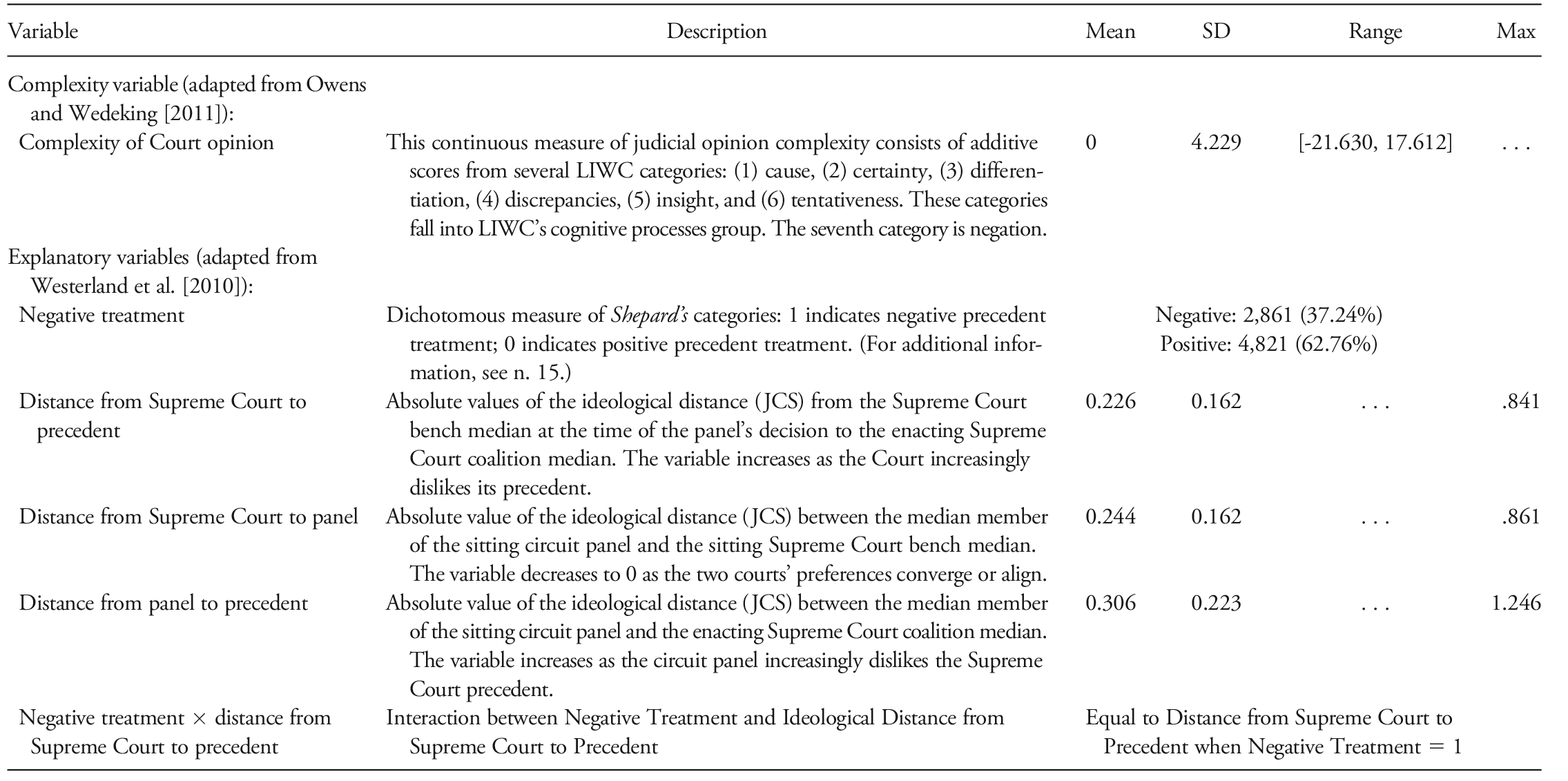
I analyzed the 7,682 opinions using LIWC to identify each opinion’s level of cognitive complexity. As identified in table 1, Complexity of Court Opinion, which is adapted from Owens and Wedeking (Reference Owens and Wedeking2011), is the product of several LIWC categories from the cognitive process group: (1) cause, (2) certainty, (3) differentiation, (4), discrepancies, (5) insight, and, (6) tentativeness. Additionally, in line with the original complexity measure from Owens and Wedeking (Reference Owens and Wedeking2011), I include a seventh category from LIWC: negations. I normalize each category to 0 before generating my additive scale, which is a single measure of Complexity of Court Opinion.Footnote 17 Table 1 provides definitions and summary statistics for variables of interest that I use in the empirical estimations that follow. In examining the components categories of Complexity of Court Opinion, my exploratory factor analysis retained a single dimension, as it was the only factor with an eigenvalue greater than 1 at approximately 1.903 (Kaiser Reference Kaiser1960).
Complexity, Precedent, and Preference Variable Definitions and Summary Statistics
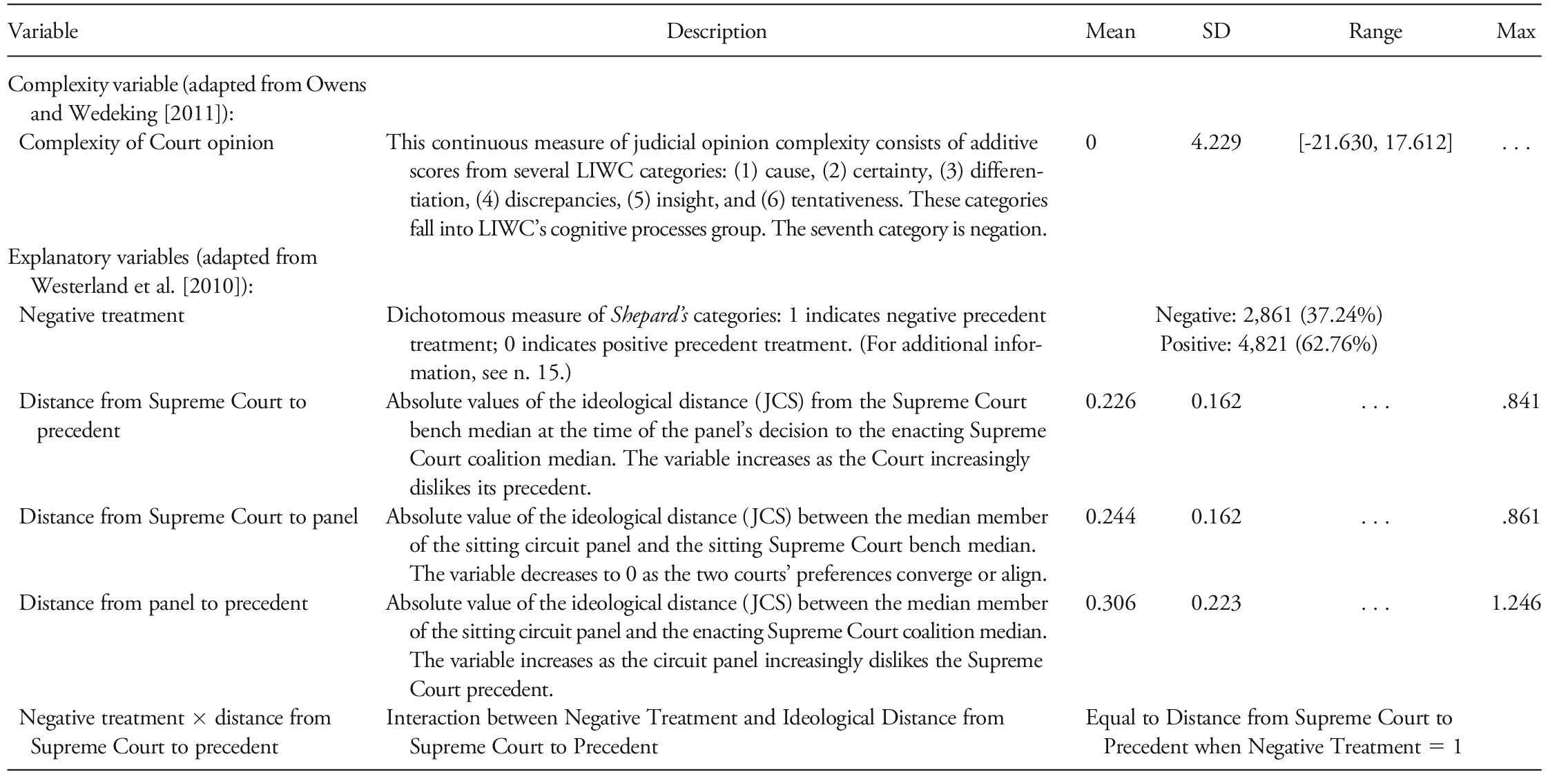
In addition to the measure of circuit opinion complexity, table 1 examines several other important variables, which are borrowed and adapted from Westerland et al. (Reference Westerland, Segal, Epstein, Cameron and Comparato2010). First, the data on precedent treatment are broken down into two categories: positive treatment and negative treatment.Footnote 18 In most of the empirical models that follow, this variable is operationalized as Negative Treatment, which is equal to 1 when the circuit court opinion treats the Supreme Court precedent negatively. The variable is equal to 0 when the circuit court treats the precedent positively.Footnote 19
Distance from Supreme Court to Precedent is a measure (using Judicial Common Space scores) of how much the contemporary Supreme Court—at the time of the circuit court panel’s decision—likes the existing Court precedent.Footnote 20 To be technical, Distance from Supreme Court to Precedent, which is also defined in table 1, is the absolute value of the spatial distance between the enacting Court’s majority coalition median and the contemporary Court’s bench median; as the median justice of the contemporary Court becomes more ideologically proximate to the median of the majority that enacted the precedent, the variable decreases to 0 and cannot take negative values.
This variable, in capturing the contemporary Court’s preferences, is how I operationalize the primary constraint imposed by the Supreme Court on lower courts. When Distance from Supreme Court to Precedent is large, the Court dislikes its precedent, and the circuit court panel need not worry about insulating negative treatment. On the other hand, when Distance from Supreme Court to Precedent is small, the Court likes its precedent, and the circuit court is constrained in negative precedent treatment. Negative treatment under such conditions increases the likelihood of review and reversal. Therefore, Distance from Supreme Court to Precedent, interacted with Negative Treatment, provides—in part—an examination of the Negative Treatment Hypothesis.
In the analysis that follows, Distance from Supreme Court to Precedent singularly examines the Positive Treatment Hypothesis. When Negative Treatment equals 0, the circuit court has positively treated the Court’s precedent. That also causes the interaction variable to equal 0. Therefore, Distance from Supreme Court to Precedent examines changes in opinion complexity given positive precedent treatment. As Distance from Supreme Court to Precedent increases, the bench median increasingly dislikes the Court’s prior precedent and would prefer negative treatment. Positive treatment, in turn, should lead to increases in opinion complexity in order for the circuit to insulate its opinion.
Table 1 details several additional covariates. Distance from Panel to Precedent identifies the circuit panel’s precedent preferences. Distance from Supreme Court to Panel measures the ideological alignment between the Court’s bench median and the circuit panel. I examine these control variables in greater depth in section 10.2 of the appendix.
Empirically Estimating Opinion Complexity
The hypotheses I identify above require me to examine cognitive complexity in circuit court opinions as an outcome variable, given variation in the key explanatory variables of interest: circuit court precedent treatment (i.e., Negative Treatment, with Positive Treatment as the reference category), the median justice’s preference for the treated precedent (Distance from Supreme Court to Precedent), and an interaction between those variables. These variables together allow me to empirically assess the Negative Treatment and Positive Treatment Hypotheses, which address the following questions. When a circuit court panel treats a precedent negatively, and that precedent is ideologically proximate to the current Court’s bench median, does the circuit court opinion increase in complexity? Conversely, when a circuit court panel treats a precedent positively, and that precedent is not ideologically proximate to the current Court’s median justice, does the circuit court opinion increase in complexity?
In order to straightforwardly answer these questions and test the hypotheses, I pursue two separate modeling strategies. First, I subset the circuit court opinion data according to what type of precedent treatment occurred (according to the Shepard’s treatment coding identified in table 1). Therefore, the 7,682 cases become distinct subsets (i.e., negative and positive) for separate bivariate regressions. Using Distance from Supreme Court to Precedent as my sole explanatory variable to predict Complexity of Court Opinion as my outcome variable, the bivariate regressions provide a clear-cut, initial test of my hypotheses.
Following that, I delve more deeply into different modeling strategies in order to more rigorously test my hypotheses. I employ both OLS multivariate regression and mixed effects multilevel models, both with different model specifications and interaction variables, in order to flesh out any potential empirical support for my hypotheses. In these models, Distance from Supreme Court to Precedent independently tests the Positive Treatment Hypothesis, while ideological distance, Negative Treatment, and their interaction jointly test the Negative Treatment Hypothesis.
Bivariate Regressions across Data Subsets
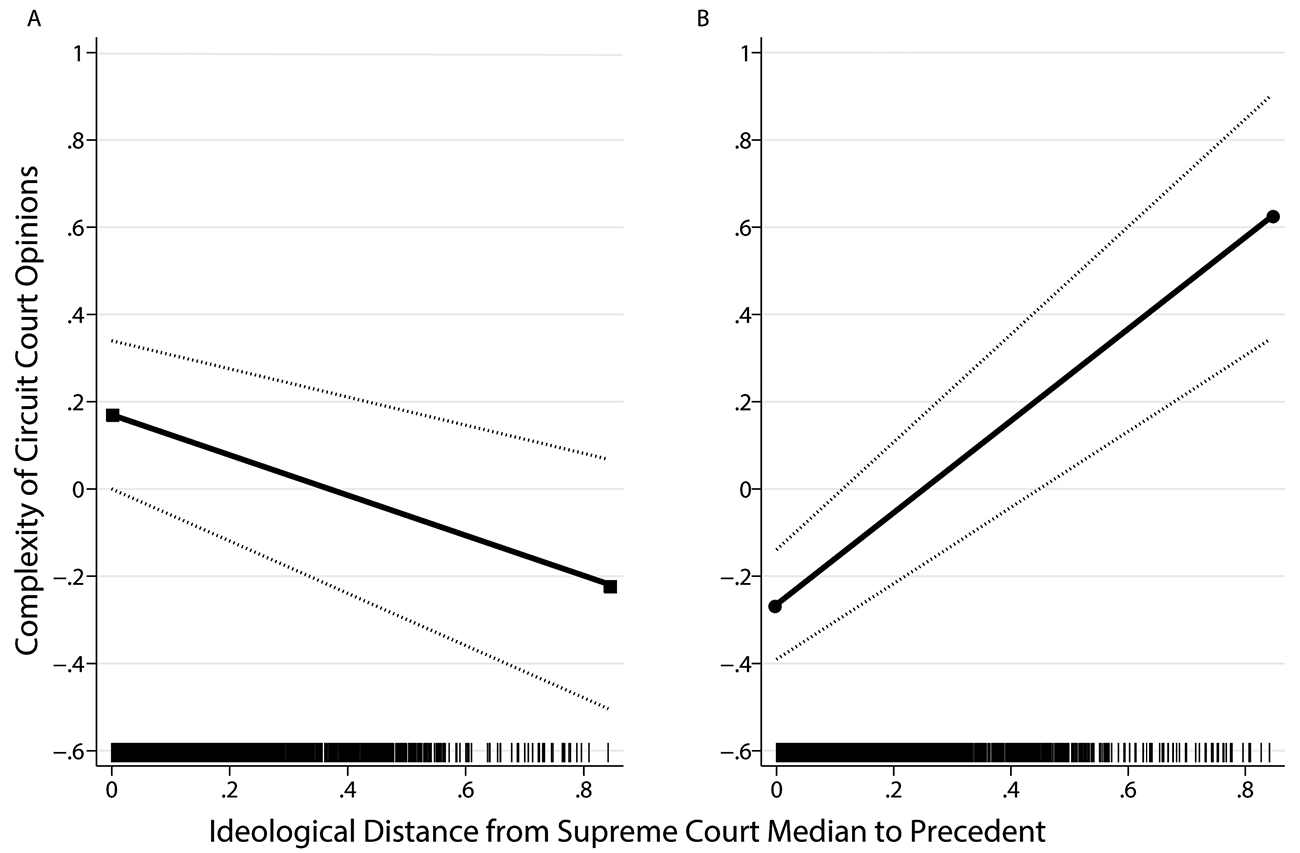
As a first test of my hypotheses, figure 1 displays the results of two independent bivariate OLS regressions, in which I use the contemporary Supreme Court median’s preferences for the treated precedents to predict circuit court opinion complexity across each precedent treatment type.Footnote 21 Figure 1A displays the results of the bivariate regression for negative precedent treatment cases, which amount to 2,861 cases of the entire 7,682 observations in the data set. Conversely, figure 1B uses the positive precedent treatment cases, which are 4,821 cases among the 7,682 observations.
Bivariate regressions of opinion complexity across precedent treatment
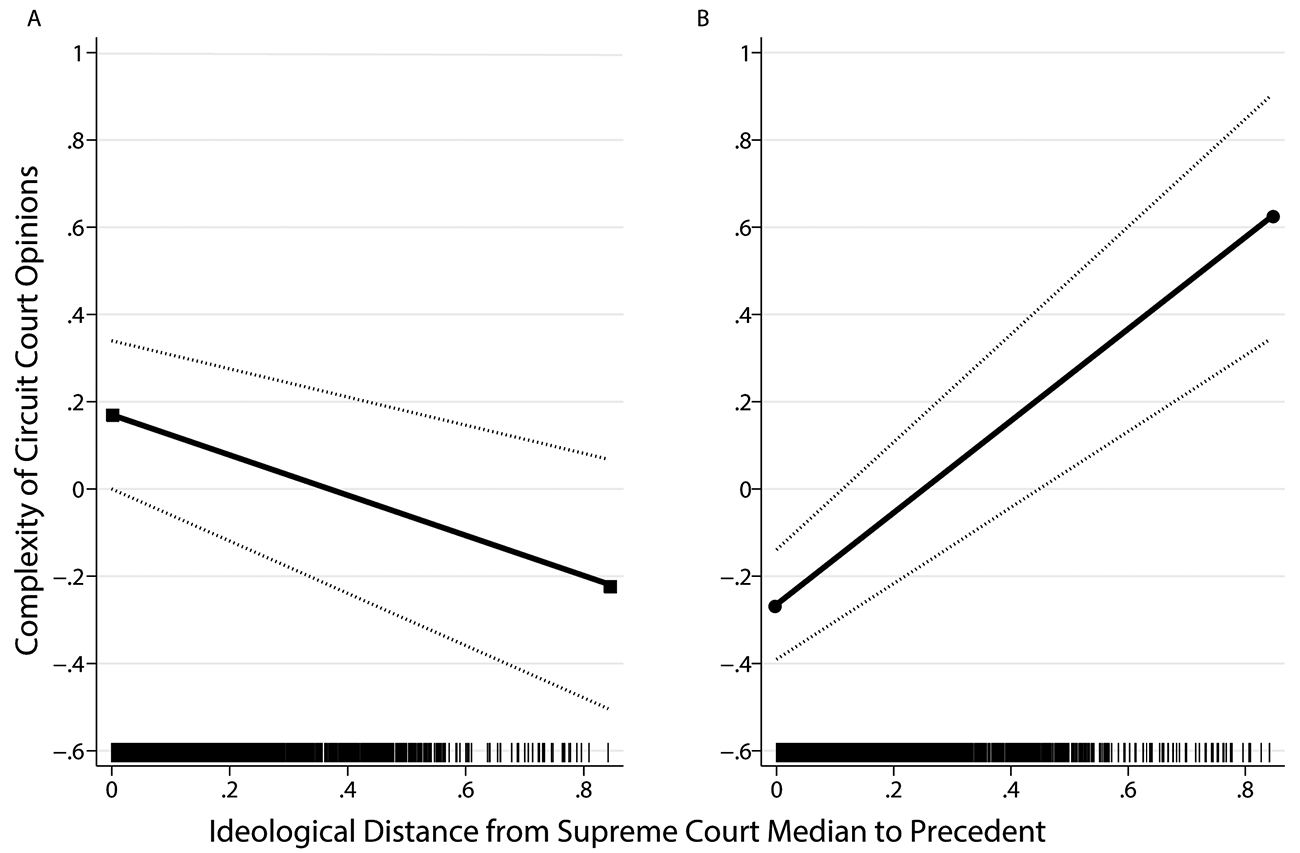
First, the negative treatment panel (fig. 1A) shows the negative relationship between Distance from Supreme Court to Precedent and Complexity of Court Opinion among negative treatment cases. The slope of the line suggests increasing complexity when the circuit negatively treats a precedent the Supreme Court increasingly prefers (moving from right to left along the x-axis). As the Supreme Court increasingly dislikes the precedent—that is, as ideological distance increases along the x-axis—circuit court judges have less reason to insulate negative treatment of that precedent, and I observe decreases in complexity. While the negative treatment panel of figure 1 provides some support for the Negative Treatment Hypothesis, the broad confidence intervals result in a lack of statistical reliability. This stems, in part, from using a subset of the data, including only 2,861 of the 7,682 observations, which leads to larger standard errors.
Second, I examine positive treatment—4,821 of 7,682 cases, representing a majority of the overall data—in figure 1B . There, we see that Complexity of Court Opinion is increasing as the Supreme Court increasingly dislikes the treated precedent. The increase is substantial and statistically reliable across the range of the graph, where an increase from the minimum to the maximum of Distance from Supreme Court to Precedent results in a nearly one-point increase in complexity. This plot provides strong, preliminary support for the Positive Treatment Hypothesis. While these isolated findings are encouraging, it is unclear whether the relationships will hold in aggregated models. That is the precise empirical exercise I present below.
Multivariate Regression Estimations
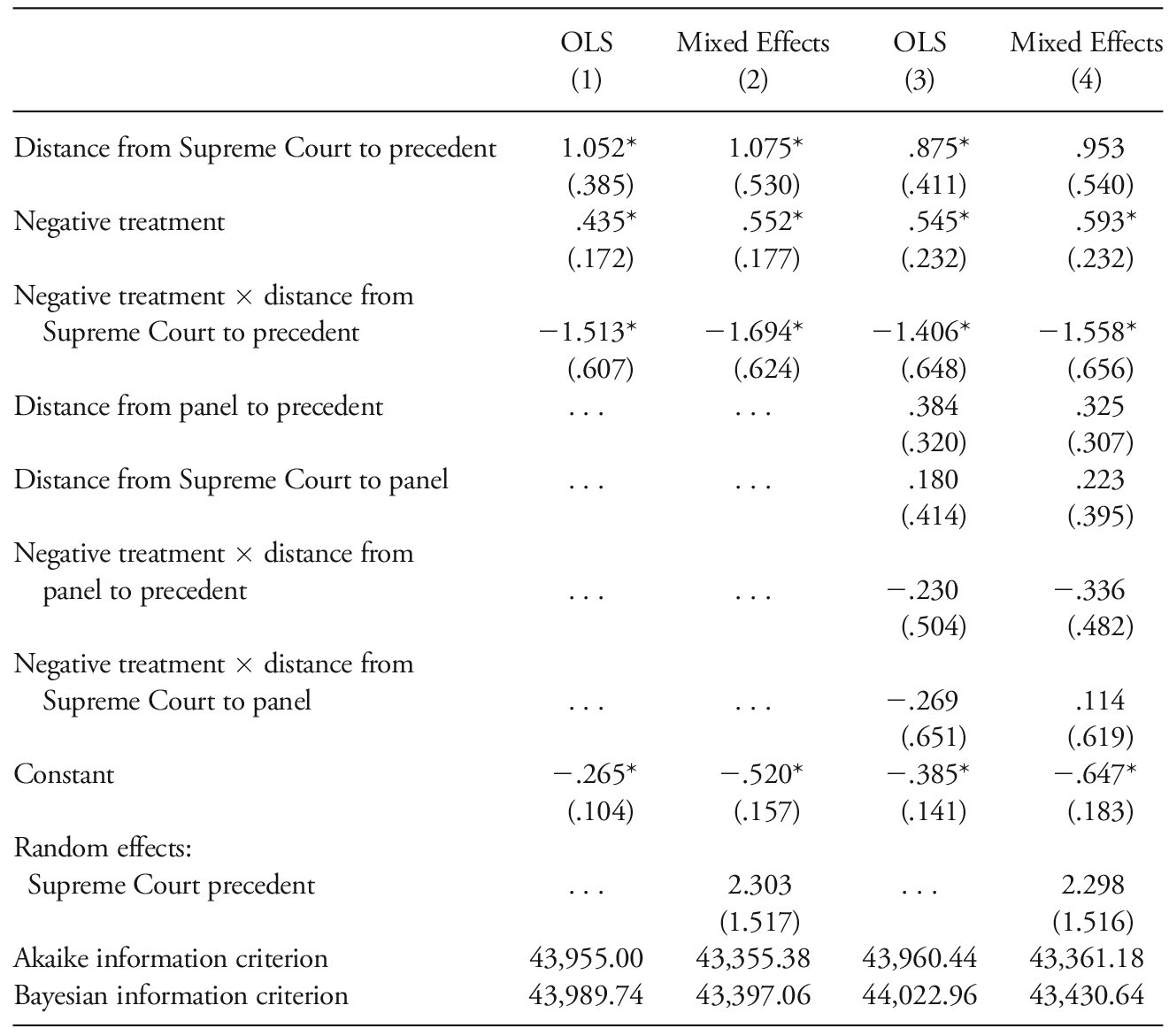
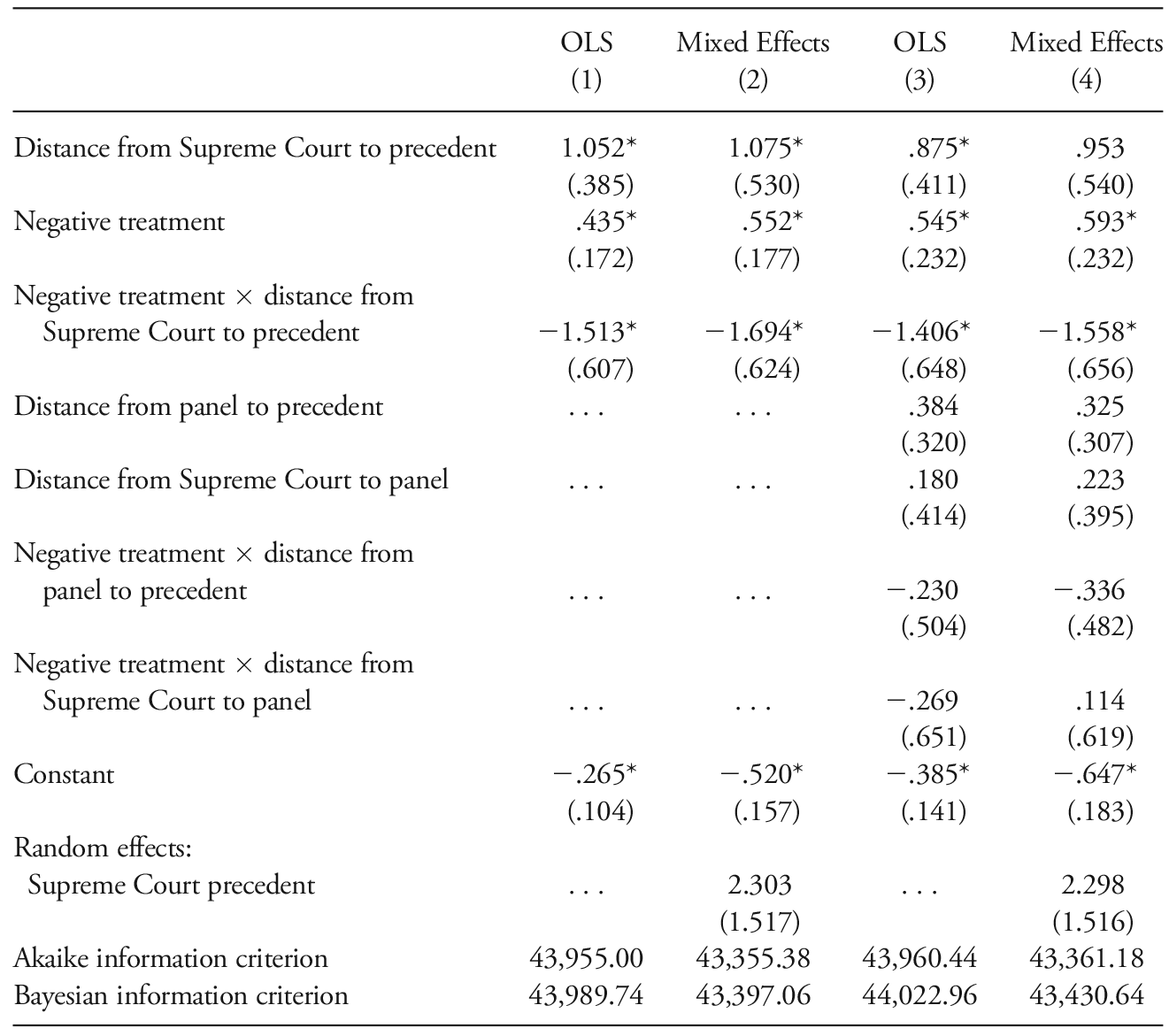
The multivariate regression estimations in this section employ the entire 7,682-observation data set, including both positive and negative treatment cases. To answer the questions restated above, table 2 provides regression estimations of cognitive complexity by using Complexity of Court Opinion as the outcome variable. First, columns 1 and 2 of table 2 display the results of two basic regression estimations, both of which include only the explanatory variables of interest mentioned above: treatment, ideological distance, and their interaction. Second, columns 3 and 4 display the results of more saturated regression estimations. These models allow me to control for the influence of potential confounding variables, which might be correlated with the predictors of interest and the outcome variable. The control variables include (1) the circuit court panel’s preferences for the treated precedent (Distance from Panel to Precedent) and (2) the ideological distance between the contemporary Court median and the circuit panel (Distance from Supreme Court to Panel). Descriptions of these variables are presented in table 1. Additionally, I interact those variables with Negative Treatment. As an example, controlling for the circuit judges’ precedent preferences is necessary as we can reasonably imagine those preferences might be correlated with both the choice of precedent treatment and the judge’s opinion writing. I will further discuss these control variables below.Footnote 22
OLS and Random Effects Multilevel Regression Estimations of Opinion Complexity
Notes.— Outcome variable is Complexity of Court Opinion. Multilevel model estimations allow for random intercepts across the 411 Supreme Court precedents cited by the circuit court opinions. N = 7,682.
* p < .05.
Furthermore, I pursue two distinct modeling strategies in table 2. The first is simply to estimate the relationship using OLS regressions, which are displayed in columns 1 and 3. The second strategy, displayed in columns 2 and 4, is to use random effects multilevel models, which allow for correlation among responses from the same clusters. In this case, I allow for correlation among circuit cases that treat the same Supreme Court precedent. These models allow for random intercepts for each treated precedent.Footnote 23 All of these models provide insights on the questions and hypotheses discussed above. In summary, a circuit court’s negative treatment of a Supreme Court precedent that the Court median increasingly prefers leads to increases in circuit court opinion complexity. Also, circuit court opinion complexity tends to increase when a circuit panel positively treats a precedent that the contemporary Court median increasingly dislikes.
In examining the Negative Treatment Hypothesis, I am interested in three variables: Negative Treatment, Distance from Supreme Court to Precedent, and the interaction variable, Negative Treatment × Distance from Supreme Court to Precedent. The coefficient for Negative Treatment represents the level of complexity when Negative Treatment is present in a circuit opinion and Distance from Supreme Court to Precedent is 0, which is when the contemporary Supreme Court median is in perfect alignment with the Court’s precedent and would most want the precedent to be treated positively. The interaction term would, likewise, be equal to 0 under such circumstances. In other words, when the contemporary Court median highly prefers its precedent, Negative Treatment informs us of the level of Complexity of Court Opinion to which the circuit court resorts when negatively treating the precedent. The coefficient for Negative Treatment is positive and statistically reliable, meaning that circuit opinions have higher levels of opinion complexity than do positive treatment cases when the Supreme Court median highly prefers its precedent (i.e., distance equals 0).
The interaction between Negative Treatment and Distance from Supreme Court to Precedent allows me to explore how variations in Supreme Court preferences drive this process, especially as the median justice increasingly dislikes the precedent being treated. In examining the Negative Treatment Hypothesis, this interaction variable informs us how Complexity of Court Opinion changes given two joint conditions: first, Distance from Supreme Court to Precedent increases from 0; second, the circuit court negatively treated the Supreme Court precedent. In all four columns presented in table 2, the coefficient estimate for the interaction variable is both statistically significant and substantively and directionally appropriate, suggesting that when the circuit court negatively treats a Court precedent that the bench median increasingly prefers, the panel’s opinion becomes more complex. The converse also holds, where the circuit’s negative treatment results in decreasing complexity when the Court median increasingly dislikes the treated precedent.
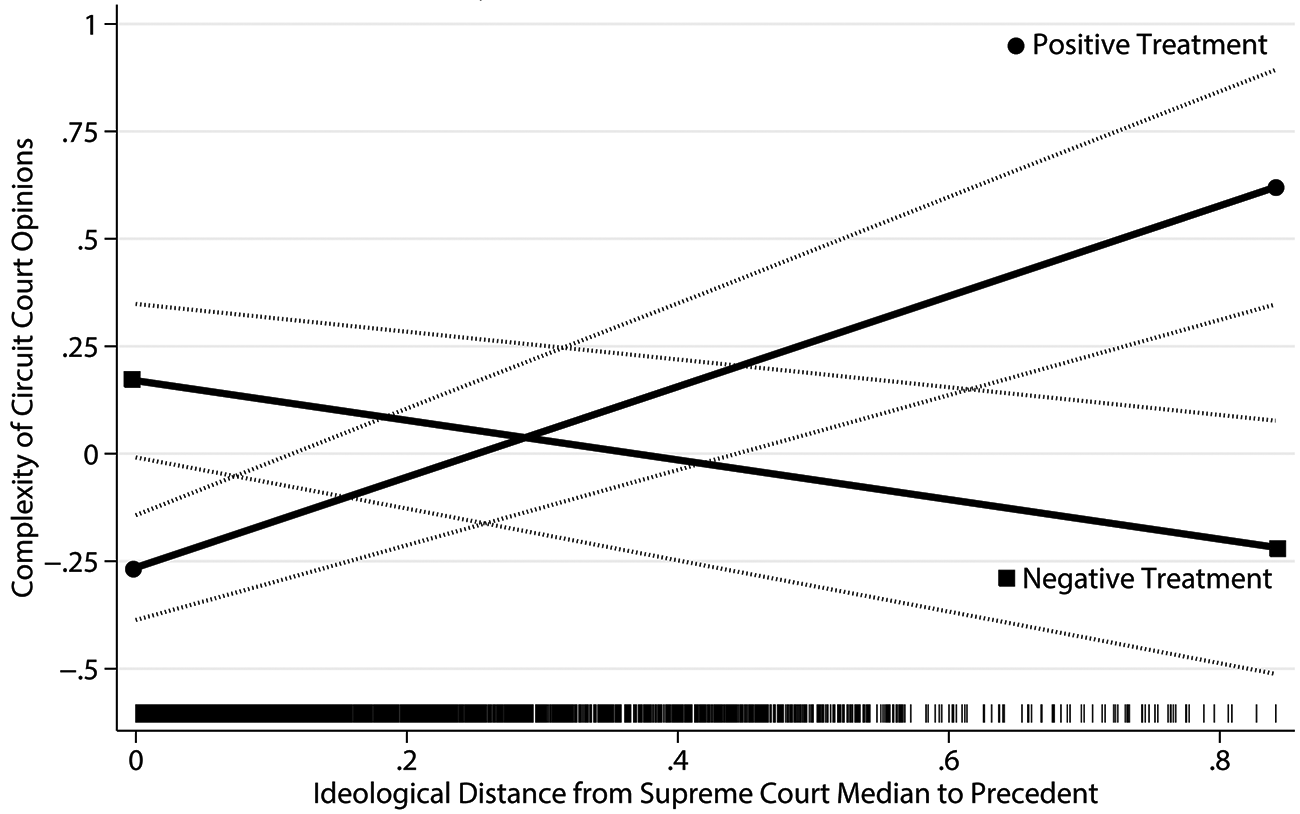
Of course, given the nature of interaction variables, I must also consider the concomitant influence of Distance from Supreme Court to Precedent, as it is a constitutive term in the interaction variable. Therefore, as stated above, it is all three explanatory variables of interest that test the Negative Treatment Hypothesis. Given the additive relationship between the coefficients, it seems that there is at least some evidence that negative treatment cases are distinct from positive treatment cases across the range of Distance from Supreme Court to Precedent. Still, it is much clearer from these coefficients that the three-way relationship among Negative Treatment, Distance from Supreme Court to Precedent, and Complexity of Court Opinion is sloping negative. That is, given increases in Distance from Supreme Court to Precedent and Negative Treatment, I always observe lower levels of complexity. This relationship, which I first found in figure 1, is reiterated in figure 2. In sum, I am confident that in cases in which a circuit court panel negatively treats a precedent, the Supreme Court median’s increasing preference in favor of those precedents leads to increases in opinion complexity.
Opinion complexity, Supreme Court preferences, and circuit precedent treatment
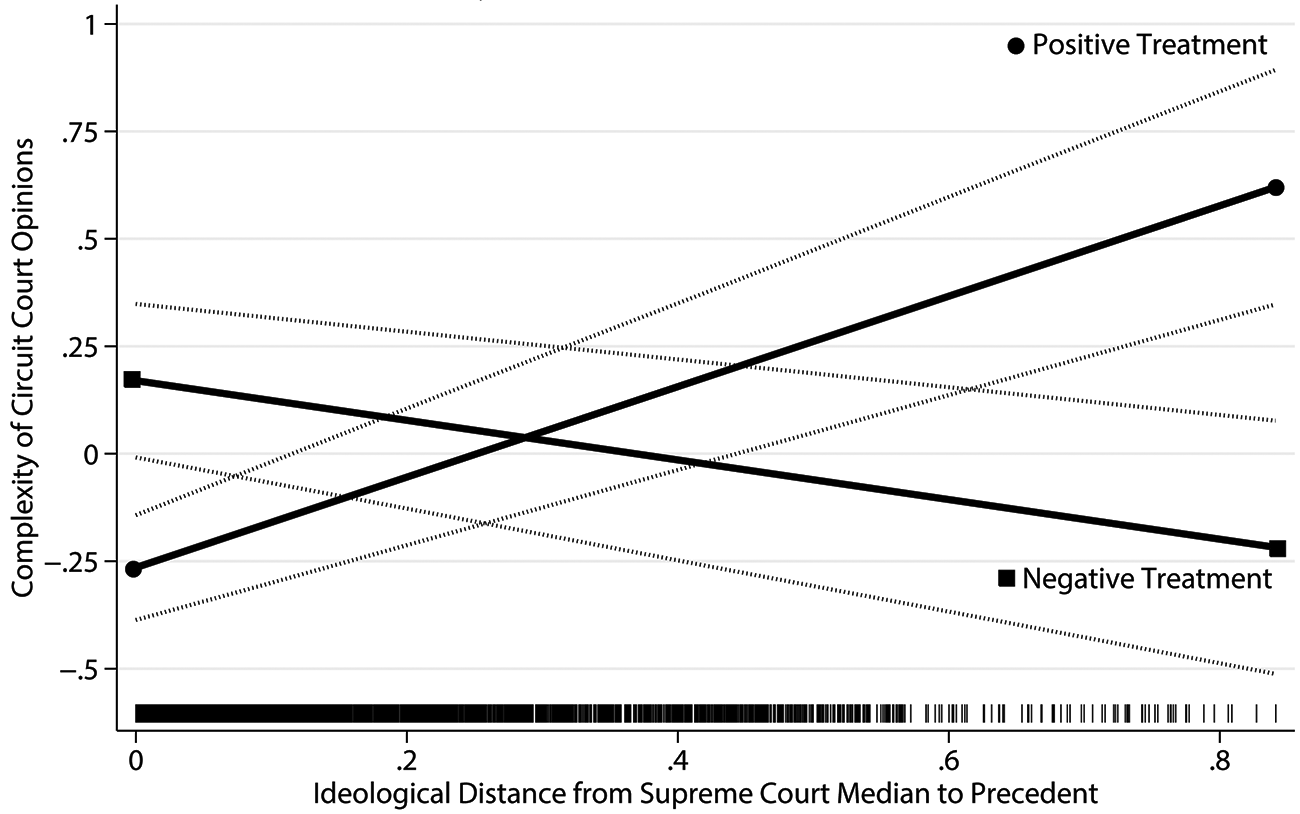
To evaluate the Positive Treatment Hypothesis, I look to the coefficient estimates for Distance from Supreme Court to Precedent, as it represents the change in complexity when the circuit panel does not negatively treat the Court’s precedent (making both Negative Treatment and the interaction variable equal to 0). In three of the four columns, Distance from Supreme Court to Precedent is statistically reliable. Column 4’s coefficient approaches statistical significance, and it likely would achieve it at a lower threshold. In all four columns, the coefficient is in the substantively appropriate direction, suggesting increasing opinion complexity as the Supreme Court increasingly dislikes the positive precedent treatment. The converse is also true: as the Supreme Court increasingly prefers its precedent and the panel treats that precedent positively, I find evidence of decreases in opinion complexity. These results are plotted in figure 2.
Turning to the control variables in columns 3 and 4 of table 2, the results are consistent across modeling strategies. The hypothesized relationships between the Court median’s precedent preferences and circuit precedent treatment hold despite two important considerations: (1) the circuit panel’s own preferences for the precedent and (2) the ideological alignment between the circuit panel and the contemporary Supreme Court median.Footnote 24 The control variable for Distance from Supreme Court to Panel does not affect the results of the model estimations for Complexity of Court Opinion. The same is the case for Distance from Panel to Precedent; as the panel increasingly likes the precedent in question, I find no evidence for changes in opinion complexity. That strongly suggests that, while the circuit panel’s preferences might be correlated with precedent treatment, those preferences are not necessarily influencing the decision to write a more or less complex opinion. Likewise, the ideological alignment within the hierarchical relationship—something that might trigger more or less shirking or insulation by the lower court—has a statistically indistinguishable effect on opinion complexity. Furthermore, the presence of random intercepts for the treated Supreme Court precedent in columns 2 and 4 do not influence the substantive support for either hypothesis. Finally, the joint presence of (1) the confounding variables and (2) random intercept terms in the column-4 model cause Distance from Supreme Court to Precedent to edge outside statistical reliability.
The results from table 2’s column 1 are plotted in figure 2, which has a rug to indicate the distribution of Distance from Supreme Court to Precedent. Of primary concern in figure 2 is the difference between the slopes of the lines, as the hypotheses discussed above concern changes in complexity given circuit precedent treatment and Supreme Court preferences. While the confidence intervals on the precedent treatment estimations are quite large, the slopes are distinct and, furthermore, supportive of the expected relationships.
Given negative treatment and as the Court median increasingly prefers its precedent (Distance from Supreme Court to Precedent goes to 0), Complexity of Court Opinion increases substantially. In other words, when the circuit panel knows the Supreme Court bench median prefers a precedent that the panel negatively treats, the panel’s opinion increases in complexity. Furthermore, I find evidence in figure 2 that positive treatment leads to the expected changes in opinion complexity. When the circuit opinion positively treats a precedent that the Supreme Court bench median increasingly dislikes (i.e., moving from left to right on the x-axis), opinion complexity increases. From the minimum to the maximum of Distance from Supreme Court to Precedent, the change in Complexity of Court Opinion exceeds 0.35 for negative treatment and 0.75 for positive treatment. It is important again to note that the changes in complexity along the y-axis are additive scores of seven LIWC categories.
Aside from the distinct slopes of the plotted lines, the confidence interval overlap is rather significant. Where the lines are statistically distinguishable, I can say to have found evidence that opinion complexity is the result of (1) legal interpretation (i.e., the choice between positive and negative precedent treatment) by a circuit court panel and (2) the Supreme Court’s preference for the treated precedent. In particular, we see that the y-axis intercepts for the Negative Treatment and Positive Treatment lines are statistically distinguishable from one another, suggesting support for both hypotheses at the lowest levels of ideological distance. On the left side of figure 2 (at low levels of Distance from Supreme Court to Precedent), Positive Treatment corresponds to lower levels of opinion complexity than does Negative Treatment.
Proceeding from the left-hand side of the graph, the confidence intervals for the Negative Treatment and Positive Treatment lines begin to overlap around .1 or so on the x-axis. Despite that, I have some reason to believe the two lines are still statistically distinguishable for part of this overlapping region (Austin and Hux Reference Austin and Hux2002; Black and Boyd Reference Black and Boyd2010; Boyd Reference Boyd2013). In any event, where the two lines overlap is where I have the weakest evidence for the two hypotheses. To be sure, though, the slopes of the lines are distinguishable. And as the Court median increasingly dislikes its precedent, the Positive Treatment and Negative Treatment lines are significantly different from one another around .6 on the x-axis. On the right-hand side of the graph, Positive Treatment and Negative Treatment lead to different levels of opinion complexity at high levels of ideological distance.
In sum, table 2 and figure 2 provide evidence of significant increases in Complexity of Court Opinion as a result of negative precedent treatment and the Supreme Court median’s strong preference for the treated precedent. Similarly, I have evidence that a circuit panel’s positive precedent treatment can also lead to changes in opinion complexity depending on the Supreme Court’s preferences regarding that precedent. These results largely hold in the face of possible confounding variables in columns 3 and 4 of table 2, which I would have strong reason to believe would influence both precedent treatment and opinion complexity.Footnote 25 Finally, the results also hold given different specifications of the complexity outcome variable, which I explore further in the appendix.Footnote 26
Further Research and Conclusions
As text analysis continues to increase in popularity and advance in its methodologies, scholars will investigate topics like opinion complexity with increasing frequency and rigor. By exporting the concept of opinion complexity from the separation-of-powers literature (Staton and Vanberg Reference Staton and Vanberg2008; Owens et al. Reference Owens, Wedeking and Wohlfarth2013) to the judicial hierarchy, I have examined one particular strategic maneuver at the disposal of circuit court judges when they are making law in contravention of their principal’s preferences. In particular, the theoretical story and the empirical evidence support the idea that the need for opinion complexity is greater when a circuit panel is not doing what the Supreme Court would prefer. When a circuit negatively treats a precedent—more particularly, a precedent the Supreme Court prefers—the circuit author writes a more complex opinion. When a circuit positively treats a precedent—a precedent the Supreme Court dislikes—the circuit judge again authors a more complex opinion. In particular, negative precedent treatment, a strong instrument in judicial policy making, sets a different trajectory for that precedent than what the Supreme Court justices would have done themselves. Likewise, positive precedent treatment might expand a legal doctrine to a new factual circumstance, and the Supreme Court might not have preferred that outcome.
While the theory above purports to tell a story about how complex opinions arise out of strategic judicial behavior, the story is certainly not the only one. Several avenues remain unexamined and are likely worthy of scholarly attention. First, legal texts tend to be the progeny of other texts, just as particular cases are the progeny of precedents. As such, it is possible that complexity is textually heritable. Indeed, Staton and Vanberg (Reference Staton and Vanberg2008, 505) suggest as much, stating that vague precedents in a particular legal issue might lead to ambiguous opinions. It is without question that the data from this study would, in part, allow for examining such a question. Furthermore, the progenitive text need not be a court precedent but rather could be an ambiguous statute, constitutional provision, or historical text—any legal document that would act as the foundation for a future legal argument.
Second, as opinion complexity continues to be applied within hierarchical studies, it is possible to determine whether or not complexity has an effect on subsequent behavior. While this study examined whether and how opinion complexity might arise systematically in response to perceived constraints, it does not test whether complexity has the desired effect of insulating the circuit court’s decision. In other studies, Owens and Wedeking (Reference Owens and Wedeking2011) find evidence of systematic, although nonideological, variation in opinion complexity across Supreme Court justices. In turn, Owens et al. (Reference Owens, Wedeking and Wohlfarth2013) find evidence for an argument similar to what was put forth by Staton and Vanberg (Reference Staton and Vanberg2008)—that agents of a particular principal can increase the costs of unfavorable review by formulating policy in a more complex or obfuscated manner. While this argument can be applied to any principal-agent relationship—whether it is Congress or the president or a bureaucratic agency—it is ripe for application to the courts. Therefore, it is worthwhile to ask how opinion complexity predicts the behavior of reviewing courts, particularly circuit courts sitting en banc or, potentially, the Supreme Court.
Third, the theory and corresponding empirical models in this study assume a role for a circuit court judge’s preferences in determining precedent treatment.Footnote 27 To improve this study, the theory and model estimations should explicitly define and measure the opinion author’s preferences, even going so far as to look at the judge’s prior treatments of the precedent in question. After all, Westerland et al. (Reference Westerland, Segal, Epstein, Cameron and Comparato2010) found evidence that circuit court judges were not preference seeking when they made decisions about whether to comply or defy high court precedents. It is possible that circuit court judges exhibit no sincere preference-seeking behavior, and their precedent treatment decisions are largely dictated by the preferences of their principal. Indeed, there appear to be many potentially interesting research questions about the interactions between precedent and opinion language in the process of judicial lawmaking.
This study continues the recent trend in examining the content of court opinions, which are the primary product of judicial policy making. So often judicial scholars and their peers in other subfields are left studying individual votes. Judicial merits votes, congressional roll call votes, and the like are only part of the policy-making story. Therefore, just as it is wise for congressional scholars look to statutory texts for empirical evidence of systematic variation in policy-making procedures, so too is it wise for judicial scholars to look at court opinions. The texts put forth by institutions—whether they are judicial opinions, bureaucratic rules, legislative statutes, or executive orders—are the policy outcomes we strive to study.