INTRODUCTION
The family Boholinidae Fosshagen & Iliffe, Reference Fosshagen and Iliffe1989 was established on the basis of morphological characteristics as follows: (1) well-developed mouthparts; (2) primitive three-segmented rami on P1–P4; (3) three-segmented exopod and slightly reduced two-segmented endopod in female P5; (4) male right antennule geniculate; and (5) highly complex grasping male P5 (Fosshagen & Iliffe, Reference Fosshagen and Iliffe1989). Its single genus, Boholina, was also described as having a three-segmented urosome in females and a four-segmented urosome in males. However, Boxshall & Jaume (Reference Boxshall and Jaume2012) verified by examination of the types of B. crassicephala Fosshagen & Iliffe, Reference Fosshagen and Iliffe1989 that the anal somite of the urosome had been overlooked in both sexes and the species of the genus Boholina have four and five urosomites in the female and the male, respectively (Boxshall & Jaume, Reference Boxshall and Jaume2012). To date, boholinid copepods comprise four species within a single genus: B. crassicephala Fosshagen & Iliffe, Reference Fosshagen and Iliffe1989, B. purgata Fosshagen & Iliffe, Reference Fosshagen and Iliffe1989, B. parapurgata Boxshall & Jaume, Reference Boxshall and Jaume2012, and B. munaensis Boxshall & Jaume, Reference Boxshall and Jaume2012. Of these species, the first two were collected in the water column of an anchialine cave on the island of Bohol in the central Philippines (Fosshagen & Iliffe, Reference Fosshagen and Iliffe1989), and the last two were found in anchialine and brackish habitats on the coast of Muna Island, south-east of Sulawesi, Indonesia (Boxshall & Jaume, Reference Boxshall and Jaume2012).
We recently found a new Boholina species in burrows of the manicure crab, Cleistostoma dilatatum (De Haan, 1833), which predominantly occurs in muddy habitats along the north-west Pacific (Ono, Reference Ono1965; Miura et al., Reference Miura, Yano, Matssuo and Sato2004). In calanoid copepods, such a symbiotic association with other organisms is very rare and only some members of the genus Ridgewayia Thompson & A. Scott, 1903 have been described in association with pearl oysters, cave corals, sea anemones, and cnidarians (Thompson & Scott, Reference Thompson and Scott1903; Humes & Smith, Reference Humes and Smith1974; Fosshagen & Iliffe, Reference Fosshagen and Iliffe1991; Huys & Boxshall, Reference Huys and Boxshall1991). This new species is described from the north-west Pacific and its morphological relationships with its congeners are discussed.
MATERIALS AND METHODS
Copepods were collected from an inter-tidal mudflat at Ganghwa Island in western Korea (37°36′19′′N 126°30′56′′E). Ganghwa Island, located in the mid-western part of the Korean Peninsula, has a large tidal range and tidal flats covering 105 km2. In particular, the study area (37°36′19′′N 126°30′56′′E) is open to the sea and harbours small tributary channels branching off from a main tidal channel. This area is affected by freshwater inflowing from the Han River through the major channel and tides are semi-diurnal with a tidal range between 8 m at spring tide and 4 m at neap tide. There are many burrows constructed by a number of crabs: Cleistastoma dilatatum (De Haan, 1833) and Macrophthalmus (Mareotis) japonicus (De Haan, 1835) and polychaetes, Periserrula leucophryna Paik, 1977 and Nereis aibuhitensis (Grube, 1878) (Koo et al., Reference Koo, Kwon and Hyun2005). The burrows extend to the small tidal channels. Copepods were captured using an improved flexible suction tube from burrows of the manicure crab, C. dilatatum, and washed using a hand-held net of 100 µm mesh size. Copepod specimens were preserved in 70% ethanol or 5% neutralized formalin in seawater. Before dissection and microscopic observation, specimens were immersed in lactic acid for about an hour. The dissection of specimens was carried out using the reverse slide method of Humes & Gooding (Reference Humes and Gooding1964). The rostrum, genital double-somite and swimming legs were examined with a scanning electron microscope (Hitachi S-4700) to show some morphological details more clearly. The descriptive terminology proposed by Huys & Boxshall (Reference Huys and Boxshall1991) was adopted. Abbreviations used in text and figures are as follows: ae, aesthetasc; P1–P5, first to fifth swimming legs. The type specimens are deposited in the National Institute of Biological Resources (NIBR), Incheon, Korea.
RESULTS
SYSTEMATICS
Subclass COPEPODA Milne-Edwards, 1830
Order CALANOIDA Sars, 1902
Family BOHOLINIDAE Fosshagen & Iliffe, Reference Fosshagen and Iliffe1989
Genus Boholina Fosshagen & Iliffe, Reference Fosshagen and Iliffe1989
Boholina ganghwaensis sp. nov.
(Figures 1–5)
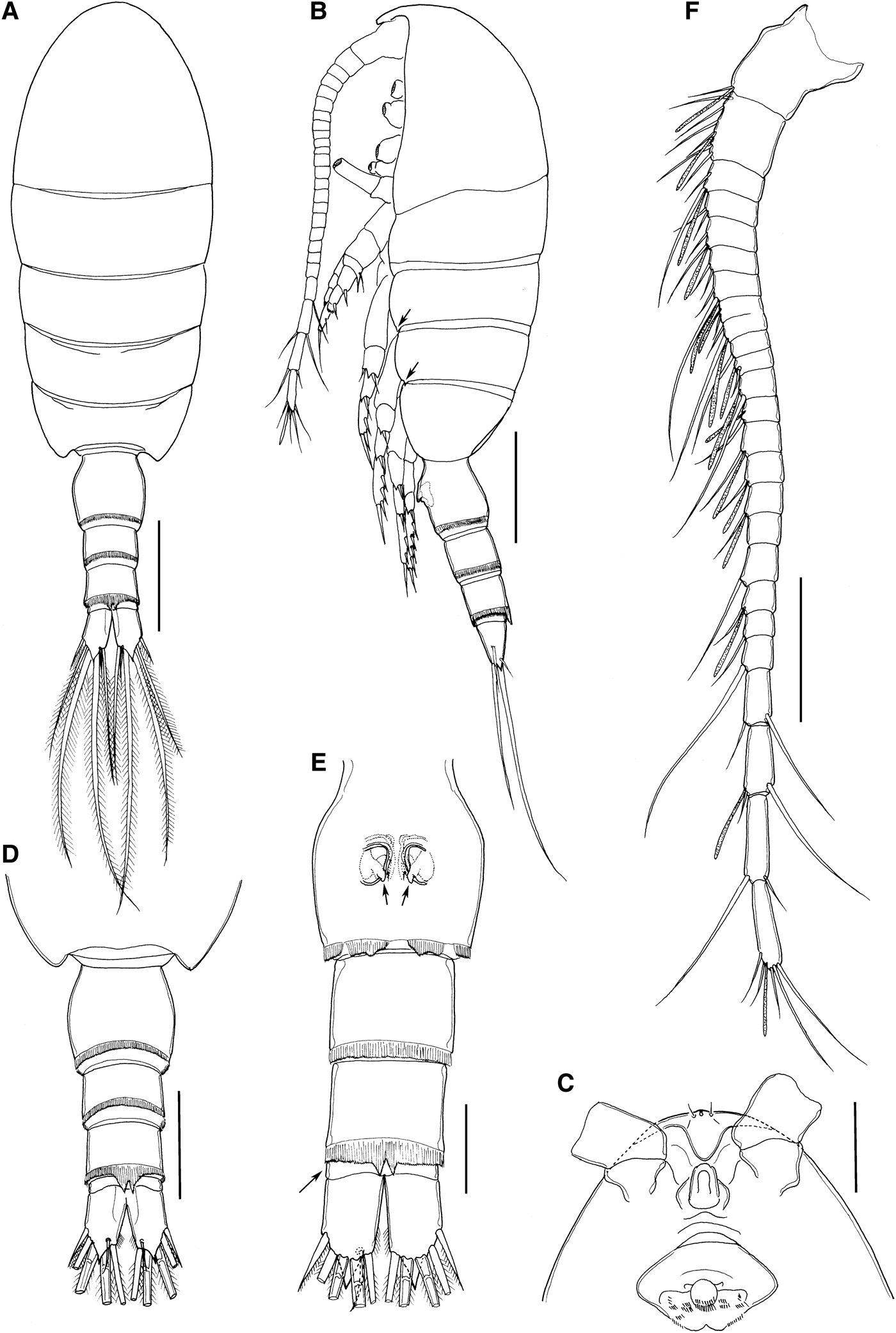
Boholina ganghwaensis sp. nov. Female (paratype): (A) habitus, dorsal view; (B) habitus, left lateral view; (C) rostrum, ventral view; (D) urosome, dorsal view; (E) urosome, ventral view, hoop-like anal somite (arrowed); (F) antennule. Scale bars: A,B, 200 µm; C,D, 100 µm; E, 50 µm.

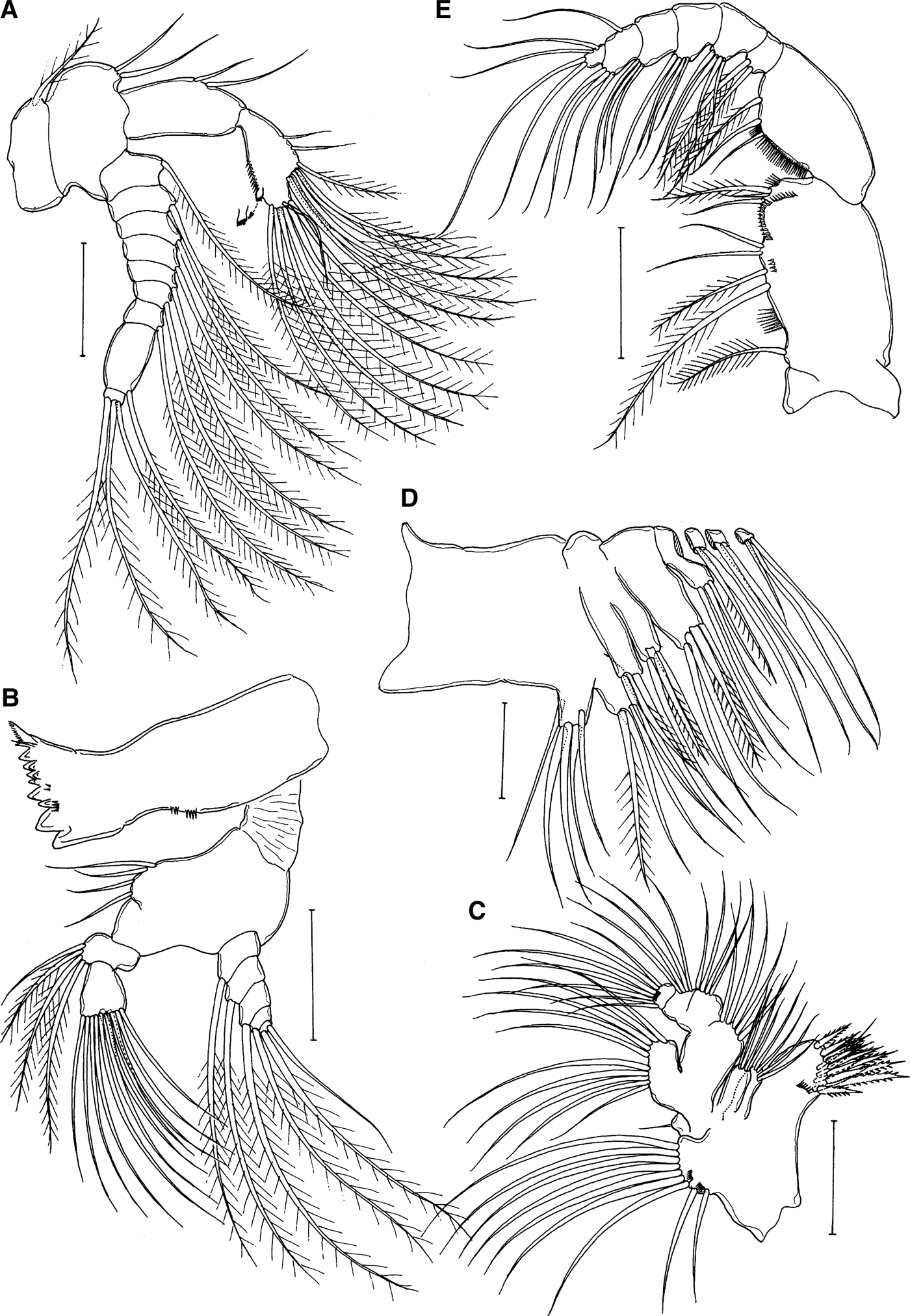
Boholina ganghwaensis sp. nov. Female (paratype): (A) antenna; (B) mandible; (C) maxillule; (D) maxilla; (E) maxilliped. Scale bars: A–C, E, 50 µm; D, 20 µm.
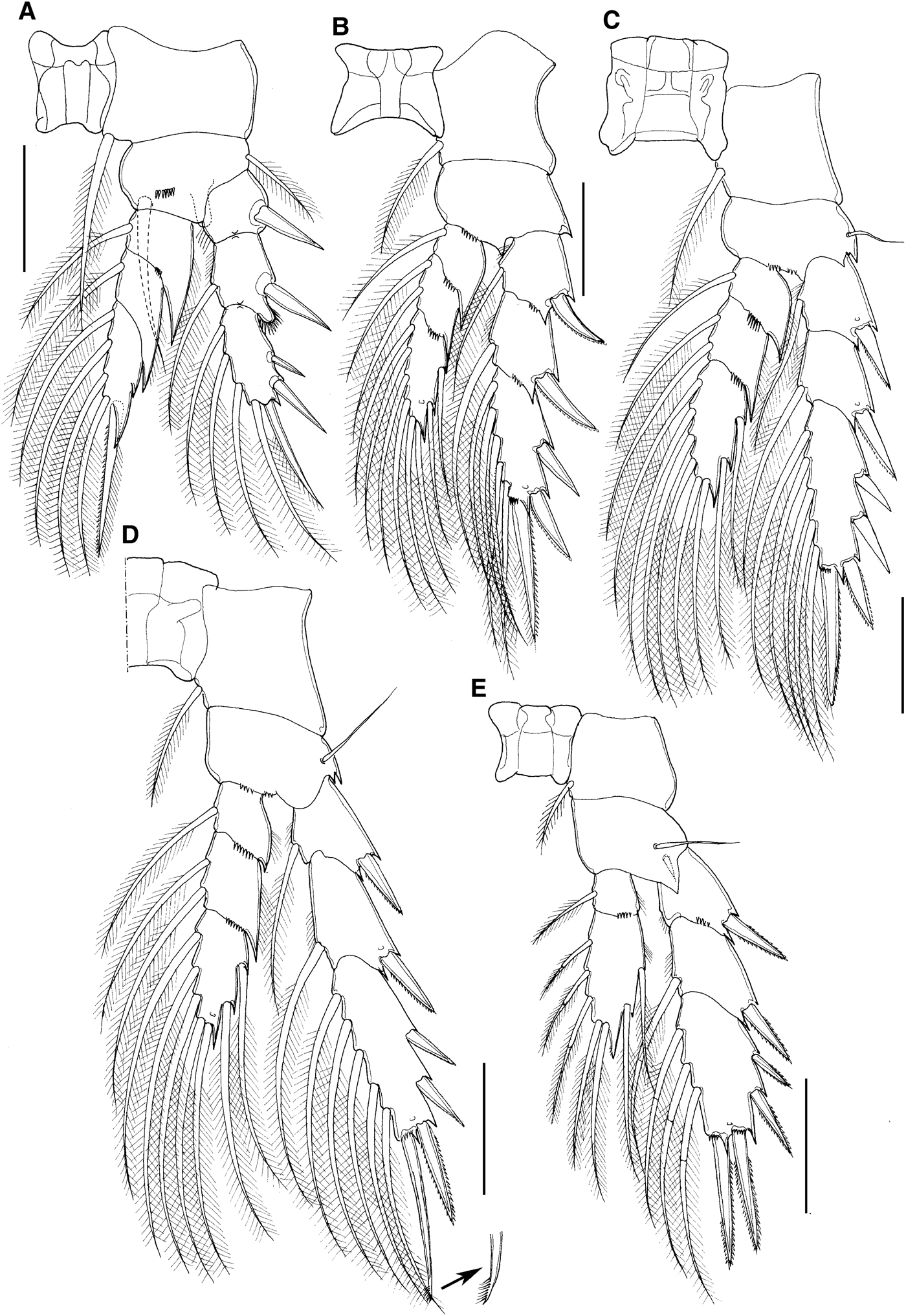
Boholina ganghwaensis sp. nov. Female (paratype): (A) P1; (B) P2; (C) P3; (D) P4; (E) P5. Scale bars: A–E, 50 µm.
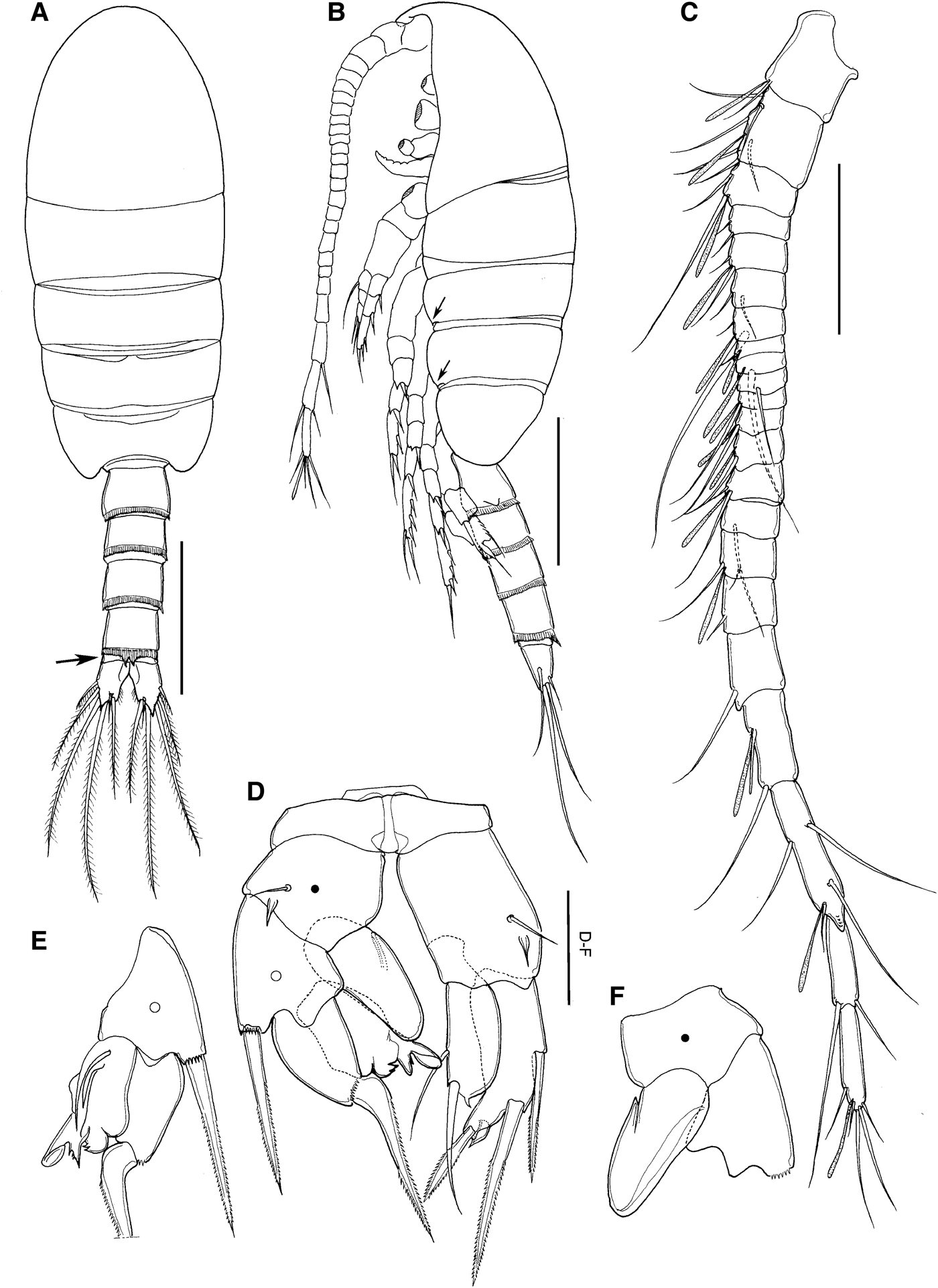
Boholina ganghwaensis sp. nov. Male (paratype): (A) habitus dorsal view, hoop-like anal somite arrowed; (B) habitus, left lateral view; (C) right antennule; (D) fifth legs, posterior view; (E) left P5 exopod, anterior view; (F) left P5 endopod, anterior view. Scale bars: A,B, 200 µm; C, 100 µm; D, 50 µm.
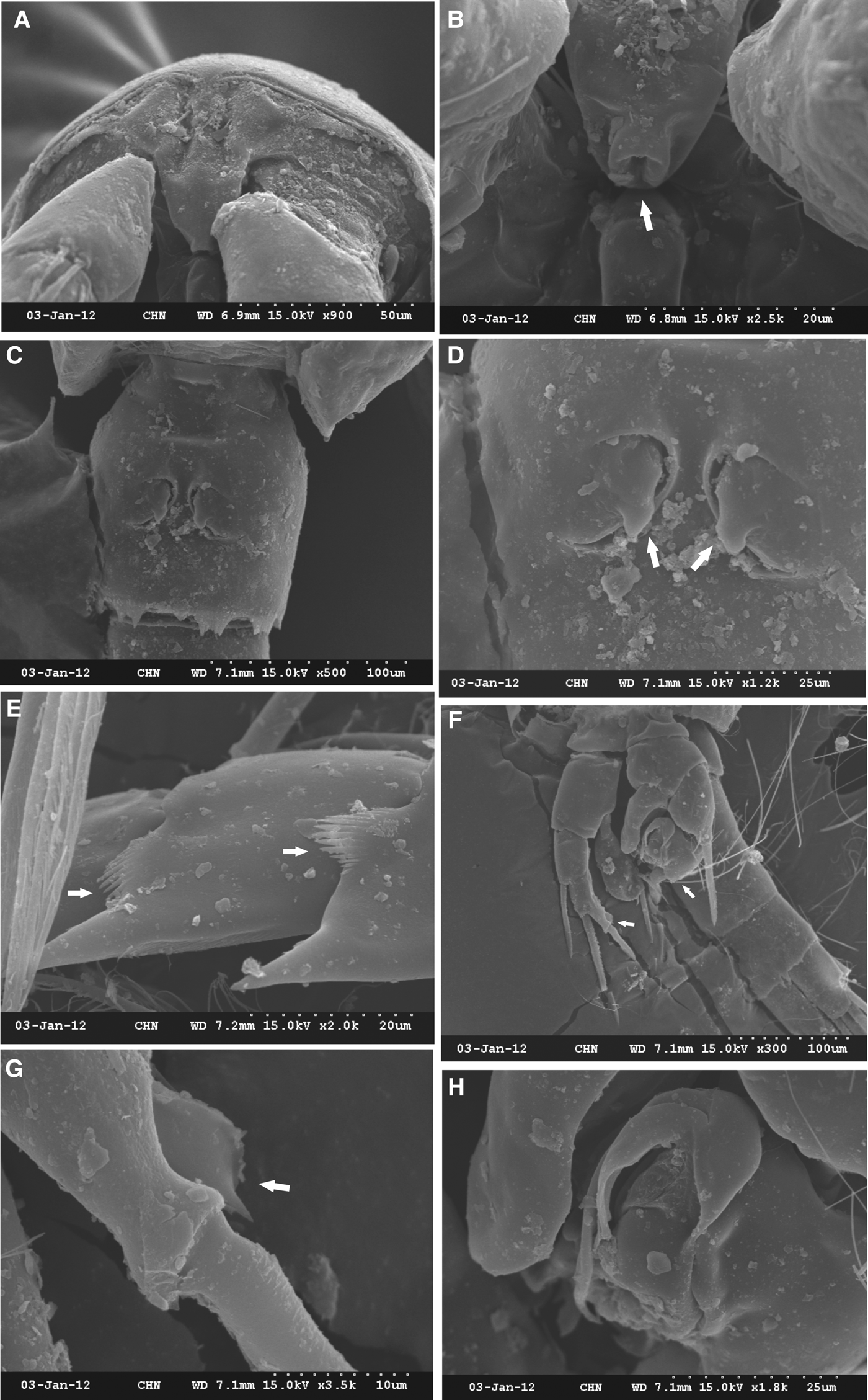
Scanning electron microscopy micrographs of Boholina ganghwaensis sp. nov. Female: (A, B) rostrum, ventral view; (C, D) genital aperture of genital double-somite, ventral view; (E) first and second segments on exopod of P3, ventral view. Male: (F) fifth legs, anterior view; (G) tip of exopod of right P5; (H) third exopodal segment of left P5. Arrows indicate the pore on rostrum, spinules, and process.
TYPE MATERIAL
Holotype: female (NIBRIV0000245276), allotype male (NIBRIV0000245277), six paratype females (NIBRIV0000245278), and four paratype males (NIBRIV0000245279) preserved in 70% ethanol deposited in the NIBR. Dissected paratypes (2 ♀♀, 2 ♂♂) are retained in the collection of the first author. All specimens from the type locality collected using a flexible suction tube from burrows of the manicure crab, Cleistostoma dilatatum, on 10 August 2010 by the first author (S.Y.M). The description below is based on the paratypes.
ADDITIONAL MATERIAL EXAMINED
One female and seven males preserved in 70% ethanol from the type locality from burrows of the manicure crab, C. dilatatum, on 22 June 2011 by the first author (S.Y.M).
TYPE LOCALITY
Yellow Sea, Ganghwa Island (37°36′19′′N 126°30′56′′E), western Korea.
ETYMOLOGY
The specific name of the new species refers to its type locality, Ganghwa Island, Korea.
FEMALE
Body (Figure 1A) robust, length 1.03–1.29 mm (mean 1.14 ±0.13 mm, N = 5). Prosome five-segmented: cephalosome and first pedigerous somites completely separated; second and third pedigerous somites forming acute posteriorly directed points (arrows in Figure 1B); fourth and fifth pedigerous somites completely fused (Figure 1A, B), posterior corners of prosome slightly rounded (Figure 1D, E). Prosome-urosome ratio 2.28:1. Urosome four-segmented, comprising genital double-somite, two free abdominal somites and anal somite; length ratio of genital double-somite, first free abdominal somite, second free abdominal somite, and anal somite as 6.75:4.41:3.91:1. Genital double-somite (Figure 1D, E) symmetrical, widest midway, posterior border ornamented with smooth hyaline frill dorsally and strongly dentate hyaline frill ventrally, 1.06 times longer than wide; paired gonopores (Figures 1E, 5C, D) located ventro-medially with small hook-like process on each gonoporal plate; two pairs of sensillae present, one pair positioned adjacent to medial margin of gonopores (arrow in Figure 5D). First and second abdominal somites with transverse hyaline frill dorsally and ventrally. Anal somite shortest. Caudal rami (Figure 1D, E) with six setae, symmetrical, about 1.64 times longer than wide (62 × 38 μm), with pointed dorsal process midway of distal margin; caudal setae II to VII present (seta I lacking); seta II spiniform, seta III about half length of seta V, seta V longer than seta IV, both plumose; dorsal seta VII short, plumose. Rostrum (Figures 1C, 5A, B) in form of rounded plate terminated by small tube with distal pore (arrow in Figure 5B).
Antennules (Figure 1F) symmetrical, extending almost to middle area of fifth pedigerous somite; 24-segmented, with all articulations expressed, except between ancestral segments II–IV and XXVII–XXVIII, and partially expressed between ancestral segments X and XI; segmentation and setation pattern as follows (ancestral segment number-setae + aesthetasc): I-1 + ae, II–IV-6 + ae, V-2 + ae, VI-2, VII-2 + ae, VIII-2, IX-2-ae, X–XI-3 + 2ae, XII-1, XIII-1 + ae, XIV-1 + ae, XV-1 + ae, XVI-1 + ae, XVII-1 + ae, XVIII-1 + ae, XIX-0, XX-1, XXI-1 + ae, XXII-1, XXIII-1, XXIV-1 + 1, XXV-1 + ae + 1, XXVI-1 + 1, XXVII–XXVIII-5 + ae.
Antenna (Figure 2A) biramous; coxa and basis separate, coxa with one and basis with two setae; endopod two-segmented, proximal segment with two setae, compound distal segment bilobed with eight and seven plumose setae subterminally and terminally, respectively, outer margin ornamented with small serrated process subdistally on medial margin; tiny spinule adjacent to serrated process; exopod nine-segmented, articulation between eighth and ninth segments not expressed, with setal formula of 1, 1, 1, 1, 1, 1, 1, 1, 3.
Mandible (Figure 2B): well-developed coxal gnathobase, with ten short cuspidated or simple teeth plus small dorsal spinulose seta, ornamented with spinule rows on medioventral part; ventral-most teeth largest. Mandibular palp biramous; basis with four setae on inner margin. Exopod five-segmented, setal formula 1, 1, 1, 1, 2; endopod two-segmented, proximal with four setae, distal segment with 11 setae.
Maxillule (Figure 2C): praecoxa and coxa incompletely fused; praecoxal arthrite with ten marginal spines plus four stiff setae on posterior surface, rows of tiny spinules present on posterior surface of segment. Coxa with four setae on coxal endite, nine setae on epipodite, with rows of tiny spinules on outer surface; basis with four and five setae on basal endites 1 and 2, respectively, and one seta on basal exite; endopod apparently three-segmented, first and second segments partially separated, second and distal segments completely separated, with setal formula of 4, 4, 7; exopod completely fused to basis, with ten setae.
Maxilla (Figure 2D): praecoxa and coxa partially fused; praecoxa with five setae on proximal endite and three setae on distal endite; coxa with three setae on both endites; basis with four setae on basal endite; endopod four-segmented, setal formula 3, 2, 2, 3.
Maxilliped (Figure 2E): syncoxa robust, with setal formula 1, 2, 2, 3 and oblique rows of tiny spinules on posterior distal part; basis with three setae and row of setules on mediolateral margin; endopod six-segmented, with setal formula 2, 4, 4, 3, 3 + 1, 4.
P1 (Figure 3A) biramous, with three-segmented rami: basis with finger-like, distally rounded process on anterior surface, and with row of spinules on posterior surface; second exopodal segment with outer rounded process with serrate distal part; first to third endopodal segments with pointed process on distolateral corners.
P2 (Figure 3B) biramous with three-segmented rami; basis with row of spinules on posterodistal edge; exopodal segments with row of spinules on distal edge; first and second endopodal segments with row of spinules on distal edge, each with pointed process on distolateral corner.
P3 (Figures 3C, 5E) and P4 (Figure 3D) biramous, with three-segmented rami: basis with row of spinules; first and second endopodal segments with row of spinules on distal edge (arrow in Figure 5E), with pointed process on distolateral corner.
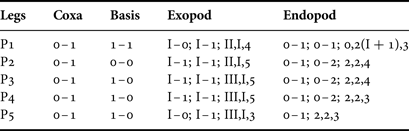
Armature formula of P1–P4 are as shown in Table 1.
Armature formula of P1–P5 (female). Roman numerals indicate spines, Arabic numeral indicate setae.
P5 (Figure 3E) biramous, with three-segmented exopod and two-segmented endopod, intercoxal sclerite smooth and unornamented; basis small, with acute process on posterior surface near base of exopod. Exopod much longer than endopod; tip of endopod reaching beyond level of proximal outer spine on third exopodal segment; distal endopodal segment 2.46 times longer (66 µm) than wide (27 µm); outer spines on exopod each with serrate frill bilaterally; terminal spine on exopod with serrate membrane externally and finely setulose frill intermedially, inner distal spine 1.03 times longer (65 µm) than outer terminal spine (63 µm), and shorter than distal exopodal segment (71 µm); first and second exopodal segments each with a pore on anterior surface at origin of outer spine; first exopodal segment with row of spinules on distal edge, third exopodal segment with rows of spinules on distal edge, and two pointed processes on distal edge; first endopodal segment with row of spinules on distal edge, second endopodal segment with pointed process on distal edge (see Table 1).
MALE
Body more slender than female (Figure 4A, B). Body 0.93–1.11 mm long (mean 1.07 ±0.08 mm, N = 5). Cephalosome completely separated from first pedigerous somite; second and third pedigerous somites with acute ventroposteriorly directed points (arrow in Figure 4B); fourth and fifth pedigerous somites completely fused; posterior corners of prosome rounded. Prosome–urosome ratio 1.81:1. Urosome five-segmented: first to fourth urosomal somites equal. Frontal margin of dorsal cephalic shield with transverse crest; ratio of first to fifth urosomal somites as 4.18:3.72:3.72:3.91:1. Caudal rami unequal, right slightly longer, about 1.94 times longer (74 µm) than wide (38 µm) with six setae, lacking dorsal seta I.
Antennules short, asymmetrical. Left antennule non-geniculate, 25-segmented and extending almost to posterior border of fifth pedigerous somite. Right antennule (Figure 4C) geniculate, 22-segmented, extending to middle of last pedigerous somite. Segmentation and setation patterns as follows: I-1 + ae; II–IV-6 + ae, V-2 + ae, VI-2, VII-2 + ae, VIII-2, IX-2 + ae, X-1 + ae, XI-1 + ae, XII-1, XIII-1 + ae, XIV-1 + ae, XV-1, XVI-2 + ae, XVII-1, XVIII-1, XIX-1, XX-1, XXI–XXIII-2 + ae, XXIV–XXV-4 + ae + process, XXVI-1 + 1, XXVII–XXVIII-5 + ae.
Antenna, mandible, maxillule, maxilla, maxilliped, and P1 to P4 as in female.
P5 strongly asymmetrical (Figures 4D–F, 5F–H); coxae and intercoxal sclerite fused to form common base. Left leg biramous: basis with seta and distal spine on posterior surface; exopod three-segmented, first segment with a long serrate outer spine (94 µm); second segment modified, bearing strongly reflexed spine (101 µm) on outer margin; third segment highly transformed bearing multiple short processes and one finger-like process; endopod forming an elongate lobe. Right leg biramous: basis with seta and distal spine on posterior surface; exopod unsegmented, with two long outer spines (proximal spine 68 µm, distal spine 102 µm), long terminal spine 49 µm long, plus short stout spine on anterodistal margin; endopod as an elongate rounded lobe about 3.19 times longer than wide (102 × 32 µm), armed with two unequal slender setae and tiny terminal pointed process, apical seta 59 µm, subapical seta 39 µm long.
REMARKS
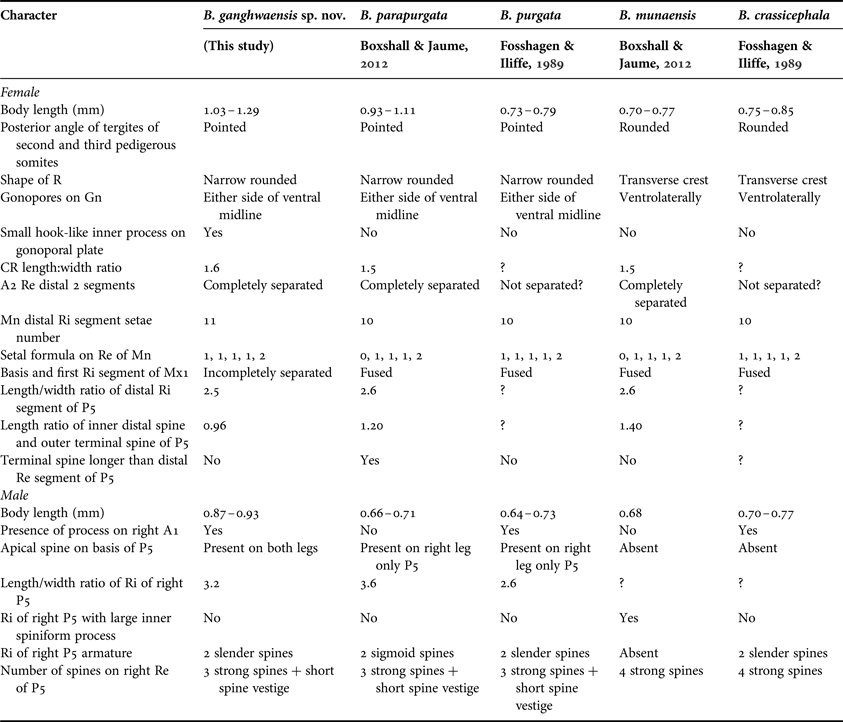
Boholina ganghwaensis is most like B. purgata and B. parapurgata, but can be distinguished by the genital double-somite, mandible, maxillule and rami of P5 in females, and antennule, mandible and fifth legs in males. A careful comparison is needed to distinguish B. ganghwaensis from B. purgata Fosshagen & Iliffe, Reference Fosshagen and Iliffe1989, because the differences between these two species are subtle. They may be distinguished by the following characteristics (see Table 2): (1) the body is larger in B. ganghwaensis than in B. purgata in both sexes; (2) a small hook-like process is present on the gonopore plate in the female (absent in B. purgata); (3) the two exopod segments of the mandible are separated in the female (not separated in B. purgata); (4) the distal endopodal segment of mandible has 11 setae (10 setae in B. purgata); (5) an apical spine is present on both basis of P5 in male (only present on the basis of right P5 basis in B. purgata); and (6) endopodal segment of right P5 about 3.2 times longer than wide (2.6 times longer than wide in B. purgata).
Comparison of morphological characteristics of the five species of genus Boholina Fosshagen & Iliffe, Reference Fosshagen and Iliffe1989. R, rostum; Gn, genital double-somite; CR, caudal rami; R, rostrum; A1, antennule; A2, antenna; Mn, mandible; Mx1, maxillule; P5, fifth swimming leg; Re, exopod; Ri, endopod.
Boholina ganghwaensis differs from B. parapurgata Boxshall & Jaume, Reference Boxshall and Jaume2012, because in the latter species (see Table 2): (1) the male body is larger; (2) a small hook-like process is present on the gonopore plate in the female (absent in B. parapurgata); (3) the setal formula 1, 1, 1, 1, 2 of the mandibular exopod of the female differs from the 0, 1, 1, 1, 2 of B. parapurgata; (4) the distal endopodal segment of mandible has 11 setae (vs 10 setae in B. parapurgata); (5) the terminal spine of the female right P5 is about 0.96 times longer than the inner distal spine (vs about 1.20 times longer in B. parapurgata); (6) the terminal spine of the female P5 is shorter than the distal exopodal segment (vs longer in B. parapurgata); (7) an apical process is present on the ancestral segment XXV of the male right antennule (vs absent in B. parapurgata); (8) an apical spine is present on both basis of the male P5 (vs present only on the right basis in B. parapurgata); and (9) the endopodal segment of male right P5 is about 3.2 times longer than wide (vs 3.6 times longer than wide in B. parapurgata).
DISCUSSION
The family Boholinidae Fosshagen & Iliffe, Reference Fosshagen and Iliffe1989 shows many similarities in its morphological characteristics with the families Ridgewayiidae M.S. Wilson, Reference Wilson1958 and Pseudocyclopidae Giesbrecht, 1893, but differs in the following characteristics: (1) the terminal spine on the distal edge of the third exopodal segment of the P4 is modified in the Boholinidae; and (2) there are no inner seta on the coxa of the female P5 in both Ridgewayiidae and Pseudocyclopidae (Fosshagen & Iliffe, Reference Fosshagen and Iliffe1989). Boholinid copepods now include four species (B. crassicephala Fosshagen & Iliffe, Reference Fosshagen and Iliffe1989, B. munaensis Boxshall & Jaume, Reference Boxshall and Jaume2012, B. parapurgata Boxshall & Jaume, Reference Boxshall and Jaume2012 and B. purgata Fosshagen & Iliffe, Reference Fosshagen and Iliffe1989) in a single genus. Boholina ganghwaensis is the fifth species, and shares the generic characteristics identified by Fosshagen & Iliffe (Reference Fosshagen and Iliffe1989), which should be amended as follows: urosome comprising four somites in female and five somites in male, and female antennule 24-segmented, with segments X and XI incompletely separated. However, B. ganghwaensis differs from the rest of the members of the genus in the following characteristics (see Table 2): (1) hook-like inner process present on gonoporal plates of the genital double-somite of female; (2) setal formula on the exopod of mandible; (3) length/width ratio of the distal endopodal segment of P5 in female; (4) length ratio of the inner and outer distal spine of P5 in female; and (5) shape of distal endopodal segment of left P5 in male.
Calanoid copepods have rarely been found in symbiotic associations, except with some bivalves, corals and sea anemones (Thompson & Scott, Reference Thompson and Scott1903; Humes & Smith, Reference Humes and Smith1974; Forsshagen & Iliffe, 1991). Benthopelagic calanoids Exumella and Ridgewayia mainly occur in hyper- or epibenthic habitats, but have been occasionally reported in caves (Wilson, Reference Wilson1958; Fosshagen & Iliffe, Reference Fosshagen and Iliffe1998; Ohtsuka et al., Reference Ohtsuka, Kase and Boxshall2000). Another genus, Placocalanus, is also regarded as an epibenthic species that may be able to burrow into sediments temporally (Fosshagen, Reference Fosshagen1970; Ohtsuka et al., Reference Ohtsuka, Fosshagen and Soh1996). Fosshagen & Iliffe (Reference Fosshagen and Iliffe1989) first reported two Boholina species in marine anchialine cave habitats in the Philippines. Boxshall & Jaume (Reference Boxshall and Jaume2012) also described two species of Boholina from anchialine and brackish habitats on the coastlines of Muna Island, south-east of Sulawesi, Indonesia. However, Boholina ganghwaensis was collected from the burrows of the manicure crab, Cleistostoma dilatatum in the inter-tidal mudflat of the Ganghwa Island, in western Korea. This is the first record of this genus living in an apparently symbiotic relationship with crabs, and cyclopoid copepods also inhabit these burrows. The burrow, being perpendicular to the surface of the mudflat, has only one entrance at the sediment surface and its depth is about 46 cm (Kim et al., Reference Kim, Ryu, Choi and Choe2011). Freshwater from the Han river intermittently inflows into the burrow at low tide, implying that B. ganghwaensis is adapted to brackish water conditions. This new observation suggests that the species of Boholina may be distributed extensively in the Indo-Pacific region. Research on the life history and geographical distribution of B. ganghwaensis in the inter tidal mudflats from the north-west Pacific is currently underway and will be dealt with in detail elsewhere.
ACKNOWLEDGEMENTS
We wish to thank two anonymous referees for their constructive comments.
FINANCIAL SUPPORT
This research was supported by Basic Science Research Programme through the National Research Foundation of Korea (NRF) funded by the Ministry of Education, Science and Technology (355-2011-1-C00139), and was ‘The survey of Korean indigenous species’ supported by the National Institute of Biological Resources (NIBR) of the Ministry of the Environment of Korea.