Implications
Betaine and conjugated linoleic acid (CLA) have been reported to decrease carcass fat in different animal models, but the mechanisms are not clearly elucidated. We have shown that acute lipolysis was increased directly by CLA, especially betaine + CLA. These data also demonstrate that they function to promote the partitioning of energy away from lipid accretion within porcine adipose tissue, in part by reducing insulin-mediated inhibition of lipolysis. These effects have favourable consequences for the consumers interested in low-fat pork meat.
Introduction
Betaine and CLA have the potential to alter growth and body composition in swine, although their mode of action is not well understood. Dietary betaine decreases fat deposition while increasing carcass lean in pigs (Fernandez-Figares et al., Reference Fernandez-Figares, Wray-Cahen, Steele, Campbell, Hall, Virtanen and Caperna2002). Dietary CLA may reduce body fat in pigs (Dugan et al., Reference Dugan, Aalhus, Schaefer and Kramer1997) and a reduction in fat accretion by CLA is also supported by cell culture studies, where the expression of genes regulating lipid accretion were decreased in cells isolated from subcutaneous adipose tissue in response to trans-10, cis-12 CLA (Zhou et al., Reference Zhou, Li, Yin, Ni, Dong, Zhang and Du2007). Betaine or CLA alone did not produce significant changes in growth performance and body composition in Iberian pigs, an obese breed distributed in Spain and Portugal, but the addition of both promoted a synergistic effect on growth, carcass protein deposition (Fernandez-Figares et al., Reference Fernandez-Figares, Conde-Aguilera, Nieto, Lachica and Aguilera2008) and yield of lean cuts (Rojas-Cano et al., Reference Rojas-Cano, Lara, Lachica, Aguilera and Fernandez-Figares2011). Biochemical and hormone profiles may partially explain the nutrient partitioning effect and increased lean deposition in pigs fed with betaine + CLA diets (Fernandez-Figares et al., Reference Rojas-Cano, Lara, Lachica, Aguilera and Fernandez-Figares2011). For example, serum triacylglycerol was increased in Iberian pigs fed with CLA and betaine + CLA supplemented diets. Betaine and CLA decreased portal-drained viscera heat production in Iberian pigs, increasing energy availability for other tissues, although the effects on growth performance depend on the energy available for growth and how it is partitioned between protein and fat (Rojas-Cano et al., Reference Rojas-Cano, Lachica, Lara, Haro and Fernandez-Figares2017). Leptin, a polypeptide hormone secreted primarily by adipose tissue, appears to play a major role in feed intake and energy metabolism (Friedman and Halaas, Reference Friedman and Halaas1998), and it has direct autocrine or paracrine effects on adipocytes (Fruhbeck et al., Reference Fruhbeck, Martinez, Martínez, Frühbeck, Aguado and Martınez1997), which in turn may contribute to the fat-reducing effect of leptin at the central nervous system level. The mechanisms underlying the decrease in fat content reported in pigs fed with betaine or CLA are poorly understood, but could involve the inhibition of lipogenesis (Zhou et al., Reference Zhou, Li, Yin, Ni, Dong, Zhang and Du2007) `and stimulation of lipolysis. The potential role of betaine and CLA on pig adipose tissue lipolytic response is unknown. We hypothesised that changes in fat accretion elicited by betaine and CLA in pigs could partially be explained by an increased lipolytic response in adipose tissue. In order to demonstrate that betaine and CLA act directly on adipocytes, it is necessary to exclude the involvement of hormonal and neural control by conducting in vitro studies. It was, therefore, the objective of the present study to assess the effects of acute (2 h) and prolonged (72 h) culture of betaine and CLA on lipolysis in pig adipose tissue.
Materials and methods
Tissue isolation and culture
For tissue isolation, five Iberian (Silvela strain) barrows (Sus scrofa mediterraneus; approximately 38 kg BW), supplied by Sánchez Romero Carvajal (Jabugo S.A., Puerto de Santa María, Spain), were housed in a controlled environment room (21 ± 1.5°C) and offered ad libitum water and a barley–soybean meal diet (101 g CP/kg DM, 14.7 MJ ME/kg DM). Adipose tissue samples were acquired following slaughter by electrical stunning and exsanguination.
The isolation and culture procedures were according to Ramsay and Richards (Reference Ramsay and Richards2004). Dorsal subcutaneous adipose tissue samples from between the shoulder blades were acquired following slaughter, diced into strips (1 × 4 cm), placed in Hanks buffer (37°C, pH 7.4) in screw-capped polypropylene Erlenmeyer flasks and transported to the laboratory. In the laboratory, adipose tissue strips were placed in fresh Hanks buffer (37°C, pH 7.4) and dissected clean of any extraneous muscle tissue and further separated into 1 cm cubes in a laminar flow hood. Adipose tissue explants (approximately 100 mg) were prepared by slicing tissue cubes with a Stadie-Riggs microtome. Tissue slices (400 µm thick) were rinsed twice with fresh Hanks buffer (37°C, pH 7.4), blotted free of excess liquid, weighed, transferred to 6-well tissue culture plates with 2 ml of basal medium per well (DMEM/F12 (50 : 50), 0.5% bovine serum albumin, 25 mM HEPES, gentamycin, amphotericin B and penicillin-streptomycin and incubated (5% CO2, 37ºC) for 1 h to wash glycerol and fatty acids. Triplicate tissue slices were then incubated in test mediums (basal medium amended with 100 µM linoleic acid (control), 100 µM trans-10, cis-12 CLA, 100 µM linoleic acid + 1 mM Bet (Aldrich #21,906-1, Tres Cantos, Madrid, Spain) and 100 µM trans-10, cis-12 CLA + 1 mM betaine). The first assay estimated the direct effects of CLA and betaine on acute and chronic lipolysis and incubations were performed for 2 and 72 h, respectively, prior to collection of medium for glycerol analysis.
The second assay examined the ability for betaine and CLA to inhibit acute or chronic insulin suppression of isoproterenol-stimulated lipolysis using tissue of the same pigs than in the first assay. Isoproterenol was used because it is a pure β-agonist, and as such it elicits the greatest lipolytic response in pig adipose tissue (Mersmann, Reference Mersmann1984). Tissue slices were incubated in the test incubation buffers, described earlier, with 1 µM isoproterenol ± 10 nM insulin in the presence of betaine and CLA for 2 h (acute) or 72 h (chronic) prior to medium collection for glycerol analysis. Glycerol is released during the hydrolysis of triglycerides correlating with free fatty acids release.
Lipolysis was terminated in medium samples (1 mL) by adding 0.1 mL 30% HClO4, followed by centrifugation at 13,000 × g for 5 min. Samples of the supernatant were neutralised with 1 N KOH and frozen for later analysis of glycerol content. Isoproterenol (#I2760, Sigma-Aldrich, St. Louis, MO) was solubilised in milli-Q water and sterile filtered through a 0.22 µm membrane. Bovine insulin (#I1882, Sigma-Aldrich, St. Louis, MO) was solubilised in 0.01N HCl. Control incubations in basal medium included a similar amount of vehicle to exclude the vehicle as a variable.
In order to solubilise fatty acids, linoleic acid and CLA, were bound to fatty acid-free albumin (#A7030, Sigma-Aldrich, St. Louis, MO), according to Svedberg et al. Reference Svedberg, Bjorntorp, Smith and Lonnroth(1990). The fatty acid:albumin molar ratio was kept at less than three to ensure that the fatty acids were bound to fatty acid-free albumin. Linoleic acid, cis-9 cis-12 linoleic acid (#10-1802-13) and trans-10 cis-12 linoleic acid (#10-1826-90-13) were provided by Larodan (Malmoe, Sweden).
Media glycerol concentration was measured at the end of the incubations using a commercially available glycerol assay kit, following manufacturer directions (#MAK117, Sigma-Aldrich, St. Louis, MO). In brief, glycerol concentration was determined by a coupled enzyme assay involving glycerol kinase and glycerol phosphate oxidase, resulting in a colorimetric (570 nm) product, proportional to the glycerol present. Samples were run in duplicate.
Leptin was analysed using a multispecies leptin RIA kit (catalogue no. XL-85K; Millipore Corporation, Saint Charles, MO, USA), following manufacturer directions. The Millipore Multi-Species Leptin assay utilises125 I-labeled human leptin and a multispecies leptin antiserum to determine the level of leptin in serum, plasma or tissue culture media by the double antibody/polyethylene glycol technique. Slopes of the standards curves prepared with medium and water were parallel. The intra- and inter-assay average coefficients of variation of concentrations were 8.6% and 11.4%, respectively.
Cell lysis was quantified based on the measurement of lactate dehydrogenase (LDH) activity, as LDH is released from the cytosol of damaged cells into the supernatant. We used a colorimetric assay (Cytotoxicity Detection KitPLUS(LDH); Roche, cat. No 04 744 926 001) based on the generation of nicotinamide adenine dinucleotide (NAD+) and lactate from pyruvate and NADH (Neilands, Reference Neilands1955). LLDH from rabbit muscle (Sigma cat. LLDH-RO Roche) was used as standard. A Victor ™X5 Perkin Elmer 2030 Multilabel reader (Turku, Finland) was used to measure absorbance at 490 nm. Triplicate instrumental analyses were carried out.
Statistical analysis
Data were analysed using a mixed-model ANOVA (PROC MIXED, SAS Institute Inc., Cary, NC, USA), which included the fixed effects of culture conditions (basal, isoproterenol and isoproterenol + insulin), treatments (Control, BET, CLA, CLABET) and the random effect of each pig. The error term used for testing treatment effect was defined by the interaction pig X treatment. Values from each pig were considered as the experimental unit of all response variables. Five separate cell preparations, each from a different pig, constituted an experiment. Results are expressed as least square means ± s.e. Statistical significance was assessed using Fisher’s least significant difference test to determine differences between treatment groups. The level of significance was set to 5%.
Results
No differences on tissue viability were found between explants cultivated for 2 and 72 h (27.7 compared with 30.7 mU/ml for 2 and 72 h of culture, respectively, P > 0.10).
Acute lipolysis
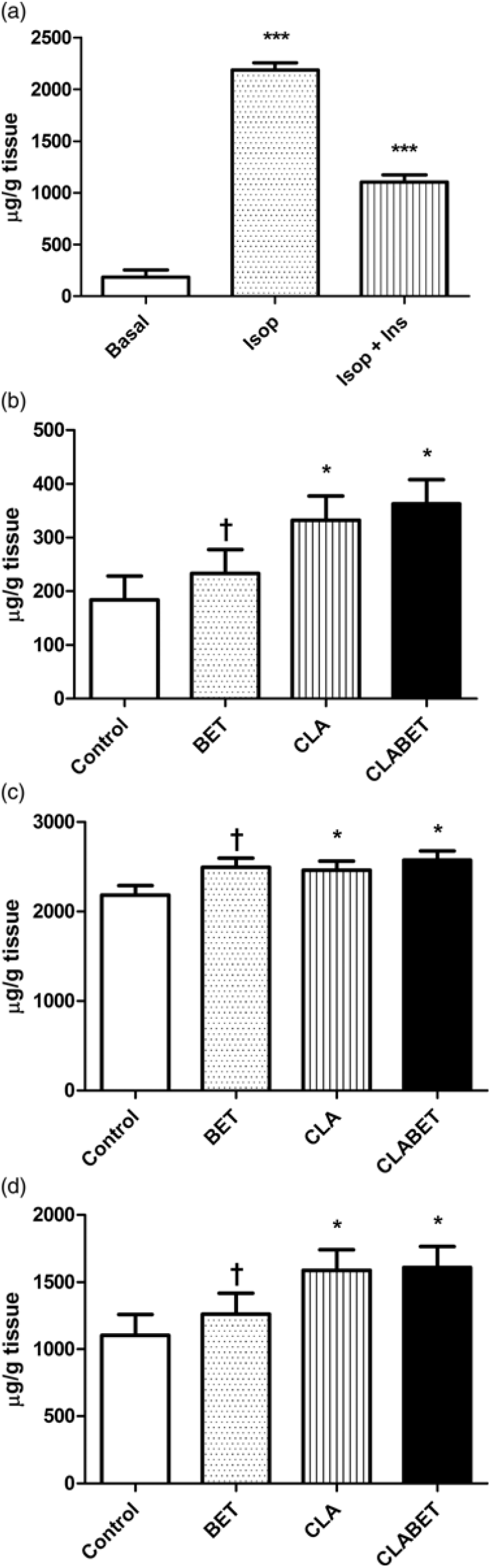
Acute lipolysis (Figure 1) was increased by CLA and CLABET (81% to 98%; P < 0.05) and tended to increase in the presence of BET (27%) under basal conditions. Isoproterenol stimulated lipolysis (P < 0.001) by 1090%, relative to basal medium. Acute exposure to BET tended to increase (13%; P = 0.071) while CLA and CLABET increased (14% to 18%; P < 0.05) isoproterenol-stimulated lipolysis compared with control. Addition of insulin (10 nM) to the medium reduced the isoproterenol-stimulated lipolytic response by 50% (P < 0.001). Supplementation of betaine to the insulin-containing medium tended to increase (P = 0.07) while CLA and CLABET increased lipolysis (45% on average; P < 0.05), partly counteracting insulin inhibition. No interaction was found between factors.
Glycerol release after acute exposure (2 h) to basal media, isoproterenol (Isop; 1 µM;) and isoproterenol + insulin (Isop.+ Ins; 10 nM;) (a). Glycerol release after acute exposure (2 h) to betaine (BET; 1 mM), conjugated linoleic acid (CLA; 0.1 mM) and CLA + BET under basal lipolysis (b), isoproterenol-stimulated lipolysis (c) and isoproterenol + insulin condition (d), respectively. Pig subcutaneous adipose tissue explants were incubated for 2 h in the absence (control) or presence of BET, CLA or CLA + BET, followed by analysis of glycerol content of the medium. Data are expressed as µg/g tissue. † Different from control 0.10 < P < 0.05; *Different from control P < 0.05; *** Different from control P < 0.001. n = 5.

Chronic lipolysis
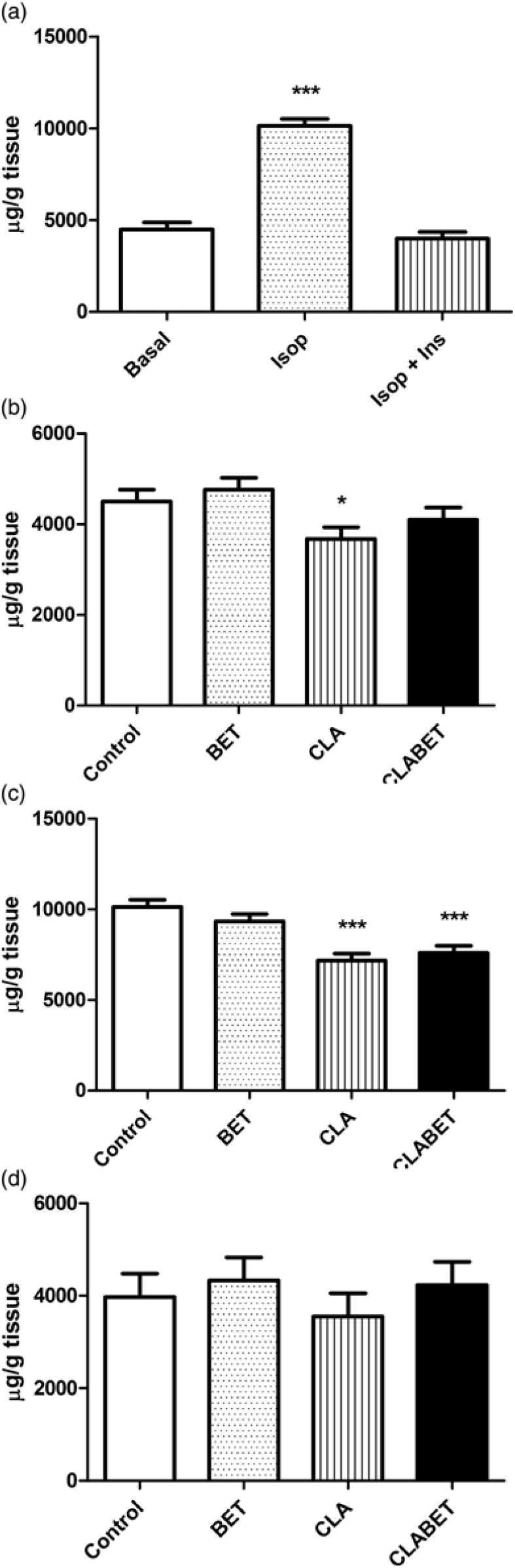
After 72 h of culture, CLA decreased (18%; P < 0.05) lipolysis (Figure 2) while BET and CLABET did not affect it (P > 0.10) under basal conditions. Isoproterenol (1 µM) produced a 125% increase in lipolytic response compared with basal conditions (P < 0.001) and CLA and CLABET partially decreased isoproterenol-stimulated lipolysis (25% to 29%; P < 0.001 relative to control). Insulin reduced the isoproterenol-stimulated lipolysis (60%; P < 0.001) back to basal conditions. However, chronic exposure to betaine and/or CLA did not affect insulin inhibition of isoproterenol-stimulated lipolysis. No interaction was found between factors.
Glycerol release after chronic exposure (72 h) to basal media, isoproterenol (Isop; 1 µM;) and isoproterenol + insulin (Isop.+ Ins; 10 nM;) (a). Glycerol release after chronic exposure (72 h) to betaine (BET; 1 mM), conjugated linoleic acid (CLA; 0.1 mM) and CLA + BET under basal lipolysis (b), isoproterenol-stimulated lipolysis (c) and isoproterenol + insulin condition (d), respectively. Pig subcutaneous adipose tissue explants were incubated for 72 h in the absence (control) or presence of BET, CLA or CLA + BET, followed by analysis of glycerol content of the medium. Data are expressed as µg/g tissue. *Different from control P < 0.05; ***Different from control P < 0.001. n = 5.

Leptin release
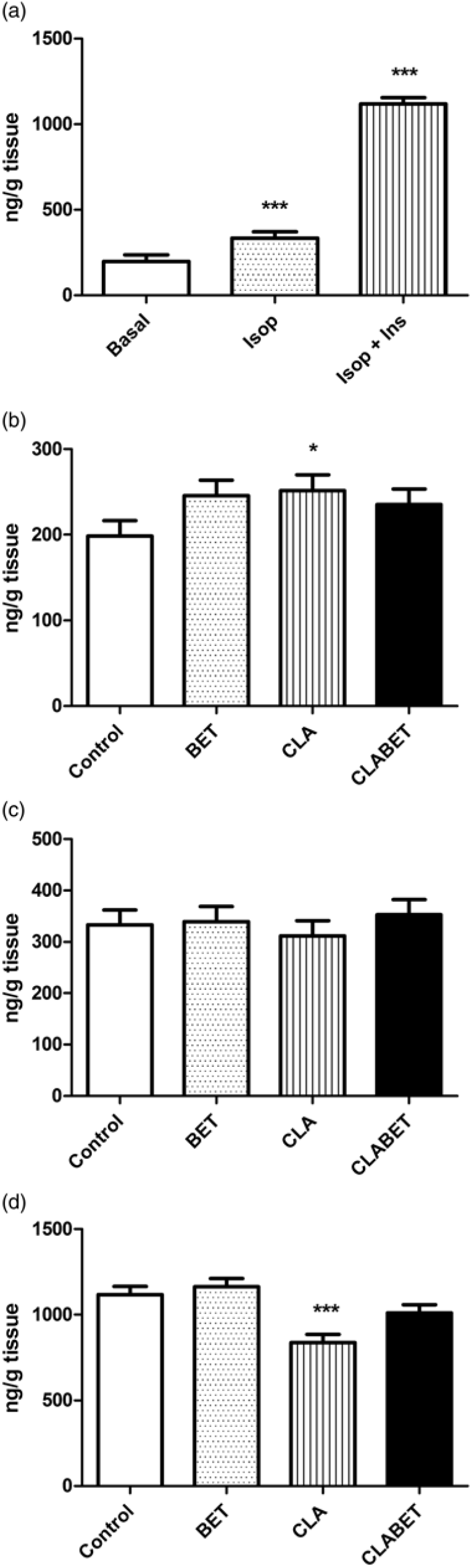
No effect of betaine on leptin secretion was found under basal or isoproterenol-stimulated conditions (Figure 3). Nevertheless, CLA increased leptin secretion under basal conditions (27%; P < 0.05). Addition of isoproterenol-increased leptin release (68%; P < 0.001) with no effect of CLA or betaine exposure (P > 0.10). Addition of insulin to the medium further increased isoproterenol-stimulated leptin release compared with basal conditions (464%; P < 0.001) but CLA decreased leptin secretion (25%; P < 0.001) compared with control, partly counteracting insulin stimulation of leptin release.
Effect of betaine- (BET; 1 mM), conjugated linoleic acid (CLA; 0.1 mM) and CLA + BET on leptin release under basal (a), isoproterenol (Isop.; 1 µM, b) and isoproterenol + insulin (Isop.+ Ins; 10 nM) conditions (c) in explants of pig subcutaneous adipose tissue cultivated for 72 h. Data are expressed as ng/g tissue. *Different from control P < 0.05; ***Different from control P < 0.001. n = 5.

Discussion
Although betaine and CLA have an impact on adipose tissue mass when supplemented together to the diet of growing Iberian pigs (Fernandez-Figares et al., Reference Fernandez-Figares, Conde-Aguilera, Nieto, Lachica and Aguilera2008), the mechanism by which they reduce body fat accretion is not elucidated. Effects could involve de novo lipogenesis, use of preformed fatty acids for lipid synthesis, rates of lipolysis or some combination of these. We have focused our research on the possible effect of betaine and CLA on lipolysis using an in vitro approach. Several studies have demonstrated that CLA and betaine can alter insulin sensitivity and thus adipocyte metabolism. In vivo studies with Iberian pigs showed increased serum insulin with no change in glucose in CLA and betaine + CLA-fed pigs (Fernandez-Figares et al., Reference Rojas-Cano, Lara, Lachica, Aguilera and Fernandez-Figares2011), although no changes on indices of insulin resistance were observed.
Lipolysis
The present study provides new insight into the effects of betaine and CLA on body fat in obese breeds. Although cis-9, trans-11 CLA and trans-10, cis-12 CLA are the most biologically active isomers that occur naturally in food (Chin et al., Reference Chin, Liu, Storkson, Ha and Pariza1992), the latter exhibits the greatest anti-obesity effect (Park et al., Reference Park, Storkson, Albright, Liu and Pariza1999).
The effect of CLA on lipolysis was biphasic increasing glycerol release under acute conditions and decreasing it under chronic conditions in our experiments. We expected increased lipolysis in both conditions that would, in part, explain the carcass fat-lowering effect of CLA in pigs. We have found no information in the literature about short-term effect of CLA on lipolysis. The short time of exposure (2 h) would suggest that there was a direct lipolytic effect of CLA.
The decreased glycerol release in our experiments under chronic exposure to CLA was unexpected, but would concur with reduced glycerol production (Yeganeh et al., Reference Yeganeh, Taylor, Tworek, Poole and Zahradka2016) under a long-term (8 days) treatment with t10-c12-CLA in differentiating 3T3-L1 cells. On the contrary, 3T3-L1 adipocytes treated with trans-10, cis-12 CLA for 6 days increased basal but not isoproterenol-stimulated lipolysis in relation to the control (Evans et al., Reference Evans, Lin, Odle and McIntosh2002). Other authors have reported no changes in lipolysis elicited by trans-10, cis-12 CLA in long-term (48 h) adipose tissue explant cultures of pigs (José et al., Reference José, Gama and Lanna2008) and mature 3T3-L1 cells (Yeganeh et al., Reference Yeganeh, Taylor, Tworek, Poole and Zahradka2016). The contrasting responses found in the literature regarding CLA effects on lipolysis could be explained by the differences in lipid metabolism among species, time of culture and culture conditions.
Betaine inhibited fat synthesis by reducing fatty acid synthase activities and increasing hormone-sensitive lipase (HSL) activity in adipose tissue of finishing pigs (Huang et al., Reference Huang, Xu, Han and Li2006). In the present study, betaine tended to increase isoproterenol-stimulated lipolysis under acute conditions, most likely through altering HSL activity. Betaine supplementation increased intramuscular fat in Alentejano pig (a sibling of Iberian pig) muscles without affecting expression of genes related to lipolysis (Albuquerque et al., Reference Albuquerque, Redondeiro, Laranjo, Felix, Neves, Félix, Freitas, Tirapicos and Martins2017), which indicates that mechanisms regulating fat accretion in intramuscular fat and subcutaneous adipose tissue may be different. Betaine has been reported to decrease homocysteine levels (Craig, Reference Craig2004), which could increase lipolysis through inactivation of AMPK pathway, as demonstrated in 3T3-L1 adipocytes with basal and isoproterenol-activated lipolysis (Wang et al., Reference Wang, Pini, Yao, Zhou, Sun, Fantuzzi and Song2011). Nevertheless, we have not detected differences in adipose AMPKα1 or AMPKα2 expression between control and dietary betaine supplemented pigs (unpublished results).
Growth hormone (GH) can play a role in fat accretion, as it directly signals adipocyte lipolysis (Dietz and Schwartz, Reference Dietz and Schwartz1991). Nevertheless, betaine effects on GH secretion are not consistent in pigs. Interestingly, 50 kg Iberian pigs fed with betaine- or CLA-supplemented diets had decreased serum GH level (Fernandez-Figares et al., Reference Rojas-Cano, Lara, Lachica, Aguilera and Fernandez-Figares2011), indicating that the mechanism by which betaine (or CLA) decrease carcass fat in Iberian pigs (Fernandez-Figares et al., Reference Fernandez-Figares, Conde-Aguilera, Nieto, Lachica and Aguilera2008) is not via the somatotrophic axis.
There is currently little information on what controls leptin secretion in pigs. Several studies have shown that circulating levels of leptin are closely correlated with body fat mass and fat cell size (Friedman and Halaas, Reference Friedman and Halaas1998), although it has become clear that factors other than changes in adipose tissue mass must be involved (Boden et al., Reference Boden, Chen, Kolaczynski and Polansky1997). CLA-decreased lipolysis stimulated or not with isoproterenol (chronic conditions, 72 h) might not be congruent with increased leptin secretion (72 h), as leptin stimulates lipolysis in pig adipose tissue directly (Ramsay and Richards, Reference Ramsay and Richards2004) and indirectly reducing insulin-mediated inhibition of lipolysis (Ramsay, Reference Ramsay2001). Chronic (7 days) exposure to insulin elevated leptin mRNA levels (Ramsay and White, Reference Ramsay and White2000). In the presence of isoproterenol and insulin (Figure 3c), CLA decreased leptin release in line with decreased lipolysis. We speculate that insulin and isoproterenol interact with CLA regarding leptin release, although the mechanism is unknown. Furthermore, trans-10, cis-12 CLA reduced fat accumulation and leptin secretion in 3T3-L1 adipocytes (Ahn, Reference Ahn2006). In contrast with in vitro data, serum leptin concentration in growing Iberian pigs fed with CLA supplemented diets (Fernández-Fígares et al., Reference Rojas-Cano, Lara, Lachica, Aguilera and Fernandez-Figares2011) remained unaltered when compared with control pigs. We have found no effect of betaine on leptin release in agreement with in vivo data (Fernandez-Figares et al., Reference Rojas-Cano, Lara, Lachica, Aguilera and Fernandez-Figares2011), although betaine reduced serum leptin release in dietary-induced obese mice (Jang et al., Reference Jang, Kim, Sung, Jung, Kim and Jo2014). Insulin greatly increased leptin release in the presence of isoproterenol. Interestingly, short-term (up to 3 h) exposure to isoproterenol decreased leptin release in human adipocytes and antagonised insulin-stimulated leptin release in rat adipocytes (Ricci et al., Reference Ricci, Lee, Russell, Wang, Sullivan, Schneider, Brolin and Fried2005) and chronic treatment of human adipose tissue (up to 2 days in culture) with insulin increased relative rates of leptin biosynthesis without affecting leptin mRNA levels (Lee et al., Reference Lee, Wang, Ricci, Sullivan, Russell and Fried2007). There is strong evidence in favour of direct effects of insulin on leptin expression (Cusin et al., Reference Cusin, Sainsbury, Doyle, Rohner Jeanrenaud and Jeanrenaud1995) in rats. Furthermore, Ramsay and White (Reference Ramsay and White2000) showed that insulin can stimulate leptin expression after 72 to 96 h of incubation (but not after 1 to 24 h of incubation) in pig adipocytes. Moreover, insulin stimulates leptin secretion from human and rodent adipocytes at concentrations as low as 0.16 nM (Mueller et al., Reference Mueller, Gregoire, Stanhope, Mobbs, Mizuno, Warden, Stern and Havel1998). The present study replicated these results with a concentration of 10 nM insulin. Difference in sensitivity may be the consequence of species variation due to the relative insulin resistance of the pig adipocyte compared with human or rodent adipocyte (Mersmann, Reference Mersmann1989). Our results in pig adipocytes clearly indicate that isoproterenol, and especially isoproterenol + insulin, increase leptin release.
Leptin receptor mRNA has been detected in a variety of porcine tissues, including adipose tissue (Lin et al., Reference Lin, Barb, Matteri, Kraeling, Chen, Meinersmann and Rampacek2000), suggesting that leptin can interact with the adipocyte to alter metabolic activity. For example, leptin alters glucose and fatty acid metabolism in pig adipocytes (Ramsay, Reference Ramsay2004). It is therefore possible that some of the effects of CLA and betaine on lipolysis may be mediated by leptin.
In contrast, with in vivo growth and body composition parameters (Fernández-Fígares et al., Reference Fernandez-Figares, Conde-Aguilera, Nieto, Lachica and Aguilera2008), no synergistic effect was found between betaine and CLA in the present study regarding lipolysis and leptin release. In conclusion, betaine and CLA had a biphasic response regarding lipolysis so that glycerol release was increased in acute conditions while CLA decreased and betaine had no effect in chronic conditions.
Acknowledgements
The authors are indebted to ML Rojas-Cano and Thays H Borges for skilful technical assistance. This research was supported by grants no. AGL 2009-08916 from Ministerio de Educación y Ciencia and AGL 2016-80231 from Ministerio de Economía y Competitividad, Spain.
I. Fernández-Fígares, 0000-0001-6739-2553
M. Lachica, 0000-0003-3415-1504
Declaration of interest
No conflict of interest exists.
Ethics statement
The study protocol was approved by the Bioethical Committee of the Spanish National Research Council (CSIC), Spain.
Software and data repository resources
None of the data were deposited in an official repository.