Implications
The objective of this work was to create a completely isolated and self-contained fish-rearing system that would be environmentally sustainable, combining effluent recycling with secondary fish production and simultaneously reducing work time and avoiding the use of filters. In terms of fish production, the prototype rearing system allowed us to obtain a suitable food conversion ratio for rearing Pseudoplatystoma punctifer (Castelnau, 1855), and in addition fish from the sewage unit could also be considered for human consumption.
Introduction
Human populations will continue to grow in the future, especially in tropical developing nations, affecting tropical ecosystems to some extent by virtue of the need for expansion of agricultural as well as aquacultural production (Laurance et al., Reference Laurance, Sayer and Cassman2014). This suggests the necessity of developing production systems requiring fewer resources in order to reduce the ecological costs of human food production by (a) improved use of resources and (b) minimizing waste production and water pollution. To the latter end, alternative recirculating aquaculture systems have already been developed by the aquaculture industry in continental waters, for example those involving the construction of artificial freshwater wetlands using macrophytes (Culley et al., Reference Culley, Rejmankova, Kvet and Frye1981; Corpron and Armstrong, Reference Corpron and Armstrong1983; Schwartz and Boyd Reference Schwartz and Boyd1995; Lin et al., Reference Lin, Jing and Lee2003; Schulz et al., Reference Schulz, Gelbrecht and Rennert2003; Li et al., Reference Li, Wu, Cheng, Liang, He, Fu and Zhong2007; Zachritz et al., Reference Zachritz, Hanson, Sauceda and Fitzsimmons2008; Martins et al., Reference Martins, Eding, Verdegem, Heinsbroek, Schneider, Blancheton, Roque d’Orbcastel and Verreth2010; Zhang et al., Reference Zhang, Li, Wu, Liu, Yao, Tao and Liu2011). Wetlands as recirculation filters have also been developed for large-scale shrimp aquaculture in brackish water (Tilley et al., Reference Tilley, Badrinarayanan, Rosati and Son2002), and for sea-water fish production (Hussenot et al., Reference Hussenot, Lefebvre and Brossard1998; Brown et al., Reference Brown, Glenn, Fitzsimmons and Smith1999). Furthermore, the integration of fish culture with vegetable cultivation, sometimes referred to as ‘aquaculture hydroponics’ (Naegel, Reference Naegel1977; Lewis et al., Reference Lewis, Yop, Schramm and Brandenburg1978; Seawright et al., Reference Seawright, Stickney and Walker1998) or ‘aquaponics’ (Rakocy, Reference Rakocy1999a and Reference Rakocy1999b; Adler et al., Reference Adler, Harper, Wade, Takeda and Summerfelt2000) makes good ecological as well as economic sense.
Green water closed systems combining intensive rearing tanks and extensive rearing ponds have been tested in fresh water (Liao and Chen, Reference Liao and Chen1983; Mires et al., Reference Mires, Amit, Avnimelech, Diab and Cochaba1990; Diab et al., Reference Diab, Kochba, Mires and Avnimelech1992; Mires and Amit, Reference Mires and Amit1992; Chin et al., Reference Chin, Ong and Foo1993; Hargreaves, Reference Hargreaves2006) in order to establish a food chain relevant to integrated multi-trophic aquaculture. But in these systems the rearing water is discarded at the end of the production cycle, because of its high concentration of phytoplankton and organic matter. In the partitioned aquaculture system (Drapcho and Brune, Reference Drapcho and Brune2000; Brune et al., Reference Brune, Reed, Schwartz and Collier2001 and Reference Brune, Schwartz, Eversole, Collier and Schewedler2003; Turker et al., Reference Turker, Eversole and Brune2003) intensive rearing units are coupled with a raceway containing high-density algae for ammonia removal and primary oxygen supply. In this case the phytoplankton needs to be continuously collected by a rolling filter in the sewage-treatment channel and removed from the system.
An alternative system was developed in Senegal (Gilles et al., Reference Gilles, Fargier, Lazzaro, Baras, De Wilde, Drakidès, Amiel, Rispal and Blancheton2013), using brackish water for rearing the West African detritivorous and euryhaline tilapia, Sarotherodon melanotheron heudelotii Dumeril, 1858 (Pauly, Reference Pauly1976; Trewavas, Reference Trewavas1983; Falk et al., Reference Falk, Teugels and Abban2000). The fish were fed commercially manufactured pellets in the intensive part of the system, but were not supplied with food in the sewage ponds, obliging them to consume waste material (i.e. dead algae, feces, uneaten food) in order to mineralize this organic matter. However, it was necessary to regulate the increase in phytoplanktonic biomass resulting from fish excretion (Gilles et al., Reference Gilles, Lacroix, Corbin, Bâ, Ibañez Luna, Nandjui, Ouattara, Oue Draogo and Lazzaro2008). Thus this system was a microcosm where a phytoplankton monoculture (Chlorella sp., 4 to 5 μm diameter, naturally seeded) was grazed by a zooplankton monoculture (Brachionus plicatilis Müller, 1786, naturally seeded) in a pond located apart from the main circulation. In this system the water was completely recycled, compensating only for evaporation, and the sediment from the zooplankton pond was partially recycled.
The main difficulty within outdoor green-water ponds in high-latitude climates lies in keeping the phytoplanktonic population stabilized independent of seasonal changes in temperature and light (Sevrin-Reyssac, Reference Sevrin-Reyssac1997; Brune et al., Reference Brune, Schwartz, Eversole, Collier and Schewedler2003). For this reason tropical regions are more suitable for outdoor green water aquaculture systems. In addition, fresh- and sea-water outdoor rearing systems can potentially be colonized by a large range of phytoplanktonic species depending on environmental parameters (i.e. pH, CaCO3 concentration, eutrophication level), while phytoplankton diversity is lower in brackish-water environments. In this regard, in brackish water it seems to be more appropriate to select the small green algae of the genus Chlorella (Witt et al., Reference Witt, Koske, Kuhlmann, Lenz and Nellen1981), which are the most suitable for this kind of rearing system because of their high purification and growth-rate efficiency (Neori et al., Reference Neori, Chopin, Troell, Buschmann, Kraemer, Halling, Shpigel and Yarish2004; Gilles et al., Reference Gilles, Lacroix, Corbin, Bâ, Ibañez Luna, Nandjui, Ouattara, Oue Draogo and Lazzaro2008). Moreover, high levels of dissolved inorganic carbon stimulate spontaneous Chlorella sp. development in photosynthetic suspended aquaculture systems (King, Reference King1970; Drapcho and Brune, Reference Drapcho and Brune2000; Makarevičienė et al., Reference Makarevičienė, Andrulevičiūtė, Skorupskaitė and Kasperovičienė2011). Furthermore, these algae are able to develop even under low light intensity (Pipes and Koutsoyannis, Reference Pipes and Koutsoyannis1961; Sevrin-Reyssac, Reference Sevrin-Reyssac1997), which could be advantageous during cloudy periods.
In this paper we describe a new prototype, based on the Senegal system but run using fresh water and tested on the grow-out stage of the Amazonian Tiger Catfish, Pseudoplatystoma punctifer Castelnau, 1855 (formerly identified as P. fasciatum Linnaeus, 1766, e.g. by Nuñez et al., Reference Nuñez, Dugué, Corcuy Arana, Duponchelle, Renno, Raynaud, Hubert and Legendre2008 and Reference Nuñez, Castro, Fernandez, Dugué, Chu-Koo, Duponchelle, García and Renno2011) in the intensive part of the circuit. This fish is of major importance for the diversification of South American aquaculture. It is reared in Brazil, and grown out in semi-intensive ponds and intensive floating cages (Bicudo et al., Reference Bicudo, Borghesi, Dairiki, Sado and Cyrino2012). Detritivorous and zooplankton-feeding fish were included in the sewage part of the system. We focus first of all on the difficulties of finding an effective composition for the ecosystem (ecological balance). Second, we describe the stabilization of the rearing system with food input (forcing), its performance, and its nitrogen budget, all during the 3-month period from August to November 2012. The major challenges of this integrated production were, (i) to minimize the use of water, thus permitting the system to be filled with ground water alone, (ii) to use the waste to increase fish production, (iii) to minimize work time required by avoiding the need for filter cleaning and (iv) to create a rearing environment less susceptible to pathogen introduction and proliferation than a classic clear water closed system.
Material and methods
Description of the prototype
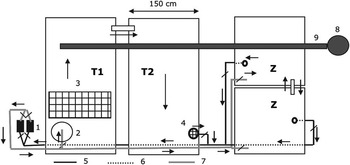
The prototype was developed at the Instituto de Investigaciones de la Amazonía Peruana (IIAP) center at Quistococha, Iquitos (03° 45′ S, 73° 10′ W), Peru. It operated as a closed recirculating system (Figure 1), housed in a greenhouse with mosquito net protection, and employing two connected lined wooden sewage tanks (T1 and T2 – extensive or sewage part) with a cage (intensive part) containing P. punctifer juveniles suspended in the first. Two lined wooden zooplankton tanks (Z) were connected in parallel with the main circuit (T1 and T2) following (Gilles et al., Reference Gilles, Fargier, Lazzaro, Baras, De Wilde, Drakidès, Amiel, Rispal and Blancheton2013), in order to eventually control the phytoplankton biomass. Each sewage tank had a useable volume of 3 m3 of water (4 m long×1.5 m wide×0.5 m deep) and the cage a useable volume of 0.24 m3 (1.25 m long×0.6 m wide×0.32 m deep). The free space around and beneath the cage permitted water circulation. The mesh size of the cage netting was 5 mm. An aeration (stripping) column (2500 mm high, 200 mm diameter) was installed in the water feed to tank 1 (Figure 1). Two re-circulating 260-W pumps were used in alternation. The flow rate was 20 m3/h and the retention time (in hours) was 0.15 in each tank (T1 and T2) and 0.3 in the circuit as a whole (T1+T2). A 12 m3/h blower allowed water mixing in order to avoid stratification of the water and reduce sedimentation of detritus and phytoplankton. A well supplied fresh ground water to compensate for evaporation from the circuit.
Schematic view of the prototype: T1 and T2=tank 1 and tank 2, Z=zooplankton tanks, 1=pumps, 2=stripping column, 3=cage, 4=filter, 5=draft tube, 6=draft tube under the tanks, 7=backflow tube, 8=blower, 9=air supply tube.

Study periods
The study covered an 18-month initial period, from January 2011 to August 2012, during which we aimed to establish a stable and efficient biological (ecological) composition within the system. Once the system was stabilized, its productivity was assessed over a second, 3-month period, from August 21 to November 23, 2012.
Biological material: fish
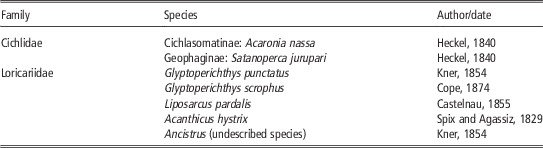
The Tiger Catfish (P. punctifer Castelnau, 1855) has previously been used in aquaculture and in our experiments under the name Pseudoplatystoma fasciatum Linnaeus, 1766. We follow Buitrago-Suárez and Burr (Reference Buitrago-Suarez and Burr2007) in the basic identification of the up to 1 m long species of the genus. But conclusions drawn in García-Dávila et al. (Reference García-Dávila, Duponchelle, Castro-Ruiz, Villacorta, Quérouil, Chota-Macuyama, Núñez, Römer, Carvajal-Vallejos and Renno2013) indicate that all the specimens used in our study belong to the more abundant genetic cluster 1 identified within what is thought to actually represent the species P. punctifer. Specimens used during the second period were obtained from a single brood (n=46), hatched at IIAP’s hatchery in April 2012 (and hence 4.5 months old). These fish consumed floating pellet food, and their phase of expressing cannibalistic behavior was over. In the sewage part representatives of two families of fish, Loricariidae (armored catfish) and Cichlidae (Table 1), were involved in the mineralization of organic matter (dead algae, feces, uneaten food) and in zooplankton feeding. The idea of using armored catfish – which are mainly periphyton grazers – in the sewage part was to establish whether they could also consume and mineralize dead algae from the bottom of the tanks. At the beginning of the first study period (January 2011) we introduced specimens of Glyptoperichthys scrophus Cope, 1874 (n=12) and Glyptoperichthys punctatus Kner, 1854 (n=6). According to Fishbase (www.fishbase.org, as at December 15, 2013), both species are adaptable omnivores that eat a large variety of foods as well as being very good algae eaters. In September 2011, 43 specimens of an unidentified species of Ancistrus Kner, 1854 were introduced into the system in order to encourage organic matter degradation. These fish are periphyton and microbenthos grazers (Evers and Seidel, Reference Evers and Seidel2005; Seidel and Evers, Reference Seidel and Evers2005). Specimens of Liposarcus pardalis Castelnau, 1855 (n=19), and Acanthicus hystrix Spix and Agassiz, 1829 (n=9) were incorporated into the ecosystem in March 2012. These species are grazers that feed on algae (periphyton), detritus, and opportunistically on small invertebrates as well (Fisch-Muller, Reference Fisch-Muller2003). Additional summarized details of the life history of suckermouth catfishes (the group to which the above-mentioned species used in our experiments belong) can be found in Evers and Seidel (Reference Evers and Seidel2005) and Seidel and Evers (Reference Seidel and Evers2005).
Fish from the sewage section

At the beginning of the project an undetermined cichlid species of the genus Aequidens Eigenmann and Bray, 1894 and two species of Apistogramma Regan, 1913, A. agassizii (Steindachner, 1875) and A. bitaeniata Pellegrin, 1936, were used experimentally in order to control the development of zooplankton, but without any success. Detailed information on the natural history of Aequidens species are published by Stawikowski and Werner (Reference Stawikowski and Werner1998), on that of the Apistogramma species by Römer (Reference Römer2000 and Reference Römer2006). Therefore juveniles of the cichlid species Acaronia nassa Heckel, 1840 (n=39), and Satanoperca jurupari Heckel, 1840 (n=60) were introduced into the system in August 2012, at the beginning of the second period, with the objective of eliminating an undetermined rotifer of the genus Trichocerca Lamarck, 1801. Adult and semi-adult (mature but not fully grown) individuals of these cichlid species used in our study are primarily carnivorous (Stawikowski and Werner, Reference Stawikowski and Werner1987, Reference Stawikowski and Werner1998 and Reference Stawikowski and Werner2004; Goulding et al., Reference Goulding, Leal Carvallo and Ferreira1988; U.R., personal observation). Wayne (Reference Wayne1985) performed stomach contents analyses on 82 specimens of A. nassa and confirmed the carnivorous lifestyle of this fish: palemonid shrimps, dragonfly larvae and small fish were most commonly found. It is a solitary, lurking predator that hovers near the bottom and captures prey by the sudden protrusion of its huge mouth (Wayne, Reference Wayne1985; Stawikowski and Werner, Reference Stawikowski and Werner1987 and Reference Stawikowski and Werner1998). Satanoperca jurupari, does not, despite its common name of ‘eartheater’, eat earth, but sticks its snout into the substrate and takes in mouthfuls which it sifts for tiny pieces of food from the mud and sand of the river bed (Weidner, Reference Weidner2000; Lucanus, Reference Lucanus2009). This food includes fruit seeds, crustaceans, insects and their larvae (Weidner, Reference Weidner2000; Stawikowski and Werner, Reference Stawikowski and Werner2004).
Monitoring of physicochemical parameters
Water temperature (°C), dissolved oxygen (DO) concentration (mg/l O2) and pH were measured in the tanks twice a day, at 0700 (before sunrise) and 1500, using a CyberScan DO 300/310 dissolved-oxygen and temperature meter (Eutech Instruments, Singapore) and a Hanna HI 9025 pH meter (Hanna Instruments Inc., RI, USA). Dissolved N-NH4 ++N-NH3, N-NO2 − and N-NO3 − levels (mg/l) were assessed by colorimetric methods using a Hanna C203 photometer (Hanna Instruments Inc.) after vacuum filtration using Whatman GF/F membrane filters (0.7-µm pore size, Ø 47 mm; Florham Park, NJ, USA). Light intensity (Wh/m2 per day) in the greenhouse, above the water’s surface, was measured with an SP Lite 2 pyranometer (Kipp & Zonen, Delft, The Netherlands) every 10 s.
Monitoring of biological parameters
Specific compositions of phytoplankton were determined using an Olympus CX41 microscope (100× magnification, 0.65× eyepiece; Olympus, Shinjuku, Tokyo, Japan). Algal density (AD) was determined by colorimetric methods using a Hanna C203 photometer (Hanna Instruments Inc.), with the ammonia medium range program at 420-nm wavelength and a tungsten lamp source. A calibration curve was established by comparing the optical density (OD) measured with the photometer and the actual AD, which was assessed from counts using a Malassez cell and an Olympus CX41 microscope (20× magnification; Olympus). In order to compute the mean AD, each sample count was performed on 12 optical fields, of which the highest and the lowest algal densities were removed. The observed relationship between OD and AD (cells/ml) was:
 $${\rm AD}={\rm 1}.{\rm 125 \ e}^{{{\rm 2}.0{\rm 62}{\bf OD}}} ,r^{{\rm 2}} =0.{\rm 9918},{\rm df}={\rm 3}$$
AD was also estimated using a Secchi disk. Rotifer densities (individuals/ml) were determined from counts made under an Olympus SZX9/12 stereomicroscope (Olympus). As with the algae, counts were performed on 12×50 µl samples, with the highest and lowest values being discarded. All fish were netted out and weighed individually using a 0.1-g precision scale balance (Jinan Jinzhong Electronic Scale Co., Ltd, Shandong, China, Model 3 S/new SU-15). P. punctifer from the cage were weighed on days 0, 17, 43, 66 and 91 of the second period. The fish were sorted and a number of the smallest individuals (n=16) removed on day 43 in order to reduce the biomass in the cage. All Loricariidae and Cichlidae from the sewage part were weighed at the beginning and end of the second period.
Fish feeding and growth during the second period
The extruded pellets (Puripaiche 45®) used to feed P. punctifer during the study contained 45% protein, 10% lipids, 2.5% fiber, 12% ash and 12% moisture. The daily feeding rate was 3% of BW from day 0 to day 43, and 2.8% of BW from day 44 to day 91. Floating food, well accepted by P. punctifer (S.G. and U.R., personal observation) allowed monitoring of the effective food intake by the fish. Fish growth was evaluated using the daily growth index (DGI):
 $${\rm DGI}=\left( {{\rm ww}_{{\rm 2}} ^{{{ \ \rm 1}/{\rm 3}}} -{\rm ww}_{{\rm 1}} ^{{{ \ \rm 1}/{\rm 3}}} } \right){\times}\left( {t_{{\rm 2}} -t_{{\rm 1}} } \right)^{{{\minus}{\rm 1}}} {\times}{\rm 1}00$$
and the specific growth rate (% ww/day):
 $${\rm SGR}=\left( {{\rm ln \ ww}_{{\rm 2}} -{\rm ln \ ww}_{{\rm 1}} } \right){\times}\left( {t_{{\rm 2}} -t_{{\rm 1}} } \right)^{{{\minus}{\rm 1}}} {\times}{\rm 1}00$$
where ww1 and ww2 are the mean individual wet weights (g) of fish at times t 1 and t 2 (days), respectively.
Evaluation of the nitrogen budget during the second period.
To assess the nitrogen (N) budget in the system the following equations were used:
 $${\rm N}_{{{\rm input}}} ={\rm N}_{{{\rm period \ \rm end}}} \,{\minus} \,{\rm N}_{{{\rm period \ \rm start}}} $$
(since the system operating implies no sedimentation, no waste discharge, and no N gaseous lost) where, in the overall circuit:
 $$\eqalignno{ & {\rm N}_{{{\rm input}}}\, {\rm = \, N}_{{{\rm food}}} \cr & {\rm N}_{{{\rm period \ start}}} \,{\rm = \, N}_{{{\rm initial \ algae}}} {\rm {\plus}N}_{{{\rm initial \ \rm dissolved \ \rm in \ \rm water}}} {\rm {\plus}N}_{{{\rm initial \ fish}}} \cr & {\rm N}_{{{\rm period \ \rm end}}} \,{\rm =N}_{{{\rm final \ \rm algae}}} {\rm {\plus}N}_{{{\rm final \ \rm dissolved \ \rm in \ \rm water}}} {\rm {\plus}N}_{{{\rm final \ \rm fish}}} \cr & {\rm N}_{{{\rm food}}} \,{\rm =}\left( {{\rm N}_{{{\rm final \ \rm algae}}} {\rm \,-\,N}_{{{\rm initial \ \rm algae}}} } \right) \cr\qquad{\rm {\plus}}\left( {{\rm N}_{{{\rm final \ \rm dissolved\ \rm in \ \rm water}}} \,{\rm - \,N}_{{{\rm initial \ \rm dissolved \ \rm in \ \rm the \ \rm water}}} } \right) \cr\qquad{\rm {\plus}}\left( {{\rm N}_{{{\rm final \ \rm fish}}} {\rm \,- \,N}_{{{\rm initial \ \rm fish}}} } \right) \cr & {\rm N}_{{{\rm food}}} \,{\rm =N}_{{{\rm fish\ \rm retention}}} {\rm {\plus}N}_{{{\rm fish \ \rm excretion}}} \cr & {\rm N}_{{{\rm fish \ \rm retention}}} \,{\rm =N}_{{{\rm final \ \rm fish}}} {\rm \,-\,N}_{{{\rm initial \ \rm fish}}} \cr & {\rm N}_{{{\rm fish \ \rm excretion}}} \,{\rm =}\left( {{\rm N}_{{{\rm final \ \rm algae}}} {\rm \,-\,N}_{{{\rm initial \ \rm algae}}} } \right) \cr\qquad{\rm {\plus}}\left( {{\rm N}_{{{\rm final \ \rm dissolved \ \rm in \ \rm water}}} {\rm \,-\, N}_{{{\rm initial \ \rm dissolved \ \rm in \ \rm the \ \rm water}}} } \right) $$
A bibliographic approach was employed in the nitrogen (N) budget assessment, using the Channel Catfish, Ictalurus punctatus Rafinesque, 1818 (a siluriform comparable to P. punctifer), N retention (%) of N consumed (Small, Reference Small2006), the tilapia (cichlid) N retention (%) of N consumed (Beveridge et al., Reference Beveridge, Phillips and Clarke1991), and the N composition of Chlorella sp. (Gilles et al., Reference Gilles, Fargier, Lazzaro, Baras, De Wilde, Drakidès, Amiel, Rispal and Blancheton2013). The N retention of the Channel Catfish was 36.3%, with a 36% protein floating catfish food, and a FCR of 1.24. Given that 63.7% N consumed by P. punctifer was excreted and then consumed by omnivorous fish in the sewage part (mainly cichlids, whose weight gain increased significantly), with a 47% N retention, it is possible to check if the N excreted by sewage fish corresponds to N dissolved plus N included in phytoplankton (last equation). Using the same protocol for measuring the OD as was employed in Senegal (Gilles et al., Reference Gilles, Fargier, Lazzaro, Baras, De Wilde, Drakidès, Amiel, Rispal and Blancheton2013), with the same or closely related alga species (Chlorella), it is possible to establish a relationship between OD and N amount corresponding to the phytoplankton density.
Results
First study period
The first objective using this new prototype in fresh water was to stabilize a phytoplankton population in the closed recirculating system, avoiding any accumulation of sediment and anaerobic conditions resulting from organic matter decomposition. Some seeding was performed in the system using samples from natural green water pools in order to try and establish a phytoplankton population. But during this first period the proliferation of a small rotifer, Trichocerca sp., which spontaneously appeared in the system, prevented the development of small green algae such as Chlorella sp. Instead this zooplankton favored the proliferation of an undetermined large spiny alga of the genus Golenkinia Chodat, 1894, whose growth was unstable and which had a tendency to flocculate, causing the recirculating closed system to become inoperative.
After the alga Golenkinia sp. had been eliminated via sterilization using chlorinated water, we were able to introduce two undetermined phytoplanktonic species of the genera Nannochloris Naumann, 1921 (Ø 3 µm) and Chlorella Beijerinck, 1890 (Ø 9 µm) into the circuit. Some small algae of the genus Scenedesmus Meyen, 1829 were also observed occasionally but eventually disappeared. But these green algae populations remained unstable as a result of predation by the rotifer. We soon observed green feces produced by the Loricariidae, and no sedimentation, indicating that these fish were actively consuming dead algae. From January 2011 to August 2012 the mean individual biomass (MIB) of G. scrophus increased from 120.8 g to 149.7 g, with a survival rate (SR) of 92% (initial and final biomass of 1450 g and 1653 g, respectively), while the MIB of G. punctatus increased from 95.6 to 128.1 g with an SR of 67% (initial and final biomass of 574 and 515 g, respectively). From September 2011 to August 2012 the MIB of Ancistrus sp. decreased from 58.0 to 56.3 g with an SR of 56% (initial and final biomass of 2494 and 1356 g, respectively). From March 2012 to August 2012 the MIB of Liposarcus pardalis remained stable, from 258.0 to 258.1 g, with an SR of 74% (initial and final biomass of 4902 and 3629 g, respectively), and the MIB of Acanthicus hystrix increased from 6.2 to 14.5 g with an SR of 89% (initial and final biomass of 56 and 116 g, respectively).
Second study period
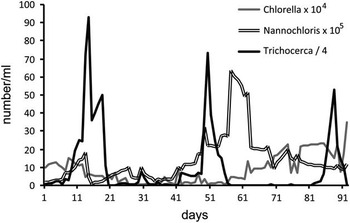
The introduction of the cichlids A. nassa and S. jurupari at the beginning of the second period (day 0) was followed by the progressive disappearance of the rotifer Trichocerca sp. (Figure 2) and the continuous population development of the two species of the genera Chlorella and Nannochloris, with episodic low-level colonization by specimens of the genus Scenedesmus. Successive rotifer blooms, followed by extinctions, indicated significant predation on this zooplankton (Figure 2). The decrease from rotifer bloom peaks indicates progressive loss of regeneration capability associated with progressive reduction in the number of dormant eggs produced during each predation event. Two months after the end of the study period the Trichocerca sp. population had completely disappeared, and the alga Nannochloris sp. became scarce. Thanks to the continuing low phytoplankton concentration (3×10⁵ cells/ml), regulation of the algal biomass by additional zooplankton tanks was not necessary during this period. Consequently, no waste accumulation (dead algae) was observed, contrary to what has been observed in brackish water in association with the use of zooplankton ponds (Gilles et al., Reference Gilles, Fargier, Lazzaro, Baras, De Wilde, Drakidès, Amiel, Rispal and Blancheton2013). Water exchange was not necessary, with only some compensation for evaporation required. Integral recycling was effective.
Temporal evolution of algal and rotifer densities in the water of the recirculating system during the second study period.

Physicochemical and biological parameters
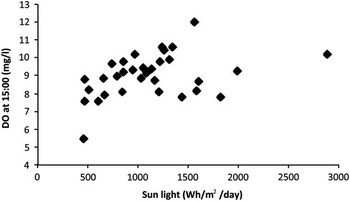
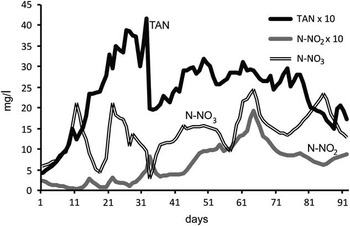
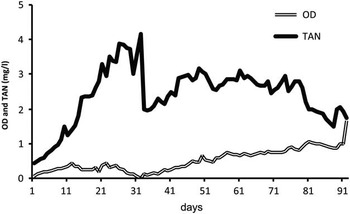
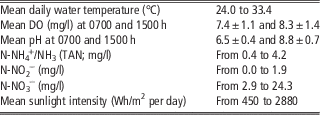
Figure 3 shows the relationship between DO at 1500 and the daily light intensity during the second period. Limits for values of dissolved total ammonia nitrogen (TAN), N-NO2 − and N-NO3 − and their evolution during the study period are shown in Table 2 and Figure 4. On day 32 the highest level of TAN (4.16 mg/l) was achieved and corresponded to the lowest level of OD (Figure 5). The following day the algal growth started to recover, and the TAN concentration decreased from 4.16 to 1.98 mg/l. During the last 2 months of the study period the progressive development of the algal biomass coincided with a progressive decrease in the TAN and N-NO3 − concentrations, while the N-NO2 − concentration remained stable (Figures 4 and 5).
Relationship between sunlight intensity (Wh/m2 per day) in the greenhouse and dissolved oxygen (DO) in the water of the recirculating system.

Temporal evolutions of total ammonia nitrogen (TAN), N-NO2 − and N-NO3 − dissolved in the water of the recirculating system during the second study period.

Temporal evolution of optical density (OD) as algal concentration and total amonia nitrogen (TAN) dissolved in the water of the recirculating system during the second study period.

Physicochemical parameters of the water in the recirculating system and light intensity

DO=dissolved oxygen; TAN=total ammonia nitrogen; Wh=watts×hours.
Fish productivity during the second period
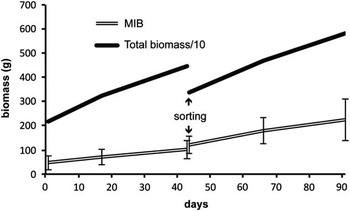
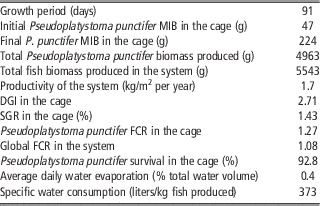
Results of fish production were obtained during the stabilization of the artificial ecosystem (Table 3), which did not affect P. punctifer growth in the cage (Figure 6). The total food distributed during this period was 6320 g, equivalent to 5.4 g/m2 per day at the beginning and 10.8 g/m2 per day at the end of the trial for the whole prototype. Pseudoplatystoma punctifer initial and final biomass was 2177 and 5828 g, respectively (and 1104 g were also removed during the sorting). Global final fish density in the system was 1.2 kg/m2 or 2.4 kg/m3, and 24.3 kg/m3 in the cage. Sewage fish productivity was 0.8 kg/m2 per year. A drop in the DGI from 3.05 to 1.86 together with a rise in the coefficient of variation from 29.9% to 38.9% and in the FCR from 1.15 to 2.05 was observed for P. punctifer during the periods from 43 to 66 and from 67 to 91 days (Figure 6).
Temporal evolution of mean individual biomass (MIB) and total biomass of Pseudoplatystoma punctifer during the second study period.

Performance and productivity of the system during the second period (2012)

MIB=mean individual biomass; DGI=daily growth index; SGR=specific growth rate; FCR=food conversion ratio.
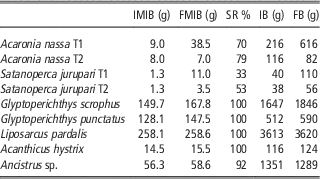
The initial biomass of the cichlids in the sewage unit was 410 g, and their final biomass was 864 g. Cichlid growth was higher in the first tank (Figure 1, T1), which included the P. punctifer rearing cage, compared with that in the second (Figure 1, T2), dedicated solely to sewage (Table 4). The initial biomass of Loricariidae was 7240 g, their final biomass 7469 g. Their growth and SRs were similar in tanks 1 and 2. Mean daily evaporation in the closed system was 4% of the water volume, and the total biomass produced during the period was 5848.8 g. So the specific water consumption was 373 l/kg of fish produced.
Cichlid and Loricariid performances in sewage tanks during the second period

IMIB=initial mean individual biomass; FMIB=final mean individual biomass; SR=survival rate; IB=initial biomass; FB=final biomass; T1 and T2=tank 1 and tank 2.
Evaluation of the nitrogen budget during the second period
The N amount included in the food was 455 g, 165.4 g of which was retained by P. punctifer and 289.4 g excreted, using the Channel Catfish retention rate (Small, Reference Small2006). On the basis that N excreted by P. punctifer was retained by sewage fish, directly eating feces, dead algae, and bacteria, and indirectly consuming dissolved N (urine), then using a retention rate of 43% (Beveridge et al., Reference Beveridge, Phillips and Clarke1991), the N amount retained by the sewage fish was 136.0 g, and 153.4 g excreted. The relationship established between OD and the concentration of N phytoplanktonic in the water permitted calculation of the amount of N retained by algae during the period as 71.2 g. The difference between final N and initial N dissolved in the water (TAN+N-NO2+N-NO3) was 64.9 g. So the total N amount in the water (phytoplanktonic+dissolved) was 136.2 g. Thus the error in the estimation of the N budget was: N fish excretion – N in the water=17.2 g. This error represents 3.9% of the total final N amount in the system.
Discussion
Physicochemical and biological parameters
A high water flow rate into the stripping column induced intense gas exchange and so dampened the effects of photosynthesis (O2 production, H2CO3 consumed) and respiration (H2CO3 production), showing low DO and pH level differences between morning and afternoon (Table 2). Values of DO at 1500 depended on the sunlight intensity during the few minutes before measuring, which explains why we observed a high degree of DO-value variation for a given level of daily light energy (Figure 3). But we observed good DO concentrations at low levels of light intensity (500 Wh/m2 per day), confirming that Chlorella sp. is a low light intensity tolerant alga (Pipes and Koutsoyannis, Reference Pipes and Koutsoyannis1961). Phytoplankton concentration (OD) increased slowly from day 33 to the end of the second study period with acceleration during the last days (Figure 5), which corresponds to a decrease in TAN and overall N-NO3 concentrations (Figure 4). So N absorption by phytoplankton worked correctly in our system. The quasi equilibrate N budget demonstrates good fish excretion recycling by the system, and explains why the global FCR was much better than that obtained in brackish water (1.08 v. 1.69) (Gilles et al., Reference Gilles, Fargier, Lazzaro, Baras, De Wilde, Drakidès, Amiel, Rispal and Blancheton2013).
Differences in phytoplankton characteristics between fresh and brackish water
Important differences in phytoplanktonic concentration were observed between the prototype freshwater ecosystem (30×105 cells/ml, OD=1.5, Secchi disk 15 to 18 cm) and the brackish-water system of Gilles et al. (Reference Gilles, Fargier, Lazzaro, Baras, De Wilde, Drakidès, Amiel, Rispal and Blancheton2013) (25×106 cells/ml, OD=4.5, Secchi disk 6 to 7 cm). Nannochloris sp. in brackish water measured 4 to 5 µm in diameter and rapidly individualized after division, whereas the diameter of the dominant Amazonian Chlorella sp. was 9 µm and remained aggregated after division until the 16-cell stage. The mineralization level of the water in Amazonian rivers is very low (Ca++: 4.9 mg/l, Mg++: 1.1 mg/l, Na+: 2.3 mg/l, K+: 0.85 mg/l, Cl−: 1.3 mg/l) (Moquet et al., Reference Moquet, Crave, Viers, Seyler, Armijos, Bourrel, Chavarri, Lagane, Laraque, Lavado Casimiro, Pombosa, Noriega, Vera and Guyot2011) and also in Amazonian ground water, whose Ca++ concentration is below 20 μg/l (Brinkmann and Dos Santos, Reference Brinkmann and Dos Santos1973). In Senegal high hardness (Ca+Mg, 69 mg/l) and medium salinity (15 g/l NaCl) favored the bloom of Chlorella (Witt et al., Reference Witt, Koske, Kuhlmann, Lenz and Nellen1981; Makarevičienė et al., Reference Makarevičienė, Andrulevičiūtė, Skorupskaitė and Kasperovičienė2011; Gilles et al., Reference Gilles, Fargier, Lazzaro, Baras, De Wilde, Drakidès, Amiel, Rispal and Blancheton2013). So the low level of mineral nutrients available in Amazonian waters appears to be the reason why the phytoplankton concentration remained low in the prototype discussed here. Nevertheless monocultures of the same phytoplankton genus occupied both environments because of the high level of dissolved inorganic carbon (King, Reference King1970; Turker et al., Reference Turker, Eversole and Brune2003; Makarevičienė et al., Reference Makarevičienė, Andrulevičiūtė, Skorupskaitė and Kasperovičienė2011) generated by the fish biomass.
Fish productivity
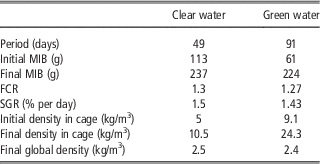
Bicudo et al. (Reference Bicudo, Borghesi, Dairiki, Sado and Cyrino2012) tested the performances of juveniles of P. fasciatum in a clear water recirculating system, where they were fed with different levels of corn gluten meal. In spite of the different feeding protocols and rearing conditions, growth and food conversion performances during Bicudo’s experiment were similar to those in our prototype (Table 5). So we can conclude that our closed system in green water works as well as a classic recirculating system in clear water. In the sewage part we observed an important difference in biomass increase between Loricariidae and Cichlidae. It is unclear whether this effect was caused by better growth potential in the latter, or resulted from differences in feeding patterns corresponding to different levels in the trophic chain. The two cichlid species used in the sewage part are carnivorous and active zooplankton feeders, but we do not actually know whether only one or both groups of fish eliminated the rotifer and thus allowed stabilization of the ecosystem.
Comparison of Pseudoplatystoma punctifer rearing performances between classic clear water (Bicudo et al., Reference Bicudo, Borghesi, Dairiki, Sado and Cyrino2012) and green water (present data) closed systems

MIB=mean individual biomass; FCR=food conversion ratio; SGR=specific growth rate.
Initial MIB and SGR in green water calculated taking account of the sorting at day 43.
The specific water consumption
We observed an important difference between fresh (prototype system) and brackish water (Gilles et al., Reference Gilles, Fargier, Lazzaro, Baras, De Wilde, Drakidès, Amiel, Rispal and Blancheton2013) in the specific water consumption: 373 v. 799 l/kg fish produced, respectively. The surface area/volume ratio was much higher in the brackish water prototype, and the very dry air (low hygrometric level) and high temperature in Senegal also explain this difference. The specific water consumption in the zero-discharge tilapia recirculation system of Shnel et al. (Reference Shnel, Barak, Ezer, Dafni and van Rijn2002) was much lower (190 v. 373 l in the present study). This system employed biological filters and featured an anoxic stage where sludge was biologically digested and nitrate was reduced to nitrogen gas. In addition, the high final fish density in this system (61.8 kg/m3) explains the differences in specific water consumption observed between the two systems. However, the FCR in the tilapia system was much higher than in our prototype (2.03 v. 1.02), and linked to the loss of nitrogen (gas).
Conclusion
The system described here had a very low maintenance requirement since there was no need for filtering equipment and no sedimentation of organic matter (self-cleaning system). In addition, the system permitted a low FCR, which could also decrease production costs. Since it only requires small amounts of water to compensate for evaporation, this kind of rearing system can run using a ground-water supply alone, thereby limiting pathogen introduction and also facilitating the selection of the fish farm location. This latter consideration is important in regions where no gravity-fed water supply is available and pumping the only option. An additional apparent positive effect of this closed system is that pathogenic organisms such as bacteria or fungi cannot easily proliferate in a balanced biological high-density system, probably due to the high degree of biological competition. We did not observe any dramatic pathogen propagation such as occurs in clear water closed re-circulating systems during larval rearing trials (S.G., personal observation).
Taking into account all the findings mentioned above, this system clearly offers ecological and economic advantages for fish aquaculture in Amazonia compared with traditional outdoor pond production. However, full monitoring of the farming environment and rearing conditions, as well as adequately trained personnel, are crucial for the success of aquaculture using this kind of rearing system. Finally, in order to achieve optimal ecological and economic profitability for the system, further research on its performance limits will be necessary: that is, (i) the lowest amount of water needed, (ii) the lowest energy consumption for mixing and re-circulating the water, (iii) the highest biomass stocking capacity and food intake (forcing level) and (iv) the sustainability and resilience of the ecosystem’s equilibrium. In addition, the suitability of this green water recirculating system for rearing earlier developmental stages of P. punctifer has yet to be tested.
Acknowledgements
The authors thank two anonymous reviewers for reading and helpfully commenting on an earlier version of this manuscript. They especially thank Mary Bailey (Crediton, Devon, UK) for her always humorous and motivating comments during her stringent review of the final version of our work.