INTRODUCTION
Sea pens are colonial marine cnidarians belonging to the order Pennatulacea having a cosmopolitan distribution in tropical and temperate waters worldwide. The common name ‘sea pen' comes from the ancient Romans who had knowledge of pennatulaceans and called them Penna marina (sea feathers or sea pens), or referred to them as Mentula alata (winged penis) (Williams, Reference Williams2011b). Sea pens or pennatulaceans are grouped with the octocorals (soft corals), together with sea whips and gorgonians. They have been encountered in benthic communities from all the world's oceans, from polar to equatorial latitudes, and from intertidal regions from a depth of a few metres to more than 6200 m (Williams, Reference Williams2011a). Based on the work of 18 researchers, the pennatulaceans includes more than 200 species in 35 genera and 14 families (Williams, Reference Williams1995a; López-González et al., Reference López-González, Gili and Williams2000; López-González & Williams, Reference López-González and Williams2002; Williams, Reference Williams2011b). The earliest account of pennatulacean natural history is from the anonymous chronicler of Captain James Lancaster's voyage to the East Indies in 1601 (Kerr, Reference Kerr1824). The most thorough account of the classification of the Pennatulacea is that of Kükenthal (Reference Kükenthal1915) and 80 years later, Williams updated classification of the group at the familial and generic levels, and gave a brief account of the nominal and valid species recognized for each genus (Williams, Reference Williams1995a). Some papers dealing with the systematics and addition of new pennatulacean taxa include: Williams (Reference Williams1989, Reference Williams1995b, Reference Williams and Carlton2007a, Reference Williamsb) from Australia, New Zealand and the Campbell Plateau; Acuña & Zamponi (Reference Acuña and Zamponi1992) and López-González & Williams (Reference López-González and Williams2002) from the Antarctic region; Grasshoff (Reference Grasshoff1982) and López-González & Williams (Reference López-González and Williams2010) from the Atlantic region; and López-González et al. (Reference López-González, Gili and Williams2000, Reference López-González, Gili and Williams2001) from the eastern Atlantic, western Pacific Oceans and African coast.
Pennatulaceans are a specialized and morphologically distinct group of octocorallian cnidarians (Bayer, Reference Bayer and Moore1956). Morphological diversity in the Pennatulacea is remarkable and includes a great variety of growth forms such as plumose, umbellate, clavate, foliate, capitates, digitiform, whip-like, or vermiform. Most species have a muscular peduncle for anchoring in soft sediments, and thus are able to inhabit vast areas of relatively uniform benthic environments such as abyssal plains (Williams, Reference Williams2011a). Dispersal potential is undoubtedly of fundamental importance regarding patterns of restricted versus widespread geographical ranges. It has been postulated that pennatulaceans initially differentiated in shallow waters of tropical oceans and diversified and dispersed to all depths of the temperate and polar regions as well as tropical seas (Williams, Reference Williams1993, Reference Williams1997). Shallow-water genera living in areas of soft sediment associated with coral reefs include Cavernularia, Veretillum, Sclerobelemnon, Scytalium, Virgularia and Pteroeides (Williams, Reference Williams, Gosliner, Behrens and Williams1996). The 35 extant pennatulacean genera can be divided into three groups based on their bathymetric ranges: shallow-water (0–400 m); mid-depth range (400–2000 m); and deep-water (2000–6100 m) (Williams, Reference Williams2011b). Species with greater depth-ranges often tend to have greater geographical ranges. This is to be expected with the deep-sea being more homogeneous than coastal environments. The pennatulacea are postulated to have originated in the shallow-water tropics (William, Reference Williams1992, Reference Williams1993). Veretillids are considered the least derived of the extant sea pens and exhibit a high diversity in the relatively shallow waters (<320 m in depth) of the Indo-Pacific, whereas a great variety of more derived sea pen taxa are present worldwide with unrestricted bathymetric ranges (Williams, Reference Williams1997). From off the African Atlantic coast, López-González et al. (Reference López-González, Gili and Williams2001) have reported the occurrence of 13 species of pennatulaceans based on cruises carried out from 1982 to 1989.
Bioluminescence has been recorded in at least 21 species of pennatulaceans and many more are likely to have such capabilities (Williams, Reference Williams2001). Bioluminescence in sea pens is most likely for defence, to startle and ward off potential predators (Williams, Reference Williams2011b). Some virgulariids are capable of rapidly disappearing into the sediment when disturbed. At least two shallow-water species (in the genera Cavernularia and Virgularia) harbour zooxanthellae and are active diurnally. Other shallow-water species are nocturnal and withdraw into the surrounding sediment during the day, emerging at night to feed (Williams, Reference Williams2011b).
Williams (Reference Williams1989, Reference Williams1995a) has reported 14 species in the genus Cavernularia occurring worldwide out of which 4 species are known to occur from the Indian waters. Kükenthal & Broch (Reference Kükenthal and Broch1911) and Williams (Reference Williams1989) defined Cavernularia as having smooth sclerites oval to stick-shaped or spindle-shaped elongate rods, spindles or needles (0.02–0.70 mm long) and are mostly unbranched or non-bifurcated at the ends, with or without an axis and without a sclerite-free outer layer to the peduncle.
Pennatulaceans from in and around India were studied by Tizard et al. (Reference Tizard, Moseley, Buchanan and Marray1885), Alcock (Reference Alcock1902), Allen & Steene (Reference Allen and Steene1994), Dinamani (Reference Dinamani1965), Marshall & Fowler (Reference Marshall and Fowler1888), Fowler (Reference Fowler1894), Gosliner et al. (Reference Gosliner, Behrens and Williams1996), Gravely (Reference Graveley1941), Hickson (Reference Hickson and Gardiner1905), Thomson & Henderson (Reference Thomson and Henderson1905a, Reference Thomson and Hendersonb, Reference Thomson and Henderson1906), Thomson & Crane (Reference Thomson and Crane1909a, Reference Thomson, Crane and Hornellb), Hornell (Reference Hornell1922), Pasternak (Reference Pasternak1964), Sankolli & Neelakantan (Reference Sankolli and Neelakantan1971), Parulekar (Reference Parulekar1981), Imahara (Reference Imahara1991), Williams (Reference Williams1993), Harkantra & Rodrigues (Reference Harkantra and Rodrigues2003) and Veena & Kaladharan (Reference Veena and Kaladharan2012).
Cavernularia obesa, Valenciennes have been described from the Bay of Bengal, Orissa coast, Palk Strait, Pulo Penang, northern part near Vankalli reef of the Gulf of Manaar, Cheval Paar, Andaman and Nicobar Islands, West Bengal and the Digha Coast (Thomson & Henderson, Reference Thomson and Henderson1905a; Thomson & Simpson, Reference Thomson and Simpson1909; Tikadar et al., Reference Tikadar, Daniel and Subbarao1986; Goswami, Reference Goswami1992; Rao & Devi, Reference Rao and Devi2003; Ramakrishna & Talukdar, Reference Ramakrishna and Talukdar2003). Benthic fauna from Visakhapatnam have been studied by Radhakrishna (Reference Radhakrishna1964), Raman (Reference Raman1980), Ganapati & Raman (Reference Ganapati and Raman1976), Sudarsan (Reference Sudarsan1983), Adiseshasai (Reference Adiseshasai1992) and Vijayakumaran (Reference Vijayakumaran2003); and the occurrence of the genus Cavernularia Valenciennes, 1850 from these waters has been previously reported by Radhakrishna (Reference Radhakrishna1964). Cavernulina orientalis is the one species of pennatulacea described from the Visakhapatnam coast (Veena & Kaladharan, Reference Veena and Kaladharan2012). There are no records pertaining to the presence of C. obesa from Visakhapatnam waters and hence the present paper highlights the identification of the species for the first time from the Visakhapatnam coast.
MATERIALS AND METHODS
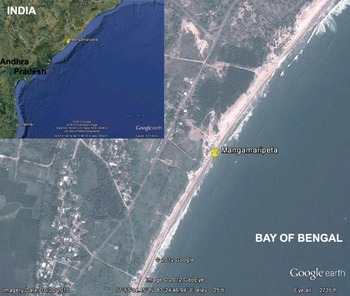
The specimens were handpicked from discards during regular sampling from the beach at Mangamaripeta, Visakhapatnam (17°51′3.35″N and 83°24′50.45″E) (Figure 1). They were fixed in buffered formaldehyde (4% in seawater) and then transferred to 70% ethanol. The following morphologies were examined: colony form (clavate); sclerites (rods, spindles and ovals); colour; and axis. Colorations of colonies were noted of fresh specimens. Sclerites were isolated from different parts of the colonies for microscopic examination following the procedure described by Bayer (Reference Bayer1961) and measurements noted using an ocular micrometer. Colony and sclerite terminology was mainly adapted from Bayer et al. (Reference Bayer, Grasshoff and Verseveldt1983) and Williams (Reference Williams1993), and the species identification was done using the key given by Williams (Reference Williams1989). The specimens have been deposited in the Visakhapatnam Regional centre of the Central Marine Fisheries Research Institute Museum, India.
Study area.

RESULTS
SYSTEMATICS
Order PENNATULACEA Verrill, 1865
Family VERETILLIDAE Herklots, 1858
Genus Cavernularia Valenciennes in Milne-Edwards & Haime, 1850
Cavernularia obesa Valenciennes in Milne Edward & Haime, 1850
(Figure 2A, B)
MORPHOLOGY
Sample 1 (Figure 2A) VSCO1, Mangamaripeta, Visakhapatnam (17°51′3.35″N and 83°24′50.45″E), beach, coll. S. Veena, 2009, 1 colony.
(A) Specimen VSCO1 Cavernularia obesa; (B) specimen VSCO2 C. obesa.

Colony is clavate with a total length of 33 mm. Peduncle length is 14 mm long and 10 mm width forming about 42% of colony length. Rachis length is about 58% of colony length measuring 19 mm long and 17 mm width (maximum width). Both rachis and peduncle are thick and fleshy. Autozooids and siphonozooids are distributed on rachis surface slightly elevated from the surface, represented by dark blackish brown spots, 244 in number and varying in diameter from 0.10–0.60 mm and separated by distances varying from 1.0–1.7 mm.
Sample 2 (Figure 2B) VSCO2, Mangamaripeta, Visakhapatnam (17°51′3.35″N and 83°24′50.45″E), beach, coll. P. Kaladharan, 2009, 1 colony.
Colony is cylindrical having a total length of 58 mm. The peduncle length is about 28% of colony length, 16 mm long and 8 mm width. Rachis length is about 72% of colony length, 42 mm long and 13 mm width (maximum width). Both rachis and peduncle are thick and fleshy comprising a vent on the ventral side. Autozooids and siphonozooids are distributed on the rachis surface with no orderly pattern of arrangement. Autozooids are 236 in number, 2–3 mm long, 3 mm wide, capable of total retraction into rachis. The tentacles of the autozooids comprise 7–8 arms (Figure 3). Distribution of the autozooids along the apical portion of the rachis are dense and few in number on the lower basal portion. Siphonozooids are densely distributed on rachis surface between the autozooids, also covering the distal terminus of the colony.
Autozooid microphotograph of specimen VSCO2 Cavernularia obesa.

AXIS AND COLORATION
Calcium carbonate internal axis is absent in both the samples. Colony colour of specimen 1 is greyish white in the rachis, with dark brown to black zooids and that of specimen 2 is creamish white. Sclerites are colourless.
SCLERITES
Rachis surface sclerites are represented by three-flanged rods 0.07–0.23 mm, rods and few spindles 0.04–0.22 mm (Figure 4A). Sclerites from the interior of rachis are similar in shape and size to those of the surface. Peduncle surface sclerites are sparsely represented by three-flanged rods measuring 0.06–0.09 mm, spindles measuring 0.07–0.15 mm (Figure 4B). Peduncle interior sclerites are dense comprising finger biscuit like sclerites, platelet like sclerites 0.05–0.22 mm and three-flanged rods and rods 0.06–0.15 mm (Figure 4C). Autozooid sclerites are completely absent. The second colony sclerites characters are much the same as those of the one described above.
(A) Rachis sclerites; (B) peduncle surface sclerites; (C) peduncle internal clerites Cavernularia obesa.

DISCUSSION
The area under surveillance is a small fishing region where gillnets are commonly operated. The specimens were dislodged from their habitat and brought ashore by fishermen along with the fish catch and discarded as trash. The probable source of Cavernularia obesa in Visakhapatnam waters may be through the exchange of ballast waters, as Visakhapatnam is one of the major Indian ports known for frequent vessel arrivals from other ports (Visakhapatnam Port Trust, Reference Visakhapatnam Port2009). Scheltema & Carlton (Reference Scheltema and Carlton1984) have also observed the emigrants being brought in by the shipping activity and ballast water discharge. Nearly 1.5 million tonnes of ballast water is exchanged annually from the Mumbai Port Trust and Jawaharlal Nehru Port Trust and the four source ports supplying the highest frequencies of ballast water discharges are Karachi (13.9%), Singapore (10.9%), Colombo (10.1%) and Jebel Ali (United Arab Emirates, 8%). The presence of Caribbean black striped mussel (Mytilopsis sallei) at the Jawaharlal Nehru Port Trust is believed to be port hobbed from Visakhapatnam and the presence of green-lipped mussel (Perna viridis) in Visakhapatnam is believed to be from Mumbai (Anil et al., Reference Anil, Clarke, Hayes, Hilliard, Joshi, Krishnamurthy, Polglaze, Sawant and Raaymakers2004). Hence ballast water monitoring, especially monitoring the species of mussels, oysters, barnacles, sponges, sea pens, ascidians, fish and planktons in Visakhapatnam is very much needed, as Visakhapatnam Port Trust is the major bulk export port that has more frequent vessel arrivals from Atlantic ports than any other ports in India (Visakhapatnam Port Trust, Reference Visakhapatnam Port2009).
Some of the pennatulaceans including Cavernularia are known to be associated with the coral reefs (Williams, Reference Williams, Gosliner, Behrens and Williams1996) and also Cavernularia and Virgularia harbour zooxanthellae which highlights their importance in the ecosystem. The recovery of this specimen, though accidental, tends to focus on the fact that due to certain disturbances like trawling, dredging and/or shipping, the specimens may have dislodged off from their habitat. Hence the presence of more numbers of this species along this region cannot be ruled out. The habitat of these species is being continuously disturbed and immediate action is necessary to be initiated in order to monitor and conserve them. The publications regarding the sea pens are inadequate from India and hence the need to bring out the resources available for these waters is very essential. As there is no previous record of Cavernularia obesa from Visakhapatnam waters, our present objective highlights the identification for the first time from theVisakhapatnam coast as well as adding this species as a new record to the benthic fauna of this area.
ACKNOWLEDGEMENTS
The authors thank Dr G. Syda Rao, Director CMFRI for his constant encouragements; Dr V.N. Nayak, Professor, Marine Biology P.G. Centre, Karnatak University, Karwar, Dr Gary C. Williams, Curator and Chair, Department of Invertebrate Zoology and Geology, California Academy of Sciences, San Francisco and Dr López-González, Biodiversidad y Ecologia de Invertebrados Marinos, Departamento de Fisiología y Zoología, Universidad de Sevilla, Reina Mercedes, Sevilla for providing literature for further study and confirming the identification; and Mr K. Bhaskar Babu, graphic designer for help with the photographic images. This research received no specific grant from any funding agency, commercial or not-for-profit sectors.