




No CrossRef data available.
Article contents
Identity of the U.S. Military: Comments on “An N of 1”
Published online by Cambridge University Press: 01 September 2004
Extract
Political scientist Russell A. Burgos has written an interesting and timely account of his intellectual journey from a “systemically inclined neorealist” to a “leaning constructivist” as a consequence of his active duty service with the U.S. Army in Iraq. In doing so, he offers some astute observations on several of the most important and enduring issues in American foreign and defense policy that are of interest to all international relations scholars. Rather than attempting to comment on the full range of his observations, this essay will focus on one of these—what Captain Burgos calls “the identity of the army in a ‘neo-imperial’ age”—with a view to assessing and bringing to bear some systematic evidence on his observations that the army has become staunchly Republican and conservative and that it sees itself as “separate from and superior to society at large.”Ole R. Holsti's latest book, Public Opinion and American Foreign Policy, revised edition, was published this year.
Information
- Type
- PERSPECTIVES
- Information
- Copyright
- © 2004 American Political Science Association
Political scientist Russell A. Burgos has written an interesting and timely account of his intellectual journey from a “systemically inclined neorealist” to a “leaning constructivist” as a consequence of his active duty service with the U.S. Army in Iraq. In doing so, he offers some astute observations on several of the most important and enduring issues in American foreign and defense policy that are of interest to all international relations scholars. Rather than attempting to comment on the full range of his observations, this essay will focus on one of these—what Captain Burgos calls “the identity of the army in a ‘neo-imperial’ age”—with a view to assessing and bringing to bear some systematic evidence on his observations that the army has become staunchly Republican and conservative and that it sees itself as “separate from and superior to society at large.”
In a seminal 1997 article on “The Widening Gap Between the Military and Society,” Wall Street Journal defense reporter Thomas Ricks warned, “The military appears to be becoming politically less representative of society” in a number of important respects, including its open identification with the right wing of the Republican Party. In his article, and subsequently in a generally sympathetic book on Marine Corps training, Ricks described the growing sense among the military that their culture and values are far superior to those of the society they have pledged to defend.1
Ricks's evidence was largely anecdotal and confined to the U.S. Marines, but it served as the springboard for subsequent analyses of survey data that included officers from all branches of the military.Two of those studies provide the data for this essay. The Foreign Policy Leadership Project (FPLP) undertook six national surveys of American opinion leaders at four-year intervals between 1976 and 1996. The samples included senior officers studying at the National War College and serving in the Pentagon, but because civil-military relations were not the primary focus of the FPLP studies, they did not include questions that dealt with the full range of issues raised by Ricks. Surveys conducted in 1998–1999 by the Triangles Institute for Security Studies (TISS) replicated the FPLP sampling design for civilian leaders. To gain access to the views of military officers at various stages in their careers, in addition to those attending the National War College, the sample also included students at the Army War College, Naval War College, Army Command and Staff College, and the Capstone Course at the National Defense University.2
For more extensive analyses of the data on military and civilian leaders, see Holsti 1998/99 and Holsti 2001.
Partisanship
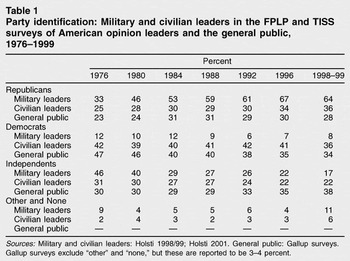
Each of the seven surveys asked respondents: “Generally speaking, do you think of yourself as a Republican, a Democrat, an Independent, or what?” Their answers, summarized in table 1, provide very strong support for Captain Burgos's observation about growing partisanship and Republicanization in the army. In the 1976 survey, fewer than half of the officers identified themselves with one of the two major political parties. In sharp contrast, more than two thirds of the civilian leaders did so. The proportion of Republican military officers grew steadily, from less than one-third in the 1976 survey to almost two-thirds in the most recent studies, while those declaring themselves to be independent or without any partisan affiliation dropped from a solid majority to fewer than one in three.3
These results are remarkably similar to those in the 2003 Army Times survey cited by Captain Burgos. Trowbridge 2003.
Party identification: Military and civilian leaders in the FPLP and TISS surveys of American opinion leaders and the general public, 1976–1999

Ideology
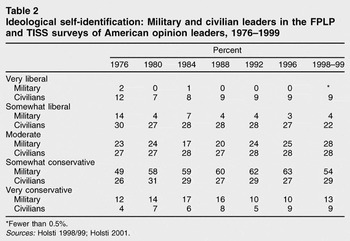
Burgos also echoes Ricks's observation that the military are becoming increasingly conservative, or, as Ricks put it, they are increasingly comfortable with the “Rush Limbaugh variant” of Republican conservatism. The FPLP and TISS data on ideological preferences also support Captain Burgos, as a vast majority, ranging between two-thirds and three-fourths, of military officers identified themselves as conservatives since 1980, while those who admitted to being liberals of any variety declined almost to the vanishing point (table 2). The number of conservative officers peaked during the mid-1980s, but not because of any concomitant increase in liberals. The figures do not, however, indicate comparable increases in the most conservative categories, as the growth was mostly among those describing themselves as “somewhat conservative.” The data also reveal that the ideological gap between the military and civilian leaders has grown in recent years because ideological changes among civilians—notably a slight decline in the number of self-identified liberals—have been far less pronounced.
Ideological self-identification: Military and civilian leaders in the FPLP and TISS surveys of American opinion leaders, 1976–1999

Military and Civilian Culture
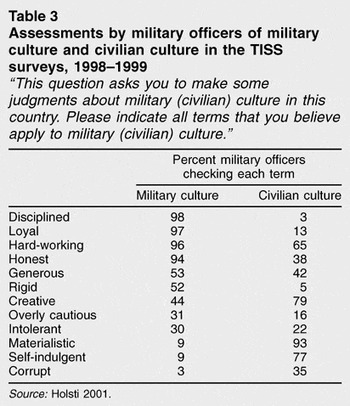
According to Captain Burgos, most of his army colleagues have a strong distaste for civilian culture, as they believe it to be excessively liberal and distinctly inferior to military culture and values. Once again, his observation parallels some themes that emerged in Ricks's account of how young marines, upon their first home furloughs after basic training, scorned the values and behavior of their one-time civilian friends. In order to probe for the existence and extent of any civil-military gap on matters of culture and values, the 1998–99 TISS survey included several items, including one cluster that asked respondents to make some judgments on civilian and military culture. Table 3 summarizes the results.
Assessments by military officers of military culture and civilian culture in the TISS surveys, 1998–1999 “This question asks you to make some judgments about military (civilian) culture in this country. Please indicate all terms that you believe apply to military (civilian) culture.”

It is not especially surprising that military respondents judged their own institution and culture in exceptionally favorable terms; we would also expect physicians, lawyers, educators, journalists and the like to provide laudatory descriptions of their own professions. As revealed in the left hand column of table 3, overwhelming majorities of military respondents viewed military culture as disciplined, loyal, honest, and emphasizing hard work. They also judged it to be free of materialism, corruption, and self-indulgent tendencies. Somewhat smaller numbers also rated it as tolerant, generous, and appropriately cautious. Only on creativity and rigidity did a majority of the military seem to harbor some doubts. However, it is not clear in this context whether “rigid” is an unfavorable trait (as in knowing only a single way to tackle a wide range of complex problems) or a favorable one (as in an unwillingness to compromise one's core values and beliefs for personal gain).4
In recent years the general public has often rated the military as the U.S. institution in which it has the highest confidence. King and Karabell 2003.
In sharp contrast, the military view of civilian culture ranged from moderately favorable to abysmal. The officers taking part in the survey conceded that Americans work hard, are creative, and are not overly cautious. They denied that Americans are intolerant or rigid. Military responses to the remaining list of traits painted a very dismal picture indeed. Civilian culture was viewed as materialistic, self-indulgent, undisciplined, dishonest, for the most part ungenerous and, worst of all from the perspective of core military values, disloyal. That only about one military officer in eight regarded civilian culture as loyal is a stunning indictment that, perhaps more than any of the other responses, indicates that there is indeed a serious gap between the two cultures.
So What?
If such findings of wide partisan, ideological and cultural gaps had emerged from surveys in a Third World emerging democracy, they would surely suggest the very real possibility of military coup in the not-too-distant future. Although the state of civil-military relations is never a trivial issue in democratic governance, especially when the military constitute one of the largest and costliest governmental institutions, the chances of such a coup in the United States are somewhere between infinitesimal and nil. Some flag officers could reasonably claim to have been abused in recent years. For example, consider the shabby treatment accorded Army Chief of Staff Eric Shinseki after he had the temerity to tell Congress prior to the invasion of Iraq in March 2003 that the United States would need to deploy several hundred thousand troops for an extended period of time to maintain order in postwar Iraq. Two days later, Deputy Defense Secretary Paul Wolfowitz interrupted his testimony before a House committee with a slashing attack on Shinseki's estimate of postwar needs in Iraq, describing them as “quite outlandish.” He went on to say: “I am reluctant to try to predict anything about what the costs of a possible conflict in Iraq might be…. But some of the higher-end predictions that we have been hearing recently, such as the notion that it will take several hundred thousand U.S. troops to provide stability in post-Saddam Iraq, are wildly off the mark.”5
Fallows 2004, 72–73. The Fallows article is a well-documented analysis of how and why the U.S. undertook the invasion of Iraq with a relatively small military force despite the many government studies, including some based on postwar occupations in the Philippines, Germany, and Japan, that warned of likely problems in post-Saddam Iraq.
Presumably these actions by Rumsfeld and Wolfowitz were sufficient to drive home the point that dissent from the administration's ideological preconceptions would not be tolerated. In case anyone had failed to draw the proper lesson, it was underlined when the President and Secretary of Defense broke tradition by pointedly absenting themselves from General Shinseki's retirement ceremony even though Fort Meade is only minutes away from the White House. These and other episodes illustrate the strong differences between many uniformed and civilian leaders in the Pentagon, but they do not begin to rise to the genuine civil-military crisis triggered by General Douglas MacArthur's open defiance in 1951 of his superiors concerning conduct of the Korean War.
Yet the gaps described by Captain Burgos and documented above can't be wholly dismissed as merely a tempest in a teapot. Partisanship in the military has a long history, dating back to the early years of the republic. A number of top military leaders have actually run for the presidency while in uniform: Whig Winfield Scott was trounced by Franklin Pierce in 1852; Democrat George B. McClellan ran a losing campaign against his boss, Abraham Lincoln, in the wartime election of 1864; Leonard Wood narrowly lost the Republican nomination in 1920; and Douglas MacArthur did little to dampen the enthusiasm of his Republican backers in 1948 and, after his retirement, in 1952. But the longer-term trend toward military professionalization includes norms against partisan political activity by military officers. Arguably the most outstanding American military leaders of World War II—five-star Generals George Marshall and Dwight Eisenhower—reflected those norms in their careers. Marshall never even voted on the grounds that doing so would be contrary to his conception of professionalism, and Eisenhower never revealed his partisan preferences until he decided to run for the presidency as a Republican in 1952.
Military historians generally agree that the professional norms against partisan political activity have enhanced the performance of the armed forces.6
See, for example, Bacevich and Kohn 1997; and Matthews 1999.
Polling expert Andrew Kohut dismissed the “gap flap” as little more than the understandable tendency of military personnel—many of whom are prosperous white Christian males—to regard the GOP as more congenial to their interests.7
It is, however, open to question whether the longer-term interests of the military (or the country) are best served by their becoming just another partisan interest group in the same way as business leaders, union leaders, trial lawyers, and the like. The alternative view was presented two decades ago by S. L. A. Marshall: “Paradoxically, it is only when the Army has a truly military posture that its political position becomes invulnerable.”8Marshall 1980, 112.
Finally, what might be done to bridge the civil-military gap? One obvious answer—to restore the draft or at least to invoke a national service requirement including military service among several options—could provide more Americans with an opportunity to experience and perhaps better appreciate both civilian and military cultures, but that issue is beyond the scope of the present essay. Suffice it to say that although the postwar chaos in Iraq and a growing sense that the American military are stretched too thinly have generated a few calls to rethink the issue, legislation to institute conscription or national service has the same chance of enactment as a bill to eliminate Thanksgiving, Mother's Day, and Valentine's Day.
References
REFERENCES
Bacevich, Andrew, and
Richard H. Kohn.
1997.
Grand Army of the Republicans: Has the U.S. military become a partisan
force?
New Republic.
December 8,
22–25.Google Scholar
Fallows, James.
2004.
Blind into Baghdad.
Atlantic Monthly
293
(January–February):
52–74.Google Scholar
Holsti, Ole R.
1998/99.
A widening gap between the U.S. military and civilian society?
Some evidence, 1976–96.
International Security
23 (Winter):
5–44.Google Scholar
Holsti, Ole R.
2001.
Of chasms and convergences: Attitudes and beliefs of civilians and
military elites at the start of a new millennium.” In
Soldiers and civilians: The civil-military gap and American
national security, ed.
Peter D. Feaver and
Richard H. Kohn,
15–99.
Cambridge:
MIT Press.
King, David C., and
Zachary Karabell.
2003.
The generation of trust: How the U.S. military has regained the
public's confidence since Vietnam.
Washington, DC:
AEI Press.
Kohut, Andrew.
1999.
The “gap flap” news release.
Washington, DC:
Pew Research Center for the People and the Press.
Marshall, S. L. A.
1980.
The soldier's load and the mobility of a nation.
Quantico, VA:
Marine Corps Association, 1980.
Matthews, Lloyd I.
1999.
Ethics, Military. In
The Oxford companion to American military history, ed.
John Whiteclay Chambers II.
New York:
Oxford University Press,
1999.
Ricks, Thomas E.
1997a.
The widening gap between the military and society.
Atlantic Monthly
280 (July):
66–78.Google Scholar
Ricks, Thomas E.
1997b.
Making the corps.
New York:
Scribners.
Trowbridge, Gordon.
2003.
2003 Military Poll—We asked. You answered.
Army Times, December.Google Scholar
Party identification: Military and civilian leaders in the FPLP and TISS surveys of American opinion leaders and the general public, 1976–1999
Ideological self-identification: Military and civilian leaders in the FPLP and TISS surveys of American opinion leaders, 1976–1999
Assessments by military officers of military culture and civilian culture in the TISS surveys, 1998–1999 “This question asks you to make some judgments about military (civilian) culture in this country. Please indicate all terms that you believe apply to military (civilian) culture.”
 You have
Access
- 4
- Cited by