How would a person far from the inner circle of opera connoisseurs describe the ending of that most complex of operatic works, Richard Wagner’s Der Ring des Nibelungen? Would such an account get told as a free-flowing stream of consciousness? Would it be sensual? Would it be logical? Surprising? Naïve? Lars von Trier’s retelling captures some of all these possibilities:
All right, so at the end they build this huge funeral pyre, and Brünnhilde suddenly realises what’s happened – why does she suddenly realise? Yeah, somebody’s been talking. Anyway, she realises what’s happened, and she says well okay, she’ll just have to take what’s coming, and she gets on her horse – it has to take what’s coming as well, apparently, although it hasn’t done a thing, it’s just been there, chewing away in the background, in the odd scene – and leaps into the pyre […] and dies in the blaze, of course, or so we have to assume, and that ring she has, she’s not wearing it … she hadn’t put it on, had she? … Well, anyway, she’s dead … but it was on [Siegfried’s] finger a moment ago, I think it’s on his finger … in any case, the whole lot goes up in flames, and then the Rhine rises, and with it come the Rhine Maidens, singing. They seize the ring, and Hagen makes a grab for it and ends up drowned, or so we have to assume, he’s dragged under by these Rhine Maidens. So in the final scene – and it’s all happening really fast now, as it nears the end – we’ve got the funeral pyre, a horse and rider leaping into the flames, a huge choir on the beach, the Rhine rising up, covering everything, the Rhine Maidens rolling and tumbling, and in the background (it says, like a kind of little closing remark), Valhalla burning down, right? And that’s it!Footnote 1
This is the surviving portion of the outline presented by von Trier himself not long after he was appointed to direct the Ring at the Festspielhaus at Bayreuth, when he summed up the whole of the cycle to his good friend, the writer Jørgen Leth, and his son, Kristian Leth, on camera outside the Festspielhaus on 11 August 2002. Von Trier had never staged a play before, let alone an opera, so Bayreuth veteran Wolfgang Wagner had taken a bit of a gamble in offering him the job.Footnote 2
The potted account quoted above, together with other recordings of Lars von Trier’s preliminary work on the Ring, were meant to provide the material for a documentary, to be released by von Trier’s own studio, Zentropa, in connection with the premiere of his Ring cycle at the Festspielhaus in 2006. The tape was tucked away in a box in the Zentropa archives, and there it has stayed since the production was finally abandoned after two years in May 2004. In the box along with this particular tape are fifty-seven others, each of about thirty-five minutes duration. A further box (hereafter referred to as ‘the second box’) contains a disorganised bundle of von Trier’s own notes and sketches for the production, along with dramaturgical ideas and photographs from nature, intended to provide inspiration for the set designs.
This wealth of material has never been published, and has instead languished at Zentropa, all but forgotten. I was first made aware of its existence during a private conversation with von Trier himself. But before being allowed access to it, I had to sign a confidentiality agreement confirming that the tapes would be used solely as part of the research for this article.Footnote 3 I was then given permission to copy key sections of this footage to a DVD of my own – to be shown exclusively by me in connection with my scholarly lectures.Footnote 4
The questions I asked myself, and to which I hoped to find at least partial answers in the contents of those two boxes included: What was the process followed during von Trier’s preliminary work on the Ring? What initial ideas or images did the director consider? What was his working relationship with Wolfgang and Gudrun Wagner; with the conductor, Christian Thielemann; the scenographer, Karl ‘Kalli’ Júlíusson, the assistant director, Elisabeth Linton, or the lighting department?Footnote 5 What led up to the final decision to abandon the production? And what can we, as opera scholars, learn from these materials?
The documents also raise a number of other questions in relation to Lars von Trier’s films. Von Trier has often professed to being fascinated by Wagner – by his philosophical ideas, which he embraced in his youth (or a Nietzschean distillation of them),Footnote 6 by his music, whose surging grandeur he preferred as purely orchestral versions without any vocal parts,Footnote 7 and not least by Wagner’s romantic Naturgeist and mythological universe, which runs like a sensuous undercurrent through all von Trier’s own films.Footnote 8
One could in fact find a number of similarities between the lives of Lars von Trier and Richard Wagner (Figs. 1a and 1b). Both were raised by fathers with Jewish heritage, only to discover later that these men were not their biological fathers and that their own direct connections to Jewishness were therefore imaginary. Both were largely self-taught: Wagner received some private lessons in composition, von Trier attended the National Film School of Denmark, but both later chose to go their own ways, much to the dismay of their teachers. Both had first wives who were actresses and second wives who were homemakers. And the similarities also extend into the creative sphere: both are creators of large-scale dramatic works centring around female characters. Like Wagner, von Trier is intent on controlling his public image. And on occasion that image is strikingly Wagnerian, as shown in Figures 1a and 1b. Both also suffered from depressionFootnote 9 and both can fairly be described as polymaths: Wagner, of course, wrote both the libretti and the music for his works, usually directed his own operas and ran his own opera house in Bayreuth; Lars von Trier has also worked as scriptwriter, actor, director, cameraman and technical director on his films and has his own film company, Zentropa.
a) official photo of Lars von Trier (by Christian Geisnæs, on the occasion of the release of the film Antichrist, 2009); b) Richard Wagner (by Pierre Petit, in Paris, 25 May 1861).

Even before tackling the Ring at Bayreuth, Lars von Trier had been inspired by the female characters of the Wagnerian universe. Breaking the Waves (1997) and Dancer in the Dark (2000) both feature naïvely romantic female leads who, like Wagner’s early heroines, meet their death so that a hero may be redeemed.Footnote 10 Starting with Dogville (2003), however, on which he was working at the same time as the Ring, von Trier’s heroines become almost as complex and unpredictable as the female protagonists in Wagner’s later operas. In this film as well as in von Trier’s so-called depression trilogy – Antichrist (2009), Melancholia (2011) and Nymphomaniac (2013) – they all attain knowledge through the agonies of love, as do several of Wagner’s female protagonists. In Antichrist and Nymphomaniac, meanwhile, the central female character lashes out at the men in a sexual explosion of anger and aggression, a response very similar to the actions of Kundry in Parsifal.
But there seems to be a particular connection between von Trier’s Ring project and Melancholia, which far surpasses the other Wagnerian echoes in his other films, and which will become my focus in the second half of this article. In Melancholia, it is the Prelude to Tristan and Isolde that runs like a leitmotif throughout the whole film, as well as providing the accompaniment to what von Trier himself calls the ‘overture’ to the film.Footnote 11 The plot of Melancholia, though, is more reminiscent of the Ring than of Tristan, as we follow the long-suffering, all-seeing Justine as she faces up to the end of the world, and indeed almost urges it on (‘she is longing for shipwrecks and sudden death’, as von Trier says of her, quoting the Danish poet Tom Kristensen, ‘and she finds it too. In a way, she succeeds in pulling this planet from behind the sun and she surrenders to it’), because the world, in its present state, deserves no better (‘The earth is evil … [and] nobody will miss it’, as Justine herself puts it in the film).Footnote 12
Prompted by these affinities with Wagner’s life and works, and by Justine’s similarity to Brünnhilde, I further decided to widen the scope of my analysis to include the following questions: which elements – textual details, images, music, dramaturgical features, characterisation, plot and so on – from his Ring project did Lars von Trier make use of in Melancholia and elsewhere? What are the differences in structure and impact between film and theatre? And how does Lars von Trier operate in the zone between these two art forms? Adopting such an approach does not mean ignoring other factors, such as autobiographical touches, gender issues, influences from the visual arts, drama, literature, cinema and other art forms, but for the most part, in this article I discuss such aspects of Melancholia and other films only insofar as they pertain to the Ring project in Bayreuth. In short, I hope that my work on the Zentropa materials will help generate a new understanding of von Trier’s creative process and his cultivated Wagnerian interrelationship of stage and film.
Lars von Trier’s Ring project – what we know
The story of how the Ring project foundered is well known, as are the ideas behind the projected staging, but until now the only sources of information have been the materials which Lars von Trier chose to make public a few months after the collapse of the project in May 2004. At that time he posted on the Internet an article entitled ‘En overdragelsesforretning’ (‘A Deed of Conveyance’), in which he explained the concept behind the production and the reasons for its failure, supplementing this with his script notes on Die Walküre and Siegfried, the two operas in the cycle which he had finished planning. These notes were freely available for a month on Zentropa’s website, as a possible inspiration to others, before being removed.Footnote 13
In his article, von Trier explained how his vision of a ‘conjuring trick’ approach, whereby the entire Ring cycle would be played out on an almost totally dark stage, with just a few spotlights illuminating characters or parts of the set, had proved unworkable because he was too much of a perfectionist. It would either have cost millions, he suggested, far beyond what the Festspielhaus could afford to pay, or the technical realisation of it would have been of such dubious quality that the illusion might be spoilt and the magic lost. This was why, after working for two years on the project, he had resigned from it; he had, in his own words, painted himself into a conceptual corner which, while extremely interesting from an artistic point of view, would have posed such practical problems that he no longer felt equal to the task.Footnote 14
In ‘En overdragelsesforretning’, under the heading ‘Logik for perlehøns’ (‘Plain as a pikestaff’), von Trier also explains his views on Wagner and his own qualifications (or lack thereof) for directing opera. As with his approach to film, he distances himself from mainstream productions. Without mentioning it by name, he criticises so-called Regietheater, in which the director imposes his or her own layers of interpretation on a work, often investing it with modern-day parallels. Von Trier’s rejection of this approach accords with the critical stance of many conductors and musicologists, which can be summed up as a commitment to Werktreue (‘fidelity to the work’). Von Trier’s own approach is inspired by the dictum of the Danish conductor Gerhard Schepelern: ‘The director must not try to be cleverer than the work.’Footnote 15
It does not take much perusal of von Trier’s text, though, to see that his ‘fidelity’ is of an entirely different order from the traditionalist productions often associated with the principle of Werktreue. While wishing to remain ‘faithful to the work’, inasmuch as he aims to create on stage the mythological illusions that Wagner was unable to realise in his own production of the Ring – partly because he did not have the benefit of today’s technology – he intends to do this in his very own, von Trierian, cinematographic fashion.
For von Trier, the key word here is ‘illusion’. And the whole point of an illusion is that it is not actually there, but exists only in the mind of the spectator. He gives a quite simple explanation of this in dramaturgical terms: ‘If A via B leads to C, we show A and C and let the spectator deal with B! It is the simple recipe for conjuring tricks. We see the preparation and the result, but never the actual transformation. It is the spectator’s acquired knowledge of sequences of events that creates the magic and the illusion.’Footnote 16
In the article’s next section, ‘Det berigede mørke’ (‘Enriched Darkness’), von Trier presents his scenographic vision. Rather than handing the audience everything on a plate, so to speak, he argues for a much lower level of lighting, more like the dim gaslight of Wagner’s day. This allows for a far greater degree of mystery, he writes. But his idea is to go even further, to turn the lighting all the way down to horror movie level; so far down that, in principle, the degree of light on stage will never exceed 5%. By eschewing ‘democratic’ lighting and opting instead for the judicious use of spotlights, he wants to be able to follow a character’s progress across a landscape or through a building, thus satisfying the audience’s need for a logical progression, while at the same time presenting them with mysterious, dreamlike surprises.Footnote 17
Video projections could then expand the stagescape and give the sense of a movable set or an almost endless, mythical space. The audience would be shown perfectly detailed images from the natural world, such as dock leaves, moss or mortised wooden beams, but only tiny sections of them and only in glimpses. Von Trier, then, wants to show ‘the Greatness in the least and the Deity in nature’ because, as he describes, ‘that was how Wagner was for me!’Footnote 18
In the video material from the Zentropa archive, however, a different story emerges, which I recreate chronologically below.
New materials
The first meeting
The video recording of the first meeting at the Zentropa offices in Copenhagen shows a discussion between Lars von Trier and Gudrun and Wolfgang Wagner, dated 12 April 2002. They are seated around a small coffee table. The conversation between von Trier and Wolfgang Wagner is conducted in English and German, with Gudrun as interpreter.
Von Trier begins by saying that he has been listening to the Ring cycle, and that he has a good feeling about it. He tells the Wagners he likes Die Walküre best, but then says, rather bluntly, that he finds Götterdämmerung ‘a little strange, storywise’. Wolfgang Wagner answers with a wry smile that Walküre is of course the most popular, and the simplest, of the four. ‘Okay, well put!’ says von Trier, and all three laugh.
But, Wolfgang adds, Walküre is not without its problems either. Act I ought to flow quite naturally and smoothly, he says, but Act II is tricky. For years, German audiences had a problem with it, because of the long recitative passages, ‘Wotans Erzählung’ and ‘Die Todesverkündigung’. But when Wolfgang staged it in Naples in 1952, Act II was a hit, because the Italians were used to the narrative tradition of ancient Greek drama. ‘And’, Wagner tells von Trier, ‘once you know that, and once you become more familiar with the Ring, suddenly you will understand Götterdämmerung’.
Wolfgang then goes on to say that, as in most other myths, the Woman is the most significant primordial element in the Ring, reminding von Trier of how ‘the last battle’ is prevented by the sacrificial death of Brünnhilde, the former goddess of war, an act which heralds the dawn of a new and better world.
Musical run-through
There then followed a series of meetings recorded between the Wagners, conductor Christian Thielemann and von Trier to discuss the casting. These discussions were conducted mainly by Gudrun Wagner and Thielemann. Von Trier requested only that the Rhinemaidens should be young and sexy,Footnote 19 and that the central characters should not be too overweight. He also ventured to ask whether it might be possible to cast real dwarves as Alberich and Mime. The answer was negative.
In a segment recorded in late May 2002, Thielemann and von Trier are alone together in the latter’s small office at Zentropa, which has been furnished with a grand piano for the occasion. Thielemann is at the piano, playing and singing his way through the whole of Wagner’s Ring, with von Trier sitting next to him on the sofa, listening. On his lap he has a parallel German-Danish version of the libretto, with the names of the characters associated with each leitmotif noted in the right-hand margin.Footnote 20
They take a break every now and then, and during these pauses Thielemann points out particularly interesting passages in the music and explains, among other things, why you cannot simply perform the whole of the Ring cycle right through in one go – it takes too much of a toll on the singers playing Brünnhilde and Siegfried, and is not easy for the conductor either.
When they get to Götterdämmerung and Thielemann plays ‘The Death of Siegfried’, von Trier is so moved that he sheds a few tears behind Thielemann’s back. The work has got under his skin, exactly as Wolfgang Wagner said it would.
The first meeting with the technical crew
On 11 August 2002 Lars von Trier had a meeting with the technical crew at Bayreuth. He spoke in English, and one of the technicians translated into German. Von Trier began by saying that this is a field in which he is ‘extremely stupid’ and that he believes his ignorance should be his ‘shield’. He will, therefore, be asking them ‘a lot of stupid questions later on’. There is some rather bewildered laughter from the German technicians and the translator replies that he does not think this will be a problem. ‘Okay’, says von Trier, ‘so you’re used to stupid questions.’ He tells them that he is planning to sleep on the stage at Bayreuth that very night, so that he can ‘have a conversation with Richard Wagner and ask stupid questions’.Footnote 21
Von Trier explains to the technicians that he feels the Ring is of ‘such a monumental character’ that no image can live up to it. As he sees it, a perfect performance of the Ring would take place in total darkness, since then everything would be happening in the minds of the audience. Instead of aiming for maximum effect, as tends to be the norm in modern productions, he wants to try ‘to go the opposite way, to go for a minimal effect, with as little light as possible’, so that he can ‘enlarge all the way through’.
In von Trier’s opinion, the impact of a large tableau is very short-lived; at some point the audience is liable to start wondering how it is all managed, how people get on and off the stage and so on. With darkness, on the other hand, one can create something really magical, something that does not let Wagner down. He envisages using lots of little spotlights, explaining that if you have a small light source that can be moved around, by the time it comes back to where it started things may have changed. You can cheat; you can work miracles. So, for example, what the audience first sees as a house can be transformed into a meadow or a forest. In this sense it is like a film, where the information given to the audience is totally controlled by the director and by the technology.Footnote 22
Von Trier does not want to place other interpretations on Wagner’s work, or add anything new. Nor does he want to make fun of any elements of the plot. The sword must be capable of shattering an anvil, and Fafner must come across as being dangerous: he is anxious to maintain this illusion. He wants the audience to forget that this is actually taking place on a stage. He does not want to go to the opposite extreme either, though, and to end up with a production that will appear totally naïve; his version has to be loyal to Wagner. He wants it all to be very traditional, in other words; but traditional in the way it was ‘before it became modern’, as he puts it.
Rather than having one large fixed stage set, von Trier envisages having several smaller, mobile elements, so that the scene could keep changing, as it does in horror films, in which – as he learnt at film school – the point is to create a sense of confusion. And the small video screens far upstage should not be perceived as video screens by the audience, but as hints of something going on far away that gradually comes closer as the characters appear on the stage, in the flesh, on barely glimpsed sets. His idea is that afterwards the audience should be able to go home and create a drawing of what they had seen.
Unwanted intrusion of light
The following year, on 18–19 November 2003, further technical meetings were held at Bayreuth. This time the scenographer, Kalli Júlíusson, was also present. One of the main subjects to be discussed was the set design for Die Walküre. The mountain would not reach up to the top of the stage space, Júlíusson explains. The mountaintop – the horizon – would occupy the centre of the space, resting on the raised middle stage lift. The repeated ascent and descent of the spotlit characters would make the mountain, otherwise covered in darkness, seem four times taller than the height of the proscenium.
One problem to which von Trier had to find a solution was the unwanted intrusion of light, which was still far too great. He suggests building boxes around the monitors and hanging a gauze bobinette, or scrim, across the orchestra pit. And he responds to the objection that neither the orchestra nor Wolfgang Wagner would be happy about the scrim by saying that if it is a matter of security, it would be possible to make a scrim that could be removed in an instant. If they feel it is a fire risk, then he is sure they can come up with a scrim that will not catch fire, and if it is a question of ventilation he is sure they can create another source of ventilation. If, however, it is a question of conservatism and not some practical problem that they can pin down and do something about, then that is a bigger issue. He explains that he has a trick he uses with actors whereby if he wants to change a little thing, he starts by saying that he wants to change a bigger thing. So the scenographer should just tell the performers that they are going to put up a scrim and that they (i.e. the musicians) will just have to play standing up.
Stage rehearsal of the Walküre overture
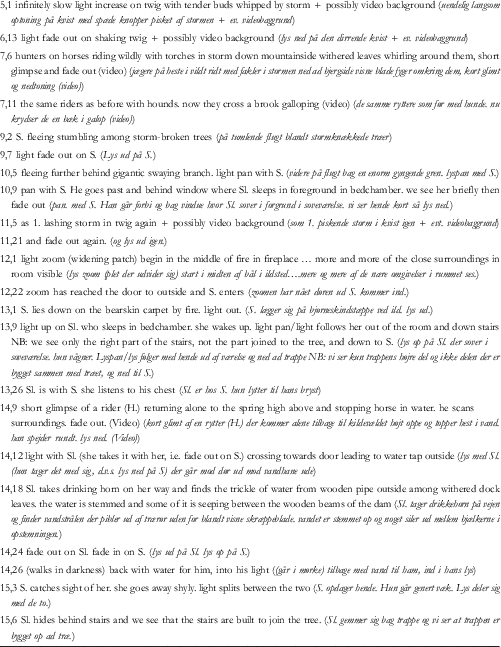
It is the day of the crucial stage rehearsal, 14 May 2004, when the set builders and lighting technicians will present the results of more than a year’s work. Gudrun and Wolfgang Wagner are sitting in the auditorium with the head of the technical crew, the scenographer and von Trier. On stage a video camera is trained on the two extras who are standing in for Siegmund and Sieglinde during the overture to Die Walküre. They are wearing the costumes from Patrice Chéreau’s 1976 production, the most neutral the wardrobe has to offer. The scrim is now hung only in front of the stage and not over the orchestra pit, as originally planned. The movements and lighting follow the script uploaded on Zentropa’s website in 2004 (see Table 1).
The Valkyrie, Act I, Prelude. Script by Lars von Trier, 9 January 2003

Note: Number indications correspond to page and bar number of opera vocal score, Peters Edition (issue 3404): Die Walkure [drama in three acts], WWW 86B, by Richard Wagner, with German-English text and table of motifs, ed. Felix Mottl (Leipzig, 1914).
Afterwards, when the house lights go up, the discussion regarding the lighting becomes more emphatic. The technical supervisor tries to defend von Trier’s idea of the scrim, but Wolfgang Wagner is now against using it at all, because he feels it prevents the overtones from carrying beyond the stage. In his experience scrims present an acoustical problem because they deaden the sound of the voices. ‘I’ve seen so few acoustically suitable stage sets lately’, he says.
Then it is von Trier’s turn and his first words are for the technicians. He tells them that this scene had been beautifully done, but he feels that to achieve the effect he is looking for they would need to use another ten scrims, because the whole idea is that the entire tree should never be visible. This means that they have a problem, one which, in his opinion, can only be solved by not worrying too much about the acoustics to begin with, figuring out how to arrive at the best image possible and then sorting out the acoustics. He then proposes that they paint the entire set black, or almost black, and steps are immediately taken to see to this.
Another possible solution that he suggests to the scenographer would be to provide every member of the audience with sunglasses, much in the way that cinemagoers are supplied with 3D glasses for viewing certain films. These could provide the additional darkening effect, which von Trier was looking for. He scraps this idea, though, because he realises that the audience would probably take off the glasses after the first five minutes and the illusion would be spoilt.
Losing the Ring
That evening, von Trier and Gudrun Wagner are having a chat backstage while they wait for the black paint to dry. They both seem relieved and apparently satisfied with the new solution. But then something must have happened, something that has not been caught on tape. The following day, von Trier and Kalli Júlíusson are filmed sitting alone at a table. Von Trier looks pale; with a look of wry resignation he holds up a bottle of pills to the camera.
The final clip on the video is short and the sound is bad. Lars von Trier is alone, standing outside a door in a backyard, surrounded by some representatives of the local media. He paces back and forth like a caged lion: waiting for a decision. ‘Fire me! Fire me! Fire me!’ he mutters under his breath, but still loud enough for the camera mike to pick up and for the journalists to hear. ‘Do you really mean that?’ one of them asks, sounding both sympathetic and curious. Von Trier says he doesn’t really know, he is in two minds: on the one hand he wants to go home to his family in Denmark, but on the other … well, he has gone so far with this project, that … And here the last videotape comes to an abrupt end.
What spelt the last straw for the project in Bayreuth is not clear from the tapes. The argument regarding the scrim seemed to have been resolved. Lars von Trier, his assistant director Elisabeth Linton and his producer Vibeke Windeløv cannot recall the incident captured on the last tape, in which von Trier is apparently hoping to be fired. Both Linton and Windeløv are, however, under the impression that if, at that point, von Trier had wanted to gain more concessions from the Wagners, and if he had been able to meet with them to discuss the possibility of this, he would probably have got what he asked for.Footnote 23
Von Trier was well aware that his project would be exceptionally costly. Devices such as the close-up shots of moss, leaves and other natural features were particularly expensive. In his interview with me, he said that he had made it clear to the Wagner family that he would not be interested if only 30% of his vision could be met, but that he might be interested if 70% could be realised. He also said that Wolfgang Wagner, who had never been happy about the project, which he labelled ‘Entartet’ (degenerate), had used the whole business with the scrim as a poor excuse to scotch it.Footnote 24
Von Trier was not, as it happens, about to be fired from the project. But according to Elisabeth Linton, it might not have been so surprising if he had half-hoped to be. The truth was that it had gradually begun to dawn on him that for the first time in his working life he was faced with bosses who were prepared to gainsay him. Von Trier had his own film company, Zentropa; he was used to calling the shots and never having his decisions challenged, unlike his colleagues in Hollywood and other major centres of the film industry, where production companies have a big say in the process. Besides which, for administrative and performative reasons, a stage director can never completely control the final result. And with a production of the Ring at Bayreuth, the risk of artistic interference was definitely greater than with less prestigious productions.Footnote 25
So the fear of later curbs on his directorial freedom seems to have been one of the reasons for his resignation; but there was also another. Producer Vibeke Windeløv had been with von Trier during rehearsals in Sweden for Dogville, just after the last video recordings from the project in Bayreuth. She witnessed how unstable he seemed, and claimed that he was often so drunk on set that she could not imagine how he was ever going to get through the lengthy rehearsal phase (eight months as opposed to the usual four) that lay ahead of him in Bayreuth.Footnote 26 After a serious conversation between von Trier and Windeløv, they agreed that she should go to Bayreuth and tell the Wagner family that he would have to withdraw from the project, which she did.Footnote 27
Pictures from the archives
I would now like to turn to the pictures stored in the second box from the Zentropa archives, which provided inspiration for von Trier’s Bayreuth production in terms of stage design, costumes, lighting and concept, and which probably also influenced his attitude to the Festspielleitung in general. If the video material gives us information on his working process, and the practical and human problems von Trier encountered, the archived images develop this, both by revealing which innovative aspects were lost to the opera world when the project failed, and by producing evidence of the type of images and sketches which later on played an important role in von Trier’s films.
The first thing to catch my eye when I opened this box was a copy of the famous photo of the Wagner family in cheerful conversation with Adolf Hitler. There were only a few things in the box, which suggests that this photo perhaps held some particular significance for von Trier. Wolfgang and Wieland Wagner’s close, and later compromising, relationship with Hitler perhaps roused von Trier’s curiosity and may have been at the back of his mind during his conversations with Wolfgang. It is worth mentioning that the second box contained absolutely no political comments on the use of Wagner’s music during the Third Reich.
Along with the Hitler photograph was a folder containing other photographs and sketches from earlier Wagner productions at the Festspielhaus. These included:
∙ sketches for the stage sets for all four operas in the original Ring cycle (1876) and photographs of Brünnhilde, Wotan and Siegfried in costumes designed by Carl Emil Doepler;
∙ sketches for Tristan and Isolde, based on Richard Wagner’s own ideas;
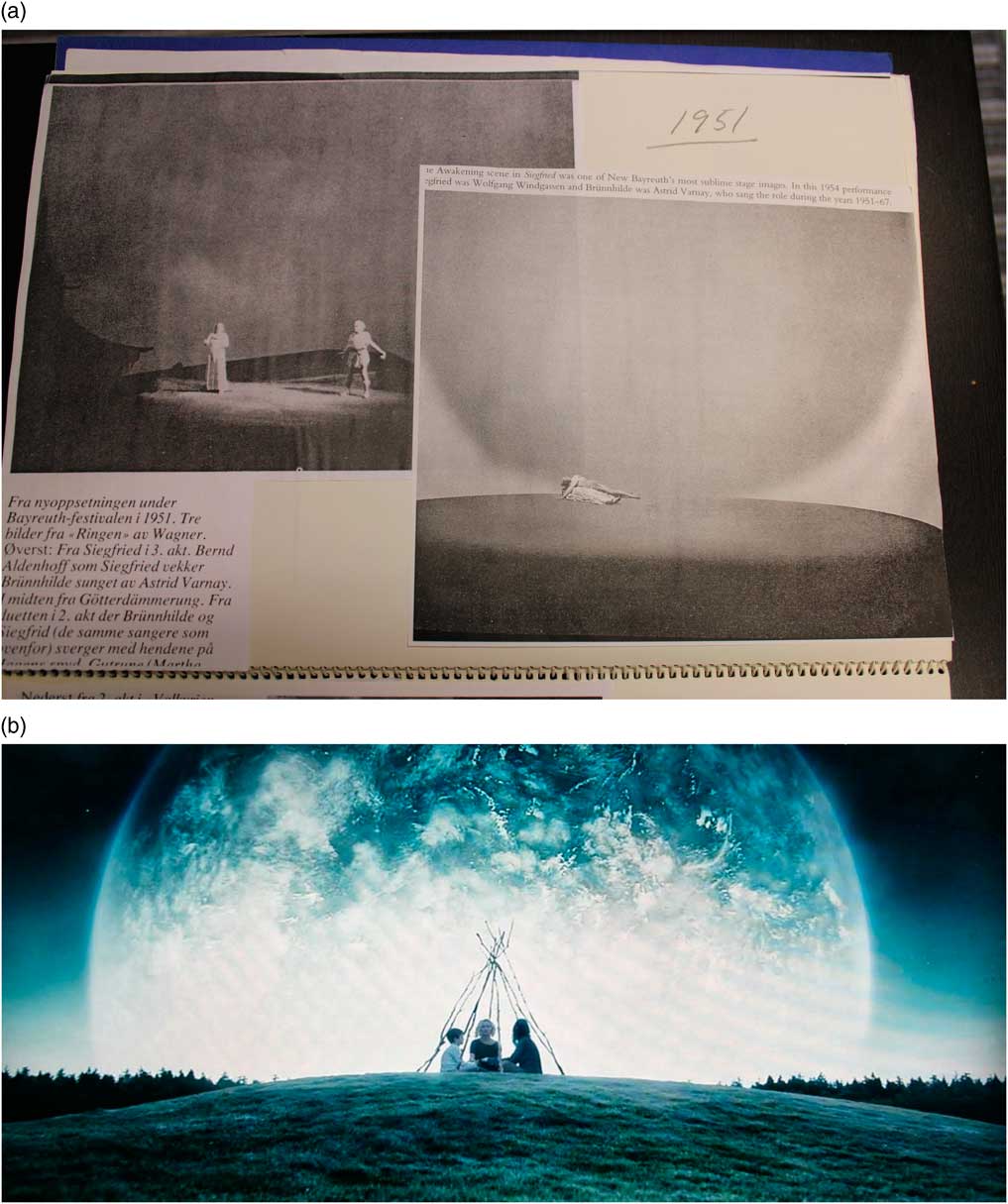
∙ a photograph from Wieland Wagner’s production of Siegfried (1951), showing an empty stage with a brightly lit circular background and two human figures in the middle;
∙ a photograph from Wieland Wagner’s Tristan und Isolde (1952), showing the two central characters sitting together under a single spotlight on an otherwise bare stage;
∙ a photograph from Wieland Wagner’s production of Siegfried, Act III (1965), showing a reticulate, root-like design;
∙ a photograph from Wolfgang Wagner’s production of Das Rheingold, Act II (1970), showing a set inspired by Wieland Wagner – an elevated, paved, revolving stage against a circular, slightly ornamental backdrop;
∙ a photograph from Harry Kupfer’s production of Der fliegende Holländer (1978), showing Senta in a spotlight at the top of the photo, the Dutchman in a spotlight at the bottom and the Dutch ship in its own light in the middle;
∙ a photograph from Harry Kupfer’s production of Götterdämmerung, Act II scene 4 (1991);
∙ a CD cover photograph taken from the same production of Kupfer’s Götterdämmerung, showing Brünnhilde and Grane from behind.Footnote 28
With the exception of the pictures from the original production, all these photographs have two things in common: simple set designs and the sophisticated use of often extremely focused lighting, of a kind that would resurface in von Trier’s later films.Footnote 29
Notes from the archive
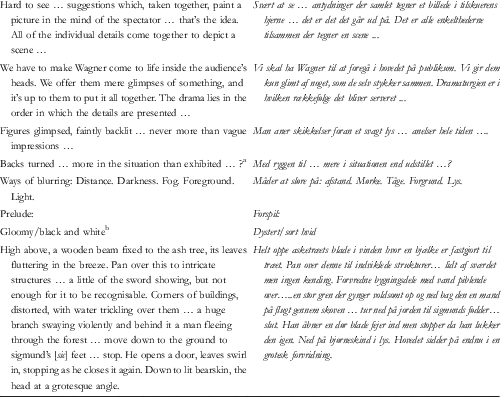
The second box also included a single sheet of paper with sketchy notes in von Trier’s hand on Die Walküre, which give a clear idea of how he envisaged staging the Prelude. The notes are reproduced in Table 2. It is evident that here, too, questions of lighting have his full attention, and that he imagines the staging as a series of close-ups.
Lars von Trier’s notes on the Prelude to The Valkyrie

a This idea is possibly inspired by the photograph from Harry Kupfer’s production of the Ring, in which Brünnhilde has her back to the audience.
b The device of presenting this scene in black and white is possibly an attempt to introduce a historical note, harking back to a time when film and television could only be made in black and white. In modern film it is often used with flashbacks, to give a flavour of the past. See Peter Harms Larsen, De levende billeders dramaturgi (Copenhagen, 2003), 184.
An early attempt to try out these ideas in practice is found on one of the videotapes in the first archive box. Before going to Bayreuth in the summer of 2002, Lars von Trier and his team, including assistant director Elisabeth Linton and scenographer Kalli Júlíusson, held a lighting rehearsal on the Old Stage at the Royal Theatre in Copenhagen, captured in the video. The purpose was to test various lighting set-ups for the Walküre Prelude. Also present were several Danish collaborators on the Ring project.
Since the sets for their own production were not yet ready, they made do with scenery and props from the Royal Theatre stores. These included two haystacks from a set for August Bournonville’s ballet Et Folkesagn (A Folk Tale) designed by Queen Margrethe II, a potted rubber plant – which a stagehand was instructed to shake, to give the impression of windy weather – and a two-metre high flight of wooden steps leading up to a platform fitted with a ship’s wheel, from an earlier production of The Flying Dutchman.
Lars von Trier follows the rehearsal from a seat in the dress circle. At one point he has a word with the scenographer about the four video screens, each four metres by six, to be hung at the back of the stage – the top one needs to be angled slightly. During the rehearsal a soundless video showing images of horses and riders plays across one of the screens in the background.
The tape of the music for the Prelude is switched on and an assistant, who is taking the part of Sieglinde, moves very slowly from the platform stage right, down the steps downstage, past the haystacks to stage left and steps onto a one-metre square, open-sided lift, which carries her upwards. Exactly twenty lamps are used to light this route, but in the final production von Trier intended to use about 100 small lamps, in order to provide an air of mystery, and to create the impression that the light is emanating from the character herself and not from one tracking spot.
The blocking of the Prelude does not, however, start with the opera’s heroine descending the stairs inside the house. Prior to this, on the video screens, we see a wrathful Hunding and his men in the forest and the fleeing hero, Siegmund, running onto the stage. Like Sieglinde he enters stage right as the ‘good’ characters in classical theatre and film so often do.Footnote 30 Hunding, his vicious pursuer, enters from the opposite side, stage left.
The following day, von Trier and his crew experimented with carrying a candle from the back of the stage down to the proscenium. He deemed this exercise very promising because it makes the whole world seem ‘dangerous’. There was, however, a problem: on the darkened set the stagehands could not see what they were doing. To get round this he suggested that they wear night vision goggles.
He also considered dividing the stage into eight ‘fields’, to allow the possibility of changing scenery in two of these, while one – Field Six, say – would remain visible to the audience while the other five would stay in darkness. A scrim would be hung in front of the stage to cut down on the amount of light falling on the stage. The secrets behind his conjuring tricks must on no account be revealed, he argued, and this screen could also be used for the projection of occasional non-naturalistic touches: a shot of a wolf with puffs of breath coming out of its mouth, for example, when Wotan is referred to as a wolf, or a close-up of ‘the semen running down Sieglinde’s legs after they’ve fucked’ (‘Sæden [der] løber ned ad Sieglindes ben efter at de har bollet’).Footnote 31
The photographs and the notes from the second archive box and the videotape of the staging experiment all point to Lars von Trier’s innovative use of close-ups. Many opera directors today use video screens on stage for close-ups of the performers, but von Trier does the exact opposite. He uses the video screens to create depth as seen from a distance, while the living characters on stage are seen in lighting-defined close-ups. And the scrim, which serves to delete irrelevant elements of the set, sometimes changes to function as a projection screen, turning into a huge, sensual two-dimensional statement of something mythological in close-up.
Finally, a look at Lars von Trier’s scribbled outline for the Ring cycle also reveals the importance of nature to his ultimate staging conceptions. Each of the four operas in the Ring cycle would be set in one of the four seasons: Das Rheingold – winter, Die Walküre – spring, Siegfried – midsummer, Götterdämmerung – autumn (see Fig. 2). From these notes we can also see that in Act III of Walküre von Trier envisaged Brünnhilde being laid down to sleep on the top of a volcano, which would then erupt. It would still be erupting when the hero woke her at the end of Siegfried, but by the end of Act I of Götterdämmerung, when a disguised Siegfried forces Brünnhilde to yield and become Gunther’s bride, it would have been quenched and would lie there, quiet and still, with lava solidifying around it. Lars von Trier harks back here to the Romantic fondness for using natural phenomena to reflect a character’s state of mind (in this case the different sorts of love felt by Wotan, Siegfried and Gunther for Brünnhilde). But he is also trying to introduce a more modern conception of realism by underplaying the magic properties of the Tarnhelm, so that Gunther can march straight across the solidified lava to Brünnhilde, without having to use Siegfried disguised as Gunther to break through the wall of fire. Von Trier’s focus on natural phenomena brings about another significant departure from Wagner’s stage directions. In the bottom right-hand corner of the sheet of paper are two notes, saying Slut under vand (End underwater) and Alt synker ned (Everything sinks down). This idea of submersion is von Trier’s own addition to the scenario. Instead of focusing on the end of the gods, as witnessed by humankind, we ourselves experience as audience a more realistic and completely irreligious death by drowning.
Lars von Trier’s handwritten outline for the entire Ring cycle.

The powerful images of nature which supplant the magic elements in the original stage directions can be seen as von Trier’s attempt to achieve the same profound significance with modern means. But they also point to the fact that realistic images of cataclysmic events lend themselves more easily to film than to stage productions – and hint at the importance von Trier’s Bayreuth experience would have for his later work for the screen.Footnote 32
From stage to screen
Among all the other material in the second box only one press cutting appears: an article from the New York Times, written by John Rockwell and entitled ‘Lars von Trier’s Vision Was Just What Wagner Needed.’ It was published right after the announcement that Lars von Trier had resigned from the production of The Ring of the Nibelung in Bayreuth. ‘Of course, Bayreuth will go on’, Rockwell writes, adding:
Mr. von Trier, too, will persevere. … And as usual, he has projects lined up into the far future. But will any of them involve the ‘Ring’? … If he were ever to make practical use of his two years of preparation for the ‘Ring’, however, it would most likely be on film. … Maybe, now, he can return to the ‘Ring’. Mr. von Trier’s first public stirring of interest in Wagner was to direct his operas on the screen, not on stage. In an interview from 2000 he said: ‘I have just decided that to film Wagner, that would be the ultimate goal of my life. The “Ring” cycle. I could die happy.’ Maybe, having been steeped in that saga, he can give us a ‘Ring’ on film that will be the vision Wagner always had but could never realize. It would come as consolation for the loss of something so many of us were looking forward to in 2006.Footnote 33
Rockwell has grasped something essential here: the idea to film Wagner was in fact brought up again by von Trier in a conversation, caught on one of the tapes in the first box, in early 2002. We hear an enthusiastic von Trier ask his business partner and CEO of Zentropa, Peter Aalbæk Jensen, whether they should film one of Wagner’s operas, at which point Aalbæk Jensen does not dismiss the idea.Footnote 34
It has not happened yet. But von Trier’s interest in Wagner and his work towards staging the Ring were not in vain, since the images and conceptions he devised would feed into his subsequent cinematic work, as I now explore.
Antichrist, Nymphomaniac and Dogville
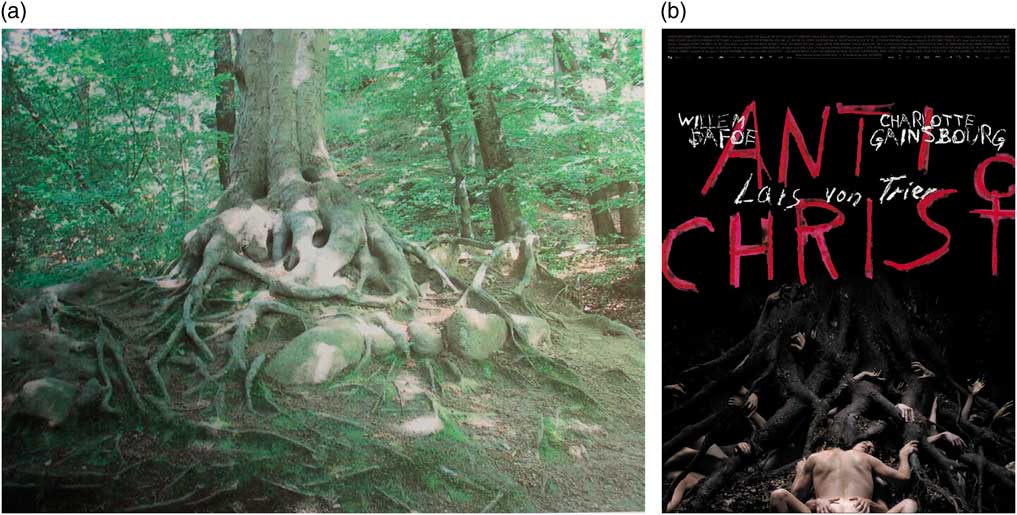
The second box from the Ring production archives was full of pictures from the natural world: rocks, ice formations, caves, different kinds of trees. Particularly worth noting are several close-ups of tree roots that he imagined in his staging of the Ring, which may have served later as inspiration for the Antichrist poster (see Figs. 3a and 3b).
a) photograph of tree roots, from the Zentropa archives; b) poster for von Trier’s film, Antichrist.
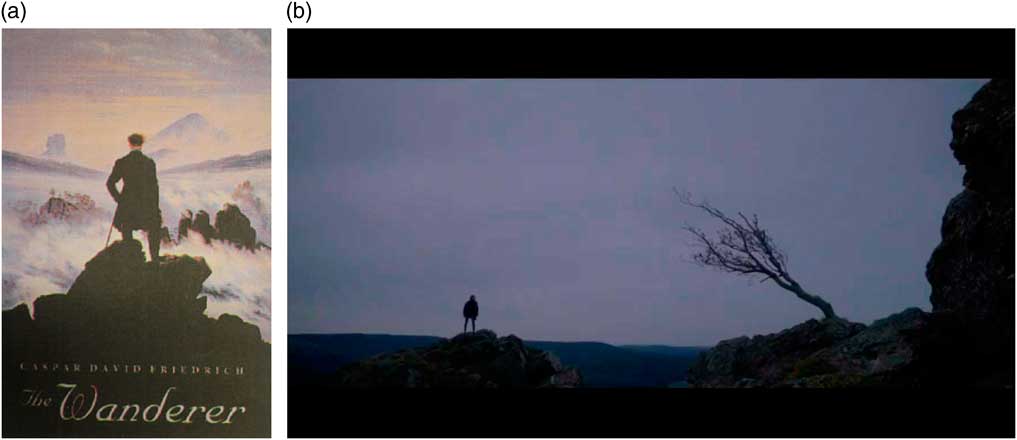
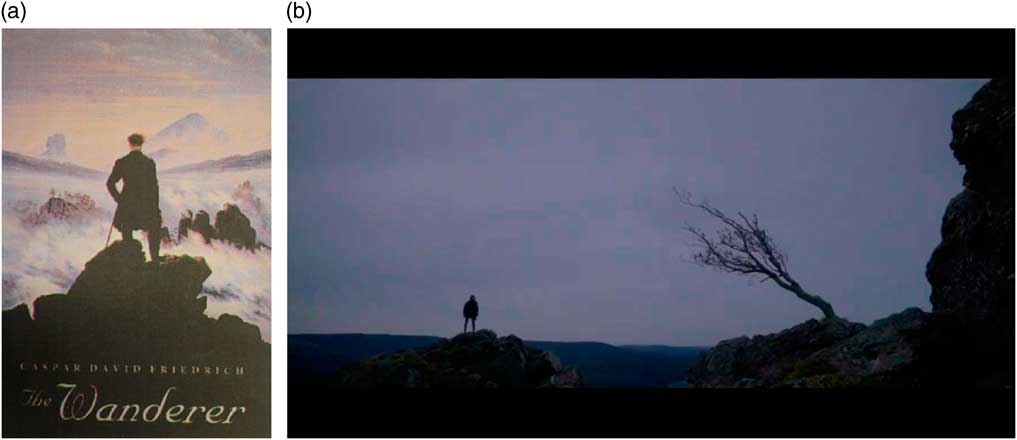
A similar influence can be found in Nymphomaniac, in the scene in which Joe climbs a rocky crag. At the top she finds herself confronted by a stunted tree meant to symbolise her personality. This scene might very well have been inspired by another picture from the second archive box: Caspar David Friedrich’s famous Romantic painting ‘The Wanderer above the Sea of Fog’ (see Figs. 4a and 4b).Footnote 35
a) picture of Caspar David Friedrich’s ‘The Wanderer above the Sea of Fog’ (c.1818), from the Zentropa archives; b) film still from Lars von Trier’s Nymphomaniac, vol. 2 (2013).
But these nature photographs are not the only ones to have achieved an afterlife. The huge close-ups on the scrim can also be followed in von Trier’s later films. In Antichrist, for instance, the close-up of the wolf is echoed by that of the fox in the notorious ‘Chaos reigns’ scene. And the close-up of semen running down the legs of Wagner’s female lead is reused and reshaped in Nymphomaniac, in the scene where Joe’s vaginal lubricant runs down her legs as she watches her dying father. More generally, there is in these two films a marked tendency to use films and photographs of nature as symbols of the states of mind of the characters. Both films open with snow or rain as symbols of grief and disaster; in Antichrist the protagonists are afraid of nature (water, grass, animals and insects) and, by implication, of themselves, and in Nymphomaniac Joe receives her erotic revelation on a sunny plateau. Many more examples could be mentioned, but what is notable about all of them is the interest in the Romantic conception of nature that von Trier sought to emphasise in the Ring.
While working on the Ring, von Trier was also involved in work on his next film, Dogville, and there is no doubt that the one had an influence on the other, not least in the exchange of genre-typical aesthetics. Dogville, with its radical, minimalistic style, its chalk lines on the floor instead of walls, doors and other objects, is one of the most uncinematic, Brechtian films in recent history, and von Trier’s fascination with Harry Kupfer’s and Wieland Wagner’s minimalistic sets may well have prompted this theatricalisation of the modern film medium.
Unlike traditional films, in which the images on the screen are not stylised, in Dogville (and its successor Manderlay) Lars von Trier manages to channel the viewer’s ability to create their own mental pictures of the empirical reality. The imagination of the audience inserts itself, so to speak, between the appearance of the phenomenon on the screen and its assault on the senses.Footnote 36 In other words, von Trier strips the objects in Dogville of their concrete, diegetic reality in order to reproduce them plastically in the viewer’s mind, and in this way the film is more like a piece of theatre, in which the relationship with the audience is much more direct and tangible than is usual in cinema.Footnote 37
Theatricality, however, had never been completely absent from von Trier’s films, even before he took on Wagner’s Ring. Selma, the central character in the film Dancer in the Dark (2000) could be said to make the same progression as in Dogville (2003) from film to theatre – albeit, in her case, through an aural rather than a visual progression – when rhythmic everyday sounds (a line slapping against a flagpole, a pen scratching on paper and so on) are transformed in her mind into a show tune, and the film’s very ordinary characters suddenly break into a Broadway-style dance routine. Selma’s ability to theatricalise the narrative technique of the film also exposes the medium’s illusionary devices and speaks directly, physically, to the cinema audience. However, this theatricalisation happens in Selma’s imagination (which is to say, von Trier’s) and not, as in Dogville, in that of the audience. And this progress from Dancer in the Dark to Dogville, I would argue, would probably not have occurred had it not been for von Trier’s close contact with Wagner’s theatrical work.
In his concept for the Ring cycle, Lars von Trier placed similar focus on the audience’s capacity to become imaginative co-creators of the experience, with the darkness between the highlighted spots encouraging the audience to use their own conceptual abilities. The manipulated, not to say phantasmagorical, deception practised by the theatre and also by the cinema screen is only revealed on those few occasions when what spectators are presented with on stage, between two visually defined points, does not tie in with what they expect to see. Such manipulation is in many ways reminiscent of Wagner’s use of leitmotifs, which crop up like cross-related bright spots in the music and can trick the listener into investing them with a specific semantic meaning, until it becomes clear that they change so much during the course of the Ring cycle that by the end they could be used to convey the very opposite meaning.
In Wagner’s Gesamtkunstwerk all the performing arts are, in principle, accorded equal importance, but music clearly has a much more independent role to play than it would normally have in film. In Wagner’s late works the leading dramatic role is even assigned to the music: far from background music, but a score capable of correcting and contradicting words and actions – capable, even, of lyingFootnote 38 – and von Trier acknowledges and enhances this role by cloaking the stage in darkness, thereby letting even the set ‘lie’ insofar as he manipulates the ability of the audience to fill in the darkened areas by subsequently surprising them with the introduction of an illogical scenographical item in the relevant middle field.
Other modern stagings of Wagner’s operas, such as Bill Viola and Peter Sellars’s Tristan in Los Angeles (2004 and 2007), Paris (2005) and New York City (2007), often employ alienation effects, such as the turning up of the house lights. Or, as in Peter Konwitschny’s Meistersinger in Hamburg (2002), the performance may actually be interrupted – in this case for the singers to discuss the appropriateness of performing Hans Sachs’s monologue, with its overtones of Nazism. Von Trier, as we have seen, employs no such effects in his own production. In his proposed Ring the narrative is, however, punctuated by anti-illusionist breaks of a type more common to the theatre than the cinema: the many simultaneous scenes, for example, forming a kind of montage of separate events. (One such example was planned for the prelude to Walküre, where a video screen shows Hunding on the chase, while on stage Sieglinde is asleep inside the house and Siegmund can be seen fleeing outside of it.)Footnote 39
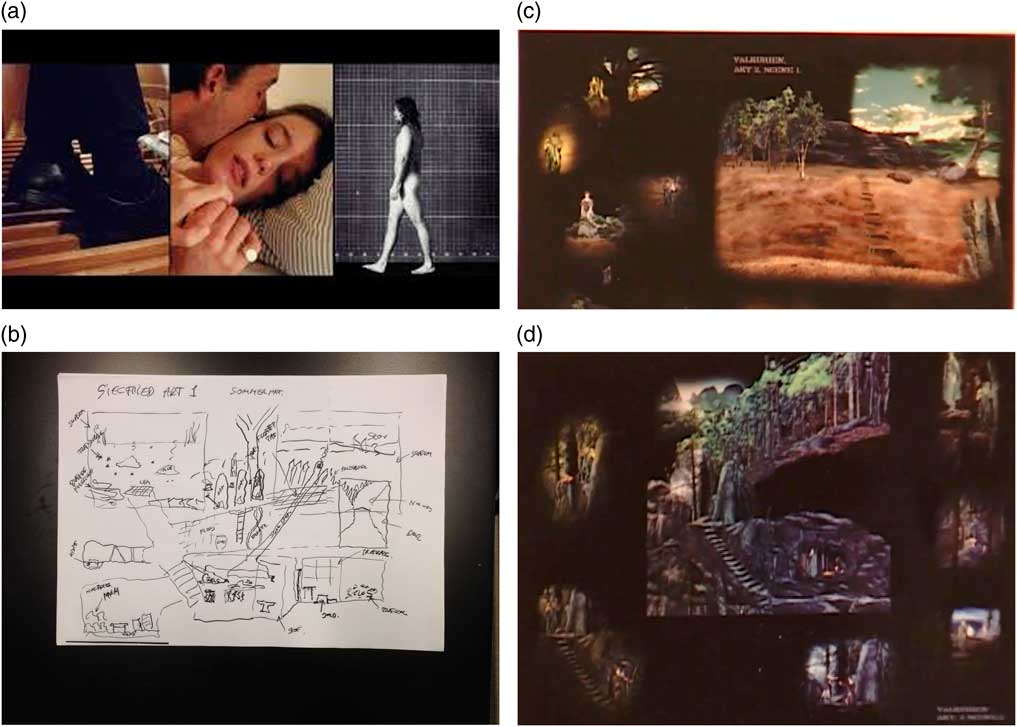
Such a montage of theatrical simultaneity manifests itself again in Nymphomaniac, where the screen is split into three as Joe tells Seligmann about each of the men who have represented the key voices in the melody of her life. A look at the design sketches for von Trier’s Ring (never before published) reveals the close similarity between these and the collage-like form used in Nymphomaniac (see Figs. 5a–d). Figure 5a shows the three different, simultaneous actions on the screen in a sequence from Nymphomaniac, 5b is von Trier’s hand-drawn sketch for Siegfried, 5c and 5d are computer-assisted sketches for the Walküre set. The general idea is the same – the introduction of more than one visual narrative to the same aural sequence, corresponding to the audience’s multiple-layered perception of the totality of the scene.
a) Split-screen shot from Nymphomaniac, vol. 1 (2013); b) Lars von Trier’s own sketch for Siegfried; c) Lars von Trier’s designer, Kalli Júlíusson’s design sketches for Die Walküre: Act II scene 1; d) Act II later on, further up the mountain (screenshots from video tape of the process found in the Zentropa archive box. Recorded 18 November 2002).

Melancholia – a ‘tragic picture opera’
If any one of von Trier’s films bears the mark of the process in Bayreuth, it is the predecessor to Nymphomaniac, Melancholia. The film is by no means wholly Wagnerian, but comes close enough for the Danish film critic Kim Skotte to call it a ‘tragic picture opera’.Footnote 40 As Skotte suggests, it would be wrong to imagine that this is simply yet another sci-fi movie about the end of the world because ‘In Melancholia no doughty space pilots are going to come zooming up at the last minute to knock the cosmic body off course or blast it to kingdom come with their nuclear missiles. The death of the Earth is like all death, inevitable. And it goes unmourned.’Footnote 41
Melancholia is a film in two parts, shaped after the two central characters, sisters Justine and Claire. Part One takes place at Justine’s wedding reception, a lavish party held at her brother-in-law’s grand estate. Very soon, family conflicts begin to rise to the surface, everything goes horribly wrong and the party ends with Justine spurning her husband, who then leaves her on their wedding night. Part Two is set shortly after this, also at the brother-in-law’s mansion. Justine has fallen into a deep depression; in the sky, a hitherto unknown planet called Melancholia looms, on collision course with Earth. Claire is very frightened, her husband is fascinated, her young son Leo tries to make sense of it all. When, after a predicted ‘fly-by’, it transpires that the rogue planet is still drawing steadily closer, Claire’s husband kills himself, and the two women and the boy are left alone on the estate, where Justine calmly and intuitively takes charge. Together the three face the moment of total destruction, when the planets finally collide.
In the bonus material on the DVD of Melancholia, von Trier explains that it is a film about depression and that he identifies with the main character, Justine. Unlike her sister Claire, she has nothing to lose, because (like von Trier) she is so frightened and so debilitated by depression that death comes almost as a relief. So this is, in a sense, the ‘happiest’ ending he has ever devised.Footnote 42 Von Trier admits that he had so much practice in dying, due to his bouts of depression and neuroses, that he hopes he will welcome death when it finally comes, that he will be able to look it in the eye.Footnote 43 This, of course, is exactly what Wagner’s Brünnhilde – unlike her sister Waltraute – does at the end of the Ring cycle: for both Brünnhilde and the audience death comes as a relief, a catharsis of sorts.
Wagner’s depression also led him to long for death, which he regarded as the only possible form of redemption. In this he likens himself not only to the Flying Dutchman but also to Brünnhilde and her demise in the Ring. In a letter to Franz Liszt, who was to conduct his Flying Dutchman in Weimar, he writes: ‘Good luck with the “Flying Dutchman”! I cannot get this melancholy hero out of my head! … For me there is no longer any possibility of redemption, except for – death! Oh, how happy I should be to die in a storm at sea … Indeed – I should be glad to perish in the flames of Valhalla!’Footnote 44
This very longing for a redemptive death is epitomised in Wagner’s Prelude to Tristan: ‘They [Tristan and Isolde] must confess they belong only to each other. No end, now, to the yearning, the desire, the bliss, the suffering of love: world, power, fame, splendor, honor, knighthood, loyalty, friendship – all scattered like an empty dream; one thing alone still living: yearning, yearning, unquenchable, ever-regenerated longing – Languishing, thirsting; the only redemption – death, extinction, eternal sleep!’Footnote 45
As previously mentioned, one of the pictures in von Trier’s Ring project archive is a photograph from Act III of Wieland Wagner’s Siegfried from 1954 (see Fig. 6a). The circle in the background and the curved platform, for which this scene is famous, constitute a by now iconic image of a final Wagnerian love. One can see how this operatic scene inspired von Trier’s final shot from Melancholia (see Fig. 6b).
a) copy of photos from Wieland Wagner’s 1951 production of Siegfried contained in Lars von Trier’s inspiration folder held in the Zentropa archives; b) still from the end of Melancholia.

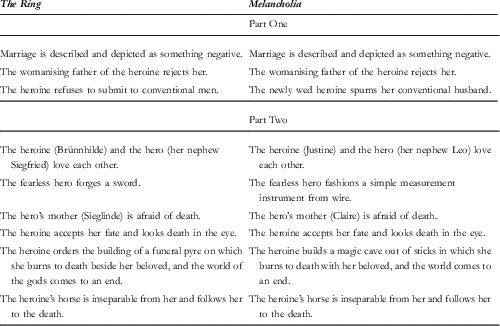
But if Melancholia and the Ring deal with similar topics, these are not the only parallels between them (as outlined in Table 3). In particular, Melancholia’s negative view of marriage, which is made very clear right from the start of the movie, resembles the treatment of marriage of Wagner’s Ring, where Brünnhilde is born out of wedlock to Erda, and her stepmother Fricka, the goddess of marriage, is depicted as an embittered and unsympathetic character, eager to see Brünnhilde’s father, Wotan, kill Brünnhilde’s half-brother Siegmund for violating the (loveless and forced) marriage between Hunding and Sieglinde.Footnote 46 In the opening sequence, or ‘overture’ as von Trier calls it, we see Justine as a bride, with strange rope-like trammels dragging behind her, and in one of the first scenes her mother treats her to a bitter rant against marriage. Having listened to this, on the very night of their wedding Justine rejects her husband.
Parallels between the Ring and Melancholia (Parts One and Two)

During the early stages of work on Melancholia, Lars von Trier told journalist Nils Thorsen that instead of using vignettes in the film he considered inserting fixed images into the body of the film itself: ‘If you simply insert some pictures illustrating Justine’s state of mind, as a part of the film. As symbols if you like. I think that would be interesting, because then you would be uniting the two art forms.’Footnote 47 There are no such images in the final film, except in the opening sequence, but the scene with Justine in the library, opening the art books on display at different pages, reflects this idea. In each case she turns from reproductions of modern abstract art to works from the Renaissance and the Romantic era – something which could be seen as a conscious transition from one mental state to another.Footnote 48
In the case of Melancholia, Lars von Trier himself noted that right from the outset his aim had been ‘to dive headlong into the abyss of German romanticism. Wagner in spades.’Footnote 49 Several visual references further solidify the relationship between this film and his earlier preparations for staging the Ring. In Melancholia Justine chooses to put on display Pieter Bruegel’s ‘Hunters in the Snow’ (1565), which is probably primarily intended as a loving reference by von Trier to the scene created by his filmic idol Andrey Tarkovsky in the sci-fi epic Solaris, based on the female protagonist’s experience of this particular painting. But it is also an inspired remake of the main visual ingredients of the Ring production. This painting first flashes onto the screen as an Ahnungsmotiv during the opening sequence of Melancholia, which is accompanied by the Tristan Prelude.Footnote 50 In the movie, Bruegel’s painting burns up, and we see sensual close-ups of branches and trees, people, birds, dogs and horses, precisely as envisioned in the Ring project. And, as was desired from his opera staging, we as viewers must make the connection ourselves between the nature images in precisely the same way.
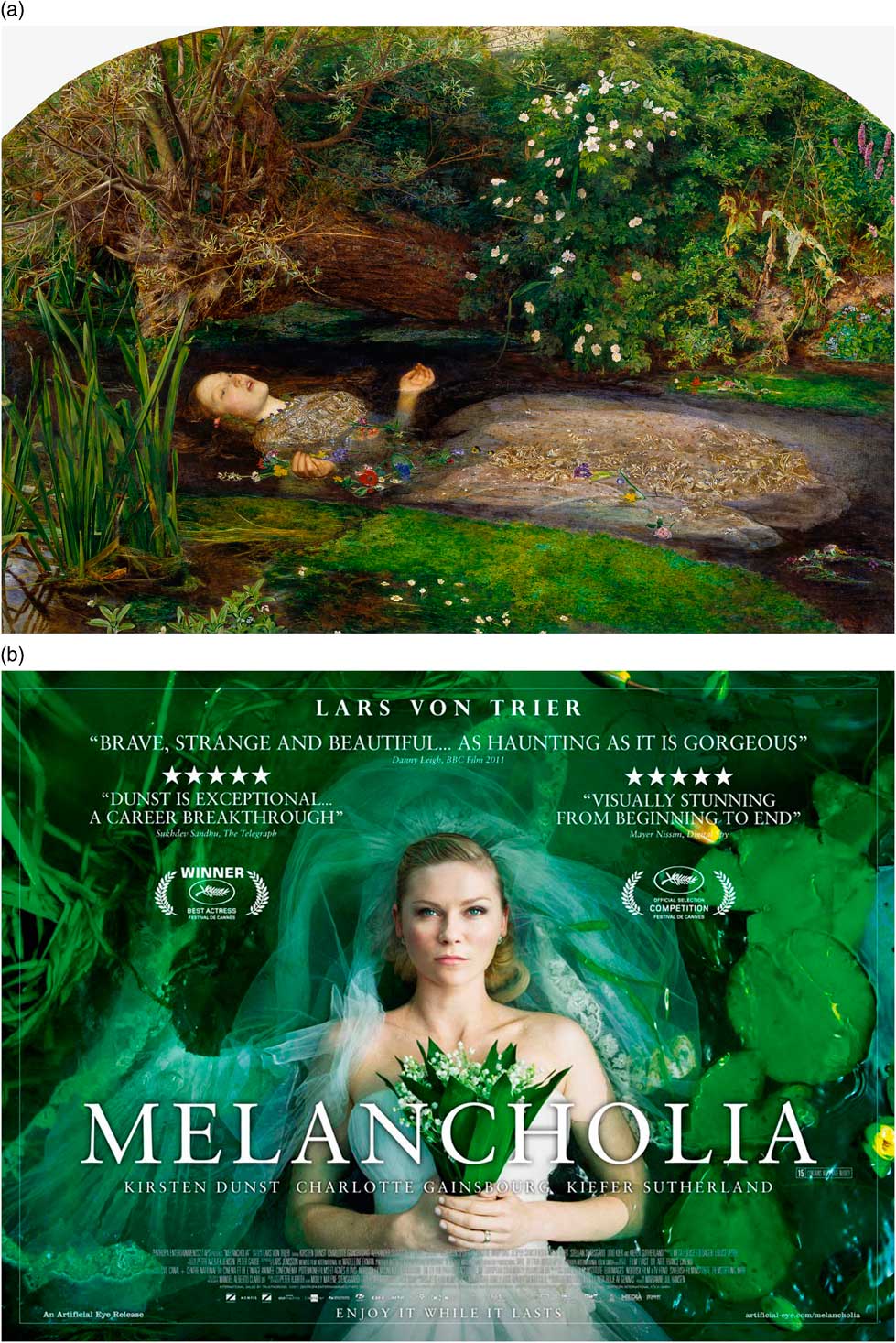
Justine’s other displayed artwork in the library scene is John Everett Millais’s ‘Ophelia’ (1852), a painting with which von Trier was very much taken at the time, according to archived video footage from the Ring project.Footnote 51 In the film’s ‘overture’ Justine herself is seen floating downstream in her wedding dress, like Ophelia, and this image is also used for the poster promoting the film (see Figs. 7a and 7b). Von Trier’s attentiveness to this picture in his conversation with the set designer of the Ring project shows that already at an early stage he saw Brünnhilde as a kind of Ophelia character: a madwoman who with eyes wide open, and singing, lets herself slide into death by drowning.
a) Sir John Everett Millais, Ophelia (1852), Tate Britain, London; b) poster for Lars von Trier’s Melancholia (2011).

Melancholia is also the film which, in its overall structure and style, owes most to the Ring project, since even after all the visual power and all the focus on such effects by von Trier, music – and not visuals – becomes the most direct form of audience involvement. And in Melancholia, von Trier’s application of such a deliberate sense of music drama is most evident. Even though von Trier did not use the music from Götterdämmerung in the film, his employment of Wagner’s Prelude to Tristan and Isolde corresponds to Wagner’s use of leitmotifs in the Ring. Von Trier links the Tristan theme to the depression-ridden Justine and uses this leitmotif to put the audience inside the head of the subject, Justine, to usher us into a world that seems like a great vision of mortality.Footnote 52 Claire finds it hard to face up to death in the way her sister does, but Justine eventually manages to make her (and the audience) accept that we are destined to die.
This concept of vanitas, or mortality, needless to say also forms the crux of the Ring. From the moment Brünnhilde’s mother, Erda, makes it clear to her father, Wotan, that ‘das Ende’ is nigh for him and for the world of the gods, it is there, running like an undercurrent through the opera in the shape of his ‘frustration’ motiv. He orders the World Ash Tree to be felled, chopped up and piled around him, so he can lie there waiting for the world to end, and it is left to Brünnhilde to set the pyre alight, thereby consigning him to the death that he has both dreaded and desired for so long. Brünnhilde’s vocal leitmotif is taken up by the orchestra at the Ring’s very end and carried to a triumphant conclusion after the musical collapse of Valhalla.
In Melancholia the music of the Tristan Prelude is mixed with the ominous rumble of the massive approaching planet, a sampled natural sound, which forms a counterpoint to the man-made musical sound, and both rise in intensity until they positively reverberate through the audience themselves. The three characters, Justine, her sister Claire and the boy Leo, are huddled together inside the magic cave that Justine has built. They are like a triad, the harmony into which dissonance yearns always to be resolved. But the music does not end with the original B major triad from Wagner’s opera. It ends abruptly, with a diegetic bang, after which everything goes very quiet: God is dead – an event that has occurred somewhere along the line between Richard Wagner and Lars von Trier, and in which Nietzsche had a philosophical hand.
And yet, leaving the cinema after seeing Melancholia, the audience may well feel relieved rather than depressed. Possibly because, as Nietzsche maintained: ‘only with reference to the spirit of music do we understand a joy in the destruction of the individual’.Footnote 53 Or possibly because after the long silence as the names of the cast roll over the screen, we are treated to more Wagner, playing over the rest of the credits – this time the Prelude to Act III of Tristan, played straight, without any competing diegetic sounds. The music is sombre, wistful and anguished, but also full of hope and exceptionally beautiful. In Lars von Trier’s Gesamtkunstwerk the world has come to an end. But Wagner’s music lives on.