Teotihuacan, an urban center with a population of 100,000–150,000 people, dominated much of central Mexico during the Terminal Formative and Classic periods (Millon Reference Millon1973, Reference Millon and Sabloff1981). It also had a much wider presence in Mesoamerica, extending its influence, and perhaps briefly its authority, into distant regions (Braswell Reference Braswell2003; Gómez Chávez and Spence Reference Gómez Chávez, Spence, Nichols and Pool2012). One of the principal hallmarks of its contact with other centers is Thin Orange, a finely made and aesthetically attractive ceramic ware that was produced in a variety of forms: bowls, cazuelas, boxes, jars, cylindrical vases, effigy vessels, and a wide range of miniatures (Kolb Reference Kolb1986; Rattray Reference Rattray2001:305–335). Although manufactured in southern Puebla, some 250 km from Teotihuacan, it was imported into the city in large quantities (Rattray Reference Rattray1990). Our concern here, however, is not with Thin Orange pottery itself but rather with the post-fire graffiti often associated with it.
The late Elizabeth Brumfiel (Reference Brumfiel and Wright1996) investigated the degree to which official Aztec gender ideology penetrated communities beyond the major state capitals. She compared state art, represented by stone sculpture and manuscript paintings, with a more widespread popular art form, figurines, and found a considerable level of resistance beyond the capitals to the dominant state perspective on women. It was with that article in mind that the present study was undertaken (Spence and Rattray Reference Spence, Rattray and Gallut2002:101).
TEOTIHUACAN ART FORMS
The city is well known for its complex and striking mural art (Berrin Reference Berrin1988; de la Fuente Reference de la Fuente1995, Reference de la Fuente1996; Miller Reference Miller1973; Séjourné Reference Séjourné1966a). The murals appear in public architecture and in the residences of high status families, and are confined to the central part of the ancient city, along and near the northern part of the Street of the Dead. Along with the sculptures associated with the Street of the Dead structures, they form a corpus of art created by specialists for elite patrons at the highest end of the status spectrum. In fact, the images and symbols of this art may be interpreted as elements of the formal iconography of Teotihuacan.
A second art form is represented by what Conides (Reference Conides2001) refers to as the pictorial ceramics of Teotihuacan, tripod vases and bowls decorated in plano-relief or with a stucco coat painted with images (see also Séjourné Reference Séjourné1966b; Rattray Reference Rattray2001). Conides (Reference Conides2001) believes that the pictorial ceramics and murals have somewhat different repertoires of symbols and themes. However, there is a significant overlap of images between the two media (Evans and Berlo Reference Evans, Berlo and Berlo1992:14). For example, frontal images of the Storm God holding darts and profile views of priests carrying hearts impaled on curved knives appear in both the murals and the ceramics (Miller Reference Miller1973:Figures 248–249; Séjourné Reference Séjourné1966a:Figures 83, 160; Reference Séjourné1966b:Figures 75, 87). Also, Teotihuacan pictorial ceramics appear in the highest ranking burials in the city center (Sempowski Reference Sempowski and Millon1994:254) and in royal burials in the Maya region (Greene and Moholy-Nagy Reference Greene and Moholy-Nagy1966; Kidder et al. Reference Kidder, Jennings and Shook1946). Teotihuacan state officials were thus aware of, and comfortable with, the decorative themes of these vessels (Conides Reference Conides1997, Reference Conides2001:350). The differences between the media may lie to some extent in the nature of their “canvases.” The large wall surfaces of the murals allowed more opportunity for expansive, even narrative, themes while the smaller and more mobile ceramic images would have been viewed by a wider audience. Both media, however, seem to present the ideology and imagery of the governing class (Conides Reference Conides1997:39).
The Cowgill et al. (Reference Cowgill, Sload and Powell1981) distribution maps of the plano-relief and stuccoed and painted sherds from the surface collections of the Teotihuacan Mapping Project (TMP) show plano-relief sherds as slightly more common and widely distributed than painted sherds, but both are rare. Conides (Reference Conides2001:110, Appendix 3) provides a list of sites with stuccoed and painted sherds in the TMP collections. There are only 103 sherds from 77 sites. Although more broadly distributed than murals, it seems unlikely that most people in the city had a pictorial vase on their mantelpiece. The maps show concentrations in the central zone and the Old City (Oztoyahualco) area in the northwest, with occasional “hot spots” elsewhere.
In contrast to the mural art and pictorial ceramics, figurines can be viewed as a popular art form. They appear on most sites in the city and evidence of their production is found at sites both in and beyond the center (Barbour Reference Barbour1976:120–126, Appendix I). Although many were probably intended for use in ritual, some were apparently toys (Spence Reference Spence and Stein2005:192). Figurines were still made by specialists in workshops, however, not by commoners in their households for their own use. Some symbols and images represented in the figurines appear also in the pictorial ceramics and murals (Séjourné Reference Séjourné1966c).
There were still other forms of artistic expression in Teotihuacan: the decorative designs of red on brown ware, Séjourné's (Reference Séjourné1966b) group 8; the large censers with their elaborate superstructure decorations of adornos, which may have been selected and applied by those who used the censers (Manzanilla and Carreón Reference Manzanilla and Carreón1991); graffiti on the architecture of the central zone (Sánchez Reference Sánchez, Monjaras-Ruiz, Rocha and Valle1996); and others. Placing all of these, however, in the social and political contexts of the city is beyond the scope of this article. The focus here is on the post-firing graffiti found frequently on Thin Orange ring-base bowls, apparently an individual and personal form of expression.
THIN ORANGE WARE
Thin Orange ware is a fine, thin-walled ware with a bright orange color. It was produced in a variety of forms but ring-base hemispherical bowls are by far the most common type (Figure 1). Although manufactured in workshops in the Tepexi de Rodríguez area of southern Puebla, some 250 km from Teotihuacan (Rattray Reference Rattray1990), they were imported into the city in large quantities.
Thin Orange Ring-base hemispherical bowls, Feature 92, site TL6.

Remarkably, Thin Orange sherds appear on virtually every site in the city. In the TMP surface collections about 19% of the sherds are Thin Orange (Cowgill et al. Reference Cowgill, Altschul, Sload and Hietala1984:160). But the sherd counts probably exaggerate its presence. The TMP collections consist largely of fragmentary artifacts from architectural fill, pulled to the surface and further damaged by modern agricultural activities. The thin walls of Thin Orange vessels would lead to breakage into more sherds than most other wares. Also, its bright color and known external origin made it particularly attractive to the archaeologists doing the collecting (Cowgill et al. Reference Cowgill, Altschul, Sload and Hietala1984:160).
More reliable counts are available for only a few excavated sites. Rattray (Reference Rattray2001:325) records the presence of Thin Orange sherds in Early Xolalpan-phase assemblages as 6.4% at Tepantitla, 11.6% at Tetitla and 15% at the Merchants’ Barrio. In Late Xolalpan it is 11.9% in Tepantitla and 11.8% in Yayahuala. Excavated Metepec phase contexts at these sites have 12–13% Thin Orange ware (Rattray Reference Rattray2001:331). Séjourné (Reference Séjourné1966b:Figures 2–3) says that it is 7.45–10.40% in the Yayahuala basurero. In contrast, the Oztoyahualco site has only 3.8% (Manzanilla et al. Reference Manzanilla, Butrón, Jiménez and Manzanilla1993:330) while Bidasoa has 5.3% (Sánchez Alaniz Reference Sánchez Alaniz2000:191, Table 2). The Tlamimilolpa period structure at San Antonio de las Palmas, on the northwest periphery of the city, has 1.9% in its earlier level but 12.9% in the later level (Monzón Reference Monzon1989:110). Cowgill et al. (1984:162, Figures 3–4) note that Thin Orange apparently has no strong class associations. Its presence in Bidasoa, a peripheral low status residence in map square S2E4, indicates as much. Although its distant origin and high quality suggest that it should be an expensive ware used largely by elites, this was apparently not the case in Teotihuacan.
Ring-base, hemispherical Thin Orange bowls were often placed in burials and offerings, but this might not have been their primary function. It is possible that they had become culturally tied to some indispensible or universal task, which would explain their widespread use. Their interior bases are often heavily abraded, suggesting their use in grinding some materials, perhaps the ingredients of some particular food or drink (Clayton Reference Clayton2009:168–169; Cowgill et al. Reference Cowgill, Altschul, Sload and Hietala1984:162). Clayton notes that they may have also been serving vessels and even drinking cups.
THIN ORANGE GRAFFITI
Graffiti (as used here) may be defined as images incised in the ceramic surface after the firing of a vessel, but not intended as part of the original design or decoration of the vessel. This definition serves to distinguish them from the post-fire incised decoration on some polished wares that was apparently an element of the vessel's intended design (see Rattray Reference Rattray2001:189, Figures 83a, 84).
The first recognition of the graffiti was by Séjourné on ring-base Thin Orange bowls from Yayahuala (1963:Figure 18) and Tetitla (Reference Séjourné1966b:Figures 136, 138). Although she does not say whether the designs are pre- or post-fire, their locations on the interior and exterior bases indicate that they are post-fire additions of the sort that concern us here. There was no discussion of their contexts, frequencies or meanings.
There have since been some passing comments on graffiti on Teotihuacan ceramics (Gómez Chávez Reference Gómez Chávez2000:236–237, 348, 394–395; Rattray Reference Rattray1992:Figure 10; 2001:329; Sánchez Reference Sánchez, Monjaras-Ruiz, Rocha and Valle1996:196; Sánchez Alaniz Reference Sánchez Alaniz2000:191), but no systematic exploration of the phenomenon until Palomares (Reference Palomares2000) analyzed the ceramics from a small post-Teotihuacan Mazapan phase (a.d. 950–1150) settlement in TMP map square N6E1. She found 10 graffiti on nine vessels. Four of them were variants of the same design, a double-line half square. She suggests that the Mazapan graffiti were potter's marks, meant to identify their products, and that vessels so marked may have been intended for, or at least preferentially used for, burials.
Evelyn Rattray and I conducted a preliminary study of graffiti on Thin Orange ring-base, hemispherical bowls (Spence and Rattray Reference Spence, Rattray and Gallut2002). Our initial survey of the data indicated that ceramic graffiti in Teotihuacan appeared overwhelmingly in vessels of that ware and form, so we focussed our analysis on that type (Spence and Rattray Reference Spence, Rattray and Gallut2002:102). We concluded that the graffiti were not potter's marks but rather had been added to the vessels by their owners. They may have been intended to mark their ownership of the bowls, or to infuse them (or the tasks in which they were used) with some force or quality (Spence and Rattray Reference Spence, Rattray and Gallut2002:111–112).
The graffiti that formed the database for that article, however, had not been systematically selected and were largely from excavations, particularly in the Merchants’ Barrio, Tlailotlacan (the Oaxaca Barrio), the La Ventilla 1992–94 project (Gómez Chávez Reference Gómez Chávez2000), and Séjourné's work at Yayahuala (Reference Séjourné1963:Figure 18) and Tetitla (Reference Séjourné1996b:Figures 136, 138). Most of the graffiti available for analysis, then, were from either the elite compounds in the city's central zone or the two foreign barrios on its outskirts. Also, no count was kept of the Thin Orange bowls that lacked graffiti. This gave the data an anecdotal quality that limited interpretation.
To remedy this, in subsequent years I conducted a broader and more systematic analysis. The surface collections of the TMP were used, organized in terms of the TMP map squares (each 500 m on a side) and, on a larger scale, the four quarters of the city. These quarters are defined by the major avenues: the north-south Street of the Dead and the East and West avenues. The sociopolitical reality of the quarters has not been established by any clear criteria, and in some respects they may have been overridden by other factors. Their separation by the major streets of the city suggests, however, that they must have had some substance.
All Thin Orange ring-base, hemispherical bowl sherds were examined from each site within a map square and all graffiti were recorded, but only those sherds with a dimension of 55 mm or more were counted for the database (Appendix I). Smaller sherds did at times show graffiti (which were recorded but not included in the site counts), but these were usually too incomplete to determine what the image represented.
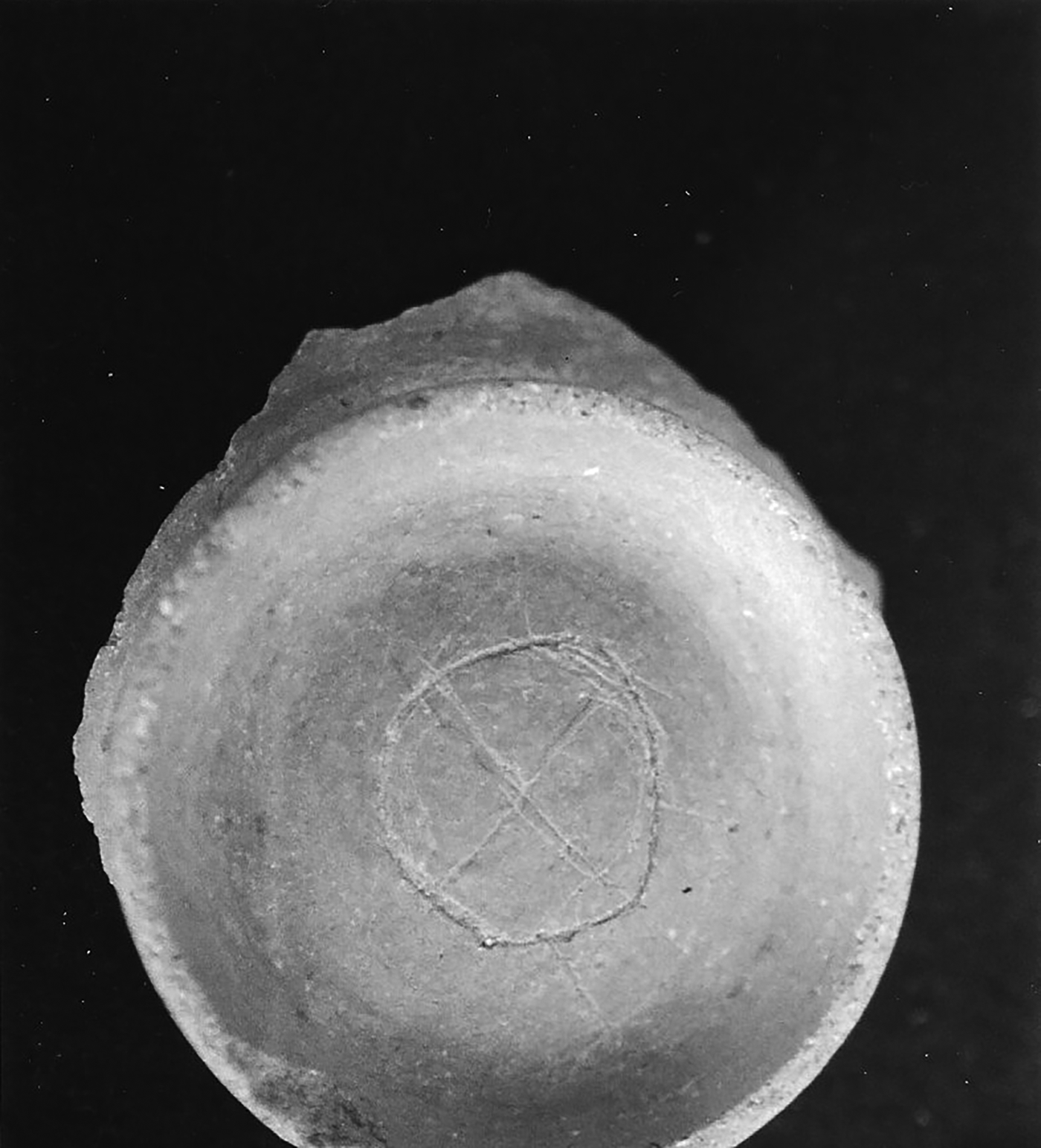
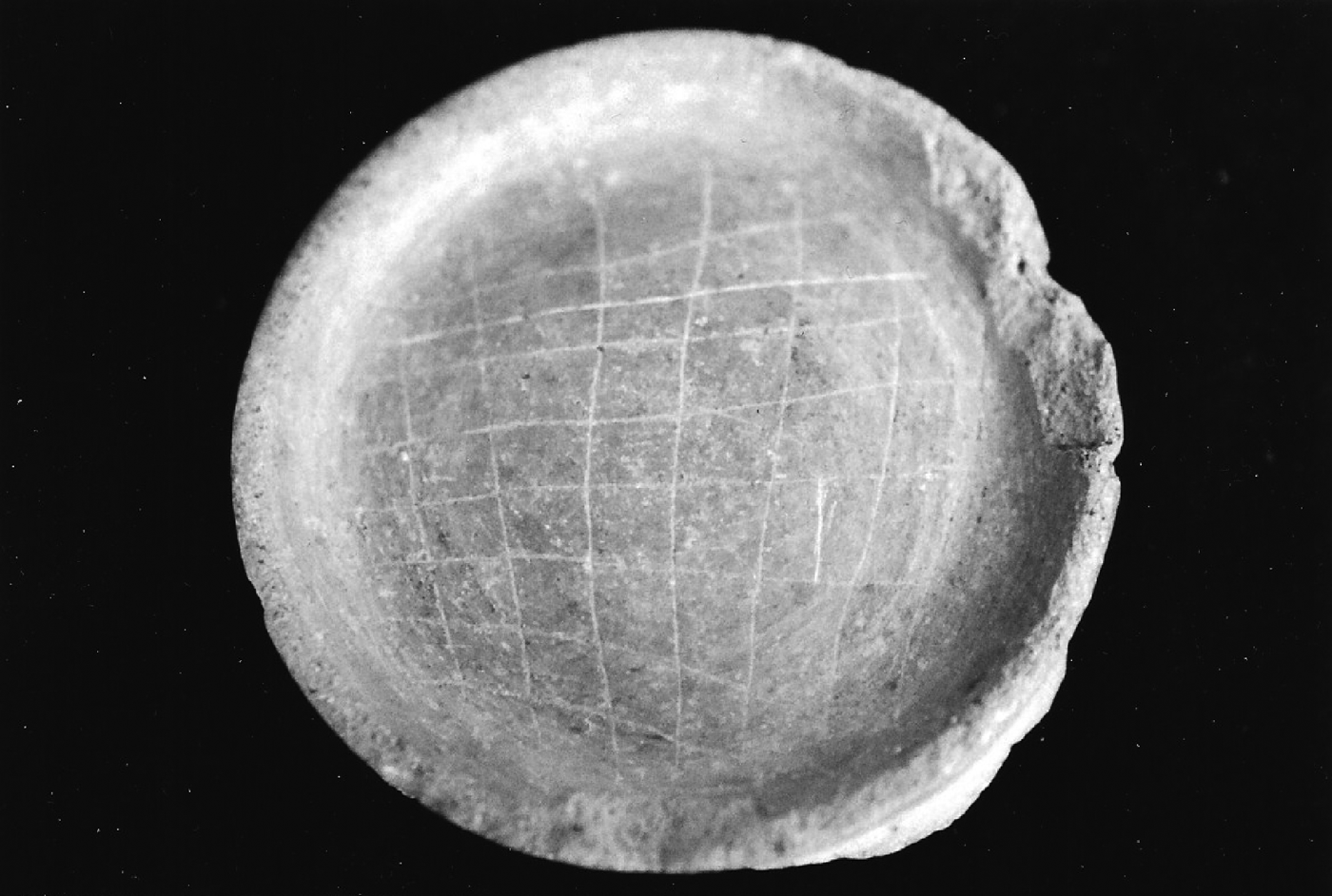
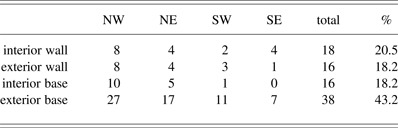
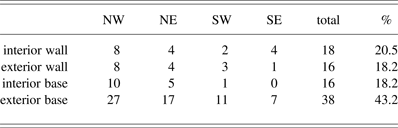
The graffiti were also recorded by their location on the bowl (Table 1). Graffiti on small sherds were included in these location counts when their location on the vessel could be established. The majority of graffiti are on the exterior base, inside the ring support (Figures 2–3). The other locations (interior base, exterior and interior walls) are each about equally represented, however, there is some variation. The exterior base location is dominant in the northwest quarter, at 50.9%, but minor in the northeast at 23.5%. The difference is significant (p < 0.05). Clayton (Reference Clayton2009:215–217) found similar variation between sites in graffiti placement, supporting the idea that the graffiti were made by the users of the vessels rather than by their producers.
Graffito on external base of Thin Orange bowl, site 13:N1W3; cross or X enclosed in a circle, inside ring support.
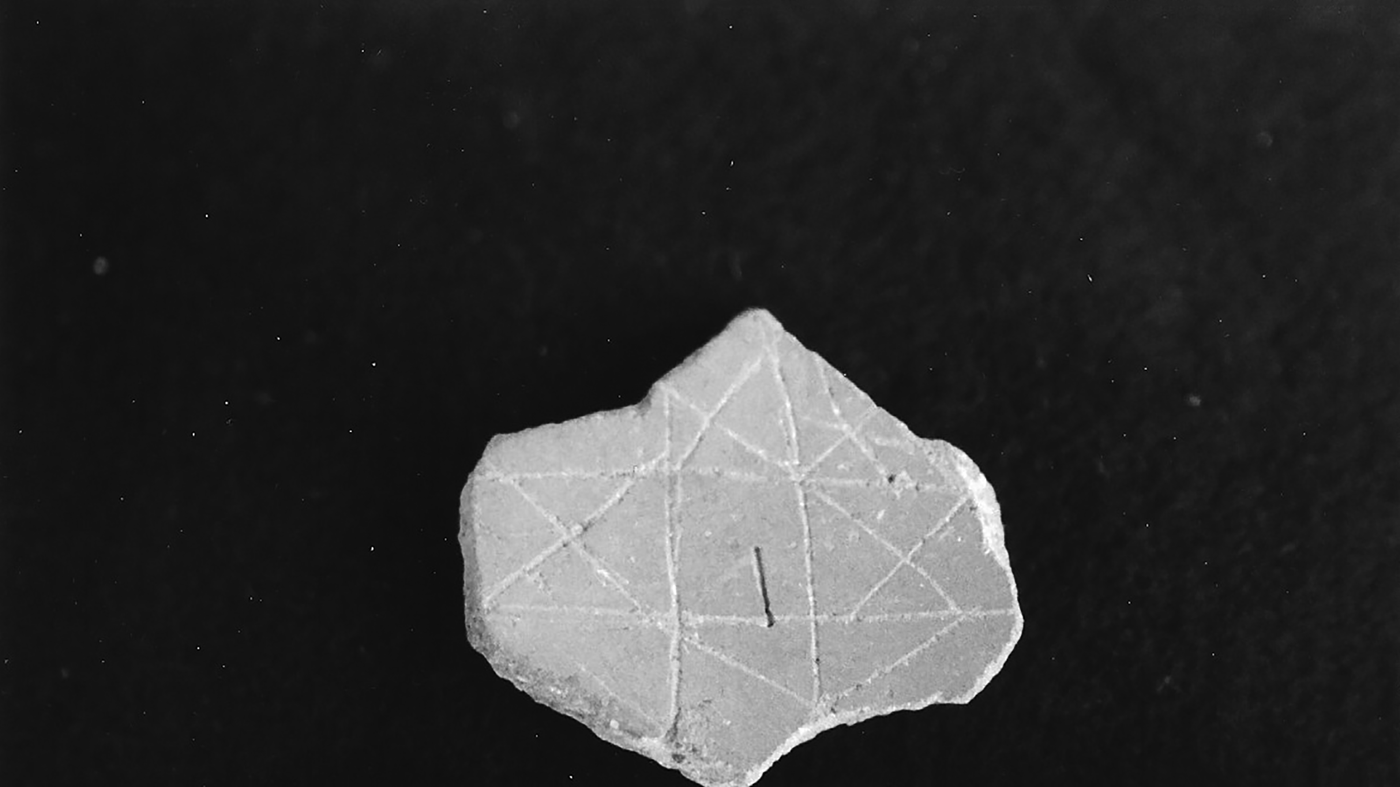
Graffito on external base of Thin Orange bowl, site 10:S:N1W3; crosshatch design inside ring support.
Location of Graffiti on Vessel
Most of the graffiti on the vessel walls and interior bases have finely incised lines, perhaps done with an obsidian blade. They are barely visible in many cases, requiring examination of the sherds with a strong lateral light and a magnifying glass. Those on the exterior bases are sometimes more coarsely drawn, with broader lines that are more scored than incised (Figure 2). In either case the images were not intended for the casual viewer. They could be seen only by somebody who looked specifically for them. Interference with the aesthetic appeal of the vessel was avoided. There remains the question of the intended audience for the graffiti, if indeed an audience was in mind when the images were produced.
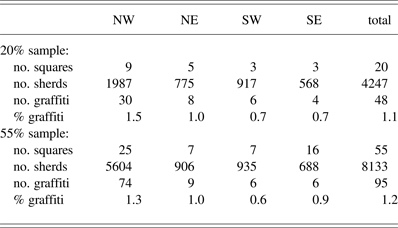
It was not possible to examine all of the TMP surface collections so a sample was selected using a table of random numbers. The sample was set at 20%, with 20 of the 99 map squares encompassed within the city to be included in the analysis. Only graffiti on sherds 55 mm or more in length were counted, although those on smaller sherds were still recorded for qualitative analyses. The results are presented by square in Appendix I and by city quarter in Table 2. Although the frequencies of graffiti differ somewhat between quarters, none of the differences are significant by Chi-square analysis at p < 0.05.
Thin Orange Graffiti Frequencies by Sample
Coverage at the 20% level, however, produced only a modest sample of graffiti and left the southern half of the city underrepresented. To compensate, additional squares were added to bring the sample size to 55 squares (55.6% of the city). This larger sample doubled the number of graffiti and expanded the sample from the south (Table 2; Appendix I). It has two flaws: square selection was non-random, and the proportion of northwest quarter material in the sample has more than doubled. This latter problem is perhaps unavoidable, given that the northwest quarter is the largest and most densely populated part of Teotihuacan.
Although not random, the 55% sample is still valid for some purposes. The graffiti frequencies for particular quarters and for the city as a whole are not significantly different between the 20% and 55% samples (Table 2). However, in the 55% sample the higher frequency of graffiti in the northwest quarter takes on more substance. Although not significantly different from the northeast or southeast frequencies, it is higher (p < 0.05) than the southwest frequency.
The greater use of graffiti is not confined to any one part of the northwest quarter. The area of the Old City, represented in the samples by squares N6W2, N6W3 (only partially analyzed), and N7W2, has a higher than average incidence, 26 graffiti in a sample of 809 Thin Orange sherds (3.2%). The difference between the Old City and the rest of the northwest quarter is significant at p < 0.001. However, there are other islands of high frequency in the quarter, like squares N1W2, N1W3 and N3W3 (Appendix I). Despite these anomalies, the addition of graffiti to Thin Orange bowls appears to have been practiced throughout the city, in modest peripheral residences like Bidasoa (Sánchez Alaniz Reference Sánchez Alaniz2000) as well as higher status central structures like Tetitla (Séjourné Reference Séjourné1966b).
The frequencies presented here are sherd counts rather than vessel counts. Vessel frequencies would be considerably higher and would offer a more accurate picture of the popularity of the practice. There is no reliable way, however, of converting the TMP sherd counts into vessel counts. In assessing the practice it would be better to use relatively complete vessels, most of which would probably come from burials or offerings. This analysis would require a close inspection of each vessel, since the graffiti are often quite faint and might not be detected by a casual observer. Both presence and absence would have to be recorded (for example, Clayton Reference Clayton2009).
To date there are reports of analysis at this level from only three places in Teotihuacan. Eleven relatively complete Thin Orange ring-base bowls were recovered during the excavation of TL6, an apartment compound in Tlailotlacan, the Oaxaca Barrio of Teotihuacan. They were in ritual deposits, in which one vessel (or fragments) was used as a cover for another which probably held the umbilical cord of a newborn infant (Spence Reference Spence and Berlo1992). Of the eleven, four had graffiti (36%). Clayton (Reference Clayton2009:Table 6.15) records 4 of 19 (21%) hemispherical bowls from La Ventilla Sector 3 burials with graffiti, and 1 of 3 from Tlajinga 33. Her data include an unspecified number (probably very small at La Ventilla 3) of ring-base hemispherical bowls that are not of Thin Orange, but rather imitations made from local clays (Clayton Reference Clayton2009:199, 210, Figure 6.10). These appeared in the Metepec phase in Teotihuacan but may have been produced earlier in other areas where the supply of Thin Orange bowls was more limited (Clayton Reference Clayton2009:199–200; Rattray Reference Rattray2001:199, 210, Figure 6.10).
Counts based on burial and offering bowls also have the advantage of providing context. However, their interpretation is not straightforward. The evidence from TL6 suggests that the graffiti there were not related to the ultimate use of the ritual deposit vessels to hold a newborn's cord. One of the Thin Orange bowls with a graffito was broken and incomplete, the sherds used as a cover for the vessel holding the cord. Part of the graffito was on sherds that had not been included in the deposit (Spence and Rattray Reference Spence, Rattray and Gallut2002:104–105, Figure 1b). Also, Thin Orange bowls in several other ritual deposits lack graffiti.
It may be, then, that the graffiti were not placed on vessels in anticipation of some ultimate ritual use. However, they may still have had some relationship to the individuals with whom they were buried. A detailed study of the burials in which they are found might help to resolve this question (for example, Clayton Reference Clayton2009:214). As always, the vessels without graffiti will be equally important in interpretation.
This approach might also shed some light on the gender of those making the graffiti. At present we cannot say whether the users of the bowls were men, women, or both. Clayton (Reference Clayton2009:168–169) suggests that the frequent interior abrasion suggests their use in grinding foodstuffs. They may also have been used as serving or drinking vessels. These functions may have been more in the domain of women, but further studies (including chemical analysis of the interior bases, for example, Soleri et al. Reference Soleri, Winter, Bozarth and Hurst2013) are required.
THE IMAGES
Deciphering the graffiti images is often difficult or impossible. Most of them in this sample of fragmentary surface-collected sherds are incomplete. Also, the ceramic surface is an intractable material for drawing, presenting a significant constraint on artistry. But the quality of the image may not have been of major concern to the inscriber since they were apparently not meant to be viewed by a wide audience. They range from indecipherable scratches through cartoonish figures and geometric patterns to complex and well crafted images.
Another problem with their interpretation is the orientation of the images. Unless the drawing is of a recognizable figure, it can be very difficult to determine top versus bottom. For example, one of the images published by Séjourné (Reference Séjourné1963:Figure 18, middle row, left) is probably a variant of the Trapeze and Ray sign, but it has been shown upside-down. A Storm God Insignia published by Millon (Reference Millon and Gallut2002:Figure 5) is also upside-down. This problem is particularly troubling with images on the exterior and interior bases where there is no orienting feature. Those on vessel walls have the lip as an orienting horizon, but it may be that the portion of the image nearest the lip is not always its top. Since the images were not intended to be widely viewed, their orientation may have had more to do with their ease of production, that is, with the position in which the inscriber found it easiest to hold the bowl while scratching the image on it. As an example, the two Thin Orange hemispherical bowls in TL6 Ritual Deposit 92 (Figure 1) both bear what seem to be variants of the same image on their interior walls (Spence and Rattray Reference Spence, Rattray and Gallut2002:Plate 1, Figure 1c-d). In the upper bowl, however, which was inverted over the lower bowl, the vertex of the triangular figure is toward the lip while in the lower bowl, which was sitting upright, it is toward the base.
The following descriptions and discussion will include the Yayahuala and Tetitla graffiti illustrated by Séjourné (Reference Séjourné1963, Reference Séjourné1966b), those found in the TMP surface collections (including a few from earlier scans of squares not included in the present 55% sample), and some recovered during excavations in the Merchants’ Barrio (Rattray Reference Rattray, Gallut and Soto2004), site TL6 of Tlailotlacan (Spence Reference Spence and Stein2005), and the La Ventilla Barrio (Gómez Chávez Reference Gómez Chávez2000). Mention will also be made of some examples that Clayton (Reference Clayton2009:Table 6.16) found in La Ventilla Sector 3 and at Tlajinga 33 (33:S3W1), although a few of these may be on ring-base bowls of local clay rather than Thin Orange.
Glyphs and Signs
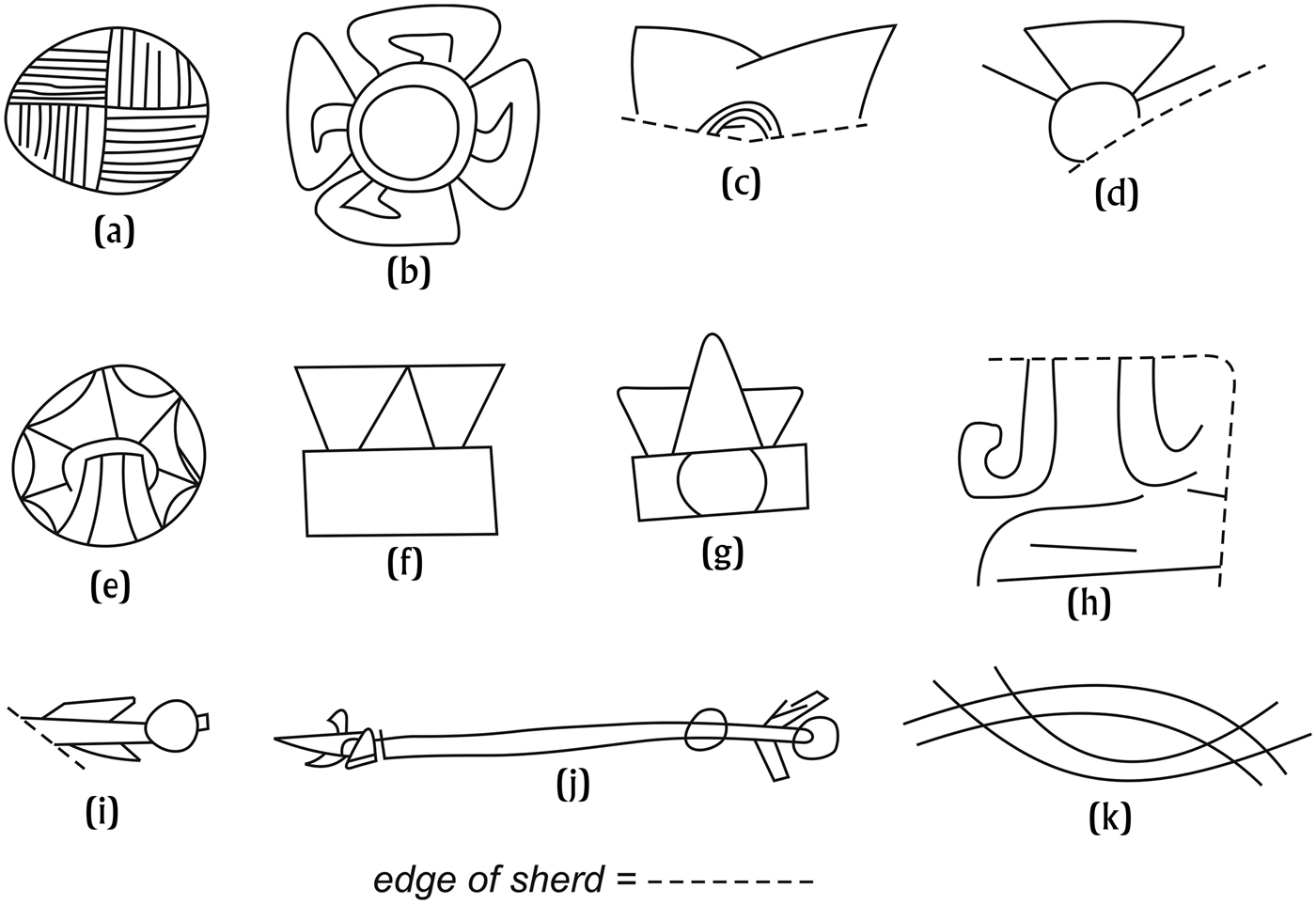
A number of the graffiti are symbols and signs familiar from the formal art of Teotihuacan, the murals and pictorial ceramics (Figure 4). Their precise meaning is often contested among the various authors who have discussed them (Kubler Reference Kubler1967; Langley Reference Langley1986, Reference Langley and Berlo1992; Pasztory Reference Pasztory1974; Taube Reference Taube2000; von Winning Reference von Winning1981). Most of them, however, do seem to have had some particular significance in Teotihuacan ideology.
Graffiti of glyphs and signs. (a) Fourway Hatching, 1:N7W2; (b) Quatrefoil, Tetitla (Séjourné 1966b:Figure 138); (c–d) Quatrefoil/Trefoil variants, 33:S3W2; (e) Cobweb, Tetitla (Séjourné 1966b:Figure 136); (f) Trapeze and Ray, 1:N1W2; (g) Trapeze and Ray, Tetitla (Séjourné 1966b:Figure 136); (h) Bifurcated Tongue, 21:N7W2; (i) Dart, 5:N1W2; (j) Dart, La Ventilla Sector 3; (k) Interlaced Bands, La Ventilla Sector 3.
Fourway Hatching
Present in Thin Orange bowls at Yayahuala, Tetitla (n = 2), and site 1:N7W2 of the Teotihuacan map (Figure 4a; Séjourné Reference Séjourné1963:Figure 18 bottom left; Reference Séjourné1966b:Figures 136 upper center, 138 upper row right). Langley (Reference Langley1986:264) reviews some of the suggestions for its meaning, but “irrigated field” seems to be the most likely interpretation (Angulo Reference Angulo and de la Fuente1996:116–117; von Winning Reference von Winning1981:II:35–39; see also Taube Reference Taube2000:41, 47, Figure 33a–c, e–f). It appears in Teotihuacan on a plano-relief vase (Conides Reference Conides2001:Figure 24a–b), a Tetitla candelero, and a moldmade plaque on a cylindrical vase (von Winning Reference von Winning1981:II:35). The base of the Tepantitla Tlalocan mural shows a very similar scene, clearly irrigated fields in that context (Miller Reference Miller1973:Figure 167).
Quatrefoil/Trefoil/Four Petal Flower
At Tetitla (n = 4) and 33:S3W2 (Figure 4b–d; Séjourné Reference Séjourné1966b:Figures 136, 138 top left, bottom left). Clayton (Reference Clayton2009:Table 6.16) also identifies three examples in La Ventilla. Langley (Reference Langley1986:316) notes the uncertain distinction between the Quatrefoil and the Flower Frontal Q, also known as the Four Petal Flower. The Trefoil motif is basically the Quatrefoil sign with the inferior lobe removed, usually to be replaced by a different motif (Langley Reference Langley1986:295). The Frontal Flower Q is differentiated by Langley (Reference Langley1986:256) from the other signs primarily by its clear association with flowers. The Quatrefoil motif is well represented in both mural art and pictorial ceramics. Manzanilla (Reference Manzanilla2006:34–35) notes its presence at Teopancazco and Xalla. Several examples occur in the pictorial ceramics at Tetitla (Séjourné Reference Séjourné1966b). The 33:S3W2 sherd is one of only two sherds in the graffiti sample that have two graffiti in the same bowl. One is on the interior base (Figure 4c) and the other is on the exterior base (Figure 4d). They appear to be variants of the same form, either a Quatrefoil or a Trefoil, but neither is complete enough to be sure which they represent.
Cobweb
At Tetitla (Figure 4e; Séjourné Reference Séjourné1966b:Figure 136 second row left). This motif also appears in pictorial ceramics at Tetitla (for example, Séjourné Reference Séjourné1966b:Figures 49, 86, 182). The same sign, including the same pendant element, occurs on the medallions of Thin Orange jars at Tetitla (Séjourné Reference Séjourné1966b:Figure 151). The pendant element is Langley's Tassel B (1986:338), which is also found pendant from Quatrefoil and Trefoil signs.
Trapeze and Ray
At Yayahuala, Tetitla (n = 2), and 1:N1W2 (Figure 4f–g; Séjourné Reference Séjourné1963:Figure 18 middle row left; Reference Séjourné1966b:Figure 136, 138). This is Langley's TR A sign, also identified as the Year sign (1986:294). It appears in both pictorial ceramics and mural art at Tetitla and elsewhere (de la Fuente Reference de la Fuente and de la Fuente1995a:Figure 19.43; Séjourné Reference Séjourné1966b:Figure 86).
Year Sign Cartouche
At Tetitla (Séjourné Reference Séjourné1966b:Figure 138 top row center). This complex and variable cluster of signs in a cartouche usually includes the Reptile Eye sign in the lower register (unfortunately missing in the incomplete Tetitla graffito) and the Bar-and-Comb sign and Year sign in the upper register. It may be associated with the butterfly complex (von Winning Reference von Winning1981:I:117). Examples occur in a plano-relief vase at Tetitla and a stuccoed and painted vase of unknown provenience (Séjourné Reference Séjourné1966b:Figures 36, 94 top).
Storm God Insignia
At an unidentified site in the Old City area of Teotihuacan (Millon Reference Millon and Gallut2002:Figure 5). This complex of symbols, associated with the Storm God, includes the Kan Cross (Langley's Quincross), the Bigotera sign, three circles, and a Rosette A frame (Langley Reference Langley1986:69, Figure 26b; von Winning Reference von Winning1981:II:65–66, Figures 1a–b, 3a–d, 5). It also occurs in an incised red ware bowl from Tetitla (Séjourné Reference Séjourné1966b:Figure 194) and in ceramic ear ornaments and almenas from various sites. In the Old City graffito the Quincross element was set at an angle rather than upright, suggesting that the inscriber had only a limited familiarity with the symbol.
Bifurcated Tongue
At 21:N7W2 (Figure 4h). Langley (Reference Langley1986:322) notes the occurrence of his Tongue Bifurcated sign with both serpents and felines. It is present in both murals and pictorial ceramics (for example, Séjourné Reference Séjourné1966a:Figure 36). The 21:N7W2 sherd is too incomplete to see other elements of the graffito.
Dart
At Yayahuala, Tetitla, La Ventilla Sector 3, and 5:N1W2 (Figure 4i–j; Séjourné Reference Séjourné1963:Figure 18 upper row right; Reference Séjourné1966b:Figure 136 center). Clayton (Reference Clayton2009:Table 6.16) notes a second example from La Ventilla but does not illustrate it. The Yayahuala and Tetitla graffiti are rather rudimentary and the 5:N1W2 example is incomplete. The La Ventilla Sector 3 example is complete and much like the darts illustrated frequently in the murals and pictorial ceramics, including in both media at Tetitla (de la Fuente Reference de la Fuente and de la Fuente1995a:Plate 7, Figure 19.7; Séjourné Reference Séjourné1966b:Figures 37, 92, 157, 165–166). There are several details of the darts that appear in most depictions, including the La Ventilla example: the upturned shoulder barbs of the point, which do not occur in actual points from Teotihuacan and so indicate that these must be stylized versions of projectile points; the fletching in the proximal part of the dart; and the circular elements located at three places along the shaft, perhaps tufts of down (von Winning Reference von Winning1981, I:81). Although darts are rarely portrayed as isolated items in the murals and pictorial ceramics (but see Séjourné Reference Séjourné1966b:Figure 94 middle), this consistency of expression suggests that they have some meaning apart from just that acquired through their bearers.
Serpent Head
At Tetitla (Séjourné Reference Séjourné1966b:Figure 136). This profile serpent's head is Langley's Head Serpent p sign (1986:269–270). It appears in mural art and pictorial ceramics, including a stuccoed and painted Thin Orange vase from a private collection and a red on brown vessel from Tetitla (Séjourné Reference Séjourné1959:Figure 132; Reference Séjourné1966b:Figure 1).
Rosette A
At Yayahuala (Séjourné Reference Séjourné1963:Figure 18 middle row right; [see also Langley Reference Langley1986:318]). Unfortunately, the Thin Orange sherd illustrated by Séjourné is not complete enough to be sure of the full design.
Interlaced Bands
At La Ventilla Sector 3 (Figure 4k). This is Langley's Bands Interlaced sign (1986:232–233), which he suggests is related to the Aztec Olin glyph (see also von Winning Reference von Winning1981:I:102–104). It is common in both murals and pictorial ceramics (for example, Séjourné Reference Séjourné1959:Figure 20; Reference Séjourné1966b:Figure 93).
Bar-and-Dot Numerals
At Tetitla and an unidentified site in the Old City (Séjourné Reference Séjourné1966b:Figure 136; Millon Reference Millon and Gallut2002:Figure 4). Both examples are incomplete so it is not possible to say whether the numerals are part of a date, a name, or something else. Bar-and-dot numerals are present but not common in Teotihuacan art (Taube Reference Taube2000:6, Figure 3). One example occurs on a stuccoed and painted Thin Orange ware jar (Séjourné Reference Séjourné1966b:Figure 134).
Naturalistic Figures
These are images, often crudely inscribed, of elements of the natural world: humans, fauna and flora (Figures 5–7). Some may also be signs in the Teotihuacan repertoire but most are probably just based on the experiences and observations, and perhaps the imaginations, of the inscribers. The variety of images that are gathered here in any particular category (for example, humans, birds) suggests that they do not form a coherent conceptual set.
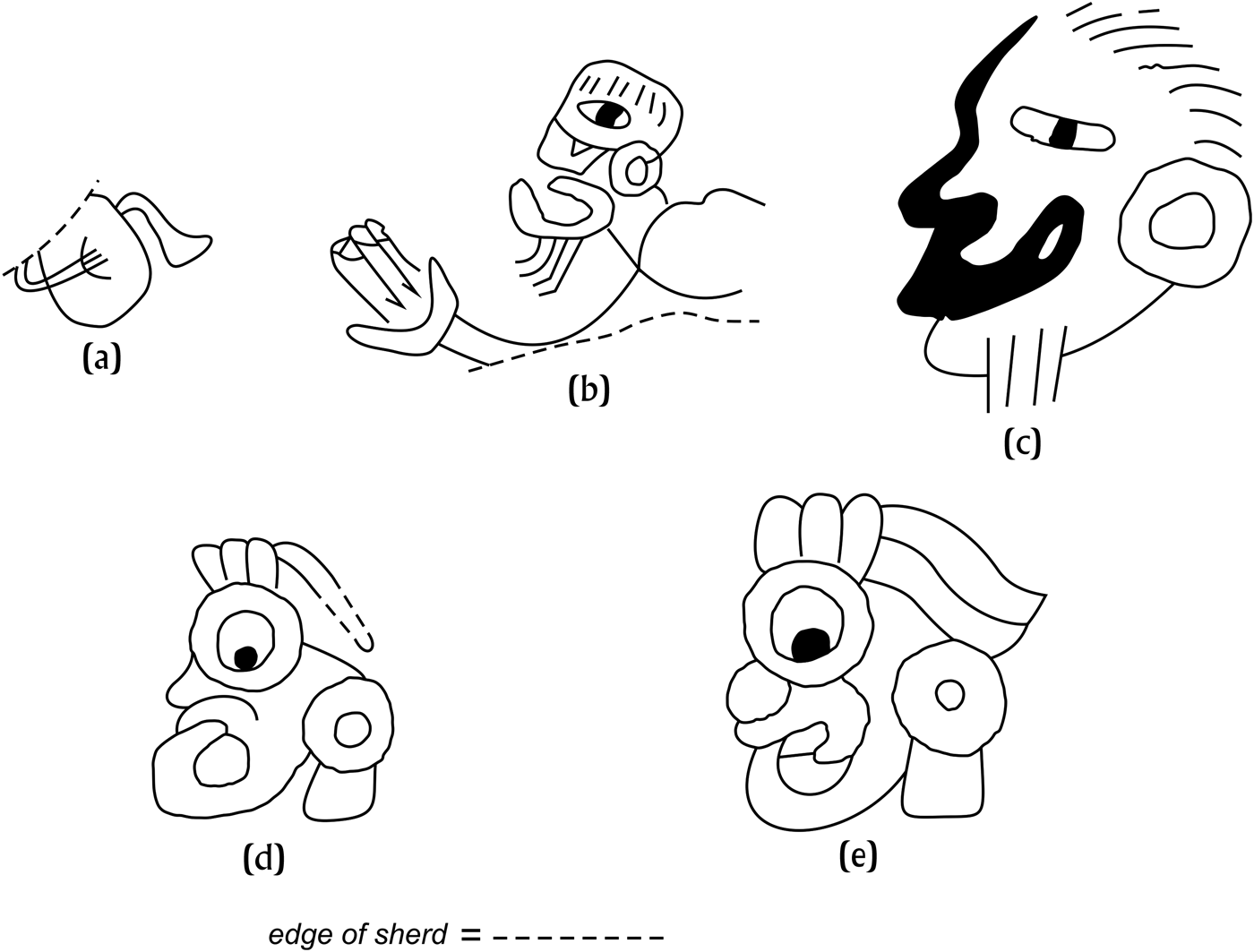
Graffiti and glyphs of humans. (a) Tetitla (Séjourné 1966b:Figure 138); (b) La Ventilla Sector 3; (c–e) glyphs 13, 30–31, Plaza of the Glyphs, La Ventilla Sector 2 (Cabrera Castro 1996a).
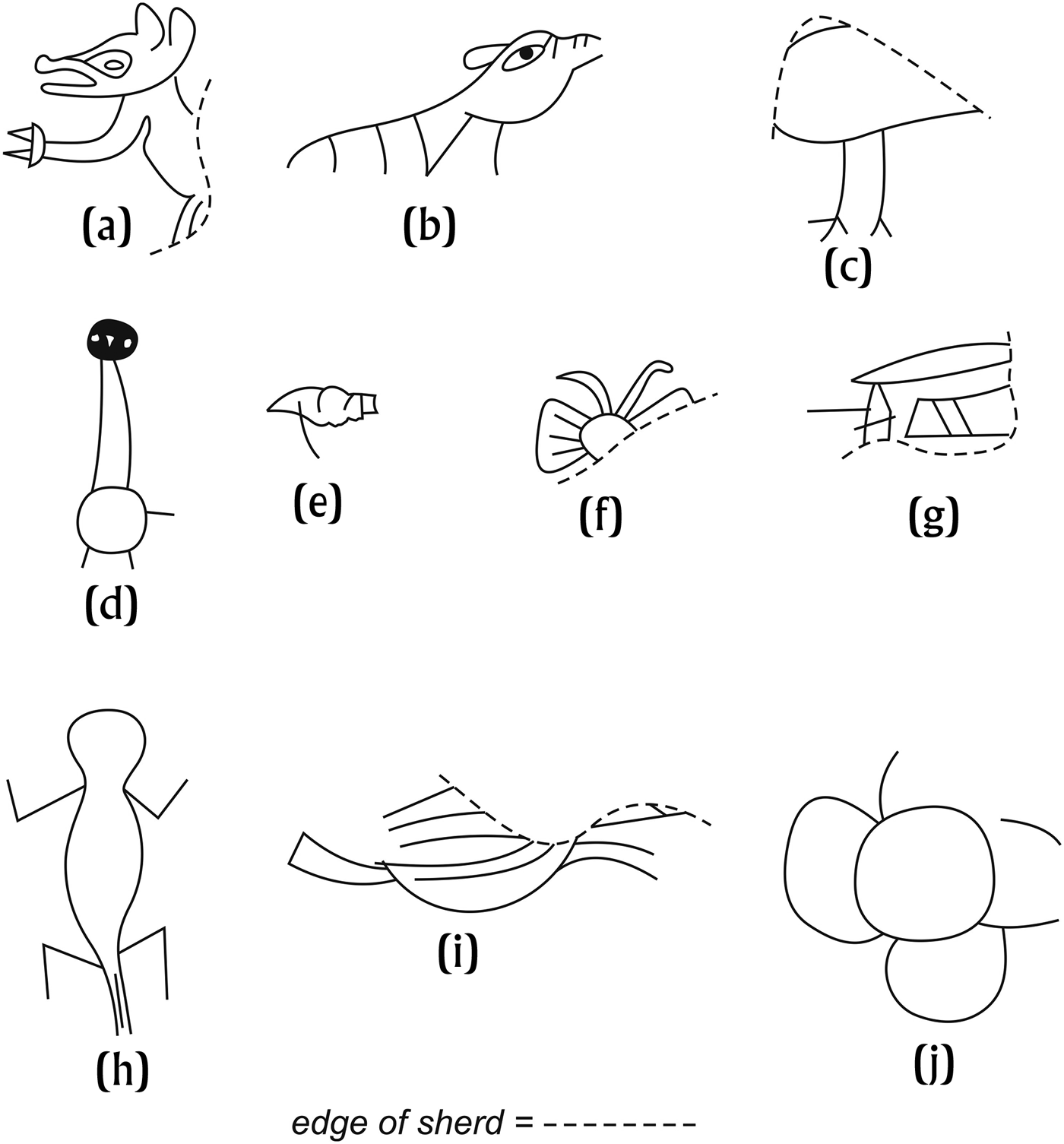
Graffiti of naturalistic figures. (a) Canid, Tetitla (Séjourné 1966b:Figure 138); (b) Tapir, TL6; (c–d) birds, 24:N7W2, 4:S1E4; (e) Conch Shell Trumpet, Tetitla (Séjourné 1966b:Figure 136); (f) Butterfly, Tetitla (Séjourné 1966b:Figure 136); (g) Turtle, 52:N6W3; (h) Lizard, 1:S1W3; (i) Squash, TL6; (j) Frontal Flower Q, 13:S1W1.
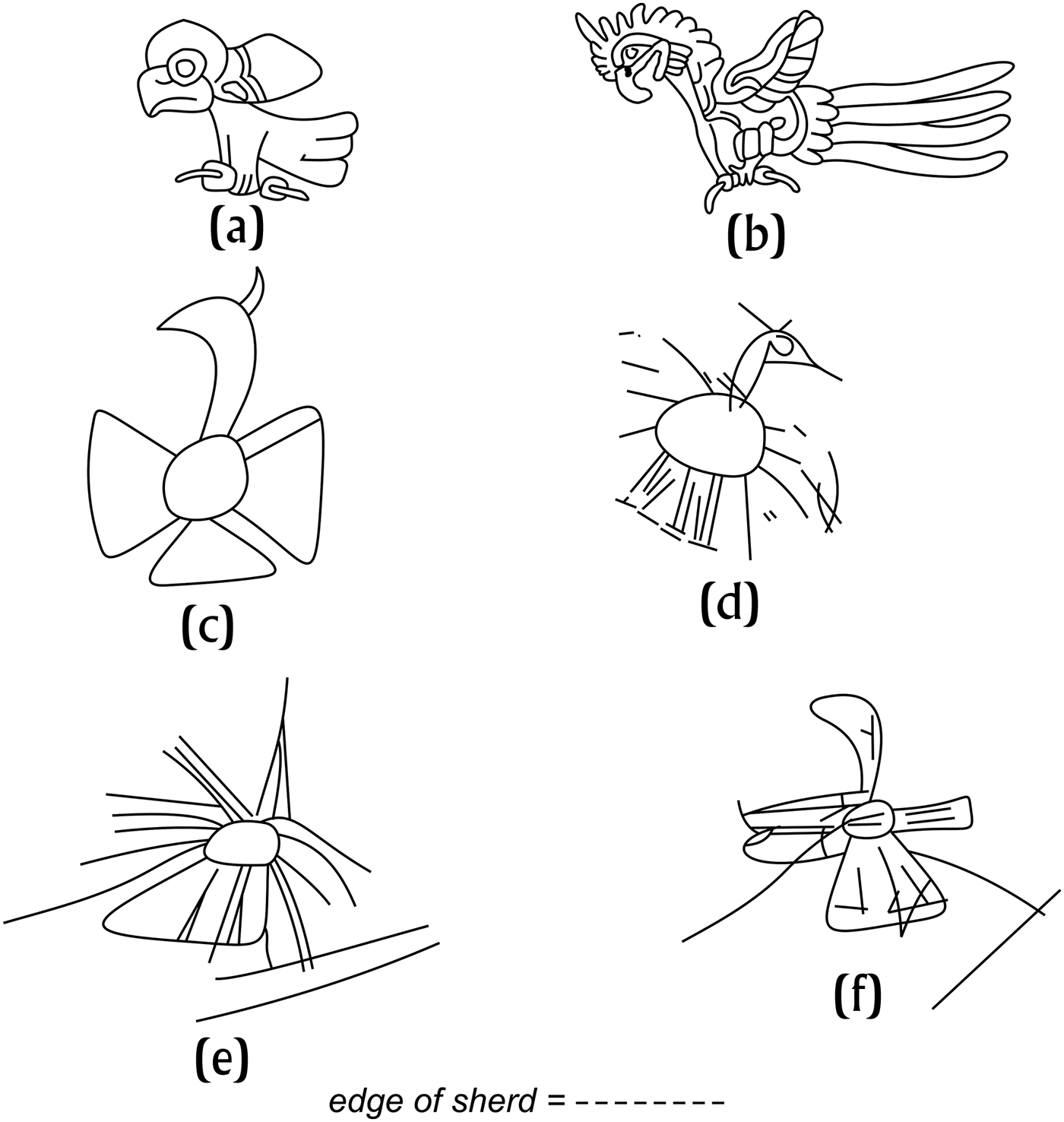
Graffiti and mural depiction of birds. (a) Tetitla (Séjourné 1966b:Figure 136); (b) Tetitla mural (Séjourné 1966c:Figure 132); (c) Moon Plaza; (d–f) wall graffiti, Street of the Dead area (Sánchez 1996:Figures 34–36).
Humans
At Tetitla and La Ventilla Sector 3 (Figure 5a–b; Séjourné Reference Séjourné1966b:Figure 138). The Tetitla image (Figure 5a) is just a cartoonish body with an arm and leg, the head area broken off. It is not even definitely human. The depiction of the hand (a semilunar form for the thumb and little finger, with vertical lines from its center for the middle fingers), however, is much like the hand in the human La Ventilla graffito.
The La Ventilla graffito shows a head in left profile with part of the upper back and an extended arm (Figure 5b). Some features of the image are similar to those in some of the glyphs painted on a plaza floor in the nearby Sector 2 structure of the La Ventilla barrio (Figure 5c–e; Cabrera Castro Reference Cabrera Castro and de la Fuente1996a, Reference Cabrera Castro1996b). Glyph 13 of the plaza (Figure 5c) has a fringe of hair and a four-line beard very similar to those of the graffito. Also, glyphs 30 and 31 (Figure 5d–e), and to a lesser extent some of the others, show a narrow and sharply upcurved lower jaw very like that of the graffito but quite different from human depictions elsewhere in the city. These similarities suggest that the person who inscribed the graffito on the Thin Orange bowl drew some inspiration directly from the plaza floor images, or at least was drawing on some local understanding of how to depict the human head, perhaps an example of Cowgill's local rules (1993:559).
Canid
At Tetitla (Figure 6a; Séjourné Reference Séjourné1966b:Figure 138), the rim and lip are present in the Tetitla sherd, allowing the image to be oriented. It is a canid, partially upright with the left foreleg reaching forward. It may be a simplified version of the canid portrayed in a Tetitla mural (Séjourné Reference Séjourné1966a:Figures 177, 183; de la Fuente Reference de la Fuente and de la Fuente1995a:291–292).
Tapir
At TL6, on a vessel from Ritual Deposit F128 (Figure 6b; Spence and Rattray Reference Spence, Rattray and Gallut2002:104, Figure 1a). There are no similar animals depicted in the Teotihuacan media. The nose suggests a tapir. Although not indigenous to the Basin of Mexico, Baird's tapir (Tapirella bairdii) was at one time present in the tropical forests of Belize, the Yucatan peninsula, Tabasco, Veracruz, Chiapas and parts of Oaxaca (Leopold Reference Leopold1977:554–559). Teotihuacan had ties to many of these areas (Gómez Chávez and Spence Reference Gómez Chávez, Spence, Nichols and Pool2012), so at least some Teotihuacanos would have been aware of the appearance of tapirs.
Birds
At Tetitla, 24:N7W2, 4:S1E4, and the Moon Plaza (Figures 6c–d, 7a, c; Séjourné Reference Séjourné1966b:Figure 136 bottom center). Although all of these graffiti are depictions of birds, they have little else in common and cannot be taken to share a single meaning or significance. The Tetitla example (Figure 7a) is very like several depictions in Tetitla ceramics (Séjourné Reference Séjourné1966b:Figures 38, 47, 57, 74) and a Tetitla mural (Figure 7b; Séjourné Reference Séjourné1966a:Figure 153; Reference Séjourné1966c:Figure 132). Séjourné identifies the bird in these images as a quetzal, indigenous to the highlands of Chiapas and Guatemala (Reference Cabrera Castro and de la Fuente1966a:286–293, 298–300). That identification, however, is not accepted by Navarijo Ornelas (Reference Navarijo Ornelas and de la Fuente1996:334–335), who suggests that the bird images identified by Séjourné as quetzals may actually include several different species. In any event, the image depicted on the Tetitla Thin Orange sherd has its closest counterparts in the mural and ceramic art of Tetitla but appears rarely, at least in that pose, at other sites in Teotihuacan.
The Moon Plaza Thin Orange graffito (Figure 7c) was recovered during excavations in the Moon Plaza by the Moon Pyramid Project (Sugiyama and Cabrera Castro Reference Sugiyama and Castro2007). It has no counterpart in the city's murals or pictorial ceramics. Similar bird images occur, however, as graffiti on the walls of structures in the Moon Plaza, Conjunto Noroeste, and Conjunto 1E of the Ciudadela (Figure 7d–f; Sánchez Reference Sánchez, Monjaras-Ruiz, Rocha and Valle1996:Figures 34–36). The latter two images were originally drawn with the head area to the viewer's left, as if flying, but are presented here in the upright position to facilitate comparison. The head of Figure 7e may have been destroyed by erosion (Sánchez Reference Sánchez, Monjaras-Ruiz, Rocha and Valle1996:217). All four images share a frontal perspective of fanned wings and tail feathers, long necks, and profile heads (where present). Sánchez (Reference Sánchez, Monjaras-Ruiz, Rocha and Valle1996: 217, 223) suggests that the three architectural graffiti show no evidence of having any symbolic meaning, and may all have been made by the same person, somebody with access to the interiors of the high status structures along the Street of the Dead. Given its similarity to the other graffiti, the Thin Orange graffito from the Moon Plaza may have been made by the same person, or perhaps copied from one of the architectural examples.
The site 24:N7W2 and 4:S1E4 birds (Figure 6c–d) are cartoonish and unlike anything in Teotihuacan formal art. They seem to be idiosyncratic expressions.
Conch Shell Trumpet
At Tetitla (Figure 6e; Séjourné Reference Séjourné1966b:Figure 136 bottom left). Langley (Reference Langley1986:290, 299) differentiates depictions of conch shells as natural objects from those as trumpets, the latter with a mouthpiece added at the broader end. The Tetitla graffito is a trumpet. Conch trumpets occur in murals at Tetitla and other sites (Miller Reference Miller1973:Figure 302), and are also represented at Tetitla in vessels of Séjourné's Group 4 (Reference Séjourné1966b:Figure 79).
Butterfly
At Tetitla (Figure 6f; Séjourné Reference Séjourné1966b:Figure 136 right). Butterflies are well represented in Teotihuacan art. The Conjunto del Sol and Tepantitla Tlalocan murals have frontal full-figure butterflies (de la Fuente Reference de la Fuente and de la Fuente1995b:Figure 6.3; Miller Reference Miller1973:Figure 116), and they also occur in ceramic art, including pictorial ceramics at Tetitla (Séjourné Reference Séjourné1966b:Figures 36, 39). Some of these may be references to the Butterfly Bird deity discussed by Paulinyi (Reference Paulinyi2014).
Turtle
At 52:N6W3 (Figure 6g). This may be a shelled creature of some sort, but it is not complete enough to say much more. Although identified here as a turtle, other possibilities (for example, armadillo, bivalve) cannot be ruled out. There is nothing similar in the murals or pictorial ceramics.
Lizard
At 1:S1W3 (Figure 6h). This seems to be a lizard, with no counterpart in the city's formal art.
Squash
At TL6 (Figure 6i). The TL6 example is in a bowl that formed the upper element in Ritual Deposit F247 (Spence and Rattray Reference Spence, Rattray and Gallut2002:Figure 1b). Depictions of squash also occur in murals at Techinantitla (Millon Reference Millon and Berrin1988:Figure IV 21a) and Tepantitla (Luna Reference Luna and de la Fuente1996:381, Figures 11, 18). A squash is also a frequent element in the Butterfly Bird deity complex of symbols (Paulinyi Reference Paulinyi2014). In any event, the mural depictions are very like each other but quite different from the TL6 graffito, suggesting that the latter owes nothing to the formal art of the city. To paraphrase Freud, sometimes a squash is just a squash.
Frontal Flower Q
At 13:S1W1 (Figure 6j; Spence and Rattray Reference Spence, Rattray and Gallut2002:Figure 4). Frontal Flower Q, also known as the Four Petal Flower, is much like the Quatrefoil, and may be simply a variant of it (Langley Reference Langley1986:256–257). It is treated separately here because the petals in the graffito are rounded, not angled as in many Quatrefoil depictions. Both variants occur in the mural art and pictorial ceramics. It is difficult to say whether the 13:S1W1 example is a meaningful sign or simply a picture of a flower, but it will be treated here as a sign.
Geometric, Abstract and Other Forms
This group is a catch-all for a variety of images, many of them not very elaborate and perhaps with no broader significance than the whim of the inscriber (Figures 8–10).
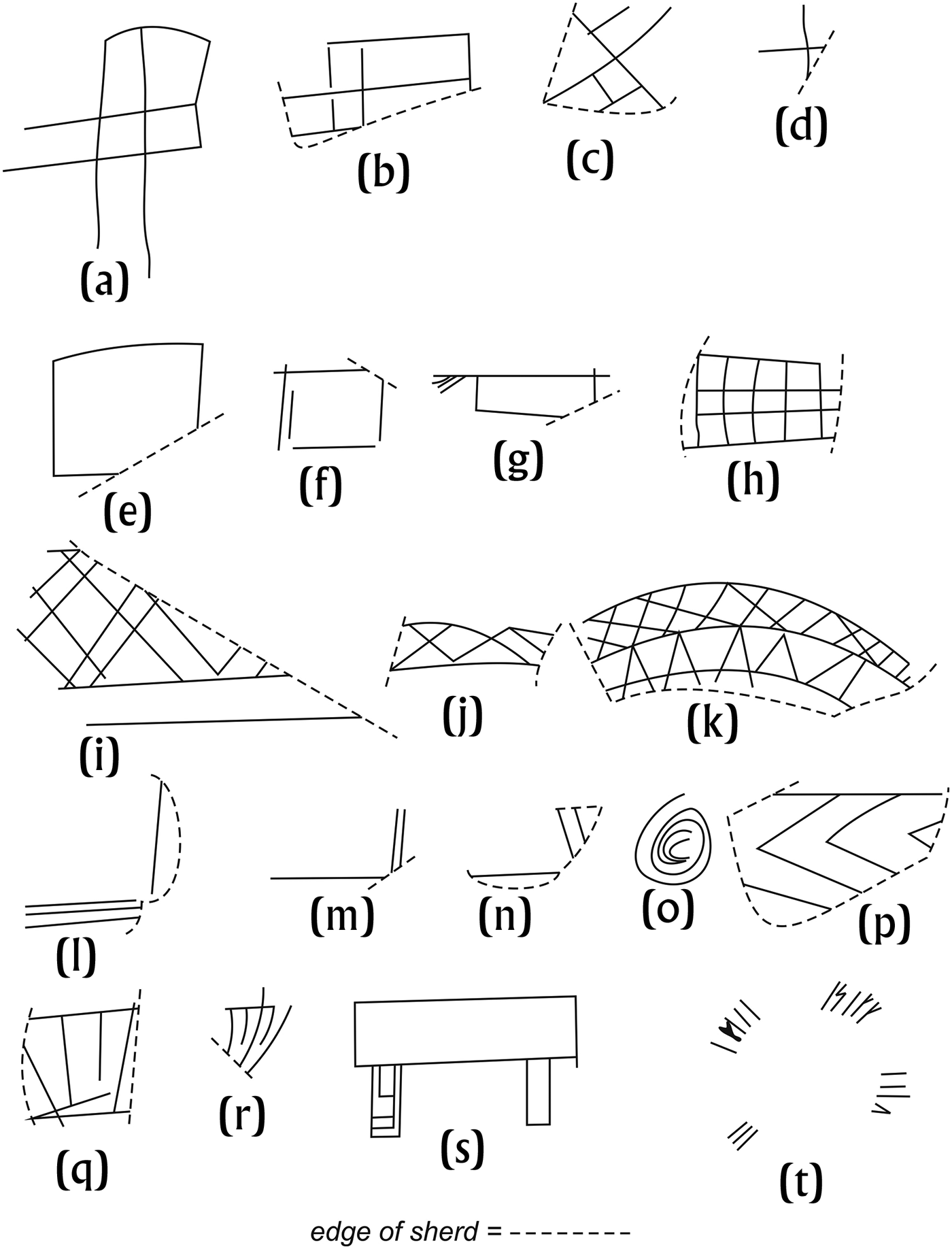
Geometric, abstract and other images I. (a–c) Patolli, Conjunto Noroeste (Sánchez 1996:Figure 21), 4:S1E4, 33:N5W4; (d) Cross/X, 1:S1W3; (e–f) Square, 16:N3W3, 28:N4E3; (g) Rectangle, 50:N5W3; (h–i) Crosshatch, 57:N5W3, 1:N1W2; (j–k) Crosshatched Arc, 57:N6W3, 15:N1W1; (l–n) Right Angle, 1:N7W2, 5:S1E4, 8:N4E3; (o) Spiral, 13:N5W3; (p) Chevron Chain, 8:N4E4; (q–r) Fan, 35:N5W4, 1:S1E4; (s) Altar, 5:S1E4; (t) Radial Lines, La Ventilla Sector 3.
Graffito of crosshatch variant, site 50:N4W2. Darker vertical line is a ceramic defect, not part of the design.
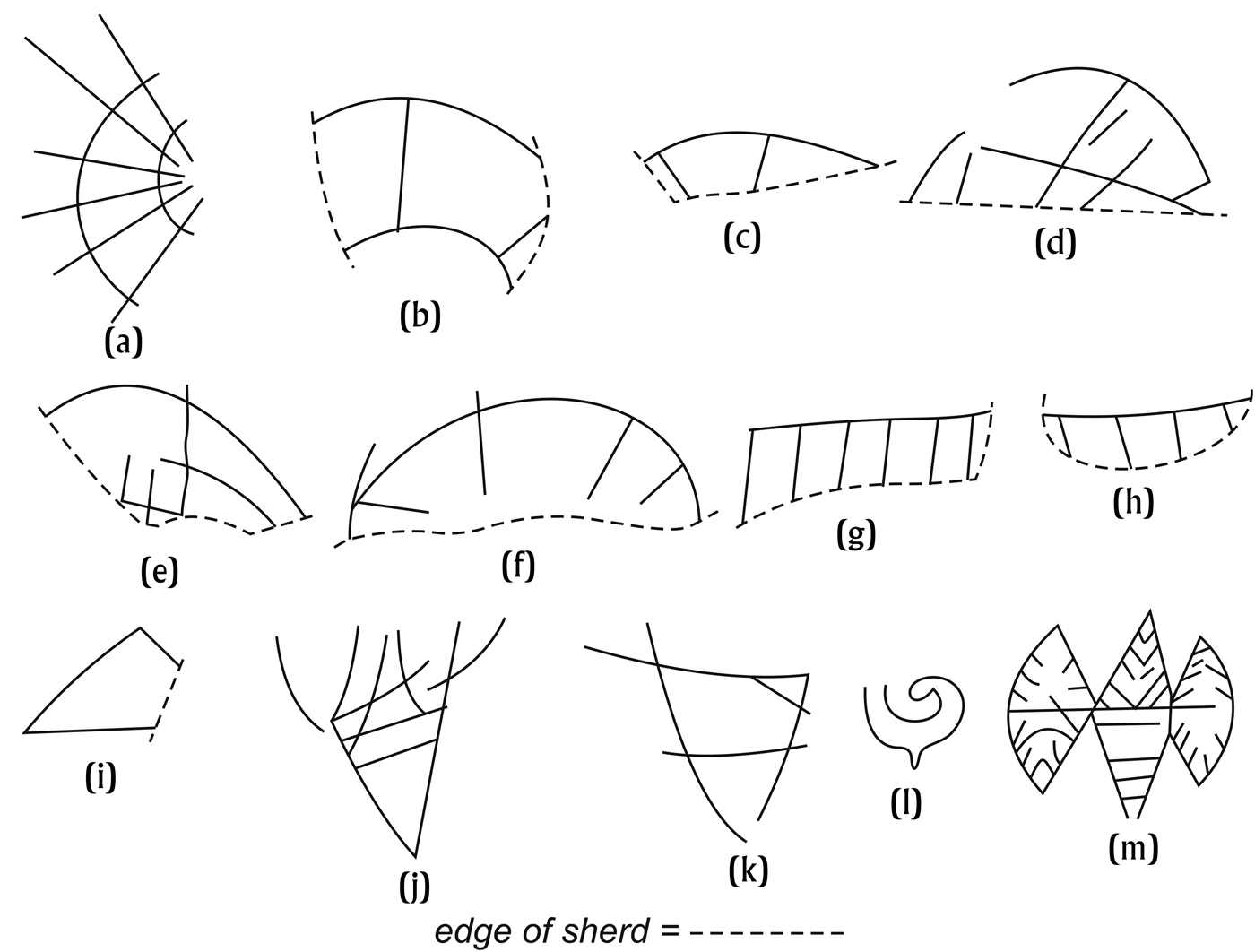
Geometric, abstract and other images II. (a–f) Radial Circles, 3:S1W2, 57:N6W3, 8:S4E1, 8:N1W2, 33:N6W3, 9:N1W2; (g–h) Ladder, 54:N6W3, 5:N3E4; (i) Triangle, 4:N1W2; (j–k) Trianguloid Forms, TL6; (l) Scroll with Spike, Tetitla (Séjourné 1966b:Figure 138); (m) Triple Diamond, Tetitla (Séjourné 1966b:Figure 136).
Patolli
At the Conjunto Noroeste, 4:S1E4, and 33:N5W4 (Figure 8a–c; Sánchez Reference Sánchez, Monjaras-Ruiz, Rocha and Valle1996:198, Figure 21). This version of the Aztec board game patolli (type C of Sánchez Reference Sánchez, Monjaras-Ruiz, Rocha and Valle1996) is often found as graffiti on Teotihuacan architecture, usually on floors but sometimes on walls or taluds (Cabrera Castro Reference Cabrera Castro and de la Fuente1996a:Plates 6, 8; Sánchez Reference Sánchez, Monjaras-Ruiz, Rocha and Valle1996). Their occasional presence on sloping and vertical surfaces suggests that the game was not always played with movable counters. Some other method of moving through the complex lattice must have been used. That method might also have been used with the ceramic graffiti. Because the 4:S1E4 and 33:N5W4 examples are on fragments their full layouts are unknown. But given the limited space available, a full patolli board, like those illustrated by Sánchez, would not have been possible. It may be, then, that the ceramic graffiti were used for an abbreviated version of the game, or were perhaps just references of some sort to the game.
Cross or X
At Yayahuala (n = 2), Tetitla (n = 2), the Merchants’ Barrio, 1:S1W3 (Figure 8d), 13:N1W3 (Figure 2), and 46:N6W3 (Séjourné Reference Séjourné1963:Figure 18 top left and center; Reference Séjourné1966b:Figure 136 top left and center; Spence and Rattray Reference Spence, Rattray and Gallut2002:Figure 7). Clayton (Reference Clayton2009:Table 6.16) also records seven examples at La Ventilla and three at Tlajinga. Except for the boxed X of Tetitla and the 1:S1W3 example, the absence of an orienting feature makes it difficult to say whether an X or a cross was intended. Neither is a common element in Teotihuacan formal art. The 13:N1W3 example is enclosed by a circle (Figure 2). Three crosses were found on Thin Orange bowls in site 11:N1W6 (Ortega Reference Ortega2009). Of two from the same offering, one cross was enclosed in a circle like the 13:N1W3 example while the other was not, suggesting that the circle was an optional embellishment rather than a meaningful component of the graffito.
Square
At 16:N3W3, 28:N4E3 and 9:N3E4 (Figure 8e–f). These do not seem to be meaningful signs. They do not appear as independent elements in the city's formal art.
Rectangle
At 50:N5W3 (Figure 8g). The cluster of lines at one end of the rectangle may be deliberate or just false starts on the graffito.
Crosshatch
At Tetitla, La Ventilla Sector 3, an unidentified site in the Old City area, 10:S:N1W3 (Figure 3), 50:N4W2 (Figure 9), 57:N5W3, and 1:N1W2 (Figure 8h–i) (Millon Reference Millon and Gallut2002:Figure 5; Séjourné Reference Séjourné1966b:Figure 138 middle row center; Spence and Rattray Reference Spence, Rattray and Gallut2002:Figure 3). According to Clayton (Reference Clayton2009:Table 6.16) there are also two examples at Tlajinga. Crosshatched forms are a common decorative element in ceramics (for example, Séjourné Reference Séjourné1966b:Figures 54, 73, 107, 176, 182), but may not have had any meaning in themselves. The La Ventilla graffito, from a hemispherical bowl in a Sector 3 perinatal burial, is particularly complex (Gómez Chávez Reference Gómez Chávez2000:394–395; Spence and Rattray Reference Spence, Rattray and Gallut2002:Figure 3). It consists of four squares filled with crosshatching alternating with four outlines of Thin Orange ware jars, the whole design filling the interior wall of the bowl. The Old City example (Millon Reference Millon and Gallut2002:Figure 5) is a long bar with crosshatching beneath the Storm God Insignia described above, in the Glyphs and Signs section. The unusual 50:N4W2 variant (Figure 9) has some of the squares filled with Xs, some with a diagonal line, and some left blank. It is difficult to say whether the inscriber was erratic in his design, lost patience with the work, or was playing some variant of noughts and crosses.
Crosshatched Arc
At 57:N6W3 and 15:F:N1W1 (Figure 8j–k). The crosshatching is within a narrow, arcing band. The 15:F:N1W1 example has an adjoining sawtooth band, like Langley's Sawtooth Equilateral sign (1986:283; see also Miller Reference Miller1973:Figure 141).
Right Angle
At 1:N7W2, 5:N:S1E4, and 8:N4E3 (Figure 8l–n). These consist of lines forming a right or nearly right angle, with one side consisting of two or three closely spaced parallel lines. There is nothing similar in the murals or pictorial ceramics.
Spiral
At 13:N5W3 (Figure 8o). This is a very small graffito, only 9 mm wide. There is nothing similar in the formal art.
Chevron Chain
At 8:S:N4E4 (Figure 8p). This appears as a decorative element in the formal art (Langley Reference Langley1986:242). Versions of it appear in some murals (for example Miller Reference Miller1973:Figure 350).
Fan
At 35:N5W4 and 1:S1E4 (Figure 8q–r). These are on the vessel walls, with the broader part of the image toward the rim. They do not seem to be elements of the formal art of Teotihuacan.
Altar
At 5:N:S1E4 (Figure 8s). This image is remarkably like the altar inside the temple of an apartment compound depicted in a Tetitla portico mural (Angulo Reference Angulo and de la Fuente1996:107, 109, Figure 3.17). Note how one of the altar's legs has been repeatedly lengthened to correspond to the other leg.
Radial Lines
At La Ventilla Sector 3 (Figure 8t). Four sets of short lines, three to five lines in each set, radiate out from the ring base of the bowl. This is not seen in the formal art.
Radial Circles
At Yayahuala, 8:S4E1, 9:N1W2, 8:N1W2, 33:N6W3, 57:N6W3, and 3:S1W2 (Figure 10a–f; Séjourné Reference Séjourné1963:Figure 18 bottom row center). These seem to be a coherent form, concentric circles with radial spokes, although a few are not complete enough to be certain and there is a lot of variation. The form is not well represented in Teotihuacan formal art. In the cases where it is present, it seems to be just a decorative element in the borders of murals or stuccoed and painted vases (Conides Reference Conides2001:Figure 41; de la Fuente Reference de la Fuente and de la Fuente1995a:Figure 19.39; Padilla and Ruiz Reference Padilla Rodríguez, Zúñiga and de la Fuente1995:Figures 17.12, 17.14; Séjourné Reference Séjourné1966b:Figures 39, 92). It is distinct from the Pinwheel sign, in which the radial spokes are curved (Langley Reference Langley1986:278; von Winning Reference von Winning1981, II:49–52).
Ladder
At Yayahuala, 54:N6W3 and 5:C:N3E4 (Figure 10g–h; Séjourné Reference Séjourné1963:Figure 18 bottom right). The two TMP examples are too incomplete to be sure of the full design.
Triangle
At 4:N1W2 (Figure 10i). This does not seem to have been a formal sign.
Trianguloid Forms
At TL6 (n = 2) (Figure 10j–k). These, noted earlier, are the basically trianguloid images in the two Thin Orange bowls forming Ritual Deposit F92 (Figure 1). There is nothing like them in the formal art.
Scroll with Spike
At Tetitla (Figure 10l; Séjourné Reference Séjourné1966b:Figure 138). Scrolls are common border elements in Teotihuacan formal art but this variant, with a projecting spike, is rare. There is one example from Zacuala, stamped on a three-handled cover (Séjourné Reference Séjourné1959:Figure 109), and several engraved on Tetitla vessels (Séjourné Reference Séjourné1966b:Figures 96, 102 top right, 108 and 111).
Cooking Vessel
At the Merchants’ Barrio (Spence and Rattray Reference Spence, Rattray and Gallut2002:Figure 2). This image, apparently of a vessel with smoke emerging from it (or perhaps from its lid), is unlike anything in the city's formal art.
Triple Diamond
At Tetitla (Figure 10m; Séjourné Reference Séjourné1966b:Figure 136 bottom right). The image is somewhat like some of the shell images illustrated by Langley (Reference Langley1986:289, 291). The presence of three linked segments, however, rather than the two expected of a bivalve, make that an unlikely identification.
Unidentifiable Images
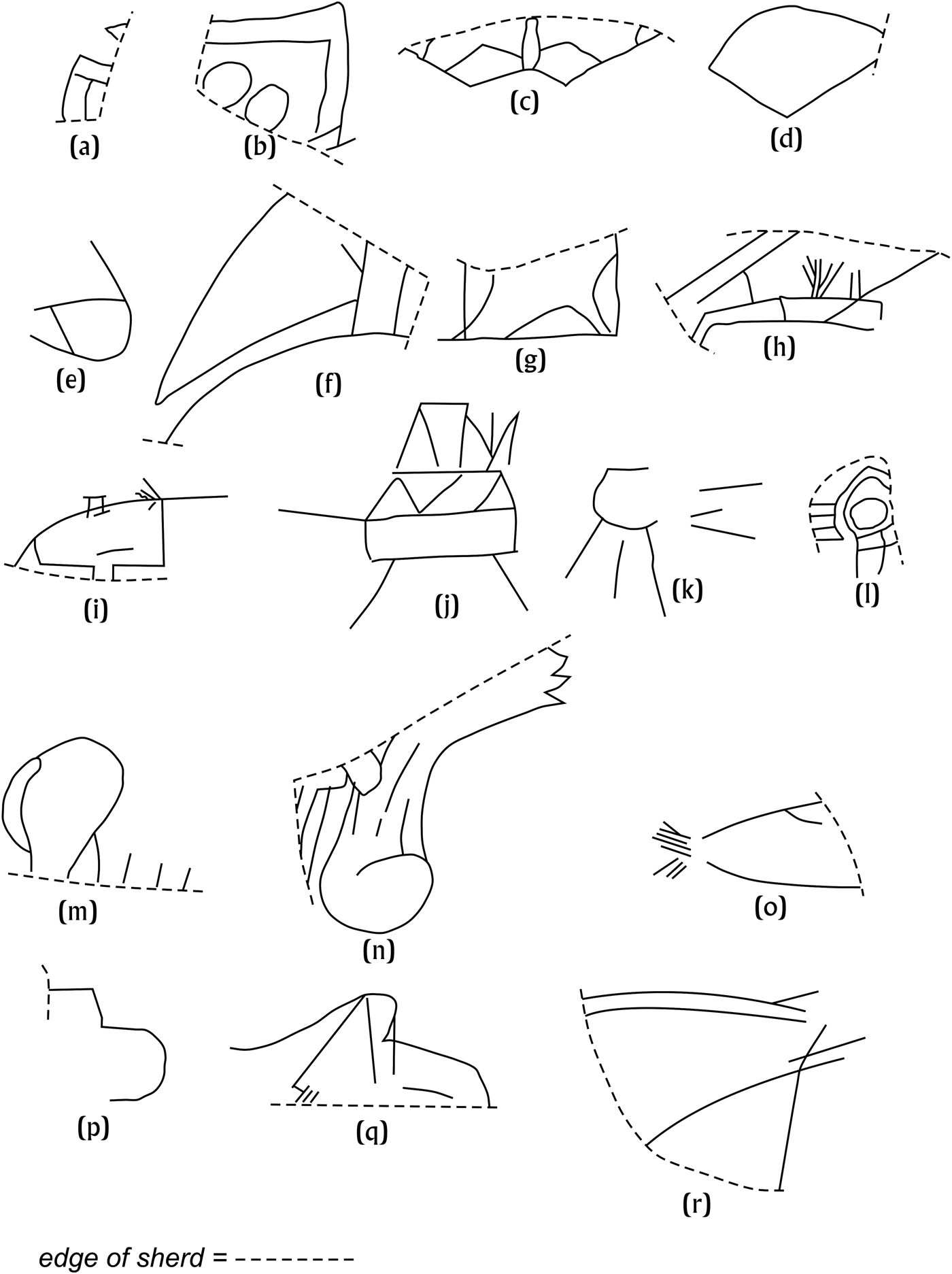
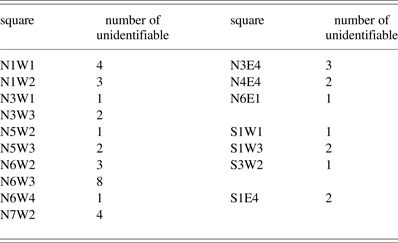
The graffiti discussed above can be identified or at least described to some degree. There are a number of others that, despite being deliberate attempts to produce a particular image, are indecipherable (Table 3). Orientations are particularly problematic in this group. Including one each from Yayahuala and Tetitla (Séjourné Reference Séjourné1963:Figure 18 middle center; Reference Séjourné1966b:Figure 136 top right), there are 43 of these. Some of these images are somewhat more coherent that others, and with future discoveries might possibly be identified (Figure 11). None at present appear to be members of a broader set of images or concepts. Among these are two graffiti from the same 1:N6W3 bowl, one on the exterior base (Figure 11q) and the other on the interior base (Figure 11r). Both images are incomplete, quite different from each other, and indecipherable.
Unidentifiable images. (a) 33:N6W3; (b) 46:N6W3; (c) 19:N1W1; (d) 1:N1W2; (e) 1:S3W2; (f) 14:N3W3; (g) 7:N1W2; (h) 12:S1W3; (i) 7:N1W2; (j) 13:N6E1; (k) 79:N6W2; (l) 8:N4E4; (m) 70:N6W3; (n) 21:N7W2; (o) 8:S4E1; (p) 15:N7W2; (q–r) 1:N6W3
Unidentifiable Images
Finally, 13 graffiti (not included in Tables 3–4 or Figure 11) are so incomplete that nothing can be made of them. They cannot be assigned to any of the above groups.
DISCUSSION
The Inscribers of the Graffiti
There are three possibilities: the graffiti may have been made by the potters who manufactured Thin Orange ware, by the importers and/or distributors of the vessels, or by those who ultimately owned and used them. However, it is unlikely that the specialists who made the ware were responsible. Graffiti do not appear in the bowls in their area of manufacture, Tepexi de Rodríguez (Spence and Rattray Reference Spence, Rattray and Gallut2002:103), and they do not occur in the majority of Thin Orange bowls in Teotihuacan. In any case, it is difficult to imagine why potters would want to place maker's marks on vessels that were going to consumers hundreds of kilometres away. Had they wished to do so, they would probably have marked the pots before firing them. Also, the wide variety of images and the indecipherable nature of many of them are not what one would expect of potter′s marks. Clayton (Reference Clayton2009:216) notes that graffiti location on the vessel varies among sites, suggesting to her that the owners were the inscribers. Similar variation in placement occurs in this sample (Table 1). The people who imported and distributed the vessels can also be eliminated from consideration for some of the same reasons.
As Clayton (Reference Clayton2009:209, 214, 216) suggests, then, the graffiti were inscribed by the owners of the pots. This helps to explain their wide range of variation. Also, the bowls were probably inscribed shortly after their acquisition. In some cases graffiti on the interior base have been partially destroyed by subsequent use abrasion.
Verónica Ortega (Reference Ortega2009), excavating in site 11:N1W6 (TL11) of the Tlailotlacan barrio, found the cross image on three Thin Orange bowls. One was in an offering associated with Altar 1 while two were together in an Altar 6 offering. The two altars were contemporaneous and only about five meters apart. Also, the two trianguloid graffiti of Ritual Deposit F92 in site 6:N1W6 (TL6) of Tlailotlacan (Figure 10j–k) seem to be variations on a single basic form. F92, as mentioned earlier, probably held the umbilical cord of a newborn (Spence Reference Spence and Plunket2002:58–59). It was one of a small cluster of five such features in one part of a TL6 courtyard (Spence Reference Spence1989:86–87, Figure 1). Another cluster of ritual deposits was 4.5 m northwest of the F92 cluster, in the same courtyard and at the same stratigraphic level. One of these was F128, which included the Thin Orange bowl with the tapir graffito (Figure 6b). These two clusters probably represent the successive birth events of two contemporaneous nuclear families that used the courtyard. Graffiti, then, were apparently created within each nuclear family rather than any larger group. The variety of graffiti from any one apartment compound suggests as much (for example, Séjourné Reference Séjourné1966b:Figures 136, 138). The graffiti refer to a personal or at most familial identity, not to those aspects of identity grounded in the wider social environment of the lineage or apartment compound (see also Clayton Reference Clayton2009:212).
This raises the question of which family member was responsible for the graffiti. Unfortunately, the gender of the inscriber cannot be identified with the available evidence. Determination of the specific uses of Thin Orange bowls and better knowledge of their ritual contexts may help to resolve this question.
Hutson (Reference Hutson2011) and Patrois (Reference Patrois2013), working with Maya architectural graffiti, determined that some of them were made by children. However, one of their basic criteria, height of the graffiti above the structure floor, is not applicable to ceramics. The cartoonish and crudely drawn quality of some ceramic graffiti might suggest the work of children, but this is not a reliable criterion. The inscribers were working on a difficult surface, and in any case may not have been overly concerned with the quality of the image, which apparently they did not intend to be widely viewed.
The Sources of the Graffiti
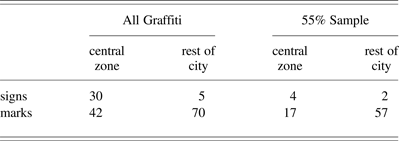
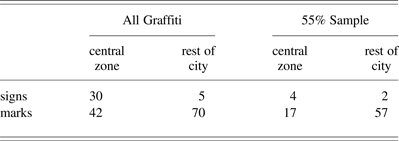
As implied in the descriptions above, the graffiti can be divided into two broad categories, referred to here as signs and marks (Table 4). The signs are those that held some significance in the formal iconography of Teotihuacan, as represented in the murals and pictorial ceramics. That iconography may be taken as an expression of the ideology of the state. Signs, then, include all those in the Glyphs and Signs group (Figure 4), plus a few in other groups: the Tetitla Canid, Conch Trumpet, Butterfly and Bird (Figures 6a, e–f, 7a), and the 13:S1W1 Frontal Flower Q (Figure 6j).
Distribution of Signs and Marks
The marks category, on the other hand, includes all of the other graffiti complete enough to assign to a category. These owe little or nothing to the formal iconography of the city. A few do occur in the formal art but apparently as decorative or border elements rather than as meaningful signs: Crosshatch, Chevron Chain, Radial Circles and Scroll with Spike (Figures 8h–i, p; 10a–f, l). Their appearance as graffiti may just be coincidental.
Many of the marks are quite unique and may have been drawn from personal observations and experiences, perhaps even visions. Haviland and Haviland (Reference Haviland and Haviland1995) say that at least two-thirds of the architectural graffiti at Tikal were derived from entoptics, forms experienced as visions in trance states, and that these forms are neurologically based phenomena that can appear anywhere in the world. But although Crosshatch and Ladder are like the entoptics, most of the Teotihuacan graffiti cannot be easily reduced to entoptic forms. In many cases they may have had deeply personal roots. It is also possible that some of them had no personal significance at all. They might simply have been marks that allowed the owners to identify their property.
Those who used a sign as a model for their graffito may have selected it because it held some personal relevance for them. The Dart, for example, may have been used by a soldier at Axotla as a reference to his role in Axotla society (Clayton Reference Clayton2009:214). There may also have been deliberate avoidance of some signs within the repertoire of images known to the inscribers. A number of signs in the formal iconography are not represented among the Thin Orange graffiti: Knife, Heart, Trilobe, Bow, Bundle, Flame, Goggle Eye, Hand, Half-Star, Nose Pendant, Triple Mountain, Pinwheel, Xi, Mat, and others (Langley Reference Langley1986). The Knife, Heart and Trilobe signs form a complex related to human sacrifice. The Flame, Mat and Xi signs are associated with rulership (Langley Reference Langley1986:273; Taube Reference Taube2000:40, Figure 32). It may be that their associations placed these signs out of bounds for personal use. Also, images closely associated with the major deities were rarely used. The Storm God Insignia on an Old City sherd, the Tetitla Serpent Head p and the Tetitla Butterfly are the exceptions, and the Butterfly might refer to some concept, like the souls of the dead, independent of any particular deity (Langley Reference Langley1986:240). Patrois (Reference Patrois2013:442, 445) notes that some topics also seem to have been avoided, or at least ignored, in the Río Bec architectural graffiti.
Some of the graffiti bear an uncanny resemblance to the artwork that formed the immediate visual environment of the inscribers. The La Ventilla Sector 3 Human, for example, shares some distinctive elements with the glyphs in the nearby Plaza of the Glyphs (Figure 5b–e), and the Moon Plaza Bird is much like the architectural graffiti there and elsewhere along the Street of the Dead (Figure 7c–f). Other examples are the Tetitla Bird graffito and the birds depicted in the Tetitla murals and ceramics (Figure 7a–b), the Cobweb motif that appears in a Tetitla Thin Orange sherd and on Tetitla Thin Orange jar medallions (Figure 4e), the Tetitla Canid and canids in a Tetitla mural (Figure 6a), the Scroll with Spike motif of a Tetitla graffito and some Tetitla vessels (Figure 10l), and the Patolli image on a Thin Orange sherd from a structure with numerous architectural graffiti of the same type of patolli board (Figure 8a; Sánchez Reference Sánchez, Monjaras-Ruiz, Rocha and Valle1996). It is possible that the inscriber of the graffito was the same person who created the other art (Sánchez Reference Sánchez, Monjaras-Ruiz, Rocha and Valle1996:217, 223). More likely, however, the inscriber copied from the other art, or all the images were subject to the same highly localized understanding of how to properly portray that particular subject.
Distribution Patterns
Most of the graffiti in the signs category occur in the central zone of the city, where the major public structures and elite residences are located (Table 4). This is roughly the area with TMP map squares N5W2, N5E2, S1W2 and S1E2 as its corners. A small number of signs are from the rest of the city, which has a much higher proportion of non-elite residences. Conversely, most of the graffiti in the marks category come from the city beyond the central zone, although a large number also occur in the center (Table 4).
This distinction between the central zone and the areas beyond it is not absolute. Upper and lower class residences do tend to cluster respectively in the central zone and the rest of the city, but there are a number of exceptions. The city is not neatly divided into concentric circles of descending class (Millon Reference Millon and Sabloff1981). Also, it is possible that Séjourné selected images from Yayahuala and Tetitla that were more recognizable and familiar from the formal art, leading to an exaggerated incidence of signs in the central zone. Two-thirds of the 33 examples that she illustrates are signs.
To control for this possibility a reduced data set, derived solely from the 55% sample of the TMP collections, is presented (Table 4). In that set the number of signs in the central zone decreases from 30 to 4, or proportionately from 42% to 19%, indicating that many graffiti in the larger set from those contexts had indeed been selected with a bias toward signs. Nevertheless, in both sets the difference in location is significant by Chi-square analysis. In the smaller 55% set the difference is significant at the level of p < 0.02. It is worth noting, however, that in both sets even the residents of the central zone more often than not chose their images from sources other than the formal iconography of Teotihuacan (Table 4).
It is interesting to see that the practice of inscribing images in Thin Orange bowls was also present in the two foreign barrios, Tlailotlacan and the Merchants’ Barrio (Ortega Reference Ortega2009; Spence and Rattray Reference Spence, Rattray and Gallut2002:Figures 1–2, 5b, 7). It suggests that their residents, whatever their origins, were in this respect Teotihuacanos. Also of interest is the fact that they did not draw upon the formal iconography for their images.
The Purpose of the Graffiti
Clayton (Reference Clayton2009:214) believes that the graffiti were ownership marks. Spence and Rattray (Reference Spence, Rattray and Gallut2002:111–112) thought they may have functioned in that capacity but added that they may also have been appeals to supernatural forces, perhaps for support in whatever tasks the vessels were used for. The broader sample analyzed here, however, includes numerous graffiti with no obvious ritual or religious significance, making the supernatural appeal argument unlikely. It may still be true in some cases, like the Storm God Insignia from the Old City or the Fourway Hatching (irrigated fields) symbol from site 1:N7W2, but most of the graffiti were probably meant primarily to mark ownership.
Ownership marks would explain the wide variety of graffiti and the rather low level of repetition. The graffiti could include names or nicknames but also references to personal characteristics, achievements, experiences, or even visions. In fact, a number of the graffiti may not have had any personal reference at all, like some of the geometric, abstract and unidentifiable examples. This and their low visibility show that they were not meant to widely or publicly proclaim ownership, or to defend it against a hostile challenge.
Clayton (Reference Clayton2009:214) suggests that the graffiti may have identified ownership in public events like feasts. The Thin Orange bowls may have had specific roles in such events, like the public preparation of particular feast foods. Since the bowls are virtually indistinguishable, the graffiti would be useful in resolving any confusion that might arise over ownership. There was apparently no concern about theft since the graffiti were not prominently displayed and often did not bear any personal reference that would confirm ownership before a wider audience or an independent tribunal. However, the use of ownership marks does suggest that it was important for the owner of the bowl to retain possession of it, perhaps to continue gathering whatever social or supernatural benefit accrued from its use in public or ritual events.
CONCLUSIONS
The inscribers living in the central part of Teotihuacan often took their images from the elite iconography presented to them in the murals and pictorial ceramics that formed part of their visual environment. Presumably they were literate in that iconography and made their selection on the basis of the personal relevance of the chosen signs. Even more of these central inscribers, however, used images that had little or no connection to the formal art of Teotihuacan. The vast majority of the images from outside the central zone were also of this latter sort, personal expressions that are often idiosyncratic. In fact, some may not even have had any personal significance, but instead were just marks that would allow the owner to pick the vessel out from among a number of very similar bowls.
Some of these marks are represented by more than one example (for example, Radial Circles, Patolli, Cross/X, Right Angle), but there is nothing to suggest that they formed an alternative iconography, a corpus of images that might have served as an expression of resistance to the state ideology. Nor were they meant to communicate an alternative message or build a shared consciousness; most were effectively invisible. However, the general disinterest in the formal iconography as a source of images might in itself be an indication of commoners’ attitudes toward the state and its ideology. They may not have seen their personal concerns and interests reflected there.
The ideology of the state, then, may have had only a limited penetration into the daily lives and identities of most Teotihuacanos. Even in the central zone the iconography of the state was often overlooked as a source of personal images. Although some of this avoidance may have been due to notions of blasphemy or political modesty, a variety of signs were still available for individual use, had anyone so desired. It seems that even among the residents of the central zone more immediately personal images were preferred for marking Thin Orange ownership. There may even have been some degree of conscious resistance to the symbols and forms of an overweening state.
Some caution is required here. The available data suggest that graffiti were etched into Thin Orange bowls by people of all classes, with the elite often preferring signs selected from the formal iconography while those of lesser rank far preferred more personal images. This distinction rests largely on the spatial distribution of graffiti between the central zone and the rest of the city. The status gradient, however, in Teotihuacan was not organized strictly on the basis of distance from the center. There are high status and state-related sites near the periphery, and lower and upper status residences in close proximity in the central zone (Cowgill et al. Reference Cowgill, Altschul, Sload and Hietala1984; Millon Reference Millon and Sabloff1981). As an example, in the La Ventilla Barrio the graffiti recorded by Clayton (Reference Clayton2009) are from Sector 3, the residence of craft specialists who were apparently attached to the elites living in the nearby Sector 2 structure (Gómez Chávez Reference Gómez Chávez2000; Gómez Chávez and Núñez Hernandez Reference Gómez Chávez, Hernández, Manzanilla and Serrano1999). It may be that the dominance in the central zone of marks over signs (Table 4) reflects the presence of non-elite people in the center. The question of class participation in the inscription of graffiti, then, remains open. Future investigations should focus on the contexts of the graffiti, particularly burials and offerings, to identify the rank of those responsible for them. The evidence to date suggests that if a bowl with a graffito appears in a ritual context, that graffito was inscribed by a member of the nuclear family of the individual represented in that context, if not in fact personally by that individual.
The very personal nature of the marks makes them difficult to analyze. They cannot be herded together into a coherent body of art that can then be used to construct a picture of the Teotihuacan populace. With further examples, however, they may allow us some insight into the individual, an elusive subject that Cowgill (Reference Cowgill1993) believes we must somehow access if we wish to achieve a comprehensive understanding of ancient societies.
There is a great deal more that can be done with the Thin Orange graffiti. For one, class relationships in Teotihuacan surely did not remain stable over four centuries. Although Thin Orange ware can be seriated to some extent (Rattray Reference Rattray2001), good contextual data will be crucial to any chronological analysis of the graffiti. To that end it would be worthwhile reanalyzing extant collections, including fill and midden as well as ritual contexts, and documenting negative as well as positive occurrences. Analyses to determine the function of the bowls will also be important (for example, Soleri at al. Reference Spence2013).
Future analyses should also include collections from outside Teotihuacan, as Clayton (Reference Clayton2009) has done with Axotla. A series of 56 Thin Orange sherds from test excavations at TC 87–89 in the eastern Teotihuacan Valley (Charlton et al. Reference Charlton, Otis Charlton, Sanders and Gallut2002) included one graffito, an incomplete Right Angle or Cross/X in the exterior base. However, analysis of 105 Thin Orange sherds from Brainerd's Cerro Portezuelo collections produced no graffiti. This may be a reflection of the fact that Cerro Portezuelo's relationship with Teotihuacan was more tenuous than that of Axotla or TC 87–89 (Clayton Reference Clayton2013). At Axotla 29% of the ring-base hemispherical bowls have graffiti, some of them of images also represented at Teotihuacan (Clayton Reference Clayton2009:Tables 6.14, 6.16). This might suggest a relationship between the individuals using a particular image in Axotla and those using the same image in Teotihuacan. However, it may equally well be that people just coincidentally inscribed the same simple mark (cross, triangle, rectangle) or selected the same sign (dart) from the iconographic repertoire of Teotihuacan.
RESUMEN
La cerámica Anaranjado Delgado se importaba a Teotihuacan del área de Tepexi de Rodríguez en el estado actual de Puebla, unos 250 kilómetros al sureste de Teotihuacan. Cajetes de base anular de Anaranjado Delgado eran numerosos y tenían una amplia distribución en la antigua ciudad, ya que se encontraban en todos los conjuntos residenciales sin distinción entre las diferentes clases sociales.
En muchos casos hay dibujos esgrafiados en las paredes o en los fondos de los cajetes que fueron añadidos después de la cocción de la vasija y que son casi invisibles. Parece ser que eran marcas de pertenencia, quizás para facilitar la reclamación del cajete después de algún acontecimiento público como una celebración o festividad. Estos dibujos incluyen glifos típicos de la iconografía teotihuacana como el signo del año, la flor de cuatro pétalos, la cabeza de la serpiente emplumada y el dardo teotihuacano. Los glifos son más comunes en la parte central de la ciudad, donde vivía la élite de Teotihuacan y donde se encontraban las estructuras públicas. Sin embargo, la mayor parte de los dibujos esgrafiados son de seres naturales como humanos, aves y animales; formas geométricas ó abstractas como cuadros, triángulos y cruces; y figuras indescriptibles. Éstos ocurren en todo Teotihuacan, en el centro así como en la periferia. Este predominio de dibujos no relacionados a la iconografía sugiere que la ideología estatal no desempeñó un papel importante en la vida cotidiana y personal de la mayoría de los teotihuacanos.
ACKNOWLEDGMENTS
Evelyn Rattray discovered several of the graffiti used in this article, and has been a helpful source of observations and ideas since the research began. I am also grateful to her, Sarah Clayton and Sergio Gómez Chávez for photos and drawings of graffiti from the Reference Rattray1992–1994 INAH excavations in the La Ventilla Barrio. Kevin Gibbs, Gosia Mahoney and Lourdes Carabello helped in the search of the TMP collections, and Tom Charlton offered access to his collections. Mary Hopkins provided comments on the Spence and Rattray Reference Spence, Rattray and Gallut2002 article that have been useful in the preparation of this article. I also thank Matthew Beaudoin for his help with figures 4–8 and 10–11, and Diana Moreiras for her help with the Spanish abstract. Finally, I am grateful to the late Elizabeth Brumfiel whose Reference Brumfiel and Wright1996 article, “Figurines and the Aztec State: Testing the Effectiveness of Ideological Domination,” inspired the research on graffiti. I was pleased to tell her this a few years before her death.
Appendix I. Graffiti Proportions by Map Square, 20% and 55% Samples