Implications
There are two types of rams that are frequently used in flocks, intact rams for breeding and vasectomised rams for oestrus detection. Both types are expected to express vigorous sexual behaviour which is needed for successful reproduction. However pen tests of ram libido are seldom used on farms because the procedure is too complicated and time consuming. We demonstrate that a recently designed automated oestrus detector worn by rams provides a reliable estimate rams’ libido in the paddock and requires little investment in time and labour.
Introduction
Reproductive performance of sheep flocks fluctuates widely between farms and even within the same farm. Ram sexual activity is often cited as one among many possible interfering factors. This is not surprising as notable differences in sexual behaviour among rams have been reported for many years (Price, Reference Price1987). In addition, several studies have shown that a large proportion of the rams used for field service are not fit for mating due to a low sexual performance rate or even a total lack of libido (Price, Reference Price1987; Gouletsou and Fthenakis, Reference Fabre-Nys2010; Alexander et al., Reference Alexander, Cockett, Burton, Hadfield and Moss2012). Good management thus requires complete evaluation of the rams before the reproductive season. Such evaluations are performed but seldom include an assessment of the libido and sexual activity of the rams even though the use of males with high libido makes it possible to reduce the number of males used for field service, thus reducing their cost (Alexander et al., Reference Alexander, Cockett, Burton, Hadfield and Moss2012). There is thus growing interest in investigating consistent individual differences in sexual behaviour in studies of animal reproduction.
The libido of the ram (first mentioned by Wodzicka-Tomaszewska et al., Reference Wodzicka-Tomaszewska, Kilgour and Ryan1981; Price et al., Reference Price, Erhard, Borgwardt and Dally1992; Stellflug et al., Reference Stellflug, Lewis, Moffet and Leeds2008) can be estimated by counting the number of sexual activities per unit of time during individual tests, which is currently the most common method used for sheep. The evaluation of each ram requires at least 30 min of observations, which need to be repeated on at least six occasions to account for factors of variation (Stellflug and Berardinelli, Reference Stellflug and Berardinelli2002). Among these factors, variability in oestrus intensity can be partially limited by using several ewes at the same time (Gouletsou and Fthenakis, Reference Fabre-Nys2010; Alhamada et al., Reference Alhamada, Debus, Lurette and Bocquier2016). However, this method is time consuming and laborious and a simple, fast, reliable and inexpensive alternative is needed to estimate ram libido. Another open question is the best time of the year and the frequency of the evaluation. Very few studies have reported on the repeatability of sexual behaviour and those that did reported a wide range of results (54%: Purvis, Reference Purvis1985; 42%: Kilgour, Reference Kilgour1985 and 72%: Snowder et al., Reference Snowder, Stellflug and Van Vleck2002). The reasons the repeatability estimates differed among these studies are not clear (breed, age, experience) but may also be due to methodological problems (i.e. uncontrolled experimental conditions), all of which underline the advantage of an automated method.
Positive associations between rams with high sexual performance and ewe fertility have been reported (Kilgour, Reference Kilgour1993; Alexander et al., Reference Alexander, Cockett, Burton, Hadfield and Moss2012), but other authors (Mickelsen et al., Reference Mickelsen, Paisley and Dahmen1982) found little relationship between ram sexual performance and flock fertility. This variability could be due to inaccurate evaluation of ram libido in pen tests, which do not correspond to real mating conditions. Variability could also be due to the type of ewes used in the pen tests: either ewes in natural oestrous, or oestrous synchronised intact ewes or oestrous induced ovariectomized ewes (Price et al., Reference Price, Erhard, Borgwardt and Dally1992; Avdi et al., Reference Avdi, Banos, Stefos and Chemineau2004) or even non-oestrous ewes (Ungerfeld, Reference Ungerfeld2012). Another difficulty is that sheep are seasonal breeders; rams exhibit seasonal fluctuations in testicular volume as well as in sexual behaviour (Tulley and Burfening, Reference Tulley and Burfening1983; Rosa and Bryant, Reference Rosa and Bryant2003) resulting from variations in photoperiod (Ortavant et al., Reference Ortavant, Bocquier, Pelletier, Ravault, Thimonier and Volland-Nail1988; Avdi et al., Reference Avdi, Banos, Stefos and Chemineau2004). Some breeds have been reported to be almost completely or intermittently seasonal (Rosa and Bryant, Reference Rosa and Bryant2003), whereas the Merino breed has a long breeding season (Teyssier et al., Reference Teyssier, Migaud, Debus, Maton, Tillard, Malpaux and Bodin2011). Typically, sexual activities are high at the end of the summer and in autumn and low at the end of winter and in spring (Rosa and Bryant, Reference Rosa and Bryant2003). The best conditions in which to evaluate ram libido are not known. Lastly, the common practice in many French flocks is to use intact rams of the same breed as the ewes for breeding, and vasectomised rams of another breed for oestrus detection. This practice is preferred because it is easy to monitor the sexual activity of ewes in the flock without risk of fecundation. It is currently not known if vasectomy and the difference in breed between rams used for detection and rams used for mating enables better detection of oestrus than using rams of the same breed.
The aims of the present study were to (1) analyse the repeatability of the results of evaluations of ram libido at different seasons in individual pen tests, (2) compare the results of evaluation of ram libido in pen tests with evaluations using a simple automated method using the same rams mating in the flock in the paddock and (3) compare the new automated method for the estimation of libido in two types of rams: breeding rams and detecting rams.
Material and methods
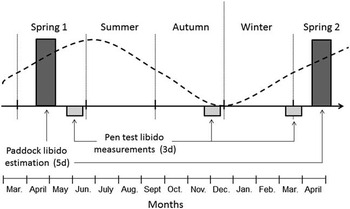
The rams used for these experiments were six sexually experienced intact breeding Merinos d’Arles rams and six sexually experienced vasectomised Mourerous rams used for oestrus detection. The same 3- to 4-year-old rams (intact: 3.8±1.2 years old and vasectomised: 3.5±0.8 years old) were used in all the different tests (Figure 1). All the males were treated in the same way during the experiments. Except when they were in the pen tests, the rams grazed in the pasture for 8 to 10 h a day with 50 other rams belonging to the same flock. The eyes, teeth and legs of the rams were examined regularly to check their general health and their body condition, the testes were palpated and wool sheared to avoid reducing the ram’s ability to mount and serve normally. One of the detecting rams died during the summer after the first spring and was replaced by another detecting ram. The results presented here were obtained from the five rams observed in all three seasons. The study was conducted at SupAgro and INRA Le Merle Experimental Station, Montpellier, located latitude 43.64°N, longitude 5.02°E. All the experiments were approved by INRA and by the Montpellier Regional Ethics Group and complied with the Animal Research Act 1985 in accordance with ethical principles laid down in the European Union directive 2010/63/EU.
Schematic diagram of the experimental design. Pen tests (light grey rectangles) were composed of three individual tests on penned rams across the three seasons. Paddock tests (dark grey rectangles) consisted of automated measurements of the number of mounts performed by the same rams mating in the flock. The dashed line shows variations in day length and/or seasons.

Libido pen tests
The pen tests were conducted at three different seasons (Figure 1): late spring (May), late autumn (December) and early spring (March) of the following year. At each season, the 12 rams were individually exposed to two groups of six unrestrained ewes: three ewes in hormonally induced oestrus and three others in artificial luteal phase. The rams were evaluated using the method of Price et al. (Reference Price, Erhard, Borgwardt and Dally1992) and Ungerfeld (Reference Ungerfeld2012). In the morning session of the 1st day each ram was placed in the pen with a group of six ewes for a 30-min observation period and again on the afternoon session with another group of six ewes. On the 2nd day the rams were not tested, but allowed to rest. On the 3rd day, the rams were tested twice using two new sets of six ewes each. This design was repeated until all the rams had been observed six times on 3 separate days. To avoid any effect of the order of passage, rams were randomly tested and a minimum interval of 4 h was left between the morning and afternoon sessions. Ewes and rams had free access to water and all animals were fed before and after the tests.
To have six ewes in oestrus on each test day, 8 to 10 mature ewes were removed from the flock and hormonally synchronised. Synchronised oestrus was achieved by inserting vaginal sponges impregnated with 40 mg FluroGestone Acetate (Chronogest CR; Intervet, Toulouse, France) and leaving them in place for 14 days. After the sponges were removed, oestrus was synchronised with an injection of gonadotropin (400 IU equine Chorionic Gonadotropin; SYNCRO PART® PMSG; Ceva Santé Animale, Libourne, France). For each test day, six receptive ewes were chosen among the synchronised ewes, after they were seen to be receptive in tests with intact rams not involved in this experiment. After transport to the experimental barn, the ewes were placed in two adjacent test pens containing three control ewes which had carried vaginal sponges for 10 days to ensure that they were not in oestrus. Therefore one group of six ewes containing three ewes in oestrus and three ewes not in oestrus were used in the morning session and another group of six ewes containing three ewes in oestrus and three ewes not in oestrus were used the afternoon sessions.
Each individual ram’s test lasted 30 min. The rams were able to engage in sexual behaviours and mount the ewes but copulation was prevented by an apron worn by the ram. The ewes could not escape from the ram. During the test, all the sexual behaviours of the male towards each female were manually recorded during live visual observation. Two observers were used for each session, one observer per pen. The observer was hidden behind a tarpaulin at an elevation of about 2 m that gave him a clear view of what was going on inside the 5×5 m pen. The occurrence of seven behaviours indicative of ram sexual activity were recorded, that is anogenital sniffing, leg kicks, emission of sounds, head on the rump, attempted mount, mount and flehmen (Price et al., Reference Price, Erhard, Borgwardt and Dally1992; Ungerfeld, Reference Ungerfeld2012). As proposed by Fabre-Nys (Reference Gouletsou and Fthenakis2010), after counting, the behaviours were grouped into pre-copulatory behaviour including anogenital sniffs, leg kicks, emission of sounds and head on the rump, and copulatory behaviour (hereafter cop-behaviour), the latter comprising the sum of number of attempted mount and mounts.
We also used the pen test to evaluate the efficiency of the Alpha-Detector® (AD; Wallace, Cardet, France; see description in the following paragraph) in counting the number of mounts. The same 12 rams were equipped with an AD and the number of courtship interactions with 18 oestrous ewes over a period of 3 days were recorded by an observer. Of the 1191 mounts visually identified in the six 30-min sessions, 1026 were recorded automatically by the AD (i.e. 94%). The following calibration was obtained for the automated method No.AD.Mounts=+0.934×No.Obs.Mounts±3.07; R 2=0.997; n=12). This equation confirms the slight underestimation (94 or 93.4%) with the automated method compared with visual observations. It also fully agrees with our previous independent measurements (93%; Alhamada et al., Reference Alhamada, Debus, Lurette and Bocquier2016).
Paddock tests: automated evaluation of the rams’ libido in the flock
We hypothesised that the AD, previously validated for detection of oestrus in ewes (Alhamada et al., Reference Alhamada, Debus, Lurette and Bocquier2016), and also validated in the present experiment, would allow automatic evaluation of the rams’ libido. Here we were more interested in the number of mounts performed by each ram than by the ewes’ behaviour. The mounts automatically recorded with the AD were assessed on two occasions during the mating periods of the experimental flock (Figure 1) – that is, 15 days before the individual pen tests in the 1st year (spring 1) and 15 days after the end of third individual pen tests in the following year (spring 2).
The rams that were freely mating in the paddock (3 to 5 ha) were left in a flock for evaluation of their libido. They were equipped with the AD in the form of a special radio frequency identification (RFID) reader placed between the front legs of the ram. The RFID antenna is triggered to read the RFID identification number of the mounted ewe. At each mount, the identifier worn by the female is read, and the exact date and time is recorded in a file. On request, the stored data are remotely transferred from the AD to a handheld device (Alpha-Receptor®; Wallace, Cardet, France) or to a laptop connected at a specified radio frequency. The remote transfer of data (>100 m) is by a radio frequency signal with no intervention on the rams. Before the paddock tests, all the females in the flock were equipped with a Half Duplex Tiris® Glass Transponders (32×3.8 mm; model RI-TRP-WR2B; GIOTEX, Barcelona, Spain) which complies with 11784/11785 ISO standard for animal identification. The detecting rams were placed in a flock of ~250 grazing Arles Merino ewes for 15 days. Thereafter, the detecting rams were replaced by breeding rams which were also equipped with the AD. The same procedure was repeated in April of the following year (spring 2) with approximately the same number of ewes. In all cases, the individual number of mounts was used to estimate the rams’ libido. Due to variations in the number of ewes in natural oestrus in the flock at different periods, the data were normalised using a period of 5 successive days with the highest number of ewes in oestrus. It is worth noting that all these measurements were obtained using rams capable of ejaculation (i.e. not wearing an apron).
Animal measurements, blood sampling and hormone assay
Originally, we assumed that scrotal circumference (SC), testosterone (T) or prolactin concentrations would provide information on the rams’ libido. The rams were restrained in a sitting position. The SC of each ram was measured at the widest scrotal diameter using a flexible tape measure before each individual series of tests in all three seasons. Before the individual pen tests in each of the three seasons, a sample of blood was collected from the jugular vein of each ram in Heparin and EDTA tubes (Terumo Venosafe™ tubes 10 ml, K2-EDTA, Lithium-Heparin; Terumo Europe N.V., Leuven, Belgium). Blood samples were then immediately transported to the laboratory and centrifuged at 3500 r.p.m. for 20 min at +4°C. The harvested plasma was stored at −20°C pending analyses. Plasma concentrations of prolactin were quantified in duplicate (2×100 μl) using a radio-immunoassay according to the procedures described by Kann (Reference Kann1971) in which the prolactin is I-125 iodinated. All the samples were analysed in a single assay, the intra-assay CV was 7.7%. The concentration of T in the plasma was measured in a single batch by enzyme immunoassay using a commercial diagnostic kit (Testosterone Enzyme Immunoassay Test Kit; Medix Biotech Inc., San Carlos, CA, USA).
Statistical analysis
Data were expressed as means (±SD). Data were analysed using the R software package (R Core Team, 2015) according to the following model:
Y ijklm =M+S i +G j +D k (S i )+R l (RS)l i +S i G j +E ijklm ,
where Y ijklm is the dependent variable, M the general mean, S i the effect of season (i=late spring or late autumn or early spring), G j the effect of the type of ram (j=detecting or breeding rams), D k (S)i the day test effect (nested within each season, with k ranging from 1 to 3), R l the random ram effect (l ranges between 1 and 12), (RS)l i the ram×season interaction, S i G j the season×ram type interaction and E ijklm is the random residual error of the model. As the interactions were non-significant they were not retained in the final analyses.
Dependent variables in the statistical models are sexual activities grouped as copulatory behaviour and pre-copulatory behaviour. Multiple comparison Tukey’s tests were used to compare means (Brillinger et al., Reference Brillinger, Preisler, Ager and Kie2004). Spearman’s correlation coefficient was also used to estimate repeatability (Bell et al., Reference Bell, Hankison and Laskowski2009). The rams were ranked according to the number of sexual activities or mounts. Friedman’s nonparametric repeated measure model was used to analyse the ranks.
Results
The mean live weights (LW) of the breeding and detecting rams were similar (80±6 kg v. 79±5 kg, P>0.1, respectively), neither was there a noticeable difference in weight from one season to another (P>0.9; Table 1). In contrast, the mean SC (Table 1) of the breeding and detecting rams varied (P<0.0001) over the year and depending on their sexual status (P<0.02). In the breeding Merino rams, the mean SC increased (P<0.001) from late spring (38.0±2.7 cm) to autumn (39.9±3.1 cm) and decreased significantly between autumn and the following spring (35.7±2.7 cm). Detecting rams exhibited the same response to the changing season: the minimum SC mean (34.9±4.2 cm) was measured in late spring and the maximum in autumn (39.2±3.4 cm). Low non-significant correlations were observed between LW and SC (r=+0.25 v. r=+0.22 in breeding and detecting rams, with P=0.6 and 0.7, respectively).
Ram characteristics measured in the pen test across the three seasons and analysed with the complete statistical model

Stat. = statistical significance.Values indicate the effects of each factor for each level that have to be added to the overall mean. Sexual behaviours of both breeding and detecting rams were grouped into copulatory activities (attempted mounts or mounts) and pre-copulatory activities (leg kicking, head on the rump, anogenital sniffing, sounds emission and flehmen), all of them counted during a 30-min test. In the lower part of the table are also given scrotal circumference (SC; cm) and live weight (LW; kg) subjected to the same statistical model
a,b,cMeans for each effect in the same line with different superscript letters differed significantly at P=0.05.
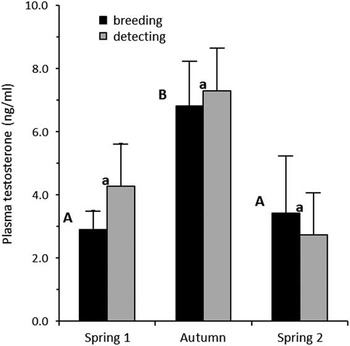
A significant difference (P<0.001) in the mean concentration of plasma testosterone was found between rams (individual values ranged from 0.9 ng/ml for the lowest to 12.3 ng/ml for the highest). There were significant differences (P<0.05) between the seasons with higher mean concentrations in winter (7.05±1.7 ng/ml) and lower concentrations in late spring (3.06±0.9 ng/ml; Figure 2). There was no difference between breeding and detecting rams: 4.4±2.0 ng/ml in breeding and 4.8±3.2 ng/ml in detecting rams. However a positive correlation was observed between the concentration of testosterone with SC: r=+0.24 (P<0.05) and with LW: r=+0.37 (P<0.05). The mean logarithmic value of prolactin concentration across all three seasons was also highly variable (CV=86%) and not significantly different (57.8±1.77 v. 72.9±2.17 v. 47.8±1.62 ng/ml for spring 1, winter and spring 2 samples, respectively).
Variations in plasma testosterone concentrations across the seasons in the breeding (black areas) and detecting rams (grey areas). A,B,aStatistical differences (P<0.05) between seasons (A,B) or breeding v. detecting rams (a).

Sexual behaviours of rams during pen tests
During the individual pen tests, all the rams showed greater interest in oestrus ewes than in ewes in artificial luteal phase. Rams displayed no copulatory behaviour (attempted mounts or mounts) towards the ewes in luteal phase and only 9% of their total pre-copulatory behaviours were directed towards them. The other behaviours of rams towards the non-oestrus ewes were very similar, the main sexual activity was anogenital sniffing (46% for breeding rams and 44% for detecting rams). These individual tests also revealed that both the season and the detecting and breeding rams had a significant influence on the pre-copulatory behaviour of rams towards the ewes in oestrus (Table 1). The mean number of pre-copulatory behaviours decreased (P<0.05) from spring to autumn then increased again the following spring. The results concerning the pre-copulatory behaviours are summarised here as a simplified ethogram to estimate the ram’s (breeding and detecting) libido using the AD. The most frequent pre-copulatory behaviour was head on the rump (88.5±23.5 times/ram per 30-min period). Leg kicking was the least frequent (32.8±21.4 times/ram per 30-min period). Frequency of anogenital sniffing (40.9±11.7 times/ram per 30-min period) and emission of sounds (74.4±44.9 times/ram per 30-min period) was intermediate. The breeding or detecting rams only had a significant influence on the number of sound emissions (P<0.001). There was no difference in copulatory activity in the breeding or detecting rams (P=0.9; Table 1) but behaviour was affected by season (P<0.05). The rams’ copulatory activities (attempted mounts and mounts) were more frequent in late spring than in any other season. Significant differences (P<0.05) were found between late spring in the 1st year (21.7±6.4 times/ram per 30 min) and early spring in the 2nd year (17.1±6.5 times/ram per 30 min). These differences (P<0.05) were due to the number of mounts counted in the 1st year (19.6±7.7 times/ram per 30 min) and in the 2nd year (15.2±6.9 times/ram per 30 min). Attempted mounts, which only represented 10% of copulatory behaviour (2.1±0.88 times/ram per 30 min), did not differ (P>0.17) over the three seasons, but were significantly (P<0.002) affected by the type of ram: breeding rams made more attempts than detecting rams (Table 1).
The analysis of the rams’ behaviour revealed significant differences (0.01<P<0.001; Table 1) between individuals in all types of sexual behaviour. In this study we focused on mountings which were measured both by visual observation and by the AD. On average, the highest ranked rams for number of mounts (30.0±1.8 and 24.0±5.7 for breeding and detecting rams, respectively) mounted ~3 times more than the lowest ranked rams (10.4±7.3 and 11.8±6.4 for breeding and detecting rams, respectively). In the series of pen tests, the correlations between copulatory and pre-copulatory behaviours were high with overall r=+0.81 (P<0.003; n=18; i.e. three repetitions of six tests) for breeding rams and r=+0.76 (P<0.02; n=18) for detecting rams during the nine 30-min tests.
Data collected on the sexual behaviour of rams in the pen tests during the three seasons showed high repeatability of sexual activity from one season to another. When the individual rams were ranked from 1 to 6 based on their copulatory and pre-copulatory behaviour the repeatability of breeding and detecting rams was 83 and 75% (P<0.05, respectively) as measured over the three seasons. When the rams were classified in groups of high v. low sexual activity, as widely reported in the literature, the repeatability of estimated libido increased to 93% (copulatory and pre-copulatory behaviours) for the breeding rams and to 92% for the detecting rams (93% for pre-copulatory behaviours and 90% for copulatory behaviours.
Paddock tests: libido of rams when mating in the flock
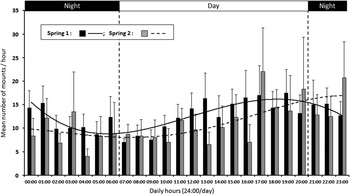
With AD it was possible to record all the mounts performed by rams over 5 days. We observed that mounting activities of rams occurred at any particular time of day or night with a tendency to occur more frequently in the afternoon (Figure 3). The average number of recorded mounts per ram over each full 5-day period was expressed on a daily basis – that is, 24 h/day. As hypothesised, the overall mean daily mounts per ram (60±40 mounts/ram per day) measured over two seasons varied considerably (CV=65%). There was no significant difference between breeding and detecting rams (62±53 v. 59±17 mounts/ram per day, respectively). Differences between rams in successive years (70±50 v. 52±27 mounts/ram per day in spring 1 and spring 2, respectively) were stable. Very high repeatability in the average daily number of mounts in the 2 successive years was found for both breeding (94%; P<0.01) and detecting rams (97%; P<0.004), showing that the ranking of the rams within their own group remained stable across years.
Nyctohemeral evolution in the hourly mean number of mounts per ram measured in six breeding rams over a period of 4 full days in same season in 2 consecutive years (spring 1 and spring 2). The time of natural sunrise and sunset are indicated in the figure and the dotted lines indicate the mean adjusted number of mounts adjusted to each hour of the day.

Discussion
The effect of season, especially photoperiod, on fluctuations in the sexual behaviour of rams, hormonal levels, and also in testicular volume has been analysed in many studies (e.g. Ortavant et al., Reference Ortavant, Bocquier, Pelletier, Ravault, Thimonier and Volland-Nail1988; Rosa and Bryant, Reference Rosa and Bryant2003; Avdi et al., Reference Avdi, Banos, Stefos and Chemineau2004). In several studies, these variations were accompanied by fluctuations in LW (Chemineau et al., Reference Chemineau, Pelletier, Guérin, Colas, Ravault, Touré, Almeida, Thimonier and Ortavant1988; Avdi et al., Reference Avdi, Banos, Stefos and Chemineau2004; Ungerfeld, Reference Ungerfeld2012). In our study, under normal feeding management (mostly grazing), the LW of rams was almost stable, which might have masked seasonal variations. As expected, the SC of both breeding and detecting rams varied across the seasons and is comparable with measurements published for other Mediterranean breeds (Avdi et al., Reference Avdi, Banos, Stefos and Chemineau2004). However, these variations were only partially accompanied by seasonal fluctuations in sexual behaviour and hormonal levels (prolactin and testosterone). The seasonal variations in testicular circumference observed in the present study although significant because they concerned the same rams, were of limited amplitude. Scrotal circumference reached maximum in autumn, when the days are shortest, and pre-copulatory behaviour was maximum but copulatory behaviours were not. This unexpected discrepancy in copulatory behaviour may be due to the non-mating season of this breed, because in Mediterranean systems, mating occurs in spring rather than in autumn or winter and we used experienced rams. However, as expected, reduced testis size in spring was measured in both years, and an increase in size as the sexual season progresses toward autumn has been reported in many studies (e.g. Chemineau et al., Reference Chemineau, Pelletier, Guérin, Colas, Ravault, Touré, Almeida, Thimonier and Ortavant1988; Avdi et al., Reference Avdi, Banos, Stefos and Chemineau2004). In the present study, the changes in testosterone concentrations were identical in the breeding and detecting rams (Figure 2). The maximum testosterone levels, which were measured in winter, were associated with the testicle diameters, which increased in autumn. Hence the modest changes in the reproductive performances of breeding and detecting rams across the seasons may be due to the fact that, in our experiment, they were not subjected to changes in feeding status.
As hypothesised, the libido of the Merino breeding rams used to sire the Merino ewes was very similar to that of the detecting rams (i.e. vasectomised Mourerous) used in this flock. Both breeding and detecting rams exhibited no more than 10% of their pre-copulatory behaviour and no copulatory behaviour at all towards ewes not in oestrus when they were placed in a group with an equal number of ewes not in oestrus. It is well known (Blissitt et al., Reference Blissitt, Bland and Cottrell1990) that rams are able to distinguish between ewes in oestrus and ewes which are not, and are also able to pick out a ewe newly in oestrous through odour (Blissitt et al., Reference Blissitt, Bland and Cottrell1990). This fact underlines the need for the presence of ewes in oestrus for the rams to be able to express their real sexual activity intervals (i.e. libido) because rams placed among ewes not in oestrus exhibit incomplete sexual behaviour. Some authors (Ibarra et al., Reference Ibarra, Laborde and van Lier2000; Ungerfeld, Reference Ungerfeld2012) nevertheless studied male sexual behaviour using non-oestrus ewes.
When evaluating ram libido in pen tests, several factors need to be taken into account (Wodzicka-Tomaszewska et al., Reference Wodzicka-Tomaszewska, Kilgour and Ryan1981; Gouletsou and Fthenakis, Reference Fabre-Nys2010) including the order in which the rams take the test, the ewe’s value as a stimulus, whether the ewe has just been mounted, and the stage of oestrus of the ewe. One study (Ibarra et al., Reference Ibarra, Laborde and van Lier2000) reported that a 20-min test is sufficient to evaluate ram libido, whereas Stellflug and Berardinelli (Reference Stellflug and Berardinelli2002) reported that an 18-min test was not sufficient and that six repetitions of a 30-min test per ram were required to evaluate the serving capacity of a ram with 95% reliability. Our experimental design was based on Stellflug and Berardinelli’s (Reference Stellflug and Berardinelli2002) recommendations, and we used six repetitions of a 30-min test in each season. Although our observations confirmed that sexual activity declines slightly during the course of the 30-min tests (data not shown), accumulating data over the 30-min period improved the reliability of the results. To date, we consider these observational pen tests to be the best available method for the evaluation of rams’ libido even if they are time consuming. The time needed to prepare the six groups of six ewes so they would all be in oestrus at the time of pen tests, to check the ewes were in oestrus, to conduct the observations, to handle the 12 rams at 30-min intervals, to process and analyse the data and to rank the rams, was 8 h/day per worker for a period of 15 days (i.e. a total of 120 h). The time needed to evaluate the same number of rams (12) using the AD for paddock tests including the time needed to install the electronic device on each ram, to collect data every 2 days plus a few minutes of computer calculations required 4 h for one worker (i.e. 0.16 day). Adding the time needed to glue the transponder on the back of the 250 ewes, which has to be done once, increased the total time required up to 3 days for a worker. The paddock test thus only needs one worker whereas the pen test needs three workers. Hence, this method of evaluating the libido of 12 rams only needs 3 working days whereas the standard pen test method needs 15 working days.
The libido of each ram, tested across three seasons with pen tests, showed high repeatability from one season to another: repeatability coefficients of pooled breeding and detecting rams were 83 and 70% for copulatory and pre-copulatory behaviours, respectively. Previous studies have already highlighted the good repeatability of ram sexual behaviour, but a wide range of results has been reported (54%: Purvis, Reference Purvis1985; 42%: Kilgour, Reference Kilgour1985 and 72%: Snowder et al., Reference Snowder, Stellflug and Van Vleck2002). The reason why repeatability estimates differed between studies is not clear, but differences in breeds, in the age of rams and in performance testing methods are possible causes. Since it has been reported (Barwick et al., Reference Barwick, Kilgour and Gleeson1985) that repeatability rates can be lowered by fairly inactive rams, the high repeatability rates observed in the present study might be due to the fact that our rams were selected for either breeding or detecting the ewes. If we classify the rams using the method described by several authors (Mickelsen et al., Reference Mickelsen, Paisley and Dahmen1982; Price et al., Reference Price, Erhard, Borgwardt and Dally1992; Kilgour, Reference Kilgour1993; Alexander et al., Reference Alexander, Cockett, Burton, Hadfield and Moss2012), which consists of dividing the rams of high and low libido groups, the repeatability of our results would be 92%.
In all the studies which compared the rams’ sexual activity measured in a pen and their sexual activity observed in a flock (Mattner et al., Reference Mattner, Braden and George1971; Salmon et al., Reference Salmon, Cognie, Orgeur, Venier and Signoret1984; Kilgour, Reference Kilgour1993; Ibarra et al., Reference Ibarra, Laborde and van Lier2000) the visual observations of rams only lasted a few hours. With the AD used in our study, it was possible to continuously record the number of mounts performed by rams over a period of 5 days including nights. In addition, some animal behaviour studies mentioned that estimated repeatability was higher in the field than in the laboratory (Bell et al., Reference Bell, Hankison and Laskowski2009). The high correlations between the average number of mounts obtained on two occasions in the pen and the number of mounts in the flock in spring 1 (r=+0.89) and spring 2 (r=+0.94) proved that the AD worn by mating rams provides a reliable indication of their sexual activity. Even if some previous studies (Mickelson et al., Reference Mickelsen, Paisley and Dahmen1982) found no correlation between libido scores of rams in pen tests and their sexual activity in the flock, one other study (Mattner et al., Reference Mattner, Braden and George1971) reported similar but lower results (r=+0.70) than ours. Our good results might be due to the prolonged (5 days plus nights) automatic recording without being disturbed by the presence of humans. Our records show that the sexual activity of breeding rams (number of mounts/hour) from 2100 to 0700 h is quite high although the maximum mean number of mounts occurred in the late afternoon. This means that the pen tests were not conducted at the time of maximum sexual activity observed when rams mate freely. Since the sheep in our flock were permanently out at pasture, we do not have a simple explanation for the difference between the day and the night, aside from the fact that sheep graze during daylight. In addition, when the ewes gather together at night, or during the afternoon, the rams may find it easier to detect ewes in oestrus; on the other hand, high ambient temperatures during the day may reduce the rams’ sexual activity. Although the number of ewes in oestrus in the flock varied from day to day, we believe that the sexual activity measured in paddock is more representative of reproductive performance of rams than that measured in the pen tests. In addition, rams’ sexual behaviour is enhanced by competition between males (Ungerfeld, Reference Ungerfeld2012), and is stimulated by olfactory cues that to a large extent account for the transfer of information among individuals males (Maina and Katz, 1999), which may not happen in pen tests. Furthermore, due to the short duration of pen tests, it is recommended to equip the rams with an apron to prevent copulation and expression of refractoriness, whereas the AD makes it possible to measure sexual behaviour over several days in real conditions.
However, to fully validate the new method in paddock conditions it would be necessary to visually count rams mounting ewes in a flock of several hundred individuals, which was not feasible. Consequently all we could do was to sequentially evaluate rams in a pen test and in the flock of ewes. Due to the high repeatability of mounting activities confirmed here, this hypothesis is sound. The comparison was made by analysing the results obtained in the pen with those obtained in the paddock over periods that were very close (within a fortnight) and on two occasions a year later (in spring 1 and spring 2). The first step of validation was to check the relationship between visually observed mounts and automatically recorded mounts both during pen tests for 12 rams on a thousand mounts (see the ‘Material and methods’ section). We found that the AD underestimated the observed mounts by 7%. This result needs to be compared with the risk of errors made by observers during pen tests. We did not estimate this error, but it has previously been reported to be in the range of 5% (Santos, Reference Santos2011), which does not disqualify the automated method with its 7% underestimation. Considering the specificity of the automated method to evaluate libido, it will be recalled that libido involves all sexual activities displayed by males. In the pen tests, we observed that rams expressed 9% of their pre-copulatory activities on non-oestrus ewes. As the AD only measures mounts, but not the other behaviours that account for libido scores, an error of 9% can be assumed, with no risk of a false negative signal, because the rams did not mount non-oestrus ewes. Hence, the specificity of this automatic method is 91% because there is no reason to think it would be different in a flock containing spontaneous oestrus and non-oestrus ewes. The sensitivity of the AD was calculated as the ratio of true positive to true positive+false negative (i.e. 93%/(93%+7%)=93%). A sensitivity of 93% means that rams with the same libido score within a 7% range cannot be distinguished. The precision of the AD was calculated as the ratio of true positive to true positive+false positive (i.e. 93%/(93%+0%)=100%). Such high precision is the direct result of the impossibility to obtain false positive results (FP=0%) because the AD cannot read the RFID transponder of a ewe in the absence of a mount.
The fact that the repeatability of libido scores across the seasons was higher with the AD for both breeding (94%) and detecting rams (97%), than copulatory behaviour measured in the pen test for both breeding (70%) and detecting rams (83%), leads us to recommend the automated measurement of libido as the new reference method.
Conclusion
Up to now the reference method used to estimate the libido of rams, the pen test, relies on a standardised artificial environment and short periods of visual observations. This method is 5 to 30 times more time consuming than the automated method described here which can be performed, without any facility other than a classical paddock and ewes in oestrus. In this paper, we demonstrated that mounting behaviour per se, counted in the flock over a period of several days, is as reliable as the libido scores obtained by visual measurements in pen tests. Due to the stability of the mating behavioural repertoire of male sheep – that is, high correlations between copulatory and pre-copulatory behaviours, automated recording the number of mounts provides a reliable estimation of the libido of individual rams. To our knowledge, pre-copulatory behaviours have not been shown to play a determining role in male breeding efficiency. From a welfare point of view, the use of this automated device has several advantages: males are not constrained in a novel environment, males and females are not stressed by handling and the limited presence of an observer avoids the effects of human–animal interactions. In addition, there is no need to select ewes in oestrus or to synchronise oestrus through hormone treatments. Finally, for on-farm use, this AD can help evaluate both breeding and detecting males, and our study demonstrated that this evaluation can be undertaken in any season provided that females in oestrus are present in the flock. An important question remaining would be to investigate if this automated system can serve as a useful predictor of field performance when used on young males, for which pen tests have been shown to be less reliable. There is a critical need to identify high- and low-performing males at a young age, so selection for breeding can begin earlier.
Acknowledgements
This work was part of CASDAR project ‘ReproBio’. M. A. is supported by a scholarship from the Al-Furat University, Syria. The authors thank the technical staff of Le Merle experimental station (Montpellier SupAgro); P.M. Bouquet, C. Maton, J.D. Guyonneau and D. Montier, and Montpellier technical staff; G. Viudes. Hormonal dosages were determined by A. Tesniere (SELMET, INRA, Montpellier) and PRC laboratory (INRA, Tours). The authors thank D. Santo of Wallace-Group (Cardet, France) for his investment in the development of the Alpha-Detector® devices.