Medieval learning can be hard to trace. We certainly have good evidence of medieval teaching: one celebrated teaching text from the science of astronomy is Geoffrey Chaucer's guide to the astrolabe, ostensibly written for his ten-year-old son, through which, he writes, ‘I purpose to teche the a certein nombre of conclusions aperteynyng to the same instrument’.Footnote 1 Much, too, is known about techniques of memorization.Footnote 2 Yet we do not know how ‘little Lewis’ read his father's instructions, or how he came to understand the instrument in his hands. This is a common problem, since documents of learning contexts, generally produced by teachers, tend to reflect the transmission of didactic material rather than its reception.Footnote 3 Thus when historians discuss ‘medieval learning’ they are often referring to the delivery of knowledge – or, worse, simply knowledge itself – rather than the processes by which it was absorbed.Footnote 4
Recent historical work has, however, begun to trace learning processes. Research within the field of history of science has focused on the practices of scientists, including learning practices, though this ‘practice turn’ is less popular for pre-modern science and rarely extends to the poorly documented practices of scientific non-elites.Footnote 5 Meanwhile, historians of monasticism, seeking to challenge assumptions about a late medieval decline in monastic scholarship, have begun to uncover the opportunities monks had to learn in almonry schools, at university and within the cloister itself.Footnote 6 This article brings the two fields together through its exploration of the astronomical study of a monk who, although he was immersed in the scholarly practices of well-resourced Benedictine houses, may not have attended university, and never attained either prominence within scientific circles or a position of authority within the cloister.
The ‘monastic renaissance’ we find in at least some wealthier and better-connected monasteries extended to the sciences, which were not just practised by experts in universities.Footnote 7 In particular, astronomy was an important subject of study, enshrined in the quadrivium of mathematical sciences and central to monastic concerns such as timekeeping and healthcare. It was studied through a range of Christian and non-Christian sources, including some texts that were explicitly intended as beginners’ primers. However, such textbooks were not indispensable to learning, and this article will show how monastic scholarly practices could facilitate learning (and indeed may have been implicitly intended to do so) in ways that obviated the need for the guidance of a teacher. Close reading of the texts and objects produced in monasteries can reveal the processes by which those sciences were learned and in turn developed and disseminated.
Monasteries had been centres of astronomical scholarship before the foundation of universities and continued to be so, if in a reduced capacity, thereafter. Such scholarship went well beyond the practical timekeeping and calendrical calculation developed by Bede (c.673–735): by 1100 Walcher, prior of Great Malvern, had carried out observations and computed lunar tables that far surpassed what was necessary to find the date of Easter.Footnote 8 Moreover, Benedictine abbeys in Catalonia, France and southern Germany had been at the forefront of the reception of mathematical knowledge from the Islamic world, producing some of the earliest Latin translations of texts on instruments such as the astrolabe.Footnote 9 Such scholarly commitment was underpinned by a range of motivations. Precise timekeeping symbolized order and authority, and had the practical benefit of regulating monastic routines; it is not surprising that monasteries possessed a range of time-telling devices.Footnote 10 A second practical driver could have been the use of astrology for medical purposes: the largest astrological libraries in this period were in religious houses, and the Benedictines had particular rules governing the dress to be worn and the biblical verses to be intoned when carrying out surgical procedures such as phlebotomy.Footnote 11 Monks were also, it seems, attracted to astronomy by devotional motivation – the desire to approach the mind of God by learning about his creation – as well, perhaps, as simple intellectual curiosity.Footnote 12
With the rise of the European universities in the twelfth century, monasteries lost some of their importance as centres of scholarship, but they remained significant intellectual institutions. Several recent histories have argued against earlier accounts of late medieval monastic stagnation. Historians have naturally focused on traditional monastic interests such as theology, history and canon law, but the point applies equally, and in some cases with even greater force, to the mathematical sciences. From the late thirteenth century, the chapters of English Benedictines enacted statutes to promote study, and in 1336 the papal bull Summi magistri ordered Benedictine houses to send one monk in every twenty to university; although some were later reprimanded for not doing so, others, like Westminster and St Albans, sent far more than required.Footnote 13 Few monks stayed long enough to graduate, and they were required to focus on theology and canon law, but they would have studied the introductory arts course, unless they had already done so at their monastery.Footnote 14 That meant at least some of the mathematical sciences: arithmetic, geometry, astronomy and music. On their return to the cloister, some monks brought their scientific interests, or at least their scientific books, with them. Many astronomical texts surviving from monastic libraries were produced at universities. Even if the monks who brought them back deposited them in the monastic library and never looked at them again, they were available for other monks to study.Footnote 15 They include the most widespread primers such as John of Sacrobosco's On the Sphere, as well as a range of more recondite texts. These fed into an active internal network of learning, in which monks were encouraged to busy themselves with the gamut of scholarly tasks: ‘studying, reading, and writing books; glossing, correcting, illuminating, and also binding’, as the 1351 constitutions of Thomas de la Mare (abbot of St Albans 1349–96) put it.Footnote 16 The abbots of St Albans were clearly aware of the advantages of university education, as they were consistently generous benefactors to Gloucester College, Oxford.Footnote 17 As well as the benefits of learning which monk-students brought back to St Albans and which trickled down through the monastery, such munificence must have contributed to the abbey's reputation for scholarship at this time; and this in turn may have attracted new monks to the house, sometimes directly from Oxford.Footnote 18
One monk who made that move was Richard of Wallingford. He had studied at Oxford for six years before making his profession, and after only three years in St Albans returned to the university for a further nine years, during which he completed his most important work.Footnote 19 He had been back in the monastery for only a few weeks in autumn 1327 when abbot Hugh of Eversden died, and following some energetic lobbying Richard was elected to succeed him.Footnote 20 Succeeding generations of monks recalled his efforts to restore the abbey finances neglected by previous abbots, and the leprosy that cut short his tenure, but above all they celebrated his achievements as an astronomer. Both the surviving images of him (in the abbey chronicle and book of benefactors) show him with astronomical instruments of his own invention.Footnote 21 In his most important and celebrated work, the Treatise on the Albion (1326), he prayed of his Albion instrument, a multifunctional planetary computer of unprecedented refinement and complexity, that ‘its place among other instruments will not be undistinguished, especially since its design could direct the minds of many people to higher things’.Footnote 22 The Albion was certainly distinguished in its capacity to simplify and speed up the difficult calculations involved in astronomy and astrology, such as predicting eclipses and the positions of celestial bodies, as well as timekeeping and calendrical computation; in addition, any student who worked through the treatise, which comprised geometrical proofs as well as explanation of the instrument's construction and uses, would learn a great deal about the heavens. There is no sense in monastic accounts that Richard's scientific interests detracted from his piety; rather, the monks took pride in his contribution to the abbey's reputation for learning.Footnote 23 It was surely to preserve and perhaps enhance this reputation, as well as to honour his memory, that fresh copies were made of Richard's most significant work: at least three of the nine more-or-less faithful copies of the Albion (that is, those not following John of Gmunden's popular fifteenth-century edition) were produced at St Albans.Footnote 24 It is clear that his successors valued his achievements in advancing learning at the monastery and promoting its reputation as a centre of scholarship. The abbey chronicle stresses Richard's ‘many books and instruments of Astronomy, and Geometry, and other particular sciences, in which he excelled beyond all his contemporaries’; his fifteenth-century successor abbot John Whethamsted (himself a great supporter of monastic learning, who built and stocked the library at Gloucester College) wrote that ‘the albion contains in itself the functions of all the other instruments. Richard of Wallingford, formerly abbot of the monastery of Alban, first discovered it – a man so learned in the art of astronomy that, from his time to the present, there has been no Englishman like him.’Footnote 25
Reverence for Richard of Wallingford was undoubtedly a motivating factor in the production of the manuscript that is the principal subject of this article, Bodleian Library MS Laud Misc. 657. The codex comprises eighty leaves, still in their medieval binding, of which twenty-six were initially left blank (four of these were filled by a slightly later hand). In the first two-thirds of the book, a single hand copied two of Wallingford's works: the Albion and another instrument treatise, the Rectangulus, also written in 1326. This copy of the Rectangulus has little to distinguish it from others. Albion, however, presents a different case, as its scribe explained on the first page:
It should be known that Master Richard, abbot of the monastery of St Albans, first composed this book; and through it he devised and made that marvellous instrument which is called Albion. But afterwards a certain Simon Tunsted, professor of sacred theology, changed certain things not only in the book but also in the instrument, as will be clear to scholars in this book. Also, he added certain things.
Master John of Westwyke gave this book to [the priory of] God and the blessed Mary and St Oswyn, king and martyr, at Tynemouth; and to the monks serving God there. May the soul of the said John and the souls of all the faithful, through the mercy of God, rest in peace. Amen.Footnote 26
The life of this John Westwyk has been partially reconstructed in a recent article by Kari Anne Rand: he was evidently first a monk of St Albans before moving to Tynemouth around 1380.Footnote 27 He was there for no more than three years before leaving to take part in the 1383 crusade to Flanders led by Bishop Henry le Despenser. Later he returned to St Albans, where he probably died soon after 1397; it was there or perhaps in London that he wrote the Middle English instrument treatise known as The Equatorie of the Planetis, long attributed to Chaucer.Footnote 28 There is no evidence that Westwyk studied at university. Yet his composition of the Equatorie in 1393 demanded no little scientific expertise. Assuming that he acquired this expertise within the monastery, his learning processes can be observed in his production, shortly before his move north to Tynemouth, of MS Laud Misc. 657.
Westwyk's prefatory note, quoted above, makes it quite explicit that he is collating two versions of the treatise, those of Richard of Wallingford and Simon Tunsted (a Franciscan active at Oxford in the 1350s and 1360s), and that he is studying them alongside an actual Albion instrument. For the most part his copy is identical to other early copies of Richard of Wallingford's treatise. Where it differs, it is not always immediately clear how much is copied directly from Tunsted, since no other copy survives of his version. Wallingford's editor John North suggested that all substantive changes were Tunsted's; conversely, James Clark argued that Westwyk had produced a ‘more advanced’ version of Tunsted's text.Footnote 29 Careful reading, however, makes it clear that while most changes were probably made by Tunsted, some represent original writing by Westwyk.Footnote 30
Throughout the text Westwyk is clear about his elucidatory editorial task. For example, where he writes out two versions of the same description of a part of the instrument, he interposes himself: ‘Concerning the circle on the first face of the first disc, I found this written in the other book.’Footnote 31 Elsewhere he makes his use of a physical Albion instrument explicit, noting that ‘this conclusion is void, because this statement supposes that the circle of the year of the Sun, with the days of the months, is inscribed on the second limb just as on the first; which is not the case on our instrument, nor is it necessary, so it is best omitted.’Footnote 32 Collating rather than editing, he bracketed the void conclusion, but did not delete it.
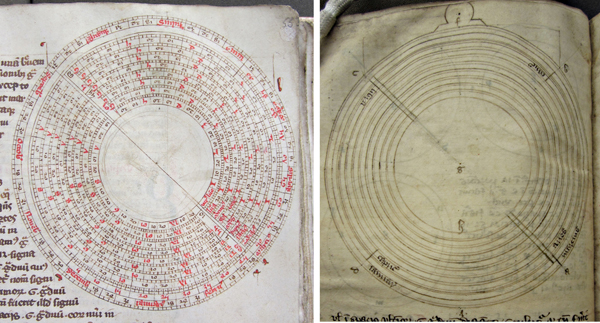
In his later Equatorie of the Planetis treatise, Westwyk was to show himself attentive to the relationship between the size and accuracy of instruments: the treatise begins by advising the reader that ‘the largere that thow makest this instrument … the ner the trowthe of thy conclusiouns’.Footnote 33 In his collation of the Albion we see him learning the importance of size. Where the original treatise stated that the Albion was to be at least 12 inches in diameter, Westwyk's version changes this to 16; but he then drew a caret, with the marginal addition ‘or 12’.Footnote 34 A marginal gloss in an early fifteenth-century hand in another St Albans copy of the Albion, which refers in the present tense to 656 divisions in the margin of the spiral disc of ‘the abbot's Albion’, suggests that the writer had seen Richard of Wallingford's own instrument; the number of divisions suggests that it was probably around 15 inches in diameter.Footnote 35 It could well be the same instrument studied by Westwyk, who perhaps revised the text to reflect the size of the instrument he was using, before deciding to reinsert Wallingford's original specification. Certainly on the following page access to the instrument made a difference to Westwyk's scribal practice, as he wrote: ‘note that the figure of the circles of the first limb of the first face should be in this space, but it is very plainly inscribed on the instrument, so it is omitted here’.Footnote 36 Following this is a partially complete diagram; the circles have been traced out, but the scales have not been filled in (Fig. 2; cf. Fig. 1). Manuscripts of the Albion, particularly those from St Albans, generally include a high proportion of Richard of Wallingford's diagrams (perhaps reflecting a devotional motivation for their production), unlike many medieval treatises, where copyists were often reluctant to do the geometry, so Westwyk's omission is more significant than it might appear.
The first limb of the first face of Richard of Wallingford's Albion. Fig. 1 is a complete diagram of that part of the instrument; John Westwyk explained his choice not to complete this diagram in his copy (Fig. 2). Oxford, Corpus Christi College, MS 144, fol 55r; Bodl., MS Laud Misc. 657, fol 11v. Reproduced by permission of the President and Fellows of Corpus Christi College, Oxford, and the Bodleian Libraries, University of Oxford.

On occasions Westwyk's collation of the two versions of the Albion tested the limits of his abilities. In one remarkably frank note, he wrote: ‘the abbot works with the circle of iomyn for the equation of days. But Simon works in another way, as is taught in the 18th use; and also in many other places which seem inconsistent.’Footnote 37 The implication is clear: he has noted multiple differences between the work of Richard of Wallingford and Simon Tunsted, but he is not always able to disentangle their implications or decide which is better.
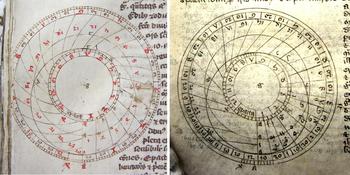
Westwyk's attempts to work out the treatise as he collates it are in general quite successful. However, some mistakes are apparent. Close examination of his diagrams suggests that while he was able to copy simple figures with care and a reasonable level of accuracy, more complex constructions caused him greater difficulty. We see this, for example, in his copy of the diagram illustrating the hour lines of lunation on the first face of the first disc. The explanation in the treatise is quite explicit, but a comparison (Figs 3–4) with the best extant version of this diagram, in Corpus Christi MS 144, shows that Westwyk did not follow it effectively. The instructions require that, after completing the inner and outer graduated rings, an eccentric circle is to be drawn touching the outside of the inner graduated ring at the top, and the inside of the outer graduated ring at the bottom; a further concentric circle is then to be drawn, of a medium size such that it intersects the eccentric circle on the horizontal diameter DGB. This was accomplished successfully in Corpus Christi 144, but Westwyk drew the medium-sized circle rather too large, so it clearly does not intersect the eccentric circle in the correct place. Moreover, the inner, middle and outer circles were to be divided into 20, 22 and 24 parts respectively; Westwyk divided them rather unevenly into 23, 24 and 25 (comparison of the lower-left quadrants of figures 3 and 4 should make the difference clear).
The hour lines of lunation on the first face of the first disc of Richard of Wallingford's Albion. The two medium-sized circles should intersect on the horizontal diameter DGB; this has been done successfully in Fig. 3 (left), but in Fig. 4 (John Westwyk's copy) the intersection is clearly too low. Westwyk also did not divide the inner, middle and outer circles evenly into the correct number of parts. Oxford, Corpus Christi College, MS 144, fol 58v; Bodl., MS Laud Misc. 657, fol 15v. Reproduced by permission of the President and Fellows of Corpus Christi College, Oxford, and the Bodleian Libraries, University of Oxford.

Westwyk's attempts to learn from the treatise are clearest in the long section he added to the end of it, which draws on a range of diverse sources in Islamic and Jewish astronomy. Wallingford advertised his invention as bringing together the functions of several other instruments, and Westwyk appended a two-page summary of the relationship between those instruments.Footnote 38 This is separated from the main treatise and is somewhat disjointed in style, quite different from the earlier text, so it is very likely to be an original addition by Westwyk himself. He first compares the Albion with the saphea of the eleventh-century Andalusian astronomer al-Zarqālī, whom he knew as Arzachel; Wallingford had deliberately not given full details of the saphea since ‘it has its own treatise’, and it appears Westwyk was hoping to mitigate Richard's omission with some helpful detail from that treatise.Footnote 39 He then moves on to the astrolabe, noting a few features common to all astrolabes before exploring some distinctive attributes of the Albion's astrolabe plate. Here his discussion draws on the canonical text attributed to the eighth-century Persian Jewish astronomer Māshā’allāh, which was in the library at St Albans.Footnote 40 Finally, after the astrolabe plate, Westwyk focuses his attention on the Albion's rather complex plate for lunar and solar eclipses. Here, too, he draws on his reading of other sources to supplement the Albion’s theoretical content. Richard of Wallingford had cited Albategni, the tenth-century Syrian al-Battānī, and Westwyk apparently followed up this citation in order to expand on Wallingford's discussion of lunar eclipses with al-Battānī’s explanation of three reasons why the quantity of eclipse varies.Footnote 41
The learning process visible through MS Laud Misc. 657 extends to its mathematical tables. It was unusual for medieval astronomical treatises, especially instrument treatises, to include tables; although tables circulated in enormous quantities and variety, they were normally somewhat independent from texts, and astronomers tended to compile their own sets to suit their individual purposes. The Albion, however, did have its own tables, which Richard of Wallingford had drawn up specifically to aid in the construction of the instrument.Footnote 42 John Westwyk copied the complete set, with great accuracy: a comparison of a sample table (4.17) in five copies of the Albion shows that Westwyk's copy has no scribal errors at all, whereas three of the other four have rather more.Footnote 43 His accuracy is remarkable, particularly since the opaque content of tables normally leads to a higher incidence of scribal errors than is found in texts.
Apart from copying them, Westwyk made two important additions to the Albion tables. First, he added a table of lunar elongations at the end of the treatise, because, as he explained, ‘the Lord Abbot put the mean longitude of the Moon on his spiral; but Master Simon put the elongation of the Moon from the Sun on his spiral … so I wrote this table, so that anyone can make it that way if he likes’.Footnote 44 Tunsted's redesign had made Wallingford's original table useless; Westwyk, in contrast, is at pains to make his copy useful, adding a signe-de-renvoi so that the new table can be read alongside the original one (where he marked a corresponding sign).Footnote 45 Westwyk's statement that ‘I wrote’ (scripsi) the table does not mean that he computed it personally; its inconsistent values suggest that it was derived from two pre-existing tables rather than drawn up from scratch. It contains a large number of copying errors, and since, as we have established, Westwyk was normally a very accurate copyist, it was most likely copied from a corrupt exemplar.
However, the second additional table was certainly computed by Westwyk himself. The design of the Albion called for at least one scale of oblique ascensions (the arc of the ecliptic that rises with a given arc of the equator – that is, in a given time), in order to help find the ascendant and divide the astrological houses. The first such scale was to be inscribed in the innermost circle on the limb of the second face of the mater, for the latitude of a place ‘where we intend to stay for a long time and make many observations; additional scales could also be inscribed on the plates for other latitudes’.Footnote 46 To assist in this, the final table in the Albion treatise was a table of oblique ascensions for latitude 51° 50′, the latitude of Oxford. (St Albans was close to the same latitude, which may partially account for the survival of so many books of Oxford astronomy at the abbey.) Westwyk copied that table, but also added another, for latitude 55°; to make his intention clear, he wrote ‘tynemuth’ [sic] just below the table header.Footnote 47
Tynemouth was a dependent house of St Albans. Set on a cliff overlooking the North Sea, and strategically close to the Scottish border, it was in every sense an outpost. Ambitious monks went there to prove themselves (including Thomas de la Mare, who had been prior when elected to the abbacy of the mother house);Footnote 48 wayward monks were sent there as punishment.Footnote 49 We cannot be sure why Westwyk went, but we know he was there for only three years before joining the ill-fated crusade of the bishop of Norwich to Flanders.Footnote 50 In any case, he took MS Laud Misc. 657 with him. Its quality of parchment and (as we have seen) varied sources mean that it was clearly produced at St Albans; but Westwyk's addition of the table for 55° shows that it was intended as a gift for the northern cell: the addition represents an act of charity in distributing the fruits of learning in St Albans to a daughter house, but also an act of devotion to the memory and reputation of Richard of Wallingford.
Computing the table required some sophisticated spherical trigonometry. The table header, which Westwyk copied from Wallingford's original, explains that ‘it was calculated and composed as explained in the canons in the second book of the Almagest’.Footnote 51 However, when we deconstruct the tables for 51° 50′ and 55° using modern software, we find that although Wallingford cited Ptolemy's Almagest, the most important work of ancient astronomy, as a source, he used a value for the table's crucial underlying parameter – the obliquity of the ecliptic – that was different from Ptolemy's: 23° 33′ 30″, rather than 23° 51′ 20″.Footnote 52 Yet Westwyk did use a Ptolemaic value in his calculations. Having no way of knowing what Wallingford had done, he simply followed the lead Wallingford had given in the table header. The great labour of calculation meant that tables like this were far more often copied than computed from scratch; it is therefore rare to find a table for an unusual latitude like Westwyk's. Its production was perhaps in part an act of charity towards the monks of Tynemouth, but it was also undoubtedly an exercise in mathematical learning. His faithfulness to Ptolemy's methods, greater than that of his source, can be seen as a learner's uncertainty about how closely to follow unfamiliar instructions.
In 1393, some thirteen years after his collation of MS Laud Misc. 657, John Westwyk wrote The Equatorie of the Planetis, drafting a description of a planetary instrument he had apparently designed himself and compiling astronomical tables to aid in its use. The Equatorie is a thoroughly pedagogical work. Although Westwyk was still himself learning as he wrote it (Seneca's dictum ‘while men teach, they learn’ may well have been familiar to him), he writes with the authoritative voice of a teacher.Footnote 53 His instructions for the construction of the equatorium make use of many of the techniques Chaucer had pioneered in his Treatise on the Astrolabe: direct, informal address to the reader, didactic repetition and anticipating a student's misunderstandings. He warns his reader against a mistake that will make the instrument inaccurate, and immediately gives a tip for undoing such a mistake, writing ‘yif thow myshappe in this cas i shal teche the a remedie’.Footnote 54 The resulting set of instructions is remarkably easy to follow, and can be used to make a fully functioning instrument; this is rarely true of medieval treatises, which often read more like thought experiments.Footnote 55 The act of charity implied by the composition (or perhaps translation) of this text in Middle English is matched by Westwyk's earlier devotion to the brothers of Tynemouth, and to the memory of Richard of Wallingford, expressed through his copying of the Albion and Rectangulus treatises. Yet his production of MS Laud Misc. 657 was also a learning experience. John had probably come to St Albans abbey from the nearby village of Westwick, and although he may have studied at the grammar school sponsored by the abbey, he is unlikely to have gone to university. Nevertheless, in part because of the learning brought by those monks who did attend university, John could have obtained an astronomical education (with or without supervision) through the monastic labour of ‘studying, reading, writing, glossing [and] correcting’ enjoined by his abbot Thomas de la Mare.
That scholarly labour could certainly include astronomy, embracing not only texts by English monks but also the great works of Islamic and Jewish astronomy. Although recent research has revealed the hitherto unappreciated range of monastic scholarship, more remains to be done to gain a fuller understanding of their scientific interests; many manuscripts remain unedited and poorly catalogued. Likewise, the networks, outside elite university circles, through which scientific ideas circulated and developed remain largely unmapped. The loss of so many texts, as well as library catalogues and other supporting documents, makes it hard to catch a glimpse of such networks and their processes of communication and learning. Yet with careful reading we can uncover some of their practices. At any rate, we can be sure, despite Richard of Wallingford's concern that through such practices he had ‘strayed from the study of pious things’, that the theories and methods he helped develop were valued, and learned with devotion and pride, by late medieval monks.Footnote 56