Introduction
The independence of courts in Latin America has been a subject of considerable debate, especially in the context of democratic consolidation.Footnote 1 Scholars have sought to evaluate courts in the context of the separation of powers, recognising that judicial decision-making and judicial independence are contingent outcomes of debate and conflict between elected branches and courts.Footnote 2 Conflict between branches may span the gamut from mundane, quotidian interactions between elected branches and the courts, such as discussion of budget allocations or public debate about the jurisprudential norms guiding specific cases; through more unique but still relatively common processes such as judicial appointments; to somewhat more critical but not quite crisis-level ‘executive assaults’, defined as ‘interferences by presidents in the freedom of particular individuals to critique the exercise of state power’; and finally, to significant moments of inter-branch conflict, defined variously as ‘institutional crises’ or ‘pugnas de poderes’.Footnote 3
Latin America since the 1990s has been subject to fewer institutional crises such as coups, but nonetheless vulnerable to the gradual usurpation of power.Footnote 4 A cunning ruler may eat away at opposition slowly, avoiding crises and instead gradually constraining opponents and incrementally emasculating institutions of horizontal accountability.Footnote 5 The bolder alternative of an overt executive strike against the courts carries with it the risk of a fatal domestic backlash, or even of international intervention. A more gradual assault, by contrast, may provide similar gains, but at less risk to the executive. Perhaps demonstrating this calculus, democracies in the region seem increasingly threatened by incremental erosions of checks and balances.
This situation leads to some incredible verbal gymnastics, perhaps best exemplified by the difficulty faced in defining Venezuela's regime. Was Venezuela under Chávez a democracy? It had more elections and referenda over the course of the decade than its regional peers. But the concentration of power begs the question: what sort of democracy was this so-called ‘Bolivarian democracy’? As a prominent regime critic stated, ‘if the “physiology” of the regime is doubtfully democratic, its “anatomy” is formally democratic’.Footnote 6 Chávez's Venezuela seems to have been something less than democratic in its essence: ‘an authoritarian electoral regime’, ‘an electoral autocracy’, ‘a hybrid regime’ or a ‘competitive authoritarian regime’.Footnote 7 Even those who noted the substantive gains of ‘radical democracy’ under Chávez, including social mobilisation and an expanded concept of citizenship, recognise that by liberal democratic standards, Chávez undermined conventional checks and balances.Footnote 8 Venezuela thus came to represent a ‘paradigmatic case of the incremental erosion of democracy’.Footnote 9
In order to maintain this hybrid regime while preserving a degree of democratic legitimacy, President Chávez sought to weaken the courts. At least initially, the Chávez government did not alter any of the de jure protections to judicial independence. The manner by which the courts were co-opted included rhetorical signalling, popular pressures such as street protest, and far more extreme purging and packing. Although the new Supreme Court had been granted ‘essential protections’ to judicial independence under the 1999 Constitution, including tough rules for appointment and impeachment, a decade later the court had been cowed, leading it to ‘passivity and acquiescence’ and a failure to curb ‘assaults on the separation of powers’.Footnote 10
How did this outcome prevail? To what extent were institutional rules changed, and under what conditions? How were political actors inured to the challenges to judicial independence? These questions are addressed in three stages. First, the paper provides a heuristic model that illustrates how changes in de facto judicial independence may result even in the absence of overt changes to de jure protections. The second section applies the model to the Venezuelan case, demonstrating how incremental efforts to curb courts can culminate in the almost complete voiding of judicial checks on executive action. The final section concludes by discussing the implications for our understanding of judicial independence.
Modelling Judicial Independence
This section draws on the comparative judicial politics literature to elaborate a simple heuristic model of independence as a contingent outcome of interactions between the preferences of the judiciary and the elected branches. The goal is not to describe all potential forms of interaction, but instead to lay open our underlying assumptions regarding independence as explicitly as possible, providing a synthesis and reappraisal of existing scholarship, as well as a foundation for future empirical research and theory-building.Footnote 11 The model demonstrates the contingency of independence, as well as the fundamental inadequacy of thinking of judicial independence only in terms of de jure parchment protections.
An independent court is generally understood to be free to act in ways that diverge from the preferences of other branches of government and, if necessary, in ways that constrain those branches in accordance with the court's interpretation of prevailing legal and constitutional rules. But this definition leaves something to be desired, failing to take into account the basic fact that ‘judicial independence fluctuates with politics’.Footnote 12 As Shapiro notes, ‘lawmaking and judicial independence are fundamentally incompatible. No regime is likely to allow significant political power to be wielded by an isolated judicial corps free of political restraints.’Footnote 13 Given such contingency, what does independence truly mean?
Independence is described here as the interaction between the preferences of two actors, a high court labelled the ‘court’, and a government labelled the ‘executive’.Footnote 14 For the sake of simplicity, we assume these two key actors have unified preferences, while acknowledging that this leaves aside potentially important factors such as judicial–legislative relations, intra-court relations and relations with lower courts. A second simplifying assumption is that there is only one policy theme under debate at any given moment, permitting us to plot the players' interactions in a single two-dimensional Cartesian space.
Given its origins in the regime, seldom is the court at complete loggerheads with the executive branch.Footnote 15 Power is often delegated to the judiciary as a means of providing the regime with a credible adjudication mechanism or enforcing past agreements between regime members, and as a result, the regime may tolerate a judiciary that interferes routinely in the affairs of governance.Footnote 16 Further, judges often operate with an audience: peer groups in other government agencies may ensure that judicial preferences are not very distinct from executive preferences.Footnote 17
It is reasonable to assume, however, that the court will never perfectly mirror the incumbent executive's preferences. Courts will have different preferences for at least two reasons. First, courts are typically designed to represent the long haul: they include appointees from past political coalitions and draw for justification on legislation approved by these coalitions. In many countries, furthermore, the connection with executive preferences is remote: justice selection procedures might require the executive to choose from among a list of nominees selected by the court itself (such as in Chile) or from among members of the judicial professions (such as in Brazil).
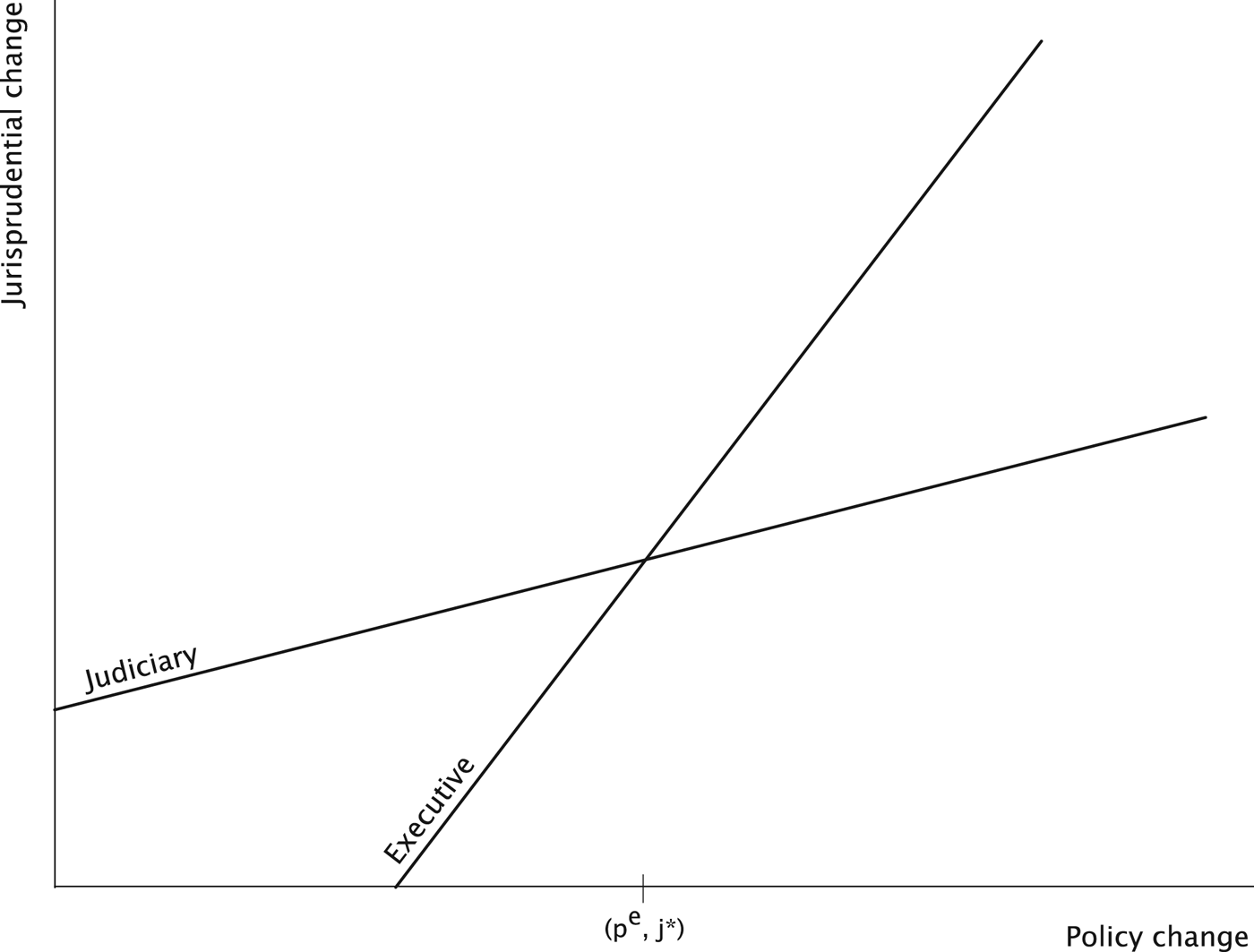
Second, law matters. The distinct origins of the court will lead it to pay close attention to constitutions, laws, legal doctrines, jurisprudence and theories of judicial interpretation, in ways that motivate, enable and constrain its actions.Footnote 18 As a result, even a court with strong policy preferences will likely couch these in legal form and, all other things being equal, this will lead it to generally prefer less jurisprudential change per unit of policy change as compared with the executive.Footnote 19 Judges act as ‘stewards’ of their institutional mission, and especially of jurisprudential traditions.Footnote 20 Both parties, then, will have preferences about the appropriate trade-off between jurisprudential change and policy change in cases that come before the court, as shown in Figure 1.Footnote 21
Executive and Judicial Preferences

It is assumed that the executive will generally seek to maximise policy change: it will be willing to trade larger amounts of jurisprudential change for any amount of policy change, as illustrated by the steeper slope of its preference function. This is not to imply that the executive has no jurisprudential preferences of its own, but because the executive has shorter time horizons, while the judiciary gives greater consideration to law and legal procedure, the model posits a steeper slope, all other things being equal. The two actors' preference functions intersect at a point (pe, J*), where J* is the level of jurisprudential change (shorthand for changes in both constitutional interpretation and prevailing judicial doctrine) and pe is the level of policy change. Around (pe, J*), the judiciary is independent and can take decisions that follow its preferred ratio of policy change to jurisprudential change.
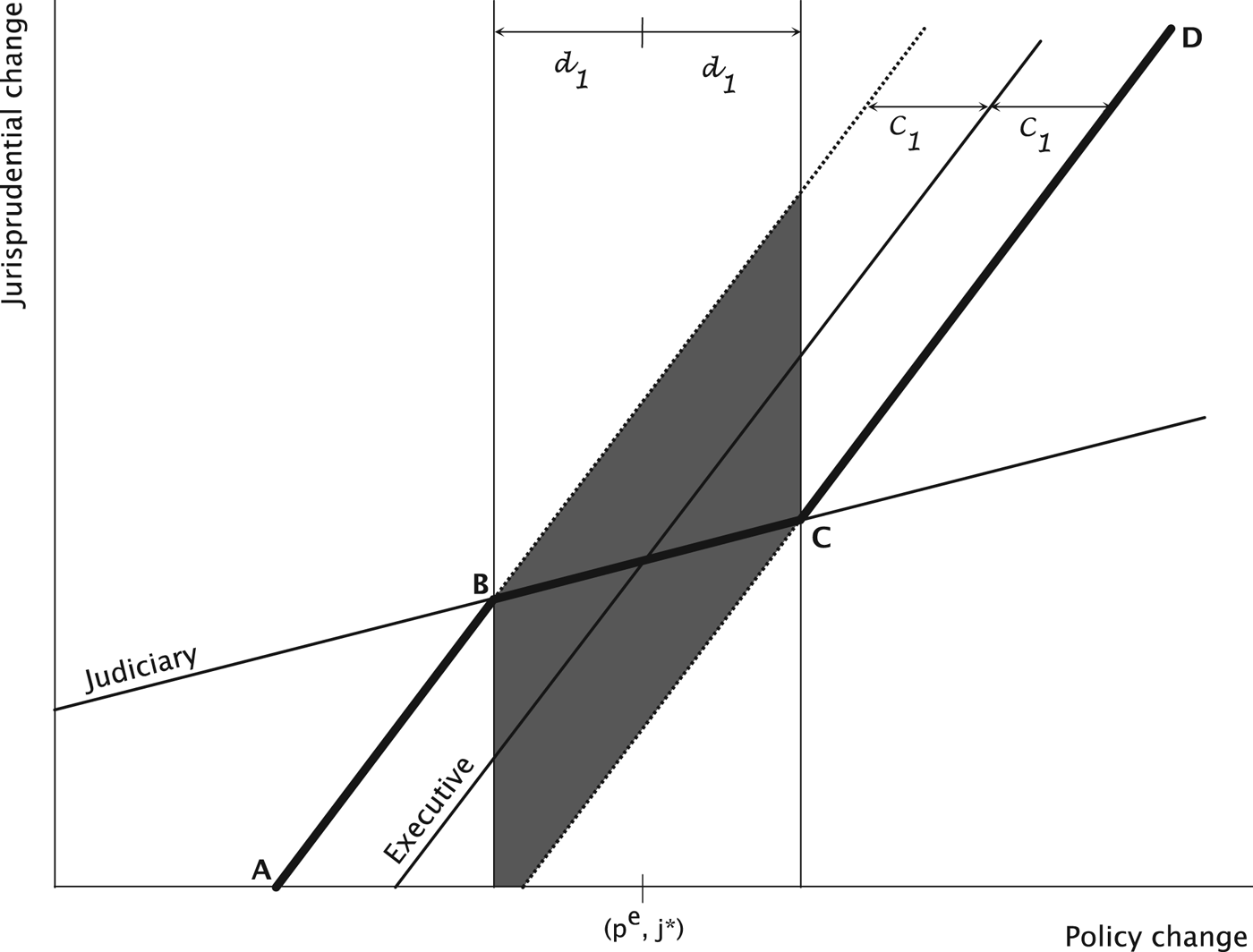
The court is not necessarily indifferent to a movement along its preference function, and if given the chance may prefer an ideal point at a point to the east or west of (pe, J*). How would the executive react in such a case? The executive cannot automatically override the judicial decision, as it will face potential costs as a result of such action. These costs (c 1) are graphed on either side of the executive preference function in Figure 2. The effective space within which the executive will tolerate judicial decisions – the space of de facto judicial independence – is determined at its outer limit by the intersection between the judicial preferences function and the cost of override functions (points B and C).Footnote 22 Within this shaded space, shown here as 2(d1), the executive will permit the court to choose its preferred mix of policy and jurisprudential change. On either side of the resulting limits of independence, however, the executive will impose its own preferences. If there were no constraints, the court could choose any point on its sloped preferences function to the west of B or east of C. But because the executive can constrain the court once its costs of override have been reached, the court will face potentially high costs outside that space, and thus is forced to rule strategically. Under such circumstances, the best possible outcome for the court lies along segments AB or CD.Footnote 23
Preferences and Costs of Override
Even within the space 2(d1), however, the executive can be expected to act to bring court preferences closer to its own. The central difficulty the executive faces is that it cannot impose its preferences on the court willy-nilly within this space; the executive is constrained by the slope of the judicial preference function relative to its own and by the costs of override. As a consequence, the executive may endeavour to alter these factors so as to achieve its policy objectives without judicial interference and to guarantee that even if it is out of office, something closer to its preferences will prevail within the court.
This is a crucial point. By altering the slope of judicial preferences about the appropriate trade-off between legal change and policy change, or by altering the costs of override, the executive will indirectly alter the breadth of de facto independence without necessarily ever directly overriding or changing the institutional rules governing the court.Footnote 24
This argument represents an innovation on previous spatial models of judicial behaviour, such as the ‘tolerance intervals’ model developed by Epstein, Knight and Shvetsova, because it recognises that actors simultaneously balance legal goals against policy objectives, rather than operating only in a limited policy space.Footnote 25 The model follows Epstein et al.'s lead in assuming that the bounds of executive tolerance (costs of override) are determined in part by diffuse public support for the court and by recognition of the court's legitimacy. It is also influenced by their notion that if it wishes to survive, a court will not often stake a position that lies beyond the tolerances of other political actors.Footnote 26 However, the model moves beyond the policy trade-offs addressed by Epstein et al. and toward the broader issue of judicial independence, linking de facto preferences and de jure rules in a single model that demonstrates the interactive nature of executive–judicial relations.
The notion that the balancing of legal and policy preferences can have important effects on independence is simple to illustrate. Imagine that each actor has an ideal point representing its desired amount of policy change. This ideal point will lie somewhere along the horizontal axis of policy change.Footnote 27 The two actors' ideal points might be quite close in horizontal space, and they could potentially even lie on the same vertical line reflecting an identical amount of desired policy change (pe±x). But because the two actors' preference functions do not have the same slope, and thus reflect a different willingness to trade policy change for jurisprudential change, even if both actors shared the same ideal point in the policy realm, these points could be vertically quite distant, as they would be if a vertical line were drawn near the eastern margins of Figure 2. Even a court that shared exactly the executive's desire for a particular amount of policy change (on the horizontal axis) could nonetheless end up at a very different point in terms of jurisprudential change (on the vertical axis). As a result, the court's ideal point might lie outside the space 2(d1), even if it exactly shared the executive's policy preferences. Indeed, even when presidents pick courts that largely share their policy preferences, judges may nonetheless be unwilling to make the significant jurisprudential changes needed to achieve a given mix of policy and jurisprudential change, thus leading to lingering conflict even in highly constrained courts, such as Venezuela's high court under Chávez.
With this model in mind, what tools can be used to influence independence? Two simple strategies are available: either to shift the slope of the court's preference function, or to lower the costs of override (c1), below which the executive will not rationally intervene in judicial decision-making. The factors that enable these two strategies are reviewed briefly below. The key lesson, however, is that these factors should not be confounded with independence as they are in fact antecedent to it and only influence the size of de facto independence indirectly, by determining the costs of override (c1) or the slope of judicial preferences, or both.
Institutional arrangements
Domingo argues that judicial independence depends formally on three institutional factors: appointments procedures, tenure and stability in office, and the degree of autonomy and structure of the judicial budget.Footnote 28 Guarantees of non-interference by the elected branches in these factors will make it harder to intimidate individual judges or the court, and will ensure the long-term nature of judicial decision-making. But these guarantees do not mean much by themselves. In a separate work, Domingo notes that despite such protections, Mexican courts under the Partido Revolucionario Institucional (Institutional Revolutionary Party, PRI) behaved timidly, responding to the broader political environment in which they operated.Footnote 29 In the post-war United States the legislature has routinely bent judicial preferences by manipulating budgets, and evidence suggests the Supreme Court has responded by ‘shifting its decisional output in the direction preferred by the legislature’.Footnote 30
Some protection against political interference may be provided by methods of appointment that distance judges from the elected branches, and long tenures that allow judges to outlive their political cohort institutionally.Footnote 31 But judges' preferences may be altered by their career options upon leaving office, while the mere threat of override will continue to thwart decisions that lie far from central executive preferences.Footnote 32 Other plausible influences include the breadth of constitutional or statutory powers, which cases courts can hear, their jurisdiction, and the very structure of the court system itself. The executive may, for example, choose to create or eliminate tiers of the judiciary in ways that advance its policy priorities, as in the US 1801 Judiciary Act, whereby new courts were created and subsequently eliminated in ways expected to favour successive governing factions.Footnote 33
When office-stripping is not an option, jurisdiction-stripping may be. By stripping jurisdiction over certain matters, it is possible to completely remove these from the model: independence is simply a moot point in those policy arenas in which courts have no voice. Alternately, the discretion of judges in statutory interpretation is often restricted by imposing sentencing guidelines or establishing a strict standard of review. The rules governing standing, as well as the topics that can be reviewed, may also vary enormously, constraining both the types of cases and the identity of the plaintiffs that the court hears.
The importance of support from publics, the legislature or political parties is readily apparent to justices who, while generally focused on longer-term constitutional issues, are nonetheless well attuned to public sentiment. Marshall, for example, claims that the US Supreme Court ‘reflect[s] public opinion about as accurately as other policy makers' at the national level.Footnote 34 About three-fifths of Supreme Court decisions follow opinion polls, which is little different from other branches, and US justices are ‘broadly aware of fundamental trends in the ideological tenor of public opinion’.Footnote 35 Public support has two potential effects: altering judicial preferences about the appropriate trade-off between policy and jurisprudence, and increasing the costs of override, including through acceptance of courts' inherently anti-majoritarian role.Footnote 36
A related point refers to the divided government hypothesis. Although the model here depicts a single elected branch, a common argument in the literature from Latin America is that divided government may improve conditions for independence by providing an external institutional protector, and by increasing the likelihood that someday the incumbent will be out of office and will thus require an independent arbiter that is not the governing party's lapdog.Footnote 37
Electoral turnover may also provide an ‘insurance policy’ for courts by increasing the costs of override.Footnote 38 In competitive electoral markets, courts may provide contract enforcement to interest groups who reached political deals in past legislatures, and may thus garner courts protection against current legislatures, who might otherwise seek to overturn past bargains.Footnote 39 The flip side is that dominant one-party governments may be able to shape the career incentives of judges in ways that undermine otherwise reasonable institutional safeguards. As Ramseyer notes in the Japanese case, and Domingo in the Mexican, the Liberal Democratic Party (LDP, post-1945) and the PRI (1917–94) were able to reduce significantly the costs of override by ensuring that disloyal judges would face lacklustre future career options.Footnote 40
Executive oversight
The capacity of the executive to effectively oversee court decisions also influences independence. The more complex the court's decisions, and the less obvious their implications for policy, the less likely it is that these decisions will trigger executive reaction. It thus matters whether courts are required to write opinions justifying their decisions publicly or explaining the exact preferences of members of the court, and the opacity of the legal justifications surrounding any given decision may play an important role in signalling (or obfuscating) preferences.Footnote 41 Shapiro notes how the ‘marvellously impenetrable lump’ of common law enabled British courts to build their power relative to the executive, in essence by claiming to be more closely attuned to other branches' preferences than they were in fact.Footnote 42
Conversely, by increasing the number of cases the high court may be forced to hear (either by increasing the likelihood of appeal or by increasing the number of lower courts), political actors can force it to adopt a lax standard. McNollgast notes, for example, that Brown vs. Board of Education's ‘ambiguous message to school districts to desegregate with “all deliberate speed”’ was a remarkably imprecise and vague ruling that offered considerable leeway to local governments.Footnote 43 By forcing the court to adopt a lax standard, the other branches restricted its ability to take its most preferred decision freely.
Legitimacy
In many regimes, frontal assaults on the judiciary may trigger antipathy for the executive, increasing the costs of override. Latin American presidents disregard this lesson at their peril: both Ecuador's and Honduras' experiences in the 2000s illustrate the risk that manipulating the judiciary may backfire, as in the removal of President Gutiérrez in 2004 for trying to stack the courts, or the ouster of President Zelaya in 2009 for disregarding a significant court decision. This may be the case even in authoritarian regimes, as Pakistan's President Musharraf learned from the political backlash that followed the suspension of Chief Justice Chaudhry in 2007. Even when court decisions are unpopular, courts may acquire legitimacy that encourages the public to ‘accept judicial decisions, even those they bitterly oppose, because they view courts as appropriate institutions for making such decisions’.Footnote 44 A related point is that overriding the judiciary on any given case may have costs to other cases on the judicial docket. More positively, sympathetic courts can resolve issues that the executive itself may not be willing to tackle.
Executive non-compliance and override
Having described the ways in which the executive may constrain the courts within the space of de facto independence, let us turn to the question of executive behaviour outside the space of de facto independence. Independence cannot simply be defined as the extent to which judges can act without facing retaliation, because a potentially more pernicious threat to court survival is the possibility that judicial decisions will simply be ignored. In its strategic calculations, therefore, the court may often seek to limit its decisions in such a way as to at least partially meet the expectations of one or, if possible, both of the litigants and thereby guarantee that its decision will be carried out in practice.Footnote 45
Examples of non-compliance are rife, even in long-established democracies. One clear case is US president Andrew Jackson's refusal to carry out court decisions protecting the treaty rights of Indians – which generated the apocryphal if probably erroneously attributed quote, ‘John Marshall has made his decision, now let him enforce it.’ Similarly, President Lincoln's failure to accept Justice Taney's writ of habeas corpus for John Merryman required no active effort by the executive to override the courts. The reversion to executive preferences in decisions beyond the limits of de facto independence does not necessarily result from active efforts to cow the court. In other words, the policy path depicted in segments AB and CD of Figure 2 need not result from an explicit override, but could be a failure to actively comply with the court's decision.
Non-compliance can be corrosive to court power in the long term. It is no surprise, then, that courts often constrain their own decisions so as not to trigger non-compliance. While these self-constrained decisions are taken freely, they are strategic decisions that do not position the court where it would ideally prefer to rule. They illustrate the weakness of many measures of independence: the court chooses a point either within the bounds of de facto independence (segment BC) or along the costs of override (segments AB or CD), rather than where it might otherwise act absent these constraints (on its preferences function to the east of C or west of B).Footnote 46 The court, in other words, is pushed east and west by its reluctance to move north or south, and in some cases will end up worse off as a result (for example, AB or CD).
The model illustrates some concepts that have been largely intuitive for many scholars, such as the change in independence that results from altering the costs of override. High costs of override would lead to potential freedom of action by courts; low costs would, all other things being equal, lead to more constrained courts. At the extreme, when the costs of override approach zero, courts might even become irrelevant in certain policy domains. Under military rule in Argentina, for example, early attempts to build ‘authoritarian legality’ set the military on a collision course with the judiciary, the costs of override fell sharply, and as a consequence, the courts played no meaningful role in limiting human rights abuses. In authoritarian Brazil, by contrast, a combination of higher (but still restricted) costs of override and closer preference functions between the courts and the military enabled the courts to uphold ‘older liberal notions of the law against newer national security conceptions of law’, with important outcomes in terms of the ratio of state trials to state killings. While the figures are still reprehensible, the ratio was more than 1,600 times better in Brazil than in its southern neighbour.Footnote 47
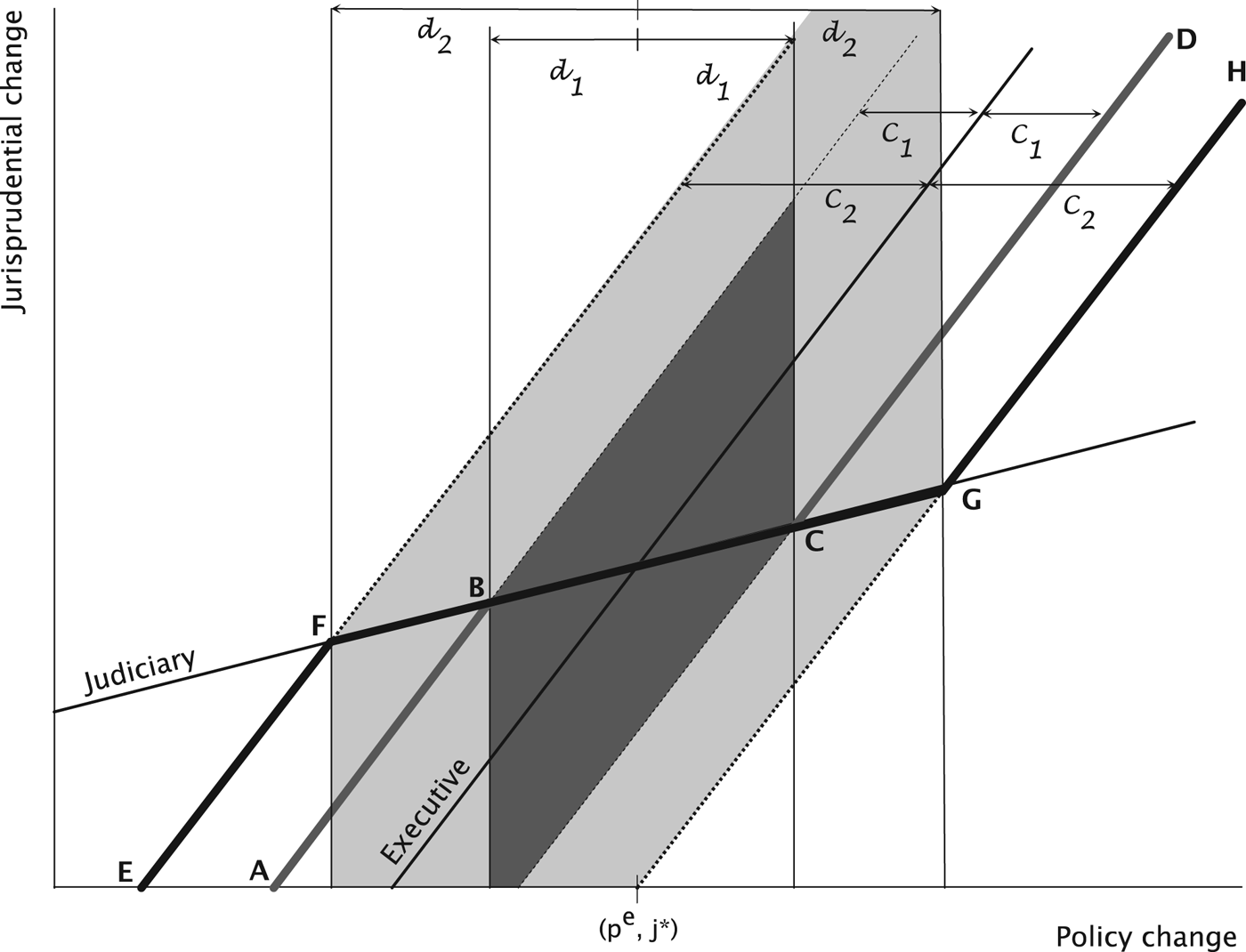
Figure 3 illustrates graphically how higher costs of override expand the limits of de facto independence, from 2(d1) to 2(d2), broadening the range of mutually acceptable judicial decisions from segment BC to segment FG.
Independence under a Higher Cost of Override
Less obvious are the findings that arise from the infinite number of possible combinations of executive and court preferences. One particularly stimulating finding is the expansion in de facto independence that results if preferences are more aligned; that is, if the court is willing to trade jurisprudential rigidity for policy flexibility, or if the executive is willing to make the opposite trade. The argument that a court which is perceived as friendly may be able to act against the executive more effectively than a court which is perceived as hostile finds empirical backing. In the United States, public rhetoric in periods when Supreme Court decisions are taken close to the limits of de facto independence illustrates how independence is more frequently called into question when the two branches have sharply different preference slopes. Consider the conflict over the Commerce Clause under FDR, for example, or the more recent animosity toward supposed judicial activism on social issues.
Readers may reasonably think about a ‘friendly’ court in at least two ways. The first is to imagine that the court shares with the executive a willingness to change policy at a similar ideal point on the X-axis (pe±x). At the extreme, one could imagine a friendly court that is purely ‘jurisprudential’, with a flat horizontal preference function, but with its preferences truncated so that the court's preference function would run as a short horizontal segment entirely contained between the bounds of the executive costs of tolerance, with no preferences to the west of B or east of C.
A more realistic conception, however, may be to think of a friendly court with a sloped preference function that includes preferences both inside and outside the bounds set by the costs of override. Although it will be rare for the executive and the judiciary to share exact preferences, and even rarer for them to share the same exact ideal points of desired policy change, the slope of a ‘friendly’ court's preference function will be close to that of the executive. The preference functions may not perfectly coincide, in part because courts really do make trade-offs between policy and law (and tend to be less flexible on jurisprudential matters than the executive), but also because of the typical nomination process for justices. Executives are unable to foresee all policy challenges that are likely to reach the court, so they choose justices on the basis of the trade-offs that they anticipate their appointees will make between policy and law (hence the common adjectives describing nominees as ‘deferential’, ‘constitutionalist’, ‘reflecting judicial modesty’ and so on), rather than solely on the basis of policy positions.
The implications of the similarly sloped preference function of a friendly court are worthy of reflection. The implication is that the greater the degree of concordance between executive and judiciary preferences, the wider will be the space for the court to act according to its own preferences about the appropriate trade-offs between policy and jurisprudence – ergo, the greater de facto independence there will be. This finding runs counter to the language of many arguments in the literature. Consider, for example, McNollgast's work, when they argue that during periods in the United States prior to the Second World War, ‘courts were instruments of the ruling party and exhibited relatively little independence on statutory issues’.Footnote 48 Under these conditions, because the executive and court shared similar views on the appropriate trade-off between policy and jurisprudence, courts were in fact acting independently. What they were not doing was acting against the preferences of the executive, which is all too often the default definition of independence.
This provides conceptual reinforcement for the common admonition that independence cannot and should not be measured ‘simply by considering judicial reversals of governmental acts’.Footnote 49 As the slopes of executive and judicial preferences approach each other, the intersection of court preferences with the costs of override – which determines the limits of de facto independence – will move further east and west.Footnote 50 This raises the possibility that the court could take policy decisions further to the east and west without fear of repercussions. The less independence is in fact required (since agreement between the executive and judiciary is so high), the more de facto independence there may be. Although this seems paradoxical, it is in many ways an old argument: the lower the stakes and the less sharp the differences among policy actors, the less likely it is that these actors will reach the outer bounds of tolerance for each other.
Shocks in the policy domain
Finally, there is the related issue of shocks in the policy domain – shocks such as a significant partisan realignment, structural economic change or war. A good starting point is the oft-cited US experience during the New Deal. Roosevelt was thwarted in his efforts to approve New Deal legislation in large part because, even before policy positions came into the game, the larger conflict was jurisprudential: the Supreme Court of the 1920s and early 1930s was extremely averse to the federal government's willingness to change policy via administrative law. The ‘Four Horsemen’ on the Supreme Court acted to strike down those federal laws that utilised or required executive branch lawmaking, suggesting that whatever the differences over ideal policy positions, a potentially more foundational disagreement lay in the huge amount of jurisprudential change needed to implement the New Deal's policy changes.
Ultimately, the costs of confronting the Supreme Court seemed a small price to pay to achieve executive policy objectives, and Roosevelt proposed a bill that expanded the number of justices on the court. Using the language of the model, the goal of the legislation was to appoint new justices and thereby steepen the slope of the court preference function, making it more amenable to trading jurisprudential change for policy adaptability. In most cases, while politicians try to change the slope of the court's preference function through appointments when deaths or retirements provide such an opportunity, there is not much they can do between vacancies; hence the court-packing plan.Footnote 51 Interestingly from the perspective of the model, packing ultimately proved unnecessary because it served as notice of the potential for an executive override (and transparently signalled the executive's cost of override function). Despite there having been no change in its willingness to trade jurisprudential change for policy change, in response to this signal, the Supreme Court deftly shifted its public posture through a series of decisions by which it ‘wisely chose to give up on the substantive issues and preserve its structural integrity’.Footnote 52 The slope of its preferences did not change, but given a clear choice between either ruling on its own preferences and facing retaliation or keeping within the options tolerable to the executive, it chose to vote along AB or CD, because its sincere preferences were not on BC.
There are many other examples in which the Supreme Court has restricted its behaviour so as to stay within the signalled bounds of executive tolerance. The court's reaction to Wilson's Espionage Act (1917), FDR's relocation of Japanese-Americans (1942) and Bush's indefinite detention of terrorism suspects without due process all illustrate the court's tendency to restrain itself when executive preferences are suddenly sharply altered by war, giving rise to the maxim ‘Inter arma enim silent leges’ (In times of war, the law falls silent). Alternately, consider the stress that the economic reforms of the 1990s in Latin America placed on the region's courts, as executives adopted neoliberal policies, shifting their preference functions, even as courts remained wedded to new transitional constitutions that – as in Brazil – often included highly statist jurisprudential norms.Footnote 53 A further example comes from democratising Chile, where Helmke reports frequent inter-branch crises in the 1990s, as the civilian government tried to bring the courts inherited from the authoritarian regime closer to its own preferences without changing the costs of override.Footnote 54
Exogenous policy shocks generated by war or structural economic change forced a re-evaluation of prevailing policies and jurisprudential interpretations of the limits on executive action. In most of these cases, the executive preference function steepened, while the costs of override fell in response to changing public sentiment. It may be that judicial preferences also shift in moments of crisis: more than one justice has noted that the Constitution is not a suicide pact.Footnote 55 Just as likely, however, is that the court bides its time so as not to directly confront elected branches when such an action might engender non-compliance or retaliation. The courts in these cases largely responded to executive signals by limiting their own actions, as in Brazil's many economic stabilisation plans. Where courts did not do so, as in Argentina under Menem, the executive either proactively worked to alter court preferences – in sometimes brutish ways – or simply failed to comply.Footnote 56
It is precisely because they took place at the limits of the model that these cases are enlightening. More than cases that lie close to the executive's core preferences, they help to signal exactly where the limits on independence lie. Ultimately, too, they help to suggest how policy will be determined: one can expect the trade-off between policy change and jurisprudential change to follow the court preference function up to the limits of de facto independence, but beyond that point the likely outcomes will be somewhere closer to the executive preference function (that is, they will fall either on line ABCD or, more likely, directly on the executive preference function), given the executive's superior instruments of budget and personnel control.
Four facets of the model are worth highlighting. First, independence is contingent upon policy arena. The dynamic model presented here would become hopelessly complex if it were to incorporate various policy dimensions at the same moment, and it thus serves only to depict relations between the two branches in a particular policy arena at a particular moment in time. As the next section will demonstrate, conflict between Chávez and the court centred on electoral politics; in the field of criminal law, for example, there was less effort by the executive to control the court. The larger point is that independence varies by policy arena because preferences and the costs of override vary by policy arena.
Second, the model provides conceptual backing for the frequent argument that discussions of independence cannot easily be separated from politics. Politics plays a role in determining both the de facto and de jure influences on the costs of override and on preferences. De facto influences include retaliation (physical threats, threat of arrest or prosecution), career options upon leaving the bench, public support for courts or decisions, divided government and electoral turnover, the possibility for clear oversight of decisions, the public legitimacy of courts, the potential of interference to affect other cases on the docket, the likelihood of non-compliance, and shocks in the policy domain. De jure influences include the scope of jurisdiction, constitutional or statutory powers, the rules on impeachment or removal, the appointment process, the size of the court, tenure stability and budgetary autonomy.
Third and more novel is the model's illustration of the fact that independence is not directly a result of the variables that determine either the preference functions or the costs of override, but rather is a result of their interplay. In other words, the common practice of arguing that independence is a result of budgetary autonomy, appointment procedures or other institutional phenomena abbreviates the causal chain. By themselves, these variables mean little: many of the variables cited in the literature as components or prerequisites of judicial independence are in fact only important in combination with other variables, by conditioning the costs of override or the speed of shifts in the court's preferences. Although the strengthening of institutional variables – by increasing judges' pay or their tenure, for example – is an important goal in its own right, such measures contribute to increasing the costs of override rather than directly enhancing independence itself. It is only subsequently that, in an interactive fashion, they may have an influence on independence. It should be no surprise, then, that even well-paid, well-trained and influential judges may lose their independence quite rapidly – that is, even if formal protections remain unchanged, courts may find themselves outside the new bounds of de facto independence as preferences shift, or the relative costs of override decline, in a space where they face either override or non-compliance. At such moments, judges may well seek to act cautiously in the hopes of preserving the court to fight another day.
Finally, the model demonstrates the folly of measuring independence solely by counting decisions taken against governments. Such decisions may be independent, in the sense of following judges' innate and sincere preferences, but so too may be decisions taken in favour of the government. To complicate matters further, decisions taken freely by the court within the space 2(d1) described in the model may be taken strategically, with an eye to avoiding the outer limits of executive tolerance. Peretti makes a similar argument: ‘Certainly, judges are free to ignore strategic considerations and tolerate policy irrelevance or failure, and some do … [but] if judges desire policy success, they must acknowledge and accommodate limits on their independence.’Footnote 57 In sum, even seemingly independent decisions may not reflect the decisions that the court would take in a world devoid of regular interactions with the other branches. As the next section demonstrates, these facets of judicial independence were artfully exploited by Chávez's government in order to gradually restrict the court's ability to block the administration's initiatives.
Shrinking Judicial Independence in Venezuela
The Venezuelan government gradually brought the judiciary to heel between 1999 and 2004, without conducting a full-blown frontal assault on the high court, at least initially. During this period, furthermore, changes to independence came about without any changes in de jure independence. In Chávez's first five years in office, there were few changes to the law on the books that would explain the courts' declining independence; the courts were curbed solely by gradual efforts to change judges' preferences and lower the perceived costs of override.
Between Chávez's election in 1998 and 2010, Venezuela was asked to make a large number of electoral choices, including presidential elections in 1998, 2000 and 2006, a referendum on holding an Asamblea Nacional Constituyente (National Constituent Assembly, ANC) in April 1999, elections to the ANC in July 1999, a referendum on the new Constitution in December 1999, a recall referendum (2004), parliamentary elections (2005, 2010), a referendum on changes to the Constitution in December 2007, and another referendum on lifting executive term limits in February 2009. Interspersed with these electoral choices were a number of extra-institutional conflicts, including the failed April 2002 coup attempt, during which Chávez was deposed for two days, and a two-month-long protest strike in 2002. The opposition had few tangible successes, however, and even when they prevailed in the 2007 referendum on changes to the Constitution, Chávez bounced back and 14 months later won a resounding victory in the 2009 referendum overturning term limits.
In light of these many electoral consultations and their importance to regime legitimation, electoral law has been a touchstone of political confrontation, and one to which the Chávez government ascribed great value. This section focuses particularly on electoral disputes in the courts, although similar interactions have been apparent in other facets of relations between the court and the government, including human rights and economic matters. Between 1998 and 2004, the Chávez government attempted to achieve its aims by limiting judicial independence using de facto instruments rather than de jure changes, including hectoring judges, calling public demonstrations, threatening non-compliance and replacing judges. By 2004, as the court's inconvenient effects in the electoral arena became more evident, the government's strategy turned to adoption of de jure changes to judicial independence, including a change to the Organic Law of the Supreme Court that increased the number of judges and facilitated purging, even as the government persisted in its use of the de facto restraints on judicial independence adopted in the previous period.
Restricting judicial independence by the de facto route, 1998–2004
Early in his first term, Chávez made clear that he intended to reform the 1961 Constitution, but would do so extra-constitutionally: although the 1961 Constitution established that amendment was only possible with the support of two-thirds of Congress, Chávez did so through the ANC with simple majority support. In the face of considerable popular pressure, the Tribunal Supremo de Justicia (Supreme Court) reluctantly accepted the referendum establishing the ANC but tried to strictly limit its powers to drafting the new Constitution.Footnote 58 It failed in part because once the ANC convened in August 1999, Chávez's large majority meant that there was little opposition to his insistence that the ANC would not only write the Constitution but also dissolve both Congress and the Supreme Court. Despite any reservations the court may have had about the suspension of Congress, Chávez's enormous popularity – he was enjoying the highest approval ratings of any president since the 1960s – meant that the court ‘did not feel confident enough to block’ his wishes.Footnote 59 Further, any court decision to the contrary would likely be ignored, creating a compliance problem: the court preferred a decision outside 2(d1) in Figure 3, requiring less jurisprudential change, but resolved to tacitly permit the new status quo to prevail, for fear that non-compliance would render it even less institutionally relevant.
Chávez's supporters held 123 of the ANC's 131 seats, and used this majority to restructure judicial personnel for reasons that had little to do – prima facie – with reducing judicial independence. The ANC established a judicial emergency committee that removed 190 judges for a number of seemingly good reasons, including wealth incompatible with their wages, having been the subject of criminal investigations or having received seven or more complaints.Footnote 60 Perhaps aware of the blow to its image that accompanied these dismissals, the Supreme Court reversed its earlier position and approved the ANC's powers to intervene in other branches, ratifying the status quo. Facing costs of override that had fallen to nearly zero due both to vast majorities and to the low legitimacy of judicial institutions, in other words, the court avoided making a decision that was far from Chávez's ideal outcome. This decision was not unanimous, however, and led the court's president to resign in protest less than a month after the ANC was sworn in, publicly noting that the court ‘simply committed suicide to avoid being assassinated. But the result is the same: it is dead.’Footnote 61
The ANC proceeded to issue decrees appointing a new Supreme Court and a new Consejo Nacional Electoral (National Electoral Council, CNE), as well as a new attorney general, ombudsman and comptroller general. These changes were also justified as an effort to root out the endemic corruption of the Punto Fijo system, although as Levine notes: ‘None of these appointments followed the procedures laid out in the new constitution itself, which required that civil society groups nominate for these positions, that the Citizens' Power present a slate to the National Assembly (for Supreme Court and CNE) and that the Assembly confirm these.’Footnote 62 Again, perhaps reflecting fears of non-compliance in the face of overwhelming public support and the direction of a majority of its members' own preferences, the Supreme Court did little to halt this procedural sleight of hand. The court was constrained in part by its history of corruption and politicisation, which meant that public perceptions of its role were poor.Footnote 63 Further, the new Constitution on the face of it ‘substantially broadened the Supreme Court's role’, including broader constitutional review powers and stronger administrative oversight of the lower courts, suggesting that the court had plenty to gain from temporary acquiescence. It thus tacitly accepted a decline in the costs of override, even as the slope of its preferences moved ever closer to the executive's through the resignation of key opponents of Chávez from the court.
Nonetheless, later moves by the Supreme Court would demonstrate that despite its timidity during the ANC, the court's preferences about the appropriate trade-off between policy change and jurisprudential change remained distinct. Some of these differences were not entirely adverse for Chávez, as in May 2000, when the Supreme Court ordered the postponement of the scheduled election after the CNE admitted that it was not adequately prepared for the vote and thus could not guarantee fair results. Although the decision seemingly ran against Chávez's desire for an election that would capitalise on his popularity – which was running high at that time – it did serve his broader interest in demonstrating subservience to an electoral process. This was particularly useful to Chávez in light of events in Peru, where Fujimori had been widely accused of manipulating the voting process, setting off a wave of scandals that would lead to his downfall.Footnote 64 Indeed, Chávez publicly applauded the court's decision when it was announced, perhaps reflecting his strategic response to what was becoming an ‘increasingly polarised and volatile’ political situation.Footnote 65 The court's decision was thus closest to Point C, demonstrating preferences that were significantly different from the executive's but still within the bounds of tolerance.
The clash of distinct preferences became clearest following the April 2002 coup attempt, when the Supreme Court raised the ire of the government by voting three times to dismiss the case against two generals and two admirals accused of involvement in the coup (a decision outside 2(d1)), arguing that there was insufficient evidence to prosecute. Given that the new court had been nominated entirely by Chávez's supporters in the ANC, this adherence to jurisprudential norms above political preferences came as a shock to the government. Chávez had threatened the court ahead of the final vote, telling justices that they needed to behave ‘like an umpire in a baseball game’ and could be replaced if they did not. Announcing the final decision in August, Supreme Court president Iván Rincón highlighted the court's continued preference for at least some jurisprudential stability, stating: ‘The constitution is not only to be used when it is beneficial to me. It has to be respected all the time’.Footnote 66
The decision stood, in part because it preserved a status quo that the executive could not alter by non-compliance. But the decision sparked street violence by government supporters, and a special committee of the National Assembly (the new unicameral congress created by the ANC) recommended removing one justice on unrelated charges and further investigating another. The author of the Supreme Court's decision, Justice Franklin Arrieche, was accused of providing false credentials during hearings regarding his appointment to the court, and the National Assembly annulled his appointment. Arrieche successfully appealed, and as a result of a temporary injunction from the court, remained a justice until his removal two years later. The government was not so subtly seeking to further shift court preferences, but there were limits to how far it would go to violate formal institutional protections. Between 2002 and 2004, the Supreme Court was irreconcilably divided internally. Some decisions clearly antagonised the government – in 2003, for example, the constitutional chamber within the court declared unconstitutional the National Assembly's failure to appoint new members to the CNE, which was stalling an opposition effort to move forward with a recall referendum against Chávez.
Simultaneously, however, the Supreme Court made several high-profile decisions in the opposite direction. In November 2002, it overruled the CNE's decision to allow a referendum on whether Chávez should resign, arguing that the decision required a super-majority vote by the CNE rather than a simple majority. The court's decision followed strong rhetoric by the government against the opposition ‘ambush’ of the electoral process, clearly signalling the executive's resistance to the referendum. A month later, the court issued another friendly decision, a temporary restraining order forcing the state oil company, Petróleos de Venezuela, to restart operations in the face of the nationwide strike against the government. The Supreme Court also failed to hear the appeals of three judges on the country's second-highest court who were suspended after repeatedly challenging government policies.Footnote 67 Most importantly, a new case before the Supreme Court in January 2003 led the justices to suspend yet another referendum attempt, scheduled for February, despite the fact that the opposition had collected two million signatures in favour of a referendum on a non-binding resolution calling on Chávez to resign.
But the Supreme Court's opposition to the referendum was based largely on its reading of the Constitution, which stated that a binding referendum could only be held halfway through the president's term (that is, June 2003). By August 2003, as that deadline passed, the court's jurisprudential preferences meant that it was ready to allow a referendum. The opposition managed to obtain more than three million signatures in support of this new referendum effort by December, but the CNE disqualified 876,000 of these on a technicality. Violent protests erupted. Responding to a constitutional challenge, in March 2004, the three judges in the Supreme Court's electoral chamber overturned the CNE, allowing the disqualified signatures to stand.Footnote 68 This decision temporarily placed the court outside 2(d1).
The Chávez government's response was to move the case to the constitutional chamber, where friendly justices held a majority. The electoral chamber's ruling was quashed a week later, forcing the opposition to mount a new petition drive.Footnote 69 Soon thereafter, the government announced that the attorney general would investigate the three judges in the electoral chamber for unethical behaviour and present its allegations to the National Assembly for a vote, in an effort to simultaneously diminish the costs of override and shift court preferences.
Restricting independence via both the de facto and de jure routes, 2004–2010
Up until this point, the Chávez government had contented itself with threatening the Supreme Court, without actually changing underlying institutional rules. Facing the likelihood of an August referendum that might be closely contested (and thus require favourable judicial decisions), Chávez took more drastic steps to curtail the court. In May 2004, he signed the Organic Law of the Supreme Court, expanding the court from 20 to 32 justices, a number that increased the number of justices in each of the six chambers of the court by two. The government alleged congestion as its primary motivation, although observers were quick to point to the odd coincidence that the quota of two new judges in each chamber was the exact number required to achieve a majority in the electoral chamber.Footnote 70 The new law did little to reduce the de facto power of the Supreme Court, recognising its prerogatives of review, and it did nothing to limit access. But, as Urribarri notes: ‘The government's intervention was not designed to render the Court institutionally powerless but to ensure the government's political domination by reconfiguring the Court's composition and enhancing the ruling majority's ability to hold the Court accountable in the event of defection.’Footnote 71
The packing of the Supreme Court was accomplished by reducing the required congressional majority for court appointments from two-thirds to a simple majority.Footnote 72 Purging was also facilitated by the new law. Although the Constitution sets a 12-year term and requires a two-thirds vote in the National Assembly for impeachment, the Organic Law allowed the ‘temporary’ suspension of justices facing impeachment votes.Footnote 73 Given that the offences that merit impeachment are vaguely defined and open to subjective interpretation, the law was a powerful instrument for aligning preferences.Footnote 74 To further strengthen its powers, the National Assembly granted itself the power to nullify previous Supreme Court appointments by a simple majority. In other words, the executive lowered the costs of override in the purging rules, while facilitating preference alignment through easier rules for packing.
Two weeks after the Organic Law's approval, the National Assembly purged the Supreme Court's vice-president, Justice Arrieche.Footnote 75 Arrieche was removed from the court with a simple majority, and his subsequent appeal – arguing that removal of a justice without a majority vote violates the letter of the Constitution – was rejected 3–2 by the constitutional chamber. In July, two of the justices in the electoral chamber, Alberto Martini Urdaneta and Rafael Hernández Uzcátegui, retired from the court to avoid prosecution by the government or dismissal by the National Assembly for allegedly unconstitutional acts (most importantly, for ruling that the referendum petitions were valid). In December 2004, Chávez's majority in the National Assembly filled the 12 new seats – ‘all of whom had passed the test of being deemed avowed “revolutionaries”’ – and the five existing vacancies, and also appointed 32 substitute justices.Footnote 76 The court preference function was now better aligned to that of the executive, and the costs of override had shrunk significantly.
Within a year of these moves, by March 2005, the Supreme Court had revoked its August 2002 decisions and permitted the prosecution of the officers allegedly involved in the coup. The referendum against Chávez failed, and soon thereafter Chávez won a third term, beginning in January 2007. Later that month, the National Assembly voted him authority to rule by decree power for 18 months (the second time he had been given such power; the first was in 2001). Having successfully dominated the other two branches of government, Chávez turned his focus to the media, refusing to renew the broadcast license for the opposition network RCTV. By November the National Assembly had approved a constitutional reform that would permit Chávez to run for re-election indefinitely and to handpick regional ‘vice-presidents’. This reform was to be subjected to a national referendum in December. But there was dissension even within the ranks of the Chavistas, including prominent military officers such as former minister of defence General Raúl Isaías Baduel, and governors and mayors left out of the reform.Footnote 77 Perhaps because of this opposition, as well as overreaching and idiosyncratic behaviour (exemplified by rising accusations of corruption on the part of his family, an odd push for a half-hour change in Venezuela's time zone, and moves to nationalise industry), Chavéz's position was narrowly defeated (51 to 49 per cent) in the December referendum.
Chávez chose to retreat, at least temporarily: he granted amnesty to opponents charged in the 2002 coup, and showed signs of backing down from some of his more extreme public stances. But over the course of the next year, he used decree power to enact 26 laws further consolidating authority in the presidency. One of these – the intelligence law of June 2008 – led to significant public outcry, particularly provisions that would require citizens to comply with requests to assist intelligence agencies or activist groups loyal to Chávez. Public dissent included opposition by at least one justice, Mármol de León, who called it a ‘step toward the creation of a society of informers’.Footnote 78 Perhaps illustrating the ability of judicial actors whose preferences otherwise lay close to those of the executive to actually curb that very executive, Chávez agreed to withdraw the decree.
In electoral matters, however, the Supreme Court remained quite constrained, agreeing in August 2008 to the blacklisting of nearly 300 candidates on rather spurious grounds. The ruling upheld the comptroller general's disqualification of candidates alleged to have participated in ‘administrative irregularities’ even if they had never been convicted. As Petkoff notes, this was an artful interpretation of the law, skirting Article 42 of the Constitution, which clearly requires ‘a firm judicial sentence’ for disqualification.Footnote 79 In 2010, Chávez once again pushed through nine new justices' appointments to bend court preferences even closer to his own.
The Venezuelan case shows an artful combination of measures aimed to shift court preferences and reduce the costs of override, enabling Chávez to preserve a democratic façade even as he significantly reduced de facto judicial independence.Footnote 80 The preservation of the court and government acquiescence to decisions made by the court responded to two objectives: it permitted the resolution of conflicts between loyal members of the regime, and it preserved the appearance of contestation, allowing the regime to claim that despite its control of all three branches of government, it was not undemocratic.Footnote 81 But it was clear that from early in Chávez's rule, he intended to severely restrict the court's role as a check.
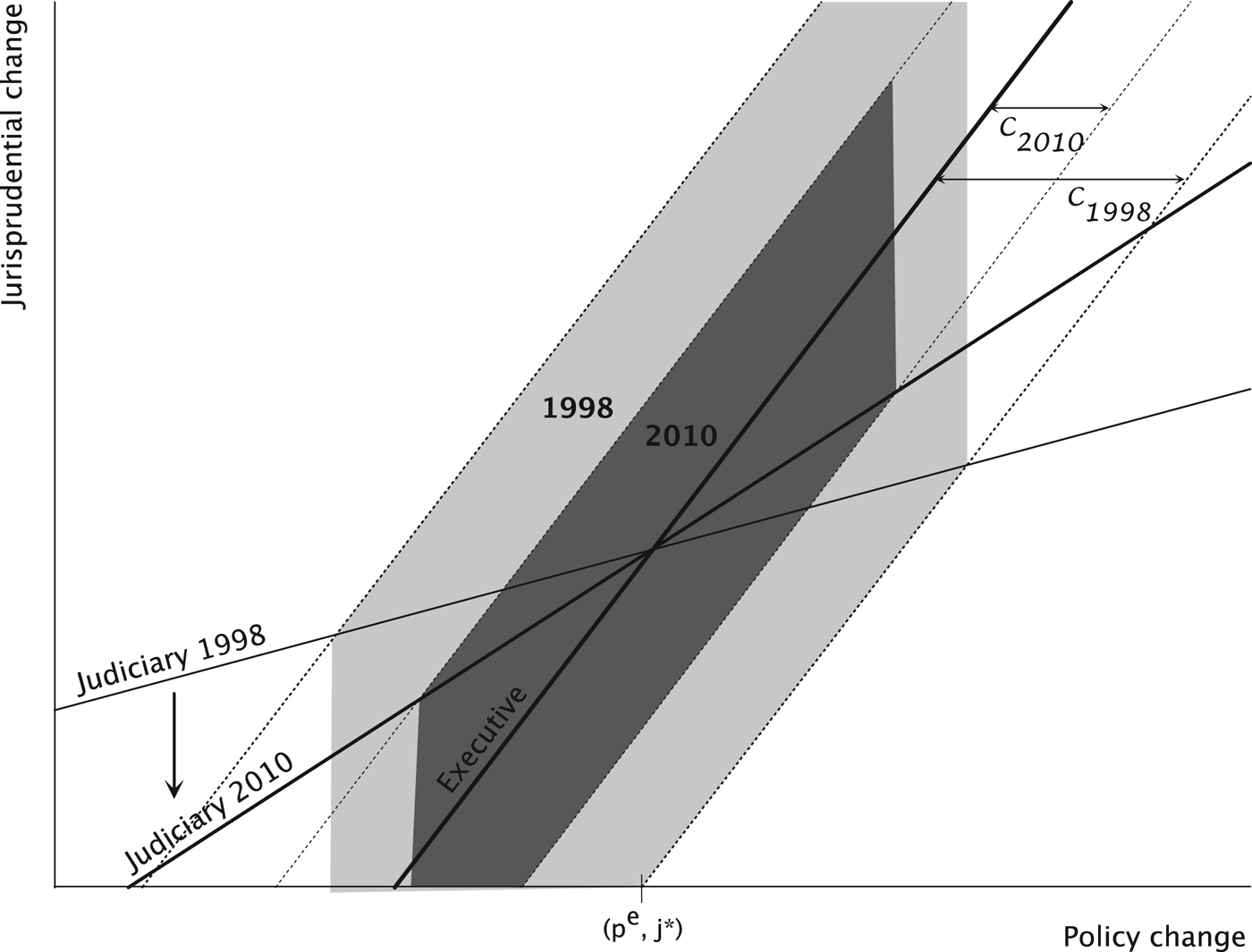
Many of the measures adopted to restrict court leeway took place in the five years prior to the passage of the 2004 Organic Law; that is, before changes in de jure independence had been implemented. The 2004 law, however, further reduced the costs of override, this time via de jure rules. It is intriguing from a historical and comparative perspective that even on this repeatedly purged and packed court some adherence to jurisprudential norms persisted, illustrating that it is very difficult for any government to bring the preferences of the judiciary fully into alignment with its own, in part because of the trade-off between policy and jurisprudential change highlighted in the model. But the Chávez government had clearly constrained the court tightly in the course of little more than a decade. Figure 4 summarises the general direction of Chávez's endeavours, illustrating how his efforts to reduce the cost of override and align the slope of judicial preferences closer to those of the executive led to declining judicial independence between 1998 and 2010.
Summarising the Chávez Effect

Conclusion
This paper has provided a heuristic model of the dynamics of judicial independence, and illustrated how the diverse toolkit of instruments to limit both de jure and de facto judicial independence was used to great effect by the Chávez government between 1998 and 2010. As adherence to at least the procedural window dressing of democracy deepens in Latin America, governments seeking to unshackle themselves of troublesome courts may find that efforts to constrain de jure judicial independence will be challenged by regional and international organisations. As a result, the less scrupulous among them may increasingly fall back on informal de facto procedures such as those employed by Chávez, which allow the government to point to its preservation of formal democratic institutions even as it subverts them from within.
Chávez's Venezuela demonstrates that by shifting judicial preferences through new appointments, threatening non-compliance with key rulings and threatening key judges, governments can gradually move courts closer to their own preferences about the appropriate mix of jurisprudential and policy change. Simultaneously, a combination of tools can be used to reduce the costs of override, including budgetary threats, personal retaliation and public incitement. Governments may thus be able to weaken the effectiveness of the court as a check against the subsequent introduction of de jure challenges to judicial independence, as Chávez did in 2004. This two-step process poses a serious threat to substantive democracy in the region, eroding its core meaning without destroying its outward procedural shell. Such erosion is an increasing concern, with the third wave of democratisation teetering on the verge of regression not only in Venezuela but also potentially in Bolivia, Ecuador and several nations of Central America.
At a theoretical level, the Venezuelan story demonstrates that judicial independence is much more than a tally of formal institutional protections and the formal law on the books. Instead, independence is the outcome of ongoing interactions between political branches and courts over time. As a result, this paper calls into question many of the measures of de jure judicial independence used by social scientists. One issue is that of exactly how we are measuring judicial independence, a question too broad to discuss here but ably addressed elsewhere.Footnote 82 The second is the degree to which any measure can in fact capture the dynamic, quotidian changes in de facto independence. It is worth highlighting that although two prominently used indices of judicial independence demonstrated a shift in Venezuelan judicial independence from some to none in 2002–3, neither of these indices captured any of the preceding story of the constraints placed on the Supreme Court by Chávez beginning in 1998.Footnote 83 Most measures fail to capture the contingency and mutability of judicial independence over time, much less the shifting constraints under which courts and judges labour.
The heuristic model presented here, though, is not applicable solely in situations of authoritarian regress. Even in the more advanced democracies of the region, the model provides useful insights on the logic of political interactions between the branches. For example, in Chile during the 1990s, there were frequent attempts by democratically elected presidents to shift the court's willingness to trade jurisprudential change for policy change.Footnote 84 Equally intriguing is the experience of Brazil's Supremo Tribunal Federal (Supreme Federal Tribunal, STF), which has acted in ways that demonstrate acute awareness of existing political constraints and the consequences of ignoring differences between its preferences and those of the executive branch. The result has been a court marked by a statesmanlike character, neither excessively deferential nor overly conflictual in its relations with the executive.Footnote 85 While its decisions have often been contentious, the STF has managed to find a middle way in a number of highly complex cases, such as choices between components of the 1994 Real Stabilisation Plan and the 1988 Constitution, and more recently, between public repudiation of high-level corruption in the mensalão (‘big monthly payment’) scandal and the Lula government's public and private efforts to sway the court. In cases such as these, concern with institutional self-protection has led the STF to engage in decision-making that squared the letter of the law against potential compliance by the executive, avoiding a hostile response by demonstrating tacit recognition of the bounds of acceptable decisions. Future research might well adopt this model as a way of evaluating the moments when inter-branch conflict is likely to occur, and the consequences for the deepening of democratic practices throughout the region.