INTRODUCTION
Numerous studies have proven beneficial effects of polyunsaturated fatty acids (PUFA) on human health (Simopoulos Reference Simopoulos1991; Horrocks & Yeo Reference Horrocks and Yeo1999; Belury Reference Belury2002). Consumers are increasingly paying attention to healthy food (Hoefkens et al. Reference Hoefkens, Verbeke and Van Camp2011) and next to sugar, salt or total fat intake recommendations, it is of interest to increase the PUFA content of the human diet. In many countries, ruminant products represent a substantial part of the human diet. Unfortunately, lipids in milk (Chilliard et al. Reference Chilliard, Glasser, Ferlay, Bernard, Rouel and Doreau2007) and meat of ruminant origin (Wood et al. Reference Wood, Enser, Fisher, Nute, Sheard, Richardson, Hughes and Whittington2008) is low in PUFA, despite the high PUFA content in forage lipids (Boufaied et al. Reference Boufaïed, Chouinard, Tremblay, Petit, Michaud and Bélanger2003a ). This is due to the extensive lipolysis and biohydrogenation (BH) which takes place in the rumen (Buccioni et al. Reference Buccioni, Decandia, Minieri, Molle and Cabiddu2012). However, lipolysis, which is a prerequisite for rumen BH, might also take place prior to ingestion. Animal diets, especially in intensified dairy farms, often consist of conserved forages, which are low in esterified lipids by transformation to non-esterified fatty acids (FA) during wilting and ensiling (Dewhurst et al. Reference Dewhurst, Scollan, Lee, Ougham and Humphreys2003; Van Ranst et al. Reference Van Ranst, Fievez, De Riek and Van Bockstaele2009a , Reference Van Ranst, Fievez, Vandewalle, Van Waes, De Riek and Van Bockstaele2010). Nevertheless, several in vivo and in vitro experiments have shown reduced BH of PUFA when conserved red clover (Trifolium pratense L.) was a substantial (Van Ranst et al. Reference Van Ranst, Vandewalle, Gadeyne, De Riek and Fievez2013; Halmemies-Beauchet-Filleau et al. Reference Halmemies-Beauchet-Filleau, Vanhatalo, Toivonen, Heikkila, Lee and Shingfield2013) or the sole (Lee et al. Reference Lee, Theobald, Gordon, Leyland, Tweed, Fychan and Scollan2014) part of the herbivore's ration, which has been partly attributed to a protective role of polyphenol oxidase (PPO) (Lee et al. Reference Lee, Harris, Dewhurst, Merry and Scollan2003) against hydrolysis of FA during wilting and ensiling. Recently, a summary of postulated mechanisms and current thinking on red clover's increased flow of PUFA across the rumen has been published (Lee Reference Lee2014). Three potential working mechanisms have been proposed involving PPO-catalysed quinone formation (Van Ranst et al. Reference Van Ranst, Lee and Fievez2011), with the latter being hypothesized to bind to plant lipases or polar lipids (PL), or being involved in the formation of a network of protein-bound phenols entrapping thylakoid lipid (‘encapsulation’) (Lee et al. Reference Lee, Tweed, Cookson and Sullivan2010). Others have put forward the possibility of changes in ruminal digestion kinetics to explain reduced BH of red clover FA with increasing rumen outflow of PL (Halmemies-Beauchet-Filleau et al. Reference Halmemies-Beauchet-Filleau, Vanhatalo, Toivonen, Heikkila, Lee and Shingfield2013). The increased duodenal flow of esterified FA seems a common feature in most of the proposed mechanisms. Moreover, as preserving processes such as wilting and ensiling dramatically reduce forage PL and lipolysis is a prerequisite of the BH process, it could generally be assumed that BH of FA in the rumen is higher with decreasing levels of PL remaining in the forage. Nevertheless, in contrast to what would be expected, Van Ranst et al. (Reference Van Ranst, Fievez, Vandewalle, Van Waes, De Riek and Van Bockstaele2010) observed a reduction of rumen BH of red clover PUFA upon longer ensiling, which concomitantly was associated with decreasing levels of forage PL. However, poor silage quality might have contributed to these observations. Additionally, former silage-based experiments focussed particularly on the plant's own enzymes (Van Ranst et al. Reference Van Ranst, Fievez, De Riek and Van Bockstaele2009a ) liberated by cell damage, whereas the role of microbial lipases during ensiling has been largely neglected.
To summarize, BH of FA in the rumen was hypothesized to be higher with decreasing levels of PL remaining in the (conserved) forage, whereby microbial lipases could enhance lipolysis in silo. Therefore, the aim of the present study was twofold: first, to assess whether reduction in red clover PUFA BH is associated with better conservation of forage PL, and second, to clarify the possible role of microbial activity during ensiling on PL disappearance. For this purpose, laboratory-scale silage was made using fresh, wilted and ensiled material as well as various post-harvest treatments, similar to the experimental setup of Van Ranst et al. (Reference Van Ranst, Fievez, Vandewalle, Van Waes, De Riek and Van Bockstaele2010), in order to induce variation in forage PL content. Furthermore, molasses or formic acid were used as silage additives to stimulate or impair microbial activity, respectively. Perennial ryegrass (Lolium perenne L.) was used as a control. The current experiment further aimed at improving the understanding of the role of PPO in reducing BH.
MATERIALS AND METHODS
Plant material
Red clover (T. pratense L. cvar Lemmon) was sown in May 2010 in three fields at the Institute for Agricultural and Fisheries Research (ILVO, Belgium; 50°59′N, 3°47′E). These fields were kept as replicates throughout the whole experiment. The forage was harvested at the early blooming stage 10 cm above ground level using a Haldrup harvester (J. Haldrup s/a, Løgstør, Denmark) twice in 2010 and 2012 and four times in 2011 before harvesting for the current experiment on 10 September 2012. Each year, mineral fertilizer was applied in March, after the first and second cut of the red clover [6 kg nitrogen (N)/ha, 20 kg phosphorus pentoxide (P2O5)/ha and 140 kg potassium oxide (K2O)/ha]. The average dry matter (DM) content of red clover was 234 g/kg. The cultivar Lemmon was used, as this cultivar is known for its high PPO activity (Van Ranst et al. Reference Van Ranst, Fievez, Vandewalle, De Riek and Van Bockstaele2009b ).
Perennial ryegrass (L. perenne L.) was used in the current experiment as a negative control, since ryegrass shows hardly any PPO activity and subsequent quinone-forming ability in comparison with red clover (Van Ranst et al. Reference Van Ranst, Fievez, Vandewalle, De Riek and Van Bockstaele2009b ). Ryegrass was sown on 20 April 2010 (50°59′N, 3°46′E) in three fields, kept as replicates throughout the whole experiment and harvested in the vegetative stage five times in 2011 and three times in 2012 before harvesting for the current experiment using a Haldrup harvester on 16 August 2012. The forage was fertilized annually (296 kg N/ha, 14 kg P2O5/ha and 276 kg K2O/ha). The average DM content of ryegrass was 248 g/kg.
Silages
Each of the three red clover replications was split into three equal parts (5 kg of fresh material each) for the different treatments. The first part was undamaged, the second part was crushed by hand (squeezing and turning) and the last part was frozen in liquid nitrogen followed immediately by thawing. The degree of cell damage as such was not measured, but slight discoloration for the crushed and frozen/thawed treatment was observed. Then, forages were wilted on the day of harvesting in a ventilated oven at 35 °C to a DM content of at least 350 g/kg. When the targeted DM content was reached, the oven was switched off and the material left overnight in the oven. If the desired DM content had not been reached during the day, the oven was switched off overnight and wilting was continued the next day. After wilting, a silage additive was added to all treatments (undamaged, crushed or frozen/thawed), either molasses (9 g/kg wilted material) or formic acid (3 ml/kg wilted material). The total time between harvesting and ensiling, including the period of artificial drying, was c. 24 h. Approximately 250 g of wilted forage containing a silage additive was ensiled by vacuum packing in polyethylene bags (poly-ethylene vacuum bags 300 × 400 mm2 and 20 µm thick) and stored for 2, 4, 10 or 60 days in a dark place at a constant temperature of 18 °C before opening the silage and sampling. Samples of c. 75 g were taken in the field from the intact parent herbage and will be further referred to as ‘fresh material’, before ensiling for ‘wilted material’ and immediately after opening of the silage for ‘ensiled material’. Samples were vacuum packed and stored at –18 °C until further analysis.
Ryegrass was wilted, ensiled and sampled in a similar way: 4- and 60-day silages were made using undamaged ryegrass and molasses (9 g/kg wilted material) for comparison.
Incubations
Samples taken for in vitro incubation were lyophilized before grinding in a mill with a 1 mm sieve (Brabender Technology, Duisburg, Germany). Ruminal incubations were performed as described by Van Ranst et al. (Reference Van Ranst, Fievez, Vandewalle, Van Waes, De Riek and Van Bockstaele2010). Briefly, 250 mg of freeze-dried and ground fresh, wilted, 4- or 60-days ensiled material was put into 125-ml incubation flasks together with 10 ml buffer solution, 10 ml distilled water and 5 ml of rumen fluid. The buffer solution contained 7·16 g/l disodium phosphate dodecahydrate (Na2HPO4·12H2O), 3·1 g/l monopotassium phosphate (KH2PO4), 0·248 g/l magnesium chloride hexahydrate (MgCl2·6H20), 17·48 g/l sodium bicarbonate (NaHCO3) and 2 g/l ammonium bicarbonate (NH4HCO3). Fievez et al. (Reference Fievez, Vlaeminck, Jenkins, Enjalbert and Doreau2007) demonstrated that no in vitro adaptation period was required and the currently used inoculum/buffer ratio was appropriate to estimate BH of C18 : 2n-6 or C18 : 3n-3. Rumen fluid was taken before morning feeding from three fistulated sheep, which were fed hay ad libitum and had free access to drinking water. Fistulation of the sheep was approved by the Ethical Commission of the Institute for Agricultural and Fisheries Research (ILVO), Belgium (file number 114, 2009). Rumen contents from sheep were combined (pH = 6·44) and filtered through a sieve with a pore size of 1 mm under continuous carbon dioxide (CO2) flushing at 39 °C. Incubation flasks were flushed with CO2 before adding 1 ml of ethane (internal gas standard) followed by incubation under intermittent shaking at 39 °C for 24 h in a batch culture incubator (Edmund Bühler GmbH, Hechingen, Germany). After 24 h, flasks were removed from the incubator and placed in ice water. Measurements of pH (Hanna Instruments, Temse, Belgium), gas (Hassim et al. Reference Hassim, Lourenço, Goel, Vlaeminck, Goh and Fievez2010) and volatile fatty acids (VFA; vide infra) were performed as a quality control of the incubations. Five ml of homogenized rumen fluid was taken before and after 24 h incubation and freeze-dried before analysis of long-chain FA.
Analysis
Silage quality
The quality of the ensiled forages was assessed by analysing VFA, lactic acid and ammonia after opening of the plastic bags.
Volatile fatty acids (acetic acid, propionic acid, butyric acid) were analysed using a chromatographic method. Silage (5 g wet material) was mixed in 25 ml acidified water (20 ml 10/1 phosphoric acid/formic acid per litre distilled water) using an Ultra-Turrax (9500 rpm, T25, IKA-Labortechnik, Staufen, Germany) equipped with a S25N18 dispersing element (IKA-Labortechnik, Staufen, Germany) and shaken for 2 h using a Multi-Tube Vortex (VX-2500, VWR International, Leuven, Belgium). Next, samples were filtered and centrifuged (22 000 g , 30 min, 4 °C) before again filtering the remaining supernatants. Samples were analysed using gas chromatography (HP 7890A, Agilent Technologies, Diegem, Belgium) equipped with a FID detector and a Supelco Nukol capillary column (30 m × 0·25 mm × 0·25 µm, Sigma-Aldrich, Diegem, Belgium). The temperature programme was as follows: 120 °C at injection for 0·2 min; increased by 10 °C/min to 180 °C and maintained at this temperature for 3 min; injector temperature: 250 °C; detector temperature 255 °C. For this temperature programme, 0·3 µl was injected with a split/splitless ratio of 25 : 1 using hydrogen (H2) as a carrier gas at 0·8 ml/min. The VFA peaks were identified based on their retention times, compared with external standards. Ruminal VFA were analysed using the same chromatographic protocol.
Lactic acid concentrations were determined using the remaining supernatants from the VFA analysis through oxidation to acetaldehyde using Conway microdiffusion chambers and spectrophotometry at 224 nm (Conway Reference Conway and Conway1957).
Ammonia was also determined using the supernatants remaining after preparation for VFA analysis, based on the method described by Chaney & Marbach (Reference Chaney and Marbach1962). Briefly, 2 ml of supernatant was taken and acidified using 2 ml 0·2 N hydrochloric acid (HCl). Samples were shaken, centrifuged (1700 g , 20 min) and 1 ml supernatant collected in an experimental tube. Next, 4·5 ml of a solution containing 10 g/l phenol (Merck, Darmstadt, Germany) and 0·05 g/l sodium nitroprusside dihydrate [Na2(Fe(CN)5NO)·2H2O; Sigma-Aldrich, Diegem, Belgium], and 4·5 ml of a solution containing 5 g/l sodium hydroxide (NaOH) and 4·2 ml/l 10% sodium hypochlorite (NaClO) (Sigma-Aldrich, Diegem, Belgium), were added, vortexed and left at room temperature for 1 h. Ammonia was quantified using an external standard [0–20 mg/l ammonium chloride (NH4Cl), Sigma-Aldrich, Diegem, Belgium] and by measuring the absorbance at 625 nm.
Isolation of lipid fractions and fatty acid quantification
First, lipids from fresh, wilted or ensiled material were extracted. Therefore, 5 g of fresh or wilted material or 3 g of ensiled material was extracted as described by Lourenço et al. (Reference Lourenço, Van Ranst, De Smet, Raes and Fievez2007) using chloroform/methanol (C/M) (2/1, v/v) and 4 ml C19 : 0 as an internal standard (2·5 mg/ml chloroform, Sigma-Aldrich, Diegem, Belgium) and brought to a final volume of 100 ml using chloroform/methanol. Extracts were stored at –18 °C until further analysis.
Next, lipid extracts were separated into three lipid fractions by solid phase extraction as described by Van Ranst et al. (Reference Van Ranst, Fievez, Vandewalle, Van Waes, De Riek and Van Bockstaele2010): PL (mainly composed of glycolipids and phospholipids), free fatty acids (FFA) and neutral lipids (NL) [composed of triacylglycerides (TAG), diacylglycerides and monoacylglycerides]. The internal standard used for the NL, FFA and PL fractions consisted of 0·25 ml TAG-C13 : 0 (0·25 mg/ml chloroform, Nu-Chek Prep Inc., Elysia, MN) and 0·1 ml C21 : 0 (0·5 mg/ml chloroform, Sigma-Aldrich, Diegem, Belgium), whereby C21 : 0 was only added to the FFA and PL fraction after extraction and before methylation for quantification.
Finally, the different fractions were methylated and FA quantified using gas chromatography as described by Van Ranst et al. (Reference Van Ranst, Fievez, Vandewalle, Van Waes, De Riek and Van Bockstaele2010). A gas chromatograph (HP 6890, Agilent Technologies, Diegem, Belgium) equipped with a Solgel-wax column (30 m × 0·25 mm × 0·25 µm, SGE Analytical Science, Ringwood, Victoria, Australia) was used. The temperature programme was as follows: 150 °C for 2 min; increased by 3 °C/min to 250 °C; injector temperature: 250 °C; detector temperature 280 °C. For this temperature programme, 2 µl was injected using a split/splitless ratio of 50 : 1 and H2 as carrier gas at a flow rate of 1 ml/min. FA peaks were identified based on their retention times, compared to external standards (Supelco 37, Supelco Analytical, PA; PUFA-3, Matreya LLC, Pleasant Gap, PA). Quantification of FA methyl esters was based on the area of the internal standards and on the conversion of peak areas to the weight of FA by a theoretical response factor for each FA (Ackman & Sipos Reference Ackman and Sipos1964; Wolff et al. Reference Wolff, Bayard and Fabien1995).
Long-chain fatty acids and in vitro ruminal biohydrogenation
The total FA composition of fresh, wilted or ensiled material and ruminal incubation fluid was determined after lyophilization by direct transesterification according to the method described by Gadeyne et al. (Reference Gadeyne, Van Ranst, Vlaeminck, Vossen, Van Der Meeren and Fievez2015). An aliquot of 250 mg of lyophilized plant material or 5 ml of rumen fluid sampled before or after 24 h incubation was used together with 2 ml C13 : 0 (1 mg/ml toluene, Sigma-Aldrich, Diegem, Belgium) as internal standard to quantify FA. Gas chromatography equipment and conditions were the same as described for the lipid fractions (vide supra). In vitro ruminal BH of C18 : 3n-3 was calculated as [(proportion of C18 : 3n-3 in total C18 FA)0 h – (proportion of C18 : 3n-3 in total C18 FA)24 h]/(proportion of C18 : 3n-3 in total C18 FA)0 h, assuming no net synthesis of 18-carbon FA in the rumen. Biohydrogenation of C18 : 2n-6 was calculated similarly.
Statistics
All results were analysed using the MIXED procedure of SAS (SAS Enterprise Guide 6, SAS Institute Inc., Cary, NC). Perennial ryegrass (undamaged material using molasses) was compared with red clover (frozen/thawed material using molasses) using a two-sample t test (TTEST procedure).
Characteristics of differently treated wilted red clover were compared using the following model:
 $${Y_i} = \mu + {T_i} + \varepsilon $$
where Y i is the response, T i the fixed effect of treatment (i = undamaged, crushed or frozen/thawed) and ε the residual error.
Treatments imposed on red clover silages were compared using the following model:
 $$\eqalign{{Y_{ijk}} & = \mu + {S_i} + {A_j} + {T_k} + {S_i} \times {A_j} + {S_i} \times {T_k} + {A_j} \times {T_k} \cr & \quad + {S_i} \times {A_j} \times {T_k} + \varepsilon}$$
where Y ijk is the response, S i the fixed effect of ensiling period (i = 2, 4, 10 or 60 days), A j the fixed effect of additive (j = molasses or formic acid), T k the fixed effect of treatment (k = undamaged, crushed or frozen/thawed) and ε the residual error. Ensiling period (S i ) was considered as a repeated measurement and partitioned into linear and quadratic contrasts for both the main and interaction effects, unless ensiling period contained only two factors (i = 4 or 60 days; results of in vitro rumen incubations). Linear rate analysis for the loss of lipids from the PL fraction was done using the REG procedure.
The following model was used to compare treatments imposed on perennial ryegrass:
 $${Y_i} = \mu + {S_i} + \varepsilon $$
where Y i is the response, S i the fixed effect of stage (i = fresh, wilted, 4- or 60-days silage) and ε the residual error.
Results for red clover total FA distributions and BH were analysed using the following model:
 $${Y_i} = \mu + {S_i} + \varepsilon $$
where Y i is the response, S i the fixed effect of stage (i = fresh, wilted, 2-, 4-, 10- or 60-days silage) and ε the residual error.
Differences were significant at P < 0·05, while tendencies were assigned at P < 0·10. Differences among least squares means were evaluated using Tukey's multiple comparison test.
Finally, relationships between varying PL levels, imposed by the different treatments, and the level of C18 : 3n-3 BH were evaluated by linear regression analysis using the REG procedure of SAS.
Results
Silage quality
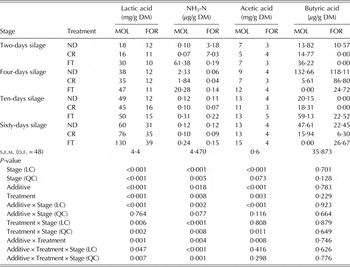
Since one of the objectives was to assess the influence of in silo microbial activity, formic acid was included as a silage additive to prevent in silo microbial development. To check whether silages of satisfactory quality and variation in silage microbial activity was obtained with the two silage additives, the end products of microbial activity during ensiling (lactic acid, NH3-N, acetic acid and butyric acid) were measured. Results for red clover and perennial ryegrass silages are presented in Tables 1 and 2, respectively.
Silage parameters (lactic acid, NH3-N, acetic acid and butyric acid) of red clover which was undamaged, crushed or frozen/thawed before wilting and ensiled with molasses or formic acid as additive for 2, 4, 10 or 60 days (n = 3)

DM, dry material; MOL, molasses; FOR, formic acid; ND, undamaged; CR, crushed; FT, frozen/thawed; s.e.m., standard error of the mean; d.f., degrees of freedom; LC, linear contrast; QC, quadratic contrast.
Silage parameters (lactic acid, NH3-N, acetic acid and butyric acid) of perennial ryegrass which was undamaged and ensiled with molasses as additive for 4 or 60 days (n = 3)

DM, dry material; s.e.m., standard error of the mean; d.f., degrees of freedom.
Lactic acid was detected in both red clover and perennial ryegrass silages. Lactic acid concentration in red clover silages increased linearly over time with molasses as silage additive, in contrast to formic acid where a much smaller increase over time was observed. When molasses was used, greater lactic acid concentrations were found in the more severely damaged material compared with the undamaged counterparts, in contrast to formic acid where only minor or no consistent effects of damaging were observed.
Ammonia (NH3-N) concentrations in red clover and perennial ryegrass silages were generally low. Short-term red clover silages (2 and 4 days) with frozen/thawed forage and molasses contained much greater concentrations of NH3-N compared with the undamaged and crushed silages, in contrast to the longer ensiled counterparts.
Higher acetic acid concentrations were observed with increased ensiling duration when molasses was used, both for red clover as well as perennial ryegrass. Red clover silages with molasses showed higher acetic acid concentrations than silages with formic acid. The highest butyric acid concentrations were observed for non-damaged 4-day silages. However, butyric acid concentrations were generally low in all silages and not affected by ensiling duration, additive or treatment.
Lipid fractions in fresh, wilted and ensiled forage
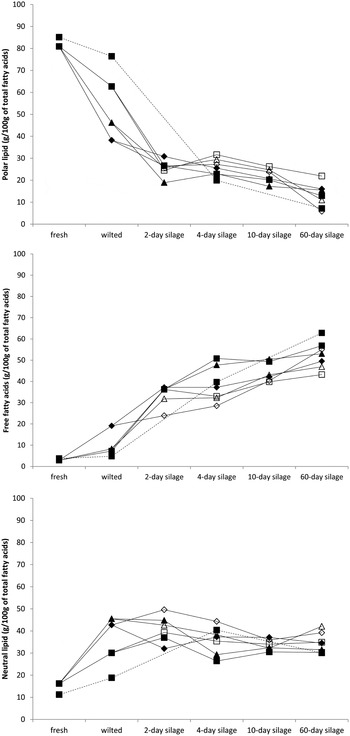
Total lipids in forage extracts were fractionated before methylation into three classes: PL, FFA and NL. The distribution of total lipids into these lipid fractions in fresh, wilted and ensiled red clover and perennial ryegrass is presented in Fig. 1. The total amount of FA and the relative composition of the major FA C16 : 0, C18 : 0, C18 : 1n-9, C18 : 2n-6 and C18 : 3n-3 in fresh, wilted and ensiled red clover or perennial ryegrass are reported in Supplementary Tables S1, S2 and S3 (available online at http://www.http://journals.cambridge.org/AGS). Numerical values and results of statistical analysis for data shown in Fig. 1 are reported in Supplementary Tables S4, S5 and S6 (available online at http://www.http://journals.cambridge.org/AGS).
Distribution of total fatty acids in the polar lipid, free fatty acid or neutral lipid fraction (g/100 g total fatty acids) of fresh, wilted and ensiled (2, 4, 10 or 60 days) red clover (data points connected by full lines) or perennial ryegrass (data points connected by dotted lines) which was undamaged (squares), crushed (triangles) or frozen/thawed (diamonds) before wilting and ensiled with molasses (full symbols) or formic acid (empty symbols) as additive (n = 3).

Most lipids in fresh red clover were present as PL (80·9 g/100 g FA), while only minor proportions were present as FFA (2·90 g/100 g FA) or NL (16·2 g/100 g FA) (Fig. 1). The proportion of PL dropped markedly while FFA and NL increased during wilting of red clover. There was a tendency for less PL when wilted material was more severely damaged (P = 0·079). As a result, lipolysis during wilting, i.e. the disappearance of FA from the PL fraction (as compared with the PL fraction of the fresh forage), varied on average between 22·5 and 52·7 g/100 g FA for the undamaged and frozen/thawed wilted red clover, respectively. The PL fraction decreased further linearly upon ensiling. The longer red clover was ensiled, the smaller the PL fraction (P < 0·001; linear contrast) and the larger the FFA fraction (P < 0·001; linear contrast). Compared with the wilted material, the greatest changes from esterified to non-esterified FA were generally observed upon ensiling and NL also increased upon wilting (P < 0·001). Remarkably, a plateau or maximum value seemed to be reached for NL from the wilting phase onwards, as this fraction was unchanged during the later silage stages irrespective of the degree of damage and both for molasses- and formic acid-supplemented forages. The FFA fraction continued to increase until 60 days of ensiling. Despite high variation within type of damaging (treatment) for both additives (Table S5), a tendency towards lower PL (P = 0·058) and higher FFA (P < 0·001) proportions were found in red clover silages with molasses as compared with formic acid, but a significant interaction was found between the quadratic contrast of silage duration and additive (P = 0·008 and P = 0·043 for PL and FFA, respectively). Polar lipids were released at a slower rate in silages with molasses (–0·157 g/100 g FA/day; P < 0·001) than in silages with formic acid (–0·250 g/100 g FA/day; P < 0·001), whereby the PL fraction for formic acid silages reached the smallest level after 60 days of ensiling (only 5·83 g/100 g FA of FA remained in the PL fraction of frozen/thawed red clover silages). The FFA did not increase in formic acid-supplemented silages when ensiled for a short time (2 and 4 days; P > 0·999), as opposed to silages with molasses (P = 0·005). However, after a longer ensiling period, FFA levels in silages with both additives were similar (P = 0·097 and P = 0·369 for 10 and 60 days, respectively).
As for red clover, most lipids in perennial ryegrass were present as PL (85·1 g/100 g FA) and only minor proportions as FFA (3·75 g/100 g FA) or NL (11·2 g/100 g FA). Lipids in the PL fraction of ryegrass gradually turned into FFA and NL over the wilting and ensiling stages. The sharpest decrease in PL was observed between the wilted forage and the 4-day ensiled material (P < 0·001). Between 4 and 60 days of ensiling (P = 0·001), NL lipids in ryegrass silages seemed to decrease in favour of FFA. Lipid distributions in perennial ryegrass and red clover were similar for the 4-day silages using molasses (frozen/thawed forage; P = 0·222, P = 0·668 and P = 0·516 for PL, FFA and NL, respectively). However, PL was lower and FFA higher for red clover compared to ryegrass for the wilted material (frozen/thawed; P < 0·001 and P = 0·003 for PL and FFA, respectively), but the opposite was found for the 60-day ensiled material (frozen/thawed; P < 0·001 and P = 0·007 for PL and FFA, respectively). Higher levels of NL were observed for wilted red clover compared to grass (P < 0·001), but no differences were found between the 60-day silages (P = 0·111). Overall, disappearance of FA from the PL fraction was faster in red clover as compared with ryegrass, since only limited decreases were observed from ryegrass PL during wilting. The opposite was true for ensiled material where PL reached lower levels in ryegrass as compared with red clover.
In vitro incubation of fresh, wilted and ensiled forage
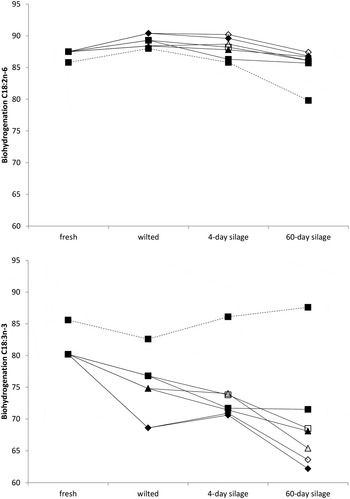
Treatments as described in the previous section resulted in different proportions of FA in the PL and FFA fraction. Fatty acids in the esterified PL and NL fraction need to be hydrolysed prior to ruminal BH. Hence, differences in lipolysis could result in differences in BH by microbial hydrogenases in the rumen. Therefore, fresh, wilted, 4- and 60-day ensiled red clover and perennial ryegrass were subjected to 24 h in vitro rumen incubations. Results for BH of C18 : 2n-6 and C18 : 3n-3 (the major unsaturated FA in the forages) in fresh, wilted and ensiled red clover and perennial ryegrass are shown in Fig. 2. Numerical values and results of statistical analysis for data shown in Fig. 2 are reported in Tables S4, S6 and S7 (available from http://journals.cambridge.org/AGS). To monitor the quality of the incubations, both VFA (acetic acid, propionic and butyric acid) and gas (H2 and CH4) produced by micro-organisms from the forages were measured after 24 h. In this way, it was possible to determine that differences in BH would not have been caused by major changes in microbial activity (indicated by the total VFA production) or shifts in the microbial population (indicated by changes in VFA or CH4 proportions). Fermentation characteristics for fresh, wilted and ensiled red clover or perennial ryegrass are presented in Tables S8, S9 and S10 (available from http://journals.cambridge.org/AGS). Overall, differences in fermentation characteristics between treatments for both red clover and perennial ryegrass were small.
Biohydrogenation of C18 : 2n-6 and C18 : 3n-3 after 24 h in vitro rumen incubation of fresh, wilted and ensiled (4 or 60 days) red clover (data points connected by full lines) or perennial ryegrass (data points connected by dotted lines) which was undamaged (squares), crushed (triangles) or frozen/thawed (diamonds) before wilting and ensiled with molasses (full symbols) or formic acid (empty symbols) as additive (n = 3).

Fresh red clover showed BH levels of 0·875 and 0·802 for C18 : 2n-6 and C18 : 3n-3, respectively (Fig. 2). No differences in BH of C18 : 2n-6 were found between damage-levels of the wilted material (P = 0·247), while BH of C18 : 3n-3 in frozen/thawed red clover was lower as compared with the less damaged treatments (undamaged = crushed > frozen/thawed; P = 0·002). Biohydrogenation of both types of PUFA was more extensive for red clover material which had been ensiled for a longer period (P < 0·001), although differences were largest for C18 : 3n-3. There was no effect of silage additive on BH (P = 0·101 and P = 0·855 for C18 : 2n-6 and C18 : 3n-3 BH, respectively). Damaging affected C18 : 2n-6 and C18 : 3n-3 BH differently: while BH of C18 : 2n-6 gradually increased when red clover was damaged more (undamaged = crushed < frozen/thawed; P < 0·05), a decrease in C18 : 3n-3 BH was observed upon increased damaging (undamaged > crushed > frozen/thawed; P < 0·05). In contrast to C18 : 2n-6 (P = 0·325), interaction effects were found for C18 : 3n-3 (P = 0·003): BH of 4-day red clover silages and undamaged 60-day silages did not differ, but BH of C18 : 3n-3 in 60-day ensiled red clover gradually decreased upon damaging (undamaged > crushed > frozen/thawed). No or only small differences occurred between fresh, wilted, 4- and 60-day ensiled red clover of C18 : 2n-6 BH, whereas C18 : 3n-3 BH was lowest in 60-day silages containing red clover which had been most severely damaged before wilting (freezing and thawing). A reduction in BH of up to 18% for frozen/thawed silages with molasses as compared with the fresh forage was observed.
On the other hand, fresh perennial ryegrass showed BH levels of 0·858 and 0·856 for C18 : 2n-6 and C18 : 3n-3, respectively. No decrease in BH of C18 : 3n-3 upon wilting and ensiling of fresh perennial ryegrass was observed (P = 0·061), while only a slight decrease in BH of C18 : 2n-6 was seen after 60-days of ensiling (P = 0·001). As a result, frozen-thawed red clover using molasses resulted in lower levels of BH for C18 : 3n-3 as compared with perennial ryegrass (P = 0·002, P = 0·002 and P < 0·001 for wilted, 4- and 60-day silages, respectively). The opposite was true for BH of C18 : 2n-6 for 4- and 60-day ensiled forage (P = 0·034 and P < 0·001, respectively), while similar levels were found for BH of C18 : 2n-6 in both wilted forages (P = 0·153).
DISCUSSION
As forages are often wilted and ensiled for preservation during storage, their FA gradually disappear from the PL fraction, leading to an increase of non-esterified FA (Dewhurst et al. Reference Dewhurst, Scollan, Lee, Ougham and Humphreys2003; Van Ranst et al. Reference Van Ranst, Fievez, Vandewalle, Van Waes, De Riek and Van Bockstaele2010, Reference Van Ranst, Vandewalle, Gadeyne, De Riek and Fievez2013). Results from the present study confirm the gradual turnover of FA originating from the PL fraction to FFA and NL upon conservation, both in red clover and perennial ryegrass. However, it remained unclear whether this disappearance of FA from the PL fraction is primarily caused by the plant's own enzymes, liberated during harvesting, wilting or ensiling, or if there is any contribution in this turnover of enzymes from microbes occurring during ensiling. Second, the unexpected aspect found by Van Ranst et al. (Reference Van Ranst, Fievez, Vandewalle, Van Waes, De Riek and Van Bockstaele2010), showing a decreased rumen microbial BH of linolenic acid upon longer ensiling of red clover when smaller amounts of PL remained, deserved further investigation. Both aspects will be discussed in the next sections, followed by a paragraph to help further the understanding of which mechanism is more likely to explain red clover's increased flow of PUFA across the rumen, based on the current results.
Contribution of microbial development during ensiling on lipid metabolism
Former research has focused mainly on plant enzymes being responsible for FA conversions during wilting and ensiling (Lee et al. Reference Lee, Winters, Scollan, Dewhurst, Theodorou and Minchin2004; Van Ranst et al. Reference Van Ranst, Fievez, Vandewalle, De Riek and Van Bockstaele2009c ; Ding et al. Reference Ding, Long and Guo2013). One of the most characteristic features of membrane deterioration in stressed plants is the progressive decline in phospholipid and galactolipid levels, accompanied by relative enrichment of FFA and NL by stress-induced degradation of membrane lipids, e.g. by wounding of the plant material, by enzymes such as galactolipase (Kaniuga Reference Kaniuga2008). However, the contribution of microbes could not be excluded. Therefore, it was evaluated whether microbial activity could play a role during ensiling in this turnover of FA from PL by comparing silages with molasses or formic acid, assuming the former to stimulate microbial activity (in particular Lactobacilli) in silo (Lattemae et al. Reference Lattemae, Ohlsson and Lingvall1996), while formic acid lowered pH in the latter silages to such an extent that fermentation was restricted (Lattemae et al. Reference Lattemae, Ohlsson and Lingvall1996; Dewhurst & King Reference Dewhurst and King1998). Progressively increasing lactic acid concentrations were found upon longer ensiling using molasses as an additive, while low levels were observed for silages containing formic acid. Further, short-term silages with frozen/thawed forage and molasses contained high concentrations of NH3-N, suggesting more extensive proteolysis, but the disappearance in the long-term silages could indicate that NH3-N was then used for microbial growth. Microbial lipases, which become more abundant with increasing microbial activity (Van Ranst et al. Reference Van Ranst, Fievez, Vandewalle, Van Waes, De Riek and Van Bockstaele2010) were hypothesized to enhance lipolysis in silo. Lipolytic activity by Lactobacilli has been shown before, although lipase activities of extracts obtained from lactic acid bacteria were substantially lower than those reported for other micro-organisms (Meyers et al. Reference Meyers, Cuppett and Hutkins1996). However, no consistent results over the different silage additives were found, suggesting microbial lipases in silo did not contribute to a large extent in PL disappearance. Accordingly, the current results confirm observations by Ding et al. (Reference Ding, Long and Guo2013), suggesting that plant enzymes play the most prominent role in silage lipolysis.
Effect of variation in forage polar lipid levels on in vitro ruminal biohydrogenation
In order to study the effect of varying levels of PL on in vitro ruminal BH, an experimental setup similar to the one described by Van Ranst et al. (Reference Van Ranst, Fievez, Vandewalle, Van Waes, De Riek and Van Bockstaele2010) was used. Wilting and ensiling of red clover forage over different time intervals, damaged to varying extents, allowed the creation of substantial variation in proportions of FA remaining in the PL fraction, while the use of molasses and formic acid as silage additive ensured sufficient silage quality. The following subsections will focus on the variation in PL and BH imposed by the different treatments and the link between them is discussed.
Variation in fatty acids disappearing from the polar lipid fraction in red clover and perennial ryegrass
It has been suggested before that activation of PPO in red clover, by damaging the crop, could lead to protection against disappearance of FA from the PL fraction (Lee et al. Reference Lee, Tweed, Minchin and Winters2009). Polyphenol oxidase is a generic name used for all enzymes that are capable of catalysing the oxidation of (di)phenols to quinones using molecular oxygen. These quinones are highly reactive towards all types of nucleophilic binding sites, as found in amino acids and different phenolic groups, resulting in the non-enzymatic polymerization and formation of melanin-like protein–phenol complexes (Yoruk & Marshall Reference Yoruk and Marshall2003). High PPO activity has been reported in different red clover cultivars (Van Ranst et al. Reference Van Ranst, Fievez, Vandewalle, De Riek and Van Bockstaele2009b ). Activation of PPO is needed due to the separate subcellular compartmentalization of the enzyme, residing in the chloroplast, and its diphenolic substrates, which are presumably present in the vacuole (Lee et al. Reference Lee, Tweed, Cookson and Sullivan2010). It is known that higher PPO activity leads to higher production of protein-bound phenols and decreased lipase activity (Lee et al. Reference Lee, Winters, Scollan, Dewhurst, Theodorou and Minchin2004; Van Ranst et al. Reference Van Ranst, Fievez, Vandewalle, De Riek and Van Bockstaele2009c ). For the current experimental setup, it was assumed that exposing red clover to liquid nitrogen, followed by immediate thawing, leads to a larger degree of PPO activation than crushing the forage or leaving it unharmed (Lee et al. Reference Lee, Tweed, Minchin and Winters2009). Van Ranst et al. (Reference Van Ranst, Fievez, Vandewalle, De Riek and Van Bockstaele2009c ) also found the highest induction of PPO activity for frozen/thawed red clover in comparison with undamaged material. However, results from the present study were inconclusive concerning the disappearance of FA from the PL fraction when ensiled red clover was more severely damaged. Nevertheless, both in the current work as well as the study of Van Ranst et al. (Reference Van Ranst, Fievez, Vandewalle, Van Waes, De Riek and Van Bockstaele2010), fermentation progressed during ensiling of red clover and differences in PL proportions were found compared with the original forage, resulting in similar and relatively small levels of FA remaining in the PL fraction after wilting or ensiling, irrespective of the level of damage. These observations suggest there was no effect of damage, and hence PPO activation, on the disappearance of FA from the PL fraction. The fact the degree of damage did not result in the expected variation in protection might be related to the suicidal inactivation properties of PPO (Munoz-Munoz et al. Reference Munoz-Munoz, Garcia-Molina, Varon, Garcia-Ruiz, Tudela, Garcia-Canovas and Rodriguez-Lopez2010), which may limit the extent of PPO oxidation, protein-bound phenol production and ultimately FA protection (Lee et al. Reference Lee, Tweed and Sullivan2013). Furthermore, lower PL proportions were observed in silages with molasses than with formic acid, similar to the findings of Koivunen et al. (Reference Koivunen, Jaakkola, Heikkilä, Lampi, Halmemies-Beauchet-Filleau, Lee, Winters, Shingfield and Vanhatalo2015), which suggested formic acid addition during ensiling of red clover reduced in silo lipolysis. Notably, the lowest PL levels were observed for frozen/thawed red clover ensiled for 60 days with formic acid, but differences with other treatments were not significant (Table S5).
Besides different levels of damage imposed on red clover forage, treatments with undamaged perennial ryegrass were included for comparison. Although PPO in ryegrass and red clover are not the same, as they show different PPO activities (Winters et al. Reference Winters, Minchin, Merry and Morris2003) with varying affinity for different substrates (Parveen et al. Reference Parveen, Threadgill, Moorby and Winters2010), comparisons between both were made, in which ryegrass was considered as control, due to its low PPO activity compared with red clover. As a result, both forages were expected to have different abilities to create quinones, protein-bound phenols and presumed protection levels. Therefore, statistical comparisons were made between undamaged ryegrass and frozen/thawed red clover, as these were considered to be the most extreme. The pattern of PL disappearance in grass and red clover differed. Although a faster turnover in red clover was found during the wilting phase, substantial disappearance from the PL fraction of ryegrass only started upon ensiling. These differences might be explained by unintentionally more severe cell damage in red clover or might be related to different release patterns of lipases and diacylglycerol transferase (DGAT) induced by wilting and damage stress, whereby DGAT liberation might explain the increases in NL (Kaup et al. Reference Kaup, Froese and Thompson2002). Finally, most ryegrass PL disappeared in favour of FFA and NL after ensiling for a longer period, whereas PL levels in red clover (12·9–16·0 g/100 g FA) remained slightly higher (P < 0·001) than in their ryegrass counterparts (7·1 g/100 g FA). This effect was also observed recently by Koivunen et al. (Reference Koivunen, Jaakkola, Heikkilä, Lampi, Halmemies-Beauchet-Filleau, Lee, Winters, Shingfield and Vanhatalo2015), showing lower lipolysis in silages of red clover ensiled with formic acid than a mixture of timothy (Phleum pratense L.) and meadow fescue (Festuca pratensis Huds.) grasses.
Variation in biohydrogenation in red clover and perennial ryegrass
Esterified forage FA are largely transformed to FFA by microbial lipases, galactosidases or phospholipases produced in the rumen (Jenkins Reference Jenkins1993), followed by a rapid hydrogenation of unsaturated FFA by ruminal microbes (Buccioni et al. Reference Buccioni, Decandia, Minieri, Molle and Cabiddu2012). In the present study, lower in vitro C18 : 3n-3 BH was observed when wilted or ensiled red clover was damaged to a higher extent. These results are in contrast to the findings of Van Ranst et al. (Reference Van Ranst, Fievez, Vandewalle, Van Waes, De Riek and Van Bockstaele2010), where a reduction in BH was observed upon wilting and ensiling of fresh red clover, irrespective of damage. As it was hypothesized before, FA in damaged wilted red clover seemed to be protected better against ruminal hydrogenases, most probably by stimulation of PPO and the presumed consequent formation of protein-bound phenols (Lee et al. Reference Lee, Tweed, Cookson and Sullivan2010). Although protein-bound phenols as such were not measured, a severe browning reaction in the frozen/thawed forage was observed, which is an indication of quinone formation and polymerization (Lee Reference Lee2014). In contrast to red clover, no differences were found in BH of C18 : 3n-3 for perennial ryegrass between the different wilted and ensiled stages. Differences in C18 : 3n-3 BH between both forages became larger as red clover was wilted and ensiled, possibly because protein-bound phenol complexes in frozen/thawed wilted and ensiled PPO-rich red clover could develop better than in undamaged and PPO-poor ryegrass. Van Ranst et al. (Reference Van Ranst, Fievez, Vandewalle, Van Waes, De Riek and Van Bockstaele2010) also showed a decrease in BH was achieved by intensively damaging red clover, but only after 60 days of ensiling, which is suggested to be due to high PPO activity. However, one would not expect quinones to be formed in the absence of oxygen in good quality silages. Possibly, small levels of oxygen were present or leaked into the poly-ethylene bags during ensiling. This could explain why prolonged ensiling of red clover, in contrast to perennial ryegrass, resulted in better protection: possibly small but adequate levels of oxygen in the laboratory-scale silages were enough to result in the necessary quinone formation to obtain protection. Prior damaging was an essential pre-treatment to activate PPO during the wilting stage, while further contact between PPO and the diphenolic substrate during the ensiling stage might have ameliorated protection.
BH of C18 : 2n-6 in red clover, however, did not follow the trend of C18 : 3n-3 BH. Remarkably, BH of C18 : 3n-3 was lower than for C18 : 2n-6 in fresh red clover, although BH for both FA still fell within the ranges of the meta-analysis based on in vivo data by Glasser et al. (Reference Glasser, Schmidely, Sauvant and Doreau2008). Differences between C18 : 2n-6 and C18 : 3n-3 BH after the various treatments of the fresh herbage might be related to the different physical location of both FA: C18 : 3n-3 is mainly found in chloroplast membranes, where PPO is also present (Lee et al. Reference Lee, Tweed, Cookson and Sullivan2010), while C18 : 2n-6 is found in many plant cell organelles (Hawke Reference Hawke, Butler and Bailey1973).
Association between proportions of polar lipids and linolenic acid biohydrogenation in red clover and perennial ryegrass
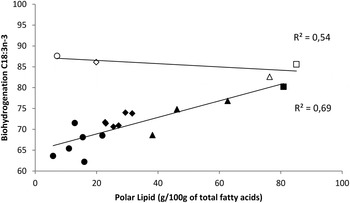
Lipolysis of esterified FA by either plant or microbial lipases is a prerequisite before BH can take place in the rumen (Lourenço et al. Reference Lourenço, Ramos-Morales and Wallace2010; Buccioni et al. Reference Buccioni, Decandia, Minieri, Molle and Cabiddu2012). Also in the present study, most FA of the original PL fraction of the fresh forage gradually hydrolysed upon wilting and prolonged ensiling. Generally, it could be assumed that BH of FA in the rumen of animals fed with wilted or ensiled forage would be higher, as more FA are already present in a non-esterified form, facilitating the BH of these FA. The relation between FA remaining in the PL fraction of red clover and perennial ryegrass forage and in vitro rumen C18 : 3n-3 BH is shown in Fig. 3, combining all different red clover and ryegrass treatments of the present study. It is clearly shown that reduced proportions of FA in the PL fraction were associated with reduced BH of C18 : 3n-3, an effect which was observed before in red clover (Van Ranst et al. Reference Van Ranst, Fievez, Vandewalle, Van Waes, De Riek and Van Bockstaele2010). Former studies with timothy (P. pratense L.) (Boufaïed et al. Reference Boufaïed, Chouinard, Tremblay, Petit, Michaud and Bélanger2003b ) also showed a decreased in vitro rate of C18 : 3n-3 BH upon wilting. However, this effect was not observed for perennial ryegrass, where C18 : 3n-3 BH was relatively constant and unaffected by the proportion of PL remaining in the forage. Apparently, red clover FA seemed to be protected against ruminal hydrogenation to some extent, but not against disappearance from the PL fraction. These findings are in contrast to the results from Halmemies-Beauchet-Filleau (Reference Halmemies-Beauchet-Filleau, Vanhatalo, Toivonen, Heikkila, Lee and Shingfield2013), which suggested increased PUFA leaving the rumen arises principally from dietary lipid escaping lipolysis rather than escaping rumen BH. It may be possible that even though PL is reduced by lipolytic activity, PPO-induced complexing by protein-bound phenol formation still progressed after the wilting phase, resulting in decreased BH, as Lee et al. (Reference Lee, Tweed and Sullivan2013) reported the continuation of oxidation by non-enzymatic processes in the extended wilt, showing the importance of o-diphenolic substrate concentration besides PPO activity to protect forage C18 : 3n-3 against rumen BH.
Effect of increasing proportions of total fatty acids in the polar lipid fraction on biohydrogenation of linolenic acid after 24 h in vitro rumen incubation of red clover (full data points; undamaged, crushed or frozen/thawed before wilting and ensiled with molasses or formic acid; n = 3) and perennial ryegrass (empty data points; undamaged and ensiled with molasses; n = 3). Variation in polar lipid proportions was imposed by combining fresh (squares), wilted (triangles) and ensiled (4 days, diamonds; 60 days, circles) treatments.

Evidence for mechanisms of red clover polyunsaturated fatty acids protection across the rumen
Recently, Lee (Reference Lee2014) summarized the potential mechanisms explaining red clover's increased flow of PUFA across the rumen: first, deactivation of plant or microbial lipases by quinone binding; second, quinone binding to polar lipid reducing lipolysis; third, changes in microbial (biohydrogenating) ecology; fourth, altered digestion kinetics with increased flow rate of red clover lipids through the rumen and so reduced microbial processing; fifth, entrapment of thylakoid lipid within protein-bound phenols reducing access to microbial lipases. The last two mechanisms have been postulated to be the most probable. However, alterations in rumen digestion kinetics or forage particle size distribution to explain differences in in vivo PUFA escape from the rumen (Halmemies-Beauchet-Filleau et al. Reference Halmemies-Beauchet-Filleau, Vanhatalo, Toivonen, Heikkila, Lee and Shingfield2013) could not have played a role in the current in vitro setup. Also, as disappearance of lipid from the PL fraction still progressed upon ensiling, it is unlikely that direct lipase inhibition by PPO-created quinones or quinone–lipid binding (Van Ranst et al. Reference Van Ranst, Lee and Fievez2011) are the main reasons of protection of FA against BH. The possibility of altered biohydrogenating communities by incubating red clover or perennial ryegrass (Huws et al. Reference Huws, Lee, Muetzel, Scott, Wallace and Scollan2010) could not be ruled out with the current setup. Finally, the encapsulation hypothesis as a consequence of protein-bound phenol formation induced by PPO still stands. Differences observed in the present study between C18 : 2n-6 and C18 : 3n-3 BH, related to the different physical location of both FA, were used before to suggest that protection of PUFA against ruminal BH is obtained by thylakoid lipid entrapment within protein-bound phenol matrices (Lee et al. Reference Lee, Tweed, Cookson and Sullivan2010; Van Ranst et al. Reference Van Ranst, Lee and Fievez2011). In favour of this hypothesis, a similar protection mechanism was recently used to protect PUFA against BH by emulsifying oil in an extract of PPO-rich red clover proteins and creating protection by interfacial protein cross-linking upon diphenol addition (Gadeyne et al. Reference Gadeyne, Van Ranst, Vlaeminck, Vossen, Van Der Meeren and Fievez2015).
The post-doctoral research of Gijs Van Ranst was supported by Flanders Food (Belgium). Nympha De Neve received a Ph.D. grant from the Institute for the Promotion of Innovation through Science and Technology in Flanders (IWT-Flanders) (Belgium). Bruno Vlaeminck was a Postdoctoral Fellow of the Fund for Scientific Research-Flanders (Belgium). The Institute for Agricultural and Fisheries Research (ILVO, Belgium) is thanked for kindly delivering the fresh red clover and perennial ryegrass. The authors highly appreciated technical assistance of the staff of LANUPRO, in particular Charlotte Melis.
SUPPLEMENTARY MATERIAL
The supplementary material for this paper can be found at http://dx.doi.org/10.1017/S0021859615001203