1. Two folios from a bilingual PsalterFootnote 1
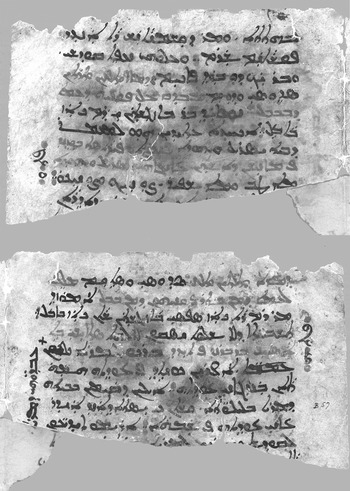
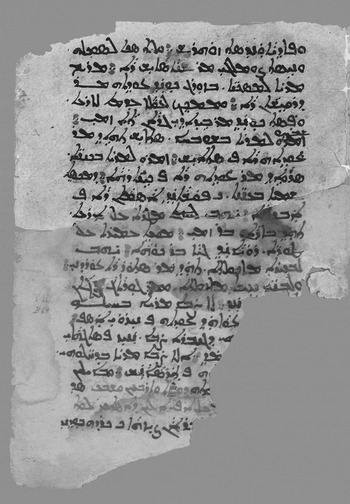
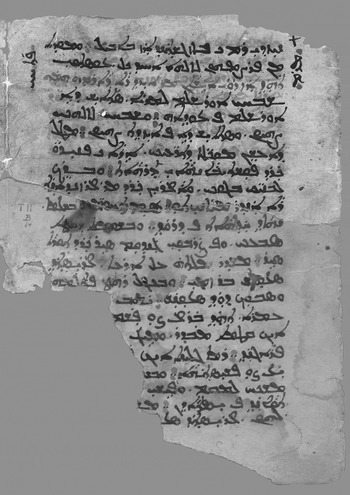
The existence in the German Turfan collection of a bilingual Psalter in Syriac and New Persian was first made known in 1915 by F. W. K. Müller, who identified and published the fragment T II B 57, the upper part of a double folio. This fragment is now preserved in the Museum für Asiatische Kunst (formerly Museum für Indische Kunst) in Berlin, where it bears the shelf-mark MIK III/112. Many years later, a further fragment of the same double folio, T II B 64 [No. 4] (shelf-mark SyrHT 153), was discovered by Werner Sundermann in the Staatsbibliothek in what was then West Berlin. The addition of this fragment almost completes the second folio, which now lacks only the bottom inner corner. In his 1974 article Sundermann therefore re-edited this folio, revising Müller's text and combining it with the newly-discovered fragment. Unfortunately, he made only a few remarks on Müller's text of the first folio, although a revised edition would certainly have been worthwhile, not only because T II B 64 includes a tiny piece of the inner margin of this folio, with parts of a few letters from the beginning of R10 and the ends of V9–11, but also because Müller's mixed system of transcription and transliteration is extremely idiosyncratic and awkward to interpret. It is even more unfortunate that Sundermann's otherwise excellent edition of the second folio is disfigured by numerous misprints. In view of the uniqueness of this text and its high importance for the history of the Persian language, the history of the Syriac script, and the history of the Christian church in Central Asia, I make no further excuse for presenting a new edition and translation of the complete text.
The double folio contains Psalms 131.18–132.1, 133.1–3, and 146.5–147.7 (according to the numbering of the Peshitta), including the numbers and headings to Psalms 132, 133, and 147,Footnote 2 parts of which are written in red ink, but not the “Canons” of Mar Aba. Marginal rubrics indicate the number of half-verses (petgāme) in each Psalm and the beginning of a new marmitā (a subdivision of the Psalter) with Psalm 147.Footnote 3 These annotations agree precisely with those found in the Psalter used today in the “Church of the East”.Footnote 4
The Persian text is written in Syriac script, making use of some non-Syriac letters and conventions.Footnote 5 Some of these letters and conventions are identical to those commonly found in Sogdian texts in Syriac script, in particular the use of ṣadhe <c>Footnote 6 to represent [č] and [ǰ] and the new characters <f> (a modified pe) and <x> (a modified kaph) to represent [f] and [x] respectively; the absence of the Sogdian character <ž> (a modified zain) may be a matter of chance, since the sound [ž] is rare in Persian and no word in which it would be expected happens to occur in this text. On the other hand, the letters qoph <q>, ṭeth <ṭ>, and ‘e <‘> are only used in Syriac words and are not used (as in Sogdian) for the sounds [k], [t], and [γ]. Instead, [k] is written by means of kaph <k>, [t] by means of tau ṭ, and [γ] by means of a modified gamal, here transliterated <ğ>. As already noted by W. B. Henning, this modified gamal is also attested in the only other known New Persian Turfan text in Syriac script, the fragmentary pharmacological manuscript published in the second part of this article;Footnote 7 apparently it was also used in at least one Sogdian text, but the latter is now lost and known only from a transliteration by Olaf Hansen.Footnote 8 As for the other voiced fricatives, [δ] is (facultatively) represented in Syriac fashion by a dalath with an extra subscript dot (rukkākā),Footnote 9 here transliterated <δ > , e.g. sδ beside sd [saδ] “hundred”, while [v] is (also facultatively) represented by a modified beth, here transliterated <β>. The existence of such a letter, as distinct from the simple <b>, has not previously been noticed: it occurs here only in the Persian spelling of the name of Babylon, b ā’β el and b’βl (beside b’bl), all of which, like Syriac bbl (the spelling used in the Syriac part of the bilingual), were no doubt pronounced [bāvēl] or [bāvĕl].
As Sundermann has already noted, the letter ḥeth <ḫ> is used in the Persian part of the bilingual for the equivalent Arabic letter ḥā (only attested in ḫ ad [ḥad(d)] “border”). One might expect the letter qoph <q> to be used for Arabo-Persian [q], but the only word in which this sound should have occurred, sāq “shank”, is spelt with <g>, s’gh ā’ [sāg-hā] “shanks”, perhaps indicating voicing or neutralization in final position.Footnote 10
A notable feature of this manuscript is the rather full vocalization by means of matres lectionis (the letters alaph, yodh and waw) and diacritic points: [ā] is represented by the letter alaph ( ’ ), usually accompanied by the points known as zqāpā (ā’ or ’ā), while [ă] can be represented by ptāḥā (a), which in initial position is accompanied by alaph (’a); [ē/ĕ] is represented by zlāmā qašyā (e), with or (rarely) without an accompanying yodh (ey or ye) or alaph (e’ or ’e), [ī/ĭ] by ḥbāṣā (yi), in initial position optionally preceded by alaph (’yi), [ō/ŏ] by rwāḥā (wo), [ū/ŭ] by alāṣā (wu).Footnote 11 In all cases the points are optional while the matres lectionis appear to be compulsory, at least for the long vowels.Footnote 12 Finally, we may note the use of a point above a final -h in hm aḣ [hamah] “all”, presumably to indicate that it retains its consonantal value,Footnote 13 and over yodh to indicate a consonantal [y] in mẏ’n [mayān] “middle” (a usage also attested in some Sogdian texts in Syriac script).
TextFootnote 14
folio I, recto (Plate 1a)
Syriac–New Persian bilingual Psalter (T II B 57 = MIK III/112 + T II B 64 [No. 4] = SyrHT 153), folio I, recto and verso

1 bhtt’. wmr dwušmnā’naš rā’ ’andr
2 pwšā’nam šarm  w‘lwhy n‘p..’ qwdšy.
3 wbr yak dwu bwaδ p'kyim {red} dm’’ wtltyn wtrtyn
4 {black} sδ wsyi wdwuwum {red} mbdq ‘l pwnyh d‘m’
5 dbbbl {black} nm'yaδ br b'zgaštan yi ram kFootnote 15 ’az
6 bā’βel ’kḫd’ ‘tydyn hwuw lm‘mr
7 dbyt ysryl wyhwd’ {red} pyakcā’y pyrā'st bwuδnd
8 p m'nyišn d’štan x'ng'hyi [y]sryl wyhwd’Footnote 16
9 {black} m’ ṭb wm’ špyr. cwu nyek wcwu nyikwo
10 (l)[’ḫ··’ m](’)[d‘m](r··)[yn]’(k)[ḫ](d)’[ ](mr)[ ](br)’δrā’nFootnote 17
11 [rā’ ](’)
folio I, verso (Plate 1b)
1 Footnote 18{red} dm’’ wtltyn wtlt {black} sd wsyi ws’ewum {red} m..lp
2 l‘m’ dṃn btr pwnyhwn dṃn bbl {black} ’āmwozδ
3 mr rm rā’ k ’az spsyi bā’z gštan šā’n k ’az b’βl
4 tšbḫ··t’ dl’ šlw’ nsqwn l'lh’ {red} st'yišyi be’
5 ’ās'yiš br brnd p ’yizδFootnote 19 {black} brkw lmry’ klkwn <‘bdẅhy dmry’ > Footnote 20
6 ’āfryin kwun’eδ p xwδ’h hmaḣ
7 tā’n bandgā’nyi xwδ’h ’ylyn d ymyn bbyth
8 dmry’ blylẅt’. wšā’n k yist’δFootnote 21 ’andFootnote 22 ’andr
9 x'nyi xwδ’h p šabhā’ ’rymw ’ydÿkwn
10 lqwdš(’ wbrkw )l(mr)y’[ b](r)[ ](’)[w](r)[’eδ dst](h)’
11 (tā’)[n nbrk](k)
folio II, recto (Plate 2)
Syriac–New Persian bilingual Psalter (T II B 57 = MIK III/112 + T II B 64 [No. 4] = SyrHT 153), folio II, recto

1 wp’δyā’wandst zwohrš wl(y)t sk’ lswklh.
2 wnyest cwmlgyi mr šnā'sā’yiš rā’ mrym
3 mry’ lmsk··n’. bzwurg kwunaδ xwδ’hFootnote 23 mr
4 drwyešā’n rā’ wmmk..k l‘ẅāl’Footnote 24 ‘dm’ l'r‘’.
5 wpast kwunaδ mr beyd’δyi grā’n tā’ zmyi
6 <šbḫw>Footnote 25 lmry’ bšwbḫ’. st'yiš th’eδ mr
7 xwδ’hFootnote 26 rā’ p st'yiš zmrw lmry’ bknr··’.
8 srāw’eδ mr xwδ’h rā’ p kyenā’rhā’ dmks..’
9 šmy’ b‘n··n’. k pwošā’naδ ’āsmā’n rā’ p
10 ’ab(r)[h](ā)’ ẏhb mṭr’Footnote 27 ‘l ’r‘’.
11 thaδ b'rā’n br zmyi mw‘..’ ‘myr’ ‘l
12 ṭwr··’. rwoyā’naδ gyā’ br kwohā’ ẏhb
13 lb‘yr’ m'kwlt’. thaδ mr stwor rā’ xwordnyi
14 wlbn··y n‘b’ m'kwlt’. wmr gwurā’ğ [b]cgā’nFootnote 28
15 [r](’)[k](x)[w](’)nand l’ ċb’ mry’ bḫylh
16 [dswsy’ n]xwā’haδ xwd'h p nyirwo yi ’asp
17 [’pl’ bšqw]hy dgnbr’ ċb’. nanyiz p s'ghā’yi
18 [ k’]maδ ’l’ ċb’ mry’ bdḫ··lwhy.
19 [ xwd](’)h p tarsā’ānašFootnote 29 wb'ylyn
20 [dmskyn lṭyb](w)th {red} dm’’ w'rb‘yn wšb‘ {black} sd
21 [wcyhyl whftw](m) {red} ‘l ’pÿ ’ylyn d'st‘r lwt
22 [‘m’ dpnw mn bb](l) {black} (b)r ’ān cyizhā’ k krdh bwuδnd
folio II, verso (Plate 3)
Syriac–New Persian bilingual Psalter (T II B 57 = MIK III/112 + T II B 64 [No. 4] = SyrHT 153), folio II, verso.

1 Footnote 30nyizdyi rm k b'zgštandFootnote 31 ’az b'byl wmwd’
2 ṃn prcwphwn l'lh’ ’ḫyd kl.Footnote 32 xwstwyiFootnote 33
3 {red} thaδ ’az rwoyi ’ešā’n mr ’yizδ rā’ dā’rndh hmah
4 {black} šbḫy ’wršlm lmry’. stā’yiš de’
5 ’wršlm p xwδ’h wšbḫy l'lhky
6 chywn. wst'yiš de’ p ’yizδt chywn mṭl
7 d’‘š..n mwk··l’ dtr··‘yky. ’erā’ k pnyirwo
8 kard pwuštybā’nhā’yi drhā’tFootnote 34 wbr..k
9 lbnÿky bgwky. w’āfryin kard mr frznd'nat
10 rā’ ’andr mẏ’nyi twu sāṃ tḫwm··(yky) bšlm’.
11 nhā’δ ḫadhā’tFootnote 35 p drwoδ wbšwmn’ d(ḫ)ṭ’
12 sb‘ky. wp carbwuyi gandwum syer kard twrā’
13 syer mšdr mlth ‘l ’r‘’. fryistaδ
14 sxwu[na](š)Footnote 36 br zmyi wb‘gl rhṭ pt(g)mh[.]
15 wsbwuk dwaδ sxwunaš ẏhb [tlg’ ’yk]
16 ‘mr’. thaδ barf cwu pšm [ w‘rpl’]
17 ’yk qṭm’ mbdr. wmyeğ [ ]
18 prā’gnaδ rm’ gly(d)’Footnote 37 ’yk (p ··)[t’ ]
19 yax cwu pšyistahā’ wq(d)[m ‘ryh mnw]
20 mškḫ lmqm. wpyešyi [ ]
21 twā’naδ p yistā’δn m(š)[dr mlth wmpšr]
22 lhwn. fryistad sx[wunaš ]
Translation
folio I, recto
(Psalm 131, v. 18) … shame – And His enemies I shall clothe with shame – and upon Him my holiness shall flourish – and my purity shall be doubled.Footnote 38
(Psalm 132). One hundred and thirty-second. One hundred and thirty-second. He reveals the return of the people which (was) in Babylon. He reveals the return of the people from Babylon. Those of the house of Israel and Judah were ready to dwell together. (Those of) the house of Israel and Judah were prepared to have (their) habitation together. (v. 1) How good and how excellent (it is) – How good and how excellent (it is) – for [brothers, when they dwell] together – for brothers …”
folio I, verso
(Psalm 133). One hundred and thirty-third. One hundred and thirty-third. He teaches the people after their return from Babylon. He teaches the people after their return from Babylon. Praises without ceasing they raise to God. Praise without ceasing they offer to God. (v. 1) Bless the Lord, all you servants of the Lord – Bless the Lord, all you servants of the Lord – those who stand in the house of the Lord in the nights – those who have stood in the house of the Lord in the nights. (v. 2) Lift up your hands to holiness and bless the Lord – [Lift up] your hands [to holiness and bless the Lord]. (v. 3) [May the Lord bless] you …
folio II, recto
(Psalm 146, v. 5) … and mighty is His power – and there is no limit to His understanding – and there is no summation to His knowledge. (v. 6) The Lord raises up the poor – The Lord makes great the poor – and He casts down the wicked unto the ground – and He casts down those who perform iniquity unto the ground. (v. 7) Praise the Lord with praise – Give praise to the Lord with praise – sing to the Lord with harps – sing to the Lord with harps! (v. 8) Who covers the sky with clouds – Who clothes the sky with clouds – gives rain upon the earth – gives rain upon the earth – makes the grass grow on the mountains – makes the grass grow on the mountains. (v. 9) He gives food to cattle – He gives food to cattle – and to the children of the raven food – Footnote 39 – and to the children of the raven [which] cry out. (v. 10) The Lord does not take pleasure in the strength [of a horse] – The Lord does [not] take pleasure in the strength of a horse – [nor] does He take pleasure in the shanks of a hero – nor does He [take pleasure] in the shanks of [a hero]. (v. 11) But the Lord takes pleasure in those who fear Him – [But the Lord takes pleasure] in those who fear Him – and in those [who await] His [loving-kind]ness.Footnote 40
(Psalm 147). One hundred and forty-seventh. One hundred [and forty-seventh]. On those (things) which happened to [the people who returned from Babylon]. On those things which were done
folio II, verso
with regard to the people who returned from Babylon. And he praises God, the holder of all, in their presence. He confessesFootnote 41 to God, the holder of all, in their presence. (v. 1) Praise the Lord, Jerusalem – Give praise to the Lord, Jerusalem – and praise your God, Zion – and give praise to your God, Zion. (v. 2) Because He has strengthened the bars of your gates – Because He has strengthened the bars of your gates – and has blessed your children in your midst – and has blessed your children in your midst. (v. 3) He has established your borders in peace – He has established your borders in peace – and has satisfied you with the fat of the wheat – and has satisfiedFootnote 42 you with the fat of the wheat. (v. 4) He sends His word upon the earth – He sends His word upon the earth – and His word runs swiftly – and His word runs swiftly. (v. 5) He gives [snow like] wool – He gives snow like wool – [and] scatters [fog] like ashes – and scatters fogFootnote 43 [like ashes]. (v. 6) He scatters ice like [scraps] – [He scatters] ice like scraps – and [who] can stand before [His frost]? – and [who] can stand before [His frost]? (v. 7) He [sends His word and melts] them – He sends [His] word …
2. Two folios from a pharmacological textFootnote 44
M 7340 (T II Toyoq) is a squarish fragment from one of the bottom corners of a folio, with symmetrical creases and tears which indicate that it was formerly folded both horizontally and vertically. No single line is complete; to judge from those lines which can be at least partially reconstructed, not more than two-thirds of the width of the original page survives at any point. Most of the text is written in red ink. Although the signature M 7340 suggests a Manichaean manuscript, Mary Boyce's catalogue of the Turfan texts in Manichaean script rightly identifies it as “New Pers[ian] in Syriac script”, citing W. B. Henning's identification of the fragment as containing a pharmacological text concerning kinds of oils.Footnote 45
Since recto and verso cannot be determined with complete certainty, the two sides of this fragment will be referred to here as A and B. Side B is somewhat faded and in parts obscured by ink impressions from another folio. The first two lines of this side are inscribed in black ink and may contain a section title. The rest of the text contains recipes for three kinds of medicinal oil (rōγan), whose names may mean “brassiness oil”, “watermelon oil” and “camel-blanket oil”. Each of these names is written on a separate line, centred on the page (A6, A14, B3), and repeated in black ink in the side margins. Each recipe begins with a paragraph (A7, A15–16, B4–7) listing the medical conditions for which it is effective: the formula šāyaδ … -rā “it is appropriate for …” is best preserved in B4–7. It continues on a new line (as is clear from the fact that the last part of line A7 is left blank) with a list of ingredients and amounts, the latter expressed in zwz “drams”, with an occasional instruction as to the preparation of the ingredients: […] ǰudābī-tar “[make it] drier” (B10). Although the text is poorly preserved, its formulaic structure and regular layout make it relatively easy to determine the general sense, for instance, which words are names of diseases and which those of ingredients.
Another folio of this manuscript is constituted by a group of three small fragments (T II B 69, T II B 69, T II B 14[b]) which are now joined together into a single fragment of irregular shape bearing the shelf-mark n 175. The shape of the fragment, especially the positions of the tears, makes it likely that it was at some time folded together with M 7340, despite the signatures implying that one was found in Toyoq and the other at Bulayïq. Once again, the order of the two sides is unclear: here they will be referred to as C and D. In this case the text is written entirely in black ink, except for a few punctuation marks in red. Unfortunately only a word or two is preserved in each line, but the general structure of the text seems to be similar to that of M 7340, as is indicated in particular by the centred heading in D11, probably naming a particular kind of pill (gōlī), and the immediately following formula with šāyaδ … “it is appropriate (for) …” in D12. A similar recipe probably began in C15, where the blank space at the end of the line suggests the former presence of a centred heading. As in M 7340, most of the surviving text consists of lists of ingredients and amounts. Once the amount is given in stēr “staters” (D5) instead of zwz “drams”. A few verbal forms, e.g. bar āmēz “mix” (D8), are attested as part of the instructions for preparing the medicine.
This manuscript displays a considerable linguistic variety. The text as a whole is clearly in Persian, and the greater part of its vocabulary consists of Persian words (including those of Arabic origin). Words of foreign origin are of course used for some of the plants and other ingredients, but sometimes Syriac words are used rather than their Persian counterparts for no discernible reason. Examples are ḥmr’ “wine” (D10) and knšmy’ “dropsy” (B1*, B4), as well as the numbers to be mentioned below. Sogdian influence may also be seen in gāw-rōγan (A4) or γāw-rōγan (A8) “butter” as opposed to Persian rōγan-i gāw,Footnote 46 while the verbal form buwā “let it be” (D2, D9) seems to be of Parthian origin.
The present text is similar in many points to the prescriptions or recipes in the first part of the Syriac “Book of Medicines” published by Budge (Reference Budge1913). These typically begin with a statement of the illness or illnesses for which the medicine is efficacious (ḥšḥ “is suitable”) followed by a list of ingredients and amounts, commonly measured in drams (zwz’, zwz, pl. zwz ··’, zẅz) but also in ounces (’ẅn), staters ('styr ··’) etc., and instructions for preparing the medicine. Many of the ingredients, such as aniseed, ginger, liquorice, pepper and spikenard, are also the same as those attested in our text.
A remarkable feature of Budge's manuscript is its systematic use of the ancient Aramaic numeral symbols.Footnote 47 In our text the numbers are generally written in words, either Syriac (‘sr’ “10” or ‘sryn “20”,Footnote 48ḥmšt‘sr “15”, št‘sr “16”, ’rb‘m’’ “400”) or Persian (čahār “4”, hašt “8”, sēzdah “13”, bīst “20”, sī(?) “30”, hazār “1000”), but, as Sebastian Brock has kindly pointed out to me, the numeral symbols are attested at least once, in line C11: 3 .. 3 .. (written zyz .. zyz .., exactly as apud Budge) “three (drams) each”. Just above this, at the end of line C9, is a complex character which seems most likely to represent the numeral symbol for “100”. In this connection it is worth mentioning that the symbol for “5”, which resembles the letter ‘e, may occur in T II B 17 No. 4 (shelf-mark SyrHT 1), a Syriac pharmacological fragment from Bulayïq published by Miklós Maróth in 1984. In line 9 of this text, a recipe for preventing the growth of unwanted hair begins with the words ṣwr ‘. prḥdẅd’ b'wrq‘t’ dktn’, which I understand as: “tie up five bats in a piece of linen cloth”.Footnote 49
The orthography of these pharmacological fragments resembles that of the bilingual Psalter in many respects. In particular we may observe the use of ṣadhe <c> to represent [č] and [ǰ] and the occurrence of the non-Syriac letters <f>, <x>, <ğ> and <β> (this last only in C6, in an incomplete word). On the other hand, [δ] is always represented by the simple <d>, not by <δ>. The letters ḥeth <ḫ> and ‘e <‘> are attested only in Syriac words, but qoph <q> is used, as expected, for Arabo-Persian [q] in words such as qwlnc [qaulanǰ] “colic”.Footnote 50
This text is much less fully vocalized than the Psalter, though the system seems to be the same in general. However, a word-internal [ā] is not always represented by alaph but is sometimes indicated by zqāpā (ā) alone as in g āw [gāw] “cow”, or left unmarked as in the final syllables of k ā’hš-grftgn [kāhiš-griftagān] “those affected by consumption” and spndn [spandān] “mustard”. As in the Psalter, [ē] can be represented by the combination of zlāmā qašyā with alaph (e’) as in s e’zd ah [sēzdah] “13”, but here too it may be that the points could be omitted and that alaph alone could represent [ē], in which case rwy'ny (B3 and margin) may be read [rōyēnī] “redness, brassiness”.Footnote 51
Finally, we may note that k- [ke] “who” is written together with the following word and that the ezafe -y [-i] is always attached to the preceding word, unlike the Psalter, where k is always and y i is usually written separately.
Text
Side AFootnote 52
1 traces only
2 [ ].. wqdrFootnote 53 .. wpylpl (..) spndny •••[ ]
3 [ ]•’m'rg .. wswn'q .. wsyr ..
4 [ ]ry gāw .. ch'r .. ch'r .. zwz .. gwrwğn ..
5 [].
6Footnote 54 [ . ](r)wğny xarbwz .
7 [š’yd ––](r’ w)tbhr’ .
8 [ ](’)rb‘m’’ zwz . ğāwrwğnFootnote 55 ..
9 [ ]ṁnFootnote 56. qndy xwzy
10 [ ](r) .. wqyrfh .. ws'dy
11 [ ](’) .. hšt .. hšt .. (z)wz( ..)
12 [ .](.) wzncbyl (..) št‘sr ..
13 [št‘sr .. z]wz .
14Footnote 57 [ ](r)wğny cmlfr'š .
15 [š’yd ––r’]. wdrdy phlwhār’ . wkā’hš grft-
16 -gnr’ (..)
Side BFootnote 58
1 (knšmy'r’. ––)cr’.Footnote 59 myelycr’.Footnote 60 drd(y nym)[sr?]
2 (r’ w––––)[r](’.). [ ]
3Footnote 61 . rwğny rwy'ny . [ ]
4 š’yd . knšm(y)’r’ . wqwl(nc)r’[ .]
5 (wdrd)yFootnote 62 pywn(d)hr’ . w(dr)[dy ––r’ ]
6 w’(y)š’nr’ . k(š)km g[rfth(?) w'yš’nr’]
7 (kbwd) . (•b•)gm .[
8 twrp(l) .. t(r)ywš(n) .. (’)[
9 k’(m)y wsgbyn .. h(z’r .)[.
10 cd'by tr .. ••’(y’)y (.). sws .. [ ]
11 (ḫ)m(š)t(‘)s(r .. ––––)[ ]
12 (––n)k .. d(st)h .. ’lb• .. ‘(s)[r’Footnote 63]
Side C
1 ](x)wš .. b’[
2 ]y .. šwsth[
3 ](y) .. gwly .. frz[
4 ] w'ny trym'n [
5 ]dr'ws .. ss'l’w[s
6 z](wz) .. twxmy ’aβ[ ](g)[ ](c)[
7 ]swmbl .. wg[
8 tw]xmy bastwl'k ..
9 ](y) .. slyxh .. 100(?) ..
10 ] w'nyswn ..
11 ]• .. 3 (..) 3 .. zwz ..
12 ]•[ ](b)wdy bls'n ..
13 ]sy zwz ..
14 zw]z ..
15 [ . gwly(?) … … . ]
16 [š’yd ](r’)
Side D
1 z]wz .. wnym .. [
2 ]wzy bw’ .. [
3 ]dry .. tryn g[
4 ] nyk .. byst •[
5 ](d) .. se’zdah steyr[
6 ]• .. wbwe[y](d)[Footnote 64
7 (w•’n)ydr’ ba(d’)[
8 wbr ’myz b(ā)’ [
9 fndq .. wbwā(’)[
10 wḫmr’ .. 'spy[d
11 . gw(l)[y
12 šā’yd x(r’)[chār’?
13 wsw[
14 plpl[
15 xwlng[’n
16 [](šwq)[Footnote 65
Translation
Side A
(Ingredients:) … and qadar, and pepper, mustard of …, … and swn'q, and garlic, [and] cow's …: four drams each; butter …
Watermelon oil.
(Efficacy:) [It is useful] for … and for fever(s).
(Ingredients:) …: 400 drams; butter, …, Khuzi candy, … and cinnamon, and spikenard(?) of …: eight drams each; … and ginger: 16 drams [each].
Camel-blanket(?) oil.
(Efficacy:) [It is useful for …], and for pain in the sides, and for those suffering from consumption.
Side B
… for dropsy, for [colic](?), for my elyc, for migraine(?), and for …
Brassiness(?) oil.
(Efficacy:) It is useful for dropsy, and for colic, and for pain in the joints, and [for] pain(?) [in …], and for those who [are] constipated, [and for those] who have …Footnote 66
(Ingredients:) Turpeth, trywšn, … k'my, and sagapenum: 1,000 [drams each]; … [make it] drier … liquorice, …: 15 [drams]; …: a handful; …, ten(?) [drams] …
Side C
(Ingredients:) … washed … flower of …Footnote 67 and that ofFootnote 68 ficus heterophylla, …, seseli …: … drams; seeds of …, spikenard, and …, seeds(?) of b astwl’k, …, benzoin: 100(?) [drams]; … and aniseed, …: 3 drams each; … of balsam, …: 30(?) drams; …: … drams(?).
[… pill(?).]
(Efficacy:) [It is useful for … and] for …
Side D
(Ingredients:) … dram(s) and a half … let it be … moist … good …: 20 [drams]; …: 13 staters … and you should(?) be …, and(?) …, and mix (it) with …, hazelnuts, and let it be … and wine, white(?) …
… pill.
(Efficacy:) It is useful [for] pimples(?) …
(Ingredients:) … and … pepper … galangale …
3. Glossary
The pages of the Psalter are cited as Ir, Iv, IIr, IIv, those of the pharmacological fragments as A, B, C, D. The glossary does not include words occurring in the Syriac part of the Psalter. No transcription is given for words and names which are taken over in their Syriac spelling.
’abrhā’ [abr-hā] “clouds” IIr10*
’aβ•g[ (a plant?) C6*
’āfryin [āfrīn] “blessing” Iv6, IIv9
’lb• (an ingredient?) B12*
’āmwozδ [āmōzaδ] “teaches” Iv2
’myz: see br ’myz
’ān, ’n [ān] “that” IIr22, C4
’and: see yist’δ ’and
’andr [andar] “in” Iv8, IIv10. See also the next.
’andr pwšā’nam [andar pōšānam] “I clothe” Ir1–2
’nyswn [anīsūn] “aniseed” C10
’erā’ [ē-rā] “for this reason” IIv7
’rb‘m’’ “400” A8. Syriac.
’ās'yiš [āsāyiš] “ceasing” Iv5
’āsmā’n [āsmān] “sky” IIr9
’asp [asp] “horse” IIr16
'spyd [ispēδ] “white” D10*(?). If correctly restored, perhaps to be understood as part of the name of “white mustard” (Sinapis alba), cf. Arabic 'spyδ 'sfnd etc. (Henning Reference Henning1965: 37), or “white lead”, cf. Syriac 'spydk’ etc. (Ciancaglini Reference Ciancaglini2008: 111).
’ešā’n, ’yš’n [ēšān] “those” IIv3, B6. Cf. wšā’n.
’wr’eδ: see br ’wr’eδ
’wršlm “Jerusalem” IIv5. Syriac form.
’yš’n: see ’ešā’n
’yizδ [īzaδ] “God” Iv5, IIv3, IIv6
’az [az] “from” Ir5, Iv3, IIv1, IIv3. See also the next.
’az sps-yi [az spas-i] “after” Iv3. See Sundermann Reference Sundermann, Gignoux and Tafazzoli1974: 448.
’[ B8*
‘sr’ “ten” (or ‘sryn “twenty”) B12*. Syriac.
bā’ [bā] “with” D8
be’ [bē] “without” Iv4
bā’βel, b’βl, b'byl [bāvel] “Babylon” Ir6, Iv3, IIv1. Cf. Sundermann Reference Sundermann, Gignoux and Tafazzoli1974: 449.
b'rā’n [bārān] “rain” IIr11
b'zgaštan, bā’z gštan [bāz-gaštan] “return” Ir5, Iv3
b'zgštand [bāz-gašt-and] “they returned” IIv1
b’[ C1
bcgā’n [baččagān] “children” IIr14*
bls'n [balsān] “balsam, balm of Gilead” C12. The history of this form has recently been discussed by Maggi Reference Maggi2003: 120–22.
bandgā’n [bandagān] “servants” Iv7
br [bar] “upon” Ir3, Ir5, Iv5, IIr11, IIr12, IIr22*, IIv14. See also br ’myz, br ’wr’eδ, br brnd.
br’δrā’n [brāδarān] “brothers” Ir10*
br ’myz [bar āmēz] “mix” (2 sg. impv.) D8
br ’wr’eδ [bar āwarēδ] “raise” (2 pl. impv.) Iv10*
br brnd [bar barand] “they offer” Iv5
barf [barf] “snow” IIv16
brnd: see br brnd
bastwl'k (a plant?) C8
bw’, bwā’ [buwā] “let it be” D2, D9. Apparently a 3 sg. subj. à la parthe. It is noteworthy that this form is attributed to Firdausi by his lexicographer ʿAbd al-Qādir, see Salemann Reference Salemann1895: 24 (no. 230); Wolff Reference Wolff1935: 155.
bwaδ, bwd(?) [buwaδ] “becomes, is” Ir3, B7*
bwuδnd [būδ-and] “they were” Ir7, IIr22
bweyd [buwēδ] “be” D6*(?). Apparently a 2 pl. form (indic. or impv.), despite the clear 2 sg. impv. bar āmēz which follows in D8.
bad’[ D7*
beyd’δyi grā’n [bēdāδī-garān] “doers of iniquity” IIr5
byst [bīst] “20” D4
bzwurg [buzurg] “great” IIr3
cā’y [ǰāy] “place” Ir7
cd'by-tr [ǰudābī-tar] “drier” B10. This interpretation was suggested to me by Werner Sundermann. Cf. the Pahlavi compound adjectives with ǰud- as privative prefix.
ch'r [čahār] “four” A4 (x2)
chywn “Zion” IIv6. Syriac form.
cmlfr’š [ǰamal-firāš] “camel-blanket”(?) A14, A14m
carbwu [čarbū] “fatness” IIv12
cwu [ču] “how, like” Ir9 (x2), IIv16, IIv19
cwmlgyi [ǰumlagī] “summation” IIr2. See Benveniste Reference Benveniste1938: 461–2; Sundermann Reference Sundermann, Gignoux and Tafazzoli1974: 445 n. 33.
cyizhā’ [čīz-hā] “things” IIr22
de’ [dē] “give” (2 sg. impv.) IIv4, IIv6. Cf. th’eδ, thaδ.
dā’rndh [dārandah] “holding” IIv3
d’štan [dāštan] “to have” Ir8
drd [dard] “pain” A15, B1, B5* (x2)
drhā’ [dar-hā] “gates” IIv8
drwyešā’n [darwēšān] “the poor” IIr4
drwoδ [drōδ] “peace” IIv11
dsth [dastah] “handful” B12*
dsth’ [dast-hā] “hands” Iv10*
dwu [du] “two” Ir3
dwaδ [dawaδ] “runs” IIv15
dwušmnā’n [dušmanān] “enemies” Ir1
dwuwum [duwum] “second” Ir4
fndq [funduq] “hazelnut” D9
fryistaδ, fryistad [fristaδ] “sends” IIv13, IIv22
frznd'n [farzandān] “children” IIv9
frz[ (a plant?) C3
gandwum [gandum] “wheat” IIv12
grfth, grftgn: see škm-grfth, kā’hšgrftgn
gāw [gāw] “cow, ox” A4. See also gwrwğn, ğāwrwğn.
gwl [gul] “flower” C3(?)
gwly [gōlī] “ball, pill” D11*
gwurā’ğ [gurāγ] “crow, raven” IIr14. See Sundermann Reference Sundermann, Gignoux and Tafazzoli1974: 445 n. 36.
gwrwğn, ğāwrwğn [gāw-rōγan, γāw-rōγan] “butter, ghee” A4, A8. Cf. gāw and rwğn.
gyā’ [giyā] “grass” IIr12
g[ D3, C7
hftwm [haftum] “seventh” IIr21*
hmaḣ, hmah [hamah] “all” Iv6, IIv3
hšt [hašt] “eight” A11 (x2)
hz'r [hazār] “1000” B9*
ḫadhā’ [ḥad(d)-hā] “borders” IIv11
ḫmr’ “wine” D10. Syriac.
ḫmšt‘sr “15” B11. Syriac.
k, k- [ke] “who, which, that” Ir5, Iv3 (x2), Iv8, IIr9, IIr15, IIr22, IIv1, IIv7, B6, B7*. Translates Syriac d-, see Benveniste Reference Benveniste1938: 459.
kā’hš-grftgn [kāhiš-griftagān] “those affected by wasting disease, consumptive” A15–16
k'maδ [kāmaδ] “desires, takes pleasure” IIr18*
k'my [kāmī?] (an ingredient?) B9
knšmy’ “dropsy” B1*, B4. Syriac knāš-mayye, lit. “gathering of waters”.
kard [kard] “he made” IIv8, IIv9, IIv12
krdh [kardah] “done” IIr22
kwohā’ [kō(h)-hā] “mountains” IIr12
kwun’eδ [kunēδ] “make” (2 pl. impv.) Iv6
kwunaδ [kunaδ] “makes” IIr3, IIr5
kyenā’rhā’ [kēnār-hā] “harps” IIr8
-m [-m] (1 sg. encl. pron.) Ir3
m'nyišn [māniš(n)] “dwelling” Ir8. The final -n may be historical, since the suffix is otherwise written -y iš in this manuscript, cf. Benveniste Reference Benveniste1938: 459.
mr [mar] (object marker) IIr5. See also the next. Misunderstood by Müller as Syriac mār “Lord”, first correctly identified by Schaeder Reference Schaeder1935: 570 n. 2. Cf. also Benveniste Reference Benveniste1938: 459–61.
mr … rā’ [mar … rā] (object marker) Ir1, Ir10–11*, Iv3, IIr2, IIr3–4, IIr6–7, IIr8, IIr13, IIr14–15*, IIv3, IIv9–10
mẏ’n [mayān] “middle” IIv10
myeğ [mēγ] “fog” IIv17
myelyc (a disease?) B1*
na- [na-] “not” IIr17
nhā’δ [nihāδ] “he established” IIv11
nm'yaδ [nimāyaδ] “reveals” Ir5
nyek, nyk [nēk] “good” Ir9, D4
nyikwo [nīkō] “excellent” Ir9
nym [nīm] “half” D1. See also the next.
nym-sr [nīm-sar] “migraine” B1*(?)
nyirwo [nīrō] “strength” IIr16, IIv7
nyest [nēst] “is not” IIr2
nyiz [nīz] “also” IIr17
nyizd-yi [nizd-i] “with regard to” IIv1. This form, which puzzled Müller, must represent a variant of nazd-i “near to, in the opinion of, etc.”.
p, p- [pe] “in, to, with” Ir7, Ir8, Iv5, Iv6, Iv9, IIr7, IIr8, IIr9, IIr16, IIr17, IIr19, IIv5, IIv6, IIv7, IIv11, IIv12, IIv21
p’δyā’wand [pāδyāwand] “mighty” IIr1. Cf. Pahlavi p'tyd'wnd, JP p'dywnd (MacKenzie Reference MacKenzie1968: 251).
p'kyi [pākī] “purity” Ir3
phlwhā- [pahlū-hā] “sides” A15
plpl: see pylpl
prā’gnaδ [parāganaδ] “scatters” IIv18
past [past] “cast down” IIr5
pšm [pašm] “wool” IIv16
pšyistahā’ [pašista(h)-hā] “scraps, morsels” IIv19. On the etymology of this word see Sims-Williams Reference Sims-Williams1985: 59.
pwošā’naδ [pōšānaδ] “he clothes” IIr9
pwšā’nam: see ’andr pwšā’nam
pwuštybā’nhā’ [puštebān-hā] “bars (of a gate)” IIv8. The -y- presumably represents an anaptyctic vowel.
pylpl, plpl [pilpil] “pepper” A2, D14
pyrā'st [payrāst] “prepared” Ir7
pyeš-yi [pēš-i] “before” IIv20
pywndh- [paywand-hā] “joints” B5
qdr [qadar?] (an ingredient) A2
qnd [qand] “sugar, candy” A9
qwlnc [qaulanǰ] “colic” B4
qyrfh [qirfa] “bark, peel, sort of cinnamon” A10
rā’, -rā’, -r’ [rā] “to, for” (also object marker) IIr9, IIv12, A7*, A7, A15, A16, B1*, B1 (x2), B2* (x2), B4 (x2), B5, B6, C16*. See also ’erā’, mr … rā’.
ram, rm [ram] “people” Ir5, Iv3, IIv1
rwo [rō] “face, presence” IIv3
rwğn [rōγan] “oil” A6, A6m, A14, A14m, B3, B3m. Cf. also gwrwğn, ğāwrwğn.
rwoyā’naδ [rōyānaδ] “causes to grow” IIr12
rwy'ny [rōyēnī] “redness, brassiness” B3, B3m
s'd [sād] (an ingredient?) A10. Perhaps a variant of sādah, sādaǰ “Indian spikenard”?
s'ghā’ [sāg-hā] “shanks” IIr17
s’ewum [sewum] “third” Iv1
se’zdah [sēzdah] “13” D5
sbwuk [sabuk] “quickly” IIv15
sδ, sd [saδ] “hundred” Ir4, Iv1, IIr20
sgbyn [sagbīn] “sagapenum” B9
slyxh [salīxah] “benzoin” C9
spndn [spandān] “mustard” A2
sps-yi see ’az sps-yi
srāw’eδ [srāwēδ] “sing” (2 pl. impv.) IIr8
ss'l’ws “seseli” C5*. Syriac form. Cf. also Persian sasāliyūs.
-st [ast] “is” IIr1. See also nyest.
st'yiš, stā’yiš [stāyiš] “praise” Iv4, IIr6, IIr7, IIv4, IIv6
stwor [stōr] “cattle” IIr13
steyr [stēr] “stater” D5
swmbl [sumbul] “spikenard” C7
swn'q (an ingredient) A3
sws [sūs] “liquorice” B10
sw[ D13
sxwun [saxun] “word” IIv14*, IIv15, IIv22*
syi, sy [sī] “thirty” Ir4, Iv1, C13(?)
syr [sīr] “garlic” A3
syer [sēr] “satisfied” IIv12, IIv13
-š, -aš [-š, -aš] (3 sg. encl. pron.) Ir1, IIr1, IIr2, IIr19, IIv14*, IIv15
šā’n [-šān] (3 pl. encl. pron.) Iv3
šā’yd, š’yd [šāyaδ] “it is appropriate” B4, D12
šabhā’ [šab-hā] “nights” Iv9
škm-grfth [šikam-griftah] “constipated” B6*(?)
šnā'sā’yi [šnāsāyī] “knowledge” IIr2
šarm [šarm] “shame” Ir2
št‘sr “16” A12. Syriac.
šwq[ D16*
šwsth [šustah] “washed” (or “handkerchief, towel”) C2
-t, -at [-t, -at] (2 sg. encl. pron.) IIv6, IIv8, IIv9, IIv11
tā’ [tā] “unto” IIr5
tā’n [-tān] (2 pl. encl. pron.) Iv7, Iv11*
tbh [tabah] “fever” or tbh- [tabhā] “fevers” A7
th’eδ [thēδ] “give” (2 pl. impv.) IIr6. Cf. de’ and the next. On the devoicing of initial d- before -h- see Sundermann Reference Sundermann, Gignoux and Tafazzoli1974: 445 n. 34.
thaδ [thaδ] “gives” IIr11, IIr13, IIv3, IIv16
tarsā’ān [tarsā’ān] “those who fear” IIr19. For similar ENP and JP examples of hiatus between the ā of the stem and that of the suffix (including ENP tarsā’ān “Christians”) see Lazard Reference Lazard1963: 173.
trym'n [trēmān?] “ficus heterophylla” C4. Identified by Dieter Maue, who kindly refers me to Skt. trāyamāṇa/ā- “id.” and Uygur trym’n in a list of drugs in Rachmati Reference Rachmati1932: 30 (= 428), text 3, line 177.
tryn [tarīn] “moist, fresh” D3
trywšn (an ingredient) B8*
twu, tw [tu] “you” (sg.) IIv10, IIv12
twā’naδ [tuwānaδ] “he can” IIv21
twrpl [turpil] “turpeth” B8. The final -l agrees not with the usual NP form turbid but with forms from further east, cf. Khot. ttrolä, Sogd. ṭrypl(?), Skt. tripuṭā- etc. (see Maue and Sims-Williams Reference Maue and Sims-Williams1991: 491).
twxm [tuxm] “seed” C6, C8*
w- [u] “and” Ir1, Ir3, Ir4 (x2), Ir8, Ir9, Iv1 (x2), IIr1, IIr2, IIr5, IIr14, IIv6, IIv9, IIv12, IIv15, IIv17, IIv20, A3 (x2), A7*, A10 (x2), A12, A15 (x2), B2*, B4, B5*, B5, B6, B9, A2 (x2), D1, D6, D7*, D8, D9, D10, D13, C4, C7, C10
wšā’n [wašān?] “those” Iv8. Cf. ’ešā’n. Unclear form, presumably etymologically identical to MMP ’wyš’n. In favour of the reading wa-, P. O. Skjærvø draws my attention to va- in ENP va-rā (cf. Lazard Reference Lazard1963: 225). It does not seem that the initial w- is the conjunction “and”.
x'n [xān] “house” Iv9
x'ng'h [xāngāh] “house” Ir8
xr'c(?) [xurāǰ] “pimple”(?) D12*
xarbwz, xrbwz [xarbūz] “water-melon” A6, A6m
xwā’haδ [xwāhaδ] “desires, takes pleasure” IIr16
xw'nand [xwānand] “they cry” IIr15*
xwδ’h, xwd'h [xuδāh] “Lord” Iv6, Iv7, Iv9, IIr3, IIr7, IIr8, IIr16, IIr19*, IIv5
xwlng'n [xūlangān] “galangale” D15*
xwordnyi [xordanī] “food” IIr13
xwstwyi [xustūwī] “confession” IIv2
xwzy [xūzī] “of Khuzistan” A9
yhwd’ “Judah” Ir8. Syriac form.
-yi, -y, yi [-i] (ezafe) Ir5, Ir8, Iv3, Iv4, Iv7, Iv9, IIr16, IIr17, IIv3, IIv8, IIv10, IIv12, A2, A4, A6, A6m, A9, A10, A14, A14m, A15, B1*, B3, B3m, B5, D3(?), C2(?), C3(?), C4, C6, C8, C12. See also ’az sps-yi, nyizd-yi, pyeš-yi.
yak [yak] “one” Ir3, Ir7
ysryl “Israel” Ir8. Syriac form.
yistā’δn [istāδan] “to stand” IIv21
yist’δ ’and [istāδ-and] “they stood” Iv8
yax [yax] “ice” IIv19
zmyi [zamī] “ground, earth” IIr5, IIr11, IIv14
zncbyl [zanǰabīl] “ginger” A12
zwohr [zōhr] “power” IIr1. The spelling with unetymological h, which is also found in Pahlavi and JP, is probably a hypercorrection resulting from the loss of etymological h in zōr from older zōhr “libation”. See Sundermann Reference Sundermann, Gignoux and Tafazzoli1974: 444 n. 32; Nyberg Reference Nyberg1974: 232; Shaked Reference Shaked2003: 217.
zwz “drams” A4, A8, A11, A13*, D1*, C6*, C11, C13, C14*. Syriac abbreviation.
Numerals
3 – C11 (x2)
100(?) – C9
Ends of incomplete words (in reverse-index order)
]’nydr’ D7*
]’ A11*
]c B1
]bwd C12
]d D5*
]’m'rg A3
]nk B12*
]b•gm B7*
]ṁn A9
]dr D3
]r A4, A10*
]dr'ws C5
]xwš C1*
]’y'y B10*
]wzy D2
]y C3*, C9*