Long-term exposure to high levels of UV-B radiation can negatively affect an organism's growth and development, result in physiological- or genome-level alterations, impair immune system function and increase mortality (Blaustein & Belden Reference BLAUSTEIN and BELDEN2003, Caldwell & Flint Reference CALDWELL and FLINT1994, Caldwell et al. Reference CALDWELL, BJÖRN, BORNMAN, FLINT, KULANDAIVELU, TERAMURA and TEVINI1998, Croteau et al. Reference CROTEAU, DAVIDSON, LEAN and TRUDEAU2008, Ries et al. Reference RIES, HELLER, PUCHTA, SANDERMANN, SEIDLITZ and HOHN2000). Although the effects of UV-B radiation (hereafter, referred to as UV-B) are often unique to individuals, there is also evidence that UV-B can alter the structure and function of populations and communities (Marinone et al. Reference MARINONE, MARQUE, SUÁREZ, DIÉGUEZ, PÉREZ, DE LOS RIOS, SOTO and ZAGARESE2006, Mostajir et al. Reference MOSTAJIR, DEMERS, DE MORA, BELZILE, CHANUT and GOSSELIN1999). Amphibians represent a large group of animals that are particularly sensitive to increased levels of UV-B (Blaustein et al. Reference BLAUSTEIN, KIESECKER, CHIVERS, HOKIT, MARCO, BELDEN and HATCH1998), which can cause developmental and physiological malformations (Ankley et al. Reference ANKLEY, DIAMOND, TIETGE, HOLCOMBE, JENSEN, DEFOE and PETERSON2002, Fite et al. Reference FITE, BLAUSTEIN, BENGSTON and HEWITT1998), slow growth (Belden & Blaustein Reference BELDEN and BLAUSTEIN2002a, Reference BELDEN and BLAUSTEIN2002b; Pahkala et al. Reference PAHKALA, LAURILA and MERILA2001), and alter behaviour (Blaustein et al. Reference BLAUSTEIN, CHIVERS, KATS and KIESECKER2000, Han et al. Reference HAN, KATS, POMMERENING, FERRER, MURRY-EWERS and BLAUSTEIN2007, Kats et al. Reference KATS, KIESECKER, CHIVERS and BLAUSTEIN2000, Reference KATS, BUCCIARELLI, SCHLAIS, BLAUSTEIN and HAN2012).
Most research on the effects of UV-B in amphibians has occurred in temperate regions and has focused on the development and mortality of aquatic embryos and larvae (Belden & Blaustein Reference BELDEN and BLAUSTEIN2002a, Reference BELDEN and BLAUSTEIN2002b; Blaustein & Kiesecker Reference BLAUSTEIN and KIESECKER2002, Fite et al. Reference FITE, BLAUSTEIN, BENGSTON and HEWITT1998), whereas fewer studies have examined the effect of UV-B on tropical amphibians (Han et al. Reference HAN, KATS, POMMERENING, FERRER, MURRY-EWERS and BLAUSTEIN2007, Kats et al. Reference KATS, BUCCIARELLI, SCHLAIS, BLAUSTEIN and HAN2012). Tropical regions of the world receive abundant levels of sunlight throughout the year (McKenzie et al. Reference MCKENZIE, LILEY and BJÖRN2009), and recent data suggest that ultraviolet radiation has increased in the neotropics, possibly exacerbating amphibian decline (Middleton et al. Reference MIDDLETON, HERMAN, CELARIER, WILKINSON, CAREY and RUSIN2001). Similar to temperate amphibians, tropical amphibians often breed in and inhabit lakes and streams that are exposed to direct sunlight and UV-B (Middleton et al. Reference MIDDLETON, HERMAN, CELARIER, WILKINSON, CAREY and RUSIN2001); however, some tropical frogs also breed in small, temporary pools of water such as phytotelmata (e.g. members of Dendrobatidae) or directly develop in the absence of water (e.g. members of Craugastoridae; Crump Reference CRUMP2015, Savage Reference SAVAGE2002). The effects of UV-B on these reproductive strategies are not known and will require further study, but many of these species are active diurnally following metamorphosis, which exposes them to higher levels of UV-B than nocturnal species. Some species, such as aposematic dendrobatid frogs, are conspicuously active during the day and utilize sun-exposed areas for reproduction and vocalization (Savage Reference SAVAGE2002). Recently, two dendrobatids (Oophaga pumilio and Dendrobates auratus) were found to prefer lower levels of UV-B in the field and under laboratory conditions, which is considered an adaptation associated with their diurnal activity (Han et al. Reference HAN, KATS, POMMERENING, FERRER, MURRY-EWERS and BLAUSTEIN2007, Kats et al. Reference KATS, BUCCIARELLI, SCHLAIS, BLAUSTEIN and HAN2012); however, the majority of diurnally active species in the tropics behave more cryptically in their behaviour and reproduction (Crump Reference CRUMP2015, Savage Reference SAVAGE2002), and nothing is known about how these frogs respond to different levels of UV-B.
Herein, the behaviour of two, diurnally active neotropical frog species – Oophaga pumilio (Dendrobatidae) and Craugastor bransfordii (Craugastoridae) – in response to two different experimental levels of UV-B was examined. These two species are active during the day, are comparable in size, share similar microhabitats, and do not reproduce in or inhabit large bodies of water (Guyer & Donnelly Reference GUYER and DONNELLY2005, Savage Reference SAVAGE2002). It was hypothesized that both species would avoid higher levels of UV-B, but that C. bransfordii would more strongly avoid UV-B given its cryptic behaviour and concealed nature during the day (Guyer & Donnelly Reference GUYER and DONNELLY2005; Savage Reference SAVAGE2002).
The present study was conducted in a lowland tropical rain forest from 5–10 March 2017 at the Organization for Tropical Studies, La Selva Biological Station (10°43′N, 83°98′W) in north-eastern Costa Rica. Adult frogs were captured from trails throughout La Selva between 07h00–09h30 and 16h00–18h00, and measured for snout-to-vent length (SVL) to the nearest 0.1 mm. A total of 77 frogs were used in the study – 22 C. bransfordii (average SVL: 18.1 mm), 27 male O. pumilio (average SVL: 22.0 mm)) and 28 female O. pumilio (average SVL: 21.7 mm). The sex of C. bransfordii was not determined, as there are no external secondary sexual characteristics in this species (Savage Reference SAVAGE2002). All frogs were stored at ambient temperature in individually labelled Ziploc® bags with a small amount of moist leaf-litter.
UV-B avoidance tests were conducted between 10h00 to 16h00 in opaque plastic arenas (21 × 34 cm), using similar methods to Han et al. (Reference HAN, KATS, POMMERENING, FERRER, MURRY-EWERS and BLAUSTEIN2007). Arenas contained perforation holes along their sides to allow airflow, and a moist paper towel on the floor to provide humidity. Arena lids were split into two equal halves and fitted with a trimmed mylar filter on one side (Stencil Ease Blank Mylar, 4 mil (0.102 mm)) and a trimmed acetate filter on the other side (Grafix™ Acetate, 0.003 mm clear). Natural transmission of solar irradiance through each filter was measured using a Li-Cor LI-1000 quantum/radiometer/photometer, and there was no difference in solar irradiation (photon flux μmol s−1 m−2) between the two filters (t8, 10 = 1.92, P = 0.091). The transmittance of UV-B of each filter type (i.e. percentage of UV-B passing through each filter) was measured with an Ocean Optics (Dunedin, FL) USB 4000 UV-VIS spectrophotometer with a PX-2 pulsed xenon light source and a R400-7-SR reflectance probe with a 400-µm core diameter. The mylar filter allowed 14% UV-B transmittance (low UV-B) and the acetate filter allowed 84% UV-B transmittance (high UV-B).
To begin each trial, frogs were placed in the centre of the arena and beneath the UV-B filters, followed by the entire arena being covered with a lightproof box (i.e. cover object) for 2 min. After acclimatization, the cover object was removed for a 10-min trial in which an observer recorded the total time a frog spent under each filter type. The observer was 2 m from the arenas. Trials were only considered successful if frogs moved between filter types at least once, spending time on each side of the arena. After each trial, experimental arenas were wiped clean with 70% ethanol and fitted with a new moist paper towel. The orientation of the arenas was randomized prior to the start of each trial by rotating the containers between 0–360° and by swapping sides for the UV-B filters. Temperature and humidity were recorded inside the experimental arenas prior to beginning each trial using a Traceable® humidity/temperature pen. UV-B avoidance tests were conducted in the absence of rain, and in open and uniformly lit, tree-shaded areas.
Independent samples t-tests were used to compare filter preference (i.e. the time spent under each filter) between C. bransfordii and O. pumilio, and between male and female O. pumilio. A series of linear regressions were used to assess the relationships between filter preference of each species with humidity and temperature. All statistical analyses were performed using IBM SPSS statistical software version 24.
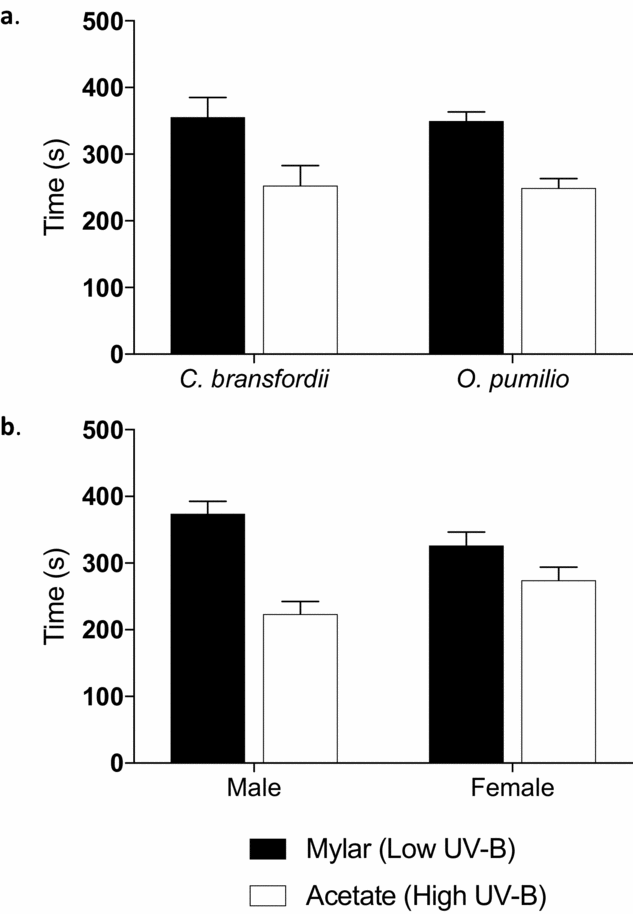
Oophaga pumilio and C. bransfordii both spent significantly more time under the mylar (low UV-B) filter than acetate (high UV-B) filter (t54, 55 = 5.10, P < 0.0001; t21, 22 = 2.40, P = 0.021, respectively; Figure 1a); however, there was no significant difference in time spent under the mylar (low UV-B) filter between species (t75, 77 = 0.195, P = 0.846; Figure 1a). Male O. pumilio spent significantly more time under the mylar (low UV-B) filter than the acetate (high UV-B) filter (t52, 54 = 5.70, P < 0.0001; Figure 1b). Female O. pumilio also spent more time under the mylar (low UV-B) filter than the acetate (high UV-B) filter, but it was not significantly different (t54, 56 = 1.86, P = 0.068; Figure 1b). There was no difference in time spent under the mylar (low UV-B) filter between male and female O. pumilio (t53, 55 = 1.75, P = 0.086; Figure 1b). There was no relationship between time spent under each filter type and temperature (mylar: F1, 75 = 0.257, P = 0.615; acetate: F1, 75 = 0.007, P = 0.935) or humidity (mylar: F1, 75 = 1.89, P = 0.173; acetate: F1, 75 = 1.35, P = 0.248) inside the experimental arenas.
Average amount of time frogs spent under the mylar filter (low UV-B, 14% transmittance) and acetate filter (high UV-B, 84% transmittance) between Oophaga pumilio and Craugastor bransfordii (a) and between male and female Oophaga pumilio (b). Error bars represent ± 1 SE.

Despite the obvious differences in diurnal behaviour between O. pumilio and C. bransfordii, the two species preferred lower levels of UV-B equally (Figure 1a), an adaptation that may allow for their diurnal activity, while limiting their exposure to higher levels of radiation (Han et al. Reference HAN, KATS, POMMERENING, FERRER, MURRY-EWERS and BLAUSTEIN2007, Kats et al. Reference KATS, BUCCIARELLI, SCHLAIS, BLAUSTEIN and HAN2012). Oophaga pumilio is a conspicuous and bold species (Blanchette et al. Reference BLANCHETTE, BECZA and SAPORITO2017) in which males vocalize from UV-B-exposed perches to attract mates and defend territories (Kats et al. Reference KATS, BUCCIARELLI, SCHLAIS, BLAUSTEIN and HAN2012, Pröhl Reference PRÖHL2005, Pröhl & Hödl Reference PRÖHL and HÖDL1999), and females exhibit extensive parental care towards their developing tadpoles, which can include climbing sun-exposed plants (Brust Reference BRUST1993), an activity that likely expose them to higher levels of UV-B. Furthermore, while C. bransfordii is considered more cryptic in its behaviour, its diurnal activity still exposes it to higher levels of UV-B than nocturnal frogs. Our finding that both conspicuous and cryptic frogs exhibit similar behavioural preferences to lower levels of UV-B may suggest that reducing exposure to harmful UV-B is a behavioural strategy common to other diurnal species.
The mechanism(s) by which O. pumilio and C. bransfordii detect and actively avoid higher levels of UV-B is not known, but the ability to see in the ultraviolet spectrum is common among vertebrates, including O. pumilio (Kats et al. Reference KATS, BUCCIARELLI, SCHLAIS, BLAUSTEIN and HAN2012). It therefore seems possible, if not likely (as suggested by Han et al. Reference HAN, KATS, POMMERENING, FERRER, MURRY-EWERS and BLAUSTEIN2007, Kats et al. Reference KATS, BUCCIARELLI, SCHLAIS, BLAUSTEIN and HAN2012), that vision plays a role in these frogs ability to detect UV-B. Further research will be necessary to elucidate the factors involved in detection of UV-B levels by tropical frogs, how this relates to their behaviour, and whether or not detection and preference for lower levels of UV-B is restricted to diurnal species or whether this is common to all tropical frogs.
Previous studies have focused largely on behavioural responses of adult dendrobatid frogs to UV-B radiation (Han et al. Reference HAN, KATS, POMMERENING, FERRER, MURRY-EWERS and BLAUSTEIN2007), and in particular males (Kats et al. Reference KATS, BUCCIARELLI, SCHLAIS, BLAUSTEIN and HAN2012), but have not examined differences between sexes. Our results find that male O. pumilio more strongly prefer lower levels of UV-B radiation (Figure 1b), which may suggest differences in the degree of UV-B exposure or sensitivity between males and females, or that females utilize an alternative mechanism to avoid UV-B. Males spend a large portion of their day vocalizing, sometimes from sunlit perches (Brust Reference BRUST1993, Pröhl & Hödl Reference PRÖHL and HÖDL1999), which presumably exposes them to higher levels of UV-B. Kats et al. (Reference KATS, BUCCIARELLI, SCHLAIS, BLAUSTEIN and HAN2012) recently reported that males maintained calling perches longer when experimentally exposed to lower levels of UV-B, and that males are found more commonly on perches with naturally lower levels of UV-B, suggesting that males choose perches based on UV-B levels. Although female O. pumilio do not spend their time on exposed perches, they do transport tadpoles to reproductive sites, which can be exposed epiphytes, and then return regularly to feed the developing tadpoles (Haase & Pröhl Reference HAASE and PRÖHL2002, Pröhl & Hödl Reference PRÖHL and HÖDL1999, Stynoski Reference STYNOSKI2009, Weygoldt Reference WEYGOLDT1980). The degree of maternal care exhibited by female O. pumilio presumably exposes them to higher levels of UV-B, at least occasionally, and therefore it is somewhat surprising that they did not prefer lower levels of UV-B as strongly as males in the present experiment. This is especially interesting given that the more cryptic C. bransfordii did exhibit a preference for lower levels of UV-B; however, whether female O. pumilio are capable of tolerating UV-B or use alternative methods to avoid high levels of UV-B is not known and will require further study.
UV-B exposure is unavoidable for diurnal amphibians, and even ambient levels can be damaging (Blaustein & Belden Reference BLAUSTEIN and BELDEN2003). Although our study provides evidence that O. pumilio and C. bransfordii behaviourally prefer lower levels of UV-B, this appears to be an adaptation for reducing high levels of UV-B radiation, and would not protect these frogs from ambient UV-B. Amphibians possess other mechanisms for protection, which include melanin production (Blaustein & Belden Reference BLAUSTEIN and BELDEN2003, Ovaska et al. Reference OVASKA, DAVIS and FLAMARIQUE1997) and the ability to repair damaged DNA (Blaustein & Belden Reference BLAUSTEIN and BELDEN2003, Sancar & Tang Reference SANCAR and TANG1993). Understanding how these alternative mechanisms are related to behavioural avoidance in diurnal frogs will undoubtedly provide further insight on the evolution of UV-B adaptations in tropical frogs.
ACKNOWLEDGEMENTS
We would like to thank the Organization for Tropical Studies, La Selva Biological Research Station for their support and permission to carry out this research on their property. We would also like to thank the Costa Rican government for permitting this research. We thank A. Jones and the students of the 2017 Tropical Field Biology Course at John Carroll University for their help in frog collection. The John Carroll University Institutional Animal Care and Use Committee (IACUC protocol #1700) approved all methods used in the study.