

Introduction
At a time when the Parthenon Sculptures refuse to go away (in every sense of the phrase) and uncatalogued items were allegedly found to have been sold off by a member of staff, The British Museum needs some good news. There must have been sighs of relief all round when their new exhibition in the (itself often controversial: Puffett Reference Puffett2023) BP Gallery, Legion: life in the Roman Army, opened to almost universal press acclaim (e.g. Clark Reference Clark2024; Jones Reference Jones2024); it runs from 1 February to 23 June 2024. However, some (perfectly valid) observations in her blog by a scholar qualified in the field triggered a ‘woke alarm’ in some less-qualified quarters (McGrath Reference McGrath2024). It was always likely to be a crowd pleaser, with something for every “exercitologist” (Bishop Reference Bishop2014: 24), whether amateur or professional. For those visitors who had cut their Roman military teeth on Graham Webster's seminal Roman Imperial Army (Webster Reference Webster1969, 1979, 1985), it was going to have its work cut out to satisfy.
Predictably, the Ermine Street Guard (https://www.erminestreetguard.co.uk/) attended the formal opening in the Great Court—admirably avoiding the fate of the centurion Julianus during the siege of Jerusalem, where his hobnailed boots caused him to skid and fall over on the smooth stone pavement (Josephus, Jewish War 6.1.8). Competent and confident, they set the tone for what was to come, even if hands twitched towards sword hilts when the acting director wrongly identified them as the Second Augustan Legion (‘it even says Twentieth Legion on the vexillum’ sighed one mildly indignant re-enactor).
Legion will inevitably invite comparison with an earlier French exhibition, L'Armée de Rome, la puissance et la gloire (Schörle Reference Schörle2018), held at the Musée départemental Arles antique in 2018/19, but more of that later.
Description
Two threads bind the exhibition together and both work well. First there is the unfolding story of Claudius Terentianus, an Egyptian with a fondness for writing home who joins the Alexandrine fleet after his first attempt to enlist in a legion fails (Strassi Reference Strassi2008; Taylor Reference Taylor2011); this section uses the archive of family correspondence on papyrus, found in Karanis, Egypt. Second, aimed at younger visitors, is a narrative by children's author Terry Deary's creation, Rattus Rattus, who explains the army in terms all lovers of his books (and subsequent TV series) will instantly recognise and identify with. The use of Deary, no stranger to controversy himself, although even better known for his Horrible Histories than for his (tongue-in-cheek?) comments on the redundancy of public libraries and sending children out to work (Clark Reference Clark2013), was undoubtedly a smart ploy.
The narrative of the exhibition moves through various themes, illustrated by some genuine five-star exhibits from various partner museums; Yale University Art Gallery, National Museums of Scotland, English Heritage Hadrian's Wall Museums, Museum and Park Kalkriese—as well as private collectors—are among the many who loaned items. There are also some familiar gems from the British Museum's own collections. ‘Enlisting’ deals with trials and tribulations of recruitment and training. In ‘A Soldier's Remains’, the visitor is confronted with an actual Roman soldier (Figure 1), probably a marine of the praetorian fleet at Misenum, who died on the beach at Herculaneum during the rescue bid led by Pliny the Elder. His weaponry and tools had been seen here in the Nero exhibition of 2021, but this time he came too, prone and powerful.
The Herculaneum soldier (photograph by M.C. Bishop).

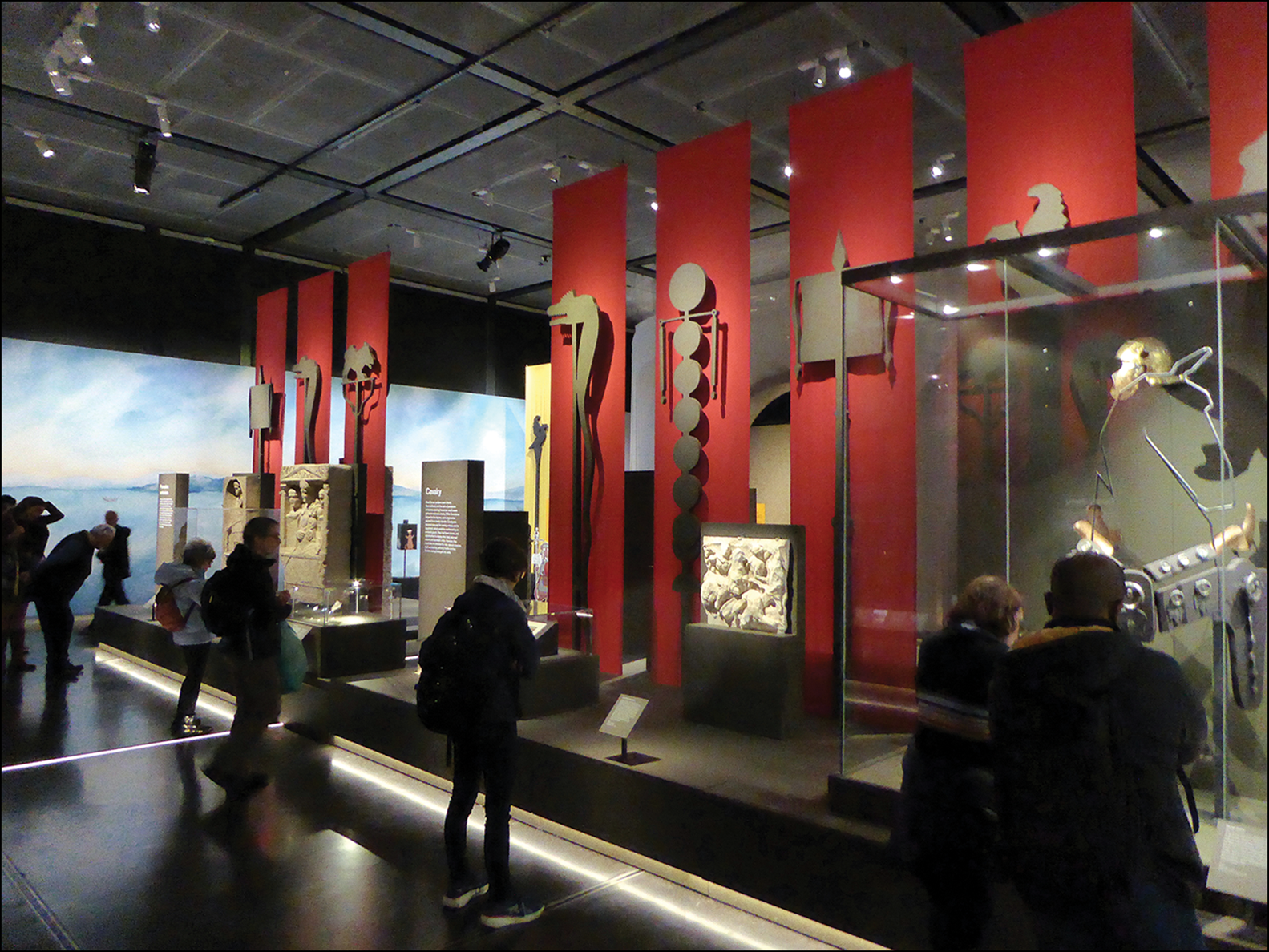
Whatever one's feelings about the public display of human remains (there is a handy note to explain the museum's policy on this), the Romans’ epigraphically attested obsession with enduring fame has certainly been achieved by this anonymous marine. ‘Ranks and Roles’ enumerates the organisation and career structure of the army and uses some of the finest figural tombstones from the UK and the Rhineland to help, including the centurion Favonius Facilis from Colchester (whose likely cremated remains are also present) and some contemporaneous pieces from Bonn and Mainz, always hauntingly reminiscent of those American Civil War photographs of men about to go to war (Figure 2).
General view of the section of the exhibition devoted to centurions and cavalry (photograph by M.C. Bishop).
‘Advance to Aristocracy’ presents a chance for a name check for the Herculaneum marine's former commander, Pliny the Elder, with the inclusion of the Xanten horse-harness components, one of which bears an inscription mentioning the great man in his earlier guise as a cavalry commander. No historical context is given for these, but the possibility that, like the larger Doorwerth hoard of similar fittings, the set may relate to the Batavian uprising of AD 69/70 by some auxiliaries (Bishop & Coulston Reference Bishop and Coulston2006: 31), lends an added poignancy to its inclusion in this exhibition. The illustration of the cavalry training exercise, Arrian's hippika gymnasia, by means of the display of the face-mask helmets from Nola and Ribchester alongside the Crosby Garrett helmet is powerful. ‘Dressing for Battle’ is where the hardware comes into its own, with some spectacular finds making an appearance, notably the famous curved rectangular scutum, gaudily painted—and shown alongside one of the few bosses from such legionary shields, found in the Tyne at South Shields which is also highly decorated—and one of the complete horse armours from Dura-Europos. Even after years of looking at photos of it, the shield-board painting is breathtaking up close, its totemic lion appealingly nonplussed (Figure 3).
The lion of the Dura-Europos shield, possibly the totemic animal of Sixteenth Legion Flavia Firma, a detachment of which was at Dura in the third century AD (©Yale University Art Gallery (Public Domain)).

Helmets, swords and shafted weapons abound—visitors can even try on some replicas—but another outstanding (and astounding) exhibit is the set of lorica segmentata (type of laminated armour) from Kalkriese, conveniently displayed in its own case so that a detailed inspection from all angles is possible. Incidentally, the fact that the German armour is here along with eponymous pieces of armour from Corbridge and Newstead, is itself a World FirstTM, if you like that sort of thing. ‘Tent Life’ looks at the Roman army on campaign, including some leather tent panels from Vindolanda displayed in situ on a tent mock-up, along with the obligatory wooden tent pegs and paraphernalia of campaigning ‘sub pellibus’ (Bishop Reference Bishop2014: 47). ‘Fort Life’ not only examines the soldiers in their more permanent homes but touches on the lives of the civilians such as Regina, the former slave of a Syrian, Barates, who accompanied them—for some tastes this is perhaps not displayed to a great enough extent, but truthfully that subject demands an exhibition in its own right. The final theme is ‘Soldiers in Society’ and deals with the policing role of the army within society, in the absence of a dedicated force for that purpose. The gruesome burial of two armed soldiers from Canterbury, dumped in a pit, one on top of the other, once again confronts us with real Roman soldiers and underlines that they were not just found in forts, fortlets and fortresses. These two lie next to a victim of crucifixion from Fenstanton, nail still through ankle, a rare example of a common, harsh, and all-too-well-known form of criminal punishment.
Lastly, as is by now traditional, one exits through a ‘shopportunity’ suitably stuffed with doodads, baubles and even a select few books.
Design
The layout is delightfully spacious compared with some preceding exhibitions (memories of the frustrating log jam at the beginning of the 2014 Vikings exhibition in the self-same space still linger a decade later). There is an evolving soundscape as you move through the themes—seagulls and marching boots at the beginning as Terentianus is recruited, birds and cicadas as he retires at the end—but good luck with hearing those when eager school groups are in! Captions are provided low down on displays to please most and satisfy accessibility requirements, although those of us who are taller would have welcomed their duplication higher up (but this is sadly true of all British Museum exhibitions).
Plusses and minuses
If one had drawn up a tick-sheet of things that had to be included in such an exhibition, Legion scores highly. The headline items—notably those from Dura-Europos, Kalkriese, Herculaneum and Newstead—are complemented by lesser-known material, a significant proportion of it from private collectors (there is, of course, a discussion to be had about that) and serves to show how far Roman army studies have come since Webster's book. This format also underlines the wrong-headedness of the old ‘don't we already know everything?’ line one sometimes hears, remembering James Curle's original thoughts on the saddle horns in the light of more recent reinterpretations (Curle Reference Curle1911; Bishop Reference Bishop, Hunter and Keppie2012: 70).
It is also a reviewer's job to pick nits (and a handy louse comb from Vindolanda is conveniently included in the ‘Tent Life’ section) but the infestation is slight. From the beginning, a sporadic rattle greets the visitor and it is only near the end that this is revealed to be a game of knuckle bones. This is one of the more annoying interactives—of which there are, thankfully, few—to be encountered (a military height chart was amusing and, yes, one can see a long way from up here!). Compared with L'Armée de Rome, the importance to modern Roman military studies of the work of re-enactors and experimental archaeologists is largely ignored, which is a pity, for they are far more than just decoration for opening events.
Book
As is normal, a lavishly illustrated book of essays Legion: life in the Roman Army by Richard Abdy (Reference Abdy2024) accompanied the exhibition. It is a shame that a catalogue section is now unfashionable because they are always handy to go back in later years and remind oneself of what was seen, not least as not everything in the book is in the exhibition. For example, Flavius Bassus’ magnificent tombstone did not make it over (despite being rumoured to be coming), so the visitor has to content themselves with a picture of it (there is a tiny photo in the exhibition but it is easily missed). The hardback is on general sale from the usual outlets, but the (cheaper) paperback is available only in The British Museum.
The book accompanying L'Armée de Rome shamelessly included catalogue sections at the end of each chapter and is none the worse for it. Moreover, the fact that a series of specialists contributed essays to it gave it a breadth and authority that some might feel the Legion book lacks.
Impact and audiences
Terry Deary's notion of Rotten Romans—make no mistake, they could be a thoroughly unpleasant bunch, but then so could everybody in antiquity; just as now—reminds one of why it was always a good plan not to be staring across a battlefield at a Roman army. The positive press reaction during the exhibition (archaeology still makes good copy, even if it features ‘baffled’ archaeologists slightly too often) is encouraging, perhaps raising questions around cuts to the funding of academic archaeology and the humanities which make this sort of thing possible. In the run-up to the opening, details about selected highlights were handed to the press, including the newly re-reconstructed articulated arm guard from Newstead and the Kalkriese armour, and were eagerly published and broadcast.
Pitching an exhibition like this at several strata of audiences (children, of course, uninterested and interested adults, enthusiasts and academics both familiar and unfamiliar with the period) is never easy. All will have their preconceptions; however, few subjects in the realm of ancient history and archaeology excite quite such interest as the Roman army (or, properly, armies: James Reference James2002: 39).
Conclusion
So, would Webster-hardened veterans approve? Showcasing how far Roman military studies have come in five decades, as this exhibition so ably does, the answer is that they ought to. Verging on a once-in-a-lifetime opportunity to see wonderful, and in some cases unique, items, Legion really demands more than one viewing.
However, one is inevitably forced to ask whether it fulfilled its potential. The study of the Roman army has progressed beyond Webster's seminal work, incorporated many different disciplines and leaned into the lead provided by prehistory in more recent times. Perhaps what is missing is a means of encapsulating the gap between that near-complete set of armour from Kalkriese and the material from Corbridge; how the former was subjected to the latest industrial tomography to produce a 3D scan to enable its interpretation and reconstruction (Varusschlacht im Osnabrücker Land 2020), whereas in the 1960s a piece of the Corbridge armour was taken to Wallsend to experiment with Swan Hunter's X-ray machine (used to check ship welding). Sometimes ‘here's how we know this’ is just as interesting as ‘we know this’.
Carping aside, returning in the final weeks, when visitor numbers have inevitably subsided, will reward with an opportunity to peruse items again. I will be going back; it will be worth it just to bend down and stare that insouciant Dura lion in the eye one more time.



