Introduction
The death of a spouse has significant health and economic consequences for the surviving partner. Specifically in older adults, widowhood has been associated with adverse effects on the surviving partner's physical and mental health, withdrawal from social engagement, increased economic burden, and mortality risk (van Grootheest et al., Reference van Grootheest, Beekman, Broese van Groenou and Deeg1999; Sonnenberg et al., Reference Sonnenberg, Beekman, Deeg and van Tilburg2000; Lee et al., Reference Lee, DeMaris, Bavin and Sullivan2001; Angel et al., Reference Angel, Jimenez and Angel2007; Moon et al., Reference Moon, Kondo, Glymour and Subramanian2011; Sasson and Umberson, Reference Sasson and Umberson2014). However, criticism has been directed at the existing literature base (Lee and DeMaris, Reference Lee and DeMaris2007; Sasson and Umberson, Reference Sasson and Umberson2014) as many of these findings are typically drawn from studies with cross-sectional designs (van Grootheest et al., Reference van Grootheest, Beekman, Broese van Groenou and Deeg1999; Sonnenberg et al., Reference Sonnenberg, Beekman, Deeg and van Tilburg2000; Lee et al., Reference Lee, DeMaris, Bavin and Sullivan2001), which estimate the effects of widowhood at one time point, comparing partnered or married with those who are widowed. In those instances where longitudinal designs have been implemented, designs have predominantly utilized two observation points with time ranging between one month and five years (Murrell and Himmelfarb, Reference Murrell and Himmelfarb1989; Harlow et al., Reference Harlow, Goldberg and Comstock1991; Deleon et al., Reference Deleon, Kasl and Jacobs1994; Lichtenstein et al., Reference Lichtenstein, Gatz, Pedersen, Berg and McClearn1996; Marks and Lambert, Reference Marks and Lambert1998; Carr et al., Reference Carr, House, Kessler, Nesse, Sonnega and Wortman2000; Chou and Chi, Reference Chou and Chi2000; Bonanno et al., Reference Bonanno2002; Carr, Reference Carr2004). Consequently, by their very designs, with limited number of observations and varied length of observation period, many of these studies have limited capacity to estimate effectively pre-event, duration, and post-event changes in widowed mental health. One example of a study that utilized a truly longitudinal design to capture trajectories of depression was reported recently by Sasson and Umberson (Reference Sasson and Umberson2014), who utilized multiple measurements of a nationally representative sample over a 14-year period to identify increased likelihood of depression in those who became widowed. However, their sample was relatively young at baseline (aged 51–61 years) with the youngest only just reaching 65 years at the end of their study period, and their findings may not necessarily describe the experiences of older adults. Also, Harlow et al. (Reference Harlow, Goldberg and Comstock1991) examined changes in depression at multiple observation points throughout a single year. Although all participants were partnered at baseline, there were differences between those who became widowed and those who remained partnered on baseline measures, suggesting adverse effects on the surviving partner prior to partner's death. However, their failure to include sufficient pre-event information limits making assertions about the extent to which these changes are a consequence of spousal loss
In order to address some of the shortcomings of the previous literature on the impact of widowhood on mental health and wellbeing, the current study examines findings from a study of older Australians aged 65+ years at baseline who were repeatedly observed biannually for up to 16 years on dimensions of mental health and wellbeing (Browning and Kendig, Reference Browning and Kendig2010). First, we estimate the impact of widowhood by comparing the impact of transition into widowhood for participants at any time over the study period with whether a participant was widowed at any time over the study period. Then we estimate trajectories of wellbeing and mental health in those who reported becoming widowed and compare age-normative trajectories of those who remained married. By centering time at the occasion of partner's death, we will explicitly model the trajectories of participants’ mental health and wellbeing pre-, during, and post-event for up to 16 years prior to and post partner's death.
There is also a need to reconcile operational differences in mental health and wellbeing, particularly among older adults. The role of mental health in late life is important; there is considerable evidence that increasing psychological distress in late life, particularly in males (Burns et al., Reference Burns, Butterworth, Luszcz and Anstey2013a) can severely impact quality of life, frequently accompanying age-normative declines in other health indices and when approaching mortality (Gerstorf et al., Reference Gerstorf2010; Burns et al., Reference Burns2013b; Reference Burns, Mitchell, Shaw and Anstey2014b). It is increasingly understood that mental health can also be assessed in terms of wellness or wellbeing, particularly in older adults (Ryff, Reference Ryff1989; Burns et al., Reference Burns, Mitchell, Shaw and Anstey2014b; Reference Burns, Sargent-Cox, Mitchell and Anstey2014c), but prior studies into the effects of widowhood have typically focused on dimensions of clinical mental health. Studies ignore other important components of wellbeing that underlie a multi-dimensional model of wellbeing and mental health (Huppert et al., Reference Huppert2009); examples are few (Wells and Kendig, Reference Wells and Kendig1997). There is clearly a need to complement research about mental health in late life with other wellbeing dimensions and to assess how related, yet different, constructs change over time through the widowhood transition. We therefore incorporate measures of subjective wellbeing, defined in terms of the presence of positive affect and the absence of negative affect (Ryan and Deci, Reference Ryan and Deci2001) as well as clinically relevant depressive symptoms.
Methods
Participants
Participants were from the Melbourne Longitudinal Studies on Healthy Ageing (MELSHA) study. The background and methods of the study have been reported in detail elsewhere (Kendig et al., Reference Kendig, Helme, Teshuva, Osborne, Flicker and Browning1996; Browning and Kendig, Reference Browning and Kendig2010). To summarize, participants (n = 1,000) in the 1994 baseline survey were living in private dwellings in metropolitan Melbourne, were aged 65 years and over in 1994, and then followed for up to 16 years. The response rate for the baseline interview was 70%, yielding a sample representative of older people living in the community in Melbourne at the time, except for those who were too ill to be interviewed and non-English speaking people. Respondents in the baseline survey were followed up biennially thru telephone interviews and by mail in the intervening years. The baseline data collection conducted in respondents’ homes included a face-to-face interview, a brief physical assessment, and a self-completion instrument, which was returned later by mail. For the current study, data were used from participants (n = 652) who were either married or de facto (n = 577) at baseline or widowed (n = 75) four years prior to baseline observation. Of the 577 participants partnered at baseline, n = 89 reported becoming widowed over the survey period, at a mean period = 8.7 years (SD = 5.33) from the baseline and at the mean age of 84.5 years (SD = 5.8). Just over 53% of the participants were females, reported a mean age of 73 years (range 65–94 years), and provided up to eight observations (mean = 4.3; SD = 1.2). Reflecting their age-cohort, substantial numbers left school between the age of 13 and 14 years (47%), 15 and 16 (31%), with only 19% leaving school older than 16 years of age. Of the 652 participants included in this study, 11.1% provided data at all eight observations, 8.5% provided seven observations, 13.5% provided six observations, 11.1% provided five observations, 14.6 provided four observations, 10.0% provided three observations, 14.7% provided two observations, and 16.6% provided one observation.
Measures
Subjective wellbeing
Subjective Wellbeing (SWB) was assessed in terms of positive and negative affect. The Brief Positive and Negative Affect Measures (Lawton et al., Reference Lawton, Kleban, Dean, Rajagopal and Parmelee1992) were used to assess positive and negative affective components of SWB, with participants asked to indicate “how often they had felt [insert affect] over the last year.” Participants responded on a Likert scale ranging from “1 – very dissatisfied” to “5 – extremely satisfied.” Two higher order factors were extracted from a factor analysis (not reported here) to reflect the positive and negative affect dimensions. Affect scores were then T-scored to baseline (mean = 50; SD = 10) in order to make direct comparisons between the affect dimensions.
Mental health
Mental Health was assessed using the depression scale from the Psychogeriatric Assessment Scales (PAS), which provide an assessment of two major psychogeriatric disorders: dementia and depression (Jorm et al., Reference Jorm1995). The PAS depression scale assesses presence of 12 symptoms of depression over the previous two weeks. Validation of the PAS depression scale indicated a score of 4 or more as indicative of depression in 80% of depression patients (Jorm et al., Reference Jorm1995).
Covariates
We adjusted for several time-invariant socio-demographic characteristics, including baseline chronological age, and education (assessed in terms of age of leaving school). Analyses were stratified by gender.
Statistical analysis
Statistical analyses were undertaken in STATA v.10. Generalized Estimating Equations (GEE) estimated population effects and examined differences in the trajectories of wellbeing and mental health. As the SWB indicators reflected continuous outcomes, analyses of both positive and negative affect dimensions were specified with a Gaussian distribution and identity link function. As the PAS reflected a count of depressions, analysis of depressive symptoms utilized a Poisson distribution with a logit link function. First, we examined differences in the wellbeing and mental health of participants when they first reported becoming widowed during the study period. Second, we estimated trajectories in wellbeing and mental health to examine the declines pre- and post partner's death using piecewise regression by centering the intercept at the observation at which participants first reported being widowed. As trajectory scores of SWB and mental health are more sensitive to the occasions at or around change in widowhood status, linear slopes were estimated to capture the more substantial changes in both pre- and post-event time periods, while quadratic slope was estimated to moderate the extent of linear effects that would otherwise lead to improbable SWB scores and depressive symptom counts.
Results
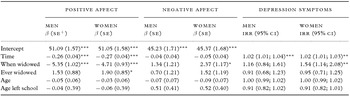
We examined the impact of widowhood by comparing the effects of “ever” experienced widowhood over the observation period (vs.) “when” participants reported becoming widowed. Results (Table 1) indicated that the observations in which respondents indicated being widowed was strongly related to lower positive affect for both men (β = −5.35 (SE = 1.02), p = 0.007) and women (β = −4.71 (SE = .93), p < 0.001), but increased levels of negative affect (β = 2.37 (SE = 1.17), p = 0.042) and depressive symptomology (Incidence Rate Ratios (IRR) = 1.54 (95% CI: 1.14; 2.08), p = 0.005) for women only. We supplemented these analyses with a series of post hoc analyses to examine whether main effects for widowhood status were an artefact of methodological limitations such as participant drop. Therefore, we assessed whether the effect of widowhood status was consistent over time or moderated by participant dropout. Interactions between widowhood status and both time and participant dropout were not significant and indicate that the main effects were stable across the study period and not impacted by dropout.
Comparing the impact of widowhood on subjective wellbeing and depression over 16 years

Notes: +SE was computed with Sandwich Estimator.
***p < 0.001, **p < 0.01, *p < 0.05.
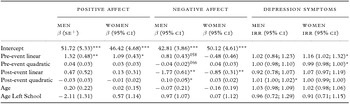
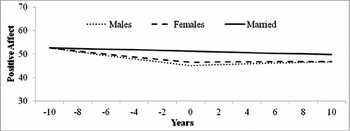
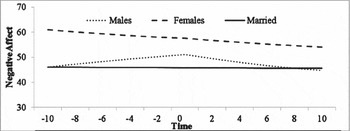
Since the occurrence of widowhood was so strongly indicated with changes in wellbeing and mental health, we examined changes in the trajectories of wellbeing and depressive symptoms in the years preceding and post-widowhood transition by estimating linear and quadratic slopes in and out of the time of widowhood transition. These estimates are reported in Table 2. For both men and women there were higher levels of positive affect immediately pre partner's death (men: β = 1.32 (SE = 0.48), p = 0.006; women: β = 1.09 (SE = 0.43), p < 0.012), suggesting significantly lower positive affect at time of widowhood. The lack of significant change following partner's death suggests that neither men nor women rebounded back to pre-event levels of positive affect. In contrast, for negative affect, both men and women reported no change in negative affect in the years preceding partner's death, but a decline in negative affect post partner's loss (men: β = −1.77 (SE = 0.61), p = 0.004; women: β = −0.85 (SE = 13), p = 0.005), suggesting positive adaptation to the partner's loss. Higher levels of negative affect were reported by men in the years preceding partner's death, but these just failed to reach our cutoff for statistical significance (p = 0.05). Trajectories of positive (Figure 1) and negative affect dimensions (Figure 2) were plotted for men and women and compared with the trajectories estimated from those who remained married across the observation period. Clearly, both men and women reported comparable positive affect in comparison with those who remained married, but both genders reported comparable decline in positive affect in the years preceding partner's loss while they never regained those losses post partner's loss. Females who reported partner-loss reported consistently higher levels of negative affect, while for males, we can more clearly see the impact of widowhood and their capacity to rebound following partner's loss. In contrast to affect, changes in depressive symptomology were inconsistent between men and women. Women reported a significant increase in the number of depressive symptoms reported pre-loss (IRR = 1.16 (95% CI: 1.02; 1.32), p = 0.027), suggesting increasing levels leading into partner's death. A quadratic effect for pre-widowhood time for women (IRR = 0.99 (95% CI: 0.97; 0.99); p = 0.046) and for men, a very small post-event quadratic effect (IRR = 1.01 (95% CI: 1.00; 1.02) p = 0.042) only just reach statistical significance. No anticipatory effects in depressive symptomology were identified for men.
Examining the trajectories of subjective wellbeing and depression through the widowhood transition

Note: +SE computed with Sandwich Estimator.
***p < 0.001, **p < 0.01, *p < 0.05.
Comparing trajectories of positive affect between widowed men and women with those who were married.

Comparing trajectories of negative affect between widowed men and women with those who were married.

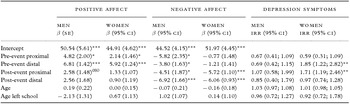
As a form of sensitivity analysis, we re-estimated pre- and post-levels of wellbeing and mental health by collapsing time into the following five discrete periods (Table 3): (1) the time of the event (the reference category), (2) an immediate pre-event period (0–2 years prior to the event), (3) a distant pre-event period (>2 years prior to the event), (4) an immediate post-event period (0–2 years post the event), and (5) a distant post-event period (>2 years post the event). For positive affect, higher positive affect was reported in the years prior to partner's death for both men (Proximalprior: β = 4.82 (SE = 2.00), p = 0.016; Distalprior: β = 6.81 (SE = 1.42), p < 0.001) and women (Proximalprior: β = 3.14 (SE = 1.46), p = 0.031; Distal prior: β = 5.92 (SE = 1.24), p < 0.001). For negative affect, men (Proximalpost: β = −4.51 (SE = 1.87), p = 0.016; Distalpost: β = −6.92 (SE = 1.66), p < 0.001) and women (Proximalpost: β = −5.72 (SE = 1.11), p < 0.001; Distalpost: β = −6.06 (SE = 0.93), p < 0.001) reported lower negative affect in the years following their partner's death. In contrast to the earlier trajectory analyses, for men, the lower negative affect in the years preceding death now reached statistical significance (Proximalpost: β = −5.82 (SE = 2.35), p < 0.001; Distalpost: β = −3.80 (SE = 1.63), p < 0.001). In terms of depressive symptoms, men reported no significant change either prior to or post partner's death in these analyses. For women, no clear pattern of increasing depressive symptomology was reported, with significantly lower numbers of depressive symptoms reported distally prior to partner's death and proximally post partner's death. Overall, analyses supported findings of the analysis of wellbeing trajectories. For example, both linear and discrete models indicate increased positive affect pre-event for males and females. Similarly, pre-event negative affect was lower for men in both linear and discrete models (reaching statistical significance pre-event), while both men and women reported lower negative affect post-event in both linear and discrete models.
A sensitivity analysis using discrete time periods to examine changes in levels of subjective wellbeing and depression through the widowhood transition

Note: +SE computed with Sandwich Estimator.
***p < 0.001, **p < 0.01, *p < 0.05.
Discussion
Using 16 years of longitudinal data from the MELSHA study, we examined the extent to which transitioning into widowhood is associated with poorer mental health and wellbeing outcomes. In addition, we have estimated trajectories of pre- and post-event levels of mental health and wellbeing to examine the extent to which widows report (1) anticipatory changes prior to partner's death, and (2) a return to long-term pre-widowhood levels of wellbeing and mental health post partner's death. Overall, we have identified that the experience of widowhood does present some long-term impact on the mental health and wellbeing of older adults. However, it is the period when partner's death occurs that the biggest risk to mental health and wellbeing presents. For example, both men and women reported declines in positive affect at those times when widowhood occurred. The importance of examining outcomes for men and women separately is clear and supports other research that has identified different gender trajectories in mental health and wellbeing in late life (Burns et al., Reference Burns2013b). Our findings indicated increased number of depressive symptoms for women when reporting becoming a widow, a finding not identified for men.
When estimating trajectories of changes in wellbeing and mental health, we identified differences in how widowhood influenced changes in different dimensions of mental health and wellbeing. First, for both men and women, decline in positive affect was identified prior to widowhood transition, suggesting an anticipatory effect of partner's death. These changes appear to be permanent as there is no evidence that suggests that either gender rebounds in terms of positive affect. In contrast, for both men and women, declines in negative affect post partner's death were reported, suggesting resilience to the widowhood transition. In our sensitivity analyses, men also reported lower negative affect in the years preceding partner's death, indicating the risk of increased negative affect at the period when partner's death occurs. Changes in depressive symptoms were inconsistent between men and women. Men do not appear to report substantial changes in depressive symptoms as a consequence of partner's death. Females appear to report increasing depressive symptoms in the years leading to partner's death, but based on our sensitivity analyses, these symptoms appear to dissipate immediately in the years following partner's death. We can only conclude therefore that while positive affect appears to be particularly impacted by widowhood in the long term, this does not hold for negative affect and depressive symptoms. Overall, this suggests that widowed report a capacity to adapt to partner's death. Our findings support a growing literature base that argues for the need to discriminate between different dimensions of mental health and wellbeing (Ryan and Deci, Reference Ryan and Deci2001; Burns et al., Reference Burns, Mitchell, Shaw and Anstey2014b; Reference Burns, Sargent-Cox, Mitchell and Anstey2014c) in order to examine fully the impact of contextual events on the quality of life in older adults through and enhance health promotion (Kendig et al., Reference Kendig, Browning, Thomas and Wells2014). We also provide further evidence for the need to examine wellbeing in older men and women, separately (Burns et al., Reference Burns2013b; Reference Burns2014a), as the results here confirm different patterns of SWB and mental health responses between men and women.
These findings need to be considered in the light of several limitations. Of the original baseline sample of 652 participants who were partnered or recently widowed at baseline, a further 25% reported a recent death. Overall, the number of study participants who reported transitioning into widowhood was low. Low numbers of men and women who transitioned into widowhood may undermine our capacity to model effectively wellbeing and mental health trajectories both pre and post event. However, comparing these analyses with discrete indicators of proximal and distal periods confirmed our linear models. Our findings are also based on a cohort aged 65+ in 1994 and we cannot dismiss the likelihood that different birth cohorts will report quite different experiences. For instance, increasing longevity may see larger numbers of men outliving their women partners in heterosexual partnerships. Also, younger cohorts, particularly those of the baby-boomer generation, comprise cohorts of individuals who have challenged established social structures, questioning many assumed and accepted social values and attitudes, but unfortunately beyond the capacity of the current study to examine. Such intergenerational differences are likely to impact our capacity to draw direct comparisons between older adults of different birth cohorts. Consequently, this may moderate the extent to which these findings might be replicated in younger cohorts.
Methodologically, we have assumed that a single-population trajectory best describes the nature of change in our sample of older widows. Previously, Burns et al. (Reference Burns, Byles, Magliano, Mitchell and Anstey2015) have demonstrated the utility of mixture distributions that identify quite different types of trajectories in mental health and wellbeing in older adults. It may be that different sub-classes of individuals report quite different types of changes as a consequence of their transition into widowhood. We may well hypothesize that individuals’ emotional responses to partner's death may moderate their own mortality risk. It may be that those who are closer to their own death may report quite different response patterns. However, the low number of widowed prohibits a substantive examination of this question within MELSHA. Also, we are unable to examine the impact of the cause of partner's death and whether the death was unexpected or not. It may well be different wellbeing and mental health responses may be moderated by these features of partner's death.
Future research also needs to consider the range of social and individual factors that may moderate capacity to be resilient to spousal loss. Finally, while a longitudinal study, MELSHA observed participants every two years and we cannot examine the more intricate changes over shorter temporal durations of weeks and months. However, given the length of observation period, we can be confident about the robustness of our findings, although we cannot make any statement about the extent to which these findings would be replicated in other Australian cities or in other national samples. This is clearly an area that needs further elucidation.
In conclusion, we present an important contribution to the literature, reporting the trajectories of wellbeing and mental health prior and post widowhood transition over a 16-year period. We have demonstrated that the occurrence of widowhood does not have significant long-term impact on all mental health and wellbeing dimensions. While both men and women reported lower positive affect post-loss, changes in negative affect were only short-lived for both men and women whereas short-term changes in depressive symptomology were reported for females only. Our results suggest that the impact of widowhood is inconsistent between men and women or across different dimensions of mental health and wellbeing. This indicates the value in operationalizing wellbeing and mental health across multiple and related measures and examining the impacts of widowhood for both men and women separately. In order to maximize the identification of older people whose wellbeing is compromised following the death of a spouse, it is clearly important to use a range of measures across both mental health and wellbeing domains.
Conflict of interest
None.
Description of authors’ roles
All authors have read and approved the final version of this manuscript. Specifically, R. A. Burns formulated the research question, determined the analytical methods and undertook the statistical analysis, and led the writing of the manuscript. C. Browning and H. L. Kendig contributed to data collection, and contributed to writing the manuscript.
Acknowledgments
We thank the study participants for their long-term commitment to the project. The chief investigators who have contributed to MELSHA are: Colette Browning (Monash University, co-director of MELSHA), Hal Kendig (The Australian National University, co-director of MELSHA), Maria Fiatarone Singh (University of Sydney), Leon Flicker (University of Western Australia), Robert Helme (University of Melbourne), Birgitta Lundgren Lindquist (Jonkoping University), Meg Morris (University of Melbourne), Daniel O’Connor (Monash University), Susan Quine (University of Sydney), Jane Sims (Monash University), Shane Thomas, (Monash University), Carolyn Unsworth (La Trobe University). Associate investigators are Karen Teshuva and Yvonne Wells (La Trobe University). Burns is supported by the Australian Research Council Centre of Excellence in Population Ageing Research (project #CE110001029).