Early adolescence is a challenging developmental period often marked by increases in internalizing symptoms (Muuss, Reference Muuss1996). This developmental transition can be particularly taxing for ethnic minorities, who experience multiple stressors related to their social disadvantage, which in turn increase the risk of psychological distress (Beiser, Hou, Hyman, & Tousignant, Reference Beiser, Hou, Hyman and Tousignant2002; Gutman, Sameroff, & Eccles, Reference Gutman, Sameroff and Eccles2002). Internalizing symptoms are associated with a number of adjustment problems in adulthood (Fröjd et al., Reference Fröjd, Nissinen, Pelkonen, Marttunen, Koivisto and Kaltiala-Heino2008; Rohde, Lewinsohn, & Seeley, Reference Rohde, Lewinsohn and Seeley1996; Weissman et al., Reference Weissman, Wolk, Goldstein, Moreau, Adams and Greenwald1999). Documenting the course of internalizing symptoms during early adolescence and examining the risk processes associated with the development of these symptoms, as well as factors that promote positive youth development (promotive factors), is of primary importance. Knowledge in these areas will not only advance our understanding about the developmental progression of these symptoms and the factors leading to such trajectories but also help to inform future interventions.
Using data from a longitudinal study of Puerto Rican youth in Puerto Rico and in New York, we aim to document Puerto Rican youths' trajectories of internalizing symptoms in these two contexts and to evaluate whether youth living in a minority context are at increased risk of developing internalizing problems. We draw from García Coll et al.'s (Reference García Coll, Lamberty, Jenkins, McAdoo, Crnic and Wasik1996) integrative model for the study of competencies in minority children to examine how social status can influence the developmental outcomes of ethnic minority youth.
Internalizing Symptoms During Adolescence
Adolescence is a developmental period marked by changes in the physical, social, psychological, and cognitive domains (Lerner & Galambos, Reference Lerner and Galambos1998). Because psychological problems generally follow a developmental progression, transitions and differences in how individuals navigate transitions offer a fertile ground for explaining and predicting individual differences in developmental course (Graber & Brooks-Gunn, Reference Graber and Brooks-Gunn1996; Zahn-Waxler, Klimes-Dougan, & Slattery, Reference Zahn-Waxler, Klimes-Gougan and Slattery2000). Numerous studies show that depression and some types of anxiety disorders increase from childhood to adolescence, particularly among girls, with the advent of puberty (e.g., Costello & Angold, Reference Costello, Angold and March1995; Graber & Sontag, Reference Graber, Sontag, Lerner and Steinberg2009; Kessler et al., Reference Kessler, Amminger, Aguilar-Gaxiola, Alonso, Lee and Ustun2007; Zahn-Waxler et al., Reference Zahn-Waxler, Klimes-Gougan and Slattery2000). The increase in internalizing disorders during these years is affected by multiple influences at the biological, individual, family, social, and contextual levels (Cicchetti & Toth, Reference Cicchetti and Toth1998). According to the cumulative and simultaneous events perspective, internalizing symptoms increase in adolescence as a result of rapid increases in the number of life events individuals experience and the stress associated with these events (Graber & Sontag, Reference Graber, Sontag, Lerner and Steinberg2009; Grant, Compas, Thurm, McMahon, & Gipson, Reference Grant, Compas, Thurm, McMahon and Gipson2004), as well as the biological and neurological changes associated with adolescence (Yurgelun-Todd, Reference Yurgelun-Todd2007). Successful adaptation during this developmental transition will depend on the resources available to youth to cope with these events. Because internalizing disorders during adolescence predict internalizing disorders in adulthood (Johnson, Cohen, & Kasen, Reference Johnson, Cohen and Kasen2009), a developmental psychopathology approach calls for the examination of predictors of trajectories of internalizing symptoms during early adolescence. Understanding individual differences in the course of internalizing symptoms during this developmental transition is central to our understanding of processes of risk and resilience across the lifetime (Graber & Brooks-Gunn, Reference Graber and Brooks-Gunn1996).
Even though there is a general consensus that internalizing problems increase from childhood to adolescence, the course of internalizing symptoms during adolescence is not as well understood. In a meta-analysis of studies using the Child Depression Inventory among children aged 8–16, Twenge and Nolen-Hoeksema (Reference Twenge and Nolen-Hoeksema2002) found that in cross-sectional studies, depression increased with age, especially among females after the age of 13. Conversely, in longitudinal studies, Child Depression Inventory scores decreased over time. This tendency to report fewer symptoms in follow-up interviews even when this is unlikely or impossible is known as the attenuation effect (Jensen et al., Reference Jensen, Bird, Canino, Dulcan, Rae and Richters1993). Some longitudinal studies have found increases in internalizing symptoms over time (Cole et al., Reference Cole, Tram, Martin, Hoffman, Ruiz and Jacquez2002; Leve, Kim, & Pears, Reference Leve, Kim and Pears2005), while others have found curvilinear relationships between time and internalizing symptoms (Bongers, Koot, van der Ende, & Verhulst, Reference Bongers, Koot, van der Ende and Verhulst2003; Garber, Keiley, & Martin, Reference Garber, Keiley and Martin2002). More recent studies using group-based methods have found variability in trajectories of internalizing symptoms in children and early adolescents, with some groups experiencing increases, others decreases, and still others stability over time (Duchesne, Vitaro, Larose, & Tremblay, Reference Duchesne, Vitaro, Larose and Tremblay2008; Mazza, Fleming, Abbott, Haggerty, & Catalano, Reference Mazza, Fleming, Abbott, Haggerty and Catalano2010). This study describes the trajectories of internalizing symptoms of youth aged 10 to 13 who are undergoing the transition from childhood to adolescence (for a study examining children's externalizing symptoms using the same data set, see Bird et al., Reference Bird, Shrout, Davies, Canino, Duarte and Shen2007).
Ethnicity, Social Context, and Mental Health
In the United States, as in many societies, ethnicity is an important social position factor through which individuals are stratified in the social hierarchy (García Coll et al., Reference García Coll, Lamberty, Jenkins, McAdoo, Crnic and Wasik1996). Children who grow up in a context in which they are part of a statistical minority often (although not always) adopt a weak position in the existing social hierarchy. A cultural diversity perspective on the development of internalizing symptoms in youth needs to consider how social position factors, such as race, ethnicity, and minority status, affect children's development. According to García Coll et al. (Reference García Coll, Lamberty, Jenkins, McAdoo, Crnic and Wasik1996), social position itself does not account for the effect of classification variables on the development of minority children but rather the effect of macrolevel mechanisms of racism, prejudice, discrimination, and oppression on the minority child's and family's environment. These mechanisms operate in proximal environments through their effects on residential, economic, social, and psychological segregation. Ethnic minorities often develop in segregated contexts characterized by neighborhood disadvantage, poverty, low parental education, unemployment, and fragmented social networks, all of which affect family dynamics and child development (Beiser et al., Reference Beiser, Hou, Hyman and Tousignant2002; García Coll et al., Reference García Coll, Lamberty, Jenkins, McAdoo, Crnic and Wasik1996; Gutman et al., Reference Gutman, Sameroff and Eccles2002; McLeod, Reference McLeod1998; Vega & Rumbaut, Reference Vega and Rumbaut1991). In contrast, children who grow up in a context where they are part of the majority culture occupy a privileged status in society and typically do not experience the same kind of racial and ethnic discrimination, social alienation, and cultural stress that ethnic minorities do.
Research comparing the psychological outcomes of low- and high-status groups has focused on group comparisons between ethnic minorities and Whites. These studies have generally found that ethnic minority youth, particularly Hispanics, have elevated levels of depression and anxiety compared to Whites (for a review, see Anderson & Mayes, Reference Anderson and Mayes2010). Among Hispanics, Puerto Rican adults have higher rates of psychiatric disorders than do other Hispanic groups (Alegría et al., Reference Alegría, Mulvaney-Day, Torres, Polo, Cao and Canino2007). Group comparisons between ethnic minorities and Whites are informative in the study of health disparities, but such comparisons can present conceptual and methodological challenges. First, these comparisons assume that Whites are the normative group and view minorities as having defective outcomes when compared to Whites (e.g., García Coll et al., Reference García Coll, Lamberty, Jenkins, McAdoo, Crnic and Wasik1996). Second, minority status is confounded with socioeconomic status, making it difficult to disentangle the relative influence of ethnicity, social class, culture, and context on well-being. Research comparing the same ethnic group in their home culture and in their host culture is critical for understanding how the context of migration and minority status influences psychological outcomes (Stevens & Vollebergh, Reference Stevens and Vollebergh2008). Even though some studies have compared the outcomes of youth in the sending and receiving countries (e.g., Suárez-Orozco & Suárez-Orozco, Reference Suárez-Orozco and Suárez-Orozco1995), these studies typically do not explore trajectories in both contexts. Examining trajectories of internalizing symptoms during early adolescence is particularly important because studies have shown that greater variation in trajectories of these symptoms occurs during early adolescence than later (Cole et al., Reference Cole, Tram, Martin, Hoffman, Ruiz and Jacquez2002). In addition, point estimates of group differences in mental health only provide a snapshot of how mental status differs for different groups. Longitudinal examinations of mental health outcomes among ethnic minorities would help us understand how the stress process operates among these groups (Stevens & Vollebergh, Reference Stevens and Vollebergh2008). We address some limitations of past studies by comparing the trajectories of internalizing symptoms of Puerto Ricans in two contexts varying in minority status.
Risk Factors for Mental Health
If youth developing in a context where they occupy a low status in society are at increased risk of developing internalizing symptoms, it is important to identify the factors and processes that increase this risk. Developmental outcomes among low-status youths need to be considered within the context of racism, prejudice, discrimination, and oppression (García Coll et al., Reference García Coll, Lamberty, Jenkins, McAdoo, Crnic and Wasik1996). These mechanisms are manifested in minority youths' physical, social, and psychological environments by creating segregated contexts with limited access to resources. Moreover, these mechanisms can influence youth development directly through interactions in more proximal inhibiting and promoting environments. We consider three mechanisms that might account for differences in internalizing symptoms between low- and high-status youth: perceived discrimination, exposure to community violence (i.e., experiencing or witnessing violent acts such as fights, sexual assault, or gang activity), and parent–child conflict. We hypothesized that exposure to these risk factors is greater for early adolescents who are migrants to the United States and who are part of a minority group. We expected these risk factors, in turn, to be related to internalizing symptoms and to account for differences in internalizing symptoms across the two social contexts.
Individuals who live in a context where they are members of a visible minority group are especially vulnerable to experiences of discrimination due to their race/ethnicity, their skin color, and the way that they speak (García Coll et al., Reference García Coll, Lamberty, Jenkins, McAdoo, Crnic and Wasik1996; Gluszek & Dovidio, Reference Gluszek and Dovidio2010). Discrimination can be experienced in various contexts, and it limits the availability and amount of access to resources individuals have. A review of the existing literature shows a robust association between experiences of discrimination and internalizing symptoms (Williams, Neighbors, & Jackson, Reference Williams, Neighbors and Jackson2008). A longitudinal study also found that increases in racial discrimination over time were associated with increases in depressive symptoms (Brody et al., Reference Brody, Chen, McBride Murry, Ge, Simons and Gibbons2006). The relationship between discrimination and mental health has also been found among Puerto Rican adolescents in the United States (Szalacha et al., Reference Szalacha, Erkut, García Coll, Alarcón, Fields and Ceder2003), but studies have not tested whether differences in internalizing symptoms between Puerto Ricans in a majority and a minority context can be partly attributed to discrimination.
Another mechanism through which minority status can influence the development of minority children is by creating segregated environments with low resources and opportunities (García Coll et al., Reference García Coll, Lamberty, Jenkins, McAdoo, Crnic and Wasik1996). Ethnic and racial groups devalued by society are often concentrated in urban, poor neighborhoods, where exposure to community violence can be high (Carlson, Reference Carlson2006; Gorman-Smith & Tolan, Reference Gorman-Smith and Tolan1998). Residence in such contexts is associated with lower adaptation among immigrant youth (Portes & Rumbaut, Reference Portes and Rumbaut2001). Most of the research linking exposure to community violence to children's psychological well-being has focused on externalizing behaviors, but there is some evidence that higher exposure to violence is related to distress (Mrug, Loosier, & Windle, Reference Mrug, Loosier and Windle2008; Ozer & McDonald, Reference Ozer and McDonald2006).
Finally, we consider parent–child conflict as a third mechanism through which youths in minority versus majority contexts can differ. As García Coll et al. (Reference García Coll, Lamberty, Jenkins, McAdoo, Crnic and Wasik1996) point out, environments can be promoting, inhibiting, or both, depending on the cultural context in which individuals develop. The family is an important aspect of the Latino family's life that often promotes positive youth development (Fuller & García Coll, Reference Fuller and García Coll2010); however, incongruence between parents' goals, values, and expectations, and those of the child can be a source of tension in the family. Sometimes children of immigrants acculturate to the US culture faster than their parents. Even though this is not the only pathway to acculturation, when parents and their children acculturate at different rates, clashes between parents' and children's goals, values, and expectations often increase parent–child conflict (Kasinitz, Mollenkopf, Waters, & Holdaway, Reference Kasinitz, Mollenkopf, Waters and Holdaway2008; Portes & Rumbaut, Reference Portes and Rumbaut2001; Suárez-Orozco & Suárez-Orozco, Reference Suárez-Orozco and Suárez-Orozco2001). Poor family functioning and greater parent–youth conflict are related to distress and declines in psychological well-being (Harker, Reference Harker2001; Lee & Liu, Reference Lee and Liu2001; Smokowski, Rose, & Bacallao, Reference Smokowski, Rose and Bacallao2010). However, there are no studies examining whether parent–child conflict during adolescence is greater when the parents' culture is incongruent with that of the dominant group or whether this accounts for different trajectories of internalizing symptoms in youth in minority versus majority contexts.
Experiences of discrimination, exposure to community violence, and parent–child conflict are experiences that are not necessarily stable over time. Hence, capturing the stability or change of these experiences as youth develop is as important as examining change in internalizing symptoms. Recent methodological advances allow the simultaneous modeling of levels and growth in more than one domain, and to examine how change in one domain relates to change in another domain (Willett & Sayer, Reference Willett, Sayer, Schumacher and Marcoulides1996). This study advances previous work on discrimination, exposure to violence, and parent–child conflict by examining whether the social context in which youth develop relates to levels and slopes of these risk factors and by examining whether these in turn relate to levels and slopes of internalizing symptoms.
Culturally Relevant Promotive Factors for Internalizing Symptoms
Despite the elevated risk for internalizing symptoms experienced by youth during adolescence and the additional risks ethnic minorities experience due to their social disadvantage many youths successfully adapt to the challenges they experience. The impact that social stratification mechanisms such as racism, prejudice, discrimination, and segregation have on minority families' lives stimulates the development of goals, values, and behaviors that deviate from the majority group and draw from the native culture's traditions, cultural legacies, and history (García Coll et al., Reference García Coll, Lamberty, Jenkins, McAdoo, Crnic and Wasik1996). This adaptive process serves as a coping mechanism families rely on to respond to stressors and demands of their environment. For example, characteristics of the Latino culture such as parental monitoring and religiosity could protect minority youth from the negative influence of neighborhood violence, segregation, fragmented social networks, and limited access to support mechanisms on internalizing symptoms, and promote positive youth development (Escobar, Reference Escobar1998; Shields & Behrman, Reference Shields and Behrman2004). Within the risk and resilience framework, promotive factors are those features of individuals or their environment that are associated with positive outcomes in both high- and low-risk populations (Sameroff, Reference Sameroff2000). In contrast, protective factors are those that can minimize the negative effect of risks and are expected to have little impact on low-risk populations (Gutman et al., Reference Gutman, Sameroff and Eccles2002; Masten, Best, & Garmezy, Reference Masten, Best and Garmezy1990; Rutter, Reference Rutter, Rolf, Masten, Cicchetti, Nuechterlein and Weintraub1990). From this perspective, we term the culturally relevant predictors of internalizing symptoms promotive factors because we expect them to have a positive influence on all youth. However, we expect these factors to have a stronger association with internalizing symptoms among Puerto Rican youth in New York, who are exposed to multiple risk factors associated with their minority status. In other words, we expect the negative influence of living in a context where one is part of the minority group on internalizing symptoms to be reduced by parental monitoring and religiosity.
Parental monitoring is an important value in many cultures, but research has shown that Latino parents tend to be more protective and monitor their children more than Whites or Asians (Okagaki & Frensch, Reference Okagaki and Frensch1998; Shakib et al., Reference Shakib, Mouttapa, Johnson, Ritt-Olson, Trinidad and Gallaher2003). For Latino families, parental monitoring and control are expressions of concern and involvement in child upbringing (Elder, Eccles, Ardelt, & Lord, Reference Elder, Eccles, Ardelt and Lord1995). Parental monitoring provides opportunities for communication and disclosure of information about children's whereabouts. Most research has focused on the protective effect of monitoring on externalizing behaviors (e.g., Beyers, Bates, Pettit, & Dodge, Reference Beyers, Bates, Pettit and Dodge2003), but the few existing studies looking at internalizing symptoms show that monitoring is related to less distress (e.g., Harker, Reference Harker2001). Parental monitoring might be particularly important for ethnic minority youth given their heightened exposure to stressors such as exposure to violence and stigmatization (Beyers et al., Reference Beyers, Bates, Pettit and Dodge2003). When parents monitor their children, they are better positioned to identify problems their children face, protect them, and seek help when needed.
Faith plays an important role in Latinos' and immigrants' lives (Stepick, Reference Stepick, Leonard, Stepick, Vasquez and Holdaway2005). Participation in religious activities and internalization of faith principles into daily life (intrinsic religiosity) can enhance well-being, particularly immigrants', who often face stressors associated with the migration experience (Oh & Yoshikawa, Reference Oh, Yoshikawa and García-Coll2011; Suárez-Orozco, Suárez-Orozco, & Todorova, Reference Suárez-Orozco, Suárez-Orozco and Todorova2008). Individuals who participate in religious services enter a community where they gain access to a social network that can provide support in times of need (Marks, Reference Marks2005). Intrinsic religiosity is also thought to be beneficial in aiding individuals to develop a worldview that gives meaning to life, enhances self-worth, and offers hope in times of distress (Ellison, Reference Ellison1995). Furthermore, religiosity can serve as a form of coping in response to daily stressors (Koenig, McCullough, & Larson, Reference Koenig, McCullough and Larson2001; Pargament, Smith, Koenig, & Perez, Reference Pargament, Smith, Koenig and Perez1998). Intrinsic religiosity and church participation are negatively associated with depression and positively related to psychological well-being among adults and adolescents (Pargament et al., Reference Pargament, Smith, Koenig and Perez1998; Wong, Rew, & Slaikeu, Reference Wong, Rew and Slaikeu2006).
The current study capitalizes on a rich epidemiological data set of Puerto Rican youth in two contexts to examine the relationship among minority status, social context, risk and resilience, and internalizing symptoms. We aim to answer the following research questions: (a) How do internalizing symptoms of Puerto Rican youth change over time? (b) Do the individual trajectories of internalizing symptoms in two contrasting groups of Puerto Rican adolescents, one residing in Puerto Rico and one in New York, differ? (c) If adolescents' trajectories of internalizing symptoms vary as a function of their social context and minority status, can risk factors such as discrimination, exposure to community violence, and parent–child conflict account for these differences? (d) How do parental monitoring and religiosity relate to adolescents' trajectories of distress? In other words, do these factors have a buffering effect such that the association of living in a minority context and internalizing symptoms is weaker when levels of parental monitoring and religiosity are higher?
When answering these questions, we acknowledge that there are many reasons why Puerto Ricans living in New York might differ from those living on the island besides being subjected to minority status. We use propensity score and covariate adjustment methods to remove probable migration effects to highlight the processes that are related to minority status differences.
Method
Sample
This study uses data from the Boricua Youth Study, a longitudinal study of Puerto Rican youth living in the standard metropolitan areas of San Juan and Caguas, Puerto Rico (PR), and in the South Bronx, New York (NY). Both samples were multistage probability samples that represent the target areas according to the 1990 US Census. Household eligibility criteria included the presence of a child aged 5 to 13, and both the child and at least one of the primary caregivers had to be Puerto Rican. Up to three children per household could participate in the study. If more than three children were eligible, three were randomly selected to participate in the study (see Bird et al., Reference Bird, Canino, Davies, Duarte, Febo and Ramírez2006, for details on the study design and procedures).
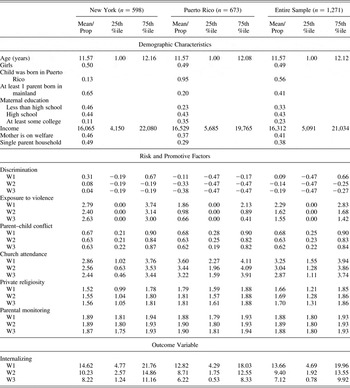
Our study uses data on early adolescents aged 10 years and older at the time of the first interview (NY, n = 598; PR, n = 673). Measures of internalizing symptoms were not administered to younger children because the reliability of the measure used in this study is poor for young children (Breton et al., Reference Breton, Bergeron, Valla, Lepine, Houde and Gaudet1995). Table 1 shows the weighted proportions, means and 25th and 75th percentiles for a number of demographic characteristics of our subsample. The mean age for both groups of Puerto Rican youth was 11.6, with roughly the same proportion of males and females. As expected, the majority of youths in PR were born in PR, whereas the majority of youths in NY had been born outside of PR. Sixty-five percent of youths in NY had at least one parent who had been born on the mainland, compared to 20% of youths in PR. Mothers in NY were less educated than those in PR, and they were more likely to be receiving welfare. A larger proportion of children in NY came from single-parent households when compared to youth in PR. There were no significant differences in income across the two contexts. However, because the cost of living is different in the two sites, differences in rates of welfare receipt are a better indicator of socioeconomic differences between sites, because housing expenses are factored in when determining welfare eligibility.
Weighted proportions, means, and 25th and 75th percentiles for demographic characteristics and predictor and outcome variables

Note: W1, Wave 1; W2, Wave 2; W3, Wave 3.
Procedure
Participants were interviewed in their homes in their preferred language (English or Spanish) by trained laypersons with at least a high school education. There were three annual assessments, starting in the summer of 2000 and ending in the fall of 2004.
Attrition rates were low. Only 7.95% of the sample was not interviewed at Wave 2, and 11.88% at Wave 3. Retention rates were higher in PR than in NY at Wave 2 (94.95% vs. 88.8%) and Wave 3 (90.64% vs. 85.28%). Missing data analyses tested whether missing status at the two follow-ups were predicted by 15 background characteristics measured during the first wave. Only one significant difference emerged: children living in single-parent households were less likely to participate at Wave 2, β (SE) = 0.43 (0.21), p < .05.
Measures
All of the study variables, except for place of residence (NY or PR), are time varying, measured at all three waves. We conducted measurement invariance analyses using Wave 1 measures to test whether the measures had the same psychometric structure in PR and in NY. We tested for metric, strong, and strict factorial invariance by constraining the factor loadings, item intercepts, and residuals to be equal across groups and by comparing the fully constrained models against a model that allowed model parameters to be different across the two groups, using chi-square difference tests (Gregorich, Reference Gregorich2006). Of primary concern was establishing metric invariance, to ensure that the items had the same meaning across the two groups. We dropped items if there was evidence that they were not metrically invariant across the two contexts. The measures described below reflect the metrically invariant items that we retained after the measurement invariance analyses. The bottom part of Table 1 shows the descriptive statistics for the resulting measures.
Context
Context is defined as youths' place of residence, with NY = 1 and PR = 0.
Youth internalizing symptoms
Internalizing symptoms were measured using youths' responses to the generalized anxiety, specific phobia, posttraumatic stress disorder, separation anxiety, social phobia, and major depression schedules of the National Institute of Mental Health Diagnostic Interview Schedule for Children—Version IV (Bravo, Woodbury-Farina, Canino, & Rubio-Stipec, Reference Bravo, Woodbury-Farina, Canino and Rubio-Stipec1993; Shaffer, Fisher, Lucas, Dulcan, & Schwab-Stone, Reference Shaffer, Fisher, Lucas, Dulcan and Schwab-Stone2000). Internalizing symptoms represent a count of positive responses to the questions corresponding to the selected disorders (α = 0.74, at Wave 1). Symptom scales have been shown to have better test–retest reliability than do categorical diagnoses (Shaffer et al., Reference Shaffer, Fisher, Lucas, Dulcan and Schwab-Stone2000).
Discrimination
The discrimination scale is composed of four items (α = 0.67) taken from the Hispanic Stress Inventory (Cervantes, Padilla, & Desnyder, Reference Cervantes, Padilla and Desnyder1990). Youth were asked about their perceptions of unfair treatment in the past year (e.g., being treated badly “because of your race, your skin color, or where you come from?” and “because of your social class or because you are poor?”). Respondents answered on a 2-point scale (0 = rarely or never, 1 = sometimes or often). Because responses to these items were binary, tests of measurement invariance for this measure involved conducting a two-parameter item response theory analysis in which we estimated item discriminations and difficulties. The item “You feel other people don't like you because you are Puerto Rican” was not invariant across the two groups. Because this item was the most frequently endorsed item, we avoided eliminating it by saving the factor scores derived from the partial invariance model that allowed the threshold for that item to be different across the two contexts and used the factor scores as our measures of discrimination at each wave. Factor scores are centered at zero, which means that zero represents average discrimination, negative values represent less than average, and positive values represent more than average.
Exposure to violence
Exposure to violence was assessed using a modified version of the Exposure to Community Violence Scale (Richters & Martinez, Reference Richters and Martinez1993). At Wave 1, youth were asked whether they had ever been exposed to 10 different violent acts (e.g., “being chased by gangs or individuals”), and at Waves 2 and 3, whether they had experienced these acts in the past year. For each act, youth responded whether they experienced it themselves, saw it happen to someone else, or knew someone who experienced it. These response categories were not mutually exclusive, and therefore for each item scores ranged from 0 to 3. The final scores represent a sum of exposure to the 10 violent acts.
Parent–child conflict
Parent–child conflict was assessed through parents' reports using an adapted version of Hudson's Index of Parental Attitudes (Hudson, Reference Hudson1982). The scale consists of eight items such as “How often does [mother] feel very angry toward the child?” and “To what extent does the child understand [mother]?” (reverse coded; α = 0.74). The response scale for items with a “how often” stem ranged from 0 = never/almost never to 3 = very often, and the scale was from 0 = not at all to 3 = a lot for all other items. Parents' responses to these items were averaged.
Religiosity
We created two variables from participants' responses to questions about their religious beliefs and practices (Miller, Wasserman, Neugebauer, Gorman-Smith, & Kamboukos, Reference Miller, Wasserman, Neugebauer, Gorman-Smith and Kamboukos1999). The first variable consists of a single item measuring the child's active participation in religious services, ranging from 1 = never to 7 = everyday. The second variable consists of three items tapping into the importance of religion to the child's family (α = 0.67), such as “In general, how important is religion or spirituality in your family?” Responses ranged from 1 = not important to 3 = very important and were averaged across items.
Parental monitoring
Parental monitoring was assessed using five items from the Parental Monitoring Scale (Patterson & Stouthamer-Loeber, Reference Patterson and Stouthamer-Loeber1984). Mothers were asked about various aspects of monitoring including supervision and keeping track of the child's whereabouts (e.g., “How often do you or the child's other caretakers know where she/he is when she/he is not at home?”). Participants responded in a 3-point scale ranging from 0 = never or almost never to 2 = almost always or always (α = 0.68). Responses to the five items were averaged.
Data analytic approach
Propensity scores and bias reduction
There are many reasons why the group of families who migrate to the United States might differ from those who do not, even before minority status and discrimination are considered. We attempted to remove such selection effects using propensity scores to adjust for selection into place of residence (Rosenbaum & Rubin, Reference Rosenbaum and Rubin1985; Rubin, Reference Rubin1997). Propensity score adjustment is a comprehensive semiparametric approach that allows the analyst to construct strata of persons from the two sites that are comparable with respect to known selection factors. We estimated the propensity scores using logistic regression, where we predicted the probability of living in NY from 13 baseline covariates (e.g., parental psychopathology, mother's education, and income). We used the propensity scores to create five roughly equal-sized subclasses for which we adjusted in all of the analyses (Rosenbaum & Rubin, Reference Rosenbaum and Rubin1985). Adjusting for the propensity score strata, as opposed to the actual propensity score, avoids making parametric assumptions about the relationship between variables. Propensity score strategies are superior to traditional methods such as regression-based covariance adjustment because their estimation is more robust to model misspecification than linear regression and they are less susceptible to bias introduced when variables are entered in the wrong functional form (D'Agostino, Reference D'Agostino1998; Rosenbaum & Rubin, Reference Rosenbaum and Rubin1985). In addition, our analyses adjust for child's age, gender, parental psychopathology, number of stressful life events, number of people living in the household, and welfare, in order to reduce bias in the estimates. Combining covariance adjustment and propensity score adjustment yields more reliable results than does either method alone (Rubin & Thomas, Reference Rubin and Thomas2000). Continuous variables were centered at their mean, and categorical variables were dummy coded.
Multilevel models (MLMs)
We used MLMs to model youths' trajectories of internalizing symptoms (Raudenbush & Bryk, Reference Raudenbush and Bryk2002). These models are well suited to answer questions about change and to handle multiple levels of nesting in the data (observations nested within individuals, siblings nested within households, and households nested within census blocks). MLMs take into account that units within each cluster are not independent and allow us to estimate variation between clusters and within clusters by fitting models at two levels. At the lowest level of clustering in this data set, the individual, we are able to estimate within-person variation (how a person is different from one time point to the next), and between-person variation (how different people have different patterns of change), and what predicts such differences. Even though our models take into account all three levels of nesting, our description of analyses and results focuses on the first level of nesting, at the individual level.
In MLMs, the within-person variation is described in the Level 1 model. This model represents the repeated measures and can be formulated with the following equation for Level 1:
 $$\hbox{INTSYMP}_{ij} = {\rm \pi}_{0_i} + {\rm \pi}_{1_i}\hbox{TIME_ C}_{ij} + {\rm \varepsilon}_{ij}\comma$$
where the internalizing symptom for person i on the jth time point is predicted by π0i, an intercept for person i, π1i is the true change trajectory for person i (slope), and ɛij is an error term for person i at time j. In this model, time is centered at the first time point, and therefore the intercept represents the true internalizing symptom score for person i at Wave 1. The Level 2 model represents between-person variation, or how interindividual changes in trajectories vary by time-invariant predictors (Singer & Willet, Reference Singer and Willett2003). A simple version of this model can be expressed using the following equations for Level 2:
 $${\rm \pi}_{0_i} = {\rm \gamma}_{00} + {\rm \zeta}_{0_i}\comma$$
 $${\rm \pi}_{1_i} = {\rm \gamma}_{10} + {\rm \zeta}_{1_i}\comma$$
where the individual intercept π0i is represented by an average intercept γ00 and by the difference between the individual intercept for person i and the average intercept (ζ0i). The individual slope, π1i, is represented by an average slope (γ10) and by the difference between the individual slope for person i and the average slope (ζ1i). In these models, γs represent fixed effects, or average effects across people, and ζs represent random effects, or individual variations around intercepts and slopes. Time-invariant (between-person) predictors, such as context, can be added to the Level 2 model.
To test whether monitoring and religiosity are related to youths' levels and slopes of internalizing symptoms, we added each predictor into separate models. Because our predictors were measured at all three time points, we obtain information on two kinds of variation: within person and between person. Using parental monitoring as an example, an individual's level of monitoring can vary from one time point to the next, such that at one assessment the person's level of monitoring might be higher or lower than his or her reported level at another assessment (within person). In addition, some individuals tend to be generally higher on monitoring than others (between person). To capture both types of variation, we entered two variables in the model for each predictor (Hoffman & Stawski, Reference Hoffman and Stawski2009). In Level 1, we added a time-varying variable that represents within-person variation, or the individual's score on the promotive factor at time j centered at the person's mean. The coefficient associated with this term answers the question: how does being higher/lower than one's average levels of monitoring relate to internalizing symptoms? In Level 2, we added a time-invariant variable that represents person i's mean levels of the promotive factor across the three time points, centered at the grand mean. In our continued example, this variable indicates how being high on monitoring, compared to other people, influences internalizing symptoms.
For each promotive factor, we ran four models. Model 1 tested the main effect of the promotive factor on levels of internalizing symptoms. Model 2 added interactions with time to test whether the effect of the predictor varied over time. Model 3 added interactions with context to test whether the promotive factor buffered the negative effect of living in a minority context on levels of internalizing symptoms. Model 4 further added interactions among context, time, and the promotive factor to test whether the buffering effect varied over time.
MLMs were estimated in SAS Version 9.2 using restricted maximum likelihood according to the MIXED procedure. We specified an unstructured covariance matrix, which makes no assumptions about the structure of the error terms. This procedure allowed us to take into account sampling weights to adjust for unequal probabilities of selection into the study and to adjust for differences in age and gender distributions between the 1990 and 2000 censuses.
Structural equation models
To test whether discrimination, exposure to violence, and parent–child conflict could account for contextual differences in internalizing symptoms, we fit a latent growth curve model (Kline, Reference Kline2005; Singer & Willett, Reference Singer and Willett2003) using structural equation modeling in MPlus (Muthén & Muthén, Reference Muthén and Muthén1998–2010). Even though latent growth models are essentially MLMs for change, they are more flexible and allow us to examine whether the rate of change in one variable is associated with the rate of change in another variable. In latent growth models, each annual measurement of exposure to violence, discrimination, parent–child conflict and internalizing symptoms is represented as an indicator of two latent growth factors: a latent intercept and a latent slope. The latent intercept represents initial status, and it corresponds to the intercept in a regression equation, so the factor loadings are fixed to be 1. The factor loadings for the latent slope are fixed to be 0, 1, and 2, which specifies a linear trajectory centered at time 1. This means that the latent intercept represents the level at Time 1. The latent intercept and slope are allowed to covary. In addition, latent intercepts and slopes have means representing the mean of that factor at Time 1 and the average rate of change across people, respectively. These factors also have variances like those estimated in the Level 2 model in Equation 2 (i.e., γ and ζ), which represent individual variation in intercepts and slopes.
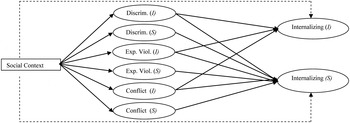
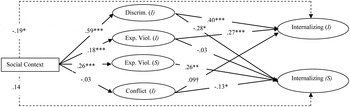
The latent intercepts and slopes from the measurement model for each construct can be combined in the conceptual model shown in Figure 1. This model tests the relationship between context and initial levels and slopes of discrimination, exposure to violence, and parent–child conflict, as well as the relationship between these latent variables and early adolescents' initial levels and slopes of internalizing symptoms. The model also includes direct effects from context to internalizing intercept and slope. We tested this model in two steps. First, we fitted a series of univariate growth curve models in which we evaluated the measurement model for each of the latent constructs. Second, we tested the conceptual model depicted in Figure 1. Analyses take into account clustering at the household level (i.e., siblings nested within household).
The hypothesized path model. The theoretical model adjusts for propensity scores, child's age, gender, parental psychopathology, number of stressful life events, number of people living in the household, and welfare at the indicator level. Discrim., discrimination; Exp. Viol, exposure to community violence; Conflict, parent–child conflict; I, Intercept; S, Slope.

Results
Change in internalizing symptoms
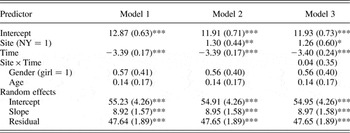
Table 2 presents the results of fitting a series of MLMs evaluating how internalizing symptoms change over time and whether there are contextual differences in levels and trajectories of internalizing symptoms. Model 1 shows that internalizing symptoms decreased over time.Footnote 1 The random effects for intercept and slope indicate that there was a significant amount of variation in individuals' intercepts and in slopes, meaning that people differed from each other in their initial levels and in their rate of change over time. The residual term represents variation in individuals' deviations around their own linear trajectory at each time point. The covariance between intercepts and slopes was negative, indicating that, on average, youth with higher initial levels of internalizing symptoms were more likely to have steeper negative slopes. There were no gender differences in levels of internalizing symptoms, and no association between age at Time 1 and levels of internalizing symptoms.Footnote 2
Results from multilevel models testing how internalizing symptoms change over time and differences across the two contexts
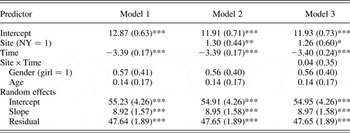
Note: These models further adjust for propensity score strata, parental psychopathology, number of people in household, number of stressful life events, and welfare. The values in parentheses are standard errors.
*p < .05. **p < .01. ***p < .001.
Contextual differences in internalizing symptoms
Model 2 in Table 2 added the main effect of context to test whether there are contextual differences in initial levels of internalizing symptoms. Youth in NY had higher levels of internalizing symptoms than did those living in PR. The interaction between context and time in Model 3 was not significant, indicating that there were no contextual differences in slopes of internalizing symptoms.
Risk factors
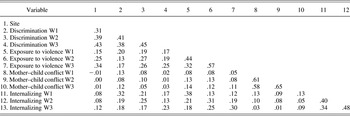
Next, we explored whether discrimination, exposure to violence, and parent–child conflict could account for the observed contextual differences in levels of internalizing symptoms, using structural equation modeling. Table 3 shows the correlations among the variables in the model. Even though there were no observed differences in slopes of internalizing symptoms across the two contexts, we kept the hypothesized relationships with internalizing slope in the model for exploratory purposes, although the paths of main interest are the ones that can help explain differences in overall levels of internalizing symptoms across the two contexts. The results from the univariate growth models testing the measurement models for each construct indicated that the measurement model for exposure to violence had an acceptable fit, χ2 (1) = 13.24; comparative fit index (CFI) = 0.94, root mean square error of approximation (RMSEA) = 0.10, confidence interval (CI) = 0.06–0.15. The mean level of exposure to violence at Wave 1 was 2.16 and the mean rate of change was –0.33, indicating that, on average across all people, exposure to community violence decreased over time. There was a significant amount of variation on both intercepts (σ2 = 4.66, p < .001) and slopes (σ2 = 1.34, p < .01) for exposure to violence. The measurement model for discrimination showed less good fit, χ2 (1) = 27.03; CFI = 0.88, RMSEA = 0.14, CI = 0.10–0.19. The mean level of discrimination was 0.04 at Wave 1, and the mean slope was –0.12. There was a significant amount of variation on intercepts (σ2 = 0.17, p < .001), but there was no variation on slopes, meaning that the rate of change in discrimination was consistent across individuals. The model for parent–child conflict showed a good fit, χ2 (1) = 3.39; CFI = 1.00, RMSEA = 0.04, CI = 0.00–0.10. The mean level of conflict at Wave 1 was 0.67, and the average rate of change was –0.03. As it was for the case for discrimination, there was significant variation in the intercept (σ2 = 0.13, p < .001) but not in the slope of parent–child conflict. Finally, the measurement model for internalizing symptoms showed an acceptable fit, χ2 (1) = 12.88; CFI = 0.96, RMSEA = 0.10, CI = 0.06–0.15. The intercept at Wave 1 was 13.23, and the average slope was –3.15. There was a significant amount of variation on both intercepts (σ2 = 50.56, p < .001) and slopes (σ2 = 7.53, p < .01) of internalizing symptoms.
Correlations among study variables

Note: Correlations above .06 were significant at the .05 level. W1, Wave 1; W2, Wave 2; W3, Wave 3.
Because there was no significant variation on the slopes for discrimination and parent–child conflict, we removed the latent slopes for these two variables from the full explanatory model. However, we modeled the means for Waves 2 and 3 for both variables to take into account that the means were not equal across time points and that there was a significant decline in those measures over time. We allowed the latent variables to be correlated with each other, and we correlated the residuals for the indicators in contemporaneous time points.
Figure 2 shows the final model with the standardized coefficients. This model fit the data well, χ2 (48) = 86.98, CFI = 0.99, Tucker–Lewis index = 0.95, RMSEA = 0.03, CI = 0.02–0.03. As expected, levels of discrimination were higher in NY than in PR. Discrimination in turn was related to higher initial levels of internalizing symptoms. This indirect effect was significant, β (SE) = 0.24 (0.06), p < .001. Youths' levels of discrimination at Wave 1 were associated with larger reductions of internalizing symptoms over time. This means that youths who experienced a large amount of discrimination at Wave 1 were more likely to show recovery in internalizing symptoms over time, whereas youths who experienced an unusually low amount of discrimination at Wave 1 were relatively more likely to have flat or increasing levels of internalizing symptoms over time.
The latent growth curve model testing whether contextual differences in internalizing can be accounted for by exposure to community violence, discrimination, and parent–child conflict. This model adjusts for propensity scores, child's age, gender, parental psychopathology, number of stressful life events, number of people living in the household, and welfare at the indicator level. Discrim., discrimination; Exp. Viol., exposure to community violence; Conflict, parent–child conflict; I, intercept; S, slope.

Youth in NY had higher initial levels of exposure to violence than did youth in PR. Exposure to violence in turn was related to higher initial levels of internalizing symptoms. This indirect effect was significant, β (SE) = 0.05 (0.02), p < .01. Initial levels of exposure to violence were not related to the slope of internalizing symptoms. Because the slope for exposure to violence was negative, the significant path from context to exposure to violence slope suggests that youth in NY showed less improvement than did youth in PR. The slope of exposure to violence was related to the slope of internalizing symptoms, such that youth with more violence reduction also had more internalizing reduction.
There were no differences in parent–child conflict across the two contexts. There was only a trend-level association between average levels of parent–child conflict and the intercept for internalizing symptoms. There was, however, a significant association between parent–child conflict and the slope of internalizing symptoms, such that higher levels of conflict at Wave 1 were associated with a greater reduction in internalizing symptoms over time. After we entered the explanatory variables into the model, the relationship between context and the intercept of internalizing symptoms became negative.
Promotive factors
We next tested whether culturally relevant predictors such as religiosity and close parental monitoring served as promotive factors for Puerto Rican youths' mental health and whether they could buffer the negative effect of living in a minority context on youths' internalizing symptoms. Results for parental monitoring showed that both average levels, β (SE) = –2.94 (1.11), p < .01, and time-specific levels, β (SE) = –2.02 (0.76), p < .01, of parental monitoring were associated with fewer internalizing symptoms. That is, parents who had a general tendency to monitor their children had children with lower levels of internalizing symptoms, and having higher than their average levels of monitoring at a particular point in time was also associated with fewer internalizing problems. There were no significant context by monitoring interactions. For time-invariant monitoring β (SE) = 2.74, ns, and for time-varying monitoring β (SE) = –0.94 (1.53), ns. Next, we added interactions among the two monitoring variables and time, and we found that average levels of parental monitoring were associated with youths' slopes of internalizing symptoms, β (SE) = 2.26 (0.93), p < .05. At Wave 1, youths whose parents monitored them highly had lower levels of internalizing symptoms than those who were monitored less. However, the positive effect of monitoring was reduced at Wave 2, and it disappeared by Wave 3. There was no significant interaction between time-varying monitoring and time, β (SE) = –0.36 (1.07), ns. Finally, we added the three-way interactions among monitoring, time, and context, and found that the effect of monitoring on slopes of internalizing symptoms did not vary by context, β (SE) = 1.85 (1.88), ns, and β (SE) = 2.01 (2.17), ns, for time-invariant and time-varying monitoring, respectively.
In terms of religiosity, we found that, contrary to what was expected, average levels of active participation in religious services across the three time points were associated with more internalizing symptoms, β (SE) = 0.35 (0.15), p < .05. Time-varying levels of participation were not related to higher levels of internalizing symptoms, β (SE) = 0.06 (0.15), ns. In our next model, we found that the negative effect of overall levels of active participation on levels of internalizing symptoms was stronger in NY than in PR, β (SE) = 0.81 (0.30), p < .01. There was no significant interaction between time-varying levels of active participation and context, β (SE) = 0.20 (0.30), ns. Next, we added interactions with time and a significant interaction between time-varying participation and time emerged, β (SE) = –0.44 (0.21), p < .05: at Wave 1, having higher than personal average levels of participation in religious services was associated with higher levels of internalizing symptoms, but at Wave 3, having lower than average levels of participation was associated with higher levels of internalizing symptoms. There were no significant three-way interactions among context, time, and participation, β (SE) = 0.05 (0.26) and β (SE) = –0.34 (0.43), for time-invariant and time-varying religious participation, respectively.
The pattern of results for family religiosity was similar to the results we obtained for religious participation, but only at a trend level. Average levels of family religiosity were related to higher levels of internalizing symptoms, β (SE) = 1.10 (0.58), p < .10, and this association was stronger in NW than in PR, β (SE) = 2.22 (1.16), p < .10. There was also a trend-level interaction between time and average levels of family religiosity, β (SE) = 0.81 (0.46), p < .10, where youth coming from more religious families had less steep declines in internalizing symptoms than those coming from families with low levels of religiosity (complete tables with results for all predictors are available from the first author upon request).Footnote 3
Discussion
Drawing on García Coll et al.'s (Reference García Coll, Lamberty, Jenkins, McAdoo, Crnic and Wasik1996) integrative model for the study of minorities, we used a unique longitudinal data set of two groups of Puerto Rican youth, one living in their home culture and another living in a context where they are part of an ethnic minority group (NY), to examine how social position, as measured by ethnic minority status, affects children's internalizing symptoms through social mechanisms like discrimination and segregation, which manifest themselves in children's physical, social, and psychological environments. We compared the trajectories of internalizing symptoms of the two groups of Puerto Rican youth and investigated the longitudinal relationship between culturally relevant risk and promotive factors and youths' internalizing symptoms. Five main findings emerged from this study: (a) on average, internalizing symptoms decreased over time within individuals; (b) youth in NY had higher levels of internalizing symptoms than youth in PR; (c) contextual differences in internalizing symptoms were accounted for by experiences of discrimination and exposure to violence; (d) parental monitoring was associated with fewer internalizing symptoms in both contexts; and (e) contrary to expectations, religious participation and family religiosity were associated with more, rather than fewer, internalizing symptoms.
A primary goal of this study was to describe Puerto Rican youths' trajectories of internalizing symptoms during early adolescence. Studies reveal that internalizing symptoms, particularly depression, are relatively stable before and after early adolescence, but they increase rapidly during this developmental transition (Cole et al., Reference Cole, Tram, Martin, Hoffman, Ruiz and Jacquez2002; Kraatz Keiley, Bates, Dodge, & Pettit, Reference Kraatz Keiley, Bates, Dodge and Pettit2000). On average, internalizing symptoms of Puerto Rican youth in our sample decreased over time. This negative slope is unexpected from a developmental perspective, but it is consistent with the attenuation effect often present in longitudinal studies (e.g., Smokowski et al., Reference Smokowski, Rose and Bacallao2010). This finding is typically attributed to a methodological effect rather than a real decline in symptoms. Several mechanisms accounting for this bias in reporting have been proposed: an “educational effect” of the first assessment that raises participants' threshold for reporting symptoms; an “avoidance effect,” whereby participants learn that positive responses are followed by contingent questions that lengthen the interview; a “telescoping effect” whereby participants refer to events occurring prior to the time frame of the question and therefore inflate Time 1 symptoms; and regression toward the mean (Piacentini et al., Reference Piacentini, Roper, Jensen, Lucas and Bird1999). None of these explanations would suggest that the size of the attenuation effect would be different for the two sites.
Capitalizing on the study's design, we compared the internalizing trajectories of Puerto Rican youth living in two contrasting contexts to examine how social position factors like minority status influence youth mental health. Puerto Rican youth living in a context where they are part of a minority group (NY) had higher levels, but similar slopes, of internalizing symptoms than those living in a majority context (PR). This finding suggests that after adjusting for a host of variables associated with place of residence and with internalizing symptoms, minority status represents an initial risk that increases overall levels of internalizing symptoms, but it does not represent an additional risk on the rate of change of internalizing symptoms. This increased risk for internalizing symptoms among Puerto Ricans living in a context where they are members of a minority group is consistent with what one would expect given their relative social disadvantage. Individuals are stratified into different sections of the social hierarchy based on their race, ethnicity, and minority status, and even though social position itself does not account for differences in developmental outcomes, social mechanisms of discrimination and segregation based on group membership do (García Coll et al., Reference García Coll, Lamberty, Jenkins, McAdoo, Crnic and Wasik1996).
To examine which mechanisms could explain how social position factors like minority status operate, we used structural equation modeling and evaluated whether differences in internalizing symptoms across the two contexts could be accounted for by risk factors often experienced by ethnic minority families and immigrants, such as discrimination, exposure to violence, and parent–child conflict. Consistent with what García Coll et al.'s (Reference García Coll, Lamberty, Jenkins, McAdoo, Crnic and Wasik1996) integrative model would predict, we found that minority status influenced the development of internalizing symptoms indirectly through discrimination and exposure to community violence. Youth in NY reported higher levels of discrimination and exposure to violence than did youth in PR. These two variables were in turn associated with higher levels of internalizing symptoms. Other studies have also found significant associations between exposure to violence and internalizing symptoms (Mrug et al., Reference Mrug, Loosier and Windle2008; Ozer & McDonald, Reference Ozer and McDonald2006) and discrimination and internalizing symptoms (Brody et al., Reference Brody, Chen, McBride Murry, Ge, Simons and Gibbons2006; Hwang & Goto, Reference Hwang and Goto2008; Szalacha et al., Reference Szalacha, Erkut, García Coll, Alarcón, Fields and Ceder2003; Umaña-Taylor & Updegraff, Reference Umaña-Taylor and Updegraff2007). This study extends previous research by exploring how these processes can account for mental health differences in groups differing in their position in the social hierarchy. After entering exposure to violence and discrimination into the model, the relationship between context and internalizing was reversed, such that youth in PR had higher levels of internalizing than did those in NY. These findings support the idea that social position does not affect children's development directly but rather through the contexts and experiences that result from stratification mechanisms (e.g., discrimination) and segregation (García Coll et al., Reference García Coll, Lamberty, Jenkins, McAdoo, Crnic and Wasik1996).
We also expected contextual differences in internalizing symptoms to be partially accounted for by the intergenerational conflict that arises when parents and their children have different cultural frameworks (Portes, Reference Portes1997). We found no evidence that youth living in NY had higher levels of conflict than did those in PR. However, our measure of parent–child conflict tapped into global parent–child conflict, not conflict associated with cultural differences, which might explain the null result. In addition, our hypothesis assumed that parent–child conflict would be higher in NY as a result of differential rates of acculturation in parents and youth (i.e., dissonant acculturation); however, other acculturation patterns (e.g., consonant and selective acculturation) have been observed among ethnic minorities, which would not predict high intergenerational conflict (Portes, Reference Portes1997). We did find a marginally significant positive association between parent–child conflict and youths' levels of internalizing symptoms, which is consistent with previous studies (Harker, Reference Harker2001; Smokowski et al., Reference Smokowski, Rose and Bacallao2010).
Even though we did not find any differences in the slopes of internalizing symptoms across the two social contexts, we were interested in evaluating whether youth in the two contexts had different slopes of discrimination, exposure to community violence, and parent–child conflict, and whether change in these variables over time was related to change in internalizing symptoms. Initial univariate growth models indicated that there was only significant variation in the slopes for exposure to violence and internalizing symptoms. Like the slope for internalizing symptoms, on average, youths' reports of exposure to violence decreased over time. Once again, this could represent a real improvement or an attenuation effect. Declines in exposure to community violence over time were slower in NY relative to PR, which might be indicative of a risk for more detrimental outcomes for youth in a minority context. As expected, greater reductions in exposure to violence were related to greater declines in internalizing symptoms. It is possible that greater exposure to violence increases internalizing symptoms; alternatively, an unmeasured third variable could be leading to trajectories of both internalizing symptoms and exposure to community violence (e.g., increases in unemployment rates over time could affect trajectories of exposure to violence and internalizing symptoms). Our findings extend previous cross-sectional studies on violence exposure and internalizing symptoms (Mrug et al., Reference Mrug, Loosier and Windle2008; Ozer & McDonald, Reference Ozer and McDonald2006) by examining how change in exposure to community violence relates to change in internalizing symptoms over time. Youth who experience increases (or slower declines in this case) in violence exposure also experience more maladaptive trajectories of internalizing symptoms.
We also linked the intercepts of discrimination and parent–child conflict to the slope of internalizing symptoms and found that reporting high levels of discrimination and conflict at Wave 1 was associated with improvement in internalizing symptoms over time. These findings are unexpected from a mental health perspective, but they are the expected pattern if the reduction of internalizing is in part due to an attenuation effect, whereby persons report high levels of problems at the first assessment. These findings illustrate one of the challenges in studies using repeated measures: disentangling real change from reporter bias.
Because not all children respond similarly to adversity, we examined the relationship among culturally relevant promotive factors, specifically, parental monitoring and religiosity, and levels and slopes of internalizing symptoms, and we tested whether these cultural assets could buffer the negative association between growing up in a minority context and internalizing symptoms. We found that both average and time-specific levels of parental monitoring were associated with lower levels of internalizing symptoms. This finding is consistent with other studies examining externalizing symptoms among primarily White youths (Beyers et al., Reference Beyers, Bates, Pettit and Dodge2003). We also found that the positive influence of parental monitoring diminished over time. To explore the role of development on this effect, we conducted ancillary analyses in which time was substituted by age. A similar pattern of results was found, where parental monitoring had a larger effect when children were younger. It is possible that increased monitoring during adolescence becomes a source of conflict between parents and their children, as adolescents are in search of more independence. Alternatively, as children grow older, peer influences and other external influences become more prominent than those they gain from their families.
Levels of monitoring were similar across the two contexts, and we found no significant interactions between monitoring and context, indicating that monitoring did not buffer the negative influence of minority-status context on levels of internalizing symptoms. This finding suggests that, even though the two groups of youths are exposed to different social environments and stressors, some family processes promote adaptive behaviors regardless of the level of risk (Sameroff, Reference Sameroff2000).
We expected both religious participation and family religiosity to have a positive influence on youths' mental health and to buffer the risk that living in a minority context appeared to confer on youths' internalizing symptoms. However, we found that overall levels of participation in religious activities as well as family religiosity were associated with higher internalizing symptoms and that these associations were stronger in NY. Even though there is empirical support for the beneficial effects of religiosity on mental health outcomes (e.g., Ellison, Reference Ellison1995), some scholars have argued that religious participation may also lead to increased distress if individuals feel like their church and its members are constantly passing judgment on them (Dollahite, Marks, & Goodman, Reference Dollahite, Marks, Goodman, Coleman and Ganong2004; Krause, Ellison, & Wulff, Reference Krause, Ellison and Wulff1998; Nooney & Woodrum, Reference Nooney and Woodrum2002). Similarly, turning to religion as a coping mechanism can be a positive or a negative experience (Herrera, Lee, Nanyonjo, Laufman, Torres-Vigil, Reference Herrera, Lee, Nanyonjo, Laufman and Torres-Vigil2009; Pargament et al., Reference Pargament, Smith, Koenig and Perez1998). Positive religious coping is characterized by a quest for spiritual support, forgiveness, collaborative religious coping, spirituality, and benevolent religious appraisal, and it is associated with positive health outcomes. Conversely, negative coping style is characterized by spiritual discontent, punitive God reappraisals, and interpersonal religious discontent, and it is associated with psychological distress. We are unable to distinguish between these two coping styles, but it is possible that the negative associations between family religiosity and mental health are due to negative (versus positive) coping styles. Future research should disentangle these two forms of coping to gain a better understanding of how religion influences Puerto Rican youths' mental health.
Another possible explanation for the negative association between religiosity and adolescents' mental health is that children and families are turning to religion in times of distress. Ellison, Boardman, Williams, and Jackson (Reference Ellison, Boardman, Williams and Jackson2001) found that the negative association between frequency of prayer and psychological distress dropped to nonsignificance when adjusting for social stressors. Thus, the apparent negative influence of religiosity on internalizing symptoms might reflect higher religious involvement in families undergoing multiple stressors.
Our finding that the negative influence of religiosity on mental health was stronger in NY was unexpected, but average levels of religiosity across the two contexts need to be considered in the interpretation of this finding. Mean levels of church attendance and family religiosity were higher in PR than in NY, which suggests that religiosity and church attendance are more normative in PR. High levels of family religiosity and frequent church attendance in a more diverse place like NY might be a source of cultural tension between youth and their nonreligious peers. In addition, second-generation youth often view religious leaders and institutions as controlling and as a threat to their freedom (Stepick, Reference Stepick, Leonard, Stepick, Vasquez and Holdaway2005). In this study, parents reported on the family's religiosity, which may not coincide with youths' religiosity. Future research should consider the relationships among Latino youths' religiosity, religious participation, and their mental health, as well as family–youth religious incongruence and their mental health.
This study makes a number of contributions to the literature and has some implications for research and practice. It furthers the literature on minority mental health by documenting the longitudinal development of internalizing symptoms during early adolescence among Puerto Rican youth and by examining longitudinal relationships between risk and promotive factors and internalizing symptoms. Knowledge about the stability and change in the relationship between risk and promotive factors for mental health not only allows us to gain a better understanding of how the risk and resilience process operates but also enables us make better decisions about the timing of interventions (Brody et al., Reference Brody, Chen, McBride Murry, Ge, Simons and Gibbons2006). Our finding that the positive effect of monitoring diminishes over time suggests that family interventions for Puerto Ricans focused on increasing parental knowledge about their children's whereabouts might benefit from targeting children in middle childhood, for whom parental monitoring appears to have a greater impact.
By comparing the same ethnic group in two contrasting contexts, one in which they are part of the main culture and one in which they are part of the minority group, this study extends previous studies comparing ethnic minorities to Whites by allowing us to gain a better understanding of how the social context in which youth develop and their status in society affects their well-being. This study suggests that social position factors such as minority status and the stressors associated with this social disadvantage contribute to the elevated rates of mental disorders among Puerto Ricans and that ethnic group comparisons should be interpreted with caution. We should note that, in this study, living in a context where one is a statistical minority is only a proxy for social position. Not all ethnic minority groups are considered low status in a given society, and not all members of low-status groups occupy a weak position in the social hierarchy. Skin color and social class, for example, are other social position factors that interact with minority status. These other factors can magnify or reduce the influence that minority status has in shaping the environments in which individuals develop, as well as the degree of segregation and discrimination that individuals experience in any given context (García Coll et al., Reference García Coll, Lamberty, Jenkins, McAdoo, Crnic and Wasik1996).
Our finding that disadvantages in mental health among youth in a minority context disappeared after accounting for discrimination and exposure to violence supports the notion that social position per se does not predict developmental outcomes as strongly as social stratification mechanisms such as racism, prejudice, discrimination, and segregation, which affect the social environments of minority children (García Coll et al., Reference García Coll, Lamberty, Jenkins, McAdoo, Crnic and Wasik1996). Elevated experiences of discrimination among Puerto Rican youth in a context where they are a more socially devalued group were related to poorer mental health. The psychological burden involved in maintaining a positive sense of self while experiencing discriminatory experiences can be challenging, and it can exhaust individuals' resources to deal with such experiences (Brody et al., Reference Brody, Chen, McBride Murry, Ge, Simons and Gibbons2006). In addition to facing experiences of discrimination, greater exposure to violence partially accounted for the increased risk for internalizing symptoms among Puerto Rican youth in NY. Exposure to violence might increase biological and psychological stress responses, which can in turn affect individuals' mental health (Wright Berton & Stabb, Reference Wright Berton and Stabb1996). Our finding that experiences of discrimination and exposure to community violence accounted for contextual differences in internalizing symptoms suggests that setting-level efforts to reduce minority youths' exposure to these stressors should be prioritized.
Experiences of discrimination and exposure to violence are only two manifestations of stratification mechanisms, but the effect of these mechanisms on other contexts, such as school, neighborhood, childcare, and work, is also expected to influence minority children's developmental outcomes. In auxiliary analyses, we expanded our explanatory model (Figure 2) to explore whether there were contextual differences in neighborhood characteristics (i.e., vandalism, prostitution, and delinquency are in their neighborhood), school environment (i.e., fights, gangs, and people selling drugs in the school), and home environment, and whether these predicted youths' internalizing symptoms. Consistent with social stratification theory, youths in NY lived in more disadvantaged neighborhoods, attended less safe schools, and had poorer home environments. These, however, did not predict internalizing symptoms.
The findings and contributions of this study need to be considered in light of several limitations. First, this study assumes that Puerto Rican families in both contexts come from the same population and that selection factors that distinguish the two groups can be adjusted. It is known that the “great migration” of Puerto Ricans to NY in the middle of the twentieth century was driven largely by a spike in unemployment in PR (Perez, Reference Perez2004). Thus, the characteristics and family histories of those who migrated and those who stayed are likely to be different across the contexts. We attempted to address this issue by using propensity score adjustment. However, unlike random assignment, propensity scores only reduce bias on the variables used to estimate the propensity score. In addition, there are other contextual variables that distinguish the two groups; however, we believe that disadvantages in the social environment of Puerto Rican youth in NY relative to their island Puerto Rican counterparts are related to their social position and are a result of mechanisms of segregation. Second, even though Puerto Ricans on the mainland represent a statistical minority, the largest Puerto Rican population on the mainland resides in NY (US Census Bureau, 2001). Thus, Puerto Rican youths' experiences in the NY might be different to Puerto Rican youths' experiences in other parts of the country, where the minority population is small. This might compromise the generalizability of our findings, but we believe that, if anything, our findings would be stronger in contexts where Puerto Ricans represent a smaller minority. Third, with only three time points, we were limited to fitting linear trajectories, which precluded us from exploring whether the decline in youths' internalizing symptoms over time is a methodological artifact or a real improvement. It is reasonable to believe that the negative time effects we found represent a report bias (i.e., attenuation), but the possibility that these effects represent real improvements should not be excluded. Recent studies using group-based models have identified groups of individuals for whom internalizing symptoms do decline over time (Duchesne et al., Reference Duchesne, Vitaro, Larose and Tremblay2008; Mazza et al., Reference Mazza, Fleming, Abbott, Haggerty and Catalano2010). Some studies have found curvilinear trajectories of internalizing symptoms, where symptoms decline during early adolescence and then increase during mid-adolescence or late adolescence (Bongers et al., Reference Bongers, Koot, van der Ende and Verhulst2003; Garber et al., Reference Garber, Keiley and Martin2002). Future research with more data points should explore curvilinear trajectories in order to gain a better understanding of the developmental course of internalizing symptoms during this period. Fourth, some of our measures had only moderate reliability. In addition, religiosity tapped into family's religiosity, which might or might not correspond to the child's religiosity, and our measure of parent–child conflict was a global measure that did not tap into the type of intergenerational conflict that arises when youth and their parents have different cultural frameworks. Fifth, we relied solely on self- and parent-reported data for all of our measures. We hypothesized that our risk variables would predict trajectories of internalizing symptoms, but it is possible that the direction of these effects is reversed, where internalizing symptoms increase negative attributional biases, leading to increased perceptions of discrimination and exposure to violence. Thus, we cannot make definitive conclusions about the direction of the effects reported.
Notwithstanding these limitations, this study makes important contributions to the literature on minority mental health. To our knowledge, no other study has documented the trajectories of internalizing symptoms in Puerto Rican youth, even though Puerto Ricans are the second-largest minority group in the United States. The unique study design allowed us to compare the trajectories of internalizing symptoms in the same ethnic group but in contrasting contexts differing in minority status. The findings of this study highlight the importance of considering the social mechanisms through which race, ethnicity, and minority status affect the development of internalizing symptoms in minority children in the United States and alert us to use caution when interpreting ethnic group comparisons in mental health outcomes.