Introduction
Cardiovascular disease (CVD) is the leading cause of death globally, nationally in the United States (US), and also in the state of West Virginia (WV). Reference Roth, Forouzanfar and Moran1–Reference Mozaffarian, Benjamin and Go3 WV, a state entirely within the Appalachian region, has one of the highest CVD mortality rates in the US.Reference Mozaffarian, Benjamin and Go 3 In 2013, the age-adjusted CVD mortality rate in WV was 270.6 per 100,000, and when ranked from low to high WV ranked 47 out of the 52 states and territories in the US.Reference Mozaffarian, Benjamin and Go 3 High blood pressure and abnormal lipid levels are well-established risk factors for CVD. Reference Ong, Tso, Lam and Cheung4–8 Once thought to be prevalent in adults only, these risk factors are increasingly observed in children as well. Reference Azadbakht, Kelishadi and Saraf-Bank9–Reference Owen, Whincup and Kaye17 Elevated blood pressure and dyslipidemia have been linked with numerous perinatal factors, including, but not limited to, infant birth weight. Reference Azadbakht, Kelishadi and Saraf-Bank9–Reference Owen, Whincup and Kaye17 General birth weight categories include low birth weight (LBW) (<2500 g), normal birth weight (NBW) (2500–4000 g), and high birth weight (HBW) [>4000 g (8.8 lbs.)]. 18–20 The incidence of LBW is higher (9.4%) in the state of WV than the national US average of 8.0%. 21
The “fetal origins of adult disease” hypothesis proposed by Barker and colleagues posits that early life exposures such as undernutrition in utero could potentially increase susceptibility to poor health outcomes in later life.Reference Barker, Gluckman and Godfrey 22 LBW is an indicator of suboptimal fetal growth and is an important predictor of long-term health outcomes including morbidity and mortality from CVD. Reference Huxley, Owen and Whincup23–Reference Risnes, Vatten and Baker25 LBW has shown to be an independent risk factor for childhood CVD risk factors such as obesity,Reference Zarrati, Shidfar and Razmpoosh 26 high blood pressure, Reference Azadbakht, Kelishadi and Saraf-Bank9, Reference Gademan, van Eijsden and Roseboom27–Reference Sousa, Guimaraes, Daltro and Guimaraes30 and poor lipid profile.Reference Donker, Labarthe and Harrist 31 However, some studies have found a weak association or no association between birth weight and subsequent risk of developing high blood pressure Reference Tilling, Davies and Windmeijer32–Reference Laor, Stevenson, Shemer, Gale and Seidman34 or childhood hypertension.Reference Malin, Morris, Riley, Teune and Khan 35 Additionally, some studies have reported this relationship in overweight, but not in non-overweight children.Reference Bergel, Haelterman, Belizan, Villar and Carroli 36 Moreover, others have observed a U-shaped association between birth weight and childhood CVD risk factors.Reference Hardy, Sovio and King 37 However, a systematic review that found a linear association between birth weight and blood pressure concluded that infants born preterm or LBW (<1500 g) were at a risk for higher systolic blood pressure (SBP) later in life.Reference de Jong, Monuteaux, van Elburg, Gillman and Belfort 24 Similarly, another meta-analysis also demonstrated an inverse linear association between birth weight and later risk of high SBP.Reference Mu, Wang and Sheng 38
Studies examining the association between birth weight and serum lipid levels in children have also yielded inconsistent findings. Some studies have found an inverse association between birth weight and elevated triglycerides (TG), Reference Frontini, Srinivasan, Xu and Berenson28, Reference Donker, Labarthe and Harrist 31 increased low-density lipoprotein (LDL) cholesterol levels, and lower mean high-density lipoprotein (HDL) cholesterol levels in later childhood.Reference Frontini, Srinivasan, Xu and Berenson 28 Other studies have demonstrated a U-shaped relationship between birth weight and childhood HDL levels.Reference Azadbakht, Kelishadi and Saraf-Bank 9 In another study, birth weight analyzed as a continuous variable was unrelated to lipid profiles in childhood; however, when birth weight was categorized, HBW (>4000 g) relative to NBW (2500–4000 g) was associated with significantly higher total cholesterol (TC) and non-HDL levels.Reference Zhang, Kris-Etherton and Hartman 39 Still, other studies have found no significant association between HBW and serum lipid profile in children (6 years of age) or between LBW and serum cholesterol levels at 8 years of age, Reference Bekkers, Brunekreef and Smit10, Reference Thorsdottir, Gunnarsdottir and Palsson 40 in adolescence,Reference Sousa, Guimaraes, Daltro and Guimaraes 30 or in early adulthood.Reference Gomes, Subramanian and Escobar 41 Reflecting these conflicting results, a recently published systematic review and meta-analysis concluded that the currently used birth weight cutoffs may be poor predictors of adverse health outcomes in later life.Reference Malin, Morris, Riley, Teune and Khan 35
As can be seen, studies to date have yielded contradictory results regarding the association between birth weight and certain childhood CVD risk factors. Moreover, this association has not been studied in the WV population, a population that suffers from a high degree of CVD burden. Given the former, the main objective of the current study was to determine the association between infant birth weight and specific childhood CVD risk factors.
Methods and materials
Data sources
This study utilized data from three sources: (1) WV Birth Certificates, (2) the Working in Appalachia to Track High Birth Score, Critical Congenital Heart Disease and Hearing Loss (WATCH) aka the Birth Score project, 42 – Reference Mullett, Cottrell and Lilly 44 and (3) the Coronary Artery Risk Detection in Appalachian Communities (CARDIAC) project Reference Muratova, Demerath and Spangler 45 . Project WATCH collects data on every infant born in WV prior to discharge in order to identify infants who are at a high risk of infant mortality.Reference Umer, Lilly and Hamilton 46 In this study, children participating in Project WATCH (all of whom are merged with the Birth Certificate data) born between 1994 and 2000 were merged with data collected by the CARDIAC project in years 2004–2010. The CARDIAC project collects data on fifth-grade public school children (M = 11.0 years, SD = 0.5) in all 55 counties in WV with informed consent by parents/guardians and assent by the child.Reference Muratova, Demerath and Spangler 45 Further details of the data collection procedure are described elsewhere.Reference Cottrell, John and Murphy 47 – Reference Ice, Murphy, Minor and Neal 50 The West Virginia University Institutional Review Board (Protocol number 1504666639) approved the study. This study includes only those participants for whom data were available from all three projects. The Project WATCH applications programmer performed the matching process for all years. Overall, an approximate 50% data match was achieved between the CARDIAC (N = 46,198) and Project WATCH (N = 22,136) data. Reasons for non-matches included CARDIAC participants born out of state; Project WATCH participants who were not named at the time the Birth Score form was filled out; CARDIAC participants with a different name than that given at birth; CARDIAC participants who were legally adopted; and use of out-of-state hospitals by those living near state borders. Both Project WATCH data collectors and CARDIAC data collectors were blinded to the data for the other project.
Dependent variables
The main outcome variables included resting blood pressure [SBP and diastolic blood pressure (DBP)] and serum lipid profile (TC, LDL, HDL, non-HDL, and TG) for fifth-grade children (M = 11.0 years, SD = 0.5). Area coordinators employed by the CARDIAC project, along with trained health science students, local school nurses, and phlebotomists conducted blood pressure, anthropometric measurements, and blood lipid testing. Further details of the data collection procedure are described elsewhere.Reference Cottrell, John and Murphy 47 – Reference Ice, Murphy, Minor and Neal 50 Blood pressure was taken in a sitting position with the arm resting on a table at the level of the heart after the child had rested for 5 min. The first Korotkoff sound was used to record SBP and the fifth Korotkoff sound (K5, the last sound heard) was used to record DBP, measured in mm Hg. Lipids were mostly fasting although when the student forgot to fast, non-fasting values were used. All lipid values were measured in mg/dl by LabCorp Inc. (Burlington, NC, USA). LDL cholesterol was estimated using the Friedewald equation.Reference Friedewald, Levy and Fredrickson 51
Independent variable
The main exposure variable was defined as birth weight in grams at the time of delivery. A LBW may be due to preterm birth or due to intrauterine growth restriction (IUGR).Reference Sola-Visner 52 LBW and HBW babies are found in both preterm and full-term births. Thus, it has been suggested that these two populations should be examined independentlyReference Wilcox 53 because the determinants of preterm birth and fetal growth differ.Reference Kramer 54 Several experts in the field also suggest that it is IUGR rather than prematurity that is associated with increased risk for chronic diseases later in life.Reference Delisle 55 For the purpose of this project, we used data for full-term infants only, i.e., infants born ≥ 37 weeks of gestation. Birth weight has been shown to be both linearly (positively Reference Schellong, Schulz, Harder and Plagemann56, Reference Terry, Wei, Esserman, McKeague and Susser 57 and inversely Reference Gademan, van Eijsden and Roseboom27, Reference Sousa, Guimaraes, Daltro and Guimaraes30, Reference Li, Strobino, Ahmed and Minkovitz 58 ) and nonlinearly (i.e., U-shape Reference Azadbakht, Kelishadi and Saraf-Bank9, Reference Lauren, Jarvelin and Elliott 59 ) associated with CVD risk factor measures. To allow analysis of possible nonlinear relationships, birth weight was also categorized using conventional cutoffs, i.e., LBW (<2500 g), NBW (2500–4000 g), and HBW (>4000 g). 18–20
Mediator
As a mediator, the study used body mass index (BMI) percentiles as a measure of the child’s adiposity status in fifth grade (M = 11.0 years, SD = 0.5).Reference Must and Anderson 60 Trained area coordinators, nurses, and health science students measured the children’s height and weight using SECA Road Rod stadiometer (78”/200 cm) and the SECA 840 Personal Digital Scale, respectively (Seca Corp, Hanover, MD, USA). BMI percentiles represent a measure of relative weight adjusted for the child’s height, age, and sex corresponding to the 2000 CDC growth charts.Reference Kuczmarski, Ogden and Guo 61
Covariates
The study adjusted for sociodemographic variables and other potential confounders based on current literature. The sociodemographic variables included the child’s age, sex, race, maternal age (at birth), maternal education [at birth and later when the child was in fifth grade (M = 11.0 years, SD = 0.5)], and maternal health insurance status (Medicaid and non-Medicaid) at the time of delivery. The race/ethnicity of the child was parent-reported in fifth grade (M = 11.0 years, SD = 0.5). Race was dichotomized as “white” and “other” based on the racial/ethnic distribution of the WV population (i.e., 94% white). 62 The CARDIAC project collects parent-reported information on family history (parent or grandparent) of heart disease, coronary heart disease, heart attack, open-heart surgery, angioplasty, and death from heart diseases. For this study, we created one variable for family history of CVD (yes or no) based on having a family history of any one of these six outcomes. The CARDIAC project also collects information on family history of high cholesterol and diabetes, factors also included in our analysis. Additional covariates included the number of previous pregnancies (0 or ≥1), smoking during pregnancy (yes or no), smoking in the house when the child was ∼11 years old in fifth grade (yes or no), weight gain during pregnancy (measured in lbs.), gestational age (range 37–44 weeks), and infant feeding intention (the nurses ask the mothers if they intend to exclusive breastfeeding or do both breastfeeding and bottle).
Statistical analysis
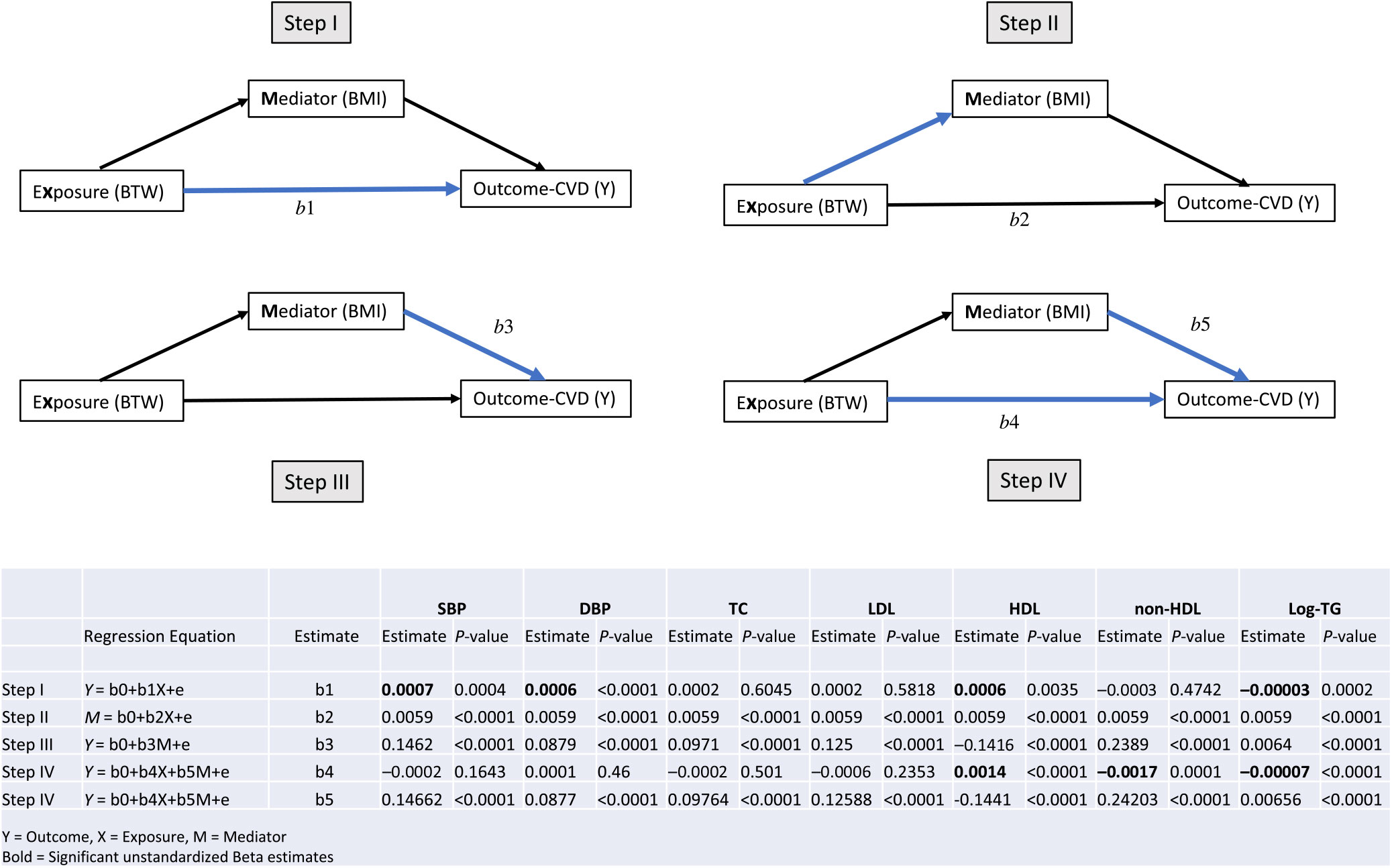
All statistical analyses were conducted using SAS version 9.3 (SAS Institute, Cary, NC, USA). CVD risk factors with a skewed distribution were log-transformed for all analyses. One-way analysis of variance (ANOVA) was used to determine whether there were significant differences between the means of all the outcomes of interest and birth weight groups (LBW, NBW, and HBW). Tukey’s post hoc tests were performed when findings indicated significant omnibus F-tests. Bivariate relationships between the birth weight (continuous) and the CVD risk factors (continuous variables) were assessed using the Pearson product-moment correlations. Seven separate multiple regression analyses were performed for the seven continuous dependent variables (SBP, DBP, TC, LDL, HDL, non-HDL, and log-TG). All CVD outcomes were first regressed on birth weight (main independent variable) as a continuous variable and also as a categorical variable to determine both the linear and nonlinear relationships between birth weight and CVD risk factors (model 1). In separate models, BMI percentile of the child in fifth grade (M = 11.0 years, SD = 0.5) was included in order to assess its role as a mediator (model 2). For all outcomes, additional covariates based on existing literature were then added to model 2 (model 3). The covariates were removed one at a time from the regression model if they were not statistically significant (highest p-value greater than p > 0.05). We also performed the regression analysis with and without the birth weight variable to calculate the amount of variance shared between birth weight and CVD risk factors (change in R², model 3). In order to better illustrate that role of BMI as a mediator, we did additional analysis following four steps that comprised of four sets of regression. Step 1: regressing exposure on the outcome (X → Y). Step 2: regressing exposure on the mediator (X → M). Step 3: regressing mediator on the outcome (M → Y). Step 4: regressing both the exposure and the mediator on the outcome (X + M → Y). If a mediation effect exists, the effect of the exposure (X) on the outcome (Y) will disappear (or at least weaken) when the mediator (M) is included in the regression.Reference Shrout and Bolger 63 Additionally, we tested full, partial, and no mediation models using PROC CALIS, with the best fitting model having the lowest Akaike information criterion (AIC).
Sensitivity analysis
To explore whether there were gender differences, we included the interaction term between gender and birth weight in the regression analysis. If the interaction term was significant, we performed separate regression models by gender for that outcome. In order to use birth weight as a continuous variable and assess for the U-shaped relationship, we used splines modeling technique that takes into consideration the relationship between the birth weight and the outcome within and between levels of the predictor variable (i.e., birth weight).Reference Hurley, Hullsey, McKeown and Addy 64 , Reference Huang 65 A linear spline is a continuous function formed by connecting linear segments. They are piecewise polynomial segments in one variable of some degree D with function values, which is continuous and the function has D-1 derivatives that agree at the points where they join. The joining points are called knots that mark one transition to the next and allowing the curve the freedom to change direction and follow the data more accurately to model the relationship between the independent and the dependent variable. Reference Hurley, Hullsey, McKeown and Addy64, Reference Huang 65 We used two knots at the two conventional cutoff points for birth weight distribution (<2500 and >4000 g). This allows the slope of the regression to change at these two knots, thus allowing flexibility of the continuous birth weight to fit the nonlinear segments (three segments).
Results
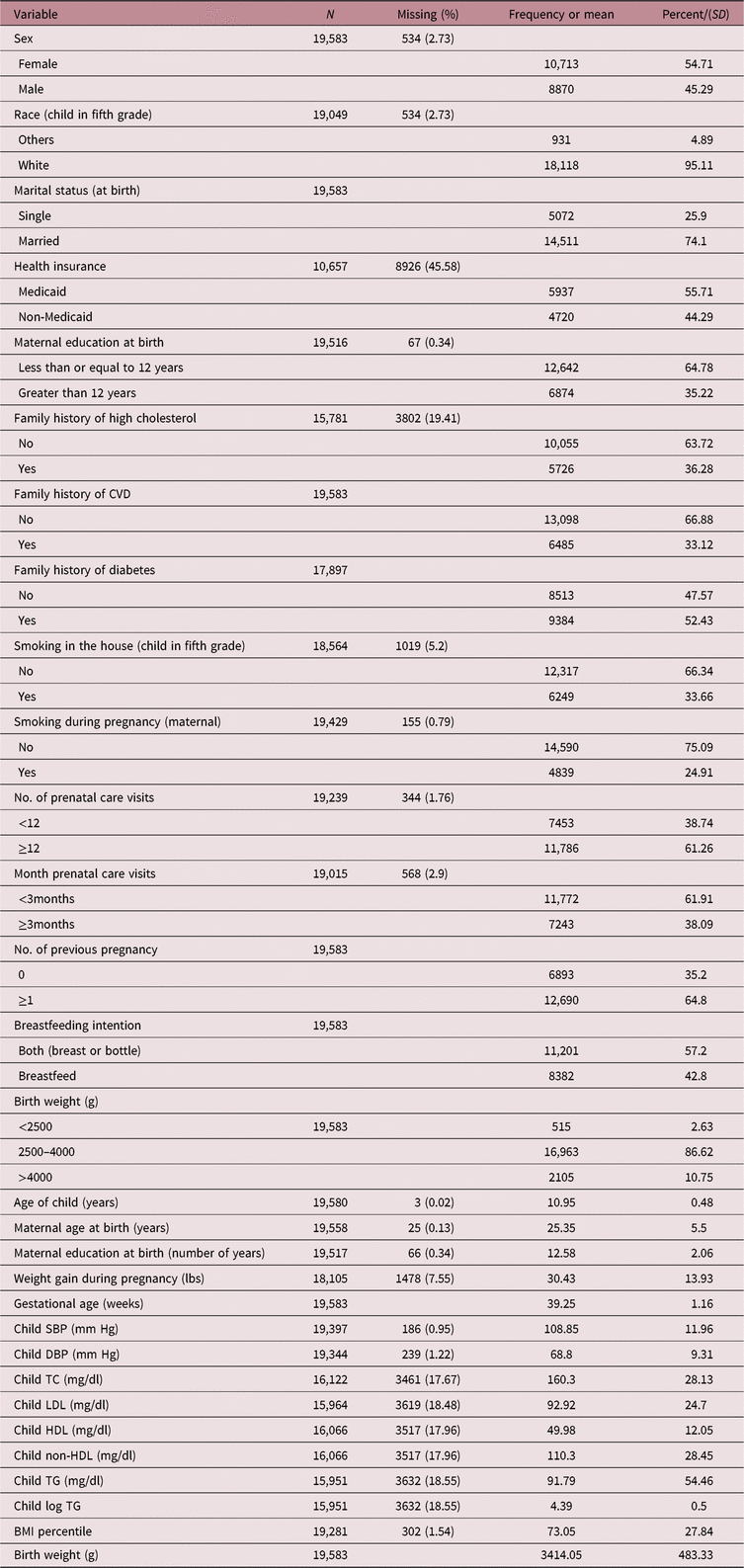
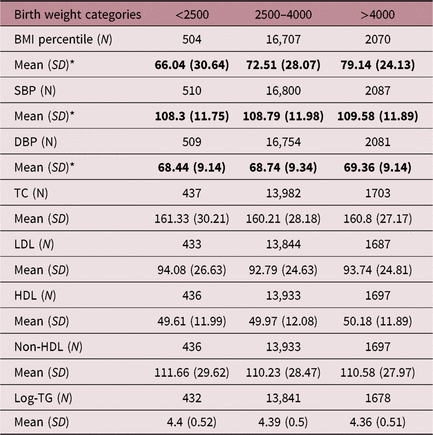
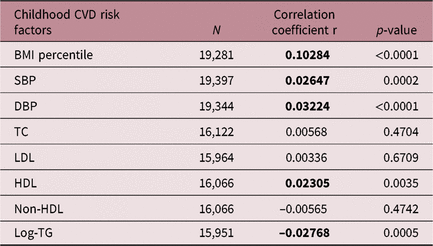
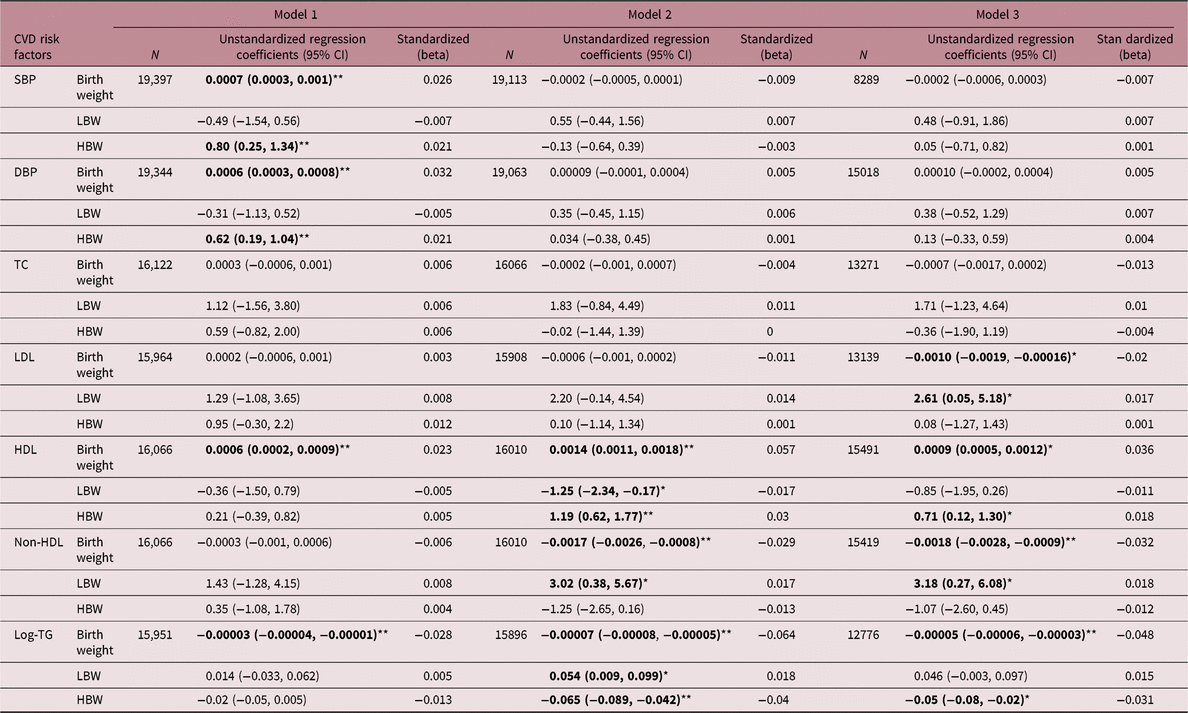
A total of 22,136 participants were available for analysis with the merged data. After excluding preterm births [gestational age < 37 weeks: 2097 (9.67%)], the final number of participants for this study was 19,583. In this full-term sample, nearly 3% of infants were LBW and 11% were HBW. The detailed population characteristics are available in Table 1. The means of all the outcomes of interest by the three birth weight groups are given in Table 2. Consistent with the ANOVA results, birth weight (continuous) was statistically significant and positively correlated with childhood SBP (N = 19,397, r = 0.03, p = 0.0002) and DBP (N = 19,344, r = 0.03, p < 0.0001) (Table 3). Birth weight was also statistically significant and positively correlated with childhood HDL (N = 16,066, r = 0.02, p = 0.0035), and a negative correlation with TG (N = 15,951, r = –0.03, p = 0.0005) (Table 3). The results of the unadjusted regression analysis followed the same pattern as observed in the correlations (Table 4 – model 1, Fig. 1, Supplementary Fig. 1 and 2).
Population characteristics at birth and in fifth grade using merged data from the Birth Score Project (1994–2000) and CARDIAC Project (2004–2010) for all infants who were born full-term (N = 19,583)

Results of one-way analysis of variance (ANOVA) for the mean difference in blood pressure and lipid levels in fifth-grade children by low birth weight (<2500 g), NBW (2000–4000 g), and high birth weight (>4000 g) groups using merged data from the Birth Score Project (1994–2000) and the CARDIAC Project (2004–2010) for all infants who were born full-term (N = 19,583)

*p < 0.05 (omnibus F-test); Post hoc test (Tukey’s) were performed where the omnibus F-test was significant to explore which means were significantly different between groups. All comparisons were significant for BMI. For SBP and DBP only high birth weight (>4000 g) was significantly greater than NBW (2500–4000 g) (p < 0.05).
Bold: statistical significance at alpha 0.05.
Pearson product-moment correlations between birth weight and childhood CVD risk factors using merged data from the Birth Score Project (1994–2000) and the CARDIAC Project (2004–2010) for all infants who were born full-term (N = 19,583)

Bold: statistical significance at alpha 0.05.
Results of the multiple regression analysis for the association between birth weight and CVD risk factors of fifth-grade WV children using merged data from the Birth Score Project (1994–2000) and the CARDIAC Project (2004–2010) for all infants who were born full-term (N = 19,583)

LBW (<2500 g), HBW (>4000 g), Referent: NBW (2500–4000 g).
Variables included in the model: Model 1: All the outcomes were regressed on birth weight (both linear and categorical). Model 2: All the outcomes were regressed on birth weight variable and the child’s BMI percentile in fifth grade. Model 3: All the outcomes were regressed on birth weight and the child’s BMI percentile and additional covariates. Only covariates that were significant in the Spearman’s correlation were used in the multiple regression analysis. Each nonsignificant covariate was deleted from the regression model one at a time. Variables retained in model for SBP: child’s age, race (white vs. other), maternal health insurance status at the time of delivery (non-Medicaid vs. Medicaid), and family history of cholesterol (yes vs. no); DBP: child’s age, race (white vs. other), and family history of cholesterol (yes vs. no); TC: child’s age, race (white vs. other), and family history of cholesterol (yes vs. no); LDL: child’s age, gender, interaction between age*gender, and family history of cholesterol (yes vs. no); HDL: child’s age, gender, race (white vs. other), family history of CVD (yes vs. no), maternal smoking status during pregnancy (yes vs. no), and maternal age at the time of delivery; Non-HDL: child’s age, family history of cholesterol (yes vs. no), and breastfeeding intention (breastfeed vs. both); TG: child’s age, sex, race (white vs. other), family history of cholesterol (yes vs. no), family history of CVD (yes vs. no), and maternal education at birth.
* <0.05;
** <0.01.
Bold: statistical significance at alpha 0.05.
Conceptual diagram to demonstrate the role of BMI percentile as a mediator in the association between birth weight (exposure) and CVD risk factors (outcome). Note X = independent variable, Y = dependent variable, and M = mediating variable. Seven different dependent variables include the resting blood pressure [systolic blood pressure (SBP), diastolic blood pressure (DBP)] and lipid profile [total cholesterol (TC), low-density lipoprotein cholesterol (LDL), high-density lipoprotein cholesterol (HDL), non-HDL, and triglycerides (TG)].

Adding the child’s current BMI to the model rendered the association of birth weight to SBP and DBP nonsignificant, and altered the apparent direction of the association of birth weight and SBP, TC, and LDL (Table 4 – model 2). In contrast, inclusion of BMI in the model slightly strengthened the positive association of birth weight to HDL, as well as the inverse association of birth weight to non-HDL and TG. Children born with LBW had significantly lower HDL and those born with HBW had significantly higher HDL levels, whereas the reverse was true for non-HDL and TG at ∼11 years of age in fifth grade (Table 4 – model 2). Moreover, after adjustment for additional covariates, the association between birth weight (continuous) was statistically significant and negative for LDL (b = –1.1 md/dl; 95% CI: –1.9, –0.2 per 1000 g increase, p = 0.02), non-HDL [(b = –0.2 mg/dl per 1000 g increase; 95% CI: –0.3, –0.1, p = 0.0002)], and TG [(b = –0.005 mg/dl per 1000 g increase; 95% CI: –0.007, –0.004, p = 0.0001] (Table 4 – model 3). For HDL, the association remained statistically significant and positively associated with birth weight in the fully adjusted model [(b = 0.1 mg/dl per 1000 g increase; 95% CI: 0.06, 0.13, p = 0.0001)] (Table 4 – model 3). BMI percentile was significantly associated with birth weight (N = 19,281, r = 0.10, p < 0.0001; b = 5.9 BMI percentiles; 95% CI: 5.1, 6.7 per 1000 g increase, p = 0.0001) (Tables 2 and 3, and Fig. 1). The standardized regression coefficients for BMI percentile and the outcomes ranged from 0.14 to 0.35 (negative for HDL) for every one-unit standardized increase in the BMI percentile (Supplemental Table S1). The list of additional covariates and their relationship with the statistically significant outcomes are detailed in Supplemental Tables S1 and S2. The unique variance shared between birth weight and the significant outcomes were determined by calculating the change in R-square, which ranged from 0.02% to 0.2% (Supplemental Table S1).
Mediation analysis
In terms of whether full, partial, or no mediation fits the outcomes best, AIC was smallest for full mediation for SBP and DBP. As seen in Fig. 1, for these outcomes, the b1 path is significant, and when b4 is added in, the association disappears (as seen in the b5 path). For example, for SBP the b1 p = 0.004 and it drops to p = 0.1643. Partial mediation (indicating that birth weight directly impacted the outcome in addition to indirectly impacting it via BMI percentile) fits best for HDL, non-HDL, and TG (p < 0.0001).
Sensitivity analysis
No gender differences were observed in the additional sensitivity analysis that examined the interaction of birth weight by gender on blood pressure and lipid levels of children. The results of the sensitivity analyses that used spline regression models for children are presented in Supplemental Table S3. For the models that included the child’s current BMI and additional covariates (Table S3 – model 3) showed that with every one-unit increase in the birth weight, the child’s TC, LDL, and non-HDL levels decreased significantly in the <2500 g segment only. DBP demonstrated a U-shaped relationship in both the crude and adjusted spline models. However, none of the segments were statistically significant.
Discussion
This study described the relationship between birth weight and childhood CVD risk factors that included blood pressure and the serum lipid profile. The results demonstrated that LBW is associated with higher risk of some abnormal lipid levels (lower HDL, higher non-HDL, and higher TGs) in children independent of current BMI at ∼11 years of age in children born full-term. For other outcomes (SBP and DBP), the relationship with birth weight is fully mediated by the child’s current BMI at ∼11 years of age.
Blood pressure
Our findings regarding the relation of birth weight to SBP are broadly consistent with previous studies indicating a positive association between birth weight and childhood SBP in the crude analysis, but an inverse association in the adjusted model.Reference Bergel, Haelterman, Belizan, Villar and Carroli 36 , Reference Menezes, Hallal and Horta 66 However, in contrast to findings reported in several previous investigations, Reference Frontini, Srinivasan, Xu and Berenson28, Reference Mu, Wang and Sheng38, Reference Zhang, Kris-Etherton and Hartman39, Reference Huxley, Shiell and Law67, Reference Gamborg, Byberg and Rasmussen 68 the adjusted association in our study, although inverse, was not significant after adjustment for BMI, suggesting that childhood BMI may in part mediate the negative asssociation of birth weight to SBP.
Likewise, our findings regarding DBP are in general agreement with studies that reported a significant positive association between birth weight and childhood DBP in the unadjusted analysis Reference Filler, Yasin and Kesarwani29, Reference Menezes, Hallal and Horta 66 that became nonsignificant (but remained positive) after adjusting for the child’s current BMI.Reference Amorim Rde, Coelho, de Lira and Lima Mde 33 Azadbakht and collegues also found significant positive bivariate association between birth weight and DBP as observed in our study. However, in contrast to our findings, this positive association remained statistically significant after adjusting for the child’s current BMI in both thisReference Azadbakht, Kelishadi and Saraf-Bank 9 and other previous studies. Reference Gademan, van Eijsden and Roseboom27, Reference Zhang, Kris-Etherton and Hartman 39 While a positive association between birth weight and DBP is not consistent with the Barker’s hypothesis, it is important to note that DBP is a less reliable measure compared to SBP in children. Reference Frese, Fick and Sadowsky69, Reference Pickering, Hall and Appel 70 Furthermore, numerous studies have shown SBP to be a stronger predictor of CVD compared to DBP.Reference Tin, Beevers and Lip 71
Lipids
In agreement with someReference Azadbakht, Kelishadi and Saraf-Bank 9 , Reference Frontini, Srinivasan, Xu and Berenson28, Reference Donker, Labarthe and Harrist 31 but not allReference Van Hulst, Barnett and Paradis 72 prior investigations, we found a statistically significant association between birth weight and childhood HDL (positive), and TG (negative). Inclusion of the child’s current BMI strengthened these associations. LDL cholesterol and non-HDL were statistically significant and negatively associated with birth weight after adjustment for the child’s BMI and additional covariates, consistent with findings of other studies. Reference Frontini, Srinivasan, Xu and Berenson28, Reference Zhang, Kris-Etherton and Hartman 39 The results from the analysis using birth weight as a categorical variable suggested that the association between birth weight and lipid levels is linear rather than U-shaped as demonstrated by some studies, Reference Donker, Labarthe and Harrist31, Reference Lauren, Jarvelin and Elliott59, Reference Huang, Burke and Newnham 73 and appears independent of childhood BMI. While the association of birth weight to TC was in the expected direction (i.e., negative),Reference Owen, Whincup, Odoki, Gilg and Cook 74 this association was not significant in the unadjusted models.
Collectively, these findings suggest that birth weight may be a significant predictor of certain childhood CVD risk factors (notably the lipid levels in children) independent of the child’s current BMI. However, the change in R 2 showed that birth weight accounted for less than 1% of unique variance in lipid levels of ∼11 years old fifth-grade WV children. While the effect size is small, these risk factors may persist and amplify with age, leading to potentially unfavorable consequence in later adulthood. Moreover, it is also probable that the long-term programming effects of LBW may be subtle and may not manifest in childhood, but only become apparent with advanced age and/or coincidence with secondary stressors and comorbidities.
Adjusting for current BMI
Birth weight was statistically significant and positively associated with the child’s current BMI percentile at ∼11 years of age. BMI percentile was also statistically significant and positively associated with all CVD risk factors except for HDL where the association was negative (Fig. 1). Our earlier work as well as results from this study have shown that HBW is associated with higher childhood BMI in 11-year-old WV children.Reference Umer, Hamilton and Britton 75 When BMI percentile was included in the model, the relationship with birth weight became statistically nonsignificant for SBP and DBP and reversed in direction for SBP. Thus, suggesting that BMI percentile fully mediates the relationship between birth weight and SBP and DBP. Gillman and colleagues also demonstrated an inverse association between birth weight and CVD risk factors after adjusting for current body size.Reference Gillman 76 However, for three lipid levels (HDL, non-HDL, and TG), the relationship with birth weight was partially mediated by the child’s current BMI at ∼11 years of age. Our results suggest that BMI is a key predictor of CVD risk factors (Table 4, Fig. 1) and a partial/full mediator for the relationship between birth weight and select CVD risk factors. These results suggest that targeted interventions should focus on to reducing BMI in HBW babies, whereas in LBW babies there should be a focus on reducing levels of CVD risk factors regardless of whether they present as overweight/obese.
Strengths and limitations
The study has several strengths. First, the study has a large sample size. Second, the merged data from birth to when the child was ∼ 11 years old provided longitudinal information on important covariates at both time points. Third, the data collection procedures included having trained staff and a consistent methodology for measurement and laboratory assays. Fourth, all 55 counties in WV participated in the CARDIAC project, thus providing comprehensive population-level data for the state. Lastly, to our knowledge, this is the first study that has examined these associations in children of WV, where the health outcomes are among the poorest in the nation. The descriptive characteristics of the study sample explicate the poor socioeconomic and health status of the WV population.
In addition to strengths, our study also has several potential limitations. For example, a lack of information was available for several potential confounders: parental adiposity status, maternal prepregnancy weight, maternal height, maternal lipid status before and during pregnancy, maternal birth weight, rapid infant weight gain during the first year of life, pubertal status, family history of hypertension, and children’s physical activity and dietary behaviors. In addition, due to the unique population characteristics of WV, a predominantly Caucasian rural state entirely within the Appalachian region of the US, results may not be generalizable to other populations, although previous studies have yielded similar findings. Reference Azadbakht, Kelishadi and Saraf-Bank9, Reference Frontini, Srinivasan, Xu and Berenson28, Reference Filler, Yasin and Kesarwani29, Reference Donker, Labarthe and Harrist31, Reference Amorim Rde, Coelho, de Lira and Lima Mde33, Reference Bergel, Haelterman, Belizan, Villar and Carroli36, Reference Zhang, Kris-Etherton and Hartman39, Reference Menezes, Hallal and Horta 66 Lastly, the magnitude of association seems extremely small though statistically significant (small p-values) perhaps due to the large sample size, cautions us about the clinical and population health importance of this association. However, the occurrence of CVD risk factor in childhood is an important concern as these risk factors persist, track, and amplify with age, leading to potentially serious CVDs in later adulthood. Targeted interventions should focus on LBW babies born full-term and HBW babies that are overweight in childhood as a disease prevention strategy for WV families and communities.
Conclusion
In sum, our findings suggest that LBW is associated with a higher risk of abnormal lipid levels (higher LDL, non-HDL, and TGs, and lower HDL levels) in ∼ 11-year-old fifth-grade children independent of their current weight status. The results are consistent with Barker’s hypothesis and offer further support for a role of prenatal environment in fetal development that may have negative health consequences later in life.Reference Barker, Gluckman and Godfrey 22 Additionally, well-designed longitudinal studies are needed to confirm and extend these findings, and to understand the complex biological pathways underlying the association of birth weight to CVD risks at different stages of life. Furthermore, future research in diverse populations is also needed to establish and refine birth weight cutoffs that can more accurately identify infants at higher risk for future CVD.Reference Malin, Morris, Riley, Teune and Khan 35 Lastly, identifying and effectively addressing the determinants of LBW may aid in mitigating risk for CVD later in life.
Acknowledgements
The West Virginia WATCH/Birth Score Program is funded under an agreement with the West Virginia Department of Health and Human Resources, Bureau for Public Health, Office of Maternal, Child and Family Health. The CARDIAC project is funded by the West Virginia Bureau of Public Health. The authors wish to thank the children and families who have participated in the CARDIAC Project and the Birth Score Project. The authors would like to thank Cris Britton, data manager of WATCH/Birth Score Project for providing the matched data. GA Kelley and C Lilly were partially supported by the National Institute of General Medical Sciences of the National Institutes of Health under Award no. U54GM104942. The content is solely the responsibility of the authors and does not necessarily represent the views of the National Institutes of Health.
Financial Support
This research received no specific grant from any funding agency, commercial, or not-for-profit sectors.
Conflicts of Interest
None
Ethical Standards
The authors assert that all procedures contributing to this work comply with the ethical standards of the relevant national guidelines on human experimentation (Project WATCH/Birth Score Project) and with the Helsinki Declaration of 1975, as revised in 2008, and have been approved by the institutional committees [West Virginia University Institutional Review Board (Protocol number 1504666639)].
Supplementary material
To view supplementary material for this article, please visit https://doi.org/10.1017/S204017441900045X