


Silicification - the precipitation of silica within the remains of a buried organism - allows for the three-dimensional preservation of a fossil in minute cellular to subcellular detail and forms the basis for some of the most spectacular Lagerstätten for terrestrial ecosystems (e.g. Selden & Nudds Reference Selden and Nudds2004). Among these are the plant-bearing chert deposits of the Transantarctic Mountains, which were discovered by J.H. Mercer and J.D. Gunner during the 1969/1970 ‘Beardmore Expedition’ and sampled and first screened by J.M. Schopf soon thereafter (Schopf Reference Schopf1970). The collection, preparation and in-depth study of plant-bearing cherts from the Beardmore Glacier generated more than 125 publications, and systematic treatments of the permineralized biotas resulted in the description of 30 genera and almost 50 species of structurally preserved plants and fungi. The exquisite anatomical preservation enabled unusually detailed reconstruction of many of the preserved organisms, yielding the most completely known fossil members for several groups of gymnosperms (see Escapa et al. Reference Escapa, Taylor, Cúneo, Bomfleur, Bergene, Serbet and Taylor2011). Together with similar silicified peat deposits from the remote Prince Charles Mountains in East Antarctica (McLoughlin & Drinnan Reference McLoughlin and Drinnan1997), these conservation-Lagerstätten of the Transantarctic Mountains constitute an extraordinary window into the biology and ecology of late Palaeozoic and early Mesozoic high-latitude terrestrial ecosystems. Perhaps the single most important of these deposits is the silicified peat from the Triassic Fremouw Formation at Fremouw Peak in the Beardmore Glacier area. Triassic silicified peat also occurs elsewhere in the Transantarctic Mountains, including the Allan Hills in southern Victoria Land (Taylor & Taylor Reference Taylor, Taylor, Taylor and Taylor1990) and Timber Peak in northern Victoria Land (Bomfleur et al. Reference Bomfleur, Schneider, Schöner, Viereck-Götte and Kerp2011), but thus far the quality of preservation at other sites proved too poor to merit in-depth study.
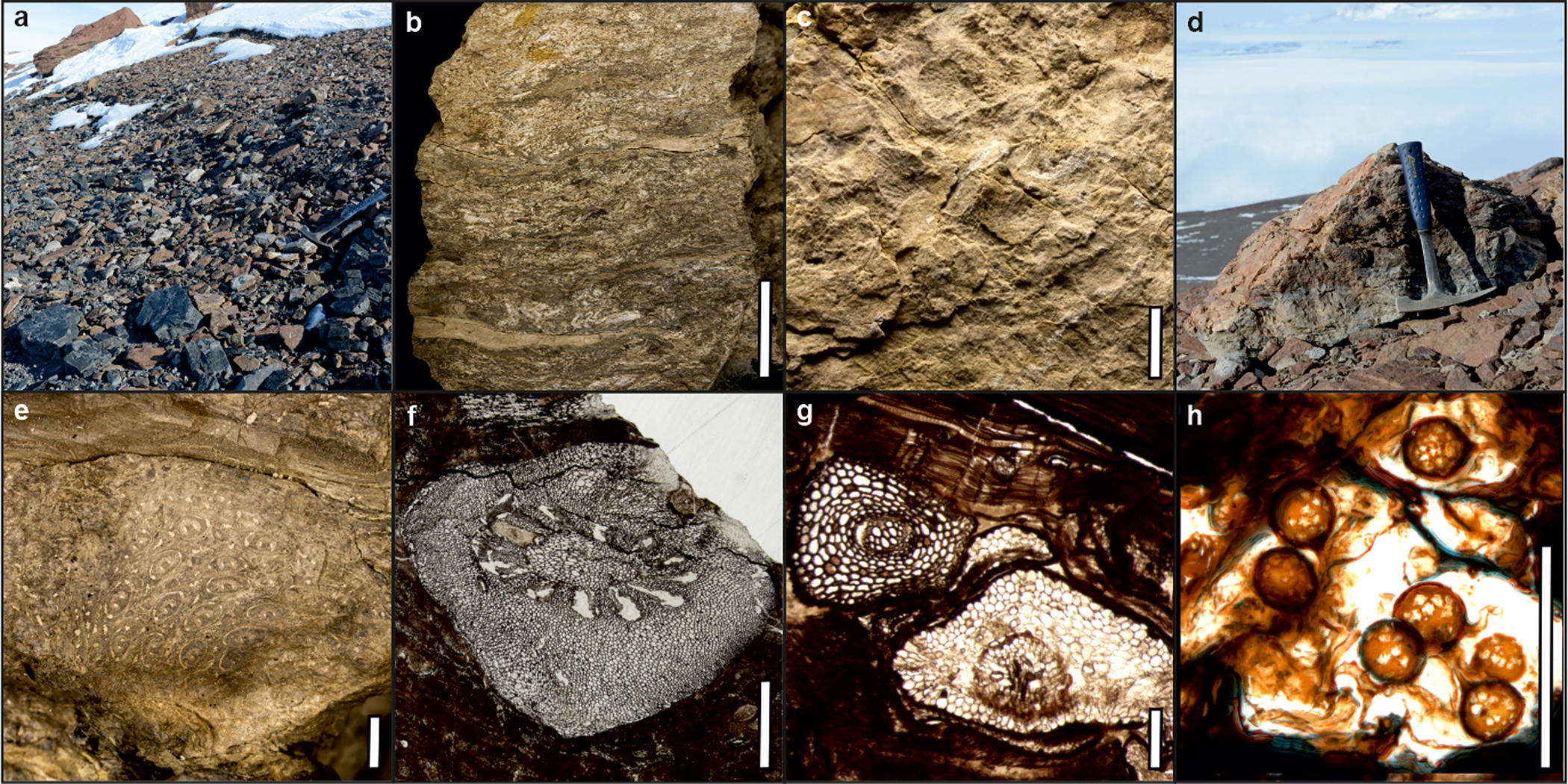
Geological-palaeontological fieldwork during the 11th German Antarctic North Victorialand Expedition 2015/2016 discovered previously unknown fossil sites with silicified plant material in Triassic strata of the northern Helliwell Hills in the lower reaches of the Rennick Glacier, more than 1200 km north of the Beardmore Glacier (Fig. 1a; Bomfleur et al. Reference Bomfleur, Mörs, Unverfärth, Liu, Läufer and Castillo2021). Scattered float blocks of silicified peat occur along the slopes surrounding an unnamed small mesa 3 km east of Dziura Nunatak. The type section of the Middle to Upper Triassic Helliwell Formation occurs on the east- and south-east-facing slopes of this mesa (Bomfleur et al. Reference Bomfleur, Mörs, Unverfärth, Liu, Läufer and Castillo2021, figs 3a & 4; see also Fig. 1b of this paper). Two deposits of silicified peat can be distinguished at the site. The first, much more common type (here termed type A) occurs in the form of loose blocks that appear to derive from lenses of silicified peat encapsulated within a coal seam exposed on the north-eastern slope of the mesa (Fig. 2a). Weathered cross-sectional surfaces of this peat deposit show distinct, wavy and (sub)horizontal layers of variably compacted axes and putative leaf mats (Fig. 2b) with only poor cellular detail. Some naturally weathered surfaces of these matted layers contain conspicuously small Dicroidium leaves and leaflets (Fig. 2c), the dominant foliage type in the Triassic of Antarctica (Escapa et al. Reference Escapa, Taylor, Cúneo, Bomfleur, Bergene, Serbet and Taylor2011). The second type of silicified peat (type B) occurs on the north-western slopes in the form of large (> 50 cm in diameter), dome-shaped individual allochthonous blocks (Fig. 2d). Type B blocks are characterized by conspicuous reddish weathering colours, with cross-sectional surfaces exposing uncompacted woody axes, leaves and assorted other plant material, including several in situ-preserved rhizomes of Osmundaceae showing very fine anatomical detail (Fig. 2e). Diagnostic details in the stipe bases in these rhizomes indicate close affinities with the extant interrupted fern (Claytosmunda claytoniana). First thin sections prepared from these type B blocks confirm exquisite preservation of plant tissues, cells and possibly cellular contents and reveal a rich and diverse assemblage of possible lycophytes, various ferns and several gymnosperms (Fig. 2f,g). In addition, fungal remains are widely represented within well-preserved plant remains and cells (Fig. 2h). We anticipate that further preparation and detailed screening and analysis of these new occurrences of silicified peat will not only fill a gap in the plant fossil record of southern Gondwana, but also significantly expand our knowledge of the Triassic vegetation of Antarctica and its unique past polar biome.
a. Geographical position of the sample site in the Helliwell Hills, northern Victoria Land (71°44′2″S, 161°21′36″E). b. Simplified lithological column of Triassic strata at the sample site, with an arrow indicating the stratigraphic position of the silicified peat deposits (modified after Bomfleur et al. Reference Bomfleur, Mörs, Unverfärth, Liu, Läufer and Castillo2021).

a. North-eastern slope of the sample site showing isolated blocks of highly compacted silicified peat type A in immediate surrounding of an exposed coal seam. b. Cross-sectional surface of type A silicified peat, showing distinct layering. c. Bedding surface of type A silicified peat, showing fragments of Dicroidium fronds. d. Isolated dome-shaped block of type B silicified peat at the north-western slope of the sample site. e. Weathered cross-sectional surface of type B silicified peat showing an osmundaceous rhizome (GXI-HCNW-Osmunda). f. Thin section of marattialean fern root (GXI-HCNW-Osmunda-a-S1). g. Thin section showing two roots with pristine cellular preservation (GXI-HCNW-002-S1). h. Detail showing Sclerocystis-like fungi (GXI-HCNE-003-S1). Scale bars: b. = 1 cm; c., e. = 5 mm; f. = 2 mm; g. = 200 μm; h. = 100 μm.
Acknowledgements
We thank Andreas Läufer and the Bundesanstalt für Geowissenschaften und Rohstoffe (Hannover) for the invitation to join the GANOVEX XI expedition, and the entire GANOVEX team, especially Thomas Mörs (Stockholm), for fruitful and enjoyable collaboration in the field; the staff of the rock preparation laboratory of IGP (Münster), especially Mayla Renz-Kiefel and Rebekka Schulze-Hobeling, as well as Michael Köhler (Stahnsdorf) for thin section preparation; the Deutsche Forschungsgemeinschaft (DFG project 500787157 to BB) for financial support; and an anonymous reviewer for helpful comments and suggestions.
Author contributions
BB performed the fieldwork. PH and BB analysed the material. PH processed and photographed the material. PH and BB discussed the results, wrote the manuscript and provided illustrations.
Competing interests
The authors declare none.



