In the summer of 2004, in his Presidential Address to the American Sociological Association, Michael Burawoy made an argument for what he called “Public Sociology.” Footnote 1 At around the same time, the modern era of social media was just beginning to come into being. Facebook was founded that February. A year or so later, when “For Public Sociology” was arriving as a printed journal article in people’s mailboxes, Mark Zuckerberg began expanding Facebook membership to universities other than Harvard. A year after that it was available to more or less everyone. Twitter was founded in July of 2006. The iPhone launched in 2008, helping precipitate a revolution in computing that is still going on. Just as Burawoy was calling for sociologists to engage with the public, the infrastructure of publicity, the dominant ways of engaging with an audience, and some of the basic assumptions about being a scholar in public were all about to change substantially.
I return here to some of the decade-old themes in Burawoy’s manifesto. I shall argue that one of social media’s effects on social science has been to move us from a world where some people are trying to do “public sociology” to one where we are all, increasingly, doing “sociology in public.” This process has had three aspects. First, social media platforms have disintermediated communication between scholars and publics, as technologies of this sort are apt to do. This has not ushered in some sort of communicative utopia, but it has lowered the threshold for sharing one’s work with other people. Second, new social media platforms have made it easier to be seen. Sadly, I do not mean that it is now more likely that you or I will become famous. Rather, these technologies enable a distinctive field of public conversation, exchange, and engagement. They have some of the quality of informal correspondence, but they are not hidden in private letters. They take place as real-time interaction, but do not depend on you showing up to a talk. Again, as is typically the case with communication technologies, exactly what gets enabled can vary. The field of public conversation encompasses everything from exciting forms of serendipitous collaboration to the worst sort of trolling and harassment. Thirdly, new social media platforms make it easier for these small-p public engagements to be measured. They create or extend opportunities to count visitors and downloads, to track followers and favorites, influencers and impacts. In this way they create the conditions for a new wave of administrative and market elaboration in the field of public conversation. New brokers and new evaluators arise as people take the opportunity to talk to one another. They also encourage new methods of monitoring, and new systems of punishment and reward for participation. Universities and professional associations, for example, become interested in promoting scholars who have “impact” in this sphere. But they are also slightly nervous about associating what they have come to think of as their “brand” with potentially unpredictable employees, subscribers, and members.
I take each of these points in turn. I shall try to think about them from a general point of view while illustrating some of their practical aspects from my own experience. I have been doing sociology in public for some time. I started blogging in 2002, and helped start a pretty widely-read group blog soon afterwards.
Ten Years of Public Sociology
Burawoy made his argument for public sociology in his 2004 ASA Presidential Address. That article is an effective combination of substantive argument and careful triangulation of disciplinary disagreements. Much of Burawoy’s energy was devoted to identifying four basic kinds of sociology, which he labeled Professional, Policy, Critical, and Public. While making a case for the importance of the latter, he also wanted to emphasize—good Marxist that he is—the prospect of unifying these streams into something new. The closing sentences sketch out a tremendous vision for the field:
I envision myriads of nodes, each forging collaborations of sociologists with their publics, flowing together into a single current. They will draw on a century of extensive research, elaborate theories, practical interventions, and critical thinking, reaching common understandings across multiple boundaries . . . and in so doing shedding insularities of old. Our angel of history will then spread her wings and soar above the storm. Footnote 2
One of the most pleasing things about it is its well-tempered optimism, something that sociologists are usually not much good at. Reading it today, one is struck by the argument it makes about Sociology’s disciplinary connection to civil society. “[Sociology] studies the state or the economy from the standpoint of civil society,” that is, “associations, movements and publics . . . outside both state and economy—political parties, trade unions, schools, communities of faith, print media and a variety of voluntary organizations.” Footnote 3 The idea is that, to a first approximation, political science depends on the state, and has an interest in political order and a natural connection to the world of government. Economics depends on the market, and often has an interest in market expansion. Meanwhile sociology depends on civil society, and has an interest in the expansion of society outside of the state and the market. Burawoy does not lean too hard on this argument, but as a set of parallels it is intriguing. When I started graduate school there was a lot of talk in the field about civil society, civic engagement, and the voluntary sector in America. At the time—perhaps because I had emigrated from Europe’s most charming agrarian theocracy—I had no clear idea what “civil society” was. Eventually I realized that when people talked about civil society what they meant were the things you did in public, but in your spare time. This was perhaps a little simple-minded, but it is actually a pretty good working definition. Footnote 4
There is also a natural connection here to the world of scholarly research. Although by now thoroughly professionalized, academic life has deep roots in the desire to talk about scholarly preoccupations in public, and in one’s spare time. It is in this sense an aspect of civil society. On a personal level, having the desire to go and tell people about your work is a good sign that you are substantively absorbed by what you are doing. The point generalizes to disciplines. To the degree that thinking, talking, and arguing about research in one’s spare time and in public is a feature your field, it is a sign that your discipline is confident about what it does. Modern social media bring together these shared features of civil society and academic discourse in a new way. Social media platforms facilitate and accelerate the possibilities for talking about one’s work in public, assuming we want to take advantage of it.
It is fair to say the initial response from the field of Sociology did not quite live up to Burawoy’s beautiful vision. The reaction was essentially inward looking. A lot of writing and a certain amount of bellyaching on the topic got published, almost all of it in outlets read only by people in the field, and even then only if their library had an institutional subscription. People used to say of the conceptual efforts of some German sociologists in the 1970s and 1980s that they had succeeded in unifying theory and practice—in theory. In a similar sort of way, the debate about public sociology succeeded in unifying professional and public sociology, in professional journals.
Herbert Gans points this out in a recent essay. Footnote 5 “Most of the discussion of public sociology took place in the 5 years immediately following the Burawoy address. Moreover, almost all of it dealt with sociology, virtually ignoring the public and the role it plays in the realization of public sociology.” Footnote 6 Gans tries to shift the attention away from the stage and back towards the audience. “We have to start the ball rolling” he argues, “But ultimately, we have limited control over what becomes public sociology. The public has the last word.” He goes on to distinguish different kinds of publics—students in classes, “general magazines” like the New Yorker and The Atlantic, on up to the “general public” watching TV or going to the movies. He notes the broad division in the public by level of education, and the connections between this division, the size of the audience and its taste for longer or shorter pieces of work. He emphasizes the role of what he calls “presenters,” people whose role it is to get material out in front of some public or other:
Consequently, sociologists must understand how presenters make indirect and direct contact with their publics and when and why they try to present a sociological product as public sociology. Although some presenters keep in touch with a number of sociologists, others wait until they learn about something that calls for a sociologist.
Who those people are varies depending on the public one is trying to reach. They may be journalists on social science or lifestyle beats, freelancers, or people working on “explainer journalism,” for example. And he also notes that a “fifth set of presenters is emerging in the world of the social media . . . like the opinion leaders of old, they occasionally discover a sociological book, article or other product and tell their friends and followers about it . . . . while not much sociology is likely to wind up in such news outlets, the social media audience is humongous.” Footnote 7
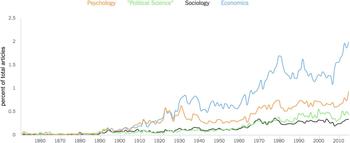
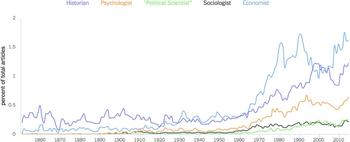
If Burawoy is right about Sociology’s elective affinity with civil society, we should be thinking hard about how to engage with those presenters, or how to become one once in a while. We should be doing this if only because our position in traditional media hasn’t really budged over the past decade. Figures 1 and 2 present some keyword data from the print history of The New York Times detailing the relative frequency of disciplinary names and occupational titles over time.
Relative frequency of social science discipline names in New York Times stories, 1856–2015 (“History” omitted, )

Relative frequency of social science occupational names in New York Times stories, 1856–2015

The story here is a familiar and somewhat demoralizing one. A minor though interesting feature of this data worth noting is the gap that opens up between Political Science and Sociology that begins in the 1980s. The big picture is not one that I’d expect to be different for other sorts of big media outlets, at least not within the United States.
Ten Years of Social Media
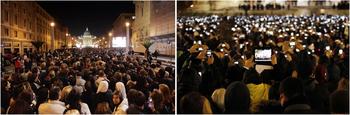
In any case, the New York Times is resolutely Old Media. What about the world of social media? How much has changed, and how much is the same as it ever was? When we think about communications revolutions, as for example Claude Fischer has taught us, we should take care not to get carried away. Footnote 8 The temptation is to say that everything has changed. Figure 3, for example, contrasts two photographs taken near St Peter’s Square in Rome. The photograph on the left was taken around the time Benedict became Pope. The crowd is waiting expectantly. The photograph on the right was taken more recently. In it, the crowds await the first appearance of Benedict’s successor, Pope Francis. It seems as though people could not wait to Facebook and Instagram their new Pope. It’s a very striking image, and the contrast between the two circulated widely on social media itself.
Two views of crowds in St Peter’s Square

Except the comparison is not quite accurate. In the first image, people are not waiting for the appearance of Pope Benedict. They are waiting for the appearance of the body of the late John Paul II for public viewing. The crowd is waiting to pay its respects. In the second photograph, they are celebrating the first appearance of a new Pope. These are two rather different circumstances.
This is a by now familiar point about the role of social context in the use of communication technology. While it is not out of the question that the lying-in-state of the next Pope will be heavily Instagrammed, we do need to be careful about the kinds of technological effects we are interested in. I want to emphasize the varied effects of disintermediation, visibility, and measurement. To do so I focus on three kinds of social media whose effects I have experienced first hand, namely blogs, Twitter, and Facebook. These are quite different things, but they are all part of the second great wave of web expansion that began in the early 2000s.
Blogs
Blogging is the oldest format, and today seems rather unfashionable. It is a kind of bridge between the older World Wide Web of static homepages (and now-forgotten community phenomena like webrings), and the newer platform-based world of self-conscious sharing of “content.” It is social media in the absence of mobile computing. Or alternatively, blogging is the old Web combined with a USENET-like expectation of daily conversation and exchange. As a widespread and self-conscious activity it begins early in the 2000s, or thereabouts. One reason that it remains of interest is that there is a very large-period effect associated with people who started then. Across the spectrum of blogs, many of those who started writing regularly online between about 2000 and 2004 and found an audience remain very visible in the world of online media and the chattering classes more generally. Matthew Yglesias, for example, was a Philosophy undergraduate at Harvard when he began writing his personal blog, and is now a high-profile writer for Vox media. Ezra Klein, also of Vox and MSNBC, got his start in a similar way. Glenn Reynolds of Instapundit was and is a law professor in Tennessee. He ended up with a very large audience thanks to what a rapid-fire style of one-line posts and links—something that in retrospect seems rather Twitter-like. Writers like Megan McArdle began blogging about the September 11 attacks and ended up at Bloomberg and later the Atlantic. The political scientist Daniel Drezner started his own blog and now regularly writes for Foreign Affairs, the Washington Post, and appears on various cable TV news shows. The lists of cases could easily be multiplied.
There were not that many sociologists involved during this period. Encouraged by Eszter Hargittai, I began blogging in 2002 and a year later became one of the first members of Crooked Timber, a group weblog initiated by the political philosopher Chris Bertram. Its members did not have much in the way of prior personal connections, or any organizational structure beyond the website. But having a group meant that we could address one of the main pressures faced by solo-bloggers at the time, namely the pressure one felt to write more or less daily in order to keep one’s audience. Diffusing this responsibility to the group made things easier.
Since it was founded in 2003, Crooked Timber has produced just over ten thousand individual posts, and almost half a million comments. Comments are actively moderated, which is an absolute necessity for public engagement of any sustained sort. Many a hopeful theory of democratic participation, civil society, and pluralistic public engagement has foundered on contact with jerks who would try the patience of Jürgen Habermas himself. Moderation is also necessary to fend off the zombie army of robots or professional spam-farmers who try to sneak ads for Viagra or Cialis into your threads. Crooked Timber does not carry any advertising. This is less a point of high moral principle and more the result of our inability to find an Ad Network that didn’t seem terrible. The upshot is that Crooked Timber remains a kind of living fossil of a particular era of blogs. Most of its peers have either gone extinct or been subsumed by larger (commercial) entities. By the by, it means you can trust our site metrics are not fantastically inflated by ad robots and automated clickers, something that has become a chronic problem for many other outlets and the advertisers who pay to use them.
Figure 4 shows analytics data for visitors to Crooked Timber going back to the summer of 2006. Over the past nine years we have had a total of almost forty million page views, almost 23 million user sessions, and over 8.5 million unique users. Our usage patterns over that period have remained pretty stable. We get between five and ten thousand visitors a day, with periodic spikes when a particular post becomes popular.
Daily Unique Visitors to Crooked Timber, 2007–2015

In “Science as a Vocation,” Weber remarks that although we do not get our best ideas while sitting at our desks all day doing regular work, we wouldn’t get any good ideas unless we sat at our desks all day doing regular work. In a similar way, successfully engaging with the public means doing it somewhat unsuccessfully very regularly. This fact is closely connected to the value of doing your everyday work somewhat publicly. You cannot drop a lump of text onto the Internet and expect anyone to pay attention if you have not been engaging with them in some ongoing way. You cannot put your work up on your website, or “do a blog,” or manufacture interest in your research like that. There is a demand side as well as a supply side to “content,” and most of the time the demand side does not care about what you have to say. This is why, in my view, one’s public work ought to be continuous with the intellectual work you are intrinsically motivated to do. It is a mistake to think that there is a research phase and a publicity phase. Your employer might see it that way, but from a first-personal point of view it is much better—both intrinsically and in terms of any public engagement you might want—to think of yourself as routinely doing your work “slightly in public.” You write about it as you go, you are in regular conversation with other like-minded researchers or interested parties, and some of those people may have or be connected to larger audiences with a periodic interest in what you are up to.
Doing social science in the age of social media also means reconciling yourself to the structure and limits of online attention. Analytics data for websites typically measure your users’ “Average Session Duration,” as well as something called their “Bounce Rate.” Session duration is the typical length of time visitors spend on your site. In the case of Crooked Timber, nine years worth of visits data shows an average session duration of two minutes and forty eight seconds. While you can read or skim a fair amount of text in three minutes, it is not a particularly long time. Bear in mind, too, that this data is for a quite pointy-headed website that often has a lot of long posts. The Bounce Rate, meanwhile, is a measure of whether people stick around to read something else once they have seen and read the page they arrived at. Crooked Timber is quite typical: people do not stick around. Two-thirds of visitors read the one thing that brought them to the website, and then they go somewhere else.
This does not mean they never come back. But it does mean that, as a rule, one should not think of your website or blog as a kind of community or a place people go and spend time reading around in depth. And remember, our high bounce rate is for a site that has almost half a million comments on it. We really do have a solid community of readers and commenters. Even so, we are not where our commenters spend most of their time, and our commenters are not where the bulk of our traffic comes from.
It is quite common to mistake the role websites or blogs play in people’s reading and conversation. Universities and professional associations make this error all the time. For example, administrators may want to add a comment section to articles or try to start discussion forums. And although the material may be relevant and interesting to visitors, most of the time there will be no discussion in that place. This is because there is no reader community on that site to begin with, and no prospect of one developing, given the use people are making of it. This can make even successful sites look more forlorn than they really are.
Twitter makes the tendency toward low engagement and rapid bouncing around even more pronounced. The distribution of followers across Twitter users is extremely skewed. At the low end, a large number of nominally-existing Twitter accounts are either abandoned or run by robots. Many people use the service in a fairly low-key way and follow just a few friends (or celebrities). Correspondingly, those people tend to have few followers in return. It is useful to think in terms of orders of magnitude. Most users have no more than ten followers; many have fewer than a hundred; a few have more than a thousand, and so on up to the very far end of the distribution where people like Kim Kardashian live with tens of millions of devotees. Twitter makes analytics data available to its users, although absent systematic data collection it is hard to see the larger distributional facts that would allow proper comparisons.
Still, casual observation suggests the story here is similar to blogging in two ways. First, taking a “press-release” approach to social media as an individual is unlikely to go well. Individual consistency of identity is what gets rewarded in terms of attention (whether positive or negative). Occasional appearances to drop a link to one’s new article into the public sphere will likely be ignored. The demand for continuity between who you are and what you say, and the implicit presumption of what we might call discursive availability to complete strangers is a double-edged sword. On the one hand, Twitter is a fundamentally asymmetric network where there is no obligation to follow people who choose to follow you. On the other hand, the convention of “@-replies” means that someone tweeting publicly can be engaged with at will by anyone who sees those tweets. The predictable result is that users may find themselves in a storm of unwanted and perhaps malicious or abusive attention if something they say is widely retweeted.
Consistent with the rest of social life, some kinds of people are much more likely than others to be targets of harassment or abuse. Thus far, Twitter’s efforts to manage this sort of abuse at the platform-level (e.g., in terms of the ability to report or block users) have been unsatisfactory. This is at least partly because shutting down this sort of flow of attention is inimical to the interests of the platform owners, regardless of how horrible it is for particular users. The main form of defense against this so far has been community-based mobilization to manage bad users. This is something that was much more easily done in the earlier, blog-based phase of social media. In that case, particular blogs could establish and enforce standards for good behavior because they were managing their own websites. The ecology of conversation and commenting was thus one of connected islands of argument, each with its own locally enforceable norms. In a platform-based system like Twitter, it is much more difficult to accomplish this sort of norm enforcement, especially when the platform’s design actively militates against it.
The structure of “engagement” is again roughly parallel to the blog case. As with numbers of followers, we can think in terms of orders of magnitude. An “ordinary” popular tweet by someone with a few thousand followers might be seen by one or two hundred thousand people. Of those, seven thousand might be measured as having “engaged with the media” (i.e., they clicked through to read it, or magnified a picture to look at it more closely); seven hundred people might retweet it; seventy people might say something back to the user directly; and seven people might decide to follow the user as a result of seeing the tweet. Of those seven new followers, maybe four or five are real and the remainder are spambots.
So, even in cases of massive exposure, there are logarithmically decaying effects in terms of engagement. For some hot-button topics, widespread exposure inevitably means attracting individual or organized harassment. Because this drop-off in attention and engagement from widely-circulated items is enormous, the structure of attention from any particular individual’s point of view is ephemeral and extremely skewed. Twitter’s loosely connected network of users combined with its absence of choke-points and its hard limit on the size of tweets makes it easy to propagate context-free statements in storms of disagreement, laughter, or derision. This means that most of the time people are tweeting to some relatively tiny audience, right up until huge numbers of people decide to judge them based on a quick glance at the 140 characters they wrote. The key question from the individual user’s point of view is whether the five or six users who choose to engage with you are determined trolls or not. Again, the chances that they will be are not random, as various predictable dimensions of group membership are disproportionately targeted for attack. Twitter tends to produce small, viable communities of like-minded people focused on common nodes of interest who then—like residents of some quiet coastal fishing village—periodically see one or more of their members swept out to sea by an unexpected tsunami.
Facebook’s network structure is a symmetric one based on friendship rather than an asymmetric one of followership. The main thing to understand about Facebook is that although it is unfashionable it is also gigantic. Eighty-seven percent of Americans have good internet access, but only about 21 percent of them ever use Twitter. (This is slightly higher for African Americans—about 27 percent.) In contrast, 72 percent of Americans with Internet access say they use Facebook. Globally it has 1.4 billion users, most of whom are active at least some time during the month. Footnote 9 While services like Twitter, Pinterest, Instagram, and others are large enough in absolute terms and also still growing, none has the attention of more than one-third of online adults in the United States, and none has the global reach of Facebook. The most widely-read thing I ever wrote was a blog post called “Using Metadata to Find Paul Revere.” It was circulated quite widely in the news media, it was reprinted in Slate and other places, and it still gets linked to regularly. About half a million people read it, or at least looked at it briefly. By far the biggest path to it was through sharing on Facebook. Social media referrals, and especially Facebook referrals, drive so much traffic that people or organizations primarily concerned with generating pageviews on their websites spend a lot of time tailoring their content to be friendly to or take advantage of that fact. This is not necessarily friendly to the intellectual enterprise. But there is little point denying that Facebook has reached the scale of the very largest publics considered as a vehicle for disseminating material.
Working in Public; Arguing in Your Spare Time
Civil Society
From a disciplinary point of view, what opportunities are there for Sociology in the age of social media? The optimistic story is one where we increasingly jettison the two-by-two table identifying kinds of social scientist and focus instead on what Burawoy calls the umbilical cord connecting us to Civil Society. Civil Society, remember, is what you do sort of in public, mostly in your spare time. Social media, as a communications technology, disintermediates you, your colleagues, and your publics. It lets you talk to one another and to the wider world, not as a form of publicity in the old-fashioned sense, but rather as part of an ongoing conversation that in principle can be seen and joined by others, for good and bad.
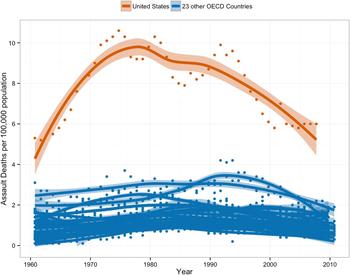
What that means is that all of the types of Sociologist identified by Burawoy—Professional, Policy, Critical, and Public—are increasingly doing their work in this environment. Most of the time the effect is small, but ideally it builds over the long run. For example, figure 5 shows a time series of deaths due to assault in the United States and twenty-three other OECD countries. It was published in a blog post in 2012 and now regularly appears or is referenced in the media. Just as it is for many social scientists, data visualization like this is a routine part of my everyday work. I make a figure because I am interested in finding out something for myself. Considered in isolation, this usually does not qualify as “research”—certainly not in the strong sense of a peer-reviewed finding with empirical novelty or theoretical significance. Footnote 10 Being able to make the data and code public with freely-available tools is itself an aspect of civic life. It is a way of sharing expertise and the use of tools that was not really possible until recently. Because I run my own website, I make the “content” available for nothing and make sure it stays online rather than being deleted or disappearing behind a paywall. Because I have been doing this for more than ten years, a fair number of people working in the media—the “presenters,” in Gans’s phrase—read my posts or tweets, and trust that what I do is accurate and reliable. And because of that continued attention, my site has a pretty good Google Page Rank. So even if you have never heard of me, you searching for “assault deaths in America” will probably lead you to seeing figure 5 right at the top of your search results. This will probably make you more likely to click through, and perhaps also to link to or share the figure somewhere else—thus further reinforcing the reliability of the search result. Footnote 11
U.S. Assault Death Rates in Cross-National Context
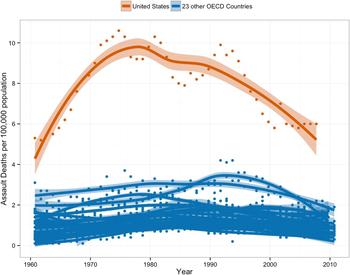
Slowly, by this route, a few of these data visualization posts have become stable reference points for journalists and talking heads. A clear point and a good picture can go a long way. The assault deaths graphic is reliably referenced whenever there is a mass shooting in the United States, which sadly is very often. This is is an interesting role to occupy as an academic social scientist. I write publicly about other topics in my field, or other questions that I am working on, and I develop arguments in posts discussing whatever it is I am thinking about. Some of those do well, but most do not. The posts that are shared widely and seen by the biggest publics are often about identifying patterns rather than providing explanations. A good journal article or a deliberate marketing effort for a book may get in the news for specific findings or a big idea. Then its fifteen minutes will be up. The journal article usually ends up behind a paywall. The book, you have to buy. But a good blog post, especially a data-focused one, can have an unexpectedly long life. It becomes more like a public resource. It won’t make you Thomas Piketty, but you do keep popping up in the papers.
It also doesn’t take that much effort, once you have had some practice. A simple graphic summarizing a bus-ride’s worth of data analysis from the OECD can keep surfacing in the ebb and flow of national media. The material should be focused, freely available, and—increasingly unusual—at a stable URL for more than a few months. In short, if it flows naturally from what you would be doing anyway, it can be worth making publicly available. Not as “your findings” about something, with Your Special Theory (keep that for the journals), but just as data you’re working with that’s of interest. Very few people in sociology (or social science more generally) do this, even though there is absolutely a huge demand for what might seem like basic data on topics of public interest. It might be that we have spent too much time in the church of the Sociological Imagination, Footnote 12 which tends to encourage its disciples to proclaim their hidden knowledge of the “sociological” perspective as if it were a sort of revealed truth. Better instead to read the Appendix to Mills’s book, on the craft of scholarship, which presents a congenial picture of intellectual life as a matter of ongoing inquiry into particular questions one cares about getting the right answer to. There, Mills advocates keeping a journal as a record of and a means of wrestling with those questions. Thinking of some parts of that journal as a publicly discoverable object is close to what I advocate here.
We are gradually moving in this direction, not just individually but also institutionally. A disciplinary magazine like the American Sociological Association’s Contexts, for example, had the right idea about reaching out to the public. But it launched at a time when producing a new print magazine and getting an audience for it was a tremendous challenge, given wider trends in the publishing industry. It was also of necessity bound to the ASA as an organization, and thus to the political economy of journal revenue. It is difficult for a properly public outlet to fit inside the milking parlor that is academic publishing. In a similarly promising way, the Berkeley Journal of Sociology has reinvented itself as an online outlet in a way that I hope people will keep contributing to and supporting. It has strong content, modern production values, and is freely available for anyone to read. The trick is to keep at it, and keep making the material available, while not unrealistically expecting the site itself (as opposed to some excellent article or other) to become a hub for conversation.
Measured Success
There are two worms in the apple. The first is systematic abuse in the social media field. Harassment, threats, and backbiting are problems deeply entwined with the structure of open networks. It is one thing to circulate some bit of quantitative data analysis, even on a controversial topic. It may be quite another to cut in to topics where your opponents really and truly hate you for who you are. Footnote 13 A robust community is something of a defense, but is not easy to construct out of nothing. Neither can communities easily take hold in settings where the presumption of easy engagement is facilitated by design, and the door is held open to harassment as a result. Calls to simply ignore abuse—to not feed the trolls, and to block or avoid pests—are intrinsically limited in their effectiveness. This is especially the case when this outcome is itself the flip-side of the “engagement” or “impact” that the whole enterprise is geared toward generating, and a built-in feature of the sharing network. A side effect of Twitter’s structure, for example, is that the more successful one becomes in terms of “engagement” or “impact,” the more unpleasant one’s user experience is likely to be.
The desire to measure that impact is our second worm. Social media enables communication but also encourages tracking of activity and quantitative measures of success. This has sent individuals and organizations scrambling in pursuit of new sorts of status, and pushed an effort to produce legitimate measures of that status. As blogging developed, for example, universities were by turns oblivious, skeptical, or straightforwardly hostile. A decade later, they all began to set up institutional blogs and seek proper measures of their employees’ participation and impact. While it can be great to have new modes of scholarly interaction and engagement recognized as such, there is also a clear administrative downside. Once your dean or department chair believes that your social media nonsense may actually be a good thing, they will want to measure it. Once they measure it, they want to rank it. The dead hands of either bureaucracy or the market will try to push their way in to civil society. As Chris Bertram has remarked on this point, a public role then also becomes an administrative goal. The result is that blogging, or other similar activities, will tend to stop being useful for their own sake and start being more like a string of brochures or press releases for research or op-ed pieces. Footnote 14
As I have argued, an alternative way of seeing things recognizes that there is no real “impact” without good prior work. Simultaneously, we should take the opportunity to carry on at least some of the everyday business doing real research in a newly semi-public field. Over the long term this is also the main foundation on which reasonable norms of public engagement must be built. A key source of resistance to this idea is sociologists themselves (or academics more generally). This may be because while civil society is what you do publicly and in your spare time, serious academics are not supposed to have any free time, and they certainly are not supposed to acknowledge it publicly. Instead, their waking hours are meant to be spent as serious people devoted to the research effort, and everyone knows that this is incompatible with being seen in public. Sociologists may be particularly prone to this sort of thinking because they do not have a lot of disciplinary power out in the world. As a result, they feel compelled to present themselves in a way that enforces a divide between real research and its public coverage. On the other hand, in fields where disciplinary self-confidence is less of an issue, one tends to see a much higher volume of people arguing semi-formally, in public, and in their spare time. This happens on websites, on blogs, in working papers, on Twitter, on Facebook threads, and so on. Successful disciplinary communities increasingly make at least some of their real work visible in these settings. Far from being inconsistent with a serious disciplinary self-image, it is rather an expression of it. It flows directly from the common base of everyday work, ordinary disagreement, and regular puzzling out of problems. It accumulates into the small but robust disciplinary publics that, like barrier islands, provide at least some protection against social media tsunamis. If you prefer to see this sort of civic sociability as a matter of professional service rather than an ordinary aspect of intellectual life, feel free to consider it so. But either way, we all face the challenge of figuring out how to work successfully in a latently public, ambiently visible way.