Introduction
More than 80 percent of the world poultry population is in village poultry production systems contributing up to 90 percent of poultry products in some developing countries. Village poultry mainly consists of indigenous or local breeds. However, commercial hybrids and crosses between indigenous and hybrids also exist (Besbes, Reference Besbes2009). Village chickens contribute to household food security in many ways including supplying high-quality animal protein, generate income as household savings and insurance. They also play important roles in religious and cultural life of the society in most of the developing countries (Tadelle, Alemu and Peters, Reference Tadelle, Alemu and Peters2000; Nasrollah, Reference Nasrollah2008; Besbes, Reference Besbes2009). Moreover, the genetic attributes of indigenous chickens in terms of tolerance to some diseases and parasite and adaptation to harsh environmental conditions make them important as gene pool source for improvement of village poultry production (Nasrollah, Reference Nasrollah2008; Saadey et al., Reference Saadey, Galal, Zaky and Zein El-Dein2008; Besbes, Reference Besbes2009).
Rural poultry production in Ethiopia contributes to the national economy in general and the rural economy in particular, representing 98.5 and 99.2 percent, respectively, of the national egg and poultry meat outputs, as cited by Tadelle, Alemu and Peters (Reference Tadelle, Alemu and Peters2000). However, the per capita egg and poultry meat consumptions in Ethiopia are among the lowest in the world. One of the reasons for low productivity from traditional poultry farming is the fact that comparatively little research and development work has been carried out on indigenous chickens (Tadelle, Alemu and Peters, Reference Tadelle, Alemu and Peters2000). Village poultry occupies a unique position in rural communities as there are few alternative animal protein sources and no cultural taboos related to the consumption of egg and poultry meat unlike those from pig meat. Moreover, village poultry can be reared by women and resource poor farmers and does not require large investments (Tadelle, Alemu and Peters, Reference Tadelle, Alemu and Peters1999).
Production superiority of improved commercial breeds and poultry hybrids under low input village production systems is very much decreased because of the prevailing environmental conditions. There are very few examples of breeding programmes for indigenous poultry breeds around the world, and those that exist are mainly in Europe and for specialized production traits only. Indigenous poultry breeds are most often dual purpose; therefore, improving their performance will be achieved through increasing growth and egg production. Moreover, survival or longevity under village conditions is also very important for the output and should be used as an important selection criterion (Besbes, Reference Besbes2009).
Cross-breeding of indigenous with improved exotic breeds is one of the tools for improving village poultry productivity, which requires continuous supply of pure lines. An alternative to regular crossing is to perform one or a few crosses between two or more populations to produce a single population of animals containing a mixture of genes from each population which is called synthetic or composite animal. One of the main advantages of synthetic is that only one population has to be maintained, rather than the two or more parental populations required for regular crossing programme. Moreover, heterosis can be exploited in some traits mainly owing to the wide genetic differences of parents. However, performance can be reduced from base generation to first generation produced by inter se mating in the synthetic population because of the reduced heterozygosity (Syrstad, Reference Syrstad1992).
In this study, a 4-way cross-bred chicken population using two indigenous and two exotic chicken breeds was produced and evaluated under on-station in the college farm and on-farm in village farm conditions. The indigenous naked neck (N) and Netch (white feathered)(W) were used as sire pure lines and the exotic Rhode Island Red (R) and Fayoumi (F) were used as dam pure lines. The 4-way cross-bred chickens will be developed to a synthetic chicken after crossing within the 4-way cross-bred population. The different attributes of the four breeds are expected to be expressed in the final synthetic population. This study was therefore conducted with the objectives of producing 4-way cross-bred chicken population and to compare their performance under on-station and on-farm management systems.
Materials and methods
Experiment sites and animals
The on-station experiment was conducted at the poultry farm of Hawassa University, College of Agriculture, which is located 275 km south of the Ethiopian capital Addis Ababa. The on-farm trials were done with farmers in the Boricha village, 20 km south of Hawassa.
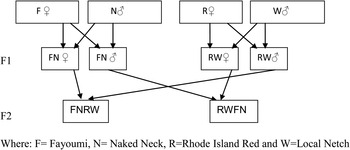
The experimental chickens were a result of 4-way crossing using two indigenous male chicken breeds: naked neck (N) and local white, a white feathered chicken called Netch (W), and two exotic female breeds: Fayoumi (F) and Rhode Island Red (R). Among the local chickens in Ethiopia, naked neck ecotype is known for its high egg production and heavy body weight, which is somewhat better than that of the other local breed Netch (Teketel, Reference Teketel1986). Specifically, chickens carrying the Na (naked neck) gene have been known to have higher growth rate and egg production under high ambient environment (Merat, Reference Merat and Crawford2003; El-safty, Reference El-Safty2006; Islam and Nishibori, Reference Islam and Nishibori2009). The Netch is, on the other hand, widely available in the experiment area and considered to be highly adapted to the environment. Fayoumi is an Egyptian breed developed for high egg production and is believed to withstand harsh tropical condition, whereas Rhode Island Red is a dual purpose chicken breed characterized by hardiness and high productivity (Gueye, Reference Gueye1998). Reciprocal crossing were done for comparison. Figure 1 shows the 4-way crossing scheme of the breeds used. There was no selection made on F1 population and all chickens laying eggs were used to produce F2.
Schematic representation of the 4-way crossing used in the experiment.

Crossing was conducted at the college poultry farm at the Hawassa University. Mating was done in two rounds; each cock mated with two hens in the first round and with two other hens in the second round. The hens and cocks were housed separately and mating was facilitated by bringing a hen and a cock from their pens and putting them in a separate pen. After the first hen had been successfully mated, she would be taken out and the second hen would be introduced to the pen with the cock.
Trap nests were provided in pens for both the F1 and F2 crosses so that individual egg production could be recorded. The date of lay and ID number of the hen that laid the egg were written on all eggs during collection. Eggs from the parents (F1) were collected from the pens and stored in a room with a ventilator for up to 10 days. All eggs were weighed individually at setting. At the 18th day of incubation the eggs were candled and eggs with live embryo were transferred to the hatchery. The trays in the hatchery were modified by fitting 6 cm × 6 cm cells, made of plywood, and individual eggs were placed in the cells. Each cell was again identified with the same information found on the egg to avoid confusion if the information written on the egg shell was lost during hatching. The tray was covered with a wooden frame with mesh wire to avoid mix up of chicks at hatching and during tagging. The chicks were individually tagged. They were then weighed and vaccinated against New Castle Disease (NCD) before they were transferred to the brooding house. The chicks were hatched in batches because of the small number of eggs produced during the 10 days collection period. The eggs would be spoiled if more days were added to incubate more eggs. Chicks from the same batch were placed together in separate pens within brooding house and were moved to layer pens together when they were 4 months old.
Management of experimental animals
On-station
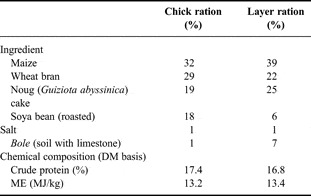
The chicks were provided with starter ration until they were 4 months old. At the age of 8 week, the lamps used for heating were removed and the pens were widened proportionate to the number of chicks in the batch. After 4 months the chickens were transferred to the layer house where a layer ration was provided. The layer house was a deep litter house divided into several pens using mesh wire. The pullets were assigned to 10 different pens with a maximum of 10 pullets in each pen. The cocks were housed separately in two different pens. The walls of the house were partially made of thick mesh wire for natural ventilation and light. The type and composition of rations used are presented in Table 1. Feeders and waterers were placed in each pen and feeding was ad lib. Trap nests with four separate compartments were provided in each pen so that individual egg production could be recorded.
Ingredient and analysed chemical composition of chick and layer rations used in the trial.

On-farm
One-day-old full sibs and half sibs of the on-station chicks were distributed to 10 women farmers. All chicks were vaccinated against NCD and leg banded with ID number. Hay box brooders were provided, and they consisted of two parts: a brooder box stuffed with hay and a box used for exercise. Starter ration for at least 2 weeks was also given to the farmers to help the chicks adapt to the village conditions. Farmers gave the chicks local bread softened with water, ground maize or other kitchen scraps. Water was provided with containers such as old plastic, clay or metal containers. A broad spectrum antibiotic medicine was also given to the farmers with instructions on how to administer the medicine in case of disease symptoms. The chicks were released to the field within a few weeks after their arrival at the farm, but placed in the brooder box during night and cold times. After the chicks had grown larger, i.e. at 3–4 months, farmers placed them either in separate house built for chickens or they stayed in the farmers' house during the night.
All chicks were identified with plastic leg band with ID numbers which were used till the end of the experiment. The plastic band was replaced at least twice as the chick's leg grew. Data were collected twice a week or once a month, depending on the trait recorded.
Data collection
Hatching and growth
All chicks were weighed upon hatching before they were transferred to the brooding house. They were hatched in six different batches and chicks of the same batch were housed in the same pen for ease of management. The chicks in some batches were more in number and thus they were divided into more than one pen. The chicks were weighed every week until they were 8 weeks old and then monthly thereafter. All chicks were weighed individually by using a digital weighing scale powered both by electricity and battery. Body weight gain was calculated as a difference between consecutive body weight measurements.
Mortality
Chicken mortality was recorded during weighing day, i.e. any chicken not alive for weighing on a particular weighing day was considered as dead. No post-mortem analysis was done for on-farm dead chickens but occasional post-mortem analysis was done for on-station dead chickens. Structured questionnaire was prepared to collect information about the causes of mortality under on-farm condition.
Egg production and quality
Age at first egg (AAFE) was recorded in days for both on-farm and on-station chickens. Number of eggs produced by each chicken was recorded individually daily in the on-station trial and at least twice a week in the on-farm trial. Egg production recording under the on-farm condition was done by a development agent stationed in the farmers' village. Three types of egg production analysis were made for both management systems; egg number (EN) is the average number of eggs produced by a layer in a particular period; hen housed egg production (HHEP) is calculated as the total number of eggs produced divided by the number of hens originally housed in a pen or farmer's house; and hen day egg production (HDEP) in percent is calculated as the number of eggs produced in a particular time divided by the number of layers alive at that particular time. Calculation of HHEP was started from the month at which the layers were first housed in a pen, i.e. at 4 months of age. The number of live layers was calculated as the average number of layers at the beginning and end of a particular recording period. Moreover, percent HHEP was also calculated for comparison with percent HDEP.
 $${\rm HHEP}=\displaystyle{{\rm Number}\, {\rm of}\, {\rm eggs}\, {\rm produced} \over \matrix{ {\rm Number}\, {\rm of}\, {\rm hens}\, {\rm originally}\, {\rm housed}\cr {\rm in}\, {\rm a}\, {\rm pen}\, {\rm or}\, {\rm farmer{'}s}\, {\rm house}} },$$
 $${\rm HDEP\lpar \percnt\rpar }=\displaystyle{{\rm Number}\, {\rm of}\, {\rm eggs}\, {\rm produced} \over \matrix{{\rm Number}\, {\rm of}\, {\rm live}\, {\rm hens}\, {\rm in}\, {\rm a}\, {\rm pen}\cr {\rm or}\, {\rm farmer^{\prime}s}\, {\rm house}}} \times 100.\fleqno$$
Internal and external egg quality in both management systems were recorded at the age of 8 and 12 months on-station, but only at the age of 12 months on-farm. The eggs were weighed individually using a digital weighing scale, and average egg weight was calculated for each pen/farmer. Average egg shell thickness (mm) was measured using digital calliper at broad, narrow and middle side of each egg, and the average of three measurements was used for statistical analysis. Yolk colour was measured using Roche colour fan scale (1 = very pale to 16 = deep orange). It was measured by three people and the average of the three measurements was used for further analysis. Albumen and yolk height (mm) were measured using tripod micrometer after the egg was broken out on a flat glass. Egg length and width (mm) were measured by digital calliper and egg shape index was calculated as the ratio of egg width over egg length. Haugh unit was calculated using the formula:
 $${\rm HU}= 100\, {\rm log }\lpar {\rm AH}+ 7. 57 - 1. 7\, {\rm EW}^{0. 37} \rpar \comma \;$$
where AH is the observed albumen height in mm and EW is the egg weight in grams.
Statistical analysis
All traits were analysed using the mixed model procedure in the software package SAS (Statistical Analysis System) (SAS, 2003) using sex, age, management system and their interactions as fixed effects, depending on the trait in question. Pen number, individual farmer and ID number of chickens were all used as random effect, depending on the model. The effect of reciprocal crossing on almost all traits was insignificant and it was thus removed from the models.
Model 1 was used to analyse body weight traits, using sex and management system as fixed main effects and fixed interaction effect of sex and management systems at different ages.
 $$Y_{ijn}=\mu+S_i+M_j+S_i \left({M_j } \right)+e_{ijn}\comma \; \eqno\lpar 1 \rpar$$
where Y ijn is the individual body weight and body weight gain of chickens in both on-station and on-farm; μ, is the overall mean; S i, is the fixed effect of sex i, i = 1–2 (male and female); M j, is the fixed effect of management system j, j = 1–2 (on-station and on-farm); S i (M j), is the effect of sex unique to each management systems; and e ijn, is the random error.
Egg number was analysed by model 2 using age and management systems as fixed main effects and fixed interaction effect of age and management systems. Moreover, Id number of chickens and pen or farmer was used as random effects. There are no repeated records for AAFE and thus effect of age and individual ID number were removed from the model. HHEP was calculated per pen or farmer in which they were kept, therefore the random effect of ID was not used in the model.
 $$Y_{ijkln}=\mu+A_i+M_j+A_i \left({M_j } \right)+{\rm ID}_k+{\rm PF}_l+e_{ijkln}\comma \; \eqno\lpar 2 \rpar$$
where all effects and levels are the same as model 1 except Y ijkln = egg production in both on-station and on-farm; A i is the fixed effect of age i, i = 1–2 (between 4– 8 months and 9–12 months); A i (M j) is the effect of interaction between age and management systems; IDk is the random effect of individual chicken; PFl is the random effect of farmer or pen m, m = 1–10 pens or 1–10 farmers; e ijkln is the random error.
Model 2 was modified to model 3 to analyse egg quality traits because of the unequal number of measurement times in the two systems.
 $$Y_{ijkln}=\mu+M_j+A_i \left({M_j } \right)+{\rm ID}_k+{\rm PF}_l+e_{ijkln}\comma \; \eqno\lpar 3 \rpar$$
where all other effects and levels are the same as model 2 except Y ijkln = egg quality in both on-station and on-farm; A i is the fixed effect of age i, i = 1–2 (at 8 and 12 months on-station and at 12 month on-farm).
Results
Mortality
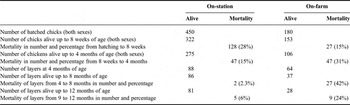
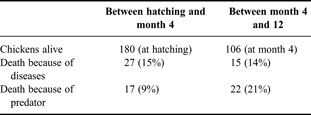
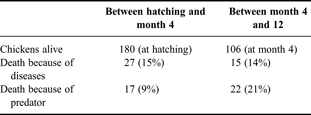
Mortality during the brooding time was higher in on-station than in on-farm. Most of the mortality in on-station occurred during the early stage of the growth period. Mortality decreased during the laying period in on-station, but increased over the same period in on-farm (Table 2). The cause of mortality in different age groups under the on-farm management system is presented in Table 3 and chickens that were lost for unknown reasons were not included in the mortality. All mortality in on-station was because of disease.
Mortality of chickens under on-station and on-farm condition at different ages.

On-farm number of chicken deaths with percentage because of disease and predator.
Body weight and gain
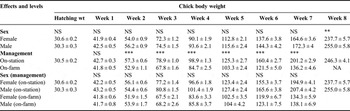
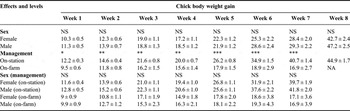
Body weights of chicks measured at different ages are presented in Table 4. The average hatching weight of the male and female was not significantly different. Likewise the difference in body weight of chicks from week 1 to week 7 was not significant for males and females, but the gap became widened every week until it was significantly higher for males at week 8. Management system had significant effect on body weight of chicks after week 2, but no significant interaction was observed between sexes and management systems. Weekly body weight gain of chicks was not significant for either the males or the females but difference because of management systems was increasingly significant as age increases (Table 5).
Least square means with standard error of chick body weight (g) from hatching to 8 weeks of age.

*** = P ≤ 0.001; NS, not significant; NA, not available.
Least square means with standard error of chick body weight gain (g) from week 1 to week 8.

*** = P ≤ 0.001; ** = P ≤ 0.01; * = P ≤ 0.05; NS, not significant; NA, not available.
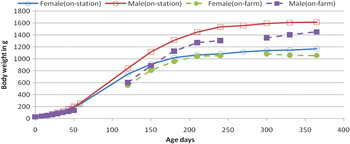
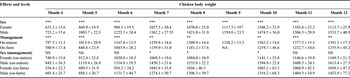
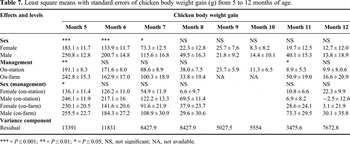
Body weight of grown chicken was significantly higher for males than females, as was chickens kept under on-station compared with on-farm (Table 6). Although body weight gain of male chickens was significantly higher than females, the difference decreases and eventually disappeared after month 8. However, in general, there is a trend of higher body weight gain for males than for females, especially for chickens kept under on-farm condition compared with those kept under on-station condition (Table 7). Figure 2 shows body weight of chickens during the entire measurement period. As described above the increasing gap in body weight between the management systems started at early age but became stabilized as the chickens grew older.
Body weight of chickens at different weeks of age.

Least square means with standard error of chicken body weight (g) from 4 to 12 months of age.

*** = P ≤ 0.001; ** = P ≤ 0.01; * = P ≤ 0.05; NS, not significant; NA, not available.
Least square means with standard errors of chicken body weight gain (g) from 5 to 12 months of age.

*** = P ≤ 0.001; ** = P ≤ 0.01; * = P ≤ 0.05; NS, not significant; NA, not available.
Egg production and quality
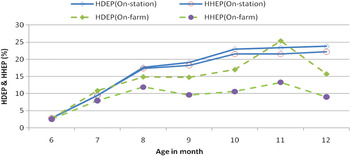
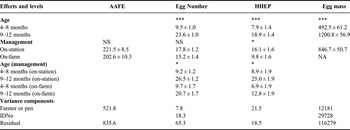
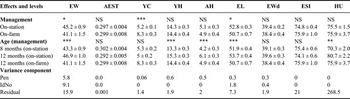
Although no significant difference in AAFE between the management systems was found, it is worth noting that on-farm chickens started laying at 203 days as compared with 222 days for on-station chickens. The number of eggs laid in the first period, between the age at which the chickens were housed in layer's pen (months 4) and month 8, was lower than the number of eggs produced in the last period, i.e. between month 9 and end of the recording period (i.e. month 12) in both management systems. Management system had no significant effect on the average number of eggs produced, but there was an interaction effect between age and management, since slightly more eggs were laid between months 4 and 8 on-farm than on-station, whereas the reverse happened between months 9 and 12. However, HHEP was significantly higher for chickens kept under on-station condition compared with those kept under on-farm condition. Egg mass was only calculated for chickens kept under on-station condition. (Table 8). Percent HDEP and HHEP are presented in Figure 3. No significant difference in egg quality traits were found caused by management system, except for yolk colour. However, higher egg weight and egg length were found on-station (Table 9).
HDEP and HHEP for one day at different age in the two management systems.

Least square means with standard error and variance components for AAFE in days, egg number (EN)/layer, HHEP and egg mass.

*** = P ≤ 0.001; * = P ≤ 0.05; NS, not significant; NA, not available.
Least square means with standard error and variance components for egg quality traits.

*** = P ≤ 0.001; ** = P ≤ 0.01; * = P ≤ 0.05; NS, not significant; EW, egg weight; AEST, average egg shell thickness; YC, yolk colour; YH, yolk height; AH, albumen height; EL, egg length; EWd, egg width; ESI, egg shape index; HU, Haugh unit.
Discussion
The higher on-station chick mortality was mainly because of coccidiosis that occurred on chicks that were hatched in the second round. Owing to shortage of brooding pens the chicks were housed in pens close to the layers, and this may have facilitated transmission of the disease. On the other hand, the relatively low mortality of chicks kept on-farm may be attributed to provision of chick brooder box for the farmers, which has proved to be effective in reducing chick mortality in village poultry-keeping condition. Solomon (Reference Solomon2007) found that mortality of chicks reared on-farm up to 8 weeks of age using hay box chick brooder was 10 percent, compared with 14 percent mortality for chicks kept on-station using an infra red electric brooder. It has also been reported that in Ethiopia, survival rate of chicks reared to an age of 3 months under natural brooding condition reaches up to 40 percent, and the results found in the present study might thus be considered as satisfactory. In addition to the hay box brooder, some farmers had constructed day-time shades to protect the chicks from predators. As the chicks grew older, mortality on-station was reduced owing to provision of anti-coccidial treatment and also control of other diseases and parasites. On the other hand, mortality of chickens on-farm increased very much in the same period, mainly because of attack by predators. After the brooding period the chickens are left outside to search for feed in the backyard vegetable farm, and this makes them an easy prey to stalking predators such as fox and wild cats. Cause for mortality on farm is summarized in Table 3, which was obtained by questionnaires answered by the farmer at the end of the experiment.
Hatching weight and body weight up to week 7 were not significantly different for males and females, but the males had significant higher body weight after week 8. Also Mekki et al. (Reference Mekki, Yousif, Abdel Rahman, Wang and Musa2005) reported insignificant difference in body weight at hatching between males and females, but as the chicks grew, males were significantly higher than females in body weight owing to the presence of sexual dimorphism. Interaction of sex of chicken with management system for body weight is shown in Figure 2.
The higher body weight of on-station chickens is most likely because of the fact that the chickens reared on-station were fed on formulated ration throughout the whole experiment period. Formulated feed were provided with the chicks to the farmers to feed the chicks for at least 2 weeks, but the farmers then had to provide their own feed, which mainly consisted of crushed maize and other kitchen scraps. This feed may not supply enough nutrients for growth. Moreover, after some weeks farmers also released the chicks outside the brooding boxes for a few hours per day, and when they were fully grown they stayed out all day to look for food, which in turn increases exercise and resulted in loss of energy. In a study by Dou et al. (Reference Dou, Shi, Sun and Wang2009) chickens kept in the free range system had lower body weight compared with those kept indoors. They concluded that the performance of chickens kept in free-range system would be inferior to that of a controlled environment because of fluctuating temperature and increased exercise.
Significant body weight difference after the brooding period leads to a widening of the gap between male and female body weight, as shown in Figure 2. This figure also shows that the difference in body weight between chickens kept in the two systems is most pronounced at 4 months of age. Higher body weight gain during early stage of growth in chicks kept on-station than on-farm (Table 4) has practical significance for future management. Chambers (Reference Chambers and Crawford1990) reported that it is necessary in applied poultry breeding to evaluate growth during juvenile stages to permit choice of actions long before maturity. Actions such as provision of better management practices such as better feed and disease control in the on-farm system during early stage of growth could increase body weight and could narrow the difference in body weight of chickens in the two systems during the rest of the production period.
AAFE was lowered by about 20 days in chickens under on-farm conditions compared with those kept on-station. This is reflected in the average number of eggs laid, which is slightly higher in on-farm than in on-station (Table 8) and the relatively higher HDEP percent up to 8 months of age (Figure 3). Early laying is considered to be important for the farmers because a chicken should produce as many eggs as possible before disease or predation terminates the production under these difficult conditions. Chickens kept under relatively better feed and management conditions (on-station) is expected to have a lower AAFE than scavenging chickens reared on-farm. Islam and Nishibori (Reference Islam and Nishibori2009) reported that exotic and cross-breds of indigenous naked neck with exotic chickens kept under scavenging system showed delayed age at sexual maturity and lower egg production. AAFE depends on the type of feed the chickens had in their early growth stage, length and intensity of light etc. Therefore, a possible reason for the result may be that there was enough forage in the backyard during the short rainy season in this important early life phase of the chickens. Moreover, the chicks on-station were infected with coccidiosis during the first few weeks, which may have had negative influence on AAFE. Although average number of egg produced per bird was not significantly different between the two systems, there was a relatively higher egg production under the on-station management system. This was expected because scavenging chickens produce less number of eggs compared with those kept in intensive management systems (Hossain, Reference Hossain1992; Solomon, Reference Solomon1996; Dana and Ogle, Reference Dana and Ogle2002). As expected, HHEP was lower in on-farm than in on-station because of higher mortality in the former system during the laying period. Figure 3 consequently shows relatively smaller difference in HDEP percent between the two systems than in HHEP percent. In general, egg production in this study was lower than expected in both management systems. However, it is reasonable to believe that selection at all levels of crossing would have improved the production potential of the final synthetic breed.
Egg weight and egg length at the age of 12 months was higher in on-station than in on-farm. A higher egg length is expected to give heavier egg, as the two is highly correlated (Fassill et al., Reference Fassill, Gjøen, Kathle, Ådnøy and Girma2009). Egg weight is also affected by the type and amount of feed consumed, which was superior in the on-station system. Hossain (Reference Hossain1992) also reported a relatively higher egg weight from chickens kept under intensive than rural conditions. As expected yolk colour was more yellow and therefore superior on-farm compared with on-station, mainly because of the consumption of green forages by the chickens in the backyard vegetable farms.
Although the effect of reciprocal crossing was insignificant on almost all traits recorded, it has practical importance to this project in that it is possible to produce more number of offspring, i.e. with the use of both crossings.
Conclusions
As expected performance of the chickens under on-station management system where there is better feed and housing was higher than those kept under on-farm condition. Compared with a study by Fassill et al. (Reference Fassill, Gjøen, Kathle, Ådnøy and Girma2009), the current study showed a substantial improvement in egg production of local chickens under farmer's management condition. AAFE laid was shortened. Body weight of chickens was also improved by the 4-way cross-bred chickens compared with local chickens. However, much has to be done to reduce mortality during laying period under on-farm condition. Overall performance of the 4-way cross-bred chicken under on-farm condition could further be improved by providing better housing in order to protect the chickens from predators, extreme temperatures, diseases and parasites. Moreover, supplementing the chickens with relatively quality feed ingredient especially during growing period could improve production performance in later ages. Further study on cross-breds of different blood levels of indigenous and exotic chickens under on-station and on-farm systems should be made in order to choose the best possible combinations for each system. Selection at all levels of crossing would increase production. Economic aspect should also be included in the study.
Although it is believed that heterosis is expected in the F1 and F2 generations, it was not estimated in this experiment owing to significant loss of female indigenous breeds as they had adaptation problem in the college farm. Males from indigenous breeds were used for mating and there was very limited performance data from females which made it difficult to analyse heterosis.
Acknowledgments
The authors would like to thank Norwegian Development Organization (NORAD) and Operational Research (supported by Irish government) for financial support. Hawassa University (Ethiopia) and Norwegian University of Life Sciences (Norway) have provided different facilities during the experiment period.