Introduction
Trapping techniques are frequently used to monitor pest species and to provide data on their occurrence, even at low density, as well as reasonably precise estimates of densities and sex ratios. As with most trapping methods, characteristics of the trap may influence its effectiveness and trap colors are a key factor in attracting and trapping most insect species (e.g. Broadbent, Reference Broadbent1948; Capinera and Walmsley, Reference Capinera and Walmsley1978; Ali, Reference Ali1993; Cho et al., Reference Cho, Eckel, Walgenbach and Kennedy2011; Rodriguez-Saona et al., Reference Rodriguez-Saona, Byers and Schiffhauer2012; Vrdoljak and Samways, Reference Vrdoljak and Samways2012). Traps based on the response of insects to colors have been applied worldwide to sample harmful and beneficial insects, in wild and cultivated plants (Capinera and Walmsley, Reference Capinera and Walmsley1978; Cho et al., Reference Cho, Eckel, Walgenbach and Kennedy2011; Vrdoljak and Samways, Reference Vrdoljak and Samways2012). For instance, colored traps are commonly used to attract several insect pests belonging to the orders Hemiptera (Rodriguez-Saona et al., Reference Rodriguez-Saona, Byers and Schiffhauer2012), Thysanoptera (Atakan and Bayram, Reference Atakan and Bayram2011), Diptera (e.g. Haniotakis, Reference Haniotakis1986), Coleoptera (e.g. Petrice et al., Reference Petrice, Haack and Poland2013; Ávalos and Soto, Reference Ávalos and Soto2015), as well as for many beneficial flower-visiting insects (anthophiles), e.g. Hymenoptera (Vrdoljak and Samways, Reference Vrdoljak and Samways2012). The effectiveness of colored traps is strictly related to the spatiotemporal behavior and reproductive phenology of the target species (see Green and Flint, Reference Green and Flint1986; Abrahamczyk et al., Reference Abrahamczyk, Steudel and Kessler2010). Furthermore, colored sticky traps are a simple, rapid, and cost-effective method to monitor population dynamics of harmful species and their natural enemies (Atakan and Bayram, Reference Atakan and Bayram2011) as well as to control insects' numbers in crop protection (Gu et al., Reference Gu, Bu, Xu, Bai, Liu and Liu2008; Broughton and Harrison, Reference Broughton and Harrison2012). Invasive insects, particularly those affecting human activities (e.g. agriculture, tourism, ornamental species plantation) and wellness, deserve well-addressed monitoring programs to limit their damages (Francese et al., Reference Francese, Mastro, Oliver, Lance, Youssef and Lavallee2005; Hoodle and Hoodle, Reference Hoddle and Hoddle2011; Maistrello et al., Reference Maistrello, Vaccari, Caruso, Costi, Bortolini, Macavei, Foca, Ulrici, Bortolotti, Nannini, Casoli, Fornaciari, Mazzoli and Dioli2017; Masetti et al., Reference Masetti, Magagnoli, Lami, Lanzoni and Burgio2018).
The black planthopper Ricania speculum (Walker, 1851) (Hemiptera: Fulgoromorpha: Ricaniidae) is an invasive alien species of Far Eastern origin, reported in Europe since 2009 (Mazza et al., Reference Mazza, Pennacchio, Gargani, Franceschini, Roversi and Cianferoni2014). At present, the species is present out of its native range only in Italy (https://www.hemiptera-databases.org/flow/). As to Italy, this species has rapidly spread across Liguria (Mazza et al., Reference Mazza, Pennacchio, Gargani, Franceschini, Roversi and Cianferoni2014; Rossi and Lucchi, Reference Rossi and Lucchi2015), Tuscany (Silvestri, Reference Silvestri2017), Veneto, Piedmont, and Latium (Mazza et al., Reference Mazza, Marraccini, Lucchi, Marianelli, Sabbatini Peverieri, Bosio, Giacometto, Rapa, Cianferoni, Roversi and Gargani2018). The black planthopper feeds and lays eggs on a wide range of host plants and its large polyphagy has been highlighted recently (e.g. Mazza et al., Reference Mazza, Pennacchio, Gargani, Franceschini, Roversi and Cianferoni2014; Rossi et al., Reference Rossi, Stroiński and Lucchi2015; Rossi and Lucchi, Reference Rossi and Lucchi2015; Lucchi and Rossi, Reference Lucchi and Rossi2016; Laudonia et al., Reference Laudonia, Lucchi, Rossi and Viggiani2017; Silvestri, Reference Silvestri2017; Mazza et al., Reference Mazza, Marraccini, Lucchi, Marianelli, Sabbatini Peverieri, Bosio, Giacometto, Rapa, Cianferoni, Roversi and Gargani2018).
The plants attacked by this alien invasive species in Italy include important crops (e.g. vines, citrus, olives, and other fruit trees) and many ornamental plants (from angiosperms to gymnosperms; e.g. Mazza et al., Reference Mazza, Pennacchio, Gargani, Franceschini, Roversi and Cianferoni2014; Mazza et al., Reference Mazza, Marraccini, Lucchi, Marianelli, Sabbatini Peverieri, Bosio, Giacometto, Rapa, Cianferoni, Roversi and Gargani2018). Sap suction is currently the main damage reported. Also, injuries to the plant tissue have been reported where the female inserts the eggs with its sharp ovipositor (e.g. Rossi et al., Reference Rossi, Stroiński and Lucchi2015; Lucchi and Rossi, Reference Lucchi and Rossi2016) causing the withering of thin shoots or branches where the eggs are laid (G. Mazza, pers. obs.; Rossi et al., Reference Rossi, Stroiński and Lucchi2015). At present, the effect of the honeydew production, by juveniles and adults, does not appear to create damage on the host plants (Rossi et al., Reference Rossi, Stroiński and Lucchi2015). Finally, this species can acquire the Flavescence dorée phytoplasma, but Galetto et al. (Reference Galetto, Pegoraro, Marzachì, Rossi, Lucchi and Bosco2019) demonstrated that R. speculum is unable to transmit this pathogen.
The fast range expansion of this species in Italy makes it a possible new threat to native plants including olive crops and human activities such as agriculture and plant nurseries with consequent economic damage. The species is usually monitored through classical entomological methods and, in Italy, the reports concerning its distribution come mainly from visual inspection (e.g. Rossi et al., Reference Rossi, Stroiński and Lucchi2015; Mazza et al., Reference Mazza, Marraccini, Lucchi, Marianelli, Sabbatini Peverieri, Bosio, Giacometto, Rapa, Cianferoni, Roversi and Gargani2018). Only, Li et al. (Reference Li, Wang, Ye, Xu and Han2015) used sticky colored traps for capturing this planthopper in mangrove forests in China, i.e. within its native range. The aims of this study were: (i) to evaluate the use of the sticky color traps to capture the black planthopper and (ii) to study in-depth the phenology (seasonal occurrence) and the activity rhythms of this species, to apply effective monitoring methods and correct pest control measures.
Materials and methods
Study area
The study was performed in Tuscany (central Italy), in three rural landscape areas in the municipality of Viareggio (Province of Lucca: 43°50′40″ N–10°16′15″ E, 5 m a.s.l.). The three areas of 500 m2 are 500 m far apart from each other and covered mostly with human settlements, surrounded by orchards and gardens, with several native and exotic plant species (e.g. Acacia dealbata Link, Amaranthus sp., Cannabis sativa L., Carya illinoinensis (Wangenh.) K. Koch, Cupressus sp., Laurus nobilis L., Liquidambar sp., Parthenocissus quinquefolia (L.) Planch, Prunus spp., Trachelospermum jasminoides (Lindl.) Lem., Tribulus terrestris L.). Sampling areas were selected as hosting high densities of R. speculum (Mazza et al., Reference Mazza, Marraccini, Lucchi, Marianelli, Sabbatini Peverieri, Bosio, Giacometto, Rapa, Cianferoni, Roversi and Gargani2018).
Traps and captures
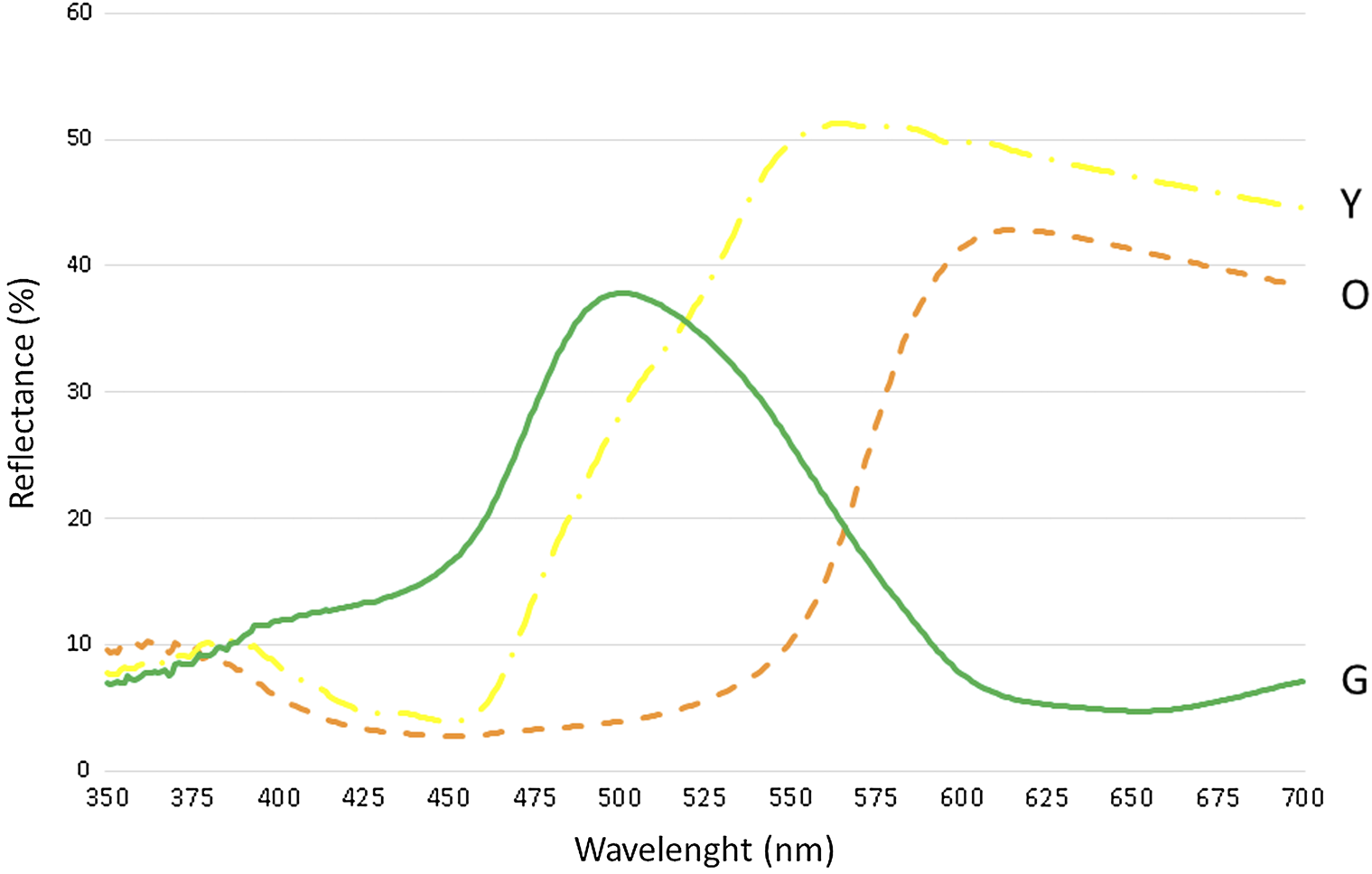
Yellow (Y), green (G), and orange (O) sticky traps (Flortis®, Settimo Milanese, Italy: http://www.flortis.it/it) were used for this study. The spectral reflectance of the colored traps was analyzed by a spectroradiometer Fieldspec 3 Hi-res (ASD inc., Malvern Panalytical, New York, USA), with a spectral resolution of 3 nm and a sampling interval of 1.4 nm. White reference was made by a calibrated panel (Spectralon®, ASD inc., Malvern Panalytical, New York, USA), ~100% reflective within the instrument wavelength range of 350–2500 nm. The green trap showed the maximum reflectance between 475 and 525 nm (35–38% of reflectance), the orange one between 600 and 650 nm (~40% of reflectance), and the yellow one between 540 and 600 nm (~50% of reflectance) (fig. 1). Traps consisted of 10 × 22 cm rectangular adhesive plastic boards. Boards were adhesive on both sides. In each area, three cross bamboo frames were used as support for the suspension of the chromotropic traps, which were spaced 10 m apart and located at a minimum of 10 m from bushes/trees. One trap per color was attached in the north–south direction above the ground at the height of the vegetative growth (approximately 180 cm above the ground on the frame), as per Hoddle et al. (Reference Hoddle, Robinson and Morgan2002) and Wallis and Shaw (Reference Wallis and Shaw2008) and the three traps were spaced 20 cm from each other (Supplementary fig. 1). All the color combinations (YGO, GOY, and OYG) were present in each area, for a total of 27 installed traps. Traps were positioned on the 1st of July, removed on the 31 October 2018 and replaced once a week after the first adult capture (Mazza et al., Reference Mazza, Pennacchio, Gargani, Franceschini, Roversi and Cianferoni2014). Traps were visually inspected about once/1 h during the collection time (06:00–01:30 h), following Fanini et al. (Reference Fanini, Longo, Cervo, Roversi and Mazza2014). Despite the interruption in the late night, no individuals were found attached to the trap in the early morning, when the inspection started again. During inspections, the time of arrival of the specimens was reported and adults were gently removed from the traps and sexed by observing the shape of the abdomen (Rossi and Lucchi, Reference Rossi and Lucchi2015), through a hand lens 10 × magnification. Unsexed individuals referred to adults that escaped during the manipulation time or to portions of adults attached to the traps without abdomen (i.e. the body part required for a reliable sex attribution).
Reflectance spectra of the yellow (Y), green (G), and orange (O) sticky traps used to capture of R. speculum adults between July and October 2018.

We used General Linear Models (Crawley, Reference Crawley2007) to test the effects of mean temperature, minimum temperature, maximum temperature, atmospheric pressure, relative humidity, visibility, wind intensity, wind speed, and precipitation on the total number of captured adults. Meteorological data were taken from https://www.ilmeteo.it/portale/archivio-meteo/Viareggio/2018 (Accessed on 01 July 2019). Before running the total model, we tested for intercollinearity (r > |0.6|: Mori, Reference Mori2017); if the r value in the correlation matrix was >|0.6|, one of the correlated variables had to be discarded (Mori, Reference Mori2017). No intercollinearity was detected among variables; thus, all of them were included in the total model. As captures were not normally distributed (Shapiro–Wilk test = 0.926; P < 0.005), they were log-transformed (Shapiro–Wilk test = 3.944; P = 0.083). All the variables were included in a total model, as no intercollinearity was detected. Non-significant ones were removed one at a time until the elimination of variables resulted in a significant increase of the residual deviance (Crawley, Reference Crawley2007). Models were run through the R package lme4 (Bates et al., Reference Bates, Maechler, Bolker and Walker2014).
Activity rhythms and intersexual temporal overlap
Activity rhythms and patterns of intersexual temporal overlap have been calculated through the R packages overlap (Meredith and Ridout, Reference Meredith and Ridout2014).
Records for each individual were categorized as: daytime (between 30 min after sunrise and 30 min before sunset), nighttime (between 30 min after sunset and 30 min before sunrise), dawn (from 30 min before sunrise to 30 min after sunrise), and dusk (from 30 min before sunset to 30 min after sunset) (see Carnevali et al., Reference Carnevali, Lovari, Monaco and Mori2016). Sunrise and sunset times were calculated through the R package NightDay for every trapping day (Hughes-Brandl, Reference Hughes-Brandl2011). The Rayleigh test was computed through the R package circular (Lund et al., Reference Lund, Agostinelli, Arai, Gagliardi, Portugues, Giunchi, Irisson, Pocernich and Rotolo2017) to evaluate the distribution uniformity of the daily activity data, to assess whether the black planthopper showed a random activity pattern over the 24-h cycle (Lioy et al., Reference Lioy, Mori, Wauters and Bertolino2016). Intersexual comparisons were carried out to estimate the coefficient of overlapping (Δ) between temporal activity patterns of both sexes. A total activity rhythm was then estimated to account also for unsexed individuals. The coefficient of overlapping ranges between 0 (no overlap) and 1 (total overlap: Linkie and Ridout, Reference Linkie and Ridout2011; Meredith and Ridout, Reference Meredith and Ridout2014). We calculated the Δ4 estimator as the smallest sample of each pairwise comparison was always >0.75 (Linkie and Ridout, Reference Linkie and Ridout2011; Meredith and Ridout, Reference Meredith and Ridout2014). An overlap coefficient included between 0.50 and 0.75 was considered as ‘intermediate’ (Monterroso et al., Reference Monterroso, Alves and Ferreras2014). The temporal overlap was considered as ‘high’ if Δ4 > 0.75 (Monterroso et al., Reference Monterroso, Alves and Ferreras2014) and as ‘very high’ when Δ4 > 0.90. The probability of a species to be active was defined as ‘density of activity’ (Linkie and Ridout, Reference Linkie and Ridout2011; Meredith and Ridout, Reference Meredith and Ridout2014; Torretta et al., Reference Torretta, Serafini, Puopolo and Schenone2016).
We divided our 4-month study period into two 2-month periods according to heliophany, i.e. July–August (mean heliophany > 9.5 h) and September–October (mean heliophany <8 h), which is suggested to affect the activity rhythms of R. speculum. Analyses were carried out at both total and 2-month scales. The Watson's Two-Sample Test of Homogeneity (U 2) was used to compare intersexual overlap (Torretta et al., Reference Torretta, Serafini, Puopolo and Schenone2016), using circular statistics with the R package circular (Lund et al., Reference Lund, Agostinelli, Arai, Gagliardi, Portugues, Giunchi, Irisson, Pocernich and Rotolo2017).
Trap-color captures
The effect of trap-color on capture success was assessed using collected individuals and computing the Ivlev's Electivity Index (hereafter, E-index: Ivlev, Reference Ivlev1961), which compares the availability of a trap-color with its capture success, following the formula:
 $$E{\rm}={\rm } \sum\limits_{i = 1}^n {\displaystyle{{(U_i-A_i)} \over {(U_i + A_i)}}} $$
where U i is the proportion of the use of traps of the ‘i’ color and A i is its availability (i.e. 33.3% for each of the three trap-colors). The E-index values vary between −1 (total avoidance) and +1 (total selection): thus, any positive value indicates that capture success for that color was higher than predicted, whereas negative ones show avoidance. Following previous works (e.g. Lazzaro, Reference Lazzaro1987; Lückstädt and Reiti, Reference Lückstädt and Reiti2002; Laurenzi et al., Reference Laurenzi, Bodino and Mori2016; Mori et al., Reference Mori, Zozzoli and Mazza2018), we assessed a strong selection/avoidance at values ≥ + 0.3 or ≤ − 0.3, respectively. E-Indices were calculated for both sexes and total (to account for unsexed individuals), at both total and 2-month scales.
Results
In 123 days of captures, we collected a total of 827 specimens of R. speculum (421 males, 154 females, and 252 unsexed). The captures were concentrated in 78 days: the first adults were trapped on 18 July 2018, whereas after the date of 4 October 2018, no individual was captured. The species in Tuscany (central Italy) is univoltine, as illustrated in Supplementary fig. 2, with a peak of adults captured in September.
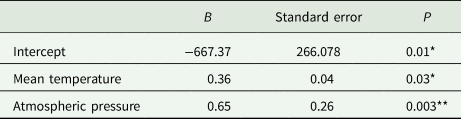
In the final model, the number of captures was significantly influenced by mean temperature and atmospheric pressure (table 1: R 2 = 0.52). The former decreased significantly with the decreasing of both meteorological parameters and was significantly greater in summer.
Factors affecting the number of captures of R. speculum, estimated through a general linear model

*P ≤ 0.05; **P ≤ 0.01; ***P ≤ 0.001.
Activity rhythms and intersexual temporal overlap
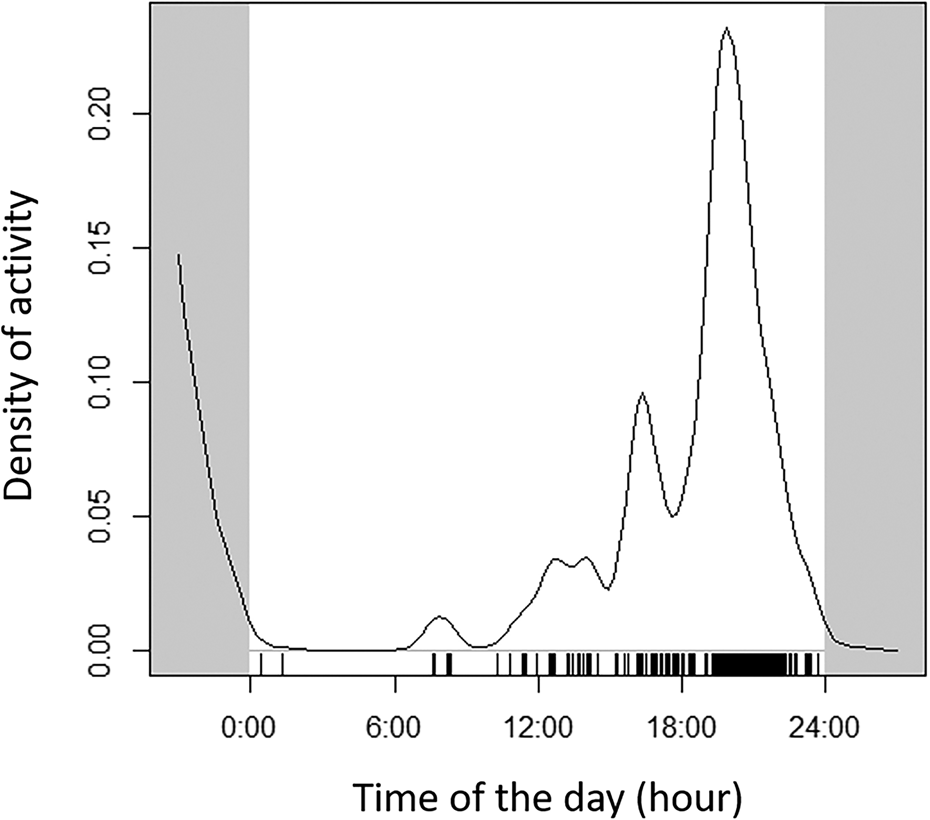
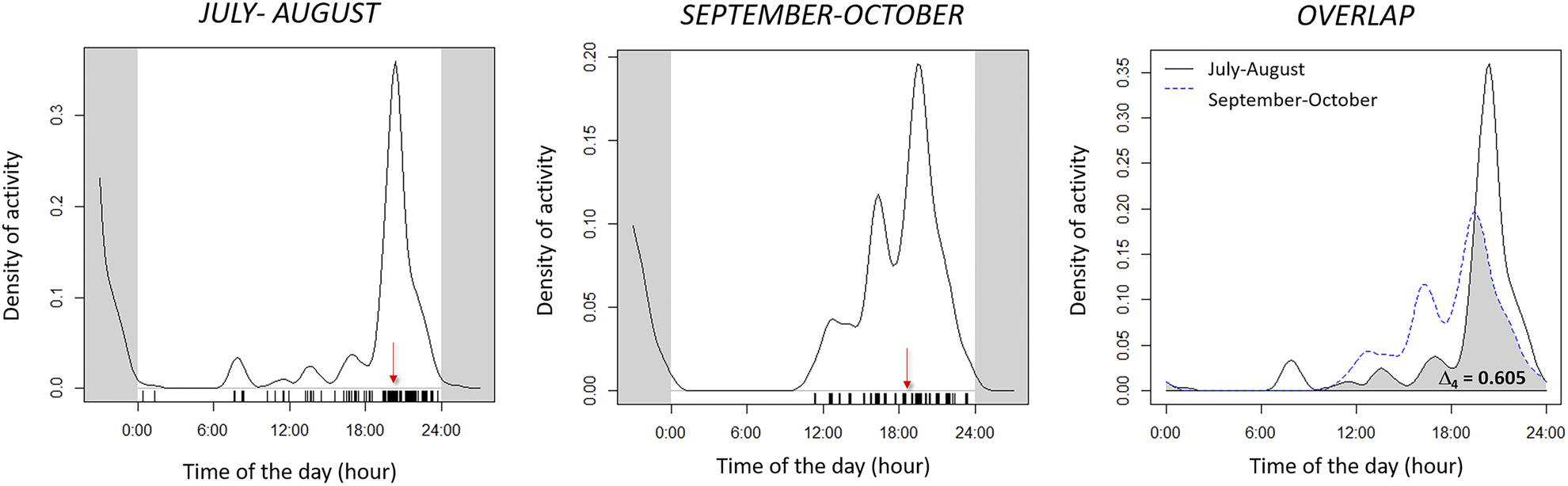
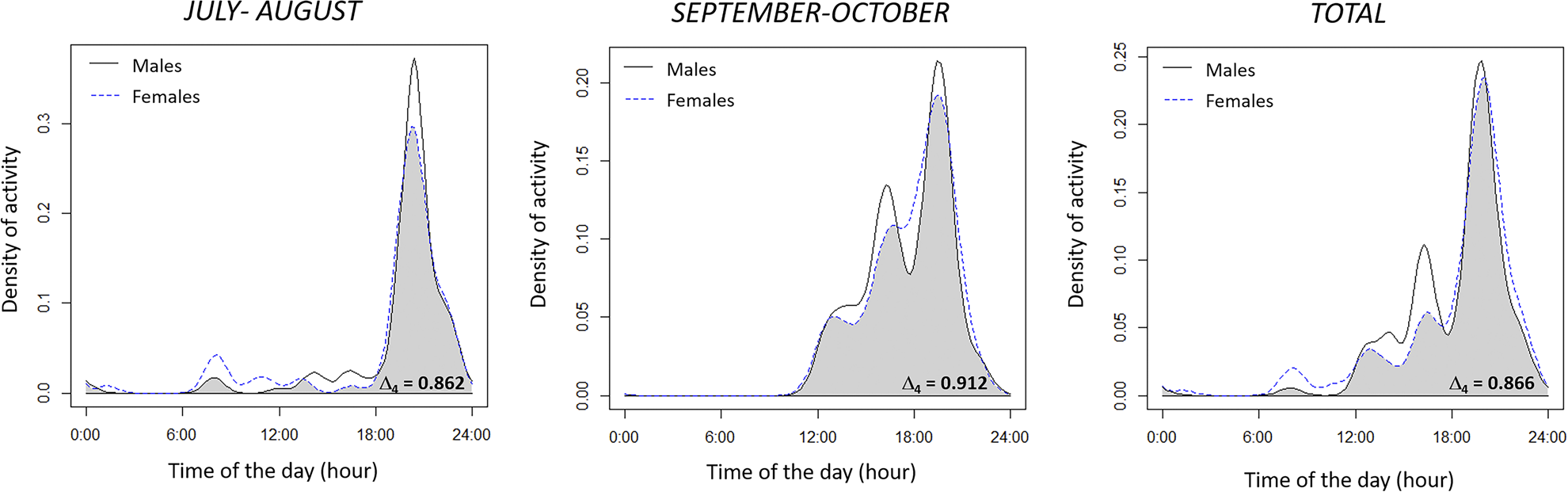
R. speculum is mostly a crepuscular species, which activity peaks at sunset (fig. 2). When heliophany was the highest (i.e. July–August), R. speculum adults were active for a long period of time, i.e. between 6:00 and midnight, with a significant peak at 20:43 (Rayleigh test: Z = 56.42, r = 0.71, P < 0.001), i.e. at sunset. When heliophany was the lowest (i.e. September–October), the activity of R. speculum was concentrated between late morning and midnight, peaking at 17:17 (Rayleigh test: Z = 93.18, r = 0.77, P < 0.001), i.e. at sunset time (fig. 3). Different heliophany may explain the intermediate coefficient of overlap (Δ4 = 0.605).
Activity rhythms of R. speculum during the 4-month period (July–October 2018). Density of activity = probability of the species to be active.

Activity rhythms of R. speculum during 2-month periods (July–August; September–October) at different heliophany, and interperiod overlap. Arrows show sunset time. Density of activity = probability of the species to be active.

An intersexual overlap did not change between the two 2-month periods (Watson's Two-Sample Test of Homogeneity U 2 = 0.18, P = 0.08: fig. 4) and it was high or very high.
Overlap of activity rhythms of the R. speculum males and females in both 2-month periods (July–August; September–October) and total (July–October). Density of activity = probability of the species to be active.

Trap-color captures
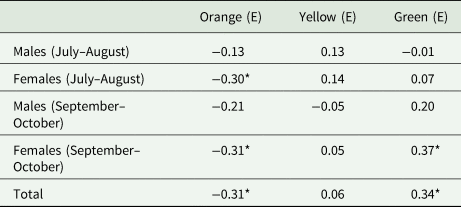
Females were more selective than males and tended to be occasionally captured by orange traps in both periods, whereas being mostly trapped by green ones in September–October (table 2). Conversely, males seem to be captured by colored traps proportionally to their local availability (table 2). From a general point of view (i.e. including unsexed individuals), captures were the lowest in orange traps, yellow ones captured in proportion to their availability, and green traps were the most successful in capturing insects (table 2).
Ivlev's Electivity Indices (E) for each color of traps, and for each sex in both bi-month periods. Asterisks highlight significant attraction (positive values ≥0.3) or avoidance (negative values ≤−0.3)

Discussion
The black planthopper is an alien invasive species that is becoming abundant in central Italy, as confirmed by the high number of captured individuals in a short period. This result is noteworthy since this species seems to be spreading in Italy and it can feed and lay eggs in a long list of plants ranging from angiosperms to gymnosperms (Mazza et al., Reference Mazza, Marraccini, Lucchi, Marianelli, Sabbatini Peverieri, Bosio, Giacometto, Rapa, Cianferoni, Roversi and Gargani2018). The number of captures of R. speculum was influenced by the mean environmental temperature and by the atmospheric pressure, suggesting that most of the activity of this species occurs in the warmest period of the year.
Our study confirmed that this species is univoltine in the introduction area and that it overwinters in the egg stage (cf. Rossi et al., Reference Rossi, Stroiński and Lucchi2015, for Liguria). Conversely, in the native range, the black planthopper may reproduce twice per year, overwintering at the juvenile stage (Yu, Reference Yu2007, for China). This finding is possibly related to high plasticity of this insect as reported for other alien invasive organisms (Carvalho et al., Reference Carvalho, Leitão, Funghi, Batalha, Reis, Gama Mota, Lopes and Cardoso2013). Such plastic behavior might allow pests to quickly cope with the most diverse environmental conditions. The capability to maintain such long-term plasticity was described as one of the most remarkable behavioral characteristics of invasive species (e.g. Carvalho et al., Reference Carvalho, Leitão, Funghi, Batalha, Reis, Gama Mota, Lopes and Cardoso2013; Fanini et al., Reference Fanini, Longo, Cervo, Roversi and Mazza2014).
According to our study, the species showed a flight period of a few months in summer, with a peak in September, when over 200 individuals were captured in one week. As to the other regions of Italy, the adults show similar patterns of behavior: in Liguria the adults are present from July to October (Mazza et al., Reference Mazza, Pennacchio, Gargani, Franceschini, Roversi and Cianferoni2014; Silvestri, Reference Silvestri2017), in Veneto the species was reported from July to September and, in Piedmont, it was discovered in September (Mazza et al., Reference Mazza, Marraccini, Lucchi, Marianelli, Sabbatini Peverieri, Bosio, Giacometto, Rapa, Cianferoni, Roversi and Gargani2018). The activity of both sexes significantly peaked at dusk, making it a mainly crepuscular insect. Also, R. japonica Melichar, 1898, now Orosanga japonica (Melichar, 1898) seems a crepuscular/nocturnal insect since it was collected in Bulgaria using light traps during the night (Gjonov, Reference Gjonov2011). This crepuscular behavior probably represents the best trade-off between temperature, predator avoidance, and host plant searching. Foraging at low light intensities is particularly common for insects in tropical/subtropical areas (e.g. the area of origin of the black planthopper) where severe food interspecific competition and a high risk of predation occur (Greiner, Reference Greiner2006). Moreover, the laying behavior is a ritualized and time-consuming process (Rossi et al., Reference Rossi, Stroiński and Lucchi2015), which may expose planthoppers to predation: thus, eggs are probably mostly laid at a low light intensity.
We showed that the colored sticky traps are effective tools to monitor the black planthopper presence; thus, they may be used for early detection in new areas, as well as for mass trapping programs. More in-depth studies are however required to optimize trap height and number as in Wang et al. (Reference Wang, Gao, Shi, Qin, He, Hu, Tan and Chen2015) for Aleurocanthus spiniferus (Quaintance, 1903) (Hemiptera: Aleyrodidae).
Captures provided us with an accurate idea of the phenology patterns, but a wrong idea of the sex ratio. Despite the high percentage of unsexed individuals, the sticky traps captured more males than females. This difference may be caused by a different flight activity between sexes, or potential different feeding habits between males and females, but further ad hoc experiments are necessary to solve this issue. Similar male-biased trapping has been reported also for some species of leafhoppers captured with sticky traps (e.g. Meyer and Colvin, Reference Meyer and Colvin1985; Kersting and Baspinar, Reference Kersting and Başpmar1995) and for the Diptera Agromyzidae (Scheirs et al., Reference Scheirs, De Bruyn and Von Tschirnhaus1997): male-biased catches in colored traps can be explained by sex-dependent feeding and/or mating strategies (Scheirs et al., Reference Scheirs, De Bruyn and Von Tschirnhaus1997).
As to the capture success by different trap-colors, only Li et al. (Reference Li, Wang, Ye, Xu and Han2015) investigated the sticky colored traps in mangrove forests in Shenzen (China) for capturing this species: ten colors (but not orange) were tested, with the yellow traps showing the highest attractive effect. This study, however, does not represent a valid comparison with the current investigation, as it has been carried out in a completely different study site (i.e. a tropical mangrove forest).
From a general perspective, yellow is the color preferred by most insects and the attraction to yellow may constitute a stimulus eliciting food and/or host plant search (Prokopy, Reference Prokopy1972). Visual cues are important to locate and select the host plants and several leafhoppers such as Empoasca spp. are attracted to colors commonly associated with living foliage (Rodriguez-Saona et al., Reference Rodriguez-Saona, Byers and Schiffhauer2012). The attraction to a color may also change the following physiological stages (Francese et al., Reference Francese, Crook, Fraser, Lance, Sawyer and Mastro2010). Accordingly, we showed that yellow traps captured in proportion to their availability, orange ones were avoided, and green ones were the most attractive, mostly in September–October. Attraction to green may be host-related since this color is typical of foliage and this color preference may be related also to the peak of egg-laying. Eggs in R. speculum are usually laid in clusters within the tissues of young twigs or in the leaf midrib (Rossi et al., Reference Rossi, Stroiński and Lucchi2015). Given that the species overwinters in the egg stage within the invasive range (Italy; Rossi et al., Reference Rossi, Stroiński and Lucchi2015), early Autumn (September–October) may also represent the peak of egg-laying.
Green sticky traps seem to be the most suitable ones to sample R. speculum adults in the invasive range and they might be used both for the early detection and monitoring. The use of green traps may also reduce the impact on non-target species, such as the beneficial ones (e.g. hymenopteran parasitoids, bees, and coccinellids) since these species are mainly attracted by yellow traps (Wallis and Shaw, Reference Wallis and Shaw2008). Our captures seem to confirm this trend, but further studies are necessary to confirm it.
To conclude, the trapping effort during the activity peak with green sticky traps may (i) enhance the capture success of each trap, (ii) reduce the impact on non-target species, and (iii) increase the number of captures, to reduce the population densities and, in turn, possible damage to cultivated areas.
Supplementary material
The supplementary material for this article can be found at https://doi.org/10.1017/S000748531900083X.
Acknowledgements
Thanks to Kathleen Collins Tostanoski for the English revision. We thank the anonymous reviewers and the Editor for their many insightful comments and suggestions that improved the manuscript. Thanks to Andrea Rocchini and Mirko Guidi for the help in the installation of the traps and field surveys. The research was supported by the Mipaaft Project ‘Salvaguardia e valorizzazione del patrimonio olivicolo italiano con azioni di ricerca nel settore della difesa fitosanitaria (SALVAOLIVI)’ and in the frame of the Euphresco Project ‘International Plant Sentinel Network (IPSN)’.