Introduction
The naranjilla plant (Solanum quitoense) is a shrub grown on steeply sloped lands in the foothills of the Andes Mountains. Primarily produced in Ecuador and Columbia, its fruit is used to make a widely consumed juice. Naranjilla is a profitable crop for smallholder farmers, generating higher incomes than alternative crops in the region (Sowell and Shively, Reference Sowell and Shively2012). However, its profitability is threatened by susceptibility to soil-borne pathogens that shorten the plant's productive life. Because these pathogens remain in the soil, producers continually shift cultivation onto new lands, clearing primary forest and contributing to deforestation, runoff and biodiversity loss (Sowell and Shively, Reference Sowell and Shively2012).
The INIAP Quitoense is a grafted variety of naranjilla that is resistant to soil-borne pests and diseases. This variety was developed by Ecuador's National Agriculture Research Institute, the Instituto Nacional de Investigaciones Agropecuarias (INIAP), with the assistance of the Integrated Pest Management Innovation Lab (IPM IL). [The IPM IL is a USAID-funded research support program dedicated to advancing IPM science and developing IPM technologies in order to support USAID's objectives to provide long-term social, economic and environmental benefits.] This variety has been tested on agricultural experiment stations and in farmers' fields and its productivity benefits are statistically and practically significant. The variety's resistance increases the plant's longevity and productivity. It can also be replanted on disease-infested land, reducing deforestation caused by continual land clearing to avoid the soil pest. In contrast to resistant hybrids, the grafted variety maintains the fruit quality of the common variety, making it an attractive alternative for small-scale producers. Fruit quality is especially important because hybrid fruits fetch substantially lower prices in local markets due to their lower quality juice. Despite its documented benefits, as with many new agricultural technologies, few farmers have adopted the grafted variety and diffusion is far below potential.
Diffusion of grafted naranjilla varieties is complicated due to the need to either train farmers in grafting techniques (i.e. decentralized grafters) or transport grafted seedlings to distant locations. Ecuador faces the dual problem of limited resources for public agricultural extension to train potential grafters and high costs of transportation to distant producing zones. Limited diffusion of the grafted variety represents a lost opportunity to reduce deforestation, improve water quality and biodiversity and raise incomes of naranjilla farmers. INIAP leadership is interested in understanding the potential economic impacts of the Quitoense variety prior to investing in diffusion efforts. An ex-ante impact assessment is complicated by two factors: (i) naranjilla is a semi-perennial and the grafted variety has a different time profile of costs and income flows than the common (highly susceptible) and the hybrid alternatives; and (ii) the hybrid and the common have fruits of such different qualities that their markets are fundamentally distinct. This paper presents adjustments to the economic surplus methods described in (3) to account for these factors. The paper goes on to estimate potential aggregate economic benefits over a 20-year time horizon of the INIAP/IPM IL research invested in developing the INIAP Quitoense.
The paper begins by describing the naranjilla varieties and their attributes. It then presents modifications of methods for calculating producer and consumer surplus to reflect the reality that naranjilla is a semi-perennial plant and that markets for fruits of naranjilla varieties are differentiated. Other parameters used to calibrate the partial surplus model are next explained. Results for several scenarios are given, alongside sensitivity analysis and a discussion of environmental and health benefits from adoption.
Background
Although naranjilla is a minor crop, it is an important source of income for Andean smallholder farmers, being produced on more than 10,000 hectares (ha) (Sowell and Shively, Reference Sowell and Shively2012). Minor crops, also referred to as underutilized, neglected or orphan crops, can be defined as crops whose potential benefits for health, income generation or environmental services are underexploited (Jaenicke and Höschle-Zeledon, Reference Jaenicke and Höschle-Zeledon2006). Investment in research for minor crops is naturally small compared with the amount invested in major crops, despite the potential that minor crops hold in improving nutrition, incomes and climate resilience (Azam-Ali et al., Reference Azam-Ali, Sesay, Karikari, Massawe, Aguilar-Manjarrez, Bannayan and Hampson2001).
Some research and development for minor crops is well documented. Research leading to the development of NERICA (New Rice for Africa), a hybrid of locally adapted African rice and a high-yielding rice, generated higher yields and incomes for adopters. However, adoption was below predictions, indicating that more extension and training might be needed to promote diffusion (Tadele and Assefa, Reference Tadele and Assefa2012). Quncho, a recombinant inbred line of tef, a grain grown and consumed in Ethiopia, is another example of successful research on an orphan crop. The successful diffusion of Quncho can be attributed to the strain's pale grain color, high yields and an innovative diffusion strategy that included revolving seed loans, provision of inputs and active involvement by researchers and extension agents (Tadele and Assefa, Reference Tadele and Assefa2012).
Impact assessments for integrated pest management research with minor tropical fruits have been conducted for controlling Phytophthora in jackfruit and durian in the Philippines. An ex-ante impact assessment was conducted which expected a maximum adoption level of 77% after 4 years. At this rate, research and extension activities had a 43:1 benefit–cost ratio and 43% internal rate of return (Preciados et al., Reference Preciados, Bulayog, Borines, Guadalquever, Oakeshott and Hall2012a). An ex-ante impact analysis of management of the same disease on durian expected a maximum of 30% adoption to be achieved after 6 years. However, since many durian growers are smallholders with limited capital and an unwillingness to adopt new technologies, the returns of the research are highly dependent on extension efforts (Preciados et al., Reference Preciados, Bulayog, Borines, Guadalquever, Oakeshott and Hall2012a, Reference Preciados, Bulayog, Soguilon, Montiel, Oakeshott and Hallb).
These findings support the importance of research for minor tropical fruits. More impact assessments need to be conducted in order to further document the benefits of research on minor crops, and propel further investment. This paper adds to the existing literature by quantifying the value of naranjlla research. In doing so, we provide evidence to encourage diffusion efforts, as well as future research initiatives.
Like many minor crops, naranjilla offers promising economic potential, particularly for export to markets in the USA and Europe, where consumers demand healthful, exotic fruit juices (Sabbe et al., Reference Sabbe, Damme and Verbeke2013). However, the primary market for the fruit is within Ecuador. Low productivity and high pesticide residues, consequences of naranjilla's vulnerability to disease, have limited exports to levels far below their potential (Andrade, Reference Andrade2004).
Common naranjilla is susceptible to several pests and diseases, including bacterial canker, anthracnose, naranjilla vascular wilt (caused by Fusarium oxysporum f. sp. quitoense), root-knot nematode (Meloidogyne incognita) and the fruit borer (Neoleucinodes elegantalis) (Alwang, Reference Alwang and Crsp2012). Fusarium oxysporum f. sp. quitoense is a soil-borne pathogen that can remain in the soil for several years (Ignjatov et al., Reference Ignjatov, Milošević, Nikolić, Gvozdanović-Varga, Jovičić and Zdjelar2012); the pathogen weakens the plant and increases its susceptibility to other pests and diseases. Root damage from nematodes, which also dwell in the soil, increase the plant's susceptibility to infection from F. oxysporum f. sp. quiotense (Sowell and Shively, Reference Sowell and Shively2012). Once the soil is infected, farmers must plant in pathogen-free areas, typically by cutting primary or secondary forest (Andrade, Reference Andrade2004; Ochoa et al., Reference Ochoa, Yangari, Ellis and Williams2004). Evidence shows that 68% of naranjilla producers consider recently converted forest to be the best land for naranjilla cultivation (Andrade, Reference Andrade2004).
Pests and diseases reduce the productive life of the plant and thus contribute to land-clearing as producers clear pathogen-free forests. The common variety has a productive life exceeding 36 months in the absence of pathogens, but in most pathogen-infested areas, fewer than 10 months of production are normal (J. Ochoa, personal communication, 2014). The shortened productive life contributes to an increasing cycle of land conversion and extensification of naranjilla cultivation, contributing to carbon emissions by accelerating deforestation (Sowell and Shively, Reference Sowell and Shively2012).
Deforestation resulting from naranjilla cultivation is of particular concern in the Amazonian region of Ecuador, a biodiversity ‘hotspot’ which is also home to the province that produces the most naranjilla, Napo (Myers et al., Reference Myers, Mittermeier, Mittermeier, Da Fonseca and Kent2000; Sowell and Shively, Reference Sowell and Shively2012). Deforestation in the Amazonian region has been accelerated by oil exploitation and the Agrarian Reform Laws (1964, 1972), which encouraged the colonization and clearing of unoccupied forest land (Mecham, Reference Mecham2001; Mosandl et al., Reference Mosandl, Günter, Stimm, Weber, Beck, Bendix, Kottke, Makeschin and Mosandl2008). Naranjilla is one of the few crops that could be profitable in the most remote colonized areas (Bromley, Reference Bromley1981), as growing conditions are ideal, few purchased inputs are used and despite being a perishable crop, it ships well. In the 1990s, the Ecuadorian region had one of the highest deforestation rates in the Amazon, with about 2% of existing forest lost every year, releasing large quantities of greenhouse gases (Mainville et al., Reference Mainville, Webb, Lucotte, Davidson, Betancourt, Cueva and Mergler2006).
The Amazonian region of Ecuador contains large quantities of sequestered carbon—most of the region has either high (111–160 tons (t) ha−1) or medium–high (61–110 t ha−1) levels of carbon sequestered in above and belowground biomass (Bertzky et al., Reference Bertzky, Ravilious, Araujo Navas, Kapos, Carrión, Chíu and Dickson2010). When soil carbon is included, large portions of land east of the Andes are estimated to store 311–633 t ha−1 of carbon. Deforestation also leads to soil erosion, dramatically diminishing soil fertility, and the combination of low-fertility and pathogen-infestation contributes to shifting cultivation of common naranjilla. In addition, runoff from soil erosion collects in streams, increasing the water's mercury content. This harms the aquatic biosystem and poses a risk to human health through the consumption of fish containing toxic levels of mercury (Mainville et al., Reference Mainville, Webb, Lucotte, Davidson, Betancourt, Cueva and Mergler2006).
Hybrid varieties of naranjilla have been developed to address problems related to pests. The Puyo hybrid, a cross between a bitter variety of naranjilla and Solanum sessiflorum, is more tolerant to pests and diseases than the common variety. The hybrid produces smaller, lower-quality fruits which fetch lower prices in Ecuadorean markets. To counter this, close to harvest, producers apply diluted mixtures of the herbicide Dacocida 4D, containing the chemical 2, 4-dichlorophenoxyacetic acid (2, 4-D). This application stimulates hormone production and acts to enlarge the fruit (Heiser, Reference Heiser, Gustafson, Apples and Raven1993; Winter, Reference Winter2005). The chemical is known to cause skin and eye irritations, coughing, burning, dizziness, weakness and nausea (Winter, Reference Winter2005). Application of 2, 4-D is suspected to be a cause of serious negative health effects reported in farming communities, and residues that remain on the fruit are considered dangerous, inhibiting international trade (Sowell and Shively, Reference Sowell and Shively2012).
The Palora hybrid, developed by the INIAP, produces larger fruit, and does not require the application of 2, 4-D. A cross between the Baeza variety of naranjilla and S. sessiflorum, fruit from the Palora has a thick skin, which allows it to withstand handling and transport (Andrade, Reference Andrade2004). However, it is still of lower quality than the common fruit and typically is sold for lower prices in most markets. The Puyo hybrid is grown far more extensively than the Palora (Andrade, Reference Andrade2004), although the Palora is grown in some regions. Demand for both hybrid varieties is partially driven by their transportability and shelf life, which facilitates sale to coastal markets. Furthermore, hybrid varieties are considered to be easier to grow due to their resilience to disease, making them an appealing option to farmers.
Since it is recognized that the hybrid fruit is inferior quality, the price of common naranjilla is typically higher than that of either hybrid variety (Sowell and Shively, Reference Sowell and Shively2012) and the fruits are separated in final markets. Additionally, cultivation of hybrid varieties does not alleviate the issues of shifting cultivation and overapplication of pesticides and herbicides. Like the common variety, the hybrid plant does not produce well if replanted on fusarium- and nematode-infested lands, and hybrid cultivation is also associated with shifting cultivation. The hybrid variety also has a short lifespan of 18 months.
Despite these disadvantages, the hybrid Puyo is more widely cultivated than the common variety (Andrade, Reference Andrade2004; Ochoa and Ellis, Reference Ochoa and Ellis2005). Farmers consider it to be an easier and more reliable crop than the common variety, in part because the common variety, vulnerable to foliar pests and diseases, requires frequent fumigation in infested areas (Heiser, Reference Heiser, Gustafson, Apples and Raven1993; Revelo et al., Reference Revelo, Vitero, Vásquez, Valverde, León and Gallegos2010). As a result, data used in this analysis show that input costs are lowest for hybrid, despite use of 2,4-D. The general term ‘hybrid’ will be used to describe cultivation of Palora and Puyo.
The INIAP Quitoense variety, developed by the INIAP with the assistance of the IPM IL, is resilient to soil-borne pests and disease while maintaining the fruit quality of common naranjilla. The fruit of the conventionally grown common (non-grafted) and the INIAP Quitoense are identical. The INIAP Quitoense consists of the Baeza variety of common naranjilla (selected for its high yields) grafted to rootstocks of Solanum hirtum, selected for its resistance to disease (Vásquez, Reference Vásquez2012). Four major economic benefits of cultivation of the INIAP Quitoense can be identified: (i) duration of the plant's productive life is increased; (ii) resistance to fusarium allows many cycles of grafted plant to be planted in the same lot, eliminating costs associated with land-clearing when shifting cultivation; (iii) yields are increased; and (iv) farmers benefit from higher market prices for common varieties. These benefits allow suppliers to reduce costs and increase long-run supply. In addition to these market-mediated economic benefits, use of grafted naranjilla reduces forest degradation and biodiversity loss, reduces environmental costs associated with pesticide application and runoff, and protects farmers’ health.
Despite these benefits, barriers to adoption of the INIAP Quitoense exist. Farmers, usually smallholders, must provide an investment up-front in grafted plants, or receive training in grafting. The grafted plants sell for US$1.10, while the seedling for the hybrid variety is sold for only US$0.15, and can be propagated through transplantation. In a survey of 47 producers, 71% indicated that the cost of the grafted plants dissuaded adoption of the technology (Sowell, Reference Sowell2011). To avoid this, farmers can graft their own plants, but this requires technical training. In order for farmers to invest time or money into the INIAP Quitoense, they must be convinced of its value. However, interviews indicate that some growers are skeptical of the grafted naranjilla, having heard of unsuccessful attempts to grow other grafted varieties. [Unstructured interviews were conducted with 15 naranjilla farmers in June 2014 to gather information about naranjilla cultivation and attitudes toward the INIAP Quitoense.] Furthermore, because the scion of the INIAP Quitoense is common naranjilla, there is a knowledge gap for hybrid growers. The hybrid varieties, which are more resistant to pests and diseases (Heiser, Reference Heiser, Gustafson, Apples and Raven1993; Revelo et al., Reference Revelo, Vitero, Vásquez, Valverde, León and Gallegos2010), are considered to be easier to cultivate. Hybrid growers may shy away from the challenge of combatting the foliar pests and diseases to which the common naranjilla is vulnerable. Further investment in diffusion such as training farmers to graft and maintain common naranjilla will go far in improving adoption of this technology. By quantifying the net present value and internal rate of return under different adoption scenarios, we are defining the gains that can be achieved by investing in technology diffusion. The parameters used in the model (demand and supply elasticities, proportional changes in production costs, prices, etc.) are necessary to characterize the effect of adoption in the market. This effect must be known in order to define the impact of changing one of the factors influencing the adoption decision.
Methods
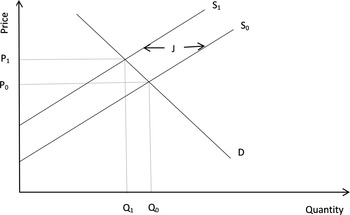
In order to translate production gains and cost-savings from the farm to the aggregate level, we used partial equilibrium economic surplus analysis, a widely used process for measuring market-transmitted economic benefits (Alston et al., Reference Alston, Norton and Pardey1995). As the INIAP Quitoense is adopted, the supply of common naranjilla increases, shifting out the supply curve according to the difference between the unit cost of production for the INIAP Quitoense compared with the conventional common variety. This difference was computed using cost and yield data for three naranjilla varieties provided by INIAP researchers. The magnitude of the supply shift depends on the degree of cost savings (known in the literature as the k-shift) and the extent of adoption (Figure 1).
The K-shift from a new agricultural technology: The market for common naranjilla. Note: The new variety is associated with a lower per-unit cost of production (due to higher productivity or lower costs or both); as the variety is adopted over increasing areas, the market supply curve shifts downward. This shift is known as the K-shift.

The impact of the new technology is measured as a change in total economic surplus, which is the sum of consumer surplus and producer surplus. Benefits to consumers are measured as the change in consumer surplus, while producer surplus changes reflect changes in producer welfare. Consumer surplus is what consumers are willing to pay for the good above the market price, and is represented graphically as the area below the demand curve and above the market price. Producer surplus is the return producers receive from selling their products at market price rather than selling at the lowest price that they would accept. It is represented graphically by the area below the market price and above the supply curve (Alston et al., Reference Alston, Norton and Pardey1995).
The distribution of benefits between producers and consumers is dependent on the elasticity of demand, a measure of consumer responsiveness to price fluctuations. When supply shifts out against an inelastic demand (low consumer responsiveness), market prices decline and consumers are benefitted. The demand elasticity is determined by various factors, including exportability of the product. Because naranjilla is not widely exported, a closed economy model is appropriate.
Economic surplus analysis
The formulae for computing economic surplus change are now well known (Alston et al., Reference Alston, Norton and Pardey1995). Changes in surplus from technology adoption depend on: (i) the expected proportionate yield increase per hectare after adoption of the new technology; (ii) the expected proportionate change in variable input cost per hectare; (iii) the elasticities of supply and demand; (iv) the land area under adoption and its time profile; and (v) the discount rate. Figure 1 shows the change in producer and consumer surplus resulting from a research-induced increase in supply. Adoption of the cost-lowering technology leads to a rightward shift (increase) in supply. As supply shifts against an inelastic demand curve, prices fall (from P 0 to P 1), quantities increase (from Q 0 to Q 1) and benefits to consumers and producers emerge. The K-shift representing the cost reduction per unit can be expressed as:
 $${K_t} = \left[ {\displaystyle{{E(Y)} \over {\rm \varepsilon}} - \displaystyle{{E(C)} \over {1 + E(Y)}}} \right]p{A_t}(1 - {\rm \delta} )\; $$
In Equation (1), E(Y) is the expected proportionate yield gain per hectare, E(C) is the expected proportionate cost change per hectare, p is the initial price, A is the adoption (percentage land under new technology), ε is the supply elasticity, and δ is the discount rate (Alston et al., Reference Alston, Norton and Pardey1995). In Equation (1), the K-shift varies by year, with the cumulative adoption (A t ) driving change over time. The data and process for finding these proportionate changes for naranjilla are discussed in the Subsection ‘Naranjilla life cycles’.
Adjustments to the surplus model
An important adjustment is needed to compute the time profile of the K-shift for naranjilla. Because the plant is a semi-perennial, proportionate changes in yields and input costs vary over the production cycle, which extends for more than 1 year. In a standard surplus approach, the crop is taken to be an annual. For naranjilla, in the first year of production, land must be cleared for all varieties and no production occurs for 8 months after planting. These land-clearing costs and time delays in harvest must be accounted for. When common or hybrid naranjilla ceases production due to fusarium infestation and the resulting pest and disease damage (which INIAP researchers indicate occurs 10–18 months after planting, depending on the degree of infestation), the farmer must shift to a new area and land clearing costs are accrued again. In contrast, the grafted variety requires more upfront costs for seedlings, but, once initial land clearing costs are accounted for, further land clearing is unnecessary. Eighteen months into the production cycle, grafted naranjilla will still produce, so in addition to the different time profile of costs, annual yield profiles vary over time.
The representation of these adjustments is straightforward. Define
 $E(Y_r^t )\; $
to be the expected proportional yield difference in year t between the grafted and comparison variety that was planted in year r and
 $E(C_r^t )\; $
to be the corresponding cost of production differential. Further, define A
r
to be the cumulative proportion of total naranjilla land planted to the grafted variety in year r. Then,
 $${K_t} = \mathop \sum \limits_{r = 1}^t \left\{ {\left[ {\displaystyle{{E(Y_r^{t - r + 1} )\;} \over {\rm \varepsilon}} - \displaystyle{{E(C_r^{t - r + 1} )} \over {1 + E(Y_r^{t - r + 1} )\;}}} \right]p{A_r}(1 - {\rm \delta} )} \right\}\; \; $$
Equation (2) represents an adjustment to the standard formula to account for the temporal differences discussed above. Procedures for measuring these parameters are discussed below.
A second adjustment is needed to account for different-quality fruits associated with common/grafted naranjilla compared with the hybrid. Lower-quality hybrid fruits comprise a different market than the common fruit. Thus, adoption of the grafted technology by producers who had previously been producing the hybrid variety represents product displacement. This displacement is modeled in separate markets. As increasing land is planted to the grafted variety, shifting the supply rightward in the common naranjilla market, land is lost in the hybrid sector and in the hybrid naranjilla market, the supply shifts leftward as a result (Figure 2).
The J-shift from less land in production: The market for hybrid naranjilla.

The supply shift in the hybrid market as a result of producers switching their land from hybrid to the grafted variety requires a modification of the standard model. Define J (see Figure 2) as the difference (reduction) in quantity of hybrid produced as hybrid land is shifted into grafted production. By definition,
 $$J = Q_0^{\rm h} \times \displaystyle{{Q_0^{\rm h}} \over {A_0^{\rm h}}} \times \Delta A$$
where Q
0 represents the initial quantity of hybrid produced, Q
0/A
0 is the average yield of hybrid and ΔA is the land converted from hybrid to grafted naranjilla. Following Mensah and Wohlgenant (Reference Mensah and Wohlgenant2010), define
 $j\, = \,J/Q_0^{\rm h} = \displaystyle{{Q_0^{\rm h}} \over {A_0^{\rm h}}} \times \Delta A$
. If β is the slope of the supply curve, then define k = J × β. Then
 $${\rm \beta} = \displaystyle{1 \over {\rm \varepsilon}} \times \displaystyle{{P_0^{\rm h}} \over {Q_0^{\rm h}}} $$
where ε is the elasticity of supply and P 0 is the initial price in the naranjilla market. Standard manipulation (Mensah and Wohlgenant, Reference Mensah and Wohlgenant2010) leads to an expression for K = (j/ε) from which surplus change in the hybrid naranjilla market can be computed. The data and process to calculate the j-shift are described in the Subsection ‘Computing the j-shift’. The aggregate change in consumer and producer surplus is then computed as the net change in the two (common/grafted and hybrid) markets.
Data
The basic building block of the surplus approach is the difference between the unit cost of production for the new variety compared with existing alternatives. This difference was computed using cost and yield data for three naranjilla varieties provided by INIAP researchers. Detailed production budgets were created based on information collected in randomized field trials conducted by INIAP researchers in Tandapi and Puyo, Ecuador for the common naranjilla, the INIAP Quitoense and the Palora and Puyo hybrid varieties. The research was conducted in farmers’ fields and overseen by INIAP researchers. Further trials were conducted of the INIAP Quitoense and the Palora and Puyo hybrid varieties on 24 of 2000 m2 parcels belonging to eight farmers. These trials confirm the cost and yield changes used in this paper. The production budgets include costs for labor, equipment, chemical and other inputs for planting, maintenance, and harvesting, as well as capital costs (including land rental). Fruit yields are reported in kilograms, and disaggregated between quality types (first through fourth). Available price data are not disaggregated by quality. Therefore, a single price estimation was applied, and total quantities produced (the sum of all classifications) were used. Different land-clearing costs were reported for each variety. Since this is attributable to variations in land rather than the differences in the varieties themselves, these costs were averaged across varieties.
Naranjilla life cycles
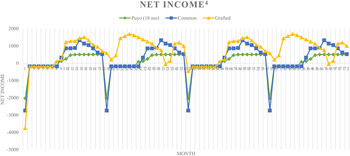
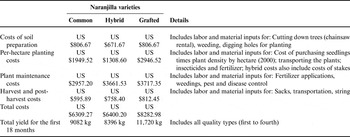
Table 1 provides an initial comparison between the varieties for one life cycle of the hybrid and common, and half a life cycle for the INIAP Quitoense. Grafted naranjilla has the highest production cost during these first 18 months. However, this relationship changes over time. After 18 months, the INIAP Quitoense continues to produce fruit while the hybrid and common plants must be replanted. After 3–6 years, the INIAP Quitoense, because of its resilience to soil-borne pathogens, can be replanted on the same soil, avoiding the costs and environmental damage associated with clearing and preparing new land. As a result, the INIAP Quitoense provides more consistently positive income over time, avoiding the high costs of clearing land and reducing the frequency of replanting. The variation in net monthly income from different varieties of naranjilla is shown in Figure 3.


Cost and yield data for grafted naranjilla were disaggregated by year, while data on conventionally grown common was provided in two 18-month cycles. In order to compare the two cultivars on a year-by-year basis, the costs of cultivating the conventionally grown common variety were disaggregated by month. Month one included all costs for soil preparation and planting. Weeding occurs four times in the 18-month cycle. Costs for pest and disease management activities during cultivation were divided between the dry and rainy seasons. However, for simplicity, all costs of maintaining the plant were summed and averaged over 18 months. Costs associated with harvesting fruit were averaged over the duration of the harvest period and allocated to the appropriate months (INIAP, 2013c).
After assigning a cost value for each month in the 18-month production cycle, it was necessary to establish costs and yields for yearly increments. Year one includes months one through 12 in the 18-month cycle: soil preparation and planting costs of month one, 8 months of pre-harvest costs without yields, and 4 months of harvest. The second year begins on month 13 of the 18-month cycle. The remaining 6 months of harvest occupy the first half of year 2. Month 7 of year 2 corresponds with the beginning of the second production cycle. Expenses from clearing the land and planting are included in this month's costs, and pre-harvest costs continue to the end of year 2. Year 3 includes the final 6 months of the second 18-month cycle. Two months into the year, harvest begins, lasting until the last month of the year. The process begins again with year 4, and is projected over the course of the 20-year time horizon.
A similar procedure was followed for the INIAP Quitoense. Since the grafted variety has a longer production cycle (3 years), costs of soil preparation and planting were only included in the first year. In the fourth year, producers must plant new trees. However, since the grafted variety can be replanted on the same land, farmers do not have to clear land again. Therefore, costs for the first month of the fourth year include costs of planting—purchase of the seedling and soil preparation. They do not include land-clearing costs. Costs and yields for years 5 and 6 are equal to those for years 2 and 3. Costs and yields for years 4, 5 and 6 are carried forward for the rest of the 20-year time horizon.
Computing the J-shift
As discussed in the previous section, the J-shift was based on the number of hectares converted from hybrid to common naranjilla per year divided by the total number of hectares in common cultivation. Losses accrued from the inward shift in the hybrid market are accounted for by calculating change in total surplus from diminished land in hybrid production. The proportionate change in land allocation to hybrid naranjilla was calculated by dividing the number of hectares converted from hybrid to grafted naranjilla per year by the total number of hectares in hybrid production. These losses were then subtracted from the gains in surplus to find the net change. For each of these proportions, hectares under cultivation were estimated based on average yields and total kilograms produced per year of the Puyo hybrid variety, which reflects the number of hectares under production reported by the MAGAP for 2010 (MAGAP, 2014).
Yield data from the Puyo hybrid variety, which is produced much more widely than any other hybrid, were used in this analysis (Andrade, Reference Andrade2004). Although the cost and yield data for the Puyo variety provided by the INIAP show the plant as having a 29-month lifespan, naranjilla producers interviewed by one of the authors in 2014 consistently stated that the hybrid variety has a lifespan of 18 months, which was adopted in this analysis. The experimental data as provided by the INIAP was broken into 3 years. Years 1 and 2 are complete years while year 3 consists of the remaining 5 months. To construct the yield summary for this shorter lifespan, year 1 data and year 3 data were used. Yields for the 5 productive months of year 3 were considerably higher than one half of yields from year 2. In order to obtain the most conservative measure of impacts, yield data from year 3 was used for the last 6 months of the production cycle.
Other parameters in the analysis
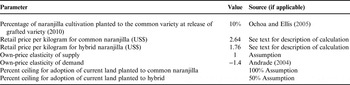
Other parameters in a surplus analysis are listed below with explanations of the bases for choosing values for these parameters. Due to a high level of uncertainty associated with many of these parameters, sensitivity analysis was conducted to compare outcomes when parameters are varied. Table 2 provides an overview of the parameter values and their sources.
Parameters used in base scenario.

Prices
The equilibrium prices used in the analysis were based on a variety of information sources. Naranjilla price data are available on the website of Ecuador's Ministerio de Agricultura, Ganadería, Acuacultura y Pesca (MAGAP). However, these prices are collected from wholesale markets in several cities in Ecuador, and our model focuses on retail markets. We manipulated the price data provided by MAGAP in order to determine a realistic end-consumer price for 2010, the year from which our initial equilibrium quantity value is collected.
First, price data were collected from MAGAP for years 2009–2011. Prices were averaged across time and market locations in order to establish a single average wholesale price for hybrid naranjilla. The percentage increase from wholesale to retail prices was found by comparing May and June 2014 wholesale prices provided by MAGAP with prices for naranjilla found at Supermaxi, the dominant Ecuadorian grocery chain (McMurray and Gross, Reference Mcmurray and Gross2007), collected in June 2014. The increase of 80% was applied to the wholesale hybrid naranjilla to establish an estimate of its retail price at US$1.80 kg−1.
When calculating the retail price for common naranjilla, it was necessary to account for the greater price premium observed at the retail level compared with that in the wholesale markets. Supermaxi prices could not be used to estimate this difference, as common naranjilla was sold in packaging, representing additional value-added of the product, and skewing a comparison with the hybrid naranjilla. Instead, price data collected from the open-air produce market in Otavalo were used to estimate the price differential between common and hybrid naranjilla in retail markets. After averaging the findings, the price of common naranjilla was found to be 1.79 times the price of hybrid naranjilla. The data did not account for variation in fruit qualities (the assumption would be that the distribution of low, medium and high-quality fruits were identical for common and hybrid naranjilla). Additionally, the prices are only representative of one market in one region, when there are indications that regional price disparities are significant. As an acknowledgement of this uncertainty, we calculated the retail price of common naranjilla to be 1.5 times the hybrid price of naranjilla rather than 1.79 times. A lower price premium for common naranjilla results in a more conservative estimate of the change in total economic surplus associated with the displacement of hybrid by grafted (common) naranjilla.
The values for product prices used in the analysis reflect the known consensus that common naranjilla sells for a substantially higher price than hybrid naranjilla. The quality difference between the common and hybrid naranjilla is clear in appearance, texture and flavor, and these differences lead to market price differences. Sensitivity analysis was conducted on these assumptions. In order to examine the outcomes when prices are the same for common and hybrid naranjilla, the estimated hybrid price was used for both hybrid and common fruit.
Quantity produced and land under cultivation
Data on total national naranjilla production was acquired through Ecuador's MAGAP, which reports total production of 20,005 Mt (metric tons) on 3643 ha in 2010, the base year for this analysis (MAGAP, 2014). These figures do not distinguish between hybrid and common naranjilla production. The common variety accounts for only a small percentage of total naranjilla produced, mainly due to widespread disease pressure (Andrade, Reference Andrade2004; Ochoa and Ellis, Reference Ochoa and Ellis2005). Here, common naranjilla production is taken to be 10% of the total, while the remaining 90% is comprised of hybrid varieties. In the results section we examine the impact of assuming that a larger proportion of the land under naranjilla production is used for common. The number of hectares under naranjilla was estimated to be 3547 based on the yield data provided by the INIAP (INIAP, 2013a, b, c). This estimate, which is close to the number reported by MAGAP, is used in our analysis in order to be consistent.
Elasticity of demand
The own-price elasticity of demand (η) [the own-price elasticity of demand is used in the calculation of consumer and producer surplus (see equation (3)), is a measure of consumer responsiveness to price variation. The own-price elasticity of demand for naranjilla was estimated by Andrade (Reference Andrade2004) using a log-linear econometric model. The authors, who make no distinction between hybrid and common naranjilla, obtained national yield and price data from MAGAP, assuming that national production and consumption are equal. Average income of working individuals in Quito and Ambato was used based on statistics from el Banco Central del Ecuador and el Instituto Nacional de Estadísticas y Censos. The model found the elasticity of demand to be to be −1.39; a rounded version of this value for elasticity, −1.4, was used in the analysis. This is a very high elasticity of demand. Studies of the demand elasticity for other fruits, and for fruit in general, typically calculate the demand elasticity to be below −1 in absolute value (Mohamed et al., Reference Mohamed, Abdulatif, Mahir Abdullah and Yahia2011; Castellon, Reference Castellon2012; Weerhewa et al., Reference Weerhewa, Rajapakse and Pushpakumara2013). However, observations of the wholesale market for naranjilla support the likelihood of such a high elasticity. Naranjilla wholesalers in Ambato were observed in June 2014 selling the hybrid and common fruits for approximately the same price due to an influx of the common fruit. Consumers may be highly responsive to fluctuations in price because of the availability of many other fruits that are commonly used to make juice. Still, sensitivity analysis was conducted using less elastic demand, specifically unitary elasticity (equal to −1) and elasticity equal to −0.75.
Elasticity of supply
Long-term own-price elasticities of supply are greater than short-term supply elasticities, particularly for agricultural goods. A supply elasticity (ε) of one is typically used for annual crops, and a supply elasticity of 0.5 is typically used for perennial crops and livestock, which require more time to increase production. Although naranjilla is a perennial crop, its brief productive lifespan increases its elasticity of supply (Alston et al., Reference Alston, Norton and Pardey1995). Since the short lifespan resembles that of an annual crop, an elasticity of supply of one was used. An assumption about the supply elasticity is the only route possible as data necessary to estimate it are not available, nor can studies of the supply elasticity of naranjilla be found in the literature. Sensitivity analysis was conducted to examine the results if a higher or lower elasticity of supply is assumed.
Adoption rate
The current study is being conducted soon after the release of a promising variety and, as such, is ex-ante in nature. Limited information is available on adoption (A) of grafted varieties on naranjilla-producing land because most grafting is done by individual farmers and no comprehensive representative survey of naranjilla growers has been conducted. In the spirit of ex-ante impact assessments, total economic surplus was estimated for scenarios reflecting low, medium, and high rates of ceiling adoption (the maximum proportion of naranjilla land that would be planted to the grafted variety). A baseline adoption ceiling of 100% was used for land currently under common naranjilla and 50% ceiling was assumed for hybrid land. Two alternate adoption scenarios were simulated: one with 100% adoption ceiling for both groups, another with only 50% adoption by common producers and 25% adoption by hybrid producers. The information that is available on adoption supports the first scenario. INIAP researchers estimate that, by 2015, at least 300 ha had been converted to grafted naranjilla. The adoption rates used for the base scenario expect 242 ha to be converted to the INIAP Quitoense by the end of 2015.
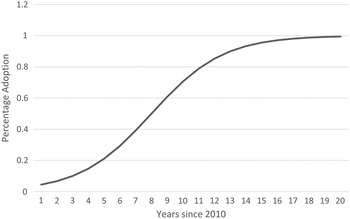
The diffusion of the technology is expected to occur in an S-shaped pattern (Rogers, Reference Rogers1962). The shape of the curve is a result of the gradual adoption of the technology by different groups of adopters ranging from innovators to laggards. Figure 4 displays the S-curve used in this analysis. It is assumed that the rate of adoption increases dramatically (reaches hypergrowth) after 2 years, in 2012. Following this, the rate of adoption is expected to slow after 10 years.
S-shaped diffusion curve.

Discount rate
The value of future gains from the technology must be brought back to present value. Discount rates of 3–5% are typically used (Alston et al., Reference Alston, Norton and Pardey1995), while this study maintains a conservative estimate of total benefits by using a 5% discount rate.
Costs of research and technology transfer
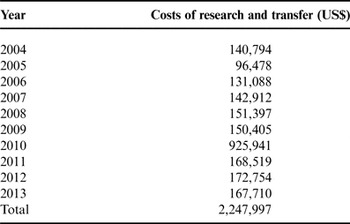
Once the benefits (net changes in consumer and producer surplus) are computed, costs of research and technology transfer are needed to calculate net benefits and the internal rate of return for research and extension. Costs of research and technology transfer were provided by the INIAP researchers for years 2004–2013 (Table 3).
Costs of research and transfer.

Source: INIAP records.
Note: All costs are in 2009 dollars.
Results
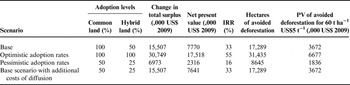
The base scenario assumes that the INIAP Quitoense will strongly appeal to producers of common naranjilla, and uses a 100% adoption rate (obtained over time) for this group. Hybrid producers are expected to be more resistant to adopting the INIAP Quitoense, as they are less familiar with the care required by the common plant. A 50% ceiling adoption rate was assigned to this group. In this scenario, the change in total surplus over 20 years is US$15.51 million, with a net present value of US$7.77 million. With the research and transfer costs that were reported, this provides an internal rate of return of 33%. These results are reported in Table 4. With the high elasticity of demand reported by Andrade (Reference Andrade2004), producers gain more than consumers, taking 58% of the benefits. This suggests that adoption of this technology can have a significant impact on the livelihoods of naranjilla producers, who are poor and have few agronomic alternatives.
Results for three levels of adoption.

In addition to these market-mediated economic benefits, farmers who adopt the INIAP Quitoense after producing the hybrid variety will accrue health benefits from no longer having to apply the chemical 2, 4-dichlorophenoxyacetic acid (2, 4-D). Furthermore, adoption of the INIAP Quitoense prevents deforestation. In the base scenario, up to 17,300 ha of land will avoid deforestation over a 20-year period as a result of the adoption of the INIAP Quitoense. At 60 t ha−1 of carbon, a low estimate for carbon stored in below and aboveground biomass in the Amazon, this translates to 1,038,000 t of stored carbon. The average price of carbon credits from offset measures such as prevented deforestation was US$5.00 t−1 in 2010, a high US$12.00 t−1 in 2011, US$7.40 t−1 in 2012 and US$4.20 t−1 in 2013. Assuming the relatively low price of the base year of 2010, and using a discount rate of 5%, the present value of the potential monetary value of this avoided deforestation is US$3.67 million. So, the non-market benefits (when health costs are included) likely approach the market benefits.
Two other adoption scenarios were evaluated (Table 4). An optimistic scenario was created in which 100% of common and hybrid producers adopt by the end of the 20-year period. In this scenario, total change in economic surplus over 20 years is US$30.75 million. The net present value is US$17.52 million. In order for this scenario to be achieved, transfer and extension would have to be increased in order to encourage hybrid producers to switch cultivation. Because of the additional challenges faced by hybrid growers to adjust to the foliar care for the common naranjilla, dissemination of the INIAP Quitoense should be accompanied by training in the care of the plant. A pessimistic adoption scenario was also evaluated in which 50% of common producers and 25% of hybrid producers adopt. Even when adoption is this low, total change in economic surplus is US$6.97 million and the net present value is US$2.32 million.
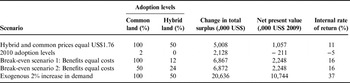
At the very least, we know that, at the end of 2010, 220 ha had been converted to growing the INIAP Quitoense. Assuming that one-third of this was adopted by hybrid growers and the other two thirds by common growers, the change in total surplus over 20 years equals US$2.13 million. While costs exceed benefits, this is a significant impact for the first wave of adoption. In order for the present value of the 20-year benefit stream to equal research costs, 100% of land under common cultivation and 12% of land under hybrid cultivation, or, alternatively, 50% of land under common cultivation and 24% of land under hybrid cultivation will have to be shifted to grafted production. These results are shown in Table 5.
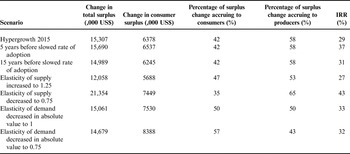
Other model scenarios.

Note: See the text for description of scenarios.
INIAP researchers identify farmer field schools as the most important step for spurring further adoption, and suggest implementing five farmer field schools in each of six naranjilla-growing provinces. Doing so would reach 600 naranjilla farmers, essentially guaranteeing high adoption rates. The program is estimated to cost US$150,000 (Dr. V. Barrera, personal communication, January 13, 2016). A scenario was run which included US$200,000 of additional diffusion costs spread out over 3 years, beginning in 2016. This had only a minor impact on net present value, which decreased by 2% compared with the base scenario.
Another potential impact of the adoption of the INIAP Quitoense is the increase in exported naranjilla due to the decreased application of 2–4D (Sowell and Shively, Reference Sowell and Shively2012; Sabbe et al., Reference Sabbe, Damme and Verbeke2013). This potential outcome was incorporated into the analysis by modeling a scenario in which demand is exogenously increased by 2% each year. This scenario, which holds all other model parameters at their base values, results in an increase in total surplus 33% greater than in the base scenario (Table 5).
Sensitivity analysis was conducted by varying a few key parameters. Increasing the elasticity of supply to 1.25 decreases the total change in economic surplus from US $15.51 to 12.10 million. Fifty-three percent of this surplus change accrues to producers. Decreasing the elasticity of supply to 0.75 increases the change in total surplus to US$21.35 million. Sixty-five percent of the increase in total surplus accrues to producers.
Decreasing elasticity of demand (in absolute value) from the very elastic −1.4 to unitary elasticity (−1) reduces the change in total economic surplus (compared with the base scenario) by 3%, and results in a more even distribution in welfare benefits between producers and consumers (Table 6). Further decreasing the elasticity of demand to −0.75 reduces the change in total economic surplus by 5%; however, as naranjilla is a highly prized juice, this inelastic demand is not likely to accurately describe the market. Consumer surplus exceeds producer surplus in this situation by 14 percentage points. When the prices of the hybrid and common fruits are equal, the estimated change in total surplus decreases dramatically, by 68%. This marked difference is due to the way that the model separates the two markets, which does not take into account the cost and yield benefits of switching from hybrid to grafted naranjilla production. As a result, in this analysis the benefits of the INIAP Quitoense are strongly influenced by the price premium for the higher quality fruit. Sensitivity analysis was also run on the assumptions used to construct the S-shaped adoption curve. If there is a lag in adoption, then hypergrowth would begin later. A scenario was run in which hypergrowth begins in 2015. Other possible scenarios include having five or 14 years (rather than 10) before the rate of adoption decreases. The effects of these changes make are not large.
Sensitivity analysis.

Note: See the text for description of scenarios.
Discussion and limitations
The economic, environmental and health impacts from the INIAP Quitoense demonstrate that research on minor crops is worthwhile and important. Although naranjilla is produced by a limited amount of farmers and is not essential for food security or nutrition, investment to improve its production can substantially improve rural livelihoods and health, protect fragile environments and avoid greenhouse gas emissions while creating economic returns. However, the rates of return to this research, estimated in this paper, will not be realized unless efforts are taken to overcome barriers to adoption. Modest efforts at promoting diffusion will create economic and environmental benefits in all of the scenarios. The costs of such outreach and their expected return in terms of adoption can be compared against the scenarios as a justification of public expenditure.
The environmental and health benefits of the conversion to grafted naranjilla are very close to the estimated market-mediated surplus benefits. If mechanisms can be encountered to enable small-scale producers to capture some of these environmental benefits (payment schemes, possibly reinforced through certification), further incentives will be created for adoption of the grafted variety.
Limitations to this research are primarily a result of incomplete information. The analysis did not take into account regional variations in price. Because price data were not disaggregated by quality, we were not able to take into account quality differences within the hybrid and common varieties. Information on the percentage of naranjilla cultivation that is comprised by the common naranjilla was also uncertain. Furthermore, by separating the two markets, yield and cost benefits of switching from hybrid to grafted naranjilla production are lost in this analysis, implying that the actual benefits would be greater than what is reported here.
Acknowledgements
This project was made possible by the United States Agency for International Development and the generous support of the American people through USAID Cooperative Agreement No. EPP-A-00-04-00016-00. Funding for this research was provided by the USAID under Agreement No. EPP-A-00-04-00016-00. The paper reflects views of the authors and not of the agency. The authors thank Austin Larrowe, Patricio Gallegos and Jose Ochoa for assistance during fieldwork.