Introduction
Stored-product insects are a recurrent problem in retail stores, where they damage and contaminate food products. Tribolium castaneum (Coleoptera: Tenebrionidae) and Trogoderma granarium (Coleoptera: Dermestidae) feed on various stored products such as flour and cereals. Tribolium castaneum is also highly tolerable to humidity as low as 11% and reduces the quality and quantity of the infected products (FAO, 2008). Potentially, it has an important impact on public health since it produces as irritants and repellents several varieties of substituted benzoquinone compounds that are highly reactive and toxic (Li et al., Reference Li, Lehmann, Weißbecker, Ojeda Naharros, Schütz, Joop and Wimmer2013). The beetles emit an unpleasant odor and can expedite the growth of the fungus in the contaminated products (Rustamani et al., Reference Rustamani, Khatri, Sultana and Laghari2014).
The khapra beetle, T. granarium, is a serious post-harvest pest of grain and cereal products in many tropical and subtropical regions of the world and has been considered as one of the 100 most invasive pests in the world (Lowe et al., Reference Lowe, Browne, Boudjelas and de Poorter2000). This species is a noxious stored product insect that is listed as a quarantine species by the European and Mediterranean Plant Protection Organization (EPPO) and others (Myers and Hagstrum, Reference Myers, Hagstrum, Hagstrum, Philips and Cuperus2012). Its undeniable economic importance relies on its ability to cause huge physical and quality losses in the stored grains by feeding and increasing the temperature of the storage environment making them liable to be invaded by some other pests including fungi and bacteria (Özberk, Reference Özberk2018). It has been estimated that an infestation level of 75% damaged grains by T. granarium larvae in wheat grains and some other cereals causes a considerable reduction in total protein and carbohydrate and other direct and indirect damage to the grain (Ahmedani et al., Reference Ahmedani, Haque, Afzal, Aslam and Naz2009).
Control of this kind of insects relies heavily on the use of fumigants, which has led to problems such as environmental pollution, increasing costs of the application, pest resurgence and resistance and hazard effects on non-target organisms in addition to direct toxicity to users (Benhalima et al., Reference Benhalima, Chaudhry, Mills and Price2004; Kumar et al., Reference Kumar, Mohapatra, Kotwaliwale and Singh2016).
Non-thermal atmospheric pressure plasma discharge (APPD) is a specific type of plasma that is <40°C at the point of application (Nasr et al., Reference Nasr, Zinhoum and Lotfy2020). The non-thermal atmospheric pressure plasma is a promising technology that is simple to set up, easy to operate and economical and it can be considered a safe physical method for the disinfection of agricultural products after harvest (Tyata et al., Reference Tyata, Subedi, Shrestha and Baral2012). As a processing environment, non-thermal APPD offers unique advantages of high chemical reactivity, low power consumption, high energy efficiency and low gas temperature without the need for complicated vacuum systems (Zhou, Reference Zhou2019). It is a mixture of atoms, molecules, ions, and electrons. Recently, the efficacy of non-thermal APPD types against insects, Sitophlus granarius, Plodia interpunctella, Ephestia kuehniella and T. castaneum, was evaluated (Mishenko et al., Reference Mishenko, Malinin, Rashkovan, Basteev, Bazyma, Mazalov and Kutovoy2000; Abd El-Aziz et al., Reference Abd El-Aziz, Mahmoud and Elaragi2014; Mohammadi et al., Reference Mohammadi, Imani, Dorranian, Tirgari and Shojaee2015). Other plasma species, atoms, metastable, and gaseous radicals can also have a pesticidal effect. Nevertheless, these plasmas should be non-thermal, therefore combining a low gas temperature close to the ambient, with high electron temperature, the electrons with high energies being able to sustain the generation of active chemical species including reactive oxygen species (ROS) and nitrogen species (Carpen et al., Reference Carpen, Chireceanu, Teodorescu, Chiriloaie, Teodoru and Dinescu2019; Zhou, Reference Zhou2019). Operation in the air reduces the costs when compared to the use of noble gases and the dielectric barrier discharge (DBD) system is a promising choice in order to adopt the non-thermal APPD technology for the management of stored-product pests (Kim et al., Reference Kim, Yun, Jung, Jung, Jung, Choe and Jo2011).
Microwaves are a part of the spectrum of the electromagnetic radiation and comprising frequencies ranging from 300 MHz to 300 GHz corresponding to a wavelength from 1 m to 1 mm (Abdelghafar, Reference Abdelghafar2015). Microwave disinfestation is a physical method that can be used to control insects in stored cereals and cereal products (Vadivambal et al., Reference Vadivambal, Jayas and White2006). Moreover, microwave heating is based on the transformation of alternating electromagnetic field energy into thermal energy by affecting polar molecules of a material (Chen et al., Reference Chen, Chen, Chen, Zhang and Zheng2019). Whereas they are especially useful because of their ability to penetrate common, non-conducting materials (Bhattacharya and Basak, Reference Bhattacharya and Basak2017). The use of microwaves to kill insects is based on the dielectric heating effect produced in grain which is a relatively poor conductor of electricity (Vadivambal et al., Reference Vadivambal, Jayas and White2007). Microwave quarantine method seems to have great potential as an alternative method of killing insects in stored grain because of several advantages such as the control of all developmental stages of storage pests, having no chemical residues on the food product, having minimal impact on the environment. Insects are unlikely to develop resistance to this treatment and providing rapid heating (Wang and Tang, Reference Wang and Tang2001; Karabulut and Baykal, Reference Karabulut and Baykal2002). Some authors are unanimous in affirming that the ionizing radiation can sterilize or kill insects of the order Coleoptera pests of stored grains (Vadivambal et al., Reference Vadivambal, Jayas and White2006, Reference Vadivambal, Jayas and White2007; Manickavasagan et al., Reference Manickavasagan, Alahakoon, Al-Busaidi, Al-Adawi, Al-Wahaibi, Al-Raeesi and Jayas2013; Abd El-Raheem and Said, Reference Abd El-Raheem and Said2016).
The main objective of this study was to investigate the possible use of non-thermal APPD with air as the working gas and microwave energy as stressor agents necessary for the control of T. castaneum and T. granarium adults and larvae in wheat grains, besides investigating their effect on the viability of wheat grains (in terms of wheat germination). Furthermore, the present study was carried out to investigate the antioxidative defense system in T. castaneum and T. granarium adults and larvae that occur under non-thermal plasma treatments.
Materials and methods
Insects culture
Tribolium castaneum and T. granarium adults and larvae were reared on Egyptian wheat variety Sakha 69 obtained from an already existing culture at the research laboratory of Stored Products Department, Plant Protection Research Institute, Doki, Giza, Egypt. To prepare immature individuals for use in each of the assays, the following procedure was performed. Tribolium castaneum adults were added to glass jars containing wheat grains and wheat flour, then given 48 h to settle, mate, and lay eggs, before being removed using a #25 sieve. Larvae were used in experiments 2.5–3 weeks after the removal of adults (Pranavi et al., Reference Pranavi, Prasad and Lakshmipathi2016). A similar procedure was performed for T. granarium larvae, with adults given 48 h to reproduce before being removed. Given that the larvae may go through supernumerary molts based on food availability and density, it is difficult to determine instars, so T. granarium larvae were classified as large, given 7–8 weeks to develop, or small, given 3–4s week, which conforms to prior size classification schemes for Trogoderma spp. (Domingue et al., Reference Domingue, Morrison, Yeater and Myers2020). Insects were reared under controlled conditions set at 30 ± 2°C, with the relative humidity of 60 ± 5%.
Non-thermal APPD treatment
The samples were treated with a non-thermal plasma system developed at the Department of Physics, Faculty of Science, Al-Azhar University as illustrated in the schematic diagram of DBD cell used as a stress for the control of T. castaneum and T. granarium adults and larvae (fig. 1). The DBD reactor consisted of two parallel plate electrodes. The upper electrode is an Al-sheet of dimensions 25 × 25 cm2 pasted on the dielectric glass plate of thickness 1.5 mm and the lower electrode was a stainless-steel plate of the same dimensions. The gap distance between the dielectric glass plate and the lower electrode is 2–3.5 mm. Plasma discharges were generated by a 25 kV/30 mA AC power supply of 50 Hz frequency, which is connected to the upper electrode, while the lower electrode is connected to earth through a resistor R of 100 Ω or a capacitor C of 3.35 μf. The voltage across discharge electrodes was measured using a resistive potential divider (1:1000) which was connected in parallel with the discharge electrodes. The discharge current has been measured by measuring the voltage drop across the resistor R through a digital storage two-channel oscilloscope (GWinsTEX GDs-1072-u, 70 MHZ). The dissipated power during the discharge has been estimated using a capacitor C to calculate charge flow through the reactor. The temperature reached by the samples during treatments was evaluated using a thermocouple inserted inside the grain samples. The thermocouple reading was performed at the end of each treatment. Due to the use of a non-thermal plasma source and the power conditions used here, temperatures 40–45°C have been determined on the samples due to the lower AC power supply of 50 Hz frequency.
The schematic diagram of DBD cell used as a stress for the control of T. castaneum and T. granarium adults and larvae.

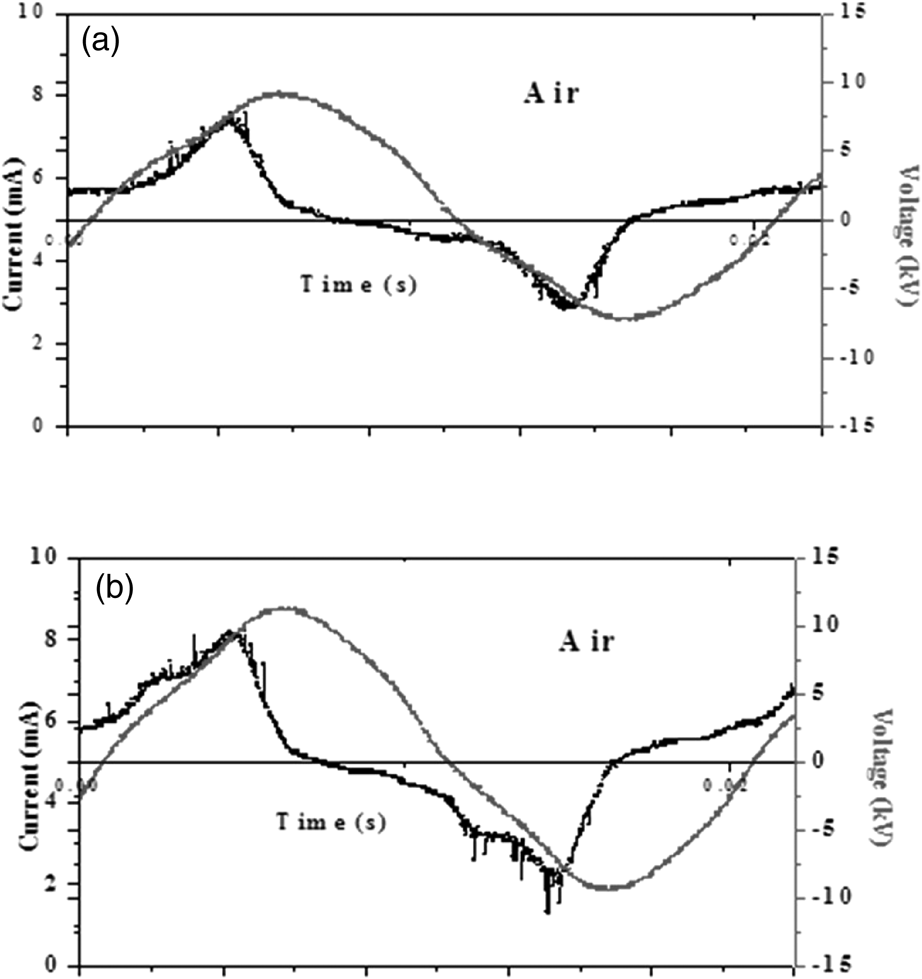
DBD pulses are the visually uniform glow-like discharge plasma consisting of strong filamentary discharges on the surface over the gap between the electrodes that are typical of filamentary barrier discharges. For the duration of the rising and falling voltage half-cycles, the current directions (positive or negative) are distinct. The accumulation of charges on the surface of quartz creates an inverse electrical field along the surface, leading to the quenching of the relatively strong filamentary discharges. The elementary discharges are distributed randomly over the quartz surface and are getting stronger at an increasing gas voltage, resulting in the visually uniform plasma. More discharge channels can be generated by increasing applied voltage as illustrated by the current-voltage waveform for atmospheric pressure air plasma discharge at about (a) 9 KV and (b) 10 KV applied voltage (fig. 2a, b) (Bhesh and Raju, Reference Bhesh and Raju2019). The increase of voltage leads also to the reduction of the duration of micro-discharges, probably due to the higher electric field. At a dielectric surface, the micro-discharge channels spread into surface discharges covering a much larger region than the original channel diameter. Moreover, the discharge power also could be determined by a Lissajous figure as illustrated by the air DBD plasma at about 9, 10, and 11 KV applied voltages (fig. 3); they are an important technique for the electrical characterization of DBDs and can be created by plotting the charge transferred during the discharge and applied voltage (Kostov et al., Reference Kostov, Nishime, Hein and Toth2013). The insect's samples were placed in the gap between two electrodes under atmospheric pressure air and the DBD system is operated using air as a processing gas (fig. 1). Samples of 10 g of wheat grains consisted of 25 larvae and 25 adults for both insects and separately for each treatment in small cloth bags. The insects were exposed to 5.4, 10.15, and 15.9 W for 3, 5, 10, 15, 20, 30, 60, 90, 120, and 150 s for T. castaneum and T. granarium adults and larvae. Three replications were conducted for each insect and control. After treatment, the packaging material containing insect and wheat grains was kept in the incubator under constant conditions (30 ± 1°C, 60 ± 5% RH). Observations on the mortality of adults and larvae were carried out at 24 h and 7 days post-exposure. Mortality percentages were calculated and corrected according to Abbott formula for natural mortality in untreated controls (Abbott, Reference Abbott1925).
Current voltage waveform for atmospheric pressure air plasma discharge at about (a) 9 KV and (b) 10 KV applied voltage.

Lissajous figures of air DBD plasma at about 9, 10, and 11 KV applied voltages.

Microwave treatment
The microwave system (Model MS23K3513AK, 230 V-50 HZ-800 W-2450 MHZ) was used. Samples of 10 g of wheat grains consisting of 20 larvae and 20 adults for both insects were put in Petri dishes. Samples were exposed to 100, 180, and 300 W for 20, 30, 60, 90, 120, and 150 s for T. castaneum and T. granarium adults and larvae. Three replications were conducted for each insect and control. After treatment, the treated samples were packed in small cloth bags and kept in the incubator under constant conditions (30 ± 1°C, 60 ± 5% RH). Observations on the mortality of adults and larvae were carried out at 24 h and 7 days post-exposure. Mortality percentages were calculated and corrected according to Abbott formula for natural mortality in untreated controls Abbott (Reference Abbott1925). The temperatures of the wheat kernels during treatment were monitored using an electronic probe thermometer. The thermometer reading was performed at the end of each treatment. Temperatures 60–90°C have been determined on the samples due to the treatment of microwave.
Wheat grain germination test
The viability of wheat grains post-treated with non-thermal atmospheric pressure plasma and microwave energy was carried out to find the effect of the non-thermal APPD and microwave energy on germination of post-treated wheat grains to LT50's and LT90's levels used in present work as food for the experimental insects at 15.9 and 300 W power level for non-thermal APPD and microwave energy, respectively. The treated seeds were placed on the filter paper in 9 cm Petri dishes and 10 ml of distilled water was added into each dish to create germinating conditions. After that, these samples were incubated in a light incubator at the temperature of 25°C. During the germination and growth, 5 ml of distilled water was added daily to each Petri dish to keep sufficient moisture for germination. The germination percentage was recorded after 7 days.
Biochemical tests
Non-thermal plasma in terms of LT50 was chosen for studying biochemical effects on T. castaneum and T. granarium adults and larvae. Adults and larvae were selected 24 h post-exposure to 15.9 W power level of non-thermal plasma, which caused 50% mortality. Glutathione S-transferase (GST), catalase (CAT), peroxidase, phenoloxidase, lactate dehydrogenase (LDH) were determined according to the methods of Ishaaya (Reference Ishaaya1971), DGCK (1972), Habig et al. (Reference Habig, Pabst and Jakoby1974), Hammerschmidt et al. (Reference Hammerschmidt, Nuckles and Kuc1982), and Aebi (Reference Aebi1984), respectively. Protein contents in adults and larvae extracts were determined using the method described by Bradford (Reference Bradford1976).
Statistical analysis
For statistical analysis, the average percent mortalities of the tested insects were calculated and corrected using Abbott's formula (Abbott, Reference Abbott1925). To get the best fitting of the obtained results, both exposure times and tested powers were transformed to log values (LN (value + 1)). Hence the statistical model becomes Y = a ± b 1 LN (Exposure time + 1) ± b 2 LN (Power + 1). Obtained results were analyzed using Proc Reg in SAS (Anonymous, 2003). This is considered as Multiple Regression Model (determination of the significant effect of multiple factors on one aspect). R 2 values presented the goodness of fitting, while the P values presented the significant probability of the tested factors (i.e. exposure times and tested powers) over 24 h and 7 days. On the other hand, for estimating the expected exposure time to cause 50 and 90% mortality, each set of data (under each tested power for each stage belonging to each pest) that obtained mortality data were fitted to linear relation as Y = a ± b (LN exposure time + 1). Hence 50 and 90% mortality were estimated using the following equations: (LN exposure time + 1) = (50−a)/b and (LN exposure time + 1) = (90−a)/b (for 50 and 90%, respectively). The inverse of obtained values (−1) (i.e. exp values−1) was considered to present the expected exposure times to case 50 and 90% mortality, respectively. To elucidate the general differences between the two pests, stages, and inspection times factorial analysis was conducted using Proc ANOVA in SAS. Means were compared by Tukey's HSD (P = 0.05 level) in the same program. Obtained data from biochemical and germination tests were analyzed as one/two-way ANOVA, in the same program.
Results
The effect of non-thermal APPD on the survival of T. castaneum and T. granarium adults and larvae
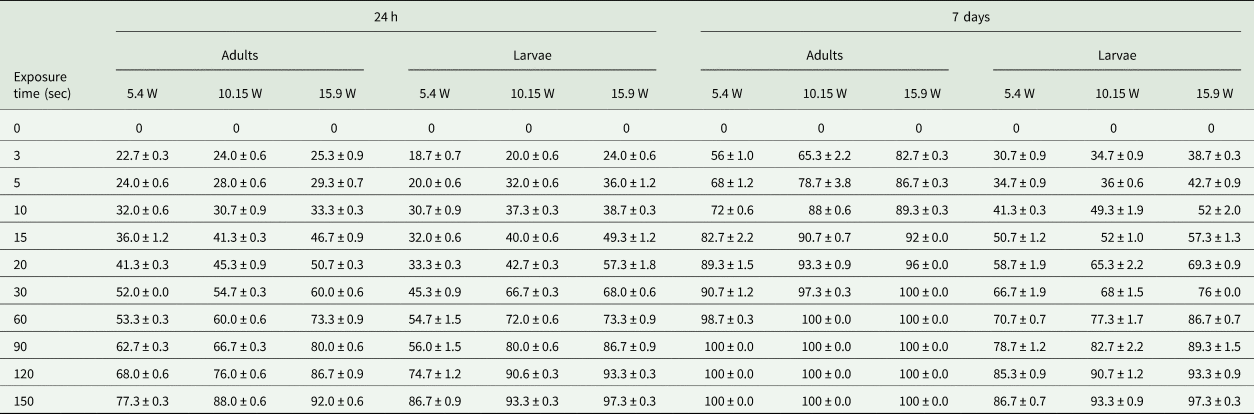
The effect of non-thermal APPD produced with DBD using air as a processing gas on the survival of adults and larvae of T. castaneum 24 h and 7 days post-exposure to different powers for various time periods is shown in table 1. Non-thermal APPD caused 13.3 and 20.0% mortality to T. castaneum adults and larvae, respectively, at 5.4 W power level for an exposure time of 3 s which is increased by increasing the power level to reach 18.3, 25.0% and 20.0, 33.3% mortality at the power levels 10.15 and 15.9 W, respectively, for the exposure time 3 s to T. castaneum adults and larvae, respectively. Moreover, the mortality percentage of T. castaneum adults and larvae was increased by increasing the exposure times and power level to reach 80.0 and 83.3% at 5.4 W power level for an exposure time of 150 s, respectively, which amount to 86.7 and 91.7% for T. castaneum adults and larvae at 15.9 W power level of non-thermal APPD, respectively (table 1). The exposure time of 120, 90, and 60 s to non-thermal APPD at 5.40, 10.15, and 15.90 W power level caused complete mortality to T. castaneum larvae, respectively, 7 days post-exposure. Non-thermal APPD caused 35.0, 40.0, and 58.3% mortality at 5.40, 10.15 and 15.90 W power levels which increased by increasing the exposure times and power level to reach 95.0 and 98.3% mortality to T. castaneum adults, respectively, 7 days post-exposure. Similar conclusions were secured in the case of the mortality of T. granarium adults and larvae. The effect of non-thermal APPD produced with DBD using air as a processing gas on the survival of adults and larvae of T. granarium 24 h and 7 days post-exposure to different powers for various time periods is shown in table 2. The mortality percent was 22.7 and 18.7% at the 3 s, 5.4 W power level for adults and larvae, respectively, 24 h post-exposure to the non-thermal APPD, while it reached 24.0, 20.0% and 25.30, 24.60% at the 3 sec, 10.15 and 15.9 W power level for adults and larvae, respectively, 24 h post-exposure to the non-thermal APPD. Additionally, the mortality percentage of T. granarium adults and larvae was increased by increasing the exposure times and power level to reach 77.3 and 86.7% at the 150 s, 5.4 W power level for adults and larvae, respectively, 24 h post-exposure to the non-thermal APPD, whereas it reached 88.0, 93.3% and 92.0, 97.3% at the 150 s, 10.15 and 15.9 W power level for adults and larvae, respectively, 24 h post-exposure to the non-thermal APPD. While 90.0, 60.0, and 30.0 s exposure to non-thermal APPD caused complete mortality to T. granarium adults at 5.4, 10.15, and 15.9 W power level, respectively, 7 days post-exposure. In addition, non-thermal APPD caused 30.7, 34.7, and 38.7% mortality at 5.4, 10.15, and 15.9 W power levels which increased by increasing the exposure times and power level to reach 86.7, 93.3, and 97.3% mortality to T. granarium larvae, respectively, 7 days post-exposure.
Effect of non-thermal APPD using air as a processing gas on the percentage mortality (mean ± SE) of T. castaneum adults and larvae 24 h and 7 days post-exposure to different powers at various time periods (sec)

Effect of non-thermal APPD using air as a processing gas on the percentage mortality (mean ± SE) of T. granarium adults and larvae 24 h and 7 days post-exposure to different powers at various time periods (sec)

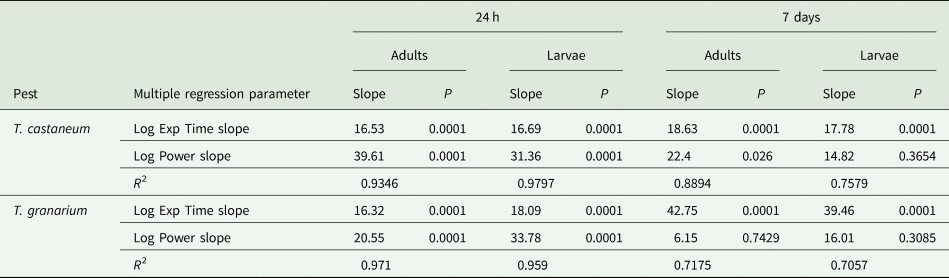
Determination of the significant effect of exposure times and tested power levels of the non-thermal APPD factors on the mortality percent of T. castaneum and T. granarium adults and larvae is presented in table 3. After 24 h post-exposure, both factors (time and power level) were highly significant (P < 0.0001, with R 2 = 0.93, 0.98 and 0.97, 0.96, respectively) to non-thermal APPD. Whereas after 7 days, the main factor that affects the mortality percent of T. castaneum and T. granarium adults and larvae was attributed to the exposure time (P < 0.0001, with R 2 = 0.9, 0.8, and 0.7), respectively.
Determination of the significant effect of exposure times and tested power level factors on the mortality percent of T. castaneum and T. granarium adults and larvae after 24 h and 7 days post-exposure to non-thermal APPD using air as a processing gas

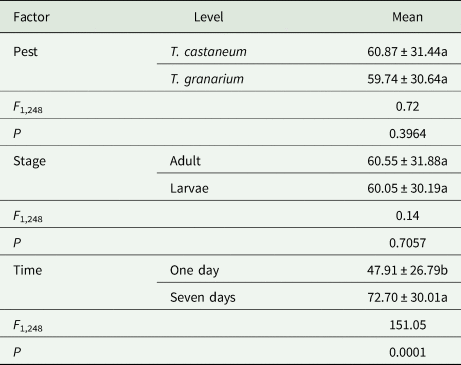
Results of the factorial analysis for the general trend between the two pests, stages, and the time of exposure are shown in table 4. A highly significant effect was recorded due to the exposure time on T. castaneum and T. granarium mortality (F 1,248 = 151.05 and P = 0.0001). The most influential factor that had a massive effect was the exposure time while a non-significant effect was recorded due to the pest and the stages (F = 0.72, P = 0.39 and F = 0.14, P = 0.71), respectively.
Factorial analysis for the general trend between the two pests, stages, and inspection times post-exposure to non-thermal APPD

Means with the same letter are not significantly different.
The effect of microwave energy on the survival of T. castaneum and T. granarium adults and larvae
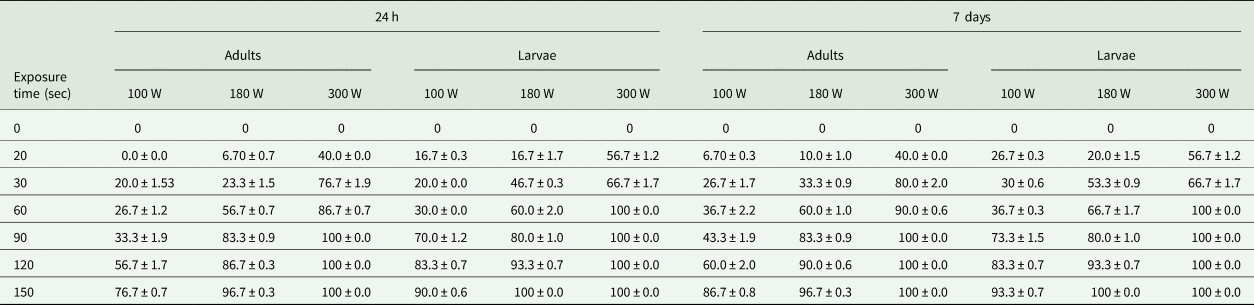
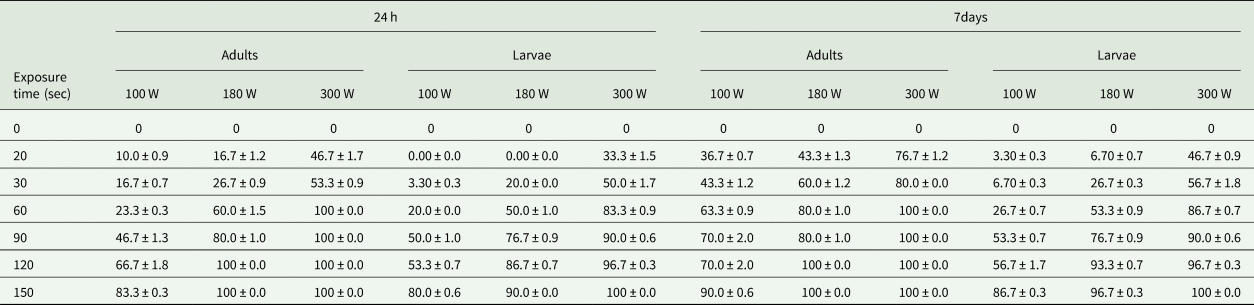
The mortality percent of T. castaneum adults and larvae 24 h and 7 days post-exposure to different powers of microwave energy for various time periods is shown in table 5. The percentage mortality was 20.0% to T. castaneum adults and larvae, respectively, at 100 W power level for an exposure time of 30 s which increased by increasing the power level to reach 23.3, 76.7% and 46.7, 66.7% mortality at the power levels 180 and 300 W, respectively, for the exposure time 30 s to T. castaneum adults and larvae, respectively. The exposure time of 90, 120, and 150 s to microwave energy at 300 W power level caused complete mortality to T. castaneum adults 24 h post-exposure. While the exposure time of 150 s to microwave energy at 180 W power level caused complete mortality to T. castaneum larvae 24 h post-exposure. Moreover, the mortality percentage of T. castaneum adults and larvae was increased by increasing the exposure times and power level of the microwave energy to reach 100% at 300 W power level for an exposure time of 90 and 60 s for T. castaneum adults and larvae, respectively, 7 days post-exposure. Similar results were obtained in the case of the mortality of T. granarium adults and larvae post-exposure to microwave energy 24 h and 7 days post-exposure to different powers for various time periods as shown in table 6. The mortality percent was 23.3 and 20.0% at the 60 s, 100 W power level for adults and larvae, respectively, 24 h post-exposure to the microwave energy, while it reached 100% at the 120 s, 180 W power level for adults and 100% at the 150 s, 300 W power level for larvae 24 h post-exposure to the microwave energy. Furthermore, the mortality percentage of T. granarium adults and larvae was increased by increasing the exposure times and power level of the microwave energy to reach 100% at 180 and 300 W power level for an exposure time of 120 and 150 s for T. castaneum adults and larvae, respectively, 7 days post-exposure.
Effect of microwave energy on the percentage mortality (mean ± SE) of T. castaneum adults and larvae 24 h and 7 days post-exposure to different powers at various time periods (sec)

Effect of microwave energy on the percentage mortality (mean ± SE) of T. granarium adults and larvae 24 h and 7 days post-exposure to different powers at various time periods (sec)

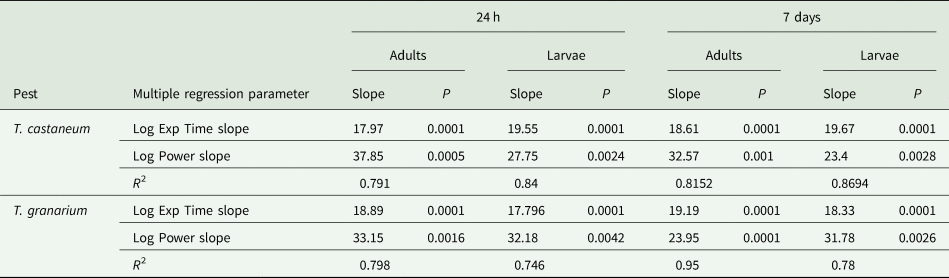
Determination of the significant effect of exposure times and tested power levels of the microwave energy factors on the mortality percent of T. castaneum and T. granarium adults and larvae is presented in table 7. Both factors (time and power level) that affect the mortality percent of T. castaneum and T. granarium adults and larvae were highly significant (P < 0.05, with R 2 = 0.791, 0.84 and 0.798, 0.746, respectively) and (P < 0.05 with R 2 = 0.82, 0.87 and 0.95, 0.78), respectively, 24 h and 7 days post-exposure to the microwave energy.
Determination of the significant effect of exposure times and tested power level factors on the mortality percent of T. castaneum and T. granarium adults and larvae after 24 h and 7 days post-exposure to microwave

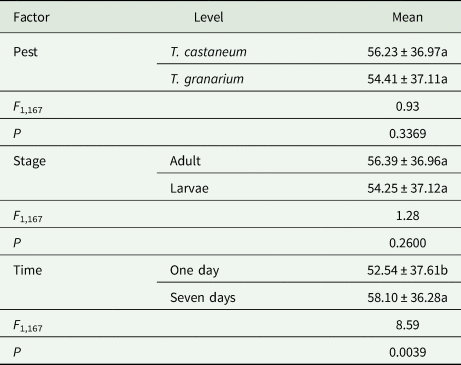
Results of the factorial analysis for the general trend between the two pests, stages, and the time of exposure are shown in table 8. A highly significant effect was noted due to the time on T. castaneum and T. granarium mortality after 24 h and 7 days post-exposure to the microwave energy (F 1,167 = 8.59 and P = 0.0039). The most influential factor that had a massive effect was the exposure time while a non-significant effect was recorded due to the pest and the stages (F = 0.93, P = 0.3369 and F = 1.28, P = 0.26), respectively.
Factorial analysis for the general trend between the two pests, stages, and inspection times post-exposure to microwave energy

Means with the same letter are not significantly different.
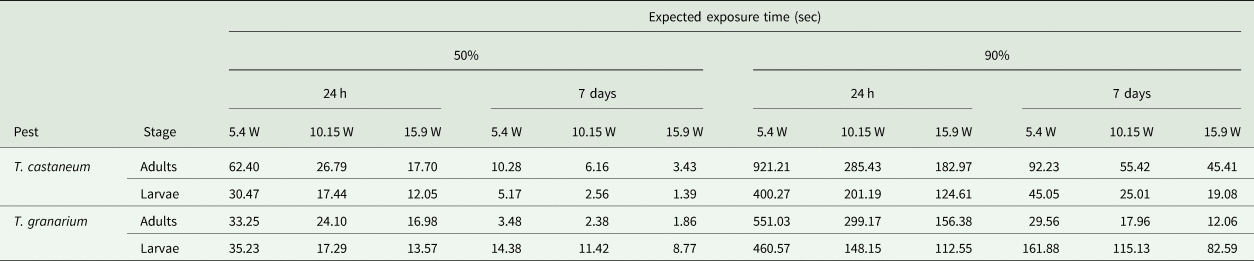
The expected exposure time to cause 50 and 90% mortality for T. castaneum and T. granarium adults and larvae post-exposure to non-thermal APPD and microwave at different power levels after 24 h and 7 days post-exposure is presented in tables 9 and 10. The expected exposure time to cause 50 and 90% mortality values decreased with increased exposure time and power level for both insects after 24 h and 7 days post-exposure to non-thermal APPD and microwave powers. The expected exposure time to cause 90% mortality values for T. granarium larvae was greater than those for the adult stage of the same insect and greater than those of T. castaneum adults and larvae at the same power levels after 7 days of exposure. Trogoderma granarium larvae were the most tolerant life stage to non-thermal APPD and required 161.88, 115.13, and 82.59 s to achieve 90% mortality across the 5.4, 10.15 and 15.9 W power levels, respectively, after 7 days of exposure to non-thermal APPD. Also T. granarium larvae required 10650.44, 388.14, and 103.17 s to achieve 90% mortality at 100, 180, and 300 W power levels, respectively, after 7 days of exposure to microwave energy.
The expected exposure time (sec) caused 50 and 90% mortality for T. castaneum and T. granarium adults and larvae post-exposure to non-thermal APPD using air as a processing gas at different powers after 24 h and 7 days post-exposure

The expected exposure time (sec) caused 50 and 90% mortality for T. castaneum and T. granarium adults and larvae post-exposure to microwave at different powers after 24 h and 7 days post-exposure

The present study investigated the effect of non-thermal APPD application at 15.9 W and microwave energy at 300 W as a power level on the germination of post-treated wheat grains at LT50's and LT90's levels used in the present study (table 11). Our results showed that, even though the germination percent increased as the time of exposure increased, the germination percentage of wheat grains post-exposure to LT50 of tested insects significantly decreased post-exposure to non-thermal APPD 37.0, 29.0, 37.0, 32.0% for LT50 to T. granarium and T. castaneum adults and larvae, respectively, compared to control 63.0% (P < 0.05). On the contrary, the germination percentage of wheat grains post-exposure to non-thermal APPD at LT90 generally, there were non-significantly differences in germination percent after non-thermal APPD treatment 71.0, 67.0, 55.0, and 64.0% at LT90 for T. granarium and T. castaneum larvae and adults, respectively, compared to 63.0% for control (P > 0.05). Our result showed that the plasma grain treatment for an appropriate time of 1.9–3.1 min (112.55–182.97 sec) improved the germination. A decrease of germination started beyond 2.08 min (124.61 sec) was only observed 24 h post-exposure to non-thermal APPD but still insignificant with control (P > 0.05).
Effect of non-thermal APPD at 15.9 W and microwave energy at 300 W on the germination% of wheat grains post-exposure to lethal exposure times at the 50 and 90% level of T. castaneum and T. granarium adults and larvae

Means followed by the same letter are not significantly different using Tukey's HSD test (P = 0.05).
The results of the germination test conducted on wheat grains post-exposure to microwave energy (300 W power level) at LT50's and LT90's levels induced the germination percent decreased as the time of exposure increased table 11. The germination percentage of wheat grains post-exposure to LT50 of tested insects significantly decreased post-exposure to microwave power (300 W) to 52.0, 57.3, and 38.0% for LT50 to T. castaneum and T. granarium adults and larvae, respectively, compared to control 78.0% (P < 0.05). Only a non-significant decreased (66%) was observed post-exposure to microwave power (300 W) for LT50 to T. castaneum larvae compared to control 78.0% (P < 0.05). Moreover, the germination percentage of wheat grains post-exposure to LT90 significantly decreased after microwave treatment to 4, 13, 7, and 0% at LT90 for T. castaneum and T. granarium larvae and adults, respectively, compared to 78% for control (P < 0.05).
Changes in antioxidant enzyme activity in T. castaneum and T. granarium adults and larvae were examined 24 h after exposure to 15.9 W of non-thermal plasma, which caused 50% mortality as shown in table 12. In the present study, the results of measurements of CAT activity showed an increase in its level and was significantly higher in larvae of both insects and adults of T. granarium compared to that in the control (P < 0.05). The CAT activity showed no significant changes among T. castaneum adults (P > 0.05) compared to that in the control.
Changes in antioxidant enzyme activity and total proteins (mean ± SE) in T. castaneum and T. granarium adults and larvae 24 h after exposure to lethal exposure times 50% level at 15.9 W power level of non-thermal APPD using air as a processing gas

Means followed by the same letter are not significantly different using Tukey's HSD test (P = 0.05).
The results of measurements of GST activity showed a significant increase in the activity of GST in adults’ stage of both insects compared to that in the control (P < 0.05). While a significant decrease in the activity of GST in larval stages of both insects is observed compared to control (P < 0.05) after 24 h of non-thermal APPD application.
Data presented in table 12 revealed that a significant decrease in peroxidases activity was recorded in all stages in both insects after 24 h of non-thermal APPD application than in controls (P < 0.05).
By comparing the levels of LDH and phenol oxidase (PO) in both T. castaneum and T. granarium in larval and adult stages after 24 h of non-thermal APPD application, it was found that in LDH and PO levels significantly changed in adult stages of both insects and the larval stage for T. granarium compared to control (P < 0.05). Whereas there were no significant differences in the activity of LDH and PO levels in the larvae of T. castaneum treated with non-thermal APPD opposed to controls (P > 0.05) 24 h post-exposure.
On the other hand, when comparing the total protein levels in T. castaneum and T. granarium post-exposure to 24 h of non-thermal APPD application, it was found that the total protein significantly decreased in T. castaneum in both adults and larval stages compared to control (P < 0.05) (table 12). However, there was a non-significant decrease in the total protein levels in T. granarium in both adults and larvae stages treated with non-thermal APPD as opposed to controls (P > 0.05) 24 h post-exposure.
Discussion
Various insects cause quantitative and qualitative losses in stored products every year. Chemical pesticides are widely used to control stored product pests (Konradsen et al., Reference Konradsen, Van Der Hoek, Cole, Hutchinson, Daisley, Singh and Eddleston2003). Concerns about resistance to insecticides, as well as their environmental impact, have stimulated researchers to find out an alternative pest control method. Results obtained revealed that non-thermal APPD and different powers of microwave energy showed an effective method against the T. castaneum and T. granarium adults and larvae at various treatments and the mortality percentage which is investigated with independent variables: applied power and exposure time. The results indicated that there was a positive relationship between mortality rates of T. castaneum and T. granarium and both power levels and exposure times of non-thermal APPD and microwave. The mortality percent was found to be power and time-dependent 24 h and 7 days post-exposure, i.e. increased with increasing applied power and with increasing exposure treatment time. In case of the microwave, the main reason for this positive relationship could be due to the increase in the frequency oscillation of the water molecules in the body of treated insects (Zhao et al., Reference Zhao, Qiu, Xiong and Cheng2007; Valizadegan et al., Reference Valizadegan, Pourmirza and Safaralizadeh2009). Vadivambal et al. (Reference Vadivambal, Jayas and White2006) reported that the use of microwaves is based on the dielectric heating effect produced in grain, which is a relatively poor conductor of electricity. An attractive feature of insect control using microwave energy is that the insects are heated at a faster rate than the product they infest because of the high moisture content of insects. So, it is possible to heat the insects to a lethal temperature because of their high moisture content while leaving the drier foodstuff unaffected or slightly warm.
But in the non-thermal APPD, the main reason for this positive relationship could be due to the increase in the chemical species, including ROS noted for their catalytic activity and biological significance, highly energetic electrons, electromagnetic radiation, and thermal effects, which individually and synergistically affect the treated target (Lu et al., Reference Lu, Laroussi and Puech2012; Bazaka et al., Reference Bazaka, Jacob and Ostrikov2015). These effects have been exploited to induce stress, thus may stimulate the death that occurred in larvae and adults due to oxidative stress of plasma in this work. Exposure to plasma may damage the cuticle and epidermis and produce damage signals to attract hemocytes to the affected area. This might cause further clotting and melanization which is a defensive response trying to heal the damage due to ROS by the disintegration of fat bodies. Similar responses were found in Drosophila melanogaster larva by Ferreira et al. (Reference Ferreira, Gomes, Benilov and Khadem2016).
One hundred percent mortality was achieved for T. castaneum larvae and T. granarium adults at 5.4 W for an exposure time of 120 and 90 s to non-thermal APPD, respectively. While complete (100%) mortality was achieved for T. castaneum adults and larvae at 300 and 180 W for an exposure time of 90 and 150 s to the microwave power, respectively. Whereas for T. granarium adults and larvae 100% mortality was achieved at 180 and 300 W for an exposure time of 120 and 150 sec to the microwave power, respectively; a similar observation was found by Vadivambal et al. (Reference Vadivambal, Deji, Jayas and White2010) who evaluated the potential of microwave radiation to eliminate larval and adult stages of T. castaneum at 600 W for an exposure time of 14 s. The results are to some extent consistent with that reported by Ahmady et al. (Reference Ahmady, Mousa and Zaitoun2016), who studied the microwave radiation effect on T. confusum and Callosobruchus maculatus at 400 W and found that complete mortality of T. confusum adults was obtained at 25 s, whereas 98.8% mortality percentage was obtained at the same exposure time for C. maculatus adults. Zinhoum et al. (Reference Zinhoum, Negm, Abd-El Hameed and Afify2019) stated that adult mortality of Stegobium paniceum increased by increasing the exposure time at different exposure powers of microwave (low, medium, and high). The mortality of pulse beetle was found to increase with the increase in microwave exposure time and power level or both (Singh et al., Reference Singh, Singh and Kotwaliwale2012).
The effect of non-thermal APPD was studied against insects by Mishenko et al. (Reference Mishenko, Malinin, Rashkovan, Basteev, Bazyma, Mazalov and Kutovoy2000). They found that treating S. granarius using a combination of radiation and plasma discharge resulted in 100% mortality. Keever et al. (Reference Keever, Dowdy, Bures, Hankins and Bourham2001) used a helium-based non-thermal APPD to treat Lasioderma serricorne. They found that a 70 s exposure to the non-thermal APPD resulted in 92% mortality of adults 2 days after treatment. By changing some variables, such as time, the insecticidal effect of plasma can be changed. In accordance with Donohue et al. (Reference Donohue, Bures, Bourham and Roe2006), our results showed that the major influence on the mortality for both pests was achieved with exposure time and different power levels 24 h post-exposure to non-thermal APPD and microwave energy. On the other hand, the exposure time had the foremost effect on the mortality for both pests at different power levels 7 days post-exposure to non-thermal APPD with no effect of the applied power. While both factors (time and power level) had the foremost effect on the mortality percent of T. castaneum and T. granarium adults and larvae post-exposure to microwave energy. Microwave heating can effectively eliminate insects of all life stages (egg, young larva, old larva, pupa, and adult) from stored grains at the optimum microwave power and LT (Vadivambal et al., Reference Vadivambal, Jayas and White2008; Purohita et al., Reference Purohita, Jayasa, Yadav, Chelladuraia, Fields and White2013).
The expected exposure time to cause 50 and 90% mortality values decreased with increased exposure time and power level for both insects after 24 h and 7 days post-exposure to non-thermal APPD and microwave energy. It was found that microwave was more effective after 24 h, while non-thermal APPD plasma was more effective after 7 days. The smaller the LT50 and LT90 the better, so the time needed to kill the T. castaneum and T. granarium adults and larvae is decreased, so the time efficiency was achieved. These findings are in harmony with that of Zinhoum et al. (Reference Zinhoum, Negm, Abd-El Hameed and Afify2019). Trogoderma granarium larvae were the most tolerant life stage to both non-thermal APPD and microwave energy. The expected exposure time to cause 90% mortality values for T. granarium larvae was greater than those for the adult stage of the same insect and greater than those of T. castaneum adults and larvae at the same power levels after 7 days of exposure to non-thermal APPD and microwave energy. While T. granarium adults and T. castaneum larvae were the most susceptible to both non-thermal APPD and microwave powers. Increases in time had the intense effect of increasing susceptibility of all life stages and species. A decrease in the exposure time was estimated to achieve target levels of mortality in nearly all cases with each increase in power levels. One explanation is that the presence of long dense larval hairs reduces the direct body exposed to the non-thermal APPD and microwave energy. In addition, the presence of the food source provided when larvae are exposed to the non-thermal APPD and microwave powers may have helped to reduce larval exposure or provided a means for larvae to limit or escape exposure (Toews et al., Reference Toews, Campbell and Arthur2010; Kharel et al., Reference Kharel, Arthur, Zhu, Campbell and Subramanyam2014). Trogoderma granarium adults were generally more susceptible than larvae. However, the greater mortality obtained for adults could be due to the absence of long dense hairs similar to larvae. These results agree with those obtained in a recent study using three species of T. granarium. Results show consistently that adults are more susceptible to insecticides compared to larvae (Athanassiou et al., Reference Athanassiou, Kavallieratos, Boukouvala, Mavroforos and Kontodimas2015; Ghimire et al., Reference Ghimire, Arthur, Myers and Phillips2016).
Reactive species such as hydrogen peroxide and nitric oxide are known to have effects on many developmental processes in plants (Domingos et al., Reference Domingos, Prado, Wong, Gehring and Feijo2015; Mittler, Reference Mittler2017). The oxidative stress of plasma effects has been exploited to induce stress and thus selectively stimulate seed germination (Ji et al., Reference Ji, Choi, Pengkit, Im, Kim, Kim, Park, Hong, Jung, Choi and Park2016; Zhou et al., Reference Zhou, Zhou, Zhang, Zhuang, Yang, Bazaka and Ostrikov2016). Generally, our results revealed that wheat grains viability (in terms of wheat germination) was increased by increasing the time of non-thermal APPD application. Exposure time to cause 50% mortality significantly decreased post-exposure to non-thermal APPD compared to exposure time to cause 90% mortality. These data indicated that non-thermal APPD at this time did not harm the wheat grains, i.e. normal texture, color and appearance, germination percent only were influenced. Germination of wheat grains treated with LT90's levels of non-thermal APPD showed that the plasma grain treatment for an appropriate time that ranged from 1.9 to 3.1 min (112.55–182.97 sec) improved the germination. Germination acceleration is further enhanced with an increase of exposition time from 11% for 3 min plasma treatment to around 40% for 30 min plasma treatment of germinated wheat grains (Nishime et al., Reference Nishime, Wannicke, Horn, Weltmann and Brust2020). A similar result was found in the study of Los et al., (Reference Los, Ziuzina, Akkermans, Boehm, Cullen, Van Impe and Bourke2018); short plasma treatment had a minimal positive influence on the germination rate of wheat. In the experiment described in Ziuzina et al. (Reference Ziuzina, Los, Akkermans, Boehm, Cullen, Van Impe and Bourke2018), the grain germination percentage of samples treated for up to 5 min was not affected, but it was decreased after 20 min of non-thermal plasma treatment. Our results go in line with those of Jiafeng et al. (Reference Jiafeng, Xin, Ling, Jiangang, Hanliang, Qilai, Renhong and Yuanhua2014) who mentioned a significant increase in the germination potential of wheat grains post-exposure by cold plasma. Also, as reported in the available study, using DBD plasma with various surrounding gases (oxygen, air, argon, and nitrogen), they observed a significant increase of germination potential by 24.0, 28.0, and 35.5% after 4 min of exposure (Meng et al., Reference Meng, Qu, Wang, Sun, Liang and Hu2017). Li et al. (Reference Li, Wang, Meng, Qu, Sun, Liang and Hu2017) reported that wheat grains germination increased after 7 min of non-thermal plasma treatment. Gidea et al. (Reference Gidea, Magureanu, Teodorescu, Iosub and Cimpoceriu2017) showed that the plasma grain treatment for an appropriate time improved the germination rate, speed of germination, and speed of growth in the early stage. The same authors also presented the hypothesis that the changes in the wheat grain germination characteristics suggested an appropriate DBD plasma treatment dose to promote wheat grain germination. Also, the grains treated for 3 and 6 min had the highest germination rate of 95–100% (Roy et al., Reference Roy, Hasan, Kabir, Reza, Talukder and Chowdhury2018a). However, further increments of non-thermal plasma treatment time caused a non-significant decrease in the germination rate. Similarly, Roy et al. (Reference Roy, Hasan, Talukder, Hossain and Chowdhury2018b) reported that germination rate, germination index, and vigor index increased for all used exposition times and atmospheres, with an optimal exposure time of 6–9 min. Los et al. (Reference Los, Ziuzina, Akkermans, Boehm, Cullen, Van Impe and Bourke2018) stated that short plasma treatment had minimal influence on the germination rate of wheat; however, extending treatment time up to 20 min negatively affected this qualitative parameter. In the experiment described in Ziuzina et al. (Reference Ziuzina, Los, Akkermans, Boehm, Cullen, Van Impe and Bourke2018), the grain germination percentage of samples treated for up to 5 min was not affected, but it was decreased after 20 min of non-thermal plasma treatment. In conclusion, the enhancement of the wheat seed germination depends on the cold plasma dose; the dose value of RONS can play an essential role in the control of growth and improvement of plants (Matra, Reference Matra2016).
Microwave radiation is often broadly classified and induces thermal and non-thermal effects in the biological system of plant seeds which depends mainly on power (Lazim and Ramadhan, Reference Lazim and Ramadhan2020). A significant decrease (P < 0.05) in wheat grain germination was observed after treatment with microwave energy at a power level of 300 W at LT50. The negative effect of all microwave treatments on germination percent increased with increasing exposure time (LT90). A shorter exposure time (10.8 s) showed a stimulating effect than the longer one. These results are in line with Wang et al., (Reference Wang, Wang and Guo2018) who found that the best germination percentage appeared when exposing the wheat grains for 10 s to microwave radiation. Similar results have been reported for bean (Tomasz, Reference Tomasz2015) and pepper seeds (Matwijczuk et al., Reference Matwijczuk, Kornarzyñski and Pietruszewski2012). While the longer exposure time (LT90) of microwave radiation treatment of wheat grains had an inhibitory effect on germination percent. These results are in resemblance to the research evidence obtained by Aladjadjiyan (Reference Aladjadjiyan2010) who study the influence of microwave irradiation treatment with the frequency of 2.45 GHz on the germination of lentil seeds that ascertained that longer exposure time had an inhibitory effect on plant development as well as the higher output power of microwave irradiation. The increase in the microwave seed exposure level to microwave showed a significant negative effect on seed germination (Lazim and Ramadhan, Reference Lazim and Ramadhan2020). Similar results for corn seed have been reported by Ashabahebwa et al. (Reference Ashabahebwa, Wang-Hee and ByoungKwan2015). Further increase in the exposure time and power level leads to increasing rate and extent of physical damage and thus leads to hard negative results (Kuzugudenli, Reference Kuzugudenli2018). Also, the vibration of water molecule dipoles induced by microwave radiation is another effect of microwave on water molecules within the seed plant that give a thermal effect that affects the reaction rate in biological processes according to van Hoff's rule and Arrhenius, the law affects reaction rate in biological processes. Some studies have shown positive and negative impacts of microwave on the germination of wheat grain cultivars (Nikulin et al., Reference Nikulin, Kovalev and Chang2009; Lakshmappa et al., Reference Lakshmappa, Seema, Ramachandran and Manmohan2011; Abdelghafar, Reference Abdelghafar2015). The present research revealed that there is a significant increase (P < 0.05) in the activity of CAT in the larvae of both insects and adults of T. granarium and also no significant difference (P > 0.05) among T. castaneum adults compared to that in the control. Consequently, the increase in CAT activity after the treatment of adults and larvae with non-thermal APPD could be expected in order to scavenge hydrogen peroxide. CAT is one of the most potent catalysts known. This enzyme catalyzes the dismutation of two molecules of H2O2, a powerful and potentially harmful oxidizing agent, to water and molecular oxygen (Karra et al., Reference Karra, Pulvin, Meziani, Thomas, Touraud and Kunz2003). Several researchers have found similar results for the activity of CAT in insect bodies under different stress conditions (Krishnan and Kodrík, Reference Krishnan and Kodrík2006; Fahmy, Reference Fahmy2012; Madhusudhan et al., Reference Madhusudhan, Iresh-Kumar, Singh, Sinha, Kirankumar and Prasad2012). In consistence with our results, Abd El-Aziz et al. (Reference Abd El-Aziz, Mahmoud and Elaragi2014) reported that there was a significant change (P < 0.05) in the enzymes of the antioxidant defense system to maintain homeostasis in P. interpunctella after atmospheric pressure plasma jet treatment as a result of the oxidative stress due to radicals.
Also, part of the system is GST which catalyzes the conjugation of glutathione reductase to nucleophilic xenobiotics or cellular components damaged by oxyradical attack resulting in their detoxification (Vontas et al., Reference Vontas, Small and Hemingway2001; Fahmy Reference Fahmy2012) that proved that GST is involved in the inactivation of toxic lipid peroxidation products accumulated during destructive processes caused by two insect growth regulators which enhance the oxidative stress and antioxidant efficiency of the cotton leafworm, Spodoptera littoralis.
Peroxidases provide one of the protective mechanisms in the cell against any harmful effects of free radicals (Iiyama et al., Reference Iiyama, Chieda, Lee, Kusakabe, Yasunaga-Aoki and Shimizu2007). Peroxidases are antioxidants and have a significant role in the regulation of cell life, proliferation, and death. It prevents damage to important cellular components caused by ROS. It has been involved in cell protection from the noxious effect of excess oxidant stress (Pompella et al., Reference Pompella, Athanase, Aldo, Vincenzo De and Alessandro2003). According to our results, peroxidases play an important role in protecting cells in all stages in both insects against the antioxidant effect of non-thermal APPD application, as a significant decrease in the level of its activity was observed in treatment compared to control after 24 h. The lower titer of peroxidases in this study may be due to its consumption in scavenging the generated ROS. Similar results were mentioned in Bacillus thuringiensis-treated Aedes caspius larvae where B. thuringiensis inhibited induction of the anti-stress factor, peroxidases, and hence larvae died within 24 h of treatment (Ahmed, Reference Ahmed2011). The depletion of peroxidases because of oxidative stress is another possible reason for the observed rise in the peroxidase level in the tissues of organisms (Vijayavel and Balasubramanian, Reference Vijayavel and Balasubramanian2009). Our result agrees with the finding of Pankaj et al. (Reference Pankaj, Misra and Cullen2013) who reported that cold plasma has been reported to inactivate a range of enzymes such as polyphenol oxidase and peroxidase.
The results revealed in this study indicated the potential of these enzymes considered as an indicative criterion to the degree of damaged occurred in T. castaneum and T. granarium after 24 h of non-thermal APPD application. These results go with that of Brown et al. (Reference Brown, Cook, Lipton and Coleman2012) who concluded that LDH is an enzyme that is expressed at high levels when the cell is exposed to stress and/or damaged. Also, LDH is used as an indicative criterion of exposure to chemical stress or toxic materials (Wu and Lam, Reference Wu and Lam1997; Nathan et al., Reference Nathan, Kalaivani, Chung and Murugan2006). The LDH is a parameter that is widely used in toxicology and clinical chemistry to diagnose cell, tissue, and organ damage (Ribeiro et al., Reference Ribeiro, Guilhermino, Sousa and Soares1999). The current results of disturbed LDH activity in T. castaneum and T. granarium by non-thermal APPD application indicate that this technique of the treatment might be affecting the synthesis or functional levels of LDH, directly or indirectly by altering the cytomorphology of the cells. Also, the induction or inhibition of the LDH activities as recorded in the present study might be on molecular levels, referred to as depression or mutations of the regulating genes responsible for the biosynthesis of polypeptide chains building this enzyme (Bencheraiet et al., Reference Bencheraiet, Kherrab, Kabouche, Kabouche and Maurice2011; Bhandary et al., Reference Bhandary, Kumari, Bhat, Sharmila and Bekal2012). Also, Qari et al. (Reference Qari, Abdel-Fattah and Shehawy2017) reported that LDH activity has been disturbed by plant extracts and insecticides as reported in the available study.
Differently, the total protein levels were insignificantly decreased in T. granarium adults and larvae compared to control. Free radicals can adversely alter proteins and can result in loss of enzyme activity (Devasagayam et al., Reference Devasagayam, Tilak, Boloor, Sane, Ghaskadbi and Lele2004). The consequences of protein damage as a response mechanism to oxidative stress are loss of enzymatic activity, altered cellular functions such as energy production, interference with the creation of membrane potentials, and changes in the type and level of cellular proteins (Grune, Reference Grune2020). Proteins are major targets for radicals and two-electron oxidants in biological systems due to their abundance and high-rate constants for reaction (Michael, Reference Michael2016). Consequently, increased oxidative stress leads to enhanced regulation of antioxidants and these processes had been mirrored in insect physiological adaptations and resistance. Once inside the cell, ROS can induce significant damage (P < 0.05) to intracellular components of the organism, including carbohydrates, lipids, proteins, and nucleic acids, affecting cellular metabolism, and, at sufficiently high concentration, leading to cell death (Jukapli and Bagheri, Reference Jukapli and Bagheri2016; Tallósy et al., Reference Tallósy, Janovák, Nagy, Deák, Juhász, Csapó, Buzás and Dékány2016).
Conclusion
Current technologies involve the use of non-chemical processes that are effective in disinfesting insect pests in stored grains. However, they come with their specific own set of challenges, based on the results of microwave disinfestation, it is considered a safe method to other quarantine methods and can avoid problems of food safety and environmental pollution. Complete mortality, that is, 100% could be achieved using microwave energy in a short time. Although microwaves have the potential for disinfecting the food products, they have not been used widely because there are no industrial installations that can treat deep in the grain bulk. It is possible to use microwave energy on thin layers on belts but not in bulk. The microwave technology needs to be further developed to meet industry needs and provide economically feasible installations that can compete with existing storage insect control technologies.
Non-thermal plasma is a recently proposed emerging field and one potential topic is pest control in stored products. The plasma generated at atmospheric pressure should be further investigated as an alternative non-toxic pest control method to control pests in stored products as it does not leave any chemical residue on the treated food products. Further studies are required in the design and development of commercial and continuous cold plasma treatment and what the economic, ecological, and consumer benefits and acceptability are.
Acknowledgements
We are grateful to Prof. Dr Mohamed Abou Seta who is responsible for Statistical Department Lab., Plant Protection Research Institute, Agricultural Research Center, Dokki, Giza, Egypt for aiding in statistical analysis and advice on data handling, and we benefited from helpful conversations with him.