Introduction
Studies based on the behavioral theory of the firm have opened the black box of firms’ decision-making and propose answers about how managers with bounded rationality make decisions in an uncertain environment (March & Simon, Reference March and Simon1958; Cyert & March, Reference Cyert and March1963). Performance feedback-based learning (Greve, Reference Greve2003b) is one of the mechanisms managers use. A central tenet of the performance feedback model is that managerial behavior depends on a satisfactory performance level, the ‘aspiration level,’ which is compared with actual performance. When managers evaluate their firm’s performance, they need a reference for comparison; this is usually their past companies or industry peers they consider comparable, for whom reference performance levels are historical or social aspirations (Greve, Reference Greve2003b; Bromiley, Reference Bromiley2005). Although historical performance feedback is relatively well-defined, little attention has been paid to social reference groups, a critical source of firm heterogeneity (Hu, He, Blettner, & Bettis, Reference Hu, He, Blettner and Bettis2017).
Although the reference group is a core concept in performance feedback-based learning studies, it is usually taken as a given and fixed over time (e.g., industry peers, a strategic group, or a group of firms). One exception is Massini, Lewin, and Greve (Reference Massini, Lewin and Greve2005), who examine heterogeneous reference groups to explain why some firms persistently innovate while others imitate. The studies that consider reference groups as heterogeneous across strategic groups and innovation types usually assume that reference groups are unique, stable, and internally homogeneous (Fiegenbaum & Thomas, Reference Fiegenbaum and Thomas1995; Massini, Lewin, & Greve, Reference Massini, Lewin and Greve2005). A recent study on German soccer league (Bundesliga) clubs (Moliterno, Beck, Beckman, & Meyer, Reference Moliterno, Beck, Beckman and Meyer2014) suggests that two socially derived performance benchmarks, a reference group threshold and a top performance threshold, challenge the research practice of using average performance within the reference group. However, this study still considers the reference group as externally given and stable over time.
This study focuses on social comparison and reference groups. Festinger (Reference Festinger1954) introduced social comparison theory. In his seminal work, he stated that individuals have a fundamental drive to evaluate their abilities and opinions so as to obtain self-knowledge through comparison to others. In real-world settings, social comparison theory has played a key role in delineating how boundedly rational actors choose comparison groups and how they react to performance evaluation via social comparison (e.g., Wheeler & Miyake, Reference Wheeler and Miyake1992; Buunk & Gibbons, Reference Buunk and Gibbons2007; Yip & Kelly, Reference Yip and Kelly2013). Notwithstanding these reference group advances, empirical research at the firm level remains scant, and a thorough theoretical exploration of how a firm’ reference group evolves over time in response to performance below social aspirations (PBSAs) (interchangeable with social performance shortfalls) is required.
We attempt to improve the realism and precision of performance feedback models by positing that the very construct of a reference group is not only heterogeneous across firms but also malleable within the firm. As Porac, Thomas, Wilson, Paton, and Kanfer (Reference Porac, Thomas, Wilson, Paton and Kanfer1995) note in their study on the Scottish knitwear industry, the dominant theories of competition fail to account for role of managers’ mindset in market competition with rivals. Questions such as who the competitors are and which competitive dimension is critical for identifying competitors are fundamental to the nature of market competition. In this line of thinking, managers’ cognitive identification of a reference group or competitors creates market rivalry (Baum & Lant, Reference Baum and Lant2003; Kim & Tsai, Reference Kim and Tsai2012), resulting in the plausible inference that managers have their own reference group and that their mindset and cognition, of which performance feedback may be the precursor, would influence changes in reference group.
This study’s main research question is how a reference group evolves with PBSAs over time. To our knowledge, no earlier study has suggested social performance shortfalls as the source of reference group change. Based on the behavioral theory of the firm, social psychology (self-enhancement and self-improvement), social identity (social creativity strategies), and the impression management literature, we attempt to explain how performance below the social aspiration level influences a firm’s propensity to replace reference group member firms and the extent to which the reference group changes downward or upward in terms of average performance. To test our hypotheses, we analyze a sample of firms from the Dow Jones Industrial Average (DJIA) and their reference group firms identified in annual proxy statements from 1993 to 2008. Our findings indicate that managers can choose to change their reference group as an alternative to organizational search or risk-taking and explain the evolution of reference groups and aspiration levels.
Our study provides an important theoretical contribution. It advances performance feedback-based learning by extending the range of reactions to performance feedback into a cognitive adaptation – reference group change. Although earlier studies on performance feedback-based learning have focused on action-centered responses such as research and development (R&D) expenditures (Greve, Reference Greve2003a; Chen & Miller, Reference Chen and Miller2007; Vissa, Greve, & Chen, Reference Vissa, Greve and Chen2010), expansion and growth (Audia & Greve, Reference Audia and Greve2006; Greve, Reference Greve2008), mergers and acquisitions (Haleblian, Kim, & Rajagopalan, Reference Haleblian, Kim and Rajagopalan2006; Iyer & Miller, Reference Iyer and Miller2008), and organizational misconduct (Harris & Bromiley, Reference Harris and Bromiley2007; Mishina, Dykes, Block, & Pollock, Reference Mishina, Dykes, Block and Pollock2010), we illuminate a cognition-centered adaptation to social performance shortfalls through the empirical evidence of reference group change, thereby widening the range of reactions to performance feedback into a cognitive adaptation.
Literature review and hypotheses
The behavioral theory of the firm posits that managers construct organizational aspiration levels, clearly dividing performance into success and failure. When a firm does not meet its aspiration or goal, managers judge it a failure (Cyert & March, Reference Cyert and March1963; Greve, Reference Greve2003b). They then start a problemistic search for solutions, beginning where the problem was detected, in order to find solutions in the vicinity of the problem and current alternatives. The search continues until they find a satisfactory solution. Managers conduct increasingly complex (distant) searches if they cannot find a solution by following the ‘neighborhood of the symptom’ rule or the ‘neighborhood of the existing policy’ rule (Cyert & March, Reference Cyert and March1963: 169–170).
The behavioral theory of the firm, focusing on the relationship between performance feedback and organizational search, has accumulated a significant amount of empirical evidence, not only concerning corporate risk-taking (Singh, Reference Singh1986; Bromiley, Reference Bromiley1991; Wiseman & Bromiley, Reference Wiseman and Bromiley1996) but also in various other contexts, such as R&D expenditures (Greve, Reference Greve2003a; Chen & Miller, Reference Chen and Miller2007; Vissa, Greve, & Chen, Reference Vissa, Greve and Chen2010), expansion and growth (Audia & Greve, Reference Audia and Greve2006; Greve, Reference Greve2008), mergers and acquisitions (Haleblian, Kim, & Rajagopalan, Reference Haleblian, Kim and Rajagopalan2006; Iyer & Miller, Reference Iyer and Miller2008), divestments of previously acquired units (Shimizu, Reference Shimizu2007), alliance partnerships (Baum, Rowley, Shipilov, & Chuang, Reference Baum, Rowley, Shipilov and Chuang2005), changes in market position (Greve, Reference Greve1998b), strategic convergence and divergence (Park, Reference Park2007; Schimmer & Brauer, Reference Schimmer and Brauer2012), organizational misconduct (Harris & Bromiley, Reference Harris and Bromiley2007; Mishina et al., Reference Mishina, Dykes, Block and Pollock2010), internal capital allocation (Arrfelt, Wiseman, & Hult, Reference Arrfelt, Wiseman and Hult2013), and new product introduction (Audia & Brion, Reference Audia and Brion2007; Gaba & Joseph, Reference Gaba and Joseph2013).
However, several contingencies affect how the main effects of performance feedback impact organizational actions. These contingencies influence a firm’s propensity to undertake a problemistic search or engage in risky actions under threat. Examples include bankruptcy risk (March & Shapira, Reference March and Shapira1992; Miller & Chen, Reference Miller and Chen2004; Chen & Miller, Reference Chen and Miller2007), organizational learning (Haleblian, Kim, & Rajagopalan, Reference Haleblian, Kim and Rajagopalan2006; Desai, Reference Desai2008), organizational legitimacy (Desai, Reference Desai2008), future performance prospects (Chen, Reference Chen2008), corporate structure (Vissa, Greve, & Chen, Reference Vissa, Greve and Chen2010; Gaba & Joseph, Reference Gaba and Joseph2013), corporate culture (O’brien & David, Reference O’brien and David2014), corporate status and distinctiveness (Kim & Rhee, Reference Kim and Rhee2017), executives’ social network ties (Mcdonald & Westphal, Reference Mcdonald and Westphal2003), and the chief executive officer’s compensation profile (Lim & Mccann, Reference Lim and Mccann2013).
Managers have multiple aspiration levels and performance measures (Cyert & March, Reference Cyert and March1963; Greve, Reference Greve2003b; Bromiley, Reference Bromiley2005). One of these may become relevant for performance evaluation, while another may be more critical under other circumstances (Short & Palmer, Reference Short and Palmer2003; Labianca, Fairbank, Andrevski, & Parzen, Reference Labianca, Fairbank, Andrevski and Parzen2009; Moliterno et al., Reference Moliterno, Beck, Beckman and Meyer2014). Therefore, scholars have investigated issues such as when and how managers shift their attention from one dimension to another in evaluating performance. Survival may replace aspiration when firms are close to bankruptcy, which influences risk-taking tendencies (March & Shapira, Reference March and Shapira1992; Shapira, Reference Shapira1994; Miller & Chen, Reference Miller and Chen2004). Managers shift their focus between historical and social aspirations (Short & Palmer, Reference Short and Palmer2003; Baum et al., Reference Baum, Rowley, Shipilov and Chuang2005); between different performance metrics, such as profitability, size, network status, and growth (Baum et al., Reference Baum, Rowley, Shipilov and Chuang2005; Audia & Brion, Reference Audia and Brion2007; Greve, Reference Greve2008); between internal technology and external market searches (Vissa, Greve, & Chen, Reference Vissa, Greve and Chen2010); between multiple reference points, such as prior performance, prior aspiration, and prior performance of reference groups (Blettner, He, Hu, & Bettis, Reference Blettner, He, Hu and Bettis2015); and between economic and political reference points (Hu et al., Reference Hu, He, Blettner and Bettis2017).
Although studies have pioneered a new research stream on the effect of performance feedback-based learning, the literature is missing a link between performance feedback and organizational search. Even though the reference group is a fundamental concept in performance feedback-based learning studies, it is generally assumed that reference groups are externally given, internally homogeneous, and stable over time (e.g., industry peers, a group of firms, or a strategic group). For instance, social aspiration is usually defined in terms of the average performance across industry incumbents, which are considered the reference group of comparable firms (Greve, Reference Greve2003b). Studies taking a cognitive approach suggest that strategic outcomes and other organizational processes result from executives’ definitions of their firms’ direct competitors (Porac & Thomas, Reference Porac and Thomas1990; Reger & Huff, Reference Reger and Huff1993; Lant & Baum, Reference Lant and Baum1995; Porac et al., Reference Porac, Thomas, Wilson, Paton and Kanfer1995; Baum & Lant, Reference Baum and Lant2003). Several recent studies have considered the possibility that strategic outcomes and performance feedback influence managers’ perspectives, specifically in how they define the strategic group in terms of industry category and financial performance. Porac, Wade, and Pollock (Reference Porac, Wade and Pollock1999) found that firms motivated to justify their executive compensation levels tend to choose firms in less similar industries and lower performance levels as peer firms for comparison. Drawing on the cognitive approach to strategic groups, we thus posit that managers’ cognition, of which social performance feedback may be the precursor, affects the (re)construction of the reference group and investigate the underlying mechanisms of reference group change in response to social performance shortfalls.
Social performance shortfalls and reference group change
Contrary to studies that assume a fixed reference group, we argue that executives choose or change reference groups in response to social performance shortfalls, as Fiegenbaum, Hart, and Schendel (Reference Fiegenbaum, Hart and Schendel1996) and Greve (Reference Greve2003b) suggest. The possibility of changing reference groups is a crucial but neglected source of firm heterogeneity strategy and organizational learning literature (Massini, Lewin, & Greve, Reference Massini, Lewin and Greve2005). When performance falls below social aspiration levels, firms have several responses available, including organizational search, positional change, unethical actions, and shifting attention among multiple performance measures (Greve, Reference Greve1998a; Park, Reference Park2007; Greve, Reference Greve2008; Mishina et al., Reference Mishina, Dykes, Block and Pollock2010). Apart from the action-centered responses in response to social performance shortfalls, we suggest that managers could choose a cognition-centered response – reference group change – to cope with PBSA, for three reasons.
One reason why firms may change reference groups derives from competing motives such as self-enhancement and self-improvement when they face performance problems. The self-enhancement motive refers to ‘people’s desire to enhance the positivity or decrease the negativity of the self-concept’ (Sedikides & Strube, Reference Sedikides and Strube1995: 1330), whereas the self-improvement motive refers to the ‘desire for feedback with improvement potential’ (Sedikides & Hepper, Reference Sedikides and Hepper2009: 900). Jordan and Audia (Reference Jordan and Audia2012) and Audia, Brion, and Greve (Reference Audia, Brion and Greve2015) have claimed that an understanding of the competing motives sheds light on the mechanisms of the choice of reference group. Indeed, studies have suggested that managers’ decision-making is affected by multiple motives. Studies provide evidence of such self-enhancing or self-protecting behaviors in various contexts (Porac, Wade, & Pollock, Reference Porac, Wade and Pollock1999; Audia & Brion, Reference Audia and Brion2007). For instance, Porac, Wade, and Pollock (Reference Porac, Wade and Pollock1999) found that managers selectively choose comparison organizations from outside existing industry boundaries to conceal performance problems, whereas Collins (Reference Collins1996) found that, in hopes of self-improvement, researchers set a target group with better performers. In the same vein, managers may choose high-performing firms as a reference group to benchmark against others and improve their firms’ performance (Labianca, Fairbank, Thomas, Gioia, & Umphress, Reference Labianca, Fairbank, Thomas, Gioia and Umphress2001; Strang & Macy, Reference Strang and Macy2001; Sitkin, See, Miller, Lawless, & Carton, Reference Sitkin, See, Miller, Lawless and Carton2011). Either motivation may make managers try to change their firms’ reference group in response to social performance shortfalls.
Second, Tajfel and Turner (Reference Tajfel and Turner1979) suggested the theoretical principles of a social identity theory of intergroup relations, stating that individuals endeavor to accomplish positive social identity derived from favorable comparisons with out-groups and that members of negatively stigmatized in-groups strive to make their groups more positive by changing the comparable elements, such as in social creativity strategies (Mullen, Brown, & Smith, Reference Mullen, Brown and Smith1992; Jackson, Sullivan, Harnish, & Hodge, Reference Jackson, Sullivan, Harnish and Hodge1996). Given the literature on social identity, we infer that there may be a positive association between performance shortfalls and the likelihood of changing reference group.
Third, scholars have suggested that boundedly rational actors regard reference groups as key reference points for social comparison and performance benchmarks because they tend to simplify the business environments by classifying competitors as reference groups (e.g., Reger & Huff, Reference Reger and Huff1993; Lant & Baum, Reference Lant and Baum1995; Peteraf & Shanley, Reference Peteraf and Shanley1997; Schimmer & Brauer, Reference Schimmer and Brauer2012). When a firm’s performance falls short of its social aspirations, its managers delve into the causes of the performance problems by scanning the vicinity of the symptom. If the managers fail to find a satisfactory solution, they continue to search for solutions by relying on complex (distant) searches (Cyert & March, Reference Cyert and March1963). In the search process, since reference groups function as performance benchmarks (Schimmer & Brauer, Reference Schimmer and Brauer2012), managers who do not obtain useful information in the proximity of their reference groups may change to new reference groups. We therefore propose that managers with bounded rationality react to social performance shortfalls by redefining their reference group. We thus hypothesize as follows:
Hypothesis 1: The likelihood of a firm’s reference group change is positively associated with its performance shortfalls.
Social performance shortfalls and downward comparison
Given the positive association between performance shortfalls and the likelihood of reference group change, do they change their reference group upward or downward in terms of the reference group’s average performance? We define downward comparison as a cognitive and behavioral assessment in which a firm compares its performance with worse performers, whereas upward comparison is a cognitive and behavioral assessment in which a firm compares its performance with better performers. Social comparison studies have argued that individuals or organizations experiencing negative performance tend to protect and improve their subjective well-being using comparisons with those worse off (Wills, Reference Wills1981; Jordan & Audia, Reference Jordan and Audia2012). Audia and Brion (Reference Audia and Brion2007) used an experimental field study to test how decision makers respond to diverging performance indicators, finding that decision makers prioritize diverging performance measures in a self-enhancing way.
Motivated by self-enhancement or self-serving drives, decision makers thus tend to conceal or distort their poor performance using comparisons with less-successful others (Abrahamson & Park, Reference Abrahamson and Park1994; Porac, Wade, & Pollock, Reference Porac, Wade and Pollock1999). In the context of Chief Executive Officer (CEO) compensation, companies are encouraged to report comparable firms when they explicitly implement relative performance evaluation, providing a unique opportunity to investigate antecedents to peer firm selection for relative performance evaluation. Using 25% of the Standard and Poor’s (S&P) 1,500 firms employing explicit relative performance rules for executive compensation, Gong, Li, and Shin (Reference Gong, Li and Shin2011) suggest that outperforming firms are more likely to select similar peers, consistent with efficient contracting considerations, while underperforming firms tend toward rent-seeking behavior and choose peer firms with poor expected performance. Executives in underperforming firms have a strong self-serving bias in peer selection out of a concern over the potential loss of reputation and reduced pay resulting from poor performance (Gong, Li, & Shin, Reference Gong, Li and Shin2011: 1009). In another experimental study, Audia, Brion, and Greve (Reference Audia, Brion and Greve2015) suggest that self-assessment and self-enhancement are two driving motives behind the choice of reference group and that participants in the lower performance condition more frequently choose less-similar and even more poorly performing organizations.
Jordan and Audia (Reference Jordan and Audia2012) listed the conditions that induce a ‘performance assessment mode,’ such as retroactively revising evaluation standards, instead of a ‘problem-solving mode,’ such as search, change, and risk-taking when performance is below aspiration levels. The conditions are greater narcissism, greater belief that ability is fixed, greater accountability to others for performance outcomes, greater task complexity, and higher informational power (Jordan & Audia, Reference Jordan and Audia2012: 224). Based on these factors that shift firms from a problem-solving mode to a performance assessment mode, we expect that PBSA levels can accentuate the self-enhancing mode, resulting in a downward comparison rather than an upward comparison. We thus propose the following:
Hypothesis 2a: The degree of a firm’s downward comparison is positively associated with its performance shortfalls.
Social performance shortfalls and upward comparison
In contrast to the arguments for the self-enhancing effect of falling social performance on downward comparisons, several sociological/psychological studies based on impression management and self-improvement propose another mechanism, suggesting that a firm may try to compare itself to better firms in response to performance shortfalls. First, the affiliation-based impression management effect arises when performance falls below social aspiration levels. We propose that managers motivated to manage stakeholders’ impressions will adjust their aspiration levels upward by reconstructing their reference groups. Unfavorable situations such as social performance shortfalls put considerable pressure on executives and induce them to reconstruct reference groups upward to improve their firms’ status or reputation. Labianca et al. (Reference Labianca, Fairbank, Andrevski and Parzen2009) argue that firms construct superior reference groups to elevate their self-worth. An organization’s status is reflected in the status of the organizations with which it is affiliated (Podolny, Reference Podolny1993; Benjamin & Podolny, Reference Benjamin and Podolny1999). Therefore, investment bankers, for example, focus heavily on the status of the actors their banks are associated with when participating in financial deals in the capital market (Podolny, Reference Podolny2010: 46–52). Reference groups’ social and economic positions serve as both a signal for the firm’s growth prospects and a vehicle for organizational endorsement (Benjamin & Podolny, Reference Benjamin and Podolny1999). This signal of upward comparison under threat may prompt stakeholders to shift their attention away from image-risking events (Staw, Mckechnie, & Puffer, Reference Staw, Mckechnie and Puffer1983; Salancik & Meindl, Reference Salancik and Meindl1984; Elsbach, Reference Elsbach2003). Eventually, stakeholders may attribute a negative situation to uncontrollable external factors such as changes in the economic environment rather than managerial incompetence (Staw, Mckechnie, & Puffer, Reference Staw, Mckechnie and Puffer1983; Salancik & Meindl, Reference Salancik and Meindl1984; Elsbach, Reference Elsbach2003). Therefore, to prevent negative statements about a CEO’s leadership resulting from low firm performance, an upward comparison can be a strategic means of managing the firm’s image (Schlenker, Reference Schlenker1980; Elsbach & Sutton, Reference Elsbach and Sutton1992; Westphal, Park, Mcdonald, & Hayward, Reference Westphal, Park, Mcdonald and Hayward2012). In other words, firms may signal to stakeholders that they are on the right path in the long run to blunt perceptions of unfavorable situations and secure organizational legitimacy and resources from external stakeholders (Pfeffer & Salancik, Reference Pfeffer and Salancik1978; Dimaggio & Powell, Reference Dimaggio and Powell1983; Burt, Reference Burt1992; Podolny, Reference Podolny2001; Washington & Zajac, Reference Washington and Zajac2005).
Second, the self-improvement effect applies when performance decreases below social aspiration levels. Managers may wish to improve performance when it falls. Collins (Reference Collins1996: 52–53) suggests one example:
Imagine a researcher comparing publication records with a peer’s. If it is learned that the target publishes more often, the researcher may feel badly about being behind but has learned a lot. It might be discovered that publishing two more articles would even the score, and seeing that someone else has done this may make it seem more possible for one to achieve. Objective feedback does not provide this kind of ‘get ahead’ information. Thus, combining the forces of self-improvement with those of self-evaluation may lead to the override of esteem-protection factors in comparison behavior. That is, people may be willing to sacrifice the subjective experience of being better than others to facilitate its objective attainment.
Accordingly, decision makers motivated by self-improvement shift aspiration levels upward by replacing a firm in their reference group with a firm or firms performing above aspiration levels. An upward comparison may rank a firm even worse within the reference group in terms of performance (Greve, Reference Greve2003b), though motivations for self-improvement improve a firm’s true performance toward that of comparable peer firms or at least provide the appearance that they might.
We integrate the mechanisms of the affiliation-based impression management effect and the self-improvement effect and argue that upward comparison may be the response to PBSA levels. To summarize, when firm performance falls below social aspiration levels, affiliation-based impression management or the self-improvement view suggests that firms may change their reference groups to those with higher average performance to give a better impression and improve their true performance toward the aspiration level of reference group firms – that is, create an upward comparison. Thus, we propose the following competing hypothesis:
Hypothesis 2b: The degree of a firm’s upward comparison is positively associated with its performance shortfalls.
Methodology
Sample and data collection
To test our hypotheses, we use a dataset comparing the performance of firms listed on the DJIAFootnote 1 index from 1993 to 2008 with a set of reference groups selected by their board members. In June 1992, the US Securities and Exchange Commission announced new rules to enhance stakeholders’ rights and interests (for details, see Straka [Reference Straka1993]) with amendments requiring that publicly traded firms disclose the reference groups constructed by their board committees to provide stakeholders a clear and precise understanding of business performance. Firms listed on S&P 500 index must report their performance relative to the average performance of firms listed on the index. Firms are also allowed to report their performance relative to the average performance of either a different broad market index or a set of firms selected in good faith, as long as they disclose the selection criteria for the reference group (Straka, Reference Straka1993). In January 2006, the Securities and Exchange Commission amended its regulations on executive compensation disclosures to reflect stakeholders’ increased desire for transparency in the setting of executive compensation. Firms are required to disclose how they select peer groups and use them to set an appropriate level of executive compensation in the Compensation Discussion and Analysis (CD&A) section of their proxy statements. Under the amended rules, firms use peer groups for either compensation-benchmarking or performance evaluation to determine executive compensation. We identified whether a firm used its peer groups for relative performance evaluation by examining Compensation Discussion and Analysis reports from fiscal years 2006, 2007, and 2008. If a firm remarks that it determines executive compensation based on its performance against a peer group’s performance, it is classified as a relative performance evaluation firm; otherwise, it is classified as a compensation-benchmarking firm. Firms using reference groups to benchmark compensation were excluded from our sample to keep the analysis consistent and rigorous. Between 1993 and 2005, Securities and Exchange Commission regulations required public firms to report a performance graph by comparing their performance with that of other peer groups or a market index such as S&P Chemicals and S&P Retailing (Straka, Reference Straka1993). Additionally, if a firm selects a peer group, it must explain why it selected it. We assume the peer group used for the performance reporting is for relative performance evaluation. Hence, a group of peer firms with which to compare the performance reported in a firm’s annual proxy statements is an appropriate proxy for firm-level perceptions of the boundaries of its reference group.
As an illustration, Table 1 reports the selection and composition of E. I. du Pont de Nemours and Company’s (DuPont) reference group for fiscal year 2001. On the S&P 500, DuPont presents not only the S&P 500 index as the default performance comparison indicator but also two additional reference groups. DuPont reconstructed its previous reference group for some reason and introduced a new reference group according to executives’ perceptions of the boundaries of the former reference group. In 2001, according to DuPont’s 2002 proxy statement, ‘DuPont changed its reference group to more accurately reflect its competitive frame by considering mergers and restructurings within the prior reference group as well as changes in the firm’s business line’ (p. 20). Although firms’ self-reported documents often mention accurate and up-to-date reflections of the current competitive landscape as the explicit public reason they changed the reference group, we delve into the hidden decision-making mechanism for reference group changes and their direction in terms of updated aspiration levels.
Selection and composition of Dupont’s reference group for fiscal year 2001

Note. In 2001, DuPont changed its reference group by introducing a new reference group (reference group 2). We exclude the S&P 500 index from the firm’s reference group because it is the default performance comparison indicator.
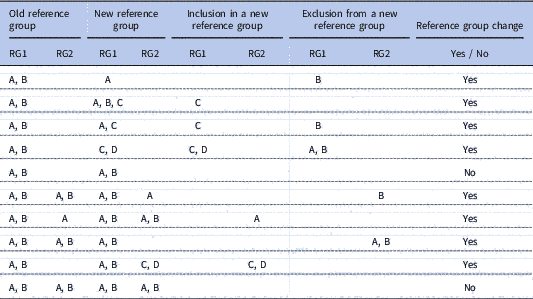
Table 2 presents an example of how a firm selects and changes its reference group. Firms can have multiple reference groups. A firm that presents its own reference group has broad discretion in selecting and changing it for performance comparison (Straka, Reference Straka1993). A firm can reconstruct its reference group by either including new peer firms or market indices such as the DJIA, S&P Chemicals, and S&P Retailing or by excluding peer firms or market indices from the original reference group. Firms occasionally change their frames of reference and reconfigure their reference group member firms, enabling us to identify and measure firms’ reference group changes and their direction.
How a firm (re)constructs its reference group

Note. In this table, old reference group means a firm’s previous reference group, new reference group represents the firm’s current reference group, and RG1 and RG2 denote the firm’s reference groups 1 and 2, respectively. Each letter of the alphabet in a reference group indicates a firm or market index. We exclude the S&P 500 index from the firm’s reference group because it is the default performance comparison indicator.
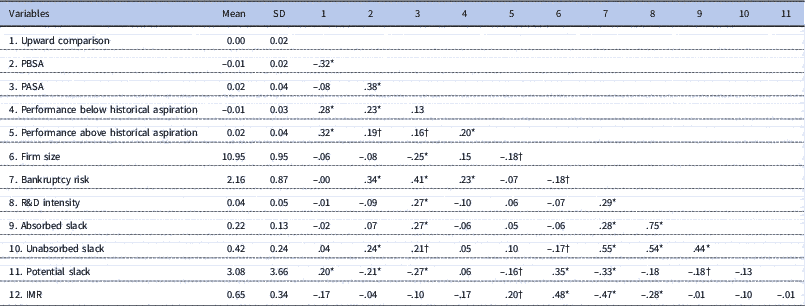
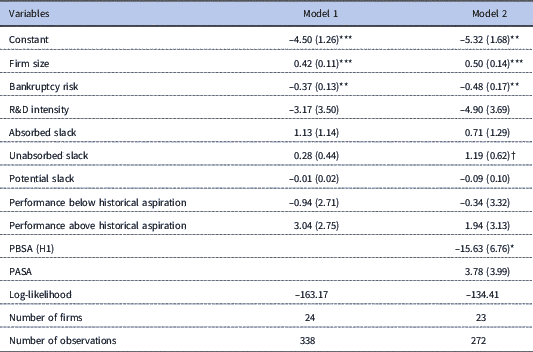
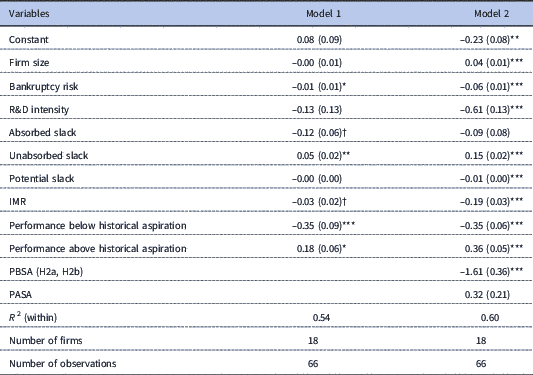
We collected data on the reference groups of firms listed on the DJIA index from 1993 to 2008, since the Securities and Exchange Commission’s new regulations were approved in October 1992. The data were obtained from the firms’ annual proxy filings available from the Securities and Exchange Commission’s EDGAR database. We also collected data on firm characteristics, financial performance, and reference groups from the S&P Compustat database between 1993 and 2008. The original sample of DJIA-listed firms was >30 because new firms such as Intel Corporation and Verizon Company replaced the previously listed firms. Such replacements occurred five times between 1993 and 2008 (for a good description of the history of the components of the DJIA, see http://www.djindexes.com/mdsidx/downloads/brochure_info/Dow_Jones_Industrial_Average_Historical_Components.pdf). A total of 41 firms remained for two or more years between 1993 and 2008, but they used a composite index to evaluate performance and were therefore discarded from the sample. The unbalanced panel sample for a random effect probit regression, with reference group change as the dependent variable, comprises 23 firms with 272 observations. From this probit regression, we obtain the inverse Mills ratio (IMR) for Heckman’s second-stage equation for panel data analysis. Table 3 provides the means, standard deviations, and pairwise correlations between the variables in this study, including IMR. Table 4 presents the results from the first-stage probit regression. For the second-stage regression, of 23 firms, we used 18 firms with 66 observations that had changed their reference groups because the second-stage model examines the direction of reference group change. Table 5 reports the results of unbalanced panel data analysis for Heckman’s second-stage equation.
Descriptive statistics and correlations

Note. All values are defined yearly, when a firm changes its reference group (73≤N≤116).
IMR=inverse Mills ratio; PASA=performance above social aspiration; PBSA=performance below social aspiration.
†p<.10; *p<.05.
Results of probit regression for predicting a firm’s reference group change

Note. Significance levels are for two-tailed tests. Standard errors are in parentheses.
PASA=performance above social aspiration; PBSA=performance below social aspiration.
†p<.10; *p<.05; **p<.01; ***p<.001.
Results of fixed-effects regression for predicting upward comparison

Note. Significance levels are for two-tailed tests. Robust standard errors are in parentheses.
IMR=inverse Mills ratio; PASA=performance above social aspiration; PBSA=performance below social aspiration.
†p<.10; *p<.05; **p<.01; ***p<.001.
Measures
Dependent variables
The hypotheses predict the positive association between performance shortfalls and the likelihood of changing the reference group (Hypothesis 1) and the extent to which a firm replaces its reference group with better performers (Hypotheses 2a and 2b). As seen in Table 2, a firm reconstructs its reference group by adding or removing one or more firms or stock market indices. The firm can also add or remove better or worse performers.
To test Hypothesis 1, the first model used a dummy variable for reference group change as the dependent variable. If the composition of the reference group at time t differs from that of the reference group at time t−1, then reference group change at time t is coded as one, and zero otherwise. Next, to test Hypotheses 2a and 2b, we use upward comparison as the dependent variable.
As shown in Figure 1, the oval-shaded areas represent the periods of (re)constructing reference groups for the following years. The downward arrowheads indicate the ends of fiscal years. The oval area in Figure 1 shows the performance comparison of firm i’s reference group for year t−1 and year t. The average performance is compared in the same year t−1 because firm i’s same reference group can perform better than the previous year. Thus, our measure controls the performance improvement in firm i’s same reference group, thereby leading to a more accurate performance comparison. Return on asset, calculated as net income divided by total assets, was the performance measure (e.g., Greve, Reference Greve2003b; Harris & Bromiley, Reference Harris and Bromiley2007; Mishina et al., Reference Mishina, Dykes, Block and Pollock2010). To measure return on asset for stock market indices, we identified firms listed on the stock market indices and collected financial data to compute return on asset. The return on asset for a certain stock market index was calculated as the sum of the firms’ net income divided by the sum of the firms’ total assets.
An illustration of the measurement of performance comparison.

The formula for the dependent variable is  $${\rm upward\; comparison}_{{it}} {=}{\rm performance}_{{t{-}}{1}} {\rm \;of\; reference\;group}_{{it}} -{\rm performance}_{{t{-}}{1}} {\rm \;of\; reference\; group}_{{it{-}}{1}} $$ where
 ${\rm performance}_{{t{-}1}} {\rm \;of\; reference\; group}_{{it}} \left( {{=}{{\sum_{j{=}1}^n {\rm performance}_{{jt{-}1}} \;{\rm of}\; {\rm reference\; group}_{{ijt}} } \over n}} \right)$
is the average performance at time t − 1 of all of firm i’s reference groups for year t. Firm i’s reference group j consists of peer firms or stock market indices selected by firm i’s board members. Hence, a positive value for this variable indicates that firm i reshuffled its reference group at time t by including a better firm or group of firms – that is, an upward comparison. A negative sign for this variable implies that firm i changed its reference group at time t − 1 to a new reference group at time t whose average performance is below that of the original reference group at time t − 1; that is, a downward comparison. Thus, upward comparison refers to the extent to which firm i’s reference group changes in terms of improving its average performance. To avoid issues with simultaneity bias, the dependent variable was temporally forwarded by one year relative to the independent and control variables.
Independent variables
To examine the impacts of PBSAs on both the likelihood of changing the reference group and the degree of upward comparison, social performance feedback was defined as the difference between a firm’s performance and the average performance of its reference groups. For a consistent measurement of the second dependent variable of upward comparison, return on asset was used to measure performance because it is a more appropriate measure, in broadly capturing firm-level effectiveness, and is less sensitive to varieties of financial structure than other performance metrics are (Greve, Reference Greve2003b).
We used a linear spline function for social performance feedback to differentiate between performance below and above social aspiration levels (Greve, Reference Greve2003b; Mishina et al., Reference Mishina, Dykes, Block and Pollock2010; Greene, Reference Greene2012). We constructed two separate variables: $$\eqalign{& {\rm Performance\; below\; social\; aspirations}_{{i,t} {-1}} \cr &\quad={\rm performance}_{{i,t} {-1}} -{\rm performance}_{{t-} 1} {\rm \;of\; reference\; group}_{{i,t-} 1} {\rm if\; performance\; feedback}_{{i,t}_{-1}} \,\lt\,0 \cr & \quad{=}0\:\quad {\rm otherwise} \ {\rm and}} $$
 $$\eqalign{ & {\rm Performance\; above\; social\; aspirations}_{{{i,t}} {{{-}1}}} \cr &\quad{=}{\rm performance}_{{{i,t}}{{{-}1}}} -{\rm performance}_{{{t{-}}} {1}} \;{\rm of\; reference\; group}_{{{i,t{-}}} {1}}; \cr \,\quad & \quad{\rm if \;performance\; feedback}_{{{i,t}} {{{-}1}}} \,\gt\,0 \cr &\quad {=}0\:\quad {\rm otherwise}} $$
Thus, when a firm’s performance relative to social aspirations decreases, the value of PBSA is negative; when a firm’s performance relative to social aspirations increases, the value of performance above social aspiration (PASA) as a control variable is positive. If Hypothesis 1 is valid, the estimated coefficient of PBSA should be negative when regressed on the dependent variable of reference group change. Hypotheses 2a and 2b are therefore valid if the estimated coefficients of PBSA are positive and negative, respectively, when regressed on the dependent variable of upward comparison.
Control variables
We controlled several important factors that may affect the likelihood of a reference group change and the degree of upward comparison. We controlled for R&D intensity, since studies show that organizational R&D intensity affects firms’ decisions about search activity and business reorganization (Chatterjee & Wernerfelt, Reference Chatterjee and Wernerfelt1991; Montgomery & Hariharan, Reference Montgomery and Hariharan1991). R&D intensity was measured as R&D expenditures divided by sales. We further included slack resources to account for a firm’s search propensity. The behavioral theory of the firm (Cyert & March, Reference Cyert and March1963) posits that organizational search activity is not only triggered by failure but also facilitated by slack resources. Organizational slack resources act as a catalyst for organizational innovation because they enable firms to explore and conduct new experiments (Cyert & March, Reference Cyert and March1963). Following Bourgeois and Singh (Reference Bourgeois and Singh1983), we categorized slack resources into three components: absorbed slack, unabsorbed slack, and potential slack. Following previous studies, we measured these types of slack based on firm-level financial data (Bromiley, Reference Bromiley1991; Greve, Reference Greve2003b). Absorbed slack was the ratio of the selling, general, and administrative expenses to sales. Unabsorbed slack was computed as quick assets divided by liabilities. Potential slack was measured as debt divided by equity. We controlled for the effect of firm size on performance feedback-based learning and organizational change. Firm size was measured as the logarithm of a firm’s total assets, since the distribution of firm size was highly skewed (Haveman, Reference Haveman1993; Zajac, Kraatz, & Bresser, Reference Zajac, Kraatz and Bresser2000). We also controlled for the likelihood of bankruptcy risk defined using Altman’s (Reference Altman1983) Z-score. Bankruptcy risk was estimated as
 $$\eqalign{&{\rm Z\hbox{-}score}{=} 1.2 {\times}\left( {{\rm working\; capital\,/\,total\; assets}} \right){+}1.4{\times}\left( {{\rm retained \;earnings}\,/\,{\rm total\; assets}} \right) \cr & {+}3.3{\times}\left( {{\rm earnings\; before\; interest\; and\; taxes}\,/\,{\rm total\; assets}} \right) \cr & {+}{\rm 0}.6{\times}\left( {{\rm market\; value\; of\; equity\,/\,total\; liabilities}} \right){+}0.999{\times}\left( {{\rm sales}\,/\,{\rm total\; assets}} \right)} $$
A lower Z-score indicates a greater likelihood of bankruptcy. By multiplying the original value of the Z-score by −1, we measured bankruptcy risk such that greater bankruptcy risk means a lower Z-score. Finally, although our theoretical focus is more about social aspirations, following the tradition of performance feedback-based learning studies historical performance feedback should be included in our empirical models. Historical performance feedback was defined as the difference between a firm’s performance and its earlier performance. Just as a linear spline function was applied to social performance feedback, we used the same function for historical performance feedback, resulting in performance below and above historical aspirations.
Model specifications
We estimated the hypothesized impacts of performance feedback on the likelihood of reference group change using data for all DJIA firms and the degree of upward comparison using data only for sample firms that changed their reference groups. Since sample selection bias could arise from the truncated sample and the limited number of dependent variables (Greene, Reference Greene2012), we applied Heckman’s (Reference Heckman1979) two-step estimation procedure. We first estimated the likelihood of a change in the firm’s reference group depending on performance feedback using the following probit regression:
 $\displaylines{ y_{i}^{{\rm {\ast}}} {=}X'_{i} {\rm \beta }{+}{\rm {\epsilon}}_{i}, {\rm }y_{i} {=}1 \,;{\rm if} y_{i}^{{\rm {\ast}}} \,\gt\,0 \cr {=}0\;{\rm otherwise} \cr} $
and
 $\eqalign{& {\rm Prob}(y_{i} {=}1 \,\mid\, X_{i} ){=}{\rm \Phi }(X'_{i} {\rm \beta })\quad {\rm and} \cr & {\rm Prob}(y_{i} {=}0{\rm }\,\mid\,X_{i} ){=}1{-}{\rm \Phi }(X'_{i} {\rm \beta }) \cr} $
where subscript i denotes the rows (observations) of X, X i is the column vector of explanatory variables, which is the transpose of the ith 1 ${\times}$K (variable) row of X, β is the vector coefficients,
 ${\rm {\epsilon}}_{i} $ is the vector of residuals, and
 ${\rm \Phi }$ is the standard normal cumulative distribution function. The term
 $y_{i}^{{\rm {\ast}}} $ is an unobserved latent variable and represents the likelihood of a change in a firm’s reference group.
Since identifying a firm’s desire to change its reference group is impossible, we captured the likelihood of a change in the firm’s reference group by transforming  $y_{i}^{{\rm {\ast}}} $ into a dummy variable
 $y_{i}^{{}} $ reflecting the firm’s actual choice. The term
 $y_{i}^{{}} $ is the dependent variable in the first-stage equation and equals one when the firm changes its reference group and zero otherwise. The variables on the right in the first-stage model are the control variables, PBSAs, and PASAs. The estimated coefficients are shown in Model 2 of Table 4. We also obtained IMR, referred to as λ, from the first-stage probit estimation by computing the ratio of the value drawn from the probability density function, denoted
 $\phi $, to the value drawn from the cumulative distribution function of the standard normal distribution
 ${\rm \lambda }{=}{{\phi (X'_{i} {\rm \beta })} \over {{\rm \Phi }(X'_{i} {\rm \beta })}}$. In the second-stage equation, we estimated the relationship between social performance shortfalls and the direction of the reference group change by regressing firm i’s upward comparison (
 $$z_{i} $$) on the row vector of explanatory variables (
 $W'_{i} $) and the estimated IMR calculated from the probit regression. Thus, the second-stage estimation equation takes the form
 $z_{i} {=}W'_{i} {\rm \gamma }{+}u_{i} $, observed only if
 $z_{i} {=}1$.
Our data set had an unbalanced panel structure because the number of observations varied among firms listed on the DJIA due to exclusion from the index. We applied fixed-effects models that control for omitted time-invariant variables correlated with the explanatory variables because omitting the time-invariant variables is likely to result in biased estimates (Greene, Reference Greene2012). Autocorrelation can often influence the data set used in our study, which we avoid by employing the Wooldridge test for serial correlations in residuals in panel data (Wooldridge, Reference Wooldridge2010). The result seemed to discount first-order correlation. Our models relied on robust standard errors by using the vce (robust) option in Stata 13 because the residuals were heteroscedastic (Hoechle, Reference Hoechle2007).
Results
Table 3 presents the means, standard deviations, and pairwise correlations for the variables used in our study. All correlation coefficients are low to modest, yet we computed the variance inflation factor to detect multicollinearity among the key variables. Robustness checks indicate that multicollinearity does not seem to be an issue.
Table 4 provides the results of the first-stage model of Heckman’s two-step procedure to predict a change in a firm’s reference group depending on performance feedback. Model 1 represents our baseline model containing only control variables. The coefficients of firm size and bankruptcy risk are significant. In Model 2, we add the main effects of PBSA and PASA. However, the estimated coefficient of PBSA is negative and significant, implying that there is a positive association between the degree of social performance shortfalls and the likelihood of changing the reference group, and supporting Hypothesis 1 that PASA is positive but statistically insignificant.
Table 5 reports the results from the estimates of the fixed-effects (within) regressions with robust standard errors. In Model 1, we analyze the control variables and their effects on upward comparison. The coefficient of unabsorbed slack is positive significant, meaning that a higher degree of unabsorbed slack may enable firms to increase their aspirations because they can take advantage of uncommitted cash flows and untapped liquidity. Bankruptcy risk increases upward comparisons. The coefficient of IMR in Model 1 indicates that sample selection bias does not seem to be an issue.
In Model 2, we add the main explanatory variables to test whether PBSA (H2a and H2b) affects the degree of upward comparison positively or negatively. The coefficient of IMR implies that sample selection bias exists but has been corrected. The coefficient of PBSA is negative and statistically significant, supporting Hypothesis 2a and rejecting Hypothesis 2b. Thus, on the one hand, the degree of upward comparison is positively associated with the level of a firm’s performance shortfalls, but on the other hand, the coefficient of PASA is positive but insignificant.
Robustness checks
We conducted additional analyses to ensure that our findings are robust when we apply alternative model specifications. In the first-stage model, we use the fixed-effects logistic regressions with robust standard errors to control for unobserved firm heterogeneity. Then, we computed the variance inflation factor to detect multicollinearity among the variables. We found that, in the second-stage model, the variance inflation factors of several variables, including IMR, are greater than 10, which is a general threshold for multicollinearity. To rule out that our findings did not result from an artifact of multicollinearity, we retested Hypotheses 2a and 2b using orthogonalized variables. This statistical method is useful because it provides numerical accuracy for highly correlated variables. We orthogonalized variables with variance inflation factors greater than 10 using the command ‘orthog’ in Stata 13. Our primary results are not sensitive to alternative model specifications or multicollinearity (these results are available from the authors upon request).
Discussion
This study aims to reflect the realism and precision of performance feedback models by tackling the conventional assumption that reference groups are externally given and stable over time. In this paper, thus, we shed light on how reference groups are reconstructed over time and what are the underlying mechanisms behind changes of reference groups. Drawing on performance feedback-based learning, social psychology (self-enhancement and self-improvement), social identity (social creativity strategies), and affiliation-based impression management studies, we investigated failure-induced changes of reference group as an alternative to organizational search or risk-taking and the direction of change (downward and upward comparisons).
Specifically, we suggest that a firm’s reference group change may be the result of performance problems and propose two competing hypotheses on the direction of reference group changes in response to performance feedback. Performance below aspiration levels may have one of two effects on the average performance of the reference group: negative or positive, implying downward or upward comparisons, respectively. To test these ideas, we use a panel data set of a comparison of the average performance of firms listed on the DJIA with that of reference groups selected by their board members. We found that a firm’s performance shortfalls are positively related to its reference group change. We also found strong support for the prediction that there may be a positive association between the degree of upward comparison and the level of performance shortfalls. That is, we found support for Hypotheses 1 and 2b.
Contribution
Most studies assume a stable or even homogeneous reference group within an industry (Greve, Reference Greve2013). Our results indicate that managers may not only change reference groups but also compare their firm’s performance with upward-adjusted reference groups as performance falls below social aspiration levels. That is, while performance feedback-based learning studies have paid attention to such action-centered responses as R&D expenditure, risk-taking, organizational change, and adaptive behavior, this study suggests a cognition-centered response – reference group change – as an alternative to action-centered reactions to performance shortfalls. Thus, this paper theoretically and empirically contributes to the literature on performance feedback-based learning by extending the range of reactions to performance feedback into a cognitive adaptation – reference group change.
Theoretical implications
The discussion on organizational status and reputation indicates that comparisons with inferior others reduce one’s own status and reputation (Benjamin & Podolny, Reference Benjamin and Podolny1999; Elsbach & Bhattacharya, Reference Elsbach and Bhattacharya2001). Further, concealing or distorting the firm’s negative performance runs against its fiduciary duty to shareholders, thereby risking severe punishment. Therefore, we infer that firms whose performance falls below aspiration levels may try to disclose it and improve their negative performance rather than conceal and distort it. Thus, when performance falls below aspiration levels, the organization may attempt to improve its negative performance using upward comparisons instead of distorting its performance through downward comparison because doing so would risk losing a positive affiliation-based impression (Labianca et al., Reference Labianca, Fairbank, Andrevski and Parzen2009; Podolny, Reference Podolny2010); the firm may also wish to develop competence by setting stretch goals (Collins, Reference Collins1996; Sitkin et al., Reference Sitkin, See, Miller, Lawless and Carton2011).
According to agency theory, our results are counterintuitive, since it assumes that managers pursue their personal interests if the principal–agent contact does not curtail self-serving and opportunistic behaviors (Jensen & Meckling, Reference Jensen and Meckling1976; Eisenhardt, Reference Eisenhardt1989). To secure higher compensation based on relative performance evaluation, managers are motivated to make their performance look better when it falls below aspiration levels, so they should choose reference groups that push average performance downward, thus enhancing their own performance relative to aspirations. This is akin to self-protection behavior under threat (Labianca et al., Reference Labianca, Fairbank, Thomas, Gioia and Umphress2001; Audia & Brion, Reference Audia and Brion2007; Gong, Li, & Shin, Reference Gong, Li and Shin2011; Jordan & Audia, Reference Jordan and Audia2012; Audia, Brion, & Greve, Reference Audia, Brion and Greve2015). However, our research shows that managers did the opposite and compared their firm to better performing firms. Our result is more consistent with stewardship theory than with agency theory (Davis, Schoorman, & Donaldson, Reference Davis, Schoorman and Donaldson1997; Martin & Butler, Reference Martin and Butler2017). The upward comparison may be due to a motivation for self-improvement, which dominates self-protection motivation. This is akin to taking rather than avoiding risk. In the field of strategy, Hamel and Prahalad (Reference Hamel and Prahalad1992) argue similarly, insisting that managers require a mindset of stretch and leverage to secure a sustainable competitive advantage in the face of global competition. Strategic stretching supplements the idea that matching ambition with resources is a strategy for success. Instead, being strategic means creating a chasm between ambition and resources, which concentrates and accumulates resources around strategic goals, thereby achieving continued industry leadership.
This paper also provides theoretical and empirical implications for competitive dynamics research. Few studies on competition provide explanations for how managers define rivals and reference groups (Porac, Thomas, & Baden-Fuller, Reference Porac, Thomas and Baden-Fuller1989; Chen, Reference Chen1996; Fiegenbaum, Hart, & Schendel, Reference Fiegenbaum, Hart and Schendel1996). Scholars have recently suggested competitive tensions (Chen, Su, & Tsai, Reference Chen, Su and Tsai2007), top management team members’ consensual comprehension (Le Breton-Miller, Miller, & Lester, Reference Le Breton-Miller, Miller and Lester2011), identity domains (Livengood & Reger, Reference Livengood and Reger2010), and the subjective intensity of rivalry between individuals, groups, and firms (Kilduff, Elfenbein, & Staw, Reference Kilduff, Elfenbein and Staw2010) as antecedents of competition. Notwithstanding the theoretical advances in reference group research, there remains a need for studies that directly reflect the dynamics of reference groups as a competitive referent (Ketchen, Snow, & Hoover, Reference Ketchen, Snow and Hoover2004). We attempted to illustrate how a firm changes configuration membership, thereby representing strategic movements in a competitive landscape. Firms entering or exiting a reference group and the direction of reference group evolution are core questions for theories of competitive strategy because the boundaries and composition of reference groups influence competitive decisions and organizational learning (Porac et al., Reference Porac, Thomas, Wilson, Paton and Kanfer1995; Fiegenbaum, Hart, & Schendel, Reference Fiegenbaum, Hart and Schendel1996).
Practical implication
Our findings have a practical implication for managers. A firm’s reference group reflects its strategic intention in competitive environments because its reference group serves as a key indicator of social comparison and performance benchmarks. For instance, if a firm experiencing low performance attempts to choose high-performing firms as a reference group, its strategic orientation toward self-improvement may induce its managers to aggressively implement a series of initiatives designed to improve performance. On the contrary, if a low-performing firm compares itself with low performers, its managers may show defensive reactions to poor performance rather than aggressive strategies for solving performance problems. Therefore, managers should take a close look at other firms’ changes of reference groups as a reaction to performance feedback to understand how they perceive the competitive environment and what strategies they pursue.
Limitations
Notwithstanding the rigor of our work, our results may not be generalizable owing to its limited sample and sample size. Although we endeavor to control firm size and unobserved heterogeneity, our sample firms listed on the DJIA index are large and visible to external stakeholders. Thus, the mechanisms behind the direction of reference group change may differ from the logics of smaller and less visible firms. Firms listed on the DJIA index may suffer from comparing themselves with worse performers because downward comparison under performance problems can serve as a signal for a grave situation. Moreover, since firm size often acts as a buffer against performance problems, our sample firms would feel less pressure to conceal performance problems by redefining their reference groups, while less-prominent firms facing performance problems are less likely to confront risks deriving from concealing negative performance by comparing themselves with worse performers. Future research should extend the sample targets and the number of sample firms.
Further research
Our study suggests several avenues for future research. First, despite the theoretical claims (Kerr & Landauer, Reference Kerr and Landauer2004; Sitkin et al., Reference Sitkin, See, Miller, Lawless and Carton2011), we have not empirically examined the impact of upward or downward comparisons on performance. If managers have confidence in their firms’ competence, they will compare upward, leading to higher aspiration levels. In a similar vein, there has been growing interest in how strategic intent/strategy orientation affects performance outcomes (e.g., Liu & Chen, Reference Liu and Chen2015; O’Shannassy, Reference O’Shannassy2016). Although we controlled for size, slack, and R&D intensity, our analysis did not include measures of firm-level capabilities or resources. Including these measures of capabilities and considering the endogeneity of upward comparison could reveal the performance effect of downward/upward comparisons.
Second, a comparative analysis of the effect of performance feedback on upward and downward comparisons and search activity would provide a new avenue for attention shifts in cognitive and behavioral changes. Managers can choose to change comparisons or organizational search, such as R&D expenditures, when their firms’ performance falls below aspiration levels. Their choice will depend on a few contingencies. Recently, Kacperczyk, Beckman, and Moliterno (Reference Kacperczyk, Beckman and Moliterno2015) disentangled change and risk in their study on the mutual fund industry, suggesting internal and external social comparison as antecedents to risk-taking and change; whether an upward comparison is a kind of change or a risk-taking behavior remains to be explored. Changes of reference groups or aspiration levels entail cognitive rather than physical changes. Still, upward comparisons could be risky change to managers. Although theories on failure-induced search and risk-taking are well developed, theories on changes to reference groups or aspiration levels are less developed. The distinction and interaction between problemistic search and reference group change are worth further investigation.
More studies on reference groups are needed. We have little knowledge about the mechanism of reference group evolution. For example, scholars have not yet clearly addressed how managers construct a portfolio of reference group firms in terms of performance, competitive relationship, and so on; why some firms have reference groups with greater variance in performance than others do; and why some firms have more non-competing firms in their reference group than others have. Once we obtain more complete answers, we will have more to say on competition and learning among firms.
Conclusion
Although many scholars have studied new organizational constructs as a consequence of performance feedback, most have clustered around organizational change, risk, or risky change (Gavetti, Greve, Levinthal, & Ocasio, Reference Gavetti, Greve, Levinthal and Ocasio2012; Shinkle, Reference Shinkle2012; Kacperczyk, Beckman, & Moliterno, Reference Kacperczyk, Beckman and Moliterno2015). Few scholars have studied aspiration levels or the reference groups themselves as explained variables (see Mezias, Chen, & Murphy, Reference Mezias, Chen and Murphy2002). In other words, firms’ action-centered responses to performance feedback, such as change and risk-taking, are regarded as a matter of course adopted by the majority, whereas cognition-centered responses to performance feedback, such as reference group and aspiration level changes, are rarely considered (Shinkle, Reference Shinkle2012). The two types of organizational responses to performance feedback should be complements within the behavioral theory of the firm. We took the road less-traveled by scholars to challenge the taken-for-granted assumption that reference groups are stable. Our study shows that reference groups are malleable and that firms change them intentionally, which is an alternative approach to the action-centered theory of performance feedback-based organizational learning. In this sense, by integrating experiential learning based on performance feedback and cognitive learning based on upward comparison into performance feedback-based upward comparison, our study contributes to the theory of organizational learning by emphasizing managers’ forward-looking cognition and a shared mental model (Kim, Reference Kim1993; Gavetti & Levinthal, Reference Gavetti and Levinthal2000; Gavetti, Levinthal, & Ocasio, Reference Gavetti, Levinthal and Ocasio2007; Chen, Reference Chen2008; Gavetti et al., Reference Gavetti, Greve, Levinthal and Ocasio2012). Finally, our results show that performance feedback influences upward comparison as well as reference group change. Our results provide an initial basis for understanding the evolution of reference groups and aspiration levels.
Acknowledgements
None.
Financial support
This work was supported by the Ministry of Education of the Republic of Korea and the National Research Foundation of Korea (NRF-2017S1A5A2A01025562).
Conflicts of interest
None.