1. Introduction
This article examines the significance of Weyl symmetry in string theory. Along the way we introduce the basics of string theory in a streamlined fashion, drawing on familiar ideas from classical and quantum field theory (QFT). We then explain how general relativity is a ‘consequence’ of string theory: not merely in the sense that it contains massless spin-2 particles (gravitons) but in the strong sense that the coherent states of the graviton obey the Einstein field equations—gravitons truly form the gravitational field. This result follows from ‘reimposing’ Weyl symmetry in quantized string theory, so in the final section of the article we sketch some more esoteric considerations justifying this assumption.
2. The Formalism
2.1. The Classical String
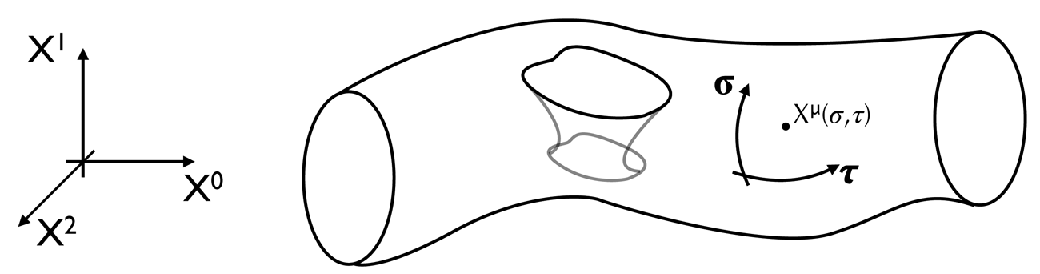
We start with a classical relativistic string, an object of one spatial dimension and one temporal dimension—it is best to think of it as a space-time object from the get go.Footnote 1 Let us suppose that it is ‘closed’, meaning that its (spatial) ends are joined into a loop (fig. 1). Our string is free, subject to internal tension, but (for now) under the influence of no external forces, including gravity, so that it lives in Minkowski space-time, with metric ημν. Suppose that the points of the string come labeled with ‘internal space-time coordinates’ τ and σ (later σ0 and σ1), while ‘external’ or ‘target’ space-time has coordinates X μ (μ = 0, 1, … , D − 1). Then we can describe the string worldsheet in space-time by assigning appropriate coordinates (X 0, X 1, … , X D−1) to each internal point (σ, τ); formally, there is a D-component vector field on the string. From the point of view of the string then, motion in target space amounts to changes in this field. This picture will be important as we progress, so bear it in mind.
Closed string in target space. Time runs from left to right, so the string divides into two closed strings, which then recombine. Such a worldsheet, with a topological hole, represents the first-order correction to the string propagator (see sec. 3).

So how do we expect this two-dimensional object to behave? One’s mind turns to Hooke’s law, but that is uncongenial to relativity—Lorentz contraction should not change the tension in a string. What Hooke’s law tells us more generally is that a string will minimize its length. Again, that is not relativistically invariant but close—the relativistic statement is that a string will minimize its space-time area. Thus, the simplest classical, relativistic string action is proportional to the invariant area

. Explicitly,

, or transforming into string coordinates, we obtain the famous Nabu-Goto action:

where T is the tension in the string (although you cannot immediately see this from the form of the action). It shows that the string does not satisfy Hooke’s law, because it is an invariant constant. The action also shows that all that matters is the total length of the string, not how parts might be stretched relative to one another—again un-Hooke-like behavior. So, for one thing, the dynamics has no way of identifying parts of the string over time (the action has diffeomorphism symmetry with respect to the σs)—but the significance of this behavior is far greater.Footnote 2
The square root in S NG is awkward, but a formal trick leads to the equivalent sigma (or Polyakov) action:

The ‘trick’ involves introducing a second ‘internal’ metric, γαβ on the string worldsheet—to be carefully distinguished from the restriction of the space-time metric to the string.
Now the un-Hooke-like behavior of the string manifests itself in the fact that intervals with respect to the internal metric have no physical significance. The action appears to depend on how the string is stretched along its length—the derivatives are determined by the distance in external space separating points on the worldsheet separated by an infinitesimal distance in the string coordinates. But the behavior of the string that we have been stressing means that such infinitesimal distances have no physical significance, and so it should make no difference if any is rescaled by an arbitrary factor. In short, the action must be Weyl, or conformally invariant, and indeed it is: as can be readily checked, the sigma action is unchanged by  .Footnote 3
Two comments. First, the action is conformally invariant with respect to the string metric, not the target space metric. For ημν the relevant symmetry is Poincaré invariance. (The other symmetry of the action is diffeomorphism invariance with respect to both the σs and Xs.) Second, although we have stressed the connection of conformal invariance to the un-Hooke-like behavior of a relativistic string, we did so mainly to illustrate how string theory is grounded in some very familiar physics. Conformal invariance will be crucial in what follows, but all we need is the straightforward mathematical fact that S σ has that symmetry—not any story about why. For now, we have this: from the point of view of the string, string theory concerns a D-dimensional conformal field, living on a two-dimensional space-time (i.e., the worldsheet). That picture was central to the developments of the ‘second string revolution’ of the 1990s and generally is the one that we will adopt.
The symmetries can be used to set the worldsheet metric flat:

where the derivatives are with respect to the worldsheet coordinates.Footnote 4 Minimizing with respect to X μ yields a wave equation,

, whose general solution for a closed string is (after a little more work in classical wave physics)

where ℓS, the ‘characteristic string length’, is determined by the tension:

. This equation describes an initial position, linear momentum, and left- and right-moving vibrations—the αn are the amplitudes of the modes of the string. Identifying the linear momentum as the zeroth mode of the string will be useful.

2.2. Immediate Consequences
Now, because of conformal symmetry, the variation of the action with respect to rescaling the metric must vanish:

The four equations given by the possible values of α and β can be solved and, if the expansion for X μ is inserted, entail that

The Lm and

are crucial objects in the formalism describing the string, the ‘Virasoro generators’, and the constraints (7) play a vital role in the theory. Physically speaking, from the worldsheet perspective, (6) gives T αβ, the stress-energy tensor of the two-dimensional stringy space-time, and the Virasoro generators are its modes. Geometrically speaking, they are the generators of conformal transformations on the worldsheet.Footnote 5
2.3. Quantization
In this article we employ both canonical and path integral quantization: either way, X μ is a field on a two-dimensional Minkowski space-time—the string worldsheet. Thus, we start with equal-time commutation relations for the ‘field’:

which entails via (4) that

Hence, the quantized αs are raising and lowering operators, as one should expect. Our earlier analysis now shows that the quantized mass spectrum is discrete: it includes massless photons and gravitons and, importantly for later work, a new massless scalar, the ‘dilaton’ (as well as negative mass tachyon modes). For suitable string tensions, the modes can reproduce the observed masses of meson families. However, the appropriate tension for quantum gravity is much greater, so observed particles are not theorized to be mode excitations of the string. (The mass spectrum of the standard model is reproduced in a more complex way—relying, e.g., on compactified dimensions, or D-branes.)
Equation (9) tells us that for m ≠ 0 the Virasoro generators can be obtained by simply replacing the αs in (7) with operators, while L 0 requires normal ordering. Omitting all details, the resulting commutation relations are found to be

the (classical) algebra of conformal generators, plus a ‘central charge’ term, which indicates a quantum ‘anomaly’, a breakdown of classical conformal invariance. Restoring the symmetry requires that D = 26 and leads to the (in)famous compactified dimensions of string theory. In what follows we explain another consequence of the anomaly.
3. General Relativity from String Theory
Consider the sigma action (eq. [2]) but with a general Lorentzian metric,

:

where α′ is (up to a factor) just the reciprocal of the tension. At this point you may think that G μν is free parameter, to be inserted by hand—that the ‘background’ metric is independent of what the string does. But you would be wrong: G μν has to satisfy the source-free Einstein field equations (EFEs)—a result going back to Friedan (Reference Friedan1980) and a conjecture going back to the 1970s. String theory requires general relativity (to lowest order).
The proof runs as follows (see Callan et al. Reference Callan, Friedan, Martinec and Perry1985; Gasperini Reference Gasperini2007 for more detail):
1. Consider the perturbative expansion of the interacting string propagator, a closed string in and out, with intermediate interactions. The Feynman diagrams in the expansion are cylinders with increasing numbers of ‘holes’, each associated with a small interaction parameter. Figure 1 shows the first-order term.
2. Its contribution is given by (11), a ‘nonlinear sigma model’: a two-dimensional QFT on the worldsheet, in which G μν is a (varying) self-coupling for the X μ field.
3. This QFT has a well-studied perturbation theory and is known to be renormalizable. (Here we have second perturbation expansion: a QFT expansion for a field on a term in a perturbative sum of worldsheets—and similarly for the other terms.)
4. Renormalization means counter-terms, which ‘run’, or have a length dependence, described by renormalization group β-functions.
5. Friedan showed perturbatively that the β-function associated with G μν is—remarkably—given by
 , the Ricci tensor plus higher-order corrections.
6. Now, recall that we are talking about QFT on a string worldsheet, so the length scale is with respect to the string metric, not the target space metric. But conformal invariance means that the theory can have no dependence on such a length. So the β-function vanishes, and by Friedan’s work, R μν = 0, or G μν is ‘Ricci flat’ to lowest order. But that is equivalent to the vacuum EFEs.

In short, conformal invariance of string theory as a worldsheet QFT entails general relativity for target space. Of course, space-time is not Ricci flat, but happily the result generalizes. To take a salient example, suppose that strings live in a target space with a Yang-Mills field, a string theory with familiar matter. The action has the form

This action is for a ‘heterotic’ string, featuring both conformal symmetry and supersymmetry between bose and fermi degrees of freedom: θ represents fermionic ‘coordinates’ in addition to the bosonic σs. The background gauge field is represented by A, which couples to a fermion field ψ (j is their current). Callan et al. (Reference Callan, Friedan, Martinec and Perry1985) investigated this action, showing that to lowest order G μν is Ricci flat and that the standard free Yang-Mills equations must be satisfied. Moreover, they also showed that at first order in α′ the β-function for the target metric has a term corresponding to the stress energy of the Yang-Mills field.

Thus, once again, worldsheet conformal symmetry, βG = 0, means that to order α′, the EFEs hold, even when matter is present.
However, we want to argue that these are more than formal results (we express what seems to be the view of string theorists). The results do not simply show that strings tell matter and geometry backgrounds how to behave: they in fact describe how fields built from string excitations are related, so that the field equations are simply low energy descriptions of the string itself. ‘Background’ fields do not represent new degrees of freedom in addition to those of string theory: they are not distinct primitive entities. Instead they represent the behavior of coherent states of string excitations: the quantum states, that is, which describe classical field behavior. Thus, when one includes a general metric in the action, one has a quantum theory of perturbations around a coherent state corresponding to the given classical metric. The result shows that graviton (and Yang-Mills) coherent states must be related appropriately: by the EFEs.
More precisely, there are two claims involved in the view that background fields represent coherent states (Polchinski Reference Polchinski2003, sec. 3.6): (i) that the string is an adequate ‘theory of everything’, in the sense that the string spectrum includes quanta for all desired background fields, and (ii) that the terms in the action accurately capture the effective behavior of those coherent states. Then by i the G μν field is composed of stringy excitations, and by ii it satisfies the EFEs, making it the gravitational field and the excitations gravitons—the general relativistic theory of space-time is simply a low-energy effective theory of strings.
If this is correct, then in a central sense, string theory is background independent: the metric arises from string interactions, rather than being stipulated a priori. Just like general relativity, many solutions are possible, but matter and gravity have to satisfy a mutual dynamics—except in string theory, there is no fundamental distinction between the two, a significant ontological unification.
4. Toward a Philosophical Analysis of Conformal Symmetry
The connections to the dimensionality of space-time, and to the EFEs that we have sketched show that conformal symmetry is a key concept connecting string theory to phenomenological space-time. (By ‘phenomenological’ we mean space and time as they are described by general relativity, and thus as they are envisioned in more or less direct experience, since the situations we normally experience fall within the domain of general relativity.) We claim that conformal symmetry should therefore be an important focus of philosophical attention in the study of string theory. Huggett and Wüthrich (Reference Huggett and Wüthrich2013) argue for the importance of philosophical analysis of the ‘empirical significance’ of such concepts in theories of quantum gravity: in short, such analyses promise to illuminate how (and even whether) aspects of space-time can emerge from a theory that does not presuppose them at the fundamental level, in some sense. (The article also explains the value of such analyses even for partial theories, such as bosonic string theory: the development of complete theories must be preceded by the development of suitable concepts, typically found in protoform in incomplete theories.) This essay is a contribution to such an analysis, which we continue to develop in this section. The key question now is whether conformal symmetry is an independent postulate of string theory; if not, then—in a deductive-nomological model of explanation—it is not truly explanatory at all.
The story so far is that the classical string action is conformally invariant but that this symmetry is broken by quantization. We have seen the effect of this ‘conformal anomaly’ in the central charge appearing in the Virasoro algebra and in slightly more detail in the derivation of the EFEs, above: they follow when the quantum symmetry is ‘reimposed’.
Now, the latter derivation was given in the context of renormalization and so may appear to be a consequence of perturbation theory; one might assume that string theory does not require general relativity intrinsically but only for a certain of approximation scheme to work. This would be a mistake (see, e.g., Fine and Fine Reference Fine and Fine1997; Nakahara Reference Nakahara2003, chap. 13). Consider a schematic path integral for a quantum field:  . Manifestly, a symmetry of the Lagrangian no longer suffices for a quantum symmetry: path integrals—hence amplitudes—will only be unchanged if the measure of the path integral is also invariant, and anomalies arise when it is not. Anomalies appear in the perturbative expansion of a path integral, but path integrals are not inherently perturbative.
One might wonder whether it is possible to abandon conformal symmetry in quantum string theory, whether it is an independent postulate, required to derive the EFEs and 26 dimensions. Insofar as the question is well put, the answer is no. Weyl symmetry is a local gauge symmetry, and QFTs with local gauge anomalies are pathological: so such is string theory—more specifically the nonlinear sigma model on the worldsheet—in which the EFEs do not hold, or in other than 26 dimensions. Such pathologies are generally ‘cured’ by adding new terms to the Lagrangian, to cancel out the anomalous behavior of the measure. We now see that that is exactly what happens if one does not reimpose conformal symmetry and allows an arbitrary number of dimensions. To do so we draw heavily on Polchinski (Reference Polchinski2003, secs. 3.4, 3.7, and 9.9), including all the equations below.
In this case, different choices of conformal factor in the Weyl transformation of the internal metric,  , will be physically different. Hence,
 is a new physical degree of freedom over the worldsheet, a scalar background field: specifically a dilaton field, Φ(X), the new string mode introduced earlier—even more specifically (as we will discuss) a linear dilaton field.
The dilaton field appears when we break Weyl symmetry, so we study the consequences by studying the field. So we start with a new action including a background dilaton field Φ(X), as usual understood as representing physics around a coherent dilaton state:

where R is the Ricci scalar. Equation (14) can be rewritten as an effective action over space-time:

Comparison of (14) and (15) indicates that at low energy the perturbative expansion parameter α′ can be identified with

. This identification implies a connection between the presence of a linear dilaton and the applicability of string perturbation theory: where the former diverges, the latter breaks down, which is evidence that the theory is ill defined in such a regime. We will now see that saving perturbation theory—preventing the linear dilaton from diverging—will lead back to Weyl invariance, so the attempt to violate the symmetry fails.
Consider a space-like dilaton,

, so that

. Polchinski (Reference Polchinski2003, sec. 9.9) explains how the divergencies at large X 1 can be fixed by introducing a ‘tachyon profile’, τ(X), satisfying

The tachyon appears in the worldsheet action as follows:

where

, and τ0 an initial tachyon value.
For D ≤ 2, q 1 is a positive quantity, so for  the tachyon exponential gets large, suppressing this limit in the path integral and yielding an effective repulsive potential. But it is precisely for
 that
 diverges. Hence, the tachyon controls the theory for D ≤ 2. For D > 2, q 1 is complex, and the tachyon exponential is oscillatory, so the argument no longer holds. For this reason, ‘noncritical’ string theory (i.e., of other than 26 dimensions for the bosonic string) is not a popular research program.
But supposing, as Polchinski (Reference Polchinski2003, 324) suggests, that the tachyon prevents  by some other mechanism (or if D ≤ 2), so the theory does not diverge; then, (16) holds. But (according to Polchinski Reference Polchinski2003, 323) (16) is the condition for Weyl invariance of the dilaton—hence for Weyl invariance of the full action, as G μν has been chosen to be trivial. So we are brought full circle: attempting to break conformal symmetry requires a linear dilaton, the linear dilaton requires a tachyon, but the tachyon entails conformal symmetry. We have seen exactly what was described for the general case of local anomalies: the only cure is to add new terms to the Lagrangian to reimpose the symmetry at the quantum level. The classical symmetry requires the quantum symmetry for consistency.
Before we end this section, we wish to mention a remarkable feature of the dilation of interest in understanding the nature and origin of spatial dimensions. Assuming Weyl symmetry has indeed been recovered for the dilaton, the β-functions for the action (15) must again vanish:

and

The former is a third example of how string theory entails the EFEs, in this case when gravity couples to a dilaton field. The simplest solution has a Minkowski target space-time,

, in which case R μν = 0 and

, where V μ is a constant, so that the dilaton has a simple linear dependence on space-time. But then (19) yields

Earlier we saw that in the absence of a dilaton field, Weyl symmetry requires that D = 26—the ‘critical’ dimension. Now we see that in the presence of a dilaton field D can take on other values, less than or greater than 26, depending on whether the gradient of the dilaton is space-like or time-like. It is interesting to notice that the dimension now appears to be a dynamical (although constant) feature of the theory, controlled by the (square of) the gradient of the dilaton, V μV μ.
5. Conclusion
The significance of the derivation of general relativity from string theory is, we believe, quite clear. However, we would like to comment briefly on the importance of the main result of the previous section: that conformal symmetry is not a logically independent postulate. To do so we refer to Healey’s discussion of gauge symmetry, in which he makes an equivalent point about the so-called abelian anomaly of QFT. To transpose his conclusions into the current context, “[the EFEs] are not implications of [conformal symmetry] but only of a replacement [i.e., a modified action] for a theory beset by internal difficulties associated with its violation.” That is, although the derivation of the EFEs appeals to conformal symmetry, since that is itself a consequence of string theory, it is not, logically speaking, a necessary premise of the derivation. Healey goes further, adding that (again transposing) “[conformal symmetry] is a purely formal feature of the theory” (Healey 2007, 183). Presumably his reasoning is that because the symmetry is not logically independent, it lacks either physical or explanatory significance. We believe that this final step takes too narrow a view of explanation, for instance, that of the deductive-nomological model, where only logically independent premises form the explanans. However, a defense of the position that the role of conformal symmetry in the derivations we have described gives it more than formal significance will have to wait for another time.
In this article we have attempted to sketch enough of string theory to show the significance of conformal symmetry. Of course this is a huge and complex subject, and we can barely claim to have scratched the surface. However, we have indicated some crucial conceptual features. Thus, we hope to have established our principal claim, that conformal symmetry of string theory deserves to be a focus of attention in the philosophical study of quantum gravity—itself one of the most pressing subjects within philosophy of physics.