In 2001, the Institute of Medicine released a consensus statement that implicated four factors as reasons for the widening gap in the quality of healthcare delivery, including the growing complexity of medicine, the chronicity of disease, poorly organised delivery systems, and constraints on our ability as providers to exploit new technology. 1 The use of evidence-based best practices, created through research evidence, clinical expertise, and patient values, was recommended as a means to decrease practice variation and avoid both underuse and overuse of resources. In this model of profession-based care, groups of providers can identify high-priority care delivery processes and apply them to large populations of patients with similar needs using best practice guidelines. The goal of this ideological practice shift is to learn from and reduce inappropriate variation among clinicians while embracing appropriate variation arising from individual complex patients.Reference James 2 , Reference James and Hammond 3
Practice variation has previously been studied in paediatric cardiac careReference Burstein, Rossi and Jacobs 4 including care of complex patients with functionally univentricular hearts.Reference Wallace, Jaggers and Li 6 , Reference Ohye, Sleeper and Mahony 7 Children born with hypoplastic left heart syndrome are arguably one of the most complex and most studied populations with CHD. These children undergo a series of palliative operations resulting in improved longevity and quality of life. In 2010, the National Heart, Lung and Blood Institute-funded Pediatric Heart Network reported results from the Single Ventricle Reconstruction trial that randomised 555 patients with hypoplastic left heart syndrome and other single right ventricle anomalies to a shunt strategy during the Stage I operation with the primary end point being transplant-free survival.Reference Ohye, Sleeper and Mahony 7 In 2012, Pasquali et alReference Pasquali, Ohye and Lu 8 performed a sub-analysis of the Single Ventricle Reconstruction data and found tremendous practice variation surrounding the Stage I operation in nearly every aspect of perioperative care across centres participating in the trial.
We used the public-use data set from the Single Ventricle Reconstruction trial to explore centre-level variability surrounding the Stage II operation for patients with hypoplastic left heart syndrome and other related single right ventricle anomalies. We have an abundance of data demonstrating excellent Stage II outcomes in the current era, but we have no clear understanding of the institutional variation that drives these outcomes. To address the significant gap in our understanding of the practices that drive clinical outcomes, we sought to identify modifiable areas that could be targeted to decrease practice variation using best practice guidelines by describing the range of care across centres in a large well-characterised cohort, rather than determining the specific underlying causes of any variation identified.
Patients and methods
Patient population
Details of the Single Ventricle Reconstruction trial (ClinicalTrials.gov number, NCT00115934) design have been published previously. Briefly, neonates with a diagnosis of hypoplastic left heart syndrome and related single morphological right ventricle anomalies undergoing the Norwood procedure were eligible for inclusion in the trial. Exclusion criteria were single, morphological left ventricle, preoperative anatomic features rendering a specific shunt type technically impossible, and any major congenital or acquired extracardiac abnormality thought to independently affect survival or need for cardiac transplantation. Patients were randomised during 2005–2008 at 15 North American clinical centres with 39 surgeons participating. Dynamic allocation within surgeon was used to ensure that no single surgeon had a preponderance of one shunt type. All Single Ventricle Reconstruction sites were medium- or high-volume congenital heart surgery sites. For the purposes of this analysis, one site that enrolled the fewest patients (n=3) was excluded. In the remaining 14 sites, the number of patients enrolled per site ranged from 6 to 84 (median=23). The Single Ventricle Reconstruction trial was approved by each centre’s institutional review board or research ethics board and informed written consent was obtained from both parents or guardians.
Data collection
Detailed information regarding preoperative, operative, and postoperative care was prospectively recorded on standardised case report forms. All patients received care according to usual institutional practice. The operative period reflected only direct time spent in the operating room. The postoperative period was defined as the interval between returning from surgery and hospitalisation discharge.
Preoperative variables included whether patients were discharged home during the inter-stage period, pre-Stage II catheterisations and type of interventional procedures, reason for the timing of Stage II, type of Stage II performed, method of nutritional support, and use of digoxin. The perioperative/operative variables included age at surgery, total support time and perfusion techniques, use of modified ultrafiltration, and the medications used in the operating room, such as aprotinin, corticosteroids, and alpha blockade. Perfusion type was defined as deep hypothermic circulatory arrest, regional cerebral perfusion, or a combination of the two techniques. Deep hypothermic circulatory arrest was defined as >10 minutes of no circulatory flow. Periods of ⩽10 minutes of deep hypothermic circulatory arrest were allowed in the regional cerebral perfusion group to account for cannula repositioning and atrial septectomy without the surgery being classified as being done under deep hypothermic circulatory arrest. The lowest temperature on bypass was recorded from a core measurement site – nasopharynx, rectum, or bladder. The lowest haematocrit was recorded on bypass before initiating deep hypothermic circulatory arrest or regional cerebral perfusion.
Postoperative variables included duration of ventilation and length of stay for both ICU and hospital stays, postoperative interventions including interventional cardiac catheterisation, cardiac surgery, or extracorporeal membrane oxygenation during the perioperative period regardless of whether it was initiated in the operating room or later in the postoperative period, in-hospital death/transplant, number of discharge medications, discharge oxygen use, and discharge oxygen saturations.
Analysis
Study variables were described using standard summary statistics, and no hypotheses were tested. Aggregate rates for dichotomous variables, and mean ± standard deviation along with median and interquartile range for continuous variables, were calculated for the overall study population. The total number of centres that used a particular practice or type of care was calculated. For these centres, centre-level descriptive data were calculated. For continuous variables, the median value of the affected sites was calculated; for dichotomous variables, the proportion of patients at the affected centres in which the practice or type of care was used was calculated. Median, interquartile range, and range were then calculated from these centre-level data. In the body of paper, results are all listed as interquartile range unless otherwise specified. In the tables, results are reported as median, interquartile range, and total range. Owing to the descriptive nature of the analysis, formal statistical comparisons were not made. All analyses were performed using R version 3.3.2 (2016-10-31).
Results
Study population
Of the original 555 patients enrolled in the Single Ventricle Reconstruction trial, 400 patients from 15 centres underwent Stage II palliation. We excluded the centre enrolling only three patients from the analysis, and thus the final cohort included 397 patients from 14 centres.
Preoperative variables
Preoperative data are listed in Table 1. The median weight and age at Stage II across centres was 5.7 kg (5.5–6.1) and 162 days (147–170). Of Stage II procedures at all centres, 70% were performed electively. Essentially all patients underwent a pre-Stage-II cardiac catheterisation and 32% (22–38) underwent a catheter-based procedure, the most common being balloon angioplasty of the aortic arch (18%). At least one patient remained hospitalised during the entire inter-stage period at six centres, accounting for the 6%Reference Johnson, Jaggers and Li 5 – Reference Mahle, Nicolson and Hollenbeck-Pringle 11 of patients who were never discharged home before their Stage II palliation at these sites. At the time of Stage II surgery, 78% of patients were receiving at least a portion of their nutrition orally. Among the 14 centres, 58% of patients received all of their nutrition orally (53–71) and 18% received feeds through a gastrostomy tube. Among the 12 centres that used gastrostomy tube feeding, there was threefold variability (median 20%; interquartile range 13–33) in their use. In at least 1 centre, gastrostomy tubes were used in 50% of patients. Digoxin was used in nine centres, with 26% of patients receiving it preoperatively (26–36).
Preoperative variables.

AVV=atrioventricular valve; BDG=bidirectional glenn; G=gastrostomy tube; GJ=gastrojejunostomy tube; IQR=interquartile range; NG=nasogastric tube; NJ=nasojejunostomy tube.
Perioperative variables
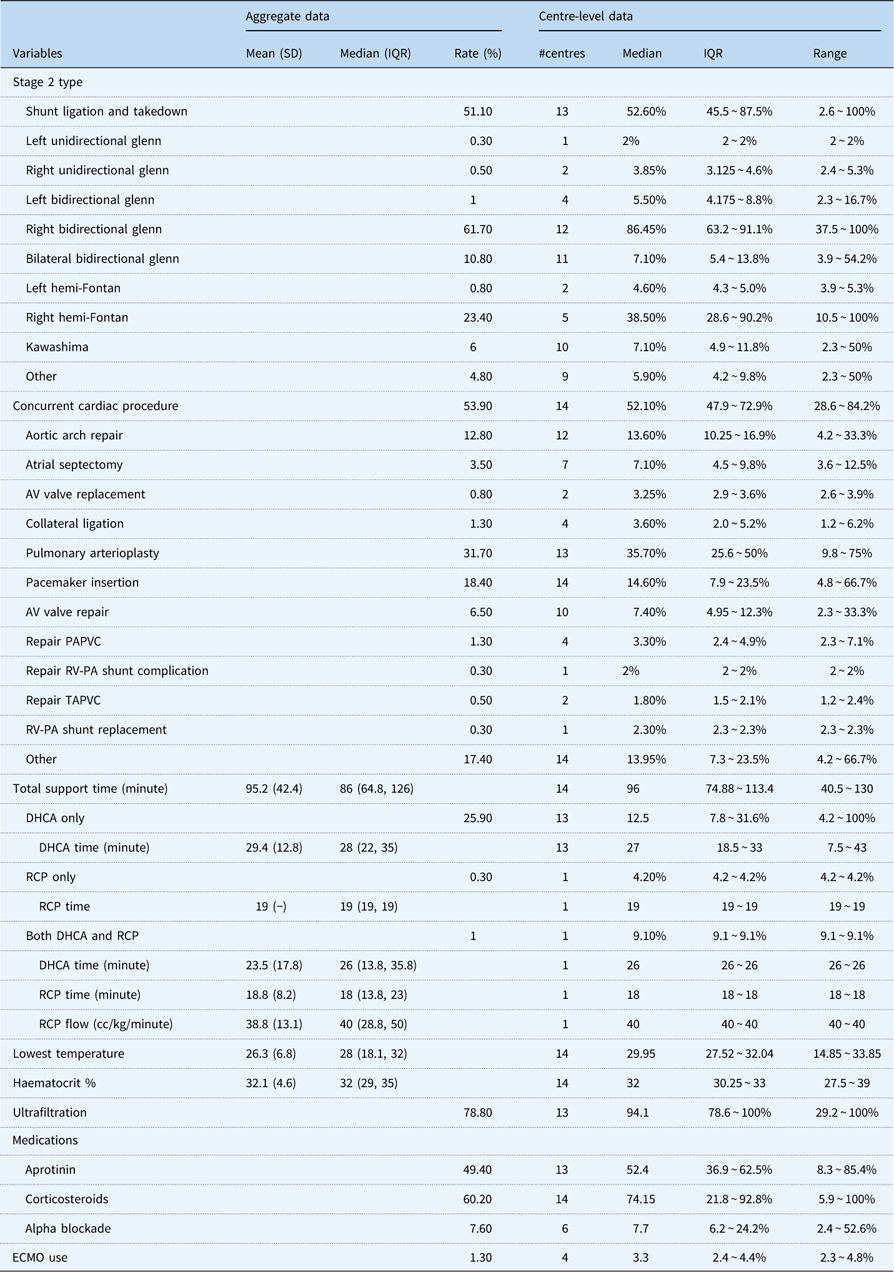
There was significant variation in the duration of cardiopulmonary bypass times (Table 2) across centres with a median of 96 minutes (75–113). In aggregate, 62% of the entire cohort had a right-sided bidirectional Glenn, 23% received a right hemi-Fontan, and 11% received a bilateral bidirectional Glenn. In the 12 centres that performed at least one bidirectional Glenn, a median of 86% (62–91) of patients received a bidirectional right-sided bidirectional Glenn. Only five centres performed at least one hemi-Fontan, and in those centres a median of 39% (29–90) of patients received a right-sided hemi-Fontan. Thirteen centres used deep hypothermic circulatory arrest in a median of 13% (8–32) of patients. The median time of deep hypothermic circulatory arrest in these centres was 27 minutes (19–33). Only one centre used retrograde cerebral perfusion. A median of 52% of patients (48–73) underwent a concurrent cardiac procedure, the most common being pulmonary arterioplasty (31%). The lowest temperature reported was a median of 30°C (27–32) with little variability in lowest haematocrit. Most patients (79%) underwent modified ultrafiltration. Despite high variability, the majority of patients received corticosteroids in all centres (74% (interquartile range 22–93)).
Perioperative/operative variables.

AV=atrioventricular; DHCA=deep hypothermic circulatory arrest; ECMO=extracorporeal membrane oxygenation; IQR=interquartile range; PAPVC=partial anomalous pulmonary venous connection; RCP=retrograde cerebral perfusion; RV-PA=right ventricle-to-pulmonary artery shunt; TAPVC=total anomalous pulmonary venous connection.
Postoperative variables
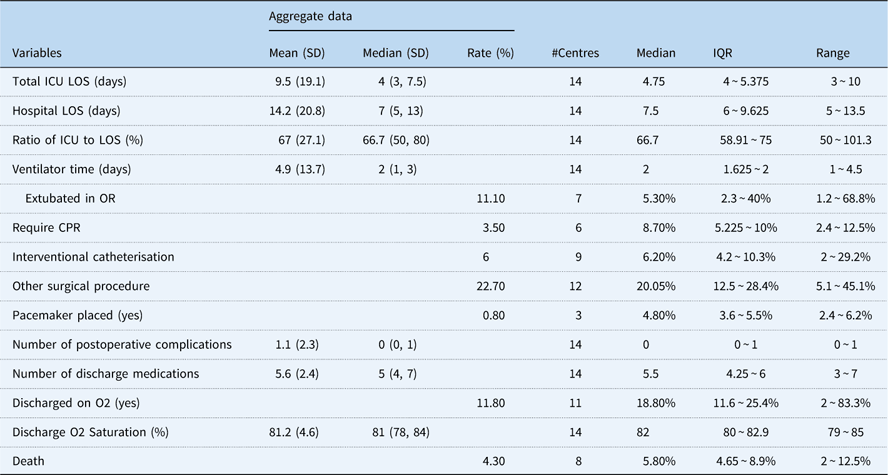
ICU length of stay, ventilator days, total length of stay, and number of medications on discharge (Table 3) varied among centres. Only seven centres reported performing intraoperative extubation at the end of the procedure. Among those centres, a median of 5% (2–40) of patients were extubated intraoperatively. In total, 11 centres discharged a median of 19% (12–25) of patients on oxygen despite little variability among all centres for discharge oxygen saturations. Overall, 4% of patients died during the Stage II hospitalisation. These deaths occurred at eight centres with a median mortality rate of 6%.Reference Johnson, Jaggers and Li 5 – Reference Anderson, Beekman and Kugler 9
Post-operative variables.

CPR = cardiopulmonary resuscitation; IQR=interquartile range; LOS=length of stay; OR = operating room.
Discussion
Our study shows a high degree of preoperative and perioperative centre-level variability in care processes for children undergoing Stage II palliation for hypoplastic left heart syndrome and related morphological right ventricle anomalies. These results are similar to the high degree of practice variability reported for patients with hypoplastic left heart syndrome undergoing the Norwood operation.Reference Pasquali, Ohye and Lu 8 Our findings were made possible through the use a large collaborative network to identify areas of variability that can potentially be controlled using clinical practice guidelines. The implementation of shared baselines or clinical practice guidelines across large collaborative groups, including the National Pediatric Cardiology Quality Improvement Collaborative, the Pediatric Heart Network, and the Pediatric Cardiac Critical Care Consortium, has resulted in previously unattainable improvement in patient care and outcomes.Reference Anderson, Beekman and Kugler 9 – Reference Vener, Gaies, Jacobs and Pasquali 12 In our analysis, we identified several areas, including nutrition, operative technique, and postoperative care, that may be targeted for further study to establish guidelines for best practices in the care of patients undergoing Stage II palliation.
In the preoperative period, we identified the wide variation in feeding methods and in the use of digoxin as areas for further study. The proportion of patients in our cohort who were receiving feeds through a gastrostomy tube before Stage II (18%) was comparable to the National Pediatric Cardiology Quality Improvement Collaborative study (14%),Reference Anderson, Beekman and Kugler 10 and increased 5% from the time of discharge home after the Norwood.Reference Lambert, Pike and Medoff-Cooper 13 Although causes may be multifactorial, the additional 5% of infants who got a gastrostomy tube placed during the inter-stage period warrants further study as gastrostomy tube feeding at discharge has been associated with longer hospitalisations and lower weight-for-age Z-scores before Stage II compared with children fed orally.Reference Lambert, Pike and Medoff-Cooper 13 Given the limitations of this database, we were unable to accurately determine whether more children with gastrostomy tubes died in the inter-stage period. Ideally, each child will receive full oral nutrition, but regardless of clinical outcomes, our data reveal inherent institutional preferences regarding the method and route of nutritional supplementation in those children who cannot take adequate calories for growth orally.
We found a fourfold variability in the use of digoxin in the preoperative period. Recent evidence found using the Single Ventricle Reconstruction and National Pediatric Cardiology Quality Improvement Collaborative database suggests that single ventricle patients treated with digoxin in the inter-stage period have a reduced mortality.Reference Brown, Mangeot and Anderson 14 , Reference Oster, Kelleman, McCracken, Ohye and Mahle 15 In the current era, these findings may decrease the variability in the use of digoxin. Consistent implementation of digoxin for all children in the inter-stage period warrants consideration as a practice guideline.
The choice of Stage II operation was also highly variable, with the predominant operation being the right-sided bidirectional Glenn followed by the hemi-Fontan. These findings were consistent with the Pediatric Heart Network-Infant Single Ventricle trial where 69% of patients received a bidirectional Glenn.Reference Cnota, Allen and Colan 16 In contrast, however, nearly twice as many (23%) had a right hemi-Fontan in our cohort compared with the patients (12%), probably reflecting the inclusion of a broader diversity of single-ventricle lesions in the Infant Single Ventricle trial. The disparity in choice of the Stage II procedure may be partly related to surgeon preference and the fact that the bidirectional Glenn is a technically easier operation and many surgeons have little experience performing the hemi-Fontan. Regardless, the choice of procedure is important because it typically establishes the type of Fontan procedure.
The large amount of variability in the intraoperative use of deep hypothermic circulatory arrest had no clearly attributable medical indication. There was fourfold variability in the use of deep hypothermic circulatory arrest, and one centre used circulatory arrest in all of their patients. As >50% of patients had a concurrent procedure at the time of Stage II, brief periods of deep hypothermic circulatory arrest may have been used to accomplish each of these additional surgeries, but the limitations of the database prevented further exploration. In fact, the current study was not designed to advocate for or against any particular operative or perfusion strategy, but rather to highlight the discrepant ways in which similar patients are treated.
Postoperatively, there was a 20-fold variability among centres for the proportion of patients extubated in the operating room. Intraoperative extubation requires cardiopulmonary stability and an anaesthetic plan to minimise narcotics. Anaesthetic plans were not available, and thus we were unable to determine specific factors associated with intraoperative extubation. However, given the previous success in collaborative learning projects, the practice of early extubation in the operating room following Stage II is a prime collaborative opportunity.Reference Mahle, Nicolson and Hollenbeck-Pringle 11
Our data highlight several areas that probably represent variation based on local provider or institutional practice preferences and may be targets for future outcome studies to determine best practices. Preoperatively, the method of nutritional delivery and the use of digoxin represent opportunities amenable to process control through standardisation. Similarly, the intraoperative use of deep hypothermic circulatory arrest and the type of Stage II procedure performed – bidirectional Glenn or hemi-Fontan – are potential areas of inappropriate variation among centres. If we are able to identify a superior practice pattern among these variables, future efforts can be directed towards a collaborative standardisation of care.
Limitations
The limitations of our study reflect those describedReference Pasquali, Ohye and Lu 8 for practice variation around the Norwood procedure. The 14 participating centres were medium- to high-volume centres, and these data may not actually represent true variability globally. Because we were limited to data obtained in the Single Ventricle Reconstruction database, we were not able to analyse variability among all care processes or practices. Regarding the choice of type of Stage II operation, we were unable to determine whether surgeon preference or specific anatomic findings accounted for this variability. These limitations prohibited an analysis of patient-level variation based on risk factors or individual complexities or practice-based variation. Finally, we did not study the effect of practice variability on clinical outcomes. Although we identified potentially modifiable risk factors, a future prospective study will be necessary to determine whether they are truly modifiable and affect outcomes.
Conclusion
We showed marked centre variability in the care and management of patients with hypoplastic left heart syndrome and related single right ventricle anomalies undergoing the Stage II palliation and identified potential targets for further study to develop best practice guidelines. Given the significant variability of all care practices and the low incidence of single ventricle heart disease, it will be critical to create structured and iterative processes to decrease variability and test them using a collaborative, transparent, and multicentre approach.
Acknowledgements
The authors acknowledge the Pediatric Heart Network Single Ventricle Reconstruction Trial Public-use Data set for supplying all data for the manuscript.
Financial Support
This research received no specific grant from any funding agency or from commercial or not-for-profit sectors.
Conflicts of Interest
None.