[Address Leaf]
A discourse touching ye present estate and gouuernement of the kingdomes of Denmarke and Norwegen, with a description of the said realmes, and Dominions appertayninge vnto them. written in September Anno 1588.Footnote 1
[begin 1r]
HauingeFootnote 2 been now twise sente from her Majestie into Denmarke,Footnote 3 I thinke it good, to wryte some discourse touching theise northerne kingdomes, and the presente gouernment of the same, in the kinge Christian the 4th his minoritie: for yat there is lyttle wrytten trulie of theise kingdomes, besides that false bruites are spread of them, euen by such as persuade they know somewhat[.]Footnote 4 wherein I thinke it best, first of all, to Consider the titles of the kinge, and afterward to treate in order of the Dominions, from whence he receaueth his titles.Footnote 5 He wryteth himselfe king of Denmarke, Norway, of the Gothes, and Vandales, Duke of Sleswicke, Holste, Stormar, and Dytmarsen, Counte of Oldenburghe and Delmenhurste[.]Footnote 6 as for Denmarke, it is a greater Cuntrey, and better inhabited, then hitherto hath been putt in printe, and but slenderlie expressed in geographicall Cardes:Footnote 7 which is deuided into 3 principall portions, viz: into Jutia, and Certaine other faire Islandes, and the Country called Schonia. JutiaFootnote 8 or Jutlande which of some wryters is called Cismarnia Dania, is a Cuntrey from whence the Englishmen came first of all into great Britannie, in which Jutia is a shire at this time Called Angleheme,Footnote 9 which is to say, the habitacion of Englishmen, which is also deuided from the Dukedome of Holste, by the riuer called Eidora.Footnote 10 The Cuntrey is most fertile, and contayneth 28 Townes[,] 4 Bishoprickes[,] 14 monasteries, and 20 princelie Castles, vnto which the king is wonte oftentimes to resorte, keeping his Court in them. This Cuntrey doth yeild aboue fiftie Thowsand oxen, and horses, yerelie, which are carried ouer into Germanie, paying for Custome,Footnote 11 vnto the kinge, for euerie one, a Dollar, and hath euerie yere aboue an hundred thowsand hogges of Th’inhabitauntes of Jutia, where the BooresFootnote 12 are verie slaues, as they are in most places, in the Dominions of the king of Denmarke: which are wonte to manure the Lordes groundes, and at all times must be readie to serue their masters, whensoeuer they are Commaunded to bring wood, to carrie stones, and other seruile offices, at their owne Charges, being bound to yeild in steed of annuall rentes, a certein number of hogges yerelie, and likewise a proporcion of Corne. In manie places of Jutia and Holsatia the king receaueth yerelie of the Boores for euerie hogge viijs lubecke, which maketh in English money xvd.Footnote 13 This Cuntrey on both sides hath the Ocean, and the Danish sea, called Mare Balticum, which the two riuers of Idora, and Slie, do make allmost an Islande[.] There are great store of wilde Bores, and stagges, which the kinge and nobilitie do Continuallie exercise, following and hunting them.Footnote 14 The rest of the Dukedomes of Sleswyke, (which is a peculier appanageFootnote 15 of the Crowne of Denmarke) of Holst, Stormar, and Dytmars,Footnote 16 are besett with huge, and allmost continuall forrestes, full of oke, or beech, for the most parte, in such sorte, that those Dukedomes in times past were Called Holsatia, which signifieth as much, as the breed of wood[.]Footnote 17 a man shall not see greater fiers made in anie place, then which are made in theise Cuntries, where is to be vnderstood, that all Sleswick
[begin 1v]
all Holste, all Stormar, and all Ditmars, doe not appertaine onelie to the kinge[,] allthough he hath the best parte of theis Dukedomes, as Cheife of the house of Holst. For manie Townes and Castles appertaine to the last kinges brother, and more to Dukes Adolphes Children.Footnote 18 As for the Dukedome of Ditmars,Footnote 19 which was Conquered, anno 1559 by the late kinge, Duke Adolph, and Duke John th’ elder Footnote 20 his brother, it was deuided equallie amongest them three, but Duke John dying 6 yeres past without issue, left his parte to be deuided betwixt the king, and duke Adolphe, the king receauing the better parte: so that more then halfe of that Dukedome, which is a most fertile Cuntrey, and allmost an Islande, apperteineth vnto the king of Denmark[,] where is to be Considered, that allthough theise Dukedomes do border vppon Jutia, yet three of them, viz: Holst, Stormar, and Ditmars, acknowledge the Constitucions of the Empire#.Footnote 21 In this first member of Denmarke called Jutia, and in the rest specified Dukedomes besides th’inhabitauntes doe liue most of all by their pastures, and grazinge, they are much giuen vnto fishinge, hauing plentie of fishes on euerie side; which Countrey stretcheth from the riuer Albis vnto Scagen, a promontorie ouer against Norway aboue 300 English miles.Footnote 22 The second parte of DenmarkeFootnote 23 conteyneth manie faire Islandes, as are Fionia, Zelandia, Fimbria, Alsen, Falstria, Lolandia, Langlandia, Bornholmia, Huena &c. amongest which, Zealand is the Cheifest,Footnote 24 which Island Contayneth in length 60 English miles, and 50 in breadth[.] it hath 13 Citties and 7 Castles, which belonge vnto the king of Denmarke, and 700 parishes. In this island is the Cheefe TowneFootnote 25 of all Denmarke, called in latin Hafnia, in the Dutch and Denmarke tongue tongue, Copenhagen, which is as much as to say, the merchauntes hauen, because it is verie Conuenient for merchauntes to trade in; where the king of DenmarkeFootnote 26 for the most parte, keepeth his warlicke shippes 36 in number, which are better made for seruice, and also better appointed, then anie of his predecessors haue had.Footnote 27 In which towne, is an vniuersitie founded by Christierne the first, where the kinge, besides the stipendes, which he giueth vnto the professors, liberallie maineteineth an hundred scholers.Footnote 28 In the middest of this Island standeth the Cittie of Roschilde,Footnote 29 an auncient Bishopricke, which hath a verie Commodious hauen, and a Cathedrall Church, which is famous with the burialls of the Cheifest kinges of Denmake, where also the late king Frederick the seconde, with his father, lieth buried. There are in this Islande most pleasaunt lakes or fishing pondes, abounding with all good fishe: as there is one at Sieburghe,Footnote 30 most delectable round abou[t]Footnote 31 besett with wood, wherein are the greatest and fattest breames that may be founde in Europe, and serueth alltogether for the prouision of the kinges Courte: there was in tymes past in the middest thereof, a Castell w[hich]Footnote 32 the king suffred to decay, least in time of warre it might giue occasion
[begin 2r]
of rebellion. There are likewise in this Islande goodlie forrestes verie pleasaunte for the Chace, where the late king was wonnte yerelie in the monethes of Julie and Auguste to kill fowreteen or fifteene hundred Deare.Footnote 33 In the whole IslandeFootnote 34 there is no towne more frequented then Elsenoer at this presente[,] where the late kinge builte a most royall Castell called Croen-burghe,Footnote 35 from which place a man may see right ouer against him, the Coaste of Schania not aboue 3 English miles distaunte; which Castle is situated after such manner, that being fowre square the sea compasseth 3 Corners of the same, which aswell for the pleasante situacion, and royall magnificence, as also for strength and reuenues, is the onelie Castell (I thinke) in the world where all the shippesFootnote 36 that Come out of Europe, towardes Sweden, Pommerlande, Pruslande, and Liuonia must paie tole, for such merchandises as they carrie and recarrie, with such seueritie, that if the merchauntes doe conceale anie small porcion of their ladinge, all their goodes are forthwith confiscated.Footnote 37 There were 3 English shippes in Julie,Footnote 38 for Concealing of merchaundises, at my last arriuall thither, confiscated to the value of 6000li sterlinge, and the proprietaries themselues committed to Custodie, whom, with much adoe, I procured to be released, and their merchaundises restored.Footnote 39 In summa, that which the golde, and siluer mines, doe yeild to other princes, the same doth this Custome, beinge vnto the kinge: which of late yeres vppon occacion of the warre against sweden, hath been so encreased, that it passeth all measure, and is so Confirmed now by process of time, that I doe not well see, how it might be mitigated, vnlesse the passageFootnote 40 allmost ended from the riuer Albis into the east sea, by Wismare, were finished, which being begonne by Albertus Duke of Meckleburghe was after his decease staied and hindred by Duke Vlricke of Meckleburghe his brother, (who yet liueth) being moued thereunto, by th’intercession of his wife, which was a queen of Denmarke[.]Footnote 41 And now the said Duke Vlricke doth not prosecute the worke, which hath Coste manie thowsand Dollars, by reason of his daughter now Queen of Denmarke, and the yonge kinge his nephew: some thinke he receaueth some yerelie porcion out of the realme of Denmarke, to abstaine from finishing the same, which by digging an English mile, and with farther expences of 2000li sterlinge, might be perfected, Themperor havinge allreadie giuen his Consente, and taxed the Toles, which in that passage should be paid, for merchaundise this way. Duke Adolph of late bethought himselfe, how he might make the riuer of Eidor,Footnote 42 running nigh his Castle of Gottorpe into the Ocean, and the riuer of Slie, comming out of the Danish sea by Sleswycke, vnto Gottorpe, ioyne together, where the grounde were to be Cutt, but one mile longe, which enterprise were most easie to be effectuated, if eyther the king of Denmarke would suffer it,
[begin 2v]
or that Adolphes Children were so mightie, as they might resist him[.] If t[he]Footnote 43 two riuers did one enter into another, all such shippes, as were bent out of Italie, Spaine, England, Fraunce, the Low Countries, and Dutch-lande, for to passe into Prussia, and to the Narue,Footnote 44 would then take this way, & not the way of Elsenoer, through the sounde where the king may staie all the shippes, which from all Europe come that way. The last yere the late kinge staied aboue 600 shippes of Hollanders and Zealanders, in theise partes, and fined them at 30000 Dollars, for spoiling an Embassador of the house of Rantzow, whom he had sente vnto the prince of Parma, as also for that Th’estates had not onelie opened his letteres, but Counterfayled his seale, to send him his letteres shutt againe.Footnote 45 The tole in this place amounteth commonlie by the yere, vnto Two hundred Thowsand poundes sterlinge: But the last yere by reason of scarcetie of Corne, 6800 shippes, passed that way, which were worth vnto the kinge, Thirteene hundred thowsand dollars, which amounteth to Three hundred thowsande pound sterlinge[.] The last kinge perceauinge the sweetenes of this Custome, was wonte to say, that he felt this sound to be verie sound for him. They of Lubecke aswell in their owne name, as in the name of the Hanse Steedes, anno 1582 at the Diett of Th’empire, holden at Ausburghe, complained of the king of Denmarke for encreasing of the Tole to be paid in the sounde, but the king mindinge to declare how little he esteemed th’accusacions of them of Lubecke, and that he did not acknowledge Th’emperour for his Judge in matters apperteyning vnto Denmarke, sett a double tole vppon them[.]Footnote 46 for whereas his Custome is to receaue an 100 Dollars for an 100 last, he caused them of Lubecke to paie 200. But the yere following at the baptisme of his youngest sonne John, he receaued them of Lubecke into fauor againe, and did exacte no more of them, then of the rest of the Cytties. Besides this, I know that the king hath aboue fiftie Thowsande pound sterlinge yerelie for the tole of, which he receaueth for Hamburgh and Rostock beareFootnote 47 (with which, all his kingdomes and dominions are serued) adding such money, as he receaueth for licencinge of oxen and horses to be transported out of his Countries into Germanie. There is another small Islande called HuenaFootnote 48 about 6 English miles distaunte from Croneburghe, most pleasantelie situated, which is rounde, and about 2 English miles in length, and 6 in Compasse, where a gentleman of an auncient house called Ticho Brahe,Footnote 49 verie well seen in Alcumie, but especiallie excellinge in Astronomie, and all the mathematicall sciences: where this gentleman, as in a place most fitt for celestiall obseruacions, hath erected singuler instrumentes, to obserue the Courses
[begin 3r]
of the celestiall bodies, the like whereof were neuer heretofore so fyttlie framed, sparing no coast or trauell that way: who is a man not vnworthy here to be spoken of, and remembred. Next vnto Zealande, in greatenes and riches, is another Islande called Fionia,Footnote 50 not alltogether so greate as Zealande[,] but a most fertile Islande, and full of townes where manie merchauntes doe inhabite. The king hath 4 Castles in the said Islande, besides Rugarde,Footnote 51 where he was wonte, especiallie to keepe his Courte, at his Comming into the saide Island. Gentlemen dwell here in great number, partelie for the pleasauntenes of the aire and soile, partelie for the number of woodes and forrestes, where they wante no hunting of stagges, wolfes, foxes, and hares. In the middest thereof is the cittie of Ottenzee,Footnote 52 which in times past was a famous Bishopricke. To this Islande belonge manie other Islandes, all fruitfull and inhabited; besides two other, which are not farre from Zealand, and situated towardes the south, called Lolandia and Falstria,Footnote 53 which are most fertile, and allotted to the presente Queen for her Dowrie, wherein are goodlie Townes, and Castles, faire pastures, good Corne, and great aboundance of huge woodes, which lie ouer against the Queenes father, the Duke of Meckleburghes, landes. Fimbria,Footnote 54 for the fertilitie of the grounde, is inferior to none, so full of howses as is possible to beare. It hath 4 parishes, to witt Landtkirche, Burghe, Petersdorfe, Badendorfe. Burgh is a proper Towne, not farre from whence, is the Castell of Glambecke apperteyning to Duke Phillip of Holste, sonne vnto Duke Adolph[u]s[,] which Island is verie populous[.] Alsen,Footnote 55 a goodlie Islande 16 miles longe 8 miles broad, in which Island is Sunderburgh a towne and Castell of the same name, besides Norburgh, Osterhollem, Holle, Gammelgaart, it hath 13 parishes, verie well frequented, full of goodlie woodes, wherefore great abundance of stagges is there[.] all this Island apperteineth to Duke John the last kinges brother, who hath bought from the gentlemen which dwellt in the said Island, their possessions: he paid vnto Hans Blome a gentleman,Footnote 56 for such lordshippes as he had in this Island, an hundred sixtie six thousand Dollars, which summe maketh in English money Thirtie seauen Thowsand pound sterlinge. LangelandFootnote 57 another Island hath 30 miles in length, in which is the Towne of Rutcopinge, and the kinges Castle Called Tranker, which Island hath 16 parishes. Lessoe,Footnote 58 an Island of 12 miles longe, which hath 3 parishes, and hath goodlie woodes. TassingaFootnote 59 which hath not pass 4 miles in length, but is very fertile, in which is the lordship of
[begin 3v]
Kettorpe, apperteyninge to the familie of the Rosekrantz and Rantzows. BornholmiaFootnote 60 neare the Coast of sweden, hath 30 miles in length, it hath diuerse parishes and villages, and a Castell called santwicke.Footnote 61 It was some times morgaged by Frederick the first of that name, vnto them of Lubecke, but was recouuered againe. There are manie other fertile Islandes, whose names I will onlie rite, for to describe them all would be to longe, which in diuerse Cardes of Denmarke are omitted: as are, Fare,Footnote 62 Massol, Sproe, Durholme, Fanne, Asse, Wedderre, Fee, Roe, Lintholme, Oem, Aggars, Ekholme, Toroe, Cioe, Strune, Arnae, Muncoe, Luoe, Moena, which hath diuers parishes, and the Towne called Stekoe, with the kinges Castell called Elmelonde, in which Island are most highe mountaines, out of which Th’inhabitauntes digge Chalke: and this much for the second parte.Footnote 63 The thirde parte is called Schonia,Footnote 64 which Contayneth two great shires, Halland and Blekinge,Footnote 65 which Cuntries are adioyninge vnto Sweden and Norway; which thirde parte of Denmarke is as great againe, as the two former partes, full of Townes, Castells, forrestes, mines of iron, all kinde of Deare for huntinge, riuers, lakes, with all store of good fishes, abounding with all kind of Corne, and beautified wth goodlie hauens. It is said, that it taketh his name of beautie, being more pleasaunte then the rest of the partes of Denmarke.Footnote 66 In this Countrey is the Citie of Londen,Footnote 67 famous by reason, that it is the Archbishoppes metropolitane sea, where is the fairest Church in all Denmarke: of which Cittie there is a prouerbe amongest the Danes in meeter, testefying, that their Londen was before the natiuitie of Christ.Footnote 68 In times past, there were 22 parishes and parish Churches in that Cyttie. Vppon the Coast of this Countrey, about FalsterbieFootnote 69 is great fishinge for herringes, which was wonte to be before at Rugen, and vppon the Coast of Pommerlande[.] But as the taking of theis herringes, was in times past in other places, and is now neare Falsterbie, so doe fishers obserue, that the taking of them is not so frequent here, as it was wonte to be: and that they be now taken in greater number, about the Coastes of Norway towardes Mastrand. I will make an end with Denmarke, after I haue touched one matter, which is, that the 7 BishoprickesFootnote 70 of this realme, wherof fowre I haue specified to be in Jutlande, two in Zealande, and one in Schonia, were wonte to mainetaine mightie prelates, which were in a manner Electors of the Crowne of Denmarke, of which
[begin 4r]
the least, was wonte to keepe, an hundred horses, all which Bishoprickes with their reuenues were annexed to the Crowne, by the last king and his father[.]Footnote 71 As for Cloisters,Footnote 72 the late king hath Conuerted diuers to good schooles, in which he liberallie to his Continuall praise, and the profytt of the kingdome, maineteineth schollers, as in the monasterie of SorenFootnote 73 in Zealande[,] the principall Island of Denmarke. As for the relligionFootnote 74 preached throughout the king of Denmarkes Dominions, for the most parte, it agreeth with the Ausburghe Confession, as lykewise in Ceremonies, saving that they be more moderate then the Lutheranes; for the last king could not abide the booke of Concorde,Footnote 75 deuised against the Caluinistes, by Certaine princes in the Empire, stirred forward by subtill persuasions of certaine factious preachers, which booke, when Augustus last Elector of Saxonie, sent by an Embassador vnto Fredericke the seconde, late king of Denmarke, costelie bound, and richelie besett with pretious stones, the king Cast it into the fire, affirming that the said booke would sett the whole Empire one fire.Footnote 76 The cheifest deuine, which is in theise kingdomes, is Nicolaus HemmingiusFootnote 77 a man of 76 yeres, verie well learned, and well affected towardes the refourmed Churches. Generallie in great Townes and places of much resorte, they preach not onelie in the Danish, but also in the Dutch tongue: and in the Courte, the king maineteineth preachers in both tongues[.] The Pope throughout all theise Dominions, is bannished, in such sorte, that scante is there anie that can remember (vnles they haue trauelled abroad) what theFootnote 78 masse is. This is also to be obserued, that if there be anie fastinge, for prayers generallie to be made thorow the whole kingdomes, the king himselfe prescribeth them, for 3 or 4 daies, to be celebrated thorough his whole realmes at one tyme.Footnote 79 And as for gouuernemente in matters ecclesiasticall,Footnote 80 decydinge questions about of marriages, and other like questions controversies, the king hath ordeyned a Consistorie, composed of the most famous deuines of the Cuntrie, whom the Chauncellor, and some other of the kinges Counsaile, with there aucthoritie doe assist, according as occasion shall require. As for the lawesFootnote 81 by which the realme is ruled, they are municipall, and follow most such ordinaunces as Waldemarus prescribed.Footnote 82 Norway hath some particuler Constitucions, so hath Jutia, and Schania[.] As for vsurie,Footnote 83 the king doth not suffer aboue 6 in the hundred to be taken. In matters of succession,Footnote 84 if there be manie brethren, the eldest is wonte to prescribe the diuision, but the youngest hath permission to Choose first. To come to Norway,Footnote 85 being at thisFootnote 86 least kingdome doth farre passe in greatenes the kingdome of Denmarke, being at the least
[begin 4v]
Two thousande English miles in length, which Cuntrie hath 4 Bishoprickes, Nidrosia,Footnote 87 is the metropolitane sea which in times past was called Druithem, which is as much to say as the seate of the Druides; to which Citie all the churches of Island and GronelandFootnote 88 were in subiection. Bergen is likewise a Bishopricke, a Cyttie with an excellente hauen, where the Hanse Townes haue their residence: Staffanger: and Hammaria: which foure Bishoprickes were of great Jurisdiction, and all now reduced to the Crowne of Denmarke; for the kingdome of Norway by diuers transactions, hath been made subiecte vnto the realme of Denmarke, by hard Condytions.Footnote 89 Amongest others in time of warre, they are to maineteine threescore shippes; a kingedome rich in pasture, but for the most parte nourished with Corne brought vnto them from other places, whose traffique maie easelie be restrained by the king of Denmarke. As for the profytt, which the kinge hath from Norway, it consisteth most in such toles, as he hath out of hauens, as Bergen, and WarehouseFootnote 90 towardes Russia, and in stone, and Tymber, whereof is great aboundaunce, for the making of Mastes and shippes[.] he hath besides great store of marble in the said Cuntrie, and by his officers maketh great profytt of diuers skinnes, butter, and fish of sundrie sortes, as Stockfishes, and herringes, which there are taken, wherewith also he furnisheth his nauie in steed of other victualls. To which end serueth likewise innumerable quantitie of bacon, whereof, euerie hundred is bound to sende at Certaine times, a certaine quantitie vnto the kinge.Footnote 91 At Warehouse the farther most Castell of Norway, the king keepeth certaine garnisons, trauelling as much as he may, to hinder the traffique of forraine nations vnto St Nicholas porte.Footnote 92 Against which hauen, in the beginninge of the last yere, he had great enterprises, pretending that one side of the said hauen apperteined vnto him, and that it were not lawfull for anie nation to passe that way, without paying Custome vnto him: which was th’occasion, that in the yere 1583 her Majestie was Contented, to the intente, that the merchauntes tradinge to Muscouia might passe freelie, to and fro St Nicholas porte, to permitt that 80 Angells shold be giuen vnto the kinge yerelie: by which Contracte it is to be feared least the kinge hereafter will pretende greater right vnto these seas and encroch vppon Englishmen, that traffique that way, more then by right he could haue challenged; which trade of our Countrymen seemeth to be most necessarie for the realme of Englande.Footnote 93 As for the Islande of Gotlande,Footnote 94 it is said to be verie fertile, from whence the king tooke the greatest parte of such marble stone as the Chimneys
[begin 5r]
in the Castle of Croneburghe, were builte with; which haue blew vaines in them, which do much beautifie the marble[.] It hath in length an hundred English miles, & sometime was subiecte vnto the kinge of Sweden: but for theise 200 last yeres it hath been vnder the Crowne of Denmarke. In this Island in times past, florished the towne of Wisbow,Footnote 95 where was great trade of merchaundises. Not farre from this place in the yere 1566 in the warre betwixt Denmarke and Sweden, perished eleuen shippes of the kinge of Denmarkes, with the Admiralles shippe of Lubecke, driuen to the shore by tempestes.Footnote 96 In which were drowned 7000 men. This Island yeildeth great store of Corne, butter, Cheese, diuers skinnes, and furres, besides a great number of firre trees, with adundaunce of lime. Besides theise Cuntries, the names whereof the king beareth in his titles, he pretendeth right to other Islandes; as to Islande,Footnote 97 called by auncient wryters Thule, a large Islande, which he holdeth, and doth not suffer that fforryners may fish there, for linge, haberdine &c as in times past was permitted vnto Englishmen, to whom by plaine treaties passed betwixt Henry the 7th king of England, and John kinge of Denmarke, and Norway, it is lawfull to trauell thither for fishinge; requiring (which Clause is in the treaties) the said permission to be renued at euerie 7 yeres; which article not hauing been dulie obserued, hath giuen an occasion vnto the Danes to pretend that we haue lost our interest therein.Footnote 98 This Island is about 200 English miles longe, where are two Bishoprickes, Holen and Skalkolten, suffragante vnto Nidrosia, Th’archbishoppes sea of Norway,Footnote 99 in which Cuntrie they vse the old language of the Gothes, and resemble much the speech, which the Norwegians vse; in which tongue they haue of late printed the old and new Testaments;Footnote 100 from which Island, the kinge receaueth great store of linge, stockfish, traine oile, and plentie of Brimstone, fitt to make his gunpowder withall; in such sorte that he maketh great profytt of the fish of that Cuntry, hauing lett to ferme the onelie trade of fishinge there, vnto the Thesaurer of Denmarke, besides such quantitie which is sente from thence, for the maineteynaunce of the kinges Armada.# Footnote 101 He pretendeth likewise right vnto the Islandes of the Orcades and Hetlande; affirminge that by old right they doe appertaine to the Crowne of Norway: which Islandes 600 yeres since, hauing been annexed to the Crowne of Norway, were morgaged by Christierne the first, king of Denmarke and Norway, anno 1469, to James the thirde king of Scottes, vntill fiftie Thowsand guilders were paid by him, or his posteritie vnto the said kinge of Scotland, due for the Dowry promised with Margarite his daughter, which was maried to James the third anno 1470 10 Julij as after in the geneologie of the kinges of Denmarke shall appeare[.]Footnote 102 which summe of money, the late kinge, sending an Embassador, ao 1585o vnto James the sixte now kinge of
[begin 5v]
Scotlande, offred to paie, demaunding restitucion to be made vnto him, of the said Islandes, according as by his othe, he had promised to redemande them Footnote 103 being crowned king of Denmarke; at which time the king of Skottes aunswered that he had reuersales literas, by which he was discharged of restoring the said Islandes, which he was minded to sende vnto him with speed; as also to treate with him touchinge farther alliaunces. Since which time the said king of Scotlande twise sente his Embassadors vnto him, demaunding his eldest daughter to be giuen him in matrimonie, but neuer shewed anie reuersales literas, by which he should be discharged of restoring the Orcades and Hetlande, at such time as the king of Denmarke should offer paiment of the mencioned summe, for which (as I haue specified) the said Islandes were first morgaged.Footnote 104 And certaine it is, if the late king had liued, he would eyther by force or Couuenaunt, haue trauuelled to recouuer the right, which he pretended to the said Islandes. ffurthermore besides theis specified Cuntries, the king hath in his possession the Islandes of Oesel,Footnote 105 Curland, Wicke, and Mokneme, an Island betwixt Lifelande and Oesel, from whence it is distant eight English miles;Footnote 106 which Countries he obtained by the right of his brother Duke Magnus, who marying with Basilius, the great Duke of Muscouia his brothers daughter, had the said Countries with her, whom the said Muscouite made to beleiue, that he should be kinge of Liuonia.Footnote 107 Oesel hath in length 60 miles Englishe Footnote 108 in latitude 30. In which is a Cathedrall Church of Prebendaries, which is alltogether incorporated vnto the Crowne of Denmarke. The king maineteineth a Castell there, called Arensburghe with garnison.Footnote 109 There are in the said Islande 5000 inhabitauntes, and about 30 gentlemen. It Containeth 8 parish Churches, distaunt from Lifelande about 50 miles English.# Footnote 110 As for the Counties of Oldenburgh and Delmenhurst,Footnote 111 he hath presentelie nothing out of the same, but being descended of that familie, vseth the titles and armes thereof, according vnto the manner of the princes of Germany. The said Countes of Oldenburghe haue had a Controuersie with the Countes of Eastefrizelande, for the territorie of Jeueren, situated vppon the sea side, betwixt Oldenburghe and Eastefrizelande, which Controuersy, because yat Jeueren hath of late been annexed, as a fee to the house of Burgundie was to be decided, in the low Countries; where the Counte of Eastefrizelande found greater fauor, then the Counte of Oldenburghe: whereuppon the late kinge of Denmarke, a lyttle before his death, tooke occasion to aduertise the Duke of Parma, that he himselfe was descended out of the house of Oldenburghe, and because that in time to Comme the said territorie of Jeueren might descend vnto his heires
[begin 6r]
he required, that the proces might a new be examined, which the Prince of Parma Commaunded, who knowing the magnaminitie of the kinge of Denmarke, and vnderstanding the right of the Cause, trauellinge that iustice might be done therein, he brought the matter so fare, that in August last sentence was pronounced for the said Counte of Oldenburghe.Footnote 112 The kinges of Denmarke likewise pretende, that they are lordes of Hamburghe,Footnote 113 and of Lubecke; both which are situated in the Cuntrie of Holste, and if the late kinge had liued, till the first of June laste, Th’inhabitauntes of the said Cytties should haue done hommage vnto him. At this time, the king being in his minoritie, the last kinges brother is like to be their Gouuernor, vntill the king shalbe Comme to full age.Footnote 114 The king of Denmarke hath throughout all his Domynions faire hauens,Footnote 115 and pastures, which is the cause that a man may wonder that his Countries haue not longe agoe more florished, then they did, which (I thinke) is to be attributed vnto the lacke of industrie in Th’inhabitauntes. At this presente, by reason that manie of the low Countries, which are fledd into theise Dominions, the ground is farre better manured, then it was, and the trade of merchandises in Townes much bettred. The Island called AmaggarFootnote 116 ouer against Copenhagen is alltogether inhabited by men of the low Countries, whose industrie is highelie Commended by the whole nacion of the Danes. As for Th’armes,Footnote 117 which the king of Denmarke Carieth, I thinke it nott amisse to adde hereunto; because I haue heard diuers of our Heraldes to be ignorant in them. for the kingdome of Denmarke, he giueth 3 blew lyons in a Champ D’or: for Norway, he Carieth a lion rampant, holding a halliberde in a Champ rouge[.] Besides he vseth in his armes, 3 Crownes, which was wonte to be the kinge of Denmarkes armes, when Sweden was ioyned vnto the other two kingdomes, in vni token of 3 vnited realmes. Moreouer for the kingdome of the Gothes, he vseth a lion with 9 hartes: for the kingdome of the Wandales, he carieth a Dragon; ffor the Isleland of Gothelande, a lamb Carrying a banner with a Crosse in a Champ rouge; for Island a white linge Crowned in a Champ rouge: for the Dukedome of Sleswycke 2 lyons ore, in Champ azer; for the Dukedome of Holste, a white nettle leafe: for the Dukedome of Stormar, a white swan with a Crowne about her necke in a Champ d’or: for the Dukedome of Dytmarsen, a horseman syttinge vppon a white horse in Champ rouge: for Oldenburghe, Barrs rouge in Champ d’or: for Delmenhurst, a white Crosse in Champ rouge: for the Island of Oesel, an Eagle.Footnote 118
Generallie th’inhabitauntesFootnote 119 of theise Cuntries are stronge of bodie, tall, of good Complexion, verie like vnto our northerne men, of longe life, hardie, and able to take great paines, great eaters and drynkers, and good seafaryng men. Surelie all thinges well
[begin 6v]
Considered, the presente kinge after he shall Come to yeares, wilbe a mightie princeFootnote 120 whom Monsieur Danzey, (who hath been the ffrench kinges Embassador in Denmarke the space of 40 yeres)Footnote 121 iudgeth wil to Footnote 122 be one of the richest kinges in Europe; for that, besides he is not indebted, he hath great treasure in readynes, and spendeth lyttle, Consideringe that his Corne, fish, and flesh of what sorte soeuer it be, is so dailie prouided for him, that it deminisheth nothinge of his treasure, mightie of men and shippinge.Footnote 123 Being come this farre, I thinke it now requisite to adde somewhat, touchinge the gouuernementFootnote 124 of theise kingdomes, which depend not vppon succession, but vppon election: which Custome allthough th’estates of the Cuntrie doe obserue, yet neuertheles, they willinglie Choose, their last kinges eldest sonne, if there be anie vertue in him; or at the least, one that is next of blood, of the kinges famelie.Footnote 125 Oftentimes the kinges in their life times, haue trauelled to cause their sonnes to be elected kinges. As the late kinge Fredericke the seconde, foreseeinge the great priuiledges which the gentlemen of the Cuntrie haue, and to leaue the sure succession of those realmes vnto his Children, caused his eldest sonne, three yeres before his death to be chosen his successor in the kingdome of Denmarke &c. who at this presente hath the title.Footnote 126 The kingdome being gouuerned in his nonage by his mother, and especiallie by the 4 Gouuernors, of which hereafter I purpose to make mencion. Commonlie, he that is Chosen king of Denmarke, is also to succeede in Norway: howbeit, it is not enoughe for the sonne of a king to be elected the father liuinge, but is besides requisite, that hommage be done vnto him in 4 places of Denmarke:Footnote 127 first at Wiburgh in Jutlande, secondelie at Odensee in the Isle called Fionia; thirdelie in Zealand, at Rinsteede, last of all, at Londen, in the Island Called Schonia;Footnote 128 and so likewise they are to be receaued at Nidrosia, the Metropolitane Citie of Norway:Footnote 129 where, and in some other places of that kingdome, hommage is dulie to be done, for to succeede certainelie in that kingdome after the fathers death[.] whereuppon the last kinge toulde me at Hadersleben, the last winter,Footnote 130 that he minded to send his eldest sonne the spring followinge into Norway, and afterward vnto the Dukedomes of Sleswycke and Holste, there likewise to be acknowledged, as successor after him. In which Dukedomes the gentlemen haue an auncient priuiledge, that they are not bounde to Choose for their ruler, the eldest soone of the kinge, but which of his sonnes, it shall like them beste. Their histories make mencion, that the succession of the Crowne of Denmarke &c continewed in the famelie of the Waldemares, about 200 yeres. And certain it is, that the scepter of theis kingdomes, hath Continued in the famelie of the Countes of Oldenburghe (from whence this presente king is descended) for the space of an hundred and fortie yeres, as may well appeare
[begin 7r]
by his lineall discente, which I thinke good to sett here downe.Footnote 131 Christierne (which in the Danish tongue is as much as Christian) the first of that name,Footnote 132 Counte of Oldenburgh and Delmenhurst, borne of the kinge his predecessors sister, began to raigne, being elected, anno 1448 who was kinge not onelie of Denmarke and Norway, but also of Sweden, allthoughe at the first they of Sweden did not admytt him, because he was not Chosen by their Common Consente; as their Custome prescribed. Betwixt this kinge, and kinge Henry the 6th king of England, was a league made, anno 1449o as likewise between king Edward the fourth and the said Christiern, in the yere 1465,Footnote 133 who died at Hafnia, anno 1481[,] leauing 3 Children, of which JohnFootnote 134 being the eldest, succeeded his father in all the 3 kingdomes; and was the second kinge of this famelie: between whom and king Henry the 7th was Contracted a farther league, anno 1490o[.] his second brother was called Fredericke, who was afterward the 4th king of this famelie[.] The third Child was a daughter called Margerite whichFootnote 135 was married vnto James the thirde king of Scotlande, anno 1470o 10o Julij.Footnote 136 John had likewise 3 Children, Frances who died being yonge. Christierne the secondeFootnote 137 who succeeded his father in all the three kingdomes, the thirde kinge of this famelie betwixt whom and king Henrie the 8th was made a league anno 1523o[,] who had to wife Elizabeth, sister to the Emperor Charles the vth who for his Tyrannie was depriued of his kingdome, and Compelled to flie into Englande[.] Afterward by the aide of his father in law Charles the 5th[,] Henry the 8th king of Englande, and the ffrench kinge, gathering together 24 shippes, trauelled to recouuer his kingdomes againe, but was taken prisonner by FrederickFootnote 138 the sonne of Christierne the first, anno 1532[,] after which sorte he liued 27 yeres.Footnote 139 Frederick, whom I obserued to be the 4th kinge of that house, and first of that name, was Chosen king of Denmarke and Norway, vppon the depriuacion of Christierne the seconnde, after whom Sweden was seuered from the rest of the two kingdomes; he left 6 Children, Elizabeth, maried to Duke Vlricke of Meckleburghe of which mariage was borne Sophia, the late king Frederickes wife, presente Queene, and mother of Christian the 4th which now raigneth: then SophiaFootnote 140 maried to Duke Alberte of Prussia; ChristianFootnote 141 who after his fathers decease, was called the thirde of that name, and the 5th kinge of that famelie, who died anno 1559o. The other three Children of Fredericke the first, were Called, John, Adolph, and Fredericke: John died, anno 1582 without issue:Footnote 142 Adolph died 2o Octobris, anno 1586[,] who was knight of the garter: Fredericke was made Archbishoppe of Breme, Bishop of Hildeshem, and Sleswyke, who died ao 1556o. Christierne the third of that name (who detesting the Cruelltie of
[begin 7v]
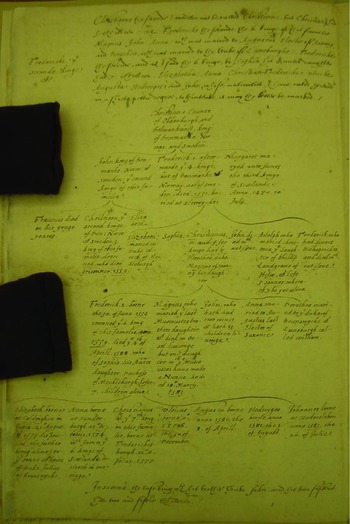
Christierne the seconde) woulde not be called Christierne, but Christian) had 5 Children: viz: Fredericke the second, the 6 kinge of this famelie: Magnus: John: Anna: which was maried to Augustus Elector of Saxony, and Dorothea, which was maried to the Duke of Luneburge. Fredericke the second,Footnote 143 and as I said the 6 kinge, by Sophia his Auntes daughter had 7 Children. Elizabetha: Anna: Christian-Fredericke: Vlricke: Augusta: Hedwiges, and John, whose natiuities I haue noted herevnder in a shorte pettie degree, to th’intente it may the better be marked.Footnote 144

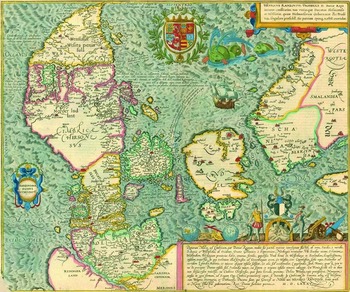
Map of Denmark by Marcus Jordanus in Braun and Hogenberg, Civitates Orbis Terrarum, Part IV (Cologne, 1588). Reproduced by permission of Antiquariaat Sanderus, www.sanderusmaps.com.

[begin 8r]
There are yet liuinge of this famelie, besides the king and his two brethren: The kinges vncle called Duke John,Footnote 145 who was borne at Coldingen anno 1545o 25o Marcij so that he is now 43 yeres of age, a tall prince, and as Cleanelie timbred as anie prince in Germanie, and brother to the last kinge: of whom the mother (who was Duchesse of SaxonieFootnote 146 ) made more accompte, then of the last kinge[.] he hath had two wiues: The first was Called Elizabeth daughter vnto Ernestus Duke of Brunswicke and Luneburghe, which he maried anno 1567 and had by her 13 ChildrenFootnote 147 all liuinge, whose names and natiuities I Copied out of a booke, which the last king lent me, and thinke good to specifie here. The first is Dorothea, borne at Coldinghen, anno 1569 16[o] Octobris. The next Child was Christianus borne at Sunderburghe 1570 26o Nouembris. The third is Called Ernsestus, borne at Sunderburgh, 1572 17o Januarij. The 4th is Alexander, borne at Sunderburgh 1573 12o Januarij. The 5th Augustus, borne 1574 21o Julij. The 6th is called Marie, borne at Sunderburgh 1575 22o Augustj. The 7th Called Adolphus-Johannes borne at Sunderburgh, 1576 17o Septembris.Footnote 148 Then Anna being the 8th was borne, 8o Octobris 1577o. The ninth Child is Sophia borne in the yere 1579 13o Augustij. Elizabeth is the 10th Child, borne ao 1580 24o Septembris. Th’eleuenth is Fredericke, borne 1581 26o Nouembris. The 12th is Called Margerite, borne 1583 24° Februarij. The last is called Phillip, borne 1584 15o Maij. The mother of which Children died in the yere 1586. His second wife is called Agnes Hedwiges daughter of Joachimus Ernestus, prince of Anhalde, which was widow of Th’elector of Saxonie Augustus; whom,Footnote 149 being but 15 yeres of age (for she was maried verie younge vnto the Elector) he tooke to wife the 14th of Februarie, 1588 at Sunderburgh, which is an Islande betwixt Jutlande and Fionia, at which mariage, the late kinge[,] Phillip Duke of Brunswycke[,] John-George, and Christian princes of Anhalte, the spouses brethren were presente.Footnote 150 Besides theise, Adolph Duke of Holste,Footnote 151 sonne to Frederick the first, hath lefte yett aliue 3 sonnes, beinge of this famelie hauing had in all 10 Children, of which Phillip and Johannes-Adolphus with a third brother,Footnote 152 are yet liuinge. Phillip was borne at Gottorpe, a faire Castle now apperteyning vnto him, anno 1570 10 Augustj[.]Footnote 153 Johannes-Adolphus was borne 1575 who was Chosen Archbishop of Breme 1585o and is besides Bishoppe of Lubecke;Footnote 154 so that there are 11 males liuinge at this presente, all descended of kinges of Denmarke, out of the familie of the Countes of Oldenburghe, besides the kinge, which now beareth the title, and his two brethren; which all do wryte themselues heyres of Norway, Dukes of Sleswycke, Holste, Stormar, and Dytmars,
[begin 8v]
Countes of Oldenburgh and Delmenhurst. Amongest which Dukes of Holste in this presente monnth of September is some discencion, for the gouuerning of the said 4 Dukedomes: Phillip who after the kinge hath the most landes in the said Dukedomes, pretendeth as the eldest sonne now liuing of Duke Adolph, that the superioritie of gouuernement in the said Dukedomes apperteyneth to him. But the nobilitie of the Cuntrie addicted to the Conseruacion of great Priuiledges, which of long time they haue enioyed, marking that the said Duke Phillip, being but 18 yeres of age, followeth more the humor of his mother, then of his father, and to carrie (as they tearme it) rather Hessicum caput,Footnote 155 then Holsaticum, doe more encline to electe for their Gouuernor Duke John, the last kinges brother; partelie for that beinge 43 yeres of age, he hath more gouuernement in him, and partelie for the Commelines of his person; but especiallie to satisfie the said Duke John, who hath shewed himselfe of late miscontented, for that Th’estates of Denmarke, haue not had that regarde of him, after the kinge his brothers death, as he thought they should haue had[.]Footnote 156 for because the presente kinge, is not yet fullie 12 yeres of age, he looked that they should haue Chosen him to be the kinges Tutor, or at the least to haue made him one of the 4 Gouuernors, partelie for that he were the next of blood vnto him,Footnote 157 partelie for that the Electors and princes of Germany, doe follow this Custome, that in the nonage of the yonge prince the next prince doth gouuerne.Footnote 158 As at this presente Duke Cassimire is the tutor, ouerseer, and ruler of his brothers sonne, the yonge Elector Pallatine, and of all his Dominions.Footnote 159 And Joachim George Footnote 160 Fredericke, a Markegraue of Brandeburgh, gouuernor in the weakenes of Albert Fredericke Duke of Prussia, and of all his possessions[.]Footnote 161 for which matter there will shortelie be a meetinge in the Dukedome of Holste: whither the 4 Gouuernors of Denmarke purpose to send a Counsellor in the kinges name to advaunce the said Duke John, and to take away all vnkindenes which might breed in the said Duke farther inconvenience against them. for the Gouuernors and nobillitie of Denmarke do thinke well of the said Duke John; but they trauell especiallie to mainetaine their priuiledges, which indeed are great; wherefore they doe alleage against him that th’estate of the princes of Germanie doth depend vppon succession by inheritaunce, and not by election, by which the kingdome of Denmarke Consisteth. The nobillitieFootnote 162 of theise Countries is onelie of gentlemen. Two hundred yeres past, they had Dukes, Earles, and Lordes, whereof somme encroching by ambicion vppon gentlemen, gaue them occasion to oppose themselues, and became in the end masters of the higher nobilitie: And afterward dealt in such manner with the kinge, that order was taken
[begin 9r]
there should be no greater nobillitie then gentlemen:Footnote 163 whose aucthoritie is so great, that the king can lyttle effectuate against them, without th’aduise of the Councellors of the realme, which were wonte to be 24 in number, without whose Consente the king can Compasse or execute no great matter, which ought all to be borne in the kingdomes of Denmarke and Norway.Footnote 164 There are now but 20 and two of them are Germaines, one borne in the Dukedome of Holste, thother in the Dukedome of Meckleburghe[,] at which the nobillitie of the Cuntrie doth stomacke.Footnote 165 The names of theise 20 which are now in aucthoritie, are theise that follow.Footnote 166
Nicholas Kaas, of Tarup: The kinges Chancellor.Footnote 167
Peter Guldenstern of Tym: Mareshall of the kingdome.Footnote 168
Peter Moncke of Estuatgaard: Admirall of the kingdomeFootnote 169
George Rosenkrantz of Rosenholme: StewardFootnote 170
Christopher Valckendorfe of Glorup: ThesaurerFootnote 171
Steno Brahe of Knudsturpe.Footnote 172
George Skram of Thielle.Footnote 173
Mandrope Passeberg, of Hagisholme.Footnote 174
Ericke Hardenberg of Matterup.Footnote 175
Haguinus Vlstandt of HuckebergeFootnote 176
Andreas Binge of SmidsturpFootnote 177
Henry Belouw of Spitterup: The kinges Lieutenaunt in Jutlande, and Captaine of castle of ColinFootnote 178
Axel Guldenstern of Lingbuy, the kinges lieutenaunt in Norway.Footnote 179
Coruitius Wiffert of Ness.Footnote 180
Absolon Goie of KielsturpFootnote 181
James Sehefeld of WisborneFootnote 182
Breida Rantzow of Rantzouisholme.Footnote 183
Christianus Skele of FusingerFootnote 184
Albert Fryse of Harritzkier.Footnote 185
Aruidus Huitfeild of Odersberg: Chauncellor of Denmarke the kingdome of Denmarke.Footnote 186
Amongest theise 20 there is mencion made of two Chauncellors. The first hath the honnor to be called the kinges Chauncellor[.]Footnote 187 Th’other being the last (by reason of his late Cooptacion into the number of Counsellors) is Chauncellor of the realme.Footnote 188 The kinges Chauncellor is head of his royall Councell, th’other determineth rather Controuersies risen amongest gentlemen, and such as are to be decyded by law, and is not allwaies presente in matters of policie, and Concerning th’estate.Footnote 189 Out of theise 20 Counsellors with the consent of the rest of the nobilitie, 4 haue been Chosen to be the
[begin 9v]
principall Gouuernors of the realm in the kinges nonage, for the space of one yere:Footnote 190 which are Nicholas Kaas, the kinges Chauncellor, Peeter Moncke Th’admirall, George Rosenkrantz Steward, and Christopher Valkendorfe, Thesaurer: which fowre dispose in as ample manner all thinges apperteyning to the kingdomes of Denmarke and Norway, as the kinge Could doe himselfe, if he were of iust yeres. As for the Dukedomes of Sleswycke, Holst, Stormar, and Dytmarsen, there are 11 other Counsellors which in the kinges name do presentelie there gouuerne, as they did before the late kinges death: whose names I add hereunto.
Henry Rantzow of Breidenberg, Counestable of Segeberge: The kinges lieutenaunte in the Dukedomes of Sleswyke, Holste, Stormar, and Dytmarse.Footnote 191
Peeter Rantzow of Troiburg: Counestable of Flensburghe.Footnote 192
John Bloome of Sehedorfe: Counestable of Haddersleben.Footnote 193
John Rantzow of Hassleberge: Counestable of Rendesberge.Footnote 194
Benedictus Alefeld of Lemculen.Footnote 195
Danish Royal Pedigree, in Rogers's ‘A discourse’, fo. 7v. Reproduced by permission of the Huntington Library, San Marino, CA.

George Sehested of Nortesche.Footnote 196
Detleuus Brocktorfe of SchreuenborneFootnote 197
Daniell Rantzow of SehegaardFootnote 198
Henry Alefeld of Saturpholme.Footnote 199
Nicholas Alefeld of Getlinge.Footnote 200
Christopher Rantzow of Quernebecke.Footnote 201
Whereof some are of most auncient houses, and of great wealth: for the first Henry Rantzow,Footnote 202 may be accounted to be the richest gentleman and subiecte in Europe, hauing Twentie Thowsand poundes sterling yerelie in reuenues; and to the value of an hundred Thowsand poundes at bancke. John Blome hath Tenne Thowsande pounde sterlinge yerelie, and is reported to haue no lesse at bancke, then Henry Rantzow. But to returne to Denmarke, of the fowre Gouuernors, which are appointed for a yere, during the kinges nonage, it is thought that the Chauncellor and Thesaurer, must allwaies Continue, by reason partelie of their owne excellencie, and trust; as partelie for their offices for they are not minded to Crowne the younge kinge, before he Come to iust yeres, and to that maturitie of iudgemente, as he may know vnto what Condicions he shall sweare. Th’estates of the Cuntry deliuered vp to the fower Gouuernors Certaine articles which they would haue to be obserued: who gouuerne verie warilie, not forgettinge their owne kinsfolkes; which they doe greatlie aduance, trauelling also to heape great treasures for the kinges vse, which at this presente, is at their disposicion. wherefore they discharge manie which serued the last kinge, who was wonte to haue Dukes and Earles in his court
[begin 10r]
to attende vppon him, which he maineteined liberallie, allowing to some 12 horses to some more, and to some less, which they thinke this king by reason of his nonage may well wante. They likewise haue Contracted abridged Footnote 203 the number of souldiors and mariners, which serued vppon the kinges shippes, to spare expences Thinking it not necessarie to keepe so manie, as the last king appointed, which being licenced to departe by order from the Thesaurer, gaue an occasion to the Admirall to be offended with the Thesaurer, for that it being apperteined to his Charge to licence such as serue in the kinges shippes.Footnote 204 Amongest other of the nobilitie (which as I said Consisteth onelie of gentlemen) I will here remember some, besides th’above mentioned, which partelie for their offices partelie for their vertues, are in greatest Credytt in the Courte of Denmarke. Stein Maltizen:Footnote 205 Mareschall of the Courte, a man skillfull in warlicke affaires, hauing been lieutenaunt vnto the Counte William of Nassaw, ouer his regimente in the low Countries, a longe time. Gerard Rantzow,Footnote 206 sonne to the kinges lieutenaunte, which Gerard is Counestable of the Castle of Croneburghe: and Capten of the kinges guarde: whose like,Footnote 207 I haue not seene for his yeres in manie kingdomes: for being but of th’age of 31 yeres, he hath seene the most parte of Europe, of Greece, and of Egypte: and speaketh 6 languages verie well, and is a Comelie and able gentleman,Footnote 208 of great spirite: of whom I do the gladlier make mencion for that being of great forwardenes, Credytt, and abilitie, he doth offer his seruice vnto her Majestie, in preparing and Conductinge of 4000 men for her highenes aduancement, when she shall please to commaund him. Eustach Tunen,Footnote 209 who is master of the horse. But none is of greater Credytt then Henry Rammell,Footnote 210 who in the yere 1586 was sent Embassador from the late king his master vnto her majestie in most honnorable manner:Footnote 211 he is at this presente the yonge kinges ouerseer, and Stewarde: The Cheifest Counsellor which the Queen doth vse: who is the verie mouth of the fowre Gouuernors: a man better seene in matters of estate, then anie in this kingdome, or then a man shall easelie find in all Th’empire[.] for which Cause the late kinge, was verie liberall vnto him, Causing him to sweare, that he should not abondone Denmarke, but sticke vnto the Queene, and the younge princes his Children. He is not paste one or two and ffortie yeres of age, and hath seene as much as anie one of his yeres, hauing been thoroughout all Europe, seen Constantinople, and Jierusalem, passed through all Greece, Egipte, yea Arabia, and a great parte of Africke[.] he is borne of an auncient house in Pommerlande, where he hath 2000li sterling by the yere: and enioyeth as much by the liberalitie of the late king, in Denmarke. By the late kinges aduice, (who by all meanes trauelled to binde him to the kingdome of Denmarke) hath Contracted with a daughter of
[begin 10v]
the familie of Rantzow which he thought to haue maried this yere, had not the king died; but after, the full yere, from the kinges death, is ended (because in this mourninge time, no gentleman being of the Court can without reproch take a wife) he mindeth to marrie her.Footnote 212 The kinges Chauncellor Nicholas Kaas,Footnote 213 (who in gouuernement is of the greatest vertue and aucthoritie in theise kingedomes,) especiallie communicateth his Counsailes, and vseth th’aduice of this Henry Rammell, which are verie Carefull presentelie how to maineteine tranquillitie at home, where are certaine dissencions, which might breede inconvenience if in time they were not looked vnto.Footnote 214 Diuers of the nobilitie Complaine that the last kinge did greatlie infringe, and breake their liberties, which they should haue in huntinge[.]Footnote 215 And there be some others which ioyne with them, who for some enormious faultes Committed, hauing been eftsoones and highelie fined by the last kinge, would haue their fines to be restored vnto them againe. ffor the king by the priuiledges of the nobillitie, cannot putt to death anie gentlemen, onelie it is lawfull for him, to fine them, and to putt them into prison. There is one, vppon whom the king sett fines twise or thrice, and at eache time, compelled him to pay Tenne Thowsand Dollars, whom he was minded to haue fined againe, but being in his deathes bedd, pardonned him: who being of a verie auncyent house, stirreth vp his freindes, & ioyning with other factyons, might trouble the quiettnes of his Cuntrey.Footnote 216 In appeasing of which, and the like humors, the fowre Gouuernors are verie Carefull. The Chauncellor of late was sore sicke, who is recouuered, whom if god should haue taken away, great Confusion might haue ensued, for that his integrytie, and Credytt, with th’aucthoritie of his office, being himselfe of a noble house, doth especiallie keep the rest of the nobilitie in good order: who with the rest are well affectionated to mainetaine good Correspondencie with the realme of Englande, and to vnderhold and preserue such alliaunces, as are betwixt the realmes on both sides,Footnote 217 which Cannot but be commodious for England and them; aswell for the Continuynge of traffique towardes St Nicholas porte, into Prussia, and the Narue, as for Conserving the Common tranquillitie of the kingdomes on both sides. Besides that, their freindshippe may be the more esteemed, for that they be, of the same religion, which is professed in Englande,Footnote 218 and great
[begin 11r]
affinitie betwixt the tongues of both kingdomes. The king of Spaine of late trauelled to haue had shippes and mariners out of Denmarke, to serue him in theise last exploites at which time diuers being wonne with great stipendes, were minded to saile towardes him: of which being truly aduertised, I dealt with the Queene and the 4 Gouuernors to stay them, declaring vnto them, how that it were against the leagues and entercourses, and not Conformable to the straight freindshippe which was betwixte the last kinge, and her majestie, neither agreable vnto the religion which they professed, to suffer their subiectes in so daungerous a time, to serue the king of Spaine, against her majestie[.] wherefore they tooke such order, that forthwith they were staied, not minding to suffer that any of the subiectes of their kingdomes should serue against her majestie.Footnote 219 Thus much may serue for this presente, touching th’estate and gouuermente of theis Northerne kingdomes.
Daniel RogersFootnote 220