Introduction
Over the past 20 years much of the level lowland forest of Southeast Asia has been lost (Namkhan et al. Reference Namkhan, Gale, Savini and Tantipisanuh2021). Particularly hit by this destruction is the biodiversity-rich transition zone between the Indo-Burma and Sundaic regions (Isthmus of Kra; Hughes Reference Hughes2017) where most of the forest has been lost on the Thai side of the border (Leimgruber et al. Reference Leimgruber, Kelly, Steininger, Brunner, Muller and Songer2005) and is under extensive and intensive threat on the Myanmar side (Donald et al. Reference Donald, Round, Aung, Grindley, Steinmetz, Shwe and Buchanan2015). One such species endemic to the region, the Gurney’s Pitta Hydrornis gurneyi, is restricted to level lowland Sundaic moist evergreen forest, almost entirely below 150 m elevation (Shwe et al. Reference Shwe, Sukumal, Grindley and Savini2020), ranging between 7° and 12.5°N (Donald et al. Reference Donald, Hla, Win, Aung, Moses, Zaw, Ag, Oo and Eames2014). First described in 1875 from Tanintharyi (Hume Reference Hume1875) and in 1877 in southern Thailand (Hume and Davison Reference Hume and Davison1878), it went unrecorded since 1952. It was rediscovered in southern Thailand in June 1986 (Round and Treesucon Reference Round and Treesucon1986, Gretton et al. Reference Gretton, Kohler, Lansdown, Pankhurst, Parr and Robson1993). In southern Myanmar (Tanintharyi region) the species was rediscovered in 2003 (Eames et al. Reference Eames, Hla, Laimgruber, Kelly, Aung, Moses and Tin2005). While subsequent surveys estimated this latest rediscovered population to be quite large (Donald et al. Reference Donald, Hla, Win, Aung, Moses, Zaw, Ag, Oo and Eames2014) the Thai population has been declining, mainly due to habitat loss following lack of protection, and by 2014 considered “functionally extinct” (Round Reference Round2014). Unfortunately, in recent years the species has declined dramatically in southern Myanmar for the same reason, ongoing rapid loss of suitable habitat due to lack of legal protection (Shwe et al. Reference Shwe, Sukumal, Grindley and Savini2020, Savini et al. Reference Savini, Shwe and Sukumal2022).
Downlisted from ‘Critically Endangered’ to ‘Endangered’ by BirdLife International as recently as 2008 following the rediscovery of a large population in southern Myanmar, Gurney’s Pitta was returned to ‘Critically Endangered’ status in 2019 (BirdLife International 2019) following the rapid decline of its habitat, which is expected to continue into the foreseeable future. Due to a lack of legal protection and with the establishment of a key proposed protected area being stalled for a decade (Donald et al. Reference Donald, Round, Aung, Grindley, Steinmetz, Shwe and Buchanan2015), remaining suitable habitat in southern Myanmar is under immediate threat of conversion from the expansion of agricultural plantations and smallholdings. This habitat has undergone a decline of over 80% in the last 20 years (Shwe et al. Reference Shwe, Sukumal, Grindley and Savini2020). The remaining habitat has been reduced to merely five suitable patches (>20 km2) located in three remaining strongholds, which remain under sustained threat of encroachment (Savini et al. Reference Savini, Shwe and Sukumal2022). Like Myanmar, the main cause of the disappearance of the species in Thailand was linked to habitat loss due to limited, and weakly implemented legal protection (Round Reference Round2014). It was rediscovered in 1986 in a 30 km2 patch of extreme lowland, closed-canopy forest dominated by Dipterocarpus sp. trees, and bamboo Dendrocalamus sp. with a palm (Licuala peltata, L. spinosa and Salacca rumphii) understorey in southern Thailand (Round and Treesucon Reference Round and Treesucon1986) including secondary forest, not older than 50 years (Donald et al. Reference Donald, Aratrakorn, Htun, Eames, Hla, Thunikhorn, Sribua-Rod, Tinun, Aung, Zaw and Buchanan2009). Following its rediscovery, part of this patch (Khao Nor Chuchi), was designated as part of the Khao Pra-Bang Khram Non-Hunting Area in 1987 and then as a Wildlife Sanctuary in 1993, which primarily included the hillsides while excluding the lowland forest on which the Gurney’s Pitta depends (Round Reference Round2014). However, the commercial value of this lowland, as well as limited enforcement, has perpetuated the species’ decline (Round Reference Round2014). Throughout this period the species in Thailand was the subject of an intensive, but ultimately unsuccessful management effort and the population shrank to such low numbers that it was considered functionally extinct by 2014 (Round Reference Round2014).
Nevertheless, in recent years in Thailand, several projects have been initiated to assess the current status of the species by extensively surveying the species range in order to develop plans for a potential reintroduction of captive-bred birds (Wildlife Research Division 2009). However, up to now, no recent quantitative work has been undertaken to assess in detail the availability of suitable habitat, as was done for southern Myanmar (Shwe et al. Reference Shwe, Sukumal, Grindley and Savini2020; Savini et al. Reference Savini, Shwe and Sukumal2022), and to assess if any forest patch (or patches) large enough remain(s) available for possible reintroduction and long-term management of the Gurney’s Pitta in Thailand.
Assuming the availability of a captive Gurney’s Pitta population for reintroduction or a wild population for translocation (issues beyond the scope of this paper), the aim of this study was to assess the status of the remaining suitable habitat in southern Thailand to understand the level of possibility for reintroducing/translocating and managing the species in the near future. First, we estimated the status of suitable remaining habitat using habitat variables based on recently published work from Myanmar for which relatively large numbers of detections for the species were available (Donald et al. Reference Donald, Hla, Win, Aung, Moses, Zaw, Ag, Oo and Eames2014, Shwe et al. Reference Shwe, Sukumal, Grindley and Savini2020) and estimate how much habitat has been lost since the species was rediscovered in 1986. Second, we identified remaining habitat patches and assessed whether they were large enough to possibly maintain a long-term viable Gurney’s Pitta population. Following what is known about the species, we assessed whether there was sufficient habitat anywhere to maintain a Gurney’s Pitta population for the mid- to long-term. Third, we estimated how much suitable forest habitat is currently located within the Thai official protected area system. Finally, we provide recommendations for possible areas as well as discuss limitations to where reintroduced/translocated populations could be managed.
Methods
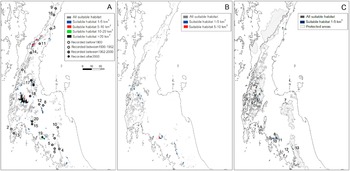
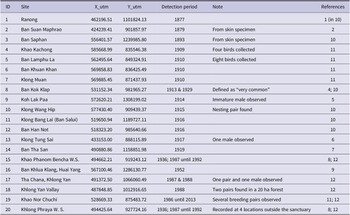
We defined the Thai range of the species based on confirmed records both recent, after its rediscovery in 1986, and historical records back to when it was first described in the country in 1875-1877, as available in Collar et al. (Reference Collar, Round and Wells1986) and Gretton et al. (Reference Gretton, Kohler, Lansdown, Pankhurst, Parr and Robson1993). Despite the species having been recorded in southern Myanmar up to 291 m DEM (digital elevation model) elevations following an extensive survey (Donald et al. Reference Donald, Hla, Win, Aung, Moses, Zaw, Ag, Oo and Eames2014), a detailed analysis of the available location data showed that only 3.4% of the detections were above 150 m (Shwe et al. Reference Shwe, Sukumal, Grindley and Savini2020). Therefore, this upland habitat should be considered marginal for viable populations in Thailand (P. D. Round pers. comm.). We therefore focused on level lowland forest (<150 m with slope <10 degrees, following Shwe et al. Reference Shwe, Sukumal, Grindley and Savini2020) ranging from southern Prachuap Khiri Khan to northern Trang (following Round Reference Round2014), between 11°50’N and 7°30’N (see Figure 1A and Table 1 for details of observation records).
Remaining suitable Gurney’s Pitta’s habitat in Thailand for (a) 1987, (b) 1998 and (c) 2018. Numbers in (a) represent the sites where the species has been detected following details in Table 1. Numbers in (c) indicate the 13 remaining patches of suitable habitat larger than 1 km2.

Details of site records where Gurney’s Pitta was observed in Thailand since its discovery (spelling of site names follow those in Collar et al. Reference Collar, Andreev, Chan, Crosby, Subramanya and Tobias2001). References cited in the table: (1) Hume and Davison Reference Hume and Davison1878, (2) Hume Reference Hume1879, (3) Robinson and Kloss Reference Robinson and Kloss1911, (4) Robinson Reference Robinson1915, (5) Gyldenstolpe Reference Gyldenstolpe1916, (6) Robinson and Kloss Reference Robinson and Kloss1918, (7) Robinson and Kloss Reference Robinson and Kloss1924, (8) Meyer de Schauensee Reference Meyer de Schauensee1946, (9) Deignan Reference Deignan1963, (10) Collar et al. Reference Collar, Round and Wells1986, (11) Round and Treesucon Reference Round and Treesucon1986, and (12) Gretton et al. Reference Gretton, Kohler, Lansdown, Pankhurst, Parr and Robson1993.

Lowland forest maps for 1987, 1998 and 2018 were produced from satellite images and digital elevation maps. Landsat 5 Thematic Mapper (TM) and Landsat 8 Enhanced Thematic Mapper (ETM) images (30-m resolution) were downloaded from https://earthexplorer.usges.gov to classify forest cover and non-forest (i.e. all other land-cover types). The initial classification was assessed by detailed manual editing using images from Google Earth where both the crown pattern and the vegetation colour were used to distinguish natural forest from plantations. Further checking, when needed, was done using Google Street View which proved to be effective, as Thailand is extensively covered by roads. Shuttle Radar Topography Mission (STRM) DEM maps were downloaded from https://earthexplorer.usges.gov and we selected elevations from 0 to 150 m to produce a lowland shapefile. Areas with slopes less than 10° were defined from elevation maps to produce a shapefile of the level lowlands. The forest cover shapefile and the elevation shapefile were overlaid. The output map of forest cover at elevations 0–150 m and slopes <10° was used to define suitable habitat for Gurney’s Pitta as described above, following Shwe et al. (Reference Shwe, Sukumal, Grindley and Savini2020) and P. D. Round (pers. comm.).
A forest patch of 20 km2 was estimated to be of sufficient size to maintain a Gurney’s Pitta population for the mid- to long-term in mildly degraded habitat, potentially accommodating a population ranging between 140 and 200 pairs (Savini et al. Reference Savini, Shwe and Sukumal2022). However, due to extensive deforestation in the region (Hughes Reference Hughes2017), we predicted that no such large patches of lowland forest remain within the Thai range of the species. We therefore only excluded fragments smaller than 1 km2 and then grouped the remaining forest into four size categories: 1 to <5 km2, 5 to <10 km2, 10 to <20 km2 and ≥20 km2. Finally, we estimated how much remaining suitable habitat is currently under legal protection by overlaying the boundaries of the Thai protected area system (UNEP-WCMC & IUCN 2014).
Results
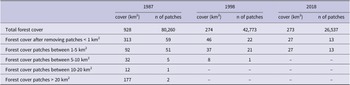
As expected, suitable forest habitat steadily declined between 1987, soon after the species was rediscovered, and 2018, the year of our most recent forest cover map. Lowland forest declined from 928 km2 in 1987 to 273 km2 currently within the known range of Gurney’s Pitta in Thailand. However, at present, suitable forest cover is highly fragmented with most of it represented by fragments <1 km2. After these fragments were removed from consideration, only 27 km2 of suitable habitat remained, declining from 313 km2 in 1987 (see Figure 1A and Table 2 for details on forest loss since 1987).
Total suitable habitat cover and patch size details for the remaining forest cover measured in 1987, 1998 and 2018, over the Thai part of the Gurney’s Pitta’s range.

Most of the remaining suitable forest cover is found in only 13 small patches, all of which are less than 5 km2. The three patches larger than 10 km2 disappeared after 1987 and only one patch between 5 and 10 km2 remained in 1998 (see Figure 1B and Table 2 for details on forest fragmentation since 1987).
A total of seven suitable habitat patches larger than 1 km2 lie inside five protected areas: from north to south following Figure 1C, patch number 2 in Khlong Naka Wildlife Sanctuary, patches 3, 4 and 5 in Khlong Saeng Wildlife Sanctuary, patch 6 in Khao Sok National Park, patch 11 in Khao Pra-Bang Khram Wildlife Sanctuary and patch 13 in Khao Bantad Wildlife Sanctuary (see Figure 1C for details). Three additional patches are found overlapping the boundary of a protected area just inside and outside Khao Pra-Bang Khram Wildlife Sanctuary (patch numbers 8, 9 and 10), where Gurney’s Pitta was last recorded in Thailand (record 19 in Table 1). Finally, three patches were found outside of the current protected area system (patches 1, 7 and 12). Number 1 is located within Pa Klang Ao Forest Park in Prachuap Khiri Khan Province, and number 12 is located within the Peninsular Botanical Garden (Thung Khai) in Trang Province.
Discussion
Our data indicate an almost complete clearance of Gurney’s Pitta habitat in its Thai range since the species was rediscovered in 1986. The remaining level lowland forest is highly fragmented with no patches even reaching 5 km2. Suitable forest cover was already greatly reduced in 1987, soon after the species was rediscovered in Khao Nor Chuchi (Round and Tresucon Reference Round and Treesucon1986), when only two patches larger than 20 km2 and one just over 10 km2 were recorded (Table 2).
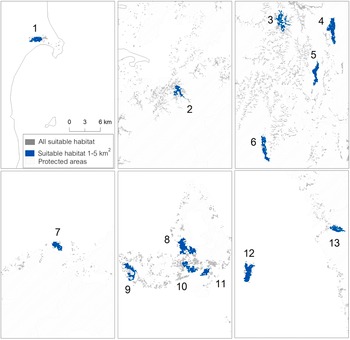
In contrast to southern Myanmar, most of the remaining suitable habitat patches (seven out of 13) are within existing protected areas (2, 3, 4, 5, 6, 7, 8, 9, 10, 11 and 13 in Figure 1C and Figure 2) and one within a forest park (1 in Figure 1C and Figure 2). One patch appears only in 2018 (patch 7 in Figure 1C and Figure 2) and may be the result of land patches previously cultivated as an orchard and subsequently abandoned, resulting in some secondary forest regrowth. In addition, a small patch was also found in a botanical garden (12 in Figure 1C and Figure 2) which however falls just outside the known southern limit of the species range.
Details of the remaining 13 fragments, larger than 1 km2, of Gurney Pitta’s suitable habitat in the Thai range of the species in 2018.

The largest single patch was found in what is now the Klong Saeng – Khao Sok forest complex and disappeared almost immediately when the Chiew Larn reservoir inundated the remaining lowland forest in in 1987 (Woodruff Reference Woodruff2013). What is left in the whole forest complex are four fragments smaller than 5 km2 (3, 4, 5 and 6 in Figure 1C and Figure 2), mere leftovers from the reservoir formation. Although several lowland species were recorded in the area (Irving et al. Reference Irving, Round, Savini, Lynam and Gale2018) there are no records of Gurney’s Pitta inhabiting the area prior to reservoir formation or subsequently. A second patch larger than 20 km2 was found near Tha Chana, Surat Thani Province, where the species was recorded in 1988 (record 17 Table 1). However, none of the lowland forest in the area remains, as it never appears to have been included in any protected area. The last large patch of lowland forest, less than 20 km2, recorded in 1987 was found in Khao Nor Chuchi where the species was rediscovered in 1986 (Round and Tresucon, Reference Round and Treesucon1986). Despite being protected and included in the Khao Pra-Bang Khram Wildlife Sanctuary, the 150 km2 protected area established to protect Gurney’s Pitta after it was rediscovered in the area in 1986 (Round Reference Round2014), habitat disturbance and its small population size have led to the demise of the pitta at this location. The degradation of the area has continued since then and now only four fragments smaller than 5 km2 remain (8, 9, 10 and 11 Figure 1C and Figure 2). Several birds were also recorded at four sites outside Khlong Phraya Wildlife Sanctuary between 1988 and 1992. Furthermore, by 1992 a large portion of the protected area was deforested leaving only few fragments smaller than 1 km2 (Gretton et al. Reference Gretton, Kohler, Lansdown, Pankhurst, Parr and Robson1993).
Options for possible reintroduction and/or translocation
Although it was hoped that Gurney’s Pitta in Thailand could perhaps be restored through intensively managing semi-wild subpopulations, for which there is still a lot to be learned (i.e. how to do this practically and how to breed the species in captivity), our results show that currently no sufficiently suitable habitat is available in southern Thailand to provide to any reintroduced population a chance of long-term survival. Consequently, assuming a captive bred population will be available for any management programme, broadly speaking, two possible scenarios are suggested to recover the species in its Thai range.
In the short-term, the small remaining patches of suitable habitat might at most allow the establishment of managed free-ranging colonies utilizing the remaining small patches, similar to programmes successfully used for species such as the Kakapo Strigops habroptilus (Clout and Merton Reference Clout and Merton1998). Following our results (patch size, elevation, and habitat quality), six sites could be potentially used for this purpose: one area is in Khlong Naka Wildlife Sanctuary (patch 2 in Figure 2), where Gurney’s Pitta was recorded in 1992 although outside the Sanctuary boundaries (P. D. Round pers. comm.). Other second choice sites could also be found in Khao Sok National Park (patch 6 in Figure 2), Khlong Saeng Wildlife Sanctuary (patches 3, 4 and 5 in Figure 2) and Khao Bantad Wildlife Sanctuary (patch 13 in Figure 2), however, all these sites were surveyed in the 1980s, at which time they did not hold any Gurney’s Pitta. This might suggest either their unsuitability for the species or these pittas were long gone prior to the surveys. Despite not being optimal, four of these areas have also been identified by the Department of National Parks, Wildlife and Plant Conservation, based on mostly different criteria (although the details were not available), as potential sites for reintroduction (Wildlife Research Division 2009) further suggesting their potential to assist in the species’ survival.
For the long term, sufficient suitable habitat could be generated by connecting existing small fragments. Reconnecting existing patches to establish a sufficiently large forest patch to secure mid- to long-term survival of Gurney’s Pitta has been suggested for southern Myanmar (Savini et al. Reference Savini, Shwe and Sukumal2022). Although reconnecting protected areas is a substantial undertaking, several countries have done so including Bhutan and Taiwan in Asia (Saura et al. Reference Saura, Bertzky, Bastin, Battistella, Mandrici and Dubois2019). When assessing where this could be done in southern Thailand the primary focus should fall on the Khao Nor Chuchi area, which includes Khao Pra-Bang Khram Wildlife Sanctuary and the largely encroached 30 km2 of the Bang Khram National Reserve Forest lying in the Khlong Thom Basin (Collar et al. Reference Collar, Andreev, Chan, Crosby, Subramanya and Tobias2001), where its presence was confirmed until recently (Round Reference Round2014). However, we also note that in spite of the long-term management programme implemented in the area since 1986, the conservation of sufficient suitable habitat was not realized, but instead much of the forest was cleared for high-value crop production, mainly rubber and oil palm. Nevertheless, despite having been extensively fragmented by agricultural expansion, the area still holds four patches (patches 8, 9, 10 and 11 in Figure 2) totaling 8.97 km2, to which extra habitat could be added if patches smaller than 1 km2 are included, specifically connecting patches 8, 10 and 11 (grey area in Figure 2), reaching a total of 17.18 km2 potentially forming a single protected area complex. The management of the area could be simplified due its particular topographical characteristics. The lowland area within the Khlong Thom Basin is ringed on three sides by the higher hills of the Khao Pra-Bang Khram Wildlife Sanctuary leaving only one side, on the west, which could facilitate access. The possibility of controlling access to the area where the species could be reintroduced, will assist the management of the area to control further deforestation and perhaps hunting. This could be achieved by including the remaining lowland forest of the Khlong Thom Basin inside the boundaries of the Khao Pra-Bang Khram Wildlife Sanctuary, as already suggested (Collar et al. Reference Collar, Andreev, Chan, Crosby, Subramanya and Tobias2001).
Since 2005 a reforestation project has been developed in the area under the supervision of the Forest Restoration Research Unit (FORRU), Chiang Mai University (Thailand), which has successfully demonstrated the concept by restoring nearly 15 ha of lowland forest (S. Elliott pers. comm.). However, local and government agencies will need to ramp-up the project to scale, which is still lacking. The process and key tree species for habitat restoration are understood and have been tested around the Khao Nor Chuchi area for Gurney’s Pitta (Elliott et al. Reference Elliott, Kuaraksa, Tunjai, Polchoo, Kongho, Thongtao and Maxwell2008), and a tree nursery was created. Despite having been achieved successfully at other sites (northern Vietnam; Meyfroidt and Lambin Reference Meyfroidt and Lambin2008, Chazdon and Guariguata Reference Chazdon and Guariguata2016), the difficulty remains as to how to conduct such restoration over large scales where small size patches are relatively far apart, as is the case here. Furthermore, commitments required for such a project from local stakeholders might be still difficult to guarantee.
Including the whole area under the protected area system, as suggested by Collar et al. (Reference Collar, Andreev, Chan, Crosby, Subramanya and Tobias2001), would provide legal tools to reduce the expansion of land clearance, both for the remaining patches as well as for future restored ones, and may also limit the persecution of the species. Both of these issues were the primary reasons for the species’ disappearance from the area since its rediscovery. However, difficulties remain as to how to acquire the needed land, currently under cultivation, for restoration. This has proven to be rather complicated here and elsewhere in Thailand where villages have been left within protected area boundaries to be monitored by park staff. As the species has been suggested to inhabit mainly secondary forest (Donald et al. Reference Donald, Aratrakorn, Htun, Eames, Hla, Thunikhorn, Sribua-Rod, Tinun, Aung, Zaw and Buchanan2009), closely managing it in areas surrounding agricultural areas could provide an initial solution.
Yet, in these small fragments of secondary forest, nest success was suspected to be low, as a consequence of intense predation pressure, particularly from snakes (Donald et al. Reference Donald, Aratrakorn, Htun, Eames, Hla, Thunikhorn, Sribua-Rod, Tinun, Aung, Zaw and Buchanan2009). However, recently published work from the region, including a major (>1,500 nests), long-term (9-year) study of nesting success and nest predators in a large (>2,100 km2) relatively undisturbed forest, as well as a similarly large 7-year nest predation study in a moderately sized (~160 km2) secondary forest patch in Thailand, indicate that nest success for most understorey bird species is naturally low (1.9–43.0% depending on the species) (Khamcha et al. Reference Khamcha, Powell and Gale2018, Pierce et al. Reference Pierce, Sankamethawee, Powell and Gale2020). Furthermore, snakes are typically the most important or second-most important nest predators depending on the species of bird (Pierce and Pobprasert Reference Pierce and Pobprasert2013, Khamcha and Gale Reference Khamcha and Gale2020). Thus, despite the naturally high nest predation rates in the region, managing nest predators and/or protecting birds and nests from predators, is recommended because reintroduced birds appear more vulnerable to predation pressure compared to those born in the wild (Collar Reference Collar2020).
Acknowledgements
We are grateful to Philip D. Round and two anonymous reviewers for providing extensive comments on the manuscript and Maliwan Namkan for helping in measuring forest cover.