Introduction
Electroless nickel plating has wide applicability in industry owing to such unique features as high uniformity in film thickness, high hardness, and superior corrosion resistance compared with the films deposited by electroplating. However, there still exist unsolved issues such as generation of hydrogen bubbles in the deposition process. The hydrogen gas, which is generated by a side reaction during the reduction of metal ions, causes such a problem as pinhole defects that deteriorate the corrosion resistance of the films. In general, corrosion of a metal surface is enhanced by microscopic imperfections in crystal structure such as grain boundary. On the other hand, the plated metal films include substantial amount of macroscopic defects, and the chemical degradation proceeds primarily through the pinholes by corroding the substrate instead of the film material itself. This is the reason why protective nickel films require thicknesses larger than 15 µm in spite of the chemical inertness of nickel itself.[Reference Di Bari, Cotell, Sprague and Smidt1]
The pinholes cause a crucial problem also in the electroplating process. Recently, several unique electroplating methods have been proposed to solve this issue by using unconventional plating media such as supercritical carbon dioxide.[Reference Yan, Sone, Sato, Ichihara and Miyata2] We found that electroplating in a foam of electrolyte is effective in reducing the number of pits and pinholes.[Reference Yamada, Mitsuya, Furuhashi, Ichihara and Usui3] It is considered that the foam can remove hydrogen bubbles efficiently from the cathode surface.[Reference Yamada, Fujisawa, Sugawara, Furuhashi, Ichihara and Usui4] A small hydrogen bubble generated on the surface has higher inner pressure than that in a larger bubble consisting the foam, because the inner pressure is inversely proportional to the bubble diameter according to the Young–Laplace equation. As a consequence, the small hydrogen bubble that came in contact with the bubble in the foam collapses promptly to merge into the foam. The bubbles in the foam can also remove the hydrogen bubbles by collision. Similar desorption of hydrogen bubbles is also reported when the electroplating was achieved in an emulsion of supercritical carbon dioxide and the plating solution.[Reference Wakabayashi, Sato, Sone, Takada, Yan, Abe, Mizumoto, Ichihara and Miyata5, Reference Sone, Uchiyama, Chang and Ferreira6]
The foam of electrolyte is also useful for performing electroless plating.[Reference Furuhashi, Yamada, Ichihara, Takai and Usui7, Reference Furuhashi, Yamada, Hayashi, Ichihara and Usui8] The foam of electrolyte can be generated by bubbling nitrogen gas into the electroplating liquid to which was added a small amount of surfactant. In our previous work, sulfuric acid monododecyl ester sodium salt (SDS) was used as a convenient surfactant to generate the foam of electroplating solution. However, SDS has a possibility to undergo chemical degradation in a strongly acidic environment.[Reference Dey and Ismail9] In this respect, fluorosurfactants exceed in chemical and thermal stability, and can be convenient for use in electroless plating that requires a high bath temperature. Moreover, fluorosurfactants are known to have several unique characteristics such as higher surface activity than their hydrocarbon counterparts.[Reference Monduzzi10, Reference Blanco, Gonzalez-Perez, Ruso, Pedrido, Prieto and Sarmiento11] Among the fluorosurfactants, ammonium pentadecafluorooctanoate (APFO) is one of the well-known anionic surfactants.[Reference Hato and Shinoda12] Both SDS and APFO consist of linear alkyl chains in their main structures of hydrophobic units. Reduction of surface tension is a prerequisite to generate the foam. APFO can reduce the surface tension of water to ca. 20 mN/m.[Reference Lu, Ottewill and Rennie13] In addition, APFO can be used as a mixture with a hydrocarbon surfactant to further reduce the surface tension.[Reference Burkitt, Ingram and Ottewill14] Taking advantage of such features of APFO, we recently achieved a remarkable improvement in corrosion resistance of nickel films deposited in the foam. The fraction of corroded area by the ferroxyl test for a 1.5 µm-thick film was reduced to 0.002% by adding APFO as compared with 0.1% that was obtained in our previous work. This paper explores such an outstanding effect of adding APFO to the surfactant in the electroless plating using foam of electrolyte.
Experimental procedure
Film deposition
The foam of electrolyte was generated by bubbling nitrogen gas into a commercial hypophosphite electroless nickel plating solution (Top Nicoron F-153, Okuno Chemical Industries, Hanaten-Higashi, Tsurumi-Ku, Osaka 538-0044, Japan) added with the surfactants of SDS and APFO. SDS was added to a concentration of either 0.03 or 0.3 wt%, and AFPO was added to a concentration of 0, 0.03, or 0.3 wt% in addition to SDS. Details of the experimental apparatus for the electroless plating in foam has been described in our previous report.[Reference Furuhashi, Yamada, Hayashi, Ichihara and Usui8] A total of 500 mL of the plating liquid added with the surfactants was poured into a glass plating vessel having an inner diameter of 80 mm and a height of 300 mm. Nitrogen gas was introduced into the liquid at a flow rate of 0.5 L/min through a spherical glass filter having a diameter of 10 mm and a mesh size of 40 µm. An airy foam of the electrolyte accumulated above the plating solution, and overflowed into a receiving vessel. The liquid level in the plating vessel was kept constant by supplying additional plating liquid. The supply rate of the additional liquid, which was regulated by itself by a siphon action to keep a constant liquid level of 100 mm deep, was typically 10–15 mL/min. The temperatures of the plating liquid and the nitrogen gas were kept at 80 °C. The substrate was an iron test piece of 25 mm × 40 mm (Yamamoto-MS B-51, Sendagaya, Shibuya-Ku, Tokyo 151-0051 Japan). Its center was located 50 mm above the surface of the plating solution. The substrate was rocked in a vertical direction with a stroke of 25 mm at 30 cycles/min. The substrate purchased from the supplier had a protective layer of zinc on its surface, which was removed by immersing in 10% aqueous solution of hydrochloric acid, followed by rinsing in pure water. The electroless deposition was achieved for 30 min in the foam.
For comparison, films were also deposited without generating foam in a plating liquid of the same composition added with the surfactants. In this case, 500 mL of the liquid was poured into a glass beaker and was heated to 80 °C on a hot stirrer. A substrate was immersed stationary in this liquid while stirring the liquid. The deposition in liquid was achieved for 7.5 min to accumulate approximately the same thickness as that deposited in the foam.
Characterization
First of all, the surface tensions of water and the plating solution added with SDS or APFO were measured by the drop weight method[Reference Adamson15] by dripping the liquid from a glass pipette at room temperature. The Harkins–Brown correction factor for the drop weight method was determined so as to match the surface tension of pure water to 72.9 mN/m. Foam was generated by using the plating solution added with SDS and APFO. The foam was sampled on a Petri dish and was observed with an optical microscope (Keyence VHX-500).
Nickel films were deposited both in the liquid and in the foam added with different concentrations of SDS and APFO. The film thickness was measured with a fluorescence measuring system (Fisher Instruments XDL-B) and averaged over five different positions on the substrate. Crystallographic property of the film was investigated with an x-ray diffractometer (Rigaku Smart Lab, with Cu Kα line) by θ–2θ scan using a parallel beam optics in a 2θ range from 30° to 90°. Elemental analysis of the film was performed by using an electron-probe energy-dispersive x-ray spectroscopy (EDX, Philips XL-30).
A 1.5 µm-thick films were deposited both in the liquid and in the foam, and were observed with the optical microscope. The corrosion resistance of the films was estimated by the ferroxyl test according to the procedure of ASTM B 689. A filter paper was soaked in an aqueous solution consisting of 10 g/L potassium hexacyanoferrate (II) trihydrate, 10 g/L potassium hexacyanoferrate (III), and 60 g/L sodium chloride, and was attached on the surface of the specimen for 5 min. The corrosion image that appeared on the filter paper was recorded with a digital camera, and was binarized to obtain the fraction of corroded area.
Results and discussion
Generation of foam
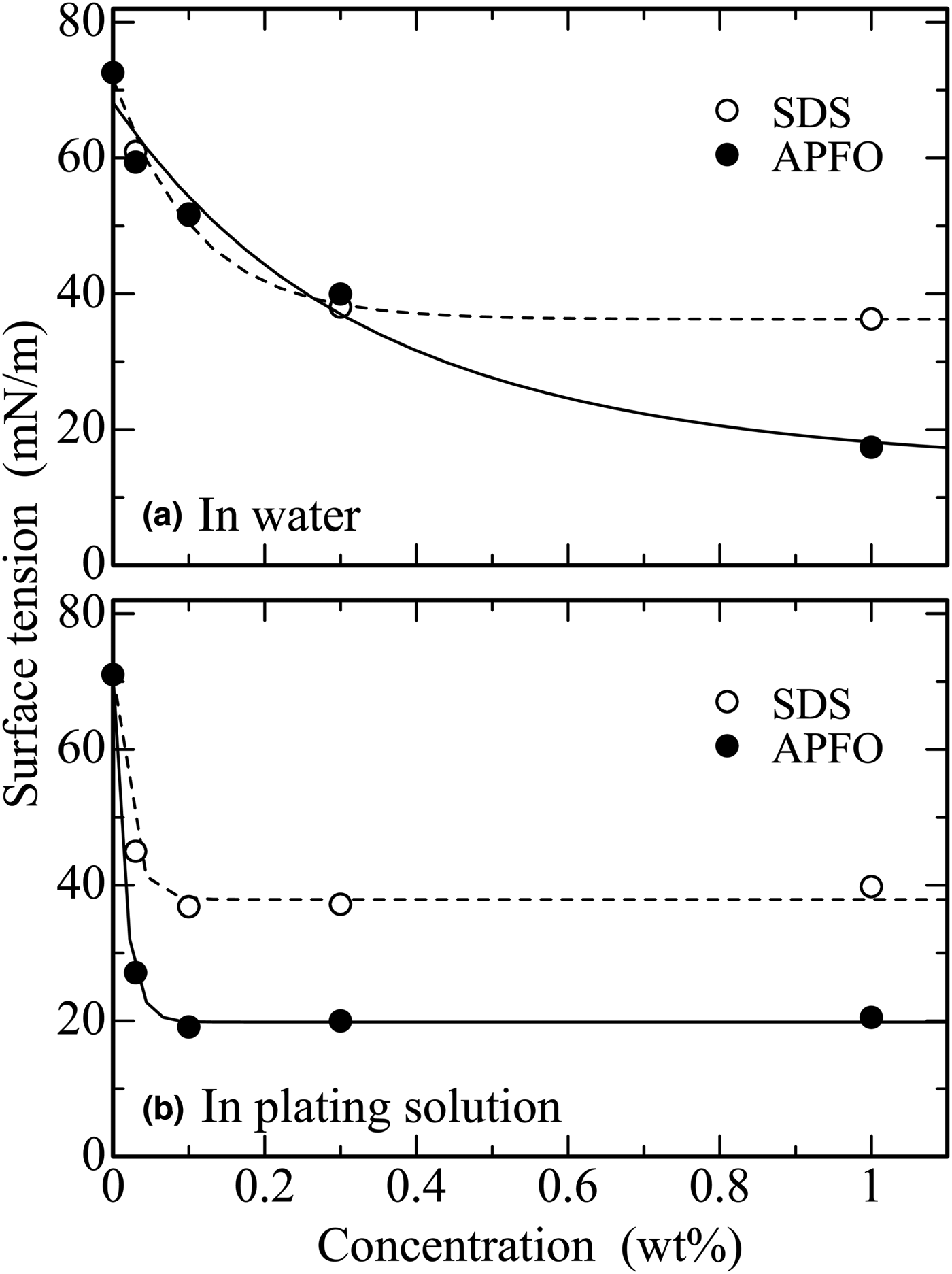
With a purpose to estimate the amount of surfactants to be added to the plating solution, the effect of adding SDS or APFO on the surface tensions of water and the plating solution was measured individually by the drop weight method. Figure 1 shows the surface tensions of (a) water and (b) the plating solution added with either SDS or APFO up to concentrations of 1 wt% at room temperature. The critical micelle concentration (CMC) of SDS in water is reported to be 0.23 wt% (8.1 mM),[Reference Umlong and Ismail16, Reference Smirnova, Vanin, Safonova, Pukinsky, Anufrikov and Makarov17] and the surface tension of water is reported to decrease to a value from 35[Reference Eckmann, Cavanagh and Branger18, Reference Bahri, Hoebeke, Grammenos, Delanaye, Vandewalle and Seret19] to 39 mN/m[Reference Ko, Oh, Kim, Nakashima, Nagadome and Sugihara20] by adding SDS to a concentration higher than the CMC. The surface tension of water shown in Fig. 1(a) is in good agreement with literature. Although the number of measuring point is limited for an accurate determination of the CMC, which is not the major objective of this paper, the surface tension of water almost saturated at the SDS concentration of 0.3 wt%. There is a slight difference in surface tensions at the SDS concentrations of 0.3 and 1 wt%. However, such a slight decrease of surface tension by adding SDS above the CMC is also found in literature.[Reference Bahri, Hoebeke, Grammenos, Delanaye, Vandewalle and Seret19, Reference Vijayan, Woods and Vaya21] With APFO in water, the CMC is reported to be 1.4 wt% (33 mM),[Reference Shinoda, Hato and Hayashi22] above which concentration, the surface tension of water decreases to a value from 18[Reference Gorodinsky and Efrima23] to 20 mN/m[Reference Downes, Ottewill and Ottewill24]. Although the amount of APFO added in this work is below the CMC, and we do not have sufficient data to determine the CMC of APFO in water, the result shown in Fig. 1(a) does not contradict with literature.
Surface tensions of (a) water and (b) the electroless plating solution added with SDS (open circles) and APFO (closed circles).

In the plating liquid, as shown in Fig. 1(b), the surface tension saturated at lower concentrations than in water both for SDS and APFO. It is known that CMCs of SDS[Reference Li, Thomas and Rennie25] and APFO[Reference Gorodinsky and Efrima23, Reference Downes, Ottewill and Ottewill24] decrease in the presence of metal ions. Both SDS and APFO have prominent effect in reducing the surface tension of the plating solution. The result shown in Fig. 1(b) suggests that it is sufficient to add SDS or APFO to a concentration smaller than 0.3 wt% to reduce the surface tension of the plating liquid.
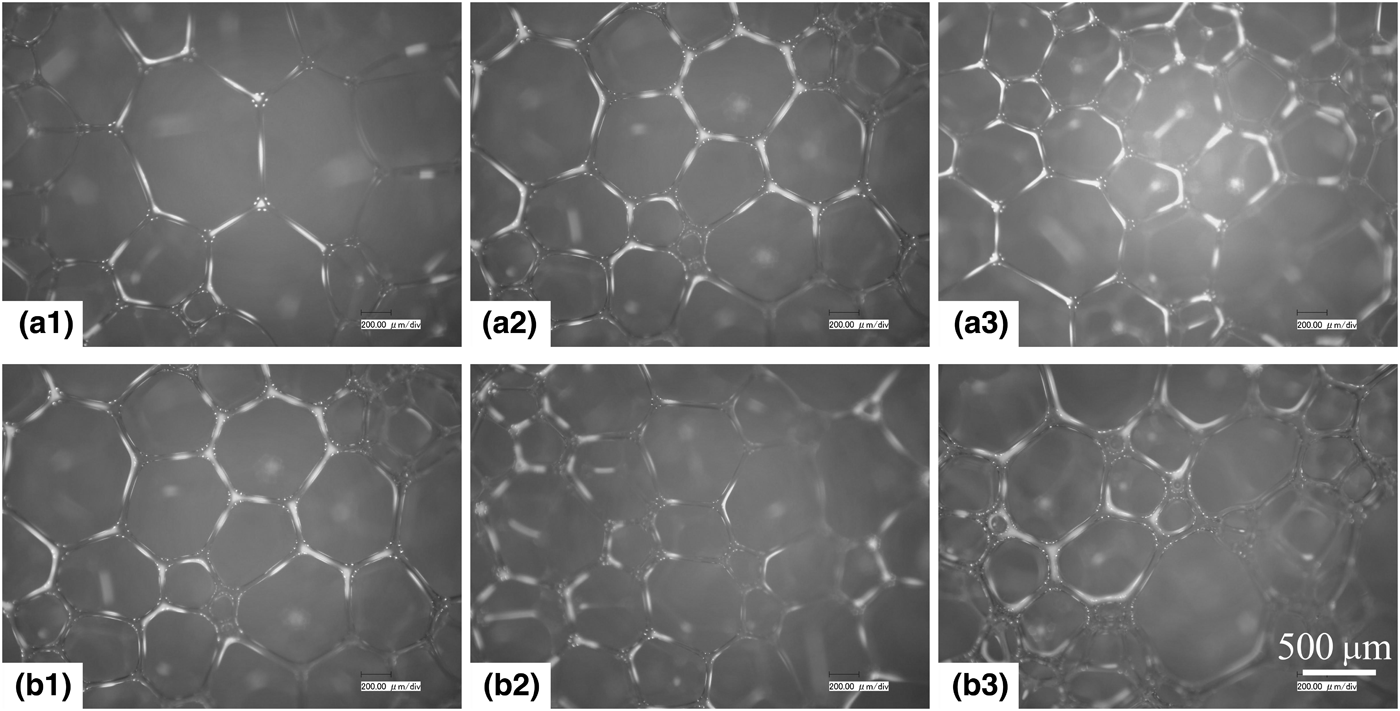
The foam of electrolyte was generated by using the plating solution added with different amounts of SDS and APFO, and were observed with an optical microscope as shown in Fig. 2. It was not possible to generate a stable foam only with APFO. The ability of generating foam by a surfactant is known to be influenced by several factors.[Reference Rosen and Kunjappu26] It is known that a surfactant having a smaller CMC has higher ability of generating foam. The CMCs of SDS and APFO are reported to be 8.1 and 33 mM, respectively, which explains the reason why a stable foam was not obtained only with APFO. It is also known that a surfactant with smaller counter ion has higher ability of generating foam, which gives another explanation why APFO having ammonium counter ion was less effective in generating foam than SDS having sodium counter ion.
Photographs of foam generated with SDS concentrations of (a1–a3) 0.03 wt% and (b1–b3) 0.3 wt%, and APFO concentrations of (a1, b1) 0 wt%, (a2, b2) 0.03 wt%, and (a3, b3) 0.3 wt%.

The foam generated in this work consisted of polyhedral gas cells separated by thin liquid lamellae, and was largely different from bubbles, i.e. gas cells individually separated in liquid, which are frequently used to stir the plating liquid. The average diameter of the foam was from 0.5 to 0.7 mm, decreasing slightly with increasing concentration of surfactants. Figure 2 also suggests that the thicknesses of lamellae between the gas cells increase with increasing concentrations of surfactants. The liquid content of the foam, which was estimated by measuring the weight and the volume, was 1.7 vol.% when the foam was generated with SDS concentration of 0.3 wt% without adding APFO. The liquid content increased to 1.9 and 2.8 vol.% by adding APFO to concentrations of 0.03 and 0.3 wt%, respectively. It is considered that drainage of liquid in the lamellae was impeded by adding the surfactants owing to increase of film elasticity or Gibbs–Marangoni effect.
Film deposition
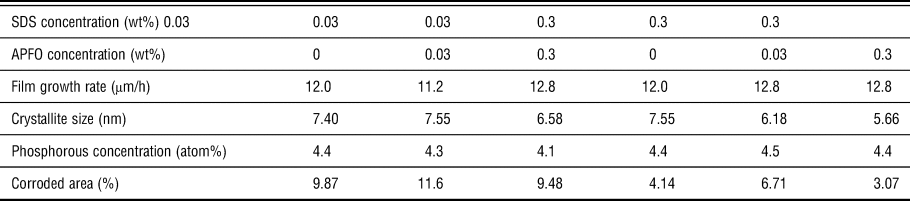
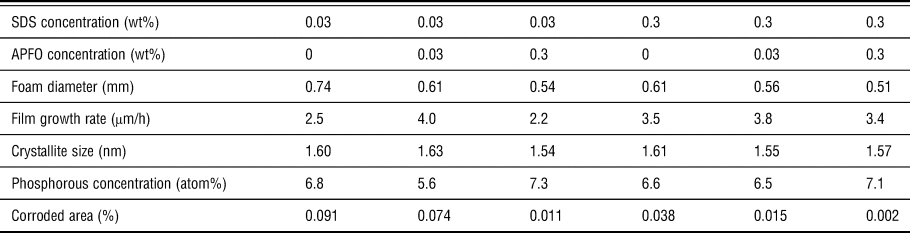
Nickel thin films were deposited both in the conventional electroplating liquid and in the foam generated from the electroless plating solution added with different amounts of SDS and APFO. The growth rates of films in the liquid and in the foam are shown in Tables I and II, respectively. In the liquid, the film growth rate was about 12 µm/h with little dependence on the amount of surfactants. This growth rate is consistent with the specification provided by the supplier of the plating liquid. All the films deposited in liquid had specular and smooth surfaces by visual inspection.
Film growth rate, crystallite size, phosphorous concentration, and fraction of corroded area for the nickel films deposited in liquid electrolyte added with different amounts of SDS and APFO.

Average foam diameter, film growth rate, crystallite size, phosphorous concentration, and fraction of corroded area for the nickel films deposited in foam of electrolyte generated by adding different amounts of SDS and APFO.

In the foam, the film growth rate was considerably smaller than that in the liquid, since the ion transportation in foam occurs only in the small volumes of lamellae and Plateau borders (ridgelines at intersections of lamellae). The small growth rate is a drawback of the electroless plating in foam. However, it is possible to improve the growth rate by increasing the flow speed of the foam on the substrate surface.[Reference Furuhashi, Yamada, Ichihara, Takai and Usui7, Reference Furuhashi, Yamada, Hayashi, Ichihara and Usui8] The film growth rate did not show a systematic dependence on the amount of surfactants in the foam as in the case of liquid. The films deposited in the foam also had specular and smooth surfaces.
Crystallographic characteristics
Crystallographic characteristics of the deposited films were analyzed by x-ray diffraction. All the films deposited in the liquid showed a single diffraction peak at 2θ = 44.5° with a full width at half maxima (FWHM) of 1.2–1.5°. No other diffraction peaks were observed, indicating that these films have preferential crystal orientation with the nickel (111) plane parallel to the substrate surface. The films deposited in foam also showed a single diffraction peak of nickel (111) plane. However, there was a notable difference in the line width of diffraction peaks. All the films deposited in foam had substantially broader diffraction peaks than those deposited in liquid with the FWHM of 5.5–5.8°.
By ascribing the broadening of the diffraction line to crystallite size, the sizes of crystallites were estimated by the Sherrer equation as shown in Tables I and II. The crystallite size of the films deposited in liquid was from 5.7 to 7.6 nm with a slight tendency to decrease with increasing concentration of surfactants. It is reported that addition of surfactant in an electroless nickel plating bath causes a decrease in crystallite size.[Reference Elansezhian, Ramamoorthy and Nair27] This is because the surfactant plays the role of brightener. Namely, in the course of film growth, the surfactant molecules adsorb preferentially on the surface of small crystallites that have large curvature, suppressing the growth of crystallites. On the other hand, the films deposited in the foam had crystallite size of about 1.6 nm, which is substantially smaller than that obtained by liquid. The crystallite size did not show an explicit dependence on the amount of surfactants. Such a decrease of crystallite size was also reported when nickel films were deposited in a foam of electrolyte by electrodeposition.[Reference Yamada, Sugawara, Furuhashi, Ichihara and Usui28] It is considered that the growth of crystallite is suppressed owing to discontinuous film growth in the foam.
Another factor that can influence the crystallinity is the phosphorus content in the film. Nickel films deposited in the hypophosphite bath is known to contain certain amount of phosphorus. The microstructures of the nickel films is reported to change from face-centered cubic crystal to microcrystal and then further to amorphous with increasing concentration of phosphorus.[Reference Allen and VanderSande29, Reference Kumar and Nair30] The atomic concentrations of phosphorus in the films analyzed by EDX are shown in Tables I and II for the films deposited in liquid and in foam, respectively. No other elements except for nickel and phosphorus were detected by the EDX analysis. The films deposited in liquid contained 4.3% of phosphorus in average, whereas those deposited in foam had substantially higher phosphorus concentration of 6–7%. The amount of phosphorus in the films did not have explicit dependence on the concentrations of surfactants. However, the higher phosphorus content partly explains why the films deposited in foam had broader x-ray diffraction peaks.
It is not clear why the films deposited in foam had higher phosphorus concentrations. However, it is known that the concentration of non-metallic component, such as phosphorous, in the electroless film increases with decreasing rate of film growth.[Reference Watanabe31] Therefore, the smaller growth rate in foam can be one of the reasons why the film deposited in foam had higher phosphorous concentration, leading to smaller crystallite size. It sounds interesting to compare a film deposited in the conventional liquid at a lower temperature, or in a conventional liquid diluted to reduce the film growth rate. However, electroless deposition in a diluted liquid or at a lower temperature is known to result in poor film quality, such as opaque surface and poor corrosion resistance, and we dare not achieve such an experiment in this work. Within the films deposited in foam, the crystallite size and the deposition rate seem to have a slight positive correlation. The films deposited in liquid did not have sufficiently wide variation in growth rate to discuss its correlation with the crystallite size.
Corrosion resistance
Corrosion resistance is one of the most important characteristics required for practical applications of nickel coatings. A typical anticorrosion nickel coating consists of double layers of 0.3 µm-thick chromium and 10–30 µm-thick nickel films depending on the grade of corrosion resistance.[Reference Di Bari, Cotell, Sprague and Smidt1] It is generally known that the corrosion resistance of electroless nickel coating is improved with increasing film thickness.[Reference Hsu, Chiu and Shih32] In practice, film thicknesses larger than 10 µm are required to obtain uniform surface by covering the pinholes. On the other hand, there is a strong demand to achieve the anticorrosion characteristic with a film thickness as small as possible. In our previous work, we found a notable improvement of corrosion resistance by depositing nickel films in the foam of electrolyte. The ratio of corroded area by the ferroxyl test was 0.1% for a 2 µm-thick film. Although this result was remarkable in comparison with the conventional standard, the corrosion of 0.1% is still below the ideal. In this work, 1.5 µm-thick single layers of nickel were deposited in liquid or in foam, and their corrosion resistance was examined by the ferroxyl test. This film thickness was chosen arbitrarily as a challenging value to explore the advantage of the electroless plating in foam added with APFO. Though the thinner the better from industrial viewpoint, the substrate itself had a native surface roughness, and a film thickness of 1.5 µm was necessary to clearly identify the coverage by the deposited film in this work.
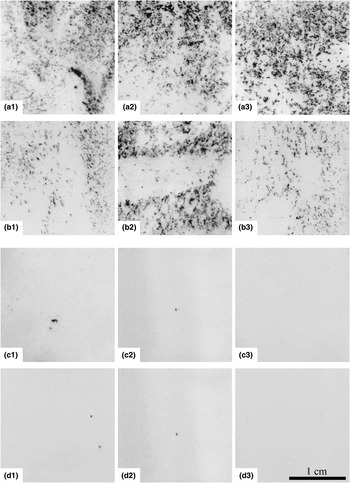
The images of corrosion spots observed by the ferroxyl tests are shown in Fig. 3 for the films deposited in the liquid (a1–b3) and in the foam (c1–d3), respectively. With such a small thickness, the films deposited in liquid had poor corrosion resistance as elucidated by the numerous corrosion spots. The film deposited with SDS concentration of 0.3 wt% showed smaller area of corrosion compared with those with 0.03 wt%. This is because SDS can take a role of brightener, which suppresses continuous growth of crystallites and enhances the formation of smooth film that consists of densely packed small crystallites. As a consequence, the film grown with brightener has uniform coverage with smaller amount of defects.[Reference Elansezhian, Ramamoorthy and Nair27] It is also reported that the surfactant molecules assist to remove hydrogen bubbles from the substrate surface by adsorbing at the hydrogen–liquid interface, resulting in reduction of pinhole generation.[Reference Chen, Hong, Ma and Ko33]
Corrosion spots observed by ferroxyl test for the films deposited in liquid with SDS concentrations of (a1–a3) 0.03 wt% and (b1–b3) 0.3 wt% added with APFO at concentrations of (a1, b1) 0 wt%, (a2, b2) 0.03 wt%, and (a3, b3) 0.3 wt %. The results for the films deposited in foam are also shown for SDS concentrations of (c1–c3) 0.03 wt% and (d1–d3) 0.3 wt% added with APFO to concentrations of (c1, d1) 0 wt%, (c2, d2) 0.03 wt%, and (c3, d3) 0.3 wt%.

On the other hand, the films deposited in foam had remarkably higher corrosion resistance. Few corrosion spots appeared by the ferroxyl test. The images shown in Fig. 3 were binarized to obtain the fraction of corroded area as shown in Tables I and II, respectively. The corroded areas of the films deposited in foam were smaller than those deposited in liquid by almost three orders of magnitude especially when APFO was added to a concentration of 0.3 wt%. The corroded area decreased with increasing amount of surfactants, and a corroded fraction as small as 0.002% was attained when the film was deposited in the foam added with both SDS and APFO of 0.3 wt%. Considering the film thickness of 1.5 µm, this corrosion resistance is remarkably high compared with that obtained in our previous work as well as to those of the films deposited by the conventional electroless plating. This result indicates that the substantial improvement in corrosion resistance was made possible by adding APFO to the surfactant.
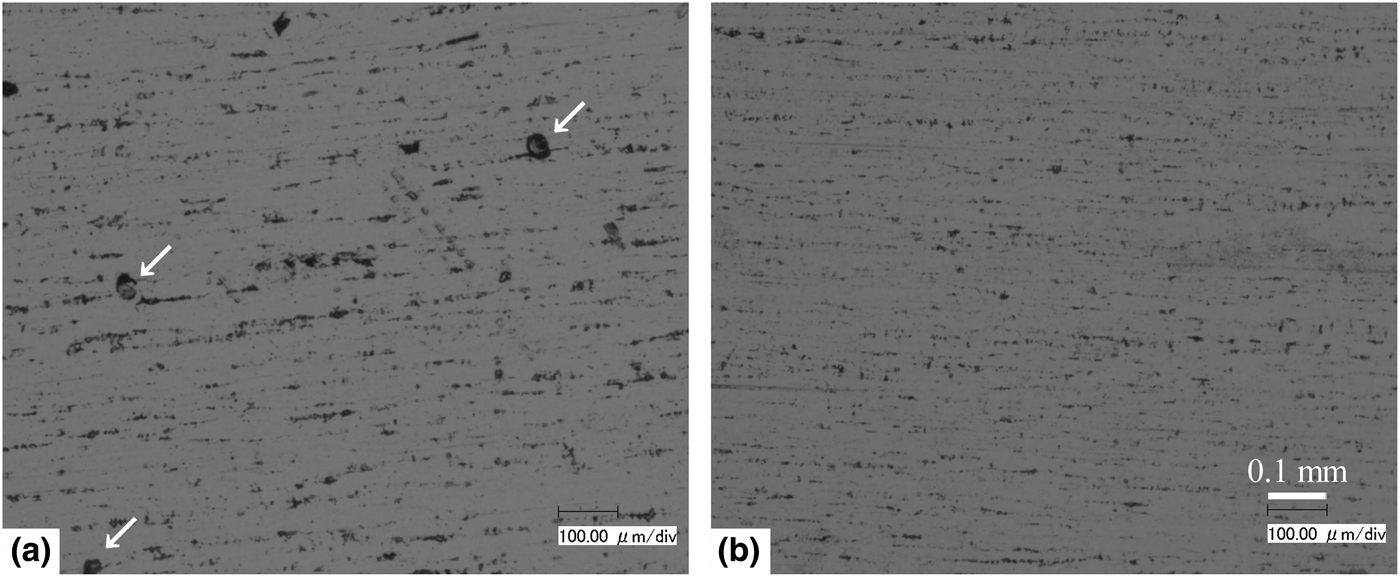
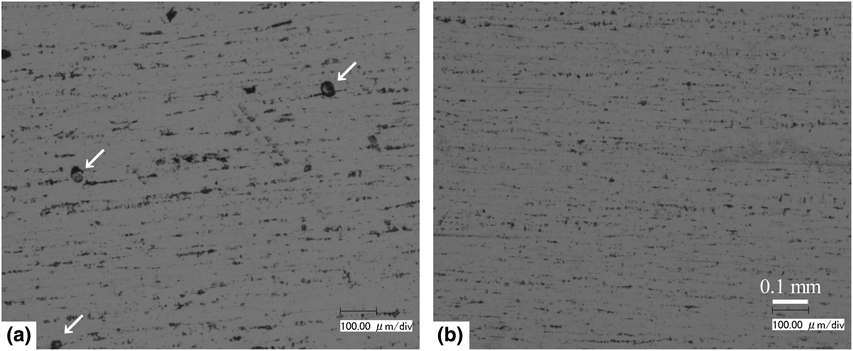
It is considered that the foam of electrolyte can remove hydrogen bubbles efficiently from the substrate surface, suppressing generation of pinholes.[Reference Yamada, Fujisawa, Sugawara, Furuhashi, Ichihara and Usui4] For this purpose, a stable foam with a small diameter, generated with a higher concentration of surfactant, was effective. Figure 4 compares optical micrographs of the films deposited (a) in the liquid and (b) in the foam with the SDS concentration of 0.3 wt% and APFO concentration of 0.3 wt%. With the film thickens of 1.5 µm, polish scratches of the original substrate surface are still observed dominantly, making it difficult to give a detailed characterization of the surface morphology. However, the films deposited in the liquid had typical defects attributable to pinholes as indicated by the arrows in Fig. 4(a), whereas the film deposited in the foam did hot have such circular defects of sub-mm size.
Optical micrographs of the films deposited (a) in liquid and (b) in foam with the SDS concentration of 0.3 wt% and APFO concentration of 0.3 wt%. The white arrows in (a) indicate the pinholes.

Conclusions
Electroless nickel plating was achieved in the foam generated from hypophosphite-based plating solution added with surfactants of SDS and APFO. The film growth rate in foam was substantially smaller than that in liquid. However, the lack of deposition rate may not cause serious problems in practical applications, since electroless plating is dominantly used for depositing thin films that serve as seed layers for accumulating thick films by electrodeposition.
The films deposited in foam had smaller crystallite size than those deposited in liquid owing to discontinuous film growth in the foam. The films deposited in foam had higher content of phosphorus than those deposited in liquid, which also contributed to reduce the crystallite size. In general, the reduction of crystallite size is convenient for improving surface smoothness and mechanical strength. The most remarkable feature of the films deposited in foam was that they had outstandingly higher corrosion resistance than the films deposited in liquid. The fraction of corroded area by the ferroxyl test was as small as 0.002% even at a thickness as small as 1.5 µm when sufficient amount of surfactants were added to the solution. Such a small value of corroded fraction has never been achieved for nickel films of this thickness. Detailed analyses of corrosion resistance such as polarization test are to be conducted in our future work.
The concentrations of surfactants did not influence the growth rate, the crystallite size, and the phosphorus content significantly. On the other hand, the corrosion resistance of the films deposited in foam was improved with increasing concentration of surfactants. Compared with our previous work, which was achieved using only SDS, addition of APFO resulted in the outstanding improvement in corrosion resistance. Moreover, chemical and thermal stability of APFO is attractive for use in electroless plating. It is expected that proper use of these surfactants can maximize the advantage of electroless plating in foam to produce highly corrosion-resistant thin films.
Acknowledgments
The authors acknowledge the financial support by KAKENHI Grant number JP21656204 from the Japan Society for the Promotion of Science. This work was also partly supported by Adaptable and Seamless Technology Transfer Program number AS242Z02308 K from the Japan Science and Technology Agency.