Introduction
The serpentine leaf miner Liriomyza trifolii (Burgess) (Diptera: Agromyzidae) is a polyphagous pest that feeds on over 400 plant species, including cotton, cucurbits, solanaceous vegetables and brassicas (Parrella, Reference Parrella1987; Srinivasan et al., Reference Srinivasan, Viraktamath, Gupta and Tewari1995; Singh et al., Reference Singh, Malik and Kumar1996; Murphy and La Salle, Reference Murphy and La Salle1999; Lei et al., Reference Lei, Zhu and Zhang2007). Feeding and oviposition punctures made by females result in stippling of foliage, especially at the leaf tip and along the leaf margins. Larvae feed on the leaf mesophyll along the leaf veins, forming zigzag mines that become noticeable a few days after oviposition and gradually widen and lengthen as the maggot matures. Both stippling and mining hamper photosynthesis, and severe infestation results in premature defoliation or complete desiccation of leaves (Parrella et al., Reference Parrella, Jones, Youngman and Lebeck1985). Wounding of the foliage also allows the entry of pathogenic bacteria and fungi into the plant (Broadbent and Matteoni, Reference Broadbent and Matteoni1990).
Liriomyza trifolii is believed to be of Neotropical origin; until the 1970s, its damage occurred only in the Caribbean and in southern and eastern USA (Parrella, Reference Parrella1987). In India, L. trifolii damage was first reported from castor (Ricinus communis L.) in 1992 (Laxminarayana et al., Reference Laxminarayana, Basappa and Singh1992) and was subsequently observed on cotton, cowpea, sunflower, cucumber, celery, chrysanthemum, chilli and rapeseed-mustard in 1993 (Singh et al., Reference Singh, Malik and Kumar1996). Recently, L. trifolii has become a major pest of cotton in many countries, including India (Srinivasan et al., Reference Srinivasan, Viraktamath, Gupta and Tewari1995; Jeyakumar and Uthamasamy, Reference Jeyakumar and Uthamasamy1996), Israel (Yathom, Reference Yathom1989), USA (Arizona; Palumbo, Reference Palumbo1992) and Turkey (Gencsoylu, Reference Gencsoylu2003). The pest causes severe damage during the seedling stage of the crop. The economic threshold of L. trifolii in beans (Cikman and Comlekcioglu, Reference Cikman and Comlekcioglu2006) has been reported, but there is no information on economic thresholds for the pest on cotton. Such information is essential for timely and targeted pest management action.
Transgenic Bt cotton hybrids have been deregulated and adopted on a large scale by farmers in India (Mohan and Manjunath, Reference Mohan and Manjunath2002; James, Reference James2008). Seed treatment with imidacloprid is a common practice for the management of sucking pests during the vegetative stage (up to 45 days after seedling emergence (DAE)). At the initiation of fruiting bodies, economically important insect pests such as whiteflies, leafhoppers, aphids and bollworms are managed predominantly with insecticides. Since the introduction of transgenic Bt cotton hybrids in the country, the serpentine leaf miner L. trifolii (at seedling stage) and the mealy bugs Phenacoccus solenopsis (Tinsley) and Maconellicoccus hirsutus (Green) (throughout the crop season) are becoming major pests of cotton (Karihaloo and Kumar, Reference Karihaloo and Kumar2009; Nagrare et al., Reference Nagrare, Kranthi, Biradar, Zade, Sangode, Kakde, Shukla, Shivare, Khadi and Kranthi2009).
We studied L. trifolii damage to different cotton genotypes, both non-Bt and Bt, with and without imidacloprid seed treatment. We also assessed the influence of abiotic factors, namely temperature, relative humidity, rainfall (RF), evaporation (E), solar radiation (SR) and sunshine (S), on the incidence of L. trifolii.
Materials and methods
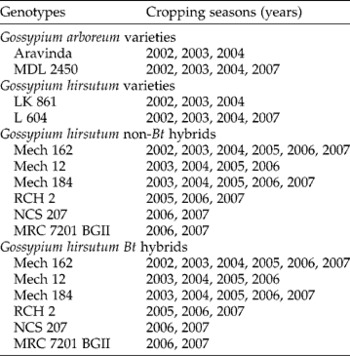
Gossypium arboreum varieties, G. hirsutum varieties and G. hirsutum hybrids (Bt hybrids expressing cry1Ac and cry1Ac+cry2Ab genes and non-transgenic ones) (Table 1) were grown under field conditions on deep black vertisols during the 2002–2007 crop growing seasons (July–December) at the International Crops Research Institute for the Semi-Arid Tropics (ICRISAT) in Patancheru, Andhra Pradesh, India. Seeds of the test cultivars (Aravinda, MDL 2450, L 604, LK 861, Mech 12, Mech 162, Mech 184, RCH 2, NCS 207 and MRC 7201 BGII) were sown in four-row plots of 4-m length on ridges with 75-cm inter-ridge spacing and 50-cm inter-plant spacing, accommodating a total of 36 plants per plot. The experiment was planted in three replications in a split-plot design. Seed treatment was the main treatment, and genotype was the sub-treatment. Seeds of one set of genotypes were treated with imidacloprid at 2 g/kg seed, while another set was left untreated. The crop was raised under rain-fed conditions following normal agronomic practices, including the application of a basal fertilizer (N:P:K = 100:40:60 kg/ha).
Cotton genotypes evaluated for Liriomyza trifolii damage during the 2002–2007 cropping seasons

The total number of leaves and the number of leaves mined by L. trifolii at 30 DAE were counted on five randomly tagged plants in the middle two rows of each plot, and the data were used to calculate the percentage of leaves mined.
To determine whether there was any Bt toxin uptake by the leaf miners from Bt cotton, we collected L. trifolii pupae from transgenic Bt and non-transgenic cotton hybrids in eppendorf tubes, crushed them in phosphate-buffered saline buffer at the ratio of 1:10 (insect sample : buffer) and used a semi-quantitative ELISA (Agdia®, Elkhart, Indiana, USA) to detect Bt toxins present in the pupae (Sharma et al., Reference Sharma, Dhillon and Arora2008).
Data on maximum (MaxT) and minimum (MinT) temperatures (°C), morning (RHM) and evening (RHE) relative humidity (%), rainfall (RF) (mm), sunshine (S) (h), open pan evaporation (E) (mm), wind velocity (WV) and solar radiation (SR) (mJ/m2) were obtained from the ICRISAT meteorological observatory. Means for each weather parameter (from crop germination to 30 DAE) were used for analysing the correlation of abiotic factors with L. trifolii incidence across seasons.
Statistical analysis
The data were subjected to ANOVA using factorial analysis, with transgenic Bt/non-transgenic and seed treatment as the main treatments and cotton cultivars as the sub-treatments (GenStat, 2008). The significance of differences between the treatments and their interactions were determined using an F-test. The interaction effects of genotypes (different varieties/hybrids of a specific cotton species) × treatments (seed treatment/untreated) × seasons and cotton types (G. arboreum varieties, G. hirsutum varieties, G. hirsutum Bt hybrids and G. hirsutum non-Bt hybrids) were also computed. Association between L. trifolii incidence and abiotic factors, and the influence of abiotic factors on L. trifolii incidence were analysed using Spearman's correlation analysis and multiple linear and stepwise regressions (Dhillon et al., Reference Dhillon, Sharma, Singh and Naresh2005).
Results
Effect of seed treatment and genotype
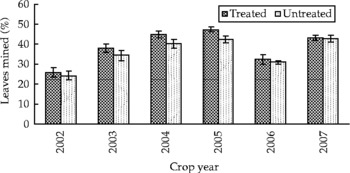
There was a significant influence of cotton types (F 3,134 = 168.83; P < 0.001) and seed treatment (F 1,134 = 9.32; P = 0.003) on the severity of damage by L. trifolii, which varied significantly across years (F 5,134 = 78.59; P < 0.001). Leaf miner damage to different cotton genotypes, both with and without seed treatment, increased from 2002 to 2007, except during 2006 (Fig. 1). However, cotton type × treatment × season interaction effects were non-significant (F 9,134 = 0.26; P = 0.98).
Liriomyza trifolii damage to cotton under seed-treated and untreated conditions during the 2002–2007 cropping seasons

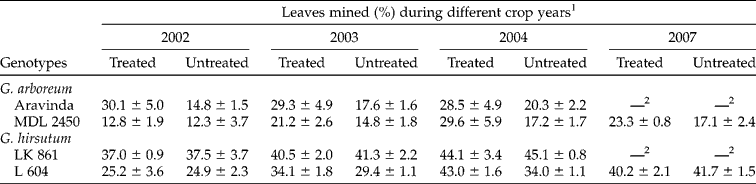
Liriomyza trifolii incidence in G. arboreum varieties varied from 12.8 to 45.1% and was significantly greater in plots with insecticide-treated seed than in untreated control plots (Table 2), probably because of the abundance of healthy leaves in treated plots and the ineffectiveness of imidacloprid in the control of L. trifolii. Damage was significantly lower in G. arboreum than in G. hirsutum varieties (Table 2), and seed treatment with imidacloprid was ineffective in controlling leaf miner damage to G. hirsutum varieties and hybrids (Tables 2 and 3).
Efficacy of imidacloprid seed treatment on reduction of serpentine leaf miner Liriomyza trifolii damage to Gossypium arboreum and G. hirsutum varieties
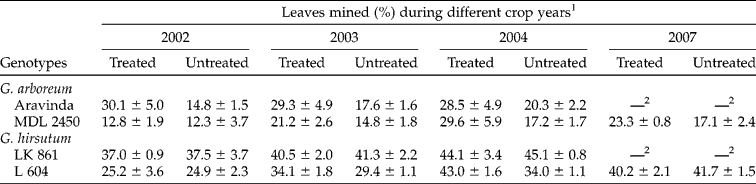
1 Values presented are means of three replications ± standard error; 2—, data not available.
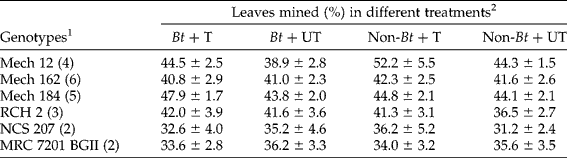
Effect of imidacloprid seed treatment on damage by the serpentine leaf miner Liriomyza trifolii to Gossypium hirsutum Bt and non-Bt cotton hybrids
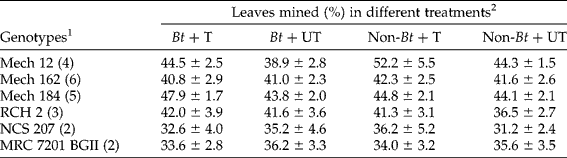
T, seed treated with imidacloprid; UT, no seed treatment;
1 figures in parentheses are numbers of years tested; 2values presented are means across seasons ± standard error.
Liriomyza trifolii incidence in G. hirsutum Bt and non-transgenic cotton hybrids varied from 32.6 to 47.9% and from 31.2 to 52.2%, respectively, across cropping seasons (Table 3). Among the cotton hybrids, L. trifolii incidence was significantly lower in MRC 7201 BGII and NCS 207 than in the other test hybrids (Table 3). There were significant differences in damage among the genotypes (F 5,174 = 13.74; P < 0.001) and across seasons (F 5,174 = 67.91; P < 0.001). However, no significant differences were noted among the seed-treated genotypes (F 3,174 = 2.43; P = 0.07). Genotype × treatment × season interaction effects for leaf miner incidence were non-significant (F 33,174 = 1.18; P = 0.24).
The L. trifolii pupae collected from the leaves of Bt cotton hybrids contained up to 1.35 ppb Bt toxin, indicating uptake of the toxin by the leaf miner larvae; however, Bt uptake had no effect on damage by L. trifolii larvae to the Bt and non-Bt cotton hybrids.
Influence of abiotic factors
Open pan evaporation (r = − 0.53**), maximum temperature (r = − 0.50**), solar radiation (r = − 0.50**) and sunshine (r = − 0.49**) had a negative influence on L. trifolii incidence, while relative humidity (r = 0.46**) and rainfall (r = 0.35*) had a positive influence (*,** = P 0.05, and 0.01, respectively). Multiple linear regression indicated that abiotic factors, namely sunshine, open pan evaporation, maximum and minimum temperatures, morning and evening relative humidity, rainfall, solar radiation and wind velocity explained 73% of the variation in L. trifolii damage (leaf miner damage (%) = 43 377+8.0 S+244.0 E+103.9MaxT+23.0 MinT − 418.0 RHM+24.0 RHE+36.2RF − 893.0 SR − 65.0 WV (R 2 = 0.73)). However, stepwise regression (leaf miner damage (%) = 74.74 − 1.36 RF − 7.77 E+0.28 RHE (R 2 = 0.99)) suggested that 99% of the variation in L. trifolii damage was associated with rainfall, open pan evaporation and relative humidity.
Discussion
Liriomyza trifolii damages cotton during the early stages of crop growth (Srinivasan et al., Reference Srinivasan, Viraktamath, Gupta and Tewari1995; Jeyakumar and Uthamasamy, Reference Jeyakumar and Uthamasamy1996), preferring younger leaves for feeding and oviposition (Lei et al., Reference Lei, Liu and Greenberg2009). The production of Bt proteins in the transgenic hybrids (expressing cry1Ac and cry1Ac+cry2Ab genes) occurs mostly during the vegetative stage of the crop, and predominantly in leaves (Kranthi et al., Reference Kranthi, Naidu, Dhawad, Tatwawadi, Mate, Patil, Bharose, Behere, Wadaskar and Kranthi2005). Although the L. trifolii pupae collected from the leaves of Bt cotton hybrids imbibed a trace amount of Bt toxin, there were no significant differences in leaf damage by the leaf miner larvae in the Bt and non-Bt cotton hybrids.
Liriomyza trifolii damage was significantly lower in G. arboreum cotton varieties than in the G. hirsutum varieties and hybrids across treatments and cropping seasons. No significant differences, however, were observed between Bt and non-Bt cotton hybrids.
Another plausible reason for the increased severity of L. trifolii damage to Bt cotton over the previously grown conventional cotton might be that broad spectrum insecticides for the control of lepidopteran pests are not as frequently used on Bt cotton as they are on conventional cotton. In addition, inherent differences in susceptibility to leaf damage among the different cotton genotypes, as previously observed by Sharma and Pampapathy (Reference Sharma and Pampapathy2006), may play a role.
Seed treatment with imidacloprid was found to be ineffective for the control of leaf miner damage, indicating the need to identify alternative strategies for the management of this and similar sucking pests.
Although L. trifolii pupae collected from the leaves of Bt cotton hybrids had ingested trace amounts of Bt toxin, no significant differences in leaf damage by L. trifolii to Bt and non-Bt cotton hybrids were recorded in our study. Lei et al. (Reference Lei, Liu and Greenberg2009), however, observed a reduction in L. trifolii damage on Bt cotton leaves. In addition, Bt-sprayed chickpea and bean crops showed lower damage by L. cicerina (Rondani) (Cikman et al., Reference Cikman, Kaplan and Coskun2008) and L. trifolii (Cikman and Comlekcioglu, Reference Cikman and Comlekcioglu2006), respectively.
Abiotic factors had a large and significant influence on L. trifolii damage, similar to previous studies. For instance, abiotic factors account for over 90% of L. trifolii incidence in castor (Singh et al., Reference Singh, Malik and Kumar1996). The present study suggested that 99% of the variation in L. trifolii damage was due to rainfall, open pan evaporation and relative humidity. Evidently, the serpentine leaf miner is highly sensitive to changes in environmental conditions. As such, climate change and widespread cultivation of leaf miner susceptible cotton genotypes, including transgenic Bt cottons, might lead to L. trifolii becoming a major pest in the future. There is an urgent need to devise better control strategies for the pest, including alternative seed treatments and leaf miner-resistant genotypes.
Acknowledgements
We are grateful to Dr David Henshaw for his support with identifying L. trifolii. We acknowledge the funding received from the Swiss Agency for Development and Cooperation, Berne; the Departments of Biotechnology and Science and Technology, New Delhi; and the IndoSwiss Collaboration on Biotechnology.