Job characteristics have been identified as an important social-contextual aspect in motivating employees for their work (e.g., Hackman & Oldham, Reference Hackman and Oldham1980). Especially in present-day working life, certain job attributes may secure employees with a certain degree of autonomy, chances for development, and an adequate social working environment that have important implications on a variety of work outcomes. The job demands- resources model (JD-R model; Bakker & Demerouti, Reference Bakker and Demerouti2007; Demerouti, Bakker, Nachreiner, & Schaufeli, Reference Demerouti, Bakker, Nachreiner and Schaufeli2001) has been extensively used to explain job characteristics’ implications on employee health and functioning by classifying different job characteristics into two broad categories, namely job demands and job resources. Job demands, such as task interruptions, workload, work-home inference, and organizational changes, refer to aspects of the job that require sustained physical and mental effort. As a result, job demands may have some physiological and psychological costs (Demerouti et al., Reference Demerouti, Bakker, Nachreiner and Schaufeli2001). Job resources, such as opportunities for skill utilization, supervisor support, financial rewards, and career opportunities, refer to those aspects of the job that may be useful to decrease the impact of job demands, and in general promote development and goal achievement (Demerouti et al., Reference Demerouti, Bakker, Nachreiner and Schaufeli2001; Schaufeli & Bakker, Reference Schaufeli and Bakker2004).
Given the distinct qualities of these two categories of job characteristics, research employing the JD-R model has found that while job demands tend to increase negative outcomes such as burnout, job resources are linked to positive outcomes such as engagement (e.g., Schaufeli & Bakker, Reference Schaufeli and Bakker2004). These different outcomes of demands and resources are assumed to be stemming from two underlying processes. On one hand, the presence of job demands and the absence of job resources are expected to be positively related to negative outcomes through an energetic process where the employee’s mental and physical energy is drained. On the other hand, the presence of job resources is expected to be positive for the motivational process. Specifically, it is assumed that job resources have a motivational potential because they foster growth, learning, and development as well as being instrumental in achieving work goals (e.g., Bakker & Demerouti, Reference Bakker and Demerouti2007).
To empirically account for these mechanisms, some recent studies have drawn on the theoretical framework of self-determination theory (SDT; Deci & Ryan, Reference Deci and Ryan2000). SDT proposes that work environments play a key role in employees’ functioning by either supporting or hindering employees’ psychological needs and subsequently affecting the quality of their work motivation, and thus provides psychological and motivational mechanisms that may explain the relations proposed by the JD-R model. Thus, studies have used the concept of basic psychological needs within the SDT-framework as a mechanism to explain the relations between job characteristics and different work outcomes (De Cooman, Stynen, Van den Broeck, Sels, & De Witte, Reference De Cooman, Stynen, Van den Broeck, Sels and De Witte2013; Fernet, Austin, Trépanier, & Dussault, Reference Fernet, Austin, Trépanier and Dussault2013; Trépanier, Forest, Fernet, & Austin, Reference Trépanier, Forest, Fernet and Austin2015; Van den Broeck, Vansteenkiste, De Witte, & Lens, Reference Van den Broeck, Vansteenkiste, De Witte and Lens2008; Van den Broeck, Vansteenkiste, De Witte, Soenens, & Lens, Reference Van den Broeck, De Cuyper, De Witte and Vansteenkiste2010). By drawing on SDT, these studies have provided important knowledge as to how and why the social-contextual environment give implications for employees’ health and functioning.
The current study contributes to and extends earlier research in two important ways. First, the present study seeks to clarify the relations between chosen job characteristics and each of the three psychological needs. Previous research that has used SDT to explain the job characteristic-outcomes relation has certain ambiguous findings, particularly for certain job demands that against theoretical assumptions have been found positively related to work functioning (Bakker, Demerouti, & Schaufeli, Reference Bakker, Demerouti and Schaufeli2005). The current study proposes that this may be due to a lack of differentiation between job challenges and job hindrances as two categories of job demands, as well as different relations between specific job characteristics and each basic need. Second, an aim is to broaden the model to investigate how the JD-R-model is related to a complete motivational process, not only accounting for the basic needs, but also autonomous motivation. Although the JD-R-model has been investigated in relation to SDT, this has mainly been done in terms of the mediation effect of the basic psychological needs on outcomes without taking motivation into account (Fernet et al., Reference Fernet, Austin, Trépanier and Dussault2013; Van den Broeck et al., Reference Van den Broeck, Vansteenkiste, De Witte and Lens2008). Moreover, when motivation is studied, the type of motivation is used as an outcome and not as an intervening variable between need satisfaction and work outcomes (Van den Broeck, Vansteenkiste et al., Reference Van den Broeck, De Cuyper, De Witte and Vansteenkiste2010), or without the basic psychological needs (Fernet, Trépanier, Austin, Gagné, & Forest, Reference Fernet, Trépanier, Austin, Gagné and Forest2015). Because satisfaction of the basic psychological needs is important for internalization of work activities and because quality of motivation has important implications on work behavior and functioning (Gagné & Deci, Reference Gagné and Deci2005), including motivation is essential. Two recent studies (De Cooman et al., Reference De Cooman, Stynen, Van den Broeck, Sels and De Witte2013; Trépanier et al., Reference Trépanier, Forest, Fernet and Austin2015) have addressed the JD-R model accounting for both need satisfaction and type of motivation, but these studies do not distinguish between the three different needs. In sum, the current study contributes to the literature on how and why job characteristics are related to work motivation and work outcomes by looking into more distinct relations between different job characteristics and different basic needs.
Self-determination theory
SDT is a theoretical framework explaining human motivation. Central to the theory is the distinction between controlled and autonomous motivation. Autonomy involves acting with a sense of volition and having the experience of choice. In contrast, being controlled entails acting with a sense of pressure, as well as a sense of having to engage in the action. Autonomous motivation is considered optimal as this type of motivation is linked to better health and functioning. In particular, SDT distinguishes between three types of autonomous motivation. First, the identified regulation entails a conscious valuing of a behavioral goal or regulation, and an acceptance of the behavior as personally important. Second, the integrated regulation is based on a desire to express oneself in one’s actions and activities. Third, intrinsically motivated behavior refers to engagement in activities based on enjoyment and interest, and is prototypically autonomous (Gagné & Deci, Reference Gagné and Deci2005).
Of importance in promoting autonomous motivation is satisfaction of the basic psychological needs for autonomy, competence, and relatedness (Deci & Ryan, Reference Deci and Ryan2000). The need for autonomy refers to the feeling of being the source of one’s own behavior. The need for competence refers to the feeling of being effective in interacting with the environment, and experiencing opportunities to exercise and express one’s capacities. The need for relatedness refers to the sense of belongingness by feeling connected to and being cared for by those around one. Previous research has shown that when satisfied, these needs promote autonomous motivation, as well as performance and well-being (Deci, Olafsen, & Ryan, Reference Deci, Olafsen and Ryan2017).
SDT can contribute to understanding the underlying mechanisms in the JD-R-model; that is how and, more importantly, why different job characteristics are linked to different employee outcomes by fostering certain psychological states. Indeed, need satisfaction is assumed to represent the underlying motivational mechanism that energizes and directs people’s behavior, and psychological need satisfaction is regarded as the essential nutriment for individuals’ optimal functioning and well-being (Deci & Ryan, Reference Deci and Ryan2000). If job characteristics can give nutriments to or hinder satisfaction of the basic needs, how employees actualize their potential, flourish, are protected from ill health and maladaptive functioning, and generally thrive at work may be explained by how job characteristics influence this motivational process. As such, the motivational process described by SDT may be coupled with the processes in the JD-R model. For example, in the JD-R perspective, it is assumed that job resources trigger motivational processes (Bakker & Demerouti, Reference Bakker and Demerouti2007; Schaufeli & Bakker, Reference Schaufeli and Bakker2004). From an SDT perspective, this is because job resources have the potential to satisfy the basic psychological needs for autonomy, competence, and relatedness, and in turn lead to greater internalization of work activities (i.e., autonomous work motivation). Thus, job resources influence employee functioning through satisfaction of these three needs, which again causes autonomous job motives. These job motives have the potential to explain the variety of job outcomes that previous JD-R-research has looked at.
The present study
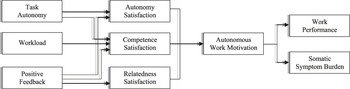
The present study discusses and tests a social-contextual model of how and why job characteristics relate to work functioning by proposing a SDT model where each basic psychological need as well as autonomous work motivation are considered in explaining these relations. The opportunity for task autonomy, positive feedback, and workload are chosen as the job characteristics to be investigated in the present study, as these represent job resources acknowledged as important for need satisfaction and a job demand that has been suggested to represent a job challenge in previous literature (e.g., Van den Broeck et al., Reference Van den Broeck, Vansteenkiste, De Witte and Lens2008). Because performance is an important factor for most organizations, self-reported work performance is included as an indicator of work functioning. In addition, SDT argues that highly effective organizations promote both high-quality performance and employee thriving, putting an equal emphasis on the importance of work motivation for employees’ well-being. Thus, the current study includes somatic symptom burden as an indicator of employee wellness to account for both types of outcomes. The proposed research model is illustrated in Figure 1, followed by an overview of the supporting literature and the research hypotheses.
Theoretical Model.

Task autonomy is a type of organizational resource concerning opportunities to control the tasks the employee performs at work, and how these are carried out (Hackman & Oldham, Reference Hackman and Oldham1980). Judging by findings by Van den Broeck, Vansteenkiste et al. (Reference Van den Broeck, De Cuyper, De Witte and Vansteenkiste2010), task autonomy seems important for satisfaction of the need for autonomy as it stimulates the notion of being in control of one’s own work environment. Further, task autonomy has also previously been connected to competence satisfaction (Fernet et al., Reference Fernet, Austin, Trépanier and Dussault2013; Van den Broeck, Vansteenkiste et al., Reference Van den Broeck, De Cuyper, De Witte and Vansteenkiste2010). Task autonomy may influence the competence need by creating an opportunity to apply knowledge and skills in performing the task. When a job offers the freedom to make choices in relation to how a task should be performed and which methods to use in the task execution, an employee is also free to use a greater range of his/her existing knowledge in determining those aspects. It is also likely that task autonomy has the potential to enhance and develop new work practices (Warr, Reference Warr1989), and, thus, satisfy the need for competence through development of new skills. As both autonomy- and competence need satisfaction is central in the creation of autonomous motivation (Deci & Ryan, Reference Deci and Ryan2000), the following hypothesis is proposed:
-
Hypothesis 1: Task autonomy is positively related to autonomous work motivation through the basic needs for autonomy and competence.
Feedback may be thought of as a social-related resource as it involves interaction with colleagues and leaders, albeit connected to the task level, and may concern feedback on both the quality and quantity in the exercise of different tasks. As such, feedback is recognized as information about the employee’s overall work performance (Hackman & Oldham, Reference Hackman and Oldham1976). Few studies have reported outcomes of this job resource alone, but it is generally assumed that it is connected to the motivational process within the JD-R model. In the study by Van den Broeck et al. (Reference Van den Broeck, Vansteenkiste, De Witte and Lens2008), positive feedback was used in an overall measure of job resources, which predicted overall need satisfaction. Because this job resource concerns feedback on the employees’ performance, it seems likely that this may relate to the feeling of competence. Furthermore, receiving positive feedback might enhance the feeling of relatedness to the organization and fellow employees, as mastering something elicits a feeling of belonging to the specific group constituted by the organization. In addition, feedback may be thought of as a form of social support from managers or colleagues, which is important for the internalization process through satisfying both the need for relatedness and the need for autonomy. In particular, positive relations between social support and the two needs for relatedness and autonomy have been shown empirically (Fernet et al., Reference Fernet, Austin, Trépanier and Dussault2013; Van den Broeck, Vansteenkiste et al., Reference Van den Broeck, De Cuyper, De Witte and Vansteenkiste2010). Hence, the following hypothesis is proposed:
-
Hypothesis 2: Positive feedback has a positive relation with autonomous work motivation through the basic needs for autonomy, competence, and relatedness.
In contrast to job resources, job demands are traditionally perceived as negative for job outcomes such as burnout (e.g., Demerouti et al., Reference Demerouti, Bakker, Nachreiner and Schaufeli2001; Schaufeli & Bakker, Reference Schaufeli and Bakker2004), turnover intention, disengagement, and absenteeism. However, research has yielded contradictory findings as relations to positive consequences for certain job demands have been found. For example, workload and cognitive demands were positively related to vigor and dedication in a study by Bakker et al. (Reference Bakker, Demerouti and Schaufeli2005). Similarly, Schaufeli, Taris, and van Rhenen (Reference Schaufeli, Taris and van Rhenen2008) and Xanthopoulou, Bakker, Demerouti, and Schaufeli (Reference Xanthopoulou, Bakker, Demerouti and Schaufeli2007) found a positive relation from time pressure and workload to engagement, respectively. Job demands have also been studied in relation to the basic psychological needs, and even though this research has found implications of job demands’ harmful relation to work-related variables through these psychological mechanisms (Van den Broeck et al., Reference Van den Broeck, Vansteenkiste, De Witte and Lens2008), the findings are not fully supported. In fact, contradictory to their hypothesis, De Cooman et al. (Reference De Cooman, Stynen, Van den Broeck, Sels and De Witte2013) found a positive relation between job pressure and satisfaction of the basic psychological needs.
To dispel the ambiguities of previous research, Van den Broeck, De Cuyper, De Witte, and Vansteenkiste (Reference Van den Broeck, De Cuyper, De Witte and Vansteenkiste2010) distinguished between job hindrances and job challenges. Specifically, the authors suggested that job hindrances have only negative consequences because they drain employee’s energy by contributing to employees’ feeling a lack of control and experiencing negative emotions. This results in an emotion-focused coping style that interfere with goal achievement and well-being. On the other hand, job challenges may have both energy-depleting and stimulating capacities; the latter feature by appealing to employees’ curiosity, competence, and thoroughness, fostering a problem-focused coping style (Van den Broeck, De Cuyper et al., Reference Van den Broeck, De Cuyper, De Witte and Vansteenkiste2010). Job challenges may therefore also have a motivating potential that results in positive affective states and outcomes such as engagement. In the study by Van den Broeck, De Cuyper et al. (Reference Van den Broeck, De Cuyper, De Witte and Vansteenkiste2010), job challenges (i.e., workload and cognitive demands) were positively related to outcomes such as vigor, and not negatively related to exhaustion. Similarly, Crawford, LePine, and Rich (Reference Crawford, LePine and Rich2010) found a positive relation between job challenges (i.e., job responsibility, time urgency, and workload) and engagement in their meta-analysis. As such, it seems appropriate to treat different demands in different ways according to qualitative distinctions; the distinction between hindrances and challenges may explain the ambiguity in previous findings.
A differentiation between hindrances and challenges may be explained by the possibility of job challenges being positively related to satisfaction of certain basic psychological needs. Because job challenges may elicit a problem-focused coping style that contributes to achievement of working goals, hence yielding opportunities for development and growth (e.g., Cavanaugh, Boswell, Roehling, & Boudreau, Reference Cavanaugh, Boswell, Roehling and Boudreau2000), job challenges may create a feeling of competence. To investigate this proposition, the present study has included the job challenge workload. Workload refers to the amount of tasks the employee is faced with on an everyday basis. Such a job challenge may stimulate employees to put effort into their job as meeting them as meaningful and desirable yields opportunities for growth and achievement (e.g., Kahn, Reference Kahn1990), hence stimulating competence need satisfaction. Thus, the following hypothesis is proposed:
-
Hypothesis 3: Workload is positively related to autonomous work motivation through satisfaction of the basic need for competence.
From an organization’s perspective, motivating employees is important to get the best out of them in terms of their performance. SDT postulates that autonomous motivation leads to positive consequences, including better performance, because it yields interest, excitement, and confidence at the tasks at hand (Ryan & Deci, Reference Ryan and Deci2000). As autonomous work motivation implies that employees engage in their work tasks based on interest and/or because they value their work and acknowledge its relevance, there is reason to believe that this will manifest in greater performance. Such a relation has been supported for intrinsic work motivation (e.g., Kuvaas & Dysvik, Reference Kuvaas and Dysvik2009) and autonomous work motivation in general (De Cooman et al., Reference De Cooman, Stynen, Van den Broeck, Sels and De Witte2013). This study proposes that the motivational processes created by job characteristics impacts employee performance:
-
Hypothesis 4: Autonomous work motivation is positively related to work performance.
In addition to employee performance, SDT has always stated that there is another important reason for fostering autonomous motivation. In particular, SDT argues that autonomous motivation is essential for peoples’ well-being. In the work domain, a large range of studies have supported hypotheses between employees’ need satisfaction at work, autonomous work motivation, and employee well-being measured by a variety of indicators such as vitality, subjective well-being, and burnout (for a review, see Deci et al., Reference Deci, Olafsen and Ryan2017). Among these indicators of employee well-being is the concept of somatic symptom burden, which has been defined as “the tendency to experience and communicate somatic distress and symptoms unaccounted for by pathological findings, to attribute them to physical illness, and to seek medical help for them … (and) becomes manifest in response to psychosocial stress”. In a study by Williams et al. (Reference Williams, Halvari, Niemiec, Sørebø, Olafsen and Westbye2014), autonomous work motivation was linked to less experience of such somatic symptoms. The current study builds on this finding by examining the role of the basic psychological needs and autonomous work motivation in the relation between job characteristics and somatic symptom burden as an indicator of employee well-being:
-
Hypothesis 5: Autonomous work motivation is negatively related to somatic symptom burden.
Method
Procedures and participants
The sample consists of 405 waiters and waitresses (134 men, 266 women, 5 unidentified) from various restaurants across Norway. The sample was young, with 47.8% of the participants aged under 30. The average years of experience as a waiter/waitress were 10.77 (SD = 9.16). Of the participants, 50.1 % worked in a company employing up to 15 people, while 20.9 % worked in a company with 30 employees or more.
The participants received a questionnaire packet and a cover letter explaining the nature of the study. They were informed that participation was voluntary, and assured that their response would be confidential and would not be tracked back to them. They completed the questionnaire either on the web or on paper.
Measures
Job resources
Relevant items for task autonomy (three items, e.g., “I can choose the way in which the work is carried out”) were taken from Van Veldhoven and Meijman (Reference Van Veldhoven and Meijman1994). Positive feedback (three items, e.g., “I get mainly positive feedback on my work method”) was measured through the scale by Van den Broeck et al. (Reference Van den Broeck, Vansteenkiste, De Witte and Lens2008). All items were assessed on a scale ranging from 1 (totally disagree) to 5 (totally agree).
Job demands
Workload was assessed using three items (e.g., “Often, I have to work extra hard to get things done”) derived from Bakker, Demerouti, de Boer, and Schaufeli (Reference Bakker, Demerouti, de Boer and Schaufeli2003). The items were measured on a scale ranging from 1 (totally disagree) to 5 (totally agree).
Basic psychological need satisfaction
The basic psychological needs were measured through The Work-Related Basic Need Satisfaction Scale (Van den Broeck, Vansteenkiste et al., Reference Van den Broeck, De Cuyper, De Witte and Vansteenkiste2010). The need for autonomy (three items, e.g., “The tasks I have to do at work are in line with what I really want to do”), the need for competence (three items, e.g., “I feel competent in my job”), and the need for relatedness (three items, e.g., “At work, I feel part of a group”). These were reported on a scale ranging from 1 (totally disagree) to 5 (totally agree).
Autonomous work motivation
The employees’ autonomous motivation was assessed using The Multidimensional Work Motivation Scale (Gagné et al., Reference Gagné, Forest, Vansteenkiste, Crevier-Braud, Van den Broeck, Aspeli and Westbye2015). The participants were asked to report different reasons for doing their job (“I put effort into my job…”). Identified regulation (three items, e.g., “Because I personally consider it as important to put efforts in this job”) and intrinsic motivation (three items, e.g., “Because the work I do is interesting”) were measured on a scale ranging from 1 (not at all for this reason) to 7 (exactly for this reason).
Performance
Work performance was measured using self-reports of the workers’ effort and quality in their work, with five items for each dimension (Kuvaas & Dysvik, Reference Kuvaas and Dysvik2009). A sample item for effort is “I try to work as hard as possible”, while a sample item for quality is “The quality of my work is top-notch”. The scales were assessed on a scale ranging from 1 (totally disagree) to 7 (totally agree).
Somatic symptom burden
Respondents perceived somatic symptoms were measured with the Patient Health Questionnaire developed by Kroenke, Spitzer, and Williams (Reference Kroenke, Spitzer and Williams2002). The measurement consists of 15 different symptoms and the employees report to which extent they have experienced any of these in the past four weeks on a three point scale – not bothered, somewhat bothered and strongly bothered.
Data analyses
The research model was tested by means of structural equation modeling (SEM) using LISREL 8.80. The analyses were conducted on covariance matrices and the maximum likelihood method of estimation. Model fit was evaluated using the Chi-Square test (χ2), its degrees of freedom (df) and p-value, the root mean square error of approximation (RMSEA), the comparative fit index (CFI), the standardized root mean square residual (SRMR), and the non-normed fit index (NNFI), which are recommended to evaluate model fit in covariance structure analyses (Hu & Bentler, Reference Hu and Bentler1999).
Results
Preliminary analyses
A confirmatory factor analysis (CFA) was conducted to ensure that the indicators adequately represented their intended constructs. The results revealed problems with the negatively phrased items for autonomy satisfaction (two items) and relatedness satisfaction (two items). These items were omitted, however, not only due to statistical consideration but also for theoretical reasons. As negatively phrased items have been linked to need frustration, it seems justified as need satisfaction and need frustration are recognized to be distinct concepts (Bartholomew, Ntoumanis, Ryan, Bosch, & Thøgersen-Ntoumani, Reference Bartholomew, Ntoumanis, Ryan, Bosch and Thøgersen-Ntoumani2011). By keeping only the positively phrased items, the measures for need satisfaction should be a better reflection of these constructs.
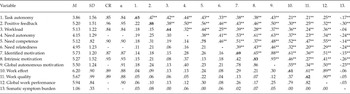
By removing the problematic items, the final measurement model includes eleven latent variables and 31 items (i.e., three for task autonomy, three for positive feedback, three for workload, one for autonomy need satisfaction, three for competence need satisfaction, one for relatedness need satisfaction, three for identified regulation, three for intrinsic motivation, five for work effort, five for work quality, and one for somatic symptom burden) The results for the final measurement model yielded good fit: χ2(df = 382, N = 405) = 875.94, p < .001, CFI = .98, NNFI = .97, SRMR = .047, and RMSEA = .057. All indicators had factor loadings of at least .68 and the average variance extracted (AVE) for all of the variables was above .50, indicating good convergent validity for the measurement scales (Fornell & Larcker, Reference Fornell and Larcker1981). Reliability for the latent variables was examined using both composite reliability (CR) and Cronbach’s alpha (α), which should show values above .7 (Nunnally, Reference Nunnally1978). All of the latent variables meet this requirement (see Table 1). Furthermore, discriminant validity for the latent variables was assessed using the AVE as recommended by Fornell and Larcker (Reference Fornell and Larcker1981). As shown in Table 1, the AVE values are all greater than the off-diagonal squared correlations.
Means (M), Standard Deviations (SD), Composite Reliability (CR), Cronbach’s Alpha (α), Average Variance Extracted (AVE), and Zero-Order Correlations/Squared Correlations for the Study Variables

Note: AVE’s on the diagonal. Squared correlations under the diagonal. Correlations above the diagonal. **p < .01.
A MANOVA (Pillai’s Trace) was performed to verify whether the study variables differed according to background variables of the sample (i.e., gender, age, years of work experience as a waiter/waitress, and number of employees in the organization). The result did not reveal a significant multivariate difference between gender F(9, 295) = 1.33, p > .05, partial η2 = .04, age groups, F(18, 588) = 1.61, p > .05, partial η2 = .05, years experience as a waiter/waitress F(333, 2268) = 1.03, p > .05, partial η2 = .13, or number of employees in the organization F(432, 2196) = .87, p > .05, partial η2 = .15. However, ANOVA showed a significant difference between gender for the experience of somatic symptom burden [F(1, 303) = 6.22 p < .05, partial η2 = .02] indicating that women experience more somatic symptoms than men. Furthermore, ANOVA showed that age was significantly related to perceived workload [F(2, 301) = 5.79 p < .01, partial η2 = .04], where the mean difference (MD) between the highest age group differed significantly from the lowest and middle age group (MD = .53, SD = .16 p < .01 and MD = .50, SD = .19, p < .05, respectively). In addition, number of years of experience as a waiter/waitress was in the ANOVA significantly related to work performance [F(37, 252) = 1.57 p < .05, partial η2 = .19]. Hence, gender, age, and years of experience in the occupation were included in the test of the structural model.
Analysis of the structural model
To analyze the structural model (Model 1) in line with the hypothesized model, the indicators of the dimensions constituting autonomous motivation (i.e., identified regulation and intrinsic motivation) and work performance (i.e., effort and quality) were indexed, so that that the two indexed dimensions represented the indicators of these constructs. Similar procedures have been used in previous research (e.g., Trépanier et al., Reference Trépanier, Forest, Fernet and Austin2015). The structural model therefore included nine latent variables and 19 items (i.e., three for task autonomy, three for positive feedback, three for workload, one for autonomy need satisfaction, three for competence need satisfaction, one for relatedness need satisfaction, two for autonomous motivation, two for work performance, and one for somatic symptom burden). Gender, age, and years of experience predicted the endogenous variables in the model. Fitting of the hypothesized model to the sample data resulted in acceptable fit: χ2(df = 171, N = 405) = 518.97, p < .001, CFI = .97, NNFI = .95, SRMR = .067, and RMSEA = .071.
To verify the role of the basic psychological needs between the job characteristics and autonomous work motivation, links from the job characteristics to autonomous work motivation were added to Model 1. However, none of the three separately considered links were significant, and the results showed that none of the added relations significantly increased model fit. Next, research based on the JD-R model has often found job characteristics directly related to employee outcomes. In particular, job resources are assumed positively related to positive employee outcomes, while job demands are assumed positively related to negative employee outcomes (e.g., Demerouti et al., Reference Demerouti, Bakker, Nachreiner and Schaufeli2001). Hence, it was investigated whether adding direct links from the job resources (i.e., task autonomy and positive feedback) to work performance would increase model fit. In addition, given that job challenges have the possibility of both being energy depleting as well as contributing positively to the motivational process (Van den Broeck, De Cuyper et al., Reference Van den Broeck, De Cuyper, De Witte and Vansteenkiste2010), links from workload to both work performance and somatic symptom burden were added. The four links were added to the proposed model (Model 1) using a stepwise approach. Although several of the separately considered links significantly increased model fit, only the link from workload to work performance was significant. Adding this link (Model 2) resulted in acceptable fit: χ2(df = 170, N = 405) = 507.80, p < .001, CFI = .97, NNFI = .96, SRMR = .065, and RMSEA = .070, and a significant increase in model fit: Δχ2 = 11.89 (df = 1), p < .001. It was therefore concluded that Model 2 was the best fitting model.
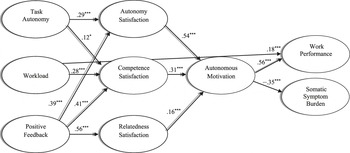
Figure 2 shows that task autonomy and positive feedback had positive significant associations with autonomy need satisfaction, and explained (together with the covariates) 38% of the variance in this basic need. All the job characteristics included (i.e., task autonomy, positive feedback, and workload) were significantly positively associated with competence need satisfaction and explained (together with the covariates) 45% of this basic need. Positive feedback was significantly associated with relatedness need satisfaction and contributed (together with the covariates) with 32% of the variance in this basic psychological need. All of the three basic psychological needs were significantly associated with autonomous work motivation and explained (together with the covariates) 63% of the variance in motivation. Finally, workload and autonomous work motivation were significantly positively associated with work performance, and autonomous work motivation was significantly negatively associated with somatic symptom burden. Workload and autonomous work motivation contributed (together with the covariates) to 43% of the variance in work performance, while autonomous work motivation explained (together with the covariates) 23% of the variance in somatic symptom burden.
Results from the Structural Equation Analysis. Note. All coefficients are standardized. For the sake of clarity, the measurement model is not presented and covariances among error terms are not shown. *p < .05, **p < .01, ***p < .001.

Test of indirect relations
Confidence interval estimates were calculated based on the results of the indirect relations obtained in the analyses of the final structural model (Model 2) to confirm the significance of these indirect relations. Results show the indirect relations of the three independent variables. First, workload is indirectly linked to autonomous work motivation (β = .09; 95% CI [.05, .13]) through competence satisfaction. Second, task autonomy is indirectly linked to autonomous work motivation (β = .19; 95% CI [.11, .27]). Third, positive feedback is indirectly linked to autonomous work motivation (β = .42; 95% CI [.32, .52]).
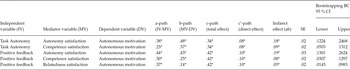
Contrasting of the indirect links between the two job resources and autonomous motivation was performed with bootstrapping to evaluate the role of each need specifically (see Table 2). Results suggested that autonomy satisfaction and competence satisfaction are both intervening between task autonomy and autonomous work motivation (β = .18; 95% CI [.12, .25] and β = .09; 95% CI [.05, .13], respectively), and that autonomy satisfaction, competence satisfaction, and relatedness satisfaction all intervene between positive feedback and autonomous work motivation (β = .19; 95% CI [.13, .26], β = .08; 95% CI [.03, .13], and β = .05; 95% CI [.01, .10], respectively).
Contrasted Indirect Effects

* p < .05.
In addition to the hypothesized indirect relations, indirect relations were also found between task autonomy and work performance (β = .11; 95% CI [.07, .15]), between task autonomy and somatic symptom burden (β = –.02; 95% CI [–.02, –.02]), between positive feedback and work performance (β = .24; 95% CI [.18, .30]), between positive feedback and somatic symptom burden (β = –.04; 95% CI [–.06, –.02]), between workload and work performance (β = .05; CI [.03, .07]), and between workload and somatic symptom burden (β = –.01; 95% CI [–.01, –.01]). Furthermore, indirect relations were found between the three basic needs and work performance through autonomous work motivation: (1) autonomy satisfaction (β = .25; 95% CI [.19, .31]); (2) competence satisfaction (β = .17; 95% CI [.11, .23]); and (3) relatedness satisfaction (β = .09; 95% CI [.03, .15]), as well as between the three basic needs and somatic symptom burden through autonomous work motivation: (1) autonomy satisfaction (β = –.04; 95% CI [–.06, –.02]); (2) competence satisfaction (β = –.05; 95% CI [–.05, –.01]); and relatedness satisfaction (β = –.01; 95% CI [–.01, –.01]).
Discussion
The purpose of the present study was to test a social-contextual model of specific job characteristics to investigate which distinct relations these have on each of the basic psychological needs in order to predict autonomous work motivation and, eventually, work performance and somatic symptom burden. Results suggest that (1) task autonomy is positively associated with satisfaction of the need for autonomy and the need for competence; (2) positive feedback is positively linked to satisfaction of all of the basic psychological needs; (3) workload has positive relations to the need for competence and work performance; (4) satisfaction of the three basic psychological needs is positively related to autonomous work motivation; 5) autonomous work motivation is positively associated with work performance and negatively associated to somatic symptom burden; (6) indirect effects of the relations between the different job characteristics and autonomous motivation have been detected, indicating the role of the basic needs in explaining these relations.
The findings build on a body of literature that has linked job characteristics from the JD-R model to the motivational framework of SDT (e.g., Fernet et al., Reference Fernet, Austin, Trépanier and Dussault2013; Van den Broeck et al., Reference Van den Broeck, Vansteenkiste, De Witte and Lens2008). However, in contrast to most previous studies, the present study considers the full motivational model including both need satisfaction and autonomous work motivation, as well as specifying the impact of each chosen job characteristic on each basic need. As proposed, different characteristics distinct relations to each basic need, which is important to acknowledge as previous studies have obtained somewhat ambiguous results for the relation between certain job characteristics and the basic needs (e.g., Van den Broeck, Vansteenkiste et al., Reference Van den Broeck, De Cuyper, De Witte and Vansteenkiste2010). As such, although the relation between job resources and the basic psychological needs is not inherently new, the results help clarify which job characteristics that relate to each need. Specifically, task autonomy relates to both the need for autonomy and the need for competence by enabling a sense of choice in relation to one’s work, as well as feeling trusted in these choices when executing one’s job. Furthermore, positive feedback is found to be related to all of the three basic needs. These relations can be explained by the perception of positive feedback as a form of social support sustaining both the need for autonomy and relatedness, as well as functioning as acknowledgment of the employees’ effort and performance, thus supporting the need for competence.
In addition, the present study provides support for a third category of job characteristics, since workload was positively related to the need for competence. Considering this result, workload differs from other traditionally perceived job demands as it is not solely negative for the motivational process, supporting a distinction between job challenges and job hindrances. Although job challenges and job hindrances may share some traits by both being energy depleting, as a job challenge, workload may also be somewhat stimulating by appealing to employees’ curiosity, competence and/ or thoroughness, and by eliciting a problem-focused coping style that may contribute to achieving work goals (Van den Broeck, De Cuyper et al., Reference Van den Broeck, De Cuyper, De Witte and Vansteenkiste2010). As such, job challenges may share common features with both the traditionally perceived job demands––job hindrances––as well as with job resources. Moreover, this category yields opportunities for growth and development, which fits well with the results in terms of workload being positively related to the need for competence. Whether this relation also hold true for other job challenges (e.g., cognitive demands and time pressure) is for future studies to determine. In addition, it is important to note that the sample in the present study is of relatively young age, and this might partly explain the results. Because the older age groups tended to report higher perceptions of workload, the relation between workload and need satisfaction might be different in a sample of older employees. More knowledge is hence needed on the energetic process of job challenges such as workload, possibly considering need frustration and health indicators of ill-being as well as knowledge of this relation across different samples.
The role of the basic needs for autonomy, competence, and relatedness for the motivational process was demonstrated through the structural equation model where the three job characteristics had indirect relations to autonomous work motivation through satisfaction of these needs. Furthermore, the basic psychological needs related to work performance and somatic symptom burden through autonomous work motivation. The results thus shows the motivational process between job characteristics and work outcomes, both in terms of employee functioning (i.e., work performance) and employee well-being (i.e., somatic symptom burden). This process contributes to the understanding of how and why job characteristics relates to employee outcomes within the JD-R framework. That is, the basic psychological needs and type of motivational work regulation within the SDT framework accounts for the theorized process described in the JD-R model by representing the motivational (or energetic) process that determines how and why social-contextual factors contributes to various work outcomes. These mechanisms is therefore important to acknowledge and include in studying the relations between characteristics of the work context and work outcomes.
In sum, as it seems like autonomously motivated employees both exercise more effort in their job, deliver more quality in their work performance, and report less somatic symptoms, stimulating the three basic needs is therefore important to promote work performance. Considering the job characteristics, both providing task autonomy, giving positive feedback and creating optimal challenges are important factors in creating need satisfaction in the analyzed model.
As the results indicate that attributes of the waiters’ and waitresses’ work are important to create autonomous motivation for the job, management needs to be aware of and consider such characteristics. Creating work tasks that have a minimum of autonomy as well as providing positive feedback will benefit both the employees and the organization: The employees will value their work and will consequently perform better for the organization. Finally, a heavy workload may not necessarily be considered solely negative, but can be perceived as a positive challenge. Nevertheless, due to the possible energy-depleting and subsequent health impairing aspects of such job challenges, management must consider such job characteristics cautiously in terms of offering employees with a heavy workload the resources to deal with such challenges so that it supports need satisfaction rather than thwarts it by becoming overwhelming.
Some limitations need to be acknowledged. For the purpose of the study, the data is based on self-reports. Only the employees can give an answer to the employees’ perception of the job characteristics, and their feeling of need satisfaction and motivation in relation to their job. Nevertheless, such self-reports may generate common method bias. In the present study, only well-validated and psychometrically sound measures were used, cf. measurement section. In addition, convergent validity, discriminant validity and reliability were assessed, and proved satisfactory (see Table 1). To further secure accuracy in the self-reports, the respondents were guaranteed anonymity, and the importance of truthful answers as well as the fact that there are no right or wrong answers was stressed in the invitation. Moreover, the predictor and criterion variables were measured with scales that contained different endpoints. Finally, to statistically test for possible common method bias, a single factor CFA was run for the study variables. The results showed that the single factor CFA had a very poor fit with a chi-square of 8601.28 on 527 degrees of freedom and a RMSEA of .195. Although these recommended remedies (Podsakoff, MacKenzie, Lee, & Podsakoff, Reference Podsakoff, MacKenzie, Lee and Podsakoff2003) cannot completely mitigate common method bias, these considerations seems to indicate that method bias was not a serious threat to the conclusions of the present study.
In terms of the measure for performance, this approach may have led the respondents to rate themselves higher than what is the objective truth. However, previous research shows that objective performance is significantly correlated with self-reports, and suggests that the amount of bias does not seem to vary across performance levels (Sharma, Rich, & Levy, Reference Sharma, Rich and Levy2004). Thus, the respondents in the present study may have overestimated their level of performance without necessarily affecting the results. In addition, a relation between autonomous motivation and performance is not new, so that the current results show this relation is logical and in line with the existing body of literature. However, future research may consider multiple sources for this construct to replicate the finding of a relation between autonomous motivation and performance.
Although the model is central to SDT theorizing, the data is correlational which makes conclusion about causality unwarranted. This design also has limitations in terms of studying mediation, but provides initial support for indirect relations between the job characteristics and autonomous work motivation through distinct basic psychological needs. Future research could attempt to replicate the findings in the present study using longitudinal designs that can also tackle the question of mediation.
Problems with the measure of the needs for autonomy and relatedness occurred. As a result, only one item remained for each of these two needs. Although Hayduk and Littvay (Reference Hayduk and Littvay2012) argues for using single indicators in SEM as adding redundant indicators may provide less research benefit than single indicators of additional latent variables, it is usually recommended to use several items for measuring a latent variable. Since the excluded items theoretically could be argued for tapping into need frustration, the only option was to excluded these items. Future use of this scale should be aware of these challenges with the measurement instrument as need frustration is a distinct concept.
Future research should investigate other job challenges (e.g., cognitive demands) to further test the assumption that job challenges, as opposed to job hindrances, is positively related to the basic psychological needs, and in particular to the need for competence. This is also relevant for other job resources, as it seems that different job characteristics relate differently to the three needs. Lastly, as job challenges may be considered both positive and negative, need frustration and controlled work motivation should be considered as intervening variables. Moreover, such relations should be studied in different samples to balance the potential effect of age, profession etc. on the nature of the sample.
Appendix A
Item means, standard deviations, factor loadings, and t-values for the final measurement model