

Introduction
The 1948 Constitution of the Italian Republic called for the implementation of the ‘fullest measure of administrative decentralization in those services which depend on the State’ (Article 5) and the setting up of regions as ‘autonomous bodies having their own powers and functions according to the principles established in the Constitution’ (Art. 115Footnote 1 ). Yet for 20 years the actual implementation of the 15 ordinary regions was largely left on paper, and it was another two decades before a new constitutional reform would shape the process of decentralization; almost 10 years later, in 2009, Italy finally completed a so-called ‘fiscal federalism’ reform.
This fitful process of decentralization might be dismissed as just another example of the inefficiency and gridlock of the Italian political system (Bull and Pasquino, Reference Bull and Pasquino2007; Farinelli and Massetti, Reference Farinelli and Massetti2011: 687). However, the punctuated equilibrium (PE) theory (Baumgartner and Jones, Reference Baumgartner and Jones1993, Reference Baumgartner, Green-Pedersen and Jones2009) suggests a less critical interpretation of such an uneven and troubled process of policy change by emphasizing the role of parties’ attention to issues in influencing the policy agenda.
This paper investigates the impact of the dynamics of party competition on the policy agenda and policy change, by focusing on the policy of decentralization.Footnote 2 The ultimate goal is to suggest a theoretical model for the analysis of policy change, one that points out the roles political parties and party competition play in the reforming process. It advances a set of hypotheses grounded in literature on agenda setting and party competition, which are then tested using the Italian process of decentralization from 1948 to 2017. This longitudinal research design makes it possible to follow the evolution of a single issue over time and the dynamics of party competition that might explain the shifts in attention paid to it. Italy represents a good case-study; it is a multiparty, parliamentary system, where parties have always exerted a strong influence over political institutions and decision-making, and despite the electoral and political changes of the early 1990s it has survived more or less intact over the period under consideration (Fabbrini, Reference Fabbrini2009).
The paper is structured as follows: the first section briefly describes the process of decentralization in Italy to assess whether it actually followed a PE pattern. The second section introduces the theoretical framework, on which a set of baseline hypotheses concerning the roles political parties and party competition have played in the process of policy change are based. The original data set designed for the estimation of party strategies used to test the hypotheses is illustrated in the third section, while the empirical analysis is carried out in the fourth section. Finally, the conclusions discuss the empirical results and provide insights about the likely policy implications of the analysis.
The ‘punctuated’ process of decentralization in Italy
The process of decentralization in Italy featured three key periods of dramatic change, alternated by long periods of stability. The first phase (1968–77) started with the approval of a law on the rules governing the election of the ordinary regions in 1968,Footnote 3 followed shortly by a law granting financial autonomy to the regionsFootnote 4 and one enabling the government to issue decrees reforming state administration, both approved in 1970;Footnote 5 the implementing decrees were finally approved in 1972.Footnote 6 This first cycle of reform concluded in 1975,Footnote 7 with the law granting the government the authority to approve decrees that would transfer competencies and administrative functions to the regions, adopted in 1977.Footnote 8 The second phase began 20 years later during Legislature XIII (1996–2001) with the so-called ‘Bassanini reform,’Footnote 9 which provided for the transfer of all administrative functions to the regions and local authorities (Baldi, Reference Baldi2006), and was followed in 2001 by the deep reform of Title V of the second part of the Constitution,Footnote 10 which assigned greater legislative competencies to the regions and was finally approved by constitutional referendum. The third phase has included the adoption of the ‘fiscal federalism’ reform in 2009 (L. 42/2009), whose implementing decrees were adopted between 2010 and 2014. Two other attempts to reform Constitutional provisions concerning the territorial organization of the state were made in 2006 and 2016, but both were defeated by constitutional referendums.
According to Baumgartner and Jones (Reference Baumgartner and Jones1993, Reference Baumgartner, Green-Pedersen and Jones2009), policy-making, at least in some policy areas, is generally characterized by long periods of stability ‘punctuated’ by outbursts of change, which are then followed by further long periods of equilibrium. One way to identify a PE pattern is to take measures of policy change and plot year-to-year percentage changes in a frequency distribution (Jones and Baumgartner, Reference Jones and Baumgartner2005; Baumgartner et al., Reference Baumgartner and Jones2006: 964). If policy change is indeed following a PE pattern, the frequency distribution should assume a leptokurtic shape, featuring a long, central peak where the values cluster around a score of 0, indicating no variation in policy change. This would indicate that for most of the period being considered no policy change occurred. The long tails, on the other hand, would represent profound outbursts of changes, which would be limited to a few moments over the entire time period considered.
In order to assess whether the Italian process of decentralization has followed a PE pattern, policy change on this area can be empirically measured using an index [Decentralization Index (DI)], which is made up of four sub-indexes measuring the legislative, statutory, administrative, and financial autonomy of the local authorities.Footnote 11 The measurement relies on extant literature and a qualitative assessment of the legislation concerning the level of autonomy of the local authorities in these domains.
For the statutory, administrative, and financial autonomy sub-indexes, a yearly score is assigned ranging from ‘no autonomy at all’ (0) to ‘high autonomy’ (3).
The index shows that statutory autonomy in Italy was very limited until 1970, as an effect of both Art. 123 Cost, requiring the ‘approval by state law’ of regional statutes, and L. 62/1953, which basically considered regions’ statutory autonomy as a mere regulatory power integrating state’s authority. It then increased with the approval of L. 1084/1970, that repealed L. 62/1953, and remained stable until L. Cost. 1/1999 amended Art. 123 Cost, which now grants regions full autonomy in approving their statutes.
As for financial autonomy, there was a first, limited increase with the reform of 1970, which earmarked some tax revenue for the regional budgets, and a second, more marked one between 1996 and 2000, as an effect of the reforms adopted (e.g. the implementing decrees of L. 662/1996 instituting the IRAP/IRPEF and the D. Lgs. 56/2000). After that period, though the constitutional reform of 2001 enshrined the principle of financial autonomy in the Constitution and L. 42/2009 introduced so-called fiscal federalism, the actual impact of these reforms on the financial autonomy of the regions has been somewhat limited; some commentators even argue that it was reduced during the economic crisis (Massetti, Reference Massetti2012).
In the case of administrative autonomy, the score of ‘subsidiarity’ has been added (4), which indicates an articulation of this autonomy for all the subnational levels. The index shows a first, modest increase of administrative autonomy after the adoption of the legislative decrees of 1972, and a more significant one following the adoption of the decrees of 616, 617, and 618 of 1977. It remained stable until 1997, when the ‘Bassanini reform’ (L. 59/1997) further enhanced the transfer of administrative competencies to regions.
Legislative autonomy is calculated by considering, for each year, whether a set of 47 policy areas (e.g. education, health, tourism, etc.) is under exclusive state competence (0), concurrent competences (1), or exclusive regional competence (2). Then, the average score is calculated for each year, resulting in a sub-index of legislative autonomy ranging from 0 (exclusive state authority in all policy areas) to 2 (exclusive regional authority in all policy areas). In this case, two main breakpoints can be identified: the first one, following the adoption of the legislative decrees of 1972, which transferred (concurrent) competencies to regions in some policy areas, pursuant to Art. 117 Cost; the second one in 2001, when, following the adoption of the constitutional reform, several matters became of exclusively regional competence. A small decline of legislative autonomy was registered in 2012, when L. Cost. 1/2012 shifted the ‘harmonization of public budgets’ from a concurrent competence back to an exclusive state competence.Footnote 12
The final DI is calculated by adding up the score of the four sub-indexes. The result is that the first increase in decentralization occurred between 1970 and 1977; it then remained stable until 1997–98 and further raised after the constitutional reform of 2001, while the fiscal federalism reform of 2009 had an overall limited impact on actual policy change.
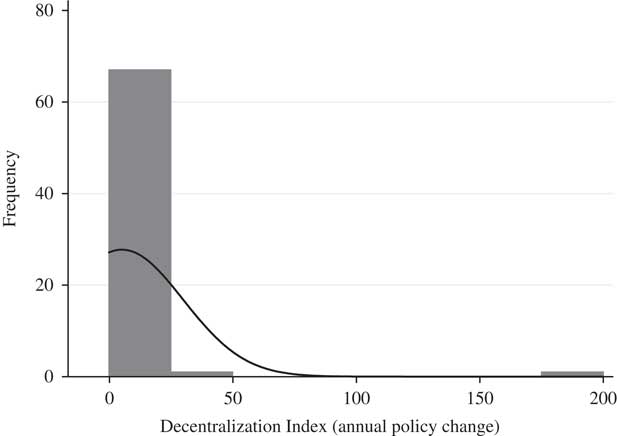
When the DI is plotted as the frequency distribution of its annual variation (Figure 1), a strongly leptokurtic curve results, exhibiting kurtosis equal to 56.74 (n=69) as most values cluster around 0. The long tails reveal that, over 70 years, the DI registered a percentage increase between 12 and 24% only six times, and experienced only two significant outbursts of change, in 1970 (+200%) and 1972 (+43%).
Frequency distribution of annual policy change on decentralization.

The empirical measurement and the leptokurtic distribution obtained to confirm the PE pattern of decentralization in Italy, featuring three moments of profound transformation of the territorial structure of the state (1970–77; 1997–98; 2001), followed by long periods in which the latter remained mostly unaltered.
Bringing the parties into the process of decentralization: an agenda-based model of policy change
Policy change in a ‘PE’ scenario
The uneven pattern of policy change on decentralization examined in the previous section is predominantly the result of the structural and institutional frictions of the Italian political system. The PE theory suggests a theoretical framework that can help clarify such intermittent development (Baumgartner and Jones, Reference Baumgartner and Jones1993, Reference Baumgartner, Green-Pedersen and Jones2009; Jones and Baumgartner, Reference Jones and Baumgartner2005).
The PE theory argues that processes of policy change characterized by long periods of stability ‘punctuated’ by outbursts of change are the result of the ‘bounded rationalities’ of the decision-makers. Political actors are called upon to deal with a potentially endless number of issues, but can only pay attention to a limited number of issues at a time. As a result, they have to ignore most, and include only a few in the policy agenda. When a policy issue seizes the attention of most of the political actors in the party system, it rises in the policy agenda, making policy change on that issue more likely to occur (Green-Pedersen and Walgrave, Reference Green-Pedersen and Walgrave2014).
Given the potentially significant impact this ‘politics of attention’ can have on the process of policy-making, agenda-setting literature has sought to explain the precise mechanisms and processes that cause shifts in attention to policy issues (Jones and Baumgartner, Reference Jones and Baumgartner2005). Since these theories developed predominantly in the United States, most studies focus on actors and dynamics that reflect the peculiarities of that political system, in which the role of parties is less significant than in the European parliamentary systems. Recent comparative approaches, however, have sought to adapt the insights of agenda-setting literature to the European parliamentary systems such as the Italian one (Baumgartner et al., Reference Baumgartner and Jones2006; Green-Pedersen, Reference Green-Pedersen2007), pointing out the roles of political parties and party competition in the processes of agenda-setting.
The most interesting contributions in this area are those studies that have tested the mandate theory using a policy agenda approach. The mandate theory, originally formulated in reference to the US case, argues that party positions on policy issues are likely to influence the policy agenda to the extent that ‘the electoral program of the winning party gets translated into government policy’ (Budge and Hofferbert, Reference Budge and Hofferbert1990: 112). Agenda-based approaches to mandate theory, which have focused on majoritarian parliamentary systems such as that of the United Kingdom (Froio et al., Reference Froio, Bevan and Jennings2016) and multiparty parliamentary systems with coalition governments such as that of Italy (Borghetto et al., Reference Borghetto, Carammia and Zucchini2014; Carammia et al., Reference Carammia, Bevan and Borghetto2018) and Spain (Chaqués Bonafont et al., Reference Chaqués-Bonafont, Baumgartner and Palau2015), have challenged this argument by showing that external pressures, including the impact of mass media and public opinion, and institutional frictions are likely to weaken the link between party electoral pledges and actual policy-making. Both the original mandate theory and the policy-agenda approaches, however, focus on the main research question, namely whether parties fulfill their electoral promises once in government (Chaqués Bonafont et al., Reference Chaqués-Bonafont, Baumgartner and Palau2015). They compare different issues at the same time, assessing the likelihood that any given issue among several that come up during an electoral campaign will eventually become the subject of legislation.
As the following sections illustrate, however, there are cases in which a policy issue, like decentralization, is always present in the majority of party manifestos, those of the governing parties and those of the opposition parties; the relevant question here is how much attention parties pay to an issue, and how this might affect policy change. The argument presented here is that variation of the salience of the issue of decentralization in the party system agenda (PSA) is likely to have an impact on the future legislative agenda, thus increasing the likelihood that policy change in the field actually occurs. In order to better understand the argument, it is useful to introduce a distinction between the individual party agendas and the PSA (Green-Pedersen, Reference Green-Pedersen2007; Green-Pedersen and Krogstrup, Reference Green-Pedersen and Krogstrup2008; Green-Pedersen and Mortensen, Reference Green-Pedersen and Mortensen2010). Individual parties have their own agendas, in which they decide whether to pay attention to certain issues and how to position themselves on them. At the same time, parties are part of a broader party system with an agenda of its own, namely the PSA, which can be defined as the hierarchy of issues that, at a given point in time, is established among the parties within a political system.
Parallel to agenda-setting literature, also scholars of decentralization have examined the role of party preferences on the dynamics of territorial reforms (Rokkan and Urwin, Reference Rokkan and Urwin1983; Rhodes and Wright, Reference Rhodes and Wright1987), by showing how partisan logics often contribute to shape processes of decentralization, also in the Italian case (Bull and Pasquino, Reference Bull and Pasquino2007; Mazzoleni, Reference Mazzoleni2009; Massetti and Toubeau, Reference Massetti and Toubeau2013).
The theoretical model outlined here can be used to formulate a first hypothesis arguing that when most political actors in the party system train their attention on a policy dimension like decentralization, this issue rises in the PSA; the main result of this heightened attention among the main political actors is that the chances of the issue being included in the legislative agenda in the subsequent legislature increase, making actual policy change more likely. Hence Hypothesis 1 might be formulated as follows: ‘The more attention paid to the issue of decentralization in the PSA during the electoral campaign, the more likely it is that a major decentralist reform will be undertaken in the subsequent legislature’ (Hypothesis 1).
Who seizes attention?
If this relationship between variations in party system attention and policy change exists, it is then necessary to understand what causes shifts in the attention of the party system. Assuming there is not some unknown force shifting parties’ attention to an issue, the causes for these shifts should be identifiable in societal pressures and the dynamics of party competition, or what agenda-setting scholars define as ‘information processing’ (Jones and Baumgartner, Reference Jones and Baumgartner2012).
Regarding societal pressures, the literature on territorial politics has argued that governments are prompted to decentralize their political systems by a number of triggering pressures, for example, a desire to enhance the efficiency and accountability of the political system (Schakel, Reference Schakel2009). It would be beyond the scope of this paper to investigate the origins and nature of these pressures. It can nevertheless be assumed that, since parties theoretically represent social demands, their shifts in attention can be interpreted as responses to demands and attempts to address emerging needs.
This explanation, however, implies that all parties respond to the same pressures in the same way. On the contrary, parties differ dramatically in their ideologies, internal organizations, geographical strongholds, and government responsibilities. Accordingly, it can further be argued that there are some parties that are more likely than others to integrate these triggering pressures towards decentralization and introduce them to the political discourse. These parties serve as ‘issue entrepreneurs.’ According to Hobolt and De Vries (Reference Hobolt and De Vries2015), ‘issue entrepreneurs’ are those actors that draw attention to issues that have previously been ignored in party competition by adopting a position that is substantially different from that of their adversaries.
The concept of issue entrepreneurship demonstrates the importance of the dynamics of party competition in influencing the PSA. The process of deciding which issues to prioritize in the PSA is one of the many battlefields in which parties compete with each other. Parties draw attention to issues with the explicit goal of affecting the PSA and emphasizing those policy dimensions that are more favorable to them (Steenbergen and Scott, Reference Steenbergen and Scott2004: 167). Each party tries to place the issues that it emphasizes the most in its own agenda, for either ideological or electoral reasons, at the top of the PSA (Green-Pedersen and Mortensen, Reference Green-Pedersen and Mortensen2010).
The success of a party’s attempts will largely depend on a combination of variables, including external events, the party’s electoral strength, and the way in which the party frames the issue. Whatever the deciding factor is, securing a place for an issue at the top of the PSA can have important consequences for a party, ranging from the achievement of policy goals (e.g. the adoption of a reform), electoral gains (if the reform goes in the expected direction for an entrepreneur party that can take credit for it), or losses (for the party’s adversaries). When a party successfully pushes an issue onto the agenda, competing parties must make decisions concerning it; even if an issue is outside their political interests, they have to position themselves to minimize the potential loss of votes to the entrepreneur actor (Meguid, Reference Meguid2005). Parties can choose to ignore the issue (a dismissive strategy), recognize the issue and emphasize it themselves by accommodating the same policy solutions proposed by the entrepreneur party (an accommodative strategy), or oppose the issue (an adversarial strategy). The decision to adopt either of the two ‘uptake’ strategies (accommodative or adversarial) hinges upon parties’ strategic considerations concerning the likely consequences, especially potential electoral losses or gains. Whatever a party’s strategic considerations may be, when most parties within a system opt for one of the two non-dismissive strategies, the political debate is focused more on the issue, raising its position in the PSA.
Of course, the process described above is purely theoretical. In reality, a certain policy issue could be promoted by more than one party at a time, and many contextual factors, including crises, media coverage, and public opinion, are likely to affect the political debate and the PSA along with the parties’ strategies.
This model, however, leads to the formulation of a second hypothesis: ‘The median attention paid to the issue of decentralization in the PSA is increased by the issue entrepreneurship activity undertaken by one or more parties in the party system’ (Hypothesis 2).
Hypothesis 2 leads to a further question concerning the features and interests of these entrepreneurs. Who is it pushing these issues, and what are their likely motivations to play this entrepreneurial role?
Agenda-setting scholars have examined the dynamics of party competition on issue, for instance by pointing out the greater influence that opposition parties exert on the PSA than government parties, which are ‘compelled to respond to issues brought up on the party agenda’ (Green-Pedersen and Mortensen, Reference Green-Pedersen and Mortensen2010: 273). This argument can be further refined by drawing also on literature on party politics.
According to Hobolt and De Vries (Reference Hobolt and De Vries2015), ‘issue entrepreneur’ parties are predominantly the ‘political losers’ in multiparty systems, parties that have not previously been in government, have experienced electoral defeat, or are far removed from the median party position on the dominant dimension of political conflict (i.e. the left–right one). These parties act as issue entrepreneurs because they have less to lose than a dominant, winning party might. Indeed, mobilizing attention for a new issue, or revitalizing a neglected one, might alienate votes and prove too risky for a party that is already enjoying electoral and governing power; a ‘winning’ party might be safer keeping discussions within the framework that brought it victory rather than promoting new issues. A ‘loser’ party, on the other hand, has little to lose, and might dare to push for change in the political discourse in the hopes of seizing the attention of voters and increasing its electoral gains in the next election. At the same time, being in the opposition and occupying a non-mainstream position on the dominant left–right dimension can allow a party to ‘potentially drive [a] wedge between existing’ parties in government (Hobolt and De Vries, Reference Hobolt and De Vries2015: 165).
Further scholarship on issue entrepreneurship emphasizes the role niche parties play as ‘issue entrepreneurs,’ relying on Meguid’s position, salience, and ownership (PSO) theory (2005, 2008). This theory describes party competition as a mainstream-niche contraposition. It assumes that new, electorally competitive niche parties will refuse to compete on extant policy dimensions, and will instead attempt to focus the political agenda on their own core policy issues (Meguid, Reference Meguid2008: 3–4). Their success in doing so depends on the strategic choices of the mainstream parties. To avoid losing votes to niche actors, these mainstream parties must choose to either include the new issue in their own agendas by staking out accommodative or adversarial positions, or dismiss the issue entirely.
The underlying idea of the PSO theory is that the ‘giants’ of the political system are compelled to adjust their strategies when challenged by political ‘dwarves’ on the terrain of a new policy dimension (Basile, Reference Basile2015: 888). Within this framework, electorally relevant autonomist parties that emerge from the center-periphery cleavage (Lipset and Rokkan, Reference Lipset and Rokkan1967) can be thought of as niche actors that ‘own’ the issue of decentralization, as their core purpose is to achieve further autonomy for the subnational levels. These parties seek to force such demands onto the political agenda. In Italy, although there is a long tradition of autonomist movements in the party system, it was only with the rise of the Lega Nord (LN) that a representative of this party family played a significant political role and prioritized the issue of decentralist reform, competing for governing positions and posing a serious electoral threat to the state-wide parties.
Based on these two theoretical approaches, two hypotheses on issue entrepreneurship might be reformulated: ‘The issue entrepreneurship activity is undertaken by one or more loser parties in the party system’ (Hypothesis 3a), following Hobolt and De Vries’ (Reference Hobolt and De Vries2015) model. Using Meguid’s interpretation, the same hypothesis could be reformulated as: ‘The issue entrepreneurship activity is undertaken by one or more niche (autonomist) parties in the party system’ (Hypothesis 3b).
Variables, data, and method
To test these hypotheses, this article uses data from the Territorial Issues Dataset (TERRISS_Dataset) based on an original coding scheme for the content analysis of party manifestos (Budge et al., Reference Budge, Robertson and Hearl1987: 18). The TERRISS_Dataset coded 120 party manifestosFootnote 13 from 1948 to 2013. The data set contains information on the emphasis posed by each party on decentralization, measured as the share of quasi-sentences related to the issue of decentralization from the entire manifesto (i.e. the salience); and the degree to which the stance taken is adversarial or accommodative, measured as the difference between positive and negative statements on decentralization divided by the overall number of quasi-sentences on decentralization (i.e. the position) (Basile, Reference Basile2016).
To test the first hypothesis, the independent variable, that is the attention devoted to decentralization in the PSA, is calculated as the medianFootnote 14 of the salience of this issue in all party manifestos for each electoral competition. High values of the median salience in the PSA indicate that in that electoral competition most parties paid a significant amount of attention to decentralist issues, fostering political debate on it at the party system level. The dependent variable, policy change, is measured by considering both the bills concerning territorial reforms passed in each legislature (legislative change) and the actual amount of variation in the degree of decentralization in the country, as measured by the DI (substantial change).
When testing the second hypothesis, the median salience at the PSA level constitutes the main dependent variable; the main independent variable is a party’s issue entrepreneurship role on decentralization, measured, as in Hobolt and De Vries (Reference Hobolt and De Vries2015), as a party’s salience score on decentralization multiplied by the distance between the party’s position on decentralization and the average position of all parties in the PSA on the issue.Footnote 15 The result is a variable ranging from −5.7 [‘least entrepreneur’ party among the coded manifestos, namely the Movimento Sociale Italiano (MSI) in 1968] to 6.4 (‘most entrepreneur’ party, namely the LN in 2008).
In Hypotheses 3a and 3b, issue entrepreneurship becomes the dependent variable. The main independent variables seek to measure whether parties might be classified as either niche actors or losers; to this purpose, the empirical analyses will take into account other variables, such as: party family – measured with a dummy variable based on a qualitative assessment of a party’s closeness to a party family: Electoral defeat – measured as the difference between the vote share in elections at time t y and the vote share in the previous election (time t y−1), so that a negative value on this variable means that a party experienced a vote loss as compared with previous election; a party’s governing roleFootnote 16 in previous legislature; a party’s distance from the median party position on the dominant left–right dimension.Footnote 17
Testing the hypotheses
Does the PSA influence policy change?
The first hypothesis relies on the assumption that the process of decentralization in Italy followed a PE pattern, and posits that decentralist reforms occurred in those legislatures preceded by electoral campaigns in which this policy issue was particularly salient in the PSA.
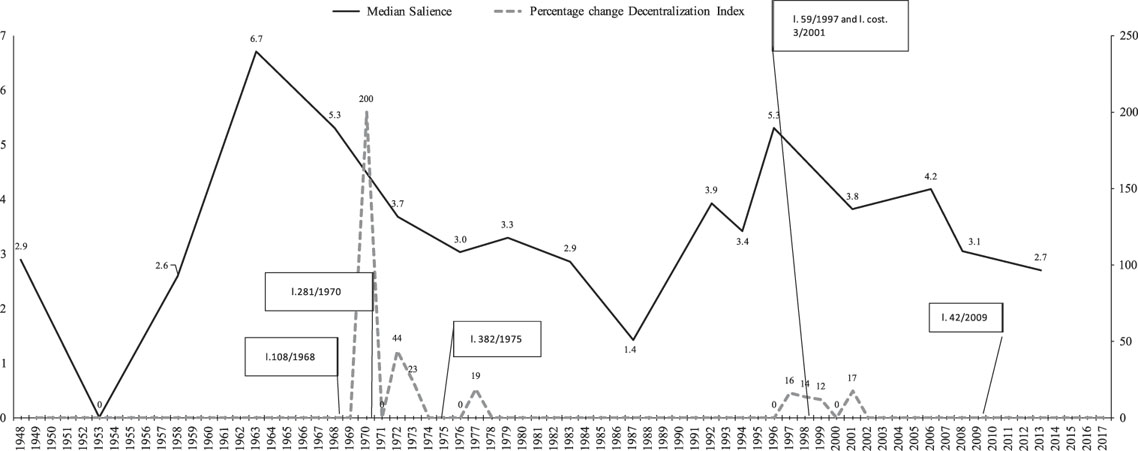
Figure 2 shows the evolution of the medianFootnote 18 amount of attention paid to decentralization, alongside the major reforms approved (legislative change) and the actual variation in the degree of decentralization of the country (substantial change), measured as the yearly percentage change of the DI.
Salience of decentralization in party manifestos and percentage change on decentralization (1948–2013). Note: Left axis – median salience of decentralization for each election in party manifestos (%). Right axis – year-to-year percentage change on the Decentralization Index (%).
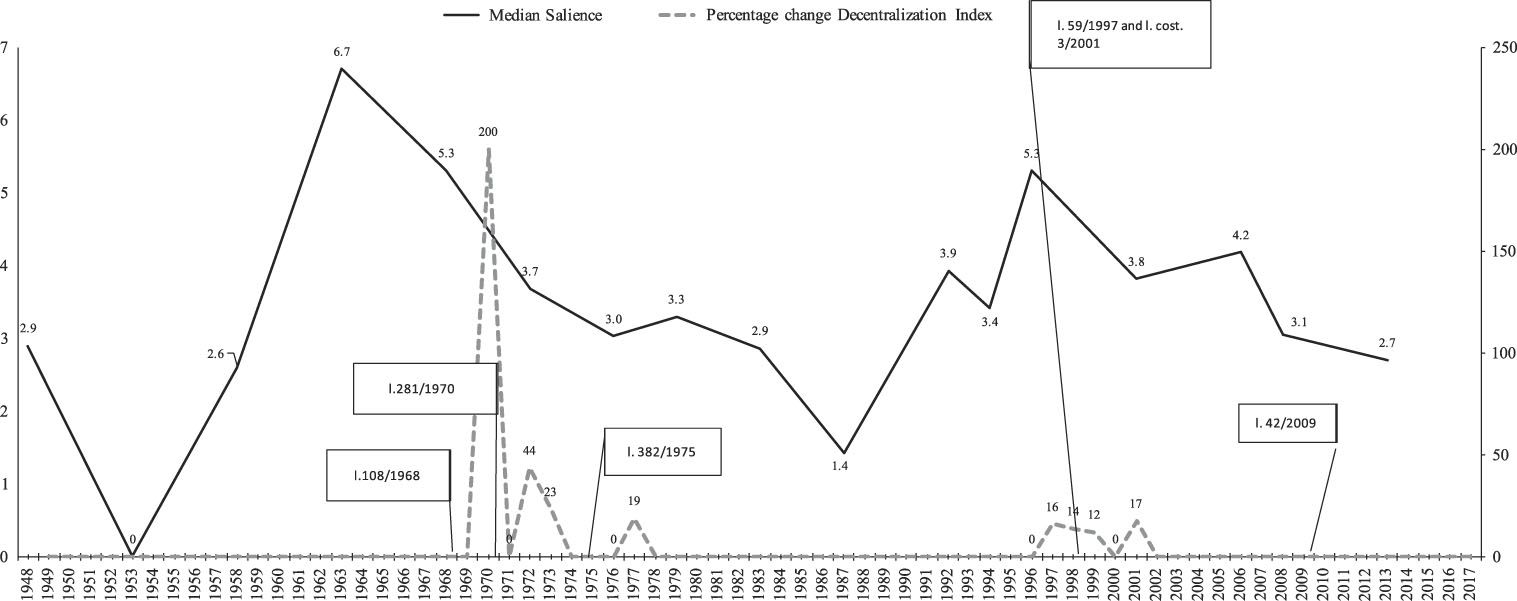
TERRISS data show that decentralization has been present in Italian political discourse since the first election of 1948. Only 18 out of 120 coded documents contain no statement related to territorial issues at all, and in about 70% of the manifestos the issue has a salience score above 2%.Footnote 19 Nevertheless, the level of overall interest in the PSA has not been even over time.
In the 1948 elections all parties except the Partito Liberale Italiano (PLI) and the MSI included statements on decentralization in their manifestos, resulting in an overall median salience of 2.9%. At the time, the main issue was how to implement the Constitutional provisions on decentralization in the absence of a clear blueprint; this resulted in limited legislative activity on decentralization, and only meager autonomy for the local authorities by L. 62/1953. The median attention paid to decentralization in the PSA dropped to 0% in 1953. Amidst general silence from the main political forces, the project of reforming the territorial structure of the country sunk into oblivion, and was not addressed at all in Legislature II (1953–58).
At the end of the 1950s, however, the time was ripe for renewed interest in the regions and the process of decentralizing the country, with median attention rising up to 2.6% in 1958. Nonetheless, the Democrazia Cristiana (DC), which considerably increased its share of the votes in the election, paid limited attention to the financial autonomy of the local authorities; and with the main governing party showing little interest, no significant action was taken on territorial reform between 1958 and 1963.
The scenario changed dramatically in the elections of 1963, when a somewhat high amount of attention was paid to decentralization (median salience of 6.7%). No party among those that entered the parliament in that period ignored the issue of decentralization. The impressive rise of the issue of decentralization in the PSA was not for nothing, either, as it presaged the adoption of L. 108/1968 on the implementation of the regions at the end of Legislature IV (1963–68) and led to a real increase in the degree of decentralization within the country, the effects of which were clearly visible after 1970 (+200% increase in the DI). This law represented an important, albeit not complete, step towards decentralization, and decentralist parties kept their attention focused on the issue to ensure adequate follow-up to this preliminary reform. As a result, in the electoral campaign of 1968 the overall salience of the issue remained somewhat high (with a median salience of 5.3%). The relevance of decentralization in the PSA actually resulted in a season of intense reforms, which reached its peak with L. 281/1970 and the adoption of the related implementing decrees in 1972. They produced an actual policy change in terms of the number of competencies and resources bestowed to the subnational levels, as is clear from the +44 and +23 percentage increases of the DI in 1972 and 1973, respectively.
The 1970s saw a decrease in the average attention paid to decentralization, although it remained a relevant issue at the system level. In 1972 the median salience was 3.7%, declining in 1976 (3%) but rising slightly in 1979 (3.3%). The amount of attention the parties devoted to decentralization was still consistent, and led to the major reform adopted with L. 382/1975 (which was actually implemented with the decrees of 1977, thus explaining the +19% percentage increase of the DI in 1977). Attention paid to decentralization dropped in the 1980s, reaching a nadir in 1987 (1.4%). In line with this drop in attention, the process of decentralization experienced a setback.
The scenario changed dramatically in the 1990s. In 1992 the median salience rose again in the PSA, reaching 3.9%; attention remained almost constant in 1994 (3.4%), and rose up to 5.3% in 1996. In the aftermath of this increase of decentralization’s position in the PSA, Legislature XIII (1996–2001) featured the most intense period of decentralist reform since 1968, the cornerstones of which were L. 59/1997 and L. Cost 3/2001. The actual effects in terms of substantial policy change were immediately visible, as the percentage variations in the DI between 1997 and 2001 reveal (from the +16% of 1997 to the +17% of 2001).
In the elections held in May 2001 the amount of attention paid to territorial issues dropped to 3.8%, although decentralization remained a somewhat salient issue in the PSA. Indeed, although during the fourteenth legislature (2001–06) the process of territorial restructuring had exhausted the thrust for reform, the ruling center-right coalition in government tried to ‘put its flag’ on the ‘federalist issue’ by promoting another constitutional reform. However, this reform came in the midst of ideological tensions between the two coalition partners, the autonomist LN and the traditionally centralist Alleanza Nazionale (AN). The result of the pressures exerted by these opposing interests was a controversial constitutional reform paired with declining interest in center-periphery issues in the party system; the reform was rejected in the constitutional referendum of 25–26th June 2006, and no substantial policy change was registered in those years.
The center-right and center-left coalitions nevertheless focused on decentralization in the 2006 elections, and the issue’s median salience increased moderately to 4.2%. With the early termination of Legislature XV (2006–2008), however, no reforms were adopted.
In the 2008 elections decentralization remained relevant, with an overall median salience of 3.1%, though there were signs that interest was declining. In Legislature XVI (2008–13), the winning center-right majority, spurred on by its autonomist ally the LN, eventually implemented the fiscal federalism reform, which became L. 42/2009.
The last election in the period under consideration, the election of 2013, registered a slight decline in interest (2.7%); decentralization was still a relevant topic, but was mostly framed as part of a broader project of reforming the system that could no longer be delayed, especially in light of the global financial crisis that began in 2008. In line with this attitude, the governing coalition attempted to pass a constitutional reform that included – among other things – a deep reform of Title V of the Constitution on decentralization. However, the reform was rejected once again by popular referendum on 4 December 2016.
In line with the expectations of Hypothesis 1, data show that when decentralist issues are high in the PSA, they are usually followed by ‘spikes’ in the amount of policy change concerning the process of decentralization. This connection between party system attention and policy change is particularly evident during the two key seasons of reforms, 1968–75 and 1997–2001, and to a lesser extent the third season from 2008 to 2013. On the other hand, the decentralization stalemate of the 1980s coincided with a dramatic drop in the attention devoted to decentralist issues in the PSA in those years.
It is interesting to note that since 1972 the salience of decentralization in parties’ discourses has declined, while the DI has registered peaks of substantial policy change. This can be explained by the fact that, once reforms were part of the policy agenda, parties lost interest in increasing the attention they paid to this policy dimension; although these issues remained relevant in the party discourse, legislative change was no longer a compelling issue for the political debate. However, the legislative reforms had triggered a process of substantial change, and it took some time before regionalist legislation became fully operative and entrenched in the state machinery. Accordingly, one could conclude that, while legislative change is dependent on a political discourse that devotes significant attention to decentralization, the peaks in substantial change are usually delayed, and tend to overlap with declining phases of interest.
Party competition and the PSA: who takes the lead?
The previous section confirms that shifts in attention to decentralist issues in the PSA are likely to affect actual policy change. Accordingly, it is crucial to understand which actors and dynamics are likely to cause such shifts in attention. Hypothesis 2 suggests that shifts in the attention devoted to decentralization in the PSA occur when the issue is utilized by a specific group of issue entrepreneurs, which can be identified as loser (Hypothesis 3a) or niche parties (Hypothesis 3b).
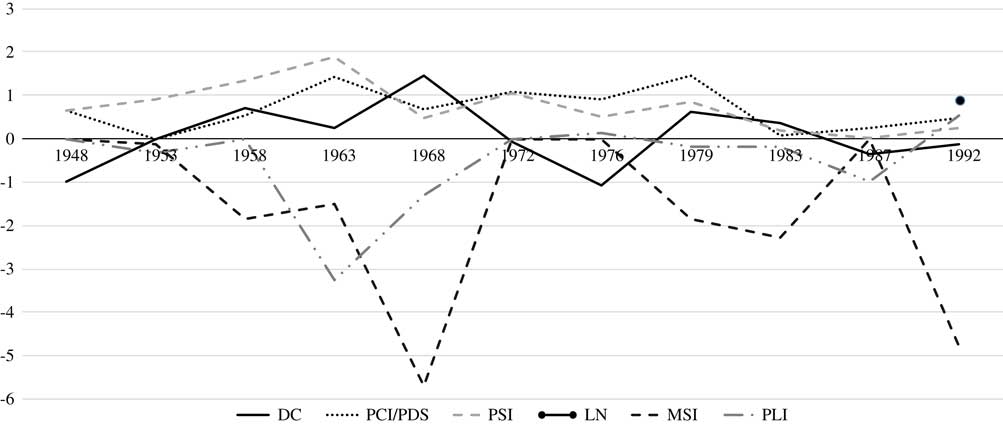
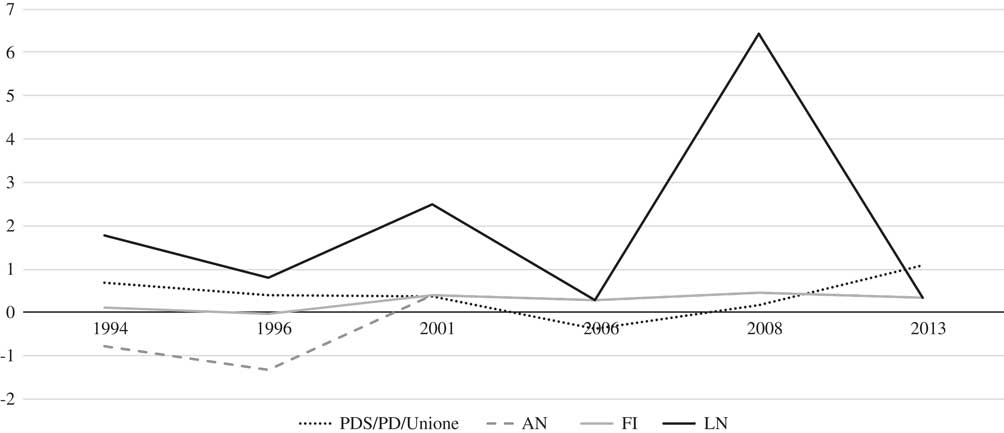
Figures 3 and 4 show the scores of parties’ issue entrepreneurship in the two periods in which Italy’s republican history is conventionally divided, respectively, First (1948–92) and Second Republic (1994–2013). As mentioned earlier, this score is calculated by subtracting the average position on decentralization in the PSA from a party’s position on this issue, for each electoral year; this difference is then multiplied by a party’s salience on decentralization, which gives a sense of the importance of this issue for that party. A party that holds a strong-decentralist position well above the average will have a high, positive score, whereas a party holding a mild-decentralist position below the average, or a position that is outright centralist, will have a negative score.
Issue entrepreneurship on decentralization in the First Republic (1948–92). Note: in order to improve the readability of the figure, data concerning minor parties, such as the Partito Socialista Democratico Italiano (PSDI) and PRI, have been omitted. DC=Democrazia Cristiana; PCI=Partito Comunista Italiano; PSI=Partito Socialista Italiano; LN=Lega Nord; MSI=Movimento Sociale Italiano; PLI=Partito Liberale Italiano; PRI = Partito Repubblicano Italiano; PDS = Partito Democratico della Sinistra.

Issue entrepreneurship on decentralization in the Second Republic (1994–2013). AN=Alleanza Nazionale; FI=Forza Italia; LN=Lega Nord; PDS = Partito Democratico della Sinistra; PD = Partito Democratico.

Between 1948 and 1992 (Figure 3), the preeminent issue entrepreneur parties were the Partito Comunista Italiano (PCI) and the Partito Socialista Italiano (PSI). With the exception of the election of 1968, they regularly superseded the main governing party, the DC, in mobilizing the political discourse on decentralization. Indeed, in the 1968 elections, the PCI issued a short manifesto containing only limited references to decentralization (1.8% of salience), coinciding with a period in which Italy was in the middle of political crisis: student protests were introducing new issues to the policy agenda, from the reform of the education system to opposition to the US intervention in Vietnam. The PCI utilized a ‘strategy of attention’ in addressing this unrest, which explains an electoral manifesto focusing on the issues that were most important to the movements (Höbel, Reference Höbel2004), which reduced the space for other topics. Likewise, the PSI paid less attention to the issue in 1968 (5.2% of salience), when it issued a joint manifesto with the Partito Socialista Democratico Italiano (PSDI). Indeed, in 1968 the reforming process had begun and the issue of reform was already a part of the agenda, further explaining why the governing party would pay more attention to the issue in 1968 than its opponents might. PCI and PSI regained the entrepreneurship role throughout the 1970s, 1980s, and early 1990s, with the exception of 1983 elections, although it corresponded with diminishing interest at the system level.
When the LN appeared on the political scene in 1992, however, the autonomist actor seized the leading entrepreneurship role. Throughout the Second Republic (Figure 4) the party occupied the driver’s seat on the issue of decentralization.
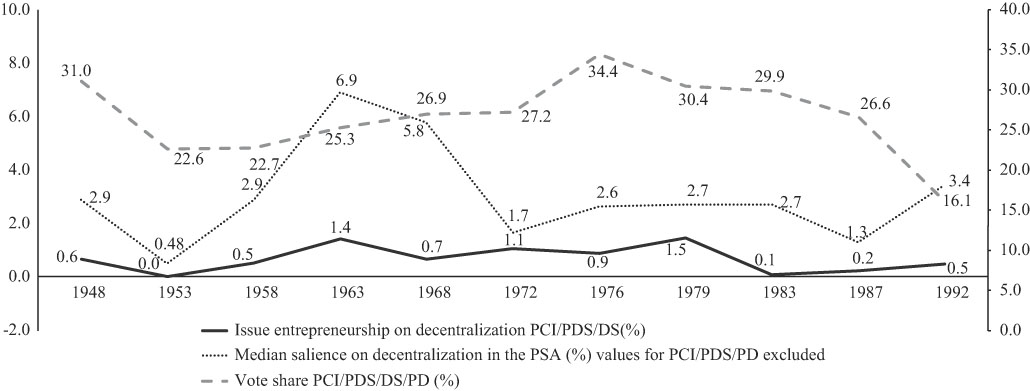
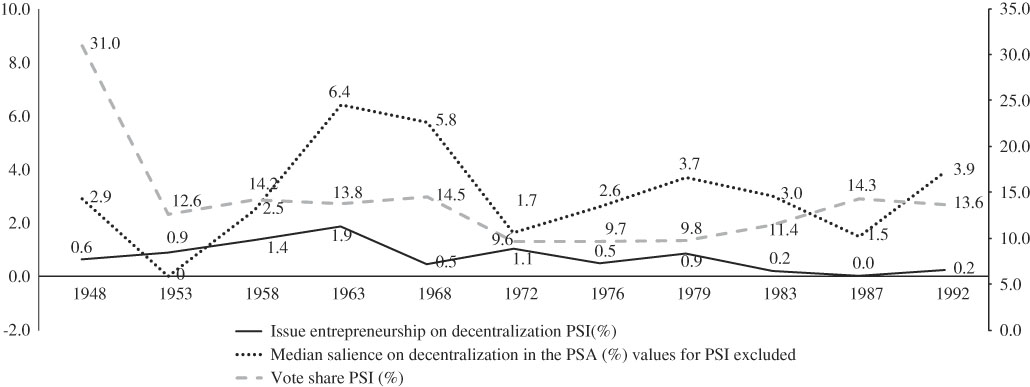
In order to test Hypothesis 2, Figures 5 (for the PCI/DS) and 6 (for the PSI) show how the parties’ activity of issue entrepreneurship tracked the evolution of the median attention on decentralization in the PSA. The raising attention in PCI’s manifestos in 1958–63, for instance, coincided with the parallel peak of salience of the issue in the PSA. Similarly, when the PSI paid more emphasis on decentralist issues in 1963 or 1979, the median attention in the PSA increased as well.
Issue entrepreneurship on decentralization – Partito Comunista Italiano (PCI)/PDS (1948–92). Note: Left axis – median salience on decentralization in the PSA of PCI/PDS’s party manifestos (%). Right axis – vote share of the PCI/PDS (%). In 1948 the vote share refers to the Partito Socialista Italiano together with the PCI. PSA=party system agenda; DS = Democratici di Sinistra; PDS = Partito Democratico della Sinistra; PD = Partito Democratico.

Issue entrepreneurship on decentralization – Partito Socialista Italiano (PSI) (1948–92). Note: Left axis – median salience on decentralization in the party system agenda (PSA) of PSI’s party manifestos (%). Right axis – vote share of the PSI (%). In 1948 the vote share refers to the PSI together with the Partito Comunista Italiano (PCI); in 1968 the vote share refers to the PSI together with the Partito Socialista Democratico (PSDI).

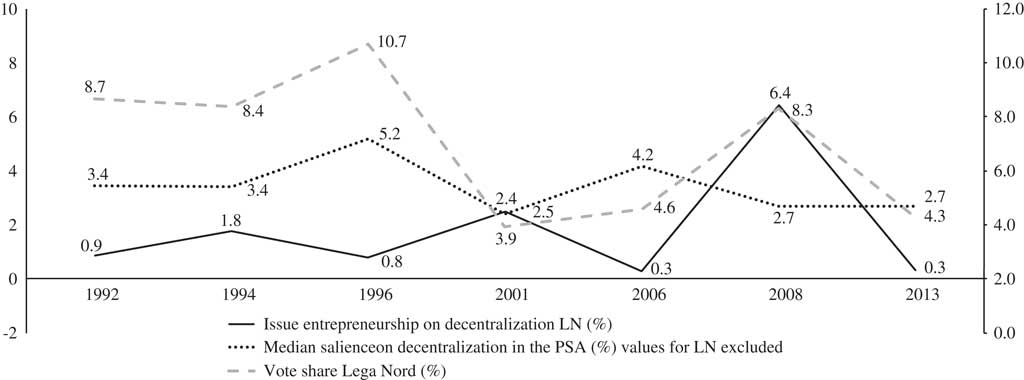
Moving to the Second Republic, Figure 7 shows the evolution of the decentralist discourse LN’s manifestos and the parallel development in the PSA.
Issue entrepreneurship on decentralization – Lega Nord (LN) (1992–2013). Note: Left axis – median salience on decentralization in the party system agenda (PSA) of LN’s party manifestos (%). Right axis – vote share of the LN (%). In 2001 the LN issued a joint document with the Polo delle Libertà (PdL); in 2006 it issued a joint document with the Casa delle Libertà; in 2013 the LN joined the electoral program of the Popolo delle Libertà.

The LN obtained its first, unprecedented electoral success in 1992, when it took 8.65% of the vote in the Chamber of Deputies, while strongly promoting decentralization in its manifesto; at the same time, the issue’s median saliency score in the PSA considerably increased from the previous election. In 1994, the LN mitigated its secessionist rhetoric, in part because of its electoral alliance with Forza Italia and AN. This coincided with a loss of votes, although the party retained an entrepreneurship role in the party system; the effects of its activity were still visible in the PSA, which continued to show constant levels of attention on decentralist issues. In 1996 the LN, which did not join the rightist coalition, radicalized its political discourse on subnational autonomy once again (salience on decentralization in LN manifesto was 13.9%), an electoral strategy that was rewarded with its best electoral result ever; at the same time, decentralization earned increased attention in the PSA on the eve of a new season of reforms. However, LN’s entrepreneurship role was reduced that year. It shared it’s decentralist position with the center-left coalition, and this also happened to be a period of strong decentralist support among most of the parties at the system level. In 2001 the LN presented a joint program with the Polo delle Libertà, which devoted a particularly intense amount of attention to federalism and local identities; in that election, however, it halved its votes. This weakening of the electoral and ideological strength of the autonomist actor coincided with a decline in interest in center-periphery issues in the PSA. After the hiatus of 2006, when the LN did not issue any manifesto of its own, the party circulated a programmatic document featuring strongly radicalized decentralist discourse in 2008, which was richly rewarded by the electorate. In this case, however, LN’s renewed decentralist rhetoric did not produce a commensurate increase in interest at the system level. Finally, in 2013, joining the electoral program of the Popolo delle Libertà, the LN dramatically reduced its emphasis on decentralist issues, and its share of the vote dropped to 4.3%.
These data, with some exceptions, partially confirm the expectations of Hypothesis 2 in both Republics, demonstrating that the median attention paid to the issue of decentralization in the PSA, at least in some cases, and especially at the onset of a shift in attention after a period of scarce interest, increases when a party undertakes issue entrepreneurship activity in the party system. It remains to be seen whether those parties often identified as the entrepreneurs of decentralization, namely the communists, the socialists, and the autonomist parties, can be classified as either niche or loser parties.
Losers, niche, or something else?
The niche nature of the LN seems rather straightforward. According to Meguid (Reference Meguid2005, 347), niche parties differ from new and mainstream parties in that they prioritize a set of issues that have previously been ignored or neglected (Meyer and Miller, Reference Meyer and Miller2015: 3) by party competition. In doing so, niche parties reject the traditional left–right dimension of political conflict, they cross-cut traditional party alignments, and they usually limit their political appeals to a restricted set of issues (Meguid, Reference Meguid2005). Indeed, the LN’s raison être consisted of demands for greater autonomy for the subnational levels, especially at its onset. The party’s focus on the very issues that traditionally formed the centerpiece of its ideology nevertheless shifted away from federalism under the leadership of Matteo Salvini in the 2010s, when the party developed a markedly populist discourse with an emphasis on anti-EU and anti-immigration stances (McDonnell and Vampa, Reference McDonnell and Vampa2016: 121). This has reduced its ability to emphasize decentralization in the party system, as previously observed. As for its potential to attract voters from both sides of the left/right continuum, spatial analyses of party support in Italy (Shin and Agnew, Reference Shin and Agnew2008) reveals that the LN, especially in the north-eastern regions, basically replaced the Christian Democrats after their collapse in 1993; in northern Italy it was also able to attract leftist voters thanks to its ability to meet increasing demands for more efficient and legitimate political institutions. In many respects, the LN can therefore be considered the first electorally relevant niche autonomist party in the Italian party system, whose electoral appearance likely played a role in boosting the salience of decentralization in the Italian political debate, as Hypothesis 3b leads us to expect.
However, data showed that issues related to the territorial redistribution of competencies have been long present in the Italian PSA, well before the electoral breakthrough of the niche actor. Before 1992 the entrepreneurship role was often played by the communist and socialist parties. They do not possess any of the features of a niche party, as they held clearly defined ideological profiles based on the traditional left–right continuum and they were by no means single-issue parties.
The question that remains is whether they can be considered ‘losers’ according to the definition provided by Hobolt and De Vries (Reference Hobolt and De Vries2015), namely parties that have experienced an electoral defeat, were in the opposition following previous elections, and are far removed from the average position on the left–right dimension. However, it is difficult to find ways the PCI and PSI display the defining features of ‘loser’ parties.
The PCI was permanently excluded from government, except for the ‘historical compromise’ of 1976; the PSI, however, held important positions in government, especially after the late 1960s. The entrepreneurial actors do not seem to display the requisite electoral weakness either. The PCI, for instance, increased its entrepreneurship activity concerning decentralization after the late 1950s, during a period in which it was gaining electoral success; similarly, the PSI had not experienced an electoral setback in the late 1950s when it started to prioritize the issue of decentralization. As for the distance from the average position on the left–right dimension, the PCI was certainly closer to the extreme left, whereas the PSI was more moderate. At a glance, then, it seems that the expectations of Hypothesis 3a are not entirely confirmed.
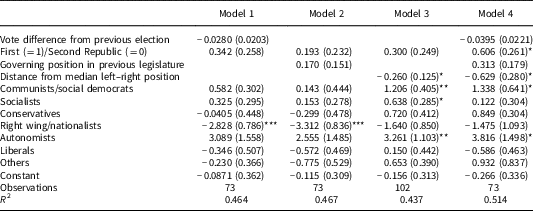
In order to provide a further test of Hypothesis 3a beyond observation based in literature, four regression models have been run with the score on issue entrepreneurship as the dependent variableFootnote 20 (Table 1). They suggest contradictory results, however.
Determinants of parties’ issue entrepreneurship

Standard errors in parentheses.
OLS robust regression analysis.
The lower number of parties when the vote difference variable is introduced is due to the presence of new parties or parties that in the previous legislature merged with other parties.
*P<0.05, **P<0.01, ***P<0.001.
The coefficient for the variable that measures the difference from the vote obtained in the previous election is negative, meaning that when parties have lost votes in previous elections (i.e. were loser) the likelihood of issue entrepreneurship in the following electoral campaign (when they gained votes) reduces; however, the coefficients are significant in neither model 1 nor model 2, due to cases in which parties promoted the decentralist issue even after periods of electoral loss.
The models show a positive coefficient for the variable measuring exclusion from office in the previous legislature, in line with the expectation that this condition would favor entrepreneurship, but it is never significant; once again, this might be explained by the fact that, during the First Republic, some opposition parties, like the MSI, adopted fierce, adversarial positions, while governing parties, including the PSI, often adopted the entrepreneur role. On the contrary, in the Second Republic the LN campaigned more to promote decentralization after being in opposition, alongside with governing parties on the center-left.
The coefficient for the variable accounting for the distance from the average left–right position is significant and negative, meaning that those actors that are more distant from the center in the left–right continuum are less likely to play an entrepreneurship role; this might be explained with the fact that, in the First Republic, the most rightist parties (MSI and PLI) were strongly centralist, thus assuming negative scores on the issue entrepreneurship variable; on the other hand, parties close to the center, such as the PSDI and the DC, often campaigned to support decentralization.
Finally, all the models control for the party family, here calculated as a dummy, and considers the Christian Democrats as a reference category. The coefficients confirm an overall tendency among the communists, social democrats, the socialists, and the autonomists, to play significantly more pronounced entrepreneurship roles than the DC; the coefficient, however, is not significant in the full model for the socialist party family.
To summarize, the regression analyses seem therefore to confirm that issue entrepreneurship is often – although not exclusively – undertaken by parties that are out of office and belong to specific party families, but they are not necessarily electorally weak, or loser actors.
There is, however, another explanation for these numbers, one based on the peculiarities of the issue of decentralization and the Italian context. It points out that issue entrepreneurship on decentralization in Italy was not just a prerogative of ‘loser’ parties but, rather, of a specific party families, due to strategic considerations. Alonso (Reference Alonso2012: 160), in particular, suggests that during the Frist Republic the PCI, which was excluded from government but had a strong electoral support, actually represented a ‘functional equivalent to a peripheral party threat’ prior to the appearance of the LN, to the extent that it had both support that was geographically concentrated in certain regions – namely Tuscany, Emilia-Romagna, and Umbria (the so-called ‘red belt’) – and displayed supportive attitudes towards decentralist reforms. Beyond ideology, this support had a purely political purpose. Given the party’s exclusion from the government (the so-called conventio ad excludendum), the creation of regions would have allowed the PCI to obtain power in at least its regional strongholds. To a lesser extent, the PSI, which was often in government, was also able to gain more votes in the same geographical areas, and it was a firm supporter of decentralist reforms in Italy, having a strategic interest in promoting a greater autonomy for the subnational levels.
Moreover, historical accounts seem to confirm the influence of these leftist parties, and not only on the PSA, but also on the process of policy change. For instance, in the early 1960s, the main governing actor, the DC, along with the other competing parties, could no longer ignore the pressure the rising PCI placed on decentralization. In order to get the necessary number of parliamentarians to support the government, appointed Prime Minister Aldo Moro, then leader of the DC, invited the Socialists to participate in the first center-left government of the Italian Republic, with one of the central points of the coalition agreement being the creation of the ordinary regions, which finally took place at the end of Legislature IV (1963–68) (Mazzoleni, Reference Mazzoleni2009: 137).
In other words, purely strategic, political considerations often lie behind the issue entrepreneurship activity of a party, regardless of any consideration about their loser or winning role in the party system.
Conclusions
The process of decentralization in Italy can best be described as a PE, in which long periods of stability have been alternated by outbursts of change. Data reveal that major decentralist reforms have usually followed electoral campaigns in which most parties focused attention on decentralization.
These shifts in attention are caused by, among other things, the issue entrepreneurship activity undertaken by individual parties that are trying to influence the PSA and obtain electoral, office, or policy advantage. The niche, autonomist LN party has played a prominent issue entrepreneurship role since its electoral breakthrough in 1992. However, before the emergence of the LN, the leftist parties, including the PCI and the PSI, represented a ‘functional equivalent’ to the autonomist party, as they drew attention to the issue of decentralization. Although these parties were mostly in the opposition and distant from the center in the left–right dimension, they cannot be classified as ‘losers’; instead, it seems that strategic, purely political considerations played a greater role than electoral considerations in triggering these parties’ issue entrepreneurship activity.
The findings of this paper contribute to the development of agenda-based research on multiparty, parliamentary systems. Based on an in-depth analysis of the Italian political discourse on decentralization, it paves the way to further comparative research to test these theoretical insights in other parliamentary systems and on different issues.
Supplementary material
To view supplementary material for this article, please visit https://doi.org/10.1017/ipo.2018.14
Acknowledgment
The author would like to thank the editors of this special issue, Enrico Borghetto, Marcello Carammia, and Federico Russo, for their support and assistance during the writing of this article. The author would also like to thank the two anonymous reviewers for their constructive comments. A preliminary version of this article was presented at the 2016 Annual Conference of Italian Political Science, held in Milan. The author would like to thank all the participants for their feedback and comments.
Financial Support
This research received no grants from public, commercial, or non-profit funding agency.