


1. INTRODUCTION
In this work we reconsider the principles driving the conceptualization and measurement of absolute poverty, a phenomenon conceivable as the inability to ‘meet the accepted conventions of minimum needs’ (Sen Reference Sen1979: 291). We will refrain from taking a relativist approach to poverty, which, following the extreme example of Sen (Reference Sen1983: 159), may lead an observer ‘to call someone poor just because he had the means to buy only one Cadillac a day when others in that community could buy two of these cars each day’. In his seminal contribution, Sen (Reference Sen1976) recommends that a poverty index should be adequately informative on the situation of the poor and identifies the incidence, intensity and inequality dimensions of aggregate poverty as the aspects of the phenomenon capturing our concerns for the poor. Those dimensions consist, respectively, in the number (or proportion) of poor people in society, the extent to which their incomes fall below the poverty line and the inequality existing among the poor. Since then the ‘three ‘I's of poverty’ have become the cornerstone for both theoretical and empirical poverty studies.
We argue that the interest in the inequality dimension of aggregate poverty originates not from an egalitarian but from a prioritarian attitude, as conceptualized by Parfit (Reference Parfit, Clayton and Williams1995). By means of simple examples and recourse to the most widely used class of poverty indices, that of Foster et al. (Reference Foster, Greer and Thorbecke1984), we show that the adoption of an additively separable poverty index based on convexly decreasing individual deprivation functions implements a prioritarian weighting scheme as defined by Crisp (Reference Crisp2003) and Vallentyne (Reference Vallentyne and Vallentyne2003) in a non-poverty context. As we shall see, the appropriateness of this interpretation can be seen in the light of (i) the intuition behind the evaluation and comparison of distributions in terms of absolute poverty through indices accounting for the inequality dimension, and (ii) the motivation behind the adoption of budgetary rules giving precedence to poorer poor in the redress of absolute poverty through direct transfers to the poor.
Further, we show that Sen's three ‘I's do not in fact account for all of the criteria upon which widely accepted poverty indices de facto rank distributions in terms of absolute poverty. This inadequacy arises from the inability of the customary three ‘I's to represent the value judgement that the condition of the worst-off individual or group in society may be the exclusive concern. This criterion is known in the literature as leximin or leximingroup (Tungodden Reference Tungodden1998, Reference Tungodden1999), depending on whether it refers to the worst-off individual or group, respectively, and is inherent in some well-known poverty indices. Should we give absolute priority to the worst off? The desirability of this principle in the context of absolute poverty is questioned on the basis of its ordinal nature. We argue that absolute priority to the poorest is not desirable if it abstracts from absolute considerations. A pivotal role of the worst off is found plausible, instead, were the latter to be identified by a threshold which can be given a meaning in terms of harshness of deprivation – in the words of Kundu and Smith (Reference Kundu and Smith1983: 430), a threshold ‘below which human suffering becomes qualitatively different’. The idea that we first should give absolute priority to the ultra-poor and subsequently to the ordinary poor if the ultra-poor are not affected is proffered. Finally, we explore whether this stance is better supported by prioritarianism or by the sufficiency doctrine which has been proposed by Frankfurt (Reference Frankfurt1987) and elaborated upon by Crisp (Reference Crisp2003) and Casal (Reference Casal2007).
The structure of the paper is as follows. In Section 2, we briefly lay out some necessary preliminaries. In Section 3, we consider the relevance and role of the ‘inequality among the poor’ in the context of absolute poverty analysis, and in Section 4 we argue that the motivation for the third ‘I’ is not egalitarianism but rather prioritarianism. In Section 5 we first discuss the identification of the poorest with the category of the ultra-poor which is common in poverty literature; next, we consider to what extent prioritarianism and sufficiency can help make sense of an approach where absolute priority is given to people below an exogenous ultra-threshold. Section 6 concludes.
2. PRELIMINARIES
Let  ,
 + and ++ be the sets of positive integers, non-negative and positive real numbers respectively. For n ∈ , ++n denotes the positive orthant of the Euclidean n-space n. In a society S of fixed and finite population size n, let yi be the economic advantage of the ith individual – which we shall henceforth call ‘income’ for convenience, though other interpretations, such as utility or well-being, are also valid. The distribution of incomes in society is represented by the vector y = (y 1, y 2, . . ., yn) ∈ ++n arranged in increasing order. Take an exogenous poverty line z ∈ ++ and define the individuals in the subset Sp = {j|j∈S, yj<z} as poor and those in Snp = S\Sp as non-poor. |Sp| = q, so that yq is the highest income value of a poor person.Footnote 1 An index of absolute poverty is a function P(y; z): ++n × ++ → +. Following the prescription of the so-called Focus Axiom, for indices of absolute poverty the distribution of incomes above the threshold z is irrelevant. Basic measures of poverty are the headcount ratio H = q/n and the income gap ratio I = ∑qi = 1Γi/q, where Γi = (z−yi)/z. H measures the fraction of the population living below the poverty line and I measures the mean normalized shortfall among the poor, where Γi, 1 ≤ i ≤ q, is individual i's shortfall from the poverty line expressed as a fraction of the poverty line itself. Consider now the following more elaborated functional forms:
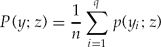

where Gp is the Gini index of inequality applied to Sp. The index in (2), proposed by Sen (Reference Sen1976), and the class of indices in (1) differ in the ability to accommodate an important property, namely the (additive) Separability Axiom. This axiom requires overall poverty to be a weighted average of the poverty levels of population subgroups, the weights being equal to subgroup population shares.Footnote 2 While the class in (1) is separable, the Sen index is not due to its incorporation of the Gini coefficient, which builds upon a rank-based weighting.
Finally, let us introduce the Transfer Axiom, postulating that a transfer of income from a poor to a richer poor (regressive transfer) must increase the poverty measure – for simplicity we restrict our attention to transfers which do not lift the recipient out of poverty. The expression distribution sensitive is widely used in the poverty measurement literature to refer to a measure of poverty which satisfies the Transfer Axiom – see Foster and Shorrocks (Reference Foster and Shorrocks1988), Ravallion (Reference Ravallion1996), Zheng (Reference Zheng1994, Reference Zheng1997, Reference Zheng2000). This term refers to the capability of these indices to pick up mean preserving changes in the income distribution within Sp, as is the case for a regressive transfer. The Sen index satisfies the Transfer Axiom, as do indices of the form (1) when the deprivation function p(yi; z) is decreasing and convex in yi – i.e. when ∂p/∂yi < 0 and ∂2p/∂yi 2 > 0 assuming continuity and differentiability. For example, consider the class of poverty measures proposed by Foster et al. (Reference Foster, Greer and Thorbecke1984). Members of this class are known as FGT indices and are the most widely used in poverty analysis. They are of the form (1) where, for poor levels of income, p α(yi; z) = (Γi)α, with Γi = (z − yi)/z and α ≥ 0. An FGT index satisfies the Transfer Axiom if α > 1.
3. A CLOSER LOOK AT THE THIRD ‘I’ OF POVERTY
Sen (Reference Sen1976) stresses the need for a poverty measure to be adequately informative on the situation of the poor. The number (or proportion) of people below the poverty threshold may be thought of as the incidence of poverty. The intensity dimension refers to the extent to which their income levels fall below the poverty line and is conceivable as the total (or per capita) amount of resources necessary to eradicate poverty. Both pieces of information are valuable to Sen, hence ‘both should have some role in the index of poverty’ (Sen Reference Sen1976: 223). However, such aspects alone are challenged on grounds of their ‘crudeness’. The blame is on the silence about how levels of income – or, equivalently, poverty shortfalls – are distributed among the poor. Such considerations motivated Sen to suggest the use of a ‘composite measure’ able to ‘take note of the inequality among the poor’ (Sen Reference Sen1976: 227). The incidence, intensity and inequality dimensions of aggregate poverty, the ‘three ‘I's of poverty’ have become since then the cornerstone for both theoretical and empirical poverty studies. Jenkins and Lambert (Reference Jenkins and Lambert1997) provide a useful diagrammatic device, the Three ‘I's of Poverty (TIP) curve, enabling to capture graphically those three aspects of poverty – for empirical applications see for example Duclos and Grégoire (Reference Duclos and Grégoire2002) and Thuysbaert (Reference Thuysbaert2008).
The need for a clarification of the principle motivating the interest in the ‘third ‘I’’ emerges from the following simple numerical example. With the poverty line set at z = 10, compare the distributions with income vectors y′ = (4, 5, 6, 12, 15) and y′′ = (4, 5, 7, 12, 15) in terms of poverty. A poverty ordering based on either of the first two ‘I's alone would, though ‘crude’, be justified according to some defensible views on poverty, but the same cannot be said with respect to a poverty ordering based merely on the inequality among the poor. A poverty comparison based on the first ‘I’ would conclude that poverty is the same in the two distributions because in both of them the poor comprise two individuals out of five. An exclusive focus on the second ‘I’ would yield the verdict that poverty is lower in y′′ because the aggregate or average gap from the poverty line is smaller. But an ordering entirely driven by the third ‘I’ (vouching that there is more poverty in y′′ because there is greater inequality among the poor) would receive very little support from both specialists and laymen: common intuitions about poverty make it difficult to judge as having more poverty a distribution where someone is better off and no one is worse off.Footnote 3 This shows that the concern for the ‘inequality among the poor’ in the context of absolute poverty evaluation is not rooted in a purely egalitarian ground.
4. PRIORITARIANISM AND DISTRIBUTION-SENSITIVE SEPARABLE POVERTY INDICES
As expressed in the seminal work of Parfit (Reference Parfit, Clayton and Williams1995: 19), a prioritarian attitude to the resolution of distributive conflicts follows the principle that ‘Benefiting people matters more the worse off these people are’. Importantly, the reason for this is that ‘these people are at a lower absolute level. It is irrelevant that these people are worse off than others . . . [but] rather that they are worse off than they might have been . . . we give priority to the worse off, not because this will reduce inequality, but for other reasons’ (Parfit Reference Parfit, Clayton and Williams1995: 22–23). As stressed by Tungodden (Reference Tungodden2003: 24), prioritarianism provides ‘a distinctive way of justifying a concern for the worse off’, the motivation being that ‘absolute circumstances should count in distributive reasoning’. Broome (Reference Broome, Wikler and Murray2007) notes that such an attitude ‘leads them [prioritarians] to value equality indirectly’.
The prioritarian stance provides a new justification for the behaviour of distribution-sensitive separable poverty indices in the resolution of distributive conflicts among members of Sp. The reason why the Transfer Axiom postulates a poverty increase as a consequence of a regressive transfer has very little to do with a concern for equality in Sp (or in S), we contend, and this axiom should not be thought of as having been simply lifted from inequality measurement theory. In our simplified framework, a regressive transfer does not involve poverty line crossing and hence does not alter the number of the poor. As a consequence, such transfer also brings about an increase in inequality in Sp (as measured by standard inequality indices among which is the Gini coefficient). Since distribution-sensitive measures of poverty signal a poverty increase as a consequence of a regressive transfer, one could be led to regard them as ‘inequality sensitive’, i.e. placing some value on equality in Sp per se. However, the words by Broome quoted above apply and in the measurement of absolute poverty the resulting ‘inequality sensitivity’ is nothing more than an indirect result. Absolute poverty is deemed to increase not because society is more unequal, but because the transferred units of income have a larger poverty-alleviating impact when in the hands of worse-off people. As for prioritarianism, absolute circumstances matter.
A key role in our argument is played by separability, which in a prioritarian framework is more than a technical condition. Tungodden (Reference Tungodden2003) points out how separability is an essential condition for prioritarianism because the focus on absolute circumstances makes the condition of other people irrelevant.Footnote 4 Benefits to the worse off matter more and, as remarked by Parfit (Reference Parfit1997: 214), ‘benefits to them would matter just as much even if there were no others who were better off’. Because of its failure to accommodate the Separability Axiom, the Sen index cannot be justified on prioritarian grounds. The opposite holds, instead, for FGT indices with α>1 thanks to their capability to satisfy both the Transfer and the Separability Axioms.Footnote 5
The two main features of prioritarianism, distribution-sensitivity and separability, play an important role in poverty alleviation strategies. On the one hand, the motivation leading prioritarianism to give priority to the worse off emerges when we consider the way poverty measures are used to inform direct anti-poverty targeting schemes. For Zheng (Reference Zheng1997: 125), distribution-sensitive poverty measures suggest a scheme where ‘income is given to the poorest person until his income equals the next poorest person, then income is distributed to these two equal poor persons equally until each person's income equal the third poorest person's income’ and so on, not for the sake of making society more equal, but to achieve an ‘effective targeting, on those who need them most, of the resources available for the relief of poverty’ (Keen Reference Keen1992: 67). In this we see a parallel to the more general principle of vertical equity ‘calling for an appropriate differentiation among unequals’ (Musgrave Reference Musgrave1990: 113). In poverty alleviation, heterogeneity in levels of income is seen as the reason motivating a differentiation in the way poor people are targeted, with the worse off receiving priority. On the other hand, separable poverty measures ‘allow policy makers to identify subgroups particularly susceptible to poverty and to design effective, consistent national and regional anti-poverty strategies’ (Zheng Reference Zheng1997: 136).
5. ABSOLUTE PRIORITY TO THE WORST OFF?
Following Crisp (Reference Crisp2003) and Vallentyne (Reference Vallentyne and Vallentyne2003), a prioritarian weighting scheme asks for the assignation of larger weights to those individuals at lower levels of advantage. Such a weighting scheme is de facto implemented by aggregate poverty indices of the form (1) where p(yi; z) is convexly decreasing in yi. This is evident in the FGT class, where each normalized shortfall from the poverty line Γj = (z − yj)/z receives a weight equal to itself raised to the power α − 1, so that for α > 1 lower levels of income receive larger weights. When α increases, the importance of worse-off individuals relative to those who are better off grows. For example, if there are at least four poor, the importance of the third worst-off increases relative to that of 4, . . ., q but decreases relative to that of the worst-off and second worst-off; and clearly, the worst-off sees its own importance increase relative to that of all other poor. Thus larger values of the parameter α in the FGT class are associated with a stronger prioritarian attitude.Footnote 6
How much priority should be assigned to the poorest in poverty evaluation? For the FGT, as α → ∞ infinitely greater weight is given to the worst off Footnote 7 and the contribution of the other poor to poverty evaluation becomes immaterial. Such a weighting scheme can be seen as an extreme version of prioritarianism – strict prioritarianism according to Tungodden (Reference Tungodden2003),Footnote 8 but it need not be considered as a prerogative of the FGT index since an identical stance is taken, in the limit, by other indices – e.g. the second class of poverty indices proposed in Clark et al. (Reference Clark, Hemming and Ulph1981) as β → −∞, see Zheng (Reference Zheng1997: 152). Such indices resolve distributional conflicts among the poor on the basis of the leximin/leximingroup criterion. Is this desirable in the context of absolute poverty?
To avoid a negative answer grounded on the argument that it would be ‘monomaniacal’ (Tungodden Reference Tungodden1998) to focus on a single individual and neglect masses, we may pose the question in terms of the worst off ‘group’ rather than individual. In order to answer the question, it should be considered that the exclusive concern for the worst off inherent in leximingroup abstracts from cardinal considerations. It is irrelevant whether the poorest is just an epsilon poorer than the second poorest, or whether the poorest is close to or far below the poverty line. In other words, absolute priority is given to the worst off regardless of whether this (person or) group lives relatively well or in severe destitution. We find this an undesirable criterion in the field of absolute poverty, where the focus should be placed on individuals’ absolute circumstances. An exclusive focus on the poorest seems plausible only if the latter is identified by means of an absolute threshold, which we may call an ultra-threshold, which is meaningful in terms of the living conditions of the poorest. In the context of absolute poverty, where absolute living conditions matter, a justification for lexical priority to the worst off must be grounded in the severity of the hardship experienced. This insight can be found in the influential contribution of Kundu and Smith (Reference Kundu and Smith1983). Considering distributional conflicts in the context of income transfers, they argue to unquestionably resolve them in favour of the poorest contender(s) should this person or group fall below an (absolute) deprivation threshold demarcating a qualitative difference in human suffering. It is the different nature of the deprivation experienced by the people below an absolute ‘ultra-poverty line’ which is used to justify absolute priority to them.
The willingness to introduce a demarcation among the poor appears widely in the poverty literature, where a distinction between ‘poor’ and ‘ultra-poor’ has been suggested by a number of contributions – see Lipton (Reference Lipton1983, Reference Lipton1988), Kakwani (Reference Kakwani1993a, Reference Kakwani1993b, Reference Kakwani1996), Cornia (Reference Cornia1994), Ravallion (Reference Ravallion1996), Klasen (Reference Klasen1997), Halder and Mosley (Reference Halder and Mosley2004) and Barrett and Swallow (Reference Barrett and Swallow2006). Some of these authors express the ultra-poverty cut off in relative terms – e.g. Klasen (Reference Klasen1997) identifies the ultra-poor as the poorest 20% of the population. Other authors attach an absolute content to the notion of ultra-poor. For Lipton (Reference Lipton1983: 7) there is a ‘borderline between poverty and ultra-poverty, indicating a risk of undernutrition and a severe risk of anthropometric shortfalls’. Lipton (Reference Lipton1988) reiterates this idea by referring to the ultra-poor as to those for whom physical personal maintenance is unstable. In a similar fashion, Cornia (Reference Cornia1994: 297) identifies the ultra-poor as those ‘with incomes below a subsistence minimum’ (emphasis in original). For Halder and Mosley (Reference Halder and Mosley2004: 387), the ultra-poor are those ‘lacking livelihood resources’. These characterizations of an (absolutely defined) ultra-poverty threshold can be seen as capturing a qualitative difference in human deprivation, which may entail permanent physical deficiencies as well as loss of human dignity.
Which normative argument underpins the view that we first should give absolute priority to the ultra-poor and subsequently to the ordinary poor if the ultra-poor are not affected? The first candidate to be considered is prioritarianism. One form of prioritarianism which could account for this criterion is the extreme version where infinitely greater weight is given to the worst off (and to the worse off in binary comparisons). Indeed, infinitely weighted prioritarianism, or leximingroup, could be invoked to account for the absolute character of the focus on the poorest category, in distributional conflicts both between the non-poor and the poor, and between the poor and the ultra-poor. However, solving such distributional conflicts along these lines can be only partially justified on prioritarian grounds. First, many prioritarians would be reluctant to endorse the extreme version of prioritarianism and assign absolute priority to the worst off; and second, although prioritarianism does indeed take people's absolute circumstances as the reason justifying priority to the worst off, it does not require the identification of exogenous benchmarks partitioning the population. Prioritarianism gives priority to the claims of people with lower benefits over those of people with higher benefits, and hence, would also prioritize the claims of a millionaire over those of a billionaire.
The evaluation of individual levels of benefits vis-à-vis an exogenous threshold does, however, explicitly feature in the sufficiency doctrine of Frankfurt (Reference Frankfurt1987).Footnote 9 Here, prominence is given to the concept of having enough, where ‘the notion of ‘enough’ pertains to meeting a standard’ (Frankfurt Reference Frankfurt1987: 37, emphasis in original). Although Frankfurt does not refer to situations of misery or starvation, the threshold(s) involved in the context of poverty evaluation can be seen as the standard(s) to be met to ‘have enough’. By clarifying the work of Frankfurt, the recent contribution of Casal (Reference Casal2007) provides insights which help conceptualize the absolute priority between groups identified by poverty and ultra-poverty thresholds. Casal (Reference Casal2007) characterizes the sufficiency stance as being composed of a positive and a negative thesis. The former ‘stresses the importance of people living above a certain threshold, free from deprivation’ while the latter ‘denies the relevance of certain additional distributive requirements’ (Casal Reference Casal2007: 297, 298).
Both of these priority relationships (ultra-poor over poor and poor over non-poor) qualify in terms of Casal's positive thesis, especially in the light of what she interprets as ‘Crisp's more recent formulation of the positive thesis’ (Casal Reference Casal2007: 298). For Crisp (Reference Crisp2003: 758), ‘absolute priority is to be given to benefits to those below the threshold’. As to Casal's negative thesis, it is only in the realm of distributional conflicts between poor and non-poor that the claims of individuals in the richer group are deemed irrelevant. The Focus Axiom in absolute poverty evaluation requires the irrelevance of how incomes are distributed above the poverty line: this implies that once everybody is at the poverty line no improvement is possible in the sense of a decrease in poverty. But in the case of conflicts between ultra-poor and moderately poor, the claims of the latter clearly do count, and would become an object of concern once ultra-poverty had been eradicated. In the light of this difference, the absolute priority given to the poor over the non-poor fully follows from a sufficiency view while the absolute priority given to the ultra-poor over the moderately poor can be seen as originating from a ‘restricted’ sufficiency argument, where only the positive thesis is accounted for.
6. CONCLUSION
In this paper we have taken a fresh look at Sen's ‘three ‘I's of poverty’. Our reconsideration has led us to point out how the interest in the ‘inequality’ dimension of absolute poverty in fact stems from a prioritarian rather than an egalitarian stance. The prioritarian motivation is well illustrated by Parfit's (Reference Parfit1997: 214) analogy: ‘People at higher altitudes find it harder to breathe. Is this because they are higher up than other people? In one sense, yes. But they would find it just as hard to breathe even if there were no other people who were lower down. In the same way, on the Priority View, benefits to the worse off matter more, but that is only because these people are at a lower absolute level. It is irrelevant that these people are worse off than others’. It is not for the sake of achieving more equality below the poverty line that distribution-sensitive indices welcome a transfer from a richer to a poorer poor; rather, because in that way resources are transferred to someone who is needier.
As shown in the paper, poverty indices may endorse different degrees of prioritarianism in terms of the strength with which priority is given to the worse off. Some of them give absolute priority to the worst off, complying with leximin (or leximingroup). We question the desirability of such criterion on the basis of its ordinal nature and its neglect of people's real living conditions. We leave the door open for absolute priority to the poorest group when this is identified by an exogenous threshold below which deprivation becomes qualitatively different and life conditions become inhuman. Deeming a distribution to have more poverty than another for the existence of such levels of deprivation would in fact neglect Sen's ‘three ‘I's of poverty’ and let the evaluation rest on an entirely different dimension: the inhumanity of poverty, a fourth ‘I’?
 and
 . Multiplying numerator and denominator by 1/Γαj, all of the stated properties of the FGT indices become evident.


