INTRODUCTION AND BACKGROUND
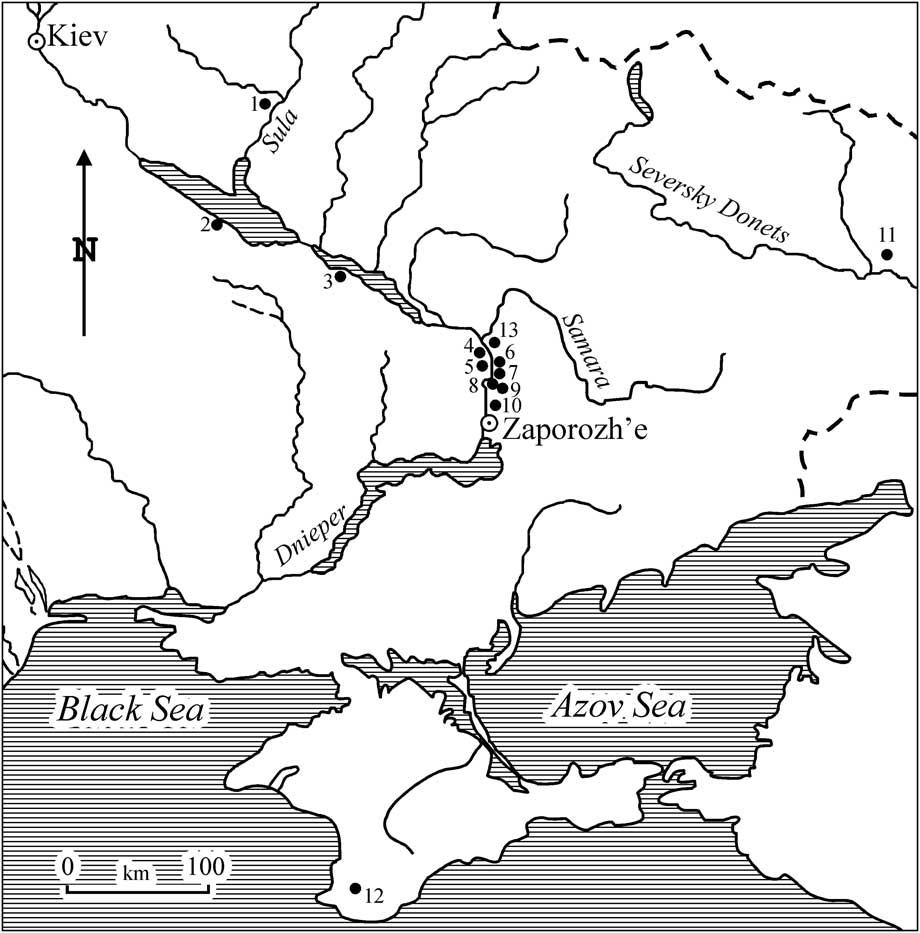
The Dnieper Rapids region of Ukraine (Figure 1) is unusual in a Eurpean context, in that it has a concentration of cemeteries dating from the Epipaleolithic through to Eneolithic/Copper Age periods (~10,200–3700 cal BC). The cemeteries in this region are characterized, in part, by the presence of extended burials, albeit with crouched inhumations occurring in the earliest phase of the sequence at Vasilyevka III (Epipaleolithic) and also in the latest phase considered here, at Molyukhov Bugor (Eneolithic). Pottery is found in the collective stages of burial at these cemeteries, during the Neolithic and later periods, and fish and deer tooth pendants occur as grave goods during all periods, with boar tusk plates (sewn onto clothing) in evidence during the later Mesolithic and Neolithic periods. The cemeteries are often delineated as Mariupol-type cemetery sites during the Neolithic phases of use (Telegin and Filenko Reference Telegin and Filenko1982; Telegin Reference Telegin1986; Telegin and Potekhina Reference Telegin and Potekhina1987), although reanalysis of the chronology of the Mariupol–type cemeteries has shown that some of these cemeteries are actually of later Mesolithic date (e.g. Vasilyevka II and Marievka) (Telegin et al. Reference Telegin, Potekhina, Lillie and Kovaliukh2002, Reference Telegin, Lillie, Potekhina and Kovaliukh2003).
Key sites mentioned in the text. 1–Vyazivok, 2–Molukhov Bugor, 3–Dereivka I, 4–Voloskoe, 5–Nikolskoye, 6–Vasilyevka II, III and V, 7–Marievka, 8–Vovnigi I, 9–Yasinovatka, 10–Vil’nyanka, 11–Rogalik II, 12–Fat’Ma Koba, 13–Igren VIII.

Additionally, as has been noted elsewhere, these cemeteries are of some interest as they are identified as “true cemeteries” in the sense that they are set apart from any settlement sites – and indeed evidence for associated settlements is rare (Telegin and Potekhina Reference Telegin and Potekhina1987). A number of the Dnieper Rapids cemeteries may have also functioned as territorial markers or as locations that indicated ancestral rights of access to the rich resources of the Dnieper River and its tributaries (Brinch Petersen and Meiklejohn Reference Brinch Petersen and Meiklejohn1995; Lillie Reference Lillie2008; Meiklejohn et al. Reference Meiklejohn, Brinch Petersen and Babb2009).
From a subsistence standpoint, the isotope research in the Dnieper Rapids to date has focused on investigating the consumption of freshwater protein resources versus terrestrial protein resources, and the concomitant presence of a freshwater radiocarbon reservoir effect (Lillie and Jacobs Reference Lillie and Jacobs2006; Lillie et al. Reference Lillie, Budd, Potekhina and Hedges2009). The continued consumption of high proportions of aquatic proteins from the Epipaleolithic through to the Neolithic period in the Dnieper Rapids region is evident from the human δ15N collagen values, which mainly demonstrate values of greater than 12‰ across the cemetery sites (Lillie and Richards Reference Lillie and Richards2000; Lillie et al. Reference Lillie, Budd and Potekhina2011). One of the main issues facing paleodietary reconstruction of prehistoric populations in the Dnieper Rapids region is the lack of significant quantities of associated fauna bone samples available for δ13C and δ15N analysis, as these isotope values are used to provide an “isotopic baseline” for dietary interpretations (e.g. Schwarcz and Schoeninger Reference Schwarcz and Schoeninger1991; Hedges and Reynard Reference Hedges and Reynard2007). Previous 14C studies in the Dnieper Rapids regions, have identified evidence for a 14C freshwater reservoir effect at the sites of Dereivka 1 and Yasinovatka (with reservoir effects of ~250 yr and ~470 yr, respectively) (Lillie et al. Reference Lillie, Budd, Potekhina and Hedges2009).
The core research questions central to understanding the diet and chronology of the study area are (i) to what proportion aquatic/freshwater protein contributes to prehistoric diets, (ii) does the amount of aquatic protein consumed vary by chronological phase, and (iii) to what extent does the presence of a freshwater 14C reservoir effect influence chronological interpretations of cemetery sites in the Dnieper Rapids region? These questions are addressed here by the integration of new carbon and nitrogen stable isotope analysis of sequential dentine samples from Igren VIII, alongside data sets of the existing stable isotope studies (Lillie and Richards Reference Lillie and Richards2000; Lillie et al. Reference Lillie, Budd and Potekhina2011).
MATERIALS
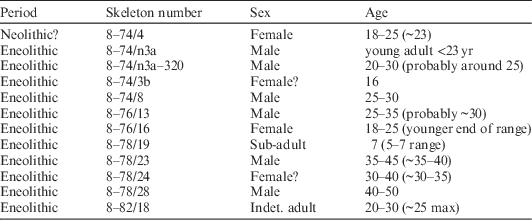
Overall, since the beginning of our isotopic research in 2000, we have studied 321 human samples, along with 26 fauna and 4 fish (archaeological) samples, from the associated cemeteries, with 8 modern fish samples included for comparison. In addition to the skeletal remains that have been analyzed to date, the current research further expands the study of prehistoric diets with the inclusion of dentine incremental analysis of 11 individuals from the Neolithic to Eneolithic phase of the cemetery population at Igren VIII (Table 1).
Typological periodization and demographic data for the individuals analyzed (dentine increments) from the cemetery of Igren VIII. (skeleton numbers in column 2 are; 8=Igren 8, 74–82=dates skeletons were excavated i.e. 1974–1982, and n3a, 4, etc. skeleton numbers allocated during excavations).

The site that forms the basis of this study is located in the Igren Peninsula on the left bank of the Samara River (Figure 1). Following on from earlier excavations in the 1930s and 1940s, D Ya Telegin and O S Filenko undertook five summer seasons of excavations between 1974 and 1978 (Telegin and Filenko Reference Telegin and Filenko1982). During these excavations, 19 burials of Eneolithic date were excavated.
The skeletal remains interred in the cemetery of Igren VIII include two Neolithic(?) burials (Nos. 4 and 12) along with 17 Eneolithic Sredny Stog culture burials (numbers 1–3, 5–11, 13, 15–18, 26, 29) and two Yamna (Yamnaya in Russian) Culture (numbers 14, 20) burials (Telegin and Filenko Reference Telegin and Filenko1982). In 12 of the graves, the bones were partially or completely “dusted” with ocher (1, 3, 5–8, 10, 13, 15, 16, 18, 29). Nine of the Sredny Stog burials (3, 5, 8, 10, 13, 15–18) contained burial goods, including flint, pottery, and jewelry. Burials 2, 5, and 10 had animal bone in association (the latter two examples are of beads from a possible headdress and bracelet, respectively). Associated finds also include a Trypillia stage B/C1 bowl and pot.
In the current study, 11 individuals from Igren VIII have been analyzed using high-resolution, incremental isotope analysis of the dentine in order to assess the relative contribution of dietary proteins. The individuals are coded with the site number, i.e. 8 for Igren VIII; the year of excavations, e.g. 74 for 1974; and the number allocated to the interment, such as n3a and n3a320 for the paired burial of a young adult male aged <23 yr and a male aged 20–30 yr (who was probably in the middle of this range) (Henderson Reference Henderson2015).
METHODS
The methods used in the current study follow those outlined in Henderson et al. (Reference Henderson, Lee-Thorp and Loe2014). Due to the limitations of the skeletal archive, teeth were chosen on the basis of availability, with the pre-molars forming the majority of available teeth (the exception being individual 8–78/19 where the first maxillary molar was used). Only those teeth that displayed limited attrition, no caries, and no damage were selected. Demographic data is presented in Table 1. Each molar was cleaned using aluminium oxide air abrasive to remove adhering dirt. The tooth was halved using a Buehler Isomet with diamond-tipped blade. Collagen was extracted from one half of the tooth by demineralizing it in 0.5M HCl. Thereafter, the demineralized, but still intact, dentine was cut into 10 strips horizontally from the tip of the crown to the root apex using a scalpel, following Beaumont et al. (Reference Beaumont, Gledhill, Lee-Thorp and Montgomery2012). The method used in this study cuts through the Andresen lines, making horizontal sections down a tooth from crown to root. In the crown of the tooth, the angle of the lines is roughly followed, although due to the size of the samples required each section represents many of these histological features. Toward the root there is an increased deviation from the histological features as they become more angled, meaning the samples are more time averaged. Each strip of demineralized dentine was rinsed in distilled water three times and heated at 70°C in pH3 H2O for 2 days, following a modified Longin (Reference Longin1971) method.
Following filtration and freeze-drying, the resulting collagen was weighed into tin capsules. Samples were measured in duplicate, at Oxford (ORAU, England), using a continuous-flow mass spectrometer (Sercon 20–22). A laboratory standard, alanine, was used to monitor data quality, check for drift and to calculate C:N ratios. The results were calibrated using a two-point calibration based on multiple aliquots of international standards, IAEACH6 and USGS40, which were included in the sample runs as well as multiple aliquots of the internal standard. Analytical reproducibility is ±0.1‰ and ±0.2‰ for δ13C and δ15N, respectively, based on multiple replicates of the internal laboratory standard.
The collagen samples obtained from each tooth strip were allocated an age range based on a developmental chart (Massler et al. Reference Massler, Schour and Poncher1941). The chart serves as a general indication of timing, although it is recognized that these ranges are approximate and that they are complicated by differences in development rates between individuals and populations. There is some evidence for differences in dentine development between males and females, with females showing slightly faster formation than males after the age of approximately 5 or 6 yr (Demirjian and Levesque Reference Demirjian and Levesque1980). As the sections made are approximate time intervals, no attempt at adjustment has been undertaken.
RESULTS
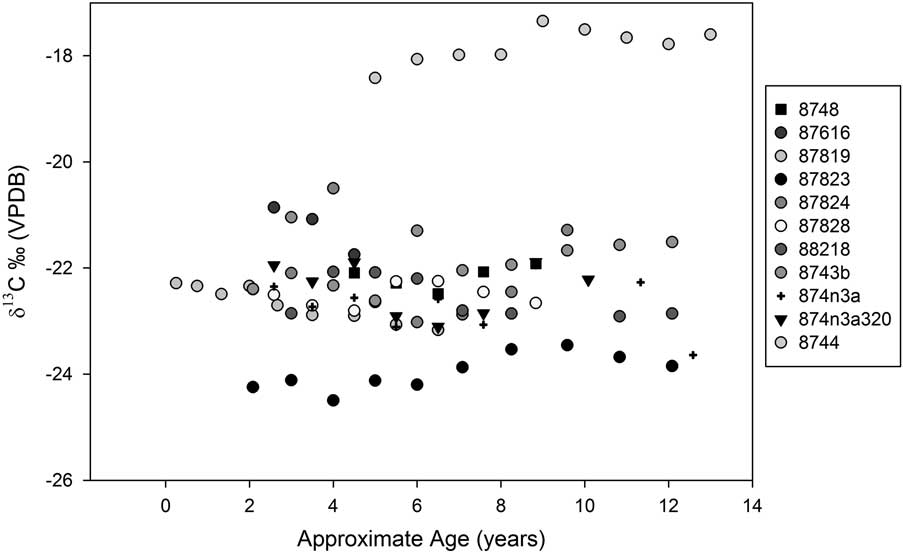
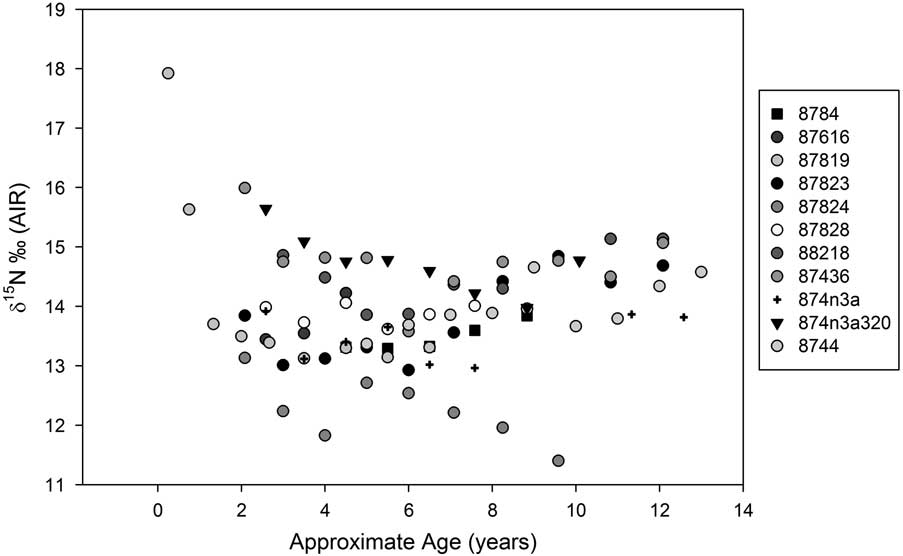
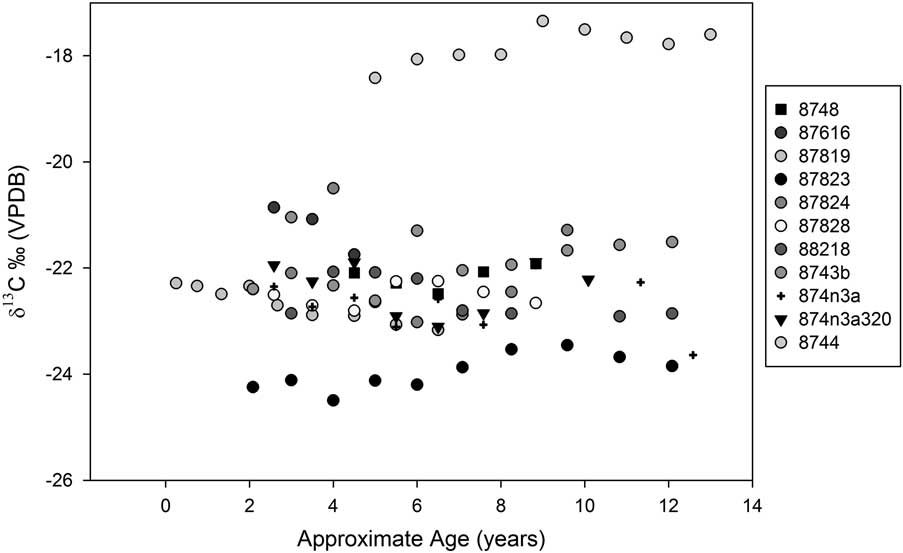
In three instances, collagen was not be recovered from the processed sample; however, this does mean that 85 samples (increments) produced a suitable collagen yield for use in the current analysis. In all of these cases, the C:N ratios were considered acceptable at between 3.1 and 3.4 (DeNiro Reference DeNiro1985). The possible Neolithic female from Igren VIII (Individual 8–74/4 [8744 in Figures 2 and 3]) has adult values of –18.6‰ for δ13C and 13.4‰ for δ15N (unpublished data). The preliminary dental δ13C ratios for this individual across the 4–9 yr age brackets in childhood indicate that this individual consumed a diet with δ13C ratios around –18.0‰, while as can be seen in Figure 2, the δ15N ratios across this period of childhood are between ~13 to 14‰ (Figure 3).
Childhood δ13C ratios for individuals from the cemetery of Igren VIII (Henderson Reference Henderson2015).
Childhood δ15N ratios for individuals from the cemetery of Igren VIII (Henderson Reference Henderson2015).

For the Eneolithic period, all of the individuals studied exhibit δ13C ratios between ca. –24.0‰ and –21.0‰ (–22.6 ± 0.8‰) from birth through to ~14 yr of age (Figure 2). By contrast, there is more variation in evidence in the δ15N ratios for this period (Figure 3). Individual 8–78/19 (87819), a child aged 7 yr at death, has a noticeably higher δ15N ratio of ~18‰ at 6 months, lowering to ~13.3‰ at 2.5 yr. While the data for individual 8–74/3b (8743b), a ~16–yr–old female(?), begins at 2 yr of age, the data again show a reduction from more elevated δ15N values (starting at 16.0‰), which appear to stabilize at around 2.5 yr of age at 14.7‰.
While the isotope data are less clear for individuals 8–74/n3a–320 (male ~25 yr of age at death) and 8–78/23 (male ~35–40 at death), it would appear that the initially higher nitrogen ratios are again stabilizing at ~2.5–3 yr of age for these individuals. As can be seen in Figure 3, for all of the individuals studied a relatively consistent nitrogen stable isotope signature is achieved by ~2–3 yr of age, after the initial higher levels in early childhood, and that once “stabilized” these ratios remain relatively constant throughout the biological age range of 2–14 yr.
The only outlier values for δ15N occur in relation to individual 8–78/24, a female(?) aged ~30–35 yr at death. Between 2–4 yr of age, the δ15N values drop from to 13.1‰ to 11.8‰ subsequently rising to 12.7‰ at 4.5 yr and then decreasing steadily to 11.4‰ by 10 yr of age. Admittedly, the overall variation in δ15N for this individual is only 1.7‰, but it is the overall decreasing chronological trend in δ15N values that makes this individual stand out from the group. Interestingly, the δ13C values for this individual exhibit the opposite trend in that they shift from –22.4‰ to –20.5‰ between 2.5 and 4 yr of age, reducing to a minimum of –23.0‰ at 6 yr of age, and subsequently rising steadily to –21.3‰ by ~9.5 yr of age. Unfortunately, at this stage in our analyses, justification for these trends is not readily apparent.
Finally, individual 8–78/23 (Male aged ~35–40) has the most negative δ13C ratios recorded for this population, with values of ~–24.0‰ recorded across the period 2–12 yr of age. The associated δ15N values elevate across the period 3–12 yr of age from 13.0‰ to 14.7‰.
Interpretation of the Igren VIII Data
The dental stable isotope analysis of the individuals from the Igren VIII cemetery indicate that in early childhood, the elevated nitrogen ratios in evidence are associated with the infant diet prior to weaning. In addition, the data suggest that in this particular population the children are weaned by ~2–3 yr of age. The reasons behind age of weaning in prehistoric populations have been shown to be complex (e.g. Sellen and Smay Reference Sellen and Smay2001), but the reliability of the resource base and nutritional value of the post-weaning diet clearly contribute to the weaning ages in the Dnieper groups. Lillie (Reference Lillie2008) has previously noted that a study of the frequency of enamel hypoplasia’s on the dentitions of the Dnieper Rapids populations has shown that very low levels of stress occur between the ages of 2.0–6.0 yr of age, across the Epipaleolithic to Neolithic periods. As noted elsewhere, however (e.g. Goodman et al. Reference Goodman, Martin, Armelagos and Clark1984), hypoplasias are nonspecific childhood stress indicators, and as such they do not necessarily reflect the occurrence of a weaning event. As such, the δ15N ratios presented in Figure 3 may provide a more robust method for assessing the timing of this event in the prehistoric populations of the Dnieper Rapids region of Ukraine.
Post-weaning, the data appear to be relatively consistent across the childhood years of the Eneolithic individuals, with the obvious exception of individual 8–78/24 (discussed below), such that by 12 yr of age all of the individuals studied are clearly consuming diets in which freshwater resources, such as fish and mollusks, are making up a significant proportion of the dietary protein, and the data also indicate that that freshwater resources made up a significant proportion of childhood diets, from ~2–3 yr through to ~14 yr of age. Importantly, this is the first time that we have obtained data on the composition of childhood diets from the Dnieper Rapids cemeteries of Ukraine.
DISCUSSION: THE WIDER CONTEXT OF THE DNIEPER RIVER SYSTEM
There is now considerable stable isotope data to support the consumption of freshwater resources by the prehistoric populations of the Dnieper Rapids region across the period 10,000–3000 cal BC (Lillie et al. Reference Lillie, Richards and Jacobs2003, Reference Lillie, Budd, Potekhina and Hedges2009, Reference Lillie, Budd and Potekhina2011, this paper). This data reinforces the archaeological evidence for fishing and shellfish gathering in the Dnieper catchment (e.g. Telegin Reference Telegin1986; Telegin and Potekhina Reference Telegin and Potekhina1987), and the addition of Igren VIII to our studies of diet for the populations occupying the Middle and Lower Dnieper Basin cemeteries and campsites across the Epipaleolithic–Eneolithic/Copper Age further enhances our understanding of the nature and duration of the consumption of these resources (i.e. from early childhood in the case of Igren VIII).
To date, the sites of Vasilyevka III, Dereivka I and II, Vil’nyanka, Yasinovatka, Nikolskoye and Molukhov Bugor, along with Voloshkoe, Vasilyevka II, Marievka, Fat’ma Koba (Crimea), Vyazivok, Rogalik II, and Vovnigi I have been analyzed using either AMS dating or a combination of AMS dating and stable isotopes analyses (Lillie and Richards Reference Lillie and Richards2000; Lillie and Jacobs Reference Lillie and Jacobs2006; Lillie et al. Reference Lillie, Budd, Potekhina and Hedges2009, Reference Lillie, Budd and Potekhina2011).
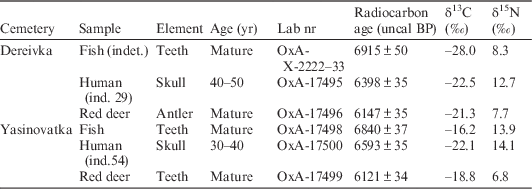
While the sites and cemeteries of Vasilyevka III, Vyshgorod, Dobryanka, Vasilyevka II, Igren VIII (Mesolithic), Vil'nyanka, Osipovka, Dereivka I, Yasinovatka, and Nikolskoye have all been AMS dated, it is perhaps now recognized that the more significant of these sites, from a dating perspective, are the Neolithic cemeteries of Dereivka 1 and Yasinovatka, where the analysis of a combination of (closely associated) human, faunal, and fish remains has shown that there are significant offsets in the 14C determinations between samples from the same grave context (Table 2). The fish and deer teeth are recovered from necklaces, pendants, or bracelets that were worn by the deceased when they were buried (Telegin and Potekhina Reference Telegin and Potekhina1987).Footnote 1
AMS dates on fish, human and fauna samples from the cemeteries of Dereivka 1 and Yasinovatka (Lillie et al. Reference Lillie, Budd and Potekhina2011: Table 1).

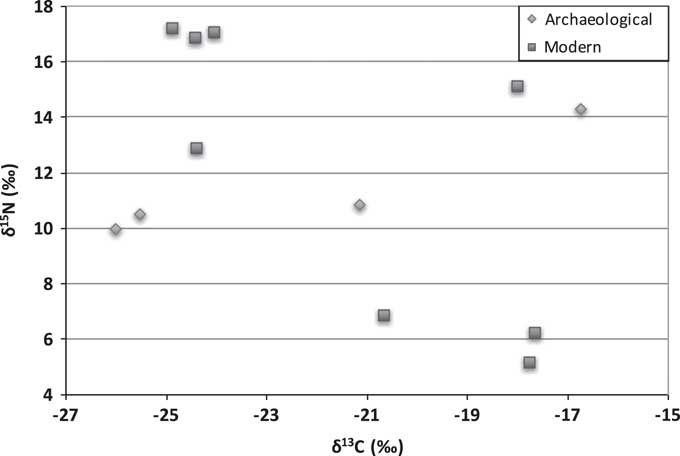
The differences (offsets) observed between the 14C determinations in Table 2 are clearly due to the different dietary sources exploited by humans, combined with the occurrence of older carbon in the fish samples (carp or pearl roach) (Lillie et al. Reference Lillie, Budd and Potekhina2011). In addition, as noted elsewhere (e.g. Lake Baikal; Bronk Ramsey et al. Reference Bronk Ramsey, Schulting, Goriunova, Bazaliiskii and Weber2014), the significant variability in δ13C and δ15N values evidenced by the fish remains from the Dnieper (both archaeological and modern samples) (Figure 4) indicates that δ13C ratios are difficult to correlate to 14C offsets (Budd Reference Budd2007; Bronk Ramsey et al. Reference Bronk Ramsey, Schulting, Goriunova, Bazaliiskii and Weber2014: 791). The δ13C isotope ratios for the human samples at Dereivka 1 (male 40–50, cortical bone of skull) and Yasinovatka (male 30–40 cortical bone of skull) are –22.4‰ and –22.6‰, respectively. In isolation, these values would potentially suggest the consumption of C3 terrestrial proteins, given the values obtained from terrestrial fauna in this region (Lillie et al. Reference Lillie, Budd, Potekhina and Hedges2009, Reference Lillie, Budd and Potekhina2011), but in combination with the elevated δ15N ratios exhibited by these individuals and the archaeological δ15N values of fish from the Dnieper (Figure 4), the values clearly demonstrate the contribution of freshwater proteins into the diet (see also Wood et al. Reference Wood, Higham, Buzilhova, Suvorov, Heinemeier and Olsen2013).
Archaeological and modern fish stable isotope values from the Dnieper River system. Archaeological samples are carp and pearl roach. Modern samples from the Dnieper and Chernovtsky rivers include silver carp, gray pike, European perch, common carp, Crucian carp, and silver carp (Budd Reference Budd2007).

The δ15N ratios of 12.7‰ at Dereivka 1 (male 40–50, cortical bone of skull) and 14.0‰ at Yasinovatka (male 30–40 cortical bone of skull) (Table 2) would potentially indicate that individual 54 at Yasinovatka is consuming proportionally higher quantities of freshwater protein than terrestrial protein when compared to individual 29 at Dereivka 1. However, it is recognized that considerable variability occurs within freshwater systems (Philippsen Reference Phiilippsen2013; Fernandes et al. Reference Fernandes, Rinne, Nadeau and Grootes2014), and these two cemeteries are some distance apart within the Dnieper system. Despite this, it is apparent that these differences in diet correlate with a larger offset from the terrestrial baseline at Yasinovatka (472 yr) than the offset in evidence at Dereivka I (251 yr). While linear interpolation is not viable on the basis of this data, in this example a 1.3‰ elevation in δ15N at Yasinovatka (as compared to the Dereivka 1 sample) coincides with a greater (i.e. 470 yr) offset from the terrestrial baseline sample when contrasted with the 12.7‰ δ15N ratio at Dereivka I (where a 250-yr offset is evident). It is anticipated that this variability will be investigated in greater detail in future studies as at face value the higher human δ15N value at Yasinovatka equates to a larger FRE offset from the terrestrial baseline, but this is complicated by the differences in fish δ13C and δ15N values between these two locations (Table 2) (Lillie et al. Reference Lillie, Budd and Potekhina2011).
Fauna and fish stable isotope values from burials within Yasinovatka and Dereivka indicate that the terrestrial fauna have isotope values of –20.0‰ (δ13C) and 7.5‰ (δ15N) for a deer tooth (incisoform, I2) in burial 28 at Yasinovatka and –20.4‰ (δ13C) and 4.9‰ (δ15N) for a deer antler sample from Dereivka (Lillie et al. Reference Lillie, Budd and Potekhina2011). The variability between these samples is likely a function of the two different elements analyzed, e.g. tooth dentine vs. antler collagen. Tooth dentine forms incrementally over a period of months (Mitchell and Youngson Reference Mitchell and Youngson1969; Brown and Chapman Reference Brown and Chapman1991; Sponheimer et al. Reference Sponheimer, Robinson, Ayliffe, Roeder, Hammer, Passey, West, Cerling, Dearing and Ehleringer2003); therefore, the bulk dentine sample represents a mixed dietary signal, including periods of nursing (see Balasse et al. Reference Balasse, Bocherens, Mariotti and Ambrose2001 for comparative research on cattle dentine samples). Conversely, red deer antlers form at approximately 1 year of age (Clutton-Brock Reference Clutton-Brock1982), and so reflect a postweaning phase of the diet. Therefore, one would expect mature antler collagen to exhibit lower δ15N values than a bulk dentine sample.
The archaeological fish tooth from burial 56 at Yasinovatka (Figure 4 – center) has values of –21.1‰ (δ13C) and 10.8‰ (δ15N), while at Dereivka the fish from burials 5 and 46 have values of –16.8‰ and –25.5‰ for δ13C and 14.3‰ and 10.5‰ for δ15N, respectively (Figure 4 – right and left sides of distribution) (Lillie et al. Reference Lillie, Budd and Potekhina2011:64–5). Along with the Neolithic sample from Vil’nyanka (Figure 4, far left), these values clearly indicate a significant potential for a wide range of offsets within a given cemetery population in the Dnieper Rapids region, depending on which sources of dietary foodstuffs are being exploited (see for e.g. Rouja et al. Reference Rouja, Dewailly and Blanchet2003). In addition, there is clearly an established potential for significant intercemetery variability both between individuals and chronological periods.
To date, stable isotope values have been recorded for the Epipaleolithic cemetery of Vasilyevka III, where Lillie et al. (Reference Lillie, Richards and Jacobs2003) analyzed 21 individuals (both males and females), all of whom had δ15N values over 11.9‰ (average=12.7±0.6‰), with a maximum value of 14.1‰ recorded on an adult male aged >55 yr, and δ13C values between –22.5‰ and –21.6‰ (average=–22.2±1.5‰). Faunal samples obtained during recent analyses have shown that at Mesolithic sites in the region (e.g. Vyazivok, Igren VIII, and Rogalik 2) and further south in Crimea, δ15N values of 5.5‰ (Cervus elaphus) through to 8.8‰ (Sus scrofa) are evidenced (Lillie et al. Reference Lillie, Budd and Potekhina2011). As such, the human isotope data are interpreted as indicating a relatively uniform diet, with a strong dependence on freshwater and terrestrial animal protein.
Towards the latter part of the Mesolithic period, the cemetery sites of Vasilyevka II and Marievka have produced contrasting indicators of diet, with Marievka (7000–6200 cal BC) having an individual (burial 10, male, 35–45 yr) dated to 7020–6100 cal BC at 2σ (OxA-6200, 7620±160 BP) with a δ13C ratio of –21.7‰ and a δ15N ratio of 13.0‰, while two other individuals (burials 4 [male? 50–60 yr]) dated to 7045–6690 cal BC (OxA-6199, 7955±55 BP) and 14 [indet. adult aged 35–45]), dated to 6685–6240 cal BC (OxA-6269, 7630±110 BP), dated to 6685–6240 cal BC (OxA-6269, 7630±110 BP) had δ13C and δ15N values of –22.0‰ and –22.1‰ and 10.1‰ and 10.8‰, respectively (all dates and isotope vales were obtained from cortical bone from the skull of each individual) (Lillie et al. Reference Lillie, Budd and Potekhina2011). Given the available fish and fauna values, it is clear that individuals 4 and 14 (adult male/adult of indeterminate sex) were consuming diets that consisted principally of terrestrial resources, while individual 10 (adult male) was consuming a diet with a stronger dependence on freshwater resources (Lillie et al. Reference Lillie, Budd and Potekhina2011:61–4).
At the later Mesolithic site of Vasilyevka II, dated to ~7300–6220 cal BC, analysis of 14 individuals by Lillie and Jacobs (Reference Lillie and Jacobs2006) led to the observation that both males and females consumed diets that were rich in freshwater resources, with δ13C values ranging from –21.8 to –20.1‰ (–20.9±0.5‰) and δ15N ratios ranging from 12.4 to 14.7‰ (13.4±0.7‰). These authors also concluded that when compared to other individuals of Mesolithic age from the cemeteries of Marievka (discussed above), Dereivka I, and Osipovka, the Vasilyevka II populations were generally placing a greater emphasis on the exploitation of freshwater resources alongside terrestrial protein sources, although variability is again in evidence (e.g. individual 10 at Marievka).
For the Neolithic period, the cemeteries of Vovnigi I, Yasinovatka, Dereivka 1, Vil’nyanka, Nikolskoye, and the site of Molukhov Bugor (a total of 43 human samples, 13 fauna, and 4 fish samples) have all been studied (Lillie et al. Reference Lillie, Budd and Potekhina2011). The fauna include a deer antler from Dereivka I that produced a δ13C value of –20.4‰ and a δ15N ratio of 4.9‰, while a deer tooth sample from Yasinovatka has produced ratios of –20.0‰ and 7.4‰ for δ13C and δ15N, respectively, and a deer tooth sample from Vovnigi I produced ratios of –19.1‰ and 6.9‰ for δ13C and δ15N, respectively. The Neolithic fauna from Molukhov Bugor produced ranges between –23.2‰ (Cervus elaphus) to –18.9‰ (Ursus arctos) for δ13C and 4.8‰ (Sus scrofa) to 7‰ (Ursus arctos) for δ15N. Intermediate values were recorded for additional pig, cattle, and sheep/goat samples from this site.
The human stable isotope values from Nikolskoye cluster between –23.6‰ and –19.6‰ for δ13C (–22.7±1.2‰) and 12.2‰ to 14.3‰ for δ15N (13.4±0.7‰). These ratios are clearly elevated when compared to the contemporary fauna, and the situation is the same at Yasinovatka where values of –24.1‰ to –22.4‰ (average=–23.4±0.6‰) and 11.4‰ to 15.1‰ (average=13.6±1.1‰) are recorded for δ13C and δ15N, respectively. At Dereivka I, values of –23.6‰ to –21.7‰ (average=–23.1±0.7‰) and 10.0‰ to 13.5‰ (11.6±1.3‰) are recorded for δ13C and δ15N, respectively. The values for the humans are difficult to interpret due to the variable faunal ranges for the period, although it is apparent that freshwater resources (fish) are contributing some proportion of the dietary proteins at these sites. This is reinforced by the fish values from Dereivka I, Vil’nyanka, and Yasinovatka, which exhibit very wide ranges for δ13C, between –26‰ and –16.8‰ and δ15N ratios of 10‰ to 14.3‰. While limited in number, the available human bone samples from Vasilyevka V have produced dietary isotope compositions with δ13C ranging between –23.2‰ and –20.2‰ and δ15N between 10.0‰ and 12.3‰, again the isotope values of certain individuals are indicative of the consumption of freshwater resources. Interestingly, while the two δ15N ratios of 10.0‰ and 10.6‰ at Vasilyevka V might suggest that these individuals had a mainly terrestrial resource oriented diet, the δ13C values of –22.4‰ and –23.2‰ would lend weight to the observation that freshwater resources were being consumed. The single individual with an elevated δ15N ratio of 12.3‰ probably consumed a diet with a higher input of freshwater resources, and the δ13C ratio of –22.3‰ for this individual reinforces this observation (Lillie et al. Reference Lillie, Budd and Potekhina2011:65).
During the Eneolithic period at the site of Molukhov Bugor, which is located higher up in the Dnieper River catchment, the stable isotope data are broadly consistent with the Neolithic data, although only four human samples were available for analysis from this location. The human samples range between –23.1‰ and –21.2‰ (average=–21.8±1‰) for δ13C and 11.5‰ to 12.9‰ (average=12.2±0.7‰) for δ15N. The Eneolithic faunal samples from Molukhov Bugor exhibit a range of –22.6‰ to –19.8‰ (average=–21.5±1.1‰) for δ13C and 5.6‰ to 7.5‰ (average=6.7±0.7‰) for δ15N. As such, it is also likely that freshwater resources, alongside terrestrial herbivores, contributed to the Eneolithic diet at Molukhov Bugor.
THE PROBLEM WITH FISH
In summary, it is clear from the isotope data and archaeological record that the inclusion of fish protein in prehistoric diets was a major factor in the Dnieper Rapids region. Returning to the core study themes of this paper, it is evident from the δ13C and δ15N values that (i) in most cases freshwater protein contributed a large (if not major) proportion of the diet for the prehistoric populations throughout the Epipaleolithic to Eneolithic periods. In addition, (ii) the amount of freshwater protein appears to be largely consistent throughout the chronological phases; the earliest dated site in the sequence, i.e. Vasilyevka III (at ~10,000 cal BC) has clear evidence for the consumption of freshwater protein (Lillie et al. Reference Lillie, Richards and Jacobs2003), and this continues through to the Eneolithic/Copper Age at Igren VIII, up to ~3000 cal BC, although the pattern for freshwater protein consumption exhibits variation at both the inter- and intrasite levels of analysis. Finally, the 14C determinations of human, fauna, and fish collagen samples recovered in close association, demonstrate very convincing evidence for a freshwater reservoir effect, ranging between ~250 and 470 yr, dependent on the feeding habits of the species of fish consumed (benthic versus bottom feeders, etc.) and the proportion of fish protein consumed in an individual’s diet.
A fundamental problem with this approach to paleodietary reconstruction lies in the fact that the fish isotope ratios are not consistent at the intra- and interspecies levels (fish can be deep or shallow water feeders, predators, and benthic feeders), and the ethnographic evidence for selectivity in human consumption patterns of fish would seem to negate any easy linear interpolation of the nitrogen ratios that are in evidence. The stable isotope data for individual 8–74/4 from Igren VIII (8744 in Figure 2) would suggest that, in light of the available fish ratios from the Dnieper Rapids (Figure 4), this individual could either have placed a very particular dietary focus on a single species, or was consuming a diet that differed markedly to the later (Eneolithic) individuals at this location. This individual appears anomalous in relation to the individuals from the Dnieper Rapids region during the prehistoric period, and recent dating of this individual has indicated that as opposed to being of Neolithic date, individual 4 from Igren VIII is in fact an intrusive interment.Footnote 2 While the consumption of freshwater resources occurs throughout the prehistoric period, we can postulate that the low δ15N values at Igren VIII (e.g. individual 8–78/24 [87824 in Figure 2]) might indicate that there are some human individuals with less potential for a reservoir offset. This could be assessed using associated faunal remains from burials, thus potentially offering a way to limit the biases that occur when dating these populations.
In conclusion, it is clear from the dating and isotope studies undertaken to date (e.g. Lillie et al. Reference Lillie, Budd, Potekhina and Hedges2009, Reference Lillie, Budd and Potekhina2011) that the majority of dates on individuals with elevated nitrogen ratios (i.e. above ~12‰) should be considered to have a potential reservoir effect. As noted above, at ~12.7‰ at Dereivka this is a 250-yr offset from the terrestrial baseline (the issue of limited faunal values not withstanding), while at 14.0‰ at Yasinovatka the offset rises to 470 yr. At this stage in the research agenda, it is clear that targeted excavations aimed at recovering a combination of human, fauna, and where possible, fish samples, are needed in order to adequately determine potential degrees of offset, and the actual offset in 14C yr, alongside the stable isotope values for the populations studied (e.g. Schulting et al. 2014).
Acknowledgments
The authors would like to thank Ricardo Fernandes and Tim Jull for detailed comments on the content of this paper.