Introduction
Montmorillonite (Mnt) is used widely for medical purposes. Mnt belongs to the smectite group, and it is composed of an alumina octahedral sheet sandwiched between two silica tetrahedral sheets (Edelman & Favejee, Reference Edelman and Favejee1940; Hofmann et al., Reference Hofmann, Endell and Wilm1933; Nagelschmidt, Reference Nagelschmidt1936). In Mnt, imperfections in the crystal lattice and isomorphous substitution induce a net negative charge that leads to the adsorption of alkaline earth metal ions in the interlayer space (Swartzen-Allen & Matijevic, Reference Swartzen-Allen and Matijevic1974). Mnt exhibits desirable characteristics such as a large ion-exchange capacity, adsorption power, specific surface area, and swelling properties (Maes et al., Reference Maes, Marynen and Cremers1977; Maes & Cremers, Reference Maes and Cremers1977). In this context, the present study examined the possibility of using Mnt mined in the Gampo area of Gyeongju, Republic of Korea, as a drug-delivery vehicle.
Ciprofloxacin (CIP) is a fluoroquinolone (FQ)-based antibiotic that acts as a bacterial barrier in controlled delivery systems (Davis et al., Reference Davis, Markham and Balfour1996). It is used widely for the treatment of osteomyelitis owing to its beneficial bactericidal effects against invasive osteomyelitis pathogens (Gentry & Rodriguez, Reference Gentry and Rodriguez1990; Lazzarini et al., Reference Lazzarini, Lipsky and Mader2005). CIP, however, tends to have a short half-life and repeatedly administering the appropriate amount of antibiotics to a target site is generally difficult (Akahane et al., Reference Akahane, Kato and Takayama1993; Ben et al., Reference Ben, Fu, Hu, Liu, Wong and Zheng2019). This problem can be solved, however, by wrapping the CIP molecule in another material that can release continuously the appropriate amount of antibiotic for the desired amount of time (Rivera et al., Reference Rivera, Valdes, Jimenez, Perez, Lam, Altshuler, de Menorval, Fossum, Hansen and Rozynek2016; Wu et al., Reference Wu, Tong, Li, Ji, Lin, Yang, Zhong, Xu, Yu and Zhou2016). In this regard, the octahedral sheets of Mnt can undergo selective dissolution under acidic conditions (Nascimento et al., Reference Nascimento, Alves, Melo, Melo, Souza and Pedrosa2015; Palkova et al., Reference Palkova, Hronsky, Jankovic and Madejova2013). Ongoing research has also shown that intercalating organic molecules in the interlayer space of inorganic clay minerals can be tailored to enhance drug-delivery systems (Choy et al., Reference Choy, Choi, Oh and Park2007; Koç Demir et al., Reference Koç Demir, Elçin and Elçin2018; Yang et al., Reference Yang, Lee, Ryu, Elzatahry, Alothman and Choy2016). In a recent study, a method to delay the drug-release rate by controlling the layer charge with various acid treatments was proposed (Joshi et al., Reference Joshi, Kevadiya, Patel, Bajaj and Jasra2009a, Reference Joshi, Patel, Kevadiya and Bajaj2009b; Namazi & Belali, Reference Namazi and Belali2016; Wu et al., Reference Wu, Lv, Liu and Wang2017), but the control of layer charge alone was insufficient to delay the drug release rate. Therefore, the potential for other Mnt properties such as surface area and pore volume to control drug-release behavior should be investigated. Against this background, the purpose of the present study was to investigate the effect of HCl acid treatment and vibratory ball milling on the drug-delivery properties of Mnt-CIP composites in an effort to prolong CIP drug release.
Materials and Methods
Starting Materials
Raw Mnt was collected from the bentonite at the Gampo-40 (Bgp40) mining area located in Gyeongju, Republic of Korea (Kim et al., Reference Kim, Kim, Kim, Park, Roh, Kang and Seo2020). The Mnt was purified in the following order. First, the bentonite ore was crushed to select particles of ≤20 mesh. Second, 2 wt.% by weight of the crushed bentonite was suspended in deionized water and mixed using a stirrer for further purification. Bentonite particles >5 μm were removed by precipitation from the beaker. Third, the supernatant was centrifuged to separate the fine (<5 μm) Mnt particles from the suspension. Finally, the Mnt produced was freeze-dried and used to synthesize drug-delivery materials (Hong et al., Reference Hong, Kim, Kim, Kang, Kang and Ryu2019).
Ciprofloxacin hydrochloride monohydrate (C17H18FN3O3∙HCl∙H2, Alfa Aesar, Ward Hill, Massachusetts, USA), sodium chloride (NaCl, Daejung, Siheung, Korea), potassium chloride (KCl, Junsei, Chuo-ku, Tokyo, Japan), monobasic sodium phosphate (NaH2PO4, Sigma-Aldrich, St. Louis, Missouri, USA), and monopotassium phosphate (KH2PO4, Samchun, Pyongtak, Korea) were used to prepare a phosphate-buffered saline (PBS) buffer solution with pH 7.4. For pH control, 1.0 M hydrochloric acid (HCl, Samchun, Pyongtak, Korea) or sodium hydroxide (NaOH, Sigma-Aldrich, St. Louis, Missouri, USA) were used.
Preparation of Mnt Powder
The freeze-dried Mnt was dispersed using a vibratory ball mill (Pulverisette 0, Fritsch, Idar-Oberstein, Germany). The amplitude of the vibration milling was 1.0 mm, and the grinding time was 20 h. In the ball-milling process, a 10 mL alumina jar with 50 mm diameter alumina balls were used. After milling, the Mnt was acid treated with 1.0 M HCl to modify the structure. After acid treatment, the Mnt was washed twice with deionized water to remove residual Cl, then freeze-dried at 187.15 K. In all the experiments, the mass of Mnt was 1 g and the volume of the solution was 500 mL. The conditions for the vibratory ball mill and acid treatment are listed in Table 1.
Conditions for the vibratory ball mill and HCl acid treatment

Synthesis of the Mnt-CIP Composite
For the interlayer intercalation of the CIP, 0.5 g (pH 4) of CIP antibiotic was added to distilled water (0.5 L) and mixed well at 150 rpm using a magnetic stirring bar. Mnt (1 g) was added, and the mixture was stirred for 24 h at a speed of 200 rpm. After CIP loading into the Mnt, the sample was immediately centrifuged at 12,000 rpm (15,385×g) for 10 min (Combi-514R, Hanil science Inc, Gimpo, Korea) to separate the Mnt-CIP composite from the solution. The prepared Mnt-CIP composite was washed with deionized water and centrifuged again to remove unreacted CIP in the composite. The washing process was repeated three times, and the resulting Mnt-CIP composite was freeze dried at −20°C for 3 days (Bondiro, Ilshin, Dongducheon, Korea). The CIP antibiotic concentration analysis was performed by plotting the concentration-absorbance relationship (calibration line) at a wavelength of 275 nm using ultraviolet spectroscopy.
Release of CIP from Mnt-CIP Composite
Elution experiments were carried out by adding 0.2 g of the Mnt-CIP composite sample to 250 mL PBS buffer solution (pH 7.5). The samples were maintained in a thermostatic bath at 36±0.5°C with shaking at 150 rpm. Release studies were conducted over 3 days. The CIP released was analyzed by collecting 1 mL of medium and immediately centrifuging the sample to separate the Mnt-CIP. The supernatant was used for CIP concentration analysis. The PBS buffer volume was maintained constant by adding fresh PBS buffer to the release medium.
The Korsmeyer-Peppas model CIP was applied to analyze the CIP release mechanism (Korsmeyer et al., Reference Korsmeyer, Gurny, Doelker, Buri and Peppas1983). The equation is as follows:

where, M t /M ∞ represents the fractional permeated drug, t is the release time, k is the transport constant, and n is the transport exponent. The release constant k provides information on the drug formulation such as structural characteristics of the nanocarriers, whereas n is related to the drug-release mechanism. In the drug-delivery system, n < 0.5 corresponded to a Fickian diffusion; 0.5 < n < 1.0, to anomalous (non-Fickian) diffusion; n = 1.0, to Case II transport; and n > 1.0, to super Case II transport. To find the exponent n of the release curve, only M t /M ∞ < 0.6 should be used (Dash et al., Reference Dash, Murthy, Nath and Chowdhury2010).
Characterization
The samples prepared were characterized by powder X-ray diffractometry (XRD), energy dispersive X-ray fluorescence spectrometry (ED-XRF), Brunauer–Emmett–Teller surface area analysis (BET), scanning electron microscopy (SEM), Fourier-transform infrared spectroscopy (FTIR), and ultraviolet-visible spectroscopy (UV-Vis). The phase properties of the powders were observed by means of XRD measurements (Smart Lab, Rigaku, Tokyo, Japan) with CuKα radiation (λ = 1.541 Å) at an operating voltage and current of 40 kV and 200 mA, respectively. Data for all samples prepared in this study were collected over the range 2 to 80°2θ with a step size of 0.01°2θ. The powder crystallite size was calculated from the Debye-Scherrer equation using the formula D p = (0.9λ/β cos θ), where D p denotes the average crystallite size, λ the wavelength of Cu radiation, β the full-width at half-maximum (FWHM) of the diffraction reflection under consideration, and θ the diffraction angle. The Mnt elemental composition was determined after acid dissolution by XRF using an ED-XRF instrument (NEX CG, Rigaku, Tokyo, Japan), equipped with a Mo X-ray tube at 50 kV.
The specific surface area and pore-size distribution were measured at 77 K (the temperature of liquid nitrogen). These measurements are based on the principle that N2 gas bonds weakly to the solid surfaces by van der Waals forces due to the high potential energy in the surface and pores of the material. The change in adsorption amount at various pressures was measured and the specific surface area of the powders was obtained by fitting the N2 adsorption curves to the BET equation (TRISTAR3000, Micromeritics, Atlanta, Georgia, USA). To minimize the error due to moisture, each sample was placed in a cell and dried in a vacuum oven at 200°C for 3 h. The pore size and pore volume were determined as per the Barrett-Joyner-Halenda (BJH) method using the adsorption branch of the isotherm.
To investigate the particle morphology and the Mnt particle size, each sample was coated with gold in argon for 180 s and then examined using an environmental SEM (JSM–6380, JEOL, Tokyo, Japan), operating at 20 kV. Changes in the organic structure of the CIP in the composite was monitored using attenuated total reflectance (AR) FTIR (Agilent, Cary 630, Santa Clara, California, USA) in the frequency range of 500–4000 cm−1. The equilibrium CIP concentrations were analyzed using a UV-Vis spectrophotometer (UV–1800, Shimadzu, Tokyo, Japan) at a wavelength of 275 nm, corresponding to its maximal absorbance. Calibrations were performed using standards of 1, 5, 10, 20, and 25 mg/L with a regression coefficient of 0.9967. The amount of CIP adsorbed was calculated as the difference between the initial and final concentrations. The conditions for acid treatment and vibration ball-mill dispersion of the Mnt layers were as follows. MA0 was the label for the raw material; samples labeled MA3 were treated with 1.0 M HCl; MA1 and MA2 were labels for samples subjected to vibration ball milling for 10 and 20 h, respectively. In addition, samples MA4 and MA5 were subjected to both the ball milling for 10 and 20 h, respectively, and acid treatment, in that order. The cation exchange capacity (CEC) of the Mnt used in this study was 44.21 meq/100 g, comprising 31.16 meq/100 g as Na, 0.56 meq/100 g as K, 0.7 meq/100 g as Mg, and 11.79 meq/100 g as Ca.
Results and Discussion
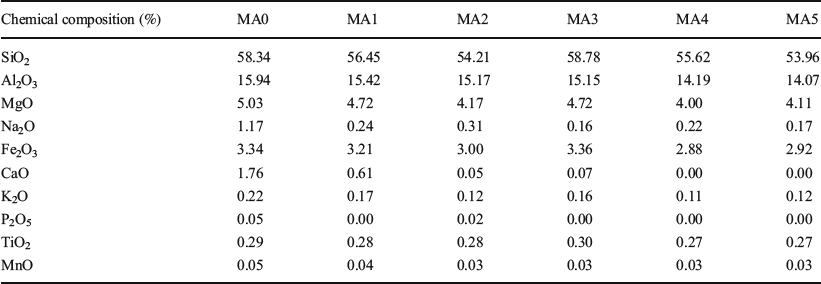
The ED-XRF results of the acid-treated Mnt indicated Si, Al, Mg, and Fe as the major components, with the SiO2 content being as high as 58.34% (Table 2). With increasing HCl concentration, the SiO2 content decreased systematically because of the progressive dissolution of Si from the tetrahedral sites. The concentrations of Al2O3, SiO2, MgO, and Fe2O3 also exhibited a general reduction after acid treatment. In this regard, Al has been reported to dissolve selectively from the Mnt octahedral sheets during acid treatment, and Si forms Si–OH groups as Al dissolves, leaving behind amorphous silica (Ekosse et al., Reference Ekosse, Mulaba-Bafubiandi and Nkoma2007; Kaviratna & Pinnavaia, Reference Kaviratna and Pinnavaia1994). The removal of the Al cation from the octahedral sheet increased the negative surface charge of the layers. As the HCl concentration increases, the Si in the tetrahedral sites also dissolves gradually.
Chemical composition of montmorillonites after acid treatment and ball milling

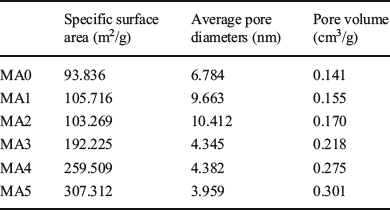
The specific surface area of all samples exhibited an increasing trend after milling dispersion and acid treatment (Table 3). The specific surface areas of samples MA0, MA1, MA2, MA3, MA4, and MA5 were 93.836, 105.716, 103.269, 192.225, 259.509, and 307.312 m2/g, respectively. Additionally, a sharp decrease in average pore size was observed in samples MA3, MA4, and MA5. The rapid increase in the specific surface area of Mnt and the formation of pores by acid treatment were accompanied by the formation of amorphous SiO2 (Pesquera et al., Reference Pesquera, González, Benito, Blanco, Mendioroz and Pajares1992; Temuujin et al., Reference Temuujin, Jadambaa, Burmaa, Erdenechimeg, Amarsanaa and Mackenzie2004). Moreover, the sample pore volume increased with increasing acid concentration in the acid treatment and with dispersion. This was expected to be due to the edge dissolution of the octahedral sheet, leaving only the amorphous SiO2 detached from the edges. In general, the positively charged group in CIP is believed to attach to the Mnt basal surface through the silica hexagonal ring where Mg has replaced the Al in the octahedral sheet, thus establishing a strong electrostatic force. Acid treatment dissolved some of the Si from the Mnt tetrahedral sheet, creating an even greater negative charge imbalance which was then balanced by the positive group of CIP. This would result in a stronger electrostatic force than with the Mg site. The proposed reaction, then, is that after the CIP is inserted into the Mnt interlayer space, the electrostatic force between the acid-treated Mnt layer and the CIP is increased and the release energy of the CIP is increased to prolong the release time (Wu et al., Reference Wu, Lv, Liu and Wang2017).
Variations in the specific surface area, average pore diameter, and average pore volume of acid-treated, milled, and untreated samples

In addition, these transformations lead to modification of the interaction between tetrahedral and octahedral sheets, thus changing the layer charge and the interaction properties between adjacent layers (Krupskaya et al., Reference Krupskaya, Zakusin, Tyupina, Dorzhieva, Zhukhlistov, Belousov and Timofeeva2017). Previous studies have indicated that the interactions between silica tetrahedral sheets and guest molecules may occur via van der Waals forces, Coulombic forces, or hydrogen bonding (Takahashi & Yamaguchi, Reference Takahashi and Yamaguchi1991). Furthermore, these results indicate that CIP molecules can be inserted into the interlayer region or the cleft edge of Mnt, which was in good agreement with XRD analysis (Fig. 1) and results reported by Li et al. (Reference Li, Cai, Zhong, Wang, Cheng and Ma2018).
X-ray diffraction patterns of antibiotic (CIP)-intercalated montmorillonite composites: a, b as a function of the milling time and c, d after ball milling and acid treatment

The XRD patterns of the Mnt and Mnt-CIP composite (Fig. 1) were also analyzed to estimate the change in width of the basal spacing (d 001) of Mnt due to the various experimental conditions considered. The MA0 exhibited apparent Mnt peaks at 5.8, 18.9, and 34.8°2θ (Fig. 1a and b). The width of the characteristic diffraction peak (001) at 5.8°2θ for MA1, MA2, MA3, MA4, and MA5 was broadened in comparison to MA0. The calculated full widths at half maximum (FWHM) values for MA0, MA1, MA2, MA3, MA4, and MA5 were 1.123, 1.393, 1.413, 1.671, 1.702, and 1.736 nm, respectively. The broadening may be due to an increase in the disordered arrangement of the Mnt layer and the particle exfoliation (Ronald et al., Reference Ronald, Calvin, William, Collins and Brydon2001).
The activation of Mnt with HCl led to the replacement of exchangeable cations with H+ ions. Moreover, Mnt with an interlayer structure can be partially damaged by dealumination (Biswas et al., Reference Biswas, Sarkar, Rusmin and Naidu2017). Thus, in the case of the acid-treated samples, the diffraction peak broadened from ~3 to 8°2θ. Moreover, the addition of CIP to Mnt increased the basal spacings for samples MA0, MA1, MA2, MA3, MA4, and MA5 from 1.52 to 1.71 nm, 1.52 to 1.70 nm, 1.48 to 1.61 nm, 1.43 to 1.69 nm, 1.42 to 1.68 nm, and 1.41 to 1.72 nm, respectively (Fig. 1c and d). These observed increases in the interplanar spacing along the (001) plane indicated that CIP molecules with large molecular structures were successfully intercalated between the Mnt layers. The mechanism of CIP intercalation is mainly due to cation exchange by electrostatic interaction rather than the formation of micelles (Cohen & Yariv, Reference Cohen and Yariv1984; Neumann et al., Reference Neumann, Gessner, Schmitt and Sartori2002). This trend is similar to other drug intercalation mechanisms (Feng et al., Reference Feng, Mei, Anitha, Gan and Zhou2009; Hamilton et al., Reference Hamilton, Hutcheon, Roberts and Gaskell2014; Jin et al., Reference Jin, Hu, Wang, Wang, Yao, Tang and Chu2014; Joshi et al., Reference Joshi, Kevadiya, Patel, Bajaj and Jasra2009a, Reference Joshi, Patel, Kevadiya and Bajajb).
The FTIR spectra of the MA0, CIP, and MA0-CIP composites (Fig. 2) exhibited a characteristic absorption band for Mnt (sample MA0) at 3446 cm–1 due to the O−H stretching of adsorbed water (Saikia et al., Reference Saikia, Parthasarathy, Borah and Borthakur2016). The bands at 3629 and 3700 cm–1 were due to the O−H stretching from structural Al−OH and Si−OH (Joshi et al., Reference Joshi, Kevadiya, Patel, Bajaj and Jasra2009a, Reference Joshi, Patel, Kevadiya and Bajajb). The shoulders and broadness of the structural O−H bands were mainly due to the contributions of several structural O−H groups occurring in MA0.
FTIR spectra of samples: a CIP, b MA0, and c MA0-CIP composite

The overlaid absorption peak at 1652 cm–1 was attributed to the H−O−H bending mode of adsorbed water (Shimodat & Brydon, Reference Shimodat and Brydon1971). The characteristic peaks at 1020 cm–1 were due to out-of-plane and in-plane Si−O stretching vibrations for Mnt (Lerot & Low, Reference Lerot and Low1976; Shimodat & Brydon, Reference Shimodat and Brydon1971). In general, as these substitutions increase, the crystallinity decreases and the structure becomes increasingly incomplete. With respect to the CIP peaks, the most characteristic bands were located in the frequency range 1800–1200 cm–1. The band at 1712 cm–1 was ascribed to carboxylic acid C=O stretching, that at 1627 cm–1 to C=O stretching corresponding to ketone, and that at 1289 cm–1 to the coupling of the carboxylic acid C−O stretching and O−H deformation (Herbert, Reference Herbert1960; Yoshida & Asai, Reference Yoshida and Asai1959). In the FTIR spectra of the MA0-CIP composite, characteristic bands belonging to MA0 and CIP appeared in the spectrum; however, several new absorption bands appeared at 1286, 1636, and 1712 cm–1, indicating that CIP interacted strongly with the MA0 layers. The absorption band at 1627 cm–1 was shifted to 1636 cm–1, which indicated that the C=O group of the ketone in CIP interacted with the hydroxyl group in Mnt (Wu et al., Reference Wu, Zhang, Li, Hong, Yin, Jean and Jiang2014). Simple mixing of CIP and Mnt would not cause a peak shift, although the insertion of CIP in Mnt resulted in a C=O stretching band (Hamilton et al., Reference Hamilton, Hutcheon, Roberts and Gaskell2014). These results indicated clearly that CIP was inserted into rather than admixed with Mnt.
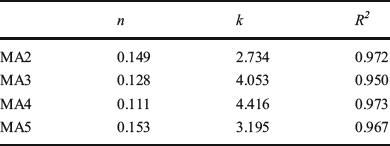
Controlled-release tests were carried out by suspending the Mnt–CIP composite in simulated PBS under continuous shaking at 36±0.5°C (Fig. 3). The error was plotted with a standard deviation of ±3%. The release of CIP from the Mnt–CIP composite was slow and sustained when simulated in PBS buffer. Such a slow and sustained release process could arise because of ion exchange between the inserted drug and the alkali metal ions in the buffer (Bekaroğlu et al., Reference Bekaroğlu, Nurili and Isçi2018). The CIP, MA0, MA1, MA2, MA3, MA4, and MA5 release percentages from initial to final were 97.04–98.94%, 85.51–95.21%, 21.51–59.87%, 14.73–55.91%, 31.51–63.83%, 12.44–52.88%, and 22.45–57.37%, respectively. The CIP only and MA0-CIP samples released CIP completely within 30 min in the PBS buffer. As for MA1-CIP, CIP was released rapidly for an initial initial 45 min, and then ceased. In addition, MA3-CIP afforded a relatively slow CIP release, although CIP was released completely after 1 h. MA2-CIP and MA4-CIP released CIP slowly but continuously for up to 3 h. As the release of CIP from the Mnt-CIP composite occurred through the exchange of Na+ or K+ ions present in the PBS buffer, the swelling of the Mnt-CIP complex was required for active ion exchange. The Korsmeyer-Peppas model was applied to determine whether that mechanism could explain CIP release from Mnt. Coefficients from the model (Table 4) for CIP release from MA2-CIP, MA3-CIP, MA4-CIP, and MA5-CIP composites revealed that n < 0.5, indicating that the release rate of CIP from MA2-CIP, MA3-CIP, MA4-CIP, and MA5-CIP was correlated with classical Fickian release behavior, which is a diffusion-controlled mechanism. Because CIP is intercalated in the composite with Mnt, the diffusion of buffer solution into the Mnt layer directly affects the CIP release rate. Otherwise, all the Mnt-CIP composites exhibited an n value of 0.73–0.77, which indicates anomalous, non-Fickian release behavior. In contrast, the MA0-CIP and MA1-CIP composites had a fast release rate, and thus values could not be obtained with the Korsmeyer-Peppas model (Costa & Sousa Lobo, Reference Costa and Sousa Lobo2001).
Release of CIP from Mnt-CIP composites in simulated PBS buffer (pH 7.4) at 36±0.5°C

Korsmeyer-Peppas model coeffcients of CIP release from Mnt-CIP composites

Conclusions
In the present study, Mnt-CIP composites were synthesized to investigate their potential as a CIP drug carrier to offer sustained CIP release. In particular, the drug-delivery potential of Mnt mined in Gampo, Gyeongju, Korea was investigated as a function of a ball-mill (samples MA2-CIP, MA4-CIP, MA5-CIP) and acid-activation (samples MA3-CIP, MA4-CIP, MA5-CIP) pre-treatment of the Mnt. First, the intercalation of CIP into Mnt was inferred, and subsequently, the in vitro release of CIP from the Mnt-CIP composites was examined. The XRD and FTIR patterns exhibited an increase in the d spacing, which was consistent with the insertion of CIP into the Mnt interlayer. In the in vitro release tests, the MA0-CIP, MA1-CIP, and MA3-CIP composites yielded a sustained CIP release over only 1 h. On the other hand, the MA2-CIP and MA4-CIP composites exhibited a slow CIP release over 3 h. This was possibly because, in the MA2 and MA4 samples, the exposure of the Mnt-CIP composite to the buffer solution was prevented. These results indicated that Mnt from the Gampo area can be used as a sustained-release carrier of CIP for oral administration.
Acknowledgments
This work was supported partly by a National Research Foundation (NRF) grant funded by the Korean Government (MSIT) (No.2020R1F1A1071104) and the Korea Institute for Advancement of Technology (KIAT) grant funded by the Korean Government (MOTIE) (P0012770).
Funding
Funding sources are as stated in the Acknowledgments.
Declarations
Conflict of Interest
The authors declare that they have no conflict of interest.