Introduction
The balsam twig aphid, Mindarus abietinus Koch (Hemiptera: Aphididae), is one of the most important pest of balsam fir (Abies balsamea (Linnaeus) Miller; Pinaceae) and other firs grown as Christmas trees in eastern North America (Bradbury and Osgood Reference Bradbury and Osgood1986; Kleintjes Reference Kleintjes1997; Berthiaume et al. Reference Berthiaume, Hébert and Cloutier2000). The balsam twig aphid has a monoecious life cycle and goes through three or four generations in southern Québec, Canada from late April to mid-late July (Cloutier and Jean Reference Cloutier and Jean2002). This species overwinters as eggs, which are laid mainly on the current-year shoots of their host trees (Deland et al. Reference Deland, Berthiaume, Hébert and Cloutier1998). Eggs hatch in late April into fundatrices, which initially feed on previous year needles before bud break, without causing any visible damage. After bud break, mature fundatrices move towards newly elongating shoots and begin parthenogenetic reproduction. Their progeny grow rapidly and form colonies that feed on current-year shoots during the elongation period. Their feeding on the current-year shoots results in needle distortion and stunting of shoots (Varty Reference Varty1966; Saunders Reference Saunders1969; Nettleton and Hain Reference Nettleton and Hain1982; Bradbury and Osgood Reference Bradbury and Osgood1986). Such damage is usually of little concern in natural forests but in Christmas tree plantations, it reduces the aesthetic value of balsam fir trees and can have substantial economic impact (Berthiaume Reference Berthiaume1998; Deland et al. Reference Deland, Berthiaume, Hébert and Cloutier1998; Berthiaume et al. Reference Berthiaume, Hébert and Cloutier2000).
Cloutier and Jean (Reference Cloutier and Jean2002) reviewed biological control of balsam twig aphid in Canada. Numerous Coccinellidae (Coleoptera) are known as predators of the balsam twig aphid and have been studied in Christmas tree plantations (Kleintjes Reference Kleintjes1997; Berthiaume et al. Reference Berthiaume, Hébert and Cloutier2000, Reference Berthiaume, Hébert and Cloutier2007) and natural stands (Varty Reference Varty1969). However, syrphid flies attacking the balsam twig aphid during larval development are not as well known. In North Carolina, United States of America, Nettleton and Hain (Reference Nettleton and Hain1982) identified two species of Syrphidae (Allograpta obliqua (Say) and Syrphus rectus Osten Sacken) attacking the balsam twig aphid in Christmas tree plantations of Fraser fir, Abies fraseri (Pursh) Poiret (Pinaceae), but they did not study their life history. Kleintjes (Reference Kleintjes1997) collected 10 species of syrphid flies near balsam twig aphid colonies but they were not linked to larval predation on the aphid.
In natural balsam fir stands, Varty (Reference Varty1966, Reference Varty1969) also reported the presence of syrphid larvae associated with the balsam twig aphid in New Brunswick, Canada but these larvae were not identified at the species level. In 1978, Martineau (Reference Martineau1985) reported that severe balsam twig aphid infestations in natural forests collapsed rapidly in Québec, apparently due to larval predation by syrphids. However, no species were identified and life cycles were not studied. Therefore, even if they appear to play an important role in the natural control of the balsam twig aphid, the larval syrphid predators of this aphid remain poorly known in eastern North America. In various agro-ecosystems, predaceous syrphid flies have been often reported to play important roles in aphid population dynamics (Schneider Reference Schneider1969; Cowgill et al. Reference Cowgill, Wratten and Sotherton1993; Tenhumberg Reference Tenhumberg1995). In order to begin correcting this gap in our knowledge of syrphid predators of the balsam twig aphid, we carried out a study in balsam fir Christmas tree plantations in Québec. Our objectives were to (1) identify syrphid species attacking the balsam twig aphid, (2) describe syrphid seasonal natural history and their synchrony with the aphid, (3) verify and report parasitism of syrphid larvae and pupae, and (4) determine the impact of spraying chemical insecticide on syrphid abundance.
Material and methods
Field work was mainly carried out in 1996 in a 6-ha commercial Christmas tree plantation of balsam fir located in Sawyerville (45°20'N, 71°34'W), Québec, Canada. Balsam fir trees were six to eight years old, about 1.5 m high, and had never been sprayed with insecticides. The plantation was surrounded by mature coniferous forests (balsam fir, white spruce (Picea glauca (Moench) Voss; Pinaceae), and scots pines (Pinus sylvestris Linnaeus; Pinaceae) and by a red pine plantation (Pinus resinosa Aiton; Pinaceae). Weeds were scarce (<10% recovery) and mostly composed of common milkweed (Asclepias syriaca Linnaeus; Apocynaceae) and cow vetch (Vicia cracca Linnaeus; Fabaceae). Balsam twig aphid density was estimated twice weekly from 29 April to 15 July, by collecting four branch apices (an apex consists of a complete previous-year shoot plus all associated current-year shoots), in the midcrown of each of 10 randomly selected balsam fir trees in the plantation. Freshly cut apices were placed individually in 100-dram plastic bottles and stored inside a cooler to stop aphid development, reproduction, and predation, until they could be examined under a stereomicroscope in the laboratory. Aphids were counted on each apex and averaged for each tree. Aphid density for each sampling date was the mean average number per apex, over the 10 replicate trees.
In the same plantation, syrphid egg and larval density were estimated twice weekly from 9 May to 26 July 1996, by randomly collecting three samples of 50 current-year shoots from 60 to 90 balsam fir trees showing signs of aphid infestation (distorted needles, honeydew, etc.). In the early season when no aphid damage was yet visible on current-year shoots, sample shoots were collected at random. Current-year shoots were selected, because balsam twig aphid colonies develop exclusively on these shoots (Nettleton and Hain Reference Nettleton and Hain1982). Each sample of current-year shoots was kept in a plastic bag inside a cooler until examination under a stereomicroscope in the laboratory. Syrphid eggs and larvae were then counted, recovered, and reared individually on balsam twig aphid in 10-cm diameter petri dishes at 21±2 °C in a field laboratory. Pupae were kept in the same conditions until adult syrphid flies, or parasitoids emerged. This allowed us to identify syrphid species attacking the balsam twig aphid and also to gather data on parasitoids attacking syrphid larvae on balsam fir Christmas trees.
To identify syrphid species pupating into the soil under balsam fir, we collected 50 pupae under each of five balsam fir trees on 26 June in the Sawyerville plantation. Pupae were reared individually in 10-dram plastic bottles and checked daily to record syrphid fly or parasitoid wasp emergence. Once emerged, syrphids or parasitoids were killed by freezing, mounted, and labelled for subsequent identification. Syrphid pupae were also collected on balsam fir branches and reared to emergence. Furthermore, we monitored syrphid larvae falling to the ground for pupating into the soil by using five Luminoc® (Comlab, Ville de Québec, Québec, Canada) pitlight traps (Hébert et al. Reference Hébert, Jobin, Fréchette, Pelletier, Coulombe and Germain2000). A trap was placed near the centre of the plantation, the others being placed 50 m apart in each cardinal direction. Luminoc® pitlight traps contained 70% ethanol to preserve insects collected and were operated from 8 May to 30 September in the Sawyerville plantation, as well as in three other balsam fir plantations of this region: East Clifton (45°16'N, 71°34'W), a plantation that had never been sprayed with insecticides, Lennoxville (45°22'N, 71°51'W) and Cookshire (45°25'N, 71°38'W), two intensively managed plantations, i.e., where insecticide was applied for controlling the balsam twig aphid, and herbicides for weed suppression. The East Clifton plantation was the smallest one used in this study (4 ha) and was surrounded by agricultural fields and weeds, especially cow vetch and Canadian anemone (Anemone canadensis Linnaeus; Ranunculaceae), which were particularly abundant (>95% recovery). The Lennoxville plantation was surrounded by agricultural fields and other balsam fir plantations while the Cookshire plantation was surrounded by agricultural fields and by mature coniferous forests (balsam fir, white spruce, and white birch (Betula papyrifera Marshall; Betulaceae)). The sizes of the Lennoxville and Cookshire plantations were, respectively, 6 ha and 12 ha; weeds were virtually absent in these plantations due to herbicide applications. The two intensively managed plantations (Lennoxville and Cookshire) were sprayed once in May with Diazinon 500 EC (Loveland Products Canada, Dorchester, Ontario, Canada) to control balsam twig aphid population. Samples were collected twice weekly from May to July, and weekly from beginning of August to the end of September. Samples were examined under a stereomicroscope in the laboratory to sort and count syrphid larvae.
We also used Malaise traps to establish the adult seasonal flight activity of syrphid species attacking the balsam twig aphid. One Malaise trap was placed near the centre of the plantation and operated from 8 May to 30 September in the Sawyerville plantation, as well as in the three other selected balsam fir plantations (East Clifton, Lennoxville, and Cookshire). All Malaise traps were checked twice weekly from 8 May to the end of July, and weekly in August and September. Samples were examined under a stereomicroscope in the laboratory to sort, identify, and count all adult Syrphidae. Vockeroth (Reference Vockeroth1992) was used for identifying syrphid species while Dasch (Reference Dasch1964), Townes (Reference Townes1983), Gibson et al. (Reference Gibson, Huber and Woolley1993), and Goulet and Huber (Reference Goulet and Huber1993) were used for parasitoids. Syrphid species and parasitoids were identified by G. Pelletier of the Laurentian Forestry Centre (Natural Resources Canada, Ville de Québec, Québec, Canada) and syrphid species were confirmed by J.R. Vockeroth from Biosystematics Research Institute (Ottawa, Ontario, Canada). Voucher specimens (Syrphidae and their parasitoids) were deposited at the René-Martineau Insectarium of the Laurentian Forestry Centre.
Results
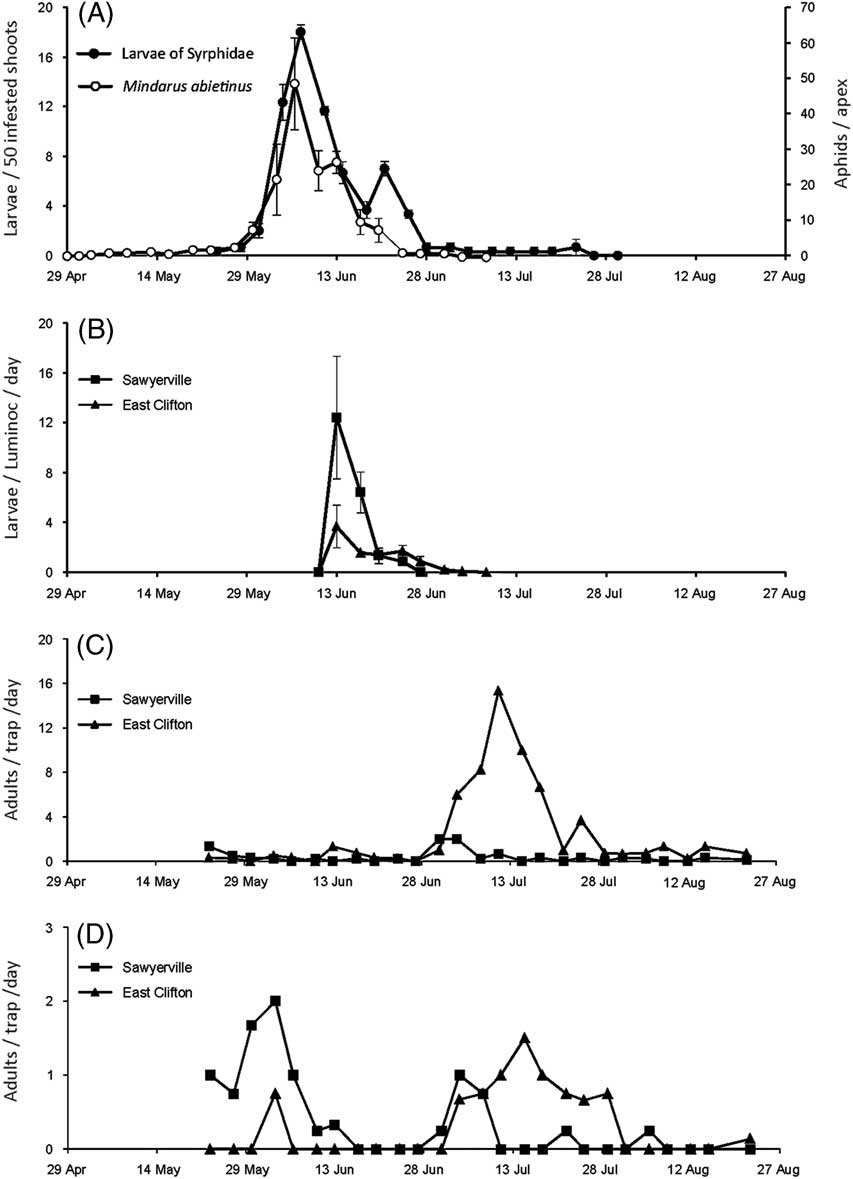
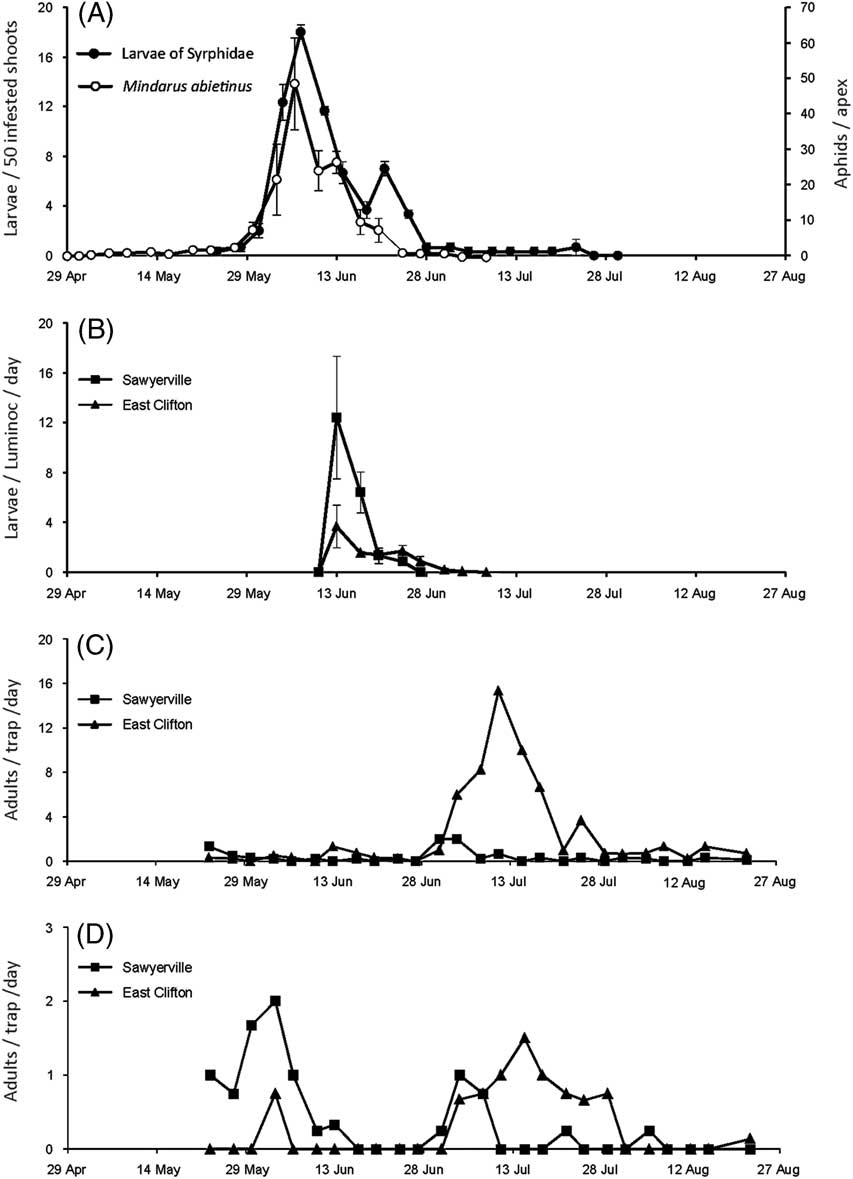
Fundatrices of the balsam twig aphid started to emerge at the beginning of May (Fig. 1A) at Sawyerville. Aphid density remained low until the last week of May when fundatrices became adults and began parthenogenetic reproduction (Fig. 1A). Then, balsam twig aphid density increased rapidly to reach a maximum of 50.0±12.9 (mean±SEM) aphids per apex on 6 June. Aphid density decreased gradually after the onset of the flight dispersal of mature sexuparae, which began on 12 June. The last date on which aphids were collected on balsam fir trees was 4 July. Only five syrphid eggs were observed on balsam fir shoots and the first larvae appeared during the last week of May when balsam twig aphid density began to increase (Fig. 1A). Syrphid larval density then increased rapidly, following closely the aphid population build-up to reach a maximum of 18.00±0.56 (mean±SEM) larvae per 50 infested shoots on 7 June (Fig. 1A). Syrphid larval density then decreased gradually and closely followed balsam twig aphid density. In the Luminoc® pitlight traps at Sawyerville, syrphid larvae were first captured on 13 June, when larval density on infested shoots was decreasing (Fig. 1B). A similar pattern was observed in the other untreated plantation (East Clifton), but in which larval density was low compared with the Sawyerville plantation (Fig. 1B).
Seasonal abundance of Mindarus abietinus and syrphid larvae per balsam fir apex (A), syrphid larvae in Luminoc® pitlight traps (B), adult flies of Eupeodes americanus (C), and adults of Syrphus torvus (D) in Malaise traps in balsam fir Christmas tree plantations, in Québec, Canada.
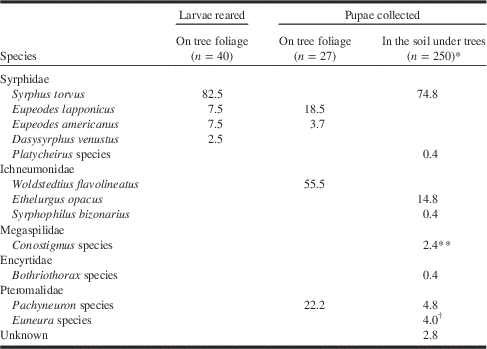
Four species of Syrphidae emerged from larvae reared on balsam twig aphids (Table 1). Syrphus torvus Osten Sacken was by far the most abundant species preying on the balsam twig aphid (82.5% of recovered individuals), followed by Eupeodes lapponicus (Zetterstedt) and Eupeodes americanus (Wiedemann) (Table 1). No parasitoid emerged from reared larvae. Syrphid species showed strongly different pupation sites, pupae of S. torvus being found exclusively in soil samples under balsam fir trees, while pupae of Eupeodes species were exclusively found on branches of balsam fir trees (Table 1). No pupa of Dasysyrphus venustus (Meigen) (Diptera: Syrphidae) was found either under or on trees, probably because of their low density (only one individual was recovered from rearing). Moreover, different parasitoids emerged from syrphid pupae depending on their location. Syrphid pupae collected on balsam fir branches were heavily parasitised by Woldstedtius flavolineatus (Gravenhorst) (Hymenoptera: Ichneumonidae) and the gregarious Pachyneuron Walker (Hymenoptera: Pteromalidae), while those collected in the soil under balsam fir trees were less parasitised but by a wider variety of parasitoids (Table 1). The Ethelurgus opacus Townes (Hymenoptera: Ichneumonidae) was the most frequent parasitoid in syrphid pupae under trees but at least four gregarious micro-hymenoptera representing four genera among three families were also collected. Multiple parasitism was common in syrphid pupae collected under trees, mostly by Pachyneuron and Euneura Walker (Hymenoptera: Pteromalidae) that were observed in 83.3% of parasitised pupae. One of these pupae was also parasitised by a third species, Conostigmus Dahlbom (Hymenoptera: Megaspilidae). Euneura were never found alone in a syrphid pupa, contrary to Pachyneuron. The number of individuals of Pachyneuron emerged from syrphid pupae was much higher when they were collected on the foliage than in pupae under trees (20 versus 7.2 parasitoids/syrphid pupa). However, an average of 7.9 Euneura also emerged from syrphid pupa parasitised by Pachyneuron. The encyrtid Bothriothorax Ratzeburg (Hymenoptera: Encyrtidae) was found in only one pupa in which Conostigmus Dahlbom (Hymenoptera: Megaspilidae) was also present.
Adult syrphid flies or parasitoids emerged from syrphid larvae collected on balsam fir trees and reared on Mindarus abietinus, and from syrphid pupae collected on the foliage of balsam fir trees or in the soil under trees in the Sawyerville Christmas tree plantation, Québec, Canada.

Notes: The data are expressed as percentage of syrphid larvae reared or pupae collected.
* % Exceeds 100% because of multiple parasitism.
** Includes two cases of multiple parasitism, one with Bothriothorax and one with Pachyneron and Euneura.
† Was always found with Pachyneuron (10 cases).
From the four syrphids identified as predators of the balsam twig aphid on trees (Table 1), only two were sufficiently abundant in Malaise traps to describe their adult seasonal abundance in the untreated plantations of Sawyerville and East Clifton. Adults of E. americanus were caught in small numbers in the two insecticide-free plantations before 28 June (Fig. 1C). After this date, which coincided with the end of high larval population on aphid-infested shoots, syrphid captures in Malaise traps increased strongly, particularly in the East Clifton plantation. Captures of S. torvus flies occurred in two distinct periods (Fig. 1D), the first one following closely the larval density peak, and the second one beginning in early July after the period of larval drop to the ground as measured with the Luminoc® pitlight traps.
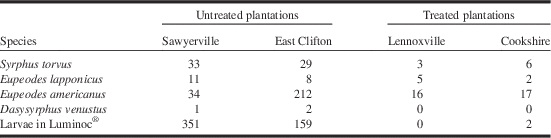
Abundance of predaceous syrphid species of the balsam twig aphid was higher in untreated balsam fir plantations compared with plantations sprayed with Diazinon to control balsam twig aphid populations. Only two syrphid larvae were captured in the pitlight traps in the two-sprayed plantations (Table 2). Captures of syrphid larvae was twice higher in Luminoc® pitlight traps in the Sawyerville than the East Clifton plantation. Adult captures of predaceous syrphids in Malaise trap (Table 2) were also higher in the two untreated plantations compared with the treated plantations. Furthermore, adults of Dasysyrphus venustus were only caught in the two untreated plantations (Table 2).
Malaise trap catches of four species of predaceous syrphid flies of the balsam twig aphid and Luminoc® pitlight trap catches of syrphid fly larvae in four balsam fir Christmas tree plantations in Québec, Canada.

Discussion
Our study confirms, for the first time, that at least four different species of Syrphidae are predators of the balsam twig aphid, the dominant one being S. torvus, which has never been reported before as a predator of the balsam twig aphid. Larvae of E. lapponicus and D. venustus are also reported for the first time as balsam twig aphid predators, as well as larvae of E. americanus, which was reported as adult flies near balsam twig aphid colonies by Kleintjes (Reference Kleintjes1997). However, the nine other species reported as adults by this author were not confirmed as balsam twig aphid predators in our study. Syrphid predator diversity is expected to vary spatially and temporally (Banks Reference Banks1959; Brown and Clark Reference Brown and Clark1960; Pollard Reference Pollard1971; Niehoff and Poehling Reference Niehoff and Poehling1995). The low abundance of D. venustus is consistent with the fact that this species is not considered as a specialist aphid feeder during larval development, contrary to the three other species associated with the balsam twig aphid in this study (Vockeroth Reference Vockeroth1992). Larvae of D. venustus can feed on aphids, but these may not be their preferred prey (Vockeroth Reference Vockeroth1992). The three other species confirmed here as predators of balsam twig aphid are known as aphid predators (Vockeroth Reference Vockeroth1992), and larvae of S. torvus and E. lapponicus have been reared with aphids collected on balsam fir trees (Brown and Clark Reference Brown and Clark1960; Vockeroth Reference Vockeroth1992).
Maximum abundance of syrphid larvae on balsam fir trees was observed during the maximum balsam twig aphid density. A similar pattern has previously been reported for aphids and their predators for numerous ecosystems (Dean Reference Dean1982; Chambers et al. Reference Chambers, Sunderland, Stacey and Wyatt1982, Reference Chambers, Sunderland, Stacey and Wyatt1986; Chambers and Adams Reference Chambers and Adams1986). In fact, synchrony with prey is critical for aphid predators (Chambers et al. Reference Chambers, Sunderland, Stacey and Wyatt1986; Berthiaume et al. Reference Berthiaume, Hébert and Cloutier2007) and this is particularly true for syrphid larvae, which are legless and thus have a poor moving capacity compared with other aphid predators, such as Coccinellidae (Sundby Reference Sundby1966; Schneider Reference Schneider1969). However, female syrphid flies are strong fliers and have good searching abilities to lay their eggs in the vicinity of aphid colonies (Chandler Reference Chandler1968a, Reference Chandler1968b, Reference Chandler1968d; Kidd Reference Kidd1982; White et al. Reference White, Wratten, Berry and Weigmann1995; Wratten et al. Reference Wratten, White, Bowie, Berry and Weigmann1995), which facilitates larval feeding as young larvae have close access to abundant prey (Schneider Reference Schneider1969). Few syrphid eggs were observed during our study, suggesting that we may have sampled balsam fir shoots at longer intervals than embryonic development of syrphid eggs and probably missed the peak of syrphid oviposition on balsam fir trees. In other studies, embryonic development of syrphid eggs was shown to be fast, being shorter than two days at temperature ranging between 20 °C and 25 °C (Chandler Reference Chandler1969; Ankersmit et al. Reference Ankersmit, Dijkman, Keuning, Mertens, Sins and Tacoma1986; Hart et al. Reference Hart, Bale and Fenlon1997). It is crucial that syrphid larval development be synchronised with the early development of aphid colonies because aphid density decreased rapidly after their adult flight dispersal, food availability being the main limiting factor for completing syrphid larval development (Tornier and Drescher Reference Tornier and Drescher1991). As reported elsewhere (Pollard Reference Pollard1971; Chambers et al. Reference Chambers, Sunderland, Stacey and Wyatt1986), inter annual weather variations could also influence predatory-prey synchrony and thus could be involved in aphid population build-up.
Syrphus torvus pupae were found on the top or in crevices of the upper ground litter under balsam fir trees. In a study of predaceous Syrphidae attacking the balsam woolly adelgid (Adelges piceae (Ratzeburg); Hemiptera: Adelgidae) in New Brunswick, Brown and Clark (Reference Brown and Clark1960) also observed that pupae of S. torvus were always found on the forest floor, where several other species of Syrphidae are also known to pupate (Clark and Brown Reference Clark and Brown1959; Schneider Reference Schneider1969; Hovemeyer Reference Hovemeyer1992, Reference Hovemeyer1995; Mitchell and Maksymov Reference Mitchell and Maksymov1977). These species appear to need the moist soil environment to form their puparia (Mitchell and Maksymov Reference Mitchell and Maksymov1977). Other species of predaceous Syrphidae rather pupate in close proximity to where their prey feed (Brown and Clark Reference Brown and Clark1960; Schneider Reference Schneider1969; Vockeroth Reference Vockeroth1992). In our study, the two species of Eupeodes showed this behaviour and pupae were exclusively found on foliage of balsam fir trees. Brown and Clark (Reference Brown and Clark1960) also observed this behaviour for E. lapponicus on balsam fir trees infested by the balsam woolly adelgid. Differential niche selection is an important mechanism that permits species coexistence (Rosenzweig Reference Rosenzweig1981; Berthiaume et al. Reference Berthiaume, Hébert and Cloutier2007). Oviposition niche partitioning based on spatial distribution is known for aphidophagous Syrphidae (Chandler Reference Chandler1968c; Hickman and Wratten Reference Hickman and Wratten1996). Our results indicate that differential niche selection can also occur for pupation among the species found here. We also observed spatial segregation of parasitoids associated with syrphid pupae. In our study, two species of Ichneumonidae emerged from pupae found on the forest floor (probably exclusively pupae of S. torvus), but these two species were not found in pupae collected on balsam fir tree branches. Conversely, Woldstedtius flavolineatus attacked exclusively pupae of Syrphidae found on foliage. This parasitoid thus seems specific to the genus Eupeodes because only pupae of these syphids were found on foliage. Also, Pachyneuron species was the only micro-hymenopteran parasitoid found in syrphid pupae on the foliage while at least four species were found in pupae under trees. This gregarious parasitoid was the most frequent micro-hymenopteran parasitoid under trees but it was most often found with Euneura species, another gregarious species, which is known as hyperparasitoid (Polaszek Reference Polaszek2011). The number of Pachyneuron adults emerged from syrphid pupae under trees was three times lower than from pupae found on the foliage, even if pupae under trees were larger. As Euneura were never found alone in a pupa, this suggests that this species is a hyperparasitoid of Pachyneuron. This higher diversity of parasitoids at the ground level might be linked with the presence of numerous Diptera pupating in the soil.
Captures in Luminoc® pitlight and Malaise traps indicate that few captures of syrphid flies and larvae occurred in the two plantations sprayed with Diazinon. Luminoc® pitlight traps indicated that recruitment in the treated balsam fir plantations was virtually non-existent, with only two larvae caught. This can be explained first by the fact that Diazinon is known to have deleterious effect on adult Syrphidae (Schneider Reference Schneider1969), and thus its use probably strongly reduced their local abundance. Secondly, insecticide application reduced balsam twig aphid population and indirectly the abundance of food for syrphids. These explanations are not exclusive and interaction probably explains the fact that so few syrphids were observed in treated balsam fir plantations. It is also likely that insecticide treatments, which are generally used yearly in plantations where balsam twig aphid is present, have a cumulative impact on the aphid and their predators.
As for other predators found in balsam fir Christmas tree plantation (Kleintjes Reference Kleintjes1997; Berthiaume et al. Reference Berthiaume, Hébert and Cloutier2000, Reference Berthiaume, Hébert and Cloutier2001, Reference Berthiaume, Hébert and Cloutier2007), more research is needed to improve our knowledge of the natural history and ecology of syrphids in this system, particularly as communities vary regionally (Nettleton and Hain Reference Nettleton and Hain1982; Kleintjes Reference Kleintjes1997). In order to define management guidelines to increase syrphid efficacy against the balsam twig aphid, we also need to determine ecological conditions in which syrphid predatory activity is maximised. This could be done through studies aimed to estimate the impact of syrphids on various balsam twig aphid populations.
Acknowledgements
The authors thank N. Desrosiers and A. Bastien from Laval University for field and laboratory assistance and J. Thibault and C. Germain (Laurentian Forestry Centre of the Canadian Forest Service in Québec) for technical assistance. Special thanks to J.R. Vockeroth from the Biosystematics Research Institute for confirmation of Syrphidae identification. Financial support for this work was provided by research grants from le Ministère de l’Environnement et de la Faune du Québec and by the Pest Management Network of the Canadian Forest Service.