Halosulfuron-methyl is a sulfonylurea herbicide that inhibits acetolactate synthase (ALS), a key enzyme in the production of the branched-chain amino acids isoleucine, leucine, and valine (Shaner Reference Shaner2014). It is registered PREPLANT before transplanting, PRE after seeding, and POST in cucumber and POST-directed in summer squash. Various studies have shown that halosulfuron-methyl may be an alternative to methyl bromide for managing yellow (Cyperus esculentus L.) and purple nutsedge (Cyperus rotundus L.) in vegetable crops (Blum et al. Reference Blum, Isgrigg and Yelverton2000; Fischer and Harvey Reference Fischer and Harvey2002; Nelson and Renner Reference Nelson and Renner2002; Trader et al. Reference Trader, Wilson and Hines2008; Vencill et al. Reference Vencill, Richburg, Wilcut and Hawf1995). In addition to nutsedge control, halosulfuron-methyl provides control of smartweed (Polygonum spp.) and pigweed (Amaranthus spp.) as well as common cocklebur (Xanthium strumarium L.), hairy galinsoga (Galinsoga quadriradiata Cav.), common ragweed (Ambrosia artemisiifolia L.), and wild radish (Raphanus raphanistrum L.) (Jennings et al. Reference Jennings, Monks and Mitchem2016). Additionally, velvetleaf was controlled 88% with halosulfuron-methyl PRE at 110 g ai ha−1 (Brown and Masiunas Reference Brown and Masiunas2002) and 98% with halosulfuron-methyl POST at 36 g ha−1 tank mixed with glyphosate at 630 g ae ha−1 (Fischer and Harvey Reference Fischer and Harvey2002).
However, limited control of morningglory species (Ipomoea spp.) with halosulfuron-methyl applied POST has been noted in several studies. Norsworthy and Meister (Reference Norsworthy and Meister2007) noted only 70% pitted morningglory control at 35 g ai ha−1 on 7.5- to 15-cm-tall weeds, whereas Trader et al. (Reference Trader, Wilson and Hines2007) reported 51% to 77% control of ivyleaf morningglory (Ipomoea hederacea Jacq.) and tall morningglory [Ipomoea purpurea (L.) Roth] with rates from 9 to 27 g ha−1. MacRae et al. (Reference MacRae, Monks, Batts, Thorton and Schultheis2007) confirmed sweetpotato [Ipomoea batatas (L.) Lam.] tolerance to halosulfuron-methyl with only 11% yield reduction when applied at 13 to 65 g ha−1 at 1 to 4 wk after crop planting. Previous research has revealed that cucumber can tolerate halosulfuron-methyl better than other cucurbits. Webster et al. (Reference Webster, Culpepper and Johnson2003) observed less than 10% cucumber shoot biomass reduction with PRE and/or POST applications at 53 g ha−1. Similarly, Mitchem and Monks (Reference Mitchem and Monks1997) reported that ‘Calypso’ cucumber could tolerate 71 g ha−1 of halosulfuron-methyl applied PRE or PRE and POST. Trader et al. (Reference Trader, Wilson and Hines2007) observed at most 13% cucumber injury 7 d after treatment (DAT) in the form of stunting and foliar chlorosis followed by complete crop recovery within 14 DAT with halosulfuron-methyl PRE or POST at rates ranging from 9 to 27 g ha−1.
Conversely, halosulfuron-methyl POST on summer squash reduced flower number 32% to 82%, depending on variety and herbicide rate, and reduced yield 25% to 45% (Starke et al. Reference Starke, Monks, Mitchem and Macrae2006). Webster and Culpepper (Reference Webster and Culpepper2005) reported that drip-applied halosulfuron-methyl at 39 g ha−1 caused up to 38% injury in zucchini summer squash, resulting in stunted plants. Thus, summer squash is generally viewed as nontolerant to halosulfuron-methyl POST applications.
The physiological basis for this differential tolerance of cucumber and summer squash to halosulfuron-methyl is not known. Rapid absorption of halosulfuron-methyl has been reported for green kyllinga (Kyllinga brevifolia Rottb.) and false green kyllinga (Kyllinga gracillima Miq.), with 47% of applied [14C]halosulfuron-methyl absorbed by 4 h after treatment (HAT) and 77% of absorbed herbicide remaining in the form of the parent compound by 96 HAT, mostly in the treated leaf and primary shoot (McElroy et al. Reference McElroy, Yelverton, Burke and Wilcut2004). Tolerance of wheat (Triticum spp.) and corn (Zea mays L.) to halosulfuron-methyl has been attributed to rapid metabolism through the hydroxylation of the pyrimidine ring followed by rapid glucose conjugation in corn and O-demethylation of the methoxy group of the pyrimidine ring in wheat (Dubelman et al. Reference Dubelman, Solsten, Fujiwara and Mehrsheikh1997).
Studies were conducted to determine absorption, translocation, and metabolism of foliar-applied [14C]halosulfuron-methyl in cucumber, summer squash, velvetleaf, and pitted morningglory to identify the basis for differential susceptibility among these species.
Materials and Methods
Plant Material
‘Early Prolific Straightneck’ summer squash and ‘Poinsett 76’ cucumber (Wyatt-Quarles Seed, Garner, NC 27529) and velvetleaf and pitted morningglory (collected near Clayton, NC) were planted in a professional growing mix (Fafard® 2 RSI, Sun Gro Horticulture Distribution, Agawam, MA 01001). Plants were grown in 10 by 10 cm square plastic pots and thinned to 1 plant pot−1 upon emergence. Plants were watered daily and grown in a greenhouse under a 24/15 C day/night temperature regime with a 16-h photoperiod. Natural light was supplemented 4 h daily with metal-halide lighting with an average midday photosynthetic photon flux of 700 μmol m−2 s−1. Plants were fertilized as needed with a fertilizer solution containing 6 mg L−1 of 20% N, 20% P2O5, and 20% K2O (Peters® Professional 20-20-20 water-soluble fertilizer, Scotts, Marysville, OH 43041).
Absorption and Translocation
Radiolabeled ([14C]pyrazole) halosulfuron-methyl with a specific activity of 2575 kBq mg−1and 98% radioactive purity was foliar applied as described by McElroy et al. (Reference McElroy, Yelverton, Burke and Wilcut2004). Treatments were applied at the 4-leaf stage for summer squash and cucumber and at 10 cm for velvetleaf and pitted morningglory. A 1-cm² piece of aluminum foil was used to partially cover the fully expanded youngest leaf on which [14C]halosulfuron-methyl was to be applied, and formulated halosulfuron-methyl (Sandea®, 75%, Gowan, Yuma, AZ 85366) at 40 g ai ha−1 plus 0.25% v/v nonionic surfactant (NIS; Induce® surfactant, Helena Chemical, Memphis, TN 38137) was applied to uncovered parts of the plants. The rate of halosulfuron-methyl corresponds to the median of the range of rates indicated on the herbicide label for use in cucumber (Anonymous 2012). Herbicide was applied using a spray chamber with a CO2-pressurized sprayer calibrated to deliver 190 L ha−1 at 146 kPa. Immediately after spraying, ten 1-µl droplets (Hamilton® Microliter Pipetter No. 705, Hamilton, Reno, NV 89502) of [14C]halosulfuron-methyl were applied to the adaxial surface of the previously foil-covered leaf of each crop and weed species for a total of 1.7 kBq plants−1. Radioactive spotting solution was a 1:1 v/v mixture of deionized water and acetone. The solution was prepared by dissolving radiolabeled [14C]halosulfuron-methyl and the commercial formulation of halosulfuron-methyl in a 1:1 v/v mixture of acetone and high-performance liquid chromatography–grade water to bring the total amount of halosulfuron-methyl applied to the treated leaf to 40 g ai ha−1. Acetone was used as the primary solvent for [14C]halosulfuron-methyl because of the instability of the compound in methanol (McElroy et al. Reference McElroy, Yelverton, Burke and Wilcut2004). NIS at 0.25% v/v was also included in the radiolabeled mixture.
Plants were harvested at 4, 24, 48, and 72 HAT. Soil from plant roots was hand removed by gentle shaking, and plants were divided into sections: (1) treated leaf, (2) above treated leaf, (3) below treated leaf, and (4) roots. Treated leaves were rinsed twice with 10 ml of a 1:1 v/v mixture of methanol-deionized water and 0.25% v/v NIS to remove unabsorbed halosulfuron-methyl. A 1-ml aliquot of each leaf wash was added to 20 ml of scintillation fluid (ScintiVerse™ BD Cocktail, Fisher Scientific, Fairlawn, NJ 07410), and radioactivity was quantified by liquid scintillation spectrometry (LSS) (Tri-Carb 2100TR Liquid Scintillation Spectrometer, PerkinElmer, Waltham, MA 02451). All plants parts were placed in paper bags, oven-dried at 60 C for 48 h, weighed, and combusted in a biological-sample oxidizer (Model OX-500 Biological Material Oxidizer, R. J. Harvey Instrument, Tappan, NY 10983), and radioactivity trapped as [14C]O2 was quantified by LSS.
Metabolism
Halosulfuron-methyl metabolism was determined by applying 10 μl of 14C-labeled halosulfuron-methyl to a leaf as described earlier. At 4, 24, 48, 72, and 96 HAT, the treated leaves were removed and washed as described earlier to remove unabsorbed herbicide. The entire treated plant was removed from the pot, washed free of soil, and immediately stored at −20 C with the treated leaf until further analysis of metabolites. Plant samples were later oven-dried at 60 C for 48 h and ground in a tissue homogenizer (Pyrex® 40-ml Ten Broeck Tissue Homogenizer No. 7727-40, Corning, Corning, NY 14831) with 10 ml of ethyl acetate. The homogenate was rinsed into a vacuum filtration apparatus with an additional 10 to 15 ml of the same solvent. The resulting filtrate was evaporated to dryness under a stream of air at room temperature. The samples were then re-eluted with 1 ml of ethyl acetate, vortexed for 1 min, and stored at −20 C until further analysis of halosulfuron-methyl metabolites.
Silica gel thin-layer chromatography (TLC) plates (20 by 20 cm) were partitioned into 1-cm lanes, and a lane was spaced between each spotted lane to prevent contamination. A 200 μl measure from each extraction sample solution was dropped on TLC plates and developed to an 18-cm solvent front. A 5-μl solution of [14C]halosulfuron-methyl standard was spotted on the first lane of each plate to serve as a reference. TLC plates were developed using a solvent mixture of butanol, water, and acetic acid (4:4:1 v/v/v). Plates were then air-dried, and radioactive positions, quantities, and corresponding R f values were determined by scanning TLC plates through a radiochromatogram scanner (Bioscan System 200 Imaging Scanner, Bioscan, Washington, DC 20007). Radioactive trace peaks were integrated with Win-Scan® software (LabLogic® Win-Scan Radio TLC v. 2.2, Bioscan, Washington, DC 20007), with the smoothing point set to 9-point cubic and background excluded from peak area calculations. Peaks below 1% of total radioactivity were rejected. The parent herbicide was identified through comparison with the R f value of the standard within each plate. Data consisted of the percentage parent herbicide, the percentage of metabolites that were more polar than the parent herbicide, and the percentage of metabolites that were less polar than the parent herbicide.
Potential herbicide degradation due to the extraction process was not evaluated, as McElroy et al. (Reference McElroy, Yelverton, Burke and Wilcut2004) reported >98% of recovered radioactivity in the form of halosulfuron-methyl for leaves spotted with [14C]halosulfuron-methyl and immediately processed. Statistical analysis was similar to the absorption and translocation study.
Statistical Analysis
The study was conducted as a randomized complete block design with a split-split-plot treatment arrangement and three replications in two experimental runs. Factors included plant species (summer squash, cucumber, velvetleaf, or pitted morningglory), harvest timings (4, 24, 48, and 72 HAT), and plants parts (treated leaf, above treated leaf, below treated leaf, or root). Main plots were harvest timings, subplots were plant species, and sub-subplots were plant portions. Data were subjected to ANOVA using the PROC GLIMMIXin SAS v. 9.4 (SAS Institute, Cary, NC 27513) to determine whether experimental runs could be combined for regression analysis. Harvest timings, plant species, plant parts, and their interaction were considered fixed variables, whereas replication, experimental run, and their interaction were considered random effects (Carmer et al. Reference Carmer, Nyquist and Walker1989). Treatment means were separated using Fisher’s protected LSD test at P=0.05. Nonlinear regression of absorption and translocation out of the treated leaf data were analyzed in R (R Core Team 2016) and plotted in SigmaPlot v. 12.0 (Systat Software, San Jose, CA 95110) using a rectangular hyperbolic model expressed as follows:
 $$y{\,\equals\,}{{\left( {A_{{{\rm max}}} t} \right)} \mathord{\left/ {\vphantom {{\left( {A_{{{\rm max}}} t} \right)} {\left( {0.11t_{{90}} {\plus}t} \right)}}} \right. \kern-\nulldelimiterspace} {\left( {0.11t_{{90}} {\plus}t} \right)}}$$
where y is expressed as the percentage of the applied dose, A max is the maximum percentage of applied [14C]glyphosate that was absorbed, t is the time, and t 90 is the time required for reaching 90% of maximum absorption (Kniss et al. Reference Kniss, Vassios, Nissen and Ritz2011; Nandula and Vencill Reference Nandula and Vencill2015).
Plotting of halosulfuron-methyl metabolism to unknown metabolites in Sigmaplot v. 12.0 was described by linear regression in summer squash, velvetleaf, and pitted morningglory (Equation 2) and by asymptotic regression in cucumber (Equation 3).
 $$y{\,\equals\,}b{\plus}ax$$
 $$y{\,\equals\,}ae^{{\left( {{b \over {c{\plus}x}}} \right)}} $$
In both equations, y is halosulfuron-methyl conversion to metabolites, and x is the time after application (in hours).
Results and Discussion
Absorption
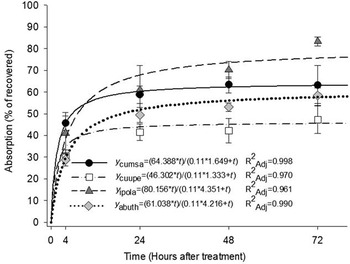
[14C]halosulfuron-methyl absorption based on leaf-wash recovery and total 14C recovered from plant parts was not different between experimental runs (P=0.1452); therefore, data from absorption experiments were combined. Recovery of [14C]halosulfuron-methyl averaged over time and species when radioactivity of the leaf wash was combined with radioactivity measured within the different plant parts was 83.4 ± 5.6%. Based on the Akaike information criterion (AIC) (Kniss et al. Reference Kniss, Vassios, Nissen and Ritz2011), absorption data were best fit using the rectangular hyperbolic model (see Equatio 1) (AIC: 946) compared with the asymptotic regression (AIC: 952); therefore, [14C]halosulfuron-methyl absorption was described using the rectangular hyperbolic model (Figure 1). The time required for 90% of maximum absorption (t 90) was not significantly different (P>0.05) among the four species, varying from 15 to 40 HAT. Maximum absorption (A max) of [14C]halosulfuron-methyl as predicted by the rectangular hyperbolic model was significantly higher (P<0.01) in halosulfuron-methyl–tolerant pitted morningglory (A max=80.2%) compared with all other species. Summer squash had a significantly lower (P<0.01) maximum absorption (A max=46.3%) than velvetleaf (A max=61.1%) and cucumber (A max=64.4%). In accordance with our estimated A max value for pitted morningglory, Carey et al. (Reference Carey, Penner and Kells1997) noted lower absorption of primisulfuron-methyl and nicosulfuron in sensitive johnsongrass [Sorghum halepense (L.) Pers.] than in primisulfuron-methyl–tolerant barnyardgrass [Echinochloa crus-galli (L.) Beauv.] and giant foxtail (Setaria faberi Herrm.), and in nicosulfuron-tolerant eastern black nightshade (Solanum ptychanthum Dunal). Askew and Wilcut (Reference Askew and Wilcut2002) reported greater absorption of trifloxysulfuron by tolerant jimsonweed (Datura stramonium L.) than by sensitive peanut (Arachis hypogaea L.) and sicklepod [Senna obtusifolia (L.) H. S. Irwin & Barneby]. Yet, as for these other sulfonylurea herbicides, differential absorption did not explain differential tolerance to halosulfuron-methyl. McElroy et al. (Reference McElroy, Yelverton, Burke and Wilcut2004) reported fast absorption in green and false green kyllinga, with 50% herbicide absorbed by 4 HAT and a maximum of 67% by 96 HAT, regardless of kyllinga species. Other studies have reported the rapidity at which sulfonylurea herbicides are absorbed by diverse plant species. Absorption of foliar-applied chlorimuron-ethyl was 75% or greater 24 HAT before plateauing during the next 48 h for soybean [Glycine max (L.) Merr.], peanut, prickly sida (Sida spinosa L.), and sicklepod (Wilcut et al. Reference Wilcut, Wehtje, Patterson, Cole and Hicks1989). A similar trend was also observed with trifloxysulfuron in cotton (Gossypium hirsutum L.), jimsonweed, smooth pigweed (Amaranthus hybridus L.), and spurred anoda [Anoda cristata (L.) Schlecht.] (Askew and Wilcut Reference Askew and Wilcut2002; Richardson et al. Reference Richardson, Hatzios and Wilson2003).
Rectangular hyperbolic model for [14C]halosulfuron-methyl absorption in cucumber (cumsa), summer squash (cuupe), pitted morningglory (ipola), and velvetleaf (abuth) during a 72-h time course and expressed as percentage of total recovered [14C]halosulfuron-methyl.

Translocation
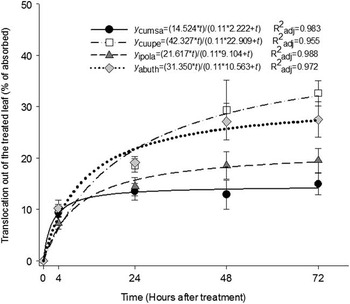
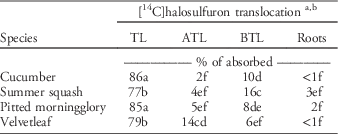
In the absence of significant difference (P=0.6668), translocation data from the two experimental runs were combined. The species by plant part interaction was significant (P=0.0002) for translocation of absorbed 14C radioactivity; therefore, data are presented as the percentage of recovered herbicide from the leaf wash and plant parts pooled over harvest timings (Table 1). Greater than 85% of absorbed [14C]halosulfuron-methyl remained in the treated leaf of cucumber and pitted morningglory, whereas less than 80% remained in the treated leaf of summer squash and velvetleaf. In cucumber and summer squash, most of the translocation occurred below the treated leaf with 10% and 16% of absorbed [14C]halosulfuron-methyl, respectively. A higher percentage of radioactivity was translocated above treated leaf (14%) than below treated leaf (6%) in velvetleaf, similar to previous reports with thifensulfuron (Lycan and Hart Reference Lycan and Hart1999). Minimal translocation occurred into the roots, with less than 3% of recovered 14C radioactivity, regardless of species. The rectangular hyperbolic model rather than the asymptotic regression was chosen to describe 14C radioactivity translocated out of the treated leaf (Figure 2), with AIC equal to 760 and 764, respectively. Using Equation 1 and considering T max (predicted total translocation) instead of A max, significantly lower T max was noted for cucumber compared with velvetleaf (P=0.0001) and summer squash (P=0.0003) with 14.5%, 31.5%, and 42.3%, respectively. Similarly, T max was significantly lower (P=0.0091) for pitted morningglory (T max=21.6%) compared with summer squash. The time to reach 90% of predicted maximum translocation was not significantly different between the four species. Previous studies also noted that the amount of sulfonylurea herbicide translocated out of the treated leaf may differ depending on plant species. McElroy et al. (Reference McElroy, Yelverton, Burke and Wilcut2004) reported up to 43% of absorbed [14C]halosulfuron translocated out of the treated leaf in Kyllinga spp. Askew and Wilcut (Reference Askew and Wilcut2002) found that less than 2% of applied [14C]trifloxysulfuron moved out of the treated leaf of cotton, peanut, and sicklepod, but up to 25% moved in the meristematic area of jimsonweed, whereas Wilcut et al. (Reference Wilcut, Wehtje, Patterson, Cole and Hicks1989) reported between 5% and 20% of applied [14C]chlorimuron-ethyl translocated out of the treated leaf at 72 HAT in two crop and four weed species. Translocation of absorbed [14C]nicosulfuron out of the treated leaf at 72 HAT was reported to be less than 5% in tolerant corn and sensitive broadleaf signalgrass [Urochloa platyphylla (Nash) R. D. Webster] (Gallaher et al. Reference Gallaher, Mueller, Hayes, Schwartz and Barrett1999) and less than 3% in tolerant eastern black nightshade but up to 23% in sensitive johnsongrass (Carey et al. Reference Carey, Penner and Kells1997). The biosynthesis of amino acids occurs primarily in young tissues, and greater acropetal translocation of ALS-inhibiting herbicides should cause greater herbicidal activity (Zhou et al. Reference Zhou, Liu, Zhang and Liu2007). Greater movement of halosulfuron above the treated leaf was observed for velvetleaf than for any other species and may be associated with velvetleaf sensitivity to halosulfuron-methyl. However, a similar translocation pattern was not observed in susceptible summer squash. This indicates that some level of herbicide translocation may occur and that sensitive species translocated 6% to 9% more of absorbed 14C radioactivity than tolerant species. Therefore, variations in the amount of radioactivity translocated out of the treated leaf may explain the differential sensitivity to halosulfuron-methyl between species used in this study.
Rectangular hyperbolic model for [14C]halosulfuron-methyl translocated out of the treated leaf in cucumber (cumsa), summer squash (cuupe), pitted morningglory (ipola), and velvetleaf (abuth) during a 72-h time course and expressed as percentage of total absorbed [14C]halosulfuron-methyl.

Translocation of [14C]halosulfuron in four plant species, averaged over harvest at 4, 24, 48, and 72 h after treatment.

a Abbreviations: ATL, above treated leaf; BTL, below treated leaf; TL, treated leaf.
b Means followed by the same letter are not different according to Fisher’s protected LSD (P ≤ 0.05).
Metabolism
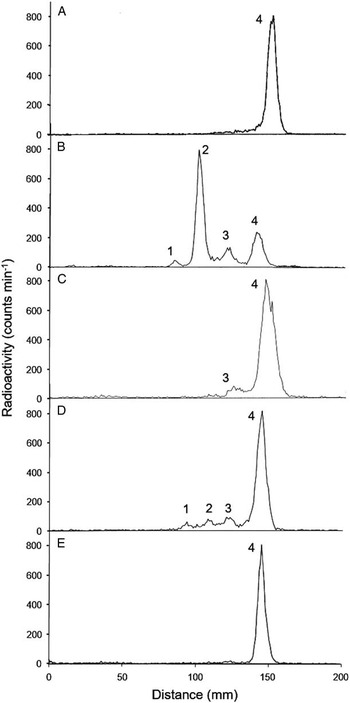
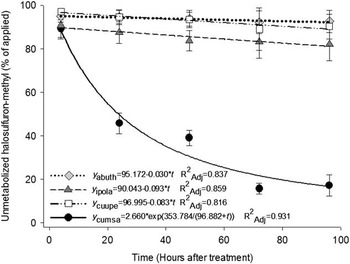
The R f value was approximately 0.75 for [14C]halosulfuron standard (Figure 3A), while three metabolites were detected with R f equal to 0.22, 0.43, and 0.52, respectively (Figure 3B). All metabolites had lower R f values than the parent compound and were combined as more polar metabolites. Nonpolar or less polar metabolites were not detected on radiograms. Similarly, McElroy et al. (Reference McElroy, Yelverton, Burke and Wilcut2004) only reported two polar metabolites of halosulfuron, although the R f values were lower at 0.13 and 0.20, respectively. Limited halosulfuron-methyl metabolism was observed in velvetleaf and summer squash, with the linear regression model predicting 94.5% and 90.3%, respectively, of the parent compound persisting 96 HAT (Figure 4). The sensitivity of velvetleaf to thifensulfuron has been directly related to its reduced ability to metabolize this herbicide (Brown et al. Reference Brown, Wittenbach, Forney and Strachan1990). Greater metabolic activity was observed for pitted morningglory, with the linear regression model predicting 17.6% of the parent compound metabolized after 96 HAT. McElroy et al. (Reference McElroy, Yelverton, Burke and Wilcut2004) reported 22% of [14C]halosulfuron metabolized 96 HAT in green kyllinga, a turf weed species for which previous studies have demonstrated limited control (<70%) with single or sequential applications of halosulfuron (Belcher et al. Reference Belcher, Walker, van Santen and Wehtje2002; Blum and Yelverton Reference Blum and Yelverton1997). Rapid herbicide metabolism was observed for cucumber, with asymptotic regression model predicting 60% [14C]halosulfuron remaining by 24 HAT and only 6% by 96 HAT. Around 48% of the radioactivity was converted to an unknown metabolite (R f=0.43) within 96 HAT in cucumber (Figure 3B), while similar conversion only averaged 6% in pitted morningglory (Figure 3C) and 3% in summer squash (Figure 3D) and was not noted in velvetleaf (Figure 3E). Li et al. (Reference Li, Kessler, Alves de Figueiredo, Nissen, Gaines, Westra, Van Acker, Hall, Robinson, Soltani and Sikkema2016) reported up 92% of halosulfuron metabolized after 48 h in halosulfuron-tolerant white bean (Phaseolus vulgaris L.) but a much lower level of metabolism in halosulfuron-sensitive adzuki bean [Vigna angularis (Willd.) Ohwi & Ohashi].
Thin-layer chromatography chromatogram of [14C]halosulfuron standard (A), and from whole-plant greenhouse-grown cucumber (B), summer squash (C), pitted morningglory (D), and velvetleaf (E) 96 h after treatment with [14C]halosulfuron. Peaks are labeled as (1) unknown metabolite (R f=0.22), (2) unknown metabolite (R f=0.43), (3) unknown metabolite (R f=0.52), and (4) halosulfuron-methyl (R f=0.75).

Metabolism of [14C]halosulfuron-methyl in cucumber (cumsa), summer squash (cuupe), pitted morningglory (ipola), and velvetleaf (abuth) during 96-h time course and expressed as percentage of total applied [14C]halosulfuron-methyl.

These results suggest that differential metabolism among species plays an important role in reported variation of their tolerance to halosulfuron. This is especially true for cucumber, which had the greatest halosulfuron metabolic activity among the four species. Unsatisfactory halosulfuron control ranging from 35% to 76% for pitted, tall, and ivyleaf morningglory has been reported in previous studies (Norsworthy and Meister Reference Norsworthy and Meister2007; Trader et al. Reference Trader, Wilson and Hines2007) and may be caused by reduced translocation and limited metabolism despite a high level of herbicide absorption. Tolerance has also been related to lower sensitivity of the ALS enzyme to sulfonylurea herbicides. Differential ALS enzyme sensitivity was the major contributing factor explaining the differential tolerance of eastern black nightshade to nicosulfuron and primisulfuron (Carey et al. Reference Carey, Penner and Kells1997). Genetic alteration of the ALS enzyme has been shown to cause annual sowthistle (Sonchus oleraceus L.) and prickly lettuce (Lactuca serriola L.) resistance to sulfonylurea herbicides (Boutsalis and Powles Reference Boutsalis and Powles1995; Eberlein et al. Reference Eberlein, Guttieri, Mallory-Smith, Thill and Baerg1997). Further studies are needed to examine whether pitted morningglory tolerance to halosulfuron can also be caused by a less sensitive ALS enzyme or whether the reduced amount of translocated halosulfuron associated with greater metabolism is the sole contributing factor.