Introduction
Taxonomic investigation of the well-known Guanshan Biota (Cambrian, Stage 4) from eastern Yunnan of South China starting in 1997 (Luo et al., Reference Luo, Hu, Chen, Zhang and Tao1999, Reference Luo, Li, Hu, Fu, Hou, Liu, Chen, Li, Pang and Liu2008), and to date abundant and diverse macroscopic brachiopods (~5 mm in shell length) have been documented from deposits of the Guanshan Biota, including three linguloids (Eoobolus, Palaeobolus, Neobolus) (Zhang et al., Reference Zhang, Holmer, Liang, Chen and Duan2020a, Reference Zhang, Strotz, Topper, Chen, Chen, Liang, Zhang, Skovsted and Brockb), one acrotheloid (Schizopholis), siphonotretoid (Acanthotretella), kutorginid (Kutorgina), as well as a nisusioid (Nisusia) (Luo et al., Reference Luo, Hu, Chen, Zhang and Tao1999, Reference Luo, Li, Hu, Fu, Hou, Liu, Chen, Li, Pang and Liu2008; Hu et al., Reference Hu, Zhang, Holmer and Skovsted2010, Reference Hu, Zhu, Luo, Steiner, Zhao, Li, Liu and Zhang2013; Chen et al., Reference Chen, Zhang, Betts, Zhang and Liu2019). However, microscopic acrotretoid brachiopods (usually <2 mm in width) have not previously been documented and described from the Wulongqing Formation (Guanshan Lagerstätte, Cambrian Stage 4) (Hu et al., Reference Hu, Zhu, Luo, Steiner, Zhao, Li, Liu and Zhang2013). In this formation, they occur as distinctive shell beds in the Sapushan and Shijiangjun sections in Wuding area, eastern Yunnan. Close observations and SEM analyses of the minute brachiopods demonstrate that they can be assigned unambiguously to the Family Acrotretidae (Linguliformea, Lingulata, Acrotretida, Acrotretoidea).
The Cambrian was a critical time in the history of life—it represents the first appearance of skeletonized metazoans, which sometimes form shell concentrations. Although several studies of early Cambrian concentrations of small shelly fossils and trilobite-dominated shell beds have been reported (Brasier, Reference Brasier1984, Reference Brasier1986; Gevirtzman and Mount, Reference Gevirtzman and Mount1986; Landing, Reference Landing1988, Reference Landing1989, Reference Landing1991; Li and Droser, Reference Li and Droser1997), early Cambrian acrotretoid brachiopod shell beds have not been previously documented. In this paper we describe the first records of microscopic acrotretoid shell beds from the lower Cambrian (Stage 4) of South China, these represent the earliest known records of shell concentrations of microscopic acrotretoid brachiopods across the Cambrian paleocontinents.
Acrotretoid brachiopods are known to make their first appearance in the late early Cambrian Stage 3, and they diversify rapidly during the middle Cambrian; later they significantly increase their taxonomic diversity into the early Ordovician. By the Devonian, this group diminished and finally went extinct (Bassett et al., Reference Bassett, Popov and Holmer1999; Holmer and Popov, Reference Holmer, Popov and Kaesler2000). Our present knowledge of Cambrian acrotretoid brachiopods is largely based on material obtained by dissolving carbonate rocks in Kazakhstan, Scandinavia, the Ural Mountains (Popov and Holmer, Reference Popov and Holmer1994; Holmer et al., Reference Holmer, Popov, Koneva and Bassett2001), United States (Streng and Holmer, Reference Streng and Holmer2006), Canada (Robson et al., Reference Robson, Nowlan and Pratt2003), Antarctic (Holmer et al., Reference Holmer, Popov and Wrona1996; Claybourn et al., Reference Claybourn, Skovsted, Holmer, Pan, Myrow, Topper and Brock2020), Morocco (Streng, Reference Streng1999), south Australia (Betts et al., Reference Betts, Paterson, Jago, Jacquet, Skovsted, Topper and Brock2017, Reference Betts, Claybourn, Brock, Jago, Skovsted and Paterson2019), Himalaya (Popov et al., Reference Popov, Holmer, Hughes, Pour and Myrow2015), and China (Li and Holmer, Reference Li and Holmer2004; Zhang et al., Reference Zhang, Zhang, Li and Holmer2016; Pan et al., Reference Pan, Skovsted, Brock, Topper, Holmer, Li and Li2019). These acrotretoid faunas are well preserved in three-dimension, including fine details of ornamentation and delicate shell structures. However, crack-out material of acrotretoid brachiopods from siliciclastic rocks have received comparatively little attention, mostly due to their minute shell size, and partly due to their poor preservation of shell morphology and interior characters, which are all diagnostic characters for defining genus and species.
The minute acrotretoid brachiopods are remarkably rich in the Wulongqing Formation and thus readily collected in the mudstone and silty mudstone ~26 meters above the base of the Wulongqing Formation containing the Guanshan Biota. In this unit, they are commonly aggregated as high-density concentrations of shell valves, occurring in several bedding planes; these represent the earliest known acrotretoid shell beds.
Here we give the first detailed systematic description of the new acrotretoid brachiopod Linnarssonia sapushanensis n. sp. from the lower Cambrian (Stage 4) Guanshan Biota in Wuding County, situated 76 km northwest of Kunming, Yunnan Province, South China. It is important also to note that its occurrence in the Wulongqing Formation may represent the earliest records of Linnarssonia from the lower Cambrian (Stage 4) muddy deposits of China, showing that the expanded geographical distribution of Linnarssonia started earlier in the early Cambrian than previously known.
Materials and methods
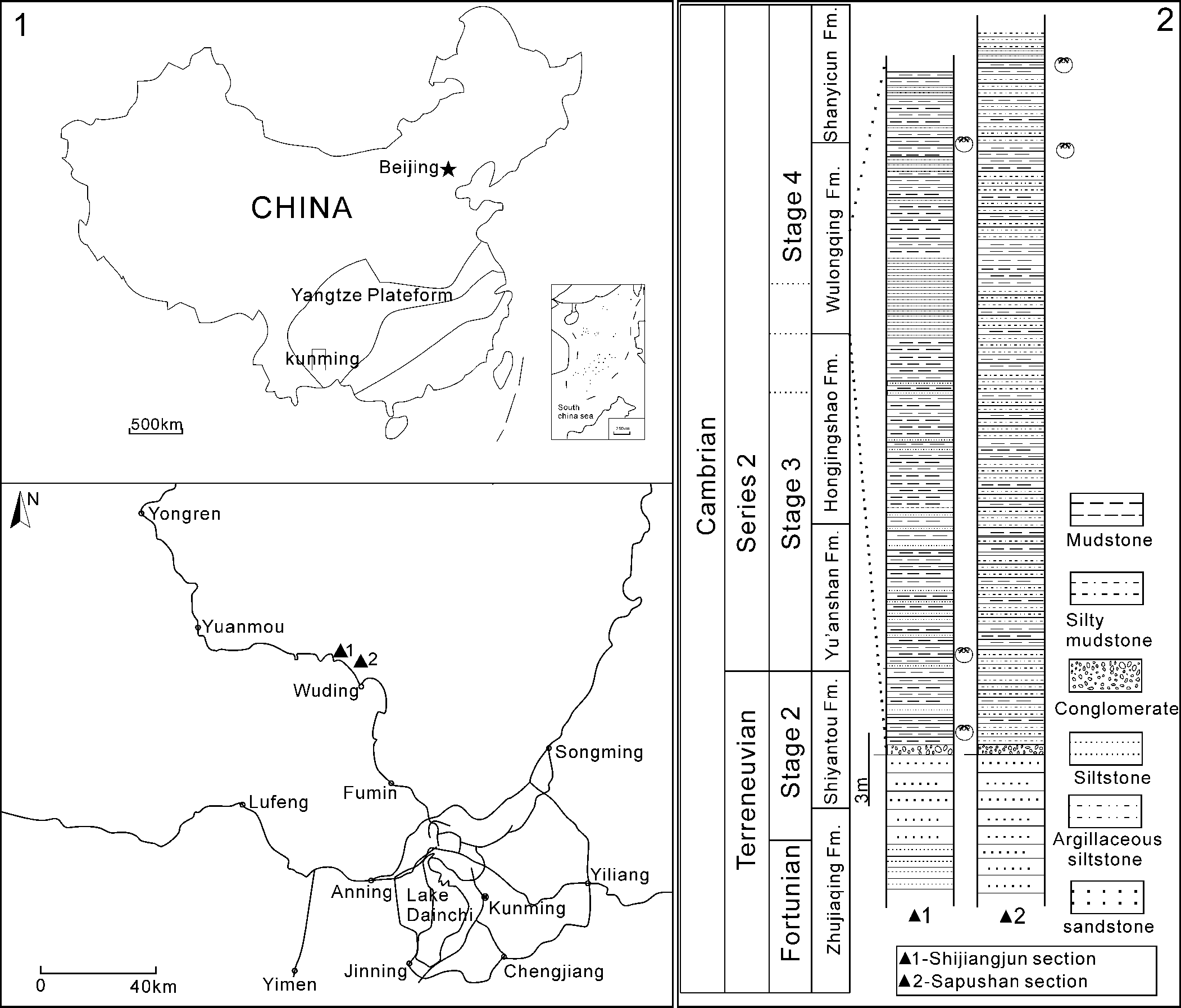
The shell beds of the acrotretoid Linnarssonia sapushanensis n. sp. come from the Wulongqing Formation (Palaeolenus trilobite Zone), Sapushan and Shijiangjun sections west of the Wuding County, 76 km northwest of Kunming, the capital city of Yunnan Province of China (Fig. 1). So far, >300 slabs with acrotretoid brachiopods have been collected from the Wulongqing Formation, Sapushan and Shijiangjun sections by the work-team of Early Life Institute (ELI), and all specimens are deposited in the Northwest University Early Life Institute, Xi'an, China (Prefix: ELI). In the available material, every slab has tens or hundreds of acrotretoid individuals. Nearly all the specimens are preserved as internal molds, with a few of specimens showing exterior shell valves with finely developed concentric growth lines. Specimens are commonly aggregated as high-density concentrations of shell valves on and across the same bedding planes.
Fossil localities, simplified geographic map, and early Cambrian stratigraphy of eastern Yunnan, South China. (1) Geographic map of China with inset box indicating the location of Kunming and the fossil localities where the fossils of Linnarssonia sapushanensis n. sp. were recovered, showing localities of Sapushan (1) and Shijiangjun (2) sections in Wuding, 40 km west of Kunming, South China; (2) stratigraphic occurrences of Linnarssonia sapushanensis n. sp. in the Wulongqing Formation at the Sapushan and Shijiangjun sections.

Acrotretoid shell beds statistically studied in this research were obtained from shell slabs, 10 cm × 8 cm (ELI CLP-183) from the Sapushan section, 10 cm × 4 cm (ELI SJJ-109), 10 cm × 7 cm × 2 cm (ELI SJJ-164) from the Shijiangjun section. Analysis of acrotretoid shell beds applied to this study includes the degree of fragmentation, size frequency distribution, density of shells, orientation, dorsal/ventral valve ratio and matrix composition. Shell width is measured to indicate size frequency distribution. The terms densely (bioclast-supported), loosely (matrix-supported, with most bioclasts within one body length of each other), and dispersed (matrix-supported, with sparsely distributed bioclasts) were used to describe the density of shells (Kidwell et al., Reference Kidwell, Fürsich and Aigner1986; Kidwell, Reference Kidwell, Allison and Briggs1991; Kidwell and Holland, Reference Kidwell and Holland1991).
Fossils were photographed with Zeiss Smart Zoom 5 Stereo micrographic system and Canon camera 5D Mark IV mounted on a photographic system. Some uncoated specimens were analyzed with a Secondary Electron Microscope (SEM) at the State Key Laboratory of Continental Dynamics, Northwest University, Xi'an. Polished slabs were made in Shaanxi Key Laboratory of Early Life and Environments and photographed under the Canon camera. Most of the shells have been subjected to deep weathering, and they are usually preserved as internal molds. In order to better display the structures, a number of latex casts were prepared using PVB ethanol solution and latex. Some fossils and latex casts were photographed and coated with ammonium chloride (NH4Cl).
Repository and institutional abbreviation
All fossil specimens examined in this study are housed in the following institution: The Northwest University Early Life Institute (ELI), Xi'an, China.
Systematic paleontology
Subphylum Linguliformea Williams et al., Reference Williams, Carlson and Holmer1996
Class Lingulata Gorjansky and Popov, Reference Gorjansky and Popov1985
Order Acrotretida Kuhn, Reference Kuhn1949
Superfamily Acrotretoidea Schuchert, Reference Schuchert1893
Family Acrotretidae Schuchert, Reference Schuchert1893
Remarks
The Acrotretidae is characterized by a ventral foramen that is completely or partly within the metamorphic shell, and they have a dorsal valve with a median septum (or ridge) and a median buttress. Their earliest stratigraphic occurrence is in lower Cambrian (upper Stage 3). The microscopic brachiopods from the Wulongqing Formation can clearly be assigned to the Family Acrotretidae because they have a shallow conical shape of the ventral valve and ventral pseudointerareas bisected by an intertrough. Like other acrotretides they also have a median buttress and a low median septum in the interior dorsal valve.
Genus Linnarssonia Walcott, Reference Walcott1885
Type species
Original designation by Walcott (Reference Walcott1885, p. 115) Obolella transversa Hartt in Dawson, Reference Dawson1868; middle Cambrian of New Brunswick, Canada.
Other species
Linnarssonia captiosa Koneva, Reference Koneva1990, L. constans Gorjansky and Koneva, Reference Gorjansky and Koneva1983, L. ophirensis Walcott, Reference Walcott1902 (Walcott, Reference Walcott1912; Rowell, Reference Rowell1966; Engelbretsen, Reference Engelbretsen1996; Holmer et al., Reference Holmer, Popov, Koneva and Bassett2001; Engelbretsen and Peng, Reference Engelbretsen and Peng2007); L. tumida Henderson and Mackinnon, Reference Henderson and Mackinnon1981 (Henderson and Mackinnon, Reference Henderson and Mackinnon1981); L. taconica Walcott, Reference Walcott1887 (Landing et al., Reference Landing, Geyer and Bartowski2002); L. parahioensis Reed, Reference Reed1910 (Popov et al., Reference Popov, Holmer, Hughes, Pour and Myrow2015); L. sagittalis Davidson, Reference Davidson1868 (Winrow, Reference Winrow2016); L. cf. L. tuberculata Pelman in Pelman and Pereladov, Reference Pelman and Pereladov1986 (Peel et al., Reference Peel, Streng, Geyer, Kouchinsky and Skovsted2016); L. rowelli Pelman, Reference Pelman1973, L. ulakhani Ushatinskaya and Korovnikov, Reference Ushatinskaya and Korovnikov2019, L. processa Imanaliev, Reference Imanaliev1983 (Ushatinskaya and Korovnikov, Reference Ushatinskaya and Korovnikov2019).
Linnarssonia sapushanensis new species
Figures 2–4, 5.1–5.7, 6–8, 10–11
Holotype
ELI CLP-007-12 (Fig. 2.8); collected from Wulongqing Formation (Palaeolenus trilobite Zone, Cambrian Stage 4) in the Sapushan section, at Wuding County of eastern Yunnan Province, China.
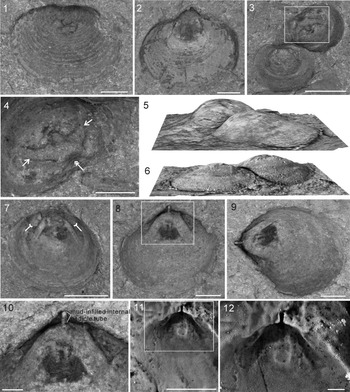
Ventral valves and latex casts of Linnarssonia sapushanensis n. sp. from the lower Cambrian Wulongqing Formation (Guanshan fauna, Series 2, Stage 4) at Sapushan section. (1, 2) Ventral valves with concentric growth lines on the shell surface (ELI CLP-142-3, ELI CLP-007-13); (3) two overlapped internal molds (ELI CLP-142-4); (4) an enlargement of the white frame of (3), showing intertrough (marked by double arrow) and vascula lateralia (marked by arrows); (5) lateral view of (3); (6) anterior view of (3); (7) internal mold showing the cardinal muscle scars (marked by tail arrows) (ELI CLP-020-7); (8) internal mold (ELI CLP-007-12), holotype; (9) lateral view of (8); (10) close-up view of (8), note the mud-filled internal pedicle tube; (11) latex cast (ELI CLP-183-30); (12) close-up view of (11). Scale bars = 500 μm (1, 2, 4, 8, 9); 1 mm (3, 7, 11); 200 μm (10, 12).

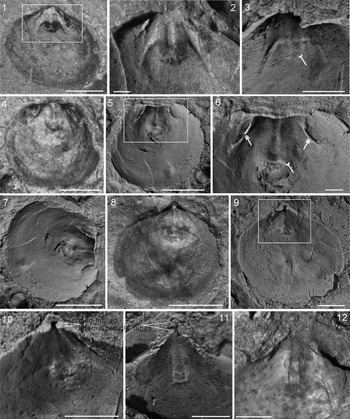
Ventral valves and their latex casts of Linnarssonia sapushanensis n. sp. from the lower Cambrian Wulongqing Formation (Guanshan fauna, Series 2, Stage 4) at Sapushan section. (1) Internal mold (ELI CLP-088), paratype; (2) enlargement of (1); (3) latex cast of (2), showing apical process with a median groove (marked by tail arrow); (4) internal mold (ELI CLP-024-8), paratype; (5) latex cast of (4); (6) an enlargement of (5), showing cardinal muscle scars (marked by double arrows) and apical process with a median groove (marked by tail arrow); (7) lateral view of (5); (8) internal mold (ELI CLP-012-6); (9) latex cast of (8); (10, 11) note the latex casts of mud-filled internal pedicle tubes; (10) an enlargement of (9); (11) latex cast of (12); (12) internal mold (ELI CLP-165-23). Scale bars = 1 mm (1, 4, 5, 7, 8); 200 μm (2, 6); 500 μm (3, 9–12).

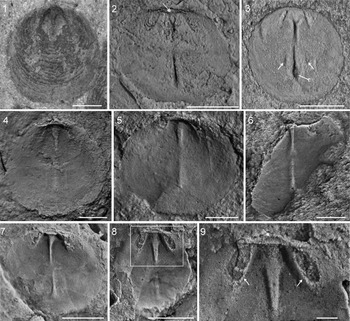
Dorsal valves and their latex casts of Linnarssonia sapushanensis n. sp. from the lower Cambrian Wulongqing Formation (Guanshan fauna, Series 2, Stage 4) at Sapushan section. (1) Dorsal valve with concentric growth lines on the shell surface; (2) internal mold (ELI CLP-017-13) with distinct median groove marked by a double arrow, paratype; (3) internal mold, showing the impressions of anterocentral muscle scars (marked by arrows) and subtriangular platform-like swelling of the terminal portion of median septum (marked by tail arrow) (ELI CLP-182-22), paratype; (4–9) latex casts with variable median septum; (4) ELI CLP-037-15; (5) ELI CLP-037-6; (6) ELI CLP-024-6; (7) ELI CLP-165-22; (8) ELI CLP-165-28; (9) enlargement of (8), showing the cardinal muscle scars (marked by arrows) and median groove (marked by double arrow). Scale bars = 500 μm (1, 6); 1 mm (2–5, 7, 8); 200 μm (9).

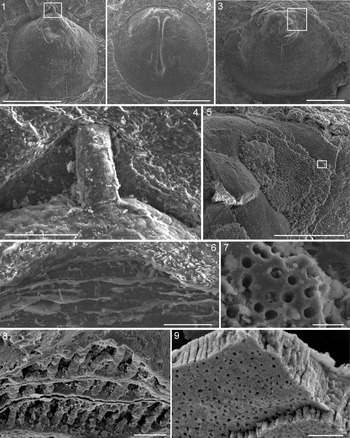
SEM images of acrotretoid Linnarssonia sapushanensis n. sp. from the Wulongqing Formation (Series 2, Stage 4) at Sapushan and Shijiangjun sections of Yunnan Province, and comparison to Eohadrotreta zhenbaensis Li and Holmer, Reference Li and Holmer2004 from the Shuijingtuo Formation of Hubei Province (from Zhang et al., Reference Zhang, Zhang, Li and Holmer2016). (1–7) Linnarssonia sapushanensis n. sp.; (1) ventral valve (ELI CLP-165-27); (2) dorsal valve (ELI CLP-182-22); (3) ventral valve (ELI SJJ-119-8); (4) close-up view of the white frame of (1), showing the pedicle tube preserved as a cylindrical projection with muddy infilling; (5) an enlargement of the white frame of (3); (6) columnar structure (ELI CLP-075-2); (7) close-up view of (5), showing hollow columns. (8, 9) Eohadrotreta zhenbaensis; (8) columnar structure (ELI AJH-201502-012); (9) close-up view showing hollow columns (ELI AJH-2015-2-14). Scale bars = 1 mm (1–3); 100 μm (4); 300 μm (5); 50 μm (6); 10 μm (7, 9); 20 μm (8).

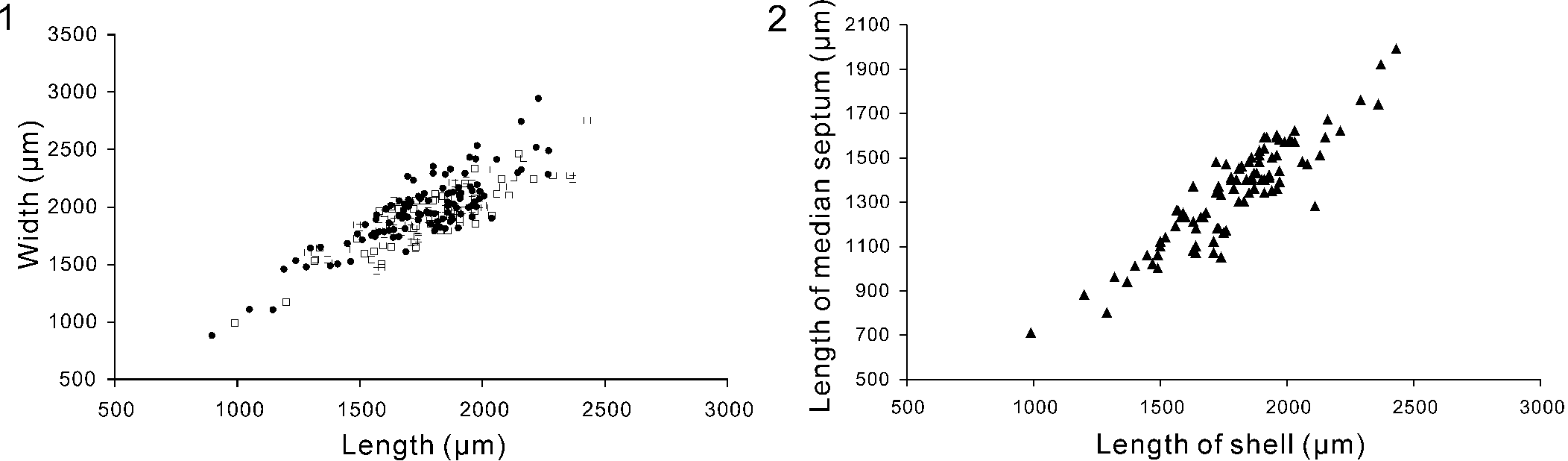
(1) Scatter diagram of length and width of shell valves, ventral valve (dots) and dorsal valve (rectangles). (2) Scatter diagram of length of dorsal median septum and dorsal valve.

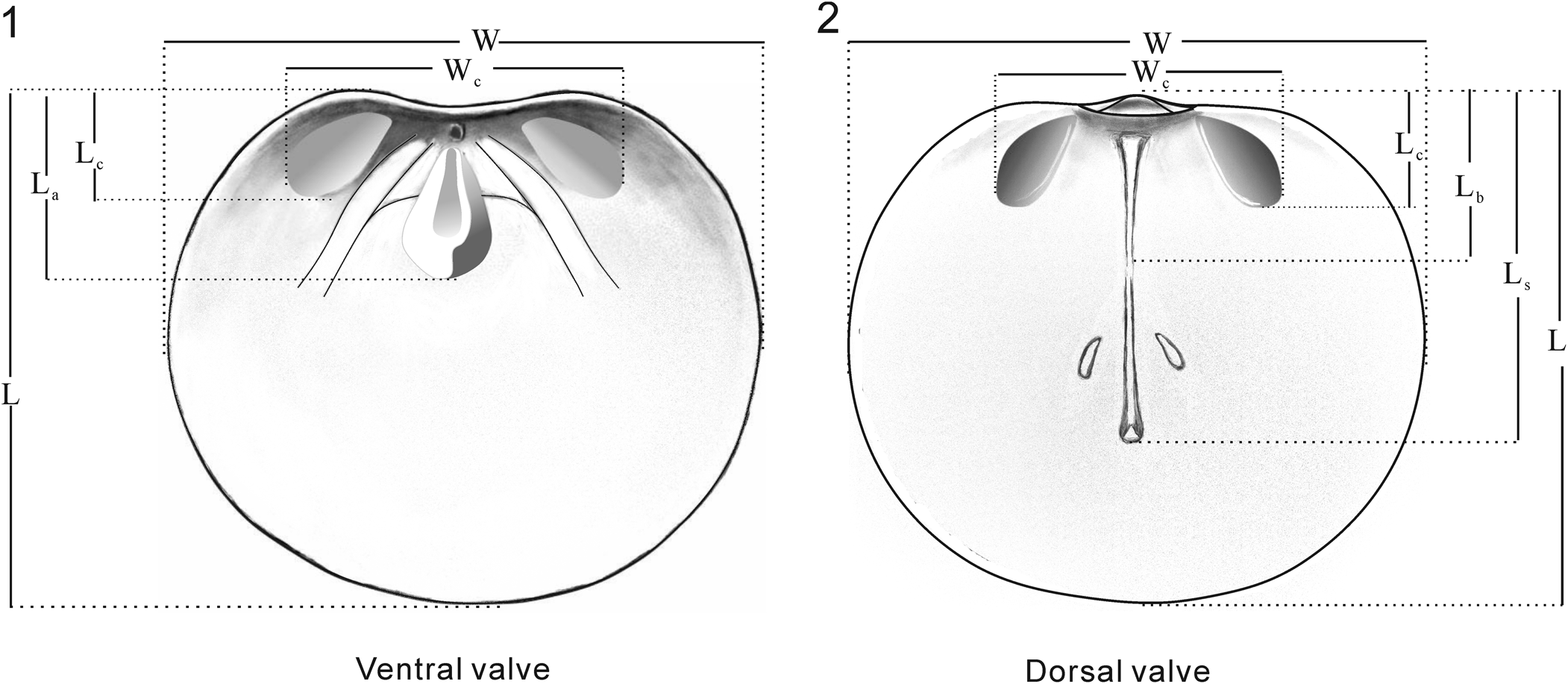
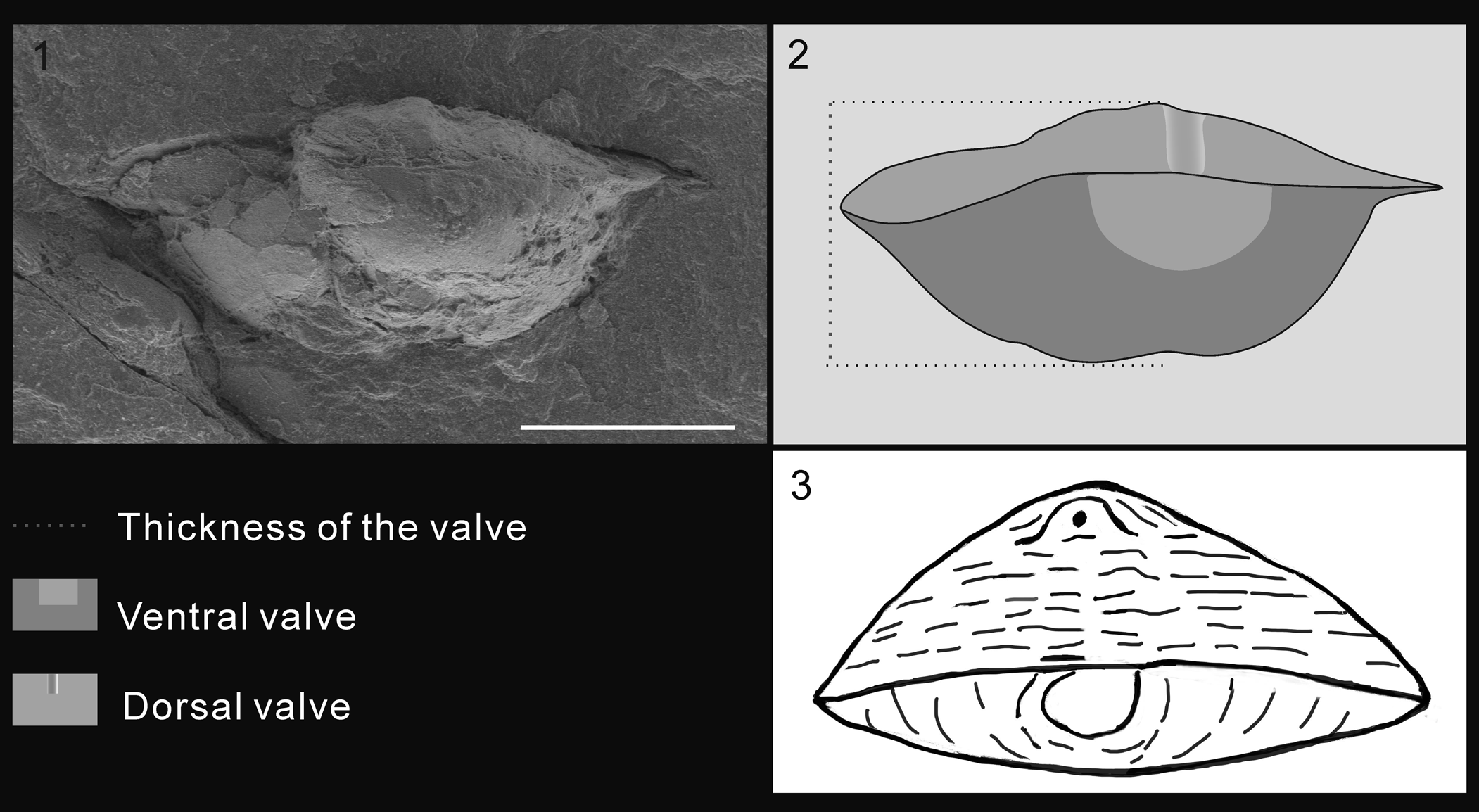
Schematic reconstruction of Linnarssonia sapushanensis n. sp., showing location of measurements in Table 1. (1) Ventral interior; (2) Dorsal interior.

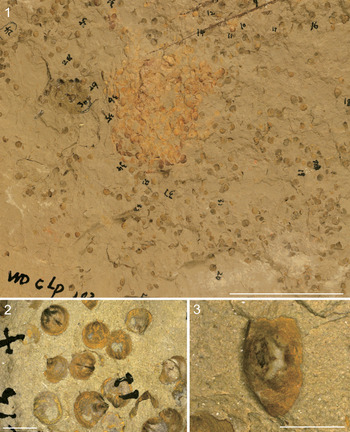
Linnarssonia sapushanensis n. sp. from the lower Cambrian Wulongqing Formation (Guanshan fauna, Series 2, Stage 4) at Sapushan section. (1) The shell concentrations of Linnarssonia sapushanensis n. sp. (ELI CLP-183); (2) close-up view of the shell valves distribution on the same bedding plane (ELI CLP-168); (3) posterior view of a ventral valve cutting across the bedding plane, showing its posterior umbo facing up (ELI CLP-177). Scale bars = 3 cm (1); 2 mm (2); 1 mm (3).

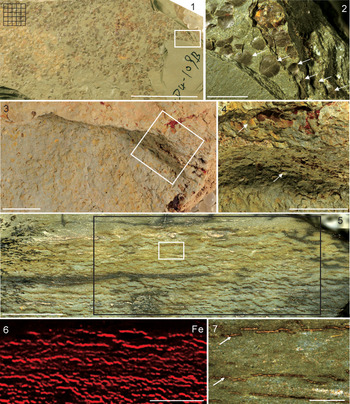
The acrotretoid brachiopod shell beds of Linnarssonia sapushanensis n. sp. from the lower Cambrian Wulongqing Formation (Guanshan fauna, Series 2, Stage 4) at Shijiangjun section. (1) Shell valves aggregated as high-density concentrations on the bedding plane (ELI SJJ-109), with inset box indicating the position of (2); (2) close-up view of (1), showing the acrotretoid shell valves distributed at different micro-layers of bedding planes (marked by white arrows); (3) the multi-layered high-density shell beds packed up to two centimeter thickness (ELI SJJ-164); (4) close-up view of (3) marked by an inset box; acrotretoid shell valves distributed at different layers of bedding planes (marked by white arrows) (5) longitudinally polished section of (3), showing frequent occurrences of the acrotretoid shell valves, aggregated approximately as 11–13 pavements within 1 cm thick muddy sediment; (6) micro-XRF mapping of the black frame of (5), showing the rich content of Fe within the acrotretoids; (7) an enlarged view of the white frame in (5), close-up photograph of the acrotretoid shells. Scale bars = 3 cm (1); or 3 mm (2); or 1 cm (3–6); or 1 mm (7).

Linnarssonia sapushanensis n. sp. from the lower Cambrian Wulongqing Formation (Guanshan fauna, Series 2, Stage 4) at Shijiangjun section. (1) Posterior view of articulated shell valves crossing the bedding planes (ELI SJJ-119-9); (2) interpretative drawing of 1; (3) sketch reconstruction of shell valves of Linnarssonia sapushanensis n. sp. in posterior view. Scale bar = 1 mm (1).

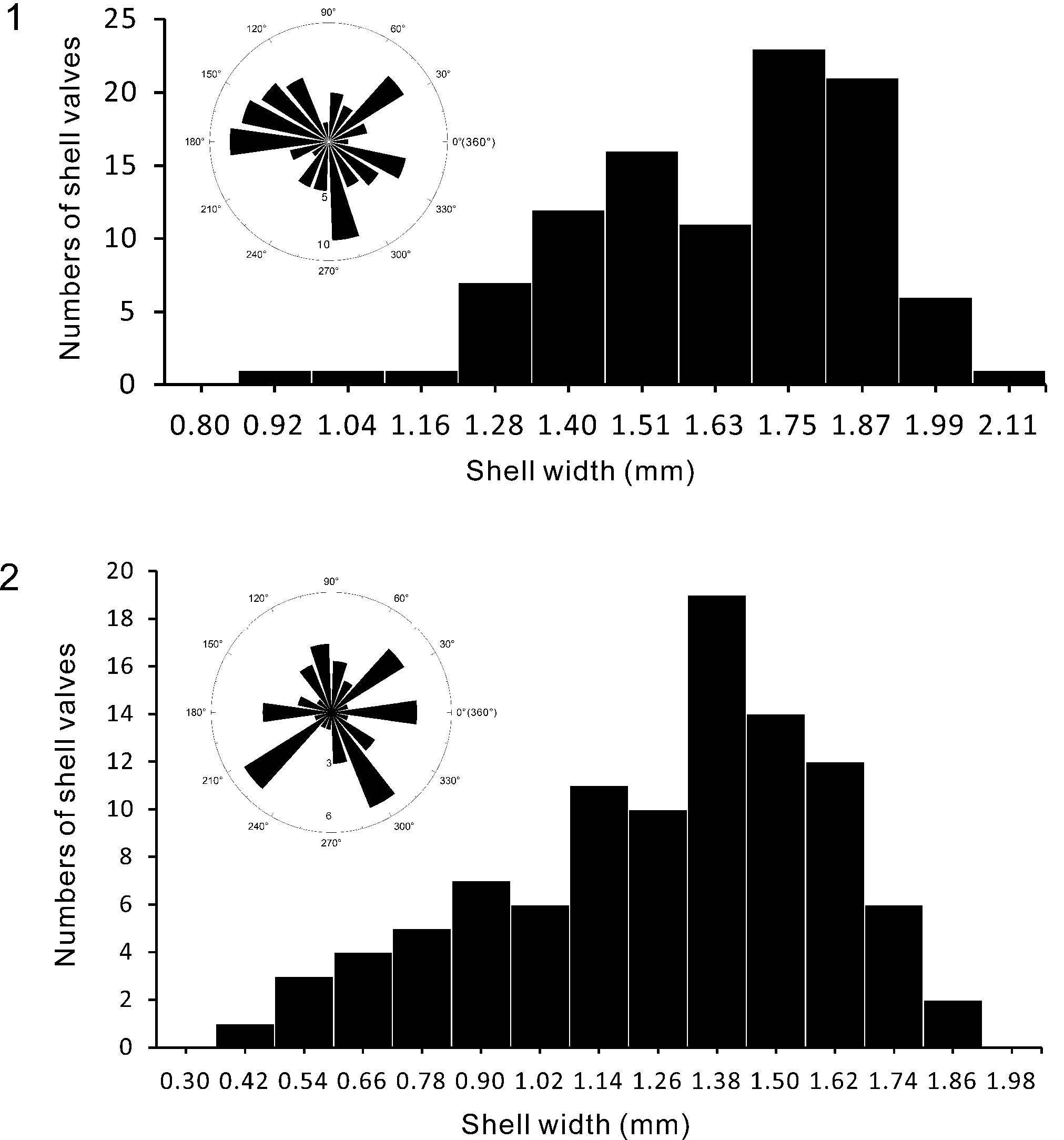
Size frequency distribution and rose diagram of Linnarssonia sapushanensis n. sp. from the lower Cambrian Wulongqing Formation (Guanshan fauna, Series 2, Stage 4) at Sapushan section (1) and Shijiangjun section (2).

Paratypes
ELI CLP-088 (Fig. 3.1–3.3), ELI CLP-024-8 (Fig. 3.4–3.7), ELI CLP-017-13 (Fig. 4.2), ELI CLP-182-22 (Fig. 4.3) from the same stratigraphic level and locality as the holotype.
Diagnosis
Ventral valve subcircular to transversely oval with straightened to slightly concave posterior margin; ventral pseudointerarea catacline to procline; pedicle foramen forming pedicle tube; ventral interior characterized by a moderately high subtriangular apical process with a median concavity. Dorsal valve slightly convex, dorsal pseudointerarea orthocline with a triangular median groove, propareas small or rudimentary; dorsal interior with a well-developed, elongate subtriangular median buttress, median septum low ridge-like, extending anterior beyond midvalve; anterior muscle scars elongate, slightly diverging anteriorly. Shell structure columnar.
Occurrence
All specimens are from the lower to middle part of Wulongqing Formation (Palaeolenus trilobite Zone, Cambrian Stage 4), Sapushan and Shijiangjun sections west of Wuding County, Yunnan Province, South China.
Description
Shell ventribiconvex, subcircular to transversely oval in outline (Fig. 2); shell valves ornamented with concentric growth lines (Fig. 2.1, 2.2).
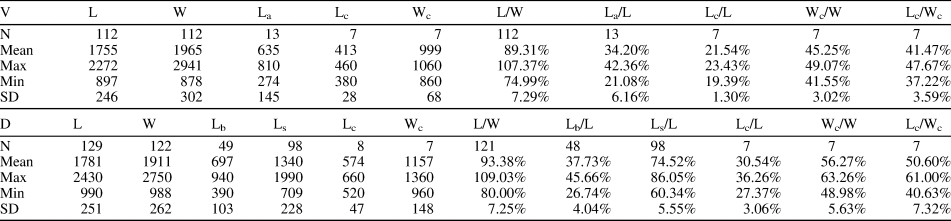
Ventral valve gently convex to conical, subcircular in outline and slightly transversely elongated, with a somewhat straight to slightly concave posterior margin; ~89% as long as wide (Table 1), with the maximum width near to the mid-valve; ventral pseudointerarea varying from catacline to procline, bisected by a shallow intertrough (Fig. 2.4, marked by doubled arrow). Ventral interior with a subtriangular apical process, characterized by a median groove that slightly expands anteriorly (Figs. 3.3, 3.6, marked by tailed arrows); apical process merging gently with floor of valve anteriorly, extending to ~34% of shell length; the vascula lateralia are impressed as pronounced ridge-like imprints extending anteriorly from the base of the apical process (Fig. 2.4, marked by arrows). Ventral pedicle foramen continued internally forming a pedicle tube; it is preserved as a cylindrical projection filled with mud (Figs. 2.8–2.10, 5.1, 5.4), which is ~60 μm in diameter, 132 μm in length. Apical pits unknown. Cardinal muscle scars broadly separated, elliptical in outline, on posterolateral slopes of valve (Fig. 2.7, marked by tail arrows; Fig. 3.6, marked by double arrow), occupying ~21% of the shell length and 45% of the shell width (Table 1).
Main dimensions and ratios of ventral and dorsal valves of Linnarssonia sapushanensis n. sp. from the lower Cambrian Wulongqing Formation (Guanshan Biota, Stage 4) in eastern Yunnan of China. Measurements (in μm) have been made as follows: V: ventral valve, D: dorsal valve, L: sagittal length of shell, W: maximum width of shell, La: length of ventral apical process; Lc, Wc: length and width of cardinal muscle scars; Lb: length of dorsal median buttress; Ls: length of dorsal median septum.

Dorsal valve subcircular in outline (Figs. 4, 5.2), ~93% as long as wide (Table 1), with the maximum height near the posterior 1/4 of shell length; dorsal pseudointerarea small and remains orthocline, with a small rudimentary propareas and transversely elongate, subtriangular median groove (Fig. 4.2, 4.9, marked by doubled arrows), median groove with transverse growth lines (Fig. 5.6), slightly overhangs valve floor. Dorsal interior with prominent median buttress, extending ~37% of the valve length; median septum ranging from low to ridge-like (Fig. 4.4–4.7), originates at about the distal end of median buttress and extends ~74% of the total valve length, some specimens with longer median septum reaching up to 86% length of valve, the terminal portion of the median septum forms a small subtriangular platform-like swelling (Fig. 4.3, marked by tailed arrow); some specimens with elongate impressions of anterocentral muscle scars situated on the lateral edge of median septum (Fig. 4.3, marked by arrows). Cardinal muscle scars widely separated (Fig. 4.9, marked by arrows), extending anterolaterally from the lateral edge of the median groove, occupying ~31% of the shell length and 56% of the shell width.
The shell structure of the Linnarssonia sapushanensis n. sp. has the typical acrotretoid columnar structure, with sets of columnar laminae (Fig. 5.6), the hollow columns are 2.5–3 μm in diameter (Fig. 5.7).
Etymology
The species name is after Sapushan Village in Yunnan Province, southern China, near the type locality of the species.
Materials
ELI-WD-CLP-001–183, ELI-WD-SJJ-001–165. More than 300 slabs collected from the lower to middle part of the Wulongqing Formation, Sapushan and Shijiangjun sections. Unfortunately, the exact number of individual ventral and dorsal valves is difficult to count because many specimens overlap each other. Specimens from both sections are commonly imperfectly preserved in the extensive shell beds, but some specimens from the Sapushan section are better preserved, and include more delicate internal structures, such as ventral apical process, dorsal median septum, and cardinal muscle scars.
Remarks
Previously described early Cambrian acrotretoid brachiopods from China include Eohadrotreta zhenbaensis Li and Holmer, Reference Li and Holmer2004, Eohadrotreta? zhujiahensis Li and Holmer, Reference Li and Holmer2004, Linnarssonia sp., and Kuangshanotreta malungensis Zhang, Holmer, and Hu in Wang et al., Reference Wang, Zhang, Holmer, Hu, Wang and Li2012 (Feng and Kobayashi, Reference Feng and Kobayashi2004; Li and Holmer, Reference Li and Holmer2004; Wang et al., Reference Wang, Zhang, Holmer, Hu, Wang and Li2012).
Linnarssonia sapushanensis n. sp. from the lower Cambrian Wulongqing Formation, Yunnan Province is similar to Eohadrotreta zhenbaensis Li and Holmer, Reference Li and Holmer2004 from the lower Cambrian Shuijingtuo Formation, Hubei Province (Zhang et al., Reference Zhang, Zhang, Li and Holmer2016) in having a typical acrotretoid columnar structures (Fig. 5.6–5.9), and a subcircular to transversely oval shell valves. However, specimens from the Wulongqing Formation differ from Eohadrotreta zhenbaensis Li and Holmer, Reference Li and Holmer2004 in having a subtriangular apical process with a median concavity, and possessing a well-developed pedicle tube, which excludes their attribution to Eohadrotreta. Only Kuangshanotreta malungensis Zhang, Holmer, and Hu in Wang et al., Reference Wang, Zhang, Holmer, Hu, Wang and Li2012 is from the siliciclastic lower Cambrian Yu'anshan Formation (Chengjiang Fauna) (Wang et al., Reference Wang, Zhang, Holmer, Hu, Wang and Li2012), but Linnarssonia sapushanensis n. sp. markedly differs from K. malungensis in having a pedicle tube, more-developed ventral mantle canals and muscular scars, as well as a more-developed dorsal median buttress and median septum. Linnarssonia sp. has also been noted from the lower Cambrian Jiulaodong Formation at Maidiping section of Emei region in Sichuan Province, but there are no descriptions or illustrations of this taxon (Feng and Kobayashi, Reference Feng and Kobayashi2004). When compared with the other acrotretid genus recovered from cracking-out of siliciclastic rocks, such as Luhotreta Mergl and Šlehoferová, Reference Mergl and Šlehoferová1990 from the traditional middle Cambrian, Jince Formation, Bohemia (Wotte and Mergl, Reference Wotte and Mergl2007), the new Guanshan species appears to be distinctly different in that Luhotreta has a significantly coarse, lamellose external shell valve ornament and lacks a median ridge in the dorsal valve.
The apical process of Linnarssonia sapushanensis n. sp. is similar to Linnarssonia constans Koneva 1983 in Gorjansky and Koneva, Reference Gorjansky and Koneva1983 from the lower Cambrian, Toyonian, Baba-Ata section, Malyi Karatau (Holmer et al., Reference Holmer, Popov, Koneva and Bassett2001), in that it has a narrow median concavity, which slightly expands anteriorly; however, the new species differs from the Kazakh species in having a catacline to procline ventral pseudointerarea, and a longer (up to 86% valve length) dorsal median ridge (Table 1).
The new species differs from L. sagittalis Davidson, Reference Davidson1868 from the “Nant Pig mudstones” Miaolingian, Wuliuan-Guzhangian of St Tudwal's Peninsula, North Wales (Winrow, Reference Winrow2016) because the new species has longer impressions of cardinal muscle scars in the ventral and dorsal valves, as well as in having a longer dorsal median ridge (L. sagittalis: V: Lc/L = 14.9%, Wc:W = 38%; D: Lc/L = 8%, Wc:W = 25%, Ls/L = 63.7%; see data from the new species in Table 1). Linnarssonia sapushanensis n. sp. differs from L. ulakhani Ushatinskaya and Korovnikov, Reference Ushatinskaya and Korovnikov2019 from the lower Cambrian Sinyaya Formation in the middle reaches of the Lena River (Ushatinskaya and Korovnikov, Reference Ushatinskaya and Korovnikov2019) in that the new species has a subtriangular apical process and well-pronounced median ridge in the dorsal valve. Linnarssonia sapushanensis n. sp. is also easily distinguished from L. processa Imanaliev, Reference Imanaliev1983 from the middle Cambrian Elanka, Kuonamka, and Yunkyulyabit-Yuryakh formations of the Olenek River (Ushatinskaya and Korovnikov, Reference Ushatinskaya and Korovnikov2019), because the latter has a larger, distinctive high apical process (L. processa: V: La/L = 50%; L. sapushanensis n. sp.: V: La/L = 34% in the Table 1).
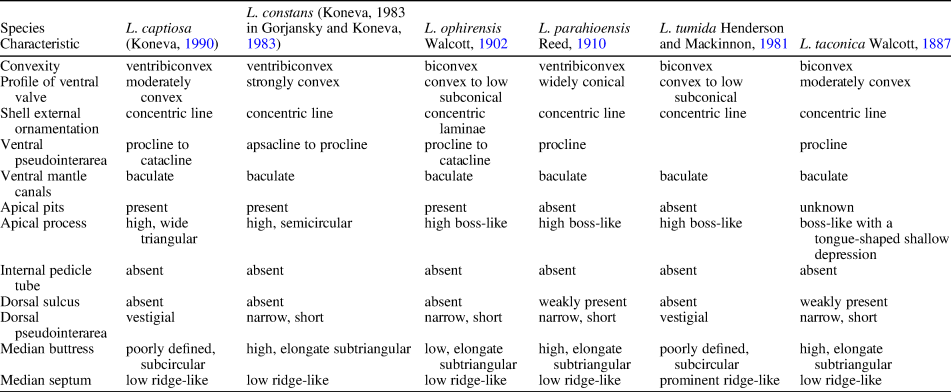
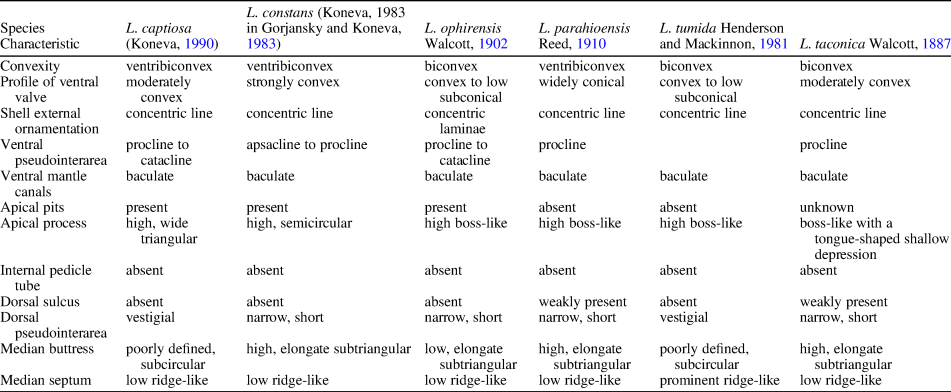
When compared to other lower and middle Cambrian species within the genus Linnarssonia (Table 2) (Matley, Reference Matley1902; Walcott, Reference Walcott1912; Cooper et al., Reference Cooper, Arellano, Johnson, Okulitch, Stoyanow and Lochman1952; Rowell, Reference Rowell1966; Henderson and Mackinnon, Reference Henderson and Mackinnon1981; Engelbretsen, Reference Engelbretsen1996; Holmer et al., Reference Holmer, Popov, Koneva and Bassett2001; Landing et al., Reference Landing, Geyer and Bartowski2002; Engelbretsen and Peng, Reference Engelbretsen and Peng2007; Popov et al., Reference Popov, Holmer, Hughes, Pour and Myrow2015; Peel et al., Reference Peel, Streng, Geyer, Kouchinsky and Skovsted2016), it is evident that they exhibit a wide variation in morphological characters. This morphological variability is mainly expressed in the shape of the ventral valve, the morphology of the apical process (e.g., high boss-like or subtriangular with median concavity), the presence of internal pedicle tube, and in the length and elevation of dorsal median septum. All well-known Linnarssonia species, aside from L. sapushanensis n. sp., were recovered by etching limestones. Linnarssonia sapushanensis n. sp. can be distinguished from all other species of Linnarssonia in having a distinctive internal pedicle tube in the ventral valve, as well as a longer median septum in the dorsal valve. The internal pedicle tubes in ventral valves are well exposed and preserved as mud-filled cylindrical tubes with the original tube walls (lost during the preservation and diagenetic process). Nevertheless, some efforts were made to prepare latex casts illustrating the tubular structures (Fig. 2.11, 2.12). In addition, the specimens presented here provide well-defined internal molds with shell interiors including muscle scars, which permit us to provide rudimentary reconstructions of shell valves of Linnarssonia sapushanensis n. sp. in Figure 7.
Morphological comparison of Linnarssonia species.
Description of acrotretoid shell beds with Linnarssonia
In the Shijiangjun section of Guanshan Fauna in Wuding County of eastern Yunnan, the brachiopod shell concentrations, including brachiopod-only and brachiopod-dominated (brachiopod-trilobite) aggregations, first appear at the base of the Wulongqing Formation. Along the sequences of the mudstone and silty mudstone of the Wulongqing Formation, there are numerous occurrences of various types of linguloid brachiopod shell aggregations, including Neobolus, Eoobolus, and Shijiangjunthele (Chen et al., Reference Chen, Zhang, Betts, Zhang and Liu2019; Zhang et al., Reference Zhang, Holmer, Liang, Chen and Duan2020a, Reference Zhang, Strotz, Topper, Chen, Chen, Liang, Zhang, Skovsted and Brockb). They mainly form monotaxic concentrations of intercalated conjoined shell valves in the siliciclastic deposits. The monotypic shell beds of early acrotretoids (composed mainly of internal molds) described here come from ~26 m above the base of the Wulongqing Formation (Palaeolenus trilobite Zone, Stage 4), and the shell beds disappear in the younger stratigraphic successions in eastern Yunnan. The typical monotaxic shell beds with microscopic acrotretoid Linnarssonia sapushanensis n. sp. are well exposed along the side of the village road from Wuding County to Sapushan Village and the lower to middle part of the Wulongqing Formation from the Shijiangjun section; excavations have been intermittently carried out in this region since 2010.
The acrotretoid shell beds from the Wulongqing Formation (Palaeolenus trilobite Zone) range from loosely to densely packed (~13–21 valves per cm2), with moderate degree of fragmentation (Figs. 8, 9). They occurred not only as a thin pavement distributed on a single bedding plane, but also as frequent shell beds with ~11–13 pavements within the muddy sediment, forming 1 cm thick individual beds (Fig. 9.5). Nearly all the shell valves are disarticulated, and the ventral/dorsal ratio of disarticulated shells is up to 1.6. Specimens are commonly aggregated as high-density concentrations of shell valves on and across the same bedding plane where some acrotretoid shell valves are well preserved (Fig. 10.1, 10.2). The size frequency distribution of 200 shells of Linnarssonia was statistically analyzed from Sapushan and Shijiangjun sections. In the Sapushan section (Fig. 11.1), individuals with shell widths between 1.40–1.87 mm are the most frequent (up to 83%), while the majority of the measured shells (79%) from the Shijiangjun section are shells with widths of 1.00–1.62 mm (Fig. 11.2). The orientation angle of the shells of Linnarssonia was statistically analyzed and plotted in a rose diagram, showing that they have random orientations (Fig. 11). The preservation of the shells is relatively good, although shells are disarticulated and slightly crushed due to post-depositional compaction. The sedimentary matrix of acrotretoid shell concentration consists of yellow-green mudstone and silty mudstones.
Discussion
The first record of Linnarssonia from lower Cambrian muddy depositional setting of China
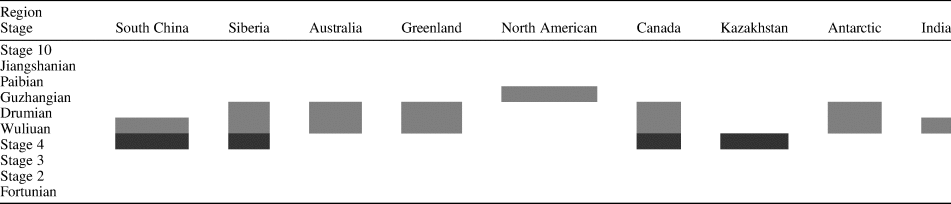
The earliest records of the Linnarssonia were reported by Pelman (Reference Pelman1977) from the early Cambrian Sinyaya and Kutorgina formations (Bergeroniellus gurarii and B. asiaticus Zones) from the middle reaches of the Lena River, Siberia Platform (Ushatinskaya and Korovnikov, Reference Ushatinskaya and Korovnikov2019). Linnarssonia already exhibits all main acrotretoid characteristics (e.g., a columnar shell structure, a pitted metamorphic shell [terminology introduced by Zhang et al., Reference Zhang, Popov, Holmer and Zhang2018], a pedicle foramen formed at early post-metamorphic growth stages, and cardinal muscle scars situated on the side of vascula lateralia). Early Cambrian species of the acrotretoid Linnarssonia seemingly initially had a restricted geographical distribution (being limited to Siberia and the Naryn microplate), and species of this genus became cosmopolitan following the Drumian (Popov et al., Reference Popov, Holmer, Hughes, Pour and Myrow2015). Linnarssonia is known from the Cambrian of Kazakhstan (Bassett et al., Reference Bassett, Popov and Holmer1999; Holmer et al., Reference Holmer, Popov, Koneva and Bassett2001), North American (Rowell, Reference Rowell1966), Canada (Landing et al., Reference Landing, Geyer and Bartowski2002), Greenland (Zell and Rowell, Reference Zell and Rowell1988; Peel et al., Reference Peel, Streng, Geyer, Kouchinsky and Skovsted2016), Siberia (Ushatinskaya and Korovnikov, Reference Ushatinskaya and Korovnikov2019), Australia (Engelbretsen, Reference Engelbretsen1996, Reference Engelbretsen2006), New Zealand (Henderson and Mackinnon, Reference Henderson and Mackinnon1981), Antarctic (Holmer and Popov, Reference Holmer, Popov and Kaesler2000; Ushatinskaya, Reference Ushatinskaya2010; Winrow, Reference Winrow2016), India (Popov et al., Reference Popov, Holmer, Hughes, Pour and Myrow2015), and South China (Engelbretsen and Peng, Reference Engelbretsen and Peng2007) (Table 3). In South China, Linnarssonia sp. was reported earlier from the lower Cambrian Jiulaodong Formation at Maidiping section of Emei region in Sichuan Province of South China (Feng and Kobayashi, Reference Feng and Kobayashi2004). However, this report does not contain any systematic description or illustration of shell valves, thus the generic assignments remain doubtful pending further reinvestigation of the Sichuan material. Thus, the new material from the Wulongqing Formation in the eastern Yunnan is the oldest confirmed Cambrian (Stage 4) record of Linnarssonia in the Yangtze Platform of South China.
Stratigraphic occurrence and geographic distribution of the acrotretoid brachiopod Linnarssonia in the Cambrian across the world (Cambrian Series 2 and Miaolingian are marked by dark and gray shades, respectively).

Ecological implications of shell concentration
The acrotretoid shell concentrations in this study form monospecific shell pavements or shell beds (~11–13 pavements within a 1 cm thick bed). Shell beds range from loosely to densely packed with low-moderate degree of fragmentation. Most of the shells are disarticulated and more than 90% of them are parallel to bedding surfaces, while some shells are perpendicular to bedding (Fig. 10). The matrix hosting the shell is a mudstone or silty mudstone.
Shell beds are influenced by biological (such as intrinsic gregarious behavior of organisms, opportunistic species explosion), sedimentological (e.g., current rework, relative sea level changes, storm surges), and diagenetic controls (Kidwell, Reference Kidwell, Fürsich and Aigner1986; Kidwell and Holland, Reference Kidwell and Holland1991; Li and Droser, Reference Li and Droser1997, Reference Li and Droser1999). The characteristics of the acrotretoid shell beds, including dense packing, parallel orientation to bedding, and low to moderate fragmentation, suggest that these shell concentrations may be interpreted as the products of storms (Fürsich and Oschmann, Reference Fürsich and Oschmann1993; Fürsich and Pandey, Reference Fürsich and Pandey1999; Li et al., Reference Li, Qu, Du, Dai, Yang, Li and Yang2016; Samira et al., Reference Samira, Payman, Reza and Mohammad2018). The large proportion of complete shells, in conjunction with a large range in shell size, likely reflects minimal transport and little hydraulic sorting.
During the Cambrian explosion interval, the substrates on which marine benthos lived changed from the microbial mats that dominated on a normal marine Proterozoic seafloor, to the Cambrian mixed layers (Dornbos et al., Reference Dornbos, Bottjer and Chen2005; Bottjer, Reference Bottjer2010; Mángano and Buatois, Reference Mángano and Buatois2014; Zamora et al., Reference Zamora, Deline, Álvaro and Rahman2017). The main signature of the transition is the increase in bioturbation (Droser and Bottjer, Reference Droser and Bottjer1988; Droser et al., Reference Droser, Gehling and Jensen1999), which is accompanied by mass occurrence of small shelly fossils in the lower Cambrian (Meishucunian) of South China (Qian et al., Reference Qian, Li and Zhu2001; Parkhaev and Demidenko, Reference Parkhaev and Demidenko2010). In South China, brachiopods first occur at the base of the lower Cambrian Yu'anshan Formation in eastern Yunnan, but there are no shell beds of brachiopods from this level, and most sessile benthic organisms in these deposits are attached to trilobite remains rather than to the shells of other brachiopods. Abundant brachiopod shell beds appear in the higher stratigraphic successions, including the Hongjingshao and Wulongqing formations. This is a sudden change indicating that brachiopod shell concentrations could be utilized as a pavement of hard substrates in the increasingly complex Cambrian soft-substrate communities. The mass occurrence of such bioclastic debris of organophosphatic brachiopods could have been a driving factor in the rapid diversification of stalked echinoderms (mainly eocrinoids), which are commonly found attached onto the shell valves of minute acrotretoid brachiopods, in, for instance, the Kaili Biota (Miaolingian, Wuliuan) (Lin, Reference Lin, Ausich and Zhao2008). The occurrence of remarkably rich acrotretoid shell beds in the lower Cambrian Wulongqing Formation indicates that the minute lingulates began to exert an important role in accelerating the Cambrian substrate evolution.
Conclusions
This is the first report of acrotretoid shell beds in the muddy deposits from the Wulongqing Formation (Guanshan fauna, Cambrian Stage 4) of eastern Yunnan, South China, which represent the earliest known records of shell concentrations of acrotretoid brachiopods across the Cambrian paleocontinents until now. The occurrence of remarkably rich acrotretoid shell beds indicates that the minute lingulates began to exert an important role in hardening and paving the soft-substrate seafloor during evolution of Phanerozoic “mixgrounds” in the early Cambrian. In addition, the occurrence of the acrotretoid Linnarssonia sapushanensis n. sp. in Wulongqing Formation (Cambrian Stage 4) represents the earliest records of this genus from the muddy deposits of China, signifying that the geographical distribution of Linnarssonia expanded earlier in the early Cambrian than previously known.
Acknowledgments
We are grateful to R.L. Freeman, the anonymous reviewer, and the Journal Associate Editor C.D. Sproat for their constructive comments and suggestions. Many thanks are also extended to J.P. Zhai, X.R. Wang, Z.L. Zhang, F. Liu, F.Y. Chen, and all the other members in ELI (Xi'an) for their generous help with the fieldwork and fossil collections in the fields and the fossil preparations since 2010. Financial support from the National Natural Science Foundation of China (41890844, 41425008, 41621003, and 41720104002 to ZZF) and the 111 project (D17013) for continuous fossil collections of the Xi'an group are sincerely acknowledged. L.E. Holmer's work was supported by a grant from the Swedish Research Council (VR 2018-03390).