The woman suffrage movement remade the United States in ways both formal and pragmatic, in the nation's practice as well as its parchment.Footnote 1 Emerging from patterns of moral reform and antislavery activism in the antebellum nineteenth century, driven forward by new organization in the wake of the Civil War, and swelling in the Progressive Era with agenda-setting triumphs wrought through vibrant but vituperative debates about the meaning of American democracy, the suffrage movement restyled citizenship as well as political discourse. Contributing to a range of state-level voting rights expansions before 1920 and then to the passage of the Nineteenth Amendment to the U.S. Constitution, the woman suffrage movement changed American institutions and norms and is responsible for the largest nominal and proportional expansion of the American electorate in national history.
In this long struggle, as scholars and students alike know, women organized and reorganized. They protested. They mimicked and mocked patterns of male voting, especially white male voting. They created new rhetorical and argumentative registers, new claim patterns ranging from Madisonian representation to republican motherhood to Victorian morality and its contrasts with the corruptions of the male-dominated party system. And to a degree that has been overlooked by most studies, they petitioned—massively, continually, and earnestly—for the transformation of citizenship. From 1870 to 1920, pro-suffrage activists sent at least 2,157 petitions to U.S. Congress asking for the granting of voting rights to women.Footnote 2 These petitions were signed by hundreds of thousands of women and men, and they echoed petitioning campaigns at the state level.
The work of imagining and expressing possibilities for change, the work of protesting, the work of petitioning, the work of organizing according to new and differentiated models, and voting itself compose some of the many repertoires of collective action and organization that characterized the saga of American woman suffrage. These repertoires were linked in various ways, often by modes of innovative recombination.Footnote 3 In this study we describe the multipatterned linkages between two of these practices—petitioning and voting.
For woman suffrage activists of so many ranks, we argue, petitioning and voting linked the imaginary and the pragmatic realms. Early woman suffrage petitions displayed, sometimes before the celebrated Seneca Falls Convention of 1848, the broad scope of activist women's claims and imaginaries. Early suffrage petitions deployed a range of argumentation and also creatively reconfigured the petition's signatory list, boldly and radically envisioning a different form of citizenship. Early woman suffrage petitioning campaigns, like mock voting campaigns, were often timed with elections.Footnote 4 These efforts met with suppression, including the attempted but unsuccessful prosecution of Susan B. Anthony in 1872. After the Civil War, suffrage activists focused their petitioning ever more during election years, such that petitioning became a parallel form of mobilization. And as the suffrage movement attained its institutional triumphs and women registered their votes at the polls, women's turnout in the United States would be strongly anticipated by where women petitioned in the years before suffrage was granted. Suffrage petitioning became, in this way, a formative practice for voting, that is, an exercise of collective action that shaped the development of another practice—its habits, its imagination, and its composite routines.
The voting-formative character of petitioning offers lessons for American political development as well as for modern social movement studies. Petitioning suffused the early republic and the antebellum period, and in the nineteenth century, it become more democratic and bolder in its aspirations and its claims. For two processes that marked U.S. democratization—suffrage expansions and the transformed notion of citizenship—petitioning contributed ideation as well as organization. An institution refashioned from America's monarchical and republican past now impelled a nation's democratization. And it did so not only by adding support but also by changing practices and self-conceptions of citizens. Even as petitioning remained commonplace in nineteenth- and early twentieth-century America, suffrage petitions followed and expressed particular logics and identities. They mimicked, rehearsed, and acted out the very object of their claims: voting. And their fervent prayers for change, together with signatures by the millions, remind us that transformations of political practice often precede institutional change.
We develop a historical-behavioral analysis of suffrage petitioning and its legacies in four stages. We begin with a discussion of the idea of political practices and their relationship to two concepts widely used in the studies of social movements, namely, routines and repertoires. We outline our argument that petitioning is something more than a routine—it comprises many different routines, such as rhetoric (writing a prayer), canvassing (collecting signatures), and embassy (sending a petition or traveling with it to present it to a sovereign)—but not quite a full repertoire in and of itself. We also emphasize the formative character of petitioning as a feature of political practices that scholars of political behavior ought to examine more directly and thoroughly.
We then begin our empirical analysis in Section 2 by describing suffrage petitioning during the antebellum period and Civil War, focusing largely on primary and secondary sources in Massachusetts and New York State. We document rhetorical and organizational innovations in these petitions, including argumentation as well as the growing size of signatory lists.
We then turn, in Section 3, to describe suffrage petitioning in the United States and the national-level data that we have collected. We examine the statistical and geographic incidence of suffrage petitioning, observing that suffrage petitioning was concentrated during election years, especially presidential election years. We also display the geographic incidence of these petitions using geocoded aggregates. After noting evidence that other forms of pro- and anti-suffrage activity were also concentrated during election years and election days, we discuss some weaknesses of the data, principally the paucity of data on petitions sent to state legislatures (though we do employ data from antebellum Massachusetts in Section 2).
In Section 4, we examine the predictive relationship between petitioning and post-suffrage-extension voter turnout. Our results suggest that, controlling for a range of variables examined by past studies, pre-suffrage petitioning is a strong predictor of post-suffrage-extension changes in turnout. This result may suggest merely that petitioning serves as only an indicator for underlying political activity that took the form of voting once women's voting rights were secured. Yet it is broadly consistent with other studies suggesting that participation in a political movement carries legacy effects for later activism and organization.Footnote 5
SUFFRAGE PETITIONING AND THE IDEA OF FORMATIVE PRACTICE
The long struggle for woman suffrage partook of the various repertoires of collective action of nineteenth-century social movements.Footnote 6 In history, sociology and political science as well as in women's studies and related fields, scholars have examined the development of ideas and organizations that supported (and some that opposed) women's voting rights. These studies, which now compose a substantial, multidisciplinary literature, focus on the emergence of activism during the antebellum period, especially during the antislavery movement and temperance campaigns.Footnote 7 In the wake of the Civil War, woman suffrage associations and other women's organizations proliferated and established both agendas and precedents for suffrage extension. They racked up critical victories in state-level suffrage campaigns and, especially in 1914 and later, put the issue squarely on the national agenda.Footnote 8 Critical pressures applied and reapplied in the period of the Great War (World War I) brought new focus to the debate, with a culminating victory in the passage and ratification of the Nineteenth Amendment in 1919–1920. In the wake of the amendment and the suffrage extensions that passed before it, women voted in ever growing numbers, but many scholars write of aspirations partially disappointed or expectations undone, given that women did not vote as a bloc and frequently mirrored their husbands’ ballot choices.Footnote 9
The activity associated with the woman suffrage campaign did more than reshape our most fundamental institutions. It also left a tangible legacy of activism that endured past its crowning constitutional triumph and spilled over into other domains, including the temperance and prohibition movements, as well as consumer and social welfare movements.Footnote 10 Movement leaders and their members made critical investments in organizational structures that would outlast the suffrage struggle, including new organizations (some explicitly dedicated to suffrage, others not), new policy initiatives whose campaigns evoked and invoked women's political identities, and participatory patterns. The behavioral and organizational legacies of woman suffrage did not stop with the Nineteenth Amendment—as shown by the National Woman Suffrage Association, the Shepherd-Towner Act and similar policies, and women's long-term activism that preceded and endured decades past 1920,.
Suffrage petitioning became not merely a formative practice generating other activities but also a departure from existing modes of petitioning (women's and men's). The success and failure of social movements opens and forecloses new opportunities of collective action. Some repertoires of action may implicitly hint at others (protests and violence), but in other cases, forms of collective action may explicitly presage later activities. Woman suffrage petitioning did both. In its prayer and in its signature displays, it announced new forms of consciousness and offered a radical repositioning of women's names in the lists of citizens entitled to vote. In this way, it both resembled and departed from some patterns of petitioning commonly studied in sociology,Footnote 11 the humanities,Footnote 12 history,Footnote 13 and political science.Footnote 14 Far more than in antislavery petitioning, in their suffrage petitioning, women not only rendered claims to citizenship but also rhetorically and symbolically transformed the concept. They rearticulated the terms of citizenship and called for absolute legal and political equality with men. In suffrage petitioning, one political practice (petitioning) explicitly embodied another (voting) and mimicked its rhetoric and its rhythms.
Conceiving of petitioning as political practice also permits dialogue with the interdisciplinary literature on repertoires of collective action. In the abundant and rightly celebrated literature on repertoires of contention, the repertoire is viewed primarily as a constraint, a structure of limitation. As Tilly described the concept in a 1993 essay that was both retrospective and prospective,
The word repertoire identifies a limited set of routines that are learned, shared, and acted out through a relatively deliberate process of choice. Repertoires are learned cultural creations, but they do not descend from abstract philosophy or take shape as a result of political propaganda; they emerge from struggle. People learn to break windows in protest, attack pilloried prisoners, tear down dishonored houses, stage public marches, petition, hold formal meetings, organize special-interest associations. At any particular point in history, however, they learn only a rather small number of alternative ways to act collectively.Footnote 15
The idea that repertoires change, and do so systematically, lay at the center of Tilly's puzzles. The central hypothesis of his early writings on contentious repertoires in Britain was that “the prior history of contention strongly constrains the choices of action currently available, in partial independence of the identities and interests that participants bring to the action.”Footnote 16
Yet how much do repertoires and their constitutive practices enable as much as constrain? Sometimes, the elements of a contentious repertoire or the composite activities of a repertoire itself can point its performers to other activities not yet undertaken, not yet permitted, or not yet habitual. This points to a more dynamic notion of repertoires.Footnote 17 Within any repertoire of contention, a formative routine is one that—by imagining new possibilities of contentious action, by imparting skills, or by augmenting coordination and activation of sentiments and dispositions—makes another routine more likely. A formative practice is a nexus of routines whose performance enables—by imaginary, by education, or by habits of contention—the addition of a new routine that was not previously part of the practice itself. As such, a formative practice stands as one link in a chain that reshapes a sequence of actual and potential historical repertoires.Footnote 18
The descriptor “formative” need not imply teleology or conscious intent, though clearly a vision of equality and engagement animated the woman suffrage petitioners. In many respects, the prospect of voting presaged the petitioning itself. Yet from its earliest moments, much of the woman suffrage petitioning took a declaratory posture, a mix of defiance and ebullience. As we discuss in the empirical sections that follow, we see the enunciative character of suffrage petitioning in the rhetoric of prayers and declarations, in the Massachusetts signatory lists from the early 1850s that referred to women as “should-be voters,” and in the mass habits of suffrage petitioners as they petitioned more intensively during election years. Like other forms of collective action, petitioning was linked to elections and their cycles and timing.Footnote 19
Was woman suffrage petitioning in the United States formative routine, formative practice, or formative repertoire? We think that petitioning combines routines (drafting, canvassing, and signing), which together constitute a larger practice, but that practice usually falls short of a full repertoire as the term has been used by social movement theorists. Petitioning rather partially composes, along with other practices and strategies, a larger repertoire, such as the repertoire of protest politics or that of gendered mobilization.Footnote 20 In the United States, woman suffrage petitioning as a formative practice shaped the ideation, aspiration, and routines that women (and many men) would use to vote and would draw upon to construct an alternative portrait of U.S. citizenship. Yet unlike other forms of contentious politics, petitioning as formative practice crossed the boundary between “routine” and “contentious” politics. In ways that evoke a common stratagem of nineteenth-century social movements,Footnote 21 woman suffrage petitioning drew upon the legitimacy of a previously routinized republican politics to advance visions more radical than those embedded in that politics. Beyond this, woman suffrage petitioning eventually transformed the contentious into the routine, legitimatizing what was previously radical, even inconceivable. As more and more women petitioned for voting rights—and as the signatures of thousands of women appeared upon documents sent to state legislatures and the U.S. Congress—those voting rights became more imaginable and more visibly possible, both for petitioners and for their neighbors. Woman suffragists’ practice of mass petitioning would prove formative not only for its practitioners but also for their audiences.
Petitioning, like voting, encompasses a bundle of activities. The prayer of the petition must be drawn up, with an eye toward those who will receive it and those who will be asked to sign. The canvass of the petition must be organized and funded. The petition documents themselves must be canvassed, either door to door or by positioning the document in a public place.Footnote 22 In either case, the petition canvass amounts to a sequence of solicitations, and as many a historical case demonstrates, particular solicitations can consume dozens of minutes, occasionally more than an hour of time as canvasser and potential signatory discuss the nature of the petition.Footnote 23 The various signatory lists must be collected and sometimes glued together. The signed petitions must be transported or presented to a sovereign recipient (a monarch, a legislature, a governor or president, a council, an agency of government, or a religious or cultural authority). All of these activities, when undertaken, assist in the emergence of political and organizational training, and they help create activists and new organizations.Footnote 24 Hence, petitioning itself, being composed of routines and strategies, can serve as practice in part of a larger repertoire, whose rehearsal can reshape and redefine the larger repertoire itself.
Woman suffrage petitioning, then, molded habits, dispositions, imaginaries, and practices of voting. This is not to say that women had never known what voting looked like, as women held suffrage under several revolutionary American governments (the last being New Jersey's so-called Petticoat Electorate, which came to an end in 1807), Kentucky had authorized widows’ voting on local, educational issues in 1838, and Kansas had given women school voting rights in 1861.Footnote 25 Yet for most of the women who organized suffrage campaigns in the mid- to late nineteenth century, the idea of voting and, in a competitive party system with emerging interest groups, being mobilized to turn out and vote, had previously been far removed from possibility and often from imagination.
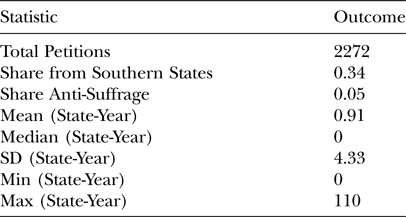
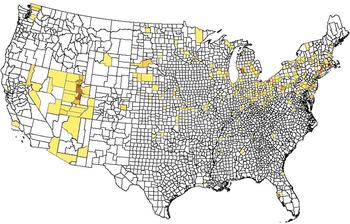
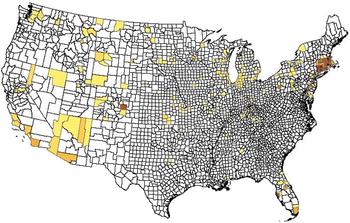
In the present article, we examine the behavioral legacies of the woman suffrage campaign by examining a new data source on suffrage petitions. Drawing upon an original data set of more than 2,000 woman-suffrage-related petitions sent to the U.S. Congress between 1870 and 1920 and recorded in the Congressional Record, we examine the evolution of petitioning that culminated in the Nineteenth Amendment to the U.S. Constitution. We first study the emergence and development of these petitioning patterns, asking whether the petitions served to enable state-level organization and whether they were predictive of changes in favor of (or against) the suffrage extensions of the Nineteenth Amendment. Our petitions’ data are geocoded (see Figures 4 and 5, later in this article), allowing for a rare visual examination of the spatial and geographical development of the woman suffrage and women's rights movements. We then combine the petitions into a county-by-year panel array (as well as a county-by-decade array with census data merged in) so that the flow of petitions can be analyzed statistically. These statistical data allow us to pinpoint where and when suffrage-related petitioning occurred before 1920.
While it is known that woman suffrage activists, which included men as well as women, sent petitions to state legislatures and to Congress, and that anti-woman-suffrage activists also did so, the full scope of this petitioning has never been analyzed by social scientists. We attempt a systematic study of national-level petitions here, adding some important state-level petitions and campaigns as well. Because our data do not include all petitions sent to the dozens of state legislatures where suffrage extension was in play, there are some questions we are not equipped to address: Did woman suffrage petitioning serve to persuade state legislatures to expand suffrage or to ratify the Nineteenth Amendment? What were the legacies of state-level petitioning campaigns? There are other questions that are related to but not directly involved in our examination of suffrage petitioning as formative practice. One could ask, for example, whether suffrage petitioning shaped other forms of pro-suffrage organization or even anti-suffrage organization.Footnote 26
Whatever the questions that can be asked of the relationship between petitioning and other aspects of the suffrage movement—or any other movement studied in historical context—it is worth remembering that these questions have not been examined systematically in the literature. The reason is that except in particular cases (especially antislavery),Footnote 27 systematic petitions’ data have not been gathered, analyzed, and harnessed in the literature. As a result, women's agency may be systematically underrepresented in much of the literature. As recent scholars of social movements and gender have emphasized, moreover, data on alternative forms of women's agency are critical to research progress in this field.Footnote 28
ANTEBELLUM SUFFRAGE PETITIONING
The U.S. women's rights movement emerged itself from the antislavery movement,Footnote 29 in which American women (black and white) played critical organizing roles. From the 1830s and 1840s onwards, women active in the antislavery cause began to advocate openly for more visible and legitimated roles for women in American society. These ranged from Angelina Grimké’s call for American women to petition legislatures in her Appeal to the Women of the Nominally Free States (1837) to women's written calls to state legislatures for an extension of voting rights. The historian Lori Ginzberg notes an early 1840s petition, predating the Seneca Falls Convention of 1848, in which women of northern New York advanced a theory of their rights.Footnote 30 In Massachusetts, women built upon their antislavery activity to call for voting and full civil rights, whether in signing their antislavery petitions as “should-be voters” or, in 1849 and afterwards, petitioning explicitly for suffrage rights. A similar petition-based mobilization occurred in Michigan in the 1850s and 1860s.Footnote 31 Although the discussion of suffrage rights were not explicitly advanced, Native American women's petitions had for decades requested an equality of women's rights, ranging from the Cherokee Women's Councils petitions of 1817 and 1818 to Jenny McIntosh's 1822 petition calling for the rights enjoyed by white women to be extended to her, a Native American woman.Footnote 32 Early American feminists in central and western New York were greatly influenced by their interactions with, and observation of, Native American women, especially in matrilineal societies such as the Iroquois (Haudenosaunee).Footnote 33
Perhaps the first explicitly pro-suffrage petitions to arrive in a state or national legislature came to the New York State Constitutional Convention of 1846. Ginzberg has documented a petition of six women from Jefferson County, New York, sent and introduced to the convention in August 1846. Coming two years before the better-known Seneca Falls Convention and its Declaration of Rights, the women of Jefferson County voiced a neo-Madisonian argument for women's equality:
To the Constitutional Convention of the State of New York.
Your memorialists, inhabitants of Jefferson county, believing that civil government has its foundation in the laws of our existence, as moral and social beings, that the specific object and end of civil government is to protect all in the exercise of all their natural rights, by combining the strength of society for the defence of the individual—believing that the province of civil government is not to create new rights, but to declare and enforce those which originally existed. Believing likewise that all governments must derive their just powers from the consent of the governed “from the great body of society, and not from a favored class, although that favored class may be even a majority of the inhabitants,” therefore respectfully represent:
That the present government of this state has widely departed from the true democratic principles upon which all just governments must be based by denying to the female portion of community the right of suffrage and any participation in forming the government and laws under which they live, and to which they are amenable, and by imposing upon them burdens of taxation, both directly and indirectly without admitting them the right of representation, thereby striking down the only safeguards of their individual and personal liberties. Your memorialists therefore ask your honorable body to remove this just cause of complaint, by modifying the present Constitution of this State, so as to extend to women equal and civil and political rights with men.Footnote 34
As Ginzberg and other historians have noted, the Jefferson County petitioners used an argument not about republican motherhood or of the inherent corruption in the male-dominated party system of the republic and how women could serve as a countervailing force, but about government legitimacy. Citing James Madison's Federalist #39,Footnote 35 they argued that the legitimacy of governance rested upon full elective consultation of all parts of society. At least two other petitions favoring woman suffrage entered the record that summer,Footnote 36 though neither received the reading or attention experienced by the Jefferson County memorial of Eleanor Vincent and five other women.
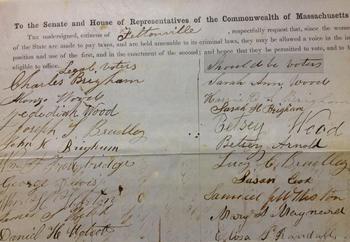
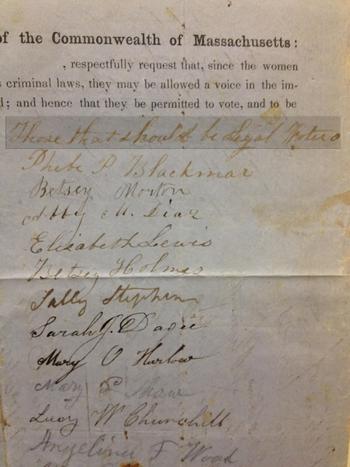
In the wake of suffrage and women's rights conventions—first in Seneca Falls in 1848 and then elsewhere in the Northeast, including the national women's rights convention in Worcester in 1850 and 1851Footnote 37—more petitions for suffrage began to flow to state legislatures and constitutional conventions. Forty-one men and women of Feltonville, Massachusetts, petitioned the Massachusetts General Court in 1850 for women's voting rights and, beyond that, eligibility to hold government office (see Figure 1).Footnote 38 It was common in nineteenth-century petitions for women and men to sign in separate columns, in part as a representation of the separate spheres inhabited by the sexes, but also as a way of permitting the recipients of petitions to distinguish between those who could vote and those who could not.Footnote 39 Many petitioners entitled these two columns of signatories as “voters” and “women,” but the Feltonville petitioners upended this binary by describing men as “voters” and women as “should-be voters.” The same year, the women of Plymouth headed their signatory column with “those that should be voters” (Figure 2). Unlike so many movements where women had drawn upon gender stereotypes and failed, the early suffragists in Massachusetts and New York upended conventional rhetoric and representations.Footnote 40
Suffrage Petitioners Representing Themselves as “Should-Be Voters” (Feltonville, Massachusetts, 1850). House Unpassed Legislation 1850 # 2577, Petition of Charles Brigham, SC1/series 230, Massachusetts Archives, Boston, MA. Courtesy of the Massachusetts Archives.

Women of Plymouth Representing Themselves as “Those That Should Be Legal Voters,” 1850. House Unpassed Legislation 1850 # 2577, Petition of Edwin Lewis, SC1/series 230, Massachusetts Archives, Boston, MA. Courtesy of the Massachusetts Archives.

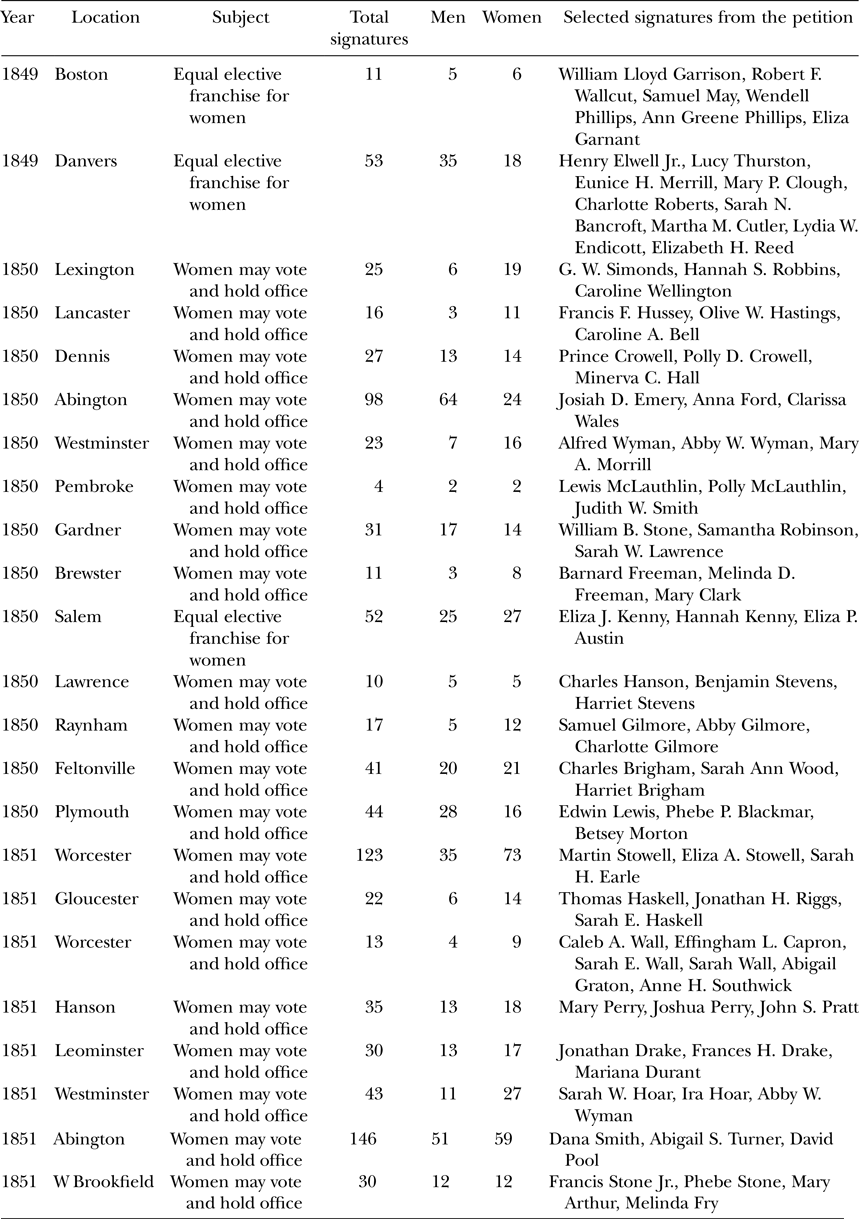
The Feltonville and Plymouth petitions were but two examples of a surge of woman suffrage petitions sent to the Massachusetts legislature from 1849 to 1851. Suffrage radicals sent at least twenty-three petitions to the General Court during these years (see Table 1). Some of these were probably coordinated at the national woman's rights convention in Worcester, but others were not, having arrived before that convention and, by dint of having been sent to different legislators for introduction on the floor, having been separately coordinated depending on their town of origin.
The Woman Suffrage Petitioning Surge in Massachusetts, 1849–1851

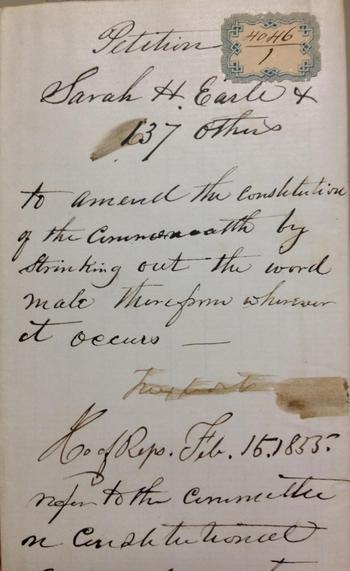
As this petitioning campaign progressed, its claims became more strident and its organizing activity became more pronounced and visible. In some cases this radicalism began to show up in the petition prayer, for example, when Sarah Earle and 137 other citizens from Worcester petitioned the Massachusetts legislature to strike out the word “male” wherever it appeared in the state constitution (Figure 3). This petition was remarkable not only because it advanced a vision of a genderless constitution, but also because the first signer was a woman. Such a constitutional amendment would have changed not only voting eligibility, but also property laws, jury eligibility, and other domains of women's lives. Beginning in 1850, women began to regularly outnumber men in the signatory list of these petitions (Table 1), with an average across the 1849 to 1851 petitions of three female to every two male signatories (female-to-male ratio = 1.57).Footnote 41 Beginning in 1851 the petitions in Massachusetts and New York regularly began to exceed 100 signatories. By 1858, pro-woman-suffrage petitioners could expect regularly to send a petition like that delivered from Nantucket, which produced 277 signatures on a suffrage petition, 191 of them from women of the island, larger than any petition from Worcester or Boston at that time.Footnote 42
Suffrage Activists Petitioning for Elimination of the Word “Male” in the Massachusetts Constitution, 1855. House Unpassed Legislation 1855 # 4046, Petition of Sarah H. Earle. SC1/series 230, Massachusetts Archives, Boston, MA. Courtesy of the Massachusetts Archives.

In New York, meanwhile, Susan B. Anthony began her campaign for suffrage with a petition.Footnote 43 Her petition advanced several claims—“(1) control by women of their own earnings; (2) guardianship of their children in case of divorce; (3) the vote.”Footnote 44 In an innovative organizational method, she appointed sixty women in 1854 as “captains,” one from each county in New York. Anthony's designation of county captains mirrored the organization of precinct captains in modern party organization, developed nowhere more vividly than in New York State. Again, habits of petition organizing mimicked and presaged habits of electoral organizing. Within ten weeks Anthony and her captains had collected six thousand signatures, and Anthony coordinated the presentation of the petitions with a state legislative session in Albany.
It was not until the late 1860s and early 1870s, however, that suffrage petitioning at the national level began to take off. The cause of women's suffrage was animated anew by the ratification of the Fifteenth Amendment (which had extended voting rights to black men), by the Reconstruction-era exercise of black voting rights in South and North, and by the recognition of women's voting rights in the territory of Wyoming in 1869. The Fifteenth Amendment spawned both celebration and resentment among white women activists, so much so that the historian Louise Newman has termed the suffrage movement one that fought implicitly (and sometimes explicitly) for “white women's rights.”Footnote 45 A renewed battle over women's voting rights shook Utah the following two years, with women's nascent liberties being granted in the territory but then taken away by federal statute in 1887, not to return until 1896 (see Section 3). Yet the Reconstruction era, the Wyoming precedent, and the question of women's liberties in the West had placed the issue of women's voting rights more durably than ever on the national agenda. A petitioning campaign for women's suffrage brought dozens of new petitions to the Massachusetts House and Senate in 1870–1872, and petitions soon began to flow into Congress.Footnote 46
GEOGRAPHIC AND TEMPORAL PATTERNS OF NATIONAL SUFFRAGE PETITIONING
The petitions sent to the U.S. Congress from 1870 to 1920 offer a unique window into the woman suffrage movement, not least because at the national level, the petitions were sent to a common institutional recipient, which acts as something of a “control” for institutional factors that would have varied across state legislatures in the period. The granularity of these data also permits a revealing look at where petitions were coming from and when they were circulated. These petitions (summarized statistically in Table 2) were collected from a text analysis of the Congressional Record, which has the advantage of completeness but sacrifices information about the number of signatories.
Summary Statistics for National Suffrage Petitions

Using historical geographic information system (GIS) shapefiles of the United States, as well as historical information on township and county boundaries, we have placed these petitions in their township and county of origin (petitions self-stated as coming from a single state cannot be so placed and have been omitted from the following figures). The activity was most heavily concentrated in the early twentieth century, given that before 1900 suffrage petitioning activity directed at Congress was characterized by sporadic activity in New England, the Ohio Valley, the Great Lakes States (particularly in the area of southern Lake Michigan), and the western states and territories. We focus our graphical displays on the period 1900 to 1920; maps for the period 1901 to 1910 (Figure 4) and the period 1911 to 1920 (Figure 5) offer a county-by-decade view of the petitions, without regard for their position on the woman suffrage issue (just 5.6 percent of the petitions we examined were against women's voting rights).
Suffrage Petitioning per Capita, 1900–1910.

Suffrage Petitioning per Capita, 1910–1920.

From 1890 to 1910 clear geographic patterns and differentials began to emerge. More and more activity was concentrated in New England, especially Massachusetts, Connecticut, and Rhode Island, with petitioning activity in the Midwest moving “westward” to western Wisconsin, Iowa, and Missouri. In the West, Colorado, Utah, and Oregon appear to have exhibited higher levels of petitioning activity, not least because important battles over state- and territory-level suffrage were going on in those jurisdictions.
The first decade of the twentieth century witnessed a profound and widespread surge in woman suffrage activity and petitioning, and the congressional petitions give a striking view of this activity (Figure 4). In the midst of pitched fights over suffrage at the state level, petitions poured into Congress from the Northeast and the Great Lakes region. The South, for reasons explained elsewhere by historians,Footnote 47 lagged appreciably in women's activism. Yet the force of politics in the West emerges most clearly in three states: Nevada, Arizona, and Utah—the state that contributed the greatest number of petitions per capita.
The centrality of Utah in these data coheres with the state's controversial place in national political culture in the late nineteenth and early twentieth centuries. Utah Territory was the home to the country's small and greatly persecuted Latter-Day Saints (LDS) population. The territory granted women voting rights in 1870, though it was a splinter and breakaway faction of former Mormon men—called the Godbeites—who coordinated to achieve this result. As part of an anti-Mormon wave of sentiment sweeping the nation in the late nineteenth century, Congress revoked women's voting rights in the Edmunds-Tucker Antipolygamy Act in 1887. Fierce and unpredictable patterns of contestation over the possible restoration of voting rights to women followed passage of that act. Many Mormon leaders were critical of the idea of women's voting rights, and anti-Mormons saw in woman suffrage a means by which Mormons could become further empowered in Utah and the nation at large. Critical matriarchs of the Mormon Church mobilized, however, in support of woman suffrage in the 1890s, including Emmeline Blanch Wells (editor of the leading woman's rights journal The Woman's Exponent, founded in 1877), Zina D. H. Young (wife of Brigham Young), Jane Richards (wife of LDS Apostle Franklin D. Richards), and Sarah M. Kimball. As Utah historian Jean Blickmore White describes these women, their position as wives of Mormon patriarchs meant that they could not be dismissed as immoderate or apostate radicals.Footnote 48
The particular intensity of the Utah suffrage petitioning depicted in Figure 4 comes from a collective petition submitted in April 1910.Footnote 49 This petition was remarkable for its breadth, coming from numerous counties in the state, reflecting the participation of women and of men, and amassing thousands of signatures. The petition also came at a time when the voting rights of Utah's women had been secured. It called instead for the submission to the state of a constitutional amendment for ratification.
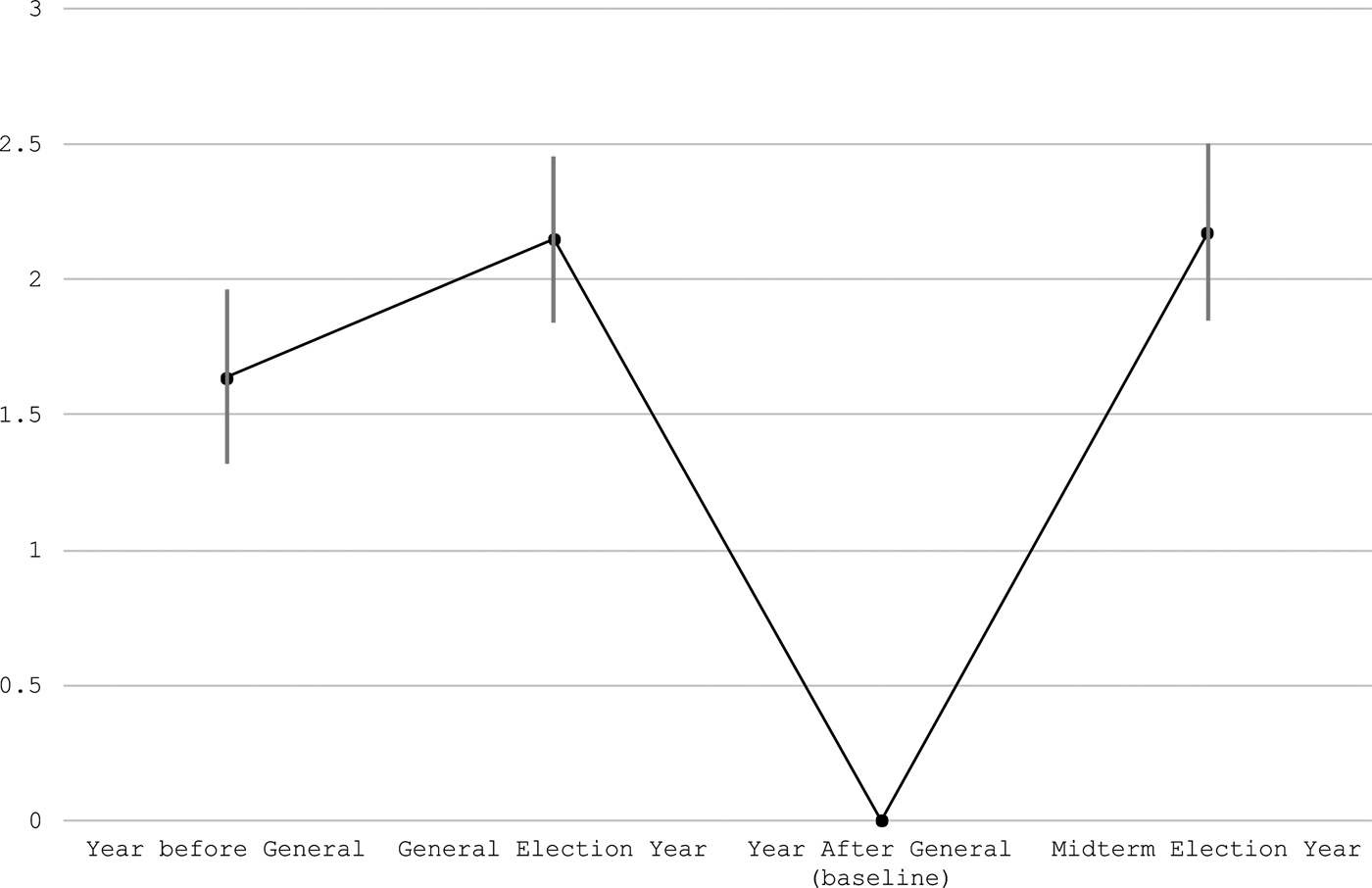
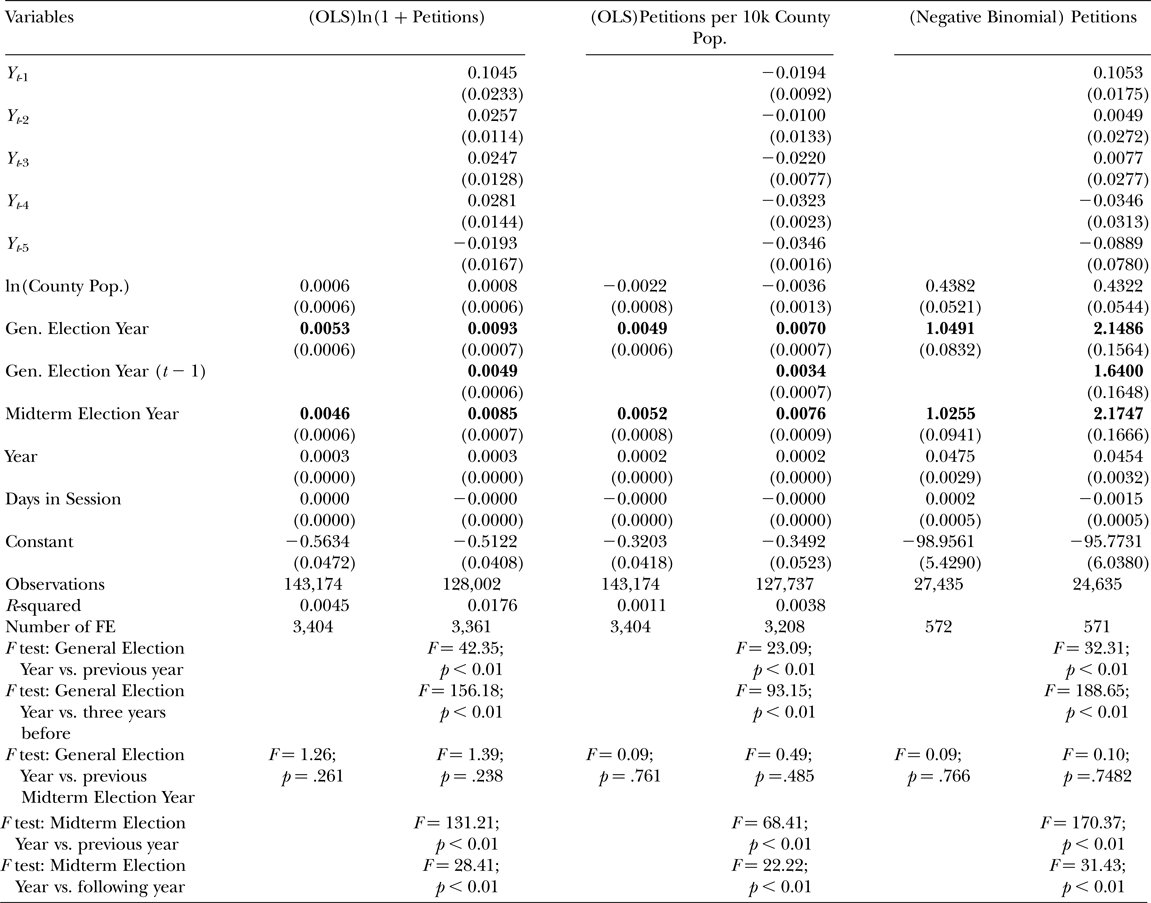
Like the 1910 Utah petition, the woman suffrage petitions were heavily concentrated in election years. We demonstrate in Table 3 that, controlling for fixed geographic characteristics, general election years were associated with significantly higher rates of petitioning (both raw numbers and rates per capita) on suffrage issues. Tests of linear restrictions show that rates of suffrage petitioning were statistically indistinguishable in general versus congressional (midterm) election years, but that election years saw higher rates of suffrage petitioning relative to the preceding pre-election-year patterns, with a large drop-off the year after a general election (see Figure 6).
Suffrage Petition Frequencies Across the Electoral Cycle.

Fixed-Effects Regressions of Suffrage Petitioning on Election-Year Characteristics
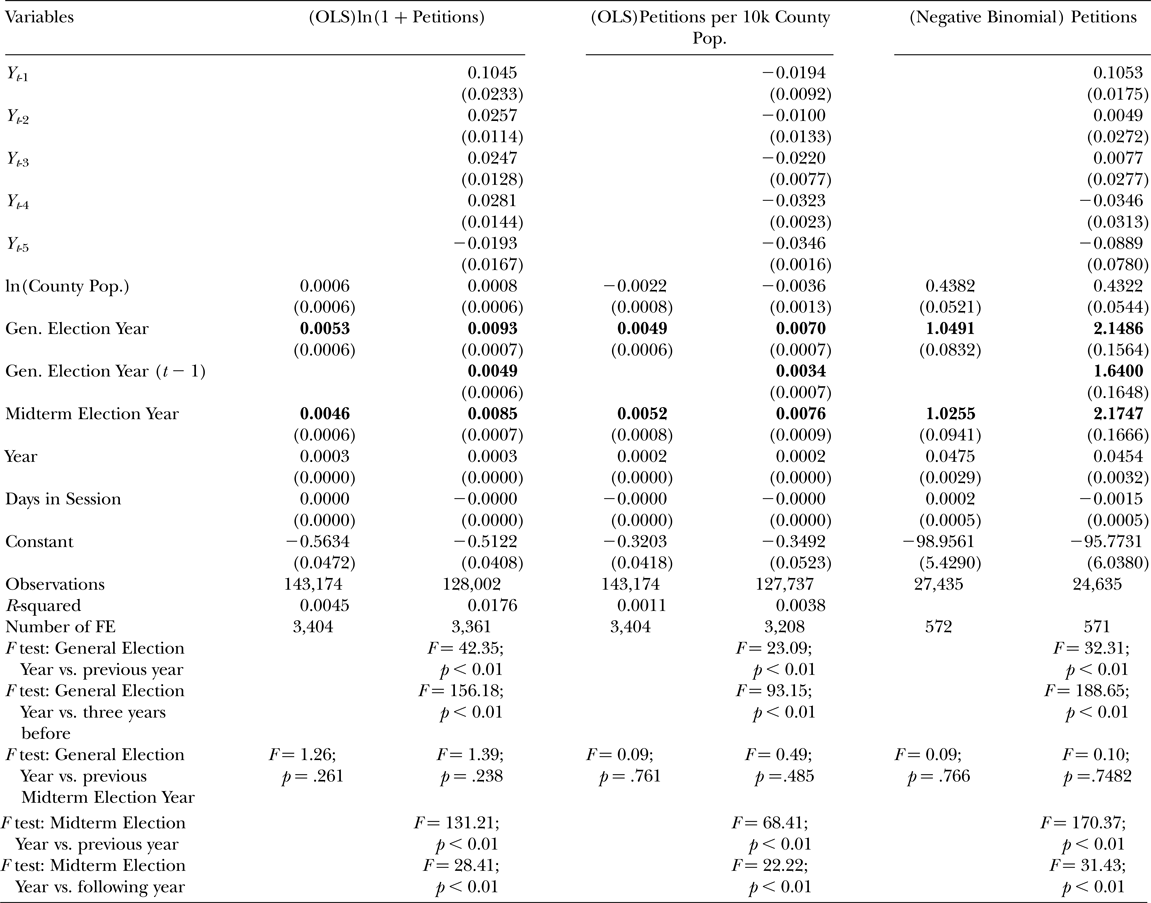
Notes. Robust standard errors in parentheses; clustered on counties for linear models. Bolded coefficient indicates statistical differentiation from zero (two-tailed test). Negative binomial regression excludes counties with zero petitions. OLS = ordinary least squares.
This pattern coheres with observations of historians, especially Eleanor Flexner, who note that election years often witnessed unfranchised women holding mock elections and other activities.Footnote 50 Election years became a reminder to women of their unfranchised status or, in states like that of Utah, of the fact that their voting rights rested upon the vote of state legislatures where they were little represented. Election years were also, during the late nineteenth and early twentieth centuries, a period of general mobilization on a range of political issues.
Some of these events have become the basis of legend. In Rochester, New York, Susan B. Anthony led a group of sixteen women who registered and then voted in the presidential election of 1872.Footnote 51 Anthony and her compatriots knew that to do so was illegal and risked a fine up to $500 and a prison sentence of possibly three years. Anthony registered and voted, and was subsequently arrested. The case became a sensational trial, and she was eventually convicted but paid no fine or jail time, due to procedural mistakes by the presiding judge and the reluctance of New York officials to see the case appealed. All the while, Anthony and her colleagues gave lecture tours and sponsored further petitioning. Flexner and Fitzpatrick describe a similar mock election in 1868 in New Jersey. The women casting their votes were keenly aware that New Jersey was the last state to abolish, in 1808, women's suffrage, which had been gained during the American Revolution.Footnote 52
The precise meaning of these election-year jumps in petitioning activity remains impossible to clarify based on historical materials and quantitative data. Yet it is clear that election years witnessed broad surges of women's and men's political activity, both in states and territories where women already enjoyed the right to vote and in venues where they did not. Similar patterns of heightened nonelectoral ideation and activity have been noticed for election years (and even within them).Footnote 53 The consistency of these patterns with other nonelectoral mechanisms of participation suggests that the prospect of voting (or of further securing limited voting rights by fixing them in the text of the Constitution) held an allure for women and that aspirations yet to be fulfilled composed a strong set of motivations for advocacy.
SUFFRAGE PETITIONING AND POST-EXTENSION TURNOUT
The historical evidence presented thus far points to suffrage petitioning as formative practice; so too does the empirical analysis linking election timing with upticks in the volume of suffrage petitions. If the bundle of activities associated with suffrage petitioning allowed women to build capacity to take full advantage of the vote, then a final, crucial question is whether variation in suffrage petitioning activity was actually associated with higher rates of voting among the “Nineteenth Amendment women” who came of age during the periods of suffrage extension.
Scholars have speculated, and ultimately confirmed, that women born before and during the period of suffrage extensions, culminating in the Nineteenth Amendment, were less likely to vote in subsequent years than those who came of age later, when female voting was an established norm. Merriam and Gosnell first identified the existence of a turnout gender gap in the 1923 Chicago mayoral election, and numerous other scholars have subsequently examined the voting behavior of Nineteenth Amendment women.Footnote 54 Subsequent research has shown that turnout rates varied substantially by state and were particularly sensitive to the partisan environment and electoral rules and institutions.Footnote 55
In addition, turnout patterns appear to have varied widely by birth cohort. Firebaugh and Chen identified this effect using a panel from the American National Election Studies (ANES 1952–1988). The authors found that female respondents in cohorts born before the Nineteenth Amendment exhibited a substantially lower turnout rate than men; the size of the gap in turnout decreased for more recent cohorts; and female respondents born well after the Nineteenth Amendment voted at rates similar to their male counterparts. According to the authors, this empirical pattern demonstrates the “staying power of norms internalized many years earlier. Historical conditions during formative years can have long-lasting effects.”Footnote 56
To assess whether suffrage petitioning marked development of a formative practice, we replicate and then extend these findings by evaluating the effects of organized movements for suffrage, expressed through petitioning to Congress, on subsequent patterns of turnout. If so, then places with high levels of petitions seeking suffrage may also have a diminished turnout gender gap that persists long after suffrage is granted.
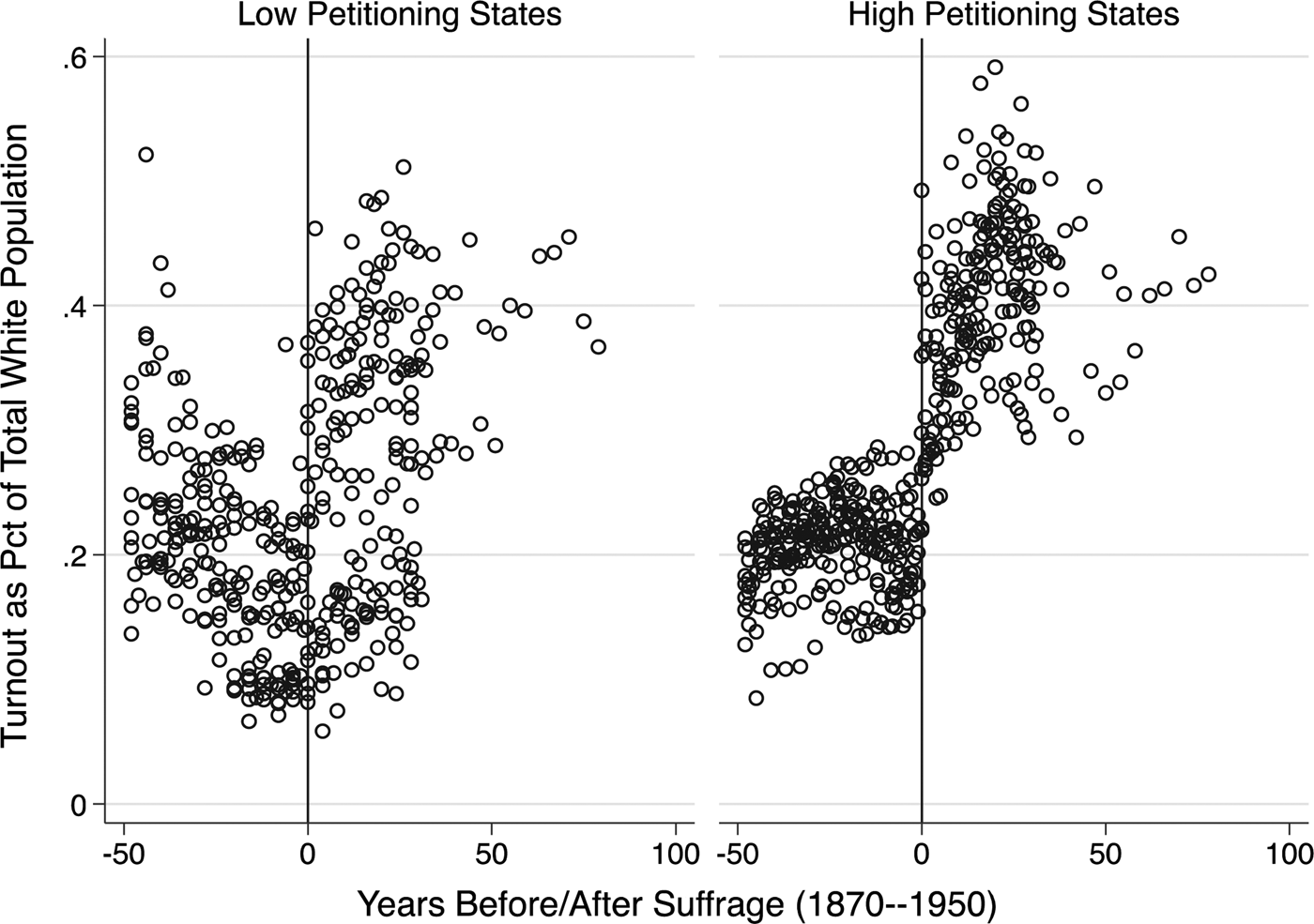
First, we can confirm that women in states with high levels of petitioning appeared to take immediate advantage of the ability to vote. Figure 7 displays overall turnout for high versus low-petitioning states immediately before and after the extension of suffrage.
State-Level Turnout Rates in the Years before and after Suffrage Was Granted for Each State.

The data follow a distinct pattern in that the overall levels of turnout appear to have jumped higher immediately after suffrage was granted in states with high levels of petitioning; however, in states with lower levels of petitioning, a considerable number of post-suffrage elections did not exhibit such a distinctive increase in turnout.
This initial cut at the data lends credence to the theory that citizens of states with high levels of petitioning-seeking suffrage also tended to make greater use of the ballot once granted the vote. Still, the conclusions we can draw from this figure are limited by the facts that we cannot isolate separate turnout rates for men versus women and that we cannot distinguish differences in voting behavior across cohorts. As a result, we turn to individual-level survey data, following Firebaugh and Chen, which allow us to observe turnout for female and for male respondents by cohort.
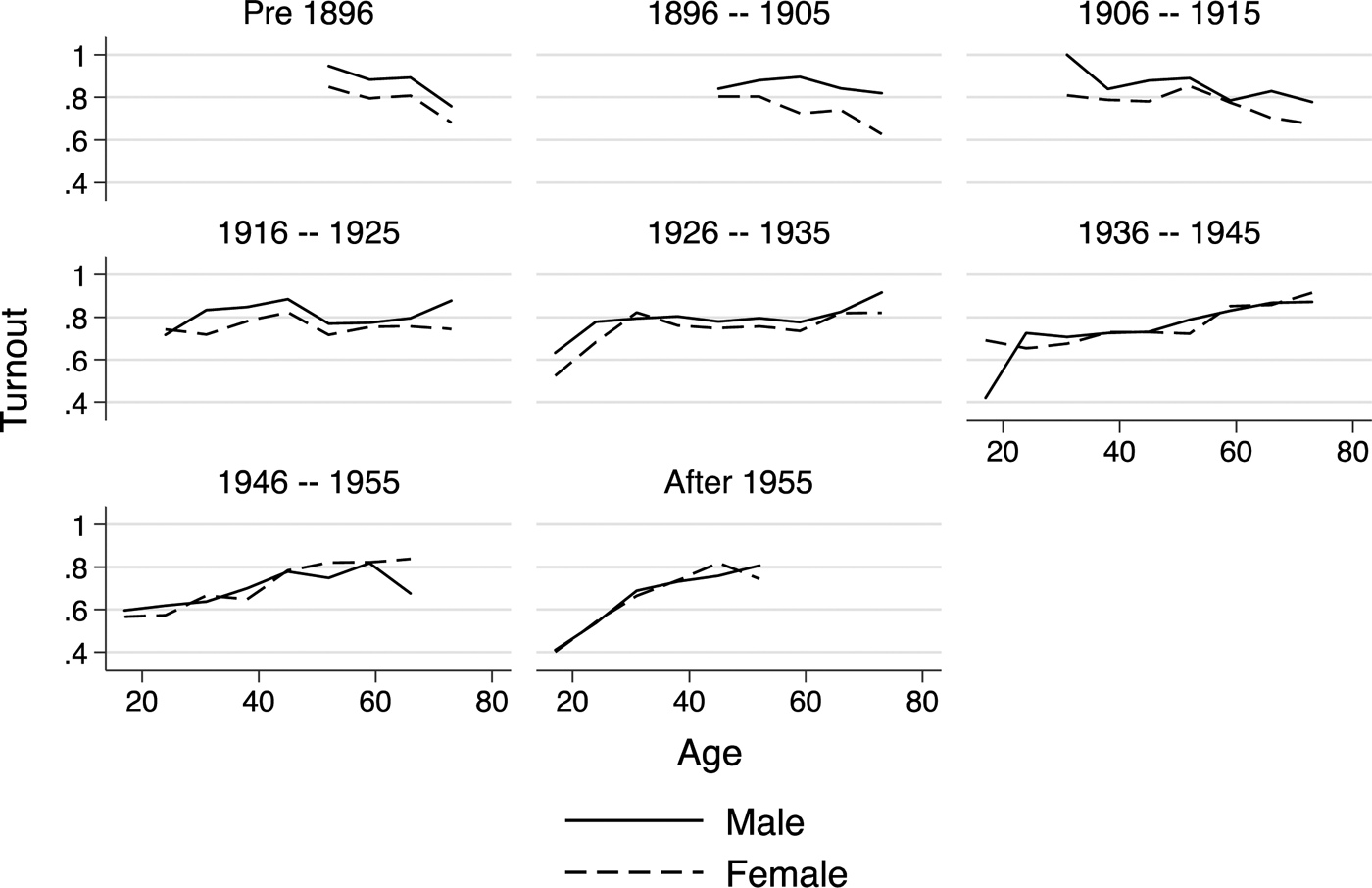
We first replicate the main result from Firebaugh and Chen. Figure 8 displays the turnout rate for men and for women based on ANES starting in 1952. ANES report voting behavior based on in depth surveys conducted during election years. In this article, we restrict the sample to only white respondents, as there is considerable heterogeneity in access to the ballot across states for other races. Respondents are divided into groups based on their birth cohort: pre-1896, 1896–1905, 1906–1915, 1916–1925, 1926–1935, 1936–1945, 1946–1955, and after 1956.
Male and Female Turnout Rates for Different Cohorts (Based on Birth Date).

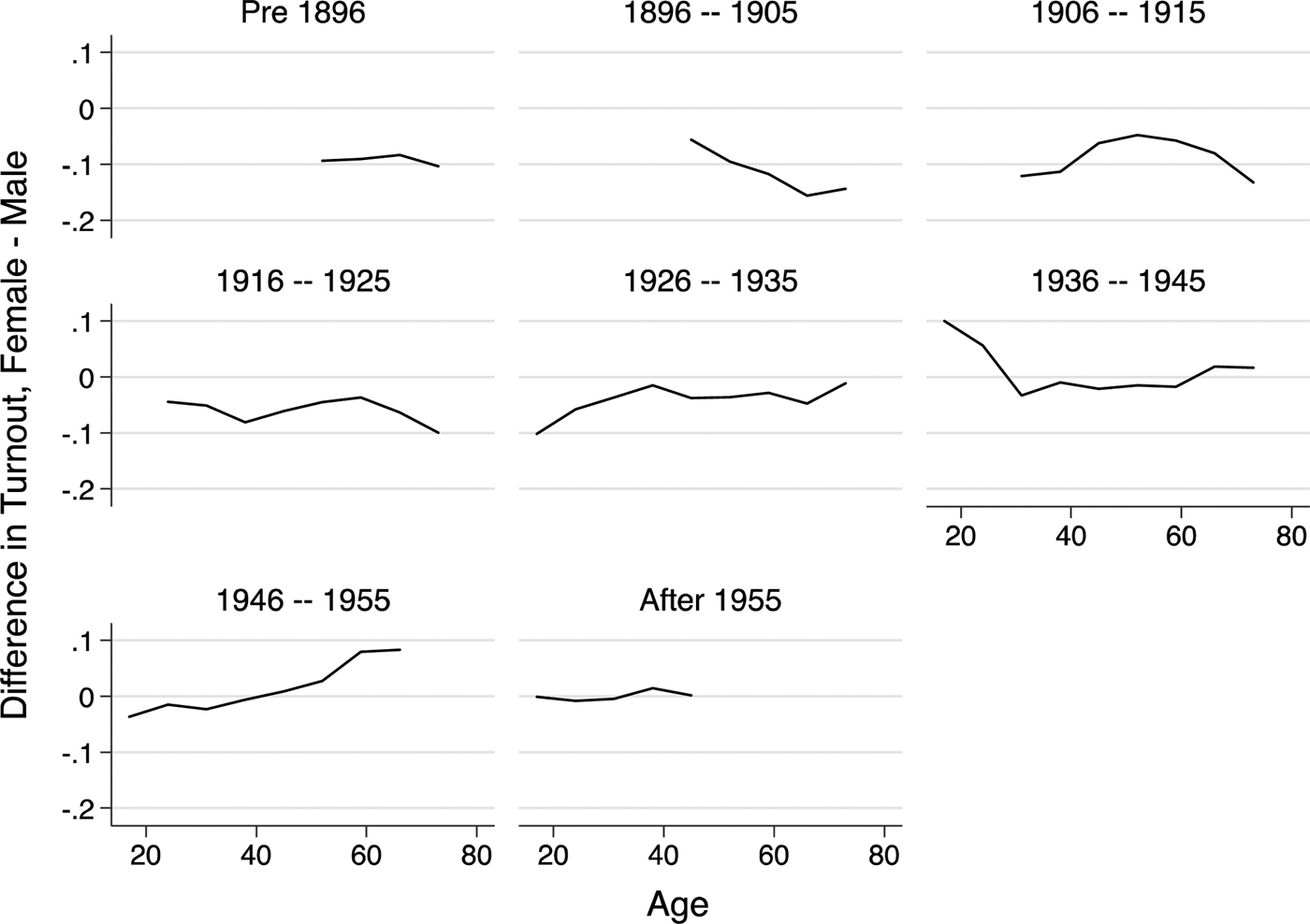
Because turnout follows a relatively well-known pattern over the life cycle, we parse turnout by age as well as by cohort. The pre-suffrage cohorts exhibit a notable gender gap. Respondents born pre-1896, 1896–1905, 1906–1915, and 1916–1925 are all less likely to turn out, regardless of age, if they are female. The gender gap appears to narrow and disappear for subsequent cohorts. This pattern is made more explicit in Figure 9, which plots the difference in turnout rate, calculated as female turnout minus male turnout.
Female Minus Male Turnout by Cohort.

As Figure 9 illustrates, pre-1896 cohort women turned out at rates close to 10 percentage points less than their male counterparts. Women born from 1896 to 1905 exhibited a similar pattern of behavior. The next two cohorts still exhibit a gender gap in turn out, but decreasingly so. By the 1926–1935 cohort, the gap had narrowed to close to zero.
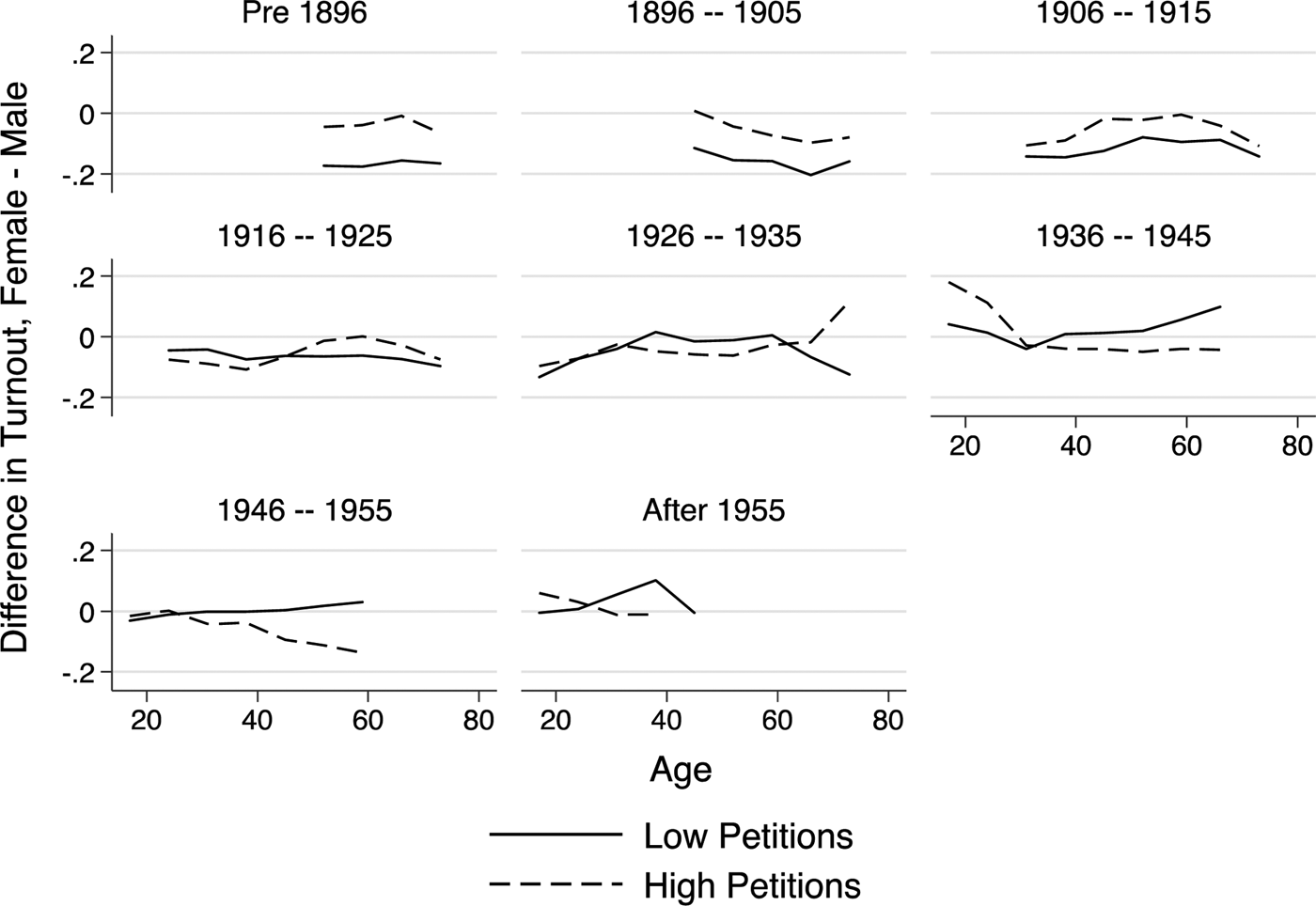
Our theory is that petitions sent to Congress signal a level of experience that will attenuate the gender gap observed in Firebaugh and Chen's study and replicated here. We have partitioned states into high- and low-petitioning states. This grouping is based upon the aggregate number of petitions sent to Congress in the period under study. States that sent greater than the median are labeled “high” and states that sent less than the median are labeled “low.” Next, we calculate the gender gap in turnout for each cohort over the life cycle for respondents in high- and low-petitioning states.
Figure 10 displays the results. For the cohort born before 1896 there are no data to calculate the gender gap before the age of 45. Similarly, there are several other cohorts where we cannot calculate the full turnout curve over the life cycle for both high- and low-petitioning states. However, we do observe a clear pattern in the data. For each cohort born before the extension of women's suffrage, the states in which there were higher levels of petitioning have a significantly narrower gender gap in turnout rate. For example, women born between 1896 and 1905 appear to have turned out to vote at rates roughly similar to their male counterparts in states with high levels of petitioning. This same pattern persists for the next two cohorts as well. Only for cohorts who came of age after the Nineteenth Amendment (i.e., starting with 1916–1925) does petitioning not appear to make any difference in the turnout gender gap.
Gender Gap in Turnout for High- and Low-Petitioning States.

We next estimate the turnout gender gap by cohort using logistic regression. The outcome variable, turnout, is a binary variable that takes the value of 1 for respondents who voted in the presidential election in the year of their ANES interview and takes the value of 0 for respondents who did not vote. Our first specification is a logistic regression of each respondent's turnout on whether they are female; indicator variables for cohorts; interactions of cohorts with the female indicator variable; and a set of controls including education level, marriage, region, election-year dummy variables, year a state ratified the Nineteenth Amendment, age, and age-squared. This approach is a slightly different parameterization of the main specification in Firebaugh and Chen's study. To estimate the turnout gender gap by cohort, we observe the quantity γ + δ, which yields the change in log odds of turnout for women versus men.Footnote 57
 $$\eqalign{ {\rm logit}\left( {turnout} \right) &= \alpha + female \cdot \gamma + cohort \cdot \pi \cr & \quad + female \times cohort \cdot \delta + X\beta + \varepsilon}. $$
To test our theory, we add an additional variable measuring the number of petitions sent from the state in which the respondentesides. We fully interact this variable with cohort and the female indicator, yielding a new model that allows us to test how the gender effects vary by cohort for different levels of petitioning.
 $$\eqalign{ {\rm logit}\left( {turnout} \right) &= \alpha + petitions \cdot \theta + female \cdot \gamma + \cr & \quad cohort \cdot \pi + female \times cohort \cdot \delta + petitions \cr & \quad\times cohort \cdot \mu + female \times petitions \cdot \tau + female \cr & \quad\times cohort \times petitions \cdot \zeta + X\beta + \varepsilon} $$
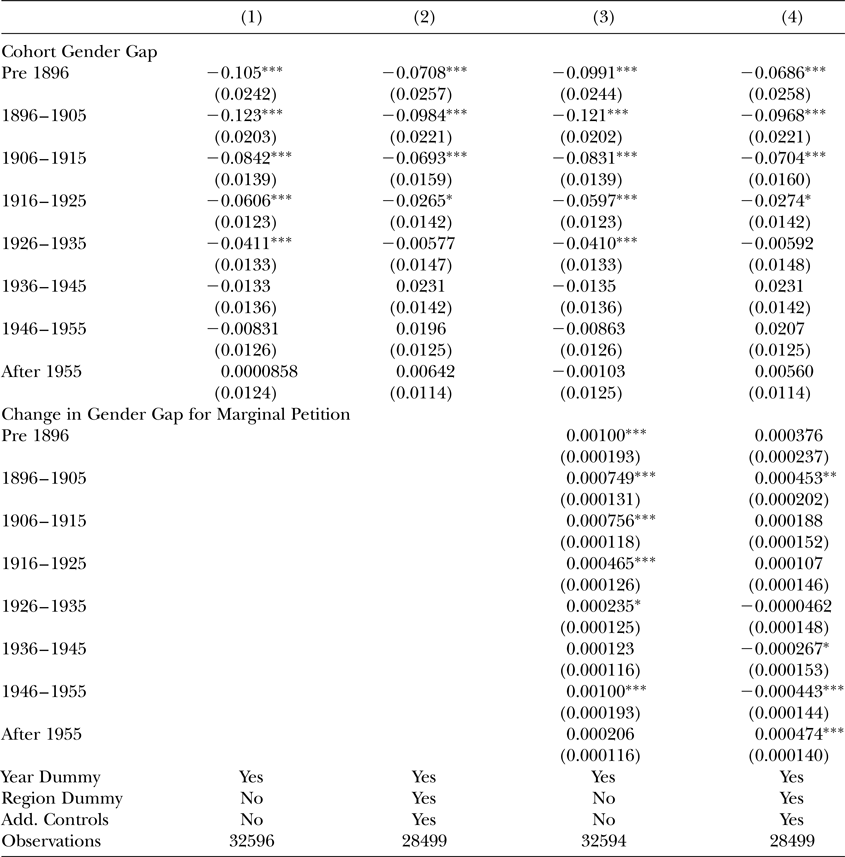
Table 4 presents our main results, reporting the marginal effects for gender and petitioning by cohort. The first specification, reported in Column 1, displays estimates from Equation 1, but only including election year as an additional covariate. In this specification, the first two cohorts have the largest gender gap, and it decreases for later cohorts. Based on the marginal effects reported in Column 1 of Table 4, women born before 1896 exhibited turnout rates 10 percentage points lower than men. For women born 1896–1905, the gender gap is a slightly larger 12 percentage points. From there, the gap declines with each subsequent cohort. Women born after 1936 exhibit no significant difference in turnout compared to their male counterparts. In the second specification, when we control for a host of confounding variables, the cohort effects line up with the timing of suffrage extension. We observe the same decreasing effects by cohort, and the cohort born from 1916 to 1925 is the last for which we observe a significant gender gap in turnout.Footnote 58
Logit Model Marginal Effects: Women's Turnout and Petitioning by Cohort

Notes. Standard errors in parentheses. * p < 0.10, ** p < 0.05, *** p < 0.01
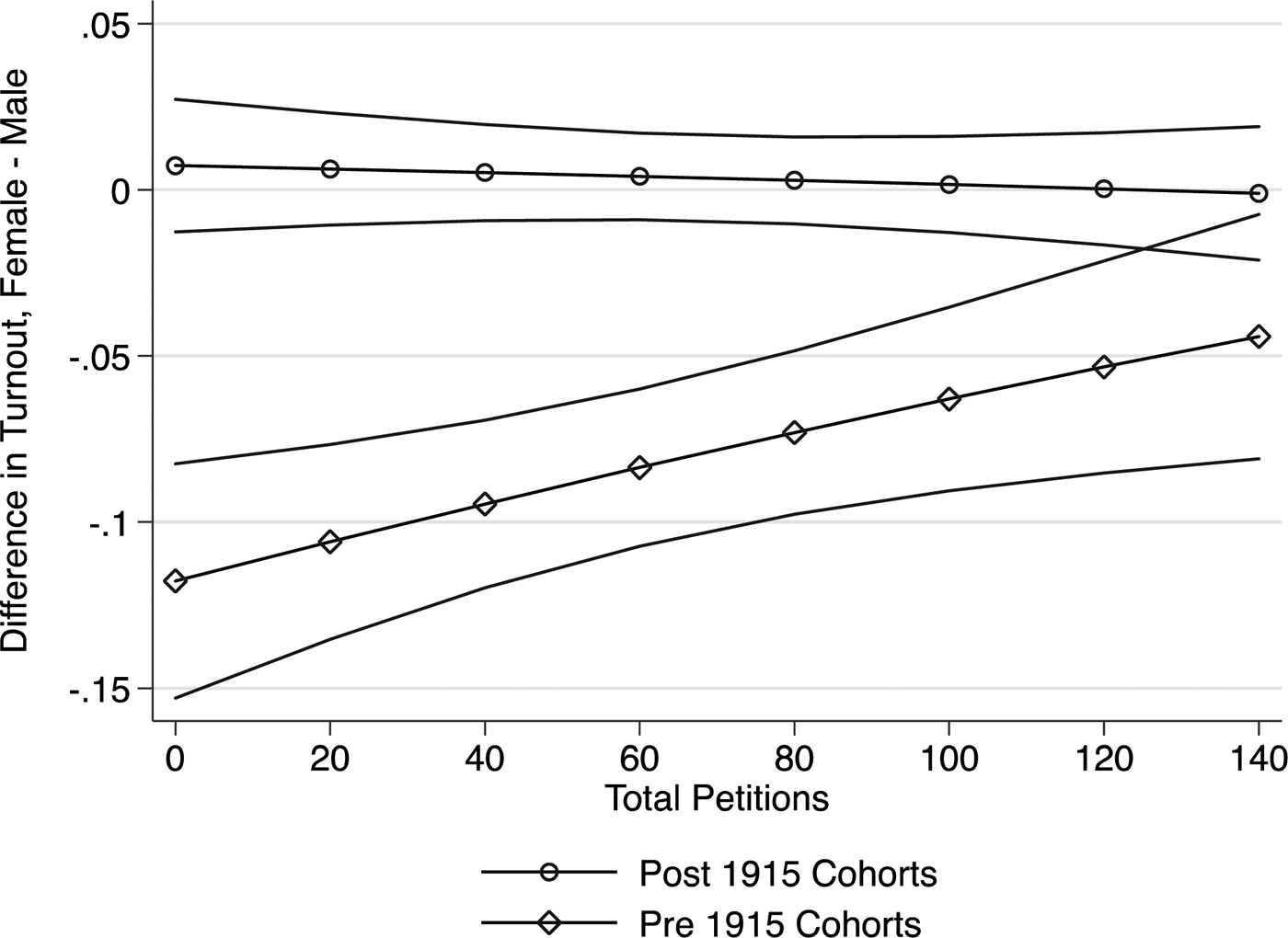
The estimates from Equation 2 represent the main result of this section, and they are summed up in Figure 11. This figure displays the estimated gender gap for the three pre-1915 cohorts versus the post-1915 cohorts. The effect size depends on the level of petitioning activity in a state. First, consistent with the previous results, the pre-1915 cohorts exhibit a greater gender gap than the later cohorts. However, as is illustrated in the figure, this gap is attenuated for states that participated in higher levels of petitioning. For states that sent in the greatest numbers of petitions, there is no significant difference across pre- and post-1915 cohorts. Most of this result is driven by the fact that the absolute value of the gender gap is decreasing in the number of petitions for pre-1915 cohorts (i.e., the slope of the line is sloping upward).
Estimated Gender Gap in Turnout for Pre-1915 Cohorts versus Post-1915 Cohorts, Based on the Number of Petitions Sent to Congress from Each State.

Columns 3 and 4 in Table 4 provide a different angle on the same question, illustrating the changing magnitude of the gender gap based on the level of petitioning in a state. In particular, the earliest three cohorts all exhibit a negative gender gap with regard to turnout. However, for each of these cohorts, the effect is diminished for respondents who live in states with higher levels of petitioning. For example, based on Column 3, an additional ten petitions erase a percentage point of the gender gap among respondents from the first cohort.Footnote 59
We have shown that the suffrage petition variable correlates with a reduced gender gap in turnout for those who came of age during the suffrage movement. However, suffrage petitions may be just one indicator for increased organizing activity among women; that is, the empirical results presented so far do not speak to petitioning's relative importance, as compared to other political “background” variables, in attenuating the gender turnout gap. Other relevant variables include indicators for the extent of organization working toward women's suffrage within a state such as the presence of a state-level suffrage organization, its membership level, its organizational structure (i.e., was there a formal member list or regular dues collection?) and whether it held an annual convention.
To evaluate the importance of petitioning as compared to these other factors, we replaced the petition variable in Equation 2 with each of the indicators discussed above (one at a time) and reran the model.Footnote 60 Because we are analyzing individual-level data by cohort (collected well after the suffrage movement) as a function of potentially dynamic historical variables, we sought to create measures that captured this variability over time. To measure state-level suffrage organization, we created a variable reporting the share of years for which a state had a formal suffrage organization. For member lists, dues collection, and conventions, we similarly calculated the proportion of years in the sample for which each of these characteristics was present in a state. To measure membership levels, we created a variable capturing each state's maximum number of members per 10,000 population units across sample years. Then, for each model run, we computed the Akaike information criterion (AIC), which serves as a measure of goodness of fit for each model and allows us to compare goodness of fit across models. The model with the lowest AIC value best fits the data. Running the model using petitions as the key predictor yielded an AIC of 29999.13. No other variable yielded an AIC below 30018.68, and the values ranged from this number up to 30043.46. Based on this information, the petition variable best explained variation as compared to these other “political” background variables. That said, replacing the petitions with other political background variables did in fact yield similar patterns to the one we observe in Figure 11. Ultimately, our view is that, while we cannot definitively say petitioning was causally prior to other political background variables such as state-level organizational capacity, we do have reason to believe that higher levels of petitioning had, as a formative practice, a uniquely predictive role in reducing male-to-female turnout differentials, a role not explained fully by other political background variables.
A final check on whether petitioning versus other state-level background political variables best explain a reduced gender turnout gap is to look at variation in turnout within states. If county-level variation in petitioning correlates with a reduced gender turnout gap, then that would suggest our proposed mechanism is at work beyond both fixed and time-varying state-level political variables. To investigate this possibility, we examine county-level data using imputed turnout rates for men and women, following the scholarship of Corder and Wolbrecht in their book Counting Women's Ballots (2016) and a previous article.Footnote 61 Corder and Wolbrecht use a Bayesian imputation procedure to estimate turnout rates among men and women in townships and counties. Drawing upon their data for Connecticut, Illinois, Massachusetts, Michigan, and New York, we regress the logged ratio of imputed female turnout to imputed male turnout in a county upon the log of petitioning per 10,000 county population. These regressions return positive coefficients nearly uniformly (eleven of twelve regressions), but only in one state (Connecticut) are these statistically distinguishable from zero. However, the dependent variables in these regressions are by construction measured with error, which would inflate the estimated standard errors and reduce the t statistics.Footnote 62
All told, the survey-based and turnout evidence is consistent with a theory in which states with high levels of suffrage petitioning had a lasting effect on subsequent turnout. While a history of robust petitioning does not completely erase the gender gap in turnout among Nineteenth Amendment women, it substantially reduces its magnitude. In this regard, then, the formative practice developed through petitioning appears to have had meaningful, long-lasting effects.
MOBILIZATION AND CROSS-RACIAL ALLIANCE IN NEW YORK, 1900–1917
The postwar victory of suffragists in New York State—where women's voting was written into the state constitution in 1917—provides a critical case whose turnabout on suffrage marked a momentous victory for the national campaign. New York State also offers a final glimpse into the formative character of petitioning. Still the most electorally pivotal state in the Union, and the crux of Democratic Party politics, New York endured a long battle over women's voting rights. Some of the very first petition-based claims for women's equality came from the state,Footnote 63 but as in Massachusetts and elsewhere in the Northeast, New York also harbored a strong Progressive-Era anti-suffrage movement. In the midst of the Great War, suffrage and anti-suffrage forces clashed repeatedly, and the outcome remained unpredictable to observers and contestants alike.Footnote 64
Two features of New York suffrage petitioning merit attention. First, as scholars have begun to emphasize the role, not just of racial politics, but of African American constituencies in the suffrage rights campaign,Footnote 65 it is noteworthy that New York witnessed the emergence of cross-racial coalitions in suffrage leadership in petitioning. Some of the most important black suffragists made their names and some of their most importance advances through petitioning. Sarah Jane Smith Thompson Garnet, who founded the Brooklyn-based Equal Suffrage Association in the 1880s, joined with Verina Harris Morton-Jones to petition Congress for “asking for the enactment of such legislation by Congress as will enforce the Fourteenth Amendment to the Constitution.” Garnet and Morton-Jones presented this petition to Congressman William H. Calder in 1908. It stands as a reminder that the many voices petitioning Congress spanned race and class, and that the petition served a moment and site of personal influence with legislators, in this case African American women presenting requests to white members.Footnote 66
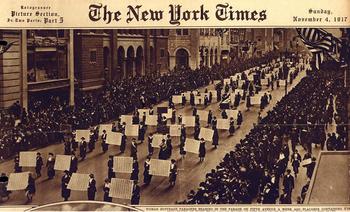
Second, New York women mounted a massive, petition-based mobilization in 1917 that melded previous scripts of practice and organization. The National American Woman Suffrage Association mounted a massive petition drive in 1917 and completed their activity in time to coincide with New York's ratification vote in November of that year. The state constitutional amendment had lost two years earlier by a substantial margin (195,000 votes), and although suffrage advocates detected momentum with the ending of WWI and the endorsement of many veterans’ groups, a late slew of anti-suffrage organizing activity led the New York Times and other papers to report on a “dark outlook” for woman suffrage in early November. The very weekend before (October 27, 1917), the suffragists held their only parade, and at the center of the parade lay the “Procession of the Petitions,” signed by more than one million women (Figure 12). Carrie Chapman Catt, president of the association, reminded a statewide audience that the petition demonstrated not only the vast force behind the constitutional amendment, but also the legitimacy and reality of the mass of her organization. “In the name of the 2,000,000 women who comprise the National American Woman Suffrage Association and who are straining their eyes toward the great promise of victory in New York State on Tuesday, I ask you to vote for woman suffrage. Remember that more than 1,000,000 of your mothers, wives, sisters, and sweethearts want you to vote for it, and have said so over their signatures.” Knowing beforehand the importance of the city vote in the state referendum, Chapman and the association had timed their Procession of the Petitions to augment crucial organization just before the statewide vote. Grafting the petition onto the parade, taking the suffrage canvass to an unprecedented scale, and innovatively melding petitioning and electoral mobilization, the postwar suffragists in New York had recombined political scripts and displayed the force of a single formative petition upon a mass scale.Footnote 67
The Procession of Petitions (October 27, 1917), New York City.

CONCLUSION—THE FORMATIVE CHARACTER OF SUFFRAGE PETITIONING
The woman suffrage campaign is rightly credited with the most far-reaching transformation of the electorate in American history. Analysis of a new data set of woman's suffrage petitioning suggests that it also constituted a mobilizing moment in its own right, as woman suffrage petitioning was highly concentrated in election years and appears to be differentially associated with women's turnout in the years after suffrage extension (both for those states that extended voting rights to women before the Nineteenth Amendment and for those states whose suffrage extension was accomplishment by the amendment).
Our multidimensional inquiry points to woman suffrage petitioning as a political practice—one that bundled and recombined a set of routines—that functioned formatively in women's voting. Early suffrage petitions announced an equality of citizenship, not merely in their prayers but also in the placement of women's names on signatory lists, a gesture toward men's names on nineteenth-century party lists. Women who organized as petition canvassers used the trappings and the lessons of electoral organizations among men, not least “captains” of mobilization assigned to geographically specific constituencies.
The larger scale of women's suffrage petitioning at the national level suggests that it was greatly heightened during national election years. Because our geocoded petition data allow for highly granular fixed effects at the county level, we can proceed with greater confidence that the election-year surges we document are the result of temporal factors and not from selection of particular counties or locations during election-year suffrage petitioning.
Finally, our analysis of women's turnout after the passage of women's suffrage suggests that petitioning was associated with women's mobilization in ways that led them to be more active in years when the cold fact of their exclusion from the ballot box became most starkly visible. These activities may well have spilled over to the years after suffrage, such that women who were more commonly active in petitioning took up the ballot with greater intensity once their suffrage rights were properly accorded them. We note that we can only speak of association and not of causation. It is entirely possible that petitioning is a measure or by-product of some other, unmeasured variable that picks up women's political culture or opportunities in the years before suffrage. Yet the same can be said of any other measure, including the detailed data collected by scholars such as Banaszak and McCammon and coauthors.Footnote 68 For now, whether epiphenomenal or not, the suffrage petitions’ data offer a high level of granularity, adding to the legacy of rich data collected by scholars examining the woman suffrage movement in the United States.
Theoretically, the emergence, the timing, the rituals, and the rhetoric of woman suffrage petitioning point to a kind of activity that remains insufficiently theorized in the social movement literature: the idea of a practice whose performance helps to form other practices and contribute to wider and refashioned repertoires. Woman suffrage petitioning assisted in the formation of voting practices and turnout behavior. Petitioning was not the only practice to have served this formative function, as women's organizations and other factors were clear concomitant factors. Association building undoubtedly helped petitioning, just as petitioning helped association building. Yet in some critical narratives—New York in 1846,Footnote 69 early Massachusetts as witnessed in its suffrage petitioning surge from 1849 to 1851, and the early work of Susan B. Anthony in 1854Footnote 70—suffrage petitioning preceded the formation of durable suffrage organizations. Moreover, the suffrage petitions announced visions of gender equality, declared women as equals in the signatory list, declared canvassers as quasi-partisan “captains,” and were systematically timed according to electoral cycles.
Not all formative practices will succeed in their vision, but it is arguable that as a model, the woman suffrage petitioning campaign did. Better understanding of these dynamics will require further historical and empirical inquiry in American political development as well as in the social sciences more broadly, not least in the depths of state archives outside of Massachusetts and New York, as well as in the archives of women's associations. The interplay of women's organizing and woman suffrage petitioning clearly needs more systematic examination, using these and other sources, and in polities other than the United States. For now, the testimony of these petitions, their signatures, and the votes that followed them demonstrate that the enunciative, anticipatory performance of petitioning presaged women's voting both before and after suffrage rights were granted.