Introduction
Huntington disease (HD) is a progressive, autosomal dominant disease caused by an expanded number of CAG repeats of the HD gene on chromosome 4 and characterized by alterations in cognition, mood, and motor functioning. Among the cognitive deficits seen in HD, decrements in executive functioning (i.e., set shifting, multi-tasking) and processing speed tend to be the most prominent and manifest early in the disease process, in some cases many years before clinical diagnosis based on unequivocal motor symptoms (Hahn-Barma et al., Reference Hahn-Barma, Deweer, Durr, Dode, Feingold, Pillon and Dubois1998; Lawrence et al., Reference Lawrence, Hodges, Rosser, Kershaw, ffrench-Constant, Rubinsztein and Sahakian1998; Paulsen et al., Reference Paulsen, Langbehn, Stout, Aylward, Ross, Nance and Hayden2008, Reference Paulsen, Zhao, Stout, Brinkman, Guttman and Ross2001; Snowden, Craufurd, Thompson, & Neary, Reference Snowden, Craufurd, Thompson and Neary2002). As genetic testing procedures are able to identify those individuals who will eventually develop HD, there is great interest in identifying potential targets for therapeutic intervention that may be initiated before motor diagnosis.
Cognitive dysfunction is progressive in HD, and longitudinal studies have documented cognitive decline over various intervals in individuals with HD (Bachoud-Levi et al., Reference Bachoud-Levi, Maison, Bartolomeo, Boisse, Dalla Barba, Ergis and Peschanski2001; Bamford, Caine, Kido, Cox, & Shoulson, Reference Bamford, Caine, Kido, Cox and Shoulson1995; Beglinger et al., Reference Beglinger, Duff, Allison, Theriault, O'Rourke, Leserman and Paulsen2010; Ho et al., Reference Ho, Sahakian, Brown, Barker, Hodges, Ane and Bodner2003; Stout et al., Reference Stout, Jones, Labuschagne, O'Regan, Say, Dumas and Frost2012), as well as in prodromal HD (Lemiere, Decruyenaere, Evers-Kiebooms, Vandenbussche, & Dom, Reference Lemiere, Decruyenaere, Evers-Kiebooms, Vandenbussche and Dom2004; Tabrizi et al., Reference Tabrizi, Scahill, Durr, Roos, Leavitt and Jones2011). In these studies, declines have been most commonly observed on measures of attention, psychomotor speed, and executive functioning, implicating frontal-striatal dysfunction.
Likewise, longitudinal morphological changes have been reported in certain brain structures in prodromal HD individuals. In particular, longitudinal changes in striatal volumes have been proposed as a potential biomarker of HD (Aylward, Reference Aylward2007). Specifically, significant decreases have been noted in caudate and putamen volumes over time in prodromal HD (Aylward et al., Reference Aylward, Li, Stine, Ranen, Sherr, Barta and Ross1997, Reference Aylward, Nopoulos, Ross, Langbehn, Pierson, Mills and Paulsen2011; Hobbs et al., Reference Hobbs, Barnes, Frost, Henley, Wild, Macdonald and Tabrizi2010), with evidence of caudate atrophy at least 14 years before estimated motor diagnosis (Hobbs et al., Reference Hobbs, Barnes, Frost, Henley, Wild, Macdonald and Tabrizi2010). Changes in frontal lobe white matter and ventricular volumes have also been observed in prodromal HD individuals (Aylward et al., Reference Aylward, Nopoulos, Ross, Langbehn, Pierson, Mills and Paulsen2011; Hobbs et al., Reference Hobbs, Barnes, Frost, Henley, Wild, Macdonald and Tabrizi2010; Reading et al., Reference Reading, Yassa, Bakker, Dziorny, Gourley, Yallapragada and Ross2005).
Additionally, significant correlations have been identified between volumes of basal ganglia structures and cognitive measures (Brandt, Bylsma, Aylward, Rothlind, & Gow, Reference Brandt, Bylsma, Aylward, Rothlind and Gow1995; Starkstein et al., Reference Starkstein, Brandt, Folstein, Strauss, Berthier, Pearlson and Folstein1988). Jurgens and colleagues (Reference Jurgens, van de Wiel, van Es, Grimbergen, Witjes-Ane, van der Grond and Roos2008) found that smaller putamen volumes were associated with poorer performance on measures of processing speed and task-switching (i.e., Symbol Digit Modalities Test and Trail Making Test, Part B). Thus, there is evidence of both decline in cognitive function and atrophy of brain regions among individuals with HD, with additional evidence that these two processes appear to occur in parallel. Furthermore, brain regions that typically show morphological changes in HD (e.g., basal ganglia) are those that are known to subserve cognitive functions that decline in HD (for review, see Montoya, Price, Menear, & Lepage, Reference Montoya, Price, Menear and Lepage2006).
Cognitive reserve has been advanced as a mechanism by which decline related to disease may be delayed or slowed (Stern, Reference Stern2009). Under the cognitive reserve hypothesis, it is theorized that individual differences exist in how effectively people are able to withstand brain pathology. Differences in both cognitive processing and underlying neural networks have both been implicated in this process (Stern, Reference Stern2009). Cognitive reserve has been used as a research tool to examine the degree to which innate and environmental factors (particularly those that are modifiable) are related to progression and manifestation of disease symptoms. Among the factors most often studied in this regard are years of education, general intellectual functioning, and occupational attainment (Alexander et al., Reference Alexander, Furey, Grady, Pietrini, Brady, Mentis and Schapiro1997; Benedict, Morrow, Weinstock Guttman, Cookfair, & Schretlen, Reference Benedict, Morrow, Weinstock Guttman, Cookfair and Schretlen2010; Sumowski, Wylie, Chiaravalloti, & DeLuca, Reference Sumowski, Wylie, Chiaravalloti and DeLuca2010).
Cognitive reserve has been examined in individuals with Alzheimer's disease, among other populations. Some studies in this area have concluded that those with higher levels of cognitive reserve remain asymptomatic for longer periods relative to those with lower levels of cognitive reserve (e.g., Fratiglioni & Wang, Reference Fratiglioni and Wang2007). Others have reported an inverse relationship between years of education and rate of cognitive decline in patients with likely AD, such that Mini-Mental State Examination scores in more highly educated individuals declined at slower rates (Fritsch, McClendon, Smyth, & Ogrocki, Reference Fritsch, McClendon, Smyth and Ogrocki2002). Additionally, neuropathological studies have found that individuals higher in cognitive reserve are more likely to remain cognitively intact despite accumulation of AD neuropathology (Roe, Xiong, Miller, & Morris, Reference Roe, Xiong, Miller and Morris2007).
Despite promising findings in the AD literature, minimal work has been conducted on this topic in prodromal HD. One study (Lopez-Sendon et al., Reference Lopez-Sendon, Royuela, Trigo, Orth, Lange, Reilmann and de Yebenes2011) reported a positive association between education levels and scores on clinical measures of HD (i.e., motor, cognitive, behavioral, functional capacity). However, this study used a cross-sectional design, somewhat limiting the conclusions that can be drawn. The effect of environmental enrichment has also been examined in HD transgenic mice (Nithianantharajah, Barkus, Vijiaratnam, Clement, & Hannan, Reference Nithianantharajah, Barkus, Vijiaratnam, Clement and Hannan2009), with results suggesting a positive, although subtle, effect of enrichment on neuronal plasticity. Overall, however, this topic has largely gone unexamined in the HD literature.
The goal of the current study was to examine the relationship between cognitive reserve and longitudinal change in cognitive functioning and brain volumes among individuals with prodromal HD. Specifically, we used linear mixed effects regression (LMER) for longitudinal data to examine rate of change in four cognitive variables (Stroop Interference, Symbol-Digit Modalities Test, and Trail Making Test, Parts A & B) and brain volumes (caudate, putamen, frontal lobe white matter) over time in relation to a composite measure of cognitive reserve. We hypothesized that higher levels of cognitive reserve would be associated with slower rates of cognitive decline over time in our sample of prodromal HD individuals. We also predicted no significant association between cognitive reserve and longitudinal change in brain volumes, based on previous neuropathological work in Alzheimer's disease.
Methods
Participants
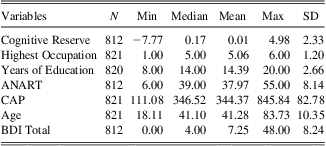
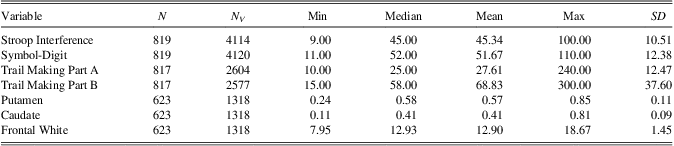
Participants were enrolled in the PREDICT-HD study, a multi-site, international, longitudinal study of prodromal HD (Paulsen et al., Reference Paulsen, Hayden, Stout, Langbehn, Aylward and Ross2006, Reference Paulsen, Langbehn, Stout, Aylward, Ross, Nance and Hayden2008). Consent was obtained according to the Declaration of Helsinki and the study protocol was approved by the Institutional Review Board at the University of Iowa as well as institutional review boards at each participating study site. All participants included in these analyses had a family history of HD and were laboratory-confirmed gene expansion-positive (at least 36 CAG repeats) individuals. Table 1 shows the descriptive statistics for the predictors at baseline. Although Beck Depression Inventory (BDI) score is a time-varying covariate, Table 1 shows results only for the baseline evaluation. Females represented 64% of the sample. Exclusion criteria included evidence of unstable medical or psychiatric illness, alcohol or drug abuse within the previous year, learning disability or mental retardation, history of special education, history of other central nervous system disease or neurological events such as seizures or head trauma, pacemaker or metallic implants, age younger than 18 years, prescription of antipsychotic medications within the past 6 months, and use of phenothiazine-derivative antiemetic medications more than 3 times per month. There was a maximum of N = 821 participants available based on these criteria. However, there were missing data, and Table 2 shows descriptive statistics by visit, including the total number of data points over all visits (NV). Participants were given a baseline assessment and were then assessed annually at six follow-up visits, for a maximum total of seven assessment points. Participants underwent cognitive testing at all time points. Neuroimaging data were collected at Visit 1 (baseline), Visit 3, and Visit 5. In addition, imaging data were more difficult to obtain resulting in approximately 200 fewer participants compared to the cognitive variables (see Table 2).
Descriptive statistics for predictor variables at baseline
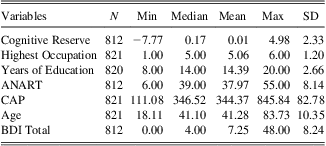
Note. Highest occupation and ANART were reverse scored, see text.
ANART = American National Adult Reading Test; BDI = Beck Depression Inventory; CAP = CAG-Age Product; N = sample size.
Descriptive statistics for response variables summarized over all time points
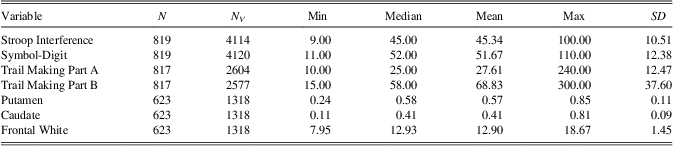
Note. Putamen, caudate, frontal white are expressed as ratio to intracranial volume × 100; NV = total number of observations over all visits; N = sample size.
Cognitive and emotional measures
Cognitive tests were drawn from the PREDICT-HD cognitive battery and were selected to target common cognitive deficits observed in HD (e.g., processing speed, set switching, inhibitory control). Selection of tests was also based upon the effect sizes of these measures in distinguishing individuals with prodromal HD from healthy control participants (Stout et al., Reference Stout, Paulsen, Queller, Solomon, Whitlock, Campbell and Aylward2011). Tests included in the analyses were the Stroop Color-Word Interference Task (Interference condition), Symbol Digit Modalities Test, and Trail Making Test (parts A and B). Premorbid intellectual functioning was estimated using measures of single word reading ability that varied by geographic location (see below). All tasks were scored by the examiner and rescored by two additional reviewers, and accuracy of data entry was reviewed separately by two research assistants to ensure the quality of the cognitive data. The National Adult Reading Test/American National Adult Reading Test was audio taped to allow for rescoring.
The American National Adult Reading Test (ANART; Grober & Sliwinski, Reference Grober and Sliwinski1991) was administered to participants in the United States, Canada, and Australia, while the National Adult Reading Test (NART-2; Nelson & Willison, Reference Nelson and Willison1991) was administered to participants in the United Kingdom. Both tests require participants to pronounce irregularly spelled words and are often used to estimate premorbid intelligence. The ANART has also been used previously to estimate premorbid IQ in the PREDICT-HD sample (Carlozzi et al., Reference Carlozzi, Stout, Mills, Duff, Beglinger and Aylward2011). Performance on these measures was based on total number of words correctly pronounced. Participants in Spain were administered the Word Accentuation Test (WAT), which assesses pronunciation of low-frequency Spanish words (Del Ser, Gonzalez-Montalvo, Martinez-Espinosa, Delgado-Villapalos, & Bermejo, Reference Del Ser, Gonzalez-Montalvo, Martinez-Espinosa, Delgado-Villapalos and Bermejo1997). Participants in Germany were administered the Wortschatztest (WST), which requires individuals to discriminate written German words from non-words (Schmidt & Metzler, Reference Schmidt and Metzler1992).
The Interference subtest of the Stroop Color-Word Interference Task (Stroop, Reference Stroop1935) measures processing speed and inhibitory control. Participants are shown color words (e.g., “blue”) written in different colored ink (i.e., red) and are required to name the ink color aloud and inhibit the dominant response of reading the word. The score used was the total number of correct responses within 45s.
The Symbol Digit Modalities Test (Smith, Reference Smith1991) is a measure of visual scanning and processing speed in which participants are required to rapidly transcribe numbers to match symbols based on a reference key. Performance on this measure is based on the number of correctly transcribed items completed in 90s.
The Trail Making Test (Reitan, Reference Reitan1958) assesses processing speed, visual scanning, response set maintenance, and set switching and is administered in two parts. In Part A, participants are required to connect numbered dots in order from 1 to 25 as quickly as possible. In Part B, participants are instructed to alternate between connecting numbers and letters in order. Performance on this measure is based on time to completion, with higher numbers indicating poorer (i.e., slower) performance.
Participants also completed the Beck Depression Inventory, 2nd Edition (BDI-II), a self-report measure of depression symptoms (Beck, Steer, & Brown, Reference Beck, Steer and Brown1996). Participants respond to questions regarding recent symptoms of depression. The measure consists of 21 questions, each of which is rated on a 0–3 scale, based on severity. Total score on this measure ranges from 0 to 63, with higher scores indicating more severe depressive symptoms. This measure was included given the prominence of depressive symptoms among individuals with HD. Total BDI score was included as a covariate in statistical analyses to control for presence of depressive symptoms, which could potentially affect cognitive performance (Smith et al., Reference Smith, Mills, Epping, Westervelt and Paulsen2012).
Additional measures
Cognitive reserve was computed as the composite of the task estimating premorbid intellectual level (ANART/NART/WAT/WST), highest obtained occupational status, and years of education. The ANART/NART was coded such that larger values indicated greater intellectual level. Occupational status was originally rated on a 1–6 scale (1 = Professional, 2 = Manager, 3 = Craftsman, 4 = Service, 5 = Laborer, 6 = Not in Labor Force). Occupational status was reverse coded to yield 0=Not in Labor Force, … 6 = Professional. There were very few responses of “Not in Labor Force.” All of the variables were separately standardized before compositing, and thus, each variable contributed equally to the Cognitive Reserve score. Higher scores indicate greater cognitive reserve.
Individuals come into the PREDICT-HD study at different ages with different CAG expansions meaning the participants enter with different levels of progression. The variability in progression must be accounted for in the statistical analysis to make proper inferences. PREDICT-HD statisticians (Zhang et al., Reference Zhang, Long, Mills, Warner, Lu and Paulsen2011) developed a proxy variable for disease progression based on an accelerated failure time (AFT) model having time to motor diagnosis as the response, and CAG, age at entry, and their interaction as predictors. The byproduct of the modeling was a “CAG-Age Product” (CAP) score, which is computed for an individual as CAP = AGE0 ×(CAG – 33.7) where AGE0 is the age at study entry. CAP is a proxy for the extent of disease progression at time of study entry, and indicates the likelihood of a near-future HD diagnosis (Zhang et al., Reference Zhang, Long, Mills, Warner, Lu and Paulsen2011). CAP can also be interpreted as an index of the cumulative genetic toxicity of the mutant huntingtin gene, sometimes referred to as “genetic burden.” Zhang et al. (Reference Zhang, Long, Mills, Warner, Lu and Paulsen2011) describe a optimization algorithm based on minimizing an analysis of variance F-value for classifying all the individuals based on CAP score cutoffs. The resulting groups are “low,” “medium,” and “high” with the labels denoting relative levels of probability of receiving a motor diagnosis in a 5-year period initiated at study entry. Thus, low CAP group individuals are less progressed at study entry than medium CAP group individuals, who are in turn less progressed than high CAP group individuals.
Neuroimaging measures
The imaging variables were derived by MRI scans obtained using a standard multi-modal protocol that included an axial three-dimensional volumetric spoiled gradient echo series and a dual echo proton density/T2 series. Scans were processed at the University of Iowa using an automated procedure implemented in BRAINS (Magnotta et al., Reference Magnotta, Harris, Andreasen, O'Leary, Yuh and Heckel2002) and artificial neural networks (Powell et al., Reference Powell, Magnotta, Johnson, Jammalamadaka, Pierson and Andreasen2008). Volume measures were determined for caudate, putamen, and frontal white matter using the automated software, AutoWorkup (Pierson et al., Reference Pierson, Johnson, Harris, Keefe, Paulsen, Andreasen and Magnotta2011). After completion of AutoWorkup, all scans were individually inspected for correct realignment and coregistration, tissue classification, and accuracy of brain and subcortical structures. Intra-cranial volume (ICV) was also calculated to allow for correction of structural volumes for overall head size. The variable for the analysis was the ratio of the brain structure to ICV × 100.
Statistical analysis
Each of the variables was analyzed separately using LMER. The details of the models are presented in the appendix. Preliminary analysis not presented indicated that linear change curves were sufficient. In addition to using cognitive reserve as a predictor, the following control variables were included: age (at baseline), gender, CAP (at baseline), and BDI, which was time-varying.
The time metric for the statistical analysis was duration, defined as current age minus age at baseline. Thus, the baseline duration score was zero, and change over time was expressed in years since study entry.
The focus of the analysis was cognitive reserve by CAP effects; specifically, baseline differences (intercept differences) and differences in change over time (change curve differences). It was hypothesized that cognitive reserve differences might vary as a function of CAP. Therefore, cognitive reserve × CAP interactions were considered for intercept and linear slope.
The analytic strategy was to fit three models for each response variable and examine relative fit. Model 1 had cognitive reserve and control variable intercept and slope effects (there were no CAP effects); Model 2 had all the effects of Model 1 plus cognitive reserve × CAP intercept differences (baseline differences); Model 3 had all the effects of Model 2 plus cognitive reserve × CAP slope differences (differences in longitudinal trajectory). Each model had random intercepts, random slopes for duration, and random error. Additional details of the models are provided in the appendix.
The models were evaluated using a scaling of Akaike's information criterion (AIC) and the likelihood ratio test (LRT). A probability scaling of the AIC, known as the AIC weight (W), was computed indicating the relative fit of each model in the group of three (see appendix). W values closer to one indicate better relative fit, whereas values closer to zero indicate worse relative fit. For this reason, W is interpreted as a global relative effect size measure (Burnham & Anderson, Reference Burnham and Anderson2002; Long, Reference Long2011).
Since the three models of the analysis were nested, the LRT was used to test each model against the next lowest (simpler), beginning with Model 2. All pairs of nested models were tested regardless of the statistical significance of a lower order pair.
Parameter estimates and standard errors were inspected to facilitate the interpretation of the results, but the details are not presented. Comprehensive results are available from the authors. Maximum likelihood methods were used to estimate the models with the lme4 package (Bates, Reference Bates2011) of the R program for statistical computing.
Results
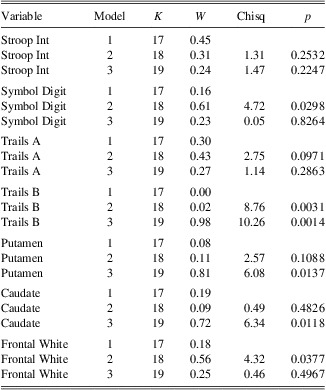
The descriptive statistics for the response variables are shown in Table 2. The results of the LMER model comparisons are shown in Table 3. As noted, W is the AIC weight indicating the relative fit of an individual model within the set of three (a higher value indicates better fit). The last three columns list the results of the LRT for the two-at-a-time comparison. The W column of the table shows that Model 3, containing the cognitive reserve by CAP change curve interaction, was the best fitting for Trail Making Test Part B, putamen, and caudate. The effect size for Trail Making Test Part B was very strong (W = 0.98), a bit weaker for putamen (W = 0.81), and substantially weaker for caudate (W = 0.72). The LRT for Model 2 Versus Model 3 had a relatively small p-value in each case (i.e., p < 0.02). Model 2, containing the cognitive reserve by CAP baseline interaction, was the best fitting for the Symbol-Digit Modalities Test, Trail Making Test Part A, and frontal white matter.
Model comparison for each outcome variable

K = number of model parameters; W = AIC weight; df = 1 for all chi-squared (Chisq) tests.
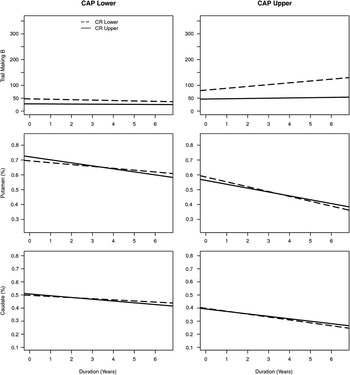
The specifics of the cognitive reserve by CAP change curve are illustrated in Figure 1. The graphs show the fitted curves as a function of two levels of CAP (lower and upper) and two levels of cognitive reserve (lower and upper). Although the entire distribution of CAP and cognitive reserve were used in the LMER analysis, specific values were substituted into the fitted models to produce predicted values for graphing. The graphing values were chosen to be the quantiles cutting off the lower and upper 10% and of the empirical distributions of the variables. The three variables (Trail Making Test Part B, putamen, caudate) mark the rows of the figure, and the two levels of CAP denote the columns. The levels of cognitive reserve are depicted by different line types (dashed = lower, solid = upper).
Specifics of the cognitive reserve by “CAG-Age Product” (CAP) change curve.

The first row illustrates the interaction effect for Trail Making Test Part B. For individuals with higher (upper) scores on CAP, those who also had lower cognitive reserve (dashed lines) had a positive slope, indicating a slowing of performance over time. For individuals with higher cognitive reserve (upper; solid lines), there was a much slower rate of decline. Regarding the individuals with lower CAP scores, the slopes for both cognitive reserve levels were slightly negative and close to parallel.
The second row of Figure 1 shows the interaction for putamen, and the third row shows the interaction for caudate. In both cases, volume decreased over time, with the overall volume being lower for those with higher CAP scores (right-hand graphs). For the upper-level CAP scores depicted at right, there was a faster decrease in volume for those with lower cognitive reserve compared to those with higher cognitive reserve. The converse was true for lower CAP; those with higher cognitive reserve tended to deteriorate slightly faster than those with lower cognitive reserve. The difference in effect sizes for putamen and caudate (see Table 3) was reflected by the caudate curves that showed less separation than the putamen curves for upper CAP.
Discussion
The goal of the current study was to examine the relationship between cognitive reserve and longitudinal change in cognitive functioning and brain volumes among prodromal HD individuals who were assessed annually over a period of up to 6 years. Our findings indicate that, after controlling for several covariates (i.e., age, gender, depression symptoms), cognitive reserve was significantly associated with linear rate of change on one cognitive measure (Trail Making Test, Part B) and in two brain structures (caudate, putamen) for those closest to estimated disease onset. Specifically, for individuals with higher CAP scores (i.e., those closer to estimated diagnosis), those with higher cognitive reserve showed a slower decline in TMT-B performance and slower rate of volume loss in caudate and putamen, relative to individuals with lower cognitive reserve. This relationship was not observed among individuals with lower CAP scores (i.e., those further from estimated diagnosis).
Although this topic has remained relatively unexplored in HD, our findings are in line with a recent study (Lopez-Sendon et al., Reference Lopez-Sendon, Royuela, Trigo, Orth, Lange, Reilmann and de Yebenes2011) demonstrating that higher education levels were related to better outcomes on clinical and cognitive measures. The authors attributed their findings to a possible disease-modifying effect of education on clinical manifestations and symptoms of HD. Our results add support to this hypothesis and extend it to include possible beneficial effects of other separate, but related, factors, namely occupation and general intelligence. The longitudinal design of our study also provides valuable information regarding cognitive reserve and long-term changes in cognition and brain structure that cannot be captured through studies with cross-sectional designs.
Our findings are also consistent with longitudinal studies that have reported a more rapid rate of decline in neurocognitive function over a follow-up period as prodromal HD participants approached estimated disease onset (Campodonico, Codori, & Brandt, Reference Campodonico, Codori and Brandt1996; Rupp et al., Reference Rupp, Blekher, Jackson, Beristain, Marshall, Hui and Foroud2010; Solomon et al., Reference Solomon, Stout, Weaver, Queller, Tomusk, Whitlock and Foroud2008). For example, Campodonico and colleagues (Reference Campodonico, Codori and Brandt1996) found that individuals closer to estimated HD onset had faster rate of decline on measures of sustained attention and processing speed over time than those who were estimated to be further from diagnosis. Using a cross-sectional research design, Stout and colleagues (Reference Stout, Weaver, Solomon, Queller, Hui, Johnson and Foroud2007) found deficits in attention, working memory, and executive function, among other domains, in individuals classified as being near clinical diagnosis, but not in those far from diagnosis. It is possible that as individuals approach diagnosis, neuropsychological measures are more likely to detect deficits in fronto-striatal circuitry. Results of our study add to a growing body of knowledge in this area and suggest that the effect of cognitive reserve is most noticeable when patients are closest to estimated disease onset.
One question raised by our findings is why the relationship between cognitive reserve and longitudinal cognitive change did not generalize to all cognitive measures. Although we initially hypothesized that higher levels of cognitive reserve would be associated with a slower rate of decline on all neuropsychological tests, Trail Making Test-B was the only cognitive measure that showed significant associations with cognitive reserve over time. Although one could argue that TMT-B is the most complex task we used (as it requires sustained attention, motor speed, visual scanning, and rapid set switching), it remains unclear how (and by what mechanism) performance on this measure alone interacts with cognitive reserve. One possibility is that TMT-B was the most intellectually demanding test administered and successful performance of the task is most highly linked with general intellectual capacity. There is some evidence to support this notion. Relative to TMT-A, for example, TMT-B is more strongly associated with fluid intelligence (Salthouse, Reference Salthouse2011) and has stronger associations with Full Scale IQ among healthy controls (Goul & Brown, Reference Goul and Brown1970). TMT-B may also have a higher sensitivity than the other measures to the types of executive functioning deficits that are particularly prevalent in HD (e.g., set switching, cognitive flexibility). Further investigation is needed on this topic to clarify some of the subtle relationships between cognitive reserve and longitudinal variations in cognition.
Results of the analyses for longitudinal brain volume change were also somewhat surprising. We initially hypothesized that cognitive reserve would show no significant association with changes in brain volumes over time. This hypothesis was based on previous findings in studies of Alzheimer's disease, demonstrating intact cognitive functioning among patients with higher levels of cognitive reserve, despite significant accumulation of AD pathology (Roe et al., Reference Roe, Xiong, Miller and Morris2007). However, our results suggest that higher levels of cognitive reserve were associated with a slower rate of caudate and putamen atrophy among those who were closest to estimated disease onset. Thus, in contrast to previous AD studies, higher cognitive reserve was associated with less neuropathology (i.e., atrophy) among prodromal HD individuals who were near clinical diagnosis. These results suggest that higher levels of education, higher occupational status, and higher general intelligence may serve as protective mechanisms to both cognitive function and striatal atrophy during the period closest to disease onset, when cognition is known to decline at a more rapid rate. A caveat to this hypothesis is that the size of the effect for the slower rate of atrophy is difficult to determine. It is unknown how much of a reduction in putamen volume, for example, is associated with manifest signs of disease. Additional research is needed to address if cognitive reserve has effects specific for HD.
Our findings were also consistent with previous research that has shown morphological changes in brain structures that are known to subserve cognitive functions that decline in HD, including caudate (Brandt et al., Reference Brandt, Bylsma, Aylward, Rothlind and Gow1995; Starkstein et al., Reference Starkstein, Brandt, Folstein, Strauss, Berthier, Pearlson and Folstein1988) and putamen (Jurgens et al., Reference Jurgens, van de Wiel, van Es, Grimbergen, Witjes-Ane, van der Grond and Roos2008). In one study, smaller putamen volumes correlated with poorer performance on two cognitive measures, including TMT-B (Jurgens et al., Reference Jurgens, van de Wiel, van Es, Grimbergen, Witjes-Ane, van der Grond and Roos2008). Our results suggest that cognitive reserve was associated with both rate of decline on TMT-B and rate of caudate and putamen atrophy for those closest to estimated disease onset. The mechanism by which cognitive reserve affects progression of cognitive deficits and brain structure changes in HD is not currently understood. Research in rodents suggests that environmental enrichment is associated with increased levels of brain-derived neurotrophic factor (BDNF) and improved motor and cognitive performance (Mazzocchi-Jones, Dobrossy, & Dunnett, Reference Mazzocchi-Jones, Dobrossy and Dunnett2011), suggesting a possible protective effect of BDNF on symptom progression in HD. However, this relationship remains unclear and warrants further investigation.
Despite previous reports describing significant changes in frontal lobe white matter among individuals with prodromal HD (Aylward et al., Reference Aylward, Nopoulos, Ross, Langbehn, Pierson, Mills and Paulsen2011; Reading et al., Reference Reading, Yassa, Bakker, Dziorny, Gourley, Yallapragada and Ross2005), we found no evidence that rate of frontal white matter atrophy was related to cognitive reserve in our study sample. Again, there is very little empirical data from other studies of HD against which to compare our findings. Others have described an association between measures of cognitive reserve and white matter integrity in studies of MCI and AD (Arenaza-Urquijo et al., Reference Arenaza-Urquijo, Bosch, Sala-Llonch, Sole-Padulles, Junque, Fernandez-Espejo and Bartres-Faz2011; Teipel et al., Reference Teipel, Meindl, Wagner, Kohl, Burger, Reiser and Hampel2009). These studies have generally concluded that white matter integrity is an important aspect of cognitive reserve and may be related to risk of developing dementia. However, these studies used diffusion tensor imaging (DTI) techniques to calculate a measure of white matter integrity (i.e., fractional anisotropy; FA), whereas our study examined gross volumes of the frontal lobe white matter. It is possible that methodological differences account for the differential findings between the current study and previous work in this area.
The current study had some limitations. First, the cohort of participants included in this study may not be an entirely representative sample, as it was restricted to individuals with prodromal HD who had undergone predictive genetic testing and who were willing to participate in an intensive, longitudinal study. However, it should be noted that this by far represents the largest sample of prodromal HD individuals ever studied. As mentioned previously, the neuroimaging methodology used may have altered our findings with regard to white matter. Our study used measures of white matter volume, which may have lacked the sensitivity to detect more subtle changes in white matter in this population. Additionally, while we found significant associations between cognitive reserve and rate of change in caudate and putamen volumes, the effect sizes of these findings were relatively small, and it is unclear whether this represents a clinically meaningful outcome. Our cognitive reserve measure also consisted of a combination of various premorbid intellectual measures that may provide different estimates of general cognitive skills, potentially introducing additionally variability into the cognitive reserve variable and making it more difficult to achieve significant correlations. In particular, the use of different measures to estimate premorbid verbal intelligence in different countries (i.e., NART, ANART, WAT, WST) may have produced subtle variation in the data and affected study outcome to some degree. Lastly, neuropsychological tests were administered to participants annually over the course of 6 years. It is possible that familiarity with the tests (i.e., practice effects) attenuated potential findings of cognitive decline over time and influenced our results to some degree.
Overall, the current study demonstrated a relationship between cognitive reserve and longitudinal changes in cognitive functioning and brain structures. Our results lend support to the hypothesis that higher levels of cognitive reserve confer some protection against the cognitive decline that precedes motor onset of HD. Furthermore, increased cognitive reserve was associated with a slower rate of atrophy in brain structures implicated in the development of HD, although the meaning of the slower rate is difficult to interpret.
Lastly, our findings carry implications regarding disease development in HD. As described previously, the construct of cognitive reserve is intended to capture the influence of both innate ability and cognitively enriching experiences on disease onset and development. This suggests that cognitive reserve represents a potentially modifiable factor and a potential target for future studies looking to delay conversion to HD. Since the genetic risk of developing HD is known, interventions to improve reserve may be initiated years before predicted onset of the disease and may provide more years of intact functioning and independence. It is also possible that earlier intervention via enriching experiences may be beneficial in limiting some of the precipitous decline that is characteristic of the years closely preceding symptom onset in HD. Engagement in cognitively enriching activities and regular physical exercise delay onset of HD and cognitive decline in rodents (Pang, Stam, Nithianantharajah, Howard, & Hannan, Reference Pang, Stam, Nithianantharajah, Howard and Hannan2006) and may prove to be protective factors in humans. An additional possibility is that individuals who are higher in cognitive reserve initially may take better care of themselves (e.g., better diet, less alcohol use, more exercise, etc.), which in turn may lead to less brain atrophy and reduced cognitive decline. However, additional work is clearly needed to address these questions. Future investigations should attempt to further clarify the complex role that cognitive reserve plays in the development of HD, as well as its specificity to HD, including possible mechanisms through which cognitive reserve may affect changes in both cognitive function and brain structure among those with prodromal HD.
Acknowledgments
We thank the PREDICT-HD sites, the study participants, and the National Research Roster for Huntington Disease Patients and Families. This research is supported by the National Institutes for Health, National Institute of Neurological Disorders and Stroke (NS040068) and CHDI Foundation, Inc (A3917). There are no conflicts of interest.
APPENDIX
Linear mixed effects regression (LMER) models were fit for each response variable (treated in isolation) to test for cognitive reserve by CAP intercept and linear slope differences. The time metric was duration (dur), defined as the current age minus the age at study entry. Suppose ageij is the current age for the ith participant (i = 1, …, N) at the jth time point (j = 1, …, ni). Then durij = ageij − agei 1.
In addition to cognitive reserve and CAP, intercept and linear slope effects of control variables were also considered. The control variables were age at study entry (agei 1), BDI (bdi), and sex (sex; 1 = male). All the predictors other than dur and bdi were time-invariant (static) predictors. Single static predictor effects represent main effects, and interactions with duration represent change curve effects. There were three random effects in each model, random intercepts, random slopes for dur, and random slopes for bdi. The LMER equation for the most complex model (Model 3; see text) is
 $${ {{Y}_{ij}} = {{\beta }_0} + {{\beta }_1}\left( {du{{r}_{ij}}} \right) + {{\beta }_2}\left( {bd{{i}_{ij}}} \right){{\beta }_3}\left( {ag{{e}_{i1}}} \right) + {{\beta }_4}\left( {se{{x}_i}} \right) \cr \quad+ {{\beta }_5}\left( {cu{{p}_i}} \right) + {{\beta }_6}\left( {c{{r}_i}} \right)<! \\ >+ {{\beta }_7}\left( {du{{r}_{ij}} \cdot bd{{i}_{ij}}} \right) \cr \quad+ {{\beta }_8}\left( {du{{r}_{ij}} \cdot ag{{e}_{i1}}} \right) + {{\beta }_9}\left( {du{{r}_{ij}} \cdot se{{x}_i}} \right) + {{\beta }_{10}}\left( {du{{r}_{ij}} \cdot ca{{p}_i}} \right) \cr\quad+ {{\beta }_{11}}\left( {du{{r}_{ij}} \cdot c{{r}_i}} \right)<! \\ >+ {{\beta }_{12}}\left( {c{{r}_i} \cdot ca{{p}_i}} \right) \cr\quad+ {{\beta }_{13}}\left( {du{{r}_{ij}} \cdot c{{r}_i} \cdot ca{{p}_i}} \right) + {{{\epsilon}}_{ij}}$$
where  $$${{{\epsilon}}_{ij}} = {{b}_{0i}} + {{b}_{1i}}\left( {du{{r}_{ij}}} \right) + {{b}_{2i}}\left( {bd{{i}_{ij}}} \right) + {{e}_{ij}}$$$
, with the bki being the random effects, and eij random error. The random effects are assumed to be correlated with each other, but not with the random errors. The random effects and random error are assumed to have zero means and non-zero variance, with the random error variance being constant over time.
In the above equation, β 12 represents the baseline cognitive reserve by CAP interaction, and β 13 represents the cognitive reserve by CAP slope interaction. In the three models compared in the analysis (see text), Model 2 omits β 13, and Model 1 omits β 12 and β 13.
The models were evaluated using a scaling of Akaike's information criterion (AIC) and the likelihood ratio test (LRT). A probability scaling of the AIC, known as the AIC weight (W) was computed indicating the relative fit. The W formula is
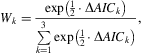 $${{W}_k} = \frac{{\exp \left( { \minus \frac{1}{2} \cdot \rDelta AI{{C}_k}} \right)}}{{\mathop{\sum}\limits_{k = 1}^3 {\exp \left( { \minus \frac{1}{2} \cdot \rDelta AI{{C}_k}} \right)} }},$$
where Wk is the kth model (k = 1, 2, 3), ΔAIC=AICk − min(AICk), with min(AICk) being the minimum AIC value of the set of three. W values closer to one indicate better fit, whereas values closer to zero indicate worse fit. For this reason, W is interpreted as a global relative effect size measure.
The LRT was used to test the pairs of nested models, Model 1 versus Model 2, and Model 2 versus Model 3. Both tests were carried out regardless the statistical significance of each. The null hypothesis for each test was that the simpler model was sufficient. Under the assumption of a large sample size and some other mild conditions, the LRT test statistic has a chi-squared distribution with df equal to the difference in the number of parameters of the pair of nested models.
PREDICT-HD Investigators, Coordinators, Motor Raters, Cognitive Raters
Thomas Wassink, MD, Stephen Cross, BA, Mycah Kimble, BA, Patricia Ryan, MSW, LISW, MA, and Eric A. Epping, MD, PhD (University of Iowa, Iowa City, Iowa, USA); Edmond Chiu, MD, Olga Yastrubetskaya, PhD, Joy Preston, Anita Goh, D.Psych, Stephanie Antonopoulos and Samantha Loi (St. Vincent's Hospital, The University of Melbourne, Kew, Victoria, Australia);
Phyllis Chua, MD, and Angela Komiti, BS, MA (The University of Melbourne, Royal Melbourne Hospital, Melbourne, Australia);
Lynn Raymond, MD, PhD, and Joji Decolongon, MSC, CCRP (University of British Columbia, Vancouver, British Columbia, Canada);
Christopher A. Ross, MD, PhD, Mark Varvaris, BA, and William M. Mallonee, MD, and Greg Suter, BA (Hereditary Neurological Disease Centre, Wichita, Kansas, USA);
Ali Samii, MD, and Alma Macaraeg, BS (University of Washington and VA Puget Sound Health Care System, Seattle, Washington, USA);
Randi Jones, PhD, Cathy Wood-Siverio, MS, Stewart A. Factor, DO, and Claudia Testa, MD, PhD (Emory University School of Medicine, Atlanta, Georgia, USA);
Roger A. Barker, BA, MBBS, MRCP, and Sarah Mason, BSC (Cambridge Centre for Brain Repair, Cambridge, UK);
Elizabeth McCusker, MD, Jane Griffith, RN, Clement Loy, MD, and David Gunn, BS (Westmead Hospital, Sydney, Australia);
Michael Orth MD, PhD, Sigurd Süβmuth, MD, RN, Katrin Barth, RN, and Sonja Trautmann, RN (University of Ulm, Ulm, Germany);
Kimberly Quaid, PhD, Melissa Wesson, MS, and Joanne Wojcieszek, MD (Indiana University School of Medicine, Indianapolis, IN);
Mark Guttman, MD, Alanna Sheinberg, BA, and Irita Karmalkar, BSc (Centre for Addiction and Mental Health, University of Toronto, Markham, Ontario, Canada);
Susan Perlman, MD, and Brian Clemente, (Los Angeles Medical Center, Los Angeles, California, USA); Michael D. Geschwind, MD, PhD, and Gail Kang, MD (University of California San Francisco, California, USA);
Gabriela Satris, BA, Tom Warner, MD, PhD, Maggie Burrows, RN, BA (National Hospital for Neurology and Neurosurgery, London, UK);
Anne Rosser, MD, PhD, MRCP, Kathy Price, RN, and Sarah Hunt, BSc (Cardiff University, Cardiff, Wales, UK);
Frederick Marshall, MD, Amy Chesire, LCSW-R, MSG, Mary Wodarski, BA, and Charlyne Hickey, RN, MS (University of Rochester, Rochester, New York, USA);
Peter Panegyres, MB, BS, PhD, Joseph Lee, and Steve Andrew (Neurosciences Unit, Graylands, Selby-Lemnos & Special Care Health Services, Perth, Australia);
Joel Perlmutter, MD, Stacey Barton, MSW, LCSW, and Amy Schmidt (Washington University, St. Louis, Missouri, USA);
Zosia Miedzybrodzka, MD, PhD, Daniela Rae, RN, and Mariella D'Alessandro, PhD (Clinical Genetics Centre, Aberdeen, Scotland, UK);
David Craufurd, MD, Judith Bek, PhD, and Elizabeth Howard, MD (University of Manchester, Manchester, UK);
Pietro Mazzoni, MD, PhD, Karen Marder, MD, MPH, and Paula Wasserman, MA (Columbia University Medical Center, New York, New York, USA);
Rajeev Kumar, MD and Diane Erickson, RN (Colorado Neurological Institute, Englewood, Colorado, USA);
Vicki Wheelock, MD, Terry Tempkin, RNC, MSN, and Lisa Kjer, MSW (University of California Davis, Sacramento, California, USA);
Wayne Martin, MD, Pamela King, BScN, RN, Marguerite Wieler and Satwinder Sran, BSC (University of Alberta, Edmonton, Alberta, Canada);
Oksana Suchowersky, MD, FRCPC, Anwar Ahmed, PhD, Stephen Rao, PhD, Christine Reece, BS, Alex Bura, BA, Lyla Mourany, and Juliet Schulz (Cleveland Clinic Foundation, Cleveland, Ohio, USA).
Executive Committee
Jane Paulsen, PhD, Principal Investigator, Eric A. Epping, MD, PhD, Hans Johnson, PhD, Megan Smith, PhD, Jeffrey D. Long, PhD, (University of Iowa, Iowa City, IA); Elizabeth Aylward, PhD (Seattle Children's Research Institute, WA); Kelsey Montross, BA, Jeremy Bockholt, BS, MS, Steve Blanchard, MSHA.
Scientific Consultants
Bio Markers: Ken Evans, PhD (Ontario Cancer Biomarker Network); Wayne Matson, PhD (VA Medical Center, Bedford, MA); Asa Peterson, MD, PhD (Lund University, Sweden); James A. Mills, MS (University of Iowa).
Brain: Jean Paul Vonsattell, PhD (Chair), and Carol Moskowitz, ANP, MS (Columbia University Medical Center); Stacie Vik, BA (University of Iowa).
Cognitive: Deborah Harrington, PhD (Chair), Gabriel Castillo, BS, Jessica Morison, BS, and Jason Reed, BS (University of California, San Diego), Michael Diaz, PhD, Ian Dobbins, PhD, Tamara Hershey, PhD, Erin Foster, OTD, and Deborah Moore, BA (Washington University Cognitive Science Battery Development); Holly Westervelt, PhD (Chair, Quality Control and Training, Alpert Medical School of Brown University), Jennifer Davis, PhD, and Geoff Tremont, PhD, MS (Scientific Consultants, Alpert Medical School of Brown University); Megan Smith, PhD (Chair, Administration), David J. Moser, PhD (University of Iowa); Carissa Gehl, PhD (VA Medical Center, Iowa City, IA); Kirsty Matheson (University of Aberdeen); Karen Siedlecki, PhD (Fordham University); Marleen Van Walsem (EHDN); Greg Elias, BA, Mary Gover, and Rachel Bernier, (Rhode Island Hospital); Noelle Carlozzi (University of Michigan); Kevin Duff, PhD (University of Utah); Nellie Georgiou-Karistianis (St. Vincent's Hospital, The University of Melbourne, Australia); and Kate Papp (University of Connecticut).
Functional: Janet Williams, PhD Eunyoe Ro, MA, Lee Anna Clark, Nancy Downing, RN, PhD, Michelle Harreld, BS, and Stacie Vik, BA (University of Iowa); Rebecca Ready, PhD (University of Massachusetts); Anthony Vaccarino, PhD (Ontario Cancer Biomarker Network); Sarah Farias, PhD (University of California, Davis); Noelle Carlozzi, PhD (University of Michigan); and Carissa Gehl, PhD (VA Medical Center, Iowa City, IA).
Genetics: Marcy MacDonald, PhD Jim Gusella, PhD, and Rick Myers, PhD (Massachusetts General Hospital); Tom Wassink, MD (Co-Chair) Eric A. Epping, MD, PhD, and James Mills, MS, (University of Iowa); Zosia Miedzybrodzka, MD, PhD (University of Aberdeen); and Christopher Ross, MD, PhD (Johns Hopkins University).
Imaging: Administrative: Kathy Jones, BS, Jacquie Marietta, BS, Greg Harris, BS, Eun Young Kim, MS, Hans Johnson, PhD, Greg Ennis, MA, and Thomas Wassink, MD (University of Iowa); John Ashburner, PhD (Functional Imaging Lab, London); Steve Potkin, MD (University of California, Irvine); and Arthur Toga, PhD (University of California, Los Angeles). Striatal: Elizabeth Aylward, PhD (Chair, Seattle Children's Research Institute). Surface Analysis: Eric Axelson, BSE (University of Iowa). Shape Analysis: Christopher A. Ross (Chair), MD, PhD, Michael Miller, PhD, and Sarah Reading, MD (Johns Hopkins University); Mirza Faisal Beg, PhD (Simon Fraser University). DTI: Vincent A. Magnotta, PhD (Chair, University of Iowa); Karl Helmer, PhD (Massachusetts General Hospital); Kelvin Lim, MD (University of Ulm, Germany); Mark Lowe, PhD (Cleveland Clinic); Sasumu Mori, PhD (Johns Hopkins University); Allen Song, PhD (Duke University); and Jessica Turner, PhD (University of California, Irvine). fMRI: Steve Rao, PhD (Chair), Erik Beall, PhD, Katherine Koenig, PhD, Michael Phillips, MD, Christine Reece, BS, and Jan Zimbelman, PhD, PT (Cleveland Clinic); Kathy Jones, (University of Iowa).
Psychiatric: Eric A. Epping, MD, PhD (Chair), Nancy Downing, RN, PhD, Jess Fiedorowicz, MD, Robert Robinson, MD, Megan Smith, PhD, Leigh Beglinger, PhD, James Mills, MS, Michelle Harreld, BS, Stacie Vik, BA, Janet Williams, PhD, Dawei Liu, PhD, David Moser, PhD, and Kelly Rowe (University of Iowa); Karen Anderson, MD (University of Maryland); David Craufurd, MD (University of Manchester); Mark Groves, MD (Columbia University); Anthony Vaccarino, PhD and Ken Evans, PhD (Ontario Cancer Biomarker Network); Hugh Rickards, MD (Queen Elizabeth Psychiatric Hospital); Eric van Duijn, MD (Leiden University Medical Center, Netherlands).
Core Sections
Biostatistics: Jeffrey D. Long, PhD, Ji-In Kim, PhD, James A. Mills, MS, Ying Zhang, PhD, Dawei Liu, PhD, Wenjing Lu, Craig Stout, and Spencer Lourens (University of Iowa).
Recruitment/Retention: Martha Nance, MD (Chair, University of Minnesota); Mycah Kimble, BA, Patricia Ryan, MSW, LISW, MA, Sean Thompson, BA (University of Iowa).
Ethics: Cheryl Erwin, JD, PhD, (Chair, McGovern Center for Health, Humanities and the Human Spirit); Eric A. Epping, MD, PhD Janet Williams, PhD, James Mills, MS, and Stacie Vik, BA (University of Iowa); Martha Nance, MD (University of Minnesota); and Lisa Hughes, MEd (University of Texas Medical School at Houston).
IT/Management: Jeremy Bockholt, Jim Smith, AS, Roland Zschiegner, Ryan Wyse, Owen Wade, Jason Evans, and Derek Weston (University of Iowa).
Program Management
Administrative: Chris Werling-Witkoske (Chair), Greg Ennis, MA, Stacie Vik, BA, Karla Anderson, BS, Brittany Lichty, BA, and Leann Davis (University of Iowa).
Financial: Steve Blanchard, MSHA, Kelsey Montross, BA, and Phil Danzer (University of Iowa).