Introduction
By the late nineteenth century, Britain had targeted Yunnan to secure direct access to the middle and upper reaches of the Yangtze River. After the British government formally obtained the right to enter Yunnan for commercial purposes, disputes began to arise along the Yunnan-Burma border. Effective resolution of these cases became essential to maintaining peace in the borderlands and preserving stable Sino-British relations. To address these issues, British, Burmese, and Yunnan officials established a joint trial system. Representatives from the three sides convened sessions to adjudicate disputes in the Sino-Burmese borderland (borderland cases) in what became known as the ‘frontier meeting for borderland cases’.Footnote 1 Academic research on this subject remains limited, with only a few scholars examining the operation and effectiveness of the frontier meeting system for borderland cases.
Beatrix Metford provided a concise account of the venue, proceedings, and cases discussed at the frontier meeting held in Nawngma, Burma.Footnote 2 Yao Yong traced the origins, implementation, and case resolutions of the joint trial system, detailing its procedures, timing, and venues; identifying the presiding judges in joint trials; and examining the causes, proceedings, and effects of trans-frontier cultivation disputes among borderland residents.Footnote 3 Emily Whewell has outlined the rationale behind the British government’s decision to transfer some borderland cases to Burmese local courts rather than adjudicate them in the consular courts in Yunnan.Footnote 4 She argues that the consuls, initially established for British economic expansion and geopolitical competition with France, became core trans-imperial legal mediators. Their key roles were representing British subjects in legal disputes, crime investigations, and probate cases in the remote frontier; and acting as pivotal mediators in Sino-British frontier meetings, serving as cultural/linguistic translators, negotiators for Burmese interests, and relationship-builders with Chinese officials. Whewell emphasizes the consuls’ pro-British stance, noting that their actions aimed to safeguard British Burmese sovereignty and maintain frontier peace and Sino-British relations.Footnote 5
Existing scholarship has not yet fully explored the origins, jurisdictional conditions, or types of judgments issued by Chinese and British officials in the frontier meetings to resolve borderland cases. Nor has it examined the tribal customary law underlying these precedents or its divergence from the national laws of China and Britain. Drawing on archival records from the British Foreign Office, the India Office, and the Ministries of Foreign Affairs of both the late Qing dynasty and the Republic of China, this article addresses these issues and demonstrates that British extraterritorial jurisdiction in China was not absolute but rather divided into two systems: one governing the interior and another governing the borderlands, each operating under its own jurisdictional system.
This article examines the distinctive system of frontier meetings for adjudicating disputes along the Yunnan-Burma border from 1902 to 1949. The first section traces the historical genesis and diplomatic evolution of this joint trial system, from the initial 1902 Manai Agreement to its formalization through subsequent officials. The second section analyses the practical operation and effectiveness of these annual meetings, detailing their procedures, case types, and reliance on monetary damages to maintain order. The third section investigates the hybrid case law developed by the courts, which blended tribal customary law with elements of Chinese and British law, while revealing the underlying inequities for China within the ostensibly reciprocal framework. Finally, the fourth section details the system’s dissolution following Burmese independence in 1948, marking the end of this unique extraterritorial arrangement. In conclusion, this article demonstrates that British extraterritorial jurisdiction in China was not monolithic but bifurcated, operating through a separate, pragmatically driven system in the borderlands that ultimately reinforced imperial power imbalances.
The development of the frontier meetings
The 1880s witnessed a growing push by Britain to open commercial access between Burma and Yunnan. British policy aimed to penetrate southwest China through Yunnan, gain access to the resources and markets of the vast middle and upper Yangtze regions, and counter expanding French influence. These efforts were intended to create a trade network linking India and Burma with China’s Yunnan, Tibet, and Sichuan regions, extending to the Yangtze River delta. Following the conclusion of the 1894 Convention Between Great Britain and China (hereafter 1894 Convention) and the 1897 Agreement Modifying the Burma Frontier and Trade Convention of 1st March 1894 (hereafter 1897 Agreement), the British government secured authorization to establish consular posts in Tengyue and Simao. China and Britain subsequently conducted partial surveys of the Sino-Burmese borderlands, leaving both the northern and southern segments undemarcated. The ‘southern undemarcated boundary’ corresponded primarily to the western edge of the Zhenbian Office (near now Cangyuan County). The ‘northern undemarcated boundary’ encompassed areas north of Jiangao Mountain (including the Chashan, Langsu, and Xiaojiang River Basin regions, as well as the vicinity of Jiangxinpo east of the Mali Kha River).Footnote 6 During the period of the Nationalist government in Nanjing, British authorities effectively controlled most of the ill-defined northern portion of the Sino-Burmese borderlands. Conditions in the undemarcated zone were further complicated by the existence of two sectors at the northern and southern boundaries of Tengchong’s jurisdiction in Yunnan province, intersected by the Tengyue-Bhamo trade route and adjoining an area colloquially known as the ‘savage hill’ (the Kachin Hills). The indeterminate boundary between China and Burma created significant ambiguity in territorial jurisdiction. As a result, both Chinese and Burmese officials asserted jurisdiction over negotiations in the borderlands, treating them as a critical element in their claims to sovereignty.
The Bao Shang Office case on the Yunnan-Burmese border prompted Chinese and British officials to initiate discussions on resolving borderland cases. In 1886, Britain annexed Burma in its entirety and incorporated it as a province of British India, appointing a lieutenant-governor to administer the territory. During this period, armed conflicts frequently occurred along the Sino-Burmese border. Chinese merchants established a Bao Shang Office (Trade Protection Office) in the Bhamo area to collect taxes, protect merchants and roadways, and oversee local public welfare. The office operated with official support from a Bao Shang battalion under the command of military officers from the Yunnan provincial government.Footnote 7 In early January of that year, George Litton, British consul in Tengyue, laid a complaint with the sub-prefect Ye Rutong regarding the establishment of an unauthorized Chinese tax station at Manmu, also called Mannong (now Myothit), near Bhamo. The station had been imposing an unlawful ‘mule tax’ and extorting Burmese merchants. The British Burmese government contended that the 1894 Convention placed Manmu under its jurisdiction and that the Bao Shang Office’s actions infringed upon the rights of the Burmese merchants and violated the territorial sovereignty of British Burma.Footnote 8 In 1902, to that end, Litton proposed inviting Ye Rutong to discuss the matter in Manai, Yunnan (now Ruili Nongdao). The agreement reached by both parties prohibited the Bao Shang Office from soliciting donations or collecting taxes and required its immediate abolition.Footnote 9 To resolve issues of looting, theft, and extradition among the populations along the Yunnan-Burmese borders, China and Britain agreed on eight provisions governing border matters. This accord became known as the 1902 Manai Agreement (also referred to as the Treaty of Manai).
Article 8 of the Manai Agreement provided that: ‘In future, when cases between Kachins on the two sides of the frontier occur, the British frontier officials and the Chinese Sawbwas will communicate officially and monthly with each other, and, in concert with the frontier military officers, will discuss and justly settle (the monthly list).’Footnote 10 A joint trial system was adopted along the Yunnan-Burma border to address criminal and civil cases on both a monthly and annual basis. Chinese and Burmese officials heard ordinary cases each month, while unresolved cases were reviewed by superior officials annually. In this article, ‘British frontier officials’ refer to the deputy commissioner of Bhamo, the deputy commissioner of Myitkyina, or the superintendent of the Northern Shan States.Footnote 11
The Manai Agreement lacked specificity. It failed to define the nature of borderland cases, the jurisdiction of Yunnan and Burmese officials, or the location of the frontier meetings. Conditions on the Yunnan side of the border were unstable in the following years, preventing the frontier meetings from convening as scheduled. In 1908, H. E. Sly, the British consul in Tengyue, reported that Burmese merchants had been robbed in Kanpitetee, Kachin State, Burma, by bandits from Zhanxi (now Yinjiang County) and that local officials were unable to arrest them. The Tengyue daoyin (circuit intendant) and governor of the Northern Shan States in Burma proposed improvements to homicide and theft proceedings.Footnote 12 In 1909, the governor of Yixi Circuit and officials from Britain and Burma convened the first frontier meeting, establishing a practice that became customary thereafter. In January 1910, Liu Yuanbi, governor of Yixi Circuit, Peng Jizhi, prefect of Yongchang Prefecture, H. A. Thornton, superintendent of the Northern Shan States, W. H. L. Cabell, deputy commissioner of Bhamo, and Archibald Rose, British consul in Tengyue, adopted the ‘Rules to be Observed in Dealing with Cases Arising Between the Frontier Subjects of Burma and Yunnan’ (hereafter 1910 Rules) and ‘Rules regarding the Scale of Compensation’ (hereafter Scale of Compensation); unforeseen and unpremeditated homicide-in-error were added to the Scale of Compensation in 1915. These two rules were later collectively referred to as the Convention for Joint Trial of Borderland Cases.Footnote 13
In practice, the frontier meeting did not operate within clearly defined boundaries or categories of borderland cases. Article 2 of the 1910 Rules limited the reach of such borderland cases. The article provided: ‘Whenever the frontier is crossed and raids occur or disturbance is caused, in addition to compensation and fine every effort must be made to arrest and punish the actual offender.’Footnote 14 According to J. B. Affleck, the British consul in Tengyue, borderland cases arose whenever residents of Yunnan or Burma crossed the border to commit crimes or financial disputes arose between residents of both sides. He cautioned that Chinese merchants, labourers, or mule train operators would exploit litigation through false claims if damages incurred in Burma were included as borderland cases. This is because, ‘each Government accepts responsibility for the control of its people on the frontier and in cases in which the people on either side cross over into the territory of the other and commit thefts or robbery or other disturbance the Government concerned accepts responsibility in compensation for the injury committed in the territory of its neighbour’. However, it would be inappropriate for a government to pay for losses caused by its subjects within its own territory.Footnote 15 Simply put, it was not in the interest of the Burmese government to assume liability for a British subject who had committed a crime against a Chinese citizen in Burma if the frontier meeting had jurisdiction over the case.
As cross-border travel among border residents increased, the Chinese and British expanded the extent of borderland cases in judicial precedent to include ‘cases of injury or tort, in which one at least of the parties, usually both, belong to one of the frontier tribes, and which occur in the districts inhabited by the frontier tribes’. Therefore, borderland cases along the Yunnan-Burma frontiers referred to those arising between Chinese and Burmese border residents.Footnote 16 Chinese, British, and Burmese officials established a specific classification standard for borderland residents in frontier meetings, that is individuals who had resided in Yunnan or Burma for more than one year and paid taxes were regarded as borderland residents. However, this classification was not strictly followed.Footnote 17 Therefore, Burmese subjects who had long lived in Yunnan were regarded as Chinese citizens under the jurisdiction of the Yunnan government in borderland cases, while Chinese subjects who had long lived in Burma were treated as Burmese subjects under the jurisdiction of the Burmese government. This approach arose primarily due to frequent cross-border migration and the lack of reliable identification documents such as passports. If criminals were identified strictly by birthright citizenship, they could often evade punishment by fleeing across the border. Therefore, officials on both sides determined identity based on length of residence rather than nationality by birth.Footnote 18 This standard became known as the ‘domicile rule’.Footnote 19
The introduction of the Convention for Joint Trial of Borderland Cases coincided with the fall of the Qing dynasty, making it impossible to convene the frontier meeting as scheduled.Footnote 20 More importantly, from the establishment of the Republic of China in 1911 through the Nanjing decade, Yunnan’s borderland policy was consistently shaped by provincial strongmen who exercised de facto autonomy in foreign affairs. Alongside this they inherited a critical legacy from the late Qing officials: a generally established institutional framework for managing the Sino-Burmese borderland cases. When the Republic was founded, these mechanisms were neither abolished nor renegotiated at the central level; instead, they were simply carried forward by provincial authorities as the default system for maintaining order on the border.
As the institutional framework was not explicitly denied by the Chinese central government, Burmese officials began trying and closing borderland cases independently, and even persuaded some Chinese native chieftains to leave Yunnan’s jurisdiction and submit to the jurisdiction of the Burmese government.Footnote 21 To address this, Yang Fuzhang, the Tengyue daoyin, and A. E. Eastes, the British consul in Tengyue, agreed the Additional Rules determined for the conduct of Cases heard at Burma-Yunnan Frontier Meetings in 1915 (hereafter 1915 Additional Rules).Footnote 22 The Additional Rules formally established the Yunnan-Burma borderland case process and the Annual Joint Trial System for borderland cases:
Officials on both sides shall report eligible cases as borderland cases to the competent officials. At the end of the year, both sides shall compile all cases, present the evidence of the plaintiff and defendant, and summon the parties to the border for a joint trial. If the plaintiffs failed to appear in court, the case was dismissed. If the defendants failed to appear, they were required to pay damages. If both parties appeared, the case proceeded. Officials from both sides were required to issue and sign judgments together. In addition to the damages imposed, each side could address any related criminal matters independently pursuant to their local laws once the case was resolved.Footnote 23
The Convention for Joint Trial of Borderland Cases was subsequently ratified by the Burmese government, the British Minister to China, and Ren Kecheng, the civil governor of Yunnan under the leadership of Tang Jiyao, the military governor of Yunnan.Footnote 24 As a result, it was no longer concluded by local officials but by the provincial government of Yunnan and the British Burma government. As a revolutionary leader who had launched the National Protection War in Yunnan, Tang Jiyao would have been expected to break with the imperial past. Yet his administration did precisely the opposite: he simply maintained the local mechanisms for managing cross-border disputes that it had inherited from the defunct empire. This apparent paradox—a revolutionary regime preserving the border institutions of the Qing dynasty and early Republican period—reveals the pragmatic realities underlying frontier governance. Such a framework worked to ensure stability on a volatile border. This precedent found its fullest expression under Tang Jiyao and his successor Long Yun, who together dominated Yunnan for over three decades. They decided to retain this framework, rather than seek renegotiation with British Burma. This may also underscore a critical phenomenon: Yunnan’s border policy was shaped by provincial officials, not by central directive.Footnote 25
Crucially, in 1915, Tang’s subordinate negotiated additional rules with the British consul—rules approved by the provincial government but never submitted to the Beiyang government’s Ministry of Foreign Affairs for ratification. In 1915, Tengyue daoyin Yang Fuzhang discussed the need to supplement the Scale of Compensation with Eastes and proposed submitting the revisions to the Yunnan provincial government and the commissioner of the Ministry of Foreign Affairs for review, and then to the governor of Burma for approval. However, the Ministry of Foreign Affairs of the Beiyang government was never informed of the matter.Footnote 26 Under international law, a local government had no authority to enter into any agreements concerning matters of sovereignty of the country.Footnote 27 Accordingly, the Chinese Yunnan provincial government had no legal authority to enter into a convention with the British Burmese government that involved ceding or transferring China’s judicial sovereignty. This raised doubts over the validity of the Convention. Although the Chinese government never formally ratified the Convention, in practice it continued to recognize and apply the system for resolving disputes along the Yunnan-Burma border.
The central government’s awareness and tacit acceptance of this arrangement is starkly illustrated by the Ministry of Foreign Affairs’ 1921 publication of the Convention in its Annual Diplomatic Review.Footnote 28 This act of ‘retroactive recognition’ validated the provincial government’s fait accompli, acknowledging agreements made a decade earlier by local officials—first under Cai E’s transitional administration, then institutionalized under Tang Jiyao—without central approval. In other words, the province initiated and managed border policy, while the central government, focused on more pressing internal and external threats, sanctioned it after the fact.
Operation and effectiveness of the frontier meetings
Officials along the Yunnan-Burma border established the Annual Joint Trial System in 1902 to resolve frontier disputes. Each year, from late December to early February, they convened temporary frontier meetings to try all cases along the border, with sessions lasting about two weeks. The venue of frontier meetings were areas such as Manai and Simapa in Yunnan (now in Yingjiang County) and Namhkam (across the river from Manai), Nawngma (near Namhkam), and Sima in Burma (all three of which are now in Northern Shan State).Footnote 29 Chinese, British, and Burmese officials participating in the joint trials included the Tengyue daoyin, the British consul in Tengyue, and Burmese district officials. During the frontier meeting sessions in Manai, Chinese officials were housed at Dai Buddhist site, while British officials were housed at government accommodations in Nawngma.Footnote 30 For this reason, the Chinese and British delegations respectively referred to the frontier meetings as the ‘frontier meetings in Manai’ and the ‘frontier meetings in Nawngma’.
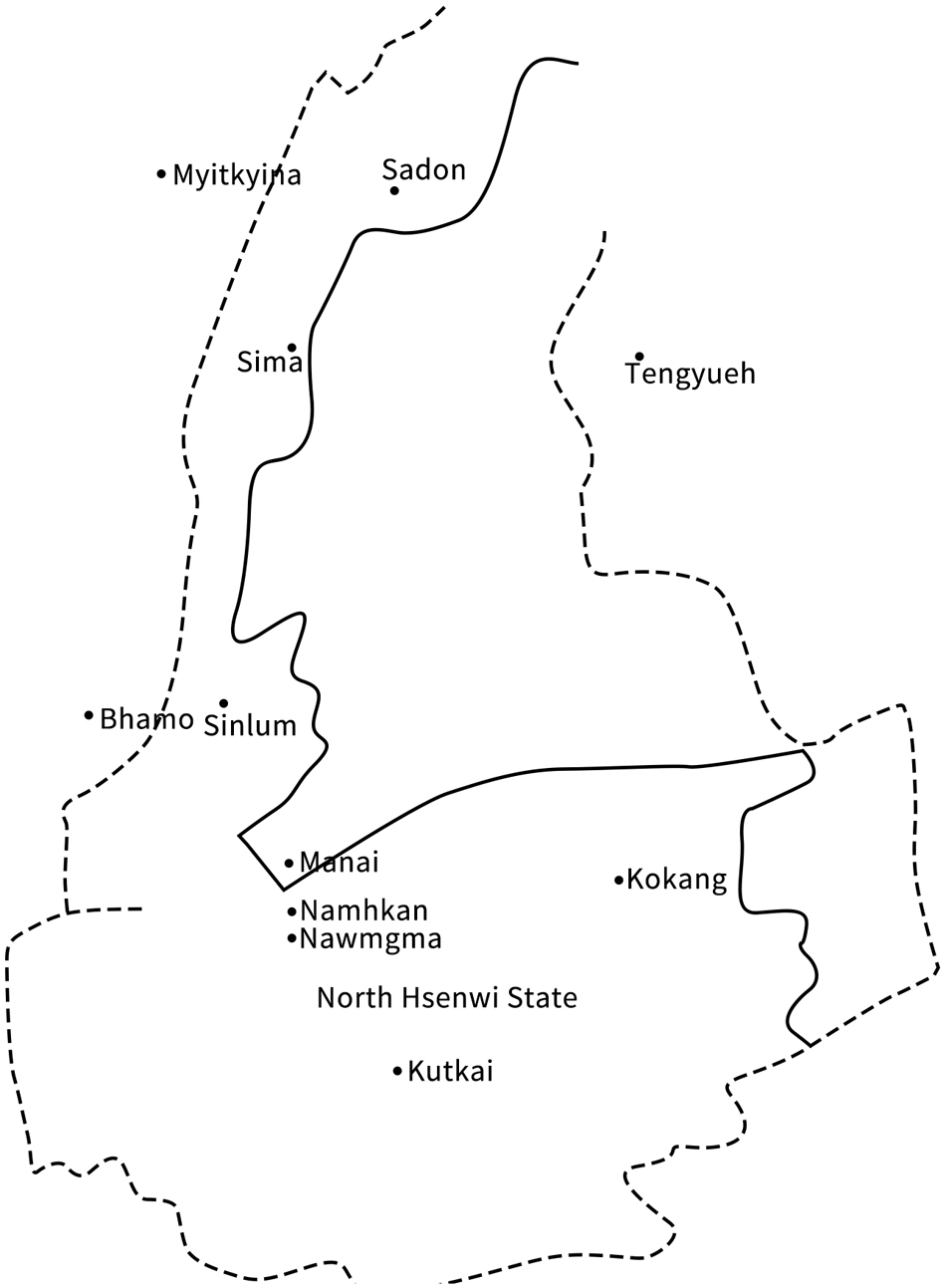
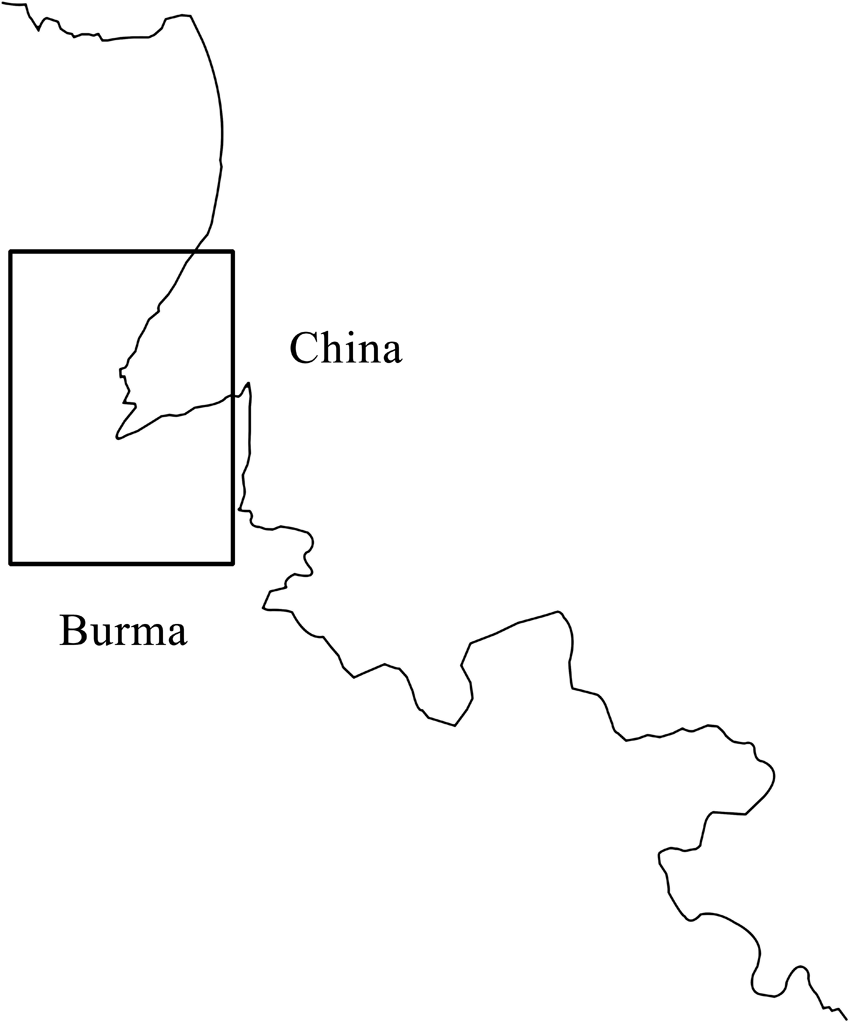
More cases were heard in Manai, known as the larger frontier meeting, which had been held since 1902. There were fewer cases heard in Sima, known as the smaller frontier meeting, which began in 1909.Footnote 31 Both frontier meetings were divided into trial and appellate courts. Cases that could not be resolved at trial were transferred to the appellate court for review. The two frontier meetings covered an area extending roughly from the Kachin Hills to the east of the Bhamo Plains and Lashio (now Northern Shan State in Myanmar), though their exact boundaries were never clearly defined (see Figures 1-1 and 1-2).
Schematic map of the territorial jurisdiction of the frontier meetings. Note: The dashed line indicates the territorial jurisdiction of the frontier meetings, while the solid line indicates the demarcated boundary between China and Burma. Source: Adapted from ‘Sketch Map of Proposed Districts’, TNA, FO 371/8037, p. 156.

Locator map of the China-Burma borderland. Note: This map is adapted from the modern China-Myanmar boundary; the box marks the approximate jurisdiction of the frontier meetings.

The frontier meetings in Manai exercised jurisdiction over native chieftain territories in Yunnan, including Longchuan (now in Dehong Dai and Jingpo Autonomous Prefecture), Mengmao (now in Ruili), Mangshi, Zhefang (now in Luxi), Longling in Yunnan, as well as Bhamo (mainly Sinlum) and the Northern Shan States (mainly Kutkai) in Burma. After 1920, the Chinese trial judge was typically a local official (such as the administrative commissioner in a native chieftain jurisdiction) and the appeals judge was the Tengyue daoyin.Footnote 32 The Burmese trial judge was a local official (such as the deputy commissioner of Bhamo) and appeals were heard by officials from the Northern Shan States and Bhamo. The frontier meeting in Sima covered parts of Yunnan, including Ganya, Zhanda, and Nandian, as well as Myitkyina in Burma (mainly Sadon, now in Kachin State) to adjudicate legal disputes between China and Burma.Footnote 33 There were very few appeals cases in Sima, so the Chinese trial and appeals judges were mainly local officials (such as county magistrates),Footnote 34 as were the British trial and appeals judges (such as the deputy commissioner of Myitkyina).Footnote 35
The frontier meetings operated in sequence, conducting trials first and appeals thereafter. Because there were no permanent judicial establishments, sessions were held in the countryside and the Chinese and British built temporary administrative offices and accommodation before convening hearings. Each side bore its own expenses for holding or participating in the frontier meetings, and the British generally committed far greater funds than the Chinese did. Operating the frontier meetings cost the Chinese side several thousand yuan annually, and residents along the border viewed the proceedings as an extravagant spectacle. Attendance from both the Chinese and British sides often reached 200 to 300 participants, revealing stark contrasts in accommodation, military contingents, and ceremonial guards. British officials stayed in exquisite quarters accompanied by disciplined troops, while Chinese officials stayed in dilapidated temples or huts with poorly equipped soldiers, a disparity that embarrassed onlookers. The British displayed great opulence ‘to impress the border residents with material splendor’, while the border residents were fully exposed to the poverty of the Chinese side, which inevitably undermined the prestige of Yunnan’s border officials.Footnote 36 It can be seen that the frontier meetings not only resolved borderland cases but also served as a venue to demonstrate the competence of border officials and the effectiveness of governance along the border.
The frontier meetings as a setting were marked by pragmatic cordiality and collaborative engagement (see Figure 2), despite the underlying imperial tensions and jurisdictional disparities between the two sides. Centred on British consuls as the core mediating force, these meetings saw British, Burmese, and Chinese officials engage in flexible, solution-oriented negotiations: both parties adopted tactical approaches such as strategic case sequencing to facilitate compromises, and consuls leveraged their understanding of Chinese bureaucratic norms and local customs to bridge judicial and cultural gaps, smoothing over procedural frictions. Beyond formal judicial deliberations, informal social interactions—including banquets, sports competitions, and casual exchanges—were a regular and integral part of the process, designed to foster personal rapport between officials of the two sides, ease diplomatic tensions, and cultivate a collegial atmosphere that laid a crucial foundation for the effective and efficient settlement of trans-frontier disputes.Footnote 37
Group photo of Chinese, British, and Burmese officials during the Manai frontier meeting in 1936. Source: ‘Yunnan-Burma Borderlands Joint Trials’, National Museum of History, Taiwan Region, China, File No. 020-011109-0097.

Figure 3 Long description
Scanned archival document printed in Chinese, featuring a sepia-toned group photograph at the centre. The photograph shows multiple people standing in front of a building with a decorated entrance. Above the photograph, a large bold title line reads in Chinese characters, partially legible as including the characters for China, England and meeting or assembly. To the right of the document, a vertical column of larger printed Chinese characters is visible, appearing to include characters that read as foreign affairs department and honoured guest. Vertical columns of smaller printed Chinese text appear on the left side of the photograph. Below the photograph, a dense block of smaller printed Chinese text spans the full width of the document. At least two circular or square red stamp impressions are visible, one in the lower left area and one near the upper left. The overall layout resembles a formal printed bulletin or commemorative notice, with the title at top, photograph in the centre, descriptive columns flanking the image and a closing text block at the bottom. The document is printed on pale paper and shows signs of age-related discolouration.
Meanwhile, the frontier meetings were considerably more complex than ordinary judicial proceedings, as Chinese, British, and Burmese officials were required to resolve extensive case backlogs from the previous year within a limited period of time. As Archibald Rose, the British consul in Tengyue, said, ‘the settlement of a long case-roll in the Mixed Courts of the frontier is no easy matter, and calls for an endless patience and unflagging persistency of purpose’.Footnote 38 As a result, some Yunnan-Burma border disputes remained unsettled, disagreements persisted, and officials from both sides often debated over differences between the Chinese and British legal systems.Footnote 39
British and Burmese host officials routinely reported the proceedings of each frontier meeting session to their superiors, the British minister in Beijing, and the British Foreign Office. Borderland cases were classified as either Chinese complaints against Burmese or Burmese complaints against Chinese, most commonly involving personal injury, livestock theft, human smuggling, and trans-frontier cultivation. The frontier meetings normally issued one of four rulings. The first—settled—was issued when conclusive evidence established guilt or liability. The second—withdrawn or dismissed—involved cases withdrawn due to false confessions, absent parties, or prolonged inability to reach a resolution. After a frontier meeting sentenced a perpetrator in a theft case to pay a penalty, the officials would close the matter and refer it to competent authorities for criminal punishment. The third type was postponement. Postponement arose under three conditions: first, when the names or addresses of the parties involved were unclear; second, when the case involved a major dispute over land ownership; third, when irreconcilable disagreements between the parties made settlement impracticable, requiring the case to be recorded and deferred. The fourth type—not heard—included cases that could not be resolved for reasons other than those listed earlier, typically because the parties could not be located.
Although four types of rulings existed, the only type of penalty imposed was damages determined under the Scale of Compensation since the frontier meetings lacked the authority to impose imprisonment or other penalties. Damages were not paid directly to the parties involved, instead they were advanced by Yunnan and Burmese officials.Footnote 40 Rose noted that the damages were ‘first of all from his [the Chinese official’s] own pocket and that he is dependent on the recovery of his outlay from numerous other officials and loosely-held tribal villages’.Footnote 41 Additionally, some Chinese officials withheld or over-collected these payments, using the process to accumulate personal wealth.Footnote 42
Chinese, British, and Burmese officials later amended the Convention and its regulations to address these deficiencies during the administration of the frontier meetings. Archibald Rose observed that the Manai Agreement failed to specify the jurisdiction of border officials following the frontier meeting sessions of January 1911. For instance, according to Kachin Hills custom, an unmarried Kachin woman was regarded as a ‘marketable commodity’, or ‘chattel’. Accordingly, a Chinese or Burmese man eloping with a Kachin woman was equivalent to stealing a ‘buffalo’ and subject to damages. However, the rules governing frontier meetings offered no guidance on whether such meetings had jurisdiction or the amount of damages owed. To address this issue, Rose recommended that the Chinese and Burmese sides appoint arbitrators to assess damages or, alternatively, that the frontier meetings refrain from hearing such cases.Footnote 43
Cabell, deputy commissioner of Bhamo, also observed that the frontier meetings could only impose damages, whereas punishing the actual offenders was or should have been the primary goal of both countries. The payment of compensation, ‘though it affords some consolation to the injured party, is a most unsatisfactory form of settlement, since it is no deterrent to future raiders and is seldom paid by the actual criminal’.Footnote 44 Therefore, Cabell recommended granting the frontier meetings full criminal jurisdiction or empowering consuls to adjudicate all criminal cases involving British subjects.Footnote 45 John N. Jordan, the British minister in China, submitted this proposal to the British Foreign Office for consideration. The Foreign Office concluded that conferring full criminal jurisdiction on consuls would ‘be contrary to the general scheme of the Order in Council, which reserves their exercise to trained barristers of judicial rank (author’s note: qualification for British Supreme Court for China judges)’, and would also violate the provisions of the 1904 Order in Council reserving life imprisonment or the death penalty exclusively for the British Supreme Court for China.Footnote 46
In October 1914, C. D. Smith, the British consul in Tengyue, likewise found it impracticable to apply the 1904 Order in Council directly to the Yunnan-Burma border. Smith reported to Jordan that ‘[t]rial of British offenders by Mixed Courts consisting of Chinese as well as British officials would violate the principle of extra-territoriality, and might give rise to disputes as to the law to be applied’. In Smith’s view, the consular courts were ill-equipped to adjudicate criminal cases along the Yunnan-Burma border and could not ensure the appearance of defendants due to the lack of prisons, guards, and the logistical challenges of making arrests in such remote areas, even if their powers were expanded. Transferring such cases to the Supreme Court in Shanghai or to the Sessions Court in Mandalay or sending officials to Yunnan for trial would have been costly and impractical due to the challenges of transporting witnesses, evidence, and interpreters over long distances. To address this issue, Smith proposed extending the jurisdiction of the Burmese officials to adjudicate all criminal cases involving British subjects.Footnote 47
In Smith’s view, this was the most appropriate way to adapt to local conditions. Because the Yunnan-Burma border was not an ‘ethnographic frontier’, most residents of Tengyue, Bhamo, Myitkyina, and North Hsenwi (now in Shan State, Myanmar), were primarily Kachin (Jingpo), Pulaung (De’ang), Shan, and a smaller number of Lisu. They lived in a state of complete integration bound by close kinship and family ties, and often crossed the border between the two countries without realizing it.Footnote 48 It would have therefore been inappropriate to apply the 1904 Order in Council designed for ordinary treaty ports, as Chinese and Burmese residents on both sides of the China-Burma border shared nearly identical customs, habits, dress, religion, language, and customary law.Footnote 49 Smith therefore recommended that British subjects along the China-Burma border be tried under Burmese law by local Burmese officials, such as the superintendent of the Northern Shan States or the Bhamo or Myitkyina deputy commissioners. In Smith’s view, these Burmese officials were better suited to adjudicate disputes in the borderland than professional judges and could avoid the inefficiencies of transferring such cases to distant courts in Shanghai or Mandalay. They were familiar with local conditions and languages, and had direct access to police forces, prisons, and interpreters.Footnote 50
Smith argued that applying the 1904 Order in Council was anachronistic. He did not advocate the abandonment of extraterritoriality in respect of the British section of these tribes, ‘but for the application to them, when accused of offences committed in China, of the same law and procedure which would apply if the same offence had been committed on the Burma side of the frontier … It would be the application, not of the law of the culprit’s domicile (which I suppose to be the principle of extra-territoriality), nor of local law (which applies wherever extraterritoriality does not obtain), but of a third system of law in some respects probably alien to both.’Footnote 51 Jordan questioned whether this arrangement conformed to Indian law. Smith explained that Section 188 of the Indian Code of Criminal Procedure (governing extraterritorial offences by Indian subjects) could serve as an analogy for Burmese residents in the Kachin Hills, allowing Burmese officials to exercise jurisdiction over Burmese offenders in Yunnan.Footnote 52 Both the British Foreign Office and the India Office agreed. Thereafter, Burmese officials were granted full criminal jurisdiction, addressing British criminal cases either within the frontier meetings or independently.
The effectiveness of the frontier meetings directly affected the lives and welfare of local residents. According to the consul Stanley Wyatt-Smith, the borderland was predominantly inhabited by scattered Kachin communities, who were accustomed to ‘vent their quarrels in blood feuds’. Compounding this, the Chinese authorities’ failure to exert effective control over these tribal groups led to rampant disputes, carrying a persistent chance of the ‘constant risk of feuds and reprisals’. Against this backdrop, Chinese and Burmese officials viewed the annual frontier meetings as a crucial safety valve—even though the number of cases handled was relatively small—as it provided a legal framework to address disputes and redress grievances.Footnote 53 As Whewell has shown, British consuls in Tengyue acted as the core legal mediators of borderland cases in Yunnan and performed multifaceted functions that were pivotal to curbing blood feuds in the borderlands. Their linguistic and cultural proficiency allowed the consuls to serve as key intermediaries between British Burmese and Chinese officials. Leveraging this role, they mediated cross-border disputes, particularly those that risked escalating into feuds or riots, advised British Burmese officials on negotiation tactics, and eased bilateral tensions through informal social interactions to facilitate case settlements.Footnote 54 It can be inferred that these consuls effectively supplanted the blood feud traditions prevalent among frontier ethnic groups, promoted the resolution of conflicts through monetary compensation, and thus emerged as a critical force in reducing blood feuds and retaliatory conflicts, and maintaining border order by preventing vendettas.
As noted, ‘failing to settle outstanding questions, or to pay the recognized compensation in the murder cases which have been proved, it will be extremely difficult to prevent ill feeling, feuds and reprisals and the serious trouble to which such affairs give rise among the tribes along the border’.Footnote 55 After the frontier meeting system was implemented, reports of blood feuds and retaliations became scarce; most communities opted to resolve conflicts through the meetings and accept ‘bloody money’ as a settlement. The frontier meetings provided residents with a peaceful method to resolve disputes, reducing the need for vigilante justice. They also served as a deterrent to potential offenders, significantly reducing the number of major crimes and largely eliminating armed robbery, a persistent problem in border politics.Footnote 56 The frontier meetings contributed substantially to maintaining law and order along the border and encouraged Chinese officials to patrol the border and ‘exchange views on common problems and difficulties’ with British and Burmese officials. The consul, the only British official stationed on the Chinese side of the China-Burma border, was uniquely positioned to observe the conditions and activities of the local Chinese population, to meet with his Burmese counterparts, and to assess how Chinese issues affected border interests. The annual frontier meetings enabled him to gather the information needed to protect Burma’s interests and to determine the most effective course for the coming year.Footnote 57
Case law developed by the frontier meetings
Chinese, British, Burmese officials mediated disputes and rendered judgments based on facts and reasoning rather than on codified law, according to the reports made under various titles, such as the Tabulated Statement of Trans-frontier Cases, submitted over the years by the British consul in Tengyue and Burmese officials. Frontier meeting officials identified the points of dispute and the legal relationship between the parties after establishing the basic facts and questioning the parties and key witnesses. In practice, the frontier meetings primarily adopted a mixed inquisitorial and adversarial process that was led by officials and allowed the parties to express their views.Footnote 58 Frontier meeting officials heard minor civil matters in a manner similar to Qing dynasty prefectural and county-level practice, identifying the facts of each case and establishing each party’s liability according to the conventions and customs along the Yunnan-Burma border and Indian law, rather than by invoking statutes or issuing standardized written judgments.Footnote 59
The frontier meetings mainly applied two types of law: printed law, embodied in the Convention for Joint Trial of Borderland Cases, and tribal customary law. The Convention was grounded in the customs of the borderland tribes rather than in the national laws of China or Burma. It could not rely on national law, which was legally binding on all provinces, primarily because the Yunnan-Burma border region was ethnically diverse, and its customs were very different from those of the interior. As stated, ‘the applicable laws cannot be based on juridical principles but must instead suit the habits and customs of borderlands residents to ensure that neither side is disadvantaged’.Footnote 60
Section 1 of the 1910 Rules is a typical example of this approach. Under this section, the village headman had to investigate when missing livestock was traced to his village and either return the livestock or pay damages. If no villager was responsible for the theft, the headman was obliged to accompany the complainant to find the livestock in other villages within three days. This was known as the ‘track law’ or ‘village liability’. That is, ‘a village to which stolen animals are tracked is responsible for paying compensation in the event of failure to follow the tracks to the next village’ whenever livestock was stolen.Footnote 61 This track law, rooted in the ‘immemorial’ customary law of the border tribes, had no equivalent in the national laws of China and Britain, and lacked any identifiable origin. Since 1910, any party failing to present witnesses to prove the location of livestock was required to accept the judgment or default judgment.Footnote 62 The core of the track law held entire villages collectively liable for damages. For example, in a 1926 case, Tao Myin Sin and 30 villagers in Longchuan County were held liable to pay damages for seven stolen buffaloes, but refused to pay, offering excuses to evade liability.Footnote 63
Borderland cases mainly involved personal injury and property disputes. The Scale of Compensation listed 16 categories of compensable claims grouped into six types: homicide, injury, fighting, human trafficking, theft of buffaloes, and theft of mules and horses, each with specified damage amounts. Homicide cases carried the highest penalty of Rs 300, while fights and the theft of a calf between one and two years old carried the lowest, Rs 10.Footnote 64 Chinese and Burmese officials often debated whether other offences beyond those listed should also incur damages. Over decades of frontier meetings, tribal customary law became the primary basis for adjudication, forming a kind of case law that combined Chinese national law, British Indian law, and tribal customary law.
Let us review a representative example of this practice. The Scale of Compensation imposed only monetary penalties rather than corporal punishment or imprisonment. Section 2 of the 1910 Rules provided that ‘Whenever the frontier is crossed and raids occur or disturbance is caused, in addition to compensation and fine every effort must be made to arrest and punish the actual offender.’ Frank B. Leach, secretary to the Government of India, noted that Chinese and British officials governed the border tribes by requiring them to pay damages either as punishment for specific offenders or as supplementary penalties. This principle was quite familiar to the tribesmen and ‘has never been objected to by them and it is admitted by all officers who have experience of such tribes that it is the only effective way of preventing blood feuds.’Footnote 65 Such damages were particularly effective in homicide cases and were commonly referred to as ‘blood money’. However, this practice stood in sharp contrast to the ordinary legal principle applied in the Chinese interior, that is, res judicata. Under the legal norms of inland China, a case that had been formally resolved would ordinarily not be subject to additional punishment, so as to uphold legal finality. Yet the frontier meetings regime imposed both monetary compensation and separate punishment by Chinese and British authorities on the same offender to satisfy local custom and preserve general legal order. This dual approach reflected the special character of the borderlands. In addition, serious offences such as homicide were typically punishable by imprisonment or more severe penalties, not by financial compensation as the primary sanction. As we have seen before, the frontier meetings prioritized mediation, compensation, and the restoration of social peace. Thus the ordinary legal principles applied in the interior regions often conflicted with the flexible negotiation in which cases were sometimes revisited or adjusted to maintain local order rather than uphold rigid legal finality.
During the frontier meeting session in Nawngma in January 1931, Li Yuegai, the first borderland development commissioner,Footnote 66 argued that Burmese officials had no authority to require Chinese officials to pay damages after Chinese offenders were sentenced, as such payments were not provided for under Chinese criminal law at the time. Li insisted that ‘the same law must be applied to all Chinese subjects, including even the most primitive hillmen inhabiting the frontier tracts’.Footnote 67 Li’s aim was to maintain territorial integrity and prevent border secession, even though the Nanjing Nationalist government had not implemented a fully uniform interior judicial system across all parts of Yunnan. Stanley Wyatt-Smith, British consul in Tengyue, argued that this position ignored the reality that ‘all law is civil and compensation is their main object: we are thus in this position, that, being modern administrators we must punish, but we must also satisfy the tribal demand for compensation’.Footnote 68 In Wyatt-Smith’s view, the Chinese officials, by being ‘insistent on the letter rather than on the spirit of the law’,Footnote 69 risked rendering the frontier meetings ineffective.
Damages and punishments under the Convention for Joint Trial of Borderland Cases were largely based on the ‘doctrine of tribal responsibility’ in the Kachin Hills, namely paying damages as a substitute for the punishment of a specific offender. This approach met the legal expectations of border tribes and was regarded as the only effective means of maintaining order along the Yunnan-Burma border.Footnote 70 However, Wyatt-Smith cautioned that applying tribal customary law to conditions where the tribal element was not the only factor (even if the most important one) could pose many difficulties.Footnote 71 He maintained that Kachin customary law, general Chinese law, and British-Indian law should all be applied when extending the frontier meetings to Chinese and Burmese subjects beyond the tribal populations. Thus, the integration of damages and penalties aligned with border customary law, prevented border residents from resorting to lynching and feuds, and maintained the unified legal order of China and Britain (under which national law applied equally in both the interior and the borderlands). For this reason, Chinese and Burmese officials agreed that ‘in frontier cases the fact that an offender has been convicted and sentenced by a British court is not a bar to a separate claim for compensation’.Footnote 72 Because the border populations preferred tribal customary law and rejected the new law, governments could exactly punish them under the new law to warn others, thereby preventing the accumulation of borderland cases and facilitating the application of national and international legal norms.Footnote 73 The frontier meetings for borderland cases thus formed the case law that bridged the national laws of China and Britain within the established customary law of the Yunnan-Burma border.
The frontier meeting occasionally adapted Chinese and British national laws to tribal customs and developed precedents that could be repeatedly applied. In 1926, a Chinese man named Hsu Wu-shih-ssu and five others were killed by Kokang villagers while traveling from Yunnan to the Kokang region. G. E. Harvey, commissioner of the Northern Shan States, and others argued that local villagers had reasonably believed that Hsu’s group intended to commit robbery, as Hsu had previously been involved with a bandit gang. However, Hsu and the rest of the group had refused to surrender when confronted and attacked some villagers. The villagers subsequently killed Hsu in what they claimed was self-defence. Zhao Zhongqi, Tengyue daoyin, demanded Rs 300 in damages from the Burmese side. G. E. Harvey, the superintendent of the Northern Shan States, contended that this amount was appropriate for manslaughter under tribal custom, but not for justifiable homicide. Zhao Zhongqi and other Chinese officials maintained that damages should be awarded in every case involving loss of human life, regardless of fault, pursuant to the Scale of Compensation. Harvey argued that ‘human life’ [人命] in the Chinese version of the Scale corresponded to ‘murder or homicide’ in the English version. Under the supplementary rules to the Scale, damages were only owed for unforeseen and unpremeditated homicides. Liability therefore could only be incurred in cases of intentional or involuntary homicide.Footnote 74
Wang Zhanqi, commissioner of the Ministry of Foreign Affairs under the Nanjing Nationalist government in Yunnan, agreed but argued that the Kokang villagers had no right of defence against the Chinese, who had merely camped near the village and had not yet committed robbery. Evidence also suggested that the villagers’ provocation triggered Hsu’s armed response.Footnote 75 Zhao Zhongqi further argued that although Hsu’s group may have harboured ‘outlaw’ intentions, they were at most planning a robbery, and the villagers had no lawful right to use lethal force.Footnote 76 The central issue in this case was whether the Kokang villagers were justified in exercising pre-emptive self-defence. The Chinese official argued that Hsu’s group was preparing to commit a robbery which did not meet the legal threshold for justified self-defence, which requires an ongoing criminal act. Leach, secretary to the Government of Burma, maintained that villagers along the Yunnan-Burma border ‘have a right to go out in search of persons suspected to be prepared to commit a dacoity and to call on them to surrender and if they resist have a right to use force as may be necessary to arrest them’, which was the ‘villagers’ right of self-defense’.Footnote 77 Burmese officials further argued that it was reasonable for the villagers to suspect Hsu’s group of planning a robbery, given the high incidence of banditry in the area around the village at the time and the group’s decision to camp in an unusual location. Because Hsu’s group refused to answer the villagers’ ordinary questions and instead opened fire, the villagers’ use of force constituted legitimate self-defence.Footnote 78 The Burmese officials maintained that strictly applying the legal standards for justified self-defence would be inappropriate in the unique conditions of the borderlands, as doing so could provoke retaliations from other villagers. They therefore supported broadening the concept to include pre-emptive self-defence.
However, no conclusive evidence was presented to verify these claims. Wyatt-Smith, the British consul at Tengyue, observed that the case involved interpreting the Scale of Compensation and ‘the right of villagers enrolled as a kind of “special constables” to shoot to kill’.Footnote 79 Leach noted that under the Indian Penal Code, the right to self-defence could ‘extend in certain cases even to the causing of death’, and therefore it was not necessary for villagers to defend themselves ‘till a dacoity had actually been committed, or to attempt to arrest a band of men believed to be preparing to commit a dacoity’. Leach argued that the villagers had the right to counterattack because Hsu’s group had failed to identify themselves and opened fire on the villagers after being warned, even though no villagers were injured.Footnote 80 Wyatt-Smith ultimately found the villagers guilty of excessive force in self-defence and held them partially liable for damages.Footnote 81 After that, a new body of case law developed between Chinese and Burmese officials which recognized villagers’ right to pre-emptive self-defence under certain circumstances.
It can be seen that at times the case law adapted or even deviated from the national laws of China and Britain, as it was primarily based on tribal customary law and the practical realities of resolving disputes in the borderlands. Importantly, although China and Burma appeared to have equal standing in forming such case law, in practice the results were unfavourable to China. In August 1930, Li Yuegai, the first borderland development commissioner, identified two major problems: first, cases involving livestock theft and homicide were routinely concluded through damages, indulging local customs that ‘treated human life as equivalent to livestock’. Second, although the Convention for Joint Trial of Borderland Cases appeared to be ‘the most equitable treaty among all of China’s foreign agreements’, its equity was merely nominal, and China was in fact disadvantaged.Footnote 82
Li Yuegai analysed that the frontier meetings were theoretically disadvantageous to Britain in jurisprudence but practically disadvantageous to China. In jurisprudence, British officials were required to surrender Chinese offenders in Burma to Chinese officials for conviction and punishment after damages had been paid by the Chinese side, rather than exercising jurisdiction under the principle of territoriality, thus, ‘a partial restriction of legal power’ already enjoyed by Britain. At the same time, Chinese officials routinely exempted British offenders in Yunnan from Chinese jurisdiction due to British extraterritoriality. Thus, British legal authority along the Yunnan-Burma border was incomplete in theory. In practice, the scope of borderland cases was vague and often defined as ‘cases that were beyond the reach of local police and courts’. The British side continued to build police stations and courts along the border, classifying Chinese complaints against Burmese subjects as internal Burmese matters rather than borderland cases and refusing to refer them to the frontier meetings, thereby denying the Chinese officials the right to participate in the trial. Additionally, the British government provided modern means of transport and covered travel and lodging expenses, which ensured high attendance at court. In contrast, roads on the Chinese side were poor and travel was costly and exhausting, discouraging many from attending as even a successful case was rarely worth the expense.Footnote 83
Along the Yunnan-Burma border, where Han Chinese populations were sparse and ethnic minorities predominated, significant differences in temperament and customs from the interior made it impractical to apply national laws. As a result, Chinese and Burmese officials adopted the Convention for Joint Trial of Borderland Cases and developed case law grounded in Chinese law, British law, and tribal customary law. However, the system failed to fully and fairly operate due to British extraterritorial jurisdiction. As Wang Zhanqi, commissioner in Yunnan, observed, the Convention caused substantial losses for China in practice because it ‘focused on the customs of border populations and adapted to local conditions, ensuring that no one suffered loss’, while at the same time ‘consisted of many brief texts without legal basis’.Footnote 84 Simply put, Burmese officials could exercise jurisdiction over Chinese offenders in Burma in Burmese courts and demand that the Chinese side pay damages through the frontier meetings, whereas the Chinese officials could only claim damages from the Burmese side without any authority to punish Burmese offenders in China due to their extraterritorial status there. Thus while the joint trial system appeared reciprocal and successfully settled a great many borderland cases and averted bloodshed, in practice it enabled Burmese officials to claim damages more freely.Footnote 85 Moreover, the arrangement created a major inequity since local Yunnan courts could not try Burmese subjects in Yunnan under Chinese law because of extraterritorial protections, while Burmese courts routinely tried Chinese subjects in Burma under the Indian Penal Code.Footnote 86
The end of the frontier meetings
The frontier meetings were held on an annual basis before 1927. As fully documented in the British Indian Office archives IOR/L/PS/10/337 (1912–1920) and IOR/L/PS/10/338 (1921–1927), now held at the British Library, the proceedings were conducted relatively regularly from 1912 through 1927. However, they became less consistent thereafter. No sessions were held in 1928 and 1929, and they only resumed in 1933, followed by another gathering in 1936. The last recorded meeting likely took place in 1940, before being suspended entirely in 1942. Multiple factors contributed to these interruptions, including scheduling conflicts among officials, objections from the Yunnan provincial government over the high cost of the meetings, and disputes over whether the central government should assume financial responsibility.Footnote 87
Burma gained independence from Britain in January 1948 and became the Union of Burma. Burmese officials then sought to inherit Britain’s extraterritoriality in China and to reinstate the joint trial system. In June of that year, Tu Yuntan, Chinese ambassador to the Union of Burma, reported to the Ministry of Foreign Affairs that the Burmese foreign minister had proposed reinstating frontier meetings for disputes in the borderlands, arguing that the Sino-Burmese borderland was remote and complex, and such disputes could not easily be resolved through ordinary diplomatic channels.Footnote 88 The Ministry of Foreign Affairs under the Nanjing Nationalist government stated that ‘it seems necessary to resume this system’, but expressed reservations and instructed the Yunnan government and commissioner of the Ministry of Foreign Affairs in Yunnan to discuss the matter further.Footnote 89 Disputes continued to arise along the Yunnan-Burma border. In October 1948, the Lianshan Administrative Agency in Yunnan (now in Yingjiang County) reported to Yang Maoshi, the regulatory inspector of the Twelfth Region of Yunnan province (stationed in Tengchong), that two northern Burmese nationals had been shot and injured by Chinese soldiers while they were collecting bamboo in Mengpeng, Yunnan. Yang Maoshi met with Burmese officials and decided that incidents involving foreign subjects should be dealt with by local police or government officials together with Burmese headmen, while the Administrative Agency’s judicial office would oversee any matters that were difficult to resolve. In November of the same year, Yang Maoshi decided to temporarily reinstate the frontier meetings system, authorizing regular joint trials to be convened by diplomatic attachés.Footnote 90
Subsequently, debates arose within the Yunnan provincial government over whether to reinstate the frontier meetings. Proponents cited concerns over border security, while opponents questioned the legitimacy of such courts. According to Xiong Zhanjia, director of the Longchuan Administrative Agency, there were constant armed clashes among local ethnic groups, often rooted in minor disputes. To prevent these incidents from escalating, he argued that reinstating the frontier meetings was necessary. However, he stressed that any reinstatement should conform to the existing judicial process.Footnote 91 Yang Wenqing, director of the Civil Affairs Agency, observed that homicide and theft cases in the borderlands were commonly resolved according to local custom, typically through the payment of damages. He argued that such practices were inappropriate for ‘civilized states’. Furthermore, in previous years, native chieftains had also taken a portion of the damages paid, which he viewed as compromising national dignity and undermining local confidence in government authority. He therefore concluded that reinstating the frontier meeting would do more harm than good.Footnote 92
Officials in Tengchong and Yingjiang contended that the temporary arrangements established before Burma’s independence should be discontinued. They advocated instead for the application of territorial jurisdiction, under which each country’s judicial agencies would adjudicate cases according to their own laws. At the same time, they recognized that enforcing the law in the Yunnan-Burma borderlands posed significant challenges due to their remoteness, the ethnically diverse population, and low levels of education. Therefore, they argued that assigning government officials each year to participate in frontier meetings in the borderlands would not only deter crime but also encourage and guide local residents, thereby reinforcing their respect for governmental authority. Therefore, after weighing the advantages and disadvantages, it was agreed that the frontier meetings would provide more benefits than harm once properly adapted.Footnote 93 Lu Feng, director of the Yingjiang Administrative Agency, argued that the frontier meetings were established during a period of national weakness. Now that extraterritorial jurisdiction had been abolished, he maintained that territorial jurisdiction under international law should govern. According to Lu, introducing other legal systems alongside China’s own was unacceptable, unnecessary, and would violate China’s territorial sovereignty.Footnote 94
In February 1949, the Yunnan provincial government reported to the Ministry of Foreign Affairs that the frontier meetings were no longer necessary. It recommended that, going forward, civil and criminal cases arising in the borderlands be adjudicated by local judicial bodies under the legal procedures of their respective countries, as required by international law. The Ministry was advised to use this framework as the basis for negotiating a new arrangement with the Burmese government. Until such an arrangement was established, the existing system could remain in effect, with funding drawn from the national treasury to avoid imposing additional financial burdens on the province.Footnote 95 After consulting with key Yunnan officials, the Ministry saw no justification for maintaining or re-establishing any form of British extraterritorial jurisdiction in China which had already been abolished in 1943, and thus declined to approve the proposal.Footnote 96 The frontier meetings in the Yunnan-Burma borderlands were then formally dissolved, marking the complete end of Burmese extraterritorial jurisdiction in China.
To understand the significance of the frontier meeting system and its impact on border governance, it is necessary to trace its origins and evolutionary trajectory. In 1902, the Bao Shang Office case prompted China and Britain to conclude the Manai Agreement, which established the initial process for resolving borderland cases. In 1910, the joint trial system was formalized with the creation of the Manai (Nawngma) and Sima frontier meetings, whose jurisdiction extended roughly from the Kachin Hills to the Bhamo Plain, eastward to Lashio. Joint trials were held annually at the frontier meetings, with Chinese, British, and Burmese officials convening trial and appellate courts each winter. These courts adjudicated cases by imposing only damages as penalties as the mountain communities only respected customary tribal laws of damages and retribution.Footnote 97 As a result, the primary outcome of adjudication was the awarding of damages, aimed at preventing further cycles of retribution. Chinese and Burmese officials frequently amended or adapted the national laws of both countries by incorporating tribal customary law to accommodate the practices and expectations of the tribes inhabiting the Yunnan-Burma borderlands. Through this process, they developed a case law specifically tailored to the Yunnan-Burma borderlands.
The main value of frontier meetings along the Yunnan-Burma borderlands lay in their ability to prevent local communities from enforcing death sentences and to serve as a precaution against vengeance and vendetta. These courts not only resolved borderland cases but also allowed officials to patrol remote communities and reinforce the central government’s sovereignty over the areas.Footnote 98 In practice, many frontier meetings lasted little more than a month and heard fewer than a dozen cases. Nevertheless, the British approached these proceedings with considerable seriousness, driven by underlying political objectives. They embellished their venues with ceremonial decorations, displaying flags and featuring a cavalry band, while China maintained a modest presence that appeared less impressive by comparison. This disparity significantly influenced how the borderland populations perceived each side and, as noted, ‘undermined China’s dignity’.Footnote 99 According to You Renlong, daoyin of Tengyue, ‘When warfare intensified and Britain’s power waned, it made every effort to intervene in the borderlands.’ Its intent, he wrote, was to ‘show off its military might on the borderlands strength and assert dominance over local populations’.Footnote 100
More than half of borderlands in Yunnan were designated national defence zones. Because of the region’s diverse populations, diplomatic incidents there differed significantly from those occurring in China’s interior.Footnote 101 These distinctive conditions greatly influenced the structure of Britain’s extraterritorial jurisdiction in the borderlands. British extraterritorial jurisdiction in China was not uniform, revealing complex and overlapping jurisdictions. In terms of extraterritorial jurisdiction, Britain divided China into the interior and the borderlands. In the interior, British domestic law and the Orders in Council enacted specifically for China applied. Trials were conducted under processes like the mixed trial and attendance at trial systems presided over by officials of the defendant’s country.Footnote 102 Indian law and the customary law of local borderland communities were applied in the Yunnan, Tibet, and Xinjiang borderlands, with cases adjudicated through joint trials. It can be seen that Britain’s regime of extraterritorial jurisdiction in China was supported by both British extraterritorial laws governing China and the colonial laws governing British India. Together, these formed the broader British extraterritorial legal system.
Glossary. Place names in English and Chinese

Acknowledgements
I thank Qu Wensheng for encouraging me to publish this article in English, as well as the anonymous reviewers of this journal for their insightful suggestions, which have significantly improved this article. I am also grateful to Adrian Dunbar for proofreading an earlier version and to Robert Oppenheim for his generous assistance in finalizing the manuscript.
Funding statement
Research for this article was supported by a grant from the Shanghai Philosophy and Social Science Planning General Project (Project No.: 2024ELS007).
Competing interests
The author declares none.