Body dissatisfaction is defined as ‘a negative subjective evaluation of the figure or body parts of one's own body’ (Presnell, Bearman, & Stice, Reference Presnell, Bearman and Stice2004). Self-consciousness and self-concept change along with physical changes in teenagers, especially during puberty, triggering adolescents to pay more attention to their physical characteristics, such as height, weight, and general appearance. Adolescents also pay close attention to others’ evaluations and discussions of their physical characteristics. Because adolescents aspire to meet the ‘ideal’ body image of thinness or masculinity, they frequently suffer from body dissatisfaction. Body dissatisfaction is a widespread issue for adolescents in Western cultures (Goldfield et al., Reference Goldfield, Moore, Henderson, Buchholz, Obeid and Flament2010; Neumark-Sztainer et al., Reference Neumark-Sztainer, Croll, Story, Hannan, French and Perry2002; Ricciardelli & McCabe, Reference Ricciardelli and McCabe2001), as well as in Asian cultures (Li, Hu, Ma, Wu, & Ma, Reference Li, Hu, Ma, Wu and Ma2005; Shin & Shin, Reference Shin and Shin2008). In the past, a large body size was considered to be a symbol of wealth in traditional Chinese culture. In recent decades, this notion has been changing slowly due to the influence of the Western conceptions of health and beauty. Excessive pursuit of the ‘ideal’ body partly reflects dissatisfaction with one's body, including dissatisfaction with the shape and/or weight of one's body (Al Sabbah et al., Reference Al Sabbah, Vereecken, Elgar, Nansel, Aasvee, Abdeen and Maes2009). Body dissatisfaction has become a common phenomenon among Chinese adolescents. A large survey of body image by Li et al. Reference Li, Hu, Ma, Wu and Ma(2005), involving over 9,000 Chinese children (3–15 years old), found approximately 60% of the children were not satisfied with their bodies, which is a comparable percentage to their counterparts in developed countries (Li et al., Reference Li, Hu, Ma, Wu and Ma2005).
Research has demonstrated a strong link between body dissatisfaction and mental health. The negative effect of body dissatisfaction on psychological wellbeing has been measured in terms of the immediate distress, low self-esteem and depressed mood, with which it has been consistently associated (Banasiak, Wertheim, Koerner, & Voudouris, Reference Banasiak, Wertheim, Koerner and Voudouris2001; Cash, Fleming, Alindogan, Steadman, & Whitehead, Reference Cash, Fleming, Alindogan, Steadman and Whitehead2002; Keery, van den Berg, & Thompson, Reference Keery, van den Berg and Thompson2004). Theorists have posited two models to explain the relationship between body satisfaction and depression. The first model asserts that body dissatisfaction, which stems from an inappropriate emphasis on the importance of thinness and other unattainable standards of beauty, contributes to depression. Support for this model comes from longitudinal studies with female adolescents, in which the negative effect of body dissatisfaction has been identified as a predictor of depressive mood, low self-esteem, eating disorders, and other psychological problems (Paxton, Neumark-Sztainer, Hannan, & Eisenberg, Reference Paxton, Neumark-Sztainer, Hannan and Eisenberg2006; Stice, Hayward, Cameron, Killen, & Taylor, Reference Stice, Hayward, Cameron, Killen and Taylor2000). The second model states that depression predicts body dissatisfaction. Given that depression involves negative self-appraisal, and body dissatisfaction is an aspect of negative self-appraisal, it follows from depression (Thomson & Bannister, Reference Thomson and Bannister1999). Longitudinal and cross-sectional evidence for this model comes from research with adolescent girls and adult women (Cohen-Tovee, Reference Cohen-Tovee1993; Keel, Mitchell, Davis, & Crow, Reference Keel, Mitchell, Davis and Crow2001; Striegel-Moore, Silberstein, & Rodin, Reference Striegel-Moore, Silberstein and Rodin1986). However, most studies investigating the relationship between body dissatisfaction and depression in adolescents have been limited to samples of females from Western countries, and few studies have investigated this association in Chinese samples. Thus, it seemed worthwhile to further examine the relationship between body dissatisfaction and depression among female and male adolescents in the Chinese culture.
Psychological functions and behaviour may be different among subgroups of a sample, such as different genders, different ages or different racial/ethnic groups. So, it is unlikely the association between body dissatisfaction and depression, self-esteem and other psychological problems is equally strong for all adolescents. For example, a systematic literature review found the risk factor model of the role of early puberty, weight increase and body dissatisfaction on depression was different between White and Black adolescent girls (Franko & Striegel-Moore, Reference Franko and Striegel-Moore2002). Asian people have different body builds and physical characteristics compared to White and Black people. Hence, their aesthetic standards of body shape and body weight, which are rooted in the social and cultural environment, may also be different, leading to different perceptions of body satisfaction. Li et al. Reference Al Sabbah, Vereecken, Elgar, Nansel, Aasvee, Abdeen and Maes(2005) found the proportion of Chinese girls who desired a thinner body was similar to that observed in developed countries, but more Chinese girls desired a large body than observed in developed countries. No doubt the association between body dissatisfaction, depression and ethnicity is even more variable and complex. Our research with Asian people can enhance understanding about the degree to which ethnic characteristics contribute to the association between body dissatisfaction and depression.
It has been suggested that the association of body dissatisfaction with psychological problems may be stronger in groups that place more importance on appearance. One reliable correlate of attention to appearance in adolescents is their body weight. Though body dissatisfaction has been found to be greater in overweight individuals than in normal-weight or underweight individuals (Wardle & Cooke, Reference Wardle and Cooke2005; Paxton et al., Reference Paxton, Neumark-Sztainer, Hannan and Eisenberg2006), some normal-weight and underweight individuals also suffer from body dissatisfaction. As far as we know, no study has examined whether the cross-sectional relationship between depression and body dissatisfaction varies across weight status. Thus, our study investigated the moderating effect of weight status on this relationship in a sample of Chinese adolescents.
Besides weight, at least two demographic characteristics have been found to affect body dissatisfaction and/or depression during adolescence, namely gender and age, and they also could moderate their association. Body dissatisfaction has been found to be greater in females than in males (Henriques & Calhoun, Reference Henriques and Calhoun1999), and in late adolescence than in early adolescence (Grilo, Masheb, Brody, Burke-Martindale, & Rothschild, Reference Grilo, Masheb, Brody, Burke-Martindale and Rothschild2005). Depression has also been found to be higher among girls than among boys during adolescence. Research has found that levels of depression change with age, and the changes are different in boys and girls, reaching their highest levels during puberty (Hankin & Abramson, Reference Hankin and Abramson2001). Holsen, Kraft, and Røysamb (Reference Holsen, Kraft and Røysamb2001) found body dissatisfaction did not predict depression in 13- to 15-year-old boys, but it did predict depression in 15- to 18-year-old boys (Holsen et al., Reference Holsen, Kraft and Røysamb2001), demonstrating that body dissatisfaction differentially predicted depression by age, at least among boys. In this study, we further tested whether the association between the two constructs varies by gender and age, using a convenience sample of adolescents in middle schools.
The first aim of the present study was to examine the moderating effects of weight status, gender and age on the association between body dissatisfaction and depression. Based on the results of first aim, the second aim was to examine the previous possible moderating effect separately in each subgroup defined by the other demographic variables. For example, if weight status moderates the association between body dissatisfaction and depression, does this moderating effect differ by gender or age?
Methods
Participants and Procedures
This study was conducted with a sample of middle-school students from four randomly selected schools (two junior high schools and two senior high schools) in Changsha city, the main city of Hunan province. Before data collection, information about the study was sent to the four schools; then the professional psychology teachers of these schools were responsible for recruiting and surveying the participants. Students who were willing to participate in the study obtained a questionnaire from their psychology teacher. A confidential informed consent agreement explaining the study's content and purpose was attached to the front of the questionnaire; the consent form required the signature of both the student and a parent or guardian, otherwise the questionnaire was deemed invalid. The students were allowed to keep the questionnaires for 1 to 3 days before voluntarily returning them. In all, 1,600 questionnaires were distributed and 1,305 were returned, yielding a response rate of 81.56%. The inclusion criteria for age in the present study ranged from 12 to 18. Forty-three students were excluded because they were older or younger than the age criterion, and 132 additional students were excluded because of the absence of a signature on the informed consent page. In addition, 29 questionnaires were excluded from our data analysis because responses were not provided for necessary demographic information or for many items of the two scales (three or more than three items for BD, five or more than five items for CES-D). Thus, the final sample for the study consisted of 1,101 students (M age = 13.98 years, SD = 1.72), including 596 boys (M age = 14.06 years, SD = 1.68) and 505 girls (M age = 13.88 years, SD = 1.75). Body mass index (BMI) ranged from 14.91 to 35.82, with an average of 19.54 (SD = 3.36).
Instruments
Demographic variables
Participants reported the following information: age, grade, gender, height, weight. The participants were grouped into the early adolescents (12–15 years) and late adolescents (16–18 years) for the analysis, based on the findings of previous studies (Holsen et al., Reference Holsen, Kraft and Røysamb2001; Mond, Van den Berg, Boutelle, Hannan, & Neumark-Sztainer, Reference Mond, Van den Berg, Boutelle, Hannan and Neumark-Sztainer2011). BMI was calculated as weight in kilograms divided by the square of height in metres. Overweight/obesity was defined and assessed based on BMI reference norms for screening overweight/obesity in Chinese children and adolescents (Group of China Obesity Task Force, 2004). A sex-specific BMI for each age at or below the 15th percentile was defined as underweight (Cole, Flegal, Nicholls, & Jackson, Reference Cole, Flegal, Nicholls and Jackson2007). The rest of the participants were defined as normal weight.
Depressive symptoms
We used the Center for Epidemiologic Studies-Depression Scale (CES-D) to assess depressive symptoms during the past week (Wang, Wang, & Ma, Reference Wang, Wang and Ma1999). Compared with other self-report depression scales, the CES-D focuses more on individual emotional experience, and less on the bodily symptoms of depression. The scale consists of 20 items (e.g., ‘I have been feeling pretty down and unhappy this week’), and respondents are asked to rate the extent to which each item applies to them, using a 4-point scale that ranges from rarely or none of the time (0) to most or all of time (3). The scores of the 20 items are summed for analysis, with higher scores representing a greater degree of depression. The CES-D has good reliability and validity and is widely used to measure symptoms of depression. The Cronbach's alpha of the CES-D was 0.896 in the current study.
Body dissatisfaction
Body dissatisfaction was assessed with the nine-item Body Dissatisfaction Subscale (BD) of the Chinese version of the Eating Disorder Inventory (EDI). This subscale was designed to measure dissatisfaction with overall shape and size. Items such as ‘I think my hips are too large’ are scored on a 6-point Likert scale: always, usually, often, sometimes, rarely, and never. Responses for each item are weighted from 3 to 0, with always assigned a score of 3, usually assigned a score of 2, and often assigned a score of 1. The remaining three responses are assigned a score of zero. The Chinese version of the EDI has been found to possess adequate reliability and validity (Zhang & Kong, Reference Zhang and Kong2004). The Cronbach's alpha for the subscale used in this study was .848 for males and .893 for females.
Data Analysis
Descriptive statistics for all variables were calculated, and the means of the body dissatisfaction and depression scores were compared by gender, age, and weight status. Independent-sample t tests were used to compare the gender differences on body dissatisfaction and depression for the entire sample, also for each age cohort and weight status subgroup. An independent sample t test also was used to compare the scores of the two age cohorts within gender. One-way ANOVA analysis was used to compare the scores of the weight status subgroups within gender, using Scheffe's test as appropriate to adjust for multiple comparisons.
Multiple regression analyses were used to examine the association of body dissatisfaction and depression across each demographic variable, controlling for the two other demographic variables. Standardised regression coefficients, standard errors, the ΔR 2 and the p value for body dissatisfaction are reported for each level of the three demographic variables. The moderating effect of a demographic variable was significant when the association of body dissatisfaction and depression was different across levels of the demographic variable, as indicated by a significant two-way interaction term of body dissatisfaction and the demographic variable (Baron & Kenny, Reference Baron and Kenny1986). Hence, a significant interaction indicated that the association of body dissatisfaction and depression differed significantly across the levels of that demographic variable. The standardised regression coefficients represent the amount of change in body dissatisfaction per standard deviation change in depression, and can be interpreted similar to the correlation coefficients. When an interaction term was significant, we indicated whether the association between body dissatisfaction and depression was significantly different at a given level of a variable compared with the reference level (i.e., male, early adolescence, of normal weight). The t test was used to assess differences in the regression coefficients’ between a given level and the reference level.
When a moderating effect of one demographic variable was found, the influence of the other two demographic variables on the moderating effect were examined by separately fitting the moderation model (two-way interaction) for each of the groups, defined by the other demographic variables. Multiple regression was used for all the analyses of the association between body dissatisfaction and depression for each pair of demographic variables, controlling for the third variable. The statistical analyses were conducted using the Statistical Package for the Social Sciences (SPSS 16.0).
Results
Sample Size for Subgroups
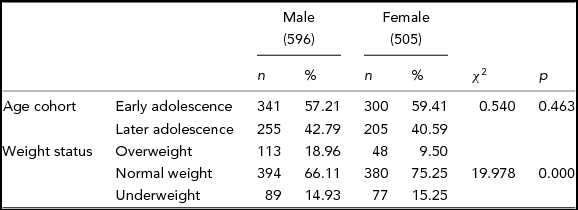
According criteria of age cohort and weight status in our study, the sample sizes for the subgroups of demographic variables for each gender are shown in Table 1. There was no significant gender ratio difference in age, but a significant gender ratio difference in weight status was found between males and females. The overweight rate of boys’ (18.96%) was significantly higher than females’ (9.50%) in our study.
Distribution of the Demographic Characteristics of Males and Females
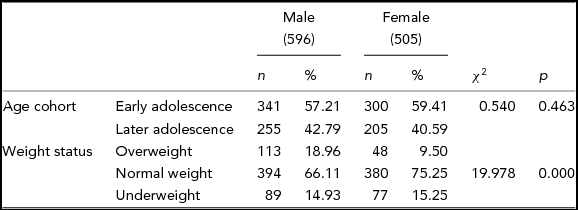
Note: % is percentage within each gender.
Body Dissatisfaction and Depression Scores
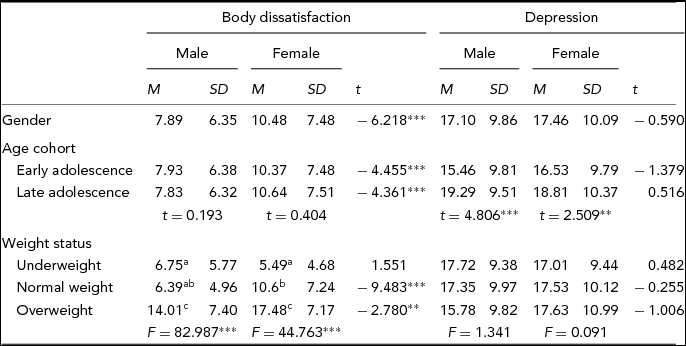
Table 2 shows the means of body dissatisfaction and depression for males and females by age cohort and weight status. Compared with the total male sample, the total female sample had a significantly higher mean for body dissatisfaction (p < .001), but no significant gender difference was found for depression (p > .05). The t tests comparing males and females by weight status found: (1) normal-weight (t = 9.483, p < .001) and overweight females (t = 2.780, p < .001) had greater mean body dissatisfaction levels than their male counterparts, but there was no significant difference between underweight males and females; and (2) there were no significant differences in depression scores (ps > .05). Female adolescents had significantly higher body dissatisfaction than males in both early adolescence (t = 4.455, p < .01) and late adolescence (t = 4.361, p < .01), but there no significant gender difference in depression for either age cohorts (ps > .05). Body dissatisfaction differed significantly by weight status for males (p < .001) and females (p < .001), and depression differed significantly across age cohort for both genders (ps < .001). Notably, underweight and normal-weight males had similar mean body dissatisfaction scores, and their body dissatisfaction was significantly less than those of obese males. Overweight females had the highest mean body dissatisfaction, and normal-weight females had a higher mean body dissatisfaction than underweight females.
Unadjusted Mean Body Dissatisfaction and Depression Scores for Males and Females by Age Cohort and Weight Status
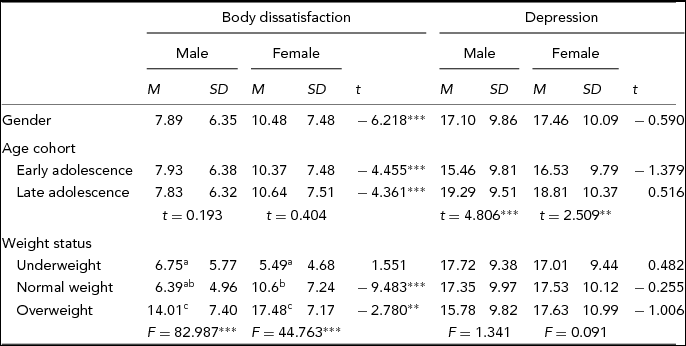
Note: t values are the results of independent-sample t-tests between the two gender groups across weight status and age; F values are the results of one-way ANOVA among all groups, by age cohort, and weight status within each gender. Within the three weight statuses for each gender, sharing a superscript letter (a-c) means they do not differ significantly from one another; *p < .05, **p < .01, ***p < .001.
Moderating Effects of Gender, Age and Weight Status
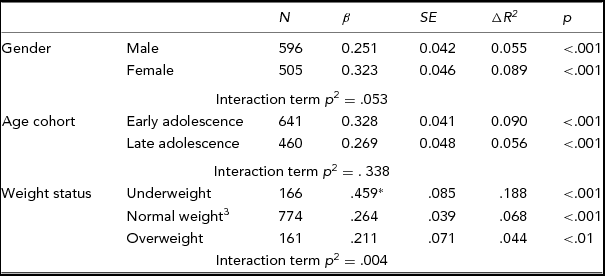
Table 3 presents the results of the regression analyses of body dissatisfaction on depression across each level of the three demographic variables. The association between body dissatisfaction and depression was strong and statistically significant for each demographic variable (βs = .211 to .459, ps < .01), controlling for the other demographic variables. The p values for the interaction terms for gender and age cohort indicated that the association of body dissatisfaction and depression did not differ significantly across the levels of these two variables. In contrast, the p values for the interaction terms for weight status indicated that the association of body dissatisfaction and depression varied significantly among the three levels of weight status. The association for the underweight group was significantly stronger than for the normal-weight group (t = 3.881, p = .001). However, no significant difference was found between the overweight group and normal-weight group (t = 1.150, p = .05).
Adjusted1 Association Between Body Dissatisfaction and Depression Across Levels of Gender, Age Cohort and Weight Status
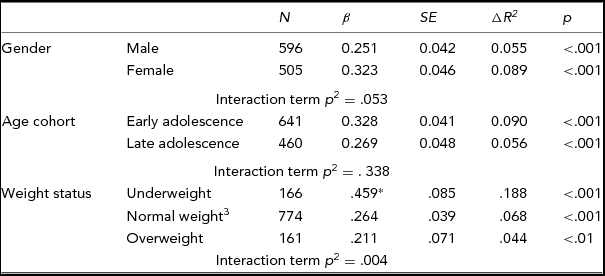
Note: 1Each model is adjusted for the two other demographic variables other than the one being tested; 2p value for the interaction term, which indicates whether the association between body dissatisfaction and depression is significantly different across the demographic variable groups; 3The reference group used for the comparison of differences in the regression coefficients; *Significantly different from the reference group.
Gender Differences on the Moderating Effect of Weight Status
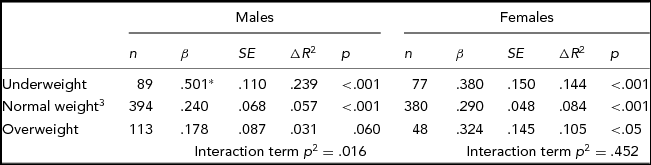
Table 4 presents the results of the regression analyses of body dissatisfaction on depression across weight status for males and females separately. Adjusted for age, a strong positive association was found between body dissatisfaction and depression (βs = .290 to .380, ps < .05) for females, regardless of weight status, but a significant association was found only for underweight (β = .501, p < .001) and normal-weight (β = .240, p < .001) males. According to the interaction terms for the moderating effect, the association differed significantly across weight status for males (p = .016), but not for females (p = .452). The association between body dissatisfaction and depression among underweight males was significantly stronger compared with normal-weight males (t = 3.377, p > .001). The association between body dissatisfaction and depression for overweight males was not statistically significant (β = .178, p = .060), and was also not significantly higher compared with normal-weight males (t = .828, p = .05).
Adjusted1 Association Between Body Dissatisfaction and Depression Across Levels of Weight Status By Gender
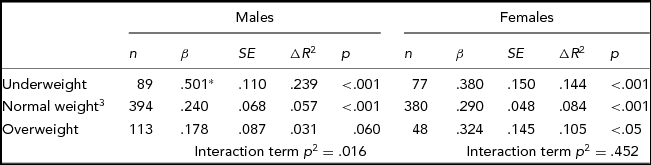
Note: 1All tests are adjusted for age cohort; 2p value for the interaction term, which indicates whether the association between body dissatisfaction and depression is significantly different across weight group within each gender; 3The reference group used for the comparison of differences in the regression coefficients; *Significantly different from the reference group.
Age Difference on the Moderating Effect of Weight Status
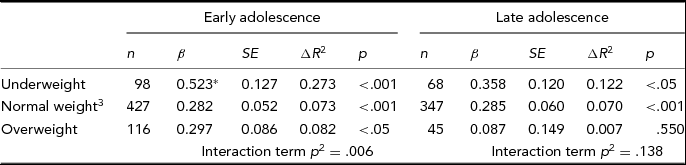
Table 5 presents the results of the regression analyses of body dissatisfaction on depression across weight status for the two age cohorts. Adjusted for gender, a strong positive association was found between body dissatisfaction and depression (βs = .282 to .523, ps < .05) for early adolescence, regardless of weight status, but a significant association was found only for underweight (β = .358, p < .001) and normal-weight (β = .285, p < .001) late adolescents. The association between body dissatisfaction and depression varied significantly across weight status for the early adolescence group (p = .006), but not for the late adolescence group (p = .138). Among the early adolescence group, compared with the normal-weight group, a significant difference was found for the strength of the association between body dissatisfaction and depression for the underweight group (t = 3.344, p = .001), whereas no significant difference was found for the overweight group (t = 0.247, p = .05) compared to the normal weight group.
Adjusted1 Association Between Body Dissatisfaction and Depression Across Levels of Weight Status By Age
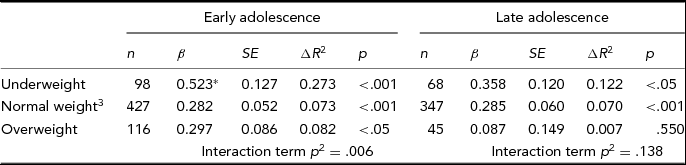
Note: 1All tests are adjusted for gender; 2p value for the interaction term, which indicates whether the association between body dissatisfaction and depression is significantly different across weight group within each age cohort; 3The reference group used for the comparison of differences in the regression coefficients; *Significantly different from the reference group.
Discussion
We examined the association between body dissatisfaction and depression across gender, age cohort, and weight status. The results indicated that the association between the two constructs varied across weight status, but not across gender or age cohort. In other words, of the three demographic variables, only weight status was found to moderate the association between body dissatisfaction and depression in our sample. Further analyses found that the moderating effect of weight status only existed in males and early adolescents, but it did not exist in female and late adolescents. From the aspect of gender, the association of body dissatisfaction and depression was particularly strong for underweight boys, weaker for normal-weight boys, and not statistically significant for overweight boys, whereas the association was strong for girls irrespective of their weight status. From the aspect of age cohort, depression was positively associated with body dissatisfaction for the underweight group of early adolescents, and to a lesser extent for the normal-weight and overweight groups of early adolescents, while the association was not statistically different across weight status for the late adolescents.
Given the strong social pressure, female adolescents tend to value physical appearance more than males as a personal attribute. Therefore, adolescent girls tended to be less satisfied with their body image and physical appearance (Simmons, Burgeson, Carlton-Ford, & Blyth, Reference Simmons, Burgeson, Carlton-Ford and Blyth1987). Our findings further demonstrate that female adolescents have a higher level of body dissatisfaction than do male adolescents. Given the assumption that the association of body dissatisfaction and psychological problems should be stronger in groups that place more importance on appearance, one might expect that body image would have a stronger effect on their depression. The association of body dissatisfaction and depression among female adolescents was stronger than the association for male adolescents in our sample, controlling for age and weight status, but the difference did not reach statistical significance. We found support for this general conclusion from the means of body dissatisfaction and depression observed in males and females. Female adolescents had higher means on body dissatisfaction than males, but females did not differ significantly from males on depression. However, higher body dissatisfaction for females did not lead to higher depression, which seems to contradict the absence of gender differences in the association of body dissatisfaction and depression. Body dissatisfaction potentially can have a great effect on depression, but this effect cannot explain all of the variance in depression, and several other variables may link depression to gender difference.
It is commonly believed that weight bias and stigma increases the vulnerability of obese/overweight individuals to body dissatisfaction and thereby depression. So, it also sounds reasonable that the association between body dissatisfaction and depression in overweight adolescents should be stronger than in their normal-weight or underweight counterparts. Consistent with common thinking, the results of ANOVA indicated that three weight status groups differed significantly in body dissatisfaction among male and female adolescents. However, no significant difference in depression was found between the weight subgroups of either gender in our study. The ANOVA results of the depression were not what we expected, but they are consistent with previous research in community samples (Goldfield et al., Reference Goldfield, Moore, Henderson, Buchholz, Obeid and Flament2010; Mustillo et al., Reference Mustillo, Worthman, Erkanli, Keeler, Angold and Costello2003). On the other hand, though the findings showed the association between body dissatisfaction and depression varied across weight status, the intensity of their association among three weight groups was not consistent with our hypothesis. The association of body dissatisfaction and depression for underweight adolescents was stronger than it was for overweight and normal-weight adolescents. These findings appear to be novel, and further analysis may partly explain the underlying reason for them.
It is notable that the moderating effect of weight status was observed only in male adolescents. Female adolescents showed a similar association between body dissatisfaction and depression in all three weight status groups. It is also notable (1) that body dissatisfaction was unrelated to depression among overweight male adolescents, (2) whereas there was a substantial relationship between them for underweight and normal-weight males, and (3) that the relationship was stronger for underweight males compared to normal-weight males. In addition, compared with their counterpart weight groups of female adolescents, overweight and normal-weight males had lower levels of body dissatisfaction, whereas underweight males had similar mean levels of body dissatisfaction. This finding is inconsistent with the results from a study of Asian Americans in which body image was not found to be related to BMI and the boys and girls had comparable body images (Siegel, Yancey, Aneshensel, & Schuler, Reference Siegel, Yancey, Aneshensel and Schuler1999). One possible reason for this disparity may be the difference in cultural background between the study samples. Given strong social pressure about physical appearance, overweight female adolescents and even normal-weight female adolescents tend to express dissatisfaction with their bodies (Xu et al., Reference Xu, Mellor, Kiehne, Ricciardelli, McCabe and Xu2010). However, mild obese and overweight boys are often considered to be strong and appealing by a large portion of people in China, especially their caregivers. So, body satisfaction in overweight boys is less likely to be reinforced for this reason, and body dissatisfaction in underweight boys is likely to be reinforced for the same reason. On the other hand, overeating and enjoyment of food may serve as strategies to cope with negative affect (Faith, Allison, & Geliebter, Reference Faith, Allison, Geliebter and Dalton1997), which might attenuate the relationship between body dissatisfaction and depression in overweight males. Based on these explanations, we can easily understand the gender difference in the prevalence of adolescent overweight/obesity in China (Chen, Reference Chen2008; Ma & Wu, Reference Ma and Wu2009). Generally, the prevalence of overweight/obesity tends to be higher among male adolescents than female adolescents in most regions of China, and this tendency was evident in our study: the overweight prevalence was nearly two times higher in males than it was in females. These findings suggest that overweight boys and their caregivers urgently need information and education about weight and health. In addition, in light of the fact that the strongest association between body dissatisfaction and depression was found for underweight male adolescents, more attention should be paid to this group because higher levels of body satisfaction may be a ‘risk factor’ for depression in this group.
It is generally believed that body dissatisfaction will change as the self-concept of adolescents develops, and this will influence their levels of body dissatisfaction and depression. However, in this cross-sectional study, the body dissatisfaction of both boys and girls did not differ significantly between the two age cohorts. This result is partially in accord with the results of van den Berg, Mond, Eisenberg, Ackard, and Neumark-Sztainer (Reference Van den Berg, Mond, Eisenberg, Ackard and Neumark-Sztainer2010), who found age differences among girls but not boys (van den Berg et al., Reference Van den Berg, Mond, Eisenberg, Ackard and Neumark-Sztainer2010). The difference may derive from differences in the psychological measurement tools or the characteristics of the samples. Further studies of age, gender, and body dissatisfaction in different cultural samples are needed to verify and explain these results. Although the mean levels of depression changed across age in our sample, the association between body dissatisfaction and depression did not vary after controlling for gender and weight status. Nevertheless, an age cohort difference was found on the moderating effect of weight status, in which the association between body dissatisfaction and depression varied by weight status only among early adolescents. In our early adolescence sample, the association of body dissatisfaction and depression was substantial for all the three weight groups, and the strongest association was found for the underweight group. These findings suggest that intervention and educational programs to reduce body dissatisfaction and depression should focus on middle-school students. At the same time, more attention should be paid to underweight early adolescents as they tend to have a higher level of body dissatisfaction and depression than other adolescents. In our late adolescence sample, the regression coefficient values between weight groups seemed to be a discrepancy, but the p value of the interaction term indicated the discrepancy cannot reach statistical significance. For the overweight group, the association of body dissatisfaction and depression was not statistically significant at all. The question of this low power may be due to the small numbers of overweight participants (especially with only 11 girls).
Limitations
The present study had several limitations. First, the information about weight and height was based on self-reports rather than actual measurement. A systematic review by Connor, Tremblay, Moher, and Gorber (Reference Connor, Tremblay, Moher and Gorber2007) reported that adolescents tend to under-report their weight and over-report their height. Second, the selection of BMI norms to evaluate the weight status of adolescents was also a limitation. The BMI cut-offs of obesity and overweight for Chinese adolescents are based on the 2004 Group of China Obesity Task Force, which may no longer reflect the physical constitution of adolescents. Unfortunately, no other suitable Chinese standards are available to define overweight and obesity status for adolescents, and there are no standards for defining underweight status. Third, given the large number of unreturned or invalid questionnaires, the sample is likely not representative of the adolescents from which it was drawn. Some students with weight and emotional problems may have been unwilling to participate, but we did not follow up these missing data. Fourth, the small sample size of some demographic subgroups was likely to reduce the statistical power of our findings. Given these limitations, the generalisabity of the findings will be affected to some degree, and further research should be conducted to re-examine this effect. Moreover, our study used a cross-section design and, therefore, the causal relationships between body dissatisfaction and depression cannot be inferred. Finally, overeating, weight perception and other factors, which are highly related to the association of body dissatisfaction and depression, were not included in this study. So, the explanations about the two constructs among the overweight and underweight groups are only inferences based on cultural features. Further testing of risk models and longitudinal studies on body dissatisfaction, depression and related outcomes in Chinese adolescents are needed to better address this poorly understood topic.
Implications for School Health
Elevated body dissatisfaction was highly related to the prevalence of depression among subgroups of adolescents, with high associations between the two constructs, which suggests that clinicians and others working with youth should continue to be mindful of the important role of personal appearance as it relates to depression in the lives of adolescents. The current findings have important implications for the development of screening and prevention programs for adolescents at risk for body dissatisfaction and depression. First of all, our investigation indicates the association between body dissatisfaction and depression was strong in nearly all the weight-status groups across gender and age cohorts, which suggests that the development of preventive interventions aimed at reducing depression through reducing body dissatisfaction should be tailored to a much broader range of middle-school students, not only to students who are overweight and obese. Second, our study found that the association between body dissatisfaction and depression varied across weight status only in males. If this finding is correct, future prevention and intervention may require different levels of attention and methods for different weight subgroups for the two genders. Both teachers and school counsellors who are responsible for students’ physical and mental health should pay equal attention to all three weight subgroups of females, but pay particular attention to different weight subgroups of males. For example, they should pay more attention to underweight males because their body dissatisfaction is more closely related to depression compared to their normal-weight and overweight counterparts. In addition, the prevention method for overweight males should be different from the methods for the other two groups because body dissatisfaction only was weakly related with depression in this group. Third, the moderating effect of weight status between body dissatisfaction and depression in our study was significant for early adolescents, but it was not significant for late adolescents. If this finding is correct, prevention and intervention efforts may also require different levels of attention and methods for the weight subgroups of early adolescents. The associations between body dissatisfaction and depression were significant in all three weight status subgroups in early adolescence. Based on these associations, effective interventions to reduce depression by reducing body dissatisfaction should begin in middle school, or even earlier.
Conclusion
In summary, the current study suggests that the depression prevention program focus on lowering body dissatisfaction level should be mindful of a wide variety of weight status of the Chinese adolescents. At the same time, the moderation effect role of some demographic variables can provide evidences for special attention on some critical demographic subgroups. Therefore, the findings have great implications for mental healthy education in schools. Future research should also be concerned with the limitations of this study; for example, by using actual measured weight and height, investigating the proposed relationships in larger representative populations, and using longitudinal designs for drawing causal conclusions, and re-examining the moderating effect of these variables.
Human Subjects Approval Statement
This study was approved by the Research Ethics Board of Central South University, as well as the four middle-school boards. All participants provided written informed consent.