Iceland Airwaves is an urban music festival held annually in the centre of Reykjavík. In the run-up to the 2014 festival, Árni Matthíasson, one of Iceland's foremost music critics, published an article in Reykjavík's English-language newspaper, the Grapevine, aimed at the festival goers he referred to as ‘intrepid travellers’. Matthíasson began with a series of provocative questions: ‘Perhaps you flew to Iceland to enjoy the island's indigenous sounds; its original vibrant authentic culture. But, here's the rub: is it really original? Is it really indigenous? How authentic is it? Are the musicians just applying face paint and donning grass skirts to entertain us?’ ÁrniFootnote 1 went on to describe how there used to be little nightlife in Reykjavík only a few decades ago, and that no one tried to make a living from making music. This had all changed in recent years, however, largely thanks to the tourists who now visit the island ‘looking for a slice of Icelandic culture and a good time’. Árni ended the article: ‘the next time you stagger around downtown Reykjavík soaking up the culture, consider that maybe you are attending a performance set up just for you – and do enjoy it, even if it sometimes isn't all that authentic’ (Matthíasson Reference Matthíasson2014).
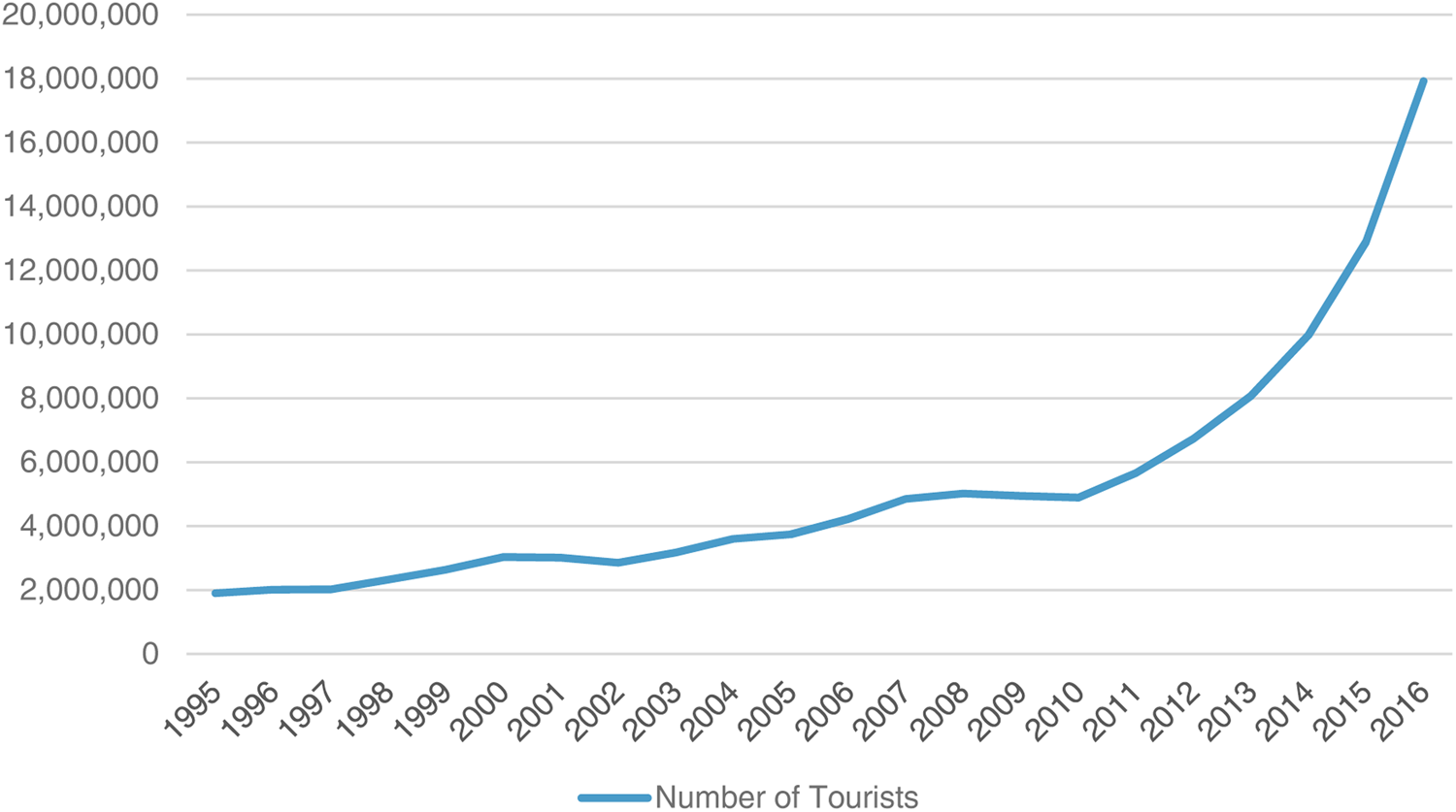
This tongue-in-cheek piece was written only a few years into the massive tourism boom that followed Iceland's serious economic crisis of 2008. The local currency, the króna, quickly depreciated, and international tourism to Iceland was encouraged by the government as a form of economic recovery. Between 2010 and 2016, the number of foreign tourists to Iceland increased at an unprecedented rate (see Figure 1). The shifts in musical life occurring around Reykjavík in response to the rise of tourism were already felt by the local population in 2014. Long-standing, beloved clubs were torn down to make way for new hotels, and live music specifically catering to tourists could now be heard in the new hotel and hostel lobbies almost every night of the week. However, Árni captured a larger attitude shift in those involved in the local music scene of Reykjavík in his article by likening the live music scene of Reykjavík during Iceland Airwaves to ‘indigenes’ applying face paint and grass skirts to entertain curious tourists. Through this rhetoric, Árni evoked a larger pattern of the exoticisation of Icelandic musical life in connection with the tourism boom (Lund et al. Reference Lund, Loftsdóttir and Leonard2017).
Numbers of foreign tourists to Iceland between 1995 and 2016.

A few days later Sindri Eldon, a local musician and Björk's son, made waves by publicly posting a note on Facebook in which he likened the images of Iceland as a magical place brimming with creativity and inherently artistic people to ‘thinking that Kenya is inhabited entirely by anthropomorphic lions, or that Japan is nothing but geishas, perverted businessmen and giggling schoolgirls as far as the eye can see’. Both Árni and Sindri's comments ahead of Iceland Airwaves in 2014 communicated a frustration with Reykjavík's live music scene being turned into a performance for tourists that ‘reproduce[s] stereotypic images, discredited histories, and romantic fantasies’ (Bruner Reference Bruner2001, p. 886). Much like the many hotels across Polynesia and the Caribbean that feature live music and dance performance for the tourists, Reykjavík's live music scene had morphed into a location of tourist fantasy and imagination, and Iceland Airwaves was the epicentre of the country's new musical tourism.
In this article, I explore how Iceland Airwaves, a festival specifically designed to connect popular music and tourism in Iceland, continues to shape, and be shaped by, tourism, even as the touristic context has changed almost unimaginably in the festival's 20 years of existence. Gibson and Connell point out that ‘little has been written about the interrelationship between economic, environmental and cultural dimensions of festivals – about how festivals could and are being used to promote local and regional development in the broadest sense, and what kinds of political and social issues are at stake’ (Gibson and Connell Reference Gibson and Connell2012, p. 5). The interrelated nature of the economic, environmental, cultural and social dimensions of music festivals demands more holistic and ethnographic research on the effects of such festivals for the local communities that host them. From a more historically informed perspective, this material is also significant as it demonstrates an important shift in the discourse of Icelandic national culture. Traditionally, the Icelandic language, medieval sagas and landscape have formed a three-part foundation of Icelandic national discourse, with music largely excluded (Cannady Reference Cannady2014). In the new tourist context, however, music in Iceland, especially popular music, has gained a more prominent place in the articulation of national identity and culture than ever before.
Methodology
The ethnographic approach taken in this research offers a nuanced study of how various actors across the realms of popular music in Iceland have shaped the current climate of ‘musical touristics’ (Rommen Reference Rommen, Rommen and Neely2014). This research is based on extensive fieldwork in Iceland that began with a short visit in 2010 followed by a year in residence in Reykjavík between 2011 and 2012, and return trips lasting between one to five months in 2014, 2015, 2017 and 2018. During that time, I conducted interviews with musicians based in Iceland, record producers in both Iceland and Germany who work with Icelandic musicians, people who work for Iceland Music (formerly Iceland Music Export) and other music export- and promotion-based organisations, government officials, concert and festival organisers in Reykjavík and other parts of the country, foreign tourists, as well as people who live in Reykjavík and experience the shifts I discuss in their daily lives. Although not all of these voices are directly included in this article, these conversations have all shaped the information discussed here.
This approach draws on Pruett's call for increased ethnographic research in more mainstream sites of popular music production and creation, instead of continuing reliance upon secondary sources such as commercial recordings and articles by critics or music journalists (Pruett Reference Pruett2011, p. 1). While I recognise the limitations of claiming ethnographic authority on the matter, the methodologies used in this research offer insight into Iceland Airwaves, foreign tourism in Iceland and the larger world of popular music in Iceland from an ethnographic perspective. My research in 2011 and 2012 was overseen by the Human Subjects Division at the University of Washington, and my research from 2013 through to the present is overseen by the Human Ethics Committee at Victoria University of Wellington.
Roadmap
In what follows, I offer an ethnographic exploration of Iceland Airwaves as a case study of musical tourism in the post-crash Icelandic economy. I begin by introducing Iceland Airwaves as a major urban festival. I briefly discuss the history of the festival and position the festival in a larger Icelandic and international context. This is followed by a discussion of music festivals in research contexts more broadly, which aims to position this research in a larger scholarly conversation that draws on interdisciplinary approaches to the study of popular music and music festivals. I then explore how Iceland Airwaves and tourism to Iceland have been connected from the festival's early years. Finally, I consider how the success of Iceland Airwaves has contributed to a larger shift in the use of popular music to market Iceland globally.
Setting the stage: Iceland Airwaves and Reykjavík
Iceland Airwaves takes place in Reykjavík over five days in early November. In 2014, 219 bands played over 674 concerts during both the official events as well as the numerous off-venue concerts held at locations around the city (interview with Grímur Atlason, 4 November 2014, Reykjavík, Iceland). In both 2014 and 2015, nearly 9000 tickets were either sold or given out for the official on-venue performances, while nearly the same number of individuals took advantage of the extensive free off-venue concerts that did not require tickets. The numbers of both ticketed and off-venue attendees have fluctuated over the lifetime of the festival, owing in part to changes in management and shifting goals of the festival organisers. Guests to the festival include international and domestic audience members, musicians, scouts from record labels and other festivals in North America and Europe, and international journalists who draw attention to specific bands, the festival in general and Reykjavík itself as a travel destination. Most notable of the foreign press has been the team from Seattle's KEXP radio station, who travel to Reykjavík each year to host and live-broadcast a special nightly set of performances by Icelandic artists for audiences in Seattle and on the internet through YouTube. KEXP has been credited with introducing Of Monsters and Men to international audiences when they recorded the band live at Iceland Airwaves in October 2010 and uploaded the video to YouTube. They also hosted Ásgeir Trausti on his first international performance, leaving local bands eager to be featured in their sponsored line up at the festival. Described as the ‘annual 5-day ball’ for Icelandic musicians by the well-known drummer Magnús Trygvason Eliassen (interview with Magnús Trygvason Eliassen, 19 October 2015, Reykjavík, Iceland), Iceland Airwaves is one of the most important opportunities of the year for local bands to be discovered and for Icelanders to hear new music by international artists playing the festival.
The director of Iceland Airwaves from 2010–2017, Grímur Atlason, explained that prior to the late 1990s, Reykjavík had not been known as an exciting city, and the few tourists who came to Iceland typically went out to the countryside in search of ‘puffins and moss’. Establishing the festival in the city was a way to infuse Reykjavík with musical life after the summer months, and it was one of the first concerted efforts to combine tourism with music. From the beginning, Grímur explained, the festival had three primary goals: (1) to create a world-class music festival; (2) to promote Icelandic music abroad; and (3) to attract tourists in the off-season (interview with Grímur Atlason, 4 November 2014, Reykjavík, Iceland). By all accounts, the festival has been successful in each of these areas, including regularly attracting more foreign attendees than locals since 2012 (of the 7500 attendees that year, 4076 were foreigners and 3424 were Icelandic).
The festival started in the middle of October 1999 as a one-day event in an old aircraft hangar in Reykjavík. From the beginning, the festival was intended to bring major international artists to play in Iceland, as well as to create a draw for tourists that did not involve puffins or mossy landscapes. Icelandair, the country's national airline, was a founding sponsor of the festival, and remained an important supporter. By 2014, the average attendee was around 28 years old, white, well-educated and with disposable income (interview with Grímur Atlason, 4 November 2014, Reykjavík, Iceland). The festival was moved into the city-centre of Reykjavík for its second year with the idea that, instead of concentrating the action in one mega venue or concert zone, the festival would take over the city in a series of smaller venues. This urban focus of the festival, combined with the extensive off-venue series, would lead to a takeover of everyday life in Reykjavík felt even by those residents who did not attend the events.
Iceland Airwaves is what Ritchie defines as a ‘hallmark event’: these are ‘[m]ajor one-time or recurring events of limited duration developed primarily to enhance the awareness, appeal and profitability of a tourism destination’ (Ritchie Reference Ritchie1984, p. 2). Getz further described such events as those that possess ‘such significance, in terms of tradition, attractiveness, quality, or publicity, that the event provides the host venue, community, or destination with a competitive advantage. Over time, the event and destination can become inextricably linked, such as Mardi Gras and New Orleans’ (Getz Reference Getz2005, p. 16). Iceland Airwaves is significant for Icelandic musicians because it is often prohibitively expensive for the musicians to tour internationally, so the festival provides an opportunity to perform and be heard by an international audience. Even though it was not initially designed as such, Iceland Airwaves has also grown into a showcase festival that functions as a talent scouting event for certain producers and record labels.
Grímur also discussed how much the festival has changed in recent years. When the festival started in 1999 there was very little professional event and tourism management in Iceland, so people had to figure things out as they went. However, the festival would in time develop a full professional team of staff members to work throughout the year on the event and related issues. The team has worked to build strong relationships across Europe with other festival organisers and cultural organisations. They also think about how to use their resources to the benefit of the entire country of Iceland, even for those who live outside of Reykjavík, and who might not have the opportunity to come to the city for the festival. This includes a satellite branch of the festival in Akureyri, the country's second largest city. The team also tries to help make connections for bands both during the festival and through the rest of the year whenever possible.
The entire city dresses up for Iceland Airwaves. Shops up and down the main street put up signs welcoming festival guests and offering them various discounts. In 2014, there were 11 official venues hosting Iceland Airwaves, with all but one centrally located in the city centre and no more than a 10-minute walk in between venues. Music in these official venues generally starts at about 8:00 p.m. and continues until 3:00 or 4:00 a.m. In addition to the official shows, an ‘off-venue’ series takes place in cafes, shops, public squares, pubs, government buildings, hotels and hostels, and other seemingly random locations throughout the city. These events start as early as noon and continue until the official shows start. The off-venue shows are free and one does not need to have an official pass to attend. The days are packed from late morning until well into the night, and the atmosphere this creates is one of a non-stop party. One of the employees of Iceland Airwaves explained this atmosphere to me by comparing it with other festivals she has been to, saying:
During Iceland Airwaves, Reykjavík is completely consumed by Iceland Airwaves, everyone is talking about it, whether it's your 70-year-old grandmother or a 27-year-old that's attending the festival or playing the festival. I didn't notice that in Brighton, it's a bigger city for one, but everybody knows that Iceland Airwaves is going on especially in the downtown area, and I was only in the downtown area in Brighton. I had hardly anyone who was working in the cafes know that the festival was going on, so it's really interesting to see the difference of how Reykjavík is all about Iceland Airwaves during Iceland Airwaves, and everybody just really welcomes it and tries to make business out of it and sell more and get people into their store or restaurant or whatever. (interview with Kamilla Ingibergsdóttir, 22 June 2012, Reykjavík, Iceland)
Reykjavík is increasingly a year-round party scene for tourists coming mainly from North America and other parts of Europe. This has allowed for the emergence of new popular venues, such as the KEX hostel, that simultaneously serve as a point of call for tourists and for locals. An ever-increasing number of music festivals in Iceland has also built on the success of Iceland Airwaves. Visitors to Iceland, and local residents, can now attend some sort of music festival, often marketed for its uniqueness, almost every month of the year.Footnote 2
Iceland Airwaves has effectively shifted local musical life toward a sense of ‘festivalisation’ in which a self-conscious promotion of local signifiers of cultural alterity (Meadows Reference Meadows, Rommen and Neely2014, p. 244) are embedded into how Icelandic popular music, the island itself, and Icelandic national culture are promoted and sold to tourists. In many ways, this approach to promoting Iceland for its unique and occasionally exotic ways of life began before the economic collapse of 2008. Grétarsdóttir has argued that ‘[i]mages of creativity based on so-called Icelandic heritage and, not least, on Iceland's untamed nature were central to reinventing national narratives to manage the nation, harmonise the national with the international, and represent difference in the phase of forming a globalised, neoliberal nation-state’ (Grétarsdóttir et al. Reference Grétarsdóttir, Ásmundsson, Lárusson, Durrenberger and Pálsson2015, p. 94). In many ways, the economic expansion of the 1990s and early 2000s was itself built on tropes of a unique Icelandic heritage and creative, innovative national spirit. In contemporary Iceland, however, this carefully cultivated sense of an extreme and exotic location has resurfaced in the marketing efforts of the tourism industry and is strongly felt in efforts related to popular music.
Music festival and tourism research
Over the past few decades, a growing body of literature on music festivals in international contexts has emerged from a diverse range of fields. From within tourism studies itself, scholars have developed theoretical models to better understand festivals such as Iceland Airwaves through the category of ‘event tourism’. In his consideration of the supply side motivations for developing ‘event tourism’, Getz posits that such events are designed to meet a range of goals including: ‘to attract tourists (especially in the off-peak seasons), serve as a catalyst (for urban renewal, and for increasing the infrastructure and tourism capacity of the destination), to foster a positive destination image and contribute to general place marketing (including contributions to fostering a better place in which to live, work and invest), and to animate specific attractions or areas’ (Getz Reference Getz2008, pp. 405–6). As I discuss below, Iceland Airwaves has been developed to address each of Getz's four goals for ‘event tourism’.
Events such as Iceland Airwaves are significant not only for what they do in the immediate period that they are held, but also for the implications of the festival over the entire year. In a 2003 article on the effects of Edinburgh's festivals on the tourism sector and the tourism sector's influence on the city, the authors argued that one of the measures of success for the city's festivals was ‘the extent to which the city attracts segments primarily interested in performing arts at its Festival venues, rather than accidental heritage tourists’ (Prentice and Andersen Reference Prentice and Andersen2003, pp. 11–12). This goes hand in hand with the modification of the city's traditional generic image by the festival. This is significant for Edinburgh owing to ongoing tensions between how Scotland's overall image is represented through Braveheart tropes and how the city itself imagines and represents itself as a modern urban centre. In this context, the festivals of Edinburgh simultaneously attract new tourists and visitors to the city and reshape the image of the city for permanent and temporary inhabitants. Edinburgh's festivals are much larger in size, scope, and duration than Iceland Airwaves, but the distinct nature of the relationships between city and festival share much in common.
In his introduction to a valuable collection of essays on music and tourism in the Caribbean, ethnomusicologist Timothy Rommen noted that scholars who engage heavily with tourism studies most likely approach it from the fields of mobility studies, leisure studies or cultural geography. These same scholars also rarely focus primarily on the relationships between tourism and music in their research. At the same time, Rommen writes that ‘for music scholars, tourism has often been ancillary – sometimes even understood as threatening – to their own research concerns, and it has thus often been relegated to cursory or otherwise incomplete treatment’ (Rommen Reference Rommen, Rommen and Neely2014, p. 3). Rommen offers the concept of ‘music touristics’ as ‘music prepared for the purpose of performance or sale within tourist networks, and by extension, on the musicians, audiences, communities, and media involved in these networks’ (Rommen Reference Rommen, Rommen and Neely2014, p. 7).
Ruthie Meadows’ chapter on musical tourism in New Orleans also offers valuable insight into the effects of ‘festivalisation’ of local musical culture and practices. In this research, Meadows examines the growth of music-centred tourist and heritage industries in New Orleans. She argues that this mode of tourism is creating a ‘touristic culture’ in which ‘local understandings and assertions of heritage, culture, memory, and authenticity are increasingly implicated in and framed by touristic logics, discourses, and practices’ (Meadows Reference Meadows, Rommen and Neely2014, p. 240). This research offers insight into processes in New Orleans that are similar to those playing out in Iceland, although the context is quite different. Yet as musical life in Iceland is increasingly marketed and framed through a tourist lens, the local population also experiences and interacts with this new discourse.
Another significant contribution to the study of music festivals is Gibson and Connell's Reference Gibson and Connell2012 volume Music Festivals and Regional Development in Australia. The authors offer a brief history of music festivals and argue that, in a broad sense, they have been around for centuries with people gathering together to experience live music making across Europe and the world (Gibson and Connell Reference Gibson and Connell2012, p. 13). However, they argue, music festivals in the contemporary, conventional sense of the term developed after the second world war in North America and Europe, with festivals such as the Newport Jazz Festival, which began in 1954, and Monterey Jazz Festival, which began in 1958, leading the way. In these early examples, festivals were ‘an alternative space for social and sexual interaction, drug consumption, musical expression and relaxation. Their beginnings often comprised part of social revolutions, motivated by desires to invert orthodoxy and moral conservatism, rather than commercial imperatives’ (Gibson and Connell Reference Gibson and Connell2012, p. 14). By the 1990s, however, a second phase of festivals developed in conjunction with more sophisticated marketing that brought a shift in the perception of such festivals as ‘commercial motives triumphed over community orientation’ (Gibson and Connell Reference Gibson and Connell2012, p. 15). Despite this shift towards more commercial motivations for many music festivals, including Iceland Airwaves, such festivals remain deeply interconnected with larger social and cultural forces.
Balancing music and tourism in Iceland Airwaves
Iceland Airwaves was initially designed to bring international bands to play in Iceland and to give Icelandic bands an opportunity to play for foreign guests, but the festival has also been connected to the country's tourism industry from the beginning. The festival was originally scheduled for mid-October to extend the tourism season beyond the popular summer months. Today, this tourism gap has closed with no clear off-season, and the festival has moved to the first week of November. The festival has also been directly related to the tourism sector through the festival's parent company, Icelandair, the country's main airline and one of the biggest forces in the Icelandic tourism sector (Jóhannesson and Huijbens Reference Jóhannesson and Huijbens2010, p. 427).
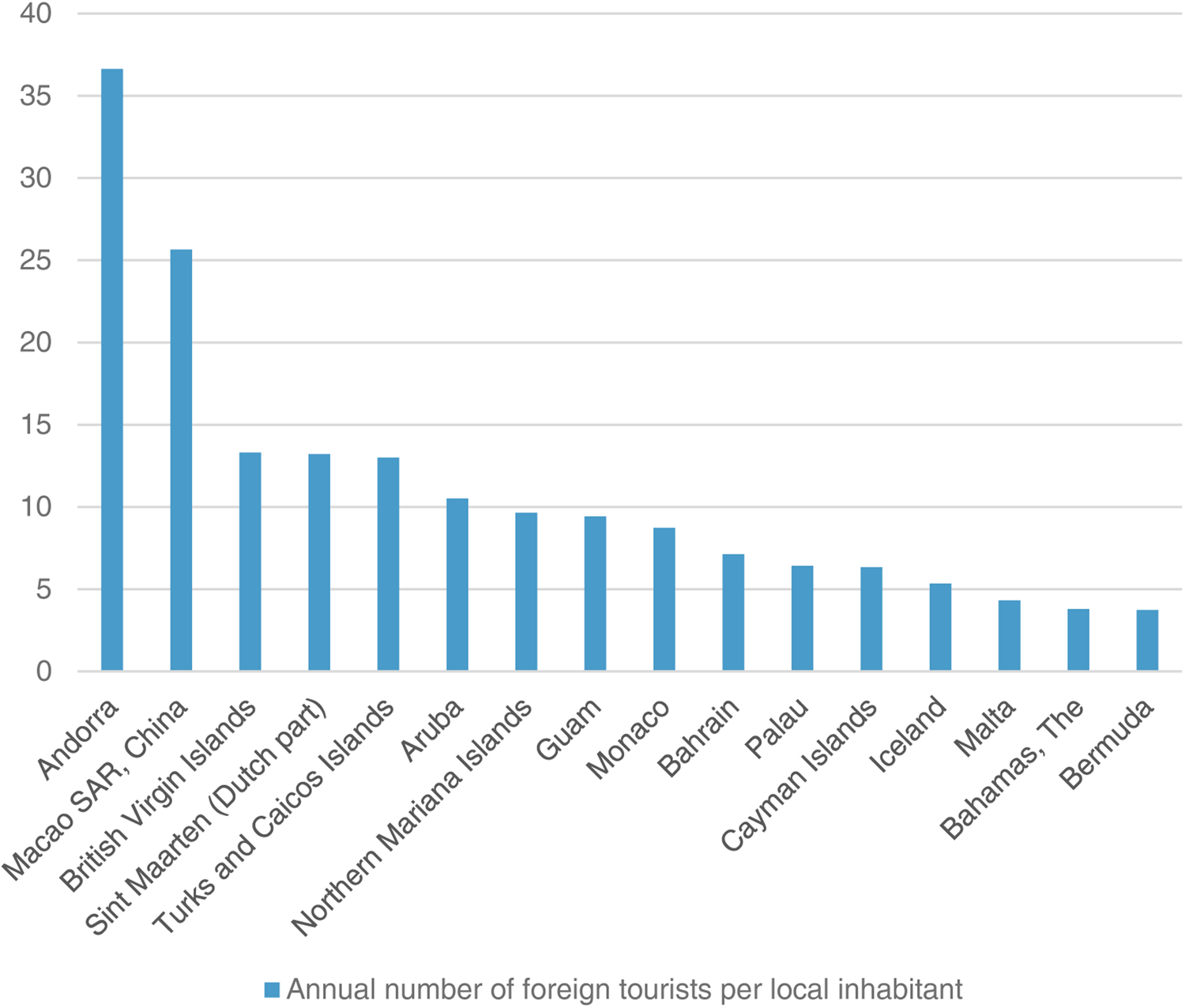
When the festival started in 1999, the number of foreign tourists to Iceland was 263,000, and the Icelandic government did not place a significant priority on supporting the tourism industry. In 2016, 1,792,000 tourists visited Iceland (World Bank n.d.) and the tourism industry is now the most significant part of the Icelandic economy, having surpassed aluminium exports in 2012 and seafood exports in 2014 (Gamma 2018). Between 2015 and 2016 alone the number of tourists to Iceland increased by 39%, with only three other countries in the world experiencing larger increases (Sierra Leone, the Marshall Islands and Nepal).Footnote 3 In 2016, the number of foreign visitors to Iceland was 5.34 times the local population, which was the 13th highest such ratio in the world based on all countries identified by the World Bank (see Figure 2). This rapid increase in tourism has changed the economic system of Iceland, but it has also had profound effects on the natural and built environments, as well as on the everyday lives of locals, as I discuss later in this article (Loftsdóttir and Lund Reference Loftsdóttir, Lund, Huggan and Jensen2016; Loftsdóttir et al. Reference Loftsdóttir, Kjartansdóttir and Lund2017; Ólafsdóttir et al. Reference Ólafsdóttir and Runnström2013; Stefánsson et al. Reference Stefánsson, Sæþórsdóttir and Hall2017).
Highest rates of tourism per capita globally (2016).
In a presentation given to tourism and events management students at the University of Iceland, Grímur, the director of Iceland Airwaves, offered specific figures about the number of visitors to Airwaves. However, he also discussed some of the more controversial aspects of popular music life in Iceland, and the ways that Airwaves may be implicated in some of them. Grímur addressed the closing of venues such as Nasa and Faktorý, both to make way for the opening of new hotels. He spoke of the negative effects of such closures on Reykjavík as a city and for the musicians here, but he pointed out that, at the time, property was cheap and easy for developers to buy. He discussed the importance of Airwaves for breaking new bands into the international market, particularly Sigur Rós and Of Monsters and Men. He also pointed out that a positive aspect of the situation for the local population is that people can now go to gigs year-round, largely thanks to tourism.
The effect of the festival on musical life through shifting venues and more gig opportunities was also discussed by every musician I spoke with as well. The employee of an Icelandair-owned hotel and bar in Reykjavík explained that his bar decided to participate in the off-venue series of Iceland Airwaves and staged a few concerts that turned out to be well attended and popular with the crowds. This showed the owners of the hotel that the space could be used as a viable venue during other times of the year as well. The viability of new hotels as concert venues has also started to affect the styles of music that musicians are likely to be asked to play in these non-Airwaves gigs, as many of the hotels request that musicians play jazz as background music (Interview, 20 October 2015, Reykjavík, Iceland). While all of the musicians I spoke with expressed frustrations with the trend of popular venues being bought up for hotel space, they also acknowledged the emerging opportunities to play for tourists in hotels and other spaces, such as the Blue Lagoon, that often come with higher payments. These financial incentives often allow the musicians to focus on less financially lucrative projects at other times, but they also highlight the ‘precarity’ of Iceland's current ‘creative economy’ (de Peuter Reference de Peuter2012, p. 32).
Airwaves is about more than just the number of tourists that attend each year, or the amount of money that is made from the festival. It also offers an opportunity for Iceland to put itself on display to tourists in a focused way. In her research on Icelandic immigrants to Canada, Brydon argued that the myths and stories people tell about themselves is a vital part of understanding how identities develop. She argued that ‘increasingly, a sense of the past is created and presented through community celebrations. Such festivals are more than just a relaxing time spent away from work or school. They are also secular rituals, moments in which we renew and redefine our sense of self’ (Brydon Reference Brydon1989, p. 14). Iceland Airwaves offers an opportunity for local musicians, business owners, the tourism industry, the government, and nearly anyone that calls Reykjavík home to continuously redefine the musical life of Reykjavík. Given that the effects of Airwaves continue throughout the year, long after the festival is over, this redefining is also an ongoing process.
KEXP and broadcasting Reykjavík
I had an opportunity to spend time with the team from Seattle's KEXP radio station in 2014 and 2015. KEXP is one of the most influential independent radio stations in the US in terms of introducing new artists to large audiences, particularly through their YouTube channel. Each year a team from KEXP comes to Reykjavík to stream live performances at the festival back to listeners in Seattle. In 2014, I interviewed Kevin Cole, the mastermind behind KEXP's Reykjavík initiatives. I was struck by Cole's sincere love of, and commitment to, exploring new Icelandic music, and helping others to do the same. Cole recounted his first visit to Iceland in 2005, explaining that he ‘spent the time experiencing the country and the people and the musicians, but it was purely because of hearing Sigur Rós … that record [Ágætis Byrjun] was so magical and unlike any other record that came, it was sort of like a new sound and that doesn't happen very often in music where there's something entirely brand new. That's why I ended up here’ (interview with Kevin Cole, 7 November 2014, Reykjavík, Iceland). I noted similar accounts of personal relationships to the music in many of the conversations I had with both Icelanders and non-Icelanders alike. This demonstration of love of music and emotional connection to place is significant as I turn to a more critical view of economics and marketing in the next section.
Marketing the nation through popular music
The growth of tourism has had significant consequences in Reykjavík, the urban centre of Iceland that is home to over half of the island's population. When I lived in Iceland in 2011, it was already becoming common for landlords to terminate long-term rental contracts to turn rental properties into short-term housing through the website Airbnb. Since that time, the housing situation in the centre of Reykjavík has become almost unmanageable for the local population owing to the proliferation of short-term rental properties and the expansion of hotels across the city. This has led to a housing shortage for permanent residents and a drastic increase in prices for housing, food and other goods and services. It is also pushing permanent residents out of Reykjavík's centre, leading some to wonder whether the city itself will eventually become a tourist-only zone. Yet Reykjavík as a city remains a compelling destination for tourists in large part because of an infamous nightlife with lively bars, cafes and live music venues.
The growth of musical tourism in the city has begun to restructure the very musical practices that have attracted tourists. Karen Oslund offered a long-view of tourism and foreign perceptions of Iceland in her 2011 book Iceland Imagined, in which she argued that since the 1990s ‘Iceland has been marketed by the tourist industry as a site of breaking pop culture and electronic music’ (Oslund Reference Oslund2011, p. 4), largely thanks to the success of Björk. In his study of Reykjavík as a music scene, sociologist Nick Prior suggests that Reykjavík's musical life has been more profoundly influenced by a tight-knit social fabric than by the surrounding landscape that has more frequently been the topic of foreign journalism and scholarship (Prior Reference Prior2015). Yet this tight-knit social fabric is now being rewoven as the local musicians and beloved venues are increasingly displaced to make way for more hotels in the Reykjavík centre.
As tourism in Iceland has grown to be the dominant sector of the economy, a unified approach to the marketing of the country has emerged thanks in part to the efforts of Íslandsstofa (Promote Iceland), a public–private partnership that describes its aims as ‘to enhance Iceland's good image and reputation, to support the competitive standing of Icelandic industries in foreign markets, to attract foreign tourists and investments to the country, and assist in the promotion of Icelandic culture abroad’ (Iceland Naturally, n.d.). This firm also runs the official tourism website for the country, ‘Inspired by Iceland’, which has frequently used popular music in its various campaigns. In 2012 they released a video using Emiliana Torrini's song ‘Jungle Drum’ that incorporated nearly every possible stereotypical image of Iceland: people dancing on glaciers, Vikings standing in the middle of a field, a nude couple being intimate outside in a natural hot pool, women dancing in the Icelandic national costume in front of turf houses, people making music in a public square and the famed Icelandic elves, or hidden people.
Iceland Naturally, the communications programme that focuses on the North American market, has followed a similar model of marketing as Íslandsstofa. Iceland Naturally describes itself as a ‘cooperative marketing organisation comprised of top Iceland brands, that promotes the tourism, services, products, and culture or Iceland to the North American audience. We represent the true essence of Iceland, its creativity and spectacular natural wonders’ (Iceland Naturally). In an interview I conducted, Hlynur Gudjonsson, who works with the company, explained the unified approach to marketing of tourism and commodities in Iceland and the role that music plays in this:
What I realized, not immediately but after awhile in this job was that … there was a common denominator through everything that was Icelandic. It could be seafood, it could be water, it could be nature, and it could be music. There's something unique about this, there's something pure about this, and there's something, different about it. You would hear this about all those different factors, but we have always used culture as the wheel under Iceland promotion, and even though we do restaurant promotions, we do film, all kinds of culture, music is a very large driver for people, specifically younger people and their interest and understanding of Iceland. And as the tourism industry continues to grow as Iceland's primary source of export revenue, the potential for popular music to both contribute to this revenue and to be shaped by these activities grows. (Interview with Hlynur Gudjonsson, 7 November 2014, Reykjavík, Iceland)
According to Hlynur, purity and uniqueness are the common threads that runs throughout most marketing and advertising of Iceland, and music is often the entry point for people to become interested in Iceland in the first place. Yet it is also worth noting that Hlynur is also deeply committed to the personal relationships he has cultivated through his work promoting Icelandic music and culture in North America.
Stefan Gössling has referred to this focus on extremes in terms of uniqueness, location and contrast, as the foundation for the ‘myth of Iceland’ in tourism marketing (Gössling Reference Gössling and Baldacchino2006, p. 116). Gössling notes that ‘there's a considerable paradox: a cold water island with few truly unique sites, unfavourable weather conditions, very high prices, and a two-month main “season” that has, in terms of tourist arrival growth rates, turned into Europe's premier destination. This phenomenon begs explanation’ (Gössling Reference Gössling and Baldacchino2006, p. 116). Gössling wrote this well before the economic collapse of 2008 and the tourism boom that ensued in the years to follow; thus, while the growth of tourism in Iceland since 2008 has been unprecedented, the tourism industry and nation-branding campaigns have continued to draw on long-existing tropes of Iceland that, in Gössling's words, ‘conjure [ ] magic in a deconstructivist human age’ (Gössling Reference Gössling and Baldacchino2006, p. 119). However, one difference in 2018 from when Gössling wrote in 2006 is that there is no longer an element of exclusivity for tourists who travel to Iceland. At the time of his writing, Iceland was one of the most expensive countries in the world for foreign travellers to visit. Those who made the trip were likely to be financially wealthy with considerable expendable income. In the years following the crash, however, the drastic drop in the value of the Icelandic currency, combined with cut-rate deals from Icelandair for ‘stopover’ trips between North America and Europe, have nearly eliminated any sense of exclusivity for travellers to Iceland.
In addition to heavy marketing of an ‘exotic yet accessible’ stopover (Lund et al. Reference Lund, Loftsdóttir and Leonard2017, p. 159), Icelandair has infused its marketing with Icelandic popular music well beyond Iceland Airwaves. In April 2011, the airline premiered GusGus's album Arabian Horse through the inflight entertainment system prior to the album's wider release the following month. Icelandair repeated this by premiering Sigur Rós's album Valtari and Björk's album Biophilia on their inflight entertainment system later that year. As part of their participation in the Iceland Naturally cooperative marketing organisation, Icelandair continues to sponsor numerous ‘Reykjavík Calling’ concerts, which feature performances of both local and Icelandic musicians, in cities around North America including Seattle, Boston, Denver, Chicago, New York City and Toronto. These concerts have occasionally served to market new routes between these cities and Keflavík, such as the concert featuring Lay Low and Mugison in Denver in 2012. Yet Iceland Airwaves remains the key musical event in Icelandair's larger music-driven marketing initiatives.
This increased use of popular music, and music in general, to market Iceland more broadly is a remarkable shift away from more traditional representations of Icelandic culture. The Icelandic language, and its roots in Old Norse, the medieval saga literature and the dramatic landscapes of Iceland have long formed the representational cornerstones of Iceland domestically and internationally. These elements of Icelandic heritage are still present in much of the marketing and representations of Iceland, but a new space has also opened for popular music.
Discussion: linking the economic collapse, tourism and Iceland Airwaves
While the link between Airwaves and tourism had always been present, the post-crash economy presented new challenges that were addressed by a process of nationalising the festival. When the festival started in 1999 it was a small-scale marketing venture by the local airline, but in 2009, the year after the crash, the festival was almost cancelled because the organisers could not afford to pay foreign musicians in Euros. The following year, a report titled Towards Creative Iceland: Building Local, Going Global was published in an attempt to quantify how much money is actually brought in by the so called ‘creative industries’, and to make the case that if the government were to contribute additional money, such revenue would increase accordingly. The authors started the report by writing:
Iceland is known for its creative talent. Our artists have achieved international prominence, and much of what the country produces in the creative and intellectual property spheres attracts attention and recognition. However, the economic impact of these activities has never previously been quantified … This is an economic sector willing and able to contribute to Iceland's GDP growth in constructive partnership with the government. (Sigurðardóttir & Young Reference Sigurðardóttir and Young2011, p. 12)
Such neoliberal priorities in which creativity, broadly conceived, is moulded into actual capital, are not unique to Iceland. However, they do help to explain how tourism and music-making have become so entwined there. In their research tracing the concept of creativity throughout the Icelandic economic crisis, a collection of Icelandic scholars argue that ‘artists and the image of untamed creativity have gained improved social status in this new order. Artists, and other representatives from the creative industries, might be described as Iceland's new “beauty queens” – icons of free spirit, originality and innovation – in line with the branding and global positioning of the all-inspiring, creative and market-friendly Iceland’ (Grétarsdóttir et al. Reference Grétarsdóttir, Ásmundsson, Lárusson, Durrenberger and Pálsson2015). This use of artists, including musicians, as marketing for the new Icelandic tourism, does not merely reflect, but instead shapes the country's image as a hotbed of creativity and artistic output.
Iceland has long captivated the imaginations of Europeans as a relatively close and yet distinctly foreign and otherworldly sort of place. This exotic ideation of Iceland, and the wider Nordic region, has been explored by scholars using the term ‘borealism’ as a northern counterpart to Edward Said's more well-known theory of Orientalism (Schram Reference Schram2011; Bohlman Reference Bohlman, Holt and Kärjä2017; Cannady Reference Cannady, Holt and Kärjä2017; Størvold Reference Størvold2018). Writing about the relationships between tourism campaigns, foreign perception and Icelandic national identity, Heiða Jóhannsdóttir argues that developing a distinct Icelandic national identity that outweighs its size and geographic marginality is one of the most vital aspects of the country's post-colonial nation-building projects. She states that this is ‘an uphill struggle, one that has shaped the relentless self-promotion and need for appreciation and approval from the outsider, elements that characterise a substantial portion of Icelandic meta-discourse. In this context, it is the approving gaze of the tourist as audience that completes the play of meaning involved in the construction of national identity’ (Jóhannsdóttir Reference Jóhannsdóttir and Eysteinsson2006, p. 116).
Iceland Airwaves is now a key player in such processes. One significant aspect of this turn to music to promote Icelandic national identity and the island itself as tourist destination is that music has historically been excluded from such promotional efforts. As discussed earlier, efforts to promote Icelandic cultural heritage have typically focused on the country's landscape, language and literature. Yet, since the late 1990s, popular music making in Iceland has emerged as a core component of national imagery efforts. This demonstrates a significant shift in cultural politics. At the same time, musicians, music educators and cultural critics are increasingly concerned that music is now viewed primarily as an economically viable industry at the same time that Reykjavík's musical life is increasingly shaped by tourist desires.
Conclusion
Iceland Airwaves is a well-organised and often inspiring music festival that succeeds in introducing international visitors to the latest Icelandic popular music. With few exceptions, the foreign guests that I have spoken with and spent time with during the festival came away excited to have experienced new music in the context of Reykjavík's famed nightlife. The local musicians I talked with generally feel exhausted yet inspired by the experience and, in various ways, look forward to the next year's festival as an opportunity to perform and meet new people. And the individuals and organisations I have worked with who run the venues, sell tickets, market the festival, and produce the media representations of the festival, similarly feel positive about the experience. It can be tempting to pick apart and analyse such events to demonstrate or expose an unexpected seedy underbelly of the experience. But in the spirit of ethnographic fidelity, the positive attitude towards the festival expressed by so many who have experienced it, in one way or another, needs to be emphasised.
At the same time, this research demonstrates that the ground beneath Iceland Airwaves and Reykjavík's larger musical life continues to shift, sometimes uncomfortably. Thanks in part to the success of the festival, the fabric of musical life in Reykjavík is being rewoven to accommodate tourists by providing more opportunities for performances and the potential for economic viability for the musicians themselves. At the same time, long-standing venues have been shuttered to make way for hotels, and there is a palpable sense of self-awareness and perhaps a bit of the dressing up for tourists that Arni Matthíasson pointed out in the writing that I discussed in the beginning of this article.
Tourism has been the biggest single driver of Iceland's economic recovery following the crash of the country's economic system in 2008. It will no doubt take years to fully investigate the new networks that have developed alongside the rise of tourism, along with the some of the more problematic consequences. The research in this article captures an evolving situation when tourism to Iceland was at its peak in the mid-2010s. By mid-2018, many Icelanders were already anticipating a decline in tourist numbers in the coming years. Such predictions came true in 2019, when the number of foreign tourists declined by 14.1% from 2018's record high of 2,343,773 to 2,013,190. Even before the 2019 decline of tourists and the COVID-19 pandemic, there was a sense in Iceland that the boom in tourism would end in bust, much like the banking boom of the early 2000s led to the economic crash of 2008. What the consequences of this might be for the new venues and new opportunities for local musicians to perform remain unknown.