Introduction
The debate on how health care should be financed stems from normative judgements regarding notions of solidarity, institutional capacities, and the landscape of the political economy. Importantly, policies regarding public and private financing of health care govern the degree to which access to care depends on need versus ability to pay, influencing equity and poverty. As governments in middle-income Arab countries like Egypt and Lebanon evaluate options for health financing policy reform, equity in access and financing remain elusive objectives, given relatively high out-of-pocket spending. Yet these countries differ with respect to income and public financing arrangements. Against this backdrop, the question arises as to how the effect of ability to pay on utilization compares between settings and with what consequences. Addressing this issue can help shed further light on economic barriers to the use of health services.
Health care is an important social determinant of health and human development, particularly as the prevalence of non-communicable chronic health conditions is on the rise (Sen, Reference Sen2001; Cockerham, Reference Cockerham and Cockerham2001; Marmot, Reference Marmot2005; WHO, 2005; Boutayeb and Serghini, Reference Boutayeb and Serghini2006; Adeyi et al., Reference Adeyi, Smith and Robles2007). In evaluating fairness in health care, this article adopts the notion of horizontal equity as ‘equal access for equal need’ in the realized use of services, with alternative approaches discussed elsewhere (Le Grand et al., Reference Le Grand, Robinson and Propper1984; Guillford et al., 2002; Barr, Reference Barr2004). Where health care is viewed as a private good, the market, i.e. ability to pay, assumes a dominant role in securing access to care, despite recognized limitations in the market for social and health services (Arrow, Reference Arrow1963; Le Grand et al., Reference Le Grand, Robinson and Propper1984; Kutzin, Reference Kutzin2001). Alternatively, health care may be valued as a public good, met through collective state financing, such as general taxation or social health insurance, with varying degrees of market involvement (Titmuss, Reference Titmuss, Goodin and Mitchell1956; Goodin, Reference Goodin and Moon1988; Le Grand, Reference Le Grand1991; Klein and Millar, Reference Klein and Millar1995). Here, ability to pay plays a relatively small or negligible role in securing health care. In general, the distribution of utilization and financing appears most equitable in tax-financed systems where people pay little or nothing at the point of use, such as in the UK and New Zealand as compared to other OECD countries (Barnett, Reference Barnett1984; Chernichovsky, Reference Chernichovsky1995; Bloom, Reference Bloom2001; Muennig et al., Reference Muennig, Franks, Haomiao, Lubetkin and Gold2005).
Income-associated equity in different types of health services has been examined, with findings from the US and Europe suggesting that inequity most often exists with respect to the use of outpatient services (Anderson and Benham, Reference Anderson, Benham and Klarman1970; Anderson and Newman, Reference Andersen and Newman1973; Phelps, Reference Phelps, Anderson, Kravits and Anderson1975; Ware et al., Reference Ware, Rogers and Davies1986; Walker, Reference Walker1986; Van Doorslaer et al., Reference Van Doorslaer and Masseria2004). Evidence from the seminal RAND Health Insurance Experiment has indicated that user fees tied to access of services tend to reduce utilization and health status as compared to free care, which has also been observed in maternal and mental health (Keeler, Reference Keeler1992; Klavus and Häkkinen, Reference Klavus and Häkkinen1996; Palmer et al., Reference Palmer, Mueller, Gilson, Mills and Haines2004; Ensor and Ronoh, Reference Ensor and Ronoh2005; Knapp et al., Reference Knapp, Funk, Curran, Prince, Grigg and McDaid2006). Furthermore, this effect appears to be disproportionately greater for those at lower income levels, where out-of-pocket payments can dramatically impinge on overall living standards (Gertler et al., Reference Gertler, Locay and Sanderson1987; Litvack and Bodart, Reference Litvack and Bodart1993). In several Asian countries, out-of-pocket payments for health care have been associated with higher rates of poverty (Grogan, Reference Grogan1995; van Doorslaer et al., Reference Titmuss, Goodin and Mitchell2006; Lu et al., Reference Lu, Leung, Kwon, Tin, Van Doorslaer and O'Donnell2007; van Doorslaer et al., Reference O'Donnell, van Doorslaer and Rannan-Eliya2007). Notably, insurance tends to reduce the share of these payments substantially whilst increasing utilization, particularly for poorer groups as seen in Vietnam and Jordan (Wagstaff and Van Doorslaer, Reference Wagstaff and van Doorslaer2001; Jowett et al., Reference Jowett, Contoyannisb and Vinh2003; Ekman, Reference Ekman2007). In general, it can be said that the higher the reliance on private financing, the more likely it is that economic barriers will induce horizontal inequity in utilization.
The aim of this article is to assess and compare the impact of income on utilization in Egypt and Lebanon. The central hypotheses that are tested empirically include: (1) whether the probability of using outpatient and inpatient services differs between countries, and (2) whether the impact of income and insurance differs for outpatient and inpatient utilization in these settings, controlling for various factors. A quantitative approach was adopted by applying economic models for the demand for health care, using data from the 2001 Multi-Country Survey Study conducted by the World Health Organization. Whilst income-associated equity has been examined in other countries, this article contributes comparative evidence regarding economic barriers to using health services in two Middle Eastern countries.
The article is organized as follows. Section 2 presents the background on the regional context. Section 3 describes the methodology including the theoretical framework adopted, data sources, and analytic approach. Section 4 presents econometric results concerning the demand for outpatient and inpatient care from pooled and country-specific analyses. The article concludes in Section 5 with a discussion of results and policy implications towards improved equity.
Background: health system financing in Egypt and Lebanon
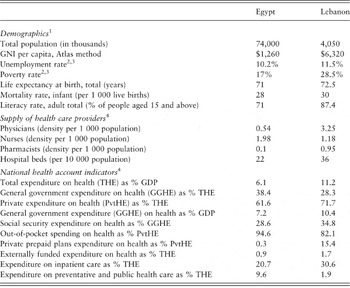
Egypt and Lebanon are interesting case studies by which to examine the effects of different health financing arrangements and per capita income in two relatively similar social settings, with reliable data available from a single survey. Contextual background information regarding socioeconomic and health indicators for both countries is summarized in Table 1. As shown, health status indicators are similar in both countries, known to be in the midst of an epidemiological transition marked by a dual burden of communicable- and non-communicable chronic health conditions (Akala and El-Saharty, Reference Akala and El-Saharty2006). However, Lebanon has a higher literacy rate, per capita income, density of health care providers, and proportion of gross domestic product spent on health care than Egypt. Both countries are marked by a generally limited political and economic discourse on health policy, with health care dominated by curative and specialist services (Karshenas and Moghadam, Reference Karshenas and Moghadam2005; Jabbour et al., Reference Jabbour, El-Zein, Nuwayhid and Giacaman2006; Maziak, Reference Maziak2006).
Egypt and Lebanon: socioeconomic indicators, 2007

Notes: GDP = gross domestic product. Sources: (1) World Bank, 2008 (Values shown for Egypt for 2005. Values for Lebanon: population and gross national income, 2006; literacy rate, 2003; health indicators, 2005). (2) UNDP, 2005 (2000 values). (3) World Bank, 2005. (4) World Health Organization Statistical Informatic System, 2008. Health supply values shown for Egypt: physicians, 2003; nurses and pharmacists, 2004; hospital beds, 2005. Values for Lebanon, 2001, except hospital beds, 2005. Expenditure values shown for 2005, except expenditure on inpatient and preventative care: Egypt, 2002; Lebanon, 2003. (5) Ministry of Health and Population, Egypt, 2007. (6) Ministry of Finance, Egypt, 2007. (7) Ministry of Finance, Lebanon, 2007.
Important differences are to be found regarding the nature of the welfare state and health financing arrangements between both countries. The Egyptian state finances and provides health care through what may be characterized as a citizenship-based welfare state, owing to a constitutional commitment to social solidarity and universal coverage (Constitution, 1923/1952). At the same time, the system is a labyrinth of parallel operating systems, overseen by the Ministry of Health and Population (MOHP). Funding derives from five main sources, including the MOHP, the General Authority for Health Insurance/Health Insurance Organisation (HIO), specific ministries such as Transport and Defence, non-governmental organizations, and households. Private health insurance covers only 1% of the population (UNDP, 2005). In 2006, the majority of total health expenditure was out-of-pocket (62%), followed by general revenue sources (27%) and social health insurance-based (SHI) financing (11%) (WHO, 2006b).
The MOHP is a general revenue-based service provider offering free care to any citizen, covering all inpatient and outpatient care. However, quality is generally perceived as poor, particularly for outpatient services (Rannan-Eliya et al., Reference Rannan-Eliya, Blanco-Vidal and Nandakumar1999; Salem, Reference Salem2002). The HIO is a social health insurance scheme financed by premiums and employer contributions, operating under the auspices of the MOHP. Eligibility is open to those employed in the formal sector, pensioners, and enrolled students, excluding dependents, and covers half of the population (Abd El Fattah et al., Reference Abd El Fattah, Saleh and Ezzat1997; Nandakumar et al., Reference Nandakumar, Nada and Ibrahim1999; Salem, Reference Salem2002). Services are provided both through HIO facilities and external contracts, with coverage benefits varying across beneficiary categories.
Previous research in Egypt suggests that there exists income-associated inequality in service utilization. Although 95% of the population is within five kilometres of a medical facility, most public outpatient services are inadequately equipped and staff poorly motivated (Salem, Reference Salem2002; El-Zanaty and Way, Reference El-Zanaty and Way2006). As a result, 70% of outpatient care is obtained privately, largely by the better-off, whilst poorer groups who cannot afford private care rely on the MOHP (Ellis et al., Reference Ellis, McInnes and Stephenson1994). Overall, the wealthy report up to four times as many outpatient visits and one and a half times the length of inpatient stays as the poor (Rannan-Eliya et al., Reference Rannan-Eliya, Blanco-Vidal and Nandakumar1999).
In Lebanon, health care is largely financed through social health insurance and private sources, with means-tested benefits provided through general revenues for selected medical treatments. Lebanon's modern-day health system was established in 1943 just after independence from the French, with a series of subsequent piecemeal reforms in the midst of recurrent periods of political and economic upheaval (Ammar, Reference Ammar2003; WHO, 2006b). Today, over 70% of total health expenditure is private, whilst 30% is public, deriving from six different sources. The Ministry of Public Health (MOPH) finances approximately 48% of expenditures, followed by the National Social Security Fund (NSSF) at 15%, with the remainder of expenditure financed through the Civil Servants Cooperative, State Security, Internal Security Forces, General Security, Army and Ministry of Social Affairs (Ammar, Reference Ammar2003). Eligibility to each of these schemes is largely determined by occupational group. However, some civil servants, professionals, and the relatively well-off seek supplemental insurance coverage from other schemes due to incomplete coverage for most health care, particularly outpatient services (Lerberghe et al., Reference Lerberghe, Ammar and El Rashidi1997).
One of the biggest challenges faced by the Lebanese health sector is a growing deficit coupled with cost containment and lack of sufficient coverage, owing to a fragmented financing system and a relatively unregulated market for hospital and pharmaceutical services. Although the MOPH and social health insurance schemes should cover the majority of the population, data suggest that the majority of public financing benefits a relatively small minority. Approximately 52% of the population are enrolled in social health insurance but are largely located in predominately urban, wealthier regions, with private health insurance (PHI) operating in parallel (Jurjus, Reference Jurjus1995). Whilst the MOPH should cover uninsured groups, most people do not seek care from the MOPH due to a perceived low quality of care and high co-payment rates, with 78% of its funds spent on 23% of the population for primarily inpatient care or high-technology procedures (Ammar, Reference Ammar2003). As a result, an estimated 14% of all households were enrolled in private health insurance in 1995, most of whom are pensioners and those with chronic health conditions who face formal or informal exclusion criteria in obtaining public insurance (Jurjus, Reference Jurjus1995). Recent calls for reforms have focused on developing a comprehensive funding network that targets poorer groups who are typically excluded from most coverage (World Bank, 2005). Further research is needed to evaluate fully the socioeconomic disparity in the use of services in Lebanon.
Methods
Theoretical framework
The notion that class structure is a determinant of social welfare (Weber, Reference Weber, Roth and Wittich1978; Cockerham, Reference Cockerham and Cockerham2001; Marmot, Reference Marmot2005) underlies the approach adopted in this study to examine the effect of income and insurance on using health services. More specifically, Anderson's (1975) framework of the social determinants of health posits the use of health services as a choice dependent upon three types of factors, including (a) ‘predisposing factors’, or demographic characteristics, social structure, and health beliefs; (b) ‘enabling factors’, or the ability to secure resources; and (c) ‘medical need’, perceived or evaluated. Importantly, empirical evidence supports the idea that the effect of different factors varies depending on how discretionary the service is perceived by beneficiaries and providers. As such, acute, inpatient care is typically less influenced by enabling factors than is preventative, outpatient care (Anderson and Newman, Reference Andersen and Newman1973).
The effect of different determinants was quantified by applying Grossman's (1972) model for the demand for health, based on a human capital approach in which health is a matter of investment (Mushkin, Reference Mushkin1962; Van Doorslaer, Reference Van Doorslaer1987). The stock of health at a given time is subject to the amount of investment in related goods in the period immediately preceding it, such as medical care, length of time, and human capital (Grossman, Reference Grossman1972). The demand for health is latent and only observed through the demand for health care (Culyer, Reference Culyer1976; Williams, Reference Williams and Culyer1978), where the demand for health care, Mt, is expressed as a function of Anderson's social determinants:

where X is a vector of observed characteristics, i.e. predisposing and enabling factors, Ht represents stock of health or medical need at time t, β and c represent parameter estimates, and v represents unobserved disturbance terms (Van de Ven and Van der Gaag, Reference Van de Ven and Van der Gaag1982; Wolfe and Behrman, Reference Wolfe and Behrman1984). Depending on the role of enabling factors, such as ability to pay, the relative importance of socioeconomic status and insurance in securing health services and equity implications can thus be evaluated.
Data sources and variable specification
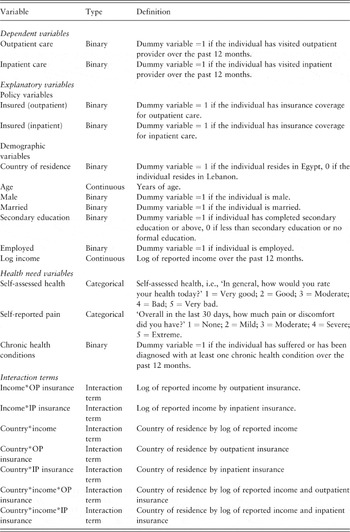
Table 2 summarizes the variables used in the analysis. Data were available for Egypt and Lebanon from the 2001 Multi-Country Survey Study on health system responsiveness, expenditure, and utilization, conducted by the World Health Organization and described in detail by Üstün et al. (2003). The survey has been applied to research on bias and disparities in self-reported health (Jones et al., Reference Jones, Rice, Bago d'Uva, Balia, Jones, Rice, Bago d'Uva and Balia2007; Bago d'Uva et al., Reference Bago d'Uva, van Doorslaer, Lindeboom and O'Donnell2008). The survey is cross-sectional and was conducted in over 60 countries using the same questionnaire. Samples were population-representative and adjusted where necessary using the Sample Population Deviation Index prior to data release, with sample sizes per country equal to approximately 3,500–5,000 respondents of at least 18 years of age. The sample size for Egypt is n = 4,490 and for Lebanon, n = 3,246.
Variable definitions1

Note: 1 For binary variables, reference category = 0.
The questionnaire is a module-based instrument that captures a combination of household- and individual-level information. Household-level information includes setting (i.e. urban or rural dwelling), household composition, income, and selected expenditure data. Individual-level information includes demographic characteristics, health insurance, health state descriptions, prevalence of chronic health conditions, utilization of health services, and perceptions of health system responsiveness, such as respect and dignity. Demographic characteristics include age, gender, marital status, education, employment status, and employment type.
Based on Anderson's (1975) framework, variables for the analyses were selected that represented the primary dependent, explanatory, and control variables, summarized in Table 2. Primary dependent variables of interest were the probabilities of using inpatient and outpatient services, whilst primary explanatory variables of interest were income and insurance status. Control variables included predisposing and medical need factors. Data were available from the survey regarding the proportion of respondents who had used outpatient and inpatient health services over the past year, although the survey did not assess whether services were obtained from private or public providers. Inpatient care was defined as an overnight stay at a health care centre or hospital. Outpatient care was defined as ‘any place outside your home where you did not stay overnight’ such as a doctor's consulting room, clinic, or hospital outpatient unit. Other information that was collected included whether access to care was refused due to lack of affordability, and whether the respondent did not seek care due to lack of affordability.
Data on socioeconomic status available from the survey included household expenditure for selected categories and self-reported income. Measures of household expenditure are the amount spent on accommodation and food over the last month and on health care over the last year. The amounts spent on insurance, medications, visits to doctors, or ‘other’ expenditures were captured. Information on average household income earned per month was also available, which included income from pensions, social insurance benefits, child allowance, and other types of income like rents, before taxes and other deductions. Where available, the use of consumption expenditure or asset information is generally considered preferable to the use of self-reported income as a proxy for household living standards, due to measurement error and systematic reporting biases associated with self-reported income (Ferguson et al., Reference Ferguson, Tandon, Gakidou, Murray, Murray and Evans2003; Roy and Howard, Reference Roy and Howard2007). However, due to a lack of information on total household expenditures and permanent income indicators, household income was used in this study. Missing data on income were detected for approximately 17% of the observations from Egypt and 30% of those from Lebanon. In order to preserve the most observations as possible for the analysis, missing values were imputed using multivariate imputation for a single variable of interest (Schenker et al., Reference Schenker, Raghunathan and Chiu2006; Horton and Kleinman, Reference Horton and Kleinman2007).
In order to allow for cross-national comparisons, expenditure and income data were converted to international dollars using 2001 purchasing power parities and adjusted for household composition (UN Statistics Division, 2007). Adjustments for household composition and size were made by applying an adult equivalency (AE) scale, defined as: AE = (A + αK)θ, where A represents the number of adults in the household, K the number of children, α the cost of children relative to adults, and θ the degree of economies of scale for an average household, ranging from 0 to 1 (Deaton and Zaidi, Reference Deaton and Zaidi2002). For developing countries, values for α typically vary between 0.3–0.5, with values for θ approaching 1 since food is a relatively large share of overall consumption (Deaton and Zaidi, Reference Deaton and Zaidi2002; Wagstaff et al., Reference Wagstaff, van Doorslaer, O'Donnell and Lindelow2003). In this analysis, values used in assessing health equity in Asia were adopted, i.e., α = 0.5 and θ = 0.75 (Deaton, Reference Deaton1997; Equitap, 2002).
Health status was determined by assessing the proportion of respondents who were diagnosed or had suffered from a chronic health condition(s) over the past year, in addition to respondents’ ratings on self-assessed health status. Although self-assessed health represents a useful policy tool that encompasses functionality and perceptions and has been correlated to future changes in health and mortality (Zimmer et al., Reference Zimmer, Natividad, Lin and Chayovan2000; WHO, 2002), some limitations include reporting bias across socioeconomic status and cultural setting (King et al., Reference King, Murray, Salomon and Tandon2003). The health states that were measured are global health status, pain, mobility, self-care, cognition, interpersonal activities, vision, sleep, and affect. For each state, respondents were asked to rate their health on a five-point ordinal scale, with descriptions shown in Appendix II for indicators used in this analysis.
Econometric analyses
Sample characteristics were evaluated for all main variables of interest using two-tailed tests of significance where appropriate. Bivariate analyses were used to examine the relationship between income and health status and out-of-pocket payments. In order to assess the determinants of health care utilization, probit and recursive bivariate probit regression models were applied, alleviating some of the limitations of drawing inferences from cross-sectional data (Amemiya, Reference Amemiya1985; Winship and Morgan, Reference Winship and Morgan1999). The binary regression relationship employed is denoted by

where
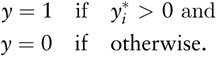
Here, yi* represents the main outcome variable of interest, or utilization; βi represents the set of estimate coefficients for a given set of explanatory variables, denoted by xi; ui represents the error term, and i represents a given observation. To ensure the reliability of parameter estimates, endogeneity of the health insurance variable was tested using the recursive bivariate probit model (Waters, Reference Waters1999; Fabbri et al., Reference Fabbri, Monfardini and Radice2004; Jones et al., Reference Jones, Koolman and van Doorslaer2004; Jones, Reference Jones2007), which might otherwise bias the estimated effects of the independent variables on the outcome (Waters, Reference Waters1999; Dougherty, Reference Dougherty2007). In this case, health insurance was suspected of being endogenous to the model since the likelihood of having insurance may be influenced by unobservable factors which may also determine utilization, such as the decision of where to live, the type of employment sought, or behavioural attitudes towards risk (Waters, Reference Waters1999; Ekman, Reference Ekman2007). The general two-equations model takes the form:


where the main outcome of interest, y 1i*, and the ‘treatment’ or endogenous variable, y 2i*, are simultaneously determined (Maddala, Reference Maddala1983). In this analysis, the main outcome of interest, y 1i*, represents the likelihood of utilization, whilst the endogenous variable, y 2i*, represents whether or not the individual is covered by health insurance.
To further understand whether the effects of insurance and income are mediated by country of residence, and whether the effect of insurance is mediated by income level, three pairwise interaction terms were added to the model, representing income*insurance, country*insurance, country*income. To explore whether the interaction between income and insurance was itself mediated by country setting, a fourth interaction term for country* income*insurance was added to the model.
Probability models were developed separately for outpatient care and inpatient care, and interaction terms were added iteratively. In order to examine the effect of country on utilization, models of health service utilization were applied by pooling observations from the two countries, and, consequently, by applying the models to separate country samples. In total, three versions of the pooled model and two versions of the country-specific models were tested. For the pooled analysis, Model 1 represents the main effects model that includes all of the main independent variables; Model 2 represents the main effects model with the addition of the three, pairwise interaction terms; and Model 3 is similar to Model 2 with the addition of the triple interaction term. For the country-specific model, Model 1 represents the main effects model, and Model 2 represents the main effects model with the addition of the income*insurance interaction term.
The criteria used to select variables for inclusion in the model were based on the distribution of responses, previous knowledge of the predictive value of a variable, and the correlation between variables. Regression models were developed using a forward strategy based on the likelihood ratio test (criterion 0.05). Estimates include probit indices, robust standard errors, p-values, and 95% confidence intervals. All analyses employed two-tailed significance levels of p < 0.05; significance levels are shown in the results for p < 0.10 (represented as ‘+’), p < 0.05 (‘*’), p < 0.01 (‘**’), and p < 0.001 (‘***’). Analyses were conducted using Stata 10 SE (StataCorp LP, College Station, Texas, USA).
Results
Results are presented for three sets of quantitative analyses. The first section describes univariate and bivariate descriptive results regarding respondent characteristics and health inequality in each setting. The second section presents econometric results from multivariate regression analyses of service utilization.
Respondent characteristics and health inequality
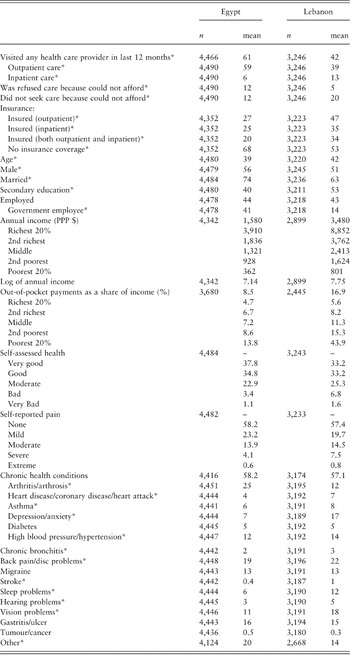
Table 3 presents sample characteristics by country, with tests of significance shown where applicable. Mean age and gender distribution were similar between countries, with an average age of 39–42 years and males constituting half of all respondents. More respondents in Lebanon had completed secondary education than had in Egypt (53% versus 40%, respectively). The Lebanese sample reported twice the mean per capita income as the Egyptian sample ($3,480 versus $1,580, respectively). These figures are relatively similar to published 2001 estimates for gross national income per capita of $4,010 and $1,530, respectively (World Bank, 2001). The average employment rate in both samples was only 43–44%, which includes formal and informal employment.
Sample characteristics by country

Notes:*Difference is significant with a 95% confidence interval. For binary variables, percentages for the reference category are shown. A two-tailed t-test was used to test for significant differences between means for continuous variables; the z-statistic was used to test for differences between proportions for binary variables. Test of significance were not applied to income or out-of-pocket information. PPP $ = 2001 purchasing power parity exchange rates
Regarding health status, the Lebanese sample reported a relatively lower health status on average than did the Egyptian sample. For example, twice as many respondents in Lebanon as in Egypt reported a ‘bad’ or ‘very bad’ self-assessed health status (8.4% versus 4.5%, respectively). The same was found for ‘severe’ or ‘extreme’ pain (8.3% versus 4.7%, respectively). Similarly, although the aggregate incidence of chronic health conditions was similar between samples, with 57% and 58% reporting at least one chronic health condition in Egypt and Lebanon, respectively, a closer look reveals important differences.
Table 3 also shows the incidence of disaggregated chronic health conditions. The incidence of several individual conditions was higher in the Lebanese sample, such as heart disease, high blood pressure, asthma, back problems, depression, and vision problems. At the same time, the incidence of arthritis and ‘other’ conditions was higher among Egyptian respondents. Conditions classified as ‘other’ were specified in the Lebanese sample only and include conditions such as allergy, anaemia, bone disorders, diabetes, thyroid problems, kidney disease, uterine/prostate problems, and rheumatism.
Regarding health insurance coverage and out-of-pocket payments, the majority of respondents in both samples were not covered by any health insurance. Forty seven per cent of Lebanese respondents had some form of insurance, compared to only 32% in the Egyptian sample. It is important to note that in the Arabic-administered version of the questionnaire, health insurance was distinguished from free care, such that these figures should capture enrolment in social or private health insurance exclusively. These figures are relatively similar to published data showing that social health insurance covers 45.9% of the Lebanese population and 45% of the Egyptian population (WHO, 2006a; WHO, 2006b). At the same time, Lebanese respondents reported higher average out-of-pocket payments than Egyptian respondents, which may reflect both the degree of financial risk as well as inherent differences in the price of health care.
Importantly, more respondents in Egypt than in Lebanon utilized health services as shown in Table 3 (61% versus 42%, respectively). Of those who sought care, outpatient services were more frequently utilized in Egypt than in Lebanon (56% versus 35%, respectively), whilst less inpatient care was sought in Egypt than in Lebanon (6% versus 13%, respectively). More respondents in Lebanon reported foregoing care due to affordability (25% versus 12%, respectively).
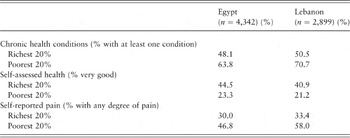
Overall, the distribution of self-assessed health, pain, and chronic conditions by socioeconomic status appeared to be more pro-poor amongst Lebanese respondents than their Egyptian counterparts, shown in Table 4. This finding suggests that health inequality is more pronounced in the Lebanese sample. Similarly, the distribution of out-of-pocket expenditure as a share of income appears more regressive in the Lebanese sample than in the Egyptian sample. Whilst the share amongst the poorest quintile is nearly twice that of the richest quintile in Egypt, the share in Lebanon amongst the poorest is nearly seven times that of the richest quintile.
Self-reported health by country and socioeconomic status

Results of multivariate analysis: outpatient and inpatient utilization
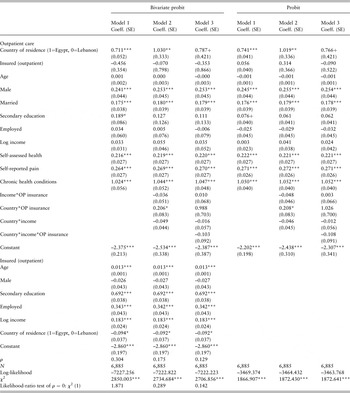
Results from multivariate regression analyses for utilization are presented in Tables 5 through 8. The output shown in the tables for the recursive bivariate probit model (‘bivariate probit’) consists of two portions. The upper half of the output relates to the primary dependent variable (y 1), the likelihood of health service utilization, and shows the coefficients for the determinants of utilization. The lower half relates to the secondary dependent variable (y 2), the likelihood of having health insurance coverage, and shows the coefficients associated with the determinants of health insurance.
Estimation results for outpatient care, pooled model†

Notes: †Significance levels: + = p < 0.10; * = p < 0.05; ** = p < 0.01; *** = p < 0.001. Upper half of the bivariate model shows the determinants of utilization, representing the dependent variable in the first of the two-equations recursive bivariate probit model. Lower half of the bivariate model shows the determinants of health insurance, representing the dependent variable in the second equation.
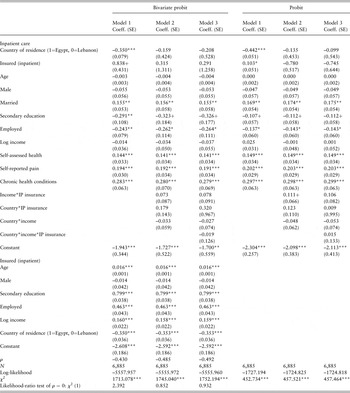
Regarding the suspected endogeneity of the insurance variable amongst the pooled sample, results of the Wald test for outpatient as well as inpatient care show that the chi-squared statistic for rho (ρ) did not differ significantly from zero, which indicates that health insurance is not endogenous to either model as shown in Tables 5 and 6. A closer look at the separate outpatient and inpatient models per country reveals that endogeneity of health insurance depends on country setting. Tables 7 and 8 show that whilst insurance was not endogenous in Egypt for either type of care, insurance was endogenous in Lebanon for both types of care. As evident by the larger p-values for rho in the outpatient model, health insurance is endogenous in Lebanon for outpatient care. As such, the probit estimates are also presented for the likelihood of utilization for Egypt, where insurance was not endogenous to the model. The effects of income and insurance on utilization will thus be discussed within the context of the country-specific models to account for variances across countries pertaining to endogeneity and relationships between dependent and independent variables.
Regarding the effect of country setting on the likelihood of using outpatient services as shown in Table 5, probit results suggest that respondents in Egypt were more likely to utilize services after controlling for other factors and interactions. Model 1 shows a significantly positive probit index for the country variable, which remains after adding the three interaction terms regarding the relationships between income, insurance, and setting (Model 2), as well as the triple interaction term, denoting the simultaneous relationship between income, insurance, and setting (Model 3). Importantly, the only interaction term that was significant was country*insurance (Model 2), which indicates that the effect of insurance depends on the location. Some caution should be exercised in interpreting this effect in the pooled model, due to country-specific differences in endogeneity related to insurance as described below.
The country effect was somewhat less pronounced for inpatient services, as indicated in Table 6. Based on the probit main effects model, which does not incorporate interaction terms, respondents in Egypt were significantly less likely to visit inpatient care. After taking into account the moderating effect of income and setting on the insurance effect, the country effect is no longer significant, although it remains negative. The only interaction term that was significant was income-insurance (Model 2). Hence, results from Model 2 suggest that a negative but non-significant effect of country setting exists after controlling for other factors, whereby respondents in Egypt are marginally less likely to be admitted to inpatient care than their Lebanese counterparts.
Estimation results for inpatient care, pooled model†

Notes: †Significance levels: + = p < 0.10; * = p < 0.05; ** = p < 0.01; *** = p < 0.001. Upper half of the bivariate model shows the determinants of utilization, representing the dependent variable in the first of the two-equations recursive bivariate probit model. Lower half of the bivariate model shows the determinants of health insurance, representing the dependent variable in the second equation.
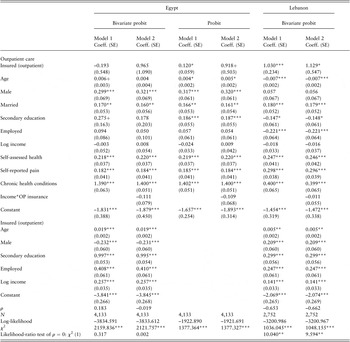
Estimation results for outpatient care by country†

Notes: †Significance levels: + = p < 0.10; * = p < 0.05; ** = p < 0.01; *** = p < 0.001. Upper half of the bivariate model shows the determinants of utilization, representing the dependent variable in the first of the two-equations recursive bivariate probit model. Lower half of the bivariate model shows the determinants of health insurance, representing the dependent variable in the second equation.
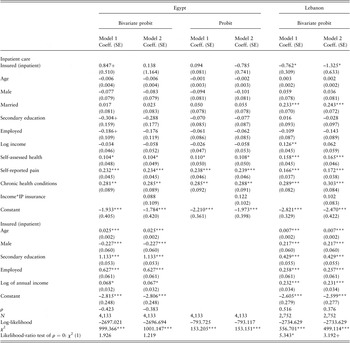
Estimation results for inpatient care by country†

Notes: †Significance levels: + = p < 0.10; * = p < 0.05; ** = p < 0.01; *** = p < 0.001. Upper half of the bivariate model shows the determinants of utilization, representing the dependent variable in the first of the two-equations recursive bivariate probit model. Lower half of the bivariate model shows the determinants of health insurance, representing the dependent variable in the second equation.
Tables 7 and 8 show the country-specific results for outpatient and inpatient utilization. The effects of some variables remain similar in the pooled and country-specific models, whilst others differ. The effects of the demographic variables such as age and gender are similar across the two approaches, suggesting that their effects are similar in these two countries. The effects of variables related to socioeconomic status, such as marital status, education, and employment status, and the policy variables, such as insurance and income, tend to differ between the pooled and country-specific models. This suggests that the relationship between utilization and social structures is unique to each country, which may be due to differences in social policies, labour market structures, and other economic and political circumstances.
Table 7 presents the estimation results for the probability of outpatient utilization in each country. These results allow for a more detailed assessment given the difference in endogeneity regarding health insurance between settings. Overall, health status was the most important determinant of outpatient use in Egypt, as indicated by the significantly positive estimates for self-assessed health, pain, and chronic health conditions. The effect of chronic health conditions on outpatient utilization was stronger in Egypt than in Lebanon. This difference may indicate variations in the nature of diseases reported, societal preferences, and clinical practices in the management of chronic health conditions between the two countries.
Insurance significantly increases the probability of visiting outpatient providers in both countries, although this effect is greater in Lebanon as indicated by the larger probit index as compared to the Egyptian model. Indeed, insurance was the most important factor determining whether a respondent visited outpatient providers in Lebanon. Being married was positively associated with utilization in both settings. Whilst people seek more care as they grow older in Egypt, they tend to use less in Lebanon. This could reflect differences in social health insurance coverage policies since pensioners in Lebanon are typically not eligible for coverage and there may be dependence on family caregivers as a result. In addition, whilst being employed does not have an effect on utilization in Egypt, it decreases the probability of using services in Lebanon.
Model 2 shows the main effects model with the addition of the interaction term for insurance income, which is not significant. The negative value suggests that as income increases insurance tends to become gradually less important in explaining outpatient use, although not significantly. In both countries, including the interaction term also increases the values of the probit indices for insurance, showing that the base model might have underestimated its effect on seeking care had the interaction term been significant. The effects of most of the other explanatory variables remain largely the same.
Estimation results for the probability of seeking inpatient care are presented in Table 8. Health status continues to be the most important factor positively determining inpatient use in Egypt, while the other explanatory variables are not significant determinants. The effect of insurance on inpatient use is less than its effect on outpatient use in both countries. In Egypt, insurance was not a significant determinant of inpatient use, whilst in Lebanon insurance was a significant determinant, although negative in direction. Its negative value suggests that having insurance decreases the probability of being admitted to inpatient facilities in Lebanon. By the same token, income positively increases the chances of seeking inpatient care there, but has no effect in Egypt. It is important to note that most Lebanese social and private health insurance schemes often refer patients to the MOHP.
After including the insurance income interaction term as shown in Model 2, results show that the interaction term is not significant, indicating that the effect of insurance on utilizing inpatient services is not moderated by income level. The effect of insurance in Lebanon is maintained in this model, whilst the effect of income is no longer significant. Estimates for the other explanatory variables do not change substantially.
As shown in the second half of all of the models, the determinants of insurance status were similar across service-specific models and countries. The most important factors determining insurance were a higher educational level and being employed, followed by income and gender, with age playing a relatively minor role. Health status covariates were tested but were not found to be significant determinants of insurance status, and, hence, were dropped from the secondary model in the recursive bivariate probit regression.
Overall, results from the probit and recursive bivariate probit models suggest that respondents in Egypt were significantly more likely to visit outpatient providers but marginally less likely to be admitted to inpatient facilities than their Lebanese counterparts, holding all other factors constant. Second, the demand for outpatient care is generally influenced by insurance and other socioeconomic variables a greater extent than is the demand for inpatient care, as expected. Third, insurance-elasticity of demand is greater in Lebanon than in Egypt for both types of health care. Fourth, whilst income was not a direct determinant in any of the outpatient models or in the Egyptian inpatient models, income was a significantly positive determinant in the inpatient model in Lebanon. Finally, whilst insurance strongly influences the probability of using services, the fact that income and employment determine the likelihood of being covered by insurance is an important finding.
Discussion and policy implications
The aim of this article was to evaluate the impact of income and insurance on access to different health services in Egypt and Lebanon. First, bivariate methods were used to explore the relationship between income, health status, and out-of-pocket payments. Next, the effect of country setting on the use of services and the determinants of insurance were evaluated using recursive bivariate probit and standard probit models, controlling for multiple factors. Finally, similar models were employed to assess the determinants of utilization in each country setting in order to account for variances in relationships between dependent and explanatory variables across countries. Results suggested that the degree of income-associated inequity in health care differs between Egypt and Lebanon, as does the role of income and insurance in explaining utilization. A discussion of results and their relevance to policy follows.
Overall findings
Results from descriptive analyses reveal interesting yet seemingly paradoxical results. In this analysis, respondents in Egypt reported a greater rate of health service utilization than did their Lebanese counterparts, despite the Egyptian group reporting relatively lower income levels, lower levels of education, and less ill health. A greater degree of socioeconomic disparity was observed in Lebanon with regard to the distribution of ill health and out-of-pocket payments. Herein lies the paradox: that the distribution of ill health and out-of-pocket payments for health care in a relatively wealthier society can be more heavily skewed pro-poor than that in a relatively poorer one, and not the reverse. However, these results are consistent with those found in other countries where access to health care is largely based on ability to pay, such as the United States and some European, Latin American, and Asian countries.
Interestingly, the observation that more respondents in Egypt utilized services was apparently driven by their greater propensity to use outpatient care than their Lebanese counterparts. The increased rate of inpatient use amongst the Lebanese sample was not high enough to compensate for their lower rate of outpatient use. The supply of services may not fully explain this result; if anything, there appear to be more health care providers per capita overall in Lebanon than in Egypt as shown in Table 1.
Upon closer investigation through multivariate regression analysis, income-elasticity and insurance-elasticity of demand for outpatient services were found to be higher for Lebanon than for Egypt. This finding may be explained by country differences regarding the nature of insurance coverage and incentives to seek certain types of care over others. Whilst the Egyptian state health system provides free outpatient and inpatient care, outpatient care is often excluded from coverage or is associated with high co-payment rates in Lebanon. These empirical results suggest that the incentive to seek outpatient care in Lebanon is relatively low. Instead, many individuals seek curative, inpatient care, which is generally covered by the MOHP, possibly even in cases where such care is neither medically necessary nor particularly cost-effective.
Coupled with findings discussed above, these results imply two general conclusions. First, a higher income alone does not necessarily increase the use of health services, but that some form of risk pooling or insurance is important in mitigating against the effect of economic barriers. Secondly, improving income-associated equity in outpatient utilization can go a long way towards improving overall equity in access, assuming that this care meets medical needs.
Methodological considerations
This study encountered various methodological limitations that have also been described in similar research. Despite limitations in drawing causal inferences from cross-sectional data, the use of recognized econometric techniques in this study helped to overcome this limitation. Whilst the relationship between explanatory factors may differ from country to country leading to biased results (Nord, Reference Nord2002), the use of two relatively similar countries, such as Egypt and Lebanon, increases the comparability amongst factors. In addition, endogeneity of the health insurance variable was tested in the pooled and country-specific samples using the recursive bivariate probit model and robust estimates of standard errors. Results indicated that endogeneity was present only in the Lebanese models, suggesting that standard probit estimates were reliable for the Egyptian data.
Although debate is found regarding the handling of sample selection bias and missing data, commonly used, standard univariate imputation techniques were adopted for purposes of this analysis. Self-assessed health status has been associated with systematic differences in interpretation arising from cross-cultural differences (King et al., Reference King, Murray, Salomon and Tandon2003). However, in light of the relatively similar cultural framework and notions regarding the sick role in the two case studies used for the analysis (Gallagher, Reference Gallagher and Cockerham2001; Adib, Reference Adib2004), potential bias arising from this limitation was considered relatively low. Future research may help to illuminate additional methodological explorations.
Conclusions
In the face of an increasing demand for health services due to epidemiological transitions, governments face the question of how best to design health-financing policies in order to ensure access to care and protect those most financially at risk. As Deaton (2002) points out, the question of whether, for example, income redistribution versus better health policies are likely to improve health is a prime question. Whilst economic and political constraints limit some of the options that might otherwise be viable in middle-income countries like Egypt and Lebanon, this analysis highlights at least three equity-related policy issues that should be considered in evaluating options for health financing policy reform.
First, the greater degree of income-associated inequality observed in Lebanon as compared to Egypt should be addressed through the lens of health financing policy. This finding is consistent with the general observation from other studies that wealthier countries that rely largely on market-based financing are associated with higher degrees of systemic unfairness than poorer countries that have at least some form of a comprehensive safety net for health care. Hence, income redistribution alone may not be sufficient for improving equity.
Second, the nature of health insurance can lead to dramatic differences in its effect on using services. Benefits included and co-payment rates are likely to be critical factors that influence utilization. Therefore, demand- and supply-side incentives to use outpatient care in particular should be considered carefully in policy setting.
Third, the importance of insurance appears to be greater for those at the lower ends of the income ladder, especially as these groups tend to face a higher burden of out-of-pocket payments and are more likely to be pushed further into poverty. Yet insurance coverage tends to be concentrated among the well-off, which only exacerbates inequity. Hence, eligibility criteria for risk-pooling schemes represent an important determinant of equity; although social values play a part in shaping criteria, nonetheless the most vulnerable should at the very least be relieved of economic barriers to health care.
Whilst a number of other factors should be considered in improving equity such as quality of care, the nature and distribution of supply, and social beliefs about curative versus preventative care, this article demonstrates that well-planned health financing policy is central to the process of ensuring and sustaining equity. Providing protection from unforeseen adverse economic consequences of using services should reduce the likelihood that people forego medically necessary care, otherwise plunging them into a vicious cycle of ill health and poverty. In future, more research is needed to distil whether the effect of income on the use of services pertains to specific types of health insurance, regions, or providers, be they public or private. Overall, alleviating economic barriers to access to care through sound health financing policy reforms is likely to bring about substantial gains in equity throughout health systems in middle-income countries such as Egypt and Lebanon.
Acknowledgements
This paper uses data from the World Health Organization's Multi-Country Survey Study. The author is grateful to Professor Martin Knapp for valuable comments and suggestions and to Ms Nirmala Naidoo for facilitating use of the dataset. The views expressed are the author's and do not reflect those of any institution.