Introduction
The ability to readily detect interactive social partners’ focus of attention, known as social attention, is fundamental to our social interactions and adaptive functioning. This exquisite ability enables us to learn about the other person's inner state and where the important events occur in the environment (Birmingham and Kingstone, Reference Birmingham and Kingstone2009). Eyes are commonly thought to play a crucial role in social attention (Langton et al., Reference Langton, Watt and Bruce2000; Itier and Batty, Reference Itier and Batty2009). It has been well documented that eye gaze can automatically direct the observer's attention toward the gazed-at location (Frischen et al., Reference Frischen, Bayliss and Tipper2007). This effect arises rapidly (Langton and Bruce, Reference Langton and Bruce1999; Friesen and Kingstone, Reference Friesen and Kingstone2003) and persists when the gaze direction is non-predictive or even counter-predictive of target location (Friesen et al., Reference Friesen, Ristic and Kingstone2004; Tipples, Reference Tipples2008), disclosing its reflexive attribute. Moreover, this gaze following behavior emerges early in life and can support language acquisition and theory-of-mind development (Hood et al., Reference Hood, Willen and Driver1998; Nuku and Bekkering, Reference Nuku and Bekkering2008). However, not all of us are equally adept at following another individual's gaze direction and this ability is impaired in individuals with autism spectrum disorder (ASD), a heritable disorder marked by striking social deficits (Bruinsma et al., Reference Bruinsma, Koegel and Koegel2004). The general consensus is that the impaired development of social attention (e.g. gaze following) is among the earliest and best predictors of ASD (Dawson et al., Reference Dawson, Bernier and Ring2012). As such, understanding the origin of social attention is central to research on the etiology of ASD.
Despite its theoretical and practical importance, whether social attention skills are controlled by genetic factors or shaped by environmental experience remains obscure. A common view is that gaze following is a learned response which is acquired with repeated exposures to gaze direction and its perceived outcomes (Driver et al., Reference Driver, Davis, Ricciardelli, Kidd, Maxwell and Baron-Cohen1999; Langton and Bruce, Reference Langton and Bruce1999). It is worth noting that the phenomenon of following the gaze of other individuals can also be observed in nonhuman primates, indicating an evolutionary basis for the mechanism of gaze following (Deaner and Platt, Reference Deaner and Platt2003). The preservation of this ability across species raises the possibility that gaze following may not be simply an acquired response and it might conceivably involve an innate module specific to gaze perception (i.e. eye-direction detector), as implied by Baron-Cohen (Reference Baron-Cohen1995).
Similarly, point-light biological motion (BM), another type of social cues, can trigger attentional orienting not only in adults but also in preschool children and 6-month-old infants (Shi et al., Reference Shi, Weng, He and Jiang2010; Hirai et al., Reference Hirai, Saunders and Troje2011; Zhao et al., Reference Zhao, Wang, Wang, Weng, Li and Jiang2014; Bardi et al., Reference Bardi, Di Giorgio, Lunghi, Troje and Simion2015). This effect persists even when the global configuration of BM is disrupted and observers are not aware of its biological nature (Wang et al., Reference Wang, Yang, Shi and Jiang2014). Combined with previous evidence (Thornton and Vuong, Reference Thornton and Vuong2004; Troje and Westhoff, Reference Troje and Westhoff2006; Wang and Jiang, Reference Wang and Jiang2012), it has hence been proposed that there might exist an innate and evolutionarily endowed brain mechanism sensitive to the direction of the limbs of another moving creature (i.e. life motion detector), which may act in an analogous manner as the eye-direction detector (Wang et al., Reference Wang, Yang, Shi and Jiang2014). However, to date, there still lacks empirical evidence regarding whether the gaze and BM following behaviors are innate or learned through extensive social experience, although from an evolutionary perspective it would be adaptive to possess these abilities innately. Further, a more intriguing question is whether the gaze and BM following abilities share common innate and genetically determined mechanisms.
To probe these issues, the current study directly investigated the relative contributions of genetic and environmental influences on individual variation in social attention abilities using a classical twin method. A variant of the Posner cueing paradigm (Posner, Reference Posner1980), which has been widely used for measuring attentional effects induced by social cues (Frischen et al., Reference Frischen, Bayliss and Tipper2007; Shi et al., Reference Shi, Weng, He and Jiang2010), was employed to assess social attention abilities. In addition to the social cues, the current study also tested a non-social attentional cue (i.e. arrow). Arrow cues, which have directional property without biological meaningfulness, can also trigger robust attentional orienting effects (Tipples, Reference Tipples2002; Friesen et al., Reference Friesen, Ristic and Kingstone2004). The comparison of the attentional effects elicited by social v. non-social cues would provide a unique opportunity to investigate whether social and non-social attention abilities, from the genetic prospective, are qualitatively distinct, and whether the genetic influences, if observed, are unique to social attention ability.
Materials and methods
Participants
A total of one hundred and sixty same-gender twin pairs (mean age = 18.5 years, range = 15–27 years, 91 female twin pairs) were randomly selected from BeTwiSt, which is a longitudinal study of twins in Beijing, China (Chen et al., Reference Chen, Li, Zhang, Natsuaki, Leve, Harold, Chen, Yang, Guo and Zhang2013). Fifty-eight monozygotic (MZ) (34 female) and 55 dizygotic (DZ) twin pairs (30 female) (a total of 226 participants) participated in Experiment 1, and 26 MZ (16 female) and 21 DZ (11 female) twin pairs (a total of 94 participants) participated in Experiment 2. In addition, 50 non-twin participants (mean age = 22.6 years, range = 18–28 years, 28 female) took part in Experiment 3. All participants had normal or corrected-to-normal vision and were naïve to the purpose of the experiments. They all gave written informed consent in accordance with procedures and protocols approved by the institutional review board of the Institute of Psychology, Chinese Academy of Sciences.
Stimuli
Stimuli were generated and displayed using MATLAB (Mathworks, Inc.) together with the Psychophysics Toolbox extensions. For gaze cueing task, neutral face images with gaze averted 17° to the left or right were employed. A female face image was taken from the Ekman and Friesen's Pictures of Facial Affect (Ekman and Friesen, Reference Ekman and Friesen1976), and it was cropped to remove features outside of the face. The gaze direction was manipulated by using Photoshop software. For walking direction cueing task, point-light BM stimuli were adopted from a previous study and created by capturing the motion of a walking actor (Vanrie and Verfaillie, Reference Vanrie and Verfaillie2004). The BM stimuli displayed stationary walking and did not contain any overall translatory motion. Each BM sequence comprised 13 dots depicting the motions of markers attached to the head and the major joints. The initial frame of the point-light display was randomized for each trial to avoid observers’ prediction. For arrow cueing task, arrows were created by combining a straight line and an arrowhead attached to the leading end of the line.
Procedure
In Experiment 1, participants took part in the gaze cueing and the walking direction cueing tasks, and in Experiment 2 participants completed the gaze cueing and the arrow cueing tasks. In Experiment 3, in addition to the visual tasks (i.e. the gaze cueing and the arrow cueing tasks), we measured autistic traits of the non-twin participants using a Chinese version of Autism-Spectrum Quotient (AQ) questionnaire (Baron-Cohen et al., Reference Baron-Cohen, Wheelwright, Skinner, Martin and Clubley2001; Zhang et al., Reference Zhang, Sun, Chen, Wu, Tang, Han, Ye and Wang2016).
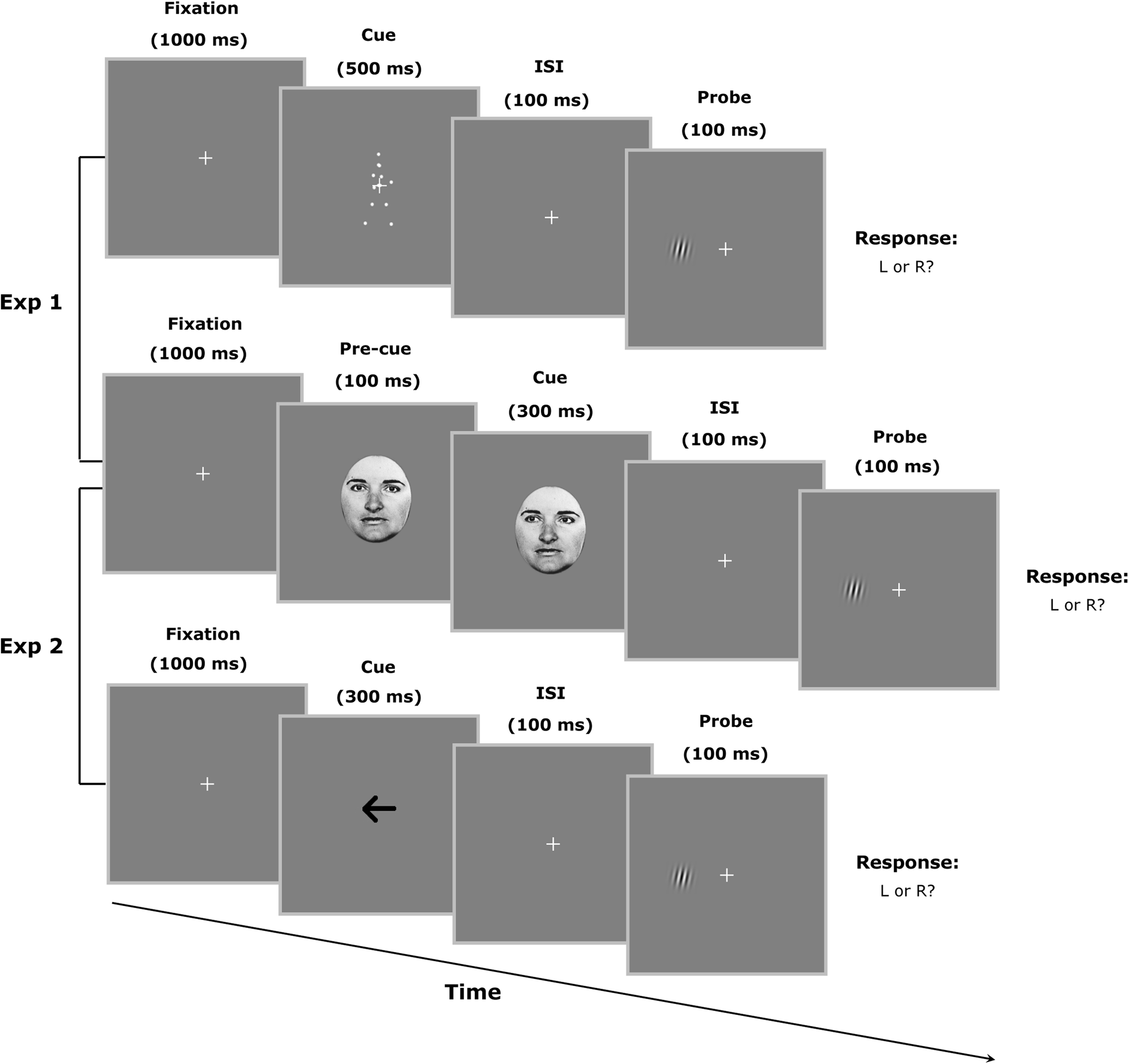
In the gaze cueing task, stimuli were displayed on a 19-inch CRT monitor, and the viewing distance was 80 cm. Each trial began with fixation on a central cross (0.5° × 0.5°) within a frame (12.6° × 12.6°) that extended beyond the outer border of the stimuli. After 1 s, a face with straight ahead gaze (subtended 3.2° × 4.2° in visual angle) was superimposed on the central cross and was presented for 100 ms. Then a cue (a face with leftward or rightward gaze) appeared for 300 ms. After the cue presentation, there was a 100 ms inter-stimulus interval (ISI) in which only the fixation was displayed, followed by a small Gabor patch that was presented briefly (100 ms) as a probe on the left or right side of the fixation. The horizontal distance between the center of the Gabor patch and the fixation was 3.2°. Participants were required to press one of two keys on a standard keyboard to indicate whether the probe appeared on the left or right side as quickly as possible while minimizing errors (Fig. 1). Throughout the task, a central cross was always displayed in the center of the screen, and participants were asked to fixate on the central cross from the beginning of each trial. The experiment consisted of 40 trials with 20 congruent trials and 20 incongruent trials. At the beginning of the task, participants were explicitly told that the cue direction did not predict target location. Test trials were presented in a new random order for each observer.
Illustrations of trial sequences in the walking direction cueing, eye gaze cueing, and arrow cueing tasks. In the walking direction cueing task, after a cue (point-light BM stimuli with leftward or rightward walking direction) was presented for 500 ms in each trial, there was a 100 ms ISI in which only the fixation was displayed, followed by a small Gabor patch that was presented briefly (100 ms) as a probe on the left or right side of the fixation. Observers were then required to press one of two buttons to indicate whether the probe appeared on the left or right side as quickly as possible while minimizing errors. At the beginning of the task, observers were explicitly told that the walking direction was not predictive of target location. The procedure of the eye gaze cueing task was similar to that of the walking direction cueing task with the exception that faces with leftward or rightward eye gaze were employed as cues and they were presented for 300 ms. The arrow cueing task was identical to the eye gaze cueing task except that leftward or rightward arrows were used as cues.

The procedure of the walking direction cueing task was similar to that of the gaze cueing task with the exception that point-light BM stimuli with leftward or rightward walking direction (2.0° × 4.3°) were employed as cues and they were presented for 500 ms. The arrow cueing task was identical to the gaze cueing task except that leftward or rightward arrows (1.0° × 0.9°) were used as cues.
Results
Genetic contributions to social attention abilities
In Experiment 1, two measures (gaze cueing and walking direction cueing tasks) were administered to assess social attention abilities in a sample of MZ and DZ twin pairs. First, the twin participants responded more quickly to targets appearing in the gaze or walking direction that was indicated by a centrally presented face or point-light walker (congruent condition) than to targets appearing in the opposite direction (incongruent condition) (gaze: 354 ms v. 374 ms, t 225 = −11.70, p < 0.001, Cohen's d = 0.29, BF10 = 3.41 × 10¹⁸; walking direction: 353 ms v. 364 ms, t 225 = −7.40, p < 0.001, Cohen's d = 0.18, BF10 = 8.56 × 10¹⁰), even when they were explicitly told that the gaze and walking direction did not predict the target location. In other words, robust and consistent attentional cueing effects were observed with both types of social cues in the twin participants, which are in line with previous studies (Friesen and Kingstone, Reference Friesen and Kingstone1998; Driver et al., Reference Driver, Davis, Ricciardelli, Kidd, Maxwell and Baron-Cohen1999; Shi et al., Reference Shi, Weng, He and Jiang2010). Additionally, the attentional effect induced by gaze was significantly larger than that induced by walking direction (t 225 = 5.04, p < 0.001, BF10 = 22 023), consistent with previous findings (Langton et al., Reference Langton, Watt and Bruce2000; Frischen et al., Reference Frischen, Bayliss and Tipper2007).
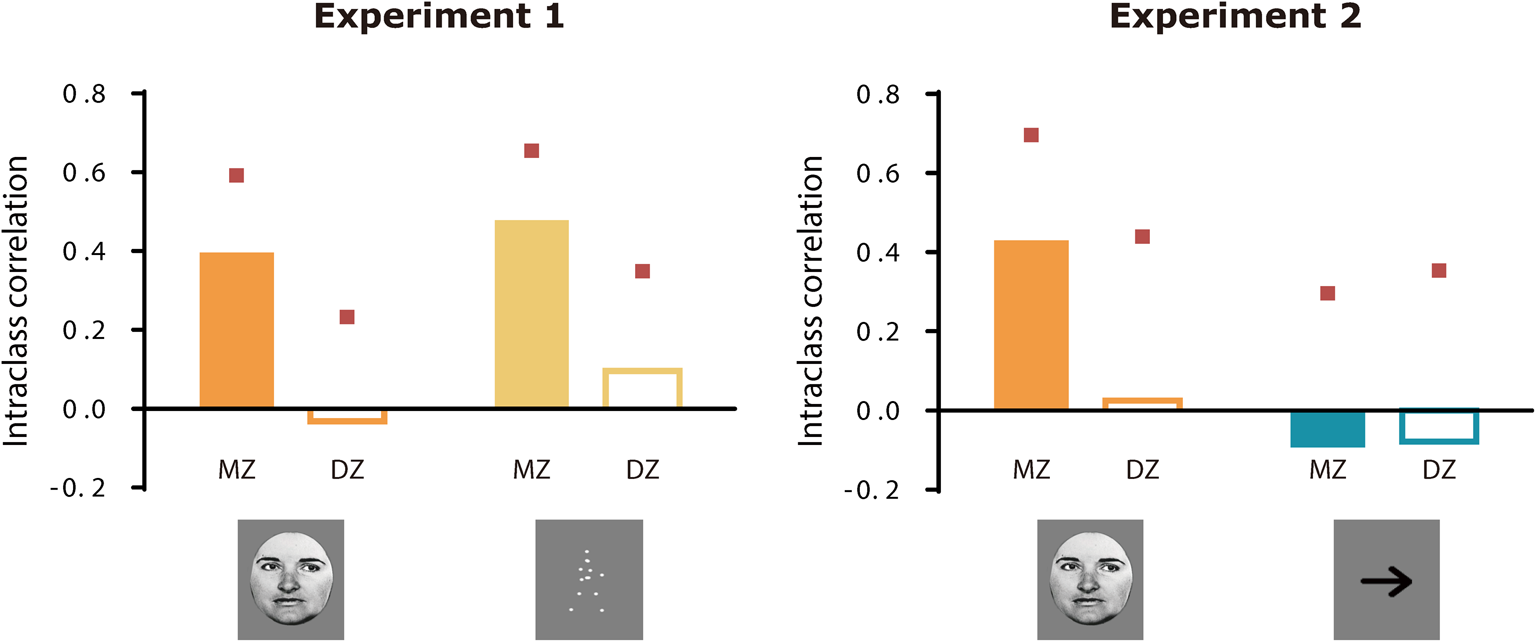
The assumption underlying the twin design is that while MZ and DZ twins share the environmental influences with the same extent, MZ twins share 100% of their genetic material and DZ twins share only 50% on average. Therefore, if genetic factors play a prominent role in shaping social attention abilities, MZ twin pairs should be more similar than DZ twin pairs in these abilities. Intraclass correlation analyses confirmed such hypothesis and showed that both the attentional effects induced by gaze and walking direction (calculated using the difference in the mean reaction time obtained under the incongruent condition v. that under the congruent condition divided by their sum, RT incongruent − RTcongruent /RT incongruent + RT congruent) were significantly more similar in MZ twins than in DZ twins (gaze: 0.40 v. −0.03, Fisher's z test, z = 2.33, p = 0.010; walking direction: 0.48 v. 0.10, z = 2.20, p = 0.014; Fig. 2, left panel), indicating substantial genetic influences on these attentional effects.
Intraclass correlations for MZ and DZ twins. In Experiment 1, for the attentional effects induced by eye gaze and walking direction, the intraclass correlations of MZ twin pairs exceeded the DZ correlations. In Experiment 2, MZ twin pairs exhibited greater similarity for gaze induced attentional effect compared to DZ twin pairs. In contrast, the attentional effect induced by arrows showed no difference in intraclass correlation between MZ and DZ twin pairs. The red small squares indicate upper boundary of 95% CIs for intraclass correlations.

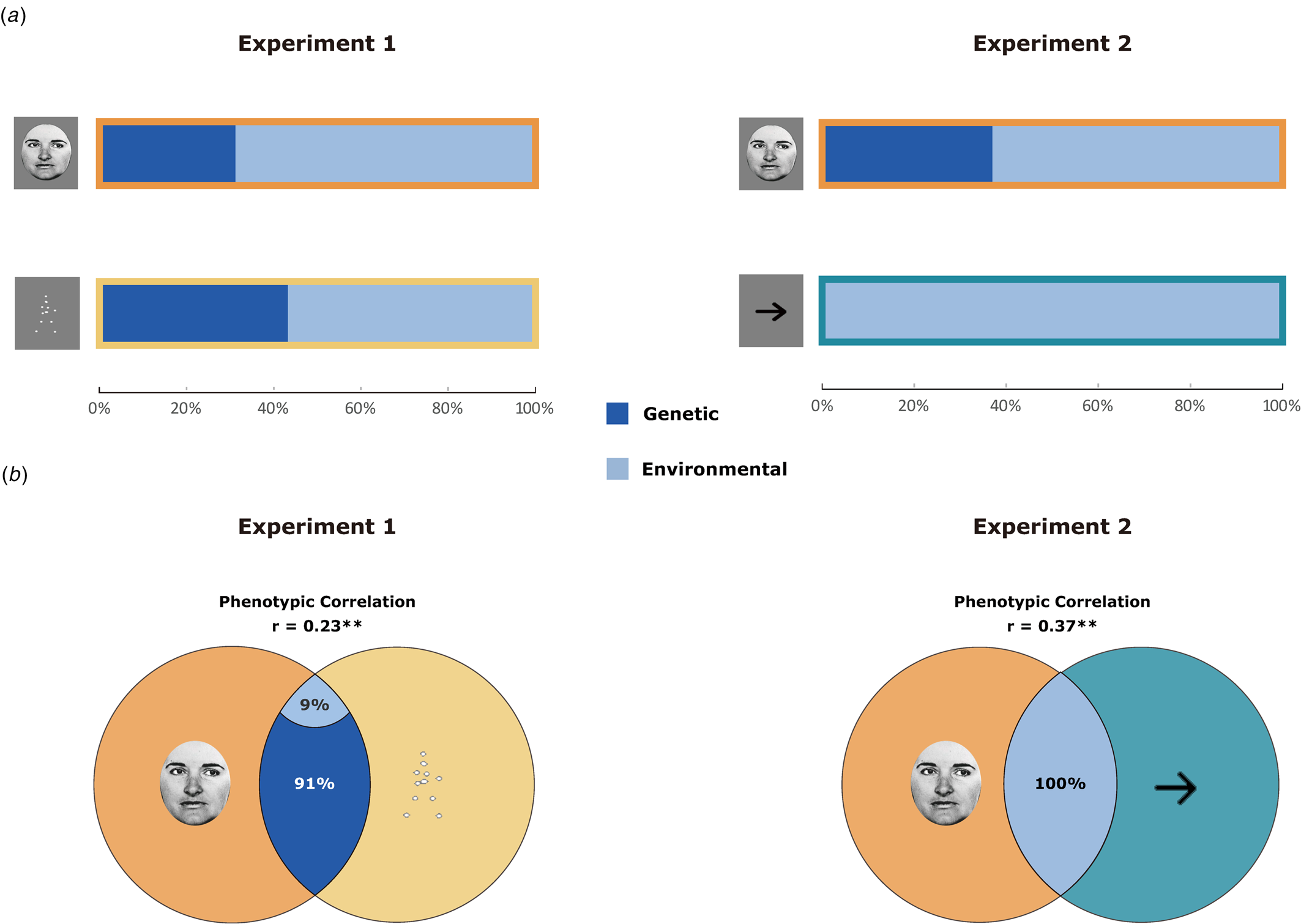
Genetic and environmental contributions to attention abilities and their phenotypic correlations. (a) In Experiment 1, univariate genetic analyses revealed heritability of attentional effects induced by two distinctively different social cues (i.e. eye gaze and walking direction). In Experiment 2, there were reliable genetic influences on gaze induced attentional effect, but no evidence of heritability was observed with arrow induced attentional effect. (b) Bivariate genetic analyses revealed that shared genetic effects can account for 91% of the covariance between the attentional effects induced by eye gaze and walking direction. By contrast, 100% of the phenotypic association between the attentional effects induced by gaze and arrow was accounted for by environmental effects.

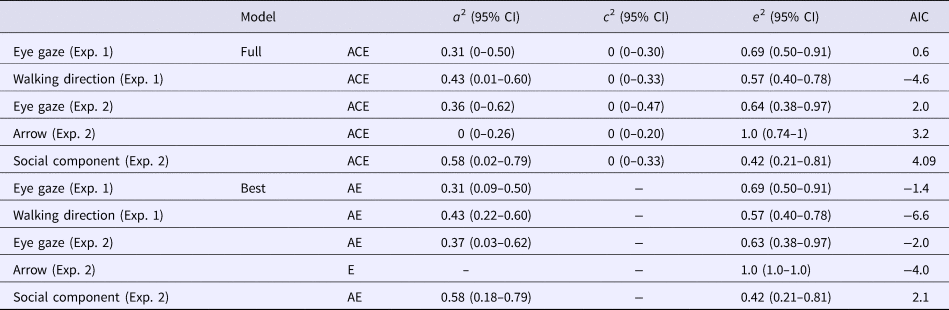
Further univariate genetic analyses (see online Supplementary Information) demonstrated that the heritability of the attentional effect of gaze and that of walking direction were 31% [95% confidence interval (CI), 9–50%] and 43% (95% CI, 22–60%), respectively (Table 1 and Fig. 3(a), left panel). More importantly, results showed a significant correlation between these two social attentional effects [r = 0.23, p = 0.001, BF10 = 64.51; Fig. 3(b), left panel], and cross-twin cross-task correlational analyses revealed that the attentional effect induced by walking direction for one twin significantly covaried with the attentional effect induced by gaze for the other twin among MZ twin pairs (r = 0.25, p = 0.007, BF10 = 8.05) but not DZ twin pairs (r = 0.07, p = 0.458, BF10 = 0.156), suggesting that common genetic factors are involved in driving the attentional effects induced by these two distinctively different forms of social cues. Further bivariate genetic analysis (see online Supplementary Information) revealed that 91% of the phenotypic association between the attentional effects induced by gaze and walking direction was accounted for by shared genetic influences, highlighting the existence of genetic pleiotropy between these phenotypes.
Univariate model fitting result

No evidence of heritability for non-social attention ability
Experiment 1 clearly demonstrates that the reflexive attentional effects of gaze and walking direction are heritable and they share a common genetic etiology. However, it remains to be elucidated whether the observed genetic influences on these attention abilities were specific to social information processing. In Experiment 2, arrow cues were employed for direct comparison with gaze cues, and two measures (gaze cueing and arrow cueing tasks) were administered in a new sample of MZ and DZ twin pairs.
Similar to that obtained in Experiment 1, a significant reflexive attentional orienting effect was observed with gaze cues (362 ms v. 381 ms, t 93 = −7.43, p < 0.001, Cohen's d = 0.34, BF10 = 3.38 × 10⁸). There was also a significant attentional orienting effect associated with arrow cues (384 ms v. 403 ms, t 93 = −5.00, p < 0.001, Cohen's d = 0.28, BF10 = 1593), consistent with previous studies (Tipples, Reference Tipples2002; Friesen et al., Reference Friesen, Ristic and Kingstone2004). There was no significant difference between the magnitudes of the attentional effects induced by these two types of cues (0.024 v. 0.023, t 93 = 0.34, p = 0.733). For the attentional effect induced by gaze, the intraclass correlation of MZ twin pairs exceeded the DZ correlation (0.43 v. 0.02, z = 1.40, p = 0.084; Fig. 2, right panel) and the heritability was estimated to be 37% [95% CI, 3–62%; Table 1 and Fig. 3(a), right panel], which replicated the findings from Experiment 1. In contrast to the attentional effect induced by gaze, there was no significant difference between the intraclass correlations of MZ and DZ twin pairs for the attentional effect (−0.09 v. −0.08, z = −0.05, p = 0.480; Fig. 2, right panel) induced by arrows, and univariate genetic analyses revealed no heritability of such non-social attentional effect [Table 1 and Fig. 3(a), right panel]. This finding resonates well with a previous study showing no evidence of heritability for the endogenous attentional orienting (Fan et al., Reference Fan, Wu, Fossella and Posner2001). It should be noted that the correlation between the gaze-induced attentional effect and the arrow-induced attentional effect was also significant [r = 0.37, p < 0.001, BF10 = 64.51; Fig. 3(b), right panel]. However, cross-twin cross-task correlations were not significant for both MZ (r = 0.04, p = 0.760, BF10 = 0.18) and DZ twin pairs (r = −0.23, p = 0.137, BF10 = 0.08), suggesting that environmental factors play a major role in shaping the non-social attentional effect and its covariation with the social attentional effect. Consistent with this notion, bivariate genetic analysis showed 100% of the phenotypic association between the attentional effects induced by gaze and arrow was accounted for by environmental effects.
On a side note, female participants showed larger attentional effects than male participants in both gaze (t 318 = 2.07, p = 0.04, BF10 = 1.86) and arrow (t 92 = 2.26, p = 0.026, BF10 = 3.93) cueing tasks (combined data from Experiments 1 and 2), in line with previous studies (Bayliss et al., Reference Bayliss, di Pellegrino and Tipper2005; Feng et al., Reference Feng, Zheng, Zhang, Song, Luo, Li and Talhelm2011). Moreover, there was also a large gender difference in the attentional effect induced by walking direction (t 224 = 3.07, p = 0.002, BF10 = 23.35), suggesting that gender differences might generalize across social and nonsocial attention abilities.
The core social attention ability extracted from conventional attentional effects
Furthermore, we calculated a core social attention index to extract the core social component from the conventional attentional effects by subtracting out the non-social component, i.e. the difference between the gaze and the arrow cueing effects. To this end, only the congruent trials were used for this calculation because they directly reflect observers’ attentional orienting toward (engagement) rather than away (disengagement) from the cueing direction, and this index has been widely used in previous attentional cueing studies (Koster et al., Reference Koster, Leyman, De Raedt and Crombez2006; Koster et al., Reference Koster, Crombez, Verschuere, Vanvolsem and De Houwer2007; Shane and Peterson, Reference Shane and Peterson2007). This core social attention index (RT arrow − RT gaze) differed significantly from zero (t 93 = 4.49, p < 0.001, Cohen's d = 0.46, BF10 = 1651), reflecting facilitated attentional orienting toward gaze-cued target relative to arrow-cued target. More importantly, MZ twin pairs exhibited greater similarity for the core social component of attentional effect compared to DZ twin pairs (intraclass correlation, 0.52 v. 0.06, z = 1.66, p = 0.049) and the estimated heritability was 58% (95% CI, 18–79%; Table 1). By contrast, the RT difference between the gaze and walking direction cueing effects obtained in Experiment 1 was not significantly different from zero (t 225 = −0.37, p = 0.710, BF10 = 0.06), and showed no difference in intraclass correlation between MZ and DZ twin pairs (0.08 v. 0.15, z = −0.37, p = 0.357) and therefore no evidence of heritability.
Covariation between the core social attention ability and autistic traits
To further examine the hypothetical link between social attention ability and ASD, we conducted Experiment 3 in which the Autism-Spectrum Quotient (AQ) questionnaire, in addition to the two attentional tasks (gaze cueing and arrow cueing tasks), was administered to an independent group of non-twin participants. The mean AQ score was 118, and there was no difference between male and female participants (117 v. 119, t 48 = −0.95, p = 0.710, BF10 = 0.16). Similar to Experiment 2, we observed significant attentional orienting effects triggered by both gaze cues (353 ms v. 375 ms, t 49 = −7.57, p < 0.001, Cohen's d = 0.39, BF10 = 2.55 × 10⁷) and arrow cues (373 ms v. 389 ms, t 49 = −5.45, p < 0.001, Cohen's d = 0.28, BF10 = 20 972), and these two attentional effects were significantly intercorrelated (r = 0.39, p = 0.005, BF10 = 15.66). Moreover, comparison of the core social attentional index against zero also showed facilitated attentional orienting toward gaze-cued target as compared to arrow-cued target (t 49 = 5.15, p < 0.001, Cohen's d = 0.73, BF10 = 7785). Crucially, observers’ core social attentional index negatively correlated with their AQ scores (r = −0.29, p = 0.042, BF10 = 3.0). That is, individuals with higher autistic traits displayed weaker vigilance for social v. non-social cues. These results, together with the heritability of social v. non-social attention ability, add direct support for the tight coupling between social attention ability and autistic traits, and hint that the core social component may provide a genetically determined and potentially more robust hallmark of ASD.
Discussion
Humans possess a remarkable ability to automatically direct attention to what or where others are focusing on, allowing exchange of critical information and facilitating appropriate social interaction (Birmingham and Kingstone, Reference Birmingham and Kingstone2009). Given its evolutionarily adaptive nature, it is not surprising that this social attention behavior is evident even in young infants and non-human primates, indicating that it may be hard-wired in the primate brain (Hood et al., Reference Hood, Willen and Driver1998; Deaner and Platt, Reference Deaner and Platt2003). The current study employed a modified Posner cueing paradigm to assess social attention abilities in twin participants and found strong heritability of such abilities. Specifically, genetic factors play a prominent role in shaping the individual variation in reflexive attentional orienting effect induced by the mostly investigated social cue (i.e. gaze). Moreover, much of the individual difference in attentional effect triggered by another distinctively different social cue, walking direction of BM, can also be explained by genetic factors. Importantly, the attentional effect induced by gaze is linked to that induced by walking direction and these social attention abilities are influenced by common genetic effects. By contrast, no evidence of heritability or genetic correlation is observed with the attentional effect triggered by the non-social cue (i.e. arrows). In addition, the core social attention ability, which is highly heritable, can be predicted by one's autistic traits. These results provide evidence that common genetic factors are involved in driving social, but not non-social, attentional effects, thus lending support to the view that ‘social attention is special’.
Although the attentional effects elicited by social stimuli, like gaze for instance, has long been proposed to be special, this view is being challenged by the findings that an automatic attentional shift could also be triggered by non-social stimuli, such as arrows (Ristic et al., Reference Ristic, Friesen and Kingstone2002; Tipples, Reference Tipples2002, Reference Tipples2008). Studies directly comparing these two types of attentional orienting have found indistinguishable behavioral effects (Bayliss et al., Reference Bayliss, di Pellegrino and Tipper2005; Tipples, Reference Tipples2008; Nummenmaa and Hietanen, Reference Nummenmaa and Hietanen2009). However, some studies have demonstrated that gaze cueing is less susceptible to top-down cognitive control, providing evidence for the uniqueness of social attention (Friesen et al., Reference Friesen, Ristic and Kingstone2004; Ristic et al., Reference Ristic, Wright and Kingstone2007). The neuroimaging findings on the engagement of attention systems during gaze- and arrow-triggered orienting are also inconsistent, as some studies reported separate attention systems engaged by gaze and arrow cues but some others found common neural substrates (Kingstone et al., Reference Kingstone, Tipper, Ristic and Ngan2004; Sato et al., Reference Sato, Kochiyama, Uono and Yoshikawa2009; Engell et al., Reference Engell, Nummenmaa, Oosterhof, Henson, Haxby and Calder2010; Uono et al., Reference Uono, Sato and Kochiyama2014; Joseph et al., Reference Joseph, Fricker and Keehn2015). There still lacks empirical evidence that could well reconcile these controversial findings. Using behavioral genetic method, the current study demonstrates a reliable genetic contribution to individual variation in gaze-mediated but not arrow-mediated attentional effect, with the latter largely explained by environmental effects, providing clear evidence for the uniqueness of the attentional effect triggered by gaze. This resonates well with developmental studies showing that the attentional effects of gaze and walking direction but not arrow direction arise early in life (Hood et al., Reference Hood, Willen and Driver1998; Farroni et al., Reference Farroni, Massaccesi, Pividori and Johnson2004; Jakobsen et al., Reference Jakobsen, Frick and Simpson2013; Bardi et al., Reference Bardi, Di Giorgio, Lunghi, Troje and Simion2015). Despite similar behavioral observations obtained from gaze and arrow, the genetic roots and underlying processes may be quite different for these two types of attention abilities. An arrow can produce an automatic attention shift is likely because it is an over-learned symbol with obvious directional information that is reinforced in daily life (e.g. road signs). In a different way, eye gaze triggers a reflexive attentional orienting may be because it represents a special cue characterized with biological significance, and such gaze-triggered attentional orienting effect might be mediated by an innate and genetically determined module (eye-direction detector) (Baron-Cohen, Reference Baron-Cohen1995).
Interestingly, we still found that gaze and arrow cueing effects are intercorrelated: individuals who show stronger gaze cueing effects also exhibit stronger arrow cueing effects. However, such covariation is largely shaped by environmental factors, in sharp contrast to the covariation between gaze and walking direction cueing effects that is mostly explained by shared genetic effects. It is thus conceivable that gaze cueing effect not only relies on an innate, specialized social attentional system but also a learned, more general attentional mechanism shared by arrow cueing, which might also explain why mixed results obtained in previous research. This notion is strongly supported by evidence that the difference between gaze and arrow cueing effects (i.e. the core social component) is heritable and negatively correlated with autistic traits.
Although eyes provide the most salient cue to others’ direction of attention, they are not the unique source of such information. Several recent findings have revealed that reflexive attentional orienting extends to the walking direction of BM, a distinctively different stimulus type from eye gaze in terms of visual properties (Shi et al., Reference Shi, Weng, He and Jiang2010; Wang et al., Reference Wang, Yang, Shi and Jiang2014; Zhao et al., Reference Zhao, Wang, Wang, Weng, Li and Jiang2014). An important question is whether the reflexive social attention of gaze and walking direction are driven by common underlying mechanisms. Baron-Cohen proposed the existence of a specialized innate module in support of an ‘eye-direction detector’, identifying where eye-gaze is directed in the environment (Baron-Cohen, Reference Baron-Cohen1995). Similarly, it has been suggested that there exists an innate module dedicated to detecting the direction of motion of other organisms (i.e. ‘life motion detector’) (Johnson, Reference Johnson2006; Troje and Westhoff, Reference Troje and Westhoff2006; Wang et al., Reference Wang, Yang, Shi and Jiang2014). Some researchers postulated a more general ‘direction of attention detector’, combining information from gaze, head and body direction, as evidenced by the findings showing that the superior temporal sulcus region is not only responsive to gaze direction but also to head and body direction (Perrett et al., Reference Perrett, Hietanen, Oram, Benson and Rolls1992; Perrett and Emery, Reference Perrett and Emery1994). The genetic correlation between the reflexive attentional effects of gaze and walking direction observed in our current study provides evidence for the existence of such innate social attention detector from the genetic perspective. Future research, combining neuroimaging and behavioral genetic methods, may help to identify the common neural circuitry subserving the reflexive orienting responses elicited by different social stimuli (i.e. ‘social attention network’) and will shed new light on the gene–brain–behavior relationships in social attention.
Findings of the current study also bring further our understanding of the relationship between social attention and ASD. Reduced social attention has often been posited to be a cardinal feature of ASD (Bruinsma et al., Reference Bruinsma, Koegel and Koegel2004; Dawson et al., Reference Dawson, Bernier and Ring2012). Infants who are later diagnosed with ASD tend to manifest reduced sharing of attention (Maestro et al., Reference Maestro, Muratori, Cavallaro, Pei, Stern, Golse and Palacio-Espasa2002; Zwaigenbaum et al., Reference Zwaigenbaum, Bryson, Rogers, Roberts, Brian and Szatmari2005). Although lack of social attention has been well documented in the clinical literature (Bruinsma et al., Reference Bruinsma, Koegel and Koegel2004; Dawson et al., Reference Dawson, Bernier and Ring2012), computerized laboratory experimental studies employing gaze cueing tasks generally report relatively normal behavior (Okada et al., Reference Okada, Sato, Murai, Kubota and Toichi2003; Kylliäinen and Hietanen, Reference Kylliäinen and Hietanen2004; Rutherford and Krysko, Reference Rutherford and Krysko2008). Only a handful of studies have reported diminished gaze cueing effects in ASD, and the magnitude of gaze cueing effects is found to be negatively correlated with the degree of autistic traits in normal population (Bayliss et al., Reference Bayliss, di Pellegrino and Tipper2005; Goldberg et al., Reference Goldberg, Mostow, Vecera, Larson, Mostofsky, Mahone and Denckla2008). It has been postulated that individuals with ASD may engage non-social mechanisms and utilize low-level visual directional properties of gaze cues to complete the task, and thus their relatively normal behavioral performance may simply reflect compensatory mechanisms rather than intact social attention ability. In the current study, we provide further evidence that the core social attention ability is genetically determined and negatively correlated with individual autistic traits, suggesting that it may be treated as a more innate and reliable behavioral marker of ASD relative to the conventional social cueing effect.
Finally, several limitations of the current study should be acknowledged. First, the sample size of our study was relatively small and insufficient to examine gender-specific effects. It is important for future studies using a larger sample to investigate gender differences in the influence of genes and environment. Next, we only employed a simple laboratory task to simulate social attention. Future research should adopt more naturalistic stimuli and tasks in conjunction with multiple types of measures (e.g. behavioral, physiological, neuroimaging) to explore real-life phenomena of reciprocal social attention (Richardson and Gobel, Reference Richardson, Gobel, Fawcett, Risko and Kingstone2015; Risko et al., Reference Risko, Richardson and Kingstone2016). Further, the linkage between the core social attention ability and ASD needs to be directly examined in clinical sample.
In conclusion, the heritability of social v. non-social attention ability observed in our study argues for an innate mechanism for social attention behaviors, and suggests a potential genetic linkage between the core social attention ability and ASD. Social attention deficits show promise as an endophenotype that has the power to specify the genetic underpinnings of ASD and inform future approaches in early diagnosis and treatment.
Supplementary material
The supplementary material for this article can be found at https://doi.org/10.1017/S003329171900031X.
Author ORCIDs
Li Wang, 0000-0002-2204-5192.
Acknowledgements
This research was supported by grants from the National Natural Science Foundation of China (Nos. 31525011, 31671137, 31771211, and 31830037), the Strategic Priority Research Program (No. XDB32010300), the Key Research Program of Frontier Sciences (No. QYZDB-SSW-SMC030), the Youth Innovation Promotion Association of the Chinese Academy of Sciences, and Beijing Municipal Science & Technology Commission.
Conflict of interest
The authors declare no competing interest.
Ethical standards
The authors assert that all procedures contributing to this work comply with the ethical standards of the relevant national and institutional committees on human experimentation and with the Helsinki Declaration of 1975, as revised in 2008.