INTRODUCTION
A growing body of literature is emerging in the domain of spirituality as it relates to caring for terminally ill patients (Nagai-Jacobsen & Burkhardt, 1989; Wright, 2002). There is empiric evidence supporting the notion that many palliative patients have spiritual needs and want these addressed (Yates et al., 1981; Smith et al., 1993; Gallup, 1997; Reed, 1997; Ehman et al., 1999; McClain et al., 2003; Flannelly et al., 2004). For some patients, spirituality and religion are separate entities, whereas for others, spirituality and religion are entwined; religion provides them the avenue for spiritual growth and refuge (Daaleman & VandeCreek, 2000; Wright, 2001). For patients, spirituality appears to be deeply personal and at the core of their personhood.
Although spirituality as it relates to patients is gaining increasing attention (O'Connor & Kaplan, 1986; Millison, 1988; Millison & Dudley, 1990; Grey, 1994; Walter, 1997; Wright, 2002), less is known of how health care professionals (HCP) experience spirituality personally or collectively in the workplace. Millison and Dudley (1990) reported that hospice professionals identify themselves as spiritual, but largely as it relates to their personal lives rather than at the workplace. White (2000) utilized cooperative inquiry to explore the concept of spirituality as understood by nine multidisciplinary professionals working at two cancer centers and discovered group members saw spirituality being expressed through the search for meaning or purpose and a sense of connection. There was also a sense that spirituality affected the way in which care was given, although this was not discussed in detail. In another study, Wright (2002) interviewed 16 spiritual care stakeholders linked to palliative care with the aim of discovering the essence of spiritual care. The present study, while building on these initial inquiries, seeks to explore not only the understanding of spirituality by a group of individual HCPs, but seeks to explore the existence of a team spirituality as experienced by an interdisciplinary palliative care team. The issue of how a HCP's personal spirituality is affected by or impacts his/her professional life remains relatively unexplored (Sloan et al., 1999; Maddix & Pereira, 2001). This relative inattention is surprising given its potential impact on personal well-being and clinical care (Krikorian & Moser, 1985; Vincent & Garrison-Peace, 1985; Kearney, 2000; Maddix & Pereira, 2001). Moreover, it would seem important for HCPs to be committed to holism in their own lives if they are to provide it to others (Griffin, 1983; World Health Organization, 1990). Thus, this study also aims to explore in detail the impact between the collective spirituality of an interdisciplinary palliative care team and the care they provide to terminally ill patients.
Nagai-Jacobsen and Burkhardt (1989), Ross (1994), McCabe (1997), and Kearney (2000) have made the case that caregivers not only need to be aware of the spirituality of their patients, but also to be aware of their own spirituality. They propose that attentiveness to this leads to healthier team functioning and ultimately to better patient care (Ross, 1994; Kearney, 2000). Maddix and Pereira (2001), in their monthly reflections with members of an interdisciplinary palliative care team, observed that team members were touched spiritually by the journeys of their patients.
We conducted this study to explore what members of an interdisciplinary palliative care team felt about their own spirituality, how that related to the care they provided to their patients, and whether they felt that they provided spiritual care. In addition, we wanted to explore the notion of a collective spirituality shared by the team.
METHODS
A qualitative autoethnographic approach was used to guide this study. Autoethnography is often viewed by social scientists as a subtype of other forms of ethnography such as narrative ethnography (Fetterman, 1983), interpretive biography (Germain, 1993), or postmodern ethnography (Spradley, 1979). Autoethnography has been linked to the idea of connecting the personal to the culture. In autoethnography, researchers use their own experiences in the culture as a way of opening the dialogue with other members of the culture under study. For example, in this study, the principal investigator's experience of spirituality (as present in this culture) is put forth to encourage reflection from other team members (Morse & Richards, 2002) to explore their own unique spirituality as it exists within the context and culture of this particular palliative team. Data (text) was constructed actively in dialogue pertaining to individual member's spirituality in exploring the possibilities of a collective spirituality of this palliative care team.
Study Setting
The study was conducted in a 10-bed Tertiary Palliative Care Unit (TPCU) in a large acute-care referral hospital and cancer center. The unit was established in 2001 with the vision of it being a distinct designated unit. This has not materialized and the 10 beds are dispersed within a larger acute medical and oncology unit. Although nonnursing team members are assigned exclusively to “palliative” designated beds, nurses are required to care for palliative, medical, and oncology patients during their shifts.
Sampling
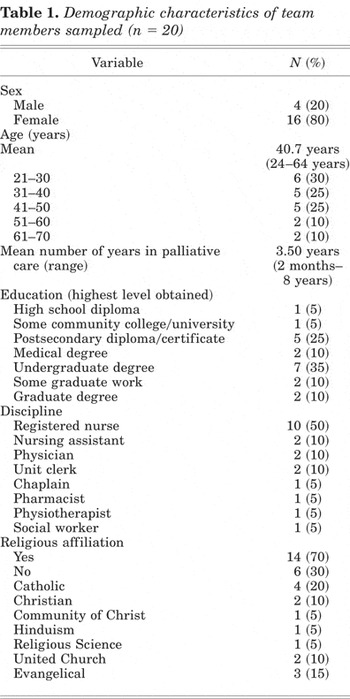
Team members of the TPCU were invited to participate in one-to-one interviews and/or focus groups. Purposive sampling was used to recruit participants for both the interviews and focus groups. Five “key informants” were selected to participate in the interviews on the basis of knowing and understanding their culture particularly well (Fetterman, 1983; Germain, 1993). Three key informants participated in the focus groups as well as the interview. There were three focus groups with a total of 18 individuals (3 of whom were key leaders who were already accounted for in the sample size), for a total of 20 participants. A wide spectrum of disciplines, ages, and religious affiliations were represented (see Table 1).
Demographic characteristics of team members sampled (n = 20)

Data Collection
Following approval from the local Research Ethics Board, data collection began with in-depth unstructured one-to-one interviews, followed later with focus groups. The interviews lasted approximately 1.5 h each. Although an interview guide was constructed for consistency of the one-to-one interviews and focus groups, the process was open to allow for exploration of individual experiences (see the Appendix). Interviews began with a main guiding or “grand tour” question (Spradley, 1979). Throughout each interview, the researcher remained open to new information and was reflective of previous interview data and emerging concepts to guide the conversation. Participants were given considerable control over the interview. Focus groups allowed the investigators to explore notions expressed in the interviews and participants to build upon the responses of other group members. The principal investigator (SS) kept field notes of his observations, experiences, and insights during both the interviews and focus groups during the study. All interviews and focus groups were tape-recorded and transcribed verbatim. The eight transcripts varied in length from 15 to 25 single-sided pages. After completion of each transcript, one of the researchers read the transcripts while listening to the audiotapes to make corrections and add notes. Five interviews and three focus groups were conducted.
Data Analysis
Using a process described by Morse and Richards (2002), the data analysis process occurred concurrently with the data collection in a flexible recursive back-and-forth process. Themes and patterns that arose in the data were intentionally explored in the subsequent interviews and focus groups. Data gathering occurred until data saturation emerged. To enhance credibility, data analysis was undertaken at two levels (Guba & Lincoln, 2000). First, each researcher read the transcripts to obtain an overall sense of the data. Each of the four researchers then independently identified themes emerging from the text and annotated these on their respective transcripts. The researchers met monthly to conduct an ongoing second level of analysis, which involved researchers sharing individual analyses and suggesting patterns (themes) that seemed to be emerging from the data. An in-depth discussion about the themes helped the researchers understand how these themes conceptually fit together. Authenticity was maintained by allowing study participants to review the emerging findings and provide further input. Initial study findings were also presented to various groups of palliative care experts, who confirmed that the interpretations resonated with their clinical experiences.
RESULTS
The analysis revealed several themes within five main categories.
Category 1: Defining Spirituality: Individual Team Members' Views
Spirituality Is Personal
Initially participants struggled to define what spirituality was. No two participants defined spirituality in the same way and experienced spirituality the same in their lives. However, they generally referred to its abstractness and illusiveness and described it as immensely personal and individualized. They often felt that spirituality is contextual and value laden.
Spirituality can mean so many different things … just a whole gamut of things in and under the umbrella of spirituality.
Spirituality and Religion May or May Not Be Mutually Exclusive
For many, spirituality appears to be an overarching umbrella with religion being one component. Some participants related that, although they had no formal religious affiliations, they experienced a force that they described as “spiritual.” They experienced this spirituality in nature, in their workplace, and sometimes from within themselves, from “deep within their being” as one participant indicated. Some participants with religious affiliations experienced “spirituality” in sources outside their religious institutions whereas others experienced “spirituality” within the context of their religious affiliations; the interconnection of spirituality and religion was important for them. A common respect for the varying viewpoints was noted.
Spirituality for me … gives meaning to my life, the purpose of my life … [it] has to do with connecting with ourselves inwardly as individuals and with God.
I connect with spirituality when I am hiking and skiing.
Spirituality for me is tied to religion.
Spirituality Is about Integrity, Wholeness, Meaning, and Personal Journeying
A common understanding emerged in the focus groups, that spirituality was related to integrity and wholeness.
I think for me, spirituality is the essence of my being … its warmth, it makes me complete. It makes me who I am.
Many of the participants viewed spirituality as a personal journey for themselves and saw this as a common experience with the people they cared for. They viewed spirituality as embedded in everyday life, an expression of attempts to live life fully.
Spirituality is such a part of my life that I don't really think about it as being spiritual. I think almost everyone plays it out in their daily interactions with each other.
Spirituality for some participants is what is at the center of their lives as persons, as professionals and members of a team.
The interrelationship between the mind, body and spirit was a common theme. It involved the recognition of person and his and her total being as central to caring for the dying individual's spiritual needs.
On this unit, whether the patient is having radiation or chemotherapy is not the important thing. It's how the patient is doing, you know, how they are feeling and how they will manage or where they are going to go, or where they are at, not just the medical treatment.
Spirituality Is about Relationship
For many, spirituality is inherently relational, including a relationship with self, others, the greater world, and a higher power. Some felt that their interpersonal connection with other team members is a key element in their spiritual journey as individuals and as professionals.
It isn't just about religion anymore, it's how people feel about themselves and how they treat others.
The relationship we have with the patients really makes you think of your priorities in life and your friends and family.
Spirituality Is about Transcendence
Many acknowledged transcendence as the essence of spirituality. There was a twofold understanding of transcendence. The first related to persons rising above their situation (patients) and, second, the sense of a greater power connecting with them. Although participants were unable to define transcendence, they used phrases such as “profound moments,” “mystery,” and “magical moments” to refer to it. Team members valued those moments of transcendence, often experiencing it as an anticipated moment of new insights and meaning (the proverbial “a-ha” moments).
Yeah, but there's times as well that you feel that you're doing exactly the right thing [at] exactly the right moment.
It is incredible. In those moments … I feel like I'm a channel of God.
Category 2: Spirituality in the Workplace: Personal Experiences
Palliative Care as a Catalyst for Our Own Spiritual Journeys
Working with the terminally ill was, for some, a strong impetus to reflect on their own spirituality and a constant reminder to attend to their spiritual and religious lives.
But as we nurture other people's spirit, that is reciprocated, so it becomes nurturing for me. And in witnessing the patient's and family's experience we reflect on our own as well.
[When hiking], I find myself thinking about my patients like Mary [pseudonym], for example, thinking about how she is, and if she has gone home, thinking that she must have come up here to hike, I remember talking with her about it, about being up here.
Some participants related how, in the course of their daily work, sometimes even in the midst of the menial tasks, conversations with or comments from patients and families drew them to a discussion on spirituality and reflection on their own views of spirituality and God. A participant explained how a physical discussion of pain led to a discussion of spirituality:
I was talking with the patient who was revealing how he was experiencing a lot of pain at night … I asked him, “That must have been very scary?” “Yes,” he replied and became very tearful and cried and I said, “Tell me what's in your heart.” [The patient went on to talk about his fear of dying.]
Participants indicated that often the physical act of caring drew them into closer spiritual relationships with their patients.
Spiritual Fulfillment in the Workplace
There were many revealing descriptions of how team members experienced spiritual fulfillment in their practice. Experiencing the wonder of nature, prayer, and reflection, feeling safe within the team, love and acceptance were presented as many of the most fulfilling spiritual moments.
Spirituality is right out there on this floor. Everywhere you look … you can't avoid it no matter what religious background you have or even if you're an atheist—you can't avoid spirituality on this floor. It's heavy … it's thick…. Soon as you walk off the elevator and come in here you can feel it. It's in the air.
Team members listen to your fears. It is a safe and respectful environment. We all work together for a common goal even when there is suffering.
Palliative Care as a Calling
For some participants, palliative care represents a spiritual calling. They view spirituality, and their connectedness with God and other humans, as a core component of being human, both in their personal and professional lives. Palliative care allows them to fulfill this calling in their lives, to find meaning and wholeness.
I believe being in this job is a miracle, a search for my true self…. It's obvious to me that there is someone else in control of my life which has got me doing what I am doing and, for once in my life, I am OK with that. I'm not going to fight it—I don't feel the need to take control because I'm actually happy and to me that's what its all about, being happy and making others happy too. That's spirituality! The best way for me to feel happy is to care for everybody else that's around me.
When I was on the medical unit I never thought of spirituality. It wasn't until I started working on this unit that I actually thought about religion and my values.
I think doing this work gives me a sense of purpose and meaning as well, and when I talk to other people that are in palliative care, a lot of them, say they were really drawn to this area.
In my younger years I recall a vivid experience; it was a pivotal moment in my life. During that experience I felt the purpose of life was to be of service to other people, in a spiritual way, I felt called…. When I got introduced to palliative are I felt—this is it.
Spirituality Is Wrapped in Caring and Often Manifests in Small Daily Acts of Kindness and of Love
Several participants reflected that spirituality was to be found and expressed in the day-to-day activities of caring and that caregivers are often oblivious to this.
Caring means making them comfortable, doing their mouth care and even though they are sick, making them look pretty good on the outside and trying to help them on the inside.
I gave him a bath and I try to make a speciality of the baths in this place, I had the bubbles about 3 feet off the tub…. The water's nice and hot cause I'm a true believer that water is healing and good for the soul and I put him in the bath tub and he just loved the bath.
There is a presence of God, and for me that presence manifests itself during the day-to-day acts of kindness, the acts of love, the acts of caring and understanding even if we are struggling as a team and label a patient as “difficult.
It's what you believe in and your actions; to me it's being happy, putting a smile on my face so I can put a smile on a patient's face; then I know I've succeeded with spirituality.
Category 3: Spirituality in the Workplace: The Collective Experience
A Collective Spirituality Stemming from Common Goals, Values, and Belonging
For most, the concept of a collective spirituality emerged unconsciously. They alluded to “we” and the “team” and a common connectedness with respect to goals and values related to patient care, particularly in incorporating spirituality in the care they provided.
I feel a collective spirituality, a goodness, when we are together and talk about patients…. As a team the individual team members contribute to bringing the wholeness together.
In a team environment such as this one, there seems to be a lot more acknowledgment of the impact of spiritual existence, the level of existence on the part of our patients, ourselves as team members and realizing that there are more forces at work than the physical things that we can measure such as the lab tests or their vital signs.
You develop a passion for caring and connectedness that includes not only those you give care to but those whom care with you, your professional colleagues.
Category 4: Nurturing of Caregivers Spirituality in the Workplace
The Nurturing Effect of a Safe and Respectful Environment
The safe and respectful environment of the unit was referred to as a contributor to a collective spirituality. Participants felt comfortable to be themselves. They were able to acknowledge their own distress, especially when caring for patients with difficult problems and total suffering.
The environment is safe and respectful to share your thoughts and concerns.
Rituals as Opportunities for Healing and Closure
Several participants described the importance of the “Time of Reflection” (once monthly meetings to light candles in memory of those who had died on the unit) as opportunities to “unload” the suffering they had experienced themselves when caring for those patients. They were opportunities to both bid farewell and to celebrate their collective work.
I feel very in touch with God when we as a team participate in the Thursday memorials…. They are very powerful because in the middle of a hectic day, suddenly I find myself at peace and going inwards and celebrating life and celebrating what we've done and the presence that we've been for patients.
Regular Opportunities to Explore Spirituality Collectively
Creating space to invite and to listen for spirituality was felt to be important. Many participants commented on the lack of opportunities to do this during working hours as an integral component of providing care. The study itself provided a venue for reflection, resulting in a stronger team spirit as a result. The experience was an enjoyable and edifying experience for most individuals. The principal investigator, in his research journal, summarized what was felt by many of the participants:
I am amazed at the spirituality of these individuals and this team. I knew and felt their spirituality prior to conducting this study, but I am surprised after each interview and focus group at just how deep this is. I find that our time together lifts me up, makes me think about what I believe and makes me feel more connected to them as persons.
Category 5: Challenges to Individual and Collective Spirituality in the Workplace
Compassion Fatigue
Unrelenting total pain and suffering experienced by patients and families was the source of sufferqhing for many team members themselves. Many had internalized these feelings of “despair” and “inadequacy.”
It's hard to work in the presence of suffering when we don't seem to make a difference.
One of the challenges I have faced is when you have been working closely with a patient and family for a long time and we have come to recognize that the pain medication is not the answer to their suffering. It's tough because we do this work to relieve someone's suffering and we just can't seem to get it right.
Spiritual Care Can Be a Daunting Task to Most Team Members
For many, providing spiritual care at the end of life can be a daunting task and several participants expressed feelings of inadequacy and discomfort in addressing spirituality. They felt ill prepared for it and also confused as to what their formal roles were in providing spiritual care. There was uncertainty as to when to draw the line between their roles and that of the unit chaplain in providing this care.
Sometimes the wounds are so deep for patients that I do not feel comfortable opening the conversation with patients. I ask [the chaplain] to see the patient and I feel that at least I have done something. We all get in deeper than we can handle sometimes. Sometimes I don't even know how I feel about the situation so I can't see myself being very helpful to the patient.
Tension with Roles Overlaps
Team members expressed tension and confusion regarding their respective roles, particularly in the first year following the unit's opening. It was only because of formal and informal discussions among one another and with the team that, over time, they came to understand that overlap of roles occurs in an interdisciplinary palliative care team. Over time they began to appreciate their own roles and expertise and their limitations in other roles.
We did not ignore the tension, we admitted that we felt it in different ways, we did it individually amongst ourselves and we did it collectively and we had some opportunities to speak about it. Out of this I believe that there is convergence of the disciplines some where in the center.
Team members acknowledged the overlap of roles that occurs when working as an interdisciplinary team working toward holistic care. They also identified the danger of all team members repeatedly engaging patients in discussions about spirituality, thereby burdening them with too much “spiritual care.”
Sometimes I feel like we can overwhelm people. Sometimes when I go into a patient's room at 2:30 and sit down and ask them “How are you doing?” They look at me and say “You are the sixth person that has asked me that question today.”
Lack of Distinct Unit and Task Assignment
Several participants expressed concerns and frustration at the unit being a mixed unit, often identifying this factor as a challenge to the spirituality of the team. Some nurses expressed frustration at their mixed assignments. Although they acknowledged benefits to that setup (including the establishment of closer relationships with their oncology colleagues and learning more about oncology and acute medicine and improving the palliative care provided to these patients), the challenges of the “mixed” setup outweighed the benefits. Having to care for medical patients as well those individuals who were dying did not allow adequate time to provide holistic care to patients and to focus. It was the source of confusion regarding goals of care. Some felt that it was not congruent with their calling.
Spirituality is about being present, connected with people. This system can really negatively impact the ability to offer holistic care and you are busy having to give a hundred medications to a medical patient when you have someone dying down the hall.
When you were hired to work palliative and that's what you came here for, it not always satisfying working with other type of patients when you know that down the hall are the patients you really want to be working with.
DISCUSSION
Participants in this study provided varying definitions of what they understood spirituality and spiritual care to be. This is not surprising, as a commonality of research in this area is the inability to confine spirituality to a simple standard definition (Cawley, 1997). Various approaches to this issue have been pursued within the literature, ranging from researchers who stress the importance of an established definition (Cobb, 2001; Rose, 2001) to those who choose a more inductive approach, allowing the definition to be determined situationally (Wright, 2002). Congruent with previous research, participants' definition of spirituality fell within the broad rubric of a connection to a sense of meaning and purpose, which may or may not involve religion (Fitchett & Handzo, 1998; Martsolf & Mickley, 1998; White, 2000). Spirituality for several of this team's members was often experienced in moments of mystery or wrestling with meaninglessness. This was different from other studies, where the emphasis focuses largely on the benefits and utility of spirituality on health outcomes (Yates et al., 1981; Reed, 1997; McClain et al., 2003), with little mention of the place of spiritual darkness or meaninglessness as an aspect of spiritual growth (Saunders, 1988).
This study not only verifies the concept previously described by other authors of “connectedness” between health care professionals and their terminally ill patients (Brock & Salmsky, 1993; Weaver et al., 1993; White, 2000; Wright, 2001; Kuhl, 2002; Cherlin et al., 2004), but also suggests that “connectedness” between team members is a spiritual experience for many health care professionals. In the context of this study, the term “connection” had three aspects: connection to self, connection to “Other” (God, the Universe, Energy), and connection to others (patients, families, and team members). Respect, love, and support appeared to be cornerstones in these connections. The team connected through ritual, listening, and engaging one another in sharing fears, joys, beliefs, and hopes. Participants in this study expressed directly and indirectly a need to incorporate opportunities for shared reflections and explorations of their personal and collective experiences in the workplace. These are important in that they not only address their personal and collective suffering, but also nurture their own spirituality. These opportunities should be integrated into their working hours, not just as after-hour electives.
It was in their shared individual values toward caring for the dying and the fundamental role of spirituality in this care, as well as their collective experiences, that a sense of belonging to a community and a sense of collective spirituality emerged. However, the sense of collective spirituality was not as explicit as that of individual team members' personal spirituality. The integration of individual members' spirituality into a broader collective spirituality may be conceptualized in the image of a stained glass window, with the separate individuals' spirituality representing different colored pieces of glass, which, combined, make up a unified whole, a larger image. Individuals' spirituality was not absorbed by the whole, but combined into a collective mosaic.
When transcendence was discussed in this study, it appeared to go beyond the contemporary notion of an ability to rise above one's current circumstance (Elkins et al., 1988; Puchalski & Romer, 2000; Hegarty, 2001). It was viewed as a mystical experience and included the less discussed nuance of the word pertaining to a connection with that which is itself transcendent, beyond the ordinary and tangible, such as God, the transpersonal, or the universe (Cassell, 1982; Ferguson et al., 1988; Burns, 1991). These numinous experiences were often unexpected and not dependent on participants' piety or spiritual awareness at the time. Spirituality, from this understanding, was not simply a framework that gave individuals meaning and purpose, but was something to be engaged in, embedded within the unit, whether participants were aware of it or not. As Joseph Campbell (1982, p. 90) states: “There is some kind of throb of resonance within, responding to the image shown without, like the answer of a musical string to another equally tuned. And so it is that when the vital symbols of any given social group evoke in all its members responses of this kind, a sort of magical accord unites them as one spiritual organism, functioning through members who, though separate in space, are yet one in being and belief.” Wright's (2002, p. 127) study of 16 palliative care professionals produced a collective definition that reiterates this point: “Spirituality is concerned with the intangibility of transcendence and the tuning in to something both beyond and within, something deeper, something wider, something bigger.”
Spirituality and spiritual care, although involving those transcendent experiences of mystery, was also profoundly immanent in the daily acts of caring. Spiritual care and spirituality were for this group often provided and experienced in simple daily acts of caring. Often, it is in the manner in which that care is provided. Routine daily care of the patients, including routine tasks such as bathing patients, when conducted with gentleness, love, respect, and attentiveness, represented for many participants spiritual care. This is akin to that which Chochinov (2002) refers to as the “tenor of care” in his dignity-conserving paradigm. Dame Cicely Saunders (1988, p. 32) has reminded us that “Care, in how it is given, can reach the most hidden places.” The centrality of such attributes in caring for the spirit is echoed by palliative patients themselves, who identify the compassion, empathy, and companionship of their caregivers as being of utmost importance to them in their dying (Brock & Salmsky, 1993; Weaver et al., 1993; Wright, 2001; Cherlin et al., 2004). Mother Teresa felt that, we can do no great things, only small things with great love. These acts included being present with people in their moments of darkness. Spirituality for this team was as much about “descending” into the questions and suffering as “transcending” to a new revelation. Dame Cicely Saunders (1988, 1993) reminds us of the importance of engaging the “darkness,” both within our ourselves and in our patients. This presents a challenge to the contemporary understanding of spirituality as a dimension perpetuated by nursing (Ross, 1995; McSherry & Draper, 1997) and medicine (Taylor & Ersek, 1995; McCabe, 1997), as spirituality seems to encompass these other aspects of the human makeup and not simply transcend them.
In this study, palliative care evoked spiritual reflection in many participants and served as a catalyst for personal spiritual journeys for some. Millison and Dudley (1990), White (2000), Maddix and Pereira (2001), and Prochnau et al. (2003) have previously described this phenomenon. Whether palliative care invokes spiritual reflection or simply attracts individuals who are already spiritual seekers requires further research. Vincent and Garrison-Peace(1985) noted that hospice nurses had a stronger belief in the afterlife than non-palliative-care nurses. However, there were an equal number of participants who spoke of how palliative care has caused them to reflect on spirituality for the first time. For some team members, palliative care represents a spiritual calling. For these individuals, faith and work was connected; what they believed about life, humanity, and themselves was correlated to the care they provided. While in this study, participants reported a positive correlation between individual's spirituality and the care that they provided; this does bring up the need for caution against the potential for proselytization and other forms of caregiver-inflicted spiritual suffering. Team members who hold strong views about religion and spirituality should be attentive to this risk. In Canada, chaplains who are trained in Clinical Pastoral Education are made aware of these potential risks and function from a multifaith and nondenominational perspective. Although the chaplain can provide a protective role against unwelcomed overzealous religious approaches, the team as a whole can also provide a balance, functioning as a holistic multifaith organism itself.
Spiritual care can be a daunting task to most team members. The topic of who cares for the spirit in palliative care has been the source of increased scholarship of late (Ajemian, 1993; McCabe, 1997; Byrne, 2001). Saunders suggested that the success of the hospice movement could be evaluated by the degree to which the spiritual dimension was being practiced by interdisciplinary teams (O'Connor & Kaplan, 1986). Although it is generally agreed that all palliative care professionals have some responsibility for providing spiritual care, there is discomfort as to what this role is, particularly if one is not a chaplain and has not received specific education in the area. When asked directly if team members provided spiritual care, many participants shied away from this possibility, as spiritual care was understood as the formal job of the chaplain, involving addressing the spiritual questions of patients and rituals such as prayer. When the discussion implied a more informal understanding of caring for the spirit in conjunction with team members' other tasks, however, participants had little reservation in identifying this as an aspect of their work. Walter (1997) has discussed different approaches to the organization of spiritual care in hospice work, ranging from the perspective that spiritual matters were the responsibility of the chaplain to a more collective responsibility of all staff. Perhaps one of the most important roles we have as health care professionals in providing spiritual care is to be listeners to others' suffering and to accompany them. In listening, we ascertain the needs for opening spiritual conversations. However, this study also alludes to the dangers of all team members repeatedly engaging patients in discussions about spirituality, thereby burdening them with too much “spiritual care.” We propose that “spiritual care” begins with an internal exploration of one's own beliefs and values and experiences.
The issue of role overlap requires attention. This overlap is inevitable in a unit where there are several members who are committed to caring for the person's mind, body, and spirit (Ajemian, 1993). Some participants spoke of this tension in the context of caring for the patient's psycho/social and spiritual needs, as this seemed to be within the scope of practice of a variety of team members. Although these tensions resolved themselves through communication and trust over time, they also required the willingness of team members to lay aside their own desires to protect their “turf.” The need for specialists who focused on certain aspects of patient care was not diminished by participants as a result of the eclectic holistic approach of this team; rather, the roles of such specialists changed from that of a professional with an exclusive scope of practice to that of a leader equipping and encouraging others to do likewise. As Ajemian (1993) notes, there are times in which the nurse takes care of a distraught family or the chaplain helps the patient find a comfortable position. In not feeling threatened by other team members, individual caregivers could better appreciate the viewpoint of the other disciplines of the team, which created a nonhierarchical environment. Physicians were singled out predominantly in this regard, with participants noting that one of the reasons that they felt there was a strong collective spirituality in the culture was due to the fact that the doctors seemed to actually value what team member had to contribute, evident in not only their words but their actions.
Team members spoke of a number of practices that facilitated individual and collective spiritual growth. The benefits of reflection have been discussed from the context of a team (Maddix and Pereira, 2001), professionals (Astrow et al., 2001), and a patient–caregiver relationship (Ross, 1994; Ben-Arye et al., 2005). Ross (1994) discovered that nurses who were perceived as being particularly skilled at providing spiritual care were those nurses who were themselves reflecting on their own spirituality. Krikorian and Moser (1985) discovered that hospice nurses' view of death was a key to increased job satisfaction and diminished stress. The importance of reflecting on not only our practice, but the more spiritual questions of our work, such as “Why am I doing this kind of work?” or “What part of me do I see in my patients?” were seen as essential aspects of spiritual health and growth for this team. If we believe that our patients are holistic persons, we are obliged as caregivers to travel the same journey as our patients, not just when we are faced with a terminal illness, but in the here and now. As McCabe (1997, p. 288) suggests, “In developing his or her own spirituality and affective side, the clinician is able to view the spirituality of the patient not only as a ‘lens' through which to frame the goals of patient care, but also as a source of inner strength for himself or herself.”
CONCLUSION
In this study, members of an interdisciplinary palliative care team, although initially struggling with the elusive nature of spirituality, identified and discussed the sense of a collective spirituality within the interdisciplinary palliative care team they worked in. Spirituality related to integrity, wholeness, meaning, and personal journeying on both an individual and a team level. Many participants saw spirituality as inherently relational. Others acknowledged transcendence as an element of spirituality. It was strongly felt that spirituality was wrapped in caring and often manifests in small daily acts of kindness and of love, embedded within routine acts of caring. Palliative care served as a catalyst for participants' own spiritual journeys, causing team members to reflect on the questions their patients were wrestling with. For a number of participants, palliative care represented a spiritual calling. A collective spirituality stemming from common goals, values, and belonging surfaced and could be felt when entering the unit. Rituals as opportunities for healing and closure were highlighted and regular opportunities to explore spirituality collectively valued. The interplay between health professionals' own spirituality and their professional work deserves further attention and research. A deeper understanding of what factors contribute to the spirituality of palliative care professionals is also needed, particularly in relation to how one develops attributes of empathy, compassion, peace, and love, which are so important to palliative patients.
ACKNOWLEDGMENTS
Special thank you to the participants of this study, whose spirit as individuals and as a team served as the inspiration for this research. Thanks to Vickie Baracos, leader of the Alberta Cancer Board's Palliative Care Research Initiative for her guidance and unfailing support of this study and the principal investigator. Thanks to Karen Olsen for her initial input and advice into the study design and methods. The study was supported by the Alberta Cancer Board's Palliative Care Research Initiative.
APPENDIX
Guiding Questions for Individual Interviews
- What does the word “spirituality” mean to you?
- How do you provide spiritual care to patients?
- Does your workplace nurture your spirituality?
- In accordance with your definition of spirituality, have you had what you would describe as a “spiritual moment” in your work?
- How do you cultivate your spirituality?
- What are some of the spiritual challenges that you face at work?
- Do you believe there is a team spirituality? If so, how do you see it?
- What is the role of a chaplain within the interdisciplinary team?
Guiding Questions for Focus Groups
- Is there a “common thread” that brings us to palliative care?
- If so, how do you feel it or sense it?
- What is spirituality?
- What is a team spirituality?
- What is your vision of a “Collective Spirit”?
- What do you see as key within a team to foster spiritual care?
- What are distinguishing qualities of this palliative care team that you have “witnessed in action”?
- What important values or beliefs guide your care?
- Team members interviewed talked about “profound” “a-ha” moments that were spiritual. Have you experienced them?
- What is present or not present in this workplace to nurture your spirituality as a team member?
- Are there spiritual questions or challenges that this team experiences?